


Harlech Castle

Encyclopedia
Harlech Castle, located in Harlech, Gwynedd
, Wales
, is a concentric castle
, constructed atop a cliff close to the Irish Sea
. Architecturally, it is particularly notable for its massive gatehouse
.
Built by King Edward I
during his conquest of Wales, the castle
was subject to several assaults and siege
s during its period of active use as a fortification
. The castle served as the de facto capital of an independent Wales between 1404 and 1409 when it was held by Owain Glyndwr
. The later seven-year siege of the castle, during the Wars of the Roses
, has been memorialised in the famous song "Men of Harlech
".
, but despite this, the first record of a fortification at Harlechhistorically or archaeologically comes from 1283 when Edward began building a castle there as part of his conquest of Wales.
 Wales and England had historically been enemies, and war broke out again between the two on 22 March 1282. The Welsh leader, Llywelyn ap Gruffudd, died later that year on 11 December. His brother Dafydd ap Gruffudd continued to fight against the English. Dolwyddelan Castle
was captured by the English in January 1283; control of Dolwyddelan opened up access to the Conwy valley. After Castell y Bere
fell to English forces two months later, 560 soldiers marched to Harlech, led by Sir Otto de Grandison. Work began in earnest on building a castle at Harlech. The earliest references to the activity date from between 14 and May. Harlech was one of 14 castles built by Edward I in the closing decades of the 13th century/ Like many of the castles in the area, Harlech was designed by Master James of St. George
. The castle took seven years to build, and cost an estimated £8,190. Following its completion, James was appointed Constable of Harlech Castle, a high-status position he held for over three years.
All the royal castles of Edward's second Welsh campaign were sited so that they could be kept supplied at all times. Harlech was not always isolated; the sea used to come to the foot of the cliffs.
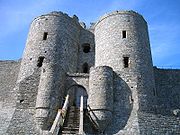 The castle is built to a concentric plan, with one line of defences enclosed by another. The outer walls are much shorter and thinner than the mighty inner walls, and have no towers defending them besides the small gatehouse. The inner ward is roughly square, with a large round tower at each corner. The domestic buildings, including the great hall, are built against the inside of the inner walls. Since the surrounding cliffs made it practically impossible to attack the castle except from the east, this side is faced by the imposing gatehouse. The gateway is flanked by two massive "D-shaped" towers, and defended by a series of doors, portcullis
es and murder-holes. Notably, there are large windows on the inner face of the gatehouse. The west wall of the inner ward also has large windows (as it forms one wall of the great hall).
The outer ditches at Harlech were cut into the rock. In the height of construction, in 1286, the workforce was 546 general labourers, 115 quarriers, 30 blacksmiths, 22 carpenters and 227 stonemasons.
Harlech is also notable for an unusual feature: the "way from the sea". Edward's forces were often in danger from land-based attack, but he enjoyed total supremacy on water. Many of his castles included sally port
s which allowed resupply from the sea, but Harlech's is far more elaborate. Here, a fortified stairway hugs the rock and runs almost 200 feet (61 m) down to the foot of the cliffs, where (at the time of construction) the sea reached. Today, the sea has retreated about 1.2 km, making it more difficult to envisage the concept in its original setting. James of St. George's plan was a triumph; when the castle was besieged during Madoc ap Llywelyn's campaign, this stairway was used to supply the castle.
Like many of Edward's castles, Harlech was originally designed to be attached to a fortified borough.
 In 1294, Madog ap Llywelyn
, a distant cousin of Llywelyn ap Gruffudd, began an uprising against English rule that spread quickly through Wales. Several English-held towns were razed and Harlech (along with Criccieth Castle
and Aberystwyth Castle
) were besieged that winter. As noted above, the "way to the sea" helped the defenders survive until the siege was lifted the following spring.
Garrisoning a castle was an expensive undertaking, and as a result in peacetime most were guarded by a small number of people. An inventory from 1403 records that Harlech's garrison had just three shields, eight helmets, six lances, ten pairs of gloves, and four guns. In 1404, the castle fell to Owain Glyndŵr
after a long siege when starvation reduced the garrison to just twenty-one men. Harlech became his residence and family home and military headquarters for four years. He held his second parliament in Harlech in August 1405. Four years later, after another long siege of eight months, Harlech Castle was retaken in 1409 by Prince Henry (later Henry V
) and a force of 1,000 men under John Talbot
, during which Edmund Mortimer
starved to death and Glyndŵr's wife, Margaret Hanmer
, two of his daughters and four grandchildren were captured, later to be imprisoned and die.
In the Wars of the Roses in the first part of Edward IV of England
's reign (1461–1470), Harlech was held by its Welsh constable Dafydd ap Ieuan as a Lancastrian stronghold. Following the Battle of Northampton
, Margaret of Anjou
and the infant Henry VII of England
fled to Scotland via Harlech. Following the defeat of the Lancastrians at the Battle of Towton
, Edward controlled the country and Harlech eventually became last major stronghold under their control. Sir Richard Tunstall arrived as a reinforcement to the Lancastrians in the latter half of the siege in 1465. In 1468 it was the last Lancastrian fortress to surrender; it was able to withstand the seven-year siege through its being provisioned from the sea. It is the longest known siege in the history of the British Isles. This famous siege inspired the song "Men of Harlech
" according to tradition. The castle was also briefly occupied during the Welsh
insurrection of 1498.
During the English Civil War
the castle was the last royalist
fortress to hold out against the Parliamentary
forces. The surrender, on 16 March 1647, over a year after King Charles
had himself been captured, marked the end of the first phase
of the war. The parliamentarians slighted
the castle after its fall.
World Heritage site
, reflecting its importance and remarkable state of preservation. The castle is now in the care of Cadw
and is open to visitors.
Architectural historian
Dan Cruickshank
selected the Castle as one of his five choices for the 2006 BBC
television documentary series Britain's Best Buildings
.
Photographs
Gwynedd
Gwynedd is a county in north-west Wales, named after the old Kingdom of Gwynedd. Although the second biggest in terms of geographical area, it is also one of the most sparsely populated...
, Wales
Wales
Wales is a country that is part of the United Kingdom and the island of Great Britain, bordered by England to its east and the Atlantic Ocean and Irish Sea to its west. It has a population of three million, and a total area of 20,779 km²...
, is a concentric castle
Concentric castle
A concentric castle is a castle with two or more concentric curtain walls, such that the outer wall is lower than the inner and can be defended from it. The word concentric does not imply that these castles were circular; in fact if taken too literally the term "concentric" is quite misleading...
, constructed atop a cliff close to the Irish Sea
Irish Sea
The Irish Sea separates the islands of Ireland and Great Britain. It is connected to the Celtic Sea in the south by St George's Channel, and to the Atlantic Ocean in the north by the North Channel. Anglesey is the largest island within the Irish Sea, followed by the Isle of Man...
. Architecturally, it is particularly notable for its massive gatehouse
Gatehouse
A gatehouse, in architectural terminology, is a building enclosing or accompanying a gateway for a castle, manor house, fort, town or similar buildings of importance.-History:...
.
Built by King Edward I
Edward I of England
Edward I , also known as Edward Longshanks and the Hammer of the Scots, was King of England from 1272 to 1307. The first son of Henry III, Edward was involved early in the political intrigues of his father's reign, which included an outright rebellion by the English barons...
during his conquest of Wales, the castle
Castle
A castle is a type of fortified structure built in Europe and the Middle East during the Middle Ages by European nobility. Scholars debate the scope of the word castle, but usually consider it to be the private fortified residence of a lord or noble...
was subject to several assaults and siege
Siege
A siege is a military blockade of a city or fortress with the intent of conquering by attrition or assault. The term derives from sedere, Latin for "to sit". Generally speaking, siege warfare is a form of constant, low intensity conflict characterized by one party holding a strong, static...
s during its period of active use as a fortification
Fortification
Fortifications are military constructions and buildings designed for defence in warfare and military bases. Humans have constructed defensive works for many thousands of years, in a variety of increasingly complex designs...
. The castle served as the de facto capital of an independent Wales between 1404 and 1409 when it was held by Owain Glyndwr
Owain Glyndwr
Owain Glyndŵr , or Owain Glyn Dŵr, anglicised by William Shakespeare as Owen Glendower , was a Welsh ruler and the last native Welshman to hold the title Prince of Wales...
. The later seven-year siege of the castle, during the Wars of the Roses
Wars of the Roses
The Wars of the Roses were a series of dynastic civil wars for the throne of England fought between supporters of two rival branches of the royal House of Plantagenet: the houses of Lancaster and York...
, has been memorialised in the famous song "Men of Harlech
Men of Harlech
"Men of Harlech" or "The March of the Men of Harlech" is a song and military march which is traditionally said to describe events during the seven year long siege of Harlech Castle between 1461 and 1468. Commanded by Constable Dafydd ap Ieuan, the garrison held out in what is the longest known...
".
Construction
In Welsh mythology, Harlech is associated with BranwenBranwen
Branwen, Daughter of Llŷr is a major character in the Second Branch of the Mabinogi, which is sometimes called the Mabinogi of Branwen after her. Branwen is a daughter of Llŷr and Penarddun...
, but despite this, the first record of a fortification at Harlechhistorically or archaeologically comes from 1283 when Edward began building a castle there as part of his conquest of Wales.
Dolwyddelan Castle
Dolwyddelan Castle was a native Welsh castle located near Dolwyddelan in Conwy County in North Wales. It was built in the 13th century by Llywelyn the Great, Prince of Gwynedd and North Wales.-Construction:...
was captured by the English in January 1283; control of Dolwyddelan opened up access to the Conwy valley. After Castell y Bere
Castell y Bere
Castell y Bere is a native Welsh castle near Llanfihangel-y-pennant in Gwynedd, Wales. Constructed by Llywelyn the Great in the 1220s, the stone castle was intended to maintain his authority over the local people and to defend the south-west part of the princedom of Gwynedd...
fell to English forces two months later, 560 soldiers marched to Harlech, led by Sir Otto de Grandison. Work began in earnest on building a castle at Harlech. The earliest references to the activity date from between 14 and May. Harlech was one of 14 castles built by Edward I in the closing decades of the 13th century/ Like many of the castles in the area, Harlech was designed by Master James of St. George
James of St. George
Master James of Saint George , also known as Jacques de Saint-Georges d'Espéranche, was an architect from Savoy responsible for designing many of Edward I's castles, including Conwy, Harlech and Caernarfon and Beaumaris in Anglesey .Early records seem to indicate that his father, Master John, was...
. The castle took seven years to build, and cost an estimated £8,190. Following its completion, James was appointed Constable of Harlech Castle, a high-status position he held for over three years.
All the royal castles of Edward's second Welsh campaign were sited so that they could be kept supplied at all times. Harlech was not always isolated; the sea used to come to the foot of the cliffs.
Portcullis
A portcullis is a latticed grille made of wood, metal, fibreglass or a combination of the three. Portcullises fortified the entrances to many medieval castles, acting as a last line of defence during time of attack or siege...
es and murder-holes. Notably, there are large windows on the inner face of the gatehouse. The west wall of the inner ward also has large windows (as it forms one wall of the great hall).
The outer ditches at Harlech were cut into the rock. In the height of construction, in 1286, the workforce was 546 general labourers, 115 quarriers, 30 blacksmiths, 22 carpenters and 227 stonemasons.
Harlech is also notable for an unusual feature: the "way from the sea". Edward's forces were often in danger from land-based attack, but he enjoyed total supremacy on water. Many of his castles included sally port
Sally port
The primary modern meaning for sally port is a secure, controlled entryway, as at a fortification or a prison. The entrance is usually protected in some way, such as with a fixed wall blocking the door which must be circumvented before entering, but which prevents direct enemy fire from a distance...
s which allowed resupply from the sea, but Harlech's is far more elaborate. Here, a fortified stairway hugs the rock and runs almost 200 feet (61 m) down to the foot of the cliffs, where (at the time of construction) the sea reached. Today, the sea has retreated about 1.2 km, making it more difficult to envisage the concept in its original setting. James of St. George's plan was a triumph; when the castle was besieged during Madoc ap Llywelyn's campaign, this stairway was used to supply the castle.
Like many of Edward's castles, Harlech was originally designed to be attached to a fortified borough.
Later history
Madog ap Llywelyn
Madog ap Llywelyn, or Prince Madoc, was from a junior branch of the House of Aberffraw and a distant relation of Llywelyn ap Gruffudd, the last recognised native Prince of Wales.-Lineage:...
, a distant cousin of Llywelyn ap Gruffudd, began an uprising against English rule that spread quickly through Wales. Several English-held towns were razed and Harlech (along with Criccieth Castle
Criccieth Castle
Criccieth Castle is a native Welsh castle situated on the headland between two beaches in Criccieth, Gwynedd, in North Wales, on a rocky peninsula overlooking Tremadog Bay...
and Aberystwyth Castle
Aberystwyth Castle
Aberystwyth Castle is an Edwardian fortress located in Aberystwyth, Ceredigion, Mid Wales that was built during the First Welsh War in the late 13th century. It was begun during Edward I's first Welsh campaign at the same time as work started at Flint, Rhuddlan and Builth...
) were besieged that winter. As noted above, the "way to the sea" helped the defenders survive until the siege was lifted the following spring.
Garrisoning a castle was an expensive undertaking, and as a result in peacetime most were guarded by a small number of people. An inventory from 1403 records that Harlech's garrison had just three shields, eight helmets, six lances, ten pairs of gloves, and four guns. In 1404, the castle fell to Owain Glyndŵr
Owain Glyndwr
Owain Glyndŵr , or Owain Glyn Dŵr, anglicised by William Shakespeare as Owen Glendower , was a Welsh ruler and the last native Welshman to hold the title Prince of Wales...
after a long siege when starvation reduced the garrison to just twenty-one men. Harlech became his residence and family home and military headquarters for four years. He held his second parliament in Harlech in August 1405. Four years later, after another long siege of eight months, Harlech Castle was retaken in 1409 by Prince Henry (later Henry V
Henry V of England
Henry V was King of England from 1413 until his death at the age of 35 in 1422. He was the second monarch belonging to the House of Lancaster....
) and a force of 1,000 men under John Talbot
John Talbot, 1st Earl of Shrewsbury
John Talbot, 1st Earl of Shrewsbury and 1st Earl of Waterford KG , known as "Old Talbot" was an important English military commander during the Hundred Years' War, as well as the only Lancastrian Constable of France.-Origins:He was descended from Richard Talbot, a tenant in 1086 of Walter Giffard...
, during which Edmund Mortimer
Edmund Mortimer, son of the 3rd Earl
Edmund Mortimer , was the second son of Edmund Mortimer, 3rd Earl of March by his wife Philippa Plantagenet, and is the best-known of the various Edmund Mortimers because of his role in the rebellion of Owain Glyndŵr...
starved to death and Glyndŵr's wife, Margaret Hanmer
Margaret Hanmer
Margaret Hanmer , sometimes known by her Welsh name of Marred ferch Dafydd, was the wife of Owain Glyndŵr and was thus, technically, Princess of Wales for the time her husband was known by the title of Prince of Wales...
, two of his daughters and four grandchildren were captured, later to be imprisoned and die.
In the Wars of the Roses in the first part of Edward IV of England
Edward IV of England
Edward IV was King of England from 4 March 1461 until 3 October 1470, and again from 11 April 1471 until his death. He was the first Yorkist King of England...
's reign (1461–1470), Harlech was held by its Welsh constable Dafydd ap Ieuan as a Lancastrian stronghold. Following the Battle of Northampton
Battle of Northampton (1460)
The Battle of Northampton was a battle in the Wars of the Roses, which took place on 10 July 1460.-Background:The Yorkist cause seemed finished after the previous disaster at Ludford Bridge...
, Margaret of Anjou
Margaret of Anjou
Margaret of Anjou was the wife of King Henry VI of England. As such, she was Queen consort of England from 1445 to 1461 and again from 1470 to 1471; and Queen consort of France from 1445 to 1453...
and the infant Henry VII of England
Henry VII of England
Henry VII was King of England and Lord of Ireland from his seizing the crown on 22 August 1485 until his death on 21 April 1509, as the first monarch of the House of Tudor....
fled to Scotland via Harlech. Following the defeat of the Lancastrians at the Battle of Towton
Battle of Towton
In 1461, England was in the sixth year of the Wars of the Roses, a series of civil wars between the Houses of York and Lancaster over the English throne. The Lancastrians backed the reigning King of England, Henry VI, an indecisive man who suffered bouts of madness...
, Edward controlled the country and Harlech eventually became last major stronghold under their control. Sir Richard Tunstall arrived as a reinforcement to the Lancastrians in the latter half of the siege in 1465. In 1468 it was the last Lancastrian fortress to surrender; it was able to withstand the seven-year siege through its being provisioned from the sea. It is the longest known siege in the history of the British Isles. This famous siege inspired the song "Men of Harlech
Men of Harlech
"Men of Harlech" or "The March of the Men of Harlech" is a song and military march which is traditionally said to describe events during the seven year long siege of Harlech Castle between 1461 and 1468. Commanded by Constable Dafydd ap Ieuan, the garrison held out in what is the longest known...
" according to tradition. The castle was also briefly occupied during the Welsh
Wales
Wales is a country that is part of the United Kingdom and the island of Great Britain, bordered by England to its east and the Atlantic Ocean and Irish Sea to its west. It has a population of three million, and a total area of 20,779 km²...
insurrection of 1498.
During the English Civil War
English Civil War
The English Civil War was a series of armed conflicts and political machinations between Parliamentarians and Royalists...
the castle was the last royalist
Cavalier
Cavalier was the name used by Parliamentarians for a Royalist supporter of King Charles I and son Charles II during the English Civil War, the Interregnum, and the Restoration...
fortress to hold out against the Parliamentary
Roundhead
"Roundhead" was the nickname given to the supporters of the Parliament during the English Civil War. Also known as Parliamentarians, they fought against King Charles I and his supporters, the Cavaliers , who claimed absolute power and the divine right of kings...
forces. The surrender, on 16 March 1647, over a year after King Charles
Charles I of England
Charles I was King of England, King of Scotland, and King of Ireland from 27 March 1625 until his execution in 1649. Charles engaged in a struggle for power with the Parliament of England, attempting to obtain royal revenue whilst Parliament sought to curb his Royal prerogative which Charles...
had himself been captured, marked the end of the first phase
First English Civil War
The First English Civil War began the series of three wars known as the English Civil War . "The English Civil War" was a series of armed conflicts and political machinations that took place between Parliamentarians and Royalists from 1642 until 1651, and includes the Second English Civil War and...
of the war. The parliamentarians slighted
Slighting
A slighting is the deliberate destruction, partial or complete, of a fortification without opposition. During the English Civil War this was to render it unusable as a fort.-Middle Ages:...
the castle after its fall.
Present day
Harlech is part of the Castles and Town Walls of King Edward in GwyneddCastles and Town Walls of King Edward in Gwynedd
The Castles and Town Walls of King Edward in Gwynedd refers to a UNESCO-designated site of patrimony located in Gwynedd, Wales.In 1986, four castles related to the reign of King Edward I of England were proclaimed collectively as a World Heritage Site, as outstanding examples of fortifications and...
World Heritage site
World Heritage Site
A UNESCO World Heritage Site is a place that is listed by the UNESCO as of special cultural or physical significance...
, reflecting its importance and remarkable state of preservation. The castle is now in the care of Cadw
Cadw
-Conservation and Protection:Many of Wales's great castles and other monuments, such as bishop's palaces, historic houses, and ruined abbeys, are now in Cadw's care. Cadw does not own them but is responsible for their upkeep and for making them accessible to the public...
and is open to visitors.
Architectural historian
Architectural History
Architectural History is the main journal of the Society of Architectural Historians of Great Britain .The journal is published each autumn. The architecture of the British Isles is a major theme of the journal, although it includes more general papers on the history of architecture. Member of...
Dan Cruickshank
Dan Cruickshank
Dan Cruickshank is an art historian and BBC television presenter.-Early life:As a young child he lived for some years in Poland...
selected the Castle as one of his five choices for the 2006 BBC
BBC
The British Broadcasting Corporation is a British public service broadcaster. Its headquarters is at Broadcasting House in the City of Westminster, London. It is the largest broadcaster in the world, with about 23,000 staff...
television documentary series Britain's Best Buildings
Britain's Best Buildings
Britain's Best Buildings is a BBC documentary series in which the TV presenter and architectural historian Dan Cruickshank discusses his selection of the finest examples of British architecture...
.
External links
Further readingPhotographs