

Anglo-Norman

Encyclopedia
The Anglo-Normans were mainly the descendants of the Normans
who ruled England
following the Norman conquest
by William the Conqueror in 1066. A small number of Normans were already settled in England prior to the conquest. Following the Battle of Hastings
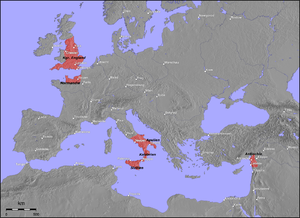
, the invading Normans and their descendants formed a distinct population in Britain, as Normans controlled all of England, parts of Wales
(the Cambro-Normans) and, after 1169, vast swaths of Ireland
(the Hiberno-Normans). Over time their language evolved from the continental Old Norman to the distinct Anglo-Norman language
(an Old French dialect).
The composite expression regno Norman-Anglorum for the Anglo-Norman kingdom that subsumes Normandy and England appears contemporaneously only in the Hyde Chronicle
.
, being a conquest by a people whose tongue and institutions were different from those of the English in many aspects, was an event of an altogether different character from the Danish conquest, a conquest by a people whose tongue was more akin to those of the English, but whose religion was pagan. The Anglo-Saxons were Catholic and shared this religion with the Normans and they had already an influence in England, before the conquest. Furthermore, the relationships between the sailors from both sides of the English channel had maintained a certain common culture.
The Normans were not a homogeneous group springing exclusively from Viking
stock, but mixed up with the first inhabitants who lived in the future Normandy. The Normans who invaded England did it with a strong contingent from a wide cross-section of north western and central France, from Maine, Anjou, Brittany and Poitou (altogether accounted for about a quarter of the army at Hastings). In terms of culture, they represented partly the Gallo-Roman civilization, as it had been absorbed and transformed by the Franks. Flemings and Bretons, who mostly only spoke French as an acquired language, were another large contingent. The Norman settlers felt no community with the earlier Danish settlers, despite the fact that the Normans were themselves partly descendants of the Vikings. However, in their own army, they did not even feel any sense of community with the Poitou, the Breton people, and other ethnies that had different languages and traditions. The association between these different troops was only occasional and corresponds to an immediate necessity for the Norman ruler. In fact, the Normans met with the steadiest resistance in a part of England that was the most influenced by the Danish. Ousting the Danish leaders who recently conquered parts of England
and provided some of the stiffest resistance to the Normans, and largely replacing the powerful English territorial magnates, while co-opting the most powerful of them, the Normans imposed a new political structure that is broadly termed "feudal" (historians debate whether pre-Norman England should be considered a feudal government - indeed, the entire characterization of Feudalism
is under some dispute).
Many of the Anglo-Saxon
nobles lost lands and titles; the lesser thegn
s and others found themselves lower down the social order than previously. A number of free geburs had their rights and court access much decreased, becoming unfree villeins, despite the fact that this status did not exist in Normandy itself (compared to other "French" regions). At the same time, many of the new Anglo-Norman magnates were distributed lands by the King that had been taken from the old Anglo-Saxon nobles. Some of these Norman magnates used their original French-derived names, with the prefix 'de,' meaning they were lords of the old fiefs in France, and some instead dropped their original names and took their names from new English holdings.
 The Norman conquest of England brought the British Isles into the orbit of the European continent, especially what remained of Roman-influenced language and culture. If the earlier England of Anglo-Saxons and Norse was tied to indigenous traditions, the England emerging from the Conquest owed a debt to the Romance languages and the culture of ancient Rome, that was not so important before the Conquest, but was maintained at a high level by the English catholic church and the clerks of England. It transmitted itself in the emerging feudal world that took its place. That heritage can be discerned in language, incorporating shards of the Roman past, in architecture, in the emerging Romanesque (Norman) architecture, and in a new feudal structure erected as a bulwark against the chaos that overtook the Continent following the collapse of Roman authority and the subsequent Dark Ages. The England that emerged from the Conquest was a decidedly different place, but one that had been opened up to the sweep of outside influences.
), encouraged them to leave, as a security measure. The first to leave went mostly to Denmark
and many of these moved on to join the Varangian Guard in Constantinople
. Although the Anglo-Saxons as a whole were not demilitarized; this would have been impractical. Instead, William arranged for the Saxon infantry to be trained up by Norman cavalry in anti-cavalry tactics. This led quickly to the establishment of an Anglo-Norman army made up of Norman horsemen of noble blood, Saxon infantrymen often of equally noble blood, assimilated English freemen as rank-and-file, and foreign mercenaries
and adventurers from other parts of the Continent. The younger Norman aristocracy showed a tendency towards Anglicisation, adopting such Saxon styles as long hair and moustaches, upsetting the older generation. (Note that the Anglo-Saxon cniht
did not take the sense of the French chevalier before the latest period of Middle English. John Wycliffe
(1380s) uses the term knyytis generically for men-at-arms, and only in the 15th century did the word acquire the overtones of a noble cavalryman corresponding to the meaning of chevalier
.
The Anglo-Norman conquest in the 12th century brought Norman customs and culture to Ireland. The Carol was a popular Norman dance in which the leader sang and was surrounded by a circle of dancers who replied with the same song. This Norman dance was performed in conquered Irish towns.
and the novel Ivanhoe
by Sir Walter Scott, may have been considerably exaggerated (see Whig history
). Some residual ill-feeling is suggested by contemporary historian Orderic Vitalis
, who in Ecclesiastical Historii (1125) wrote in praise of native English resistance to "William the Bastard" (William I of England
). In addition, a fine called the "murdrum
", originally introduced to English law
by the Danes under Canute, was revived, imposing on villages a high (46 mark/~£31) fine for the secret killing of a Norman (or an unknown person who was, under the murdrum laws, presumed to be Norman unless proven otherwise).
Whatever the level of dispute, over time, the two populations intermarried and merged. Normans began to think of themselves first as Anglo-Normans. Eventually, even this distinction largely disappeared in the course of the Hundred Years War, and by the 15th century the Anglo-Normans identified themselves as English, having been fully assimilated into the emerging English (Anglo-Saxon
) population. However, somebody like William Marshall, 1st Earl of Pembroke, who did not have any English ancestry, felt already English in the 12th century.
reflect the last vestiges of Anglo-Norman culture. In fact, it cannot be considered really as "Anglo-Norman" from an historical, ethnical and cultural point of view. The inhabitants of the Channel Islands were mainly of Norman descent until modern time. Before 1570, the Catholic church there depended on the Coutances
bishopric. Furthermore, the customary law on the Islands was the same as in Normandy until the French revolution. The Norman language still predominated in the Islands until the 19th century, when increasing influence from English-speaking settlers and easier transport links led to anglicisation.
from England and built multiple fortifications as it was one of William's ambitions to subdue the Welsh, however he was not entirely successful. Afterwards, however, the border area known as the Marches was set up and English influence increased steadily. Encouraged by the invasion, monks (usually from France
or Normandy
) such as the Cistercian Order also set up monasteries
throughout Wales. By the 15th century a large number of Welsh gentry, including Owain Glyndŵr
, had Norman ancestry. The majority of knights
who invaded Ireland were also from or based in Wales (see below).
from the 12th century, initially to support Irish regional kings such as Diarmuid Mac Murchadha whose name has arrived in modern English as Dermot MacMurrough
. Richard de Clare, 2nd Earl of Pembroke
, known as "Strongbow", was the leader of the Anglo-Norman Knights whom MacMurrough had requested of Henry II of England to help him to re-establish himself as King of Leinster. Strongbow died a very short time after invading Ireland but the men he brought with him remained to support Henry II of England
and his son John
as Lord of Ireland. Chief among the early Anglo-Norman settlers was Theobald Walter (surname Butler) appointed hereditary chief Butler of Ireland in 1177 by King Henry II and founder of one of the oldest remaining British dignities. Most of these Normans came from Wales, not England, and thus the epithet 'Cambro-Normans' is used to describe them by leading late medievalists such as Seán Duffy.
They increasingly integrated with the local Celtic nobility through intermarriage and became more Irish than the Irish themselves
, especially outside the Pale
around Dublin. They are known as Old English
, but this term came into use to describe them only in 1580, i.e., over four centuries after the first Normans arrived in Ireland.
Normans
The Normans were the people who gave their name to Normandy, a region in northern France. They were descended from Norse Viking conquerors of the territory and the native population of Frankish and Gallo-Roman stock...
who ruled England
England
England is a country that is part of the United Kingdom. It shares land borders with Scotland to the north and Wales to the west; the Irish Sea is to the north west, the Celtic Sea to the south west, with the North Sea to the east and the English Channel to the south separating it from continental...
following the Norman conquest
Norman conquest of England
The Norman conquest of England began on 28 September 1066 with the invasion of England by William, Duke of Normandy. William became known as William the Conqueror after his victory at the Battle of Hastings on 14 October 1066, defeating King Harold II of England...
by William the Conqueror in 1066. A small number of Normans were already settled in England prior to the conquest. Following the Battle of Hastings
Battle of Hastings
The Battle of Hastings occurred on 14 October 1066 during the Norman conquest of England, between the Norman-French army of Duke William II of Normandy and the English army under King Harold II...
, the invading Normans and their descendants formed a distinct population in Britain, as Normans controlled all of England, parts of Wales
Wales
Wales is a country that is part of the United Kingdom and the island of Great Britain, bordered by England to its east and the Atlantic Ocean and Irish Sea to its west. It has a population of three million, and a total area of 20,779 km²...
(the Cambro-Normans) and, after 1169, vast swaths of Ireland
Ireland
Ireland is an island to the northwest of continental Europe. It is the third-largest island in Europe and the twentieth-largest island on Earth...
(the Hiberno-Normans). Over time their language evolved from the continental Old Norman to the distinct Anglo-Norman language
Anglo-Norman language
Anglo-Norman is the name traditionally given to the kind of Old Norman used in England and to some extent elsewhere in the British Isles during the Anglo-Norman period....
(an Old French dialect).
The composite expression regno Norman-Anglorum for the Anglo-Norman kingdom that subsumes Normandy and England appears contemporaneously only in the Hyde Chronicle
Hyde Abbey
Hyde Abbey was a medieval Benedictine monastery just outside the walls of Winchester, Hampshire, England. It was dissolved and demolished in 1538....
.
Norman conquest
The Norman conquest of EnglandNorman conquest of England
The Norman conquest of England began on 28 September 1066 with the invasion of England by William, Duke of Normandy. William became known as William the Conqueror after his victory at the Battle of Hastings on 14 October 1066, defeating King Harold II of England...
, being a conquest by a people whose tongue and institutions were different from those of the English in many aspects, was an event of an altogether different character from the Danish conquest, a conquest by a people whose tongue was more akin to those of the English, but whose religion was pagan. The Anglo-Saxons were Catholic and shared this religion with the Normans and they had already an influence in England, before the conquest. Furthermore, the relationships between the sailors from both sides of the English channel had maintained a certain common culture.
The Normans were not a homogeneous group springing exclusively from Viking
Viking
The term Viking is customarily used to refer to the Norse explorers, warriors, merchants, and pirates who raided, traded, explored and settled in wide areas of Europe, Asia and the North Atlantic islands from the late 8th to the mid-11th century.These Norsemen used their famed longships to...
stock, but mixed up with the first inhabitants who lived in the future Normandy. The Normans who invaded England did it with a strong contingent from a wide cross-section of north western and central France, from Maine, Anjou, Brittany and Poitou (altogether accounted for about a quarter of the army at Hastings). In terms of culture, they represented partly the Gallo-Roman civilization, as it had been absorbed and transformed by the Franks. Flemings and Bretons, who mostly only spoke French as an acquired language, were another large contingent. The Norman settlers felt no community with the earlier Danish settlers, despite the fact that the Normans were themselves partly descendants of the Vikings. However, in their own army, they did not even feel any sense of community with the Poitou, the Breton people, and other ethnies that had different languages and traditions. The association between these different troops was only occasional and corresponds to an immediate necessity for the Norman ruler. In fact, the Normans met with the steadiest resistance in a part of England that was the most influenced by the Danish. Ousting the Danish leaders who recently conquered parts of England
England
England is a country that is part of the United Kingdom. It shares land borders with Scotland to the north and Wales to the west; the Irish Sea is to the north west, the Celtic Sea to the south west, with the North Sea to the east and the English Channel to the south separating it from continental...
and provided some of the stiffest resistance to the Normans, and largely replacing the powerful English territorial magnates, while co-opting the most powerful of them, the Normans imposed a new political structure that is broadly termed "feudal" (historians debate whether pre-Norman England should be considered a feudal government - indeed, the entire characterization of Feudalism
Feudalism
Feudalism was a set of legal and military customs in medieval Europe that flourished between the 9th and 15th centuries, which, broadly defined, was a system for ordering society around relationships derived from the holding of land in exchange for service or labour.Although derived from the...
is under some dispute).
Many of the Anglo-Saxon
Anglo-Saxons
Anglo-Saxon is a term used by historians to designate the Germanic tribes who invaded and settled the south and east of Great Britain beginning in the early 5th century AD, and the period from their creation of the English nation to the Norman conquest. The Anglo-Saxon Era denotes the period of...
nobles lost lands and titles; the lesser thegn
Thegn
The term thegn , from OE þegn, ðegn "servant, attendant, retainer", is commonly used to describe either an aristocratic retainer of a king or nobleman in Anglo-Saxon England, or as a class term, the majority of the aristocracy below the ranks of ealdormen and high-reeves...
s and others found themselves lower down the social order than previously. A number of free geburs had their rights and court access much decreased, becoming unfree villeins, despite the fact that this status did not exist in Normandy itself (compared to other "French" regions). At the same time, many of the new Anglo-Norman magnates were distributed lands by the King that had been taken from the old Anglo-Saxon nobles. Some of these Norman magnates used their original French-derived names, with the prefix 'de,' meaning they were lords of the old fiefs in France, and some instead dropped their original names and took their names from new English holdings.
Military impact
The Norman conquest of England also signalled a revolution in military styles and methods. The old Anglo-Saxon military elite began to emigrate, especially the generation next younger to that defeated at Hastings, who had no particular future in a country controlled by the conquerors. William (and his son, William RufusWilliam II of England
William II , the third son of William I of England, was King of England from 1087 until 1100, with powers over Normandy, and influence in Scotland. He was less successful in extending control into Wales...
), encouraged them to leave, as a security measure. The first to leave went mostly to Denmark
Denmark
Denmark is a Scandinavian country in Northern Europe. The countries of Denmark and Greenland, as well as the Faroe Islands, constitute the Kingdom of Denmark . It is the southernmost of the Nordic countries, southwest of Sweden and south of Norway, and bordered to the south by Germany. Denmark...
and many of these moved on to join the Varangian Guard in Constantinople
Constantinople
Constantinople was the capital of the Roman, Eastern Roman, Byzantine, Latin, and Ottoman Empires. Throughout most of the Middle Ages, Constantinople was Europe's largest and wealthiest city.-Names:...
. Although the Anglo-Saxons as a whole were not demilitarized; this would have been impractical. Instead, William arranged for the Saxon infantry to be trained up by Norman cavalry in anti-cavalry tactics. This led quickly to the establishment of an Anglo-Norman army made up of Norman horsemen of noble blood, Saxon infantrymen often of equally noble blood, assimilated English freemen as rank-and-file, and foreign mercenaries
Mercenary
A mercenary, is a person who takes part in an armed conflict based on the promise of material compensation rather than having a direct interest in, or a legal obligation to, the conflict itself. A non-conscript professional member of a regular army is not considered to be a mercenary although he...
and adventurers from other parts of the Continent. The younger Norman aristocracy showed a tendency towards Anglicisation, adopting such Saxon styles as long hair and moustaches, upsetting the older generation. (Note that the Anglo-Saxon cniht
Knight
A knight was a member of a class of lower nobility in the High Middle Ages.By the Late Middle Ages, the rank had become associated with the ideals of chivalry, a code of conduct for the perfect courtly Christian warrior....
did not take the sense of the French chevalier before the latest period of Middle English. John Wycliffe
John Wycliffe
John Wycliffe was an English Scholastic philosopher, theologian, lay preacher, translator, reformer and university teacher who was known as an early dissident in the Roman Catholic Church during the 14th century. His followers were known as Lollards, a somewhat rebellious movement, which preached...
(1380s) uses the term knyytis generically for men-at-arms, and only in the 15th century did the word acquire the overtones of a noble cavalryman corresponding to the meaning of chevalier
Chivalry
Chivalry is a term related to the medieval institution of knighthood which has an aristocratic military origin of individual training and service to others. Chivalry was also the term used to refer to a group of mounted men-at-arms as well as to martial valour...
.
The Anglo-Norman conquest in the 12th century brought Norman customs and culture to Ireland. The Carol was a popular Norman dance in which the leader sang and was surrounded by a circle of dancers who replied with the same song. This Norman dance was performed in conquered Irish towns.
Norman-Saxon conflict
The degree of subsequent Norman-Saxon conflict (as a matter of conflicting social identities) is a question disputed by historians. The 19th century view of intense mutual resentment, reflected in the popular legends of Robin HoodRobin Hood
Robin Hood was a heroic outlaw in English folklore. A highly skilled archer and swordsman, he is known for "robbing from the rich and giving to the poor", assisted by a group of fellow outlaws known as his "Merry Men". Traditionally, Robin Hood and his men are depicted wearing Lincoln green clothes....
and the novel Ivanhoe
Ivanhoe
Ivanhoe is a historical fiction novel by Sir Walter Scott in 1819, and set in 12th-century England. Ivanhoe is sometimes credited for increasing interest in Romanticism and Medievalism; John Henry Newman claimed Scott "had first turned men's minds in the direction of the middle ages," while...
by Sir Walter Scott, may have been considerably exaggerated (see Whig history
Whig history
Whig history is the approach to historiography which presents the past as an inevitable progression towards ever greater liberty and enlightenment, culminating in modern forms of liberal democracy and constitutional monarchy. In general, Whig historians stress the rise of constitutional government,...
). Some residual ill-feeling is suggested by contemporary historian Orderic Vitalis
Orderic Vitalis
Orderic Vitalis was an English chronicler of Norman ancestry who wrote one of the great contemporary chronicles of 11th and 12th century Normandy and Anglo-Norman England. The modern biographer of Henry I of England, C...
, who in Ecclesiastical Historii (1125) wrote in praise of native English resistance to "William the Bastard" (William I of England
William I of England
William I , also known as William the Conqueror , was the first Norman King of England from Christmas 1066 until his death. He was also Duke of Normandy from 3 July 1035 until his death, under the name William II...
). In addition, a fine called the "murdrum
Murdrum
Murdrum was introduced into English law by the Danes. Being the killing of a man in a secret manner, it is distinguished from simple homicide. In the Laws of Canute an unknown man who was killed was presumed to be a Dane, and the vill was compelled to pay 40 marks for his death. After the Norman...
", originally introduced to English law
English law
English law is the legal system of England and Wales, and is the basis of common law legal systems used in most Commonwealth countries and the United States except Louisiana...
by the Danes under Canute, was revived, imposing on villages a high (46 mark/~£31) fine for the secret killing of a Norman (or an unknown person who was, under the murdrum laws, presumed to be Norman unless proven otherwise).
Whatever the level of dispute, over time, the two populations intermarried and merged. Normans began to think of themselves first as Anglo-Normans. Eventually, even this distinction largely disappeared in the course of the Hundred Years War, and by the 15th century the Anglo-Normans identified themselves as English, having been fully assimilated into the emerging English (Anglo-Saxon
Anglo-Saxons
Anglo-Saxon is a term used by historians to designate the Germanic tribes who invaded and settled the south and east of Great Britain beginning in the early 5th century AD, and the period from their creation of the English nation to the Norman conquest. The Anglo-Saxon Era denotes the period of...
) population. However, somebody like William Marshall, 1st Earl of Pembroke, who did not have any English ancestry, felt already English in the 12th century.
Channel Islands
The Channel IslandsChannel Islands
The Channel Islands are an archipelago of British Crown Dependencies in the English Channel, off the French coast of Normandy. They include two separate bailiwicks: the Bailiwick of Guernsey and the Bailiwick of Jersey...
reflect the last vestiges of Anglo-Norman culture. In fact, it cannot be considered really as "Anglo-Norman" from an historical, ethnical and cultural point of view. The inhabitants of the Channel Islands were mainly of Norman descent until modern time. Before 1570, the Catholic church there depended on the Coutances
Coutances
Coutances is a commune in the Manche department in Normandy in north-western France.-History:Capital of the Unelli, a Gaulish tribe, the town took the name of Constantia in 298 during the reign of Roman emperor Constantius Chlorus...
bishopric. Furthermore, the customary law on the Islands was the same as in Normandy until the French revolution. The Norman language still predominated in the Islands until the 19th century, when increasing influence from English-speaking settlers and easier transport links led to anglicisation.
Wales
Anglo-Normans also led excursions into WalesWales
Wales is a country that is part of the United Kingdom and the island of Great Britain, bordered by England to its east and the Atlantic Ocean and Irish Sea to its west. It has a population of three million, and a total area of 20,779 km²...
from England and built multiple fortifications as it was one of William's ambitions to subdue the Welsh, however he was not entirely successful. Afterwards, however, the border area known as the Marches was set up and English influence increased steadily. Encouraged by the invasion, monks (usually from France
France
The French Republic , The French Republic , The French Republic , (commonly known as France , is a unitary semi-presidential republic in Western Europe with several overseas territories and islands located on other continents and in the Indian, Pacific, and Atlantic oceans. Metropolitan France...
or Normandy
Normandy
Normandy is a geographical region corresponding to the former Duchy of Normandy. It is in France.The continental territory covers 30,627 km² and forms the preponderant part of Normandy and roughly 5% of the territory of France. It is divided for administrative purposes into two régions:...
) such as the Cistercian Order also set up monasteries
Monastery
Monastery denotes the building, or complex of buildings, that houses a room reserved for prayer as well as the domestic quarters and workplace of monastics, whether monks or nuns, and whether living in community or alone .Monasteries may vary greatly in size – a small dwelling accommodating only...
throughout Wales. By the 15th century a large number of Welsh gentry, including Owain Glyndŵr
Owain Glyndwr
Owain Glyndŵr , or Owain Glyn Dŵr, anglicised by William Shakespeare as Owen Glendower , was a Welsh ruler and the last native Welshman to hold the title Prince of Wales...
, had Norman ancestry. The majority of knights
Cambro-Norman
Cambro-Norman is a term used for Norman knights who settled in southern Wales after the Norman conquest of England in 1066. Some historians suggest that the term is to be preferred to Anglo-Norman for the Normans who invaded Ireland after 1170 — many of whom originated in Wales. However, the term...
who invaded Ireland were also from or based in Wales (see below).
Ireland
Anglo-Norman barons also settled in IrelandIreland
Ireland is an island to the northwest of continental Europe. It is the third-largest island in Europe and the twentieth-largest island on Earth...
from the 12th century, initially to support Irish regional kings such as Diarmuid Mac Murchadha whose name has arrived in modern English as Dermot MacMurrough
Dermot MacMurrough
Diarmait Mac Murchada , anglicized as Dermot MacMurrough or Dermod MacMurrough , was a King of Leinster in Ireland. In 1167, he was deprived of his kingdom by the High King of Ireland - Turlough Mór O'Connor...
. Richard de Clare, 2nd Earl of Pembroke
Richard de Clare, 2nd Earl of Pembroke
Richard de Clare, 2nd Earl of Pembroke , Lord of Leinster, Justiciar of Ireland . Like his father, he was also commonly known as Strongbow...
, known as "Strongbow", was the leader of the Anglo-Norman Knights whom MacMurrough had requested of Henry II of England to help him to re-establish himself as King of Leinster. Strongbow died a very short time after invading Ireland but the men he brought with him remained to support Henry II of England
Henry II of England
Henry II ruled as King of England , Count of Anjou, Count of Maine, Duke of Normandy, Duke of Aquitaine, Duke of Gascony, Count of Nantes, Lord of Ireland and, at various times, controlled parts of Wales, Scotland and western France. Henry, the great-grandson of William the Conqueror, was the...
and his son John
John of England
John , also known as John Lackland , was King of England from 6 April 1199 until his death...
as Lord of Ireland. Chief among the early Anglo-Norman settlers was Theobald Walter (surname Butler) appointed hereditary chief Butler of Ireland in 1177 by King Henry II and founder of one of the oldest remaining British dignities. Most of these Normans came from Wales, not England, and thus the epithet 'Cambro-Normans' is used to describe them by leading late medievalists such as Seán Duffy.
They increasingly integrated with the local Celtic nobility through intermarriage and became more Irish than the Irish themselves
More Irish than the Irish themselves
"More Irish than the Irish themselves" is a phrase used in Irish historiography to describe a phenomenon of cultural assimilation in late medieval Norman Ireland....
, especially outside the Pale
The Pale
The Pale or the English Pale , was the part of Ireland that was directly under the control of the English government in the late Middle Ages. It had reduced by the late 15th century to an area along the east coast stretching from Dalkey, south of Dublin, to the garrison town of Dundalk...
around Dublin. They are known as Old English
Old English (Ireland)
The Old English were the descendants of the settlers who came to Ireland from Wales, Normandy, and England after the Norman invasion of Ireland in 1169–71. Many of the Old English became assimilated into Irish society over the centuries...
, but this term came into use to describe them only in 1580, i.e., over four centuries after the first Normans arrived in Ireland.
Scotland
William the Lion, King of Scotland, spent part of his reign trying to gain lost territory back from England. Unfortunately for him, he made consequential decisions and was forced surrender to Ranulf de Glanvill, who was sheriff of Westmoreland at the time and leading the army that took William of Scotland.Anglo-Norman families
|
Earl of Derby Earl of Derby is a title in the Peerage of England. The title was first adopted by Robert de Ferrers, 1st Earl of Derby under a creation of 1139. It continued with the Ferrers family until the 6th Earl forfeited his property toward the end of the reign of Henry III and died in 1279... ; Corbett (surname) Corbett, was first found in Pays de Caux,Normandy with a Norman Baron named "Corbet le Normand" he was born in early 11th century AD.The name Corbett roughly means "The Raven".And more than likely comes from the word "Corb",one of the variations of the Norman word for "Raven",which is believed to... ; Earl of Hereford The title of Earl of Hereford was created six times in the Peerage of England. See also Duke of Hereford, Viscount Hereford. Dates indicate the years the person held the title for.-Earls of Hereford, First Creation :*Swegen Godwinson... ; Earl FitzWilliam Earl Fitzwilliam was a title in both the Peerage of Ireland and the Peerage of Great Britain held by the head of the Fitzwilliam family. This family claim descent from William the Conqueror. The Fitzwilliams acquired extensive holdings in South Yorkshire, largely through strategic alliances through... ; Gorges family The House of Gorges is an ancient English family with Norman origins. Radulph, Lord of the Château de Gorges came over to England from Gorges in the canton of Périers in Normandy in the army of William the Conqueror in the year 1066 and acquired a knighthood. He had thus started the history of... ; House of Harcourt The House of Harcourt is a Norman family, descended from the Viking Bernard the Dane and named after its seigneurie of Harcourt in Normandy. Its mottos were "Gesta verbis praeveniant" , "Gesta verbis praevenient" , and "Le bon temps viendra ..... ; De Lacy de Lacy is the surname of an old Norman noble family originating from Lassy . The first records are about Hugh de Lacy . Descendent of Hugh de Lacy left Normandy and travelled to England along with William the Conqueror. Walter and Ilbert de Lacy fought in the battle of Hastings... ; De Lucy de Lucy or de Luci is the surname of an old Norman noble family originating from Lucé in Normandy, one of the great baronial Anglo-Norman families which became rooted in England after the Norman conquest. The first records are about Adrian de Luci who went into England after William the Conqueror... ; Levett Levett is an Anglo-Norman territorial surname deriving from the village of Livet-en-Ouche, now Jonquerets-de-Livet, in Eure, Normandy. Ancestors of the earliest Levett family in England, the de Livets were lords of the village of Livet, and undertenants of the de Ferrers, among the most powerful of... ; |
Mowbray Mowbray is an Anglo-Norman baronial house, derived from Montbrai in Normandy. From this village came Geoffrey de Montbrai who came to be Bishop of Coutances and accompanied Duke William of Normandy at the Conquest of England in 1066.... ; House of Neville The House of Neville is a noble house of early medieval origin, which was a leading force in English politics in the later middle ages... ; House of Percy The House of Percy were the most powerful noble family in Northern England for much of the Middle Ages, having descended from William de Percy who crossed from Normandy to England with William I in early December 1067 and was rebuilding York Castle in 1070... ; Baron Rivers Baron Rivers was a title that was created four times in British history, twice in the Peerage of England, once in the Peerage of Great Britain and once in the Peerage of the United Kingdom. The first creation came in 1299 when John Rivers was summoned to Parliament as Baron Rivers. The title became... ; Clan Sinclair Clan Sinclair is a Highland Scottish clan of Norman origin who held lands in the north of Scotland, the Orkney Islands, and the Lothians which they received from the Kings of Scots... ; House of Tosny The House of Tosny was an important noble family in 10th and 11th century Normandy, though it did not include any comtes or vicomtes. Its founder was Raoul I of Tosny .-Notable members:... ; Umfraville Umfraville, the name of an English baronial family, derived from Amfreville in Normandy. Members of this family obtained lands in Northumberland, including Redesdale and Prudhoe, from the Norman kings, and a later member, Gilbert de Umfraville , married Matilda, daughter of Malcolm, earl of Angus,... ; House of Warren The House of Warren is an Anglo-Norman comital house that held extensive lands in France, England, Wales, and Ireland... ; |
Further reading
- Crouch, David. The Normans: The History of a Dynasty. Hambledon & London, 2002.
- Loyd, Lewis C. The Origins of Some Anglo-Norman Families. (Harleian Society Publications, vol. 103) The Society, 1951 (Genealogical Publishing Co., 1980).
- Regesta Regum Anglo Normannorum, 1066-1154. (Henry William Davis & Robert J. Shotwell, eds) 4v. Clarendon Press, 1913 (AMS Press, 1987).
- Douglas, David C., The Normans, Folio Society, London, 2002.
- Villegas-Aristizabal, Lucas, "Anglo-Norman Involvement in the Conquest and Settlement of Tortosa, 1148-1180", Crusades vol. 8, 2009, pp. 63-129.
External links
- http://books.google.com/books?id=2J5rkqos7wAC&pg=PA139&lpg=PA139&dq=%22index+of+tenants-in-chief+and+the+families%22+origins+of+some+anglo-norman&source=web&ots=dBBVpg3mEb&sig=4UGn58qMW4KVF9DRct7v202vh2A&hl=en&sa=X&oi=book_result&resnum=1&ct=resultIndex of Tenants-in-Chief and the Families Holding of Them in England, The Origins of Some Anglo-Norman Families, Lewis Christopher Loyd, Charles Travis Clay, David Charles Douglas, The Harleian Society, Leeds, 1951]