


Corporatism

Encyclopedia
Corporatism, also known as corporativism, is a system of economic, political, or social organization that involves association of the people of society into corporate group
s, such as agricultural, business, ethnic, labor, military, patronage, or scientific affiliations, on the basis of common interests. Corporatism is theoretically based upon the interpretation of a community as an organic
body. The term corporatism is based on the Latin root "corp" meaning "body".
In 1881, Pope Leo XIII
commissioned theologians and social thinkers to study corporatism and provide a definition for it. In 1884 in Freiburg
, the commission declared that corporatism was a "system of social organization that has at its base the grouping of men according to the community of their natural interests and social functions, and as true and proper organs of the state they direct and coordinate labor and capital in matters of common interest."
One of the main types of corporatism is economic tripartism
involving negotiations between business, labour, and state interest groups to establish economic policy.
Corporatism is related to the sociological
concept of structural functionalism. Corporate social interaction is common within kinship
groups such as families, clan
s and ethnicities. Aside from humans, certain animal species are known to exhibit strong corporate social organization, such as penguin
s.
Corporatist types of community and social interaction are common to many ideologies, including: absolutism
, capitalism
, conservatism
, fascism
, liberalism
, progressivism
, reactionism
, socialism
, and syndicalism
.
-based corporatism emphasized clan
, ethnic, and family identification has been a common phenomenon in Africa
, Asia
, and Latin America
. Confucian
societies based upon families and clans in East Asia and Southeast Asia have been considered types of corporatism. China
has strong elements of clan corporatism in its society involving legal norms concerning family relations. Islam
ic societies often have strong clan that forms the basis for a community-based corporatist society.
 Christian corporatism
is traced to the New Testament
of the Bible
in I Corinthians
where Paul of Tarsus
discusses an organic form of politics and society where all people and components are united functionally, like the human body.
During the Middle Ages
, the Catholic Church sponsored the creation of various institutions including brotherhoods, monasteries, religious orders, and military associations, especially during the Crusades
to sponsor association between these groups. In Italy
, various function-based groups and institutions were created during the Middle Ages, such as universities, guild
s for artisans and craftspeople, and other professional associations. The creation of the guild system is a particularly important aspect of the history of corporatism because it involved the allocation of power to regulate trade and prices to guilds, which is an important aspect of corporatist economic models of economic management and class collaboration
.
Corporatism's popularity increased in the late 19th century, and a corporatist internationale was formed in 1890, followed by the publishing of Rerum Novarum
by the Catholic Church that for the first time declared the Church's blessing to trade unions and recommended for organized labour to be recognized by politicians. Many corporatist unions in Europe were endorsed by the Catholic Church to challenge the anarchist
, Marxist
and other radical unions, with the corporatist unions being fairly conservative in comparison to their radical rivals. In response to the Roman Catholic corporatism of the 1890s, Protestant
corporatism was developed, especially in Germany
, the Netherlands
, and Scandinavia
. However, Protestant corporatism has been much less successful in obtaining assistance from governments than its Roman Catholic counterpart.
social organization amongst animal species. Research has shown that Penguin
s are known to reside in densely populated corporate breeding colonies.
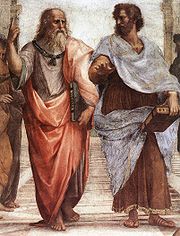 Ancient Greece developed early concepts of corporatism. Plato
developed the concept of a totalitarian
and communitarian
corporatist system of natural-based classes and natural social hierarchies that would be organized based on function, such that groups would cooperate to achieve social harmony by emphasizing collective
interests while rejecting individual interests.
Aristotle
in Politics
also described society as being divided along natural classes and functional purposes that were priests, rulers, slaves, and warriors. Ancient Rome adopted Greek concepts of corporatism into their own version of corporatism but also added the concept of political representation on the basis of function that divided representatives into military, professional, and religious groups and created institutions for each group known as colegios .
governments, resulting in corporatism being used to enforce social hierarchy.
After the French Revolution, the existing absolutist corporatist system was abolished due to its endorsement of social hierarchy and special "corporate privilege" for the Roman Catholic Church. The new French government considered corporatism's emphasis of group rights as inconsistent with the government's promotion of individual rights. Subsequently corporatist systems and corporate privilege throughout Europe were abolished in response to the French Revolution. From 1789 to the 1850s, most supporters of corporatism were reactionaries
. A number of reactionary corporatists favored corporatism in order to end liberal capitalism
and restore the feudal system
.
corporatism developed in response to classical liberalism
and Marxism
. These corporatists supported providing group rights to members of the middle classes and working classes in order to secure cooperation among the classes. This was in opposition to the Marxist conception of class conflict
. By the 1870s and 1880s, corporatism experienced a revival in Europe with the creation of workers' unions that were committed to negotiations with employers.
Ferdinand Tönnies
in his work Gemeinschaft und Gesellschaft
("Community and Society") of 1887 began a major revival of corporatist philosophy associated with the development of Neo-medievalism
and increased promotion of guild socialism
, and causing major changes of theoretical sociology
. Tönnies claims that organic
communities based upon clans, communes, families, and professional groups are disrupted by the mechanical society of economic classes imposed by capitalism. The National Socialists used Tönnies' theory to promote their notion of Volksgemeinschaft
("people's community"). However Tönnies opposed Nazism
and joined the Social Democratic Party of Germany
in 1932 to oppose fascism in Germany and was deprived of his honorary professorship by Adolf Hitler
in 1933.
 Sociologist Émile Durkheim
advocated a form of corporatism termed "solidarism
" that advocated creating an organic
social solidarity of society through functional representation. Solidarism was based upon Durkheim's view that the dynamic of human society as a collective
is distinct from that of an individual, in that society is what places upon individuals their cultural and social attributes.
Durkheim claimed that in the economy, solidarism would alter the division of labour by changing it from the mechanical solidarity to organic solidarity. Durkheim claimed that the existing industrial capitalist
division of labour caused "juridical and moral anomie
" which had no norms or agreed procedures to resolve conflicts resulting in chronic confrontation between employers and trade unions. Durkheim believed that this anomie caused social dislocation
and claimed that by this "[i]t is the law of the strongest which rules, and there is inevitably a chronic state of war, latent or acute". As a result, Durkheim claimed it is a moral obligation of the members of society to end this situation by creating a moral organic solidarity based upon professions as organized into a single public institution.
 The idea of liberal corporatism
has also been attributed to English liberal philosopher John Stuart Mill
who discussed corporatist-like economic associations as needing to "predominate" in society to create equality for labourers and give them influence with management by economic democracy
. Unlike some other types of corporatism, liberal corporatism does not reject capitalism or individualism
, but believes that the capitalist companies are social institutions that should require their managers to do more than maximize net income
, by recognizing the needs of their employees.
This liberal corporatist ethic is similar to Taylorism but endorses democratization of capitalist companies. Liberal corporatists believe that inclusion of all members in the election of management in effect reconciles "ethics and efficiency, freedom and order, liberty and rationality". Liberal corporatism began to gain disciples in the United States
during the late 19th century.
Liberal corporatism
was an influential component of the Progressivism in the United States
that has been referred to as "interest group liberalism". The support by U.S. labor
representatives of liberal corporatism of the U.S. progressives is believed to have been influenced by the syndicalism
and particularly the anarcho-syndicalism
at the time in Europe. In the United States
, economic corporatism involving capital-labour cooperation was influential in the New Deal
economic program of the United States in the 1930s as well as in Keynesianism and even Fordism
.
In Italy from 1922 until 1943, corporatism became influential amongst Italian nationalists led by Benito Mussolini
. The Charter of Carnaro
gained much popularity as the prototype of a 'corporative state', having displayed much within its tenets as a guild system combining the concepts of autonomy and authority in a special synthesis. This appealed to Hegelian thinkers who were seeking a new alternative to popular socialism and syndicalism which was also a progressive system of governing labor and still a new way of relating to political governance. Alfredo Rocco
spoke of a corporative state and declared corporatist ideology in detail. Rocco would later become a member of the Italian Fascist regime Fascismo.
Italian Fascism
involved a corporatist political system in which economy was collectively managed by employers, workers and state officials by formal mechanisms at the national level. This non-elected form of state officializing of every interest into the state was professed to reduce the marginalization of singular interests (as would allegedly happen by the unilateral end condition inherent in the democratic voting process). Corporatism would instead better recognize or 'incorporate' every divergent interest into the state organically, according to its supporters, thus being the inspiration for their use of the term totalitarian
, perceivable to them as not meaning a coercive system but described distinctly as without coercion in the 1932 Doctrine of Fascism
as thus:
and
This prospect of Italian fascist corporatism claimed to be the direct heir of Georges Sorel
's anarcho-collectivist, such that each interest was to form as its own entity with separate organizing parameters according to their own standards, only however within the corporative model of Italian fascism each was supposed to be incorporated through the auspices and organizing ability of a statist construct. This was by their reasoning the only possible way to achieve such a function, i.e. when resolved in the capability of an indissoluble state. Much of the corporatist influence upon Italian Fascism was partly due to the Fascists' attempts to gain endorsement by the Roman Catholic Church
that itself sponsored corporatism.
However fascism's corporatism was a top-down model of state control over the economy while the Roman Catholic Church's corporatism favored a bottom-up corporatism, whereby groups such as families and professional groups would voluntarily work together. The fascist state corporatism influenced the governments and economies of a number of Roman Catholic countries, such as the government of Engelbert Dollfuss
in Austria
and António de Oliveira Salazar
in Portugal
, but also Konstantin Päts
and Karlis Ulmanis
in non-Catholic Estonia
and Latvia
. Fascists in non-Catholic countries also supported Italian Fascist corporatism, including Oswald Mosley
of the British Union of Fascists
who commended corporatism and said that "it means a nation organized as the human body, with each organ performing its individual function but working in harmony with the whole". Mosley also considered corporatism as an attack on laissez-faire
economics and "international finance".
reconstruction period in Europe, corporatism was favored by Christian democrats
, national conservatives
, and social democrats
in opposition to liberal capitalism. This type of corporatism became unfashionable but revived again in the 1960s and 1970s as "neo-corporatism" in response to the new economic threat of recession-inflation
. Neo-corporatism favored economic tripartism
which involved strong labor unions, employers' unions, and governments that cooperated as "social partners" to negotiate and manage a national economy.
Attempts in the United States to create neo-corporatist capital-labor arrangements were unsuccessfully advocated by Gary Hart
and Michael Dukakis
in the 1980s. Robert Reich
as U.S. Secretary of Labor during the Clinton administration promoted neo-corporatist reforms.
By establishing itself as the arbitrator of legitimacy and assigning responsibility for a particular constituency with one sole organization, the state limits the number of players with which it must negotiate its policies and co-opts their leadership into policing their own members. This arrangement is not limited to economic organizations such as business groups or trade unions; examples can also include social or religious groups. Examples abound, but one such would be the People's Republic of China
's Islamic Association of China, in which the state actively intervenes in the appointment of imams and controls the educational contents of their seminaries, which must be approved by the government to operate and which feature courses on "patriotic reeducation".
, head of the Russian Drug Enforcement Administration, was published in the periodical Kommersant
, where he used the term "corporativist state" in a positive way to describe the evolution of Russia. He claimed that the administration officials detained on criminal charges earlier that month are the exception rather than the rule and that the only development scenario for Russia that is both realistic enough and relatively favorable is to continue evolution into a corporativist state ruled by security service officials.
In December 2005, Andrei Illarionov, former economic adviser to Vladimir Putin
, claimed that Russia
had become a corporativist state.
All political power
s and most important economic asset
s in the country are controlled by former state security
officials ("silovik
s"), according to some researchers. The control of Russian state and economic assets has been allegedly accomplished by a clique of Putin's close associates and friends
who gradually became a group of oligarchs
and who "seized control over the financial, media and administrative resources of the Russian state" and restricted democratic freedoms
and human rights
Illarionov described the present situation in Russia as a new socio-political order, "distinct from any seen in our country before". In this model, members of the Corporation of Intelligence Service Collaborators [Russian abbreviation KSSS] assumed control of state power, follow an omerta
-like behavior code, and "are given instruments conferring power over others – membership “perks”, such as the right to carry and use weapons". According to Illarionov, this "Corporation has seized key government agencies – the Tax Service, Ministry of Defense, Ministry of Foreign Affairs, Parliament
, and the government-controlled mass media – which are now used to advance the interests of KSSS members. Through these agencies, every significant resource of the country – security/intelligence, political, economic, informational and financial – is being monopolized in the hands of Corporation members"
Analyst Andrei Piontkovsky also considers the present situation as "the highest and culminating stage of bandit capitalism in Russia”. He believes that "Russia is not corrupt. Corruption
is what happens in all countries when businessmen offer officials large bribes for favors. Today’s Russia is unique. The businessmen, the politicians, and the bureaucrats are the same people."
Corporate group (sociology)
A corporate group is a general term to describe one or more individuals, usually in the form of a family, clan, organization, or company. One distinction that can be made between different cultures is whether they believe individuals or corporate groups are the basic unit of their...
s, such as agricultural, business, ethnic, labor, military, patronage, or scientific affiliations, on the basis of common interests. Corporatism is theoretically based upon the interpretation of a community as an organic
Organicism
Organicism is a philosophical orientation that asserts that reality is best understood as an organic whole. By definition it is close to holism. Plato, Hobbes or Constantin Brunner are examples of such philosophical thought....
body. The term corporatism is based on the Latin root "corp" meaning "body".
In 1881, Pope Leo XIII
Pope Leo XIII
Pope Leo XIII , born Vincenzo Gioacchino Raffaele Luigi Pecci to an Italian comital family, was the 256th Pope of the Roman Catholic Church, reigning from 1878 to 1903...
commissioned theologians and social thinkers to study corporatism and provide a definition for it. In 1884 in Freiburg
Freiburg
Freiburg im Breisgau is a city in Baden-Württemberg, Germany. In the extreme south-west of the country, it straddles the Dreisam river, at the foot of the Schlossberg. Historically, the city has acted as the hub of the Breisgau region on the western edge of the Black Forest in the Upper Rhine Plain...
, the commission declared that corporatism was a "system of social organization that has at its base the grouping of men according to the community of their natural interests and social functions, and as true and proper organs of the state they direct and coordinate labor and capital in matters of common interest."
One of the main types of corporatism is economic tripartism
Tripartism
Tripartism refers to economic corporatism based on tripartite contracts of business, labour, and state affiliations within the economy. Each is to act as a social partner to create economic policy through cooperation, consultation, negotiation, and compromise...
involving negotiations between business, labour, and state interest groups to establish economic policy.
Corporatism is related to the sociological
Sociology
Sociology is the study of society. It is a social science—a term with which it is sometimes synonymous—which uses various methods of empirical investigation and critical analysis to develop a body of knowledge about human social activity...
concept of structural functionalism. Corporate social interaction is common within kinship
Kinship
Kinship is a relationship between any entities that share a genealogical origin, through either biological, cultural, or historical descent. And descent groups, lineages, etc. are treated in their own subsections....
groups such as families, clan
Clan
A clan is a group of people united by actual or perceived kinship and descent. Even if lineage details are unknown, clan members may be organized around a founding member or apical ancestor. The kinship-based bonds may be symbolical, whereby the clan shares a "stipulated" common ancestor that is a...
s and ethnicities. Aside from humans, certain animal species are known to exhibit strong corporate social organization, such as penguin
Penguin
Penguins are a group of aquatic, flightless birds living almost exclusively in the southern hemisphere, especially in Antarctica. Highly adapted for life in the water, penguins have countershaded dark and white plumage, and their wings have become flippers...
s.
Corporatist types of community and social interaction are common to many ideologies, including: absolutism
Absolutism (European history)
Absolutism or The Age of Absolutism is a historiographical term used to describe a form of monarchical power that is unrestrained by all other institutions, such as churches, legislatures, or social elites...
, capitalism
Capitalism
Capitalism is an economic system that became dominant in the Western world following the demise of feudalism. There is no consensus on the precise definition nor on how the term should be used as a historical category...
, conservatism
Conservatism
Conservatism is a political and social philosophy that promotes the maintenance of traditional institutions and supports, at the most, minimal and gradual change in society. Some conservatives seek to preserve things as they are, emphasizing stability and continuity, while others oppose modernism...
, fascism
Fascism
Fascism is a radical authoritarian nationalist political ideology. Fascists seek to rejuvenate their nation based on commitment to the national community as an organic entity, in which individuals are bound together in national identity by suprapersonal connections of ancestry, culture, and blood...
, liberalism
Liberalism
Liberalism is the belief in the importance of liberty and equal rights. Liberals espouse a wide array of views depending on their understanding of these principles, but generally, liberals support ideas such as constitutionalism, liberal democracy, free and fair elections, human rights,...
, progressivism
Progressivism
Progressivism is an umbrella term for a political ideology advocating or favoring social, political, and economic reform or changes. Progressivism is often viewed by some conservatives, constitutionalists, and libertarians to be in opposition to conservative or reactionary ideologies.The...
, reactionism
Reactionary
The term reactionary refers to viewpoints that seek to return to a previous state in a society. The term is meant to describe one end of a political spectrum whose opposite pole is "radical". While it has not been generally considered a term of praise it has been adopted as a self-description by...
, socialism
Socialism
Socialism is an economic system characterized by social ownership of the means of production and cooperative management of the economy; or a political philosophy advocating such a system. "Social ownership" may refer to any one of, or a combination of, the following: cooperative enterprises,...
, and syndicalism
Syndicalism
Syndicalism is a type of economic system proposed as a replacement for capitalism and an alternative to state socialism, which uses federations of collectivised trade unions or industrial unions...
.
Kinship corporatism
KinshipKinship
Kinship is a relationship between any entities that share a genealogical origin, through either biological, cultural, or historical descent. And descent groups, lineages, etc. are treated in their own subsections....
-based corporatism emphasized clan
Clan
A clan is a group of people united by actual or perceived kinship and descent. Even if lineage details are unknown, clan members may be organized around a founding member or apical ancestor. The kinship-based bonds may be symbolical, whereby the clan shares a "stipulated" common ancestor that is a...
, ethnic, and family identification has been a common phenomenon in Africa
Africa
Africa is the world's second largest and second most populous continent, after Asia. At about 30.2 million km² including adjacent islands, it covers 6% of the Earth's total surface area and 20.4% of the total land area...
, Asia
Asia
Asia is the world's largest and most populous continent, located primarily in the eastern and northern hemispheres. It covers 8.7% of the Earth's total surface area and with approximately 3.879 billion people, it hosts 60% of the world's current human population...
, and Latin America
Latin America
Latin America is a region of the Americas where Romance languages – particularly Spanish and Portuguese, and variably French – are primarily spoken. Latin America has an area of approximately 21,069,500 km² , almost 3.9% of the Earth's surface or 14.1% of its land surface area...
. Confucian
Confucianism
Confucianism is a Chinese ethical and philosophical system developed from the teachings of the Chinese philosopher Confucius . Confucianism originated as an "ethical-sociopolitical teaching" during the Spring and Autumn Period, but later developed metaphysical and cosmological elements in the Han...
societies based upon families and clans in East Asia and Southeast Asia have been considered types of corporatism. China
China
Chinese civilization may refer to:* China for more general discussion of the country.* Chinese culture* Greater China, the transnational community of ethnic Chinese.* History of China* Sinosphere, the area historically affected by Chinese culture...
has strong elements of clan corporatism in its society involving legal norms concerning family relations. Islam
Islam
Islam . The most common are and . : Arabic pronunciation varies regionally. The first vowel ranges from ~~. The second vowel ranges from ~~~...
ic societies often have strong clan that forms the basis for a community-based corporatist society.
Christianity
Christian corporatism
Christian corporatism is a societal, economic, or political application of the Christian doctrine of Paul of Tarsus in I Corinthians 12:12-31 where Paul speaks of an organic form of politics and society where all people and components are functionally united, like the human body...
is traced to the New Testament
New Testament
The New Testament is the second major division of the Christian biblical canon, the first such division being the much longer Old Testament....
of the Bible
Bible
The Bible refers to any one of the collections of the primary religious texts of Judaism and Christianity. There is no common version of the Bible, as the individual books , their contents and their order vary among denominations...
in I Corinthians
First Epistle to the Corinthians
The first epistle of Paul the apostle to the Corinthians, often referred to as First Corinthians , is the seventh book of the New Testament of the Bible...
where Paul of Tarsus
Paul of Tarsus
Paul the Apostle , also known as Saul of Tarsus, is described in the Christian New Testament as one of the most influential early Christian missionaries, with the writings ascribed to him by the church forming a considerable portion of the New Testament...
discusses an organic form of politics and society where all people and components are united functionally, like the human body.
During the Middle Ages
Middle Ages
The Middle Ages is a periodization of European history from the 5th century to the 15th century. The Middle Ages follows the fall of the Western Roman Empire in 476 and precedes the Early Modern Era. It is the middle period of a three-period division of Western history: Classic, Medieval and Modern...
, the Catholic Church sponsored the creation of various institutions including brotherhoods, monasteries, religious orders, and military associations, especially during the Crusades
Crusades
The Crusades were a series of religious wars, blessed by the Pope and the Catholic Church with the main goal of restoring Christian access to the holy places in and near Jerusalem...
to sponsor association between these groups. In Italy
Italy
Italy , officially the Italian Republic languages]] under the European Charter for Regional or Minority Languages. In each of these, Italy's official name is as follows:;;;;;;;;), is a unitary parliamentary republic in South-Central Europe. To the north it borders France, Switzerland, Austria and...
, various function-based groups and institutions were created during the Middle Ages, such as universities, guild
Guild
A guild is an association of craftsmen in a particular trade. The earliest types of guild were formed as confraternities of workers. They were organized in a manner something between a trade union, a cartel, and a secret society...
s for artisans and craftspeople, and other professional associations. The creation of the guild system is a particularly important aspect of the history of corporatism because it involved the allocation of power to regulate trade and prices to guilds, which is an important aspect of corporatist economic models of economic management and class collaboration
Class collaboration
Class collaboration is a principle of social organization based upon the belief that the division of society into a hierarchy of social classes is a positive and essential aspect of civilization.-Class collaboration under capitalism:...
.
Corporatism's popularity increased in the late 19th century, and a corporatist internationale was formed in 1890, followed by the publishing of Rerum Novarum
Rerum Novarum
Rerum Novarum is an encyclical issued by Pope Leo XIII on May 15, 1891. It was an open letter, passed to all Catholic bishops, that addressed the condition of the working classes. The encyclical is entitled: “Rights and Duties of Capital and Labour”...
by the Catholic Church that for the first time declared the Church's blessing to trade unions and recommended for organized labour to be recognized by politicians. Many corporatist unions in Europe were endorsed by the Catholic Church to challenge the anarchist
Anarchism
Anarchism is generally defined as the political philosophy which holds the state to be undesirable, unnecessary, and harmful, or alternatively as opposing authority in the conduct of human relations...
, Marxist
Marxism
Marxism is an economic and sociopolitical worldview and method of socioeconomic inquiry that centers upon a materialist interpretation of history, a dialectical view of social change, and an analysis and critique of the development of capitalism. Marxism was pioneered in the early to mid 19th...
and other radical unions, with the corporatist unions being fairly conservative in comparison to their radical rivals. In response to the Roman Catholic corporatism of the 1890s, Protestant
Protestantism
Protestantism is one of the three major groupings within Christianity. It is a movement that began in Germany in the early 16th century as a reaction against medieval Roman Catholic doctrines and practices, especially in regards to salvation, justification, and ecclesiology.The doctrines of the...
corporatism was developed, especially in Germany
Germany
Germany , officially the Federal Republic of Germany , is a federal parliamentary republic in Europe. The country consists of 16 states while the capital and largest city is Berlin. Germany covers an area of 357,021 km2 and has a largely temperate seasonal climate...
, the Netherlands
Netherlands
The Netherlands is a constituent country of the Kingdom of the Netherlands, located mainly in North-West Europe and with several islands in the Caribbean. Mainland Netherlands borders the North Sea to the north and west, Belgium to the south, and Germany to the east, and shares maritime borders...
, and Scandinavia
Scandinavia
Scandinavia is a cultural, historical and ethno-linguistic region in northern Europe that includes the three kingdoms of Denmark, Norway and Sweden, characterized by their common ethno-cultural heritage and language. Modern Norway and Sweden proper are situated on the Scandinavian Peninsula,...
. However, Protestant corporatism has been much less successful in obtaining assistance from governments than its Roman Catholic counterpart.
Biology
In social psychology and biology, researchers have found the presence of corporate groupCorporate group
A corporate group is a collection of parent and subsidiary corporations that function as a single economic entity through a common source of control. The concept of a group is frequently used in tax law, accounting and company law to attribute the rights and duties of one member of the group to...
social organization amongst animal species. Research has shown that Penguin
Penguin
Penguins are a group of aquatic, flightless birds living almost exclusively in the southern hemisphere, especially in Antarctica. Highly adapted for life in the water, penguins have countershaded dark and white plumage, and their wings have become flippers...
s are known to reside in densely populated corporate breeding colonies.
Communitarian corporatism
Plato
Plato , was a Classical Greek philosopher, mathematician, student of Socrates, writer of philosophical dialogues, and founder of the Academy in Athens, the first institution of higher learning in the Western world. Along with his mentor, Socrates, and his student, Aristotle, Plato helped to lay the...
developed the concept of a totalitarian
Totalitarianism
Totalitarianism is a political system where the state recognizes no limits to its authority and strives to regulate every aspect of public and private life wherever feasible...
and communitarian
Communitarianism
Communitarianism is an ideology that emphasizes the connection between the individual and the community. That community may be the family unit, but it can also be understood in a far wider sense of personal interaction, of geographical location, or of shared history.-Terminology:Though the term...
corporatist system of natural-based classes and natural social hierarchies that would be organized based on function, such that groups would cooperate to achieve social harmony by emphasizing collective
Collective
A collective is a group of entities that share or are motivated by at least one common issue or interest, or work together on a specific project to achieve a common objective...
interests while rejecting individual interests.
Aristotle
Aristotle
Aristotle was a Greek philosopher and polymath, a student of Plato and teacher of Alexander the Great. His writings cover many subjects, including physics, metaphysics, poetry, theater, music, logic, rhetoric, linguistics, politics, government, ethics, biology, and zoology...
in Politics
Politics (Aristotle)
Aristotle's Politics is a work of political philosophy. The end of the Nicomachean Ethics declared that the inquiry into ethics necessarily follows into politics, and the two works are frequently considered to be parts of a larger treatise, or perhaps connected lectures, dealing with the...
also described society as being divided along natural classes and functional purposes that were priests, rulers, slaves, and warriors. Ancient Rome adopted Greek concepts of corporatism into their own version of corporatism but also added the concept of political representation on the basis of function that divided representatives into military, professional, and religious groups and created institutions for each group known as colegios .
Absolutist corporatism
Absolute monarchies during the late Middle Ages gradually subordinated corporatist systems and corporate groups to the authority of centralized and absolutistAutocracy
An autocracy is a form of government in which one person is the supreme power within the state. It is derived from the Greek : and , and may be translated as "one who rules by himself". It is distinct from oligarchy and democracy...
governments, resulting in corporatism being used to enforce social hierarchy.
After the French Revolution, the existing absolutist corporatist system was abolished due to its endorsement of social hierarchy and special "corporate privilege" for the Roman Catholic Church. The new French government considered corporatism's emphasis of group rights as inconsistent with the government's promotion of individual rights. Subsequently corporatist systems and corporate privilege throughout Europe were abolished in response to the French Revolution. From 1789 to the 1850s, most supporters of corporatism were reactionaries
Reactionary
The term reactionary refers to viewpoints that seek to return to a previous state in a society. The term is meant to describe one end of a political spectrum whose opposite pole is "radical". While it has not been generally considered a term of praise it has been adopted as a self-description by...
. A number of reactionary corporatists favored corporatism in order to end liberal capitalism
Capitalism
Capitalism is an economic system that became dominant in the Western world following the demise of feudalism. There is no consensus on the precise definition nor on how the term should be used as a historical category...
and restore the feudal system
Feudalism
Feudalism was a set of legal and military customs in medieval Europe that flourished between the 9th and 15th centuries, which, broadly defined, was a system for ordering society around relationships derived from the holding of land in exchange for service or labour.Although derived from the...
.
Progressive corporatism
From the 1850s onward progressiveProgressivism
Progressivism is an umbrella term for a political ideology advocating or favoring social, political, and economic reform or changes. Progressivism is often viewed by some conservatives, constitutionalists, and libertarians to be in opposition to conservative or reactionary ideologies.The...
corporatism developed in response to classical liberalism
Classical liberalism
Classical liberalism is the philosophy committed to the ideal of limited government, constitutionalism, rule of law, due process, and liberty of individuals including freedom of religion, speech, press, assembly, and free markets....
and Marxism
Marxism
Marxism is an economic and sociopolitical worldview and method of socioeconomic inquiry that centers upon a materialist interpretation of history, a dialectical view of social change, and an analysis and critique of the development of capitalism. Marxism was pioneered in the early to mid 19th...
. These corporatists supported providing group rights to members of the middle classes and working classes in order to secure cooperation among the classes. This was in opposition to the Marxist conception of class conflict
Class conflict
Class conflict is the tension or antagonism which exists in society due to competing socioeconomic interests between people of different classes....
. By the 1870s and 1880s, corporatism experienced a revival in Europe with the creation of workers' unions that were committed to negotiations with employers.
Ferdinand Tönnies
Ferdinand Tönnies
Ferdinand Tönnies was a German sociologist. He was a major contributor to sociological theory and field studies, best known for his distinction between two types of social groups, Gemeinschaft and Gesellschaft...
in his work Gemeinschaft und Gesellschaft
Gemeinschaft and Gesellschaft
Gemeinschaft and Gesellschaft are sociological categories introduced by the German sociologist Ferdinand Tönnies for two normal types of human association...
("Community and Society") of 1887 began a major revival of corporatist philosophy associated with the development of Neo-medievalism
Neo-medievalism
Neo-medievalism is a neologism that was first popularized by Italian medievalist Umberto Eco in his 1973 essay "Dreaming in the Middle Ages"...
and increased promotion of guild socialism
Guild socialism
Guild socialism is a political movement advocating workers' control of industry through the medium of trade-related guilds. It originated in the United Kingdom and was at its most influential in the first quarter of the 20th century. It was strongly associated with G. D. H...
, and causing major changes of theoretical sociology
Sociology
Sociology is the study of society. It is a social science—a term with which it is sometimes synonymous—which uses various methods of empirical investigation and critical analysis to develop a body of knowledge about human social activity...
. Tönnies claims that organic
Organicism
Organicism is a philosophical orientation that asserts that reality is best understood as an organic whole. By definition it is close to holism. Plato, Hobbes or Constantin Brunner are examples of such philosophical thought....
communities based upon clans, communes, families, and professional groups are disrupted by the mechanical society of economic classes imposed by capitalism. The National Socialists used Tönnies' theory to promote their notion of Volksgemeinschaft
Volksgemeinschaft
Volksgemeinschaft is a German expression meaning "people's community". Originally appearing during World War I as Germans rallied behind the war, it derived its popularity as a means to break down elitism and class divides...
("people's community"). However Tönnies opposed Nazism
Nazism
Nazism, the common short form name of National Socialism was the ideology and practice of the Nazi Party and of Nazi Germany...
and joined the Social Democratic Party of Germany
Social Democratic Party of Germany
The Social Democratic Party of Germany is a social-democratic political party in Germany...
in 1932 to oppose fascism in Germany and was deprived of his honorary professorship by Adolf Hitler
Adolf Hitler
Adolf Hitler was an Austrian-born German politician and the leader of the National Socialist German Workers Party , commonly referred to as the Nazi Party). He was Chancellor of Germany from 1933 to 1945, and head of state from 1934 to 1945...
in 1933.
Émile Durkheim
David Émile Durkheim was a French sociologist. He formally established the academic discipline and, with Karl Marx and Max Weber, is commonly cited as the principal architect of modern social science and father of sociology.Much of Durkheim's work was concerned with how societies could maintain...
advocated a form of corporatism termed "solidarism
Solidarism
Solidarism can refer to:*The term "Solidarism" is applied to the sociopolitical thought advanced by Émile Durkheim which is loosely applied to a leading social philosophy operative during and within the French Third Republic prior to the First World War....
" that advocated creating an organic
Organicism
Organicism is a philosophical orientation that asserts that reality is best understood as an organic whole. By definition it is close to holism. Plato, Hobbes or Constantin Brunner are examples of such philosophical thought....
social solidarity of society through functional representation. Solidarism was based upon Durkheim's view that the dynamic of human society as a collective
Collective
A collective is a group of entities that share or are motivated by at least one common issue or interest, or work together on a specific project to achieve a common objective...
is distinct from that of an individual, in that society is what places upon individuals their cultural and social attributes.
Durkheim claimed that in the economy, solidarism would alter the division of labour by changing it from the mechanical solidarity to organic solidarity. Durkheim claimed that the existing industrial capitalist
Capitalism
Capitalism is an economic system that became dominant in the Western world following the demise of feudalism. There is no consensus on the precise definition nor on how the term should be used as a historical category...
division of labour caused "juridical and moral anomie
Anomie
Anomie is a term meaning "without Law" to describe a lack of social norms; "normlessness". It describes the breakdown of social bonds between an individual and their community ties, with fragmentation of social identity and rejection of self-regulatory values. It was popularized by French...
" which had no norms or agreed procedures to resolve conflicts resulting in chronic confrontation between employers and trade unions. Durkheim believed that this anomie caused social dislocation
Dislocation
In materials science, a dislocation is a crystallographic defect, or irregularity, within a crystal structure. The presence of dislocations strongly influences many of the properties of materials...
and claimed that by this "[i]t is the law of the strongest which rules, and there is inevitably a chronic state of war, latent or acute". As a result, Durkheim claimed it is a moral obligation of the members of society to end this situation by creating a moral organic solidarity based upon professions as organized into a single public institution.
Liberal corporatism
Liberal corporatism refers to the application of economic corporatism by liberal political parties and organizations, that recognizes the bargaining interests of multiple groups within society, such as in the business, labour, and agricultural sectors and licenses them to engage in bargaining over...
has also been attributed to English liberal philosopher John Stuart Mill
John Stuart Mill
John Stuart Mill was a British philosopher, economist and civil servant. An influential contributor to social theory, political theory, and political economy, his conception of liberty justified the freedom of the individual in opposition to unlimited state control. He was a proponent of...
who discussed corporatist-like economic associations as needing to "predominate" in society to create equality for labourers and give them influence with management by economic democracy
Economic democracy
Economic democracy is a socioeconomic philosophy that suggests a shift in decision-making power from a small minority of corporate shareholders to a larger majority of public stakeholders...
. Unlike some other types of corporatism, liberal corporatism does not reject capitalism or individualism
Individualism
Individualism is the moral stance, political philosophy, ideology, or social outlook that stresses "the moral worth of the individual". Individualists promote the exercise of one's goals and desires and so value independence and self-reliance while opposing most external interference upon one's own...
, but believes that the capitalist companies are social institutions that should require their managers to do more than maximize net income
Net income
Net income is the residual income of a firm after adding total revenue and gains and subtracting all expenses and losses for the reporting period. Net income can be distributed among holders of common stock as a dividend or held by the firm as an addition to retained earnings...
, by recognizing the needs of their employees.
This liberal corporatist ethic is similar to Taylorism but endorses democratization of capitalist companies. Liberal corporatists believe that inclusion of all members in the election of management in effect reconciles "ethics and efficiency, freedom and order, liberty and rationality". Liberal corporatism began to gain disciples in the United States
United States
The United States of America is a federal constitutional republic comprising fifty states and a federal district...
during the late 19th century.
Liberal corporatism
Liberal corporatism
Liberal corporatism refers to the application of economic corporatism by liberal political parties and organizations, that recognizes the bargaining interests of multiple groups within society, such as in the business, labour, and agricultural sectors and licenses them to engage in bargaining over...
was an influential component of the Progressivism in the United States
Progressivism in the United States
Progressivism in the United States is a broadly based reform movement that reached its height early in the 20th century and is generally considered to be middle class and reformist in nature. It arose as a response to the vast changes brought by modernization, such as the growth of large...
that has been referred to as "interest group liberalism". The support by U.S. labor
Labour movement
The term labour movement or labor movement is a broad term for the development of a collective organization of working people, to campaign in their own interest for better treatment from their employers and governments, in particular through the implementation of specific laws governing labour...
representatives of liberal corporatism of the U.S. progressives is believed to have been influenced by the syndicalism
Syndicalism
Syndicalism is a type of economic system proposed as a replacement for capitalism and an alternative to state socialism, which uses federations of collectivised trade unions or industrial unions...
and particularly the anarcho-syndicalism
Anarcho-syndicalism
Anarcho-syndicalism is a branch of anarchism which focuses on the labour movement. The word syndicalism comes from the French word syndicat which means trade union , from the Latin word syndicus which in turn comes from the Greek word σύνδικος which means caretaker of an issue...
at the time in Europe. In the United States
United States
The United States of America is a federal constitutional republic comprising fifty states and a federal district...
, economic corporatism involving capital-labour cooperation was influential in the New Deal
New Deal
The New Deal was a series of economic programs implemented in the United States between 1933 and 1936. They were passed by the U.S. Congress during the first term of President Franklin D. Roosevelt. The programs were Roosevelt's responses to the Great Depression, and focused on what historians call...
economic program of the United States in the 1930s as well as in Keynesianism and even Fordism
Fordism
Fordism, named after Henry Ford, is a modern economic and social system based on industrial mass production. The concept is used in various social theories about production and related socio-economic phenomena. It has varying but related meanings in different fields, as well as for Marxist and...
.
Fascist corporatism
Fascism's theory of economic corporatism involved management of sectors of the economy by government or privately controlled organizations (corporations). Each trade union or employer corporation would, theoretically, represent its professional concerns, especially by negotiation of labor contracts and the like. This method, it was theorized, could result in harmony amongst social classes. Authors have noted, however, that de facto economic corporatism was also used to reduce opposition and reward political loyalty.In Italy from 1922 until 1943, corporatism became influential amongst Italian nationalists led by Benito Mussolini
Benito Mussolini
Benito Amilcare Andrea Mussolini was an Italian politician who led the National Fascist Party and is credited with being one of the key figures in the creation of Fascism....
. The Charter of Carnaro
Charter of Carnaro
The Charter of Carnaro was the constitution of the Italian Regency of Carnaro, a short-lived government in Fiume , proclaimed by Gabriele D'Annunzio on 8 September 1920...
gained much popularity as the prototype of a 'corporative state', having displayed much within its tenets as a guild system combining the concepts of autonomy and authority in a special synthesis. This appealed to Hegelian thinkers who were seeking a new alternative to popular socialism and syndicalism which was also a progressive system of governing labor and still a new way of relating to political governance. Alfredo Rocco
Alfredo Rocco
Alfredo Rocco was an Italian politician and jurist.Rocco was born in Naples.He was Professor of Commercial Law at the University of Urbino and in Macerata , then Professor of Civil Procedure in Parma, of Business Law in Padua, and later of Economic Legislation at "La Sapienza" University of Rome,...
spoke of a corporative state and declared corporatist ideology in detail. Rocco would later become a member of the Italian Fascist regime Fascismo.
Italian Fascism
Italian Fascism
Italian Fascism also known as Fascism with a capital "F" refers to the original fascist ideology in Italy. This ideology is associated with the National Fascist Party which under Benito Mussolini ruled the Kingdom of Italy from 1922 until 1943, the Republican Fascist Party which ruled the Italian...
involved a corporatist political system in which economy was collectively managed by employers, workers and state officials by formal mechanisms at the national level. This non-elected form of state officializing of every interest into the state was professed to reduce the marginalization of singular interests (as would allegedly happen by the unilateral end condition inherent in the democratic voting process). Corporatism would instead better recognize or 'incorporate' every divergent interest into the state organically, according to its supporters, thus being the inspiration for their use of the term totalitarian
Totalitarianism
Totalitarianism is a political system where the state recognizes no limits to its authority and strives to regulate every aspect of public and private life wherever feasible...
, perceivable to them as not meaning a coercive system but described distinctly as without coercion in the 1932 Doctrine of Fascism
Doctrine of Fascism
"The Doctrine of Fascism" is an essay written by Giovanni Gentile, but credit is given to Benito Mussolini. It was first published in the Enciclopedia Italiana of 1932, as the first section of a lengthy entry on "Fascismo"...
as thus:
and
This prospect of Italian fascist corporatism claimed to be the direct heir of Georges Sorel
Georges Sorel
Georges Eugène Sorel was a French philosopher and theorist of revolutionary syndicalism. His notion of the power of myth in people's lives inspired Marxists and Fascists. It is, together with his defense of violence, the contribution for which he is most often remembered. Oron J...
's anarcho-collectivist, such that each interest was to form as its own entity with separate organizing parameters according to their own standards, only however within the corporative model of Italian fascism each was supposed to be incorporated through the auspices and organizing ability of a statist construct. This was by their reasoning the only possible way to achieve such a function, i.e. when resolved in the capability of an indissoluble state. Much of the corporatist influence upon Italian Fascism was partly due to the Fascists' attempts to gain endorsement by the Roman Catholic Church
Roman Catholic Church
The Catholic Church, also known as the Roman Catholic Church, is the world's largest Christian church, with over a billion members. Led by the Pope, it defines its mission as spreading the gospel of Jesus Christ, administering the sacraments and exercising charity...
that itself sponsored corporatism.
However fascism's corporatism was a top-down model of state control over the economy while the Roman Catholic Church's corporatism favored a bottom-up corporatism, whereby groups such as families and professional groups would voluntarily work together. The fascist state corporatism influenced the governments and economies of a number of Roman Catholic countries, such as the government of Engelbert Dollfuss
Engelbert Dollfuss
Engelbert Dollfuss was an Austrian Christian Social and Patriotic Front statesman. Serving previously as Minister for Forest and Agriculture, he ascended to Federal Chancellor in 1932 in the midst of a crisis for the conservative government...
in Austria
Austria
Austria , officially the Republic of Austria , is a landlocked country of roughly 8.4 million people in Central Europe. It is bordered by the Czech Republic and Germany to the north, Slovakia and Hungary to the east, Slovenia and Italy to the south, and Switzerland and Liechtenstein to the...
and António de Oliveira Salazar
António de Oliveira Salazar
António de Oliveira Salazar, GColIH, GCTE, GCSE served as the Prime Minister of Portugal from 1932 to 1968. He also served as acting President of the Republic briefly in 1951. He founded and led the Estado Novo , the authoritarian, right-wing government that presided over and controlled Portugal...
in Portugal
Portugal
Portugal , officially the Portuguese Republic is a country situated in southwestern Europe on the Iberian Peninsula. Portugal is the westernmost country of Europe, and is bordered by the Atlantic Ocean to the West and South and by Spain to the North and East. The Atlantic archipelagos of the...
, but also Konstantin Päts
Konstantin Päts
Konstantin Päts VR I/1 and III/1 was the most influential politician of interwar Estonia. He was one of the first Estonians to become active in politics and started an almost 40-year political rivalry with Jaan Tõnisson, first through journalism with his newspaper Teataja, later through politics...
and Karlis Ulmanis
Karlis Ulmanis
Kārlis Augusts Vilhelms Ulmanis was a prominent Latvian politician in pre-World War II Latvia during the Latvian period of independence from 1918 to 1940.- Education and early career :Ulmanis studied agriculture at the Swiss Federal Institute of Technology Zurich and...
in non-Catholic Estonia
Estonia
Estonia , officially the Republic of Estonia , is a state in the Baltic region of Northern Europe. It is bordered to the north by the Gulf of Finland, to the west by the Baltic Sea, to the south by Latvia , and to the east by Lake Peipsi and the Russian Federation . Across the Baltic Sea lies...
and Latvia
Latvia
Latvia , officially the Republic of Latvia , is a country in the Baltic region of Northern Europe. It is bordered to the north by Estonia , to the south by Lithuania , to the east by the Russian Federation , to the southeast by Belarus and shares maritime borders to the west with Sweden...
. Fascists in non-Catholic countries also supported Italian Fascist corporatism, including Oswald Mosley
Oswald Mosley
Sir Oswald Ernald Mosley, 6th Baronet, of Ancoats, was an English politician, known principally as the founder of the British Union of Fascists...
of the British Union of Fascists
British Union of Fascists
The British Union was a political party in the United Kingdom formed in 1932 by Sir Oswald Mosley as the British Union of Fascists, in 1936 it changed its name to the British Union of Fascists and National Socialists and then in 1937 to simply the British Union...
who commended corporatism and said that "it means a nation organized as the human body, with each organ performing its individual function but working in harmony with the whole". Mosley also considered corporatism as an attack on laissez-faire
Laissez-faire
In economics, laissez-faire describes an environment in which transactions between private parties are free from state intervention, including restrictive regulations, taxes, tariffs and enforced monopolies....
economics and "international finance".
Neo-corporatism
During the post-World War IIWorld War II
World War II, or the Second World War , was a global conflict lasting from 1939 to 1945, involving most of the world's nations—including all of the great powers—eventually forming two opposing military alliances: the Allies and the Axis...
reconstruction period in Europe, corporatism was favored by Christian democrats
Christian Democracy
Christian democracy is a political ideology that seeks to apply Christian principles to public policy. It emerged in nineteenth-century Europe under the influence of conservatism and Catholic social teaching...
, national conservatives
National conservatism
National conservatism is a political term used primarily in Europe to describe a variant of conservatism which concentrates more on national interests than standard conservatism as well as upholding cultural and ethnic identity, while not being outspokenly nationalist or supporting a far-right...
, and social democrats
Social democracy
Social democracy is a political ideology of the center-left on the political spectrum. Social democracy is officially a form of evolutionary reformist socialism. It supports class collaboration as the course to achieve socialism...
in opposition to liberal capitalism. This type of corporatism became unfashionable but revived again in the 1960s and 1970s as "neo-corporatism" in response to the new economic threat of recession-inflation
Stagflation
In economics, stagflation is a situation in which the inflation rate is high and the economic growth rate slows down and unemployment remains steadily high...
. Neo-corporatism favored economic tripartism
Tripartism
Tripartism refers to economic corporatism based on tripartite contracts of business, labour, and state affiliations within the economy. Each is to act as a social partner to create economic policy through cooperation, consultation, negotiation, and compromise...
which involved strong labor unions, employers' unions, and governments that cooperated as "social partners" to negotiate and manage a national economy.
Attempts in the United States to create neo-corporatist capital-labor arrangements were unsuccessfully advocated by Gary Hart
Gary Hart
Gary Hart is an American politician, lawyer, author, professor and commentator. He served as a Democratic Senator representing Colorado , and ran in the U.S...
and Michael Dukakis
Michael Dukakis
Michael Stanley Dukakis served as the 65th and 67th Governor of Massachusetts from 1975–1979 and from 1983–1991, and was the Democratic presidential nominee in 1988. He was born to Greek immigrants in Brookline, Massachusetts, also the birthplace of John F. Kennedy, and was the longest serving...
in the 1980s. Robert Reich
Robert Reich
Robert Bernard Reich is an American political economist, professor, author, and political commentator. He served in the administrations of Presidents Gerald Ford and Jimmy Carter and was Secretary of Labor under President Bill Clinton from 1993 to 1997....
as U.S. Secretary of Labor during the Clinton administration promoted neo-corporatist reforms.
Asian corporatism
Asian corporatism, as described by Jonathan Unger and Anita Chan in their essay China, Corporatism, and the East Asian Model:"...at the national level the state recognizes one and only one organization (say, a national labour union, a business association, a farmers' association) as the sole representative of the sectoral interests of the individuals, enterprises or institutions that comprise that organization's assigned constituency. The state determines which organizations will be recognized as legitimate and forms an unequal partnership of sorts with such organizations. The associations sometimes even get channelled into the policy-making processes and often help implement state policy on the government's behalf."
By establishing itself as the arbitrator of legitimacy and assigning responsibility for a particular constituency with one sole organization, the state limits the number of players with which it must negotiate its policies and co-opts their leadership into policing their own members. This arrangement is not limited to economic organizations such as business groups or trade unions; examples can also include social or religious groups. Examples abound, but one such would be the People's Republic of China
People's Republic of China
China , officially the People's Republic of China , is the most populous country in the world, with over 1.3 billion citizens. Located in East Asia, the country covers approximately 9.6 million square kilometres...
's Islamic Association of China, in which the state actively intervenes in the appointment of imams and controls the educational contents of their seminaries, which must be approved by the government to operate and which feature courses on "patriotic reeducation".
Russian corporatism
On October 9, 2007, an article signed by Viktor CherkesovViktor Cherkesov
Viktor Vasilyevich Cherkesov is a Russian security services official.He graduated from the Law Department of Leningrad State University in 1973...
, head of the Russian Drug Enforcement Administration, was published in the periodical Kommersant
Kommersant
Kommersant is a commerce-oriented newspaper published in Russia. , the circulation was 131,000.- History :The newspaper was initially published in 1909, and it was closed down following the Bolshevik seizure of power and the introduction of censorship in 1917.In 1989, with the onset of press...
, where he used the term "corporativist state" in a positive way to describe the evolution of Russia. He claimed that the administration officials detained on criminal charges earlier that month are the exception rather than the rule and that the only development scenario for Russia that is both realistic enough and relatively favorable is to continue evolution into a corporativist state ruled by security service officials.
In December 2005, Andrei Illarionov, former economic adviser to Vladimir Putin
Vladimir Putin
Vladimir Vladimirovich Putin served as the second President of the Russian Federation and is the current Prime Minister of Russia, as well as chairman of United Russia and Chairman of the Council of Ministers of the Union of Russia and Belarus. He became acting President on 31 December 1999, when...
, claimed that Russia
Russia
Russia or , officially known as both Russia and the Russian Federation , is a country in northern Eurasia. It is a federal semi-presidential republic, comprising 83 federal subjects...
had become a corporativist state.
"The process of this state evolving into a new corporativist (sic) model reached its completion in 2005. ... The strengthening of the corporativist state model and setting up favorable conditions for quasi-state monopolies by the state itself hurt the economy. ... Cabinet members or key Presidential Staff executives chairing corporation boards or serving on those boards are the order of the day in Russia. In what Western country—except in the corporativist state that lasted for 20 years in Italy—is such a phenomenon possible? Which, actually, proves that the term 'corporativist' properly applies to Russia today."
All political power
Political power
Political power is a type of power held by a group in a society which allows administration of some or all of public resources, including labour, and wealth. There are many ways to obtain possession of such power. At the nation-state level political legitimacy for political power is held by the...
s and most important economic asset
Asset
In financial accounting, assets are economic resources. Anything tangible or intangible that is capable of being owned or controlled to produce value and that is held to have positive economic value is considered an asset...
s in the country are controlled by former state security
State Security
State Security can refer to:* general concepts of security agency or national security* Committee for State Security * State Security * State Security...
officials ("silovik
Silovik
Silovik is a Russian word for politicians from the security or military services, often the officers of the former KGB, the FSB, the Federal Narcotics Control Service and military or other security services who came into power...
s"), according to some researchers. The control of Russian state and economic assets has been allegedly accomplished by a clique of Putin's close associates and friends
Political groups during Vladimir Putin's presidency
A diverse variety of informal political groups emerged during the presidency of Vladimir Putin. They include remnants of the so-called the Yeltsin Family, Sankt Petersburg lawyers and -economists, and security-intelligence elements called the siloviki.-Background:...
who gradually became a group of oligarchs
Business oligarch
Business oligarch is a near-synonym of the term "business magnate", borrowed by the English speaking and western media from post-Soviet parlance to describe the huge, fast-acquired wealth of some businessmen of the former Soviet republics during the privatization in Russia and other post-Soviet...
and who "seized control over the financial, media and administrative resources of the Russian state" and restricted democratic freedoms
Vladimir Putin legislation and program
During his presidency Vladimir Putin proposed 227 legislative acts of the Russian Federation .-Legislation proposed by Putin, approved by the Federal Assembly of Russia, and signed by Putin:-First term:...
and human rights
Human rights in Russia
The rights and liberties of the citizens of the Russian Federation are granted by Chapter 2 of the Constitution adopted in 1993.Russia is the signatory to the Universal Declaration of Human Rights and has also ratified a number of other international human rights instruments, including the...
Illarionov described the present situation in Russia as a new socio-political order, "distinct from any seen in our country before". In this model, members of the Corporation of Intelligence Service Collaborators [Russian abbreviation KSSS] assumed control of state power, follow an omerta
Omertà
Omertà is a popular attitude and code of honour and a common definition is the "code of silence". It is common in areas of southern Italy, such as Sicily, Apulia, Calabria, and Campania, where criminal organizations defined as Mafia such as the Cosa Nostra, 'Ndrangheta, Sacra Corona Unita, and...
-like behavior code, and "are given instruments conferring power over others – membership “perks”, such as the right to carry and use weapons". According to Illarionov, this "Corporation has seized key government agencies – the Tax Service, Ministry of Defense, Ministry of Foreign Affairs, Parliament
Duma
A Duma is any of various representative assemblies in modern Russia and Russian history. The State Duma in the Russian Empire and Russian Federation corresponds to the lower house of the parliament. Simply it is a form of Russian governmental institution, that was formed during the reign of the...
, and the government-controlled mass media – which are now used to advance the interests of KSSS members. Through these agencies, every significant resource of the country – security/intelligence, political, economic, informational and financial – is being monopolized in the hands of Corporation members"
Analyst Andrei Piontkovsky also considers the present situation as "the highest and culminating stage of bandit capitalism in Russia”. He believes that "Russia is not corrupt. Corruption
Political corruption
Political corruption is the use of legislated powers by government officials for illegitimate private gain. Misuse of government power for other purposes, such as repression of political opponents and general police brutality, is not considered political corruption. Neither are illegal acts by...
is what happens in all countries when businessmen offer officials large bribes for favors. Today’s Russia is unique. The businessmen, the politicians, and the bureaucrats are the same people."
Further reading
- Jones, R. J. Barry. Routledge Encyclopedia of International Political Economy: Entries A-F. Taylor & Frances, 2001. ISBN 978-0-415-14532-9.
- Black, Antony. Guilds and civil society in European political thought from the twelfth century to present. Cambridge, United Kingdom: Cambridge University Press, 1984. ISBN 978-0-8014-1690-3.
- Wiarda, Howard J. Corporatism and comparative politics. M.E. Sharpe, 1996. ISBN 978-1-56324-715-6.
On Italian Corporatism
- Constitution of Fiume
- Rerum Novarum: encyclical of Pope Leo XIII on capital and labor
- Quadragesimo Anno: encyclical of Pope Pius XI on reconstruction of the social order
- There is an essay on "The Doctrine of Fascism" credited to Benito MussoliniBenito MussoliniBenito Amilcare Andrea Mussolini was an Italian politician who led the National Fascist Party and is credited with being one of the key figures in the creation of Fascism....
that appeared in the 1932 edition of the Enciclopedia Italiana, and excerpts can be read at Doctrine of FascismDoctrine of Fascism"The Doctrine of Fascism" is an essay written by Giovanni Gentile, but credit is given to Benito Mussolini. It was first published in the Enciclopedia Italiana of 1932, as the first section of a lengthy entry on "Fascismo"...
. There are also links there to the complete text.
On Neo-Corporatism
- Katzenstein, Peter. Small States in World Markets: industrial policy in Europe. Ithaca, 1985. Cornell University PressCornell University PressThe Cornell University Press, established in 1869 but inactive from 1884 to 1930, was the first university publishing enterprise in the United States.A division of Cornell University, it is housed in Sage House, the former residence of Henry William Sage....
. ISBN 978-0-8014-9326-3. Search text. - Olson, MancurMancur OlsonMancur Lloyd Olson, Jr. was a leading American economist and social scientist who, at the time of his death, worked at the University of Maryland, College Park...
. The Logic of Collective Action : Public Goods and the Theory of GroupsThe Logic of Collective ActionThe Logic of Collective Action: Public Goods and the Theory of Groups is a book by Mancur Olson, Jr. first published in 1965. It develops a theory of political science and economics of concentrated benefits versus diffuse costs.-Overview:...
. 1965, 1971. Harvard University PressHarvard University PressHarvard University Press is a publishing house established on January 13, 1913, as a division of Harvard University, and focused on academic publishing. In 2005, it published 220 new titles. It is a member of the Association of American University Presses. Its current director is William P...
. ISBN 978-0-674-53751-4. Search text. Chapter-previews links, pp. ix-x. - Schmitter, P. C. and Lehmbruch, G. (eds.). Trends toward Corporatist Intermediation. London, 1979. ISBN 978-0-8039-9837-7. Search text.
- Rodrigues, Lucia Lima. "Corporatism, liberalism and the accounting profession in Portugal since 1755." Journal of Accounting Historians, June 2003.
On Fascist Corporatism
- Baker, David, The political economy of fascism: Myth or reality, or myth and reality?, '"New Political Economy'", Volume 11, Issue 2 June 2006 , pages 227-250.
- Marra, Realino, Aspetti dell’esperienza corporativa nel periodo fascista, "Annali della Facoltà di Giurisprudenza di Genova", XXIV-1.2, 1991-92, pages 366-79.
External links
- Corporatism. The Canadian EncyclopediaThe Canadian EncyclopediaThe Canadian Encyclopedia is a source of information on Canada. It is available online, at no cost. The Canadian Encyclopedia is available in both English and French and includes some 14,000 articles in each language on a wide variety of subjects including history, popular culture, events, people,...
. - The Economic System of Corporatism. Professor Thayer Watkins. San Jose State UniversitySan José State UniversitySan Jose State University is a public university located in San Jose, California, United States...
Department of Economics - corporatism, or corporate state, or corporativism, or corporativismo, or state corporatism (ideology). Britannica Online Encyclopedia.
- "Corporatist Ideology in Kemalist Turkey Progress or Order?", Corporatist Ideology in Kemalist Turkey Progress or Order? by Taha Parla and Andrew Davison, 2004, Syracuse University Press, ISBN 0-8156-3054-9
- "Mussolini on the Corporate State" by Chip Berlet, 2005, Political Research Associates; Somerville, Massachusetts, USA includes study of alleged Mussolini quote on corporatism, and quotes from Mussolini texts on corporatism.
- "Economic Fascism" by Thomas J. DiLorenzo, The Freeman, Vol. 44, No. 6, June 1994, Foundation for Economic Education; Irvington-on-Hudson, New York, USA.
- 2 Mussolini autobiographies in one book. English. Searchable. Click on the result titled "My Rise and Fall" (usually the top result). Then use the search form in the left column titled "search within this book."
- The 1928 autobiography of Benito Mussolini. Online. My Autobiography. Book by Benito Mussolini; Charles Scribner's Sons, 1928. ISBN 978-0-486-44777-3. ASINAsínAsín is a municipality located in the Cinco Villas comarca of the province of Zaragoza, Aragon, Spain, located a few kilometers west of Orés. According to the 2004 census , the municipality has a population of 106 inhabitants....
: B0017RTP5G. - Corporatism by Jeffrey Grupp
- Global Food Security Threatened by Corporate Land Grabs in Poor Countries - video report by Democracy Now!Democracy Now!Democracy Now! and its staff have received several journalism awards, including the Gracie Award from American Women in Radio & Television; the George Polk Award for its 1998 radio documentary Drilling and Killing: Chevron and Nigeria's Oil Dictatorship, on the Chevron Corporation and the deaths of...