


Italian nationalism

Encyclopedia

Nationalism
Nationalism is a political ideology that involves a strong identification of a group of individuals with a political entity defined in national terms, i.e. a nation. In the 'modernist' image of the nation, it is nationalism that creates national identity. There are various definitions for what...
of Italians or of Italian culture. It claims that Italians are the ethnic, cultural
Culture
Culture is a term that has many different inter-related meanings. For example, in 1952, Alfred Kroeber and Clyde Kluckhohn compiled a list of 164 definitions of "culture" in Culture: A Critical Review of Concepts and Definitions...
, and linguistic
Language
Language may refer either to the specifically human capacity for acquiring and using complex systems of communication, or to a specific instance of such a system of complex communication...
descendants of the ancient Romans
Ancient Rome
Ancient Rome was a thriving civilization that grew on the Italian Peninsula as early as the 8th century BC. Located along the Mediterranean Sea and centered on the city of Rome, it expanded to one of the largest empires in the ancient world....
who inhabited the Italian Peninsula
Italian Peninsula
The Italian Peninsula or Apennine Peninsula is one of the three large peninsulas of Southern Europe , spanning from the Po Valley in the north to the central Mediterranean Sea in the south. The peninsula's shape gives it the nickname Lo Stivale...
for centuries. The origins of Italian nationalism have been traced to the Renaissance
Renaissance
The Renaissance was a cultural movement that spanned roughly the 14th to the 17th century, beginning in Italy in the Late Middle Ages and later spreading to the rest of Europe. The term is also used more loosely to refer to the historical era, but since the changes of the Renaissance were not...
. Italian nationalism first arose as a potent political force in the 1830s in the Italian peninsula under the leadership of Giuseppe Mazzini
Giuseppe Mazzini
Giuseppe Mazzini , nicknamed Soul of Italy, was an Italian politician, journalist and activist for the unification of Italy. His efforts helped bring about the independent and unified Italy in place of the several separate states, many dominated by foreign powers, that existed until the 19th century...
. It served as a cause for Risorgimento
Italian unification
Italian unification was the political and social movement that agglomerated different states of the Italian peninsula into the single state of Italy in the 19th century...
in the 1860s to 1870s. Italian nationalism became strong again in World War I
World War I
World War I , which was predominantly called the World War or the Great War from its occurrence until 1939, and the First World War or World War I thereafter, was a major war centred in Europe that began on 28 July 1914 and lasted until 11 November 1918...
with Italian irredentist claims to territories held by Austria-Hungary
Austria-Hungary
Austria-Hungary , more formally known as the Kingdoms and Lands Represented in the Imperial Council and the Lands of the Holy Hungarian Crown of Saint Stephen, was a constitutional monarchic union between the crowns of the Austrian Empire and the Kingdom of Hungary in...
, and during the era of Italian Fascism
Italian Fascism
Italian Fascism also known as Fascism with a capital "F" refers to the original fascist ideology in Italy. This ideology is associated with the National Fascist Party which under Benito Mussolini ruled the Kingdom of Italy from 1922 until 1943, the Republican Fascist Party which ruled the Italian...
.
Renaissance to 19th century
Renaissance
The Renaissance was a cultural movement that spanned roughly the 14th to the 17th century, beginning in Italy in the Late Middle Ages and later spreading to the rest of Europe. The term is also used more loosely to refer to the historical era, but since the changes of the Renaissance were not...
where Italy led a European revival of classical
Classical antiquity
Classical antiquity is a broad term for a long period of cultural history centered on the Mediterranean Sea, comprising the interlocking civilizations of ancient Greece and ancient Rome, collectively known as the Greco-Roman world...
Greco-Roman
Greco-Roman world
The Greco-Roman world, Greco-Roman culture, or the term Greco-Roman , when used as an adjective, as understood by modern scholars and writers, refers to those geographical regions and countries that culturally were directly, protractedly and intimately influenced by the language, culture,...
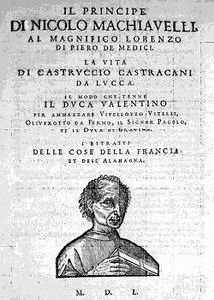
style of culture, philosophy, and art. Renaissance-era diplomat and political theorist Niccolò Machiavelli
Niccolò Machiavelli
Niccolò di Bernardo dei Machiavelli was an Italian historian, philosopher, humanist, and writer based in Florence during the Renaissance. He is one of the main founders of modern political science. He was a diplomat, political philosopher, playwright, and a civil servant of the Florentine Republic...
in his work The Prince
The Prince
The Prince is a political treatise by the Italian diplomat, historian and political theorist Niccolò Machiavelli. From correspondence a version appears to have been distributed in 1513, using a Latin title, De Principatibus . But the printed version was not published until 1532, five years after...
(1532) appealed to Italian patriotism urging Italians "to seize Italy and free her from the Barbarians
Barbarian
Barbarian and savage are terms used to refer to a person who is perceived to be uncivilized. The word is often used either in a general reference to a member of a nation or ethnos, typically a tribal society as seen by an urban civilization either viewed as inferior, or admired as a noble savage...
", the "Barbarians" he referred to were foreign powers occupying the Italian Peninsula.
1830s to 1848
The initial important figure in the development of Italian nationalism was Giuseppe Mazzini who became a nationalist in the 1820s. In his political career, Mazzini held as objectives the freeing of Italy from Austrian occupation, indirect control by Austria, princely despotism, aristocratic privilege, and clerical authority. Mazzini was captivated by ancient RomeAncient Rome
Ancient Rome was a thriving civilization that grew on the Italian Peninsula as early as the 8th century BC. Located along the Mediterranean Sea and centered on the city of Rome, it expanded to one of the largest empires in the ancient world....
that he considered the "temple of humanity
Humanity
Humanity may refer to:* The human species**The total world population* Human nature, psychological characteristics that all normal humans have in common**Compassion**Empathy**Altruism**Aggression**Fear...
" and sought to establish a united Italy as a "Third Rome
Third Rome
The term Third Rome describes the idea that some European city, state, or country is the successor to the legacy of the Roman Empire and its successor state, the Byzantine Empire ....
" that emphasized Roman spiritual values that Italian nationalists claimed were preserved by the Catholic Church. Mazzini and Italian nationalists in general promoted the concept of Romanità (the Roman ideal) that claimed that Roman culture made invaluable contributions to both Italian and Western
Western world
The Western world, also known as the West and the Occident , is a term referring to the countries of Western Europe , the countries of the Americas, as well all countries of Northern and Central Europe, Australia and New Zealand...
civilization
Civilization
Civilization is a sometimes controversial term that has been used in several related ways. Primarily, the term has been used to refer to the material and instrumental side of human cultures that are complex in terms of technology, science, and division of labor. Such civilizations are generally...
. Since the 1820s, Mazzini supported a revolution to create of an ideal Italian utopian republic
Republic
A republic is a form of government in which the people, or some significant portion of them, have supreme control over the government and where offices of state are elected or chosen by elected people. In modern times, a common simplified definition of a republic is a government where the head of...
based in Rome
Rome
Rome is the capital of Italy and the country's largest and most populated city and comune, with over 2.7 million residents in . The city is located in the central-western portion of the Italian Peninsula, on the Tiber River within the Lazio region of Italy.Rome's history spans two and a half...
. Mazzini formed revolutionary patriotic Young Italy society in 1832. Upon Young Italy breaking apart in the 1830s, Mazzini reconstituted it in 1839 with the intention to gain the support of workers' groups. However, at the time Mazzini was hostile to socialism
Socialism
Socialism is an economic system characterized by social ownership of the means of production and cooperative management of the economy; or a political philosophy advocating such a system. "Social ownership" may refer to any one of, or a combination of, the following: cooperative enterprises,...
due to his belief that all classes needed to be united in the cause of creating a united Italy rather than divided against each other.
Vincenzo Gioberti
Vincenzo Gioberti
thumb|250px|Vincenzo Gioberti.Vincenzo Gioberti was an Italian philosopher, publicist and politician.-Biography:Gioberti was born in Turin....
in 1843 in his book On the Civil and Moral Primacy of the Italians, advocated a federal state of Italy led by the Pope
Pope
The Pope is the Bishop of Rome, a position that makes him the leader of the worldwide Catholic Church . In the Catholic Church, the Pope is regarded as the successor of Saint Peter, the Apostle...
.
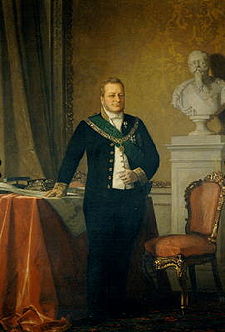
Camillo Benso
Camillo Benso, Count of Cavour
Camillo Paolo Filippo Giulio Benso, Count of Cavour, of Isolabella and of Leri was a leading figure in the movement toward Italian unification...
, the future Prime Minister of the Kingdom of Sardinia
Kingdom of Sardinia
The Kingdom of Sardinia consisted of the island of Sardinia first as a part of the Crown of Aragon and subsequently the Spanish Empire , and second as a part of the composite state of the House of Savoy . Its capital was originally Cagliari, in the south of the island, and later Turin, on the...
and afterwards the Kingdom of Italy, worked as an editor for the nationalist Italian newspaper Il Risorgimento in the 1840s.
Economic nationalism
Economic nationalism
Economic nationalism is a term used to describe policies which emphasize domestic control of the economy, labor and capital formation, even if this requires the imposition of tariffs and other restrictions on the movement of labor, goods and capital. It opposes globalization in many cases, or at...
influenced businessmen and government authorities to promote a united Italy. Prior to unification, tariff walls held between the Italian states and disorganized railway system prevented economic development of Italy. Prior to the revolutions of 1848, Carlo Cattaneo
Carlo Cattaneo
Carlo Cattaneo was an Italian philosopher, writer and patriot.-Biography:Cattaneo was born in Milan; he died in Castagnola, close to Lugano in the Swiss canton of Ticino, where he had spent the last twenty years of his life in exile.A republican in his convictions, during his youth he had taken...
advocated an economic federation of Italy.
Revolutions of 1848 to Risorgimento (1859 to 1870)
Amid unrest in Europe in 1848, Italian nationalism arose with Italians demanding Italian unification. Italian nationalists Mazzini and Gioberti promoted the Romanità (Roman ideal) that attracted students to join battalions to fight for Italian unity. Supporters of Italian nationalism ranged from across the political spectrum, it appealed to both conservativesConservatism
Conservatism is a political and social philosophy that promotes the maintenance of traditional institutions and supports, at the most, minimal and gradual change in society. Some conservatives seek to preserve things as they are, emphasizing stability and continuity, while others oppose modernism...
and liberals
Liberalism
Liberalism is the belief in the importance of liberty and equal rights. Liberals espouse a wide array of views depending on their understanding of these principles, but generally, liberals support ideas such as constitutionalism, liberal democracy, free and fair elections, human rights,...
. The Revolutions of 1848 resulted in a major development of Italian nationalist culture. Liberalization of press laws in Piedmont
Piedmont
Piedmont is one of the 20 regions of Italy. It has an area of 25,402 square kilometres and a population of about 4.4 million. The capital of Piedmont is Turin. The main local language is Piedmontese. Occitan is also spoken by a minority in the Occitan Valleys situated in the Provinces of...
allowed nationalist activity to flourish.
Italian National Society
The Italian National Society was an Italian nationalist political organization created in 1857 by Daniele Manin and Giorgio Pallevicino. The National Society was created to promote and spread nationalism to political moderates in Piedmont and raised money, held public meetings, and produced...
was created in 1857 by Daniele Manin
Daniele Manin
Daniele Manin was an Italian patriot and statesman from Venice. He is a hero of Italian unification .-Early life:...
and Giorgio Pallevicino. The National Society was created to promote and spread nationalism to political moderates in Piedmont and raised money, held public meetings, and produced newspapers. The National Society helped to establish a base for Italian nationalism amongst the educated middle class
Middle class
The middle class is any class of people in the middle of a societal hierarchy. In Weberian socio-economic terms, the middle class is the broad group of people in contemporary society who fall socio-economically between the working class and upper class....
. By 1860, the National Society influenced dominant liberal circles in Italy and won over middle class support for the union of Piedmont and Lombardy
Lombardy
Lombardy is one of the 20 regions of Italy. The capital is Milan. One-sixth of Italy's population lives in Lombardy and about one fifth of Italy's GDP is produced in this region, making it the most populous and richest region in the country and one of the richest in the whole of Europe...
.
1870 to 1922
After the unification of Italy was completed in 1870, the Italian government faced domestic political paralysis and internal tensions, resulting in it resorting to embarking on a colonial policy to divert the Italian public's attention from internal issues. Italy managed to colonize the East African coast of EritreaEritrea
Eritrea , officially the State of Eritrea, is a country in the Horn of Africa. Eritrea derives it's name from the Greek word Erethria, meaning 'red land'. The capital is Asmara. It is bordered by Sudan in the west, Ethiopia in the south, and Djibouti in the southeast...
and Somalia
Somalia
Somalia , officially the Somali Republic and formerly known as the Somali Democratic Republic under Socialist rule, is a country located in the Horn of Africa. Since the outbreak of the Somali Civil War in 1991 there has been no central government control over most of the country's territory...
but failed to conquer Ethiopia
Ethiopia
Ethiopia , officially known as the Federal Democratic Republic of Ethiopia, is a country located in the Horn of Africa. It is the second-most populous nation in Africa, with over 82 million inhabitants, and the tenth-largest by area, occupying 1,100,000 km2...
with 15,000 Italians dying in the war and being forced to retreat. Next Italy waged war with the Turkey
Turkey
Turkey , known officially as the Republic of Turkey , is a Eurasian country located in Western Asia and in East Thrace in Southeastern Europe...
from 1911-1912 and gained Libya
Libya
Libya is an African country in the Maghreb region of North Africa bordered by the Mediterranean Sea to the north, Egypt to the east, Sudan to the southeast, Chad and Niger to the south, and Algeria and Tunisia to the west....
and the Dodecanese Islands from Turkey. However these attempts to gain popular support from the public failed, and rebellions and violent protests became so intense that many observers believed that the young Kingdom of Italy would not survive.
Tired of the internal conflicts in Italy, a movement of bourgeois intellectuals led by Gabriele D'Annunzio
Gabriele D'Annunzio
Gabriele D'Annunzio or d'Annunzio was an Italian poet, journalist, novelist, and dramatist...
, Gaetano Mosca
Gaetano Mosca
Gaetano Mosca was an Italian political scientist, journalist and public servant. He is credited with developing the Theory of Elitism and the doctrine of the Political class and is one of the three members constituting the Italian School of Elitists together with Vilfredo Pareto and Robert...
, and Vilfredo Pareto
Vilfredo Pareto
Vilfredo Federico Damaso Pareto , born Wilfried Fritz Pareto, was an Italian engineer, sociologist, economist, political scientist and philosopher. He made several important contributions to economics, particularly in the study of income distribution and in the analysis of individuals' choices....
declared war on the parliamentary system, and their position gained respect among Italians. D'Annunzio called upon young Italians to seek fulfillment in violent action and put an end to the politically maneuvering parliamentary government. The Italian Nationalist Association
Italian Nationalist Association
The Italian Nationalist Association, Associazione Nazionalista Italiana was Italy's first nationalist political party founded in 1910. under the influence of Italian nationalists such as Enrico Corradini and Giovanni Papini...
was founded in 1910 by the jingoist nationalist Enrico Corradini
Enrico Corradini
Enrico Corradini was an Italian novelist, essayist, journalist and nationalist political figure.-Biography:Corradini was born near Montelupo Fiorentino, Tuscany....
who emphasized the need for martial heroism, of total sacrifice of individualism and equality to one's nation, the need of discipline and obedience in society, the grandeur and power of ancient Rome, and the need for people to live dangerously. Corradini's ANI's extremist appeals were enthusiastically supported by many Italians.
At the outbreak of World War I
World War I
World War I , which was predominantly called the World War or the Great War from its occurrence until 1939, and the First World War or World War I thereafter, was a major war centred in Europe that began on 28 July 1914 and lasted until 11 November 1918...
in 1914, Italy initially maintained neutrality, despite its official alliance with Germany and Austria-Hungary since 1882 on the grounds that Germany and Austria-Hungary were waging an aggressive war that it refused to take part in. In 1915 Italy entered the war on the side of the British and the French against Austria-Hungary and Germany. Italy's demands in the Paris peace settlement were not fully achieved, Italy did attain Trentino, Trieste, the Istrian peninsula, and South Tyrol from Austria-Hungary, though other territories previously promised to Italy were not given to it.
See also
- Italians
- Italian culture
- Romanità
- Italian irredentism
- History of ItalyHistory of ItalyItaly, united in 1861, has significantly contributed to the political, cultural and social development of the entire Mediterranean region. Many cultures and civilizations have existed there since prehistoric times....
- Ancient RomeAncient RomeAncient Rome was a thriving civilization that grew on the Italian Peninsula as early as the 8th century BC. Located along the Mediterranean Sea and centered on the city of Rome, it expanded to one of the largest empires in the ancient world....
- RenaissanceRenaissanceThe Renaissance was a cultural movement that spanned roughly the 14th to the 17th century, beginning in Italy in the Late Middle Ages and later spreading to the rest of Europe. The term is also used more loosely to refer to the historical era, but since the changes of the Renaissance were not...
- Revolutions of 1848Revolutions of 1848The European Revolutions of 1848, known in some countries as the Spring of Nations, Springtime of the Peoples or the Year of Revolution, were a series of political upheavals throughout Europe in 1848. It was the first Europe-wide collapse of traditional authority, but within a year reactionary...
- Italian unificationItalian unificationItalian unification was the political and social movement that agglomerated different states of the Italian peninsula into the single state of Italy in the 19th century...
- Italian FascismItalian FascismItalian Fascism also known as Fascism with a capital "F" refers to the original fascist ideology in Italy. This ideology is associated with the National Fascist Party which under Benito Mussolini ruled the Kingdom of Italy from 1922 until 1943, the Republican Fascist Party which ruled the Italian...