

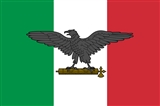
Italian Social Republic

Encyclopedia
The Italian Social Republic was a puppet state
of Nazi Germany
led by the "Duce of the Nation
" and "Minister of Foreign Affairs" Benito Mussolini
and his Republican Fascist Party
. The RSI exercised nominal sovereignty
in northern Italy
but was largely dependent on the Wehrmacht
(German military) to maintain control. The state was informally known as the Salò Republic because the RSI's Ministry of Foreign Affairs (headed by Mussolini) was headquartered in Salò
, a small town on Lake Garda
. Before 25 November 1943, when the official title of the regime was adopted, the names Republican State of Italy and Republican National State were variously used. The Italian Social Republic was the second and last incarnation of a Fascist
Italian state.
, the Grand Fascist Council, on a motion by Dino Grandi
, voted a motion of no confidence
in Mussolini. The next day, King
Victor Emmanuel III
dismissed Mussolini from office and ordered him arrested. By this time, the monarchy, a number of Fascist government members, and the general Italian population had grown tired of the futile war effort which had driven Italy into subordination and subjugation under Nazi Germany. The failed war effort left Mussolini humiliated at home and abroad as a "sawdust Caesar
". The new government, under Marshal Pietro Badoglio
, began secret negotiations with the Allied powers and made preparations for the capitulation of Italy. These surrender talks implied a commitment from Badoglio not only to leave the Axis alliance but also to have Italy declare war on Germany.
While the Germans formally recognised the new status quo in Italian politics, they quickly intervened by sending some of the best units of the Wehrmacht to Italy. This was done both to resist new Allied advances and to face the predictably imminent defection
of Italy. While Badoglio continued to swear loyalty to Germany and the Axis powers, Italian government emissaries prepared to sign an armistice
at Cassibile
in Allied-occupied Sicily
, which was finalized on 3 September.
On 8 September, the truth was finally revealed and Badoglio announced Italy's surrender
. German Führer
Adolf Hitler
and his staff, long aware of the betrayal, acted immediately by ordering German troops to seize control of northern and central Italy. The Germans disarmed the stunned Italian troops and took over all of the Italian Army's materials and equipment.
Just four days later, on 12 September, a daring German paratrooper action in the mountains of Abruzzo
, led by Otto Skorzeny
and named Operation Eiche ("Oak"), succeeded in liberating Mussolini. While in captivity, the new Italian government had moved Mussolini from place to place in order to frustrate any would-be rescuers. The Germans eventually determined that Mussolini was being housed at the Campo Imperatore
Hotel at Gran Sasso
. After being liberated, Mussolini was safely flown to Bavaria
. His liberation made it possible for a new, German-dependent Fascist Italian state to be created.
. While Mussolini was in poor health and wanted to retire, Hitler wanted him to return to Italy and set up a new Fascist state. When Mussolini balked, Hitler threatened to destroy Milan
, Genoa
and Turin
unless he went along. Reluctantly, Mussolini agreed to Hitler's demands.
The Italian Social Republic was proclaimed on September 23. The RSI had no official capital but the unofficial capital became Salò
on Lake Garda
, midway between Milan and Venice
where Mussolini resided along with the foreign office of the RSI. Neither the Germans or Mussolini wanted him to return to Rome
.
Immediately upon the state's creation, it became obvious that the Italian Social Republic was little more than a puppet state
dependent entirely upon Berlin. The RSI only received diplomatic recognition
from Germany and its satellites
. Even the otherwise sympathetic Spain refused to establish formal diplomatic relations with the RSI. From the creation of the RSI, the Germans distrusted the Italian Fascists' ability to control their own territory.
Also, the Germans quickly took advantage of the opportunity to press claims on those territories of northern Italy once ruled by Austria
. Hitler had been willing to ignore these claims even after the Anschluss
for the sake of the German alliance with Italy. Now, the German dictator found himself in a position to compel Mussolini to cede Istria
, Trieste
, and South Tyrol
to Germany. Mussolini was told that he would have to cede Venice
next. Huge portions of Italian-populated territories, acquired through years of conflict, were suddenly abandoned. While the RSI remained largely a puppet state, Mussolini maintained close personal relations with Hitler until the end of the war. No matter how overbearing the German dictator became, Mussolini realized he and his government were utterly dependent on German goodwill.
Mussolini himself knew he was little more than the Gauleiter
of Lombardy
, even though he stated in public that he was in full control. The finances of the state were completely dependent on German funding, the state lacked a constitution and had no organized economy. German forces themselves had little respect for Mussolini's failed fascist movement and saw the regime as useful only for purposes of maintaining order, such as repressing the Italian partisans
and persecuting Jews. This work was also carried out by Pietro Koch
and the Banda Koch on Germany's behalf.
The RSI took revenge against the 19 members who had voted against Mussolini on the Grand Council with the Verona trial which handed down a death sentence to all of the accused. Only two of the 19 were in RSI custody (Emilio De Bono and Mussolini's own son-in-law Galeazzo Ciano
). They were executed on January 11, 1944.
s and strikes
, began to make increasingly populist
appeals to the working class. He claimed to regret many of the decisions made earlier in supporting the interests of big business. He promised a new beginning if the Italian people would be willing to grant him a second chance. Mussolini claimed that he had never totally abandoned his left-wing influences, insisting he had attempted to nationalize property in 1939–1940 but had been forced to delay such action for tactical reasons related to the war. With the removal of the monarchy, Mussolini claimed the full ideology of Fascism could be pursued, and reversed over twenty years of Fascist support of private property and relative economic independence by ordering the nationalization of all companies with over 100 employees. Mussolini even reached out to communist Nicola Bombacci
, a former student of Vladimir Lenin
to help him in spreading the image that Fascism was a progressive movement. The economic policy of RSI was the "Socialization
". In practice, little resulted from the socialization of the economy. Unions did not exert real control of their managers and took no part in state planning. The Italian industrial sector was excluded from the new reforms by the Germans and Italian industrialists were opposed to the changes in any case. The Italian labor force (large parts of which had remained socialist or communist despite fascist rule) regarded socialization as a sham and responded with a massive strike on March 1, 1944.
He wanted to conduct a small offensive along the Gothic Line
against the Allies, with his new RSI Divisions: on December 1944 the Alpine Division "Monte Rosa" with some German battalions fought the Battle of Garfagnana
with some success.
As the situation became desperate in January and February 1945, with Allied forces in control of most of Italy, Mussolini declared that "he would fight to the last Italian" and spoke of turning Milan into the "Stalingrad
of Italy", where Fascism would make its last glorious fight. Despite such strong rhetoric, Mussolini considered evacuating Fascists into Switzerland
, although this was opposed by Germany, which instead proposed that Mussolini and key Fascist officials be taken into exile in Germany. Further disintegration of support for his government occurred as fascist and German military officials secretly tried to negotiate a truce with Allied forces, without consulting either Mussolini or Hitler.
and the (Western) Allied spring offensive
managed to oust the Germans from Italy
almost entirely. At the point of its demise, the Italian Social Republic had existed for slightly more than nineteen months.
On 27 April, Mussolini, his mistress (Clara Petacci
), several RSI ministers, and several other Italian Fascists were caught while attempting to flee. On 28 April most of the captives were shot at Mezzegra
and Dongo by Italian partisans
. Fifteen of the bodies were taken to Piazzale Loreto
, a square in the centre of Milan
and unceremoniously hanged upside down in front of a petrol station.
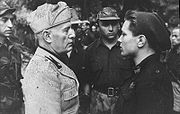 Smaller units like the Black Brigades
and the Decima Flottiglia MAS
fought for the RSI during its entire existence. The Germans were satisfied if these units were able to participate in anti-partisan activities
. While varying in their effectiveness, some of these units surpassed expectations.
In March 1944, the bulk of the 1st Italienische Freiwilligen Sturmbrigade (or la Brigata d'Assalto, Milizia Armata in Italian) were sent to the Anzio beachhead where they fought alongside their German allies, receiving favourable reports and taking heavy losses. In recognition of their performance, Heinrich Himmler
declared the unit to be fully integrated into the Waffen SS.
On 16 October 1943, the Rastenburg Protocol was signed with Nazi Germany and the RSI was allowed to raise division-sized military formations. This protocol allowed Marshal Rodolfo Graziani
to raise four RSI divisions totalling 52,000 men. In July 1944, the first of these divisions completed training and was sent to the front.
Recruiting military forces was difficult for the RSI, most of the Italian army had been interned by German forces in 1943, many Italians had been conscripted into forced labour in Germany and few wanted to participate in the war. The RSI became so desperate for soldiers that it granted convicts freedom if they would join the army and the sentence of death was imposed on anyone who opposed being conscripted. Autonomous military forces in the RSI also fought against the Allies including the notorious Decima Flottiglia MAS
of Prince Junio Valerio Borghese
. Borghese held no allegiance to Mussolini and even suggested that he would take him prisoner if he could.
During the winter of 1944-1945, armed Italians were on both sides of the Gothic Line
. On the Allied side were four Italian groups of volunteers from the old Italian army. These Italian volunteers were equipped and trained by the British. On the Axis side were four RSI divisions. Three of the RSI divisions, the 2nd Italian "Littorio" Infantry Division, the 3rd Italian "San Marco" Marine Division, and the 4th Italian "Monte Rosa Alpine Division" were allocated to the LXXXXVII "Liguria" Army
under Graziani and were placed to guard the western flank of the Gothic Line facing France. The fourth RSI division, the 1st Italian "Italia" Infantry Division, was attached to the German 14th Army in a sector of the Apennine Mountains thought least likely to be attacked.
On 26 December 1944, several sizeable RSI military units, including elements of the 4th Italian "Monterosa Division" Alpine Division and the 3rd Italian "San Marco" Marine Division, participated in Operation Winter Storm
. This was a combined German and Italian offensive against the 92nd Infantry Division. The battle was fought in the Apennines. While limited in scale, this was a successful offensive and the RSI units did their part.
In February 1945, the 92nd Infantry Division again came up against RSI units. This time it was Bersaglieri
of the 1st Italian "Italia" Infantry Division. The Italians successfully halted the US division's advance.
The RSI Minister of Defense, Rodolfo Graziani
, was even able to say that he commanded an entire Army. This was the Italo-German Army Group Liguria
.
On 29 April, Graziani surrendered and was present at Caserta when a representative of German General Heinrich von Vietinghoff
-Steel signed the unconditional instrument of surrender for all Axis forces in Italy. But, since the Allies had never recognised the RSI, Graziani's signature was not required at Caserta. The surrender was to take effect on 2 May. Graziani ordered the RSI forces under his command to lay down their arms on 1 May.
or ANR) was the air force of Italian Social Republic and also the air unit of National Republican Army in World War II
. Its tactical organization was: 3 Fighter Groups, 1 Air Torpedo Bomber Group, 1 Bomber Group and other Transport and minor units. The ANR worked closely with German Luftwaffe
in Northern Italy even if the Germans tried, unsuccessfully, to disband the ANR forcing its pilots to enlist in the German Air Force (Luftwaffe
). In 1944, after the withdrawal of all German fighter units in the attempt to stop the increased Allied offensive on the German mainland, ANR fighter groups were left alone and heavily outnumbered, to face the massive Allied air offensive over Northern Italy. In the operation time of 1944 and 1945 the ANR managed to shoot down 262 Allied aircraft with the loss of 158 in action.
chose to side with the RSI. The RSI's National Republican Navy (Marina Nazionale Repubblicana or MNR) only reached a twentieth the size of the co-belligerent Italian fleet. The RSI Navy largely consisted of four Motor Torpedo Boats (also known as Torpedo Armed Motorboats or Motoscafo Armato Silurante or MAS), two anti-submarine vessels, and various other light vessels. There were also five midget submarines stationed in northern Italy and another five midget submarines stationed in Romania on the Black Sea. The five submarines stationed in northern Italy all chose to join the RSI Navy. Because of arrears in maintenance payments, only four of the submarines in Romania were returned to the RSI.
Troops of the Decima Flottiglia MAS
fought primarily as an army unit of the RSI.
saw the establishment of the Republican National Guard (Guardia Nazionale Repubblicana or GNR), and the emergence of the Black Brigades
(brigate nere). The forty Black Brigades consisted of former MVSN, former Carabinieri
, former soldiers, former Italian Africa Police
, and others still loyal to the Fascist cause. Alongside with their Nazi
and Schutzstaffel (SS) counterparts, the Black Brigades committed many atrocities in their fight against the Italian resistance movement
and political enemies. On August 15, 1944, the GNR became a part of the Army.
.
the Fascists had been restricted in some of their actions by the monarchy. The formation of the RSI allowed Mussolini to at last be the official head of an Italian state, and it allowed the Fascists to return to their earlier republican stances.
Most prominent figures of post-war Italian far right
politics (parliamentary or extraparliamentary) were in some way associated with the experience of the RSI. Among them were Pino Romualdi
, Rodolfo Graziani
, Junio Valerio Borghese
, Licio Gelli
and Giorgio Almirante
.
Today, a significant number of far right
organizations in Italy
, notably the Fiamma Tricolore
party, still explicitly take inspiration for their social and political platform from the RSI experience. The RSI is usually seen as the example of what Fascism should have been. As a sign of this legacy, Fiamma Tricolore
, for example, guarantees free membership for ex-RSI military. A communique from the Rome
section of the Fiamma said:
ed with a fasces
. Later locally produced ones were made.
's 1976
film Salò o le 120 giornate di Sodoma
(Salò, or the 120 Days of Sodom) was set in the Republic of Salò, using it as an allegory
; the atrocities in the movie did not happen, but in the movie, most of the choices of millieus, clothing, uniforms, weapons and other details are historically correct.
Roberto Benigni
's 1997
Life is Beautiful
was also set in the Republic of Salò. Wild Blood
tells the real story of the Fascist film stars Luisa Ferida
and Osvaldo Valenti
and their support for the Republic of Salò.
Puppet state
A puppet state is a nominal sovereign of a state who is de facto controlled by a foreign power. The term refers to a government controlled by the government of another country like a puppeteer controls the strings of a marionette...
of Nazi Germany
Nazi Germany
Nazi Germany , also known as the Third Reich , but officially called German Reich from 1933 to 1943 and Greater German Reich from 26 June 1943 onward, is the name commonly used to refer to the state of Germany from 1933 to 1945, when it was a totalitarian dictatorship ruled by...
led by the "Duce of the Nation
Duce
Duce is an Italian title, derived from the Latin word dux, and cognate with duke. National Fascist Party leader Benito Mussolini was identified by Fascists as Il Duce of the movement and became a reference to the dictator position of Head of Government and Duce of Fascism of Italy was established...
" and "Minister of Foreign Affairs" Benito Mussolini
Benito Mussolini
Benito Amilcare Andrea Mussolini was an Italian politician who led the National Fascist Party and is credited with being one of the key figures in the creation of Fascism....
and his Republican Fascist Party
Republican Fascist Party
The Republican Fascist Party was a political party led by Benito Mussolini during the German occupation of Central and Northern Italy. It was founded as the successor of former National Fascist Party as an anti-monarchist party...
. The RSI exercised nominal sovereignty
Sovereignty
Sovereignty is the quality of having supreme, independent authority over a geographic area, such as a territory. It can be found in a power to rule and make law that rests on a political fact for which no purely legal explanation can be provided...
in northern Italy
Northern Italy
Northern Italy is a wide cultural, historical and geographical definition, without any administrative usage, used to indicate the northern part of the Italian state, also referred as Settentrione or Alta Italia...
but was largely dependent on the Wehrmacht
Wehrmacht
The Wehrmacht – from , to defend and , the might/power) were the unified armed forces of Nazi Germany from 1935 to 1945. It consisted of the Heer , the Kriegsmarine and the Luftwaffe .-Origin and use of the term:...
(German military) to maintain control. The state was informally known as the Salò Republic because the RSI's Ministry of Foreign Affairs (headed by Mussolini) was headquartered in Salò
Salò
Salò is a town and commune in the Province of Brescia in the region of Lombardy on the banks of Lake Garda. The city was the capital of Italian Social Republic from 1943 to 1945, with the ISR often being called the "Republic of Salò" .-History:Salò was founded in the Roman period as Pagus...
, a small town on Lake Garda
Lake Garda
Lake Garda is the largest lake in Italy. It is located in Northern Italy, about half-way between Brescia and Verona, and between Venice and Milan. Glaciers formed this alpine region at the end of the last ice age...
. Before 25 November 1943, when the official title of the regime was adopted, the names Republican State of Italy and Republican National State were variously used. The Italian Social Republic was the second and last incarnation of a Fascist
Fascism
Fascism is a radical authoritarian nationalist political ideology. Fascists seek to rejuvenate their nation based on commitment to the national community as an organic entity, in which individuals are bound together in national identity by suprapersonal connections of ancestry, culture, and blood...
Italian state.
Context of creation
On July 24, 1943, after the Allied landings in SicilySicily
Sicily is a region of Italy, and is the largest island in the Mediterranean Sea. Along with the surrounding minor islands, it constitutes an autonomous region of Italy, the Regione Autonoma Siciliana Sicily has a rich and unique culture, especially with regard to the arts, music, literature,...
, the Grand Fascist Council, on a motion by Dino Grandi
Dino Grandi
Dino Grandi , Conte di Mordano, was an Italian Fascist politician, minister of justice, minister of foreign affairs and president of parliament.- Early life :...
, voted a motion of no confidence
Motion of no confidence
A motion of no confidence is a parliamentary motion whose passing would demonstrate to the head of state that the elected parliament no longer has confidence in the appointed government.-Overview:Typically, when a parliament passes a vote of no...
in Mussolini. The next day, King
King of Italy
King of Italy is a title adopted by many rulers of the Italian peninsula after the fall of the Roman Empire...
Victor Emmanuel III
Victor Emmanuel III of Italy
Victor Emmanuel III was a member of the House of Savoy and King of Italy . In addition, he claimed the crowns of Ethiopia and Albania and claimed the titles Emperor of Ethiopia and King of Albania , which were unrecognised by the Great Powers...
dismissed Mussolini from office and ordered him arrested. By this time, the monarchy, a number of Fascist government members, and the general Italian population had grown tired of the futile war effort which had driven Italy into subordination and subjugation under Nazi Germany. The failed war effort left Mussolini humiliated at home and abroad as a "sawdust Caesar
Julius Caesar
Gaius Julius Caesar was a Roman general and statesman and a distinguished writer of Latin prose. He played a critical role in the gradual transformation of the Roman Republic into the Roman Empire....
". The new government, under Marshal Pietro Badoglio
Pietro Badoglio
Pietro Badoglio, 1st Duke of Addis Abeba, 1st Marquess of Sabotino was an Italian soldier and politician...
, began secret negotiations with the Allied powers and made preparations for the capitulation of Italy. These surrender talks implied a commitment from Badoglio not only to leave the Axis alliance but also to have Italy declare war on Germany.
While the Germans formally recognised the new status quo in Italian politics, they quickly intervened by sending some of the best units of the Wehrmacht to Italy. This was done both to resist new Allied advances and to face the predictably imminent defection
Defection
In politics, a defector is a person who gives up allegiance to one state or political entity in exchange for allegiance to another. More broadly, it involves abandoning a person, cause or doctrine to whom or to which one is bound by some tie, as of allegiance or duty.This term is also applied,...
of Italy. While Badoglio continued to swear loyalty to Germany and the Axis powers, Italian government emissaries prepared to sign an armistice
Armistice with Italy
The Armistice with Italy was an armistice signed on September 3 and publicly declared on September 8, 1943, during World War II, between Italy and the Allied armed forces, who were then occupying the southern end of the country, entailing the capitulation of Italy...
at Cassibile
Cassibile (village)
Cassibile is an Italian village and civil parish of the city and municipality of Syracuse , in Sicily. As of 2006 its population was of 5,800.-History:...
in Allied-occupied Sicily
Sicily
Sicily is a region of Italy, and is the largest island in the Mediterranean Sea. Along with the surrounding minor islands, it constitutes an autonomous region of Italy, the Regione Autonoma Siciliana Sicily has a rich and unique culture, especially with regard to the arts, music, literature,...
, which was finalized on 3 September.
On 8 September, the truth was finally revealed and Badoglio announced Italy's surrender
Surrender (military)
Surrender is when soldiers, nations or other combatants stop fighting and eventually become prisoners of war, either as individuals or when ordered to by their officers. A white flag is a common symbol of surrender, as is the gesture of raising one's hands empty and open above one's head.When the...
. German Führer
Führer
Führer , alternatively spelled Fuehrer in both English and German when the umlaut is not available, is a German title meaning leader or guide now most associated with Adolf Hitler, who modelled it on Benito Mussolini's title il Duce, as well as with Georg von Schönerer, whose followers also...
Adolf Hitler
Adolf Hitler
Adolf Hitler was an Austrian-born German politician and the leader of the National Socialist German Workers Party , commonly referred to as the Nazi Party). He was Chancellor of Germany from 1933 to 1945, and head of state from 1934 to 1945...
and his staff, long aware of the betrayal, acted immediately by ordering German troops to seize control of northern and central Italy. The Germans disarmed the stunned Italian troops and took over all of the Italian Army's materials and equipment.
Just four days later, on 12 September, a daring German paratrooper action in the mountains of Abruzzo
Abruzzo
Abruzzo is a region in Italy, its western border lying less than due east of Rome. Abruzzo borders the region of Marche to the north, Lazio to the west and south-west, Molise to the south-east, and the Adriatic Sea to the east...
, led by Otto Skorzeny
Otto Skorzeny
Otto Skorzeny was an SS-Obersturmbannführer in the German Waffen-SS during World War II. After fighting on the Eastern Front, he was chosen as the field commander to carry out the rescue mission that freed the deposed Italian dictator Benito Mussolini from captivity...
and named Operation Eiche ("Oak"), succeeded in liberating Mussolini. While in captivity, the new Italian government had moved Mussolini from place to place in order to frustrate any would-be rescuers. The Germans eventually determined that Mussolini was being housed at the Campo Imperatore
Campo Imperatore
Campo Imperatore is a mountain grassland or alpine meadow formed by a high basin shaped plateau located in the Province of L'Aquila in the Abruzzo region of Italy in the Gran Sasso massif. It is the largest plateau of the Apennine ridge...
Hotel at Gran Sasso
Gran Sasso
Gran Sasso d'Italia is a mountain located in the Abruzzo region of central Italy. The Gran Sasso forms the centerpiece of the Gran Sasso e Monti della Laga National Park which was established in 1993 and holds the highest mountains in continental Italy south of the Alps and is part of the...
. After being liberated, Mussolini was safely flown to Bavaria
Bavaria
Bavaria, formally the Free State of Bavaria is a state of Germany, located in the southeast of Germany. With an area of , it is the largest state by area, forming almost 20% of the total land area of Germany...
. His liberation made it possible for a new, German-dependent Fascist Italian state to be created.
History
Dependence on Germany
Three days following his rescue in the Gran Sasso raid, Mussolini was taken to Germany for a meeting with Hitler in Rastenburg at his East Prussian headquartersWolfsschanze
Wolf's Lair is the standard English name for Wolfsschanze, Adolf Hitler's first World War II Eastern Front military headquarters, one of several Führerhauptquartier or FHQs located in various parts of Europe...
. While Mussolini was in poor health and wanted to retire, Hitler wanted him to return to Italy and set up a new Fascist state. When Mussolini balked, Hitler threatened to destroy Milan
Milan
Milan is the second-largest city in Italy and the capital city of the region of Lombardy and of the province of Milan. The city proper has a population of about 1.3 million, while its urban area, roughly coinciding with its administrative province and the bordering Province of Monza and Brianza ,...
, Genoa
Genoa
Genoa |Ligurian]] Zena ; Latin and, archaically, English Genua) is a city and an important seaport in northern Italy, the capital of the Province of Genoa and of the region of Liguria....
and Turin
Turin
Turin is a city and major business and cultural centre in northern Italy, capital of the Piedmont region, located mainly on the left bank of the Po River and surrounded by the Alpine arch. The population of the city proper is 909,193 while the population of the urban area is estimated by Eurostat...
unless he went along. Reluctantly, Mussolini agreed to Hitler's demands.
The Italian Social Republic was proclaimed on September 23. The RSI had no official capital but the unofficial capital became Salò
Salò
Salò is a town and commune in the Province of Brescia in the region of Lombardy on the banks of Lake Garda. The city was the capital of Italian Social Republic from 1943 to 1945, with the ISR often being called the "Republic of Salò" .-History:Salò was founded in the Roman period as Pagus...
on Lake Garda
Lake Garda
Lake Garda is the largest lake in Italy. It is located in Northern Italy, about half-way between Brescia and Verona, and between Venice and Milan. Glaciers formed this alpine region at the end of the last ice age...
, midway between Milan and Venice
Venice
Venice is a city in northern Italy which is renowned for the beauty of its setting, its architecture and its artworks. It is the capital of the Veneto region...
where Mussolini resided along with the foreign office of the RSI. Neither the Germans or Mussolini wanted him to return to Rome
Rome
Rome is the capital of Italy and the country's largest and most populated city and comune, with over 2.7 million residents in . The city is located in the central-western portion of the Italian Peninsula, on the Tiber River within the Lazio region of Italy.Rome's history spans two and a half...
.
Immediately upon the state's creation, it became obvious that the Italian Social Republic was little more than a puppet state
Puppet state
A puppet state is a nominal sovereign of a state who is de facto controlled by a foreign power. The term refers to a government controlled by the government of another country like a puppeteer controls the strings of a marionette...
dependent entirely upon Berlin. The RSI only received diplomatic recognition
Diplomatic recognition
Diplomatic recognition in international law is a unilateral political act with domestic and international legal consequences, whereby a state acknowledges an act or status of another state or government in control of a state...
from Germany and its satellites
Satellite state
A satellite state is a political term that refers to a country that is formally independent, but under heavy political and economic influence or control by another country...
. Even the otherwise sympathetic Spain refused to establish formal diplomatic relations with the RSI. From the creation of the RSI, the Germans distrusted the Italian Fascists' ability to control their own territory.
Also, the Germans quickly took advantage of the opportunity to press claims on those territories of northern Italy once ruled by Austria
Austria
Austria , officially the Republic of Austria , is a landlocked country of roughly 8.4 million people in Central Europe. It is bordered by the Czech Republic and Germany to the north, Slovakia and Hungary to the east, Slovenia and Italy to the south, and Switzerland and Liechtenstein to the...
. Hitler had been willing to ignore these claims even after the Anschluss
Anschluss
The Anschluss , also known as the ', was the occupation and annexation of Austria into Nazi Germany in 1938....
for the sake of the German alliance with Italy. Now, the German dictator found himself in a position to compel Mussolini to cede Istria
Istria
Istria , formerly Histria , is the largest peninsula in the Adriatic Sea. The peninsula is located at the head of the Adriatic between the Gulf of Trieste and the Bay of Kvarner...
, Trieste
Trieste
Trieste is a city and seaport in northeastern Italy. It is situated towards the end of a narrow strip of land lying between the Adriatic Sea and Italy's border with Slovenia, which lies almost immediately south and east of the city...
, and South Tyrol
South Tyrol
South Tyrol , also known by its Italian name Alto Adige, is an autonomous province in northern Italy. It is one of the two autonomous provinces that make up the autonomous region of Trentino-Alto Adige/Südtirol. The province has an area of and a total population of more than 500,000 inhabitants...
to Germany. Mussolini was told that he would have to cede Venice
Venice
Venice is a city in northern Italy which is renowned for the beauty of its setting, its architecture and its artworks. It is the capital of the Veneto region...
next. Huge portions of Italian-populated territories, acquired through years of conflict, were suddenly abandoned. While the RSI remained largely a puppet state, Mussolini maintained close personal relations with Hitler until the end of the war. No matter how overbearing the German dictator became, Mussolini realized he and his government were utterly dependent on German goodwill.
Mussolini himself knew he was little more than the Gauleiter
Gauleiter
A Gauleiter was the party leader of a regional branch of the NSDAP or the head of a Gau or of a Reichsgau.-Creation and Early Usage:...
of Lombardy
Lombardy
Lombardy is one of the 20 regions of Italy. The capital is Milan. One-sixth of Italy's population lives in Lombardy and about one fifth of Italy's GDP is produced in this region, making it the most populous and richest region in the country and one of the richest in the whole of Europe...
, even though he stated in public that he was in full control. The finances of the state were completely dependent on German funding, the state lacked a constitution and had no organized economy. German forces themselves had little respect for Mussolini's failed fascist movement and saw the regime as useful only for purposes of maintaining order, such as repressing the Italian partisans
Italian resistance movement
The Italian resistance is the umbrella term for the various partisan forces formed by pro-Allied Italians during World War II...
and persecuting Jews. This work was also carried out by Pietro Koch
Pietro Koch
Pietro Koch was an Italian soldier and leader of the Banda Koch, a group notorious for its anti-partisan activity in the Republic of Salò.The son of a German Navy officer, Koch was born in Benevento...
and the Banda Koch on Germany's behalf.
The RSI took revenge against the 19 members who had voted against Mussolini on the Grand Council with the Verona trial which handed down a death sentence to all of the accused. Only two of the 19 were in RSI custody (Emilio De Bono and Mussolini's own son-in-law Galeazzo Ciano
Galeazzo Ciano
Gian Galeazzo Ciano, 2nd Count of Cortellazzo and Buccari was an Italian Minister of Foreign Affairs and Benito Mussolini's son-in-law. In early 1944 Count Ciano was shot by firing squad at the behest of his father-in-law, Mussolini under pressure from Nazi Germany.-Early life:Ciano was born in...
). They were executed on January 11, 1944.
The Economy
During the existence of the Italian Social Republic, Mussolini, whose government had banned trade unionTrade union
A trade union, trades union or labor union is an organization of workers that have banded together to achieve common goals such as better working conditions. The trade union, through its leadership, bargains with the employer on behalf of union members and negotiates labour contracts with...
s and strikes
Strike action
Strike action, also called labour strike, on strike, greve , or simply strike, is a work stoppage caused by the mass refusal of employees to work. A strike usually takes place in response to employee grievances. Strikes became important during the industrial revolution, when mass labour became...
, began to make increasingly populist
Populism
Populism can be defined as an ideology, political philosophy, or type of discourse. Generally, a common theme compares "the people" against "the elite", and urges social and political system changes. It can also be defined as a rhetorical style employed by members of various political or social...
appeals to the working class. He claimed to regret many of the decisions made earlier in supporting the interests of big business. He promised a new beginning if the Italian people would be willing to grant him a second chance. Mussolini claimed that he had never totally abandoned his left-wing influences, insisting he had attempted to nationalize property in 1939–1940 but had been forced to delay such action for tactical reasons related to the war. With the removal of the monarchy, Mussolini claimed the full ideology of Fascism could be pursued, and reversed over twenty years of Fascist support of private property and relative economic independence by ordering the nationalization of all companies with over 100 employees. Mussolini even reached out to communist Nicola Bombacci
Nicola Bombacci
Nicola, Bombacci , born at Civitella di Romagna, was an Italian Marxist socialist who was a member of the Italian Socialist Party in the late 19th and early 20th centuries. A friend and disciple of Lenin, in 1921 he became one of the founding fathers of the Italian Communist Party...
, a former student of Vladimir Lenin
Vladimir Lenin
Vladimir Ilyich Lenin was a Russian Marxist revolutionary and communist politician who led the October Revolution of 1917. As leader of the Bolsheviks, he headed the Soviet state during its initial years , as it fought to establish control of Russia in the Russian Civil War and worked to create a...
to help him in spreading the image that Fascism was a progressive movement. The economic policy of RSI was the "Socialization
Fascist socialization
The Congress of Verona in November 1943 was the only congress of the Italian Republican Fascist Party, the successor of the National Fascist Party. At the time, the Republican Fascist Party was nominally in charge of the Salò Republic, a small fascist state set up in Northern Italy after the Allies...
". In practice, little resulted from the socialization of the economy. Unions did not exert real control of their managers and took no part in state planning. The Italian industrial sector was excluded from the new reforms by the Germans and Italian industrialists were opposed to the changes in any case. The Italian labor force (large parts of which had remained socialist or communist despite fascist rule) regarded socialization as a sham and responded with a massive strike on March 1, 1944.
The War Effort
In 1944, Mussolini urged Hitler to focus on destroying Britain, rather than the Soviet Union, as Mussolini claimed that it was Britain which had turned the conflict into a world war and that the British Empire must be destroyed in order for peace to come in Europe.He wanted to conduct a small offensive along the Gothic Line
Gothic Line
The Gothic Line formed Field Marshal Albert Kesselring's last major line of defence in the final stages of World War II along the summits of the Apennines during the fighting retreat of German forces in Italy against the Allied Armies in Italy commanded by General Sir Harold Alexander.Adolf Hitler...
against the Allies, with his new RSI Divisions: on December 1944 the Alpine Division "Monte Rosa" with some German battalions fought the Battle of Garfagnana
Battle of Garfagnana
The Battle of Garfagnana was an offensive of the Axis forces in the western section of the Gothic Line during World War II. The offensive was even called in Italian: "Offensiva di Natale"...
with some success.
As the situation became desperate in January and February 1945, with Allied forces in control of most of Italy, Mussolini declared that "he would fight to the last Italian" and spoke of turning Milan into the "Stalingrad
Battle of Stalingrad
The Battle of Stalingrad was a major battle of World War II in which Nazi Germany and its allies fought the Soviet Union for control of the city of Stalingrad in southwestern Russia. The battle took place between 23 August 1942 and 2 February 1943...
of Italy", where Fascism would make its last glorious fight. Despite such strong rhetoric, Mussolini considered evacuating Fascists into Switzerland
Switzerland
Switzerland name of one of the Swiss cantons. ; ; ; or ), in its full name the Swiss Confederation , is a federal republic consisting of 26 cantons, with Bern as the seat of the federal authorities. The country is situated in Western Europe,Or Central Europe depending on the definition....
, although this was opposed by Germany, which instead proposed that Mussolini and key Fascist officials be taken into exile in Germany. Further disintegration of support for his government occurred as fascist and German military officials secretly tried to negotiate a truce with Allied forces, without consulting either Mussolini or Hitler.
The End
Around 25 April 1945, Mussolini's republic came to an end. This day is known as Liberation Day. On this day a general partisan uprisingItalian resistance movement
The Italian resistance is the umbrella term for the various partisan forces formed by pro-Allied Italians during World War II...
and the (Western) Allied spring offensive
Spring 1945 offensive in Italy
The Spring 1945 offensive in Italy, codenamed Operation Grapeshot, was the Allied attack by Fifth United States Army and British 8th Army into the Lombardy Plain which started on 6 April 1945 and ended on 2 May with the surrender of German forces in Italy....
managed to oust the Germans from Italy
Italy
Italy , officially the Italian Republic languages]] under the European Charter for Regional or Minority Languages. In each of these, Italy's official name is as follows:;;;;;;;;), is a unitary parliamentary republic in South-Central Europe. To the north it borders France, Switzerland, Austria and...
almost entirely. At the point of its demise, the Italian Social Republic had existed for slightly more than nineteen months.
On 27 April, Mussolini, his mistress (Clara Petacci
Clara Petacci
Clara Petacci was an upper class Roman whose father had been the personal physician to the Pope. She became the mistress of the Italian dictator Benito Mussolini, who was twenty-eight years her senior...
), several RSI ministers, and several other Italian Fascists were caught while attempting to flee. On 28 April most of the captives were shot at Mezzegra
Mezzegra
Mezzegra is a comune in the Province of Como in the Italian region Lombardy.-Geography:It lies on the northwestern shore of Lake Como between Tremezzo and Lenno at the foot of Monte Tremezzo . It is about north of Milan and about northeast of Como...
and Dongo by Italian partisans
Italian resistance movement
The Italian resistance is the umbrella term for the various partisan forces formed by pro-Allied Italians during World War II...
. Fifteen of the bodies were taken to Piazzale Loreto
Piazzale Loreto
Piazzale Loreto is a major town square in Milan, Italy.The name Loreto is also used in a wider sense to refer to the district surrounding the square, which is part of the Zone 2 administrative division...
, a square in the centre of Milan
Milan
Milan is the second-largest city in Italy and the capital city of the region of Lombardy and of the province of Milan. The city proper has a population of about 1.3 million, while its urban area, roughly coinciding with its administrative province and the bordering Province of Monza and Brianza ,...
and unceremoniously hanged upside down in front of a petrol station.
Army
Black Brigades
Black Brigades were one of the Fascist paramilitary groups operating in the Italian Social Republic , during the final years of World War II, and after the signing of the Italian Armistice in 1943...
and the Decima Flottiglia MAS
Decima Flottiglia MAS
The Decima Flottiglia MAS was an Italian commando frogman unit of the Regia Marina created during the Fascist regime.The acronym MAS also refers to various light torpedo boats used by the Regia Marina during World...
fought for the RSI during its entire existence. The Germans were satisfied if these units were able to participate in anti-partisan activities
Italian resistance movement
The Italian resistance is the umbrella term for the various partisan forces formed by pro-Allied Italians during World War II...
. While varying in their effectiveness, some of these units surpassed expectations.
In March 1944, the bulk of the 1st Italienische Freiwilligen Sturmbrigade (or la Brigata d'Assalto, Milizia Armata in Italian) were sent to the Anzio beachhead where they fought alongside their German allies, receiving favourable reports and taking heavy losses. In recognition of their performance, Heinrich Himmler
Heinrich Himmler
Heinrich Luitpold Himmler was Reichsführer of the SS, a military commander, and a leading member of the Nazi Party. As Chief of the German Police and the Minister of the Interior from 1943, Himmler oversaw all internal and external police and security forces, including the Gestapo...
declared the unit to be fully integrated into the Waffen SS.
On 16 October 1943, the Rastenburg Protocol was signed with Nazi Germany and the RSI was allowed to raise division-sized military formations. This protocol allowed Marshal Rodolfo Graziani
Rodolfo Graziani
Rodolfo Graziani, 1st Marquis of Neghelli , was an officer in the Italian Regio Esercito who led military expeditions in Africa before and during World War II.-Rise to prominence:...
to raise four RSI divisions totalling 52,000 men. In July 1944, the first of these divisions completed training and was sent to the front.
Recruiting military forces was difficult for the RSI, most of the Italian army had been interned by German forces in 1943, many Italians had been conscripted into forced labour in Germany and few wanted to participate in the war. The RSI became so desperate for soldiers that it granted convicts freedom if they would join the army and the sentence of death was imposed on anyone who opposed being conscripted. Autonomous military forces in the RSI also fought against the Allies including the notorious Decima Flottiglia MAS
Decima Flottiglia MAS
The Decima Flottiglia MAS was an Italian commando frogman unit of the Regia Marina created during the Fascist regime.The acronym MAS also refers to various light torpedo boats used by the Regia Marina during World...
of Prince Junio Valerio Borghese
Junio Valerio Borghese
Prince Junio Valerio Scipione Borghese was an Italian Navy commander during the regime of Benito Mussolini's National Fascist Party and was a prominent hard-line fascist politician in post-war Italy.-Early career:Junio Valerio Borghese was born in Artena, Province of Rome, Kingdom of Italy...
. Borghese held no allegiance to Mussolini and even suggested that he would take him prisoner if he could.
During the winter of 1944-1945, armed Italians were on both sides of the Gothic Line
Gothic Line
The Gothic Line formed Field Marshal Albert Kesselring's last major line of defence in the final stages of World War II along the summits of the Apennines during the fighting retreat of German forces in Italy against the Allied Armies in Italy commanded by General Sir Harold Alexander.Adolf Hitler...
. On the Allied side were four Italian groups of volunteers from the old Italian army. These Italian volunteers were equipped and trained by the British. On the Axis side were four RSI divisions. Three of the RSI divisions, the 2nd Italian "Littorio" Infantry Division, the 3rd Italian "San Marco" Marine Division, and the 4th Italian "Monte Rosa Alpine Division" were allocated to the LXXXXVII "Liguria" Army
Army Group Liguria
Army Group Liguria was an army group formed for the National Republican Army . The ENR was the national army of Italian dictator Benito Mussolini's Italian Social Republic...
under Graziani and were placed to guard the western flank of the Gothic Line facing France. The fourth RSI division, the 1st Italian "Italia" Infantry Division, was attached to the German 14th Army in a sector of the Apennine Mountains thought least likely to be attacked.
On 26 December 1944, several sizeable RSI military units, including elements of the 4th Italian "Monterosa Division" Alpine Division and the 3rd Italian "San Marco" Marine Division, participated in Operation Winter Storm
Battle of Garfagnana
The Battle of Garfagnana was an offensive of the Axis forces in the western section of the Gothic Line during World War II. The offensive was even called in Italian: "Offensiva di Natale"...
. This was a combined German and Italian offensive against the 92nd Infantry Division. The battle was fought in the Apennines. While limited in scale, this was a successful offensive and the RSI units did their part.
In February 1945, the 92nd Infantry Division again came up against RSI units. This time it was Bersaglieri
Bersaglieri
The Bersaglieri are a corps of the Italian Army originally created by General Alessandro La Marmora on 18 June 1836 to serve in the Piedmontese Army, later to become the Royal Italian Army...
of the 1st Italian "Italia" Infantry Division. The Italians successfully halted the US division's advance.
The RSI Minister of Defense, Rodolfo Graziani
Rodolfo Graziani
Rodolfo Graziani, 1st Marquis of Neghelli , was an officer in the Italian Regio Esercito who led military expeditions in Africa before and during World War II.-Rise to prominence:...
, was even able to say that he commanded an entire Army. This was the Italo-German Army Group Liguria
Army Group Liguria
Army Group Liguria was an army group formed for the National Republican Army . The ENR was the national army of Italian dictator Benito Mussolini's Italian Social Republic...
.
On 29 April, Graziani surrendered and was present at Caserta when a representative of German General Heinrich von Vietinghoff
Heinrich von Vietinghoff
Heinrich Gottfried Otto Richard von Vietinghoff genannt Scheel was a German Colonel-General of the German Army during the Second World War....
-Steel signed the unconditional instrument of surrender for all Axis forces in Italy. But, since the Allies had never recognised the RSI, Graziani's signature was not required at Caserta. The surrender was to take effect on 2 May. Graziani ordered the RSI forces under his command to lay down their arms on 1 May.
Air Force
The National Republican Air Force (Aeronautica Nazionale RepubblicanaAeronautica Nazionale Repubblicana
thumb|250px|Wing emblem of the A.N.R. from 1944 to 1945.The National Republican Air Force was the air force of the Italian Social Republic during World War II, closely linked with the German Air Force in northern Italy.-Description:This air force was tasked with defending the industrial areas of...
or ANR) was the air force of Italian Social Republic and also the air unit of National Republican Army in World War II
World War II
World War II, or the Second World War , was a global conflict lasting from 1939 to 1945, involving most of the world's nations—including all of the great powers—eventually forming two opposing military alliances: the Allies and the Axis...
. Its tactical organization was: 3 Fighter Groups, 1 Air Torpedo Bomber Group, 1 Bomber Group and other Transport and minor units. The ANR worked closely with German Luftwaffe
Luftwaffe
Luftwaffe is a generic German term for an air force. It is also the official name for two of the four historic German air forces, the Wehrmacht air arm founded in 1935 and disbanded in 1946; and the current Bundeswehr air arm founded in 1956....
in Northern Italy even if the Germans tried, unsuccessfully, to disband the ANR forcing its pilots to enlist in the German Air Force (Luftwaffe
Luftwaffe
Luftwaffe is a generic German term for an air force. It is also the official name for two of the four historic German air forces, the Wehrmacht air arm founded in 1935 and disbanded in 1946; and the current Bundeswehr air arm founded in 1956....
). In 1944, after the withdrawal of all German fighter units in the attempt to stop the increased Allied offensive on the German mainland, ANR fighter groups were left alone and heavily outnumbered, to face the massive Allied air offensive over Northern Italy. In the operation time of 1944 and 1945 the ANR managed to shoot down 262 Allied aircraft with the loss of 158 in action.
Navy
Very little of the Regia MarinaRegia Marina
The Regia Marina dates from the proclamation of the Kingdom of Italy in 1861 after Italian unification...
chose to side with the RSI. The RSI's National Republican Navy (Marina Nazionale Repubblicana or MNR) only reached a twentieth the size of the co-belligerent Italian fleet. The RSI Navy largely consisted of four Motor Torpedo Boats (also known as Torpedo Armed Motorboats or Motoscafo Armato Silurante or MAS), two anti-submarine vessels, and various other light vessels. There were also five midget submarines stationed in northern Italy and another five midget submarines stationed in Romania on the Black Sea. The five submarines stationed in northern Italy all chose to join the RSI Navy. Because of arrears in maintenance payments, only four of the submarines in Romania were returned to the RSI.
Troops of the Decima Flottiglia MAS
Decima Flottiglia MAS
The Decima Flottiglia MAS was an Italian commando frogman unit of the Regia Marina created during the Fascist regime.The acronym MAS also refers to various light torpedo boats used by the Regia Marina during World...
fought primarily as an army unit of the RSI.
Paramilitaries
The fall of the Fascist regime in Italy and the disbandment of the MVSNBlackshirts
The Blackshirts were Fascist paramilitary groups in Italy during the period immediately following World War I and until the end of World War II...
saw the establishment of the Republican National Guard (Guardia Nazionale Repubblicana or GNR), and the emergence of the Black Brigades
Black Brigades
Black Brigades were one of the Fascist paramilitary groups operating in the Italian Social Republic , during the final years of World War II, and after the signing of the Italian Armistice in 1943...
(brigate nere). The forty Black Brigades consisted of former MVSN, former Carabinieri
Carabinieri
The Carabinieri is the national gendarmerie of Italy, policing both military and civilian populations, and is a branch of the armed forces.-Early history:...
, former soldiers, former Italian Africa Police
Italian Africa Police
The Italian Africa Police , was the Police of "Italian Africa" from 1 June 1936 and 1 December 1941.-Characteristics:...
, and others still loyal to the Fascist cause. Alongside with their Nazi
Nazism
Nazism, the common short form name of National Socialism was the ideology and practice of the Nazi Party and of Nazi Germany...
and Schutzstaffel (SS) counterparts, the Black Brigades committed many atrocities in their fight against the Italian resistance movement
Italian resistance movement
The Italian resistance is the umbrella term for the various partisan forces formed by pro-Allied Italians during World War II...
and political enemies. On August 15, 1944, the GNR became a part of the Army.
List of RSI Ministers
The following is a list of RSI ministers. Many did not live past the end of World War IIWorld War II
World War II, or the Second World War , was a global conflict lasting from 1939 to 1945, involving most of the world's nations—including all of the great powers—eventually forming two opposing military alliances: the Allies and the Axis...
.
- Head of State and Minister of Foreign Affairs: Benito MussoliniBenito MussoliniBenito Amilcare Andrea Mussolini was an Italian politician who led the National Fascist Party and is credited with being one of the key figures in the creation of Fascism....
from 1943 to 1945 (shot by partisans on 28 April 1945).
- Undersecretary, Minister of Foreign Affairs: Serafino MazzoliniSerafino MazzoliniSerafino Mazzolini was an Italian lawyer, fascist politician, and journalist.Mazzolini was born in Arcevia, in the Marche. He founded a nationalist group in Macerata, and soon became editor of the daily newspaper L'Unione...
from 1943 to 1945 (died of a blood infection on 23 February 1945); Filippo AnfusoFilippo AnfusoFilippo Anfuso was an Italian writer, diplomat and Fascist politician.Anfuso was born in Catania. His writing career started with a volume of short stories and poetry he published in 1917. Anfuso subsequently joined as a reporter with the poet Gabriele D'Annunzio in his attempt to seize Fiume for...
- Minister of Defence: Rodolfo GrazianiRodolfo GrazianiRodolfo Graziani, 1st Marquis of Neghelli , was an officer in the Italian Regio Esercito who led military expeditions in Africa before and during World War II.-Rise to prominence:...
from 1943 to 1945. - Ministers of the Interior: Guido Buffarini GuidiGuido Buffarini GuidiGuido Buffarini Guidi was an Italian army officer & politician executed in 1945.Buffarini Guidi was born in Pisa.When Italy entered World War I, he volunteered in an artillery regiment...
from 1943 to 1945 (shot by partisans on 10 July 1945); Paolo Zerbino in 1945 (shot by partisans on 28 April 1945). - Ministers of Justice: Antonino Tringali-CasanovaAntonino Tringali-CasanovaAntonino Tringali-Casanova was an Italian politician who served under Benito Mussolini in the Italian Social Republic.Tringali-Casanova was born in Cecina, Province of Livorno, Tuscany....
in 1943 (died of natural causes on 30 October 1943); Piero PisentiPiero PisentiPiero Pisenti was an Italian Fascist journalist and politician.Pisenti was born in Perugia, Umbria, to a family of university professors. In 1912 he graduated in jurisprudence at the University of Bologna...
from 1943 to 1945. - Minister of Finance: Domenico Pellegrini GiampietroDomenico Pellegrini GiampietroDomenico Pellegrini Giampietro was an Italian academic, economist, lawyer, politician, and journalist....
from 1943 to 1945. - Ministers of Industrial Production: Silvio Gai in 1943; Angelo Tarchi from 1943 to 1945.
- Minister of Public Works: Ruggero Romano from 1943 to 1945 (shot by partisans on 28 April 1945).
- Minister of Communications: Augusto Liverani from 1943 to 1945 (shot by partisans on 28 April 1945).
- Minister of Labour: Giuseppe Spinelli in 1945.
- Minister of National Education: Carlo Alberto BigginiCarlo Alberto BigginiCarlo Alberto Biggini was an Italian Fascist politician who served as Minister of Education before and after proclamation of the Italian Social Republic under Benito Mussolini.-Biography:...
from 1943 to 1945 (died of natural causes on 19 November 1945). - Minister of Popular Culture: Fernando MezzasomaFernando MezzasomaFernando Mezzasoma was an Italian fascist journalist and political figure.-Biography:Mezzasoma was born in Rome, the son of middle-class Perugians; from his late teens he showed himself to be a passionate supporter of Benito Mussolini.Mezzasoma had to contribute to his impovershed family's income...
from 1943 to 1945 (shot by partisans on 28 April 1945). - Minister of Agriculture: Edoardo Moroni from 1943 to 1945.
- Leader of the Republican Fascist Party: Alessandro PavoliniAlessandro PavoliniAlessandro Pavolini was an Italian politician, journalist, and essayist, notable for his involvement in the Fascist government during World War II and also for his cruelty against the opponents of fascism....
from 1943 to 1945 (shot by partisans on 28 April 1945).
- Minister of Defence: Rodolfo Graziani
In post-war Italian politics
While the RSI was a puppet state of Nazi Germany, it allowed the Italian Fascist movement to build a completely totalitarian state. During the preceding twenty years of Fascist association with the Savoy monarchy of the Kingdom of ItalyKingdom of Italy (1861–1946)
The Kingdom of Italy was a state forged in 1861 by the unification of Italy under the influence of the Kingdom of Sardinia, which was its legal predecessor state...
the Fascists had been restricted in some of their actions by the monarchy. The formation of the RSI allowed Mussolini to at last be the official head of an Italian state, and it allowed the Fascists to return to their earlier republican stances.
Most prominent figures of post-war Italian far right
Far right
Far-right, extreme right, hard right, radical right, and ultra-right are terms used to discuss the qualitative or quantitative position a group or person occupies within right-wing politics. Far-right politics may involve anti-immigration and anti-integration stances towards groups that are...
politics (parliamentary or extraparliamentary) were in some way associated with the experience of the RSI. Among them were Pino Romualdi
Pino Romualdi
Giuseppe "Pino" Romualdi was an Italian right-wing politician who served both the Partito Fascista Repubblicano and the Movimento Sociale Italiano...
, Rodolfo Graziani
Rodolfo Graziani
Rodolfo Graziani, 1st Marquis of Neghelli , was an officer in the Italian Regio Esercito who led military expeditions in Africa before and during World War II.-Rise to prominence:...
, Junio Valerio Borghese
Junio Valerio Borghese
Prince Junio Valerio Scipione Borghese was an Italian Navy commander during the regime of Benito Mussolini's National Fascist Party and was a prominent hard-line fascist politician in post-war Italy.-Early career:Junio Valerio Borghese was born in Artena, Province of Rome, Kingdom of Italy...
, Licio Gelli
Licio Gelli
Licio Gelli is an Italian financier, chiefly known for his role in the Banco Ambrosiano scandal. He was revealed in 1981 as being the Venerable Master of the clandestine Masonic lodge Propaganda Due...
and Giorgio Almirante
Giorgio Almirante
Giorgio Almirante was an Italian politician, the founder and leader of the Italian Social Movement until his retirement in 1987.-Early life:...
.
Today, a significant number of far right
Far right
Far-right, extreme right, hard right, radical right, and ultra-right are terms used to discuss the qualitative or quantitative position a group or person occupies within right-wing politics. Far-right politics may involve anti-immigration and anti-integration stances towards groups that are...
organizations in Italy
Italy
Italy , officially the Italian Republic languages]] under the European Charter for Regional or Minority Languages. In each of these, Italy's official name is as follows:;;;;;;;;), is a unitary parliamentary republic in South-Central Europe. To the north it borders France, Switzerland, Austria and...
, notably the Fiamma Tricolore
Fiamma Tricolore
The Tricolour Flame Social Movement , normally just Tricolour Flame, is a neo-fascist Italian political party.-History:...
party, still explicitly take inspiration for their social and political platform from the RSI experience. The RSI is usually seen as the example of what Fascism should have been. As a sign of this legacy, Fiamma Tricolore
Fiamma Tricolore
The Tricolour Flame Social Movement , normally just Tricolour Flame, is a neo-fascist Italian political party.-History:...
, for example, guarantees free membership for ex-RSI military. A communique from the Rome
Rome
Rome is the capital of Italy and the country's largest and most populated city and comune, with over 2.7 million residents in . The city is located in the central-western portion of the Italian Peninsula, on the Tiber River within the Lazio region of Italy.Rome's history spans two and a half...
section of the Fiamma said:
[Fiamma Tricolore] is a movement born to closely approximate the ideals of the Social Republic and its fighters. We would surely have fought on the side of this Republic, if only fate had allowed us to have been born during those years.
And we would have surely fought to win, because for us the political synthesis originating from the thought of Benito Mussolini is for us the only political, economic, and spiritual system able to bring about the freedom and social justice that are today denied to Italians and all other world populations. [...][We] relaunch our battle for a better tomorrow, embodying the ideals of the Black Shirts of Alessandro PavoliniAlessandro PavoliniAlessandro Pavolini was an Italian politician, journalist, and essayist, notable for his involvement in the Fascist government during World War II and also for his cruelty against the opponents of fascism....
. — Maurizio Boccacci
Stamps
A number of postage stamps were issued by the Republic of Salò; first Italian issues were overprintOverprint
An overprint is an additional layer of text or graphics added to the face of a postage stamp or banknote after it has been printed. Post offices most often use overprints for internal administrative purposes such as accounting but they are also employed in public mail...
ed with a fasces
Fasces
Fasces are a bundle of wooden sticks with an axe blade emerging from the center, which is an image that traditionally symbolizes summary power and jurisdiction, and/or "strength through unity"...
. Later locally produced ones were made.
In the arts
Pier Paolo PasoliniPier Paolo Pasolini
Pier Paolo Pasolini was an Italian film director, poet, writer, and intellectual. Pasolini distinguished himself as a poet, journalist, philosopher, linguist, novelist, playwright, filmmaker, newspaper and magazine columnist, actor, painter and political figure...
's 1976
1976 in film
The year 1976 in film involved some significant events.-Events:*March 22 - Filming begins on George Lucas' Star Wars science fiction film...
film Salò o le 120 giornate di Sodoma
Salò o le 120 giornate di Sodoma
Salò, or the 120 Days of Sodom , commonly referred to as Salò, is a controversial 1975 Italian drama film written and directed by Italian director Pier Paolo Pasolini with uncredited writing contributions by Pupi Avati. It is based on the book The 120 Days of Sodom by the Marquis de Sade...
(Salò, or the 120 Days of Sodom) was set in the Republic of Salò, using it as an allegory
Allegory
Allegory is a demonstrative form of representation explaining meaning other than the words that are spoken. Allegory communicates its message by means of symbolic figures, actions or symbolic representation...
; the atrocities in the movie did not happen, but in the movie, most of the choices of millieus, clothing, uniforms, weapons and other details are historically correct.
Roberto Benigni
Roberto Benigni
Roberto Remigio Benigni, Cavaliere di Gran Croce OMRI is an Italian actor, comedian, screenwriter and director of film, theatre and television.- Early years :...
's 1997
1997 in film
-Events:* The original Star Wars trilogy's Special Editions are released.* Production begins on Star Wars Episode I: The Phantom Menace.* Titanic becomes the first film to gross US$1,000,000,000 at the box office making it the highest grossing film in history until Avatar broke the record in 2010.*...
Life is Beautiful
Life Is Beautiful
Life Is Beautiful is a 1997 Italian film which tells the story of a Jewish Italian, Guido Orefice , who must employ his fertile imagination to help his family during their internment in a Nazi concentration camp.At the 71st Academy Awards in 1999, Benigni won the Academy Award for Best Actor and...
was also set in the Republic of Salò. Wild Blood
Wild Blood (2008 film)
Wild Blood is an Italian film directed in 2008 by Marco Tullio Giordana.-Synopsis:This film tells the story of two renowned actors of Fascist cinema, Luisa Ferida and Osvaldo Valenti, who were supporters of the Salò Republic...
tells the real story of the Fascist film stars Luisa Ferida
Luisa Ferida
Luisa Ferida was an Italian stage and motion picture actress.-Career:Born Luigia Manfrini Frané in Castel San Pietro Terme, Ferida started as a stage actress and first appeared in films with La Freccia d'oro , in a supporting role but because of her photogenic looks and talent as an actress, she...
and Osvaldo Valenti
Osvaldo Valenti
Osvaldo Valenti was an Italian film actor. He appeared in 56 films between 1928 and 1945.He was born in Istanbul, Turkey. He and his lover, Luisa Ferida, were murdered by partisans in Milan, Italy, due to their links with Fascism...
and their support for the Republic of Salò.
See also
- 29th Waffen Grenadier Division of the SS (1st Italian)29th Waffen Grenadier Division of the SS (1st Italian)The 29th Waffen Grenadier Division of the SS or Legione SS Italiana was created on 10 February 1945 as the second SS-Division numbered 29. The first on the 29th Waffen Grenadier Division of the SS , was disbanded. The new unit created in November 1943, was based on the Waffen-Grenadier-Brigade...
- Military history of Italy during World War IIMilitary history of Italy during World War IIDuring World War II , the Kingdom of Italy had a varied and tumultuous military history. Defeated in Greece, France, East Africa and North Africa, the Italian invasion of British Somaliland was one of the only successful Italian campaigns of World War II accomplished without German support.In...
- Forced labor in Germany during World War IIForced labor in Germany during World War IIThe use of forced labour in Nazi Germany and throughout German-occupied Europe during World War II took place on an unprecedented scale. It was a vital part of the German economic exploitation of conquered territories. It also contributed to the mass extermination of populations in German-occupied...
- Operational Zone Adriatic Coast
- Prealpine Operations Zone
- Allied invasion of ItalyAllied invasion of ItalyThe Allied invasion of Italy was the Allied landing on mainland Italy on September 3, 1943, by General Harold Alexander's 15th Army Group during the Second World War. The operation followed the successful invasion of Sicily during the Italian Campaign...
(1943) - Italian Campaign (World War II)Italian Campaign (World War II)The Italian Campaign of World War II was the name of Allied operations in and around Italy, from 1943 to the end of the war in Europe. Joint Allied Forces Headquarters AFHQ was operationally responsible for all Allied land forces in the Mediterranean theatre, and it planned and commanded the...
(1943–45) - Battle of GarfagnanaBattle of GarfagnanaThe Battle of Garfagnana was an offensive of the Axis forces in the western section of the Gothic Line during World War II. The offensive was even called in Italian: "Offensiva di Natale"...
- Gothic LineGothic LineThe Gothic Line formed Field Marshal Albert Kesselring's last major line of defence in the final stages of World War II along the summits of the Apennines during the fighting retreat of German forces in Italy against the Allied Armies in Italy commanded by General Sir Harold Alexander.Adolf Hitler...
(1944–45) - BETASOMBETASOMBETASOM BETASOM BETASOM (an Italian language acronym of Bordeaux Sommergibile. was a submarine base established at Bordeaux by the Italian Regia Marina Italiana during World War II....
- BlackshirtsBlackshirtsThe Blackshirts were Fascist paramilitary groups in Italy during the period immediately following World War I and until the end of World War II...
(MVSN) - Black BrigadesBlack BrigadesBlack Brigades were one of the Fascist paramilitary groups operating in the Italian Social Republic , during the final years of World War II, and after the signing of the Italian Armistice in 1943...
- Decima Flottiglia MASDecima Flottiglia MASThe Decima Flottiglia MAS was an Italian commando frogman unit of the Regia Marina created during the Fascist regime.The acronym MAS also refers to various light torpedo boats used by the Regia Marina during World...
- Resistance during World War IIResistance during World War IIResistance movements during World War II occurred in every occupied country by a variety of means, ranging from non-cooperation, disinformation and propaganda to hiding crashed pilots and even to outright warfare and the recapturing of towns...
- Italian resistance movementItalian resistance movementThe Italian resistance is the umbrella term for the various partisan forces formed by pro-Allied Italians during World War II...
- Birth of the Italian RepublicBirth of the Italian RepublicThe Italian constitutional referendum which officially took place on 2 June 1946, is a key event of Italian contemporary history. Until 1946, Italy was a kingdom ruled by the House of Savoy, kings of Italy since the Risorgimento and previously rulers of Savoy...
- Regia AeronauticaRegia AeronauticaThe Italian Royal Air Force was the name of the air force of the Kingdom of Italy. It was established as a service independent of the Royal Italian Army from 1923 until 1946...
- Aeronautica Nazionale RepubblicanaAeronautica Nazionale Repubblicanathumb|250px|Wing emblem of the A.N.R. from 1944 to 1945.The National Republican Air Force was the air force of the Italian Social Republic during World War II, closely linked with the German Air Force in northern Italy.-Description:This air force was tasked with defending the industrial areas of...
- Esercito Nazionale RepubblicanoEsercito Nazionale RepubblicanoThe National Republican Army was the army of the Italian Social Republic from 1943 to 1945 that fought on the side of Nazi Germany during World War II....
- Guardia Nazionale Repubblicana
- Ezra PoundEzra PoundEzra Weston Loomis Pound was an American expatriate poet and critic and a major figure in the early modernist movement in poetry...