
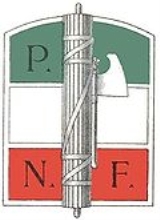
Blackshirts
The Blackshirts were
Fascist paramilitary groups in Italy during the period immediately following
World War I and until the end of
World War II.
Inspired by
Giuseppe Garibaldi's Redshirts, the Blackshirts were organized by
Benito Mussolini as a military tool of his
Fascist movement. The founders of the paramilitary groups were nationalist intellectuals, former army officiers or members of the special corp
Arditi, young landowners opposing peasants' and country labourers' unions. Their methods became harsher as Mussolini's power grew, and they used violence, intimidation, and murder against Mussolini's opponents.
Encyclopedia
- For the University of Nebraska–Lincoln Cornhuskers Football Team, see Blackshirts .
The
Blackshirts were
Fascist paramilitary groups in Italy during the period immediately following
World War I and until the end of
World War II.
Inspired by
Giuseppe Garibaldi's Redshirts, the Blackshirts were organized by
Benito Mussolini as a military tool of his
Fascist movement. The founders of the paramilitary groups were nationalist intellectuals, former army officiers or members of the special corp
Arditi, young landowners opposing peasants' and country labourers' unions. Their methods became harsher as Mussolini's power grew, and they used violence, intimidation, and murder against Mussolini's opponents. One of their distinctive techniques was force-feeding castor oil.
The ethos and sometimes the uniform were later copied by others who shared Mussolini's political ideas, including
Adolf Hitler in
Nazi Germany, who issued brown shirts to the
Sturmabteilung and black uniforms to the
Schutzstaffel , Sir
Oswald Mosley in the
United Kingdom ,
William Dudley Pelley in the
United States ,
Plínio Salgado in
Brazil , and
Eoin O'Duffy in the
Irish Free State . In recent years, the name has been appropriated by a militant fathers' rights in
Australia.
History
Established as the
squadristi in 1919 and consisted of many disgruntled former soldiers which may have numbered 20,000 by the time of Mussolini's March on Rome in 1922. In 1922 the
squadristi were reorganized into the
milizia and formed numerous
bandiere, and on 1 February 1923 they became the MVSN , which lasted until the Italian Armistice in 1943. The
Italian Social Republic, northern Italy occupied by Nazi Germany, reformed them into the GNR .
Organization
Benito Mussolini was always the Commandant-General, but executive functions were carried out by the Chief of Staff, equivalent to an army general. The MVSN especially was formed in imitation of the old
Roman army as follows:
Basic Organization
The terms after the first are neither words common to European armies nor are they purely arbitrary, but derive from the structure of the army of ancient Rome.
- Zona = division
- Legione = regiment, each legion was a militia unit consisting of a small active cadre and a large reserve of civilian volunteers.
- Coorte = battalion
- Centuria = company
- Manipolo = platoon
- Squadra = squad
These units were also organized on the triangular principle as follows:
- 3 squadre = 1 manipolo
- 3 manipoli = 1 centuria
- 3 centurie = 1 coorte
- 3 coorti = 1 legione
- 3 legioni = 1 divisioni or
- 3 or more legioni = 1 zona
Territorial Organization
The MVSN original organization consisted of 15 zones controlling 133 legions of three cohorts each and one Independent Group controlling 10 legions. In 1929 it was reorganized into four
raggruppamenti, but later in October of 1936 it was reorganized into 14 zones controlling only 133 legions with two cohorts each, one of men 21 to 36 years old and the other of men up to 55 years old, plus special units in Rome, on
Ponza Island and the black uniformed
Moschettieri del Duce and the Albanian Militia and Colonial Militia in
Africa .
Special militias were also organized to provide security police functions, these included:
Security Militia
- Anti-aircraft and Coastal Artillery Militia, a combined command which controlled two militias:
- Forestry Militia
- Frontier Militia
- Highway Militia
- Port Militia
- Posts and Telegraph Militia
- Railway Militia
- University Militia
Mobile Units
During the 1936
Abyssinian Campaign or the Invasion of
Ethiopia, the MVSN were able to raise six field divisions:
- 1st MVSN Division "23 Marzo"
- 2d MVSN Division "28 Ottobre"
- 3d MVSN Division "21 Aprile"
- 4th MVSN Division "3 Gennaio"
- 5th MVSN Division "1 Febbraio"
- 6th MVSN Division "Tevere"
In 1940 the MVSN was able to muster 340,000 first-line combat troops, providing three divisions , in 1942 a fourth division was forming, and provided a
Gruppo di Assalto to each army division. These Gruppi consisted of two cohorts plus Gruppo Supporto company of two heavy machine gun
manipoli and two 81 mm mortar
manipoli .
Later 41 Mobile groups were raised to become the third regiment in Italian Army divisions. These mobile groups suffered heavy casualties due to being undermanned, underequipped and undertrained. The three divisions were destroyed in combat in
North Africa. The MVSN fought in every theater where Italy did.
The fall of the fascist regime in Italy and the disbandment of the MVSN saw the establishment of the GNR, and the emergence of the
brigate nere or
Black Brigades. The 40 Black Brigades consisted of former MVSN, former
Carabinieri, former soldiers and others still loyal to the fascist cause. They alongside their counterparts, the
Nazi SS, committed many atrocities.
Ranks
Mussolini as
Comandante Generale was made
Primo Caporale Onorario in 1935 and Adolf Hitler was made
Caporale Onorario in 1937. All other ranks closely approximated those of the old Roman army as follows:
- Comandante generale = Commander-in-chief
- Comandante = general
- Console generale = brigadier general
- Console = colonel and commanded a legion
- Primo seniore = lieutenant colonel
- Seniore = major who commanded a cohort
- Centurione = captain who commanded a centuria
- Capomanipolo = First Lieutenant
- Sottocapomanipolo = second lieutenant
- Aspirante sottocapomanipolo = officer cadet
- Primo aiutante = First or Master Warrant officer
- Aiutante capo = Chief Warrant Officer
- Aiutante = Warrant officer
- Primo capo squadra = First Sergeant
- Capo squadra = Squad Leader or Corporal or Sergeant
- Vicecapo squadra = Vice Squad Leader or Lance Corporal
- Camicia nera scelta = Private First Class
- Camicia nera = Private
Uniforms
The MVSN wore the basic army uniform, either the grey green wool or khaki drill with a black shirt and tie, black collar patches bearing silver metal
fascio and a black fez with tassles.
Rank insignias were similar to those of the army, with enlisted rank stripes in black braided chevrons, and officer ranks stripes in black braid with the topmost having a lozenge shaped loop instead of the army's round or oval loop.
They also wore a black-colored version of the standard Italian army helmet, again with a silver
fascio on the front, although later in the war they wore a standard grey-green army helmet with a black stenciled fascia on the front.
The GNR wore a black shirt or turtle necked shirt or sweater with black helmets and Italian army trousers. This symbolised the blackshirts.
See also
External links