

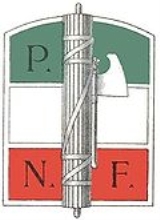
National Fascist Party

Encyclopedia
The National Fascist Party (Partito Nazionale Fascista; PNF) was an Italian political party
, created by Benito Mussolini
as the political expression of fascism
(previously represented by groups known as Fasci
; see also Italian Fascism
). The party ruled
Italy
from 1922 to 1943 under an authoritarian system that described itself as totalitarian, even though, according to today's criteria, it was not.
It is currently the only party whose reformation is explicitly banned by the Constitution of Italy
: "it shall be forbidden to reorganize, under any form whatever, the dissolved fascist party" ("Transitory and Final Provisions", Disposition XII) This paragraph may also apply to the later Republican Fascist Party
.
. The party officially abandoned all republican values when trying to earn the support of the monarchy to form a government. Also, upon coming to power, the party eventually abandoned anti-clerical policies for the tactical purpose of gaining the support of Catholic groups, and later under Mussolini the PNF endorsed the signing of the Lateran Treaty which created the Vatican City
and normalized relations between Italy and the Church which had been badly damaged since the forced annexation of the Papal States in 1870.
. In theory, trade unions and businesses would unite to form a cooperative organization to establish wages, hours of labour, and other issues. However when attempted to be put into practice, corporatism was heavily criticized by the industries who had provided financing in the past to Mussolini to protect them from socialism, and demanded that he keep the labour movement weakened to maintain their support, to which Mussolini and the party agreed, causing corporatism to favour businesses over workers who could be in only Fascist unions.
by having Italy militarily dominate the Mediterranean as part of their policy of "Mare Nostrum
" ("Our Sea") and push for colonial expansion in Africa. The Fascists' inter-war period interventionist approach brought Italy to occupy the Greek island of Corfu
in 1923, the regime allowed the annexation of the Italian occupied city of Fiume in 1924, and from the 1920s to 1934, the regime succeeded in negotiations with Britain and France in expanding the Italian colonies of Tripolitania
, Cyrenaica
, and Fezzan
until they were formally unified into the colony of Italian Libya
in 1934.
In 1935, the party advocated and proceeded to bring Italy into a colonial war with Ethiopia. The war was meant as an act of restoring Italian national pride on the international stage that had been damaged in Italy's failure to win a previous colonial war with Ethiopia in 1896.
The war with Ethiopia succeeded in 1936, but left Italy isolated with only one other country supporting Italy, Germany under the NSDAP regime of Adolf Hitler
. Although Hitler's Nazi Party was largely similar and to a significant degree based on that of the PNF, the two ideologies in both countries had differences. Fascists distrusted Hitler's aims at annexing Austria as they feared the next target would be German-populated areas of Italian-held Tyrol
, moreover Austrian independence protected Italy from any such aggression, and Austria's fascist regime had maintained good relations with Italy so that in 1934, following the assassination of Austrian leader Engelbert Dollfuss
by Austrian Nazis, Mussolini and the PNF promised Austria military support if Germany attempted annexation. Also, unlike the NSDAP Party, the PNF did not support anti-Semitism
as a number of its members were Jewish, including Mussolini's mistress and PNF propaganda director Margherita Sarfatti
, and Ettore Ovazza
who in 1935 founded the Jewish Fascist paper La Nostra Bandiera ("Our Flag"). Nevertheless, the two regimes stood eye-to-eye on other policy issues, such as both regimes' opposition to the Treaty of Versailles
and both regimes' fervent anti-communism and interventionist attitude toward combatting communist influence.
It was anti-communist sentiment that brought the two regimes to ally in the Axis Pact in 1936, and support the nationalist forces of Francisco Franco
in Spain against leftist republican forces during the Spanish Civil War
. In 1938, Mussolini (himself also forced by Nazi officials) pressured the PNF to implement anti-Semitic racial policies, the Manifesto of Race, to maintain good relations with Germany to which they reluctantly agreed. These measures were opposed by a number of Fascists including Mussolini's son-in-law and foreign minister Galeazzo Ciano
.
A famous Jewish
apologist for the National Fascist Party abroad was Margherita Sarfatti
, a mistress
of Mussolini's, who until 1938 defended the regime in the United States and Great Britain.
Fasci Italiani di Combattimento
into a more coherent political group (the Fasci di Combattimento had been founded by Mussolini in Milan
's Piazza San Sepolcro, on March 23, 1919).
The PNF was instrumental in directing and popularizing support for Mussolini's ideology. In the early years, groups within the PNF called Blackshirts
built a base of power
by violently attacking socialists
and their institutions in the rural Po Valley
thereby gaining the support of landowners.
The PNF was the main agent of an attempted coup d'état
on October 28, 1922, the March on Rome
. Even though the coup failed in giving power directly to the PNF, it nonetheless resulted in a parallel agreement between Mussolini and King
Victor Emmanuel III
that made Mussolini the head of the Italian government.
After the drastic modifying of electoral legislation (the Acerbo Law
), the PNF clearly won the highly controversial elections of April 1924
. In early 1925, Mussolini dropped all pretense of democracy and set up a total dictatorship. From that point onward, the PNF was effectively the only legally permitted party in the country. This status was formalized by a law passed in 1928 and Italy remained a one-party state
until the end of the Fascist regime in 1943.
After taking sole power, the Fascist regime began to impose Fascist ideology and symbolism throughout the country. Party membership in the PNF became necessary to seek employment or gain government assistance. The fasces
adorned public buildings, Fascist mottos and symbols were displayed on art, and a personality cult was created around Mussolini as the nation's saviour and was called "Il Duce", "The Leader". The Italian parliament was replaced in duties by the Grand Council of Fascism
solely filled with PNF members. The PNF promoted Italian imperialism in Africa and staunchly promoted racial segregation and white supremacy of Italian settlers in the colonies.
The Grand Council of Fascism
, following a request of Dino Grandi
, overthrew Mussolini on July 25, 1943 by asking the king to resume his full authority in officially removing Mussolini as prime minister, which he did, and Mussolini was imprisoned; however, the Fascists immediately collapsed and the party was officially banned by Pietro Badoglio
's government on July 27.
After the Nazi
-engineered Gran Sasso raid liberated Mussolini in September, the PNF was revived as the Republican Fascist Party
(Partito Fascista Repubblicano - PFR; September 13), as the single party of the Northern and Nazi-protected Italian Social Republic
(the Salò
Republic). Its secretary was Alessandro Pavolini
. The PFR did not outlast Mussolini's execution and the disappearance of the Salò state in April 1945.
Political party
A political party is a political organization that typically seeks to influence government policy, usually by nominating their own candidates and trying to seat them in political office. Parties participate in electoral campaigns, educational outreach or protest actions...
, created by Benito Mussolini
Benito Mussolini
Benito Amilcare Andrea Mussolini was an Italian politician who led the National Fascist Party and is credited with being one of the key figures in the creation of Fascism....
as the political expression of fascism
Fascism
Fascism is a radical authoritarian nationalist political ideology. Fascists seek to rejuvenate their nation based on commitment to the national community as an organic entity, in which individuals are bound together in national identity by suprapersonal connections of ancestry, culture, and blood...
(previously represented by groups known as Fasci
Fascio
Fascio, plural -sci /'faʃʃo, ʃi/ is an Italian word literally meaning "a bundle" or "a sheaf", and figuratively league, and which was used in the late 19th century to refer to political groups of many different orientations...
; see also Italian Fascism
Italian Fascism
Italian Fascism also known as Fascism with a capital "F" refers to the original fascist ideology in Italy. This ideology is associated with the National Fascist Party which under Benito Mussolini ruled the Kingdom of Italy from 1922 until 1943, the Republican Fascist Party which ruled the Italian...
). The party ruled
Ruling party
The ruling party or governing party in a parliamentary system is the political party or coalition of the majority in parliament. Within a parliamentary system, the majority in the legislature also controls the executive branch of government, thus leaving no possibility of dueling parties...
Italy
Italy
Italy , officially the Italian Republic languages]] under the European Charter for Regional or Minority Languages. In each of these, Italy's official name is as follows:;;;;;;;;), is a unitary parliamentary republic in South-Central Europe. To the north it borders France, Switzerland, Austria and...
from 1922 to 1943 under an authoritarian system that described itself as totalitarian, even though, according to today's criteria, it was not.
It is currently the only party whose reformation is explicitly banned by the Constitution of Italy
Constitution of Italy
The Constitution of the Italian Republic was enacted by the Constituent Assembly on 22 December 1947, with 453 votes in favour and 62 against. The text, which has since been amended 13 times, was promulgated in the extraordinary edition of Gazzetta Ufficiale No. 298 on 27 December 1947...
: "it shall be forbidden to reorganize, under any form whatever, the dissolved fascist party" ("Transitory and Final Provisions", Disposition XII) This paragraph may also apply to the later Republican Fascist Party
Republican Fascist Party
The Republican Fascist Party was a political party led by Benito Mussolini during the German occupation of Central and Northern Italy. It was founded as the successor of former National Fascist Party as an anti-monarchist party...
.
Policy
The policies of the National Fascist Party evolved over time. Initially the party harboured anti-clerical and republican values, but always maintained a nationalist agenda combined with degrees of statism and fervent anti-communism. The party adopted large elements of its policies from the authoritarian wing of the former Italian Nationalist AssociationItalian Nationalist Association
The Italian Nationalist Association, Associazione Nazionalista Italiana was Italy's first nationalist political party founded in 1910. under the influence of Italian nationalists such as Enrico Corradini and Giovanni Papini...
. The party officially abandoned all republican values when trying to earn the support of the monarchy to form a government. Also, upon coming to power, the party eventually abandoned anti-clerical policies for the tactical purpose of gaining the support of Catholic groups, and later under Mussolini the PNF endorsed the signing of the Lateran Treaty which created the Vatican City
Vatican City
Vatican City , or Vatican City State, in Italian officially Stato della Città del Vaticano , which translates literally as State of the City of the Vatican, is a landlocked sovereign city-state whose territory consists of a walled enclave within the city of Rome, Italy. It has an area of...
and normalized relations between Italy and the Church which had been badly damaged since the forced annexation of the Papal States in 1870.
Economics
In power, the party attempted to form an economic policy that was a "third way" between capitalism and socialism, this was called CorporatismCorporatism
Corporatism, also known as corporativism, is a system of economic, political, or social organization that involves association of the people of society into corporate groups, such as agricultural, business, ethnic, labor, military, patronage, or scientific affiliations, on the basis of common...
. In theory, trade unions and businesses would unite to form a cooperative organization to establish wages, hours of labour, and other issues. However when attempted to be put into practice, corporatism was heavily criticized by the industries who had provided financing in the past to Mussolini to protect them from socialism, and demanded that he keep the labour movement weakened to maintain their support, to which Mussolini and the party agreed, causing corporatism to favour businesses over workers who could be in only Fascist unions.
Foreign policy
In foreign policy, the party promised to return Italy to being an important world power, and claimed that Italy would become a New Roman EmpireItalian Empire
The Italian Empire was created after the Kingdom of Italy joined other European powers in establishing colonies overseas during the "scramble for Africa". Modern Italy as a unified state only existed from 1861. By this time France, Spain, Portugal, Britain, and the Netherlands, had already carved...
by having Italy militarily dominate the Mediterranean as part of their policy of "Mare Nostrum
Mare Nostrum
Mare Nostrum may refer to:*Mare Nostrum, the Roman term for the Mediterranean Sea, adopted by Italian nationalists and fascists.*Mare Nostrum , a Spanish-language novel by Vicente Blasco Ibáñez...
" ("Our Sea") and push for colonial expansion in Africa. The Fascists' inter-war period interventionist approach brought Italy to occupy the Greek island of Corfu
Corfu
Corfu is a Greek island in the Ionian Sea. It is the second largest of the Ionian Islands, and, including its small satellite islands, forms the edge of the northwestern frontier of Greece. The island is part of the Corfu regional unit, and is administered as a single municipality. The...
in 1923, the regime allowed the annexation of the Italian occupied city of Fiume in 1924, and from the 1920s to 1934, the regime succeeded in negotiations with Britain and France in expanding the Italian colonies of Tripolitania
Tripolitania
Tripolitania or Tripolitana is a historic region and former province of Libya.Tripolitania was a separate Italian colony from 1927 to 1934...
, Cyrenaica
Cyrenaica
Cyrenaica is the eastern coastal region of Libya.Also known as Pentapolis in antiquity, it was part of the Creta et Cyrenaica province during the Roman period, later divided in Libia Pentapolis and Libia Sicca...
, and Fezzan
Fezzan
Fezzan is a south western region of modern Libya. It is largely desert but broken by mountains, uplands, and dry river valleys in the north, where oases enable ancient towns and villages to survive deep in the otherwise inhospitable Sahara.-Name:...
until they were formally unified into the colony of Italian Libya
Italian Libya
Italian Libya was a unified colony of Italian North Africa established in 1934 in what represents present-day Libya...
in 1934.
In 1935, the party advocated and proceeded to bring Italy into a colonial war with Ethiopia. The war was meant as an act of restoring Italian national pride on the international stage that had been damaged in Italy's failure to win a previous colonial war with Ethiopia in 1896.
The war with Ethiopia succeeded in 1936, but left Italy isolated with only one other country supporting Italy, Germany under the NSDAP regime of Adolf Hitler
Adolf Hitler
Adolf Hitler was an Austrian-born German politician and the leader of the National Socialist German Workers Party , commonly referred to as the Nazi Party). He was Chancellor of Germany from 1933 to 1945, and head of state from 1934 to 1945...
. Although Hitler's Nazi Party was largely similar and to a significant degree based on that of the PNF, the two ideologies in both countries had differences. Fascists distrusted Hitler's aims at annexing Austria as they feared the next target would be German-populated areas of Italian-held Tyrol
County of Tyrol
The County of Tyrol, Princely County from 1504, was a State of the Holy Roman Empire, from 1814 a province of the Austrian Empire and from 1867 a Cisleithanian crown land of Austria-Hungary...
, moreover Austrian independence protected Italy from any such aggression, and Austria's fascist regime had maintained good relations with Italy so that in 1934, following the assassination of Austrian leader Engelbert Dollfuss
Engelbert Dollfuss
Engelbert Dollfuss was an Austrian Christian Social and Patriotic Front statesman. Serving previously as Minister for Forest and Agriculture, he ascended to Federal Chancellor in 1932 in the midst of a crisis for the conservative government...
by Austrian Nazis, Mussolini and the PNF promised Austria military support if Germany attempted annexation. Also, unlike the NSDAP Party, the PNF did not support anti-Semitism
Anti-Semitism
Antisemitism is suspicion of, hatred toward, or discrimination against Jews for reasons connected to their Jewish heritage. According to a 2005 U.S...
as a number of its members were Jewish, including Mussolini's mistress and PNF propaganda director Margherita Sarfatti
Margherita Sarfatti
Margherita Sarfatti was a Jewish Italian journalist, art critic, patron, collector, socialite, and one of Benito Mussolini's mistresses.-Biography:...
, and Ettore Ovazza
Ettore Ovazza
Ettore Ovazza was a Jew from Turin who served for a time as a minister in Benito Mussolini's government.-Early life and family:...
who in 1935 founded the Jewish Fascist paper La Nostra Bandiera ("Our Flag"). Nevertheless, the two regimes stood eye-to-eye on other policy issues, such as both regimes' opposition to the Treaty of Versailles
Treaty of Versailles
The Treaty of Versailles was one of the peace treaties at the end of World War I. It ended the state of war between Germany and the Allied Powers. It was signed on 28 June 1919, exactly five years after the assassination of Archduke Franz Ferdinand. The other Central Powers on the German side of...
and both regimes' fervent anti-communism and interventionist attitude toward combatting communist influence.
It was anti-communist sentiment that brought the two regimes to ally in the Axis Pact in 1936, and support the nationalist forces of Francisco Franco
Francisco Franco
Francisco Franco y Bahamonde was a Spanish general, dictator and head of state of Spain from October 1936 , and de facto regent of the nominally restored Kingdom of Spain from 1947 until his death in November, 1975...
in Spain against leftist republican forces during the Spanish Civil War
Spanish Civil War
The Spanish Civil WarAlso known as The Crusade among Nationalists, the Fourth Carlist War among Carlists, and The Rebellion or Uprising among Republicans. was a major conflict fought in Spain from 17 July 1936 to 1 April 1939...
. In 1938, Mussolini (himself also forced by Nazi officials) pressured the PNF to implement anti-Semitic racial policies, the Manifesto of Race, to maintain good relations with Germany to which they reluctantly agreed. These measures were opposed by a number of Fascists including Mussolini's son-in-law and foreign minister Galeazzo Ciano
Galeazzo Ciano
Gian Galeazzo Ciano, 2nd Count of Cortellazzo and Buccari was an Italian Minister of Foreign Affairs and Benito Mussolini's son-in-law. In early 1944 Count Ciano was shot by firing squad at the behest of his father-in-law, Mussolini under pressure from Nazi Germany.-Early life:Ciano was born in...
.
A famous Jewish
Jews
The Jews , also known as the Jewish people, are a nation and ethnoreligious group originating in the Israelites or Hebrews of the Ancient Near East. The Jewish ethnicity, nationality, and religion are strongly interrelated, as Judaism is the traditional faith of the Jewish nation...
apologist for the National Fascist Party abroad was Margherita Sarfatti
Margherita Sarfatti
Margherita Sarfatti was a Jewish Italian journalist, art critic, patron, collector, socialite, and one of Benito Mussolini's mistresses.-Biography:...
, a mistress
Mistress (lover)
A mistress is a long-term female lover and companion who is not married to her partner; the term is used especially when her partner is married. The relationship generally is stable and at least semi-permanent; however, the couple does not live together openly. Also the relationship is usually,...
of Mussolini's, who until 1938 defended the regime in the United States and Great Britain.
History
Founded in Rome on November 9, 1921, it marked the transformation of the paramilitaryParamilitary
A paramilitary is a force whose function and organization are similar to those of a professional military, but which is not considered part of a state's formal armed forces....
Fasci Italiani di Combattimento
Fasci Italiani di Combattimento
The Fasci Italiani di Combattimento were an Italian fascio organization, created by Benito Mussolini in 1919. After World War I had ended, he reconstituted the Milan fascio, renaming it Fasci Italiani di Combattimento. In 1921, this fascio would be transformed into the Partito Nazionale Fascista,...
into a more coherent political group (the Fasci di Combattimento had been founded by Mussolini in Milan
Milan
Milan is the second-largest city in Italy and the capital city of the region of Lombardy and of the province of Milan. The city proper has a population of about 1.3 million, while its urban area, roughly coinciding with its administrative province and the bordering Province of Monza and Brianza ,...
's Piazza San Sepolcro, on March 23, 1919).
The PNF was instrumental in directing and popularizing support for Mussolini's ideology. In the early years, groups within the PNF called Blackshirts
Blackshirts
The Blackshirts were Fascist paramilitary groups in Italy during the period immediately following World War I and until the end of World War II...
built a base of power
Power (sociology)
Power is a measurement of an entity's ability to control its environment, including the behavior of other entities. The term authority is often used for power perceived as legitimate by the social structure. Power can be seen as evil or unjust, but the exercise of power is accepted as endemic to...
by violently attacking socialists
Socialism
Socialism is an economic system characterized by social ownership of the means of production and cooperative management of the economy; or a political philosophy advocating such a system. "Social ownership" may refer to any one of, or a combination of, the following: cooperative enterprises,...
and their institutions in the rural Po Valley
Po River
The Po |Ligurian]]: Bodincus or Bodencus) is a river that flows either or – considering the length of the Maira, a right bank tributary – eastward across northern Italy, from a spring seeping from a stony hillside at Pian del Re, a flat place at the head of the Val Po under the northwest face...
thereby gaining the support of landowners.
The PNF was the main agent of an attempted coup d'état
Coup d'état
A coup d'état state, literally: strike/blow of state)—also known as a coup, putsch, and overthrow—is the sudden, extrajudicial deposition of a government, usually by a small group of the existing state establishment—typically the military—to replace the deposed government with another body; either...
on October 28, 1922, the March on Rome
March on Rome
The March on Rome was a march by which Italian dictator Benito Mussolini's National Fascist Party came to power in the Kingdom of Italy...
. Even though the coup failed in giving power directly to the PNF, it nonetheless resulted in a parallel agreement between Mussolini and King
King of Italy
King of Italy is a title adopted by many rulers of the Italian peninsula after the fall of the Roman Empire...
Victor Emmanuel III
Victor Emmanuel III of Italy
Victor Emmanuel III was a member of the House of Savoy and King of Italy . In addition, he claimed the crowns of Ethiopia and Albania and claimed the titles Emperor of Ethiopia and King of Albania , which were unrecognised by the Great Powers...
that made Mussolini the head of the Italian government.
After the drastic modifying of electoral legislation (the Acerbo Law
Acerbo Law
The Acerbo Law was an Italian electoral law proposed by Baron Giacomo Acerbo and passed by the Italian Parliament in 1924. The purpose of it was to give Mussolini's fascist party a majority of deputies.-Background:...
), the PNF clearly won the highly controversial elections of April 1924
Italian general election, 1924
The Italian general election of 1924 took place on 6 April 1924, under the Acerbo Law. The National Fascist Party used intimidation tactics that produced a landslide victory for Benito Mussolini's "National List" and a subsequent two-thirds majority The Italian general election of 1924 took place...
. In early 1925, Mussolini dropped all pretense of democracy and set up a total dictatorship. From that point onward, the PNF was effectively the only legally permitted party in the country. This status was formalized by a law passed in 1928 and Italy remained a one-party state
Single-party state
A single-party state, one-party system or single-party system is a type of party system government in which a single political party forms the government and no other parties are permitted to run candidates for election...
until the end of the Fascist regime in 1943.
After taking sole power, the Fascist regime began to impose Fascist ideology and symbolism throughout the country. Party membership in the PNF became necessary to seek employment or gain government assistance. The fasces
Fasces
Fasces are a bundle of wooden sticks with an axe blade emerging from the center, which is an image that traditionally symbolizes summary power and jurisdiction, and/or "strength through unity"...
adorned public buildings, Fascist mottos and symbols were displayed on art, and a personality cult was created around Mussolini as the nation's saviour and was called "Il Duce", "The Leader". The Italian parliament was replaced in duties by the Grand Council of Fascism
Grand Council of Fascism
The Grand Council of Fascism was the main body of Mussolini's Fascist government in Italy. A body which held and applied great power to control the institutions of government, it was created as a party body in 1923 and became a state body on 9 December 1928....
solely filled with PNF members. The PNF promoted Italian imperialism in Africa and staunchly promoted racial segregation and white supremacy of Italian settlers in the colonies.
The Grand Council of Fascism
Grand Council of Fascism
The Grand Council of Fascism was the main body of Mussolini's Fascist government in Italy. A body which held and applied great power to control the institutions of government, it was created as a party body in 1923 and became a state body on 9 December 1928....
, following a request of Dino Grandi
Dino Grandi
Dino Grandi , Conte di Mordano, was an Italian Fascist politician, minister of justice, minister of foreign affairs and president of parliament.- Early life :...
, overthrew Mussolini on July 25, 1943 by asking the king to resume his full authority in officially removing Mussolini as prime minister, which he did, and Mussolini was imprisoned; however, the Fascists immediately collapsed and the party was officially banned by Pietro Badoglio
Pietro Badoglio
Pietro Badoglio, 1st Duke of Addis Abeba, 1st Marquess of Sabotino was an Italian soldier and politician...
's government on July 27.
After the Nazi
Nazi Germany
Nazi Germany , also known as the Third Reich , but officially called German Reich from 1933 to 1943 and Greater German Reich from 26 June 1943 onward, is the name commonly used to refer to the state of Germany from 1933 to 1945, when it was a totalitarian dictatorship ruled by...
-engineered Gran Sasso raid liberated Mussolini in September, the PNF was revived as the Republican Fascist Party
Republican Fascist Party
The Republican Fascist Party was a political party led by Benito Mussolini during the German occupation of Central and Northern Italy. It was founded as the successor of former National Fascist Party as an anti-monarchist party...
(Partito Fascista Repubblicano - PFR; September 13), as the single party of the Northern and Nazi-protected Italian Social Republic
Italian Social Republic
The Italian Social Republic was a puppet state of Nazi Germany led by the "Duce of the Nation" and "Minister of Foreign Affairs" Benito Mussolini and his Republican Fascist Party. The RSI exercised nominal sovereignty in northern Italy but was largely dependent on the Wehrmacht to maintain control...
(the Salò
Salò
Salò is a town and commune in the Province of Brescia in the region of Lombardy on the banks of Lake Garda. The city was the capital of Italian Social Republic from 1943 to 1945, with the ISR often being called the "Republic of Salò" .-History:Salò was founded in the Roman period as Pagus...
Republic). Its secretary was Alessandro Pavolini
Alessandro Pavolini
Alessandro Pavolini was an Italian politician, journalist, and essayist, notable for his involvement in the Fascist government during World War II and also for his cruelty against the opponents of fascism....
. The PFR did not outlast Mussolini's execution and the disappearance of the Salò state in April 1945.
Secretaries of the PNF
- Michele BianchiMichele BianchiMichele Bianchi was an Italian revolutionary syndicalist leader. He was among the founding members of the Fascist movement. He was widely seen as the dominant leader of the leftist, syndicalist wing of the National Fascist Party, and one of the most influential politicians of the regime before his...
(November 1921 - January 1923) - multiple presidency (January 1923 - October 1923)
- TriumvirateTriumvirateA triumvirate is a political regime dominated by three powerful individuals, each a triumvir . The arrangement can be formal or informal, and though the three are usually equal on paper, in reality this is rarely the case...
: Michele Bianchi, Nicola Sansanelli, Giuseppe BastianiniGiuseppe BastianiniGiuseppe Bastianini was an Italian politician and diplomat. Initially associated with the hard-line elements of the fascist movements he later became a member of the dissident tendency....
- Francesco GiuntaFrancesco GiuntaFrancesco Giunta was an Italian Fascist politician.-Early fascist career:Born in the Tuscan town of San Piero a Sieve, he started his career as a lawyer. He served as a machine gun captain in the World War I...
(October 15, 1923 - April 22, 1924) - multiple presidency (April 23, 1924 - February 15, 1925)
- Francesco Giunta
- Quadrumvirate: Roberto Forges DavanzatiRoberto Forges DavanzatiRoberto Forges Davanzati was an Italian journalist, academic and politician. Initially a syndicalist he later became a nationalist and fascist....
, Cesare RossiCesare Rossi (politician)Cesare Rossi was an Italian fascist leader who later became estranged from the regime.-Syndicalism:...
, Giovanni MarinelliGiovanni MarinelliGiovanni Marinelli was an Italian Fascist political leader.Marinelli was born in Adria, Veneto.A wealthy man, he contributed to Fascist success by financing the March on Rome. Secretary of the National Fascist Party , he created the Ceka, a secret police established on the model of the Soviet Cheka...
, Alessandro Melchiorri- Roberto FarinacciRoberto FarinacciRoberto Farinacci was a leading Italian Fascist politician, and important member of the National Fascist Party before and during World War II, and one of its ardent anti-Semitic proponents.-Early life:...
(February 15, 1925 - March 30, 1926) - Augusto TuratiAugusto TuratiAugusto Turati was an Italian journalist and Fascist politician.Born in Parma, after moving to Brescia as a young man, Turati worked on newspapers and became one of the editors at the liberal Provincia di Brescia; he attended law classes, but never graduated...
(March 30, 1926 - October 7, 1930) - Giovanni GiuriatiGiovanni GiuriatiGiovanni Giuriati was an Italian Fascist politician.-Biography:Giuriati was born in Venice.A law graduate and lawyer, he associated in 1903 with the irredentist group Trento e Trieste , and soon became its president...
(October 1930 - December 1931) - Achille StaraceAchille StaraceAchille Starace was a prominent leader of Fascist Italy prior to and during World War II.-Early life and career:Starace was born in Gallipoli in southern Italy near Lecce. He was son of a wine and oil merchant....
(December 1931 - October 31, 1939) - Ettore MutiEttore MutiEttore Muti was an Italian aviator and Fascist politician. He was Party Secretary of the National Fascist Party from October 1939 until shortly after the entry of Italy into World War II on June 10, 1940.-World War I and Fiume:Born in Ravenna, Romagna, Muti was banned from any school in the...
(October 31, 1939 - October 30, 1940) - Adelchi Serena (October 30, 1940 - December 26, 1941)
- Aldo VidussoniAldo VidussoniAldo Vidussoni was an Italian lawyer and Fascist politician.After law studies at the University of Trieste, Vidussoni joined the Partito Nazionale Fascista in May 1936...
(December 26, 1941 - April 19, 1943) - Carlo ScorzaCarlo ScorzaCarlo Scorza was a prominent member of the National Fascist Party of Italy during World War II. He built his reputation in the Fascist paramilitary group known as the Blackshirts, and later rose to the position of party secretary, second only to Benito Mussolini in authority over the wartime...
(April 19, 1943 - July 27, 1943)
- Roberto Farinacci
Election results
| Election date | Party leader | Number of votes received | Percentage of votes | Number of deputies |
|---|---|---|---|---|
| 1921 Italian general election, 1921 The Italian general election of 1921 took place on 15 May 1921.The Liberal governing coalition, strengthened by the joining of Fascist candidates in the "National Blocs" , came short of a majority... |
Benito Mussolini Benito Mussolini Benito Amilcare Andrea Mussolini was an Italian politician who led the National Fascist Party and is credited with being one of the key figures in the creation of Fascism.... |
31,000 | 0.5% | 2 |
| 1924 Italian general election, 1924 The Italian general election of 1924 took place on 6 April 1924, under the Acerbo Law. The National Fascist Party used intimidation tactics that produced a landslide victory for Benito Mussolini's "National List" and a subsequent two-thirds majority The Italian general election of 1924 took place... |
Benito Mussolini Benito Mussolini Benito Amilcare Andrea Mussolini was an Italian politician who led the National Fascist Party and is credited with being one of the key figures in the creation of Fascism.... |
4,305,936 | 61.3% | 356 |
| 1929 Italian general election, 1929 The Italian general elections of 1929 were held on March 24, 1929. This is actually the first election in Italy with women's suffrage, although to a parliamentary reform enacted in 1928 by the Chamber of Deputies and Senate, elections were to be held as a simple referendum, with the Grand Council... |
Benito Mussolini Benito Mussolini Benito Amilcare Andrea Mussolini was an Italian politician who led the National Fascist Party and is credited with being one of the key figures in the creation of Fascism.... |
8,517,838 | 98.33% | 535 |
| 1934 Italian general election, 1934 The Italian general elections of 1934 were held on March 25, 1934. Due to a parliamentary reform in 1928 by the fascist-dominated Chamber of Deputies, the election were held as a simple referendum, with the voters were given the options to say yes or no to a single party list composed by the Grand... |
Benito Mussolini Benito Mussolini Benito Amilcare Andrea Mussolini was an Italian politician who led the National Fascist Party and is credited with being one of the key figures in the creation of Fascism.... |
10,026,513 | 99.84% | 535 |
Slogans
- Il Duce! (The Leader!)
- Viva il Duce! (Long live the Leader!)
- Eja, eja, alalà! (Equivalent in English to Hip, hip, hooray!)
- Viva la morte (Long live death [sacrifice])
- Credere, obbedire, combattere ("Believe, obey, fight")
- Libro e moschetto - fascista perfetto (Book and rifle - make the perfect Fascist)
- Tutto nello Stato, niente al di fuori dello Stato, nulla contro lo Stato (Everything in the State, nothing outside the State, nothing against the State)
- Se avanzo, seguitemi. Se indietreggio, uccidetemi. Se muoio, vendicatemi (If I advance, follow me. If I retreat, kill me. If I die, avenge me)
- Me ne frego (I don't give a damn)
- La libertà non è diritto è un dovere (Liberty is not a right it is a duty)
- Noi tireremo diritto (literally We will go straight or We shall go forward)
- La guerra è per l'uomo, come la maternità è per la donna (War is to man, as motherhood is to woman)