

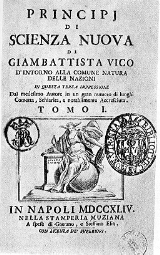
Giambattista Vico

Encyclopedia
Giovanni Battista Vico or Vigo (23 June 1668 – 23 January 1744) was an Italian
political philosopher, rhetorician, historian
, and jurist
.
A critic of modern rationalism and apologist of classical antiquity, Vico's magnum opus
is Principi di Scienza Nuova d'intorno alla Comune Natura delle Nazioni, often published in English as New Science, which may be literally translated as "Principles/Origins of New/Renewed Science About/Surrounding the Common Nature of Nations". The work is explicitly presented as a "science of reasoning" (Scienza di ragionare), and includes a dialectic between axioms (authoritative maxims) and "reasonings" (ragionamenti) linking and clarifying the axioms. Vico is often claimed to have inaugurated modern philosophy of history
, although the term is not found in his text (Vico speaks of a "history of philosophy narrated philosophically"). He is otherwise well known for noting that verum esse ipsum factum ("true itself is fact" or "the true itself is made"), a proposition that has been read as an early instance of constructivist epistemology
.
While Vico was not, strictly speaking, a historicist
, interest in him has often been driven by historicists (such as Isaiah Berlin
and Hayden White
).
, Italy
, Vico attended a series of grammar schools, but ill-health and dissatisfaction with Jesuit scholasticism
led to home schooling.
After a bout of typhus
in 1686, Vico accepted a tutoring position in Vatolla (a Frazione
of the comune
of Perdifumo
), south of Salerno
, that would last for nine years. In 1699, he married a childhood friend, Teresa Destito, and took a chair in rhetoric
at the University of Naples. Throughout his career, Vico would aspire to, but never attain, the more respectable chair of jurisprudence. In 1734, however, he was appointed royal historiographer by Charles III
, king of Naples, and was afforded a salary far surpassing that of his professorship. Vico retained the chair of rhetoric until ill-health forced him to retire in 1741.
, through observation: “The criterion and rule of the true is to have made it. Accordingly, our clear and distinct idea of the mind cannot be a criterion of the mind itself, still less of other truths. For while the mind perceives itself, it does not make itself.” This criterion for truth would later shape the history of civilization
in Vico’s opus, the Scienza Nuova (The New Science, 1725), because he would argue that civil life like mathematics
is wholly constructed.
Relying on a complex etymology, Vico argues in the Scienza Nuova that civilization develops in a recurring cycle (ricorso) of three ages: the divine, the heroic, and the human. Each age exhibits distinct political and social features and can be characterized by master tropes or figures of language
. The giganti of the divine age rely on metaphor
to compare, and thus comprehend, human and natural phenomena. In the heroic age, metonymy
and synecdoche
support the development of feudal or monarchic institutions embodied by idealized figures. The final age is characterized by popular democracy
and reflection via irony
; in this epoch, the rise of rationality
leads to barbarie della reflessione or barbarism of reflection, and civilization descends once more into the poetic era. Taken together, the recurring cycle of three ages common to every nation constitutes for Vico a storia ideale eterna or ideal eternal history.
Vico’s major work was poorly received during his own life but has since inspired a cadre of famous thinkers and artists, including Karl Marx
. Later his work was received more favourably as in the case of Lord Monboddo to whom he was compared in a modern treatise.
and pedagogic concerns. In De Nostri Temporis Studiorum Ratione ("On the Order of the Scholarly Disciplines of Our Times"), presented at the commencement ceremonies of 1708, Vico argued that whoever “intends a career in public life, whether in the courts, the senate, or the pulpit” should be taught to “master the art of topics and defend both sides of a controversy, be it on nature, man, or politics, in a freer and brighter style of expression, so he can learn to draw on those arguments which are most probable and have the greatest degree of verisimilitude” (however, in his "Scienza Nuova", Vico denounces as "false eloquence" one defending both sides in controversies). As Royal Professor of Latin Eloquence, it was Vico’s task to prepare students for higher studies in law and jurisprudence. His lessons thus dealt with the formal aspects of the rhetorical canon, including arrangement and delivery. Yet as the above oration also makes clear, Vico chose to emphasize the Aristotelian
connection of rhetoric with dialectic
or logic
, thereby reconnecting rhetoric to ends (or topics) as their center. Vico's objection to modern rhetoric is that it cuts itself off from common sense (sensus communis), as the sense common to all men. In his lectures and throughout the body of his work, Vico's rhetoric begins from a central argument
or "middle term" (medius terminus) which it then sets out of clarify by following the order of things as they arise in our experience. Probability
and circumstance
retain their proportionate importance, and discovery
– reliant upon topics or loci – supersedes axiom
s derived through reflective abstraction. In the tradition of classical Roman rhetoric, Vico sets out to educate the orator as the deliverer of the "oratio", a speech having "ratio" or reason/order at its heart. What is essential to the oratory art (as the Greek rhetorike) is the orderly link between common sense and an end commensurate to it—an end that is not imposed upon the imagination from above (in the manner of the moderns and a certain dogmatic form of Christianity), but that is drawn out of common sense itself. In the tradition of Socrates and Cicero, Vico's real orator or rhetorician will serve as midwife in the birth of "the true" (as a form or idea) out of "the certain" (as the confusion or ignorance of the student's particularized mind).
Vico's rediscovery of "the most ancient wisdom" of the senses (a wisdom that is "human foolishness" or humana stultitia), his emphasis on the importance of civic life, and his professional obligations remind us of the humanist tradition. He would call for a maieutic or jurisprudential oratory art against the grain of the modern privileging of a dogmatic form of reason in what he called the “geometrical method” of Descartes and the Port-Royal logicians.
and the natural sciences abounded as the result of Cartesianism. Widely disseminated by the Port Royal Logic of Antoine Arnauld
and Pierre Nicole
, Descartes’ method was rooted in verification: the only path to truth, and thus knowledge, was through axioms derived from observation. Descartes’ insistence that the “sure and indubitable” (or, "clear and distinct") should form the basis of reasoning had an obvious impact on the prevailing views of logic and discourse. Studies in rhetoric indeed all studies concerned with civic discourse and the realm of probable truths met with increasing disdain.
Vico’s humanism and professional concerns prompted an obvious response that he would develop throughout the course of his writings: the realms of verifiable truth and human concern share only a slight overlap, yet reasoning is required in equal measure in both spheres. One of the clearest and earliest forms of this argument is available in the De Italorum Sapientia, where Vico argues that “to introduce geometrical method into practical life is ‘like trying to go mad with the rules of reason,’ attempting to proceed by a straight line among the tortuosities of life, as though human affairs were not ruled by capriciousness, temerity, opportunity, and chance. Similarly, to arrange a political speech according to the precepts of geometrical method is equivalent to stripping it of any acute remarks and to uttering nothing but pedestrian lines of argument.” Vico’s position here and in later works is not that the Cartesian method is irrelevant, but that its application cannot be extended to the civic sphere. Instead of confining reason to a string of verifiable axioms, Vico suggests (along with the ancients) that appeals to phronêsis or practical wisdom must also be made, as do appeals to the various components of persuasion
that comprise rhetoric. Vico would reproduce this argument consistently throughout his works, and would use it as a central tenet
of the Scienza Nuova.
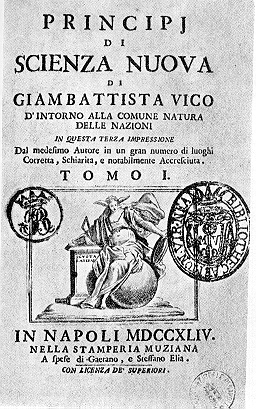 In 1720, Vico began work on the Scienza Nuova – his self-proclaimed masterpiece – as part of a treatise on Universal rights. Although a full volume was originally to be sponsored by Cardinal Corsini (the future Pope Clement XII
), Vico was forced to finance the publication himself after the Cardinal pleaded financial difficulty and withdrew his patronage. The first edition of the New Science (Scienza Nuova, rather than Nuova Scienza, for which Galileo had been known) appeared in 1725, and a second, reworked version was published in 1730; neither was well received during Vico’s lifetime.
Vico’s humanism (his returning to a pre-modern form of reasoning), his interest in classical rhetoric and philology
, and his response to Descartes contribute to the philosophical foundations for the second Scienza Nuova. Through an elaborate Latin etymology, Vico establishes not only the distinguishing features of first humans, but also how early civilization developed out of a sensus communis or common (not collective) sense. Beginning with the first form of authority intuited by the giganti or early humans and transposed in their first "mute" or "sign" language, Vico concludes that “first, or vulgar, wisdom was poetic in nature.” This observation is not an aesthetic one, but rather points to the capacity inherent in all men to imagine meaning via comparison and to reach a communal "conscience" or "prejudice" about their surroundings. The metaphors that define the poetic age gradually yield to the first civic discourse, finally leading to a time characterized by "full-fledged reason" (ragione tutta spiegata), in which reason and right are exposed to the point that they vanish into their own superficial appearance. At this point, speech returns to its primitive condition, and with it men. Hence the "recurring" (ricorso) of life to "barbarism" (barbarie). It is by way of warning his age and those stemming from it of the danger of seeking truth in clear and distinct ideas blinding us to the real depths of life, that Vico calls our attention back to a classical art of moderating the course of human things, lest the liberty enjoyed in the "Republic" be supplanted by the anarchic tyranny of the senses. Crucial to Vico's work remains a subtle criticism of all attempts to impose universality upon particularity, as if ex nihilo. Instead, Vico attempts to always let "the true" emerge out of "the certain" through innumerable stories and anecdotes drawn mostly from the history of Greece
and Rome
and from the Bible
. Here, reason does not attempt to overcome the poetic dimension of life and speech, but to moderate its impulses so as to safeguard civil life.
----
While the transfer from divine to heroic to human ages is, for Vico, marked by shifts in the tropological nature of language, the inventional aspect of the poetic principle remains constant. When referring to “poets”, Vico intends to evoke the original Greek sense of “creators”. In the Scienza Nuova, then, the verum factum principle first put forth in De Italorum Sapientia remains central. As such, the notion of topics as the loci or places of invention (put forth by Aristotle and developed throughout classical rhetoric) serves as the foundation for "the true", and thus, as the underlying principle of sensus communis and civic discourse. The development of laws that shape the social and political character of each age is informed as much by master tropes as by those topics deemed acceptable in each era. Thus, for the rudimentary civilization of the divine age, sensory topics are employed to develop laws applicable on an individual basis. These laws expand as metonymy and synecdoche enable notions of sovereign rule in the heroic age; accordingly, acceptable topics expand to include notions of class
and division. In the final, human age, the reflection that enables popular democracy requires appeals to any and all topics to achieve a common, rational law that is universally applicable. The development of civilization in Vico’s storia ideale eterna, then, is rooted in the first canon
of rhetoric, as invention via loci shapes both the creation of and discourse about civil life.
Isaiah Berlin
has devoted attention to Vico as a critic of the Enlightenment and a significant humanist and culture theorist;
Italy
Italy , officially the Italian Republic languages]] under the European Charter for Regional or Minority Languages. In each of these, Italy's official name is as follows:;;;;;;;;), is a unitary parliamentary republic in South-Central Europe. To the north it borders France, Switzerland, Austria and...
political philosopher, rhetorician, historian
Historian
A historian is a person who studies and writes about the past and is regarded as an authority on it. Historians are concerned with the continuous, methodical narrative and research of past events as relating to the human race; as well as the study of all history in time. If the individual is...
, and jurist
Jurist
A jurist or jurisconsult is a professional who studies, develops, applies, or otherwise deals with the law. The term is widely used in American English, but in the United Kingdom and many Commonwealth countries it has only historical and specialist usage...
.
A critic of modern rationalism and apologist of classical antiquity, Vico's magnum opus
Masterpiece
Masterpiece in modern usage refers to a creation that has been given much critical praise, especially one that is considered the greatest work of a person's career or to a work of outstanding creativity, skill or workmanship....
is Principi di Scienza Nuova d'intorno alla Comune Natura delle Nazioni, often published in English as New Science, which may be literally translated as "Principles/Origins of New/Renewed Science About/Surrounding the Common Nature of Nations". The work is explicitly presented as a "science of reasoning" (Scienza di ragionare), and includes a dialectic between axioms (authoritative maxims) and "reasonings" (ragionamenti) linking and clarifying the axioms. Vico is often claimed to have inaugurated modern philosophy of history
Philosophy of history
The term philosophy of history refers to the theoretical aspect of history, in two senses. It is customary to distinguish critical philosophy of history from speculative philosophy of history...
, although the term is not found in his text (Vico speaks of a "history of philosophy narrated philosophically"). He is otherwise well known for noting that verum esse ipsum factum ("true itself is fact" or "the true itself is made"), a proposition that has been read as an early instance of constructivist epistemology
Constructivist epistemology
Constructivist epistemology is an epistemological perspective in philosophy about the nature of scientific knowledge. Constructivists maintain that scientific knowledge is constructed by scientists and not discovered from the world. Constructivists claim that the concepts of science are mental...
.
While Vico was not, strictly speaking, a historicist
Historicism
Historicism is a mode of thinking that assigns a central and basic significance to a specific context, such as historical period, geographical place and local culture. As such it is in contrast to individualist theories of knowledges such as empiricism and rationalism, which neglect the role of...
, interest in him has often been driven by historicists (such as Isaiah Berlin
Isaiah Berlin
Sir Isaiah Berlin OM, FBA was a British social and political theorist, philosopher and historian of ideas of Russian-Jewish origin, regarded as one of the leading thinkers of the twentieth century and a dominant liberal scholar of his generation...
and Hayden White
Hayden White
Hayden White is a historian in the tradition of literary criticism, perhaps most famous for his work Metahistory: The Historical Imagination in Nineteenth-Century Europe...
).
Biography
Born to a bookseller and the daughter of a carriage maker in NaplesNaples
Naples is a city in Southern Italy, situated on the country's west coast by the Gulf of Naples. Lying between two notable volcanic regions, Mount Vesuvius and the Phlegraean Fields, it is the capital of the region of Campania and of the province of Naples...
, Italy
Italy
Italy , officially the Italian Republic languages]] under the European Charter for Regional or Minority Languages. In each of these, Italy's official name is as follows:;;;;;;;;), is a unitary parliamentary republic in South-Central Europe. To the north it borders France, Switzerland, Austria and...
, Vico attended a series of grammar schools, but ill-health and dissatisfaction with Jesuit scholasticism
Scholasticism
Scholasticism is a method of critical thought which dominated teaching by the academics of medieval universities in Europe from about 1100–1500, and a program of employing that method in articulating and defending orthodoxy in an increasingly pluralistic context...
led to home schooling.
After a bout of typhus
Typhus
Epidemic typhus is a form of typhus so named because the disease often causes epidemics following wars and natural disasters...
in 1686, Vico accepted a tutoring position in Vatolla (a Frazione
Frazione
A frazione , in Italy, is the name given in administrative law to a type of territorial subdivision of a comune; for other administrative divisions, see municipio, circoscrizione, quartiere...
of the comune
Comune
In Italy, the comune is the basic administrative division, and may be properly approximated in casual speech by the English word township or municipality.-Importance and function:...
of Perdifumo
Perdifumo
Perdifumo is a town and comune in the province of Salerno in the Campania region of south-western Italy....
), south of Salerno
Salerno
Salerno is a city and comune in Campania and is the capital of the province of the same name. It is located on the Gulf of Salerno on the Tyrrhenian Sea....
, that would last for nine years. In 1699, he married a childhood friend, Teresa Destito, and took a chair in rhetoric
Rhetoric
Rhetoric is the art of discourse, an art that aims to improve the facility of speakers or writers who attempt to inform, persuade, or motivate particular audiences in specific situations. As a subject of formal study and a productive civic practice, rhetoric has played a central role in the Western...
at the University of Naples. Throughout his career, Vico would aspire to, but never attain, the more respectable chair of jurisprudence. In 1734, however, he was appointed royal historiographer by Charles III
Charles III of Spain
Charles III was the King of Spain and the Spanish Indies from 1759 to 1788. He was the eldest son of Philip V of Spain and his second wife, the Princess Elisabeth Farnese...
, king of Naples, and was afforded a salary far surpassing that of his professorship. Vico retained the chair of rhetoric until ill-health forced him to retire in 1741.
Major works and their reception
Vico is best known for his verum factum principle, first formulated in 1710 as part of his De Italorum Sapientia. The principle states that truth is verified through creation or invention and not, as per DescartesRené Descartes
René Descartes ; was a French philosopher and writer who spent most of his adult life in the Dutch Republic. He has been dubbed the 'Father of Modern Philosophy', and much subsequent Western philosophy is a response to his writings, which are studied closely to this day...
, through observation: “The criterion and rule of the true is to have made it. Accordingly, our clear and distinct idea of the mind cannot be a criterion of the mind itself, still less of other truths. For while the mind perceives itself, it does not make itself.” This criterion for truth would later shape the history of civilization
Civilization
Civilization is a sometimes controversial term that has been used in several related ways. Primarily, the term has been used to refer to the material and instrumental side of human cultures that are complex in terms of technology, science, and division of labor. Such civilizations are generally...
in Vico’s opus, the Scienza Nuova (The New Science, 1725), because he would argue that civil life like mathematics
Mathematics
Mathematics is the study of quantity, space, structure, and change. Mathematicians seek out patterns and formulate new conjectures. Mathematicians resolve the truth or falsity of conjectures by mathematical proofs, which are arguments sufficient to convince other mathematicians of their validity...
is wholly constructed.
Relying on a complex etymology, Vico argues in the Scienza Nuova that civilization develops in a recurring cycle (ricorso) of three ages: the divine, the heroic, and the human. Each age exhibits distinct political and social features and can be characterized by master tropes or figures of language
Figure of speech
A figure of speech is the use of a word or words diverging from its usual meaning. It can also be a special repetition, arrangement or omission of words with literal meaning, or a phrase with a specialized meaning not based on the literal meaning of the words in it, as in idiom, metaphor, simile,...
. The giganti of the divine age rely on metaphor
Metaphor
A metaphor is a literary figure of speech that uses an image, story or tangible thing to represent a less tangible thing or some intangible quality or idea; e.g., "Her eyes were glistening jewels." Metaphor may also be used for any rhetorical figures of speech that achieve their effects via...
to compare, and thus comprehend, human and natural phenomena. In the heroic age, metonymy
Metonymy
Metonymy is a figure of speech used in rhetoric in which a thing or concept is not called by its own name, but by the name of something intimately associated with that thing or concept...
and synecdoche
Synecdoche
Synecdoche , meaning "simultaneous understanding") is a figure of speech in which a term is used in one of the following ways:* Part of something is used to refer to the whole thing , or...
support the development of feudal or monarchic institutions embodied by idealized figures. The final age is characterized by popular democracy
Democracy
Democracy is generally defined as a form of government in which all adult citizens have an equal say in the decisions that affect their lives. Ideally, this includes equal participation in the proposal, development and passage of legislation into law...
and reflection via irony
Irony
Irony is a rhetorical device, literary technique, or situation in which there is a sharp incongruity or discordance that goes beyond the simple and evident intention of words or actions...
; in this epoch, the rise of rationality
Rationality
In philosophy, rationality is the exercise of reason. It is the manner in which people derive conclusions when considering things deliberately. It also refers to the conformity of one's beliefs with one's reasons for belief, or with one's actions with one's reasons for action...
leads to barbarie della reflessione or barbarism of reflection, and civilization descends once more into the poetic era. Taken together, the recurring cycle of three ages common to every nation constitutes for Vico a storia ideale eterna or ideal eternal history.
Vico’s major work was poorly received during his own life but has since inspired a cadre of famous thinkers and artists, including Karl Marx
Karl Marx
Karl Heinrich Marx was a German philosopher, economist, sociologist, historian, journalist, and revolutionary socialist. His ideas played a significant role in the development of social science and the socialist political movement...
. Later his work was received more favourably as in the case of Lord Monboddo to whom he was compared in a modern treatise.
Vichian rhetoric and humanism
Vico's version of rhetoric is often seen as the result of both his humanistHumanism
Humanism is an approach in study, philosophy, world view or practice that focuses on human values and concerns. In philosophy and social science, humanism is a perspective which affirms some notion of human nature, and is contrasted with anti-humanism....
and pedagogic concerns. In De Nostri Temporis Studiorum Ratione ("On the Order of the Scholarly Disciplines of Our Times"), presented at the commencement ceremonies of 1708, Vico argued that whoever “intends a career in public life, whether in the courts, the senate, or the pulpit” should be taught to “master the art of topics and defend both sides of a controversy, be it on nature, man, or politics, in a freer and brighter style of expression, so he can learn to draw on those arguments which are most probable and have the greatest degree of verisimilitude” (however, in his "Scienza Nuova", Vico denounces as "false eloquence" one defending both sides in controversies). As Royal Professor of Latin Eloquence, it was Vico’s task to prepare students for higher studies in law and jurisprudence. His lessons thus dealt with the formal aspects of the rhetorical canon, including arrangement and delivery. Yet as the above oration also makes clear, Vico chose to emphasize the Aristotelian
Aristotelianism
Aristotelianism is a tradition of philosophy that takes its defining inspiration from the work of Aristotle. The works of Aristotle were initially defended by the members of the Peripatetic school, and, later on, by the Neoplatonists, who produced many commentaries on Aristotle's writings...
connection of rhetoric with dialectic
Dialectic
Dialectic is a method of argument for resolving disagreement that has been central to Indic and European philosophy since antiquity. The word dialectic originated in Ancient Greece, and was made popular by Plato in the Socratic dialogues...
or logic
Logic
In philosophy, Logic is the formal systematic study of the principles of valid inference and correct reasoning. Logic is used in most intellectual activities, but is studied primarily in the disciplines of philosophy, mathematics, semantics, and computer science...
, thereby reconnecting rhetoric to ends (or topics) as their center. Vico's objection to modern rhetoric is that it cuts itself off from common sense (sensus communis), as the sense common to all men. In his lectures and throughout the body of his work, Vico's rhetoric begins from a central argument
Argument
In philosophy and logic, an argument is an attempt to persuade someone of something, or give evidence or reasons for accepting a particular conclusion.Argument may also refer to:-Mathematics and computer science:...
or "middle term" (medius terminus) which it then sets out of clarify by following the order of things as they arise in our experience. Probability
Probability
Probability is ordinarily used to describe an attitude of mind towards some proposition of whose truth we arenot certain. The proposition of interest is usually of the form "Will a specific event occur?" The attitude of mind is of the form "How certain are we that the event will occur?" The...
and circumstance
Circumstance
- Legal terms :* Aggravating circumstance* Attendant circumstance, a legal concept which Black's Law Dictionary defines as the "facts surrounding an event."* Exigent circumstance* Extenuating circumstances- Films :...
retain their proportionate importance, and discovery
Discovery (observation)
Discovery is the act of detecting something new, or something "old" that had been unknown. With reference to science and academic disciplines, discovery is the observation of new phenomena, new actions, or new events and providing new reasoning to explain the knowledge gathered through such...
– reliant upon topics or loci – supersedes axiom
Axiom
In traditional logic, an axiom or postulate is a proposition that is not proven or demonstrated but considered either to be self-evident or to define and delimit the realm of analysis. In other words, an axiom is a logical statement that is assumed to be true...
s derived through reflective abstraction. In the tradition of classical Roman rhetoric, Vico sets out to educate the orator as the deliverer of the "oratio", a speech having "ratio" or reason/order at its heart. What is essential to the oratory art (as the Greek rhetorike) is the orderly link between common sense and an end commensurate to it—an end that is not imposed upon the imagination from above (in the manner of the moderns and a certain dogmatic form of Christianity), but that is drawn out of common sense itself. In the tradition of Socrates and Cicero, Vico's real orator or rhetorician will serve as midwife in the birth of "the true" (as a form or idea) out of "the certain" (as the confusion or ignorance of the student's particularized mind).
Vico's rediscovery of "the most ancient wisdom" of the senses (a wisdom that is "human foolishness" or humana stultitia), his emphasis on the importance of civic life, and his professional obligations remind us of the humanist tradition. He would call for a maieutic or jurisprudential oratory art against the grain of the modern privileging of a dogmatic form of reason in what he called the “geometrical method” of Descartes and the Port-Royal logicians.
Response to the Cartesian method
As he relates in his autobiography, Vico returned to Naples from Vatolla to find “the physics of Descartes at the height of its renown among the established men of letters.” Developments in both metaphysicsMetaphysics
Metaphysics is a branch of philosophy concerned with explaining the fundamental nature of being and the world, although the term is not easily defined. Traditionally, metaphysics attempts to answer two basic questions in the broadest possible terms:...
and the natural sciences abounded as the result of Cartesianism. Widely disseminated by the Port Royal Logic of Antoine Arnauld
Antoine Arnauld
Antoine Arnauld — le Grand as contemporaries called him, to distinguish him from his father — was a French Roman Catholic theologian, philosopher, and mathematician...
and Pierre Nicole
Pierre Nicole
Pierre Nicole was one of the most distinguished of the French Jansenists.Born in Chartres, he was the son of a provincial barrister, who took in charge his education...
, Descartes’ method was rooted in verification: the only path to truth, and thus knowledge, was through axioms derived from observation. Descartes’ insistence that the “sure and indubitable” (or, "clear and distinct") should form the basis of reasoning had an obvious impact on the prevailing views of logic and discourse. Studies in rhetoric indeed all studies concerned with civic discourse and the realm of probable truths met with increasing disdain.
Vico’s humanism and professional concerns prompted an obvious response that he would develop throughout the course of his writings: the realms of verifiable truth and human concern share only a slight overlap, yet reasoning is required in equal measure in both spheres. One of the clearest and earliest forms of this argument is available in the De Italorum Sapientia, where Vico argues that “to introduce geometrical method into practical life is ‘like trying to go mad with the rules of reason,’ attempting to proceed by a straight line among the tortuosities of life, as though human affairs were not ruled by capriciousness, temerity, opportunity, and chance. Similarly, to arrange a political speech according to the precepts of geometrical method is equivalent to stripping it of any acute remarks and to uttering nothing but pedestrian lines of argument.” Vico’s position here and in later works is not that the Cartesian method is irrelevant, but that its application cannot be extended to the civic sphere. Instead of confining reason to a string of verifiable axioms, Vico suggests (along with the ancients) that appeals to phronêsis or practical wisdom must also be made, as do appeals to the various components of persuasion
Persuasion
Persuasion is a form of social influence. It is the process of guiding or bringing oneself or another toward the adoption of an idea, attitude, or action by rational and symbolic means.- Methods :...
that comprise rhetoric. Vico would reproduce this argument consistently throughout his works, and would use it as a central tenet
Tenet
A tenet is one of the principles on which a belief or theory is based. Tenet may also refer to:* Tenet , a Canadian heavy metal band* Tenet Healthcare, a hospital holding company* Tenet people, an ethnic group in Sudan...
of the Scienza Nuova.
Rhetoric in the Scienza Nuova
Pope Clement XII
Pope Clement XII , born Lorenzo Corsini, was Pope from 12 July 1730 to 6 February 1740.Born in Florence, the son of Bartolomeo Corsini, Marquis of Casigliano and his wife Isabella Strozzi, sister of the Duke of Bagnuolo, Corsini had been an aristocratic lawyer and financial manager under preceding...
), Vico was forced to finance the publication himself after the Cardinal pleaded financial difficulty and withdrew his patronage. The first edition of the New Science (Scienza Nuova, rather than Nuova Scienza, for which Galileo had been known) appeared in 1725, and a second, reworked version was published in 1730; neither was well received during Vico’s lifetime.
Vico’s humanism (his returning to a pre-modern form of reasoning), his interest in classical rhetoric and philology
Philology
Philology is the study of language in written historical sources; it is a combination of literary studies, history and linguistics.Classical philology is the philology of Greek and Classical Latin...
, and his response to Descartes contribute to the philosophical foundations for the second Scienza Nuova. Through an elaborate Latin etymology, Vico establishes not only the distinguishing features of first humans, but also how early civilization developed out of a sensus communis or common (not collective) sense. Beginning with the first form of authority intuited by the giganti or early humans and transposed in their first "mute" or "sign" language, Vico concludes that “first, or vulgar, wisdom was poetic in nature.” This observation is not an aesthetic one, but rather points to the capacity inherent in all men to imagine meaning via comparison and to reach a communal "conscience" or "prejudice" about their surroundings. The metaphors that define the poetic age gradually yield to the first civic discourse, finally leading to a time characterized by "full-fledged reason" (ragione tutta spiegata), in which reason and right are exposed to the point that they vanish into their own superficial appearance. At this point, speech returns to its primitive condition, and with it men. Hence the "recurring" (ricorso) of life to "barbarism" (barbarie). It is by way of warning his age and those stemming from it of the danger of seeking truth in clear and distinct ideas blinding us to the real depths of life, that Vico calls our attention back to a classical art of moderating the course of human things, lest the liberty enjoyed in the "Republic" be supplanted by the anarchic tyranny of the senses. Crucial to Vico's work remains a subtle criticism of all attempts to impose universality upon particularity, as if ex nihilo. Instead, Vico attempts to always let "the true" emerge out of "the certain" through innumerable stories and anecdotes drawn mostly from the history of Greece
Ancient Greece
Ancient Greece is a civilization belonging to a period of Greek history that lasted from the Archaic period of the 8th to 6th centuries BC to the end of antiquity. Immediately following this period was the beginning of the Early Middle Ages and the Byzantine era. Included in Ancient Greece is the...
and Rome
Ancient Rome
Ancient Rome was a thriving civilization that grew on the Italian Peninsula as early as the 8th century BC. Located along the Mediterranean Sea and centered on the city of Rome, it expanded to one of the largest empires in the ancient world....
and from the Bible
Bible
The Bible refers to any one of the collections of the primary religious texts of Judaism and Christianity. There is no common version of the Bible, as the individual books , their contents and their order vary among denominations...
. Here, reason does not attempt to overcome the poetic dimension of life and speech, but to moderate its impulses so as to safeguard civil life.
----
While the transfer from divine to heroic to human ages is, for Vico, marked by shifts in the tropological nature of language, the inventional aspect of the poetic principle remains constant. When referring to “poets”, Vico intends to evoke the original Greek sense of “creators”. In the Scienza Nuova, then, the verum factum principle first put forth in De Italorum Sapientia remains central. As such, the notion of topics as the loci or places of invention (put forth by Aristotle and developed throughout classical rhetoric) serves as the foundation for "the true", and thus, as the underlying principle of sensus communis and civic discourse. The development of laws that shape the social and political character of each age is informed as much by master tropes as by those topics deemed acceptable in each era. Thus, for the rudimentary civilization of the divine age, sensory topics are employed to develop laws applicable on an individual basis. These laws expand as metonymy and synecdoche enable notions of sovereign rule in the heroic age; accordingly, acceptable topics expand to include notions of class
Social class
Social classes are economic or cultural arrangements of groups in society. Class is an essential object of analysis for sociologists, political scientists, economists, anthropologists and social historians. In the social sciences, social class is often discussed in terms of 'social stratification'...
and division. In the final, human age, the reflection that enables popular democracy requires appeals to any and all topics to achieve a common, rational law that is universally applicable. The development of civilization in Vico’s storia ideale eterna, then, is rooted in the first canon
Western canon
The term Western canon denotes a canon of books and, more broadly, music and art that have been the most important and influential in shaping Western culture. As such, it includes the "greatest works of artistic merit." Such a canon is important to the theory of educational perennialism and the...
of rhetoric, as invention via loci shapes both the creation of and discourse about civil life.
Isaiah Berlin
Isaiah Berlin
Sir Isaiah Berlin OM, FBA was a British social and political theorist, philosopher and historian of ideas of Russian-Jewish origin, regarded as one of the leading thinkers of the twentieth century and a dominant liberal scholar of his generation...
has devoted attention to Vico as a critic of the Enlightenment and a significant humanist and culture theorist;
External links
- Institute for Vico Studies
- Entry in the Stanford Encyclopedia of Philosophy
- Entry in the Johns Hopkins Guide to Literary Theory
- Verene, Donald Phillip. Essay on Vico's humanism, archived from Johns Hopkins University Press.
- Vico's Poetic Philosophy within Europe's Cultural Identity, Emanuel L. Paparella
- Leon Pompa, M.A., Ph.D., Vico's Theory of the Causes of Historical Change, archived at The Institute for Cultural Research
- Portale Vico - Vico Portal
- Text of the New Science in multiple formats