
All Topics  
Alfred Kinsey

 
Alfred Kinsey

   Email Print
   Bookmark   Link


Alfred Kinsey


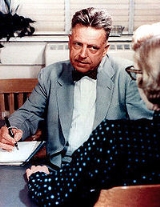
Alfred Charles Kinsey (June 23, 1894 – August 25, 1956), was an American
United States

The United States of America is a Federal government constitutional republic comprising U.S. state and a federal district. The country is situated mostly in central North America, where its Contiguous United States and Washington, D.C., the Capital districts and territories, lie between the Pacific Ocean and Atlantic Oceans, Borders of the U...
 biologist
Biologist

A biologist is a scientist devoted to and producing results in biology through the study of life.Typically biologists study organisms and their relationship to their environment....
 and professor of entomology
Entomology

Entomology is the science study of insects. At some 1.3 million described species, insects account for more than two-thirds of all known organisms,date back some 400 million years, and have many kinds of interactions with humans and other forms of life on earth....
 and zoology
Zoology

Zoology is the branch of biology concerned with the study of animals. The most common pronunciation of "zoology" is ; however, an alternative pronunciation is ....
, who in 1947 founded the Institute for Sex Research at Indiana University, now called the Kinsey Institute for Research in Sex, Gender, and Reproduction. Kinsey's research on human sexuality profoundly influenced social and cultural values in the United States and many other countries.

ed Kinsey was born on June 23, 1894, in Hoboken
Hoboken, New Jersey

Hoboken is a City in Hudson County, New Jersey, New Jersey, United States. As of the 2000 United States Census, the city's population was 38,577....
, New Jersey
New Jersey

New Jersey is a state in the Mid-Atlantic States and Northeastern United States regions of the United States. It is bordered on the north by New York, on the east by the Hudson River and the Atlantic Ocean, on the southwest by Delaware, and on the west by Pennsylvania....
, to Alfred Seguine Kinsey and Sarah Ann Charles.


Discussion
Ask a question about 'Alfred Kinsey'
Start a new discussion about 'Alfred Kinsey'
Answer questions from other users
Full Discussion Forum


Encyclopedia


Alfred Charles Kinsey (June 23, 1894 – August 25, 1956), was an American
United States

The United States of America is a Federal government constitutional republic comprising U.S. state and a federal district. The country is situated mostly in central North America, where its Contiguous United States and Washington, D.C., the Capital districts and territories, lie between the Pacific Ocean and Atlantic Oceans, Borders of the U...
 biologist
Biologist

A biologist is a scientist devoted to and producing results in biology through the study of life.Typically biologists study organisms and their relationship to their environment....
 and professor of entomology
Entomology

Entomology is the science study of insects. At some 1.3 million described species, insects account for more than two-thirds of all known organisms,date back some 400 million years, and have many kinds of interactions with humans and other forms of life on earth....
 and zoology
Zoology

Zoology is the branch of biology concerned with the study of animals. The most common pronunciation of "zoology" is ; however, an alternative pronunciation is ....
, who in 1947 founded the Institute for Sex Research at Indiana University, now called the Kinsey Institute for Research in Sex, Gender, and Reproduction. Kinsey's research on human sexuality profoundly influenced social and cultural values in the United States and many other countries.

Biography


Birth

Alfred Kinsey was born on June 23, 1894, in Hoboken
Hoboken, New Jersey

Hoboken is a City in Hudson County, New Jersey, New Jersey, United States. As of the 2000 United States Census, the city's population was 38,577....
, New Jersey
New Jersey

New Jersey is a state in the Mid-Atlantic States and Northeastern United States regions of the United States. It is bordered on the north by New York, on the east by the Hudson River and the Atlantic Ocean, on the southwest by Delaware, and on the west by Pennsylvania....
, to Alfred Seguine Kinsey and Sarah Ann Charles. Kinsey was the eldest of three children. His mother had received little formal education; his father was a professor at Stevens Institute of Technology
Stevens Institute of Technology

Stevens Institute of Technology is a technological university located on a campus in Hoboken, New Jersey, USA, founded in 1870 on the basis of an 1868 bequest from Edwin A....
. His parents were rather poor for most of Kinsey's childhood. Consequently, the family often could not afford proper medical care, which may have led to young Kinsey's receiving inadequate treatment for a variety of diseases including rickets
Rickets

Rickets is a softening of bones in children potentially leading to fractures and deformity. Rickets is among the most frequent childhood diseases in many developing countries....
, rheumatic fever
Rheumatic fever

Rheumatic fever is an inflammatory disease disease which may develop two to three weeks after a Group A streptococcal infection . It is believed to be caused by antibody cross-reactivity and can involve the heart, joints, skin, and brain....
, and typhoid fever
Typhoid fever

Typhoid fever, also known as enteric fever, or commonly just typhoid, is an illness caused by the bacterium Salmonella typhi. Common worldwide, it is transmitted by the ingestion of food or water contaminated with feces from an infected person....
. This health record indicates that Kinsey received suboptimal exposure to sunlight (the cause of rickets in those days before milk and other foods were fortified with vitamin D
Vitamin D

Vitamin D is a group of fat-soluble prohormones, the two major forms of which are vitamin D2 and vitamin D3 . The term vitamin D also refers to metabolites and other analogues of these substances....
) and lived in unsanitary conditions for at least part of his childhood. Rickets, leading to a curvature of the spine
Vertebral column

In human anatomy, the vertebral column is a column of 24 vertebrae, the sacrum, intervertebral discs, and the coccyx situated in the dorsum aspect of the torso, separated by spinal discs....
, resulted in a slight stoop that was to prevent Kinsey from being drafted in 1917 for World War I
World War I

World War I, or the First World War , was a global military conflict which involved the Great powers, organized into two opposing military alliances: the Allies of World War I and the Central Powers....
.

Early years

Kinsey's parents were extremely devout Christians; this left a powerful imprint on Kinsey for the rest of his life. His father was known as one of the most devout members of the local Methodist
Methodism

Methodism is a movement of Protestant Christianity represented by John Wesley and his younger brother Charles Wesley that sought to keep Methodism as a Revivalism movement within the Church of England....
 church and as a result most of Kinsey's social interactions were with other members of the church, often merely as a silent observer while his parents discussed religion with other similarly devout adults. Kinsey's father imposed strict rules on the household including mandating Sunday as a day of prayer (and little else), outlawing social relationships with girls. Such a strict upbringing was not entirely uncommon at the time. As a child, Kinsey was forbidden to learn anything about the subject that was to later bring him such fame. Kinsey ultimately disavowed the Methodist religion of his parents and became an agnostic.

Love of nature

At a young age, Kinsey showed great interest in nature
Nature

File:Jungle in Punjab.JPGNature, in the broadest sense, is equivalent to the natural world, physical universe, material world or material universe....
 and camping
Camping

Camping is an outdoor recreational activity.The participants, known as campers, get away from urban areas, their home region or civilization and enjoy nature while spending one or more nights, usually at a campsite....
. He worked and camped with the local YMCA
YMCA

The Young Men's Christian Association was founded on June 6, 1844 in London, United Kingdom, by George Williams . The original intention of the organization was to put Christian principles into practice....
 often throughout his early years. He enjoyed these activities to such an extent that he intended to work professionally for the YMCA
YMCA

The Young Men's Christian Association was founded on June 6, 1844 in London, United Kingdom, by George Williams . The original intention of the organization was to put Christian principles into practice....
 after his education was completed. Even Kinsey's senior undergraduate thesis for psychology
Psychology

Psychology is an academic and applied science discipline involving the science study of human mental functions and behavior. Occasionally it also relies on symbolic hermeneutics and critical theory, although these traditions are less pronounced than in other social sciences such as sociology....
, a dissertation on the group dynamics
Group dynamics

Group dynamics is the study of groups, and also a general term for group processes. Relevant to the fields of psychology, sociology, and communication studies, a group is two or more individuals who are connected to each other by social relationships....
 of young boys, echoed this interest. He joined the Boy Scouts
Boy Scouts of America

The Boy Scouts of America is the largest List of youth organizations in the United States, with over five million members in its age-related divisions....
 when a troop was formed in his community. His parents strongly supported this (and joined as well) because the Boy Scouts was an organization heavily grounded on the principles of Christianity. Kinsey diligently worked his way up through the Scouting ranks to Eagle Scout. Despite earlier disease having weakened his heart, Kinsey followed an intense sequence of difficult hikes and camping expeditions throughout his early life.

High school

In high school, Kinsey was a quiet but extremely hard-working student. While attending Columbia High School
Columbia High School (New Jersey)

Columbia High School is a four-year comprehensive regional public high school located at 17 Parker Avenue in Maplewood, New Jersey, that serves students in grades nine through twelve within the South Orange-Maplewood School District, which includes Maplewood and South Orange, New Jersey....
, he was not interested in sports, but rather devoted his energy to academic work and the piano. At one time, Kinsey had hoped to become a concert pianist, but decided to concentrate on his scientific pursuits instead. Kinsey's ability early on to spend immense amounts of time deeply focused on study was a trait that would serve him well in college and during his professional career. Kinsey seems not to have formed strong social relationships during high school, but he earned respect for his academic ability. While there, Kinsey became interested in biology
Biology

Biology is a branch of the natural sciences concerned with the study of living organisms and their interaction with each other and their environment ....
, botany
Botany

Botany, plant science, phytology, or plant biology is a branch of biology and is the Scientific method of plant life and development....
 and zoology
Zoology

Zoology is the branch of biology concerned with the study of animals. The most common pronunciation of "zoology" is ; however, an alternative pronunciation is ....
. Kinsey was later to claim that his high school biology teacher, Natalie Roeth, was the most important influence on his decision to become a scientist.

College

Kinsey approached his father with plans to study botany
Botany

Botany, plant science, phytology, or plant biology is a branch of biology and is the Scientific method of plant life and development....
 at college. His father demanded that he study engineering at Stevens Institute of Technology
Stevens Institute of Technology

Stevens Institute of Technology is a technological university located on a campus in Hoboken, New Jersey, USA, founded in 1870 on the basis of an 1868 bequest from Edwin A....
 in Hoboken. Kinsey was unhappy at Stevens, and later remarked that his time there was one of the most wasteful periods of his life. Regardless, he continued his obsessive commitment to studying. At Stevens, he primarily took courses related to English and engineering, but was unable to satisfy his interest in biology. At the end of two years at Stevens, Kinsey gathered the courage to confront his father about his interest in biology and his intent to continue studying at Bowdoin College
Bowdoin College

Bowdoin College , founded in 1794, is a private Liberal arts colleges in the United States located in the coastal New England town of Brunswick, Maine, Maine....
 in Maine
Maine

The State of Maine is a U.S. state in the New England region of the northeastern United States of America, bordering the Atlantic Ocean to the southeast, New Hampshire to the southwest, the Canadian provinces of Quebec to the northwest and New Brunswick to the northeast....
. His father vehemently opposed this, but finally relented. This decision essentially destroyed his relationship with his father and deeply troubled him for years to come.

In the fall of 1914, Kinsey entered Bowdoin College
Bowdoin College

Bowdoin College , founded in 1794, is a private Liberal arts colleges in the United States located in the coastal New England town of Brunswick, Maine, Maine....
, where he became familiar with insect research under Manton Copeland, and was admitted to the Zeta Psi
Zeta Psi

The Zeta Psi Fraternity of North America was founded June 1, 1847 as a social college Fraternities and sororities. The organization now comprises about fifty active chapters and twenty-five inactive chapters, encompassing roughly twenty thousand brothers, and is a member of the North-American Interfraternity Conference....
 fraternity, in whose house he lived for much of his time at college. Two years later, Kinsey was elected to Phi Beta Kappa and graduated magna cum laude with degrees in biology
Biology

Biology is a branch of the natural sciences concerned with the study of living organisms and their interaction with each other and their environment ....
 and psychology
Psychology

Psychology is an academic and applied science discipline involving the science study of human mental functions and behavior. Occasionally it also relies on symbolic hermeneutics and critical theory, although these traditions are less pronounced than in other social sciences such as sociology....
. He continued his graduate studies at Harvard University
Harvard University

Harvard University is a private university in Cambridge, Massachusetts, Massachusetts, United States, and a member of the Ivy League. Founded in 1636 by the colonial Massachusetts legislature, Harvard is the Colonial Colleges institution of higher learning in the United States....
's Bussey Institute
Bussey Institute

The Bussey Institute was a respected biological institute at Harvard University. It was named for Benjamin Bussey, who, in 1835, endowed the establishment of an undergraduate school of agriculture and horticulture and donated land in Jamaica Plain, Massachusetts that became the Arnold Arboretum....
, which had one of the most highly regarded biology programs in the United States. It was there that Kinsey studied applied biology under William Morton Wheeler
William Morton Wheeler

William Morton Wheeler, Ph.D. was an United States entomologist, myrmecologist and Harvard professor....
, a scientist who made outstanding contributions to entomology
Entomology

Entomology is the science study of insects. At some 1.3 million described species, insects account for more than two-thirds of all known organisms,date back some 400 million years, and have many kinds of interactions with humans and other forms of life on earth....
. Under Wheeler, Kinsey worked almost completely autonomously, which suited both men quite well. For his doctoral thesis, Kinsey chose to do research on gall wasp
Gall wasp

Gall wasps , also called Gallflies, are a family of the order Hymenoptera and are classified with the Apocrita suborder of wasps in the superfamily Cynipoidea....
s. Kinsey began collecting samples of gall wasps with obsessive zeal. He traveled widely and took 26 detailed measurements on hundreds of thousands of gall wasps. His methodology made an important contribution to entomology as a science. Kinsey was granted a Sc.D. degree in 1919 by Harvard University
Harvard University

Harvard University is a private university in Cambridge, Massachusetts, Massachusetts, United States, and a member of the Ivy League. Founded in 1636 by the colonial Massachusetts legislature, Harvard is the Colonial Colleges institution of higher learning in the United States....
. He published several papers in 1920 under the auspices of the American Museum of Natural History
American Museum of Natural History

The American Museum of Natural History , located on the Upper West Side, Manhattan, New York, USA, is one of the largest and most celebrated museums in the world....
 in New York
New York

The State of New York is a U.S. state in the Mid-Atlantic States and Northeastern United States regions of the United States and is the nation's List of U.S....
, introducing the gall wasp to the scientific community and laying out its phylogeny. Of the more than 18 million insects in the museum's collection, some 5 million are gall wasps collected by Kinsey.

Marriage and family

Kinsey married Clara Bracken McMillen, whom he called Mac, in 1921. They had four children. Their first-born, Don, died from the acute complications of juvenile diabetes in 1927, just before his fifth birthday. Daughter Anne was born in 1924, daughter Joan in 1925, and son Bruce in 1928.

Death

Kinsey died on August 25, 1956, at the age of 62. The cause of death was reported to be heart disease and pneumonia
Pneumonia

Pneumonia is an Inflammation illness of the lung. Frequently, it is described as lung parenchyma/alveolus inflammation and abnormal alveolar filling with fluid ....
. This passage was written about his work in The New York Times:
The untimely death of Dr. Alfred C. Kinsey takes from the American scene an important and valuable, as well as controversial, figure. Whatever may have been the reaction to his findings -- and to the unscrupulous use of some of them -- the fact remains that he was first, last, and always a scientist. In the long run it is probable that the values of his contribution to contemporary thought will lie much less in what he found out than in the method he used and his way of applying it. Any sort of scientific approach to the problems of sex is difficult because the field is so deeply overlaid with such things as moral precept, taboo, individual and group training, and long established behavior patterns. Some of these may be good in themselves, but they are no help to the scientific and empirical method of getting at the truth. Dr. Kinsey cut through this overlay with detachment and precision. His work was conscientious and comprehensive. Naturally, it will receive a serious setback with his death. Let us earnestly hope that the scientific spirit that inspired it will not be similarly impaired.


Career


Textbook

Kinsey published a widely used high-school textbook, An Introduction to Biology, in October 1926. The book endorsed evolution and unified, at the introductory level, the previously separate fields of zoology and botany.

Edible plants

Kinsey also co-wrote a classic book on edible plants with Merritt Lyndon Fernald
Merritt Lyndon Fernald

Merritt Lyndon Fernald was an United States botanist. In his time he was regarded as the most respected scholar of the taxonomy and phytogeography of the vascular plant flora of temperate eastern North America....
 published in 1943 called Edible Wild Plants of Eastern North America. This book is still regarded as an authoritative source in the area, but is not generally associated with Kinsey. The original draft of the book was written in 1919-1920, while Kinsey was still a doctoral student at the Bussey Institute and Fernald was working at the Arnold Arboretum.

Human sexual behavior and the Kinsey Reports


Kinsey is generally regarded as the father of sexology
Sexology

Sexology is the study of sexual interests, behavior, and function. In modern sexology, researchers apply tools from several academic fields, including biology, medicine, psychology, statistics, epidemiology, pedagogics, sociology, anthropology, and criminology....
, the systematic, scientific study of human sexuality
Human sexuality

Human sexuality is how people experience and express themselves as sexual beings. Human sexuality has many aspects. Biology, sexuality refers to the reproductive mechanism as well as the basic biological drive that exists in all species and can encompass sexual intercourse and sexual contact in all its forms....
. He initially became interested in the different forms of sexual practices around 1933, after discussing the topic extensively with a colleague, Robert Kroc. It is likely that Kinsey's study of the variations in mating practices among gall wasps led him to wonder how widely varied sexual practices among humans were. During this work, he developed a scale measuring sexual orientation, now known as the Kinsey Scale
Kinsey scale

File:Kinsey Scale.gifThe Kinsey scale attempts to describe a person's sexual history or episodes of their sexual activity at a given time. It uses a scale from 0, meaning exclusively heterosexual, to 6, meaning exclusively homosexual....
 which ranges from 0 to 6, where 0 is exclusively heterosexual
Heterosexuality

Heterosexuality refers to sexual behavior with, or attraction to, people of the opposite gender, or to a heterosexual orientation. As a sexual orientation, heterosexuality refers to "an enduring pattern of or disposition to experience sexual, affectional, or romantic attractions primarily to "persons of the opposite sex"; it also refers to "...
 and 6 is exclusively homosexual
Homosexuality

Homosexuality refers to human sexual behavior or same-sex attraction between people of the same sex or to homosexual orientation. As a sexual orientation, homosexuality refers to "having sexual and romantic attraction primarily or exclusively to members of one?s own sex"; "it also refers to an individual?s sense of personal and social identi...
; a rating of 7, for asexual
Asexuality

Asexuality is sometimes considered a sexual orientation describing individuals who do not experience sexual attraction, experience little or no sexual attraction, or lack interest in or desire for sex....
, was added later by Kinsey's associates.

In 1935, Kinsey delivered a lecture to a faculty discussion group at Indiana University, his first public discussion of the topic, wherein he attacked the "widespread ignorance of sexual structure and physiology" and promoted his view that "delayed marriage" (that is, delayed sexual experience) was psychologically harmful. Kinsey obtained research funding from the Rockefeller Foundation
Rockefeller Foundation

The Rockefeller Foundation is a prominent philanthropic organization and private foundation based at 420 Fifth Avenue, New York City. The preeminent institution established by the six-generation Rockefeller family, it was founded by John D....
, which enabled him to inquire into human sexual behavior.

His Kinsey Reports
Kinsey Reports

The Kinsey Reports are two books on human sexual behavior, Sexual Behavior in the Human Male and Sexual Behavior in the Human Female , by Dr....
—starting with the publication of Sexual Behavior in the Human Male in 1948, followed in 1953 by Sexual Behavior in the Human Female—reached the top of bestseller lists and turned Kinsey into an instant celebrity, and are still the best selling scientific books of all time. Articles about him appeared in magazines such as Time
Time (magazine)

Time is a weekly United States newsmagazine, similar to Newsweek and U.S. News & World Report. A European edition is published from London....
, Life, Look
Look (American magazine)

Look was a biweekly, general-interest magazine published in Des Moines, Iowa from 1937 to 1971, with more of an emphasis on photographs than articles....
, and McCall's
McCall's

McCall's was a monthly United States women's magazine that enjoyed great popularity through much of the 20th century, peaking at a readership of six million in 1960....
. Kinsey's reports, which led to a storm of controversy, are regarded by many as an enabler of the sexual revolution of the 1960s. Indiana University's president Herman B Wells
Herman B Wells

Herman B Wells was the 11th president of Indiana University . He served the university in a variety of capacities, most notably as president and as chancellor....
 defended Kinsey's research in what became a well-known test of academic freedom
Academic freedom

Academic freedom is the belief that the freedom of inquiry by students and faculty members is essential to the mission of the academy. They argue that academic communities are repeatedly targeted for repression due to their ability to shape and control the flow of information....
.

Significant publications

  • "New Species and Synonymy of American Cynipidae," in Bulletin of the American Museum of Natural History (1920)
  • "Life Histories of American Cynipidae," in Bulletin of the American Museum of Natural History (1920)
  • "Phylogeny of Cynipid Genera and Biological Characteristics," in Bulletin of the American Museum of Natural History (1920)
  • An Introduction to Biology (1926)
  • The Gall Wasp Genus Cynips: A Study in the Origin of Species (1930)
  • New Introduction to Biology (1933, revised 1938)
  • The Origin of Higher Categories in Cynips (1935)
  • Edible Wild Plants of Eastern North America (1943)
  • The Kinsey Reports
    Kinsey Reports

    The Kinsey Reports are two books on human sexual behavior, Sexual Behavior in the Human Male and Sexual Behavior in the Human Female , by Dr....
    :
    • Sexual Behavior in the Human Male (1948, reprinted 1998)
    • Sexual Behavior in the Human Female (1953, reprinted 1998)


Controversy

Both Kinsey's work and private life have been the subject of an enduring controversy over the study of human sexuality
Human sexuality

Human sexuality is how people experience and express themselves as sexual beings. Human sexuality has many aspects. Biology, sexuality refers to the reproductive mechanism as well as the basic biological drive that exists in all species and can encompass sexual intercourse and sexual contact in all its forms....
 (sometimes called sexology
Sexology

Sexology is the study of sexual interests, behavior, and function. In modern sexology, researchers apply tools from several academic fields, including biology, medicine, psychology, statistics, epidemiology, pedagogics, sociology, anthropology, and criminology....
), Kinsey's ethical decisions, research methodology and the impact of Kinsey's work on sexual morality.

Interviews with pedophiles

In 1981 questions were raised of how Kinsey and his staff gathered the information to produce some of the data in the Kinsey Reports
Kinsey Reports

The Kinsey Reports are two books on human sexual behavior, Sexual Behavior in the Human Male and Sexual Behavior in the Human Female , by Dr....
. Attention was directed to Tables 30-34 of Sexual Behavior in the Human Male, which report observations of orgasms in over three hundred children between the ages of five months and fourteen years. Former and current directors of The Kinsey Institute confirmed that some of the information was gathered from nine pedophiles
Pedophilia

The term pedophilia or paedophilia has a range of definitions as found in psychology, law enforcement, and the popular vernacular.As a medical diagnosis, it is defined as a psychological disorder in which an adult experiences a sexual preference for prepubescent children....
 and that Kinsey chose not to report the pedophiles to the authorities, balancing what Kinsey saw as the need for their anonymity against the likelihood that their crimes would continue. Current federal law and regulation on the protection of human subjects requiring informed consent and treatment of children as a "vulnerable population," and current Indiana law requiring that all citizens serve as "mandated reporters" of suspected cases of child abuse now prohibit research conduct similar to Kinsey's practice regarding pedophilia.

Sex life

Kinsey had been rumored to participate in unusual sexual practices. James H. Jones's biography, Alfred C. Kinsey: A Public/Private Life, describes Kinsey as bisexual and experimenting in masochism. He encouraged group sex involving his graduate students, wife and staff. Kinsey filmed sexual acts in the attic of his home as part of his research. Biographer Jonathan Gathorne-Hardy
Jonathan Gathorne-Hardy

Jonathan Gathorne-Hardy is a United Kingdom author, known for biography, including one of Alfred Kinsey, and books of social history on the United Kingdom nanny and public school system....
 explained that using Kinsey's home for the filming of sexual acts was done to ensure the films' secrecy, which would certainly have caused a scandal had the public become aware of them.

Bias

James H. Jones alleged that Kinsey’s appetite for unconventional sex, and his disdain for conventional sexual morality, drove Kinsey's agenda to strip sexuality of guilt and to undermine traditional sexual morality. Critics contend that Kinsey allowed his agenda to bias his work. They point to Kinsey's over-representation of prisoners and prostitutes and his classification of couples who have lived together for at least a year as "married".

However, other writers have said that any bias that might exist is not as severe as reported by some. For example, in the 1970s, Paul Gebhard
Paul Gebhard

Paul H. Gebhard, born , was an American anthropologist and sexologist. Born in Rocky Ford, Colorado, he earned a B.S. and a Ph.D. from Harvard University in 1940 and 1947, respectively....
 removed all suspect data (e.g. pertaining to prisoners and similar respondents), and recalculated significant sets of figures against results given by "100 percent" groups. He found only slight differences between the original and cleaned figures.

Kinsey in the media

The popularity of Sexual Behavior in the Human Male prompted widespread media interest in 1948. Time
Time (magazine)

Time is a weekly United States newsmagazine, similar to Newsweek and U.S. News & World Report. A European edition is published from London....
 magazine declared, "Not since Gone With the Wind had booksellers seen anything like it." The first pop culture references to Kinsey appeared not long after the book's publication: "[R]ubber-faced comic Martha Raye
Martha Raye

Martha Raye was an United States comic actress and traditional pop music singer who performed in film, and later on television.Biography...
 [sold] a half-million copies of 'Ooh, Dr. Kinsey!'" Cole Porter
Cole Porter

Cole Albert Porter was an American composer and songwriter from Peru, Indiana, Indiana.His works include the musical comedies Kiss Me, Kate , Fifty Million Frenchmen, DuBarry Was a Lady and Anything Goes, as well as songs like "Night and Day ", "I Get a Kick out of You", "Well, Did You Evah!", "Two Little Babes In The Wood"...
's song "Too Darn Hot
Too Darn Hot

"Too Darn Hot" is a popular music song written by Cole Porter for his Musical theater Kiss Me, Kate .The song gained new currency in 2004 because of two films that came out that year....
," from the Tony Award–winning Broadway musical Kiss Me, Kate
Kiss Me, Kate

Kiss Me, Kate is a Musical theater with music and lyrics by Cole Porter. It is structured as a play within a play, where the interior play is a musical version of The Taming of the Shrew....
, devoted its bridge to an analysis of the Kinsey report and the "average man's" "favorite sport." In 1949, Mae West
Mae West

Mae West was an United States actor, playwright, screenwriter, and sex symbol.Known for her bawdy double entendres, West made a name for herself in Vaudeville and on the theatre in New York City before moving to Hollywood to become a comedienne, actress and writer in the film industry....
, reminiscing on the days when the word "sex" was rarely uttered, said of Kinsey, "That guy merely makes it easy for me. Now I don't have to draw 'em any blueprints...We are both in the same business...Except I saw it first."

The publication of Sexual Behavior in the Human Female prompted even more intensive news coverage: Kinsey appeared on the cover of the August 24, 1953, issue of Time. The national newsmagazine featured two articles on the scientist, one focusing on his research career and new book, the other on his background, personality, and lifestyle. In the magazine's cover portrait, "Flowers, birds, and a bee surround Kinsey; the mirror-of-Venus female symbol decorates his bow tie." The lead article concludes with the following observation: "'Kinsey...has done for sex what Columbus did for geography,' declared a pair of enthusiasts...forgetting that Columbus did not know where he was when he got there.... Kinsey's work contains much that is valuable, but it must not be mistaken for the last word."

Just a few months after Kinsey published Sexual Behavior in the Human Female, the third season of the CBS television series I Love Lucy
I Love Lucy

I Love Lucy is an United States situation comedy, starring Lucille Ball, Desi Arnaz, Vivian Vance and William Frawley. The black-and-white series originally ran from October 15 1951 to April 1 1960 on CBS....
, featured the episode, 'Fan Magazine Interview' (aired February 8, 1954). Lucy Ricardo (Lucille Ball) and her neighbor Ethel Mertz (Vivian Vance) pretended to be conducting a poll and wanted to ask a woman some questions. The woman replied, "Say, your name ain't Kinsey, is it?" The studio audience then gave out an uproar of laughter. This was reportedly I Love Lucy's most risque joke ever to evade the CBS censors and make it onto the family rated show.

The 2000s have seen renewed interest in Kinsey. The musical Dr. Sex focuses on the relationship between Kinsey, his wife, and their shared lover Wally Matthews (based on Clyde Martin
Clyde Martin

Dr. Clyde Martin was an assistant to Dr. Alfred Kinsey and a co-author of Sexual Behavior in the Human Male....
). The play—with score by Larry Bortniker, book by Bortniker and Sally Deering—premiered in Chicago in 2003, winning seven Jeff Awards
Joseph Jefferson Awards

The Joseph Jefferson Awards are given annually by a volunteer non-profit committee to acknowledge excellence in Theatre in Chicago in the Chicago area....
. It was produced off-Broadway in 2005. The 2004 biographical film
Biographical film

File:Soviet Union-1964-stamp-Chapayev .jpgA biographical motion picture—often portmanteau biopic—is a film that dramatizes the life of an actual person or people....
 Kinsey
Kinsey (film)

Kinsey is a 2004 in film biographical film written and directed by Bill Condon. It describes the life of Alfred Kinsey . As a pioneer in the area of sexology research, his 1948 publication, Sexual Behavior in the Human Male was one of the first recorded works that tried to scientifically address and investigate sexual behaviour and i...
, written and directed by Bill Condon
Bill Condon

William "Bill" Condon is an Academy Award-winning American screenwriter and Film director....
, stars Liam Neeson
Liam Neeson

William John "Liam" Neeson Order of the British Empire is an Irish people actor. He is well known for his roles as Oskar Schindler in Steven Spielberg's Schindler's List and as Qui-Gon Jinn in George Lucas' Star Wars Episode I: The Phantom Menace and as the Voice acting of Aslan in The Chronicles of Narnia film series....
 as the scientist and Laura Linney
Laura Linney

Laura Leggett Linney is an American actress. Throughout her career in film, television, and theatre, Linney has won three Emmy Award Awards, a Golden Globe, and a Screen Actors Guild Award Award and has also been nominated for three Oscars and a BAFTA Award....
 as his wife. In 2004 as well, T. Coraghessan Boyle
T. Coraghessan Boyle

T. Coraghessan Boyle is a U.S. novelist and short story writer. Since the mid 1970s, he has published twelve novels and more than 60 short stories....
's novel about Kinsey, The Inner Circle
The Inner Circle (novel)

The Inner Circle is a novel by T. C. Boyle first published in 2004 in literature about the development of sexology in the United States and about Alfred Kinsey's rise to fame during the late 1940s and early 1950s as seen through the eyes of one of his loyal assistants....
, was published. The following year, PBS produced the documentary Kinsey in cooperation with the Kinsey Institute
Kinsey Institute for Research in Sex, Gender and Reproduction

The Kinsey Institute for Research in Sex, Gender and Reproduction, often shortened to The Kinsey Institute, exists "to promote interdisciplinary research and scholarship in the fields of human sexuality, gender, and reproduction"....
, which allowed access to many of its files. Mr. Sex, a BBC radio play by Steve Coombes concerning Kinsey and his work, won the 2005 Imison Award.

Sources

  • Christenson, Cornelia (1971). Kinsey: A Biography. Bloomington: Indiana University Press.
  • Gathorne-Hardy, Jonathan (1998). Alfred C. Kinsey: Sex the Measure of All Things. London: Chatto & Windus. ISBN 0253337348
  • Jones, James H. (1997). Alfred C. Kinsey: A Public/Private Life. New York: Norton. ISBN 0756775507
  • Pomeroy, Wardell (1972). Dr. Kinsey and the Institute for Sex Research. New York: Harper & Row.
  • Reinisch, June M. (1990). The Kinsey Institute New Report on Sex. New York: St. Martin's. ISBN 0312052685
  • Reisman, Judith (2006). Kinsey's Attic: The Shocking Story of How One Man's Sexual Pathology Changed the World. WND Books. ISBN 1581824602


External links

  • Fyne Times Magazine