


Pederasty in ancient Greece

Encyclopedia
Pederasty in ancient Greece was a socially acknowledged relationship between an adult and a younger male usually in his teens. It was characteristic of the Archaic and Classical periods
. Some scholars locate its origin in initiation ritual, particularly rites of passage on Crete
, where it was associated with entrance into military life and the religion of Zeus
.
The social custom called paiderastia by the Greeks was both idealized and criticized in ancient literature
and philosophy
; it has no formal existence in the Homeric epics
, and seems to have developed in the late 7th century BC as an aspect of Greek homosocial culture
, which was characterized also by athletic
and artistic nudity, delayed marriage for aristocrats, symposia
, and the social seclusion of women. The influence of pederasty was so pervasive that it has been called "the principal cultural model for free relationships between citizens."
Scholars have debated the role or extent of sexual activity, which is likely to have varied according to local custom and individual inclination. The English word "pederasty
" in present-day usage implies the abuse
of minors
, but Athenian
law, for instance, does not recognize consent and age
as factors in regulating sexual behavior. As classical historian Robin Osborne
has pointed out, historical discussion of paiderastia is complicated by 21st-century moral standards:
. It is formed from paiderastês, which in turn is a compound of pais ("child", plural paides) and erastês (see below). Although the word pais can refer to a child of either sex, paiderastia is defined by Liddell
and Scott
's Greek-English Lexicon as "the love of boys," and the verb paiderasteuein as "to be a lover of boys."
Since the publication of Kenneth Dover
's now classic work Greek Homosexuality, erastês and erômenos have been standard terms for the two pederastic roles. Both words derive from the Greek verb erô, erân, "to love"; see also eros
. In Dover's strict dichotomy, the erastês (ἐραστής, plural erastai) is the older lover, seen as the active or dominant partner, with the suffix
-tês (-τής) denoting agency
. Erastês should be distinguished from Greek paiderastês, which meant "lover of boys" usually with a negative connotation. The erastês himself might only be in his early twenties, and thus the age difference between the two lovers might be negligible.
The word erômenos, or "beloved" (plural eromenoi), is the masculine
form of the present passive participle from ero, viewed by Dover as the passive or subordinate partner. An erômenos can also be called pais, "child." The pais was regarded as a future citizen, not an "inferior object of sexual gratification," and was portrayed with respect in art. The word can be understood as an endearment such as a parent might use, found also in the poetry of Sappho
and a designation of only relative age. Both art and other literary references show that the erômenos was at least a teen, with modern age estimates ranging from 13 to 20, or in some cases up to 30. Most evidence indicates that to be an eligible erômenos, a youth would be of an age when an aristocrat began his formal military training, that is, from fifteen to seventeen. As an indication of physical maturity, the erômenos was sometimes as tall as or taller than the older erastês, and may have his first facial hair. Another word used by the Greeks for the younger partner was paidika, a neuter
plural adjective
("things having to do with children") treated syntactically
as masculine singular.
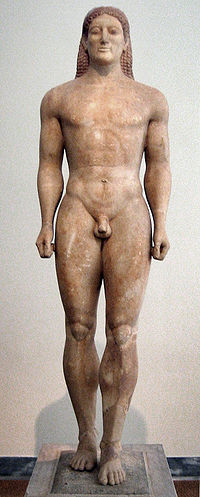 In poetry and philosophical literature, the erômenos is often an embodiment of idealized youth; a related ideal depiction of youth in Archaic culture was the kouros
, the long-haired male statuary nude
. In The Fragility of Goodness, Martha Nussbaum
, following Dover, defines the ideal erômenos as
Dover insisted that the active role of the erastês and the passivity of the erômenos is a distinction "of the highest importance," but subsequent scholars have tried to present a more varied picture of the behaviors and values associated with paiderastia. Although ancient Greek writers use erastês and erômenos in a pederastic context, the words are not technical terms for social roles, and can refer to the "lover" and "beloved" in other hetero- and homosexual couples.
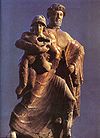
The Greek practice of pederasty came suddenly into prominence at the end of the Archaic period of Greek history; there is a brass plaque from Crete, about 650-625 BC, which is the oldest surviving representation of pederastic custom. Such representations appear from all over Greece in the next century; literary sources show it as being established custom in many cities by the fifth century BC.
Cretan pederasty as a formal social institution seems to have been grounded in an initiation
which involved ritual abduction
. A man (philetor, "lover") selected a youth, enlisted the chosen one's friends to help him, and carried off the object of his affections to his andreion, a sort of men's club or meeting hall. The youth received gifts, and the philetor along with the friends went away with him for two months into the countryside, where they hunted and feasted. At this end of this time, the philetor presented the youth with three contractually required gifts: military attire, an ox, and a drinking cup. Other costly gifts followed. Upon their return to the city, the youth sacrificed the ox to Zeus, and his friends joined him at the feast. He received special clothing that in adult life marked him as kleinos, "famous, renowned." The initiate was called a parastatheis, "he who stands beside," perhaps because, like Ganymede
the cup-bearer of Zeus, he stood at the side of the philetor during meals in the andreion and served him from the cup that had been ceremonially presented. In this interpretation, the formal custom reflects myth and ritual
.
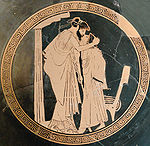 The erastes-eromenos relationship played a role in the Classical Greek social and educational system, had its own complex social-sexual etiquette and was an important social institution among the upper classes. Pederasty has been understood as educative, and Greek authors from Aristophanes
to Pindar
felt it naturally present in the context of aristocratic education (paideia
). In general, pederasty as described in the Greek literary sources is an institution reserved for free citizens, perhaps to be regarded as a dyadic
mentorship: "pederasty was widely accepted in Greece as part of a male's coming-of-age, even if its function is still widely debated."
In Crete, in order for the suitor to carry out the ritual abduction, the father had to approve him as worthy of the honor. Among the Athenians, as Socrates
claims in Xenophon
's Symposium, "Nothing [of what concerns the boy] is kept hidden from the father, by an ideal lover." In order to protect their sons from inappropriate attempts at seduction, fathers appointed slaves called pedagogues to watch over their sons. However, according to Aeschines, Athenian fathers would pray that their sons would be handsome and attractive, with the full knowledge that they would then attract the attention of men and "be the objects of fights because of erotic passions."
The age-range when boys entered into such relationships was consonant with that of Greek girls given in marriage, often to adult husbands many years their senior. Boys, however, usually had to be courted and were free to choose their mate, while marriages for girls were arranged for economic and political advantage at the discretion of father and suitor. These connections were also an advantage for a youth and his family, as the relationship with an influential older man resulted in an expanded social network. Thus, some considered it desirable to have had many admirers or mentors, if not necessarily lovers per se, in one’s younger years. Typically, after their sexual relationship had ended and the young man had married, the older man and his protégé would remain on close terms throughout their life. For those lovers who continued their lovemaking after their beloveds had matured, the Greeks made allowances, saying, You can lift up a bull, if you carried the calf.
Pederasty was the idealized form of an age-structured homoeroticism that had other, less idealized manifestations, such as prostitution
or the sexual use of slave boys. Paying free youths for sex was prohibited. Free youths who did sell their favors were ridiculed, and later in life might be prohibited from performing certain official functions.
Even when lawful, it was not uncommon for the relationship to fail, as it was said of many boys that they "hated no one as much as the man who had been their lover" (see, for instance, "Death of King Philip II of Macedon
'"). Likewise, the Cretans required the boy to declare whether the relationship had been to his liking, thus giving him an opportunity to break it off if any violence had been done to him. In Classical times there appears a note of concern that the institution of pederasty might give rise to a "morbid condition", adult homosexuality, that today's eromenos may become tomorrow's kinaidos, defined as the passive or "penetrated" partner.
argues against further allowing Timarchus, an experienced middle-aged politician, his political rights, on account of his having spent his adolescence as the kept boy of a series of wealthy men. Aeschines won his case, and Timarchus was sentenced to atimia. Aeschines acknowledges his own dalliances with beautiful boys, the erotic poems he dedicated to these youths, and the scrapes he has gotten into as a result of his affairs, but emphasizes that none of these were mediated by money. A financial motive thus was viewed as threatening a man's status as free.
By contrast, as expressed in Pausanias'
speech in Plato's Symposium, pederastic love was said to be favorable to democracy
and feared by tyrants, because the bond between the erastes and eromenos was stronger than that of obedience to a despotic ruler. Athenaeus
states that "Hieronymus the Aristotelian says that love with boys was fashionable because several tyrannies had been overturned by young men in their prime, joined together as comrades in mutual sympathy." He gives as examples of such pederastic couples the Athenians Harmodius and Aristogeiton
, who were credited (perhaps symbolically) with the overthrow of the tyrant Hippias
and the establishment of the democracy, and also Chariton and Melanippus. Others, such as Aristotle, claimed that the Cretan lawgivers encouraged pederasty as a means of population control
, by directing love and sexual desire into non-procreative channels:
, which was more than reciprocated, is held as an example of chaste pederasty. Phaedrus, in the Platonic dialogue the Symposium
states:
Plato
in his Laws, blamed pederasty for promoting civil strife and driving many to their wits' end, and recommended the prohibition of sexual intercourse
with boys, laying out a path whereby this may be accomplished.
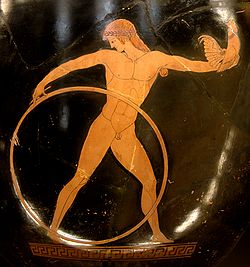
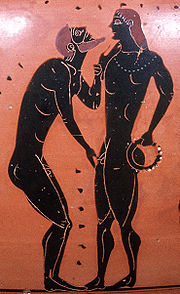 Greek vase painting is a major source for scholars seeking to understand attitudes and practices associated with paiderastia. Hundreds of pederastic scenes are depicted on Attic black-figure vases. In the early 20th century, John Beazley
classified pederastic vases into three types:
Certain gifts traditionally given by the eromenos become symbols that contribute to interpreting a given scene as pederastic. Animal gifts — most commonly hares and roosters, but also deer and felines — point toward hunting as an aristocratic pastime and as a metaphor for sexual pursuit.
The explicit nature of some images has led in particular to discussions of whether the eromenos took active pleasure in the sex act. The youthful beloved is never pictured with an erection; his penis "remains flaccid even in circumstances to which one would expect the penis of any healthy adolescent to respond willy-nilly." Fondling the youth's genitals was one of the most common images of pederastic courtship on vases, a gesture indicated also in Aristophanes' comedy Birds
(line 142). Some vases do show the younger partner as sexually responsive, prompting one scholar to wonder, "What can the point of this act have been unless lovers in fact derived some pleasure from feeling and watching the boy's developing organ wake up and respond to their manual stimulation?"
Chronological study of the vase paintings also reveals a changing aesthetic in the depiction of the erômenos. In the 6th century BC, he is a young beardless man with long hair, of adult height and physique, usually nude. As the 5th century begins, he has become smaller and slighter, "barely pubescent," and often draped as a girl would be. No inferences about social customs should be based on this element of the courtship scene alone.
. To preserve his dignity and honor, the erômenos limits the man who desires him to penetration between closed thighs.
Anal sex
may be depicted, but far more rarely. The evidence is not explicit and is open to interpretation. Some vase paintings, which Percy considers a fourth type of pederastic scene in addition to Beazley's three, show the erastês seated with an erection and the erômenos either approaching or climbing into his lap. The composition of these scenes is the same as that for depictions of women mounting men who are seated and aroused for intercourse. As a cultural norm considered apart from personal preference, anal penetration was most often seen as dishonorable to the one penetrated, or shameful. A fable attributed to Aesop
tells how Aeschyne (Shame) consented to enter the human body from behind only as long as Eros did not follow the same path, and would fly away at once if he did. Oral sex is likewise not depicted, or is indicated only indirectly; anal or oral penetration seems to have been reserved for prostitutes or slaves.
Dover maintained that the erômenos was ideally not supposed to feel "unmanly" desire for the erastês. David M. Halperin contended that boys were not aroused. More recent discussion holds that in actual practice — as contrasted with philosophical ideals — there would have been reciprocation of desire.
n poet Theognis
addressed to Cyrnus (Greek Kyrnos). Some portions of the Theognidean corpus are probably not by the individual from Megara, but rather represent "several generations of wisdom poetry
." The poems are "social, political, or ethical precepts transmitted to Cyrnus as part of his formation into an adult Megarian aristocrat in Theognis' own image."
The relationship between Theognis and Kyrnos eludes categorization. Although it was assumed in antiquity that Kyrnos was the poet's eromenos, the poems that are most explicitly erotic are not addressed to him; the poetry on "the joys and sorrows" of pederasty seem more apt for sharing with a fellow erastes, perhaps in the setting of the symposium: "the relationship, in any case, is left vague."
Theocritus
describes a kissing contest for youths that takes place at the tomb of a certain Diocles, renowned for friendship; he notes that invoking Ganymede
was proper to the occasion.
 The myth
of Ganymede
's abduction by Zeus
was invoked as a precedent for the pederastic relationship, as Theognis asserts to a friend:
Greek myths provide more than fifty examples of young men who were the lovers of gods. Pederastic love affairs are ascribed to Zeus, Poseidon
, Apollo
, Orpheus
, Hercules
, Dionysus
, Hermes
, and Pan
. All the Olympian gods
except Ares
had these relationships, which are adduced by scholars to show that the specific customs of paiderastia originated in initiatory rituals.
Dover, however, believed that these myths are only literary versions expressing or explaining the "overt" homosexuality of Greek archaic culture, the distinctiveness of which he contrasted to attitudes in other ancient societies such as Egypt and Israel.
, and Alcaeus
, a man also reputed for his bravery and political skills, who composed many of the sympotic skolia that were to become later part of the mainland tradition. Unlike the Dorians, where a lover would usually have only one eromenos, in the east a man might have several eromenos over the course of his life. From the poems of Alcaeus we learn that the lover would customarily invite his eromenos to dine with him.
, a Dorian polis, is thought to be the first city to practice athletic nudity, and one of the first to formalize pederasty. The Spartans believed that the love of an older, accomplished aristocrat for an adolescent was essential to his formation as a free citizen. The agoge
, the education of the ruling class, was thus founded on pederastic relationships required of each citizen. The lover was responsible for the boy's training. Pederasty and military training were intimately connected in Sparta, as in many other cities. The Spartans, claims Athenaeus sacrificed to Eros
before every battle.
The nature of this relationship is in dispute. Xenophon
in his Constitution of the Lacedaimonians says that the relationship among Spartan man and boys "were opposed to" pederasty, that man should make "ideal friends" out of boys, and if that the man was sexually attracted to the boy, it was considered "an abomination" tantamount to incest. Plutarch also describes the relationships as chaste, and states that it was as unthinkable for a lover to sexually consummate a relationship with his beloved as for a father to do so with his own son. Aelian relates that in Sparta, for a man to not have a youth for a lover was considered a deficiency in character, and he was punished for not making another as good as he was himself, despite his excellence. But Aelian also says that if any couple succumbed to temptation and indulged in carnal relations, they would have to redeem the affront to the honor of Sparta by either going into exile or taking their own lives.
cultivated good relations with Sparta, and may have been culturally attracted to emulate Spartan practices in the seventh century, when pederasty is postulated to have first been formalized in Dorian cities, One of the first cities after Sparta to be associated with the custom of athletic nudity, Megara
was home to the runner Orsippus
who was famed as the first to run the footrace naked at the Olympic games and "first of all Greeks to be crowned victor naked." In one poem, the Megaran poet Theognis saw athletic nudity as a prelude to pederasty: "Happy is the lover who works out naked / And then goes home to sleep all day with a beautiful boy."
, renowned for its practice of pederasty, the tradition was enshrined in the founding myth
of the city. In this instance the story was meant to teach by counterexample: it depicts Laius
, one of the mythical ancestors of the Thebans, in the role of a lover who betrays the father and rapes the son. Another Boeotian pederastic myth is the story of Narcissus
.
According to Plutarch, Theban pederasty was instituted as an educational device for boys in order to "soften, while they were young, their natural fierceness, and to "temper the manners and characters of the youth". The Sacred Band of Thebes
, a battalion made up of 150 pairs of lovers, was unbeatable until its final battle against Philip II
at Chaeronea
in 338 BC.
Boeotian pottery, in contrast to that of Athens, does not exhibit the three types of pederastic scenes identified by Beazley. The limited survival and cataloguing of pottery that can be proven to have been made in Boeotia diminishes the value of this evidence in distinguishing a specifically local tradition of paiderastia.
, Thebes, Crete
, Sparta
, Elis
and others, on the practice of pederasty have been explored by scholars only since the end of the nineteenth century. One of the first to do so was John Addington Symonds
, who wrote his seminal work A Problem in Greek Ethics in 1873, but after a private edition of 10 copies (1883) only in 1901 the work could really be published, in revised form. Edward Carpenter
expanded the scope of the study, with his 1914 work, Intermediate Types among Primitive Folk. The text examines homoerotic practices of all types, not only pederastic ones, and ranges over cultures spanning the whole globe. In Germany the work was continued by classicist Paul Brandt writing under the pseudonym Hans Licht, who published his Sexual Life in Ancient Greece in 1932.
Mainstream Ancient Greek
studies however had historically omitted references of the widespread practice of homosexuality
. E. M. Forster
's 1910 novel Maurice
makes reference to modern European ambivalence toward this aspect of ancient Greek culture in a scene where a Cambridge
professor, leading a group of students in translating an ancient Greek text says, "Omit the reference to the unspeakable vice of the Greeks." Later in the 1940s H. Mitchell wrote: This aspect of Greek morals is an extraordinary one, into which, for the sake of our equanimity, it is unprofitable to pry too closely". It would not be until 1978 and K. J. Dover
's book Greek Homosexuality, that the topic would be widely and frankly discussed.
Dover's work triggered a number of debates which still continue. Twentieth century historian Michel Foucault
declared that pederasty was "problematized" in Greek culture, that it was "the object of a special — and especially intense — moral preoccupation" focusing on concern with the chastity/moderation of the erōmenos (the term used for the "beloved" youth).. A modern line of thought leading from Dover to Foucault to Halperin holds that the eromenos did not reciprocate the love and desire of the erastes, and that the relationship was factored on a sexual domination of the younger by the older, a politics of penetration held to be true of all adult male Athenians' relations with their social inferiors — boys, women and slaves — a theory propounded also by Eva Keuls. From this perspective, the relationships are characterized and factored on a power differential between the participants, and as essentially asymmetrical.
Other scholars point to artwork on vases, poetry and philosophical works such as the Platonic discussion of anteros
, "love returned," all of which show tenderness and desire and love on the part of the eromenos matching and responding to that of the erastes. Critics of Dover and his followers also point out that they ignore all material which argued against their "overly theoretical" interpretation of a human and emotional relationship and counter that "Clearly, a mutual, consensual bond was formed," and that it is "a modern fairy tale that the younger eromenos was never aroused."
Halperin's position has been criticized as a "persistently negative and judgmental rhetoric implying exploitation and domination as the fundamental characteristics of pre-modern sexual models" and challenged as a polemic of "mainstream assimilationist gay apologists" and an attempt to "demonize and purge from the movement" all non-orthodox male sexualities, especially that involving adults and adolescents.
Classical Greece
Classical Greece was a 200 year period in Greek culture lasting from the 5th through 4th centuries BC. This classical period had a powerful influence on the Roman Empire and greatly influenced the foundation of Western civilizations. Much of modern Western politics, artistic thought, such as...
. Some scholars locate its origin in initiation ritual, particularly rites of passage on Crete
Crete
Crete is the largest and most populous of the Greek islands, the fifth largest island in the Mediterranean Sea, and one of the thirteen administrative regions of Greece. It forms a significant part of the economy and cultural heritage of Greece while retaining its own local cultural traits...
, where it was associated with entrance into military life and the religion of Zeus
Zeus
In the ancient Greek religion, Zeus was the "Father of Gods and men" who ruled the Olympians of Mount Olympus as a father ruled the family. He was the god of sky and thunder in Greek mythology. His Roman counterpart is Jupiter and his Etruscan counterpart is Tinia.Zeus was the child of Cronus...
.
The social custom called paiderastia by the Greeks was both idealized and criticized in ancient literature
Ancient Greek literature
Ancient Greek literature refers to literature written in the Ancient Greek language until the 4th century.- Classical and Pre-Classical Antiquity :...
and philosophy
Greek philosophy
Ancient Greek philosophy arose in the 6th century BCE and continued through the Hellenistic period, at which point Ancient Greece was incorporated in the Roman Empire...
; it has no formal existence in the Homeric epics
Homeric epics
In the field of classics, the term "Homeric epics" refers specifically to the Iliad and Odyssey, two epics attributed to the Ancient Greek poet Homer...
, and seems to have developed in the late 7th century BC as an aspect of Greek homosocial culture
Homosociality
In sociology, homosociality describes same-sex relationships that are not of a romantic or sexual nature, such as friendship, mentorship, or others. The opposite of homosocial is heterosocial, preferring non-sexual relations with the opposite sex...
, which was characterized also by athletic
Nudity in sport
Nudity in sport is uncommon but has not been totally absent from ancient or current sporting activities.-History:...
and artistic nudity, delayed marriage for aristocrats, symposia
Symposium
In ancient Greece, the symposium was a drinking party. Literary works that describe or take place at a symposium include two Socratic dialogues, Plato's Symposium and Xenophon's Symposium, as well as a number of Greek poems such as the elegies of Theognis of Megara...
, and the social seclusion of women. The influence of pederasty was so pervasive that it has been called "the principal cultural model for free relationships between citizens."
Scholars have debated the role or extent of sexual activity, which is likely to have varied according to local custom and individual inclination. The English word "pederasty
Pederasty
Pederasty or paederasty is an intimate relationship between an adult and an adolescent boy outside his immediate family. The word pederasty derives from Greek "love of boys", a compound derived from "child, boy" and "lover".Historically, pederasty has existed as a variety of customs and...
" in present-day usage implies the abuse
Laws regarding child sexual abuse
Child sexual abuse is nowadays outlawed in almost all countries, generally with severe criminal penalties, including in some jurisdictions, life imprisonment or capital punishment...
of minors
Minor (law)
In law, a minor is a person under a certain age — the age of majority — which legally demarcates childhood from adulthood; the age depends upon jurisdiction and application, but is typically 18...
, but Athenian
Classical Athens
The city of Athens during the classical period of Ancient Greece was a notable polis of Attica, Greece, leading the Delian League in the Peloponnesian War against Sparta and the Peloponnesian League. Athenian democracy was established in 508 BC under Cleisthenes following the tyranny of Hippias...
law, for instance, does not recognize consent and age
Age of consent
While the phrase age of consent typically does not appear in legal statutes, when used in relation to sexual activity, the age of consent is the minimum age at which a person is considered to be legally competent to consent to sexual acts. The European Union calls it the legal age for sexual...
as factors in regulating sexual behavior. As classical historian Robin Osborne
Robin Osborne
Robin Osborne is an English historian of classical antiquity, who is particularly interested in Ancient Greece. He grew up in Little Bromley, attending Little Bromley County Primary School and then Colchester Royal Grammar School...
has pointed out, historical discussion of paiderastia is complicated by 21st-century moral standards:
It is the historian's job to draw attention to the personal, social, political and indeed moral issues behind the literary and artistic representations of the Greek world. The historian's job is to present pederasty and all, to make sure that … we come face to face with the way the glory that was GreeceTo Helen"To Helen" is the first of two poems to carry that name written by Edgar Allan Poe. The 15-line poem was written in honor of Jane Stanard, the mother of a childhood friend. It was first published in 1831 collection Poems of Edgar A. Poe then reprinted in 1836 in the Southern Literary...
was part of a world in which many of our own core valuesValue systemA value system is a set of consistent ethic values and measures used for the purpose of ethical or ideological integrity. A well defined value system is a moral code.-Personal and communal:...
find themselves challenged rather than reinforced.
Terminology
The Greek word paiderastia (παιδεραστία) is an abstract noun of feminine genderGrammatical gender
Grammatical gender is defined linguistically as a system of classes of nouns which trigger specific types of inflections in associated words, such as adjectives, verbs and others. For a system of noun classes to be a gender system, every noun must belong to one of the classes and there should be...
. It is formed from paiderastês, which in turn is a compound of pais ("child", plural paides) and erastês (see below). Although the word pais can refer to a child of either sex, paiderastia is defined by Liddell
Henry Liddell
Henry George Liddell was Vice-Chancellor of Oxford University, dean of Christ Church, Oxford, headmaster of Westminster School , author of A History of Rome , and co-author of the monumental work A Greek-English Lexicon, which is still used by students of Greek...
and Scott
Robert Scott (philologist)
Robert Scott was an English academic philologist, clergyman, and a Fellow of Balliol College, Oxford...
's Greek-English Lexicon as "the love of boys," and the verb paiderasteuein as "to be a lover of boys."
Since the publication of Kenneth Dover
Kenneth Dover
Sir Kenneth James Dover, FRSE, FBA was a distinguished British Classical scholar and academic, who was head of an Oxford college and from 1981 until his retirement in December 2005 was Chancellor of the University of St Andrews....
's now classic work Greek Homosexuality, erastês and erômenos have been standard terms for the two pederastic roles. Both words derive from the Greek verb erô, erân, "to love"; see also eros
Eros
Eros , in Greek mythology, was the Greek god of love. His Roman counterpart was Cupid . Some myths make him a primordial god, while in other myths, he is the son of Aphrodite....
. In Dover's strict dichotomy, the erastês (ἐραστής, plural erastai) is the older lover, seen as the active or dominant partner, with the suffix
Suffix
In linguistics, a suffix is an affix which is placed after the stem of a word. Common examples are case endings, which indicate the grammatical case of nouns or adjectives, and verb endings, which form the conjugation of verbs...
-tês (-τής) denoting agency
Agent (grammar)
In linguistics, a grammatical agent is the cause or initiator of an event. Agent is the name of the thematic role...
. Erastês should be distinguished from Greek paiderastês, which meant "lover of boys" usually with a negative connotation. The erastês himself might only be in his early twenties, and thus the age difference between the two lovers might be negligible.
The word erômenos, or "beloved" (plural eromenoi), is the masculine
Grammatical gender
Grammatical gender is defined linguistically as a system of classes of nouns which trigger specific types of inflections in associated words, such as adjectives, verbs and others. For a system of noun classes to be a gender system, every noun must belong to one of the classes and there should be...
form of the present passive participle from ero, viewed by Dover as the passive or subordinate partner. An erômenos can also be called pais, "child." The pais was regarded as a future citizen, not an "inferior object of sexual gratification," and was portrayed with respect in art. The word can be understood as an endearment such as a parent might use, found also in the poetry of Sappho
Sappho
Sappho was an Ancient Greek poet, born on the island of Lesbos. Later Greeks included her in the list of nine lyric poets. Her birth was sometime between 630 and 612 BC, and it is said that she died around 570 BC, but little is known for certain about her life...
and a designation of only relative age. Both art and other literary references show that the erômenos was at least a teen, with modern age estimates ranging from 13 to 20, or in some cases up to 30. Most evidence indicates that to be an eligible erômenos, a youth would be of an age when an aristocrat began his formal military training, that is, from fifteen to seventeen. As an indication of physical maturity, the erômenos was sometimes as tall as or taller than the older erastês, and may have his first facial hair. Another word used by the Greeks for the younger partner was paidika, a neuter
Grammatical gender
Grammatical gender is defined linguistically as a system of classes of nouns which trigger specific types of inflections in associated words, such as adjectives, verbs and others. For a system of noun classes to be a gender system, every noun must belong to one of the classes and there should be...
plural adjective
Adjective
In grammar, an adjective is a 'describing' word; the main syntactic role of which is to qualify a noun or noun phrase, giving more information about the object signified....
("things having to do with children") treated syntactically
Syntax
In linguistics, syntax is the study of the principles and rules for constructing phrases and sentences in natural languages....
as masculine singular.
Kouros
A kouros is the modern term given to those representations of male youths which first appear in the Archaic period in Greece. The term kouros, meaning youth, was first proposed for what were previously thought to be depictions of Apollo by V. I...
, the long-haired male statuary nude
Art nude
An art nude is a work of art that takes the naked human form as its dominant subject. The term is used for painting, sculpture, photography, and mixed media.-Western tradition:...
. In The Fragility of Goodness, Martha Nussbaum
Martha Nussbaum
Martha Nussbaum , is an American philosopher with a particular interest in ancient Greek and Roman philosophy, political philosophy and ethics....
, following Dover, defines the ideal erômenos as
a beautiful creature without pressing needs of his own. He is aware of his attractiveness, but self-absorbed in his relationship with those who desire him. He will smile sweetly at the admiring lover; he will show appreciation for the other's friendship, advice, and assistance. He will allow the lover to greet him by touching, affectionately, his genitals and his face, while he looks, himself, demurely at the ground. … The inner experience of an erômenos would be characterized, we may imagine, by a feeling of proud self-sufficiency. Though the object of importunate solicitation, he is himself not in need of anything beyond himself. He is unwilling to let himself be explored by the other's needy curiosity, and he has, himself, little curiosity about the other. He is something like a god, or the statue of a god.
Dover insisted that the active role of the erastês and the passivity of the erômenos is a distinction "of the highest importance," but subsequent scholars have tried to present a more varied picture of the behaviors and values associated with paiderastia. Although ancient Greek writers use erastês and erômenos in a pederastic context, the words are not technical terms for social roles, and can refer to the "lover" and "beloved" in other hetero- and homosexual couples.
Origins
The Greek practice of pederasty came suddenly into prominence at the end of the Archaic period of Greek history; there is a brass plaque from Crete, about 650-625 BC, which is the oldest surviving representation of pederastic custom. Such representations appear from all over Greece in the next century; literary sources show it as being established custom in many cities by the fifth century BC.
Cretan pederasty as a formal social institution seems to have been grounded in an initiation
Initiation
Initiation is a rite of passage ceremony marking entrance or acceptance into a group or society. It could also be a formal admission to adulthood in a community or one of its formal components...
which involved ritual abduction
Bride kidnapping
Bride kidnapping, also known as marriage by abduction or marriage by capture, is a practice throughout history and around the world in which a man abducts the woman he wishes to marry...
. A man (philetor, "lover") selected a youth, enlisted the chosen one's friends to help him, and carried off the object of his affections to his andreion, a sort of men's club or meeting hall. The youth received gifts, and the philetor along with the friends went away with him for two months into the countryside, where they hunted and feasted. At this end of this time, the philetor presented the youth with three contractually required gifts: military attire, an ox, and a drinking cup. Other costly gifts followed. Upon their return to the city, the youth sacrificed the ox to Zeus, and his friends joined him at the feast. He received special clothing that in adult life marked him as kleinos, "famous, renowned." The initiate was called a parastatheis, "he who stands beside," perhaps because, like Ganymede
Ganymede (mythology)
In Greek mythology, Ganymede is a divine hero whose homeland was Troy. Homer describes Ganymede as the most beautiful of mortals. In the best-known myth, he is abducted by Zeus, in the form of an eagle, to serve as cup-bearer in Olympus. Some interpretations of the myth treat it as an allegory of...
the cup-bearer of Zeus, he stood at the side of the philetor during meals in the andreion and served him from the cup that had been ceremonially presented. In this interpretation, the formal custom reflects myth and ritual
Myth and ritual
In traditional societies, myth and ritual are two central components of religious practice. Although myth and ritual are commonly united as parts of religion, the exact relationship between them has been a matter of controversy among scholars...
.
Social aspects
Aristophanes
Aristophanes , son of Philippus, of the deme Cydathenaus, was a comic playwright of ancient Athens. Eleven of his forty plays survive virtually complete...
to Pindar
Pindar
Pindar , was an Ancient Greek lyric poet. Of the canonical nine lyric poets of ancient Greece, his work is the best preserved. Quintilian described him as "by far the greatest of the nine lyric poets, in virtue of his inspired magnificence, the beauty of his thoughts and figures, the rich...
felt it naturally present in the context of aristocratic education (paideia
Paideia
In ancient Greek, the word n. paedeia or paideia [ to educate + - -IA suffix1] means child-rearing, education. It was a system of instruction in Classical Athens in which students were given a well-rounded cultural education. Subjects included rhetoric, grammar, mathematics, music, philosophy,...
). In general, pederasty as described in the Greek literary sources is an institution reserved for free citizens, perhaps to be regarded as a dyadic
Dyad (sociology)
A dyad in sociology is a noun used to describe a group of two people. "Dyadic" is an adjective used to describe this type of communication/interaction. A dyad is the smallest possible social group....
mentorship: "pederasty was widely accepted in Greece as part of a male's coming-of-age, even if its function is still widely debated."
In Crete, in order for the suitor to carry out the ritual abduction, the father had to approve him as worthy of the honor. Among the Athenians, as Socrates
Socrates
Socrates was a classical Greek Athenian philosopher. Credited as one of the founders of Western philosophy, he is an enigmatic figure known chiefly through the accounts of later classical writers, especially the writings of his students Plato and Xenophon, and the plays of his contemporary ...
claims in Xenophon
Xenophon
Xenophon , son of Gryllus, of the deme Erchia of Athens, also known as Xenophon of Athens, was a Greek historian, soldier, mercenary, philosopher and a contemporary and admirer of Socrates...
's Symposium, "Nothing [of what concerns the boy] is kept hidden from the father, by an ideal lover." In order to protect their sons from inappropriate attempts at seduction, fathers appointed slaves called pedagogues to watch over their sons. However, according to Aeschines, Athenian fathers would pray that their sons would be handsome and attractive, with the full knowledge that they would then attract the attention of men and "be the objects of fights because of erotic passions."
The age-range when boys entered into such relationships was consonant with that of Greek girls given in marriage, often to adult husbands many years their senior. Boys, however, usually had to be courted and were free to choose their mate, while marriages for girls were arranged for economic and political advantage at the discretion of father and suitor. These connections were also an advantage for a youth and his family, as the relationship with an influential older man resulted in an expanded social network. Thus, some considered it desirable to have had many admirers or mentors, if not necessarily lovers per se, in one’s younger years. Typically, after their sexual relationship had ended and the young man had married, the older man and his protégé would remain on close terms throughout their life. For those lovers who continued their lovemaking after their beloveds had matured, the Greeks made allowances, saying, You can lift up a bull, if you carried the calf.
Pederasty was the idealized form of an age-structured homoeroticism that had other, less idealized manifestations, such as prostitution
Prostitution
Prostitution is the act or practice of providing sexual services to another person in return for payment. The person who receives payment for sexual services is called a prostitute and the person who receives such services is known by a multitude of terms, including a "john". Prostitution is one of...
or the sexual use of slave boys. Paying free youths for sex was prohibited. Free youths who did sell their favors were ridiculed, and later in life might be prohibited from performing certain official functions.
Even when lawful, it was not uncommon for the relationship to fail, as it was said of many boys that they "hated no one as much as the man who had been their lover" (see, for instance, "Death of King Philip II of Macedon
Philip II of Macedon
Philip II of Macedon "friend" + ἵππος "horse" — transliterated ; 382 – 336 BC), was a king of Macedon from 359 BC until his assassination in 336 BC. He was the father of Alexander the Great and Philip III.-Biography:...
'"). Likewise, the Cretans required the boy to declare whether the relationship had been to his liking, thus giving him an opportunity to break it off if any violence had been done to him. In Classical times there appears a note of concern that the institution of pederasty might give rise to a "morbid condition", adult homosexuality, that today's eromenos may become tomorrow's kinaidos, defined as the passive or "penetrated" partner.
Political aspects
Transgressions of the customs pertaining to the proper expression of homosexuality within the bounds of pederaistia could be used to damage the reputation of a public figure. In his speech Against Timarchus in 346 BC, the Athenian politician AeschinesAeschines
Aeschines was a Greek statesman and one of the ten Attic orators.-Life:Although it is known he was born in Athens, the records regarding his parentage and early life are conflicting; but it seems probable that his parents, though poor, were respectable. Aeschines' father was Atrometus, an...
argues against further allowing Timarchus, an experienced middle-aged politician, his political rights, on account of his having spent his adolescence as the kept boy of a series of wealthy men. Aeschines won his case, and Timarchus was sentenced to atimia. Aeschines acknowledges his own dalliances with beautiful boys, the erotic poems he dedicated to these youths, and the scrapes he has gotten into as a result of his affairs, but emphasizes that none of these were mediated by money. A financial motive thus was viewed as threatening a man's status as free.
By contrast, as expressed in Pausanias'
Pausanias (Athenian)
Pausanias an Athenian of the deme Kerameis, and was the lover of the poet Agathon.Although Pausanias is given a significant speaking part in Plato's Symposium, very little is known about him. Ancient anecdotes tend to address only his relationship with Agathon and give us no information about his...
speech in Plato's Symposium, pederastic love was said to be favorable to democracy
Democracy
Democracy is generally defined as a form of government in which all adult citizens have an equal say in the decisions that affect their lives. Ideally, this includes equal participation in the proposal, development and passage of legislation into law...
and feared by tyrants, because the bond between the erastes and eromenos was stronger than that of obedience to a despotic ruler. Athenaeus
Athenaeus
Athenaeus , of Naucratis in Egypt, Greek rhetorician and grammarian, flourished about the end of the 2nd and beginning of the 3rd century AD...
states that "Hieronymus the Aristotelian says that love with boys was fashionable because several tyrannies had been overturned by young men in their prime, joined together as comrades in mutual sympathy." He gives as examples of such pederastic couples the Athenians Harmodius and Aristogeiton
Harmodius and Aristogeiton
Harmodius and Aristogeiton were two men from ancient Athens...
, who were credited (perhaps symbolically) with the overthrow of the tyrant Hippias
Hippias (son of Pisistratus)
Hippias of Athens was one of the sons of Peisistratus, and was tyrant of Athens in the 6th century BC.Hippias succeeded Peisistratus in 527 BC, and in 525 BC he introduced a new system of coinage in Athens. His brother Hipparchus, who may have ruled jointly with him, was murdered by Harmodius and...
and the establishment of the democracy, and also Chariton and Melanippus. Others, such as Aristotle, claimed that the Cretan lawgivers encouraged pederasty as a means of population control
Population control
Human population control is the practice of artificially altering the rate of growth of a human population.Historically, human population control has been implemented by limiting the population's birth rate, usually by government mandate, and has been undertaken as a response to factors including...
, by directing love and sexual desire into non-procreative channels:
"and the lawgiver has devised many wise measures to secure the benefit of moderation at table, and the segregation of the women in order that they may not bear many children, for which purpose he instituted association with the male sex."
Philosophical views
Socrates' love of AlcibiadesAlcibiades
Alcibiades, son of Clinias, from the deme of Scambonidae , was a prominent Athenian statesman, orator, and general. He was the last famous member of his mother's aristocratic family, the Alcmaeonidae, which fell from prominence after the Peloponnesian War...
, which was more than reciprocated, is held as an example of chaste pederasty. Phaedrus, in the Platonic dialogue the Symposium
Symposium (Plato)
The Symposium is a philosophical text by Plato dated c. 385–380 BCE. It concerns itself at one level with the genesis, purpose and nature of love....
states:
For I know not any greater blessing to a young man who is beginning in life than a virtuous lover, or to a lover than a beloved youth. For the principle, I say, neither kindred, nor honor, nor wealth, nor any motive is able to implant so well as love. Of what am I speaking? Of the sense of honor and dishonor, without which neither states nor individuals ever do any good or great work… And if there were only some way of contriving that a state or an army should be made up of lovers and their loves, they would be the very best governors of their own city, abstaining from all dishonor and emulating one another in honor; and it is scarcely an exaggeration to say that when fighting at each other’s side, although a mere handful, they would overcome the world.
Plato
Plato
Plato , was a Classical Greek philosopher, mathematician, student of Socrates, writer of philosophical dialogues, and founder of the Academy in Athens, the first institution of higher learning in the Western world. Along with his mentor, Socrates, and his student, Aristotle, Plato helped to lay the...
in his Laws, blamed pederasty for promoting civil strife and driving many to their wits' end, and recommended the prohibition of sexual intercourse
Sexual intercourse
Sexual intercourse, also known as copulation or coitus, commonly refers to the act in which a male's penis enters a female's vagina for the purposes of sexual pleasure or reproduction. The entities may be of opposite sexes, or they may be hermaphroditic, as is the case with snails...
with boys, laying out a path whereby this may be accomplished.
In art
John Beazley
Sir John Davidson Beazley was an English classical scholar.Born in Glasgow, Scotland, Beazley attended Balliol College, Oxford, where he was a close friend of the poet James Elroy Flecker. After graduating in 1907, Beazley was a student and tutor in Classics at Christ Church, and in 1925 he...
classified pederastic vases into three types:
- The erastês and erômenos stand facing each other; the erastês, knees bent, reaches with one hand for the beloved's chin and with the other for his genitals.
- The erastês presents the erômenos with a small gift, sometimes an animal.
- The standing lovers engage in intercrural sexIntercrural sexIntercrural sex , also known as femoral/interfemoral sex/intercourse, is a type of non-penetrative sex, in which a male places his penis between his partner's thighs , and thrusts to create friction.-Heterosexuality:The sex education and sexual experimentation of adolescents may feature intercrural...
.
Certain gifts traditionally given by the eromenos become symbols that contribute to interpreting a given scene as pederastic. Animal gifts — most commonly hares and roosters, but also deer and felines — point toward hunting as an aristocratic pastime and as a metaphor for sexual pursuit.
The explicit nature of some images has led in particular to discussions of whether the eromenos took active pleasure in the sex act. The youthful beloved is never pictured with an erection; his penis "remains flaccid even in circumstances to which one would expect the penis of any healthy adolescent to respond willy-nilly." Fondling the youth's genitals was one of the most common images of pederastic courtship on vases, a gesture indicated also in Aristophanes' comedy Birds
The Birds (play)
The Birds is a comedy by the Ancient Greek playwright Aristophanes. It was performed in 414 BCE at the City Dionysia where it won second prize. It has been acclaimed by modern critics as a perfectly realized fantasy remarkable for its mimicry of birds and for the gaiety of its songs...
(line 142). Some vases do show the younger partner as sexually responsive, prompting one scholar to wonder, "What can the point of this act have been unless lovers in fact derived some pleasure from feeling and watching the boy's developing organ wake up and respond to their manual stimulation?"
Chronological study of the vase paintings also reveals a changing aesthetic in the depiction of the erômenos. In the 6th century BC, he is a young beardless man with long hair, of adult height and physique, usually nude. As the 5th century begins, he has become smaller and slighter, "barely pubescent," and often draped as a girl would be. No inferences about social customs should be based on this element of the courtship scene alone.
Sexual practices
Vase paintings and an obsession with the beloved's appealing thighs in poetry indicate that when the pederastic couple engaged in sex acts, the preferred form was intercruralIntercrural sex
Intercrural sex , also known as femoral/interfemoral sex/intercourse, is a type of non-penetrative sex, in which a male places his penis between his partner's thighs , and thrusts to create friction.-Heterosexuality:The sex education and sexual experimentation of adolescents may feature intercrural...
. To preserve his dignity and honor, the erômenos limits the man who desires him to penetration between closed thighs.
Anal sex
Anal sex
Anal sex is the sex act in which the penis is inserted into the anus of a sexual partner. The term can also include other sexual acts involving the anus, including pegging, anilingus , fingering, and object insertion.Common misconception describes anal sex as practiced almost exclusively by gay men...
may be depicted, but far more rarely. The evidence is not explicit and is open to interpretation. Some vase paintings, which Percy considers a fourth type of pederastic scene in addition to Beazley's three, show the erastês seated with an erection and the erômenos either approaching or climbing into his lap. The composition of these scenes is the same as that for depictions of women mounting men who are seated and aroused for intercourse. As a cultural norm considered apart from personal preference, anal penetration was most often seen as dishonorable to the one penetrated, or shameful. A fable attributed to Aesop
Aesop
Aesop was a Greek writer credited with a number of popular fables. Older spellings of his name have included Esop and Isope. Although his existence remains uncertain and no writings by him survive, numerous tales credited to him were gathered across the centuries and in many languages in a...
tells how Aeschyne (Shame) consented to enter the human body from behind only as long as Eros did not follow the same path, and would fly away at once if he did. Oral sex is likewise not depicted, or is indicated only indirectly; anal or oral penetration seems to have been reserved for prostitutes or slaves.
Dover maintained that the erômenos was ideally not supposed to feel "unmanly" desire for the erastês. David M. Halperin contended that boys were not aroused. More recent discussion holds that in actual practice — as contrasted with philosophical ideals — there would have been reciprocation of desire.
Poetic conventions
There are many pederastic references among the works of the MegaraMegara
Megara is an ancient city in Attica, Greece. It lies in the northern section of the Isthmus of Corinth opposite the island of Salamis, which belonged to Megara in archaic times, before being taken by Athens. Megara was one of the four districts of Attica, embodied in the four mythic sons of King...
n poet Theognis
Theognis
Theognis was a member of the Thirty Tyrants of Athens . Lysias was able to escape from the house of Damnippus, where Theognis was guarding other aristocrats rounded up by the Thirty....
addressed to Cyrnus (Greek Kyrnos). Some portions of the Theognidean corpus are probably not by the individual from Megara, but rather represent "several generations of wisdom poetry
Wisdom poetry
Wisdom Poetry refers to the type of poetry that contains some sort of moral or lesson, often written by an ancient scholar.Wisdom Poetry has no specific beginning date or founder. It is believed to be a cultural effect, like folk ballads for example. But, poetry with a moral lesson on wisdom dates...
." The poems are "social, political, or ethical precepts transmitted to Cyrnus as part of his formation into an adult Megarian aristocrat in Theognis' own image."
The relationship between Theognis and Kyrnos eludes categorization. Although it was assumed in antiquity that Kyrnos was the poet's eromenos, the poems that are most explicitly erotic are not addressed to him; the poetry on "the joys and sorrows" of pederasty seem more apt for sharing with a fellow erastes, perhaps in the setting of the symposium: "the relationship, in any case, is left vague."
Theocritus
Theocritus
Theocritus , the creator of ancient Greek bucolic poetry, flourished in the 3rd century BC.-Life:Little is known of Theocritus beyond what can be inferred from his writings. We must, however, handle these with some caution, since some of the poems commonly attributed to him have little claim to...
describes a kissing contest for youths that takes place at the tomb of a certain Diocles, renowned for friendship; he notes that invoking Ganymede
Ganymede (mythology)
In Greek mythology, Ganymede is a divine hero whose homeland was Troy. Homer describes Ganymede as the most beautiful of mortals. In the best-known myth, he is abducted by Zeus, in the form of an eagle, to serve as cup-bearer in Olympus. Some interpretations of the myth treat it as an allegory of...
was proper to the occasion.
In myth and religion
Greek mythology
Greek mythology is the body of myths and legends belonging to the ancient Greeks, concerning their gods and heroes, the nature of the world, and the origins and significance of their own cult and ritual practices. They were a part of religion in ancient Greece...
of Ganymede
Ganymede (mythology)
In Greek mythology, Ganymede is a divine hero whose homeland was Troy. Homer describes Ganymede as the most beautiful of mortals. In the best-known myth, he is abducted by Zeus, in the form of an eagle, to serve as cup-bearer in Olympus. Some interpretations of the myth treat it as an allegory of...
's abduction by Zeus
Zeus
In the ancient Greek religion, Zeus was the "Father of Gods and men" who ruled the Olympians of Mount Olympus as a father ruled the family. He was the god of sky and thunder in Greek mythology. His Roman counterpart is Jupiter and his Etruscan counterpart is Tinia.Zeus was the child of Cronus...
was invoked as a precedent for the pederastic relationship, as Theognis asserts to a friend:
There is some pleasure in loving a boy (paidophilein), since once in fact even the son of CronusCronusIn Greek mythology, Cronus or Kronos was the leader and the youngest of the first generation of Titans, divine descendants of Gaia, the earth, and Uranus, the sky...
(that is, Zeus), king of immortals, fell in love with Ganymede, seized him, carried him off to OlympusMount OlympusMount Olympus is the highest mountain in Greece, located on the border between Thessaly and Macedonia, about 100 kilometres away from Thessaloniki, Greece's second largest city. Mount Olympus has 52 peaks. The highest peak Mytikas, meaning "nose", rises to 2,917 metres...
, and made him divine, keeping the lovely bloom of boyhood (paideia). So, don't be astonished, Simonides, that I too have been revealed as captivated by love for a handsome boy.
Greek myths provide more than fifty examples of young men who were the lovers of gods. Pederastic love affairs are ascribed to Zeus, Poseidon
Poseidon
Poseidon was the god of the sea, and, as "Earth-Shaker," of the earthquakes in Greek mythology. The name of the sea-god Nethuns in Etruscan was adopted in Latin for Neptune in Roman mythology: both were sea gods analogous to Poseidon...
, Apollo
Apollo
Apollo is one of the most important and complex of the Olympian deities in Greek and Roman mythology...
, Orpheus
Orpheus
Orpheus was a legendary musician, poet, and prophet in ancient Greek religion and myth. The major stories about him are centered on his ability to charm all living things and even stones with his music; his attempt to retrieve his wife from the underworld; and his death at the hands of those who...
, Hercules
Hercules
Hercules is the Roman name for Greek demigod Heracles, son of Zeus , and the mortal Alcmene...
, Dionysus
Dionysus
Dionysus was the god of the grape harvest, winemaking and wine, of ritual madness and ecstasy in Greek mythology. His name in Linear B tablets shows he was worshipped from c. 1500—1100 BC by Mycenean Greeks: other traces of Dionysian-type cult have been found in ancient Minoan Crete...
, Hermes
Hermes
Hermes is the great messenger of the gods in Greek mythology and a guide to the Underworld. Hermes was born on Mount Kyllini in Arcadia. An Olympian god, he is also the patron of boundaries and of the travelers who cross them, of shepherds and cowherds, of the cunning of thieves, of orators and...
, and Pan
Pan (mythology)
Pan , in Greek religion and mythology, is the god of the wild, shepherds and flocks, nature, of mountain wilds, hunting and rustic music, as well as the companion of the nymphs. His name originates within the Greek language, from the word paein , meaning "to pasture." He has the hindquarters, legs,...
. All the Olympian gods
Twelve Olympians
The Twelve Olympians, also known as the Dodekatheon , in Greek mythology, were the principal deities of the Greek pantheon, residing atop Mount Olympus. Zeus, Hera, Poseidon, Demeter, Hestia, and Hades were siblings. Ares, Hermes, Hephaestus, Athena, Apollo, and Artemis were children of Zeus...
except Ares
Ares
Ares is the Greek god of war. He is one of the Twelve Olympians, and the son of Zeus and Hera. In Greek literature, he often represents the physical or violent aspect of war, in contrast to the armored Athena, whose functions as a goddess of intelligence include military strategy and...
had these relationships, which are adduced by scholars to show that the specific customs of paiderastia originated in initiatory rituals.
Dover, however, believed that these myths are only literary versions expressing or explaining the "overt" homosexuality of Greek archaic culture, the distinctiveness of which he contrasted to attitudes in other ancient societies such as Egypt and Israel.
The Greek East
The traditions of Ionia and Aeolia featured poets such as AnacreonAnacreon
Anacreon was a Greek lyric poet, notable for his drinking songs and hymns. Later Greeks included him in the canonical list of nine lyric poets.- Life :...
, and Alcaeus
Alcaeus
Alcaeus may refer to:*Alcaeus , a writer of ten plays of the Old Comedy.*Alcaeus , one of several figures of this name in Greek mythology*12607 Alcaeus - a main belt asteroid...
, a man also reputed for his bravery and political skills, who composed many of the sympotic skolia that were to become later part of the mainland tradition. Unlike the Dorians, where a lover would usually have only one eromenos, in the east a man might have several eromenos over the course of his life. From the poems of Alcaeus we learn that the lover would customarily invite his eromenos to dine with him.
Sparta
SpartaSparta
Sparta or Lacedaemon, was a prominent city-state in ancient Greece, situated on the banks of the River Eurotas in Laconia, in south-eastern Peloponnese. It emerged as a political entity around the 10th century BC, when the invading Dorians subjugated the local, non-Dorian population. From c...
, a Dorian polis, is thought to be the first city to practice athletic nudity, and one of the first to formalize pederasty. The Spartans believed that the love of an older, accomplished aristocrat for an adolescent was essential to his formation as a free citizen. The agoge
Agoge
The agōgē was the rigorous education and training regimen mandated for all male Spartan citizens, except for the firstborn son in the ruling houses, Eurypontid and Agiad. The training involved learning stealth, cultivating loyalty to one's group, military training The agōgē (Greek: ἀγωγή in Attic...
, the education of the ruling class, was thus founded on pederastic relationships required of each citizen. The lover was responsible for the boy's training. Pederasty and military training were intimately connected in Sparta, as in many other cities. The Spartans, claims Athenaeus sacrificed to Eros
Eros
Eros , in Greek mythology, was the Greek god of love. His Roman counterpart was Cupid . Some myths make him a primordial god, while in other myths, he is the son of Aphrodite....
before every battle.
The nature of this relationship is in dispute. Xenophon
Xenophon
Xenophon , son of Gryllus, of the deme Erchia of Athens, also known as Xenophon of Athens, was a Greek historian, soldier, mercenary, philosopher and a contemporary and admirer of Socrates...
in his Constitution of the Lacedaimonians says that the relationship among Spartan man and boys "were opposed to" pederasty, that man should make "ideal friends" out of boys, and if that the man was sexually attracted to the boy, it was considered "an abomination" tantamount to incest. Plutarch also describes the relationships as chaste, and states that it was as unthinkable for a lover to sexually consummate a relationship with his beloved as for a father to do so with his own son. Aelian relates that in Sparta, for a man to not have a youth for a lover was considered a deficiency in character, and he was punished for not making another as good as he was himself, despite his excellence. But Aelian also says that if any couple succumbed to temptation and indulged in carnal relations, they would have to redeem the affront to the honor of Sparta by either going into exile or taking their own lives.
Megara
MegaraMegara
Megara is an ancient city in Attica, Greece. It lies in the northern section of the Isthmus of Corinth opposite the island of Salamis, which belonged to Megara in archaic times, before being taken by Athens. Megara was one of the four districts of Attica, embodied in the four mythic sons of King...
cultivated good relations with Sparta, and may have been culturally attracted to emulate Spartan practices in the seventh century, when pederasty is postulated to have first been formalized in Dorian cities, One of the first cities after Sparta to be associated with the custom of athletic nudity, Megara
Megara
Megara is an ancient city in Attica, Greece. It lies in the northern section of the Isthmus of Corinth opposite the island of Salamis, which belonged to Megara in archaic times, before being taken by Athens. Megara was one of the four districts of Attica, embodied in the four mythic sons of King...
was home to the runner Orsippus
Orsippus
Orsippus was an ancient Greek runner from Megara who was famed as the first to run the footrace naked at the Olympic Games and "first of all Greeks to be crowned victor naked." Others argue that it was Acanthus instead who first introduced Greek athletic nudity. Orsippus won the stadion-race of the...
who was famed as the first to run the footrace naked at the Olympic games and "first of all Greeks to be crowned victor naked." In one poem, the Megaran poet Theognis saw athletic nudity as a prelude to pederasty: "Happy is the lover who works out naked / And then goes home to sleep all day with a beautiful boy."
Athens
In Athens, as elsewhere, pederastia began among the aristocracy, but in time was picked up by others. Attic pottery is a major source for modern scholars attempting to understand the institution of pederasty. The age of youth depicted has been estimated variously from 12 to 18. A number of Athenian laws addressed the pederastic relationship.Boeotia
In Thebes, the main polis in BoeotiaBoeotia
Boeotia, also spelled Beotia and Bœotia , is one of the regional units of Greece. It is part of the region of Central Greece. It was also a region of ancient Greece. Its capital is Livadeia, the second largest city being Thebes.-Geography:...
, renowned for its practice of pederasty, the tradition was enshrined in the founding myth
Founding myth
A national myth is an inspiring narrative or anecdote about a nation's past. Such myths often serve as an important national symbol and affirm a set of national values. A national myth may sometimes take the form of a national epic...
of the city. In this instance the story was meant to teach by counterexample: it depicts Laius
Laius
In Greek mythology, King Laius, or Laios of Thebes was a divine hero and key personage in the Theban founding myth. Son of Labdacus, he was raised by the regent Lycus after the death of his father.-Abduction of Chrysippus:...
, one of the mythical ancestors of the Thebans, in the role of a lover who betrays the father and rapes the son. Another Boeotian pederastic myth is the story of Narcissus
Narcissus (mythology)
Narcissus or Narkissos , possibly derived from ναρκη meaning "sleep, numbness," in Greek mythology was a hunter from the territory of Thespiae in Boeotia who was renowned for his beauty. He was exceptionally proud, in that he disdained those who loved him...
.
According to Plutarch, Theban pederasty was instituted as an educational device for boys in order to "soften, while they were young, their natural fierceness, and to "temper the manners and characters of the youth". The Sacred Band of Thebes
Sacred Band of Thebes
The Sacred Band of Thebes was a troop of picked soldiers, consisting of 150 male couples which formed the elite force of the Theban army in the 4th century BC. It was organised by the Theban commander Gorgidas in 378 BC and played a crucial role in the Battle of Leuctra...
, a battalion made up of 150 pairs of lovers, was unbeatable until its final battle against Philip II
Philip II of Macedon
Philip II of Macedon "friend" + ἵππος "horse" — transliterated ; 382 – 336 BC), was a king of Macedon from 359 BC until his assassination in 336 BC. He was the father of Alexander the Great and Philip III.-Biography:...
at Chaeronea
Chaeronea
Chaeronea is a village and a former municipality in Boeotia, Greece. Since the 2011 local government reform it is part of the municipality Livadeia, of which it is a municipal unit. Population 2,218...
in 338 BC.
Boeotian pottery, in contrast to that of Athens, does not exhibit the three types of pederastic scenes identified by Beazley. The limited survival and cataloguing of pottery that can be proven to have been made in Boeotia diminishes the value of this evidence in distinguishing a specifically local tradition of paiderastia.
Modern scholarship
The ethical views held in ancient societies, such as AthensAthens
Athens , is the capital and largest city of Greece. Athens dominates the Attica region and is one of the world's oldest cities, as its recorded history spans around 3,400 years. Classical Athens was a powerful city-state...
, Thebes, Crete
Crete
Crete is the largest and most populous of the Greek islands, the fifth largest island in the Mediterranean Sea, and one of the thirteen administrative regions of Greece. It forms a significant part of the economy and cultural heritage of Greece while retaining its own local cultural traits...
, Sparta
Sparta
Sparta or Lacedaemon, was a prominent city-state in ancient Greece, situated on the banks of the River Eurotas in Laconia, in south-eastern Peloponnese. It emerged as a political entity around the 10th century BC, when the invading Dorians subjugated the local, non-Dorian population. From c...
, Elis
Elis
Elis, or Eleia is an ancient district that corresponds with the modern Elis peripheral unit...
and others, on the practice of pederasty have been explored by scholars only since the end of the nineteenth century. One of the first to do so was John Addington Symonds
John Addington Symonds
John Addington Symonds was an English poet and literary critic. Although he married and had a family, he was an early advocate of male love , which he believed could include pederastic as well as egalitarian relationships. He referred to it as l'amour de l'impossible...
, who wrote his seminal work A Problem in Greek Ethics in 1873, but after a private edition of 10 copies (1883) only in 1901 the work could really be published, in revised form. Edward Carpenter
Edward Carpenter
Edward Carpenter was an English socialist poet, socialist philosopher, anthologist, and early gay activist....
expanded the scope of the study, with his 1914 work, Intermediate Types among Primitive Folk. The text examines homoerotic practices of all types, not only pederastic ones, and ranges over cultures spanning the whole globe. In Germany the work was continued by classicist Paul Brandt writing under the pseudonym Hans Licht, who published his Sexual Life in Ancient Greece in 1932.
Mainstream Ancient Greek
Ancient Greek
Ancient Greek is the stage of the Greek language in the periods spanning the times c. 9th–6th centuries BC, , c. 5th–4th centuries BC , and the c. 3rd century BC – 6th century AD of ancient Greece and the ancient world; being predated in the 2nd millennium BC by Mycenaean Greek...
studies however had historically omitted references of the widespread practice of homosexuality
Homosexuality
Homosexuality is romantic or sexual attraction or behavior between members of the same sex or gender. As a sexual orientation, homosexuality refers to "an enduring pattern of or disposition to experience sexual, affectional, or romantic attractions" primarily or exclusively to people of the same...
. E. M. Forster
E. M. Forster
Edward Morgan Forster OM, CH was an English novelist, short story writer, essayist and librettist. He is known best for his ironic and well-plotted novels examining class difference and hypocrisy in early 20th-century British society...
's 1910 novel Maurice
Maurice (novel)
Maurice is a novel by E. M. Forster. A tale of homosexual love in early 20th century England, it follows Maurice Hall from his schooldays, through university and beyond. It was written from 1913 onwards...
makes reference to modern European ambivalence toward this aspect of ancient Greek culture in a scene where a Cambridge
Cambridge
The city of Cambridge is a university town and the administrative centre of the county of Cambridgeshire, England. It lies in East Anglia about north of London. Cambridge is at the heart of the high-technology centre known as Silicon Fen – a play on Silicon Valley and the fens surrounding the...
professor, leading a group of students in translating an ancient Greek text says, "Omit the reference to the unspeakable vice of the Greeks." Later in the 1940s H. Mitchell wrote: This aspect of Greek morals is an extraordinary one, into which, for the sake of our equanimity, it is unprofitable to pry too closely". It would not be until 1978 and K. J. Dover
Kenneth Dover
Sir Kenneth James Dover, FRSE, FBA was a distinguished British Classical scholar and academic, who was head of an Oxford college and from 1981 until his retirement in December 2005 was Chancellor of the University of St Andrews....
's book Greek Homosexuality, that the topic would be widely and frankly discussed.
Dover's work triggered a number of debates which still continue. Twentieth century historian Michel Foucault
Michel Foucault
Michel Foucault , born Paul-Michel Foucault , was a French philosopher, social theorist and historian of ideas...
declared that pederasty was "problematized" in Greek culture, that it was "the object of a special — and especially intense — moral preoccupation" focusing on concern with the chastity/moderation of the erōmenos (the term used for the "beloved" youth).. A modern line of thought leading from Dover to Foucault to Halperin holds that the eromenos did not reciprocate the love and desire of the erastes, and that the relationship was factored on a sexual domination of the younger by the older, a politics of penetration held to be true of all adult male Athenians' relations with their social inferiors — boys, women and slaves — a theory propounded also by Eva Keuls. From this perspective, the relationships are characterized and factored on a power differential between the participants, and as essentially asymmetrical.
Other scholars point to artwork on vases, poetry and philosophical works such as the Platonic discussion of anteros
Anteros
In Greek mythology, Anteros was the god of requited love, literally "love returned" or "counter-love" and also the punisher of those who scorn love and the advances of others, or the avenger of unrequited love....
, "love returned," all of which show tenderness and desire and love on the part of the eromenos matching and responding to that of the erastes. Critics of Dover and his followers also point out that they ignore all material which argued against their "overly theoretical" interpretation of a human and emotional relationship and counter that "Clearly, a mutual, consensual bond was formed," and that it is "a modern fairy tale that the younger eromenos was never aroused."
Halperin's position has been criticized as a "persistently negative and judgmental rhetoric implying exploitation and domination as the fundamental characteristics of pre-modern sexual models" and challenged as a polemic of "mainstream assimilationist gay apologists" and an attempt to "demonize and purge from the movement" all non-orthodox male sexualities, especially that involving adults and adolescents.
See also
- Age disparity in sexual relationshipsAge disparity in sexual relationshipsAge disparity in sexual relationships refers to sexual relations between people with a significant difference in age. Whether these relationships are accepted and the question of what counts as a significant difference in age has varied over time; and varies over cultures, different legal systems,...
- Greek loveGreek loveIn the history of sexuality, Greek love is a concept of homoeroticism within the classical tradition. It is one of the "classically inspired erotic imaginings" by means of which later cultures have articulated their own discourse about homosexuality...
- Homosexuality in ancient GreeceHomosexuality in ancient GreeceIn classical antiquity, writers such as Herodotus, Plato, Xenophon, Athenaeus and many others explored aspects of same-sex love in ancient Greece. The most widespread and socially significant form of same-sex sexual relations in ancient Greece was between adult men and pubescent or adolescent boys,...
- LGBT themes in mythologyLGBT themes in mythologyLGBT themes in mythology refers to mythologies and religious narratives that include stories of romantic affection or sexuality between figures of the same sex or feature divine actions that result in changes in gender...
- PaideiaPaideiaIn ancient Greek, the word n. paedeia or paideia [ to educate + - -IA suffix1] means child-rearing, education. It was a system of instruction in Classical Athens in which students were given a well-rounded cultural education. Subjects included rhetoric, grammar, mathematics, music, philosophy,...
- Platonic lovePlatonic lovePlatonic love is a chaste and strong type of love that is non-sexual.-Amor Platonicus:The term amor platonicus was coined as early as the 15th century by the Florentine scholar Marsilio Ficino. Platonic love in this original sense of the term is examined in Plato's dialogue the Symposium, which has...
- Sacred Band of ThebesSacred Band of ThebesThe Sacred Band of Thebes was a troop of picked soldiers, consisting of 150 male couples which formed the elite force of the Theban army in the 4th century BC. It was organised by the Theban commander Gorgidas in 378 BC and played a crucial role in the Battle of Leuctra...
- The Sacred Band of StepsonsThe Sacred Band of StepsonsThe Sacred Band of Stepsons is a fictional ancient cavalry unit created by Janet Morris and based on the historical Sacred Band of Thebes, an elite strike force of paired lovers and friends that flourished during the fourth century BCE in ancient Greece, where sexuality was a behavior, not an...
, fiction
Selected bibliography
- Dover, Kenneth J. Greek Homosexuality. Duckworth 1978.
- Dover, Kenneth J. "Greek Homosexuality and Initiation." In Que(e)rying Religion: A Critical Anthology. Continuum, 1997, pp. 19–38.
- Ellis, HavelockHavelock EllisHenry Havelock Ellis, known as Havelock Ellis , was a British physician and psychologist, writer, and social reformer who studied human sexuality. He was co-author of the first medical textbook in English on homosexuality in 1897, and also published works on a variety of sexual practices and...
. Studies in the Psychology of Sex, vol. 2: Sexual Inversion. Project Gutenberg text - Ferrari, Gloria. FIgures of Speech: Men and Maidens in Ancient Greece. University of Chicago Press, 2002.
- Hubbard, Thomas K. Homosexuality in Greece and Rome. University of California Press, 2003.http://www.utexas.edu/courses/cc348hubbard
- Johnson, Marguerite, and Ryan, Terry. Sexuality in Greek and Roman Society and Literature: A Sourcebook. Routledge, 2005.
- Lear, Andrew, and Eva Cantarella. Images of Ancient Greek Pederasty: Boys Were Their Gods. Routledge, 2008. ISBN 978-0415223676.
- Nussbaum, MarthaMartha NussbaumMartha Nussbaum , is an American philosopher with a particular interest in ancient Greek and Roman philosophy, political philosophy and ethics....
. Sex and Social Justice. Oxford University Press, 1999. - Percy, William A. Pederasty and Pedagogy in Archaic Greece. University of Illinois Press, 1996.
- Same–Sex Desire and Love in Greco-Roman Antiquity and in the Classical Tradition of the West. Binghamton: Haworth, 2005.
- Sergent, BernardBernard SergentBernard Sergent is a French ancient historian and comparative mythologist. He is researcher of the CNRS and president of the Société de mythologie française.- Publications :...
. Homosexuality in Greek Myth. Beacon Press, 1986.