
All Topics  
Sappho


   Email Print
   Bookmark   Link


Sappho


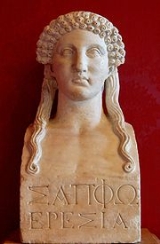
Sappho ( in English; Attic Greek
Attic Greek

Attic Greek is the prestige dialect of Ancient Greek that was spoken in Attica, which includes Athens. Of the ancient dialects, it is the most similar to later Greek, and is the standard form of the language studied in courses of "Ancient Greek"....
  , Aeolic Greek
Aeolic Greek

Aeolic or Aeolian Greek is a Linguistics term used to describe a set of rather Archaic period in Greece Greek language sub-dialects, spoken mainly in Boeotia , in Lesbos Island and in other Greek colonies....
  was an Ancient Greek
Ancient Greece

The term Ancient Greece refers to the period of History of Greece lasting from the Greek Dark Ages ca. 1100 BC and the Dorian invasion, to 146 BC and the Roman Republic conquest of Greece after the Battle of Corinth ....
 lyric poet
Nine lyric poets

The nine lyric poets were a canon of archaic Greece composers esteemed by the scholars of Hellenistic Alexandria as worthy of critical study....
, born on the island
Island

An island or isle is any piece of land that is surrounded by water. Very small islands such as emergent land features on atolls are called islets....
 of Lesbos. Later Greeks included her in the canonical list of nine lyric poets
Nine lyric poets

The nine lyric poets were a canon of archaic Greece composers esteemed by the scholars of Hellenistic Alexandria as worthy of critical study....
. Her birth was sometime between 630 and 612 BC, and it is said that she died around 570 BC. The bulk of her poetry, which was well-known and greatly admired throughout antiquity, has been lost, but her immense reputation has endured through surviving fragments.

only contemporary source which refers to Sappho's life is her own body of poetry, and scholars are skeptical of biographical readings of it.


Discussion
Ask a question about 'Sappho'
Start a new discussion about 'Sappho'
Answer questions from other users
Full Discussion Forum


Encyclopedia


Sappho ( in English; Attic Greek
Attic Greek

Attic Greek is the prestige dialect of Ancient Greek that was spoken in Attica, which includes Athens. Of the ancient dialects, it is the most similar to later Greek, and is the standard form of the language studied in courses of "Ancient Greek"....
  , Aeolic Greek
Aeolic Greek

Aeolic or Aeolian Greek is a Linguistics term used to describe a set of rather Archaic period in Greece Greek language sub-dialects, spoken mainly in Boeotia , in Lesbos Island and in other Greek colonies....
  was an Ancient Greek
Ancient Greece

The term Ancient Greece refers to the period of History of Greece lasting from the Greek Dark Ages ca. 1100 BC and the Dorian invasion, to 146 BC and the Roman Republic conquest of Greece after the Battle of Corinth ....
 lyric poet
Nine lyric poets

The nine lyric poets were a canon of archaic Greece composers esteemed by the scholars of Hellenistic Alexandria as worthy of critical study....
, born on the island
Island

An island or isle is any piece of land that is surrounded by water. Very small islands such as emergent land features on atolls are called islets....
 of Lesbos. Later Greeks included her in the canonical list of nine lyric poets
Nine lyric poets

The nine lyric poets were a canon of archaic Greece composers esteemed by the scholars of Hellenistic Alexandria as worthy of critical study....
. Her birth was sometime between 630 and 612 BC, and it is said that she died around 570 BC. The bulk of her poetry, which was well-known and greatly admired throughout antiquity, has been lost, but her immense reputation has endured through surviving fragments.

Life

The only contemporary source which refers to Sappho's life is her own body of poetry, and scholars are skeptical of biographical readings of it. Later biographical traditions, from which all more detailed accounts derive, have also been cast into doubt.

Chronology


Strabo
Strabo

Strabo was a Ancient Greeks history, geography and philosophy....
 says that Sappho was the contemporary of Alcaeus of Mytilene (born ca. 620 BC) and Pittacus (ca. 645 - 570 BC) and according to Athenaeus
Athenaeus

Athenaeus , of Naucratis in Egypt, Greeks rhetorician and grammarian, flourished about the end of the 2nd and beginning of the 3rd century A.D. The Suda only tells us that he lived in the times of Marcus ; but the contempt with which he speaks of Commodus shows that he survived that emperor....
 she was the contemporary of Alyattes
Alyattes

Alyattes may refer to:* Alyattes I, king of Lydia * Alyattes II, king of Lydia, ...
 of Lydia (ca. 610 - 560 BC). The Suda
Suda

The Suda or Souda is a massive 10th century Byzantine Empire Medieval Greek historical encyclopedia of the ancient Mediterranean world. It is an Encyclopedia lexicon with 30,000 entries, many drawing from ancient sources that have since been lost, and often derived from medieval Christian compilers....
, a 10th century Byzantine
Byzantine Empire

Byzantine Empire and Eastern Roman Empire are conventional names used to describe the Roman Empire during the Middle Ages, centered on its capital of Constantinople....
 encyclopædia, dates her to the 42nd Olympiad (612/608 BC), meaning either that she was born then or that this was her floruit
Floruit

Floruit refers to a period of time during which a person, school, movement or even species was active or flourishing. It is the third person, singular, perfect tense, indicative, active form of the Latin verb florere ? "to flourish"....
. The versions of Eusebius state that she was famous by the first or second year of the 45th or 46th Olympiad (between 600 and 594 BC). Taken together, these references make it likely that she was born ca. 620 BC, or a little earlier. Judging from the Parian Marble
Parian marble

Parian marble is a fine-grained semitranslucent pure-white marble quarried during the classical antiquity era on the Greece island of Paros. It was highly prized by the Ancient Greece for making sculptures....
 she was exiled from Lesbos to Sicily
Sicily

Sicily is an Autonomous regions with special statute of Italy. Of all the regions of Italy, Sicily covers the largest land area at 25,708 km? and currently has just over five million inhabitants....
 sometime between 604 and 594 BC. If fragment 98 of her poetry is accepted as biographical evidence and as a reference to her daughter (see below) it may indicate that she had already had a daughter by the time she was exiled. If fragment 58 is accepted as autobiographical it indicates that she lived into old age. If her connection to Rhodopis (see below) is accepted as historical it indicates that she lived into the mid-6th century BC.

Family

An Oxyrhynchus
Oxyrhynchus

Oxyrhynchus is a city in Upper Egypt, located about 160 km south-southwest of Cairo, in the governorate of Al Minya Governorate. It is also an archaeological site, considered one of the most important ever discovered....
 papyrus from around AD 200 and the Suda agree that Sappho had a mother called Cleïs and a daughter by the same name. Two preserved fragments of Sappho's poetry refer to a Cleïs. In fragment 98, Sappho addresses Cleïs, saying that she has no way of obtaining a decorated headband for her. Fragment 132 reads in full: "I have a beautiful child [pais] who looks like golden flowers, my darling Cleis, for whom I would not (take) all Lydia or lovely..." These fragments have often been interpreted as referring to Sappho's daughter or as confirming that Sappho had a daughter with this name. But even if a biographic reading of the verses is accepted, this is not certain. Cleïs is referred to in fragment 132 with the Greek word pais, which can as easily indicate a slave
Slavery in antiquity

Slavery in the ancient world, specifically, in Mediterranean cultures, comprised a mixture of debt-slavery, slavery as a punishment for crime, and the enslavement of prisoner of war....
 or any young person as an offspring. It is possible that these verses or others like them were misunderstood by ancient writers, leading to the biographical tradition which has come down to us.

Fragment 102 has its speaker address a "sweet mother", sometimes taken as an indication that Sappho began to write poetry while her mother was still alive. The name of Sappho's father is widely given as Scamandronymus, he is not referred to in any of the surviving fragments. In his Heroides
Heroides

The Heroides ' , or Epistulae Heroidum , are a collection of fifteen wiktionary:epistolary poems composed by Ovid in Latin elegiac couplets, and presented as though written by a selection of aggrieved heroines of Greek mythology and Roman mythology, in address to their heroic lovers who have in some way mistreated,...
, Ovid has Sappho lament that, "Six birthdays of mine had passed when the bones of my parent, gathered from the pyre, drank before their time my tears." Ovid may have based this on a poem by Sappho no longer extant.

Sappho was reported to have three brothers; Erigyius (or Eurygius), Larichus and Charaxus. The Oxyrhynchus papyrus says that Charaxus was the eldest but that Sappho was more fond of the young Larichus. According to Athenaeus, Sappho often praised Larichus for pouring wine in the town hall of Mytilene, an office held by boys of the best families. This indication that Sappho was born into an aristocratic family is consistent with the sometimes rarefied environments which her verses record.

A story given by Herodotus
Herodotus

Herodotus of Halicarnassus was a Greeks historian who lived in the 5th century BC and is regarded as the "Father of History" in Western culture....
 and later by Strabo, Athenaeus, Ovid
Ovid

Publius Ovidius Naso was a Roman Empire poet known as Ovid to the English language-speaking world, who wrote about love, seduction, and Roman mythology transformation....
 and the Suda, tells of a relation between Charaxus and the Egyptian courtesan Rhodopis
Rhodopis (hetaera)

Rhodopis was a celebrated 6th-century BCE Ancient Greece hetaera, of Thrace origin. She is one of only two hetaerae mentioned by name in Herodotus's discussion of the profession ....
. Herodotus, the oldest source of the story, reports that Charaxus ransomed Rhodopis for a large sum and that after he returned to Mitylene, Sappho scolded him in verse. Strabo, writing some 400 years later, adds that Charaxus was trading with Lesbian wine and that Sappho called Rhodopis Doricha. Athenaeus, another 200 years later, calls the courtesan Doricha and maintains that Herodotus had her confused with Rhodopis, another woman altogether. He also cites an epigram by Posidippus
Posidippus

Poseidippus of Pella or Posidippus was an Greeks epigrammatic poet who adhered to Orphism. He was born in the city of Pella capital of the kingdom of Macedon....
 (3rd c. BC) which refers to Doricha and Sappho. Based on this story, scholars have speculated that references to a Doricha may have been found in Sappho's poems. None of the extant fragments have this name in full but fragments 7 and 15 are often restored to include it. Joel Lidov has criticized this restoration, arguing that the Doricha story is not helpful in restoring any fragment by Sappho and that its origins lie in the work of Cratinus
Cratinus

Cratinus , Athenian comic poet....
 or another of Herodotus' comic contemporaries.

The Suda
Suda

The Suda or Souda is a massive 10th century Byzantine Empire Medieval Greek historical encyclopedia of the ancient Mediterranean world. It is an Encyclopedia lexicon with 30,000 entries, many drawing from ancient sources that have since been lost, and often derived from medieval Christian compilers....
 is alone in claiming that Sappho was married to a "very wealthy man called Cercylas, who traded from Andros" and that he was Cleïs' father. This tradition may have been invented by the comic poets as a witticism, as the name of the purported husband means "prick from the Isle of Man."

Exile


Sappho's lifetime was a period of political turbulence on Lesbos and saw the rise of Pittacus. According to the Parian Marble
Parian marble

Parian marble is a fine-grained semitranslucent pure-white marble quarried during the classical antiquity era on the Greece island of Paros. It was highly prized by the Ancient Greece for making sculptures....
, Sappho was exiled to Sicily sometime between 604 and 594 and Cicero records that a statue of her stood in the town-hall of Syracuse. Unlike the works of her fellow poet, Alcaeus, Sappho's surviving poetry has very few allusions to political conditions. The principal exception is fragment 98 which mentions exile and indicates that Sappho was lacking some of her customary luxuries. Her political sympathies may have lain with the party of Alcaeus. Though there is no explicit record of this it is usually assumed that Sappho returned from exile at some point and that she spent most of her life in Lesbos.

Phaon legend

A tradition going back at least to Menander
Menander

Menander , Greek dramatist, the best-known representative of Athenian New Comedy, was the son of well-to-do parents; his father Diopeithes is identified by some with the Athenian general and governor of the Thracian Chersonese known from the speech of Demosthenes De Chersoneso....
 (fr. 258 K) suggested that Sappho killed herself by jumping off the Leucadian cliffs for love of Phaon
Phaon

Phaon in Greek mythology was a boatman of Mitylene in Lesbos Island. He was old and ugly when Aphrodite came to his boat. She put on the guise of a crone....
, a ferryman. This is regarded as ahistorical by modern scholars, perhaps invented by the comic poets or originating from a misreading of a first-person reference in a non-biographical poem. The legend may have resulted in part from a desire to assert Sappho as heterosexual.

Sexuality and community


Nama Sappho Lisant
Sappho's poetry centers on passion and love for various personages and genders. The word lesbian
Lesbian

File:Lesbian Couple from back holding hands.jpgLesbian is a term most widely used in the English language to describe sexual and romantic desire between females....
 derives from the name of the island of her birth, Lesbos, while her name is also the origin of the word sapphic; both words were only applied to female homosexuality beginning in the 19th century. The narrators of many of her poems speak of infatuations and love (sometimes requited, sometimes not) for various females, but descriptions of physical acts between women are few and subject to debate. Whether these poems are meant to be autobiographical is not known, although elements of other parts of Sappho's life do make appearances in her work, and it would be compatible with her style to have these intimate encounters expressed poetically, as well. Her homoerotica should be placed in the seventh century (BC) context. The poems of Alcaeus
Alcaeus (poet)

Alcaeus of Mytilene , Ancient Greek Lyric poetry poet who supposedly invented the Alcaic verse. He was included in the canon list of nine lyric poets by the scholars of Hellenistic Alexandria....
 and later Pindar
Pindar

Pindar , was an Ancient Greek Lyric poetry poet.Of the canonical nine lyric poets of ancient Greece, Pindar is the one whose work is by far the best preserved, and critics in antiquity tended to regard him as the greatest....
 record similar romantic bonds between the members of a given circle.

Sappho's contemporary Alcaeus
Alcaeus (poet)

Alcaeus of Mytilene , Ancient Greek Lyric poetry poet who supposedly invented the Alcaic verse. He was included in the canon list of nine lyric poets by the scholars of Hellenistic Alexandria....
 described her thus: "Violet-haired, pure, honey-smiling Sappho" (fr. 384). The 3rd century philosopher Maximus of Tyre
Maximus of Tyre

'Cassius Maximus Tyrius' , was a Greek rhetoric and philosophy who flourished in the time of the Antonines and Commodus, 2nd century A.D....
 wrote that Sappho was "small and dark" and that her relationships to her female friends were similar to those of Socrates
Socrates

Socrates was a Classical Greece Philosophy. Credited as one of the founders of Western philosophy, he is an enigmatic figure known only through the classical accounts of his students....
:
What else was the love of the Lesbian woman except Socrates' art of love? For they seem to me to have practised love each in their own way, she that of women, he that of men. For they say that both loved many and were captivated by all things beautiful. What Alcibiades
Alcibiades

Alcibiades Cleiniou Scambonides , was a prominent History of Athens statesman, oratory, and general. He was the last famous member of his mother's aristocratic family, the Alcmaeonidae, which fell from prominence after the Peloponnesian War....
 and Charmides
Charmides

Charmides was an Athens statesman and one of the Thirty Tyrants who ruled Athens following its defeat in the Peloponnesian War. Uncle of Plato, Charmides appears in the Platonic dialogue bearing his name, as well as in Xenophon....
 and Phaedrus
Phaedrus

Phaedrus , Roman Empire fabulist, was probably a Thracian slave, born in Pydna of Macedonia and lived in the reigns of Augustus Caesar, Tiberius, Caligula and Claudius....
 were to him, Gyrinna and Atthis
Atthis

Atthis can be*Atthis , in Greek myth, the daughter of Cranaus*Atthis , a lost book by Cleidemus named for her*A woman mentioned in love poetry by Sappho...
 and Anactoria
Anactoria

Anactoria is the name of a woman mentioned by Sappho as a lover of hers in Fragment 16 . Fragment 31 is traditionally called the "Ode to Anactoria", though no name appears in it ....
 were to the Lesbian.


During the Victorian era
Victorian era

The Victorian Era of the United Kingdom of Great Britain and Ireland was the period of Victoria of the United Kingdom reign from June 1837 to January 1901....
, it became the fashion to describe Sappho as the headmistress of a girls' finishing school. As Page DuBois (among many other experts) points out, this attempt at making Sappho understandable and palatable to the genteel classes of Great Britain
Great Britain

Great Britain is an island lying to the northwest of Continental Europe. It is the List of islands by area, and the largest in Europe. With a population of 58.9 million people it is List of islands by population....
 was based more on conservative sensibilities than evidence. There are no references to teaching, students, academies, or tutors in any of Sappho's scant collection of surviving works. Burnett follows others, like C.M. Bowra, in suggesting that Sappho's circle was somewhat akin to the Spartan agelai or the religious sacred band, the thiasos, but Burnett nuances her argument by noting that Sappho's circle was distinct from these contemporary examples because "membership in the circle seems to have been voluntary, irregular and to some degree international." The notion that Sappho was in charge of some sort of academy persists nonetheless.

Works


Alexandrian edition of Sappho's poetry

The Library of Alexandria
Library of Alexandria

The Royal Library of Alexandria or Ancient Library of Alexandria in Alexandria, Egypt, was once the largest Great libraries of the ancient world....
 collected Sappho's poetry into nine books, mostly based on their meter
Meter (poetry)

In poetry, the meter is the basic rhythm of a verse . Many traditional verse forms prescribe a specific verse meter, or a certain set of meters alternating in a particular order....
:
  • Book I, poems composed in the Sapphic stanza
    Sapphic stanza

    The Sapphic stanza, named after Sappho, is an Aeolic verse form spanning four lines .The form is two hendecasyllabic verses, and a third verse beginning the same way and continuing with five additional syllables ....
    , 330 stanzas in all (fragments 1-42);
  • Book II, poems composed in glyconic
    Glyconic

    Glyconic, , describes a form of meter in classical antiquity Greek and Latin poetry. The glyconic line is the most basic form of Aeolic verse, and it is often combined with others....
     lines with dactylic expansion (frr. 43-52);
  • Book III, poems in Greater Asclepiad
    Asclepiad (poetry)

    An Asclepiad is a line of poetry following a particular metrical pattern. The form is attributed to Asclepiades of Samos and is one of the Aeolic verse....
     distichs (frr. 53-57);
  • Book IV, poems in distichs of a somewhat similar meter (frr. 58-91);
  • Book V, probably consisting of poems in various three-line stanzas (frr. 92-101);
  • Book VI (contents unknown);
  • Book VII (only two surviving lines in the same meter, fr. 102);
  • Book VIII (see fr. 103);
  • Book IX, epithalamia in other meters, including dactylic hexameter
    Dactylic hexameter

    Dactylic hexameter is a form of meter in poetry or a rhythmic scheme. It is traditionally associated with the quantitative meter of classical epic poetry in both Greek language and Latin, and was consequently considered to be the Grand Style of classical poetry....
     (frr. 104-117).
Not every surviving fragment can be assigned to a book (frr. 118-213 are unassigned), and other meters are represented in the fragments.

Surviving poetry

The surviving proportion of the nine-volume corpus of poetry read in antiquity is small but still constitutes a poetic corpus of major importance. There is a single complete poem, Fragment 1, the Hymn to Aphrodite
Aphrodite

Aphrodite is the classical Greek mythology goddess of love, sex, and beauty. According to Greek oral poet Hesiod, she was born when Uranus was castrated by his son Cronus....
, quoted in its entirety as a model of the "polished and exuberant" style of composition by Dionysius of Halicarnassus
Dionysius of Halicarnassus

Dionysius of Halicarnassus was a Greeks historian and teacher of rhetoric, who flourished during the reign of Caesar Augustus....
, with admiration of its consummate artistry: Other major fragments include three virtually-complete poems (in the standard numeration, fragments 16, 31, and the recently supplemented 58).

Recent discoveries
The most recent addition to the corpus is a virtually-complete poem on old age (fr. 58). The line-ends were first published in 1922 from an Oxyrhynchus
Oxyrhynchus

Oxyrhynchus is a city in Upper Egypt, located about 160 km south-southwest of Cairo, in the governorate of Al Minya Governorate. It is also an archaeological site, considered one of the most important ever discovered....
 papyrus, no. 1787 (fragment 1: see the third pair of images on ), but little could be made of them, since the indications of poem-end (placed at the beginnings of the lines) were lost, and scholars could only guess where one poem ended and another began. Most of the rest of the poem has recently (2004) been published from a 3rd century BC papyrus in the Cologne University collection. The latest reconstruction, by M. L. West, appeared in the Zeitschrift für Papyrologie und Epigraphik 151 (2005), 1-9, and in the Times Literary Supplement on 21 June 2005 ( and ). The poem refers to the plight of Tithonus
Tithonus

In Greek mythology, Tithonus or Tithonos was the lover of Eos, Titan of the dawn. He was a Troy by birth, the son of King Laomedon of Troy by a Naiad named Strymo ....
, with whom the goddess Eos
Eos

Eos is, in Greek mythology, the Titan goddess of the dawn, who rose from her home at the edge of Oceanus, the Ocean that surrounds the world, to herald her brother Helios, the sun....
 fell in love and requested he become immortal
Immortality

Immortality is the concept of life in a body or soul for an infinite or inconceivably vast length of time.As immortality is the negation of mortality?not dying or not being subject to death?it has been a subject of fascination to human since at least the beginning of history....
, but forgot to assure that he stay forever young
Eternal youth

Eternal youth is the concept of human physical immortality free of aging. The youth referred to is usually meant to be in contrast the depredations of aging, rather than a specific age of the human lifespan....
. The Greek text has been reproduced with helpful notes for students of the language.

Qualities of Sappho's poetry

David Campbell has briefly summarized some of the most arresting qualities of Sappho's poetry:
Clarity of language and simplicity of thought are everywhere evident in our fragments; wit and rhetoric, so common in English love-poetry and not quite absent from Catullus' love poems, are nowhere to be found. Her images are sharp—the sparrows that draw Aphrodite's chariot, the full moon in a starry sky, the solitary red apple at the tree-top—and she sometimes lingers over them to elaborate them for their own sake. She quotes the direct words of conversations real or imaginary and so gains immediacy. When the subject is the turbulence of her emotions, she displays a cool control in their expression. Above all, her words are chosen for their sheer melody: the skill with which she placed her vowels and consonants, admired by Dionysius of Halicarnassus, is evidenced by almost any stanza; the music to which she sang them has gone, but the spoken sounds may still enchant.


Legacy


Reputation in antiquity

In antiquity, Sappho was commonly regarded as the greatest, or one of the greatest, of lyric poets. The Milan Papyrus
Milan Papyrus

The Milan Papyrus is a papyrus scroll written in Alexandria in the late third or early second century BC during the rule of the Ptolemaic dynasty....
, recovered from a dismantled mummy casing and published in 2001, has revealed the high esteem in which the poet Posidippus
Posidippus

Poseidippus of Pella or Posidippus was an Greeks epigrammatic poet who adhered to Orphism. He was born in the city of Pella capital of the kingdom of Macedon....
 of Pella, an important composer of epigrams (3rd century BC), held Sappho's "divine songs."

An epigram
Epigram

An Epigram is a brief, clever, and usually memorable statement. Derived from the "to write on - inscribe", the literary device has been employed for over two millennia....
 in the Anthologia Palatina
Greek Anthology

The Greek Anthology is a collection of poems, mostly epigrams, that span the classical and Byzantine periods of Greek literature.While papyrus containing fragments of collections of poetry have been found in Egypt, the earliest known anthology in Greek was compiled by Meleager of Gadara, under the title Anthologia, or "Garland."...
 (9.506) ascribed to Plato
Plato

Plato , was a Classical Greece Greeks philosopher, mathematician, writer of philosophical dialogues, and founder of the Platonic Academy in Ancient Athens, the first institution of higher learning in the western world....
 states:
Some say the Muse
Muse

File:Muse reading Louvre CA2220.jpgThe Muses in Greek mythology, poetry, and literature are the goddesses or spirits who inspire the creation of literature and the arts....
s are nine: how careless!
Look, there's Sappho too, from Lesbos, the tenth.


Claudius Aelianus
Claudius Aelianus

Claudius Aelianus , often seen as just Aelian, born at Praeneste, was a Roman author and teacher of rhetoric who flourished under Septimius Severus and probably outlived Elagabalus, who died in 222....
 wrote in Miscellany that Plato
Plato

Plato , was a Classical Greece Greeks philosopher, mathematician, writer of philosophical dialogues, and founder of the Platonic Academy in Ancient Athens, the first institution of higher learning in the western world....
 called Sappho wise. A story is recounted in the Florilegium (3.29.58) of Stobaeus
Stobaeus

Joannes Stobaeus , so called from his native place Stobi in North Macedonia , was the compiler of a valuable series of extracts from Greece authors....
:
Solon of Athens
Solon

Solon was an Athens statesman, lawmaker, and lyric poetry. He is remembered particularly for his efforts to legislate against political, economic and moral decline in Archaic period in Greece Athens....
 heard his nephew sing a song of Sappho's over the wine and, since he liked the song so much, he asked the boy to teach it to him. When someone asked him why, he said, "So that I may learn it, then die."


A few centuries later, Horace
Horace

This article is about the Roman poet Horace. For other uses, see Horace .Quintus Horatius Flaccus, , known in the English language world as Horace, was the leading Roman Empire Lyric poetry during the time of Augustus....
 wrote in his Odes that Sappho's lyrics are worthy of sacred admiration. One of Sappho's poems was famously translated by the 1st century BC Roman
Ancient Rome

Ancient Rome was a civilization that grew out of a small agricultural community founded on the Italian Peninsula as early as the 10th century BC....
 poet Catullus
Catullus

Gaius Valerius Catullus was a Roman poet of the 1st century BC. His work remains widely studied, and continues to influence poetry and other forms of art....
 in his "Ille mi par esse deo videtur" (Catullus 51).

Loss and preservation of Sappho's works


Although Sappho's work endured well into Roman
Ancient Rome

Ancient Rome was a civilization that grew out of a small agricultural community founded on the Italian Peninsula as early as the 10th century BC....
 times, with changing interests, styles, and aesthetics her work was copied less and less, especially after the academies stopped requiring her study. Part of the reason for her disappearance from the standard canon was the predominance of Attic
Attic Greek

Attic Greek is the prestige dialect of Ancient Greek that was spoken in Attica, which includes Athens. Of the ancient dialects, it is the most similar to later Greek, and is the standard form of the language studied in courses of "Ancient Greek"....
 and Homeric Greek
Homeric Greek

Homeric Greek is the form of Ancient Greek that was used by Homer in the Iliad and Odyssey. It is an archaic version of Ionic Greek, with admixtures from certain other dialects, such as Aeolic Greek....
 as the languages required to be studied. Sappho's Aeolic Greek
Aeolic Greek

Aeolic or Aeolian Greek is a Linguistics term used to describe a set of rather Archaic period in Greece Greek language sub-dialects, spoken mainly in Boeotia , in Lesbos Island and in other Greek colonies....
 dialect
Dialect

A dialect is a variety of a language that is characteristic of a particular group of the language's speakers. The term is applied most often to regional speech patterns, but a dialect may also be defined by other factors, such as social class....
, a difficult one, and by Roman times, arcane and ancient as well, posed considerable obstacles to her continued popularity. Still, the greatest poets and thinkers of ancient Rome
Ancient Rome

Ancient Rome was a civilization that grew out of a small agricultural community founded on the Italian Peninsula as early as the 10th century BC....
 continued to emulate her or compare other writers to her, and it is through these comparisons and descriptions that we have received much of her extant poetry.

Once the major academies of the Byzantine Empire
Byzantine Empire

Byzantine Empire and Eastern Roman Empire are conventional names used to describe the Roman Empire during the Middle Ages, centered on its capital of Constantinople....
 dropped her works from their standard curricula, very few copies of her works were made by scribes, and the 12th century Byzantine scholar Tzetzes speaks of her works as lost.

Modern legends, with origins that are difficult to trace, have made Sappho's literary legacy the victim of purposeful obliteration by scandalized church leaders, often by means of book-burning. There is no known historical evidence for these accounts. Indeed, Gregory of Nazianzus
Gregory of Nazianzus

Gregory of Nazianzus was a 4th-century Archbishop of Constantinople. He is widely considered the most accomplished rhetorical stylist of the Church Fathers....
, who along with Pope Gregory VII
Pope Gregory VII

Pope Saint Gregory VII , born Hildebrand of Soana , was papacy from April 22, 1073, until his death. One of the great reforming popes, he is perhaps best known for the part he played in the Investiture Controversy, his dispute with Henry IV, Holy Roman Emperor affirming the primacy of the papal authority and the new canon law governing...
 features as the villain in many of these stories, was a reader and admirer of Sappho's poetry. For example, modern scholars have noted the echoes of Sappho fr. 2 in his poem On Human Nature, which copies from Sappho the quasi-sacred grove (alsos), the wind-shaken branches, and the striking word for "deep sleep" (koma).

It appears likely that Sappho's poetry was largely lost through action of the same indiscriminate forces of cultural change that have left us such paltry remains of all nine canonical Greek lyric poets
Nine lyric poets

The nine lyric poets were a canon of archaic Greece composers esteemed by the scholars of Hellenistic Alexandria as worthy of critical study....
, of whom only Pindar (whose works alone survive in a manuscript tradition) and Bacchylides
Bacchylides

Bacchylides was an Ancient Greek Lyric poetry poet. Later Greeks included him in the canonical list of nine lyric poets which included his uncle Simonides....
 (our knowledge of whom we owe to a single dramatic papyrus find) have fared much better.

Sources of the surviving fragments

Although the manuscript
Manuscript

A manuscript is any document that is written by hand, as opposed to being printed or reproduced in some other way. The term may also be used for information that is hand-recorded in other ways than writing, for example inscriptions that are chiselled upon a hard material or scratched as with a knife point in plaster or with a stylus on a wa...
 tradition broke off, some of Sappho's poetry has been discovered in Egyptian papyri fragments from an earlier period, such as those found in the ancient rubbish heaps of Oxyrhynchus
Oxyrhynchus

Oxyrhynchus is a city in Upper Egypt, located about 160 km south-southwest of Cairo, in the governorate of Al Minya Governorate. It is also an archaeological site, considered one of the most important ever discovered....
, where a major find brought many new but tattered verses to light, providing a major new source. One substantial fragment is preserved on a potsherd. The rest of what we know of Sappho comes through citations in other ancient writers, often made to illustrate grammar
Grammar

Grammar is the field of linguistics that covers the conventions governing the use of any given natural language. It includes morphology and syntax, often complemented by phonetics, phonology, semantics, and pragmatics....
, vocabulary
Vocabulary

A person's vocabulary is the set of words they are familiar with in a language. A vocabulary usually grows and evolves with age, and serves as a useful and fundamental tool for communication and learning....
, or meter.

Modern translations


From the time of the European Renaissance
Renaissance

The Renaissance was a cultural movement that spanned roughly the 14th to the 17th century, beginning in Italy in the late Middle Ages and later spreading to the rest of Europe....
, the interest in Sappho's writing has grown, seeing waves of fairly widespread popularity as new generations rediscover her work. Since few people are able to understand ancient languages, each age has translated Sappho in its own idiomatic way. Poetry, such as Sappho's, that relies on meter is difficult to reproduce in English
English language

English is a West Germanic language that originated in Anglo-Saxon England and has lingua franca status in many parts of the world as a result of the military, economic, scientific, political and cultural influence of the British Empire in the 18th, 19th and early 20th centuries and that of the United States from the mid 20th century onwa...
 which uses stress-based meters and rhyme compared to Ancient Greek's solely length-based meters. As a result, many early translators used rhyme
Rhyme

A rhyme is a repetition of similar sounds in two or more different words and is most often used in poetry and songs. The word "rhyme" may also refer to a short poem, such as a rhyming couplet or other brief rhyming poem such as nursery rhymes....
 and worked Sappho's ideas into English poetic forms.

In the 1960s, Mary Barnard
Mary Barnard

Mary Ethel Barnard was an United States poet, biographer and Greek language-to-English language translator. She is known for her clear interpretation of the works of Sappho, a translation which has never gone out of print....
 reintroduced Sappho to the reading public with a new approach to translation that eschewed the use of rhyming stanza
Stanza

In poetry, a stanza is a unit within a larger poem. In modern poetry, the term is often equivalent with strophe; in popular vocal music, a stanza is typically referred to as a "Verse " ....
s and traditional forms. Subsequent translators have tended to work in a similar manner. In 2002, classicist and poet Anne Carson
Anne Carson

Anne Carson is a Canada poet, essayist, translator, and a professor of Classics and comparative literature at the University of Michigan. Carson lived in Montreal for several years and taught at McGill University....
 produced If Not, Winter, an exhaustive translation of Sappho's fragments. Her line-by-line translations, complete with brackets where the ancient papyrus sources break off, are meant to capture both the original's lyricism and its present fragmentary nature. Translations of Sappho have also been produced by Willis Barnstone
Willis Barnstone

Willis Barnstone is an American poet, memoirist, translator, Hispanist, and comparatist. He has translated the Ancient Greek poets and the complete fragments of the pre-Socratic philosopher Heraclitus ....
 and Stanley Lombardo
Stanley Lombardo

Stanley F. Lombardo is an American professor of Classics at the University of Kansas. He is best known for his translations of the Iliad, the Odyssey, and the Aeneid ....
.

See also

  • Ancient Greek literature
    Ancient Greek literature

    Ancient Greek literature refers to literature written in the Greek language until the 4th century AD....


External links

  • Texts and translations
    • (Greek texts and several translations, with essays and criticism)
    • (Greek texts with commentary by William Annis)
    • (English translations)
    • (1925 translation with Greek text and transliteration)
    • (1904 translation of 100 fragments)
    • (8 fragments, with Greek text, translated by "Elpenor" and H. T. Wharton)
    • (MP3 audio of five fragments in Greek)
  • , by William Harris, Prof. Em. of Classics, Middlebury College
  • , BBC Radio 4
    BBC Radio 4

    BBC Radio 4 is a domestic UK radio station that broadcasts a wide variety of spoken-word programmes, including news, drama, comedy, science and history....
    , In Our Time, 26 April 2007
  • , translated by Mary Barnard, from 'Evocation of Sappho' four fragments set to music, sung in English translation and performed by Joe Dolce
    Joe Dolce

    Joe Dolce is an United States of America-born, Australian-resident singer/songwriter who achieved fame with the million-selling song "Shaddap You Face", recorded under his vehicle, the group named Joe Dolce Music Theatre, which was a major hit in Europe in 1981....
    , from the CD 'freelovedays', 26 April 2003.
  • , music by Manos Hadjidakis
    Manos Hadjidakis

    Manos Hadjidakis was a popular Greek composer. He was born in Xanthi, Greece. In 1962 he received an Academy Awards in the category of Best Music for his Song Never on Sunday from the film of the same name....
    , sung by Fleury D'Antonaki.