


Girolamo Savonarola

Encyclopedia
Girolamo Savonarola was an Italian
Dominican
friar, Scholastic
, and an influential contributor to the politics of Florence
from 1494 until his execution in 1498. He was known for his book burning
, destruction of what he considered immoral art, and what he thought the Renaissance
—which began in his Florence
—ought to become. He preached vehemently against the moral corruption of much of the clergy at the time. His main opponent was Rodrigo Borgia, who was Pope Alexander VI
from 1492, through Savonarola's death in 1498.
, the capital of an independent Duchy
in Emilia-Romagna
, northern Italy. According to another source, he was born at Occhiobello, 7 km from Ferrara. He was born into a respected and affluent family that had originally resided in Padua.
In his youth he studied the Bible
, St. Thomas Aquinas
and Aristotle
. Savonarola initially studied at the University of Ferrara
, where he appears to have taken an advanced Arts degree. His stance against morally corrupt clergy was initially manifested in his poem on the destruction of the world entitled De Ruina Mundi (On the Downfall of the World), written at the age of 20. It was at this stage that he also began to develop his expression of moral conscience, and in 1475 his poem De Ruina Ecclesiae (On the Downfall of the Church) displayed his contempt for the Roman Curia
by terming it 'a false, proud archaic wench'.
friar
in 1475 and entered the monastery of San Domenico in Bologna
. He immersed himself in theological study, and in 1479 transferred to the monastery of Santa Maria degli Angeli. Finally in 1482 the Order dispatched him to Florence, the ‘city of his destiny’. Savonarola was lambasted for being ungainly, as well as being a poor orator. He made no impression on Florence in the 1480s, and his departure in 1487 went unnoticed. He returned to Bologna where he became 'master of studies’.
Savonarola returned to Florence in 1490 at the behest of Count Pico della Mirandola
. There he began to preach passionately about the Last Days
, accompanied by testimony about his visions and prophetic announcements of direct communications with God
and the saint
s. Such fiery preaching was not uncommon at the time, but a series of circumstances quickly brought Savonarola great success.
The first disaster to give credibility to Savonarola’s apocalyptic message was the Medici family's weakening grip on power owing to the French-Italian wars
. The flowering of expensive Renaissance art and culture paid for by wealthy Italian families now seemed to mock the growing misery in Italy, creating a backlash of resentment among the people.
The second disaster was the appearance of syphilis
(or the “French pox”). Finally, the year 1500 was approaching, which may have brought about a mood of millennialism
. In minds of many, the Last Days were impending and Savonarola was the prophet of the day.
His parish church in San Marco
was crowded to overflowing during his celebration of Mass
and at his sermons. Savonarola was a preacher, not a theologian. He preached that Christian life involved being good and practicing the virtue
s. He did not seek to create a religious group separate from the Catholic Church. Rather, he wanted to correct the transgressions of worldly popes and secularized members of the Church's wayward Curia
.
Lorenzo de Medici, the previous ruler of Florence
and patron of many Renaissance artists, was also a former patron of Savonarola. Eventually, Lorenzo and his son Piero de Medici
became targets of Savonarola’s preaching.
invaded Florence in 1494, the ruling Medici
were overthrown and Savonarola emerged as the new leader of the city, combining in himself the role of leader and priest. He set up a republic
in Florence. Characterizing it as a “Christian and religious Republic,” one of its first acts was to make sodomy
, previously punishable by fine, into a capital
offence. Homosexuality had previously been tolerated in the city, and many homosexuals from the elite now chose to leave Florence. His chief enemies were the Duke of Milan, Ludovico Sforza
, and Pope Alexander VI
, who issued numerous restraints against him, all of which were subsequently ignored.
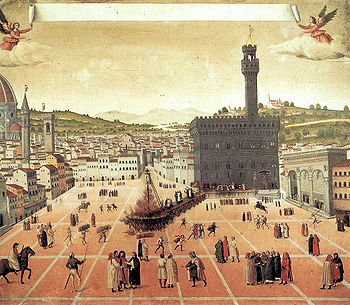 In 1497, he and his followers carried out the Bonfire of the Vanities
. They sent boys from door to door collecting items associated with moral laxity: mirrors, cosmetics, lewd pictures, pagan books, immoral sculptures (which he wanted to be replaced by statues of the saints and modest depictions of biblical scenes
), gaming tables, chess pieces, lutes and other musical instruments, fine dresses, women’s hats, and the works of immoral and ancient poets, and burnt them all in a large pile in the Piazza della Signoria
of Florence. Many fine Florentine Renaissance artworks were lost in Savonarola’s notorious bonfires — including paintings by Sandro Botticelli
, which he is alleged to have thrown into the fires himself.
Florence soon became tired of Savonarola because of the city’s continual political and economic miseries partially derived from Savonarola's opposition to trading and making money. When a Franciscan preacher challenged him to a trial by fire
in the city centre and he declined, his following began to dissipate.
During his Ascension Day sermon on May 4, 1497, bands of youths rioted, and the riot became a revolt: dancing and singing taverns reopened, and men again dared to gamble publicly.
by Pope Alexander VI
, and in 1498, Alexander demanded his arrest and execution. On April 8, a crowd attacked the Convent of San Marco. In the ensuing struggle, several of Savonarola’s guards and religious supporters were killed. Savonarola surrendered along with Fra Domenico da Pescia and Fra Silvestro, his two closest associates. Savonarola was charged with heresy
, uttering prophecies, sedition
, and other crimes, called religious errors by the Borgia
pope.
During the next few weeks all three were tortured on the rack
, the torturers sparing only Savonarola’s right arm in order that he might be able to sign his confession
. All three signed confessions, Savonarola doing so sometime before May 8. On that day he completed a written meditation on the Miserere mei, Psalm 50
, entitled Infelix ego
, in which he pleaded with God for mercy for his physical weakness in confessing to crimes he believed he did not commit. On the day of his execution, May 23, 1498, he was still working on another meditation, this one on Psalm 31, entitled Tristitia obsedit me.
On the day of his execution he was taken out to the Piazza della Signoria
along with Fra Silvestro and Fra Domenico da Pescia. The three were ritually stripped of their clerical vestments, degraded as "heretics and schismatics", and given over to the secular authorities to be burned. The three were hanged in chains from a single cross and an enormous fire was lit beneath them. They were thereby executed in the same place where the Bonfire of the Vanities
had been lit, and in the same manner that Savonarola had condemned other criminals during his own reign in Florence.
Jacopo Nardi
, who recorded the incident in his Istorie della città di Firenze, wrote that his executioner lit the flame exclaiming, “The one who wanted to burn me is now himself put to the flames.” Luca Landucci
, who was present, wrote in his diary that the burning took several hours, and that the remains were several times broken apart and mixed with brushwood so that not the slightest piece could be later recovered, as the ecclesiastical authorities did not want Savonarola’s followers to have any relics for a future generation of the rigorist preacher they considered a saint. The ashes of the three were afterwards thrown in the Arno beside the Ponte Vecchio
.
Nevertheless, the Frateschi party and her governo popolare revived until July 1499, when the French occupation of Milan began to favour it again. It was not until 1512 that the Medici returned with Spanish help, following the latest decline of the French.
, although theologically many differences exist. Savonarola did not produce a theological doctrine on salvation, and faithfully adhered to even minor theological definitions of the papal Magisterium
. However, Savonarola's call to simplicity in church interior and his rigorous moral stances have been compared to those of Jansenists. Also the insistence on the immediate danger of Hell and the fewness of the elect can be considered to be a similarity.
After Savonarola's death, a secret Catholic group known as the
Piagnoni
sprang up in Florence to preserve his memory, organized into a sort of Catholic guild. Franciscan friars were prominent among the Piagnoni, and they briefly re-appeared in 1527 when they once again overthrew the Medici, but through intervention of the Holy Roman Empire
it was brought to an end in 1530 at the Battle of Gavinana
and the Medici were restored to power.
Savonarola left many admirers throughout Europe, in particular among religiously pious humanists who valued his deep spiritual convictions. Erasmus is said to have refused to become a Protestant
partly because of the influence of Savonarola. At the same time, he is considered by Protestants to be a forerunner of the Reformation because of his criticisms of the papacy. Savonarola was said to be an inspiration to Michelangelo and Martin Luther.
In the twentieth century, a movement for the canonization
of Frà Savonarola began to develop within the Roman Catholic Church
, particularly among Dominicans
, with many judging his excommunication and execution to have been unjust. His potential beatification
and canonization is opposed by many Jesuits
, who consider Savonarola's (secular) conflict with the papacy to have been an intolerable crime.
Italy
Italy , officially the Italian Republic languages]] under the European Charter for Regional or Minority Languages. In each of these, Italy's official name is as follows:;;;;;;;;), is a unitary parliamentary republic in South-Central Europe. To the north it borders France, Switzerland, Austria and...
Dominican
Dominican Order
The Order of Preachers , after the 15th century more commonly known as the Dominican Order or Dominicans, is a Catholic religious order founded by Saint Dominic and approved by Pope Honorius III on 22 December 1216 in France...
friar, Scholastic
Scholasticism
Scholasticism is a method of critical thought which dominated teaching by the academics of medieval universities in Europe from about 1100–1500, and a program of employing that method in articulating and defending orthodoxy in an increasingly pluralistic context...
, and an influential contributor to the politics of Florence
Republic of Florence
The Republic of Florence , or the Florentine Republic, was a city-state that was centered on the city of Florence, located in modern Tuscany, Italy. The republic was founded in 1115, when the Florentine people rebelled against the Margraviate of Tuscany upon Margravine Matilda's death. The...
from 1494 until his execution in 1498. He was known for his book burning
Book burning
Book burning, biblioclasm or libricide is the practice of destroying, often ceremoniously, books or other written material and media. In modern times, other forms of media, such as phonograph records, video tapes, and CDs have also been ceremoniously burned, torched, or shredded...
, destruction of what he considered immoral art, and what he thought the Renaissance
Renaissance
The Renaissance was a cultural movement that spanned roughly the 14th to the 17th century, beginning in Italy in the Late Middle Ages and later spreading to the rest of Europe. The term is also used more loosely to refer to the historical era, but since the changes of the Renaissance were not...
—which began in his Florence
Florence
Florence is the capital city of the Italian region of Tuscany and of the province of Florence. It is the most populous city in Tuscany, with approximately 370,000 inhabitants, expanding to over 1.5 million in the metropolitan area....
—ought to become. He preached vehemently against the moral corruption of much of the clergy at the time. His main opponent was Rodrigo Borgia, who was Pope Alexander VI
Pope Alexander VI
Pope Alexander VI , born Roderic Llançol i Borja was Pope from 1492 until his death on 18 August 1503. He is one of the most controversial of the Renaissance popes, and his Italianized surname—Borgia—became a byword for the debased standards of the Papacy of that era, most notoriously the Banquet...
from 1492, through Savonarola's death in 1498.
Early years
Savonarola was born in FerraraFerrara
Ferrara is a city and comune in Emilia-Romagna, northern Italy, capital city of the Province of Ferrara. It is situated 50 km north-northeast of Bologna, on the Po di Volano, a branch channel of the main stream of the Po River, located 5 km north...
, the capital of an independent Duchy
Duchy of Ferrara
The Duchy of Ferrara is a former sovereign state of northern Italy.Obizzo II d'Este was proclaimed lifelong ruler of Ferrara in 1264. He also became seignior of nearby Modena in 1288 and of Reggio in 1289...
in Emilia-Romagna
Emilia-Romagna
Emilia–Romagna is an administrative region of Northern Italy comprising the two historic regions of Emilia and Romagna. The capital is Bologna; it has an area of and about 4.4 million inhabitants....
, northern Italy. According to another source, he was born at Occhiobello, 7 km from Ferrara. He was born into a respected and affluent family that had originally resided in Padua.
In his youth he studied the Bible
Bible
The Bible refers to any one of the collections of the primary religious texts of Judaism and Christianity. There is no common version of the Bible, as the individual books , their contents and their order vary among denominations...
, St. Thomas Aquinas
Thomas Aquinas
Thomas Aquinas, O.P. , also Thomas of Aquin or Aquino, was an Italian Dominican priest of the Catholic Church, and an immensely influential philosopher and theologian in the tradition of scholasticism, known as Doctor Angelicus, Doctor Communis, or Doctor Universalis...
and Aristotle
Aristotle
Aristotle was a Greek philosopher and polymath, a student of Plato and teacher of Alexander the Great. His writings cover many subjects, including physics, metaphysics, poetry, theater, music, logic, rhetoric, linguistics, politics, government, ethics, biology, and zoology...
. Savonarola initially studied at the University of Ferrara
University of Ferrara
The University of Ferrara is the main university of the city of Ferrara in the Emilia-Romagna region of northern Italy. In the years prior to the First World War the University of Ferrara, with more than 500 students, was the best attended of the free universities in Italy...
, where he appears to have taken an advanced Arts degree. His stance against morally corrupt clergy was initially manifested in his poem on the destruction of the world entitled De Ruina Mundi (On the Downfall of the World), written at the age of 20. It was at this stage that he also began to develop his expression of moral conscience, and in 1475 his poem De Ruina Ecclesiae (On the Downfall of the Church) displayed his contempt for the Roman Curia
Roman Curia
The Roman Curia is the administrative apparatus of the Holy See and the central governing body of the entire Catholic Church, together with the Pope...
by terming it 'a false, proud archaic wench'.
Friar
Savonarola became a DominicanDominican Order
The Order of Preachers , after the 15th century more commonly known as the Dominican Order or Dominicans, is a Catholic religious order founded by Saint Dominic and approved by Pope Honorius III on 22 December 1216 in France...
friar
Friar
A friar is a member of one of the mendicant orders.-Friars and monks:...
in 1475 and entered the monastery of San Domenico in Bologna
Bologna
Bologna is the capital city of Emilia-Romagna, in the Po Valley of Northern Italy. The city lies between the Po River and the Apennine Mountains, more specifically, between the Reno River and the Savena River. Bologna is a lively and cosmopolitan Italian college city, with spectacular history,...
. He immersed himself in theological study, and in 1479 transferred to the monastery of Santa Maria degli Angeli. Finally in 1482 the Order dispatched him to Florence, the ‘city of his destiny’. Savonarola was lambasted for being ungainly, as well as being a poor orator. He made no impression on Florence in the 1480s, and his departure in 1487 went unnoticed. He returned to Bologna where he became 'master of studies’.
Savonarola returned to Florence in 1490 at the behest of Count Pico della Mirandola
Giovanni Pico della Mirandola
Count Giovanni Pico della Mirandola was an Italian Renaissance philosopher. He is famed for the events of 1486, when at the age of 23, he proposed to defend 900 theses on religion, philosophy, natural philosophy and magic against all comers, for which he wrote the famous Oration on the Dignity of...
. There he began to preach passionately about the Last Days
Last Days
Last Days may refer to:* End time, the time period described by the eschatology of various religions-Books:*The Last Days , a 2003 novel by Joel C...
, accompanied by testimony about his visions and prophetic announcements of direct communications with God
God
God is the English name given to a singular being in theistic and deistic religions who is either the sole deity in monotheism, or a single deity in polytheism....
and the saint
Saint
A saint is a holy person. In various religions, saints are people who are believed to have exceptional holiness.In Christian usage, "saint" refers to any believer who is "in Christ", and in whom Christ dwells, whether in heaven or in earth...
s. Such fiery preaching was not uncommon at the time, but a series of circumstances quickly brought Savonarola great success.
The first disaster to give credibility to Savonarola’s apocalyptic message was the Medici family's weakening grip on power owing to the French-Italian wars
Italian Wars
The Italian Wars, often referred to as the Great Italian Wars or the Great Wars of Italy and sometimes as the Habsburg–Valois Wars, were a series of conflicts from 1494 to 1559 that involved, at various times, most of the city-states of Italy, the Papal States, most of the major states of Western...
. The flowering of expensive Renaissance art and culture paid for by wealthy Italian families now seemed to mock the growing misery in Italy, creating a backlash of resentment among the people.
The second disaster was the appearance of syphilis
Syphilis
Syphilis is a sexually transmitted infection caused by the spirochete bacterium Treponema pallidum subspecies pallidum. The primary route of transmission is through sexual contact; however, it may also be transmitted from mother to fetus during pregnancy or at birth, resulting in congenital syphilis...
(or the “French pox”). Finally, the year 1500 was approaching, which may have brought about a mood of millennialism
Millennialism
Millennialism , or chiliasm in Greek, is a belief held by some Christian denominations that there will be a Golden Age or Paradise on Earth in which "Christ will reign" for 1000 years prior to the final judgment and future eternal state...
. In minds of many, the Last Days were impending and Savonarola was the prophet of the day.
His parish church in San Marco
San Marco, Florence
San Marco is the name of a religious complex in Florence, Italy. It comprises a church and a convent. The convent, which is now a museum, has three claims to fame: during the 15th century it was home to two famous Dominicans, the painter Fra Angelico and the preacher, Girolamo Savonarola...
was crowded to overflowing during his celebration of Mass
Mass (liturgy)
"Mass" is one of the names by which the sacrament of the Eucharist is called in the Roman Catholic Church: others are "Eucharist", the "Lord's Supper", the "Breaking of Bread", the "Eucharistic assembly ", the "memorial of the Lord's Passion and Resurrection", the "Holy Sacrifice", the "Holy and...
and at his sermons. Savonarola was a preacher, not a theologian. He preached that Christian life involved being good and practicing the virtue
Virtue
Virtue is moral excellence. A virtue is a positive trait or quality subjectively deemed to be morally excellent and thus is valued as a foundation of principle and good moral being....
s. He did not seek to create a religious group separate from the Catholic Church. Rather, he wanted to correct the transgressions of worldly popes and secularized members of the Church's wayward Curia
Roman Curia
The Roman Curia is the administrative apparatus of the Holy See and the central governing body of the entire Catholic Church, together with the Pope...
.
Lorenzo de Medici, the previous ruler of Florence
Florence
Florence is the capital city of the Italian region of Tuscany and of the province of Florence. It is the most populous city in Tuscany, with approximately 370,000 inhabitants, expanding to over 1.5 million in the metropolitan area....
and patron of many Renaissance artists, was also a former patron of Savonarola. Eventually, Lorenzo and his son Piero de Medici
Piero di Lorenzo de' Medici
Piero de' Medici , called Piero the Unfortunate, was the Gran maestro of Florence from 1492 until his exile in 1494.-Life and death:...
became targets of Savonarola’s preaching.
Leader of Florence
After Charles VIII of FranceCharles VIII of France
Charles VIII, called the Affable, , was King of France from 1483 to his death in 1498. Charles was a member of the House of Valois...
invaded Florence in 1494, the ruling Medici
Medici
The House of Medici or Famiglia de' Medici was a political dynasty, banking family and later royal house that first began to gather prominence under Cosimo de' Medici in the Republic of Florence during the late 14th century. The family originated in the Mugello region of the Tuscan countryside,...
were overthrown and Savonarola emerged as the new leader of the city, combining in himself the role of leader and priest. He set up a republic
Republic
A republic is a form of government in which the people, or some significant portion of them, have supreme control over the government and where offices of state are elected or chosen by elected people. In modern times, a common simplified definition of a republic is a government where the head of...
in Florence. Characterizing it as a “Christian and religious Republic,” one of its first acts was to make sodomy
Sodomy
Sodomy is an anal or other copulation-like act, especially between male persons or between a man and animal, and one who practices sodomy is a "sodomite"...
, previously punishable by fine, into a capital
Capital punishment
Capital punishment, the death penalty, or execution is the sentence of death upon a person by the state as a punishment for an offence. Crimes that can result in a death penalty are known as capital crimes or capital offences. The term capital originates from the Latin capitalis, literally...
offence. Homosexuality had previously been tolerated in the city, and many homosexuals from the elite now chose to leave Florence. His chief enemies were the Duke of Milan, Ludovico Sforza
Ludovico Sforza
Ludovico Sforza , was Duke of Milan from 1489 until his death. A member of the Sforza family, he was the fourth son of Francesco Sforza. He was famed as a patron of Leonardo da Vinci and other artists, and presided over the final and most productive stage of the Milanese Renaissance...
, and Pope Alexander VI
Pope Alexander VI
Pope Alexander VI , born Roderic Llançol i Borja was Pope from 1492 until his death on 18 August 1503. He is one of the most controversial of the Renaissance popes, and his Italianized surname—Borgia—became a byword for the debased standards of the Papacy of that era, most notoriously the Banquet...
, who issued numerous restraints against him, all of which were subsequently ignored.
Bonfire of the Vanities
Bonfire of the Vanities refers to the burning of objects that are deemed to be occasions of sin. The most infamous one took place on 7 February 1497, when supporters of the Dominican priest Girolamo Savonarola collected and publicly burned thousands of objects like cosmetics, art, and books in...
. They sent boys from door to door collecting items associated with moral laxity: mirrors, cosmetics, lewd pictures, pagan books, immoral sculptures (which he wanted to be replaced by statues of the saints and modest depictions of biblical scenes
Bible
The Bible refers to any one of the collections of the primary religious texts of Judaism and Christianity. There is no common version of the Bible, as the individual books , their contents and their order vary among denominations...
), gaming tables, chess pieces, lutes and other musical instruments, fine dresses, women’s hats, and the works of immoral and ancient poets, and burnt them all in a large pile in the Piazza della Signoria
Piazza della Signoria
Piazza della Signoria is an L-shaped square in front of the Palazzo Vecchio in Florence, Italy. It was named after the Palazzo della Signoria, also called Palazzo Vecchio....
of Florence. Many fine Florentine Renaissance artworks were lost in Savonarola’s notorious bonfires — including paintings by Sandro Botticelli
Sandro Botticelli
Alessandro di Mariano di Vanni Filipepi, better known as Sandro Botticelli was an Italian painter of the Early Renaissance...
, which he is alleged to have thrown into the fires himself.
Florence soon became tired of Savonarola because of the city’s continual political and economic miseries partially derived from Savonarola's opposition to trading and making money. When a Franciscan preacher challenged him to a trial by fire
Trial by ordeal
Trial by ordeal is a judicial practice by which the guilt or innocence of the accused is determined by subjecting them to an unpleasant, usually dangerous experience...
in the city centre and he declined, his following began to dissipate.
During his Ascension Day sermon on May 4, 1497, bands of youths rioted, and the riot became a revolt: dancing and singing taverns reopened, and men again dared to gamble publicly.
Excommunication and execution
On May 13, 1497, Savonarola was excommunicatedExcommunication
Excommunication is a religious censure used to deprive, suspend or limit membership in a religious community. The word means putting [someone] out of communion. In some religions, excommunication includes spiritual condemnation of the member or group...
by Pope Alexander VI
Pope Alexander VI
Pope Alexander VI , born Roderic Llançol i Borja was Pope from 1492 until his death on 18 August 1503. He is one of the most controversial of the Renaissance popes, and his Italianized surname—Borgia—became a byword for the debased standards of the Papacy of that era, most notoriously the Banquet...
, and in 1498, Alexander demanded his arrest and execution. On April 8, a crowd attacked the Convent of San Marco. In the ensuing struggle, several of Savonarola’s guards and religious supporters were killed. Savonarola surrendered along with Fra Domenico da Pescia and Fra Silvestro, his two closest associates. Savonarola was charged with heresy
Heresy
Heresy is a controversial or novel change to a system of beliefs, especially a religion, that conflicts with established dogma. It is distinct from apostasy, which is the formal denunciation of one's religion, principles or cause, and blasphemy, which is irreverence toward religion...
, uttering prophecies, sedition
Sedition
In law, sedition is overt conduct, such as speech and organization, that is deemed by the legal authority to tend toward insurrection against the established order. Sedition often includes subversion of a constitution and incitement of discontent to lawful authority. Sedition may include any...
, and other crimes, called religious errors by the Borgia
Borgia
The Borgias, also known as the Borjas, Borjia, were a European Papal family of Italian and Spanish origin with the name stemming from the familial fief seat of Borja belonging to their Aragonese Lords; they became prominent during the Renaissance. The Borgias were patrons of the arts, and their...
pope.
During the next few weeks all three were tortured on the rack
Rack (torture)
The rack is a torture device consisting of a rectangular, usually wooden frame, slightly raised from the ground, with a roller at one, or both, ends, having at one end a fixed bar to which the legs were fastened, and at the other a movable bar to which the hands were tied...
, the torturers sparing only Savonarola’s right arm in order that he might be able to sign his confession
Confession
This article is for the religious practice of confessing one's sins.Confession is the acknowledgment of sin or wrongs...
. All three signed confessions, Savonarola doing so sometime before May 8. On that day he completed a written meditation on the Miserere mei, Psalm 50
Psalm 51
Psalm 51 , traditionally referred to as the Miserere, its Latin incipit, is one of the Penitential Psalms. It begins: Have mercy on me, O God....
, entitled Infelix ego
Infelix ego
Infelix ego is a Latin meditation on the Miserere, Psalm 51, composed in prison by Girolamo Savonarola by 8 May 1498, after he was tortured on the rack, and two weeks before he was burned at the stake in the Piazza della Signoria in Florence on 23 May 1498...
, in which he pleaded with God for mercy for his physical weakness in confessing to crimes he believed he did not commit. On the day of his execution, May 23, 1498, he was still working on another meditation, this one on Psalm 31, entitled Tristitia obsedit me.
On the day of his execution he was taken out to the Piazza della Signoria
Piazza della Signoria
Piazza della Signoria is an L-shaped square in front of the Palazzo Vecchio in Florence, Italy. It was named after the Palazzo della Signoria, also called Palazzo Vecchio....
along with Fra Silvestro and Fra Domenico da Pescia. The three were ritually stripped of their clerical vestments, degraded as "heretics and schismatics", and given over to the secular authorities to be burned. The three were hanged in chains from a single cross and an enormous fire was lit beneath them. They were thereby executed in the same place where the Bonfire of the Vanities
Bonfire of the Vanities
Bonfire of the Vanities refers to the burning of objects that are deemed to be occasions of sin. The most infamous one took place on 7 February 1497, when supporters of the Dominican priest Girolamo Savonarola collected and publicly burned thousands of objects like cosmetics, art, and books in...
had been lit, and in the same manner that Savonarola had condemned other criminals during his own reign in Florence.
Jacopo Nardi
Jacopo Nardi
Jacopo Nardi was an Italian historian from Florence.-Biography:He occupied various positions in the service of the Florentine republic after the expulsion of the Medici in 1494, and even on their return in 1512 he continued in the public service.In 1527 he joined the movement for the expulsion of...
, who recorded the incident in his Istorie della città di Firenze, wrote that his executioner lit the flame exclaiming, “The one who wanted to burn me is now himself put to the flames.” Luca Landucci
Luca Landucci
Luca Landucci was an Italian apothecary from Florence, best known as the writer of a diary which later became an important primary source about the history of Florence....
, who was present, wrote in his diary that the burning took several hours, and that the remains were several times broken apart and mixed with brushwood so that not the slightest piece could be later recovered, as the ecclesiastical authorities did not want Savonarola’s followers to have any relics for a future generation of the rigorist preacher they considered a saint. The ashes of the three were afterwards thrown in the Arno beside the Ponte Vecchio
Ponte Vecchio
The Ponte Vecchio is a Medieval stone closed-spandrel segmental arch bridge over the Arno River, in Florence, Italy, noted for still having shops built along it, as was once common. Butchers initially occupied the shops; the present tenants are jewellers, art dealers and souvenir sellers...
.
Nevertheless, the Frateschi party and her governo popolare revived until July 1499, when the French occupation of Milan began to favour it again. It was not until 1512 that the Medici returned with Spanish help, following the latest decline of the French.
Character and influence
Savonarola's religious actions have been compared to those of the later 17th and 18th century JansenistsJansenism
Jansenism was a Christian theological movement, primarily in France, that emphasized original sin, human depravity, the necessity of divine grace, and predestination. The movement originated from the posthumously published work of the Dutch theologian Cornelius Otto Jansen, who died in 1638...
, although theologically many differences exist. Savonarola did not produce a theological doctrine on salvation, and faithfully adhered to even minor theological definitions of the papal Magisterium
Apostolic See
In Christianity, an apostolic see is any episcopal see whose foundation is attributed to one or more of the apostles of Jesus.Out of the many such sees, five acquired special importance in Chalcedonian Christianity and became classified as the Pentarchy in Eastern Orthodox Christianity...
. However, Savonarola's call to simplicity in church interior and his rigorous moral stances have been compared to those of Jansenists. Also the insistence on the immediate danger of Hell and the fewness of the elect can be considered to be a similarity.
After Savonarola's death, a secret Catholic group known as the
Piagnoni
Palleschi
The palleschi, also known as bigi, were partisans of the Medici family in Florence. The name derived by the Medici Coat of Arm, containing six 'balls' ....
sprang up in Florence to preserve his memory, organized into a sort of Catholic guild. Franciscan friars were prominent among the Piagnoni, and they briefly re-appeared in 1527 when they once again overthrew the Medici, but through intervention of the Holy Roman Empire
Holy Roman Empire
The Holy Roman Empire was a realm that existed from 962 to 1806 in Central Europe.It was ruled by the Holy Roman Emperor. Its character changed during the Middle Ages and the Early Modern period, when the power of the emperor gradually weakened in favour of the princes...
it was brought to an end in 1530 at the Battle of Gavinana
Battle of Gavinana
The Battle of Gavinana was a battle in the War of the League of Cognac. It was fought on 3 August 1530 between the city of Florence and the Imperial army of the Holy Roman Empire....
and the Medici were restored to power.
Savonarola left many admirers throughout Europe, in particular among religiously pious humanists who valued his deep spiritual convictions. Erasmus is said to have refused to become a Protestant
Protestantism
Protestantism is one of the three major groupings within Christianity. It is a movement that began in Germany in the early 16th century as a reaction against medieval Roman Catholic doctrines and practices, especially in regards to salvation, justification, and ecclesiology.The doctrines of the...
partly because of the influence of Savonarola. At the same time, he is considered by Protestants to be a forerunner of the Reformation because of his criticisms of the papacy. Savonarola was said to be an inspiration to Michelangelo and Martin Luther.
In the twentieth century, a movement for the canonization
Canonization
Canonization is the act by which a Christian church declares a deceased person to be a saint, upon which declaration the person is included in the canon, or list, of recognized saints. Originally, individuals were recognized as saints without any formal process...
of Frà Savonarola began to develop within the Roman Catholic Church
Roman Catholic Church
The Catholic Church, also known as the Roman Catholic Church, is the world's largest Christian church, with over a billion members. Led by the Pope, it defines its mission as spreading the gospel of Jesus Christ, administering the sacraments and exercising charity...
, particularly among Dominicans
Dominican Order
The Order of Preachers , after the 15th century more commonly known as the Dominican Order or Dominicans, is a Catholic religious order founded by Saint Dominic and approved by Pope Honorius III on 22 December 1216 in France...
, with many judging his excommunication and execution to have been unjust. His potential beatification
Beatification
Beatification is a recognition accorded by the Catholic Church of a dead person's entrance into Heaven and capacity to intercede on behalf of individuals who pray in his or her name . Beatification is the third of the four steps in the canonization process...
and canonization is opposed by many Jesuits
Society of Jesus
The Society of Jesus is a Catholic male religious order that follows the teachings of the Catholic Church. The members are called Jesuits, and are also known colloquially as "God's Army" and as "The Company," these being references to founder Ignatius of Loyola's military background and a...
, who consider Savonarola's (secular) conflict with the papacy to have been an intolerable crime.
In fiction
- The video game Assassin's Creed IIAssassin's Creed IIAssassin's Creed II is a historical third-person action-adventure video game developed by Ubisoft Montreal and published by Ubisoft for PlayStation 3, Xbox 360, Microsoft Windows and Mac OS X. It is the second video game installment of the Assassin's Creed series, and is a sequel to the 2007 video...
features Savonarola briefly in the Battle of Forli and as the main antagonist in the Bonfire of the Vanities. - The novel RomolaRomolaRomola is a historical novel by George Eliot set in the fifteenth century, and is "a deep study of life in the city of Florence from an intellectual, artistic, religious, and social point of view". It first appeared in fourteen parts published in Cornhill Magazine from July 1862 to August 1863...
by George EliotGeorge EliotMary Anne Evans , better known by her pen name George Eliot, was an English novelist, journalist and translator, and one of the leading writers of the Victorian era...
features Savonarola as a central character. - The novel The PalaceThe PalaceThe Palace is a British drama television series that aired on ITV in 2008. Produced by Company Pictures for the ITV network, it was created by Tom Grieves and follows a fictional British Royal Family in the aftermath of the death of King James III and the succession of his 24-year-old son, Richard...
by Chelsea Quinn YarbroChelsea Quinn Yarbro-Biography:She was born in Berkeley, California. She attended Berkeley schools through high school followed by three years at San Francisco State College .In November 1969 she married Donald Simpson and divorced in February 1982...
features Savonarola as the main antagonist of the vampire Saint Germain. - The novel The Rule of FourThe Rule of FourThe Rule of Four is a novel written by American authors Ian Caldwell and Dustin Thomason, and published in 2004. Caldwell, a Princeton University graduate, and Thomason, a Harvard College graduate, are childhood friends who wrote the book after their respective graduations.The Rule of Four reached...
by Ian CaldwellIan CaldwellIan Caldwell is an American novelist. After graduating from Princeton University in 1998, he and his childhood friend Dustin Thomason co-wrote the semi-autobiographical The Rule of Four, which was published in 2004....
and Dustin ThomasonDustin ThomasonDustin Thomason is an American writer. He co-wrote the 2004 novel The Rule of Four with his childhood friend Ian Caldwell.The Rule of Four reached the top of the New York Times Best Seller list, where it remained for more than six months. The book was a number-one national and international...
makes extensive references to Savonarola. - The novel The Birth of Venus by Sarah DunantSarah DunantSarah Dunant is the author of many international bestsellers, most recently Sacred Hearts, the completion of her Italian historical trilogy....
makes extensive references to Savonarola. - The Agony and the Ecstasy, Irving StoneIrving StoneIrving Stone was an American writer known for his biographical novels of famous historical personalities, including Lust for Life, a biographical novel about the life of Vincent van Gogh, and The Agony and the Ecstasy, a biographical novel about Michelangelo.-Biography:In...
's novelization of MichelangeloMichelangeloMichelangelo di Lodovico Buonarroti Simoni , commonly known as Michelangelo, was an Italian Renaissance painter, sculptor, architect, poet, and engineer who exerted an unparalleled influence on the development of Western art...
's life, depicts the events in Florence from the Medici's point of view. - The novel Kámen a bolest ("suffering and the stone"), Karel SchulzKarel SchulzKarel Schulz was a Czech writer and novelist, his most famous work is historical novel Kámen a bolest . Within the communist era in Czechoslovakia he wasn't very popular to the regime, because of his thought closeness to catholicism.- Work :* Kámen a bolest – historical novel, biography of...
's historical novel about the life of Michelangelo features Savonarola as an important character. - The novel Sabbath's TheaterSabbath's TheaterSabbath's Theater is a novel by Philip Roth about the exploits of 64-year-old Mickey Sabbath. It received the National Book Award for fiction in 1995.-Summary and themes:Mickey Sabbath Sabbath's Theater (1995, ISBN 0-679-77259-6) is a novel by Philip Roth about the exploits of 64-year-old Mickey...
by Philip RothPhilip RothPhilip Milton Roth is an American novelist. He gained fame with the 1959 novella Goodbye, Columbus, an irreverent and humorous portrait of Jewish-American life that earned him a National Book Award...
makes reference to Savonarola. - The novel The Enchantress of FlorenceThe Enchantress of FlorenceThe Enchantress of Florence is the ninth novel by Salman Rushdie, and was published in 2008. According to Rushdie this is his "most researched book" which required "Years and years of reading"....
by Salman Rushdie - The portmanteau filmAnthology filmAn anthology film is a feature film consisting of several different short films, often tied together by only a single theme, premise, or brief interlocking event . Sometimes each one is directed by a different director...
Immoral TalesImmoral Tales (film)Immoral Tales is a 1974 French anthology film directed by Walerian Borowczyk. The film was Borowczyk's most sexually explicit at the time. The film is split into four erotic themed stories that involve the loss of virginity, masturbation, bloodlust and incest.After the release of Immoral Tales,...
by Walerian BorowczykWalerian BorowczykWalerian Borowczyk was a Polish film director. He directed 40 films between 1946 and 1988. His career as a film director was mainly in France.-Biography:...
features Savonarola in its fourth and final episode. - In her novel The Passion of New EveThe Passion of New EveThe Passion of New Eve is a novel by Angela Carter, first published in 1977. The book is set in a dystopian United States where civil war has broken out between different political, racial and gendered groups. A dark satire, the book parodies primitive notions of gender, sexual difference and...
, Angela CarterAngela CarterAngela Carter was an English novelist and journalist, known for her feminist, magical realism, and picaresque works...
describes the preaching leader of an army of god-fearing child soldiers as a "precocious Savonarola". - In novel, The Poet Prince, Kathleen McGowanKathleen McGowanKathleen McGowan is an American author. Her novel The Expected One sold over a million copies worldwide and has appeared in over fifty languages.-The Magdalene Line series:...
has made him as one of the enemies of Tuscan people in their pursuit of artistic fame during his reign. - In the 1976 film NetworkNetwork (film)Network is a 1976 American satirical film released by Metro-Goldwyn-Mayer about a fictional television network, Union Broadcasting System , and its struggle with poor ratings. The film was written by Paddy Chayefsky and directed by Sidney Lumet...
, the network programming executive played by Faye Dunaway refers to crusading reporter Howard Beale as a "a magnificent messianic figure, inveighing against the hypocrisies of our times, a stripStripping (television)In broadcast programming, stripping is the practice of running a television series at the same time daily , so that it appears as a strip straight across the weekly schedule...
Savonarola, Monday through Friday." - In the Showtime original series, The BorgiasThe Borgias (2011 TV series)The Borgias is a 2011 historical fiction television series created by Neil Jordan.The series is based on the Borgia family, an Italian dynasty of Spanish origin, and stars Jeremy Irons as Pope Alexander VI with David Oakes, François Arnaud, Holliday Grainger and Aidan Alexander as Juan, Cesare,...
, Savonarola can be seen preaching to a Florentine crowd. Cardinal Della Rovere (who will become Pope Julius IIPope Julius IIPope Julius II , nicknamed "The Fearsome Pope" and "The Warrior Pope" , born Giuliano della Rovere, was Pope from 1503 to 1513...
) visits the friar to inquire about his "vision" of the French army marching on Florence. Savonarola is portrayed by Steven BerkoffSteven BerkoffSteven Berkoff is an English actor, writer and director. Best known for his performance as General Orlov in the James Bond film Octopussy, he is typically cast in villanous roles, such as Lt...
. - The manga-anime series Gunslinger GirlGunslinger GirlGunslinger Girl is an ongoing manga by Yu Aida. It first premiered in the November 2002 issue of the monthly shōnen magazine Dengeki Daioh. The chapters are also being published in tankōbon volumes by ASCII Media Works. 13 volumes have been released in Japan as of April 2011...
features an episode where two of the protagonists, Jean and Ricco visit Florence. There Savonarola is mentioned among other famous people who lived in the city, while he shares his surname with one of the series antagonists.
In music
- Charles Villiers StanfordCharles Villiers StanfordSir Charles Villiers Stanford was an Irish composer who was particularly notable for his choral music. He was professor at the Royal College of Music and University of Cambridge.- Life :...
wrote an operaOperaOpera is an art form in which singers and musicians perform a dramatic work combining text and musical score, usually in a theatrical setting. Opera incorporates many of the elements of spoken theatre, such as acting, scenery, and costumes and sometimes includes dance...
titled Savonarola, which had its premiere in HamburgHamburg-History:The first historic name for the city was, according to Claudius Ptolemy's reports, Treva.But the city takes its modern name, Hamburg, from the first permanent building on the site, a castle whose construction was ordered by the Emperor Charlemagne in AD 808...
on 18 April 1884. - Luigi DallapiccolaLuigi DallapiccolaLuigi Dallapiccola was an Italian composer known for his lyrical twelve-tone compositions.-Biography:Dallapiccola was born at Pisino d'Istria , to Italian parents....
used text from Savonarola's Meditation on the Psalm My hope is in Thee, O Lord in his 1938 choral work Canti di prigioniaCanti di prigioniaCanti di prigionia is a setting for chorus, two pianos, two harps and percussion by the Italian composer Luigi Dallapiccola....
. - William ByrdWilliam ByrdWilliam Byrd was an English composer of the Renaissance. He wrote in many of the forms current in England at the time, including various types of sacred and secular polyphony, keyboard and consort music.-Provenance:Knowledge of Byrd's biography expanded in the late 20th century, thanks largely...
used the text of Savonarola's Infelix egoInfelix egoInfelix ego is a Latin meditation on the Miserere, Psalm 51, composed in prison by Girolamo Savonarola by 8 May 1498, after he was tortured on the rack, and two weeks before he was burned at the stake in the Piazza della Signoria in Florence on 23 May 1498...
in his work by the same name as part of the Cantiones Sacrae 1591 xxiv-xvi.
Works
- The Triumph of the Cross (FlorenceFlorenceFlorence is the capital city of the Italian region of Tuscany and of the province of Florence. It is the most populous city in Tuscany, with approximately 370,000 inhabitants, expanding to over 1.5 million in the metropolitan area....
, 1497), translated by Fr. John Procter, S.T.L.Licentiate of Sacred TheologyLicentiate of Sacred Theology is the title of the second cycle of studies of a Faculty of Theology offered by a pontifical universities or ecclesiastical faculties of sacred theology. An Ecclesiastical Faculty offers three cycles of study: Baccalaureate or fundamentals, Licentiate or specialized,...
, Sands & Co., London, M.H. Gill & Son, Dublin, 1901.
- Il "Trionfo della Croce" di Fra Girolamo Savonarola; ed. per la prima volta nei due testi originali latino e volgare (The "Triumph of the Cross" by Fra Girolamo Savonarola, ed. for the First Time in two Original texts of Latin and Vernacular), Fr. Lodovico Ferretti O.P.Dominican OrderThe Order of Preachers , after the 15th century more commonly known as the Dominican Order or Dominicans, is a Catholic religious order founded by Saint Dominic and approved by Pope Honorius III on 22 December 1216 in France...
, Siena, Biblioteca del clero 1899. Reprinted 2010, ISBN 1148960805 ISBN 9781148960807. Alternating Latin and Italian text, p. 2 ff. http://books.google.com/books?id=IqZLAAAAMAAJ&pg=PA2&dq=%22CRUCIS+TRIVMPHVM%22&hl=en&ei=bsqHTYvsA4PJgQfW5oHMCA&sa=X&oi=book_result&ct=result&resnum=1&ved=0CEEQ6AEwAA#v=onepage&q=%22CRUCIS%20TRIVMPHVM%22&f=false
Further reading
- Life and Times of Girolamo Savonarola in IV volumes (1888) by Pasquale VillariPasquale VillariPasquale Villari was an Italian historian and politician.-Early life and publications:Villari was born in Naples and took part in the risings of 1848 there against the Bourbons and subsequently fled to Florence...
- Fire in the City: Savonarola and the Struggle for the Soul of Renaissance Florence (2006) by Lauro Martines, ISBN 0224072528
- Girolamo Savonarola: il frate che sconvolse Firenze (1988) by T.S. Cienti
- Savonarola and Florence (1970) by Donald Weinstein
- The Life of Girolamo Savonarola (1959) by Roberto Ridolfi
- The Meddlesome Friar (1957) by Michael de la Bedoyere
- Savonarola (1930) by Piero Misciattelli (trans. by M. Peters-Roberts)
- Savonarola: A Biography in Dramatic Episodes (1927) by William Van Wyck. (A play.)
- The Renaissance (1953) by Will DurantWill DurantWilliam James Durant was a prolific American writer, historian, and philosopher. He is best known for The Story of Civilization, 11 volumes written in collaboration with his wife Ariel Durant and published between 1935 and 1975...
- The Florentine Monk (1869) by Charles SpurgeonCharles SpurgeonCharles Haddon Spurgeon was a large British Particular Baptist preacher who remains highly influential among Christians of different denominations, among whom he is still known as the "Prince of Preachers"...
- The history of the popes, from the close of the Middle Ages : drawn from the secret archives of the VaticanVatican Secret ArchivesThe Vatican Secret Archives , located in Vatican City, is the central repository for all of the acts promulgated by the Holy See. The Pope of the Roman Catholic Church, having primal incumbency until death, owns the archives until the next appointed Papal successor...
and other original sources, 40 vols. (1891) by Ludwig von PastorLudwig von PastorLudwig Pastor, later Ludwig von Pastor, Freiherr von Campersfelden , was a German historian and a diplomat for Austria. He became one of the most important Roman Catholic historians of his time and is most notable for his History of the Popes...
. See vol. V, 171ff., Corruption of the Italian Clergy of all Ranks, and 181ff., Fra Girolama Savonarola. - Unità e pluralità nella tradizione europea della filosofia pratica di Aristotele. Girolamo Savonarola, Pietro Pomponazzi e Filippo Melantone (2005) by Elisa Cuttini
- Savonarola: his Contest with Paganism (1851) by Orestes BrownsonOrestes BrownsonOrestes Augustus Brownson was a New England intellectual and activist, preacher, labor organizer, and noted Catholic convert and writer...
- The Truth of our Faith Made Manifest in the Triumph of the Cross.
- Ida Giovanna Rao, Paolo Viti, Raffaella Zaccaria, I processi di Girolamo Savonarola (1498) (Firenze, Edizioni del Galluzzo, 2002).
- Joachim Weinhardt, Savonarola als Apologet. Der Versuch einer empirischen Begründung des christlichen Glaubens in der Zeit der Renaissance (Berlin–New York: Walter de Gruyter, 2003) (Arbeiten zur Kirchengeschichte, 83.)
- Amos Edelheit, Ficino, Pico and Savonarola: The Evolution of Humanist Theology 1461/2-1498 (Leiden, Brill, 2008) (The Medieval Mediterranean, 78).
- Tamar Herzig, Savonarola's Women: Visions and Reform in Renaissance Italy (Chicago: University of Chicago Press. 2008).