

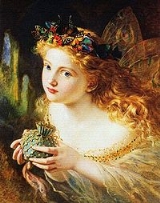
Fairy

Encyclopedia
A fairy is a type of mythical being or legendary creature
, a form of spirit
, often described as metaphysical, supernatural
or preternatural
.
Fairies resemble various beings of other mythologies, though even folklore
that uses the term fairy offers many definitions. Sometimes the term describes any magical
creature, including goblin
s or gnome
s: at other times, the term only describes a specific type of more ethereal
creature.
faierie (also fayerye, feirie, fairie), a direct borrowing from Old French
faerie (Modern French féerie) meaning the land, realm, or characteristic activity (i.e. enchantment) of the legendary people of folklore and romance called (in Old French) faie or fee (Modern French fée). This derived ultimately from Late Latin
fata (one of the personified Fates
, hence a guardian or tutelary spirit, hence a spirit in general); cf. Italian
fata, Portuguese
fada, Spanish
hada of the same origin.
Fata, although it became a feminine noun in the Romance languages, was originally the neuter plural ("the Fates") of fatum, past participle of the verb fari to speak, hence "thing spoken, decision, decree" or "prophetic declaration, prediction", hence "destiny, fate". It was used as the equivalent of the Greek Μοῖραι Moirai
, the personified Fates who determined the course and ending of human life.
To the word faie was added the suffix -erie (Modern English
-(e)ry), used to express either a place where something is found (fishery, heronry, nunnery) or a trade or typical activity engaged in by a person (cookery, midwifery, thievery). In later usage it generally applied to any kind of quality or activity associated with a particular sort of person, as in English knavery, roguery, witchery, wizardry.
Faie became Modern English fay "a fairy"; the word is, however, rarely used, although it is well known as part of the name of the legendary sorceress Morgan le Fay
of Arthurian legend. Faierie became fairy, but with that spelling now almost exclusively referring to one of the legendary people, with the same meaning as fay. In the sense "land where fairies dwell", the distinctive and archaic spellings Faery and Faerie are often used. Faery is also used in the sense of "a fairy", and the back-formation
fae, as an equivalent or substitute for fay is now sometimes seen.
The word fey, originally meaning "fated to die" or "having forebodings of death" (hence "visionary", "mad", and various other derived meanings) is completely unrelated, being from Old English fæge, Proto-Germanic *faigja- and Proto-Indo-European
*poikyo-, whereas Latin fata comes from the Indo-European root *bhã- "speak". Due to the identical pronunciation of the two words, "fay" is sometimes misspelled "fey".
, or a species completely independent of humans or angels. Folklorists have suggested that their actual origin lies in a conquered race living in hiding, or in religious beliefs that lost currency with the advent of Christianity. These explanations are not necessarily incompatible, and they may be traceable to multiple sources.
Much of the folklore about fairies revolves around protection from their malice, by such means as cold iron (iron is like poison to fairies, and they will not go near it) or charms of rowan
and herb
s, or avoiding offense by shunning locations known to be theirs. In particular, folklore describes how to prevent the fairies from stealing babies and substituting changeling
s, and abducting older people as well. Many folktales are told of fairies, and they appear as characters in stories from medieval tales of chivalry, to Victorian
fairy tales, and up to the present day in modern literature.
In his manuscript, The Secret Commonwealth of Elves, Fauns and Fairies, Reverend Robert Kirk, minister of the Parish of Aberfoyle, Stirling, Scotland, wrote in 1691:
Although in modern culture they are often depicted as young, sometimes winged, humanoids of small stature, they originally were depicted quite differently: tall, radiant, angelic beings or short, wizened troll
s being two of the commonly mentioned forms. Diminutive fairies of one kind or another have been recorded for centuries, but occur alongside the human-sized beings; these have been depicted as ranging in size from very tiny up to the size of a human child. Even with these small fairies, however, their small size may be magically assumed rather than constant.
Wings, while common in Victorian and later artwork of fairies, are very rare in the folklore; even very small fairies flew with magic, sometimes flying on ragwort
stems or the backs of birds. Nowadays, fairies are often depicted with ordinary insect
wings or butterfly
wings.
Various animals have also been described as fairies. Sometimes this is the result of shape shifting on part of the fairy, as in the case of the selkie
(seal people); others, like the kelpie
and various black dogs
, appear to stay more constant in form.
In some folklore fairies have green eyes and often bite. Though they can confuse one with their words, fairies cannot lie. They hate being told 'thank you', as they see it as a sign of one forgetting the good deed done, and, instead, want something that will guarantee remembrance.
(Irish Gaelic
bean sí or Scottish Gaelic bean shìth, which both mean "fairy woman") is sometimes described as a ghost. The northern English Cauld Lad of Hylton
, though described as a murdered boy, is also described as a household sprite like a brownie, much of the time a Barghest
or Elf
. One tale recounted a man caught by the fairies, who found that whenever he looked steadily at one, the fairy was a dead neighbor of his. This was among the most common views expressed by those who believed in fairies, although many of the informants would express the view with some doubts.
in particular they were regarded as elemental
s, such as gnome
s and sylph
s, as described by Paracelsus
. This is uncommon in folklore, but accounts describing the fairies as "spirits of the air" have been found popularly.
to Hell. As fallen angels, though not quite devils, they could be seen as subject of the Devil. For a similar concept in Persian mythology, see Peri
.
, once a friendly household spirit, became a wicked goblin. Dealing with fairies was in some cases considered a form of witchcraft and punished as such in this era. Disassociating himself from such evils may be why Oberon, in A Midsummer Night's Dream
, carefully observed that neither he nor his court feared the church bells.
The belief in their angelic nature was less common than that they were the dead, but still found popularity, especially in Theosophist
circles. Informants who described their nature sometimes held aspects of both the third and the fourth view, or observed that the matter was disputed.
.
in J. M. Barrie
's 1902 novel The Little White Bird
, and was incorporated into his later works about the character. Barrie wrote, "When the first baby laughed for the first time, his laugh broke into a million pieces, and they all went skipping about. That was the beginning of fairies."
tales of the Tuatha Dé Danann
refer to these beings as fairies, though in more ancient times they were regarded as goddess
es and god
s. The Tuatha Dé Danann were spoken of as having come from islands in the north of the world or, in other sources, from the sky. After being defeated in a series of battles with other otherworldly beings, and then by the ancestors of the current Irish people
, they were said to have withdrawn to the sídhe
(fairy mounds), where they lived on in popular imagination as "fairies."
describes a race of diminutive people who had been driven into hiding by invading humans. They came to be seen as another race, or possibly spirits, and were believed to live in an Otherworld
that was variously described as existing underground, in hidden hills (many of which were ancient burial mounds), or across the Western Sea.
In old Celtic fairy lore the sidhe (fairy folk) are immortals living in the ancient barrows and cairns. The Tuatha de Danaan are associated with several Otherworld realms including Mag Mell
(the Pleasant Plain), Emain Ablach (the Fortress of Apples or the Land of Promise or the Isle of Women), and the Tir na nÓg
(the Land of Youth).
The concept of the Otherworld is also associated with the Isle of Apples, known as Avalon
in the Arthurian mythos (often equated with Ablach Emain). Here we find the Silver Bough that allowed a living mortal to enter and withdraw from the Otherworld or Land of the Gods. According to legend, the Fairy Queen sometimes offered the branch to worthy mortals, granting them safe passage and food during their stay.
Some 19th century archaeologists thought they had found underground rooms in the Orkney islands resembling the Elfland in Childe Rowland
. In popular folklore, flint arrowheads from the Stone Age were attributed to the fairies as "elf-shot". The fairies' fear of iron was attributed to the invaders having iron weapons, whereas the inhabitants had only flint and were therefore easily defeated in physical battle. Their green clothing and underground homes were credited to their need to hide and camouflage themselves from hostile humans, and their use of magic a necessary skill for combating those with superior weaponry. In Victorian beliefs of evolution, cannibalism among "ogres" was attributed to memories of more savage races, still practicing it alongside "superior" races that had abandoned it. Selkie
s, described in fairy tales as shapeshifting seal people, were attributed to memories of skin-clad "primitive" people traveling in kayaks. African pygmies were put forth as an example of a race that had previously existed over larger stretches of territory, but come to be scarce and semi-mythical with the passage of time and prominence of other tribes and races.
’ and ‘victory’ in the pantheon of the particular form of animistic
nature worship
reconstructed as the religion of Ancient Western Europe.
in actuality being burial mounds, it being dangerous to eat food in both Fairyland and Hades
, and both the dead and fairies living underground.
", stealing small items or leading a traveler astray, are generally harmless. But far more dangerous behaviors were also attributed to fairies. Any form of sudden death might stem from a fairy kidnapping, with the apparent corpse being a wooden stand-in with the appearance of the kidnapped person. Consumption (tuberculosis
) was sometimes blamed on the fairies forcing young men and women to dance at revels every night, causing them to waste away from lack of rest. Fairies riding
domestic animals, such as cows or pigs or ducks, could cause paralysis or mysterious illnesses.
As a consequence, practical considerations of fairies have normally been advice on averting them. In terms of protective charms, cold iron is the most familiar, but other things are regarded as detrimental to the fairies: wearing clothing inside out, running water, bells (especially church bells), St. John's wort, and four-leaf clover
s, among others. Some lore is contradictory, such as rowan
trees in some tales being sacred to the fairies, and in other tales being protection against them. In Newfoundland
folklore, the most popular type of fairy protection is bread, varying from stale bread to hard tack
or a slice of fresh home-made bread. The belief that bread has some sort of special power is an ancient one. Bread is associated with the home and the hearth, as well as with industry and the taming of nature, and as such, seems to be disliked by some types of fairies. On the other hand, in much of the Celtic folklore, baked goods are a traditional offering to the folk, as are cream and butter.
Bells also have an ambiguous role; while they protect against fairies, the fairies riding on horseback — such as the fairy queen — often have bells on their harness. This may be a distinguishing trait between the Seelie Court from the Unseelie Court, such that fairies use them to protect themselves from more wicked members of their race. Another ambiguous piece of folklore revolves about poultry: a cock's crow drove away fairies, but other tales recount fairies keeping poultry.
In County Wexford
, Ireland
, in 1882, it was reported that “if an infant is carried out after dark a piece of bread is wrapped in its bib or dress, and this protects it from any witchcraft or evil.”
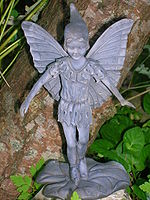 While many fairies will confuse travelers on the path, the will o' the wisp
can be avoided by not following it. Certain locations, known to be haunts of fairies, are to be avoided; C. S. Lewis
reported hearing of a cottage more feared for its reported fairies than its reported ghost. In particular, digging in fairy hills was unwise. Paths that the fairies travel
are also wise to avoid. Home-owners have knocked corners from houses because the corner blocked the fairy path, and cottages have been built with the front and back doors in line, so that the owners could, in need, leave them both open and let the fairies troop through all night. Locations such as fairy fort
s were left undisturbed; even cutting brush on fairy forts was reputed to be the death of those who performed the act. Fairy trees, such as thorn trees
, were dangerous to chop down; one such tree was left alone in Scotland, though it prevented a road being widened for seventy years. Good house-keeping could keep brownies from spiteful actions, because if they did not think the house is clean enough, they pinched people in their sleep. Such water hags as Peg Powler
and Jenny Greenteeth
, prone to drowning people, could be avoided by avoiding the bodies of water they inhabit.
Other actions were believed to offend fairies. Brownies were known to be driven off by being given clothing, though some folktales recounted that they were offended by inferior quality of the garments given, and others merely stated it, some even recounting that the brownie was delighted with the gift and left with it. Other brownies left households or farms because they heard a complaint, or a compliment. People who saw the fairies were advised not to look closely, because they resented infringements on their privacy. The need to not offend them could lead to problems: one farmer found that fairies threshed his corn, but the threshing continued after all his corn was gone, and he concluded that they were stealing from his neighbors, leaving him the choice between offending them, dangerous in itself, and profiting by the theft.
Millers were thought by the Scots to be "no canny", owing to their ability to control the forces of nature, such as fire in the kiln, water in the burn, and for being able to set machinery a-whirring. Superstitious communities sometimes believed that the miller must be in league with the fairies. In Scotland fairies were often mischievous and to be feared. No one dared to set foot in the mill or kiln at night as it was known that the fairies brought their corn to be milled after dark. So long as the locals believed this then the miller could sleep secure in the knowledge that his stores were not being robbed. John Fraser, the miller of Whitehill claimed to have hidden and watched the fairies trying unsuccessfully to work the mill. He said he decided to come out of hiding and help them, upon which one of the fairy women gave him a gowpen (double handful of meal) and told him to put it in his empty girnal (store), saying that the store would remain full for a long time, no matter how much he took out.
It is also believed that to know the name of a particular fairy could summon it to you and force it to do your bidding. The name could be used as an insult towards the fairy in question, but it could also rather contradictorily be used to grant powers and gifts to the user.
s, fairy children left in the place of stolen human babies. Older people could also be abducted; a woman who had just given birth and had yet to be churched
was considered to be in particular danger. A common thread in folklore is that eating the fairy food would trap the captive, as Persephone
in Hades; this warning is often given to captives who escape by other people in the fairies' power, who are often described as captives who had eaten and so could not be freed. Folklore differed about the state of the captives: some held that they lived a merry life, others that they always pined for their old friends.
Trooping fairies refer to fairies who appear in groups and might form settlements. In this definition, fairy is usually understood in a wider sense, as the term can also include various kinds of mythical creatures mainly of Celtic
origin; however, the term might also be used for similar beings such as dwarves or elves
from Germanic folklore
. These are opposed to solitary fairies, who do not live or associate with others of their kind.
s in their place, or as young men and women. This can be for a time or forever, and may be more or less dangerous to the kidnapped. In the 19th Century Child Ballad, "Lady Isabel and the Elf-Knight", the elf-knight is a Bluebeard
figure, and Isabel must trick and kill him to preserve her life. Child Ballad "Tam Lin
" reveals that the title character, though living among the fairies and having fairy powers, was in fact an "earthly knight" and, though his life was pleasant now, he feared that the fairies would pay him as their teind
(tithe) to hell. Sir Orfeo
tells how Sir Orfeo's wife was kidnapped by the King of Faerie and only by trickery and excellent harping ability was he able to win her back. Sir Degare narrates the tale of a woman overcome by her fairy lover, who in later versions of the story is unmasked as a mortal. Thomas the Rhymer
shows Thomas escaping with less difficulty, but he spends seven years in Elfland. Oisín
is harmed not by his stay in Faerie but by his return; when he dismounts, the three centuries that have passed catch up with him, reducing him to an aged man. King Herla (O.E. "Herla cyning"), originally a guise of Woden
but later Christianised as a king in a tale by Walter Map
, was said, by Map, to have visited a dwarf's underground mansion and returned three centuries later; although only some of his men crumbled to dust on dismounting, Herla and his men who did not dismount were trapped on horseback, this being one account of the origin of the Wild Hunt
of European folklore
.
A common feature of the fairies is the use of magic to disguise appearance. Fairy gold is notoriously unreliable, appearing as gold
when paid, but soon thereafter revealing itself to be leaves, gorse
blossoms, gingerbread
cakes, or a variety of other useless things.
These illusions are also implicit in the tales of fairy ointment
. Many tales from Northern Europe
tell of a mortal woman summoned to attend a fairy birth — sometimes attending a mortal, kidnapped woman's childbed. Invariably, the woman is given something for the child's eyes, usually an ointment; through mischance, or sometimes curiosity, she uses it on one or both of her own eyes. At that point, she sees where she is; one midwife realizes that she was not attending a great lady in a fine house but her own runaway maid-servant in a wretched cave. She escapes without making her ability known, but sooner or later betrays that she can see the fairies. She is invariably blinded in that eye, or in both if she used the ointment on both.
Fairy Funerals : There have been claims by people in the past, like William Blake
, to have seen fairy funerals. Allan Cunningham in his Lives of Eminent British Painters records that William Blake claimed to have seen a fairy funeral. 'Did you ever see a fairy's funeral, madam? said Blake to a lady who happened to sit next to him. 'Never, Sir!' said the lady. 'I have,' said Blake, 'but not before last night.' And he went on to tell how, in his garden, he had seen 'a procession of creatures of the size and colour of green and grey grasshoppers, bearing a body laid out on a rose-leaf, which they buried with songs, and then disappeared'. They are believed to be an omen of death.
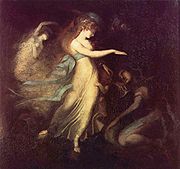 Fairies appeared in medieval romances
as one of the beings that a knight errant might encounter. A fairy lady appeared to Sir Launfal
and demanded his love; like the fairy bride of ordinary folklore, she imposed a prohibition on him that in time he violated. Sir Orfeo
's wife was carried off by the King of Faerie. Huon of Bordeaux
is aided by King Oberon. These fairy characters dwindled in number as the medieval era progressed; the figures became wizards and enchantresses. Morgan le Fay
, whose connection to the realm of Faerie is implied in her name, in Le Morte d'Arthur
is a woman whose magic powers stem from study. While somewhat diminished with time, fairies never completely vanished from the tradition. Sir Gawain and the Green Knight
is a late tale, but the Green Knight himself is an otherworldly being. Edmund Spenser
featured fairies in The Faerie Queene
. In many works of fiction, fairies are freely mixed with the nymph
s and satyr
s of classical tradition; while in others (e.g. Lamia
), they were seen as displacing the Classical beings. 15th century poet and monk John Lydgate
wrote that King Arthur
was crowned in "the land of the fairy", and taken in his death by four fairy queens, to Avalon
where he lies under a "fairy hill", until he is needed again.
 Fairies appear as significant characters in William Shakespeare
's A Midsummer's Night Dream, which is set simultaneously in the woodland, and in the realm of Fairyland
, under the light of the moon. and in which a disturbance of Nature caused by a fairy dispute creates tension underlying the plot and informing the actions of the characters. According to Maurice Hunt, Chair of the English Department at Baylor University, the blurring of the identities of fantasy and reality makes possible “that pleasing, narcotic dreaminess associated with the fairies of the play”.
Shakespeare's contemporary, Michael Drayton
features fairies in his Nimphidia; from these stem Alexander Pope
's sylphs of The Rape of the Lock
, and in the mid 17th century, précieuses
took up the oral tradition of such tales to write fairy tale
s; Madame d'Aulnoy
invented the term contes de fée ("fairy tale"). While the tales told by the précieuses included many fairies, they were less common in other countries' tales; indeed, the Brothers Grimm
included fairies in their first edition, but decided this was not authentically German and altered the language in later editions, changing each "Fee" (fairy) to an enchantress or wise woman. J. R. R. Tolkien
described these tales as taking place in the land of Faerie. Additionally, not all folktales that feature fairies are generally categorized as fairy tales.
Fairies in literature took on new life with Romanticism
. Writers such as Sir Walter Scott and James Hogg
were inspired by folklore which featured fairies, such as the Border ballad
s. This era saw an increase in the popularity of collecting of fairy folklore, and an increase in the creation of original works with fairy characters. In Rudyard Kipling
's Puck of Pook's Hill, Puck
holds to scorn the moralizing fairies of other Victorian works. The period also saw a revival of older themes in fantasy
literature, such as C.S. Lewis's Narnia books which, while featuring many such classical beings as faun
s and dryad
s, mingles them freely with hag
s, giants
, and other creatures of the folkloric fairy tradition. Victorian flower fairies
were popularized in part by Queen Mary
’s keen interest in fairy art, and by British illustrator and poet Cicely Mary Barker
's series of eight books published in 1923 through 1948. Imagery of fairies in literature became prettier and smaller as time progressed. Andrew Lang
, complaining of "the fairies of polyanthuses and gardenias and apple blossoms" in the introduction to The Lilac Fairy Book, observed that "These fairies try to be funny, and fail; or they try to preach, and succeed."
Fairies are seen in Neverland
, in Peter and Wendy
, the novel version of J. M. Barrie
's famous Peter Pan
stories, published in 1911, and its character Tinker Bell has become a pop culture icon. When Peter Pan is guarding Wendy from pirates, the story says: "After a time he fell asleep, and some unsteady fairies had to climb over him on their way home from an orgy. Any of the other boys obstructing the fairy path at night they would have mischiefed, but they just tweaked Peter's nose and passed on."
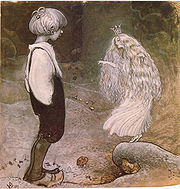 Images of fairies have appeared as illustrations, often in books of fairy tale
s, as well as in photographic-based media and sculpture
. Some artists known for their depictions of fairies include Cicely Mary Barker
, Arthur Rackham
, Brian Froud
, Alan Lee, Amy Brown
, David Delamare
, Meredith Dillman
, Jasmine Becket-Griffith
, Warwick Goble
, Kylie InGold
, Ida Rentoul Outhwaite
, Myrea Pettit
, Florence Harrison
, Suza Scalora
, Nene Thomas, Gustave Doré
, Rebecca Guay
and Greta James. The Fairy Doors of Ann Arbor, MI
are small doors installed into local buildings. Local children believe these are the front doors of fairy houses, and in some cases, small furniture, dishes, and various other things can be seen beyond the doors.
The Victorian era
was particularly noted for fairy paintings. The Victorian painter Richard Dadd
created paintings of fairy-folk with a sinister and malign tone. Other Victorian artists who depicted fairies include John Atkinson Grimshaw
, Joseph Noel Paton
, John Anster Fitzgerald
and Daniel Maclise
. Interest in fairy-themed art enjoyed a brief renaissance following the publication of the Cottingley Fairies
photograph
s in 1917 and a number of artists turned to painting fairy themes.
, Devas
, the equivalent of angels, are regarded as living either in the atmosphere
s of the planet
s of the solar system
(Planetary Angels) or inside the Sun
(Solar Angels) (presumably other planetary system
s and star
s have their own angels). They are believed to help to guide the operation of the processes of nature
such as the process of evolution
and the growth of plants. Their appearance is reputedly like colored flames about the size of a human being. Some (but not most) devas originally incarnated as human beings. Smaller, less important, evolutionarily undeveloped minor angels are called nature spirits, elementals, and fairies.
The Cottingley Fairies
photograph
s in 1917 (revealed by the "photographers" in 1981 to have been faked) were originally publicized by Theosophists, many of whom believed them to be real. C.W. Leadbeater and other Theosophists wrote many books on supernatural creatures, emphasizing that any sufficiently enlightened human should be able to see devas, nature spirits, elementals (gnome
s, ondines
, sylphs, and salamanders
), and fairies when the third eye
is activated. They are said to have etheric bodies
that are composed of etheric matter
, a type of matter finer and more pure that is composed of smaller particles than ordinary physical plane matter
.
Theosophists believe that these less evolutionarily developed beings have never been previously incarnated as human beings; they are regarded as being on a separate line of spiritual evolution called the “deva evolution” or "angel evolution path"; eventually, as their souls advance as they reincarnate
, it is believed they will incarnate as devas.
Popular culture
Legendary creature
A legendary creature is a mythological or folkloric creature.-Origin:Some mythical creatures have their origin in traditional mythology and have been believed to be real creatures, for example the dragon, the unicorn, and griffin...
, a form of spirit
Spirit
The English word spirit has many differing meanings and connotations, most of them relating to a non-corporeal substance contrasted with the material body.The spirit of a living thing usually refers to or explains its consciousness.The notions of a person's "spirit" and "soul" often also overlap,...
, often described as metaphysical, supernatural
Supernatural
The supernatural or is that which is not subject to the laws of nature, or more figuratively, that which is said to exist above and beyond nature...
or preternatural
Preternatural
The preternatural or praeternatural is that which appears outside or beyond the natural. In contrast to the supernatural, preternatural phenomena are presumed to have rational explanations that are, as of yet, unknown....
.
Fairies resemble various beings of other mythologies, though even folklore
Folklore
Folklore consists of legends, music, oral history, proverbs, jokes, popular beliefs, fairy tales and customs that are the traditions of a culture, subculture, or group. It is also the set of practices through which those expressive genres are shared. The study of folklore is sometimes called...
that uses the term fairy offers many definitions. Sometimes the term describes any magical
Magic (paranormal)
Magic is the claimed art of manipulating aspects of reality either by supernatural means or through knowledge of occult laws unknown to science. It is in contrast to science, in that science does not accept anything not subject to either direct or indirect observation, and subject to logical...
creature, including goblin
Goblin
A goblin is a legendary evil or mischievous illiterate creature, a grotesquely evil or evil-like phantom.They are attributed with various abilities, temperaments and appearances depending on the story and country of origin. In some cases, goblins have been classified as constantly annoying little...
s or gnome
Gnome
A gnome is a diminutive spirit in Renaissance magic and alchemy, first introduced by Paracelsus and later adopted by more recent authors including those of modern fantasy literature...
s: at other times, the term only describes a specific type of more ethereal
Ethereal being
Ethereal beings, according to some belief systems and occult theories, are mystic entities that usually are not made of ordinary matter. Despite the fact that they are believed to be essentially incorporeal, they do interact in physical shapes with the material universe and travel between the...
creature.
Etymology
The word fairy derives from Middle EnglishMiddle English
Middle English is the stage in the history of the English language during the High and Late Middle Ages, or roughly during the four centuries between the late 11th and the late 15th century....
faierie (also fayerye, feirie, fairie), a direct borrowing from Old French
Old French
Old French was the Romance dialect continuum spoken in territories that span roughly the northern half of modern France and parts of modern Belgium and Switzerland from the 9th century to the 14th century...
faerie (Modern French féerie) meaning the land, realm, or characteristic activity (i.e. enchantment) of the legendary people of folklore and romance called (in Old French) faie or fee (Modern French fée). This derived ultimately from Late Latin
Latin
Latin is an Italic language originally spoken in Latium and Ancient Rome. It, along with most European languages, is a descendant of the ancient Proto-Indo-European language. Although it is considered a dead language, a number of scholars and members of the Christian clergy speak it fluently, and...
fata (one of the personified Fates
Parcae
thumb|#00px|Early 16th-century [[millefleur tapestry]] depicting the Three Fates under their Greek namesIn Roman mythology, the Parcae were the personifications of destiny, often called The Fates in English. Their Greek equivalent were the Moirae. They controlled the metaphorical thread of life of...
, hence a guardian or tutelary spirit, hence a spirit in general); cf. Italian
Italian language
Italian is a Romance language spoken mainly in Europe: Italy, Switzerland, San Marino, Vatican City, by minorities in Malta, Monaco, Croatia, Slovenia, France, Libya, Eritrea, and Somalia, and by immigrant communities in the Americas and Australia...
fata, Portuguese
Portuguese language
Portuguese is a Romance language that arose in the medieval Kingdom of Galicia, nowadays Galicia and Northern Portugal. The southern part of the Kingdom of Galicia became independent as the County of Portugal in 1095...
fada, Spanish
Spanish language
Spanish , also known as Castilian , is a Romance language in the Ibero-Romance group that evolved from several languages and dialects in central-northern Iberia around the 9th century and gradually spread with the expansion of the Kingdom of Castile into central and southern Iberia during the...
hada of the same origin.
Fata, although it became a feminine noun in the Romance languages, was originally the neuter plural ("the Fates") of fatum, past participle of the verb fari to speak, hence "thing spoken, decision, decree" or "prophetic declaration, prediction", hence "destiny, fate". It was used as the equivalent of the Greek Μοῖραι Moirai
Moirae
The Moirae, Moerae or Moirai , in Greek mythology, were the white-robed incarnations of destiny . Their number became fixed at three...
, the personified Fates who determined the course and ending of human life.
To the word faie was added the suffix -erie (Modern English
Modern English
Modern English is the form of the English language spoken since the Great Vowel Shift in England, completed in roughly 1550.Despite some differences in vocabulary, texts from the early 17th century, such as the works of William Shakespeare and the King James Bible, are considered to be in Modern...
-(e)ry), used to express either a place where something is found (fishery, heronry, nunnery) or a trade or typical activity engaged in by a person (cookery, midwifery, thievery). In later usage it generally applied to any kind of quality or activity associated with a particular sort of person, as in English knavery, roguery, witchery, wizardry.
Faie became Modern English fay "a fairy"; the word is, however, rarely used, although it is well known as part of the name of the legendary sorceress Morgan le Fay
Morgan le Fay
Morgan le Fay , alternatively known as Morgane, Morgaine, Morgana and other variants, is a powerful sorceress in the Arthurian legend. Early works featuring Morgan do not elaborate her character beyond her role as a fay or magician...
of Arthurian legend. Faierie became fairy, but with that spelling now almost exclusively referring to one of the legendary people, with the same meaning as fay. In the sense "land where fairies dwell", the distinctive and archaic spellings Faery and Faerie are often used. Faery is also used in the sense of "a fairy", and the back-formation
Back-formation
In etymology, back-formation is the process of creating a new lexeme, usually by removing actual or supposed affixes. The resulting neologism is called a back-formation, a term coined by James Murray in 1889...
fae, as an equivalent or substitute for fay is now sometimes seen.
The word fey, originally meaning "fated to die" or "having forebodings of death" (hence "visionary", "mad", and various other derived meanings) is completely unrelated, being from Old English fæge, Proto-Germanic *faigja- and Proto-Indo-European
Proto-Indo-European language
The Proto-Indo-European language is the reconstructed common ancestor of the Indo-European languages, spoken by the Proto-Indo-Europeans...
*poikyo-, whereas Latin fata comes from the Indo-European root *bhã- "speak". Due to the identical pronunciation of the two words, "fay" is sometimes misspelled "fey".
Characteristics
Fairies are generally described as human in appearance and having magical powers. Their origins are less clear in the folklore, being variously dead, or some form of demonDemon
call - 1347 531 7769 for more infoIn Ancient Near Eastern religions as well as in the Abrahamic traditions, including ancient and medieval Christian demonology, a demon is considered an "unclean spirit" which may cause demonic possession, to be addressed with an act of exorcism...
, or a species completely independent of humans or angels. Folklorists have suggested that their actual origin lies in a conquered race living in hiding, or in religious beliefs that lost currency with the advent of Christianity. These explanations are not necessarily incompatible, and they may be traceable to multiple sources.
Much of the folklore about fairies revolves around protection from their malice, by such means as cold iron (iron is like poison to fairies, and they will not go near it) or charms of rowan
Rowan
The rowans or mountain-ashes are shrubs or small trees in genus Sorbus of family Rosaceae. They are native throughout the cool temperate regions of the Northern Hemisphere, with the highest species diversity in the mountains of western China and the Himalaya, where numerous apomictic microspecies...
and herb
Herb
Except in botanical usage, an herb is "any plant with leaves, seeds, or flowers used for flavoring, food, medicine, or perfume" or "a part of such a plant as used in cooking"...
s, or avoiding offense by shunning locations known to be theirs. In particular, folklore describes how to prevent the fairies from stealing babies and substituting changeling
Changeling
A changeling is a creature found in Western European folklore and folk religion. It is typically described as being the offspring of a fairy, troll, elf or other legendary creature that has been secretly left in the place of a human child. Sometimes the term is also used to refer to the child who...
s, and abducting older people as well. Many folktales are told of fairies, and they appear as characters in stories from medieval tales of chivalry, to Victorian
Victorian literature
Victorian literature is the literature produced during the reign of Queen Victoria . It forms a link and transition between the writers of the romantic period and the very different literature of the 20th century....
fairy tales, and up to the present day in modern literature.
In his manuscript, The Secret Commonwealth of Elves, Fauns and Fairies, Reverend Robert Kirk, minister of the Parish of Aberfoyle, Stirling, Scotland, wrote in 1691:
These Siths or Fairies they call Sleagh Maith or the Good People...are said to be of middle nature between Man and Angel, as were Daemons thought to be of old; of intelligent fluidous Spirits, and light changeable bodies (lyke those called Astral) somewhat of the nature of a condensed cloud, and best seen in twilight. These bodies be so pliable through the sublety of Spirits that agitate them, that they can make them appear or disappear at pleasure
Although in modern culture they are often depicted as young, sometimes winged, humanoids of small stature, they originally were depicted quite differently: tall, radiant, angelic beings or short, wizened troll
Troll
A troll is a supernatural being in Norse mythology and Scandinavian folklore. In origin, the term troll was a generally negative synonym for a jötunn , a being in Norse mythology...
s being two of the commonly mentioned forms. Diminutive fairies of one kind or another have been recorded for centuries, but occur alongside the human-sized beings; these have been depicted as ranging in size from very tiny up to the size of a human child. Even with these small fairies, however, their small size may be magically assumed rather than constant.
Wings, while common in Victorian and later artwork of fairies, are very rare in the folklore; even very small fairies flew with magic, sometimes flying on ragwort
Senecio
Senecio is a genus of the daisy family that includes ragworts and groundsels. The flower heads are normally rayed, completely yellow, and the heads are borne in branched clusters...
stems or the backs of birds. Nowadays, fairies are often depicted with ordinary insect
Pterygota
Pterygota is a subclass of insects that includes the winged insects. It also includes insect orders that are secondarily wingless ....
wings or butterfly
Butterfly
A butterfly is a mainly day-flying insect of the order Lepidoptera, which includes the butterflies and moths. Like other holometabolous insects, the butterfly's life cycle consists of four parts: egg, larva, pupa and adult. Most species are diurnal. Butterflies have large, often brightly coloured...
wings.
Various animals have also been described as fairies. Sometimes this is the result of shape shifting on part of the fairy, as in the case of the selkie
Selkie
Selkies are mythological creatures that are found in Faroese, Icelandic, Irish, and Scottish folklore....
(seal people); others, like the kelpie
Kelpie
The kelpie is a supernatural water horse from Celtic folklore that is believed to haunt the rivers and lochs of Scotland and Ireland; the name may be from Scottish Gaelic cailpeach or colpach "heifer, colt".-Description and behaviour:...
and various black dogs
Black dog (ghost)
A black dog is the name given to a being found primarily in the folklores of the British Isles. The black dog is essentially a nocturnal apparition, often said to be associated with the Devil, and its appearance was regarded as a portent of death. It is generally supposed to be larger than a normal...
, appear to stay more constant in form.
In some folklore fairies have green eyes and often bite. Though they can confuse one with their words, fairies cannot lie. They hate being told 'thank you', as they see it as a sign of one forgetting the good deed done, and, instead, want something that will guarantee remembrance.
Dead
One popular belief was that they were the dead, or some subclass of the dead. The Irish bansheeBanshee
The banshee , from the Irish bean sí is a feminine spirit in Irish mythology, usually seen as an omen of death and a messenger from the Otherworld....
(Irish Gaelic
Irish language
Irish , also known as Irish Gaelic, is a Goidelic language of the Indo-European language family, originating in Ireland and historically spoken by the Irish people. Irish is now spoken as a first language by a minority of Irish people, as well as being a second language of a larger proportion of...
bean sí or Scottish Gaelic bean shìth, which both mean "fairy woman") is sometimes described as a ghost. The northern English Cauld Lad of Hylton
Cauld Lad of Hylton
The ruins of Hylton Castle are reputed to be haunted by the ghost of a murdered stable boy Robert Skelton, known locally as the Cauld Lad of Hylton...
, though described as a murdered boy, is also described as a household sprite like a brownie, much of the time a Barghest
Barghest
Barghest, Bargtjest, Bo-guest, Bargheist, Bargeist, Barguist, Bargest or Barguest is the name often given in the north of England, especially in Yorkshire, to a legendary monstrous black dog with huge teeth and claws, though in other cases the name can refer to a ghost or Household elf, especially...
or Elf
Elf
An elf is a being of Germanic mythology. The elves were originally thought of as a race of divine beings endowed with magical powers, which they use both for the benefit and the injury of mankind...
. One tale recounted a man caught by the fairies, who found that whenever he looked steadily at one, the fairy was a dead neighbor of his. This was among the most common views expressed by those who believed in fairies, although many of the informants would express the view with some doubts.
Elementals
Another view held that the fairies were an intelligent species, distinct from humans and angels. In alchemyAlchemy
Alchemy is an influential philosophical tradition whose early practitioners’ claims to profound powers were known from antiquity. The defining objectives of alchemy are varied; these include the creation of the fabled philosopher's stone possessing powers including the capability of turning base...
in particular they were regarded as elemental
Elemental
An elemental is a mythological being first appearing in the alchemical works of Paracelsus in the 16th century. Traditionally, there are four types:*gnomes, earth elementals*undines , water elementals*sylphs, air elementals...
s, such as gnome
Gnome
A gnome is a diminutive spirit in Renaissance magic and alchemy, first introduced by Paracelsus and later adopted by more recent authors including those of modern fantasy literature...
s and sylph
Sylph
Sylph is a mythological creature in the Western tradition. The term originates in Paracelsus, who describes sylphs as invisible beings of the air, his elementals of air...
s, as described by Paracelsus
Paracelsus
Paracelsus was a German-Swiss Renaissance physician, botanist, alchemist, astrologer, and general occultist....
. This is uncommon in folklore, but accounts describing the fairies as "spirits of the air" have been found popularly.
Demoted angels
A third belief held that they were a class of "demoted" angels. One popular story held that when the angels revolted, God ordered the gates shut; those still in heaven remained angels, those in hell became devils, and those caught in between became fairies. Others held that they had been thrown out of heaven, not being good enough, but they were not evil enough for hell. This may explain the tradition that they had to pay a "teind" or titheTithe
A tithe is a one-tenth part of something, paid as a contribution to a religious organization or compulsory tax to government. Today, tithes are normally voluntary and paid in cash, cheques, or stocks, whereas historically tithes were required and paid in kind, such as agricultural products...
to Hell. As fallen angels, though not quite devils, they could be seen as subject of the Devil. For a similar concept in Persian mythology, see Peri
Peri
In Persian mythology, which constitutes the mythology of not just Persians but all Iranian peoples, peris are descended from fallen angels who have been denied paradise until they have done penance. In earlier sources they are described as agents of evil; later, they are benevolent...
.
Demons
A fourth belief was the fairies were demons entirely. This belief became much more popular with the growth of Puritanism. The hobgoblinHobgoblin
Hobgoblin is a term typically applied in folktales to describe a friendly but troublesome creature of the Seelie Court.The most commonly known hobgoblin is the character Puck in Shakespeare's A Midsummer Night's Dream. Puck, however, is only another name given to a much older character named Robin...
, once a friendly household spirit, became a wicked goblin. Dealing with fairies was in some cases considered a form of witchcraft and punished as such in this era. Disassociating himself from such evils may be why Oberon, in A Midsummer Night's Dream
A Midsummer Night's Dream
A Midsummer Night's Dream is a play that was written by William Shakespeare. It is believed to have been written between 1590 and 1596. It portrays the events surrounding the marriage of the Duke of Athens, Theseus, and the Queen of the Amazons, Hippolyta...
, carefully observed that neither he nor his court feared the church bells.
The belief in their angelic nature was less common than that they were the dead, but still found popularity, especially in Theosophist
Theosophy
Theosophy, in its modern presentation, is a spiritual philosophy developed since the late 19th century. Its major themes were originally described mainly by Helena Blavatsky , co-founder of the Theosophical Society...
circles. Informants who described their nature sometimes held aspects of both the third and the fourth view, or observed that the matter was disputed.
Humans
A less-common belief was that the fairies were actually humans; one folktale recounts how a woman had hidden some of her children from God, and then looked for them in vain, because they had become the hidden people, the fairies. This is parallel to a more developed tale, of the origin of the Scandinavian huldraHuldra
In Scandinavian folklore, the Huldra , or the skogsrå or skogsfru/skovfrue or Tallemaja in Swedish culture, is a seductive forest creature...
.
Babies' laughs
A story of the origin of fairies appears in a chapter about Peter PanPeter Pan
Peter Pan is a character created by Scottish novelist and playwright J. M. Barrie . A mischievous boy who can fly and magically refuses to grow up, Peter Pan spends his never-ending childhood adventuring on the small island of Neverland as the leader of his gang the Lost Boys, interacting with...
in J. M. Barrie
J. M. Barrie
Sir James Matthew Barrie, 1st Baronet, OM was a Scottish author and dramatist, best remembered today as the creator of Peter Pan. The child of a family of small-town weavers, he was educated in Scotland. He moved to London, where he developed a career as a novelist and playwright...
's 1902 novel The Little White Bird
The Little White Bird
The Little White Bird is a novel by J. M. Barrie, published in 1902, ranging in tone from fantasy and whimsy to social comedy with dark aggressive undertones. The book attained prominence and longevity due to several chapters written in a softer tone than the rest of the book, in which it...
, and was incorporated into his later works about the character. Barrie wrote, "When the first baby laughed for the first time, his laugh broke into a million pieces, and they all went skipping about. That was the beginning of fairies."
Pagan deities
Many of the IrishIrish mythology
The mythology of pre-Christian Ireland did not entirely survive the conversion to Christianity, but much of it was preserved, shorn of its religious meanings, in medieval Irish literature, which represents the most extensive and best preserved of all the branch and the Historical Cycle. There are...
tales of the Tuatha Dé Danann
Tuatha Dé Danann
The Tuatha Dé Danann are a race of people in Irish mythology. In the invasions tradition which begins with the Lebor Gabála Érenn, they are the fifth group to settle Ireland, conquering the island from the Fir Bolg....
refer to these beings as fairies, though in more ancient times they were regarded as goddess
Goddess
A goddess is a female deity. In some cultures goddesses are associated with Earth, motherhood, love, and the household. In other cultures, goddesses also rule over war, death, and destruction as well as healing....
es and god
God
God is the English name given to a singular being in theistic and deistic religions who is either the sole deity in monotheism, or a single deity in polytheism....
s. The Tuatha Dé Danann were spoken of as having come from islands in the north of the world or, in other sources, from the sky. After being defeated in a series of battles with other otherworldly beings, and then by the ancestors of the current Irish people
Irish people
The Irish people are an ethnic group who originate in Ireland, an island in northwestern Europe. Ireland has been populated for around 9,000 years , with the Irish people's earliest ancestors recorded having legends of being descended from groups such as the Nemedians, Fomorians, Fir Bolg, Tuatha...
, they were said to have withdrawn to the sídhe
Sídhe
The aos sí are a supernatural race in Irish mythology and Scottish mythology are comparable to the fairies or elves. They are said to live underground in the fairy mounds, across the western sea, or in an invisible world that coexists with the world of humans...
(fairy mounds), where they lived on in popular imagination as "fairies."
A hidden people
One common theme found among the Celtic nationsCeltic nations
The Celtic nations are territories in North-West Europe in which that area's own Celtic languages and some cultural traits have survived.The term "nation" is used in its original sense to mean a people who share a common traditional identity and culture and are identified with a traditional...
describes a race of diminutive people who had been driven into hiding by invading humans. They came to be seen as another race, or possibly spirits, and were believed to live in an Otherworld
Otherworld
Otherworld, or the Celtic Otherworld, is a concept in Celtic mythology that refers to the home of the deities or spirits, or a realm of the dead.Otherworld may also refer to:In film and television:...
that was variously described as existing underground, in hidden hills (many of which were ancient burial mounds), or across the Western Sea.
In old Celtic fairy lore the sidhe (fairy folk) are immortals living in the ancient barrows and cairns. The Tuatha de Danaan are associated with several Otherworld realms including Mag Mell
Mag Mell
In Irish mythology, Mag Mell was a mythical realm achievable through death and/or glory...
(the Pleasant Plain), Emain Ablach (the Fortress of Apples or the Land of Promise or the Isle of Women), and the Tir na nÓg
Tír na nÓg
Tír na nÓg is the most popular of the Otherworlds in Irish mythology. It is perhaps best known from the story of Oisín, one of the few mortals who lived there, who was said to have been brought there by Niamh of the Golden Hair. It was where the Tuatha Dé Danann settled when they left Ireland's...
(the Land of Youth).
The concept of the Otherworld is also associated with the Isle of Apples, known as Avalon
Avalon
Avalon is a legendary island featured in the Arthurian legend. It first appears in Geoffrey of Monmouth's 1136 pseudohistorical account Historia Regum Britanniae as the place where King Arthur's sword Excalibur was forged and later where Arthur was...
in the Arthurian mythos (often equated with Ablach Emain). Here we find the Silver Bough that allowed a living mortal to enter and withdraw from the Otherworld or Land of the Gods. According to legend, the Fairy Queen sometimes offered the branch to worthy mortals, granting them safe passage and food during their stay.
Some 19th century archaeologists thought they had found underground rooms in the Orkney islands resembling the Elfland in Childe Rowland
Childe Rowland
"Childe Rowland" is a fairy tale, the most popular version being by Joseph Jacobs in his English Folk and Fairy Tales, published in 1892, and written partly in verse and part in prose.-Synopsis:...
. In popular folklore, flint arrowheads from the Stone Age were attributed to the fairies as "elf-shot". The fairies' fear of iron was attributed to the invaders having iron weapons, whereas the inhabitants had only flint and were therefore easily defeated in physical battle. Their green clothing and underground homes were credited to their need to hide and camouflage themselves from hostile humans, and their use of magic a necessary skill for combating those with superior weaponry. In Victorian beliefs of evolution, cannibalism among "ogres" was attributed to memories of more savage races, still practicing it alongside "superior" races that had abandoned it. Selkie
Selkie
Selkies are mythological creatures that are found in Faroese, Icelandic, Irish, and Scottish folklore....
s, described in fairy tales as shapeshifting seal people, were attributed to memories of skin-clad "primitive" people traveling in kayaks. African pygmies were put forth as an example of a race that had previously existed over larger stretches of territory, but come to be scarce and semi-mythical with the passage of time and prominence of other tribes and races.
Christianised pagan deities
Another theory is that the fairies were originally worshiped as gods, but with the coming of Christianity, they lived on, in a dwindled state of power, in folk belief. In this particular time, fairies were reputed by the church as being 'evil' beings. Many beings who are described as deities in older tales are described as "fairies" in more recent writings. Victorian explanations of mythology, which accounted for all gods as metaphors for natural events that had come to be taken literally, explained them as metaphors for the night sky and stars. According to this theory, fairies are personified aspects of nature and deified abstract concepts such as ‘loveLove
Love is an emotion of strong affection and personal attachment. In philosophical context, love is a virtue representing all of human kindness, compassion, and affection. Love is central to many religions, as in the Christian phrase, "God is love" or Agape in the Canonical gospels...
’ and ‘victory’ in the pantheon of the particular form of animistic
Animism
Animism refers to the belief that non-human entities are spiritual beings, or at least embody some kind of life-principle....
nature worship
Earth religion
Earth religion is a New Age term used mostly in the context of Neopaganism.It is an umbrella phrase that is used to cover any religion that worships the Earth, Nature, or fertility gods and goddesses, such as the various forms of goddess worship or matriarchal religion. Some find a connection...
reconstructed as the religion of Ancient Western Europe.
Spirits of the dead
A third theory was that the fairies were a folkloric belief concerning the dead. This noted many common points of belief, such as the same legends being told of ghosts and fairies, the sídheSídhe
The aos sí are a supernatural race in Irish mythology and Scottish mythology are comparable to the fairies or elves. They are said to live underground in the fairy mounds, across the western sea, or in an invisible world that coexists with the world of humans...
in actuality being burial mounds, it being dangerous to eat food in both Fairyland and Hades
Hades
Hades , Hadēs, originally , Haidēs or , Aidēs , meaning "the unseen") was the ancient Greek god of the underworld. The genitive , Haidou, was an elision to denote locality: "[the house/dominion] of Hades". Eventually, the nominative came to designate the abode of the dead.In Greek mythology, Hades...
, and both the dead and fairies living underground.
Fairies in literature and legend
The question as to the essential nature of fairies has been the topic of myths, stories, and scholarly papers for a very long time.Practical beliefs and protection
When considered as beings that a person might actually encounter, fairies were noted for their mischief and malice. Some pranks ascribed to them, such as tangling the hair of sleepers into "Elf-locksFairy-locks
When young children, especially girls, wake from an evening's slumber with tangles and snarls in their hair, mothers with a tradition of fairy folklore might whisper to their daughters that they had caught fairy locks or elf-locks...
", stealing small items or leading a traveler astray, are generally harmless. But far more dangerous behaviors were also attributed to fairies. Any form of sudden death might stem from a fairy kidnapping, with the apparent corpse being a wooden stand-in with the appearance of the kidnapped person. Consumption (tuberculosis
Tuberculosis
Tuberculosis, MTB, or TB is a common, and in many cases lethal, infectious disease caused by various strains of mycobacteria, usually Mycobacterium tuberculosis. Tuberculosis usually attacks the lungs but can also affect other parts of the body...
) was sometimes blamed on the fairies forcing young men and women to dance at revels every night, causing them to waste away from lack of rest. Fairies riding
Fairy riding
Fairy riding was a term used for a kind of paralysis found in livestock in Scotland...
domestic animals, such as cows or pigs or ducks, could cause paralysis or mysterious illnesses.
As a consequence, practical considerations of fairies have normally been advice on averting them. In terms of protective charms, cold iron is the most familiar, but other things are regarded as detrimental to the fairies: wearing clothing inside out, running water, bells (especially church bells), St. John's wort, and four-leaf clover
Four-leaf clover
The four-leaf clover is an uncommon variation of the common, three-leaved clover. According to tradition, such leaves bring good luck to their finders, especially if found accidentally...
s, among others. Some lore is contradictory, such as rowan
Rowan
The rowans or mountain-ashes are shrubs or small trees in genus Sorbus of family Rosaceae. They are native throughout the cool temperate regions of the Northern Hemisphere, with the highest species diversity in the mountains of western China and the Himalaya, where numerous apomictic microspecies...
trees in some tales being sacred to the fairies, and in other tales being protection against them. In Newfoundland
Newfoundland and Labrador
Newfoundland and Labrador is the easternmost province of Canada. Situated in the country's Atlantic region, it incorporates the island of Newfoundland and mainland Labrador with a combined area of . As of April 2011, the province's estimated population is 508,400...
folklore, the most popular type of fairy protection is bread, varying from stale bread to hard tack
Hard Tack
Hard Tack may refer to:*Hard Tack *Hardtack, a kind of biscuit...
or a slice of fresh home-made bread. The belief that bread has some sort of special power is an ancient one. Bread is associated with the home and the hearth, as well as with industry and the taming of nature, and as such, seems to be disliked by some types of fairies. On the other hand, in much of the Celtic folklore, baked goods are a traditional offering to the folk, as are cream and butter.
“The prototype of food, and therefore a symbol of life, bread was one of the commonest protections against fairies. Before going out into a fairy-haunted place, it was customary to put a piece of dry bread in one’s pocket.”
Bells also have an ambiguous role; while they protect against fairies, the fairies riding on horseback — such as the fairy queen — often have bells on their harness. This may be a distinguishing trait between the Seelie Court from the Unseelie Court, such that fairies use them to protect themselves from more wicked members of their race. Another ambiguous piece of folklore revolves about poultry: a cock's crow drove away fairies, but other tales recount fairies keeping poultry.
In County Wexford
County Wexford
County Wexford is a county in Ireland. It is part of the South-East Region and is also located in the province of Leinster. It is named after the town of Wexford. In pre-Norman times it was part of the Kingdom of Uí Cheinnselaig, whose capital was at Ferns. Wexford County Council is the local...
, Ireland
Ireland
Ireland is an island to the northwest of continental Europe. It is the third-largest island in Europe and the twentieth-largest island on Earth...
, in 1882, it was reported that “if an infant is carried out after dark a piece of bread is wrapped in its bib or dress, and this protects it from any witchcraft or evil.”
Will o' the wisp
A will-o'-the-wisp or ignis fatuus , also called a "will-o'-wisp", "jack-o'-lantern" , "hinkypunk", "corpse candle", "ghost-light", "spook-light", "fairy light", "friar's lantern", "hobby lantern", "ghost orb", or simply "wisp", is a ghostly light or lights sometimes seen at night or twilight over...
can be avoided by not following it. Certain locations, known to be haunts of fairies, are to be avoided; C. S. Lewis
C. S. Lewis
Clive Staples Lewis , commonly referred to as C. S. Lewis and known to his friends and family as "Jack", was a novelist, academic, medievalist, literary critic, essayist, lay theologian and Christian apologist from Belfast, Ireland...
reported hearing of a cottage more feared for its reported fairies than its reported ghost. In particular, digging in fairy hills was unwise. Paths that the fairies travel
Fairy path
According to folklore a fairy path is a route taken by fairies usually in a straight line and between sites of traditional significance, such as fairy forts or raths , “airy” mountains and hills, thorn bushes, springs, lakes, rock outcrops, and Stone Age monuments...
are also wise to avoid. Home-owners have knocked corners from houses because the corner blocked the fairy path, and cottages have been built with the front and back doors in line, so that the owners could, in need, leave them both open and let the fairies troop through all night. Locations such as fairy fort
Fairy fort
Fairy forts are the remains of lios , hillforts or other circular dwellings in Ireland. From late Iron Age to early Christian times, the island's occupants built circular structures with earth banks or ditches. These were sometimes topped with wooden palisades, and wooden framed buildings...
s were left undisturbed; even cutting brush on fairy forts was reputed to be the death of those who performed the act. Fairy trees, such as thorn trees
Common Hawthorn
Crataegus monogyna, known as common hawthorn or single-seeded hawthorn, is a species of hawthorn native to Europe, northwest Africa and western Asia. It has been introduced in many other parts of the world where it is an invasive weed...
, were dangerous to chop down; one such tree was left alone in Scotland, though it prevented a road being widened for seventy years. Good house-keeping could keep brownies from spiteful actions, because if they did not think the house is clean enough, they pinched people in their sleep. Such water hags as Peg Powler
Peg Powler
The Peg Powler is a hag from English folklore with a green skin, long hair and sharp teeth who is said to inhabit the River Tees. She grabs the ankles of those who wander too close to the water's edge, especially naughty children, and pulls them under the water and drowns them; in Middleton In...
and Jenny Greenteeth
Jenny Greenteeth
Jenny Greenteeth is a figure in English folklore. A river hag, similar to Peg Powler, she would pull children or the elderly into the water and drown them. She was often described as green-skinned, with long hair, and sharp teeth...
, prone to drowning people, could be avoided by avoiding the bodies of water they inhabit.
Other actions were believed to offend fairies. Brownies were known to be driven off by being given clothing, though some folktales recounted that they were offended by inferior quality of the garments given, and others merely stated it, some even recounting that the brownie was delighted with the gift and left with it. Other brownies left households or farms because they heard a complaint, or a compliment. People who saw the fairies were advised not to look closely, because they resented infringements on their privacy. The need to not offend them could lead to problems: one farmer found that fairies threshed his corn, but the threshing continued after all his corn was gone, and he concluded that they were stealing from his neighbors, leaving him the choice between offending them, dangerous in itself, and profiting by the theft.
Millers were thought by the Scots to be "no canny", owing to their ability to control the forces of nature, such as fire in the kiln, water in the burn, and for being able to set machinery a-whirring. Superstitious communities sometimes believed that the miller must be in league with the fairies. In Scotland fairies were often mischievous and to be feared. No one dared to set foot in the mill or kiln at night as it was known that the fairies brought their corn to be milled after dark. So long as the locals believed this then the miller could sleep secure in the knowledge that his stores were not being robbed. John Fraser, the miller of Whitehill claimed to have hidden and watched the fairies trying unsuccessfully to work the mill. He said he decided to come out of hiding and help them, upon which one of the fairy women gave him a gowpen (double handful of meal) and told him to put it in his empty girnal (store), saying that the store would remain full for a long time, no matter how much he took out.
It is also believed that to know the name of a particular fairy could summon it to you and force it to do your bidding. The name could be used as an insult towards the fairy in question, but it could also rather contradictorily be used to grant powers and gifts to the user.
Changelings
A considerable amount of lore about fairies revolves around changelingChangeling
A changeling is a creature found in Western European folklore and folk religion. It is typically described as being the offspring of a fairy, troll, elf or other legendary creature that has been secretly left in the place of a human child. Sometimes the term is also used to refer to the child who...
s, fairy children left in the place of stolen human babies. Older people could also be abducted; a woman who had just given birth and had yet to be churched
Churching of women
In Christian tradition the Churching of Women is the ceremony wherein a blessing is given to mothers after recovery from childbirth. The ceremony includes thanksgiving for the woman's survival of childbirth, and is performed even when the child is stillborn, or has died unbaptized.Although the...
was considered to be in particular danger. A common thread in folklore is that eating the fairy food would trap the captive, as Persephone
Persephone
In Greek mythology, Persephone , also called Kore , is the daughter of Zeus and the harvest-goddess Demeter, and queen of the underworld; she was abducted by Hades, the god-king of the underworld....
in Hades; this warning is often given to captives who escape by other people in the fairies' power, who are often described as captives who had eaten and so could not be freed. Folklore differed about the state of the captives: some held that they lived a merry life, others that they always pined for their old friends.
Classifications
In Scottish folklore, fairies are divided into the Seelie Court, the more beneficently inclined (but still dangerous) fairies, and the Unseelie Court, the malicious fairies. While the fairies from the Seelie court enjoyed playing pranks on humans they were usually harmless pranks, compared to the Unseelie court that enjoyed bringing harm to humans as entertainment.Trooping fairies refer to fairies who appear in groups and might form settlements. In this definition, fairy is usually understood in a wider sense, as the term can also include various kinds of mythical creatures mainly of Celtic
Celtic mythology
Celtic mythology is the mythology of Celtic polytheism, apparently the religion of the Iron Age Celts. Like other Iron Age Europeans, the early Celts maintained a polytheistic mythology and religious structure...
origin; however, the term might also be used for similar beings such as dwarves or elves
Elf
An elf is a being of Germanic mythology. The elves were originally thought of as a race of divine beings endowed with magical powers, which they use both for the benefit and the injury of mankind...
from Germanic folklore
German folklore
German folklore shares many characteristics with Scandinavian folklore and English folklore due to their origins in a common Germanic mythology. It reflects a similar mix of influences: a pre-Christian pantheon and other beings equivalent to those of Norse mythology; magical characters associated...
. These are opposed to solitary fairies, who do not live or associate with others of their kind.
Legends
In many legends, the fairies are prone to kidnapping humans, either as babies, leaving changelingChangeling
A changeling is a creature found in Western European folklore and folk religion. It is typically described as being the offspring of a fairy, troll, elf or other legendary creature that has been secretly left in the place of a human child. Sometimes the term is also used to refer to the child who...
s in their place, or as young men and women. This can be for a time or forever, and may be more or less dangerous to the kidnapped. In the 19th Century Child Ballad, "Lady Isabel and the Elf-Knight", the elf-knight is a Bluebeard
Bluebeard
"Bluebeard" is a French literary folktale written by Charles Perrault and is one of eight tales by the author first published by Barbin in Paris in January 1697 in Histoires ou Contes du temps passé. The tale tells the story of a violent nobleman in the habit of murdering his wives and the...
figure, and Isabel must trick and kill him to preserve her life. Child Ballad "Tam Lin
Tam Lin
Tam Lin is the hero of a legendary ballad originating from the Scottish Borders. The story revolves around the rescue of Tam Lin by his true love from the Queen of the Fairies...
" reveals that the title character, though living among the fairies and having fairy powers, was in fact an "earthly knight" and, though his life was pleasant now, he feared that the fairies would pay him as their teind
Tithe
A tithe is a one-tenth part of something, paid as a contribution to a religious organization or compulsory tax to government. Today, tithes are normally voluntary and paid in cash, cheques, or stocks, whereas historically tithes were required and paid in kind, such as agricultural products...
(tithe) to hell. Sir Orfeo
Sir Orfeo
Sir Orfeo is an anonymous Middle English narrative poem, retelling the story of Orpheus as a king rescuing his wife from the fairy king.-History and Manuscripts:...
tells how Sir Orfeo's wife was kidnapped by the King of Faerie and only by trickery and excellent harping ability was he able to win her back. Sir Degare narrates the tale of a woman overcome by her fairy lover, who in later versions of the story is unmasked as a mortal. Thomas the Rhymer
Thomas the Rhymer
Thomas Learmonth , better known as Thomas the Rhymer or True Thomas, was a 13th century Scottish laird and reputed prophet from Earlston . He is also the protagonist of the ballad "Thomas the Rhymer"...
shows Thomas escaping with less difficulty, but he spends seven years in Elfland. Oisín
Oisín
Oisín , also spelt in English Ossian or Osheen, was regarded in legend as the greatest poet of Ireland, and is a warrior of the fianna in the Ossianic or Fenian Cycle of Irish mythology...
is harmed not by his stay in Faerie but by his return; when he dismounts, the three centuries that have passed catch up with him, reducing him to an aged man. King Herla (O.E. "Herla cyning"), originally a guise of Woden
Woden
Woden or Wodan is a major deity of Anglo-Saxon and Continental Germanic polytheism. Together with his Norse counterpart Odin, Woden represents a development of the Proto-Germanic god *Wōdanaz....
but later Christianised as a king in a tale by Walter Map
Walter Map
Walter Map was a medieval writer of works written in Latin. Only one work is attributed to Map with any certainty: De Nugis Curialium.-Life:...
, was said, by Map, to have visited a dwarf's underground mansion and returned three centuries later; although only some of his men crumbled to dust on dismounting, Herla and his men who did not dismount were trapped on horseback, this being one account of the origin of the Wild Hunt
Wild Hunt
The Wild Hunt is an ancient folk myth prevalent across Northern, Western and Central Europe. The fundamental premise in all instances is the same: a phantasmal, spectral group of huntsmen with the accoutrements of hunting, horses, hounds, etc., in mad pursuit across the skies or along the ground,...
of European folklore
European folklore
European folklore or Western folklore refers to the folklore of the western world, especially when discussed comparatively.There is, of course, no single European culture, but nevertheless the common history of Christendom during the Middle Ages and the Early Modern period has resulted in a number...
.
A common feature of the fairies is the use of magic to disguise appearance. Fairy gold is notoriously unreliable, appearing as gold
Gold
Gold is a chemical element with the symbol Au and an atomic number of 79. Gold is a dense, soft, shiny, malleable and ductile metal. Pure gold has a bright yellow color and luster traditionally considered attractive, which it maintains without oxidizing in air or water. Chemically, gold is a...
when paid, but soon thereafter revealing itself to be leaves, gorse
Gorse
Gorse, furze, furse or whin is a genus of about 20 plant species of thorny evergreen shrubs in the subfamily Faboideae of the pea family Fabaceae, native to western Europe and northwest Africa, with the majority of species in Iberia.Gorse is closely related to the brooms, and like them, has green...
blossoms, gingerbread
Gingerbread
Gingerbread is a term used to describe a variety of sweet food products, which can range from a soft, moist loaf cake to something close to a ginger biscuit. What they have in common are the predominant flavors of ginger and a tendency to use honey or molasses rather than just sugar...
cakes, or a variety of other useless things.
These illusions are also implicit in the tales of fairy ointment
Fairy ointment
Fairy Ointment or The Fairy Nurse is an English fairy tale collected by Joseph Jacobs in his English Fairy Tales. It has been told in many variants. Andrew Lang included one in The Lilac Fairy Book....
. Many tales from Northern Europe
Northern Europe
Northern Europe is the northern part or region of Europe. Northern Europe typically refers to the seven countries in the northern part of the European subcontinent which includes Denmark, Estonia, Latvia, Lithuania, Norway, Finland and Sweden...
tell of a mortal woman summoned to attend a fairy birth — sometimes attending a mortal, kidnapped woman's childbed. Invariably, the woman is given something for the child's eyes, usually an ointment; through mischance, or sometimes curiosity, she uses it on one or both of her own eyes. At that point, she sees where she is; one midwife realizes that she was not attending a great lady in a fine house but her own runaway maid-servant in a wretched cave. She escapes without making her ability known, but sooner or later betrays that she can see the fairies. She is invariably blinded in that eye, or in both if she used the ointment on both.
Fairy Funerals : There have been claims by people in the past, like William Blake
William Blake
William Blake was an English poet, painter, and printmaker. Largely unrecognised during his lifetime, Blake is now considered a seminal figure in the history of both the poetry and visual arts of the Romantic Age...
, to have seen fairy funerals. Allan Cunningham in his Lives of Eminent British Painters records that William Blake claimed to have seen a fairy funeral. 'Did you ever see a fairy's funeral, madam? said Blake to a lady who happened to sit next to him. 'Never, Sir!' said the lady. 'I have,' said Blake, 'but not before last night.' And he went on to tell how, in his garden, he had seen 'a procession of creatures of the size and colour of green and grey grasshoppers, bearing a body laid out on a rose-leaf, which they buried with songs, and then disappeared'. They are believed to be an omen of death.
Literature
Romance (genre)
As a literary genre of high culture, romance or chivalric romance is a style of heroic prose and verse narrative that was popular in the aristocratic circles of High Medieval and Early Modern Europe. They were fantastic stories about marvel-filled adventures, often of a knight errant portrayed as...
as one of the beings that a knight errant might encounter. A fairy lady appeared to Sir Launfal
Sir Launfal
Sir Launfal is a 1045-line Middle English romance or Breton lay written by Thomas Chestre dating from the late-14th century. It is based primarily on the 538-line Middle English poem Sir Landevale, which in turn was based on Marie de France's lai Lanval, written in a form of French understood in...
and demanded his love; like the fairy bride of ordinary folklore, she imposed a prohibition on him that in time he violated. Sir Orfeo
Sir Orfeo
Sir Orfeo is an anonymous Middle English narrative poem, retelling the story of Orpheus as a king rescuing his wife from the fairy king.-History and Manuscripts:...
's wife was carried off by the King of Faerie. Huon of Bordeaux
Huon of Bordeaux
Huon of Bordeaux is the title character of a 13th century French epic with romance elements. He is a knight who, after unwittingly killing Charlot, the son of Emperor Charlemagne, is given a reprieve from death on condition that he fulfill a number of seemingly impossible tasks: he must travel to...
is aided by King Oberon. These fairy characters dwindled in number as the medieval era progressed; the figures became wizards and enchantresses. Morgan le Fay
Morgan le Fay
Morgan le Fay , alternatively known as Morgane, Morgaine, Morgana and other variants, is a powerful sorceress in the Arthurian legend. Early works featuring Morgan do not elaborate her character beyond her role as a fay or magician...
, whose connection to the realm of Faerie is implied in her name, in Le Morte d'Arthur
Le Morte d'Arthur
Le Morte d'Arthur is a compilation by Sir Thomas Malory of Romance tales about the legendary King Arthur, Guinevere, Lancelot, and the Knights of the Round Table...
is a woman whose magic powers stem from study. While somewhat diminished with time, fairies never completely vanished from the tradition. Sir Gawain and the Green Knight
Sir Gawain and the Green Knight
Sir Gawain and the Green Knight is a late 14th-century Middle English alliterative romance outlining an adventure of Sir Gawain, a knight of King Arthur's Round Table. In the poem, Sir Gawain accepts a challenge from a mysterious warrior who is completely green, from his clothes and hair to his...
is a late tale, but the Green Knight himself is an otherworldly being. Edmund Spenser
Edmund Spenser
Edmund Spenser was an English poet best known for The Faerie Queene, an epic poem and fantastical allegory celebrating the Tudor dynasty and Elizabeth I. He is recognised as one of the premier craftsmen of Modern English verse in its infancy, and one of the greatest poets in the English...
featured fairies in The Faerie Queene
The Faerie Queene
The Faerie Queene is an incomplete English epic poem by Edmund Spenser. The first half was published in 1590, and a second installment was published in 1596. The Faerie Queene is notable for its form: it was the first work written in Spenserian stanza and is one of the longest poems in the English...
. In many works of fiction, fairies are freely mixed with the nymph
Nymph
A nymph in Greek mythology is a female minor nature deity typically associated with a particular location or landform. Different from gods, nymphs are generally regarded as divine spirits who animate nature, and are usually depicted as beautiful, young nubile maidens who love to dance and sing;...
s and satyr
Satyr
In Greek mythology, satyrs are a troop of male companions of Pan and Dionysus — "satyresses" were a late invention of poets — that roamed the woods and mountains. In myths they are often associated with pipe-playing....
s of classical tradition; while in others (e.g. Lamia
Lamia and Other Poems
"Lamia" is a narrative poem written by English poet John Keats.Believing himself a failure as a poet, Keats asked for his tombstone to read "Here lies one whose name was writ in water"...
), they were seen as displacing the Classical beings. 15th century poet and monk John Lydgate
John Lydgate
John Lydgate of Bury was a monk and poet, born in Lidgate, Suffolk, England.Lydgate is at once a greater and a lesser poet than John Gower. He is a greater poet because of his greater range and force; he has a much more powerful machine at his command. The sheer bulk of Lydgate's poetic output is...
wrote that King Arthur
King Arthur
King Arthur is a legendary British leader of the late 5th and early 6th centuries, who, according to Medieval histories and romances, led the defence of Britain against Saxon invaders in the early 6th century. The details of Arthur's story are mainly composed of folklore and literary invention, and...
was crowned in "the land of the fairy", and taken in his death by four fairy queens, to Avalon
Avalon
Avalon is a legendary island featured in the Arthurian legend. It first appears in Geoffrey of Monmouth's 1136 pseudohistorical account Historia Regum Britanniae as the place where King Arthur's sword Excalibur was forged and later where Arthur was...
where he lies under a "fairy hill", until he is needed again.
William Shakespeare
William Shakespeare was an English poet and playwright, widely regarded as the greatest writer in the English language and the world's pre-eminent dramatist. He is often called England's national poet and the "Bard of Avon"...
's A Midsummer's Night Dream, which is set simultaneously in the woodland, and in the realm of Fairyland
Fairyland
Fairyland commonly refers to the land of fairies, in folklore.Fairyland may also refer to:* Álfheimr, the abode of the elves in Norse mythology* Elfhame or Elfland, the abode of the elves in English and Lowland Scottish folklore...
, under the light of the moon. and in which a disturbance of Nature caused by a fairy dispute creates tension underlying the plot and informing the actions of the characters. According to Maurice Hunt, Chair of the English Department at Baylor University, the blurring of the identities of fantasy and reality makes possible “that pleasing, narcotic dreaminess associated with the fairies of the play”.
Shakespeare's contemporary, Michael Drayton
Michael Drayton
Michael Drayton was an English poet who came to prominence in the Elizabethan era.-Early life:He was born at Hartshill, near Nuneaton, Warwickshire, England. Almost nothing is known about his early life, beyond the fact that in 1580 he was in the service of Thomas Goodere of Collingham,...
features fairies in his Nimphidia; from these stem Alexander Pope
Alexander Pope
Alexander Pope was an 18th-century English poet, best known for his satirical verse and for his translation of Homer. He is the third-most frequently quoted writer in The Oxford Dictionary of Quotations, after Shakespeare and Tennyson...
's sylphs of The Rape of the Lock
The Rape of the Lock
The Rape of the Lock is a mock-heroic narrative poem written by Alexander Pope, first published anonymously in Lintot's Miscellany in May 1712 in two cantos , but then revised, expanded and reissued under Pope's name on March 2, 1714, in a much-expanded 5-canto version...
, and in the mid 17th century, précieuses
Précieuses
The French literary style called préciosité arose in the 17th century from the lively conversations and playful word games of les précieuses , the witty and educated intellectual ladies who frequented the salon of Catherine de Vivonne, marquise de Rambouillet; her Chambre bleue offered a...
took up the oral tradition of such tales to write fairy tale
Fairy tale
A fairy tale is a type of short story that typically features such folkloric characters, such as fairies, goblins, elves, trolls, dwarves, giants or gnomes, and usually magic or enchantments. However, only a small number of the stories refer to fairies...
s; Madame d'Aulnoy
Madame d'Aulnoy
Marie-Catherine Le Jumel de Barneville, Baroness d'Aulnoy , also known as Countess d'Aulnoy, was a French writer known for her fairy tales...
invented the term contes de fée ("fairy tale"). While the tales told by the précieuses included many fairies, they were less common in other countries' tales; indeed, the Brothers Grimm
Brothers Grimm
The Brothers Grimm , Jacob Grimm and Wilhelm Grimm , were German academics, linguists, cultural researchers, and authors who collected folklore and published several collections of it as Grimm's Fairy Tales, which became very popular...
included fairies in their first edition, but decided this was not authentically German and altered the language in later editions, changing each "Fee" (fairy) to an enchantress or wise woman. J. R. R. Tolkien
J. R. R. Tolkien
John Ronald Reuel Tolkien, CBE was an English writer, poet, philologist, and university professor, best known as the author of the classic high fantasy works The Hobbit, The Lord of the Rings, and The Silmarillion.Tolkien was Rawlinson and Bosworth Professor of Anglo-Saxon at Pembroke College,...
described these tales as taking place in the land of Faerie. Additionally, not all folktales that feature fairies are generally categorized as fairy tales.
Fairies in literature took on new life with Romanticism
Romanticism
Romanticism was an artistic, literary and intellectual movement that originated in the second half of the 18th century in Europe, and gained strength in reaction to the Industrial Revolution...
. Writers such as Sir Walter Scott and James Hogg
James Hogg
James Hogg was a Scottish poet and novelist who wrote in both Scots and English.-Early life:James Hogg was born in a small farm near Ettrick, Scotland in 1770 and was baptized there on 9 December, his actual date of birth having never been recorded...
were inspired by folklore which featured fairies, such as the Border ballad
Border ballad
The English/Scottish border has a long and bloody history of conquest and reconquest, raid and counter-raid . It also has a stellar tradition of balladry, such that a whole group of songs exists that are often called "border ballads", because they were collected in that region.Border ballads, like...
s. This era saw an increase in the popularity of collecting of fairy folklore, and an increase in the creation of original works with fairy characters. In Rudyard Kipling
Rudyard Kipling
Joseph Rudyard Kipling was an English poet, short-story writer, and novelist chiefly remembered for his celebration of British imperialism, tales and poems of British soldiers in India, and his tales for children. Kipling received the 1907 Nobel Prize for Literature...
's Puck of Pook's Hill, Puck
Puck (mythology)
In English folklore, Puck is a mythological fairy or mischievous nature sprite. Puck is also a generalised personification of land spirits. In more recent times, the figure of Robin Goodfellow is identified as a puck.-Etymology:...
holds to scorn the moralizing fairies of other Victorian works. The period also saw a revival of older themes in fantasy
Fantasy
Fantasy is a genre of fiction that commonly uses magic and other supernatural phenomena as a primary element of plot, theme, or setting. Many works within the genre take place in imaginary worlds where magic is common...
literature, such as C.S. Lewis's Narnia books which, while featuring many such classical beings as faun
Faun
The faun is a rustic forest god or place-spirit of Roman mythology often associated with Greek satyrs and the Greek god Pan.-Origins:...
s and dryad
Dryad
Dryads are tree nymphs in Greek mythology. In Greek drys signifies 'oak,' from an Indo-European root *derew- 'tree' or 'wood'. Thus Dryads are specifically the nymphs of oak trees, though the term has come to be used for all tree nymphs in general...
s, mingles them freely with hag
Hag
A hag is a wizened old woman, or a kind of fairy or goddess having the appearance of such a woman, often found in folklore and children's tales such as Hansel and Gretel. Hags are often seen as malevolent, but may also be one of the chosen forms of shapeshifting deities, such as the Morrígan or...
s, giants
Giant (mythology)
The mythology and legends of many different cultures include monsters of human appearance but prodigious size and strength. "Giant" is the English word commonly used for such beings, derived from one of the most famed examples: the gigantes of Greek mythology.In various Indo-European mythologies,...
, and other creatures of the folkloric fairy tradition. Victorian flower fairies
Flower fairies
Flower Fairies are illustrations by Cicely Mary Barker, created during the first half of the 20th century.-The Creator of The Flower Fairies:...
were popularized in part by Queen Mary
Mary of Teck
Mary of Teck was the queen consort of the United Kingdom and the British Dominions, and Empress of India, as the wife of King-Emperor George V....
’s keen interest in fairy art, and by British illustrator and poet Cicely Mary Barker
Cicely Mary Barker
Cicely Mary Barker was an English illustrator best known for a series of fantasy illustrations depicting fairies and flowers. Barker's art education began in girlhood with correspondence courses and instruction at the Croydon School of Art...
's series of eight books published in 1923 through 1948. Imagery of fairies in literature became prettier and smaller as time progressed. Andrew Lang
Andrew Lang
Andrew Lang was a Scots poet, novelist, literary critic, and contributor to the field of anthropology. He is best known as a collector of folk and fairy tales. The Andrew Lang lectures at the University of St Andrews are named after him.- Biography :Lang was born in Selkirk...
, complaining of "the fairies of polyanthuses and gardenias and apple blossoms" in the introduction to The Lilac Fairy Book, observed that "These fairies try to be funny, and fail; or they try to preach, and succeed."
Fairies are seen in Neverland
Neverland
Neverland is a fictional world featured in the works of J. M. Barrie and those based on them. It is the dwelling place of Peter Pan, Tinker Bell, the Lost Boys, and others...
, in Peter and Wendy
Peter and Wendy
Peter and Wendy, published in 1911, is the novelisation by J. M. Barrie of his most famous play Peter Pan; or, the Boy Who Wouldn't Grow Up...
, the novel version of J. M. Barrie
J. M. Barrie
Sir James Matthew Barrie, 1st Baronet, OM was a Scottish author and dramatist, best remembered today as the creator of Peter Pan. The child of a family of small-town weavers, he was educated in Scotland. He moved to London, where he developed a career as a novelist and playwright...
's famous Peter Pan
Peter Pan
Peter Pan is a character created by Scottish novelist and playwright J. M. Barrie . A mischievous boy who can fly and magically refuses to grow up, Peter Pan spends his never-ending childhood adventuring on the small island of Neverland as the leader of his gang the Lost Boys, interacting with...
stories, published in 1911, and its character Tinker Bell has become a pop culture icon. When Peter Pan is guarding Wendy from pirates, the story says: "After a time he fell asleep, and some unsteady fairies had to climb over him on their way home from an orgy. Any of the other boys obstructing the fairy path at night they would have mischiefed, but they just tweaked Peter's nose and passed on."
Fairies in art
Fairy tale
A fairy tale is a type of short story that typically features such folkloric characters, such as fairies, goblins, elves, trolls, dwarves, giants or gnomes, and usually magic or enchantments. However, only a small number of the stories refer to fairies...
s, as well as in photographic-based media and sculpture
Sculpture
Sculpture is three-dimensional artwork created by shaping or combining hard materials—typically stone such as marble—or metal, glass, or wood. Softer materials can also be used, such as clay, textiles, plastics, polymers and softer metals...
. Some artists known for their depictions of fairies include Cicely Mary Barker
Cicely Mary Barker
Cicely Mary Barker was an English illustrator best known for a series of fantasy illustrations depicting fairies and flowers. Barker's art education began in girlhood with correspondence courses and instruction at the Croydon School of Art...
, Arthur Rackham
Arthur Rackham
Arthur Rackham was an English book illustrator.-Biography:Rackham was born in London as one of 12 children. At the age of 18, he worked as a clerk at the Westminster Fire Office and began studying part-time at the Lambeth School of Art.In 1892 he left his job and started working for The...
, Brian Froud
Brian Froud
Brian Froud is an English fantasy illustrator. He lives and works in Devon with his wife, Wendy Froud, who is also a fantasy artist...
, Alan Lee, Amy Brown
Amy Brown
Amy Brown is a popular fantasy and fairy artist. Her career began in the 1990s, and today her watercolor designs appear on t-shirts, calendars, and buttons; and people have been using her images for tattoos. Two books of her artwork have been published, The Art of Amy Brown and The Art of Amy...
, David Delamare
David Delamare
David Delamare is a British-American artist. His work includes figurative paintings and portraits, children's book illustration, and fantasy. He is best known for his fantasy work, specifically his mermaids and fairies. His preferred media are acrylics, oils and sometimes colored pencils or oil...
, Meredith Dillman
Meredith Dillman
Meredith Dillman is a fantasy artist and illustrator from Minnesota who specializes in fairies and fairy tale paintings. Meredith graduated from Minnesota State University Moorhead where she studied art. During college she won several awards the Minnesota Newspaper Association for her illustrations...
, Jasmine Becket-Griffith
Jasmine Becket-Griffith
Jasmine Becket-Griffith is a freelance artist who specializes in fairy, fantasy, and gothic artwork. Her preferred medium is acrylic on canvas or wood and her designs appear on many lines of licensed merchandise, notably through the chain stores Hot Topic and collectibles through the Bradford...
, Warwick Goble
Warwick Goble
Warwick Goble was an illustrator of children's books. He specialized in Japanese and Indian themes.Goble was born in Dalston, north London, the son of a commercial traveller, and educated and trained at the City of London School and the Westminster School of Art...
, Kylie InGold
Kylie InGold
Kylie InGold is an Australian artist, a painter of the fairy andfantasy genre. Her painting career began in the early eighties and has endured as one of theAustralia's most popular contemporary fairy artist...
, Ida Rentoul Outhwaite
Ida Rentoul Outhwaite
Ida Rentoul Outhwaite was an Australian illustrator of children's books. Her work mostly depicted fairies....
, Myrea Pettit
Myrea Pettit
Myrea Pettit is an English fantasy and fairy artist and illustrator born in Northampton. She studied with famed Swedish illustrator Ann Mari Sjogren painting flowers, butterflies and fairies like Tinkerbell from Peter Pan....
, Florence Harrison
Florence Harrison
Emma Florence Harrison was an English Art Nouveau and Pre-Raphaelite illustrator of poetry and children's books. Many of her books were published by Blackie and Sons.-Books:*"Goblin Market, and other Poems" by Christina Rossetti*"Elfin Song"...
, Suza Scalora
Suza Scalora
Suza Scalora is an award-winning photographic artist and author focusing on the ethereal world of fairies and angels.Scalora's photographs have appeared in fashion magazines, news magazines, television, book covers, on-line art auctions, and websites. She wrote bestseller The Fairies in which her...
, Nene Thomas, Gustave Doré
Gustave Doré
Paul Gustave Doré was a French artist, engraver, illustrator and sculptor. Doré worked primarily with wood engraving and steel engraving.-Biography:...
, Rebecca Guay
Rebecca Guay
Rebecca Guay is an artist specializing in watercolor painting and illustration. She is mostly known for her work commissioned by Magic: The Gathering, White Wolf, and DC Vertigo comics, World of Warcraft TCG, Wizards of the Coast, Dungeons & Dragons and Bella Sara TCG.-Early life:Guay received a...
and Greta James. The Fairy Doors of Ann Arbor, MI
Fairy Doors of Ann Arbor, MI
The Fairy Doors of Ann Arbor, MI are a series of small doors that are a type of installation art found in Ann Arbor, MI. The first one appeared in the baseboards of the home of Jonathan and Kathleen Wright in 1993. Subsequently several others were discovered in their home; in the fireplace surround...
are small doors installed into local buildings. Local children believe these are the front doors of fairy houses, and in some cases, small furniture, dishes, and various other things can be seen beyond the doors.
The Victorian era
Victorian era
The Victorian era of British history was the period of Queen Victoria's reign from 20 June 1837 until her death on 22 January 1901. It was a long period of peace, prosperity, refined sensibilities and national self-confidence...
was particularly noted for fairy paintings. The Victorian painter Richard Dadd
Richard Dadd
Richard Dadd was an English painter of the Victorian era, noted for his depictions of fairies and other supernatural subjects, Orientalist scenes, and enigmatic genre scenes, rendered with obsessively minuscule detail...
created paintings of fairy-folk with a sinister and malign tone. Other Victorian artists who depicted fairies include John Atkinson Grimshaw
John Atkinson Grimshaw
John Atkinson Grimshaw was a Victorian-era artist, a "remarkable and imaginative painter" known for his city night-scenes and landscapes....
, Joseph Noel Paton
Joseph Noel Paton
Sir Joseph Noel Paton FRSA, LL. D. was a Scottish artist, born in Wooer's Alley, Dunfermline, Fife.Born to a family of weavers who worked with damask, Joseph continued the family trade for a short time...
, John Anster Fitzgerald
John Anster Fitzgerald
John Anster Christian Fitzgerald was a Victorian era fairy painter and portrait artist. He was nicknamed "Fairy Fitzgerald" for his main genre...
and Daniel Maclise
Daniel Maclise
Daniel Maclise was an Irish history, literary and portrait painter, and illustrator, who worked for most of his life in London, England.-Early life:...
. Interest in fairy-themed art enjoyed a brief renaissance following the publication of the Cottingley Fairies
Cottingley Fairies
The Cottingley Fairies appear in a series of five photographs taken by Elsie Wright and Frances Griffiths, two young cousins who lived in Cottingley, near Bradford in England. In 1917, when the first two photographs were taken, Elsie was 16 years old and Frances was 10...
photograph
Photograph
A photograph is an image created by light falling on a light-sensitive surface, usually photographic film or an electronic imager such as a CCD or a CMOS chip. Most photographs are created using a camera, which uses a lens to focus the scene's visible wavelengths of light into a reproduction of...
s in 1917 and a number of artists turned to painting fairy themes.
Theosophy
In the teachings of TheosophyTheosophy
Theosophy, in its modern presentation, is a spiritual philosophy developed since the late 19th century. Its major themes were originally described mainly by Helena Blavatsky , co-founder of the Theosophical Society...
, Devas
Deva (New Age)
A deva in the New Age movement refers to any of the spiritual forces or beings behind nature. According to Theosophists Charles Webster Leadbeater and Alice A. Bailey, devas represent a separate evolution to that of humanity. The concept of devas as nature-spirits derives from the writings of...
, the equivalent of angels, are regarded as living either in the atmosphere
Atmosphere
An atmosphere is a layer of gases that may surround a material body of sufficient mass, and that is held in place by the gravity of the body. An atmosphere may be retained for a longer duration, if the gravity is high and the atmosphere's temperature is low...
s of the planet
Planet
A planet is a celestial body orbiting a star or stellar remnant that is massive enough to be rounded by its own gravity, is not massive enough to cause thermonuclear fusion, and has cleared its neighbouring region of planetesimals.The term planet is ancient, with ties to history, science,...
s of the solar system
Solar System
The Solar System consists of the Sun and the astronomical objects gravitationally bound in orbit around it, all of which formed from the collapse of a giant molecular cloud approximately 4.6 billion years ago. The vast majority of the system's mass is in the Sun...
(Planetary Angels) or inside the Sun
Sun
The Sun is the star at the center of the Solar System. It is almost perfectly spherical and consists of hot plasma interwoven with magnetic fields...
(Solar Angels) (presumably other planetary system
Planetary system
A planetary system consists of the various non-stellar objects orbiting a star such as planets, dwarf planets , asteroids, meteoroids, comets, and cosmic dust...
s and star
Star
A star is a massive, luminous sphere of plasma held together by gravity. At the end of its lifetime, a star can also contain a proportion of degenerate matter. The nearest star to Earth is the Sun, which is the source of most of the energy on Earth...
s have their own angels). They are believed to help to guide the operation of the processes of nature
Nature
Nature, in the broadest sense, is equivalent to the natural world, physical world, or material world. "Nature" refers to the phenomena of the physical world, and also to life in general...
such as the process of evolution
Evolution
Evolution is any change across successive generations in the heritable characteristics of biological populations. Evolutionary processes give rise to diversity at every level of biological organisation, including species, individual organisms and molecules such as DNA and proteins.Life on Earth...
and the growth of plants. Their appearance is reputedly like colored flames about the size of a human being. Some (but not most) devas originally incarnated as human beings. Smaller, less important, evolutionarily undeveloped minor angels are called nature spirits, elementals, and fairies.
The Cottingley Fairies
Cottingley Fairies
The Cottingley Fairies appear in a series of five photographs taken by Elsie Wright and Frances Griffiths, two young cousins who lived in Cottingley, near Bradford in England. In 1917, when the first two photographs were taken, Elsie was 16 years old and Frances was 10...
photograph
Photograph
A photograph is an image created by light falling on a light-sensitive surface, usually photographic film or an electronic imager such as a CCD or a CMOS chip. Most photographs are created using a camera, which uses a lens to focus the scene's visible wavelengths of light into a reproduction of...
s in 1917 (revealed by the "photographers" in 1981 to have been faked) were originally publicized by Theosophists, many of whom believed them to be real. C.W. Leadbeater and other Theosophists wrote many books on supernatural creatures, emphasizing that any sufficiently enlightened human should be able to see devas, nature spirits, elementals (gnome
Gnome
A gnome is a diminutive spirit in Renaissance magic and alchemy, first introduced by Paracelsus and later adopted by more recent authors including those of modern fantasy literature...
s, ondines
Ondine (mythology)
Undines , also called ondines, are elementals, enumerated as the water elementals in works of alchemy by Paracelsus. They also appear in European folklore as fairy-like creatures; the name may be used interchangeably with those of other water spirits. Undines are said to be able to gain a soul by...
, sylphs, and salamanders
Salamander (legendary creature)
The salamander is an amphibian of the order Urodela. As with many real creatures, pre-modern authors often ascribed fantastic qualities to it , and in recent times some have come to identify a legendary salamander as a distinct concept from the real organism. This idea is most highly developed in...
), and fairies when the third eye
Third eye
The third eye is a mystical and esoteric concept referring in part to the ajna chakra in certain spiritual traditions. It is also spoken of as the gate that leads within to inner realms and spaces of higher consciousness...
is activated. They are said to have etheric bodies
Etheric body
The etheric body, ether-body, æther body, a name given by neo-Theosophy to a supposed vital body or subtle body propounded in esoteric philosophies as the first or lowest layer in the "human energy field" or aura...
that are composed of etheric matter
Etheric plane
The etheric plane is a term introduced into Theosophy by Charles Webster Leadbeater and Annie Besant to represent one of the planes of existence in neo-Theosophical and Rosicrucian cosmology. It represents the fourth[higher] subplane of the physical plane , the lower three being the states of...
, a type of matter finer and more pure that is composed of smaller particles than ordinary physical plane matter
Matter
Matter is a general term for the substance of which all physical objects consist. Typically, matter includes atoms and other particles which have mass. A common way of defining matter is as anything that has mass and occupies volume...
.
Theosophists believe that these less evolutionarily developed beings have never been previously incarnated as human beings; they are regarded as being on a separate line of spiritual evolution called the “deva evolution” or "angel evolution path"; eventually, as their souls advance as they reincarnate
Reincarnation
Reincarnation best describes the concept where the soul or spirit, after the death of the body, is believed to return to live in a new human body, or, in some traditions, either as a human being, animal or plant...
, it is believed they will incarnate as devas.
See also
General- ApsaraApsaraAn Apsara , also known as Vidhya Dhari or Tep Apsar in Khmer, Accharā or A Bố Sa La Tư , Bidadari , Biradali , Widodari and Apson , is a female spirit of the clouds and waters in...
- Ethereal beingEthereal beingEthereal beings, according to some belief systems and occult theories, are mystic entities that usually are not made of ordinary matter. Despite the fact that they are believed to be essentially incorporeal, they do interact in physical shapes with the material universe and travel between the...
- Fairy GodmotherFairy godmotherIn fairy tales, a fairy godmother is a fairy with magical powers who acts as a mentor or parent to someone, in the role that an actual godparent was expected to play in many societies...
- Fairy Investigation SocietyFairy Investigation SocietyThe Fairy Investigation Society was founded in Britain in 1927 by a Sir Quentin Craufurd, MBE, to collect information on fairy sightings. In 1983, a headquarters for the society was located in Blackrock, Dublin, Ireland.-History:...
- HouriHouriIn Islam, the ḥūr or ḥūrīyah are commonly translated as " companions of equal age ", "lovely eyed", of "modest gaze", "pure beings" or "companions pure" of paradise, denoting humans and jinn who enter paradise after being recreated anew in the hereafter...
- NymphNymphA nymph in Greek mythology is a female minor nature deity typically associated with a particular location or landform. Different from gods, nymphs are generally regarded as divine spirits who animate nature, and are usually depicted as beautiful, young nubile maidens who love to dance and sing;...
- PixiePixiePixies are mythical creatures of folklore, considered to be particularly concentrated in the areas around Devon and Cornwall, suggesting some Celtic origin for the belief and name.They are usually depicted with pointed ears, and often wearing a green outfit and pointed...
- SpriteSprite (creature)The term sprite is a broad term referring to a number of preternatural legendary creatures. The term is generally used in reference to elf-like creatures, including fairies, and similar beings , but can also signify various spiritual beings, including ghosts. In Eoin Colfer's Artemis Fowl books,...
- SylphSylphSylph is a mythological creature in the Western tradition. The term originates in Paracelsus, who describes sylphs as invisible beings of the air, his elementals of air...
- The Fairy witch trials of Sicily
- Tooth fairyTooth fairyThe tooth fairy is a fantasy figure of early childhood. The folklore states that when a child loses a baby tooth, if he or she places it beneath the bed pillow, the tooth fairy will visit while the child sleeps, replacing the lost tooth with a small payment....
- YakshiniYakshiniYakshinis are mythical beings of Hindu, Buddhist, and Jain mythology.-Description:A yakshini is the female counterpart of the male yaksha, and they both attend on Kubera , the Hindu god of wealth who rules in the mythical Himalayan kingdom of Alaka. They both look after treasure hidden in the...
- YōseiYoseiis a Japanese word that is generally synonymous with the English term . Today this word usually refers to spirits from Western legends, but occasionally it may also denote a creature from native Japanese folklore. For example, according to an old folk belief from Iwate Prefecture, it was once...
Popular culture
- Artemis Fowl (book series)Artemis Fowl (series)Artemis Fowl is a series of fantasy novels written by Irish author Eoin Colfer and all the books are best sellers, starring the teenage criminal mastermind Artemis Fowl II. The author summed up the series as: "Die Hard with fairies." There are seven novels in the series; the first was published in...
- Changeling: The Dreaming (game)Changeling: The DreamingChangeling: The Dreaming was part of White Wolf Game Studio's original "World of Darkness" role playing game line. Player characters are changelings, fae souls reborn into human bodies, a practice begun by the fae to protect themselves as magic vanished from the world...
- Changeling: The Lost (game)Changeling: The LostChangeling: The Lost is the fifth supplementary role-playing game line published by White Wolf, Inc. It uses the Storytelling System for rules and is set in the new World of Darkness setting...
- Cottingley FairiesCottingley FairiesThe Cottingley Fairies appear in a series of five photographs taken by Elsie Wright and Frances Griffiths, two young cousins who lived in Cottingley, near Bradford in England. In 1917, when the first two photographs were taken, Elsie was 16 years old and Frances was 10...
- List of fairy and sprite characters
- The Fairly OddParents (TV - cartoon)The Fairly OddParentsThe Fairly OddParents is an American-Canadian animated television series created by Butch Hartman about the adventures of Timmy Turner, who is granted fairy godparents named Cosmo and Wanda. The series started out as cartoon segments that ran from September 4, 1998 to March 23, 2001 on Oh Yeah!...
- The Southern Vampire Mysteries (book series)The Southern Vampire MysteriesThe Southern Vampire Mysteries, also known as The Sookie Stackhouse Novels, is a series of books written by bestselling author Charlaine Harris that were first published in 2001 and now serve as the source material for the HBO television series True Blood...
- The Spiderwick Chronicles (book series)The Spiderwick ChroniclesThe Spiderwick Chronicles is a series of children's books by Tony DiTerlizzi and Holly Black. They chronicle the adventures of the Grace children, twins Simon and Jared and their older sister Mallory, after they move into Spiderwick Estate and discover a world of fairies that they never knew...
- True Blood (TV series)True BloodTrue Blood is an American television series created and produced by Alan Ball. It is based on The Southern Vampire Mysteries series of novels by Charlaine Harris, detailing the co-existence of vampires and humans in Bon Temps, a fictional, small town in the state of Louisiana...
- Wicked Lovely (book)Wicked LovelyWicked Lovely is a young adult/urban fantasy novel by author Melissa Marr. It was published by HarperTeen, a division of HarperCollins, in June 2007...
- Winx Club (TV - cartoon)Winx ClubWinx Club is a 2004 Italian animated television series, created by Iginio Straffi and produced by Rainbow S.r.l.. The series is aimed toward children between the ages of five and twelve, but is also popular among teens...
External links
- Audio recording of a traditional fairy story from Newfoundland, Canada (streaming and downloadable formats)
- Audio recording of a Scandinavian folktale explaining fairy origins (streaming and downloadable formats)