


Aegis

Encyclopedia
An aegis is a large collar or cape worn in ancient times to display the protection provided by a high religious authority or the holder of a protective shield signifying the same, such as a bag-like garment that contained a shield. Sometimes the garment and the shield are merged, with a small version of the shield appearing on the garment. It originally was derived from the protective shield associated with a religious figure when related in myths and images. The wearing of the aegis and its contents show sponsorship, protection, or authority derived from yet a higher source or deity. The name has been extended to many other entities, and the concept of a protective shield is found in other mythologies, while its form varies across sources.
Now, the more modern concept of doing something "under someone's aegis" means doing something under the protection of a powerful, knowledgeable, or benevolent source. The word aegis is identified with protection by a strong force with its roots in Greek mythology
and adopted by the Romans; there are parallels in Norse mythology
and in Egyptian mythology
as well, where the Greek word aegis is applied by extension.
, is the shield
or buckler
of Athena
or of Zeus
, which according to Homer
was fashioned by Hephaestus
. "...and among them went bright-eyed Athene, holding the precious aegis which is ageless and immortal: a hundred tassels of pure gold hang fluttering from it, tight-woven each of them, and each the worth of a hundred oxen."
Virgil imagines the Cyclopes
in Hephaestus' forge, who "busily burnished the aegis Athene wears in her angry moods--a fearsome thing with a surface of gold like scaly snake-skin, and he linked serpents and the Gorgon
herself upon the goddess's breast—a severed head rolling its eyes." furnished with golden tassels and bearing the Gorgoneion
(Medusa
's head) in the central boss. Some of the Attic
vase-painters retained an archaic tradition that the tassels had originally been serpents
in their representations of the ægis. When the Olympian deities overtook the older deities of Greece and she was born of Metis
(inside Zeus
who had swallowed the goddess) and "re-born" through the head of Zeus fully clothed, Athena already wore her typical garments.
When the Olympian shakes the aegis, Mount Ida
is wrapped in clouds, the thunder rolls and men are struck down with fear. "Aegis-bearing Zeus", as he is in the Iliad, sometimes lends the fearsome goatskin to Athena
. In the Iliad when Zeus sends Apollo to revive the wounded Hector of Troy, Apollo, holding the aegis, charges the Achaeans, pushing them back to their ships drawn up on the shore. According to Edith Hamilton
's Mythology: Timeless Tales of Gods and Heroes, the Aegis is Zeus
' breastplate
, and was "awful to behold."
always detected that there was something alien and uncanny about the Aegis. It was supposed by Euripides
(Ion, 995) that the Gorgon
was the original possessor of this goatskin, yet the usual understanding is that the Gorgoneion was added to the Aegis, a votive gift from a grateful Perseus
.
There also is the origin myth that represents the ægis as a fire-breathing chthonic
monster similar to the Chimera, which was slain and flayed by Athena
, who afterward wore its skin as a cuirass
(Diodorus Siculus
iii. 70), or as a chlamys
. The Douris cup shows that the Aegis was represented exactly as the skin of the guardian serpent, with its scales clearly delineated. Often the Aegis is described as the bag in which Athene carried her shield and the serpent who was her son.
John Tzetzes
says that it was the skin of the monstrous giant Pallas
whom Athena overcame and whose name she attached to her own (name).
In a late rendering by Hyginus
, (Poetical Astronomy ii. 13) Zeus is said to have used the skin of the goat
deity Amalthea
(aigis "goat-skin") which suckled him in Crete
, as a shield when he went forth to do battle against the Titan
s. She is thought to bear the name of the deity who was derived from Libya, where known as Neith, the same source sometimes identified as the parallel for Athene.
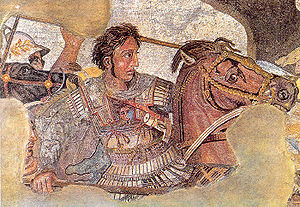 In accordance with this double meaning, the Aegis appears in works of art sometimes as an animal's skin thrown over the shoulders and arms, and sometimes as a cuirass, with a border of snakes corresponding to the tassels of Homer, usually with the Gorgon head, the gorgoneion, in the centre.
It often is represented on the statues of Roman
emperors, heroes, and warriors as well as on cameos and vases. A vestige of that appears in a portrait of Alexander the Great in a fresco from Pompeii dated to the first century BC, which shows the image of the head of a woman on his armor that resembles the Gorgon.
(Histories iv.189) thought he had identified the source of the ægis in Libya
, which was always a distant territory of ancient magic for the Greeks:
Robert Graves
in The Greek Myths (1955; 1960) asserts that the ægis in its Libyan sense had been a shamanic pouch containing various ritual objects, bearing the device of a monstrous serpent-haired visage with tusk-like teeth and a protruding tongue which was meant to frighten away the uninitiated. In this context, Graves identifies the aegis as clearly belonging first to Athena.
Another version describes it to have been really the goat's skin used as a belt to support the shield. When so used it would generally be fastened on the right shoulder, and would partially envelop the chest as it passed obliquely round in front and behind to be attached to the shield under the left arm. Hence, by metonymy
, it would be employed to denote at times the shield which it supported, and at other times a cuirass
, or chlamys
, the purpose of which it in part served. In accordance with this double meaning, the ægis appears in works of art sometimes as an animal's skin thrown over the shoulders and arms, and sometimes as a cuirass, with a border of snakes corresponding to the tassels of Homer, usually with the Gorgon's head, the gorgoneion, in the centre. It is often represented on the statues of Roman
emperors, heroes, and warriors, and on cameos and vases.
A current modern interpretation is that the Hittite
sacral hieratic hunting bag (kursas), a rough and shaggy goatskin that has been firmly established in literary texts and iconography by H.G. Güterbock, is the most likely source of the aegis.
Αιγίς has three meanings:
The original meaning may have been #1, and Ζευς 'Αιγιοχος = "Zeus who holds the aegis" may have originally meant "Sky/Heaven, who holds the storm". The transition to the meaning "shield" may have come by folk-etymology among a people familiar with draping an animal skin over the left arm as a shield.
. The goddess Bast sometimes was depicted holding a ceremonial sistrum
in one hand and an aegis in the other – the aegis usually resembling a collar or gorget
embellished with a lioness
head. Plato
drew a parallel between Athene and the ancient Libyan and Egyptian goddess Neith
, a war deity who also was depicted carrying a shield.
Ancient Nubia
shared many aspects of its mythology with ancient Egypt and there is debate about the original source of some religious concepts that the two cultures share and, whether the assimilation was from Nubia to Egypt, the reverse, or through continuing exchanges. At one time the Kush
of Nubia ruled ancient Egypt.
The image to the right was discovered in Sudan
, which is the contemporary name for the territory of Nubia during the period in which the artifact was made, during the 4th century BC. The figure is that of Isis
and she is wearing an aegis. It is likely to be an artifact of the flourishing culture of Meroë
, successors to the culture of Kush, because of the use of Egyptian hieroglyphs
and cartouche
s.
, the dragon Fafnir
(best known in the form of a dragon slain by Sigurðr) bears on his forehead the Ægis-helm (ON ægishjálmr), or Ægir's helmet, or more specifically the "Helm of Terror". However, some versions would say that Alberich was the one holding a helm, named as the Tarnkappe, which has the power to make the user invisible. It may be an actual helmet or a magical sign with a rather poetic name. Ægir is an Old Norse word meaning "terror" and the name of a destructive giant associated with the sea; ægis is the genitive (possessive) form of ægir and has no direct relation to Greek aigis.
Now, the more modern concept of doing something "under someone's aegis" means doing something under the protection of a powerful, knowledgeable, or benevolent source. The word aegis is identified with protection by a strong force with its roots in Greek mythology
Greek mythology
Greek mythology is the body of myths and legends belonging to the ancient Greeks, concerning their gods and heroes, the nature of the world, and the origins and significance of their own cult and ritual practices. They were a part of religion in ancient Greece...
and adopted by the Romans; there are parallels in Norse mythology
Norse mythology
Norse mythology, a subset of Germanic mythology, is the overall term for the myths, legends and beliefs about supernatural beings of Norse pagans. It flourished prior to the Christianization of Scandinavia, during the Early Middle Ages, and passed into Nordic folklore, with some aspects surviving...
and in Egyptian mythology
Egyptian mythology
Ancient Egyptian religion was a complex system of polytheistic beliefs and rituals which were an integral part of ancient Egyptian society. It centered on the Egyptians' interaction with a multitude of deities who were believed to be present in, and in control of, the forces and elements of nature...
as well, where the Greek word aegis is applied by extension.
In Greek mythology
The Aegis , as stated in the IliadIliad
The Iliad is an epic poem in dactylic hexameters, traditionally attributed to Homer. Set during the Trojan War, the ten-year siege of the city of Troy by a coalition of Greek states, it tells of the battles and events during the weeks of a quarrel between King Agamemnon and the warrior Achilles...
, is the shield
Shield
A shield is a type of personal armor, meant to intercept attacks, either by stopping projectiles such as arrows or redirecting a hit from a sword, mace or battle axe to the side of the shield-bearer....
or buckler
Buckler
A buckler is a small shield, 15 to 45 cm in diameter, gripped in the fist; it was generally used as a companion weapon in hand-to-hand combat during the Medieval and Renaissance, as its size made it poor protection against missile weapons but useful in deflecting the blow of...
of Athena
Athena
In Greek mythology, Athena, Athenê, or Athene , also referred to as Pallas Athena/Athene , is the goddess of wisdom, courage, inspiration, civilization, warfare, strength, strategy, the arts, crafts, justice, and skill. Minerva, Athena's Roman incarnation, embodies similar attributes. Athena is...
or of Zeus
Zeus
In the ancient Greek religion, Zeus was the "Father of Gods and men" who ruled the Olympians of Mount Olympus as a father ruled the family. He was the god of sky and thunder in Greek mythology. His Roman counterpart is Jupiter and his Etruscan counterpart is Tinia.Zeus was the child of Cronus...
, which according to Homer
Homer
In the Western classical tradition Homer , is the author of the Iliad and the Odyssey, and is revered as the greatest ancient Greek epic poet. These epics lie at the beginning of the Western canon of literature, and have had an enormous influence on the history of literature.When he lived is...
was fashioned by Hephaestus
Hephaestus
Hephaestus was a Greek god whose Roman equivalent was Vulcan. He is the son of Zeus and Hera, the King and Queen of the Gods - or else, according to some accounts, of Hera alone. He was the god of technology, blacksmiths, craftsmen, artisans, sculptors, metals, metallurgy, fire and volcanoes...
. "...and among them went bright-eyed Athene, holding the precious aegis which is ageless and immortal: a hundred tassels of pure gold hang fluttering from it, tight-woven each of them, and each the worth of a hundred oxen."
Virgil imagines the Cyclopes
Cyclops
A cyclops , in Greek mythology and later Roman mythology, was a member of a primordial race of giants, each with a single eye in the middle of his forehead...
in Hephaestus' forge, who "busily burnished the aegis Athene wears in her angry moods--a fearsome thing with a surface of gold like scaly snake-skin, and he linked serpents and the Gorgon
Gorgon
In Greek mythology, the Gorgon was a terrifying female creature. The name derives from the Greek word gorgós, which means "dreadful." While descriptions of Gorgons vary across Greek literature, the term commonly refers to any of three sisters who had hair of living, venomous snakes, and a...
herself upon the goddess's breast—a severed head rolling its eyes." furnished with golden tassels and bearing the Gorgoneion
Gorgoneion
In Ancient Greece, the Gorgoneion was originally a horror-creating apotropaic pendant showing the Gorgon's head. It was assimilated by the Olympian deities Zeus and Athena: both are said to have worn it as a protective pendant...
(Medusa
Medusa
In Greek mythology Medusa , " guardian, protectress") was a Gorgon, a chthonic monster, and a daughter of Phorcys and Ceto. The author Hyginus, interposes a generation and gives Medusa another chthonic pair as parents. Gazing directly upon her would turn onlookers to stone...
's head) in the central boss. Some of the Attic
Attica
Attica is a historical region of Greece, containing Athens, the current capital of Greece. The historical region is centered on the Attic peninsula, which projects into the Aegean Sea...
vase-painters retained an archaic tradition that the tassels had originally been serpents
Serpent (symbolism)
Serpent in Latin means: Rory Collins :&, in turn, from the Biblical Hebrew word of: "saraf" with root letters of: which refers to something burning-as, the pain of poisonous snake's bite was likened to internal burning.This word is commonly used in a specifically mythic or religious context,...
in their representations of the ægis. When the Olympian deities overtook the older deities of Greece and she was born of Metis
Metis (mythology)
In Greek mythology, Metis was of the Titan generation and, like several primordial figures, an Oceanid, in the sense that Metis was born of Oceanus and Tethys, of an earlier age than Zeus and his siblings...
(inside Zeus
Zeus
In the ancient Greek religion, Zeus was the "Father of Gods and men" who ruled the Olympians of Mount Olympus as a father ruled the family. He was the god of sky and thunder in Greek mythology. His Roman counterpart is Jupiter and his Etruscan counterpart is Tinia.Zeus was the child of Cronus...
who had swallowed the goddess) and "re-born" through the head of Zeus fully clothed, Athena already wore her typical garments.
When the Olympian shakes the aegis, Mount Ida
Mount Ida
In Greek mythology, two sacred mountains are called Mount Ida, the "Mountain of the Goddess": Mount Ida in Crete; and Mount Ida in the ancient Troad region of western Anatolia which was also known as the Phrygian Ida in classical antiquity and is the mountain that is mentioned in the Iliad of...
is wrapped in clouds, the thunder rolls and men are struck down with fear. "Aegis-bearing Zeus", as he is in the Iliad, sometimes lends the fearsome goatskin to Athena
Athena
In Greek mythology, Athena, Athenê, or Athene , also referred to as Pallas Athena/Athene , is the goddess of wisdom, courage, inspiration, civilization, warfare, strength, strategy, the arts, crafts, justice, and skill. Minerva, Athena's Roman incarnation, embodies similar attributes. Athena is...
. In the Iliad when Zeus sends Apollo to revive the wounded Hector of Troy, Apollo, holding the aegis, charges the Achaeans, pushing them back to their ships drawn up on the shore. According to Edith Hamilton
Edith Hamilton
Edith Hamilton was an American educator and author who was "recognized as the greatest woman Classicist". She was sixty-two years old when The Greek Way, her first book, was published in 1930...
's Mythology: Timeless Tales of Gods and Heroes, the Aegis is Zeus
Zeus
In the ancient Greek religion, Zeus was the "Father of Gods and men" who ruled the Olympians of Mount Olympus as a father ruled the family. He was the god of sky and thunder in Greek mythology. His Roman counterpart is Jupiter and his Etruscan counterpart is Tinia.Zeus was the child of Cronus...
' breastplate
Breastplate
A breastplate is a device worn over the torso to protect it from injury, as an item of religious significance, or as an item of status. A breastplate is sometimes worn by mythological beings as a distinctive item of clothing.- Armour :...
, and was "awful to behold."
Locating the Aegis
Greeks of the Classical ageClassical Greece
Classical Greece was a 200 year period in Greek culture lasting from the 5th through 4th centuries BC. This classical period had a powerful influence on the Roman Empire and greatly influenced the foundation of Western civilizations. Much of modern Western politics, artistic thought, such as...
always detected that there was something alien and uncanny about the Aegis. It was supposed by Euripides
Euripides
Euripides was one of the three great tragedians of classical Athens, the other two being Aeschylus and Sophocles. Some ancient scholars attributed ninety-five plays to him but according to the Suda it was ninety-two at most...
(Ion, 995) that the Gorgon
Gorgon
In Greek mythology, the Gorgon was a terrifying female creature. The name derives from the Greek word gorgós, which means "dreadful." While descriptions of Gorgons vary across Greek literature, the term commonly refers to any of three sisters who had hair of living, venomous snakes, and a...
was the original possessor of this goatskin, yet the usual understanding is that the Gorgoneion was added to the Aegis, a votive gift from a grateful Perseus
Perseus
Perseus ,Perseos and Perseas are not used in English. the legendary founder of Mycenae and of the Perseid dynasty of Danaans there, was the first of the mythic heroes of Greek mythology whose exploits in defeating various archaic monsters provided the founding myths of the Twelve Olympians...
.
There also is the origin myth that represents the ægis as a fire-breathing chthonic
Chthonic
Chthonic designates, or pertains to, deities or spirits of the underworld, especially in relation to Greek religion. The Greek word khthon is one of several for "earth"; it typically refers to the interior of the soil, rather than the living surface of the land or the land as territory...
monster similar to the Chimera, which was slain and flayed by Athena
Athena
In Greek mythology, Athena, Athenê, or Athene , also referred to as Pallas Athena/Athene , is the goddess of wisdom, courage, inspiration, civilization, warfare, strength, strategy, the arts, crafts, justice, and skill. Minerva, Athena's Roman incarnation, embodies similar attributes. Athena is...
, who afterward wore its skin as a cuirass
Cuirass
A cuirass is a piece of armour, formed of a single or multiple pieces of metal or other rigid material, which covers the front of the torso...
(Diodorus Siculus
Diodorus Siculus
Diodorus Siculus was a Greek historian who flourished between 60 and 30 BC. According to Diodorus' own work, he was born at Agyrium in Sicily . With one exception, antiquity affords no further information about Diodorus' life and doings beyond what is to be found in his own work, Bibliotheca...
iii. 70), or as a chlamys
Chlamys
The chlamys was an ancient Greek piece of clothing, a type of cloak....
. The Douris cup shows that the Aegis was represented exactly as the skin of the guardian serpent, with its scales clearly delineated. Often the Aegis is described as the bag in which Athene carried her shield and the serpent who was her son.
John Tzetzes
John Tzetzes
John Tzetzes was a Byzantine poet and grammarian, known to have lived at Constantinople during the 12th century.Tzetzes was Georgian on his mother's side...
says that it was the skin of the monstrous giant Pallas
Pallas (Giant)
In Greek mythology, Pallas was one of the Gigantes born of the blood which spilled onto Gaia when Cronus castrated her father Uranus. Pallas confronted Athena during the Gigantomachy, where she killed her and turned her skin into a shield . Pallas is sometimes referred to as being...
whom Athena overcame and whose name she attached to her own (name).
In a late rendering by Hyginus
Gaius Julius Hyginus
Gaius Julius Hyginus was a Latin author, a pupil of the famous Cornelius Alexander Polyhistor, and a freedman of Caesar Augustus. He was by Augustus elected superintendent of the Palatine library according to Suetonius' De Grammaticis, 20...
, (Poetical Astronomy ii. 13) Zeus is said to have used the skin of the goat
Goat
The domestic goat is a subspecies of goat domesticated from the wild goat of southwest Asia and Eastern Europe. The goat is a member of the Bovidae family and is closely related to the sheep as both are in the goat-antelope subfamily Caprinae. There are over three hundred distinct breeds of...
deity Amalthea
Amalthea (mythology)
In Greek mythology, Amalthea or Amaltheia is the most-frequently mentioned foster-mother of Zeus. Her name in Greek is clearly an epithet, signifying the presence of an earlier nurturing goddess, whom the Hellenes, whose myths we know, knew to be located in Crete, where Minoans may have called...
(aigis "goat-skin") which suckled him in Crete
Crete
Crete is the largest and most populous of the Greek islands, the fifth largest island in the Mediterranean Sea, and one of the thirteen administrative regions of Greece. It forms a significant part of the economy and cultural heritage of Greece while retaining its own local cultural traits...
, as a shield when he went forth to do battle against the Titan
Titan (mythology)
In Greek mythology, the Titans were a race of powerful deities, descendants of Gaia and Uranus, that ruled during the legendary Golden Age....
s. She is thought to bear the name of the deity who was derived from Libya, where known as Neith, the same source sometimes identified as the parallel for Athene.
It often is represented on the statues of Roman
Roman Empire
The Roman Empire was the post-Republican period of the ancient Roman civilization, characterised by an autocratic form of government and large territorial holdings in Europe and around the Mediterranean....
emperors, heroes, and warriors as well as on cameos and vases. A vestige of that appears in a portrait of Alexander the Great in a fresco from Pompeii dated to the first century BC, which shows the image of the head of a woman on his armor that resembles the Gorgon.
Origins
HerodotusHerodotus
Herodotus was an ancient Greek historian who was born in Halicarnassus, Caria and lived in the 5th century BC . He has been called the "Father of History", and was the first historian known to collect his materials systematically, test their accuracy to a certain extent and arrange them in a...
(Histories iv.189) thought he had identified the source of the ægis in Libya
Libya
Libya is an African country in the Maghreb region of North Africa bordered by the Mediterranean Sea to the north, Egypt to the east, Sudan to the southeast, Chad and Niger to the south, and Algeria and Tunisia to the west....
, which was always a distant territory of ancient magic for the Greeks:
- Athene's garments and ægis were borrowed by the Greeks from the Libyan women, who are dressed in exactly the same way, except that their leather garments are fringed with thongs, not serpents.
Robert Graves
Robert Graves
Robert von Ranke Graves 24 July 1895 – 7 December 1985 was an English poet, translator and novelist. During his long life he produced more than 140 works...
in The Greek Myths (1955; 1960) asserts that the ægis in its Libyan sense had been a shamanic pouch containing various ritual objects, bearing the device of a monstrous serpent-haired visage with tusk-like teeth and a protruding tongue which was meant to frighten away the uninitiated. In this context, Graves identifies the aegis as clearly belonging first to Athena.
Another version describes it to have been really the goat's skin used as a belt to support the shield. When so used it would generally be fastened on the right shoulder, and would partially envelop the chest as it passed obliquely round in front and behind to be attached to the shield under the left arm. Hence, by metonymy
Metonymy
Metonymy is a figure of speech used in rhetoric in which a thing or concept is not called by its own name, but by the name of something intimately associated with that thing or concept...
, it would be employed to denote at times the shield which it supported, and at other times a cuirass
Cuirass
A cuirass is a piece of armour, formed of a single or multiple pieces of metal or other rigid material, which covers the front of the torso...
, or chlamys
Chlamys
The chlamys was an ancient Greek piece of clothing, a type of cloak....
, the purpose of which it in part served. In accordance with this double meaning, the ægis appears in works of art sometimes as an animal's skin thrown over the shoulders and arms, and sometimes as a cuirass, with a border of snakes corresponding to the tassels of Homer, usually with the Gorgon's head, the gorgoneion, in the centre. It is often represented on the statues of Roman
Roman Empire
The Roman Empire was the post-Republican period of the ancient Roman civilization, characterised by an autocratic form of government and large territorial holdings in Europe and around the Mediterranean....
emperors, heroes, and warriors, and on cameos and vases.
A current modern interpretation is that the Hittite
Hittites
The Hittites were a Bronze Age people of Anatolia.They established a kingdom centered at Hattusa in north-central Anatolia c. the 18th century BC. The Hittite empire reached its height c...
sacral hieratic hunting bag (kursas), a rough and shaggy goatskin that has been firmly established in literary texts and iconography by H.G. Güterbock, is the most likely source of the aegis.
Etymology
GreekGreek language
Greek is an independent branch of the Indo-European family of languages. Native to the southern Balkans, it has the longest documented history of any Indo-European language, spanning 34 centuries of written records. Its writing system has been the Greek alphabet for the majority of its history;...
Αιγίς has three meanings:
- "violent windstorm", from the verb 'αïσσω (stem 'αïγ-) = "I rush or move violently". Akin to "καταιγίς" hurricane.
- The shield of a deity as described above
- "goatskin coat", from treating the word as meaning "something grammatically feminine pertaining to goatGoatThe domestic goat is a subspecies of goat domesticated from the wild goat of southwest Asia and Eastern Europe. The goat is a member of the Bovidae family and is closely related to the sheep as both are in the goat-antelope subfamily Caprinae. There are over three hundred distinct breeds of...
" (Greek αἰξ (stem αἰγ-) = "goat", + suffix -ίς (stem ίδ-))
The original meaning may have been #1, and Ζευς 'Αιγιοχος = "Zeus who holds the aegis" may have originally meant "Sky/Heaven, who holds the storm". The transition to the meaning "shield" may have come by folk-etymology among a people familiar with draping an animal skin over the left arm as a shield.
In Egyptian and Nubian mythology
The aegis also appears in Ancient Egyptian mythologyEgyptian mythology
Ancient Egyptian religion was a complex system of polytheistic beliefs and rituals which were an integral part of ancient Egyptian society. It centered on the Egyptians' interaction with a multitude of deities who were believed to be present in, and in control of, the forces and elements of nature...
. The goddess Bast sometimes was depicted holding a ceremonial sistrum
Sistrum
A sistrum is a musical instrument of the percussion family, chiefly associated with ancient Iraq and Egypt. It consists of a handle and a U-shaped metal frame, made of brass or bronze and between 76 and 30 cm in width...
in one hand and an aegis in the other – the aegis usually resembling a collar or gorget
Gorget
A gorget originally was a steel or leather collar designed to protect the throat. It was a feature of older types of armour and intended to protect against swords and other non-projectile weapons...
embellished with a lioness
Lion
The lion is one of the four big cats in the genus Panthera, and a member of the family Felidae. With some males exceeding 250 kg in weight, it is the second-largest living cat after the tiger...
head. Plato
Plato
Plato , was a Classical Greek philosopher, mathematician, student of Socrates, writer of philosophical dialogues, and founder of the Academy in Athens, the first institution of higher learning in the Western world. Along with his mentor, Socrates, and his student, Aristotle, Plato helped to lay the...
drew a parallel between Athene and the ancient Libyan and Egyptian goddess Neith
Neith
In Egyptian mythology, Neith was an early goddess in the Egyptian pantheon. She was the patron deity of Sais, where her cult was centered in the Western Nile Delta of Egypt and attested as early as the First Dynasty...
, a war deity who also was depicted carrying a shield.
Ancient Nubia
Nubia
Nubia is a region along the Nile river, which is located in northern Sudan and southern Egypt.There were a number of small Nubian kingdoms throughout the Middle Ages, the last of which collapsed in 1504, when Nubia became divided between Egypt and the Sennar sultanate resulting in the Arabization...
shared many aspects of its mythology with ancient Egypt and there is debate about the original source of some religious concepts that the two cultures share and, whether the assimilation was from Nubia to Egypt, the reverse, or through continuing exchanges. At one time the Kush
Kingdom of Kush
The native name of the Kingdom was likely kaš, recorded in Egyptian as .The name Kash is probably connected to Cush in the Hebrew Bible , son of Ham ....
of Nubia ruled ancient Egypt.
The image to the right was discovered in Sudan
Sudan
Sudan , officially the Republic of the Sudan , is a country in North Africa, sometimes considered part of the Middle East politically. It is bordered by Egypt to the north, the Red Sea to the northeast, Eritrea and Ethiopia to the east, South Sudan to the south, the Central African Republic to the...
, which is the contemporary name for the territory of Nubia during the period in which the artifact was made, during the 4th century BC. The figure is that of Isis
Isis
Isis or in original more likely Aset is a goddess in Ancient Egyptian religious beliefs, whose worship spread throughout the Greco-Roman world. She was worshipped as the ideal mother and wife as well as the matron of nature and magic...
and she is wearing an aegis. It is likely to be an artifact of the flourishing culture of Meroë
Meroë
Meroë Meroitic: Medewi or Bedewi; Arabic: and Meruwi) is an ancient city on the east bank of the Nile about 6 km north-east of the Kabushiya station near Shendi, Sudan, approximately 200 km north-east of Khartoum. Near the site are a group of villages called Bagrawiyah...
, successors to the culture of Kush, because of the use of Egyptian hieroglyphs
Egyptian hieroglyphs
Egyptian hieroglyphs were a formal writing system used by the ancient Egyptians that combined logographic and alphabetic elements. Egyptians used cursive hieroglyphs for religious literature on papyrus and wood...
and cartouche
Cartouche
In Egyptian hieroglyphs, a cartouche is an ellipse with a horizontal line at one end, indicating that the text enclosed is a royal name, coming into use during the beginning of the Fourth Dynasty under Pharaoh Sneferu, replacing the earlier serekh...
s.
In Norse mythology
In Norse mythologyNorse mythology
Norse mythology, a subset of Germanic mythology, is the overall term for the myths, legends and beliefs about supernatural beings of Norse pagans. It flourished prior to the Christianization of Scandinavia, during the Early Middle Ages, and passed into Nordic folklore, with some aspects surviving...
, the dragon Fafnir
Fafnir
In Norse mythology, Fáfnir or Frænir was a son of the dwarf king Hreidmar and brother of Regin and Ótr. In the Volsunga saga, Fáfnir was a dwarf gifted with a powerful arm and fearless soul. He guarded his father's house of glittering gold and flashing gems...
(best known in the form of a dragon slain by Sigurðr) bears on his forehead the Ægis-helm (ON ægishjálmr), or Ægir's helmet, or more specifically the "Helm of Terror". However, some versions would say that Alberich was the one holding a helm, named as the Tarnkappe, which has the power to make the user invisible. It may be an actual helmet or a magical sign with a rather poetic name. Ægir is an Old Norse word meaning "terror" and the name of a destructive giant associated with the sea; ægis is the genitive (possessive) form of ægir and has no direct relation to Greek aigis.
External links
- Theoi Project: "Aigis"
- Die Aigis: Zu Typologie und Ikonographie eines Mythischen Gegenstandes: a Doctoral dissertation on the Ægis (Westfälischen Wilhelms-Universität, MünsterMünsterMünster is an independent city in North Rhine-Westphalia, Germany. It is located in the northern part of the state and is considered to be the cultural centre of the Westphalia region. It is also capital of the local government region Münsterland...
1991) by Sigrid VierckHayo VierckHayo Vierck was a German archaeologist, who made a distinguished contribution to German Early Medieval archaeology through research in the industrial arts.-Career:...
.