


Magnus Hirschfeld

Encyclopedia
Magnus Hirschfeld was a German
physician and sexologist. An outspoken advocate for sexual minorities
, Hirschfeld founded the Scientific Humanitarian Committee, which Dustin Goltz called "the first advocacy for homosexual and transgender rights
."
and philology
in Breslau, then from 1888-1892 medicine
in Strasbourg
, Munich
, Heidelberg
, and Berlin
. In 1892 he took his doctoral degree. After his studies, he traveled through the United States
for eight months, visiting the World's Columbian Exposition
in Chicago
, and living from the proceeds of his writing for German journals. Then he started a naturopathic
practice in Magdeburg
; in 1896 be moved his practice to Berlin-Charlottenburg
.
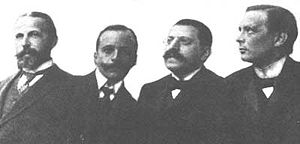 Magnus Hirschfeld's career successfully found a balance between medicine and writing. After several years as a general practitioner in Magdeburg, in 1896 he issued a pamphlet Sappho
and Socrates
, on homosexual love (under the pseudonym Th. Ramien). In 1897, Hirschfeld founded the Scientific Humanitarian Committee with the publisher Max Spohr
, the lawyer Eduard Oberg, and the writer Max von Bülow. The group aimed to undertake research to defend the rights of homosexuals and to repeal Paragraph 175
, the section of the German penal code that since 1871 had criminalized homosexuality. They argued that the law encouraged blackmail
, and the motto of the Committee, "Justice through science", reflected Hirschfeld's belief that a better scientific understanding of homosexuality would eliminate hostility toward homosexuals
.
Within the group, some of the members scorned Hirschfeld's analogy that homosexuals are like disabled
people; they argued that society might tolerate or pity them, but never treat them as equals. They also disagreed with Hirschfeld's (and Ulrichs's) view that male homosexuals were by nature effeminate. Benedict Friedlaender
and some others left the Scientific-Humanitarian Committee and formed another group, the 'Bund für männliche Kultur' or Union for Male Culture, which did not exist for long. It argued that male-male love is a simple aspect of virile manliness rather than a special condition.
The Scientific-Humanitarian Committee, under Hirschfeld's leadership, managed to gather over 5000 signatures from prominent Germans for a petition to overturn Paragraph 175. Signatories included Albert Einstein
, Hermann Hesse
, Käthe Kollwitz
, Thomas Mann
, Heinrich Mann
, Rainer Maria Rilke
, August Bebel
, Max Brod
, Karl Kautsky
, Stefan Zweig
, Gerhart Hauptmann
, Martin Buber
, Richard von Krafft-Ebing and Eduard Bernstein
.
The bill was brought before the Reichstag
in 1898, but was only supported by a minority from the Social Democratic Party of Germany
, prompting Hirschfeld to consider what would, in a later era, be described as "outing
": forcing some of the prominent and secretly homosexual lawmakers who had remained silent out of the closet
. The bill continued to come before parliament, and eventually began to make progress in the 1920s before the takeover of the Nazi Party obliterated any hopes for reform.
In 1921 Hirschfeld organised the First Congress for Sexual Reform, which led to the formation of the World League for Sexual Reform. Congresses were held in Copenhagen
(1928), London
(1929), Vienna
(1930), and Brno
(1932).
Hirschfeld was both quoted and caricatured in the press as a vociferous expert on sexual manners, receiving the epithet "the Einstein of Sex". He saw himself as a campaigner and a scientist, investigating and cataloging many varieties of sexuality, not just homosexuality. He developed a system which categorised 64 possible types of sexual intermediary ranging from masculine heterosexual male to feminine homosexual male, including those he described under the word he coined "Transvestit" (transvestite), which covered people who today would include a variety of transgender
and transsexual people.
Hirschfeld co-wrote and acted in the 1919 film Anders als die Andern ("Different From the Others"), where Conrad Veidt
played one of the first homosexual characters ever written for cinema. The film had a specific gay rights law reform agenda; Veidt's character is blackmail
ed by a lover, eventually coming out
rather than continuing to make the blackmail payments, but his career is destroyed and he is driven to suicide
.
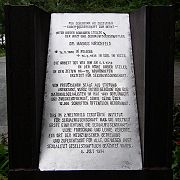 In 1919, under the more liberal
atmosphere of the newly founded Weimar Republic
, Hirschfeld purchased a villa not far from the Reichstag
building for his new Institut für Sexualwissenschaft
(Institute for Sexual Research) in Berlin
. His Institute housed his immense library on sex and provided educational services and medical consultations. People from around Europe
visited the Institute to gain a clearer understanding of their sexuality
.
Christopher Isherwood
writes about his and W. H. Auden
's visit to the Institute in his book Christopher and His Kind
. They were visiting Francis Turville-Petre
, a friend of Isherwood's who was an active member of the Scientific Humanitarian Committee. The Institute also housed the Museum of Sex, an educational resource for the public which is reported to have been visited by school classes.
The Institute and Hirschfeld's work are depicted in Rosa von Praunheim
's feature film Der Einstein des Sex
(The Einstein of Sex, Germany, 1999 - English subtitled version available). Although inspired by Hirschfeld's life, the film is a work of fiction containing numerous invented incidents and attributing motives and sentiments to Hirschfeld and other characters on the basis of little or no historical evidence.
. He campaigned for the decriminalisation of abortion
, and against policies that banned female teachers and civil servants from marrying or having children.
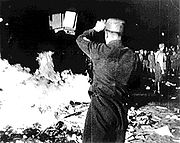 When the Nazis
took power, they attacked Hirschfeld's Institut on May 6, 1933, and burned many of its books. The press-library pictures and archival newsreel
film of the Nazi book-burning seen today are believed to be of Hirschfeld's library and records.
, then spending several weeks in Vienna
before moving on to Zurich
in August 1932. While in Switzerland, he worked on a book recounting his experiences and observations from his world tour, published in 1933 as Die Weltreise eines Sexualforschers (Brugg, Switzerland: Bözberg-Verlag, 1933), and subsequently in English translation in the United States under the title Men and Women: The World Journey of a Sexologist (New York City: G. P. Putnam's Sons, 1935) and in England under the title Women East and West: Impressions of a Sex Expert (London: William Heinemann Medical Books, 1935).
Hirschfeld had initially stayed near Germany, hoping to return to Berlin if the political situation improved. With the Nazi regime's unequivocal rise to power and with work on the book about his world tour completed, he decided to establish himself as an exile in France. On his 65th birthday, May 14, 1933, Hirschfeld arrived in Paris
, where he would live in a luxurious apartment building at 24 Avenue Charles Floquet, facing the Champ de Mars
. A year-and-half later, in November 1934, he moved south to Nice
, on the Mediterranean coast. Throughout his stay in France, he continued researching, writing, campaigning and working to reestablish a French successor to his lost institute in Berlin.
The last of Hirschfeld's books released during his lifetime, L'Ame et l'amour, psychologie sexologique (Paris: Gallimard, 1935), was published in French in late April 1935; it was his only book which never appeared in a German-language edition. In the preface, he described his hopes for his new life in France: "In search of sanctuary, I have found my way to that country, the nobility of whose traditions, and whose ever-present charm, have already been as balm to my soul. I shall be glad and grateful if I can spend some few years of peace and repose in France and Paris, and still more grateful to be enabled to repay the hospitality accorded to me, by making available those abundant stores of knowledge acquired throughout my career."
in Nice. His body was cremated, and the ashes interred in a simple but elegant tomb in the Caucade Cemetery in Nice. The headstone in gray granite is inset with a bronze bas-relief portrait of Hirschfeld in profile by German sculptor and decorative artist Arnold Zadikow (1884–1943) and is engraved with Hirschfeld's Latin motto, "Per Scientiam ad Justitiam" ("through science to justice"). (The Caucade Cemetery is likewise the location of the grave of surgeon and sexual-rejuvenation proponent Serge Voronoff
— whose work Hirschfeld had discussed in his own publications.)
On May 14, 2010, to mark the 75th anniversary of Hirschfeld's death, a French national organization, the Mémorial de la Déportation Homosexuelle (MDH), in partnership with the new LGBT Community Center of Nice (Centre LGBT Côte d'Azur), organized a formal delegation to the cemetery. Speakers recalled Hirschfeld's life and work and laid a large bouquet of pink flowers on his tomb; the ribbon on the bouquet was inscribed "Au pionnier de nos causes. Le MDH et le Centre LGBT" ("To the pioneer of our causes. The MDH and the LGBT Center").
, attached to the Allied Army of Occupation following World War I, became impressed by Hirschfeld and absorbed many of Hirschfeld's ideas. Upon his return to the United States, Gerber was inspired to form the short-lived Chicago-based Society for Human Rights in 1924, the first known gay rights organization in the nation. In turn, a partner of one of the former members of the Society communicated the existence of the society to Los Angeles resident Harry Hay
in 1929; Hay would go on to help establish the first long-term national homosexual rights organization in the United States, the Mattachine Society
, in 1950.
In 1982, a group of German researchers and activists founded the Magnus Hirschfeld Society (Magnus-Hirschfeld-Gesellschaft e.V.) in West Berlin, in anticipation of the then-approaching 50th anniversary of the destruction of the Hirschfeld's Institute for Sexual Science; ten years later, the society established a Berlin-based center for research on the history of sexology. The society's stated goals are the following:
The German Society for Social-Scientific Sexuality Research
established the Magnus Hirschfeld Medal
in 1990. The Society awards the Medal in two categories, contributions to sexual research and contributions to sexual reform.
The Hirschfeld Eddy Foundation
, established in Germany in 2007, is named for Hirschfeld and lesbian activist FannyAnn Eddy
.
In August 2011, after 30 years of advocacy by the Magnus Hirschfeld Society and other associations and individuals, the Federal Cabinet of Germany
granted 10 million euros to establish the Magnus Hirschfeld National Foundation (Bundesstiftung Magnus Hirschfeld), a foundation to support research and education about the life and work of Magnus Hirschfeld, the Nazi persecution of homosexuals, German LGBT culture and community, and ways to counteract prejudice against LGBT people; the Federal Ministry of Justice (Germany)
was expected to contribute an additional 5 million euros, bringing the initial endowment of the foundation to a total of 15 million euros.
The following have been translated into English:
Autobiographical:
Germans
The Germans are a Germanic ethnic group native to Central Europe. The English term Germans has referred to the German-speaking population of the Holy Roman Empire since the Late Middle Ages....
physician and sexologist. An outspoken advocate for sexual minorities
Sexual minority
A sexual minority is a group whose sexual identity, orientation or practices differ from the majority of the surrounding society. The term was coined most likely in the late 1960s under the influence of Lars Ullerstam's ground breaking book "The Erotic Minorities: A Swedish View" which came...
, Hirschfeld founded the Scientific Humanitarian Committee, which Dustin Goltz called "the first advocacy for homosexual and transgender rights
LGBT social movements
Lesbian, gay, bisexual, and transgender social movements share inter-related goals of social acceptance of sexual and gender minorities. Lesbian, gay, bisexual, and transgender people and their allies have a long history of campaigning for what is generally called LGBT rights, also called gay...
."
Early life
Hirschfeld was born in Kolberg (modern Kołobrzeg) in a Jewish family, the son of a highly regarded physician and 'Medizinalrat' Hermann Hirschfeld. In 1887-1888 he studied philosophyPhilosophy
Philosophy is the study of general and fundamental problems, such as those connected with existence, knowledge, values, reason, mind, and language. Philosophy is distinguished from other ways of addressing such problems by its critical, generally systematic approach and its reliance on rational...
and philology
Philology
Philology is the study of language in written historical sources; it is a combination of literary studies, history and linguistics.Classical philology is the philology of Greek and Classical Latin...
in Breslau, then from 1888-1892 medicine
Medicine
Medicine is the science and art of healing. It encompasses a variety of health care practices evolved to maintain and restore health by the prevention and treatment of illness....
in Strasbourg
Strasbourg
Strasbourg is the capital and principal city of the Alsace region in eastern France and is the official seat of the European Parliament. Located close to the border with Germany, it is the capital of the Bas-Rhin département. The city and the region of Alsace are historically German-speaking,...
, Munich
Munich
Munich The city's motto is "" . Before 2006, it was "Weltstadt mit Herz" . Its native name, , is derived from the Old High German Munichen, meaning "by the monks' place". The city's name derives from the monks of the Benedictine order who founded the city; hence the monk depicted on the city's coat...
, Heidelberg
Heidelberg
-Early history:Between 600,000 and 200,000 years ago, "Heidelberg Man" died at nearby Mauer. His jaw bone was discovered in 1907; with scientific dating, his remains were determined to be the earliest evidence of human life in Europe. In the 5th century BC, a Celtic fortress of refuge and place of...
, and Berlin
Berlin
Berlin is the capital city of Germany and is one of the 16 states of Germany. With a population of 3.45 million people, Berlin is Germany's largest city. It is the second most populous city proper and the seventh most populous urban area in the European Union...
. In 1892 he took his doctoral degree. After his studies, he traveled through the United States
United States
The United States of America is a federal constitutional republic comprising fifty states and a federal district...
for eight months, visiting the World's Columbian Exposition
World's Columbian Exposition
The World's Columbian Exposition was a World's Fair held in Chicago in 1893 to celebrate the 400th anniversary of Christopher Columbus's arrival in the New World in 1492. Chicago bested New York City; Washington, D.C.; and St...
in Chicago
Chicago
Chicago is the largest city in the US state of Illinois. With nearly 2.7 million residents, it is the most populous city in the Midwestern United States and the third most populous in the US, after New York City and Los Angeles...
, and living from the proceeds of his writing for German journals. Then he started a naturopathic
Naturopathic medicine
Naturopathy, or Naturopathic Medicine, is a form of alternative medicine based on a belief in vitalism, which posits that a special energy called vital energy or vital force guides bodily processes such as metabolism, reproduction, growth, and adaptation...
practice in Magdeburg
Magdeburg
Magdeburg , is the largest city and the capital city of the Bundesland of Saxony-Anhalt, Germany. Magdeburg is situated on the Elbe River and was one of the most important medieval cities of Europe....
; in 1896 be moved his practice to Berlin-Charlottenburg
Charlottenburg
Charlottenburg is a locality of Berlin within the borough of Charlottenburg-Wilmersdorf, named after Queen consort Sophia Charlotte...
.
Sexuality Rights activism
Sappho
Sappho was an Ancient Greek poet, born on the island of Lesbos. Later Greeks included her in the list of nine lyric poets. Her birth was sometime between 630 and 612 BC, and it is said that she died around 570 BC, but little is known for certain about her life...
and Socrates
Socrates
Socrates was a classical Greek Athenian philosopher. Credited as one of the founders of Western philosophy, he is an enigmatic figure known chiefly through the accounts of later classical writers, especially the writings of his students Plato and Xenophon, and the plays of his contemporary ...
, on homosexual love (under the pseudonym Th. Ramien). In 1897, Hirschfeld founded the Scientific Humanitarian Committee with the publisher Max Spohr
Max Spohr
Johannes Hermann August Wilhelm Max Spohr was a German bookseller and publisher. He was one of the first publishers worldwide, who published LGBT publications...
, the lawyer Eduard Oberg, and the writer Max von Bülow. The group aimed to undertake research to defend the rights of homosexuals and to repeal Paragraph 175
Paragraph 175
Paragraph 175 was a provision of the German Criminal Code from 15 May 1871 to 10 March 1994. It made homosexual acts between males a crime, and in early revisions the provision also criminalized bestiality. All in all, around 140,000 men were convicted under the law.The statute was amended several...
, the section of the German penal code that since 1871 had criminalized homosexuality. They argued that the law encouraged blackmail
Blackmail
In common usage, blackmail is a crime involving threats to reveal substantially true or false information about a person to the public, a family member, or associates unless a demand is met. It may be defined as coercion involving threats of physical harm, threat of criminal prosecution, or threats...
, and the motto of the Committee, "Justice through science", reflected Hirschfeld's belief that a better scientific understanding of homosexuality would eliminate hostility toward homosexuals
Homophobia
Homophobia is a term used to refer to a range of negative attitudes and feelings towards lesbian, gay and in some cases bisexual, transgender people and behavior, although these are usually covered under other terms such as biphobia and transphobia. Definitions refer to irrational fear, with the...
.
Within the group, some of the members scorned Hirschfeld's analogy that homosexuals are like disabled
Disability
A disability may be physical, cognitive, mental, sensory, emotional, developmental or some combination of these.Many people would rather be referred to as a person with a disability instead of handicapped...
people; they argued that society might tolerate or pity them, but never treat them as equals. They also disagreed with Hirschfeld's (and Ulrichs's) view that male homosexuals were by nature effeminate. Benedict Friedlaender
Benedict Friedlaender
Benedict Friedlaender was a German Jewish sexologist, sociologist, economist, volcanologist, and physicist....
and some others left the Scientific-Humanitarian Committee and formed another group, the 'Bund für männliche Kultur' or Union for Male Culture, which did not exist for long. It argued that male-male love is a simple aspect of virile manliness rather than a special condition.
The Scientific-Humanitarian Committee, under Hirschfeld's leadership, managed to gather over 5000 signatures from prominent Germans for a petition to overturn Paragraph 175. Signatories included Albert Einstein
Albert Einstein
Albert Einstein was a German-born theoretical physicist who developed the theory of general relativity, effecting a revolution in physics. For this achievement, Einstein is often regarded as the father of modern physics and one of the most prolific intellects in human history...
, Hermann Hesse
Hermann Hesse
Hermann Hesse was a German-Swiss poet, novelist, and painter. In 1946, he received the Nobel Prize in Literature...
, Käthe Kollwitz
Käthe Kollwitz
Käthe Kollwitz was a German painter, printmaker, and sculptor whose work offered an eloquent and often searing account of the human condition in the first half of the 20th century...
, Thomas Mann
Thomas Mann
Thomas Mann was a German novelist, short story writer, social critic, philanthropist, essayist, and 1929 Nobel Prize laureate, known for his series of highly symbolic and ironic epic novels and novellas, noted for their insight into the psychology of the artist and the intellectual...
, Heinrich Mann
Heinrich Mann
Luiz Heinrich Mann was a German novelist who wrote works with strong social themes. His attacks on the authoritarian and increasingly militaristic nature of pre-World War II German society led to his exile in 1933.-Life and work:Born in Lübeck as the oldest child of Thomas Johann Heinrich Mann...
, Rainer Maria Rilke
Rainer Maria Rilke
René Karl Wilhelm Johann Josef Maria Rilke , better known as Rainer Maria Rilke, was a Bohemian–Austrian poet. He is considered one of the most significant poets in the German language...
, August Bebel
August Bebel
Ferdinand August Bebel was a German Marxist politician, writer, and orator. He is best remembered as one of the founders of the Social Democratic Party of Germany.-Early years:...
, Max Brod
Max Brod
Max Brod was a German-speaking Czech Jewish, later Israeli, author, composer, and journalist. Although he was a prolific writer in his own right, he is most famous as the friend and biographer of Franz Kafka...
, Karl Kautsky
Karl Kautsky
Karl Johann Kautsky was a Czech-German philosopher, journalist, and Marxist theoretician. Kautsky was recognized as among the most authoritative promulgators of Orthodox Marxism after the death of Friedrich Engels in 1895 until the coming of World War I in 1914 and was called by some the "Pope of...
, Stefan Zweig
Stefan Zweig
Stefan Zweig was an Austrian novelist, playwright, journalist and biographer. At the height of his literary career, in the 1920s and 1930s, he was one of the most famous writers in the world.- Biography :...
, Gerhart Hauptmann
Gerhart Hauptmann
Gerhart Hauptmann was a German dramatist and novelist who received the Nobel Prize in Literature in 1912.-Life and work:...
, Martin Buber
Martin Buber
Martin Buber was an Austrian-born Jewish philosopher best known for his philosophy of dialogue, a form of religious existentialism centered on the distinction between the I-Thou relationship and the I-It relationship....
, Richard von Krafft-Ebing and Eduard Bernstein
Eduard Bernstein
Eduard Bernstein was a German social democratic theoretician and politician, a member of the SPD, and the founder of evolutionary socialism and revisionism.- Life :...
.
The bill was brought before the Reichstag
Reichstag (German Empire)
The Reichstag was the parliament of the North German Confederation , and of the German Reich ....
in 1898, but was only supported by a minority from the Social Democratic Party of Germany
Social Democratic Party of Germany
The Social Democratic Party of Germany is a social-democratic political party in Germany...
, prompting Hirschfeld to consider what would, in a later era, be described as "outing
Outing
Outing is the act of disclosing a gay, lesbian, bisexual or transgender person's true sexual orientation or gender identity without that person's consent. Outing gives rise to issues of privacy, choice, hypocrisy, and harm in addition to sparking debate on what constitutes common good in efforts...
": forcing some of the prominent and secretly homosexual lawmakers who had remained silent out of the closet
The Closet
The Closet may refer to:* The Closet , Chinese film* The Closet , French film* The closet, referring to undisclosed homosexuality- See also :* Closet* Closet * In the closet...
. The bill continued to come before parliament, and eventually began to make progress in the 1920s before the takeover of the Nazi Party obliterated any hopes for reform.
In 1921 Hirschfeld organised the First Congress for Sexual Reform, which led to the formation of the World League for Sexual Reform. Congresses were held in Copenhagen
Copenhagen
Copenhagen is the capital and largest city of Denmark, with an urban population of 1,199,224 and a metropolitan population of 1,930,260 . With the completion of the transnational Øresund Bridge in 2000, Copenhagen has become the centre of the increasingly integrating Øresund Region...
(1928), London
London
London is the capital city of :England and the :United Kingdom, the largest metropolitan area in the United Kingdom, and the largest urban zone in the European Union by most measures. Located on the River Thames, London has been a major settlement for two millennia, its history going back to its...
(1929), Vienna
Vienna
Vienna is the capital and largest city of the Republic of Austria and one of the nine states of Austria. Vienna is Austria's primary city, with a population of about 1.723 million , and is by far the largest city in Austria, as well as its cultural, economic, and political centre...
(1930), and Brno
Brno
Brno by population and area is the second largest city in the Czech Republic, the largest Moravian city, and the historical capital city of the Margraviate of Moravia. Brno is the administrative centre of the South Moravian Region where it forms a separate district Brno-City District...
(1932).
Hirschfeld was both quoted and caricatured in the press as a vociferous expert on sexual manners, receiving the epithet "the Einstein of Sex". He saw himself as a campaigner and a scientist, investigating and cataloging many varieties of sexuality, not just homosexuality. He developed a system which categorised 64 possible types of sexual intermediary ranging from masculine heterosexual male to feminine homosexual male, including those he described under the word he coined "Transvestit" (transvestite), which covered people who today would include a variety of transgender
Transgender
Transgender is a general term applied to a variety of individuals, behaviors, and groups involving tendencies to vary from culturally conventional gender roles....
and transsexual people.
Hirschfeld co-wrote and acted in the 1919 film Anders als die Andern ("Different From the Others"), where Conrad Veidt
Conrad Veidt
Conrad Veidt was a German actor best remembered for his roles in films such as The Cabinet of Dr. Caligari , The Man Who Laughs , The Thief of Bagdad and Casablanca...
played one of the first homosexual characters ever written for cinema. The film had a specific gay rights law reform agenda; Veidt's character is blackmail
Blackmail
In common usage, blackmail is a crime involving threats to reveal substantially true or false information about a person to the public, a family member, or associates unless a demand is met. It may be defined as coercion involving threats of physical harm, threat of criminal prosecution, or threats...
ed by a lover, eventually coming out
Coming out
Coming out is a figure of speech for lesbian, gay, bisexual, and transgender people's disclosure of their sexual orientation and/or gender identity....
rather than continuing to make the blackmail payments, but his career is destroyed and he is driven to suicide
Suicide
Suicide is the act of intentionally causing one's own death. Suicide is often committed out of despair or attributed to some underlying mental disorder, such as depression, bipolar disorder, schizophrenia, alcoholism, or drug abuse...
.
Institut für Sexualwissenschaft
Liberalism
Liberalism is the belief in the importance of liberty and equal rights. Liberals espouse a wide array of views depending on their understanding of these principles, but generally, liberals support ideas such as constitutionalism, liberal democracy, free and fair elections, human rights,...
atmosphere of the newly founded Weimar Republic
Weimar Republic
The Weimar Republic is the name given by historians to the parliamentary republic established in 1919 in Germany to replace the imperial form of government...
, Hirschfeld purchased a villa not far from the Reichstag
Reichstag (building)
The Reichstag building is a historical edifice in Berlin, Germany, constructed to house the Reichstag, parliament of the German Empire. It was opened in 1894 and housed the Reichstag until 1933, when it was severely damaged in a fire. During the Nazi era, the few meetings of members of the...
building for his new Institut für Sexualwissenschaft
Institut für Sexualwissenschaft
The Institut für Sexualwissenschaft was an early private sexology research institute in Germany from 1919 to 1933. The name is variously translated as Institute of Sex Research, Institute for Sexology or Institute for the Science of Sexuality...
(Institute for Sexual Research) in Berlin
Berlin
Berlin is the capital city of Germany and is one of the 16 states of Germany. With a population of 3.45 million people, Berlin is Germany's largest city. It is the second most populous city proper and the seventh most populous urban area in the European Union...
. His Institute housed his immense library on sex and provided educational services and medical consultations. People from around Europe
Europe
Europe is, by convention, one of the world's seven continents. Comprising the westernmost peninsula of Eurasia, Europe is generally 'divided' from Asia to its east by the watershed divides of the Ural and Caucasus Mountains, the Ural River, the Caspian and Black Seas, and the waterways connecting...
visited the Institute to gain a clearer understanding of their sexuality
Human sexuality
Human sexuality is the awareness of gender differences, and the capacity to have erotic experiences and responses. Human sexuality can also be described as the way someone is sexually attracted to another person whether it is to opposite sexes , to the same sex , to either sexes , or not being...
.
Christopher Isherwood
Christopher Isherwood
Christopher William Bradshaw Isherwood was an English-American novelist.-Early life and work:Born at Wyberslegh Hall, High Lane, Cheshire in North West England, Isherwood spent his childhood in various towns where his father, a Lieutenant-Colonel in the British Army, was stationed...
writes about his and W. H. Auden
W. H. Auden
Wystan Hugh Auden , who published as W. H. Auden, was an Anglo-American poet,The first definition of "Anglo-American" in the OED is: "Of, belonging to, or involving both England and America." See also the definition "English in origin or birth, American by settlement or citizenship" in See also...
's visit to the Institute in his book Christopher and His Kind
Christopher and His Kind
Christopher and His Kind is a 1976 memoir by the British author Christopher Isherwood, covering the period 1929 to 1939 and principally covering his years in Berlin. Isherwood's real-life experiences during this period formed the basis of his novel Goodbye to Berlin.It was adapted for television in...
. They were visiting Francis Turville-Petre
Francis Turville-Petre
Francis Adrian Joseph Turville-Petre was a British archaeologist, famous for the discovery of the Neanderthal Galilee Man in 1925 and his work at Mount Carmel, in what was then the British Mandate of Palestine, now Israel. He was a close friend of Christopher Isherwood and W. H...
, a friend of Isherwood's who was an active member of the Scientific Humanitarian Committee. The Institute also housed the Museum of Sex, an educational resource for the public which is reported to have been visited by school classes.
The Institute and Hirschfeld's work are depicted in Rosa von Praunheim
Rosa von Praunheim
Rosa von Praunheim , in Riga, Latvia. His given name is Holger Mischwitzky. He is a German film director, author, painter and gay rights activist. Openly gay, he is one of the initiators of the gay rights movement in Germany....
's feature film Der Einstein des Sex
Der Einstein des Sex
The Einstein of Sex: Life and Work of Dr. M. Hirschfeld is a 1999 German film directed by Rosa von Praunheim. The plot follows the life of the Jewish doctor Magnus Hirschfeld who was a sexologist and gay socialist...
(The Einstein of Sex, Germany, 1999 - English subtitled version available). Although inspired by Hirschfeld's life, the film is a work of fiction containing numerous invented incidents and attributing motives and sentiments to Hirschfeld and other characters on the basis of little or no historical evidence.
Feminism
In 1904, Hirschfeld joined the Bund fur Mutterschutz (League for the Protection of Mothers), the feminist organization founded by Helene StöckerHelene Stöcker
Helene Stöcker was a German feminist, pacifist and sexual reformer. Stöcker was raised in a Calvinist household and attended a school for girls which emphasized rationality and morality...
. He campaigned for the decriminalisation of abortion
Abortion
Abortion is defined as the termination of pregnancy by the removal or expulsion from the uterus of a fetus or embryo prior to viability. An abortion can occur spontaneously, in which case it is usually called a miscarriage, or it can be purposely induced...
, and against policies that banned female teachers and civil servants from marrying or having children.
Nazi reaction
Nazism
Nazism, the common short form name of National Socialism was the ideology and practice of the Nazi Party and of Nazi Germany...
took power, they attacked Hirschfeld's Institut on May 6, 1933, and burned many of its books. The press-library pictures and archival newsreel
Newsreel
A newsreel was a form of short documentary film prevalent in the first half of the 20th century, regularly released in a public presentation place and containing filmed news stories and items of topical interest. It was a source of news, current affairs and entertainment for millions of moviegoers...
film of the Nazi book-burning seen today are believed to be of Hirschfeld's library and records.
Later life and exile
By the time of the book burning, Hirschfeld had long since left Germany for a speaking tour that took him around the world; he never returned to Germany. Hirschfeld came back to Europe in March 1932, stopping briefly in AthensAthens
Athens , is the capital and largest city of Greece. Athens dominates the Attica region and is one of the world's oldest cities, as its recorded history spans around 3,400 years. Classical Athens was a powerful city-state...
, then spending several weeks in Vienna
Vienna
Vienna is the capital and largest city of the Republic of Austria and one of the nine states of Austria. Vienna is Austria's primary city, with a population of about 1.723 million , and is by far the largest city in Austria, as well as its cultural, economic, and political centre...
before moving on to Zurich
Zürich
Zurich is the largest city in Switzerland and the capital of the canton of Zurich. It is located in central Switzerland at the northwestern tip of Lake Zurich...
in August 1932. While in Switzerland, he worked on a book recounting his experiences and observations from his world tour, published in 1933 as Die Weltreise eines Sexualforschers (Brugg, Switzerland: Bözberg-Verlag, 1933), and subsequently in English translation in the United States under the title Men and Women: The World Journey of a Sexologist (New York City: G. P. Putnam's Sons, 1935) and in England under the title Women East and West: Impressions of a Sex Expert (London: William Heinemann Medical Books, 1935).
Hirschfeld had initially stayed near Germany, hoping to return to Berlin if the political situation improved. With the Nazi regime's unequivocal rise to power and with work on the book about his world tour completed, he decided to establish himself as an exile in France. On his 65th birthday, May 14, 1933, Hirschfeld arrived in Paris
Paris
Paris is the capital and largest city in France, situated on the river Seine, in northern France, at the heart of the Île-de-France region...
, where he would live in a luxurious apartment building at 24 Avenue Charles Floquet, facing the Champ de Mars
Champ de Mars
The Champ de Mars is a large public greenspace in Paris, France, located in the seventh arrondissement, between the Eiffel Tower to the northwest and the École Militaire to the southeast. The park is named after the Campus Martius in Rome, a tribute to the Roman god of war...
. A year-and-half later, in November 1934, he moved south to Nice
Nice
Nice is the fifth most populous city in France, after Paris, Marseille, Lyon and Toulouse, with a population of 348,721 within its administrative limits on a land area of . The urban area of Nice extends beyond the administrative city limits with a population of more than 955,000 on an area of...
, on the Mediterranean coast. Throughout his stay in France, he continued researching, writing, campaigning and working to reestablish a French successor to his lost institute in Berlin.
The last of Hirschfeld's books released during his lifetime, L'Ame et l'amour, psychologie sexologique (Paris: Gallimard, 1935), was published in French in late April 1935; it was his only book which never appeared in a German-language edition. In the preface, he described his hopes for his new life in France: "In search of sanctuary, I have found my way to that country, the nobility of whose traditions, and whose ever-present charm, have already been as balm to my soul. I shall be glad and grateful if I can spend some few years of peace and repose in France and Paris, and still more grateful to be enabled to repay the hospitality accorded to me, by making available those abundant stores of knowledge acquired throughout my career."
Death
On his 67th birthday, May 14, 1935, Hirschfeld died of a heart attack in his apartment at the Gloria Mansions I building at 63 Promenade des AnglaisPromenade des Anglais
The Promenade des Anglais is a celebrated promenade along the Mediterranean at Nice, France.-History:Before Nice was urbanized, the coast at Nice was just bordered by a deserted band of beach...
in Nice. His body was cremated, and the ashes interred in a simple but elegant tomb in the Caucade Cemetery in Nice. The headstone in gray granite is inset with a bronze bas-relief portrait of Hirschfeld in profile by German sculptor and decorative artist Arnold Zadikow (1884–1943) and is engraved with Hirschfeld's Latin motto, "Per Scientiam ad Justitiam" ("through science to justice"). (The Caucade Cemetery is likewise the location of the grave of surgeon and sexual-rejuvenation proponent Serge Voronoff
Serge Voronoff
Serge Abrahamovitch Voronoff was a French surgeon of Russian extraction who gained fame for his technique of grafting monkey testicle tissue on to the testicles of men for purportedly therapeutic purposes while working in France in the 1920s and 1930s. The technique brought him a great deal of...
— whose work Hirschfeld had discussed in his own publications.)
On May 14, 2010, to mark the 75th anniversary of Hirschfeld's death, a French national organization, the Mémorial de la Déportation Homosexuelle (MDH), in partnership with the new LGBT Community Center of Nice (Centre LGBT Côte d'Azur), organized a formal delegation to the cemetery. Speakers recalled Hirschfeld's life and work and laid a large bouquet of pink flowers on his tomb; the ribbon on the bouquet was inscribed "Au pionnier de nos causes. Le MDH et le Centre LGBT" ("To the pioneer of our causes. The MDH and the LGBT Center").
Legacy
American Henry GerberHenry Gerber
Henry Gerber was an early homosexual rights activist in the United States. Inspired by the work of Germany's Magnus Hirschfeld and his Scientific-Humanitarian Committee, Gerber founded the Society for Human Rights in 1924, the nation's first known homosexual organization, and Friendship and...
, attached to the Allied Army of Occupation following World War I, became impressed by Hirschfeld and absorbed many of Hirschfeld's ideas. Upon his return to the United States, Gerber was inspired to form the short-lived Chicago-based Society for Human Rights in 1924, the first known gay rights organization in the nation. In turn, a partner of one of the former members of the Society communicated the existence of the society to Los Angeles resident Harry Hay
Harry Hay
Henry "Harry" Hay, Jr. was a labor advocate, teacher and early leader in the American LGBT rights movement. He is known for his roles in helping to found several gay organizations, including the Mattachine Society, the first sustained gay rights group in the United States.Hay was exposed early in...
in 1929; Hay would go on to help establish the first long-term national homosexual rights organization in the United States, the Mattachine Society
Mattachine Society
The Mattachine Society, founded in 1950, was one of the earliest homophile organizations in the United States, probably second only to Chicago’s Society for Human Rights . Harry Hay and a group of Los Angeles male friends formed the group to protect and improve the rights of homosexuals...
, in 1950.
In 1982, a group of German researchers and activists founded the Magnus Hirschfeld Society (Magnus-Hirschfeld-Gesellschaft e.V.) in West Berlin, in anticipation of the then-approaching 50th anniversary of the destruction of the Hirschfeld's Institute for Sexual Science; ten years later, the society established a Berlin-based center for research on the history of sexology. The society's stated goals are the following:
- To study the history of research on sexuality and gender, of the sexual reform movement and of related scholarly disciplines and life reform movements.
- To help establish research on sexuality and gender within academic institutions.
The German Society for Social-Scientific Sexuality Research
German Society for Social-Scientific Sexuality Research
The German Society for Social-Scientific Sexuality Research [in German: Deutsche Gesellschaft für Sozialwissenschaftliche Sexualforschung ] is a sexuality research and counselling organization . It is primarily devoted to sociological, behavioral, and cultural sexuality research...
established the Magnus Hirschfeld Medal
Magnus Hirschfeld Medal
The Magnus Hirschfeld Medal is awarded by the German Society for Social-Scientific Sexuality Research for outstanding service to sexual science, granted in the categories "Sexual Research" and "Sexual Reform"...
in 1990. The Society awards the Medal in two categories, contributions to sexual research and contributions to sexual reform.
The Hirschfeld Eddy Foundation
Hirschfeld Eddy Foundation
The Hirschfeld-Eddy Foundation was founded in Berlin in June 2007. It is a foundation focused on human rights of lesbian, gay, bisexual and transgender people.-Name origin:...
, established in Germany in 2007, is named for Hirschfeld and lesbian activist FannyAnn Eddy
Fannyann Eddy
Fannyann Viola Eddy was an activist for lesbian and gay rights in her native Sierra Leone and throughout Africa. In 2002, she founded the Sierra Leone Lesbian and Gay Association, the first of its kind in Sierra Leone. She traveled widely, addressing the United Nations and other international groups...
.
In August 2011, after 30 years of advocacy by the Magnus Hirschfeld Society and other associations and individuals, the Federal Cabinet of Germany
Cabinet of Germany
The Cabinet of Germany is the chief executive body of the Federal Republic of Germany. It consists of the Chancellor and the cabinet ministers. The fundamentals of the cabinet's organization are set down in articles 62 to 69 of the Basic Law.-Nomination:...
granted 10 million euros to establish the Magnus Hirschfeld National Foundation (Bundesstiftung Magnus Hirschfeld), a foundation to support research and education about the life and work of Magnus Hirschfeld, the Nazi persecution of homosexuals, German LGBT culture and community, and ways to counteract prejudice against LGBT people; the Federal Ministry of Justice (Germany)
Federal Ministry of Justice (Germany)
The Federal Ministry of Justice is a federal ministry in Germany.Under the federal system of Germany, individual states are most responsible for the administration of justice and the application of penalties. The Federal Ministry of Justice devotes itself to creating and changing law in the...
was expected to contribute an additional 5 million euros, bringing the initial endowment of the foundation to a total of 15 million euros.
Works
Hirschfeld's works are listed in the bibliography:- Steakley, James D. The Writings of Magnus Hirschfeld: A Bibliography. Toronto: Canadian Gay Archives, 1985.
The following have been translated into English:
- Homosexuality of Men and Women (1922); translated by Michael A. Lombardi-Nash.
- Men and Women: The World Journey of a Sexologist (1933), AMS Press, 1974.
- Racism, translated by EdenEden PaulMaurice Eden Paul, most commonly known simply as Eden Paul was a socialist physician, writer and translator.-Biography:...
and Cedar PaulCedar PaulCedar Paul, née Gertrude Mary Davenport was a singer, author, translator and journalist.-Biography:Gertrude Davenport came from a musical family: she was the grand-daughter of the composer George Alexander Macfarren and the daughter of the composer Francis William Davenport...
. - The Sexual History of the World War (1930), New York City, Panurge Press, 1934; significantly abridged translation and adaptation of the original two-volume German edition.
- Sex in Human Relationships, London, John Lane The Bodley Head, 1935; translated from the French volume L'Ame et l'amour, psychologie sexologique (Paris: Gallimard, 1935) by John Rodker.
- The Transvestites: The Erotic Drive to Cross-Dress (1910), Prometheus Books; translated by Michael A. Lombardi-Nash.
Autobiographical:
- Hirschfeld, Magnus. Von einst bis jetzt: Geschichte einer homosexuellen Bewegung 1897-1922. Schriftenreihe der Magnus-Hirschfeld-Gesellschaft Nr. 1. Berlin: rosa Winkel, 1986. (Reprint of a series of articles by Hirschfeld originally published in Die Freundschaft, 1920–21).
- M.H. [Magnus Hirschfeld], "Hirschfeld, Magnus (Autobiographical Sketch)," in Victor Robinson, Encyclopaedia Sexualis, New York City: Dingwall-Rock, 1936, pp. 317–321.
Biographical
- Dose, Ralf. Magnus Hirschfeld: Deutscher, Jude, Weltbürger. Teetz: Hentrich und Hentrich, 2005.
- Herzer, Manfred. Magnus Hirschfeld: Leben und Werk eines jüdischen, schwulen und sozialistischen Sexologen. 2nd edition. Hamburg: Männerschwarm, 2001.
- Koskovich, Gérard (ed.). Magnus Hirschfeld (1868-1935). Un pionnier du mouvement homosexuel confronté au nazisme.'' Paris: Mémorial de la Déportation Homosexuelle, 2010.
- Kotowski, Elke-Vera & Julius H. Schoeps (eds.) Der Sexualreformer Magnus Hirschfeld. Ein Leben im Spannungsfeld von Wissenschaft, Politik und Gesellschaft. Berlin: Bebra, 2004.
- Wolff, Charlotte. Magnus Hirschfeld: A Portrait of a Pioneer in Sexology. London: Quartet, 1986.
Others
- Blasius, Mark & Shane Phelan (eds.) We Are Everywhere: A Historical Source Book of Gay and Lesbian Politics. New York: Routledge, 1997. See chapter: "The Emergence of a Gay and Lesbian Political Culture in Germany."
- Dynes, Wayne R. (ed.) Encyclopedia of Homosexuality. New York: Garland, 1990.
- Gordon, Mel. Voluptuous Panic: The Erotic World of Weimar Berlin. Los Angeles: Feral House, 2000.
- Grau, Günter (ed.) Hidden Holocaust? Gay and Lesbian Persecution in Germany, 1933-45. New York: Routledge, 1995.
- Grossman, Atina. Reforming Sex: The German Movement for Birth Control and Abortion Reform, 1920-1950. Oxford: Oxford University Press, 1995.
- Lauritsen, John and Thorstad, David. The Early Homosexual Rights Movement, 1864-1935. 2nd rev. edition. Novato, CA: Times Change Press, 1995.
- Steakley, James D. The Homosexual Emancipation Movement in Germany. New York: Arno, 1975.
External links
- Magnus-Hirschfeld-Gesellschaft
- Online Exhibit on the Hirschfeld Institute
- Gay Museum in Berlin
- Mémorial de la Déportation Homosexuelle
- Magnus Hirschfeld entry at Find a GraveFind A GraveFind a Grave is a commercial website providing free access and input to an online database of cemetery records. It was founded in 1998 as a DBA and incorporated in 2000.-History:...
(NOTE: As of Jan. 23, 2011, Find a Grave incorrectly lists the Cimetière du Château in Nice as the location of Hirschfeld's tomb; his grave is in fact located in another cemetery in Nice, the Cimetière de Caucade. In addition, the Find a Grave biography for Hirschfeld includes the dubious assertion that Hirschfeld was a transvestite, a claim not supported by the biographical literature.)