
Encyclopedia
Bisexuality is the sexual orientation which refers to the
aesthetic, romantic, or sexual desire for individuals of either
gender or of either sex. For some writers, the term is parallel to
homosexuality and heterosexuality, while for others the term expresses a blend of the two.
Although observed in a variety of forms in human societies and in the animal kingdom throughout recorded history, bisexuality has only been the subject of serious study since the second half of the
20th century, and some disagreement remains about its prevalence and nature.
Description
Bisexual orientation includes all the territory between the two extremes of
homosexuality and heterosexuality. Bisexual people are not necessarily attracted equally to both genders, and tend to prefer one or the other. Moreover, it is possible for a bisexual person to be attracted to all genders but only one sex, or to all sexes but only one gender . Another view of bisexuality is that homosexuality and heterosexuality are two monosexual orientations, whereas bisexuality encompasses them both. However, some argue that bisexuality is a distinct sexual orientation on a par with heterosexuality or homosexuality.
Individuals attracted to both males and females, like people of any other orientation, may live a variety of sexual lifestyles. These include: lifelong monogamy, serial monogamy,
polyamory, polyfidelity,
casual sexual activity with individual partners, casual
group sex, and celibacy. For those with more than one sexual partner, these may or may not all be of the same gender.
Some people who might be classified by others as bisexual on the basis of their sexual behavior self-identify as
gay,
lesbian, or straight -- for example, a bisexual woman who considers herself a lesbian may do so on the basis that a lesbian might be defined as any woman who is attracted to women , or a woman who is primarily attracted to other women. Likewise some men may identify as heterosexual because the only activities they engage in with other men do not involve
anal sex . This kind of ambiguity is problematic because some people maintain that exclusivity is part of the definitions for monosexual orientations, others feel that only one's current situation is what matters , and still other groups prefer to say that bisexuality is non-existent and a bisexual person's heterosexual feelings are merely the result of internalized
homophobia. Other bisexuals consider themselves distinct from homosexuals but part of the larger
LGBT or queer community. Some people who engage in bisexual behavior may be supportive of lesbian and gay people, but still self-identify as straight, and still others consider any labels irrelevant to their situations.
Terminology
The term
bisexual was first used in the 19th century to refer to
hermaphrodites. By 1914 it had begun to be used in the context of sexual orientation. Some bisexuals and sex researchers are dissatisfied with the term, and have developed a variety of alternative or supplementary terms to describe aspects and forms of bisexuality. Many are neologisms not widely recognized by the larger society.
- Pansexual, omnisexual, and pomosexual are substitute terms that rather than referring to both or "bi" gender attraction, refer to all or "omni" gender attraction, and are used mainly by those who wish to express acceptance of all gender possibilities including transgender and intersex people, not just two. Pansexuality sometimes includes an attraction for less mainstream sexual activities, such as BDSM. Some people who might otherwise identify as pansexual or omnisexual choose to self-identify as bisexual because the term bisexual is more widely known, and because they see it as an important term in identity politics.
- Bi-permissive describes someone who does not actively seek out sexual relations with a given gender, but is open to them. Such a person may self-identify as heterosexual or homosexual, and engage predominantly in sexual acts with individuals of the corresponding gender, and might be rated 1 or 5 on Kinsey's scale. Near-synonyms include heteroflexible and homoflexible.
- Ambisexual indicates a primarily indiscriminate attraction to either sex. A person who self-identifies as ambisexual might be attracted with equal intensity on physical, emotional, intellectual, and spiritual levels to partner regardless of sex or gender presentation, while upholding selectivity standards in other areas. Some might experience equally intense attractions that could be triggered by sex- or gender-specific traits in given the partner. A person with this orientation might fall in the 3 category on Kinsey's scale, as would some who subscribe to the 2 or 4 rating .
- Bi-curious, has several distinct and sometimes contradictory meanings. It is commonly found in personal ads from those who identify as heterosexual but are interested in homosexual "experimentation". Such people are commonly suspected - not necessarily correctly - of being homosexuals or bisexuals in denial of their homosexuality. It can also be used to describe someone as being passively-bi, bi-permissive or open to indirect bisexual contact.
- Trisexual is either an extension of, or a pun on bisexual. In its more serious usage, it indicates an interest in transgender persons in addition to cissexual men and women. In its more humorous usage, it refers to someone who will try any sexual experience.
- Biphobia describes a fear or condemnation of bisexuality, usually based in a belief that only heterosexuality and homosexuality are genuine orientations and appropriate lifestyles. Bisexual persons may also be the target of homophobia from those who consider only heterosexuality appropriate. The reverse can also apply in that bisexual persons may be targets of heterophobia or discrimination by some gays/homosexuals.
- Passively-bi, aka open-minded is a non-gender specific term that describes a straight or bi-curious person who is open to incidental or direct contact from a MOTSS, usually without reciprocation.
- Actively-bi is a non-gender specific term that describes a bi-curious/bisexual person who initiates direct contact with a MOTSS.
Modern Western prevalence of bisexuality
Main articles: Demographics of sexual orientation and Kinsey ReportsSome modern surveys report about 2%-6% of modern western populations as bisexual, but there are still many methodological difficulties with regard to randomness and size of the sample population, and the accuracy of self-reports of such personal information. Different studies also use different standards for bisexuality. Some studies ignore bisexual phenomena entirely, or separate it into same-sex and opposite-sex components. Reported results disagree over whether homosexuality is more common than bisexuality . Anecdotal reports from areas outside the west suggest much higher rates of bisexual expression.
Sigmund Freud, arguably the first scholar to write an analysis of human sexuality, theroized that every person has the ability to become bisexual at some time in his or her life. He based this on the idea that enjoyable experiences of sexuality with the same gender, whether sought or unsought, acting on it or being fantasized, in social upbringing becomes an attachment to his or her needs and desires. According to some accounts, he himself was bisexual.
Some studies, notably
Alfred Kinsey's Sexual Behavior in the Human Male and
Sexual Behavior in the Human Female , have indicated that the majority of people appear to be at least somewhat bisexual. The studies report that most people have some attraction to either sex, although usually one sex is preferred. According to some , only about 5-10% of the population can be considered to be fully heterosexual or homosexual. On the other hand, an even smaller minority has no distinct preference for one gender or the other.
Despite common misconceptions, bisexuality does
not require that a person is attracted
equally to both sexes. In fact, people who have a distinct but not exclusive preference for one sex over the other can and often do identify as bisexual. Some recent studies, including one by controversial researcher J. Michael Bailey which attracted media attention in 2005, purported to find that bisexuality is extremely rare in men, but such studies have typically worked from the assumption that a person is only truly bisexual if they exhibit virtually equal arousal responses to both opposite-sex and same-sex stimuli, and have consequently dismissed the self-identification of people whose arousal patterns showed even a mild preference for one sex.
Social status of bisexuality
Historically, bisexuality has largely been free of the social stigma associated with homosexuality, prevalent even where bisexuality was the norm. In Ancient Greece
pederasty was not problematic as long as the men eventually married and had children. All over the world among upper-class men of good social standing homosexual affairs were quietly accepted, and heterosexual marriage was often successfully used as a defense against accusations of homosexuality. On the other hand, there are bisexuals who marry or live with a heterosexual partner because they prefer the complementarity of different genders in cohabiting and co-parenting, but have felt greatly enriched by homosexual relationships alongside the marriage in both monogamous and "
open" relationships.
Some in the gay and lesbian communities accuse those who self-identify as bisexual of duplicity, believing they are really homosexuals who engage in heterosexual activity merely to remain socially acceptable. They may be accused of "not doing their part" in gaining acceptance of "true" homosexuality. Some gay and lesbian people may also suspect that a self-described bisexual is merely a homosexual in the initial stage of questioning their presumed heterosexuality, and will eventually accept that they are lesbian or gay; this is expressed by a glib saying in gay culture: "Bi now, gay later." These situations can and do take place, but do not appear to be true of the majority of self-described bisexuals. Nonetheless, bisexuals do sometimes experience lesser acceptance from gay and lesbian people, because of their declared orientation. Bisexual experimentation is also common in adolescents of every sexual orientation.
Bisexuals are often associated with men who engage in same-sex activity while closeted and heterosexually married. The majority of such men - said to be
living on the down-low - do not self-identify as bisexual.
Because some bisexual people do not feel that they fit into either the gay and lesbian or the heterosexual world, and because they have a tendency to be "invisible" in public , some bisexual persons are committed to forming their own communities, culture, and political movements. However, since "Bisexual orientation can fall anywhere between the two extremes of
homosexuality and heterosexuality," some who identify as bisexual may merge themselves into either homosexual or heterosexual society.
A common symbol of bisexual identity is the
bisexual pride flag, which has a deep pink stripe at the top for homosexuality, a blue one on the bottom for heterosexuality, and a purple one in the middle to represent bisexuality.
Another symbol of bisexual identity that uses the color scheme of the bisexual pride flag is a pair of overlapping pink and blue triangles , forming purple where they intersect.
Many gay and bisexual individuals have a problem with the use of the
pink triangle symbol as it was the symbol that Hitler's regime used to tag homosexuals . Many gay and bisexual people simply do not wish to be represented or identify themselves as a suppressed group .
An alternative to the triangle symbol is the bisexual double moon symbol that is formed when the sex specific attributes of the astrological symbol of Mars & Venus is reduced to the two circles open on both ends. Thus symbolizing that bisexuals are open to either sex unions.
The color of the bisexual double moon symbol varies. The symbol is most often displayed with rainbow colors signyfying that bisexuals belong to the gay community or family. It also may appear with the pink-purple-blue colors of the bisexual pride flag.
Bisexuality in history
Historical and literary records from most literate societies indicate that male bisexuality was common and indeed expected. These relationships were generally age-structured or gender-structured . Male heterosexuality and homosexuality, while also documented, appear mostly as exceptions, unless we are examining cultures influenced by the
Abrahamic religions, where heterosexuality was privileged, and bisexuality and homosexuality forcefully suppressed. In fact, most of the commonly cited examples of male "homosexuality" in previous cultures would more properly be categorized as bisexuality. Determining the history of female bisexuality is more problematic, in that women in most of the studied societies were under the domination of the males, and on one hand had less self-determination and freedom of movement and expression, and on the other were not the ones writing or keeping the literary record.
In
Ancient Greece it is believed that males generally went through a homosexual stage in adolescence, followed by a bisexual stage characterized by
pederastic relationships in young adulthood, followed by a heterosexual stage later in life, when they married and had children.
Alexander the Great, the Macadonian king, was a bisexual man with a male lover named Hephistion. Ancient
Rome, Arab countries up to and including the present,
China, and
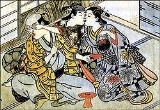
Japan, all exhibit patterns of analogous bisexual behavior. In Japan in particular, due to its practice of
shudo and the extensive art and literature associated with it, the record of a primarily bisexual lifestyle is both detailed and quite recent, dating back as recently as the
19th century.
Perhaps the most famous example is
Alexander the Great who had many wives, but was asserted by later writers to have had at least two male lovers; one of them,
Hephaestion, was his life-long friend. Bisexual behaviour was also common among Roman and Chinese emperors, the shoguns of Japan, and others.
Nevertheless, it should be noted that the terms
heterosexual,
bisexual,
homosexual, and the concept of "sexual orientation" itself are all modern sociological constructs, and may not be appropriate in historical contexts, in which
behavior might be considered homosexual, but
people were not labeled using such terms.
Ancient Greece
Ancestral law in ancient
Sparta mandated same-sex relationships with youths who were coming of age for all adult men, so long as the men eventually took wives and produced children. The Spartans thought that love and erotic relationships between experienced and novice soldiers would solidify combat loyalty and encourage heroic tactics as men vied to impress their lovers. Once the younger soldiers reached maturity, the relationship was supposed to become non-sexual, but it is not clear how strictly this was followed. There was some stigma attached to young men who continued their relationships with their mentors into adulthood. However through out most of the ancient Greek world, in Athens for example, the progression of a relationship between an older man and one of a significant younger age into a sexual relationship was severely looked down upon in society. The relationship was seen as the older man taking advantage of the younger man, and this was not encouraged.
Greek religious texts, reflecting cultural practices, incorporated bisexual themes. The subtexts varied, from the mystical to the didactic. See
Mythology of same-sex love.
Middle East and Central Asia
Islamic countries developed a culture in which love ' was held to be an absolute good, regardless of the gender of the object of affection, though irreligious behavior was condemned. Men's attraction to beautiful youths was widely understood to be normal and universal in Islamic cultures For example, the Hanbalite jurist Ibn al-Jawzi is reputed to have said that "He who claims that he experiences no desire when looking at beautiful boys or youths is a liar, and if we could believe him he would be an animal, and not a human being."
Some religious texts warn men to avoid falling for this temptation, held to be stronger than attraction to women. Other
religious texts, not uncontroversially, teach that gazing upon the beauty of boys is a path to communing with god. Poets and artists routinely depicted the love of boys, consummated or not, from the
medieval times until the early twentieth century. Among these were the poets
Abu Nuwas,
Hafez, and
Omar Khayyam, and painters such as the
Persian Reza Abbasi. The
Qur'anic prohibition against
liwat was flouted by some and circumvented by others who indulged in such relationships but stopped short of intercourse. Men convicted of
liwat, as well as their partners, could be and were upon occasion executed.
The Qur'an however requires that the transgression be witnessed by four men or eight women in order to convict the participants. Therefore, men are not given much trouble about these behaviors as it cannot be easily proved, so as long as they marry and raise families and fulfill other societal duties, they can easily "blend" in society. Such practices are claimed to be less common than in the past and have become covert, as a result of exposure to Western Victorian morality starting in the eighteen hundreds. An open declaration of homosexual preference in the Western egalitarian style would be unacceptable.
In most parts of South East Asia, bisexuality became a trend specially with adolescents. They encounter such change in sexual preference since they are very much curious about their sexual orientation and their exposure to wide range of media.
Bisexuality in animals
- See: Non-human animal sexuality
Many non-human animal species also exhibit bisexual behavior. This is, of course, common in
hermaphroditic animals, but is also known in many other species. Examples of mammals include the
bonobo Chimpanzee,
orca, and
bottlenose dolphin. Examples of avians include some species of gulls and Humboldt penguins. Biological examples are predominate in fish, flatworms, and crustaceans. Bisexuality has been observed in over 500 species.
Bisexuality in modern Western entertainment
Comparatively positive and notable portrayals of bisexuality can be found throughout mainstream media.
In movies such as:
Goldfish Memory;
The Rocky Horror Picture Show is a science fiction [i]-comedy [i]-horror [i] musical [i] ...
; and
Henry and June.
In popular music, many of the songs of
The Smiths are commonly cited as classic examples.
In notable
graphic novels,
Love & Rockets subtly portrays bisexuality.
Krazy Kat is a comic strip [i] created by George Herriman [i] that appeared in U.S. ...
is an early comic-strip character whose loves are not limited by gender.
Notable novels containing significant bisexual characters are:
- Sean David Wright's Two for One--a novel about having choices
- Anne Rice's Cry to Heaven
- Rosamond Lehmann's Dusty Answer
- Mary Renault's The Last of the Wine and The Persian Boy
- Colette's Claudine novels
- David Leavitt's The Lost Language of Cranes and While England Sleeps
- Jeanette Winterson
...
's
The Passion- Marge Piercy's Woman on the Edge of Time
- Alice Walker's The Color Purple is a 1982 [i] novel [i] by Alice Walker [i] which received the 1983 [i] Pulitzer Prize for Fiction [i] ...
- Jane Rule's Young in One Another's Arms
- Gregory Maguire's Wicked and its sequel, Son of a Witch is a sequel to ', and the fifth revisionist [i]...
- Sylvia Brownrigg's The Metaphysical Touch
- Robert Sawyer's Neanderthal Parallax
Non-fiction scholarship, such as Marjorie Garber's
Vice Versa: Bisexuality and the Eroticism of Everyday Life ,
Camille Paglia's
Sexual Personae and Louis Crompton's
Byron and Greek Love , has uncovered previously hidden histories of bisexuality.
On the TV
sitcom Will & Grace was a popular Emmy Award [i]-winning American [i] television situation comedy [i]...
, the character of Karen Walker is described as "omnisexual" and -- although married to a man -- often kisses Grace and appears to have had many female lovers throughout her life. The blatantly
ambisexual character
Jack Harkness of
Doctor Who is a long-running British [i] science fiction television [i] ...
and
Torchwood is a British [i] television science fiction [i] ...
is often described as "omnisexual" by his fans.
Rebecca Romijn-Stamos portrayed a bisexual con artist in the film
Femme Fatale is a stock character [i], usually a villain [i]ous woman [i], who deceptively mislead ...
.
In the broadway play turned movie,
RENT,
Idina Menzel plays Maureen Johnson, a character who has a relationship with both Mark Cohen and Joanne Jefferson .
There are also negative media portrayals - references sometimes made to stereotypes or mental disorders.
The television show
Friends was a long-running and widely acclaimed situation comedy [i] about a group of six friends in ...
sported a short song about the topic that expresses a common prejudice on the subject:
On the HBO drama
Oz,
Christopher Meloni played
Chris Keller, a bisexual sociopath who tortured, raped, and had numerous sexual encounters with various men and women whom he met.
A
Saturday Night Live is a weekly late night 90-minute American [i] comedy [i]-variety show [i] ...
joke ran thus:
- "A bisexual is a person who reaches down the front of somebody's pants and is satisfied with whatever they find." -- Dana Carvey as the church lady, Saturday Night Live.
Movies in which the bisexual characters conceal murderous neuroses include
Basic Instinct is an American [i] erotic [i] mystery film [i] directed [i] ...
,
Black Widow,
Blue Velvet is a 1986 [i] thriller [i] mystery [i] film [i] directed an ...
,
Cruising,
Girl Interrupted is an Academy Award [i]-winning film adapted by the memoir by Susanna Kaysen [i]. ...
.
In one of his comedy routines,
George Carlin admits to thinking about what a curse bisexuality must be: "Could you imagine wanting to fuck everybody you meet? Think of all the phone numbers you'd accumulate! You might as well just walk around with the White Pages under your arms."
See also
- Homophobia
- Biphobia
- List of bisexual people
- List of gay, lesbian or bisexual people
- List of LGBT-related organizations
- Media portrayal of bisexuality
- Bisexual chic
- Pansexuality
- Bisexual pornographic movie
References
;General
- Garrett Jones Coming Clean about Bisexuality, 2000.
- Louis Crompton. Homosexuality and Civilization, Cambridge, Mass. and London, 2003. ISBN 0-674-01197-X
- Michel Larivière. Homosexuels et bisexuels célèbres, Delétraz Editions, 1997. ISBN 2-911110-19-6
;Ancient Greece
- Kenneth J. Dover. Greek Homosexuality, New York; Vintage Books, 1978. ISBN 0-394-74224-9
- Thomas K. Hubbard. Homosexuality in Greece and Rome, U. of California Press, 2003. ISBN 0-520-23430-8
- Herald Patzer. Die Griechische Knabenliebe [Greek Pederasty], Wiesbaden: Franz Steiner Verlag, 1982. In: Sitzungsberichte der Wissenschaftlichen Gesellschaft an der Johann Wolfgang Goethe-Universität Frankfurt am Main, Vol. 19 No. 1.
- W. A. Percy III. Pederasty and Pedagogy in Archaic Greece, University of Illinois Press, 1996. ISBN 0-252-02209-2
;By country
- Stephen O. Murray and Will Roscoe, et al. Islamic Homosexualities: Culture, History, and Literature, New York: New York University Press, 1997. ISBN 0-8147-7468-7
- J. Wright & Everett Rowson. Homoeroticism in Classical Arabic Literature. 1998.
- Gary Leupp. Male Colors: The Construction of Homosexuality in Tokugawa Japan, Berkeley, University of California Press, 1995. ISBN 0-520-20900-1
- Tsuneo Watanabe & Jun'ichi Iwata. The Love of the Samurai. A Thousand Years of Japanese Homosexuality, London: GMP Publishers, 1987. ISBN 0-85449-115-5
;Modern Western
- Bi Any Other Name : Bisexual People Speak Out by Loraine Hutchins, Editor & Lani Ka'ahumanu, Editor ISBN 1-55583-174-5
- Getting Bi : Voices of Bisexuals Around the World by Robyn Ochs, Editor & Sarah Rowley, Editor ISBN 0-9653881-4-X
- The Bisexual Option by Fritz Klein, MD ISBN 1-56023-033-9
- Bi America : Myths, Truths, And Struggles Of An Invisible Community by William E. Burleson ISBN-13: 978-1-56023-478-4
- Bisexuality in the United States : A Social Science Reader by Paula C. Rodriguez Rust, Editor ISBN 0-231-10226-7
- Bisexuality : The Psychology and Politics of an Invisible Minority by Beth A. Firestein, Editor ISBN 0-8039-7274-1
- Current Research on Bisexuality by Ronald C. Fox PhD, Editor ISBN-13: 978-1-56023-288-5
- . . Report on the problems caused by stereotyping of bisexuals.
;Film
- Bryant, Wayne M.. Bisexual Characters in Film: From Anais to Zee. Haworth Gay & Lesbian Studies, 1997. ISBN 1-56023-894-1
External links
Notes