


Lesbian

Encyclopedia
Homosexuality
Homosexuality is romantic or sexual attraction or behavior between members of the same sex or gender. As a sexual orientation, homosexuality refers to "an enduring pattern of or disposition to experience sexual, affectional, or romantic attractions" primarily or exclusively to people of the same...
, or as an adjective, to describe characteristics of an object or activity related to female same-sex desire.
Lesbian as a concept, used to differentiate women with a shared sexual orientation
Sexual orientation
Sexual orientation describes a pattern of emotional, romantic, or sexual attractions to the opposite sex, the same sex, both, or neither, and the genders that accompany them. By the convention of organized researchers, these attractions are subsumed under heterosexuality, homosexuality,...
, is a 20th-century construct. Throughout history, women have not had the freedom or independence to pursue homosexual relationships as men have, but neither have they met the harsh punishment in some societies as homosexual men. Instead, lesbian relationships have often been regarded as harmless and incomparable to heterosexual ones unless the participants attempted to assert privileges traditionally enjoyed by men. As a result, little in history has been documented to give an accurate description of how female homosexuality has been expressed. When early sexologists in the late 19th century began to categorize and describe homosexual behavior, hampered by a lack of knowledge about lesbianism or women's sexuality, they distinguished lesbians as women who did not adhere to female gender roles and designated them mentally ill.
Women in homosexual relationships responded to this designation either by hiding their personal lives or accepting the label of outcast and creating a subculture and identity
Identity (social science)
Identity is a term used to describe a person's conception and expression of their individuality or group affiliations . The term is used more specifically in psychology and sociology, and is given a great deal of attention in social psychology...
that developed in Europe and the United States. Following World War II, during a period of social repression when governments actively persecuted homosexuals, women developed networks to socialize with and educate each other. Greater economic and social freedom allowed women gradually to be able to determine how they could form relationships and families. With second wave feminism and growth of scholarship in women's history and sexuality in the 20th century, the definition of lesbian broadened, sparking a debate about sexual desire as the major component to define what a lesbian is. Women generally exhibit greater sexual fluidity than men and find it easier to become physically and emotionally intimate with other women. Some women who engage in homosexual behavior may reject the lesbian identity entirely, refusing to identify themselves as lesbian or bisexual. Other women may adopt a lesbian identity for political reasons. Greater understanding of women's sexuality has led to three components to identifying lesbians: sexual behavior, sexual desire, or sexual identity.
Portrayals of lesbians in the media suggest that Western society at large has been simultaneously intrigued and threatened by women who challenge feminine gender roles, and fascinated and appalled with women who are romantically involved with other women. Women who adopt a lesbian identity share experiences that form an outlook similar to an ethnic identity: as homosexuals, they are unified by the discrimination and potential rejection they face from their families, friends, and others. As women, they face concerns separate from men. Lesbians may encounter distinct physical or mental health concerns. Political conditions and social attitudes also affect the formation of lesbian relationships and families.
Origin and transformation of the term
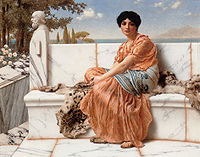
Sappho
Sappho was an Ancient Greek poet, born on the island of Lesbos. Later Greeks included her in the list of nine lyric poets. Her birth was sometime between 630 and 612 BC, and it is said that she died around 570 BC, but little is known for certain about her life...
. From various ancient writings, historians have gathered that a group of young women were left in Sappho's charge for their instruction or cultural edification. Not much of Sappho's poetry remains, but that which does reflects the topics she wrote about: women's daily lives, their relationships, and rituals. She focused on the beauty of women and proclaimed her love for girls. Before the late 19th century, the word "Lesbian" referred to any derivative or aspect of Lesbos, including a type of wine
Lesbian wine
Lesbian wine is wine made on the Greek island of Lesbos in the Aegean Sea. The island has a long history of winemaking dating back to at least the 7th century BC when it was mentioned in the works of Homer. During this time the area competed with the wines of Chios for the Greek market...
.An attempt by natives of the island of Lesbos (called Mytilene in Greece) in 2008 to reclaim the word to refer only to people from Lesbos was unsuccessful in a Greek court. Inhabitants of Lesbos claimed the use of "lesbian" to refer to female homosexuality violated their human rights and "disgrace[d] them around the world". (Lesbos locals lose lesbian appeal, BBC News Europe [July 22, 2008]. Retrieved on February 3, 2009.)
In 1890 the term was used in a medical dictionary as an adjective to describe tribadism
Tribadism
Tribadism or tribbing, commonly known by its scissoring position, is a form of non-penetrative sex in which a woman rubs her vulva against her partner's body for sexual stimulation. This may involve female-to-female genital contact or a female rubbing her vulva against her partner's thigh, stomach,...
(as "Lesbian love"): sexual gratification of two women by simulating intercourse. "Lesbianism" to describe erotic relationships between women had been documented in 1870. The terms were interchangeable with "Sapphist" and "Sapphism" around the turn of the 20th century. The use of "Lesbian" in medical literature became prominent; by 1925 the word was recorded as a noun to mean the female equivalent of a sodomite
Sodomy
Sodomy is an anal or other copulation-like act, especially between male persons or between a man and animal, and one who practices sodomy is a "sodomite"...
.

Sexual inversion (sexology)
Sexual inversion is a term used by sexologists, primarily in the late 19th and early 20th century, to refer to homosexuality. Sexual inversion was believed to be an inborn reversal of gender traits: male inverts were, to a greater or lesser degree, inclined to traditionally female pursuits and...
" by German sexologist Magnus Hirschfeld
Magnus Hirschfeld
Magnus Hirschfeld was a German physician and sexologist. An outspoken advocate for sexual minorities, Hirschfeld founded the Scientific Humanitarian Committee, which Dustin Goltz called "the first advocacy for homosexual and transgender rights."-Early life:Hirschfeld was born in Kolberg in a...
, researchers determined what was normal sexual behavior for men and women, and therefore to what extent men and women varied from the "perfect male sexual type" and the "perfect female sexual type". Far less literature focused on female homosexual behavior than on male homosexuality, as medical professionals did not consider it a significant problem. In some cases it was not acknowledged to exist. However, sexologists Richard von Krafft-Ebbing from Germany, and Britain's Havelock Ellis
Havelock Ellis
Henry Havelock Ellis, known as Havelock Ellis , was a British physician and psychologist, writer, and social reformer who studied human sexuality. He was co-author of the first medical textbook in English on homosexuality in 1897, and also published works on a variety of sexual practices and...
wrote some of the earliest and more enduring categorizations of female same-sex attraction, approaching it as a form of insanity. Krafft-Ebbing, who considered lesbianism (what he termed "Uranism
Uranian
frame|right|From [[John Addington Symonds]]' 1891 book A Problem in Modern Ethics.Uranian is a 19th century term that referred to a person of a third sex — originally, someone with "a female psyche in a male body" who is sexually attracted to men, and later extended to cover homosexual gender...
") a neurological disease, and Ellis, who was influenced by Krafft-Ebbing's writings, disagreed about whether sexual inversion was generally a lifelong condition. Ellis believed that many women who professed love for other women changed their feelings about such relationships after they had experienced marriage and a "practical life".
However, Ellis conceded that there were "true inverts" who would spend their lives pursuing erotic relationships with women. These were members of the "third sex
Third gender
The terms third gender and third sex describe individuals who are categorized as neither man nor woman, as well as the social category present in those societies who recognize three or more genders...
" who rejected the roles of women to be subservient, feminine, and domestic. "Invert" described the opposite gender roles and the related attraction to women instead of men; since women in the Victorian period were considered unable to initiate sexual encounters, women who did so with other women were thought of as possessing masculine sexual desires. The work of Krafft-Ebbing and Ellis was widely read, and helped to create public consciousness of female homosexuality.In Germany between 1898 and 1908 over a thousand articles were published regarding the topic of homosexuality. (Faderman [1981], p. 248) Between 1896 and 1916, 566 articles on women's "perversions" were published in the United States. (Faderman, [1991], p. 49.) The sexologists' claims that homosexuality was a congenital anomaly were generally well-accepted by homosexual men; it indicated that their behavior was not inspired by nor should be considered a criminal vice, as was widely acknowledged. In the absence of any other material to describe their emotions, homosexuals accepted the designation of different or perverted, and used their outlaw status to form social circles in Paris and Berlin. "Lesbian" began to describe elements of a subculture.
Identity and gender

Identity (social science)
Identity is a term used to describe a person's conception and expression of their individuality or group affiliations . The term is used more specifically in psychology and sociology, and is given a great deal of attention in social psychology...
that defines their individual sexuality, as well as their membership to a group that shares common traits. Women in many cultures throughout history have had sexual relations with other women, but they rarely were designated as part of a group of people based on who they had physical relations with. As women have generally been political minorities in Western cultures, the added medical designation of homosexuality has been cause for the development of a subcultural identity.
Construction of lesbian identity
For some women, the realization that they participated in behavior or relationships that could be categorized as lesbian caused them to deny or conceal it, such as professor Jeannette Marks at Mount Holyoke CollegeMount Holyoke College
Mount Holyoke College is a liberal arts college for women in South Hadley, Massachusetts. It was the first member of the Seven Sisters colleges, and served as a model for some of the others...
, who lived with the college president, Mary Woolley
Mary Emma Woolley
Mary Emma Woolley was an American educator, peace activist and women's suffrage supporter. She was the first female student to attend Brown University and served as the 11th President of Mount Holyoke College from 1900-1937....
, for 36 years. Marks discouraged young women from "abnormal" friendships and insisted happiness could only be attained with a man.Other historical figures rejected being labeled as lesbians despite their behavior: Djuna Barnes
Djuna Barnes
Djuna Barnes was an American writer who played an important part in the development of 20th century English language modernist writing and was one of the key figures in 1920s and '30s bohemian Paris after filling a similar role in the Greenwich Village of the teens...
, author of Nightwood
Nightwood
Nightwood is a 1936 novel by Djuna Barnes first published in London by Faber and Faber. An edition published in the United States in 1937 by Harcourt, Brace included an introduction by T. S. Eliot.....
, a novel about an affair Barnes had with Thelma Wood, earned the label "lesbian writer", which she protested by saying, "I am not a lesbian. I just loved Thelma." Virginia Woolf
Virginia Woolf
Adeline Virginia Woolf was an English author, essayist, publisher, and writer of short stories, regarded as one of the foremost modernist literary figures of the twentieth century....
, who modeled the hero/ine in Orlando on Vita Sackville-West
Vita Sackville-West
The Hon Victoria Mary Sackville-West, Lady Nicolson, CH , best known as Vita Sackville-West, was an English author, poet and gardener. She won the Hawthornden Prize in 1927 and 1933...
, with whom she was having an affair, set herself apart from women who pursued relationships with other women by writing, "These Sapphists love women; friendship is never untinged with amorosity." (Castle, p. 4–5.) Other women, however, embraced the distinction and used their uniqueness to set themselves apart from heterosexual women and gay men. From the 1890s to the 1930s American heiress Natalie Clifford Barney
Natalie Clifford Barney
Natalie Clifford Barney was an American playwright, poet and novelist who lived as an expatriate in Paris....
held a weekly salon in Paris to which major artistic celebrities were invited and where lesbian topics were the focus. Combining Greek influences with contemporary French eroticism, she attempted to create an updated and idealized version of Lesbos in her salon. Her contemporaries included artist Romaine Brooks
Romaine Brooks
Romaine Brooks, born Beatrice Romaine Goddard , was an American painter who worked mostly in Paris and Capri. She specialized in portraiture and used a subdued palette dominated by the color gray...
, who painted others in her circle; writers Colette
Colette
Colette was the surname of the French novelist and performer Sidonie-Gabrielle Colette . She is best known for her novel Gigi, upon which Lerner and Loewe based the stage and film musical comedies of the same title.-Early life and marriage:Colette was born to retired military officer Jules-Joseph...
, Djuna Barnes
Djuna Barnes
Djuna Barnes was an American writer who played an important part in the development of 20th century English language modernist writing and was one of the key figures in 1920s and '30s bohemian Paris after filling a similar role in the Greenwich Village of the teens...
, social host Gertrude Stein
Gertrude Stein
Gertrude Stein was an American writer, poet and art collector who spent most of her life in France.-Early life:...
, and novelist Radclyffe Hall
Radclyffe Hall
Radclyffe Hall was an English poet and author, best known for the lesbian classic The Well of Loneliness.- Life :...
.
Berlin had a vibrant homosexual culture in the 1920s: about 50 clubs catering to lesbians existed, women had their own magazine titled Die Freundin (The Girlfriend) between 1924 and 1933, and another titled Garçonne specifically for male transvestites and lesbians. In 1928 a book titled The Lesbians of Berlin written by Ruth Margarite Röllig further popularized the German capital as a center of lesbian activity. Clubs varied between large establishments so popular that they were tourist attractions to small neighborhood cafes where only local women went to find other women. "Das Lila Lied
Das Lila Lied
The Lavender Song is a cabaret song written in 1920 with lyrics by Kurt Schwabach and music by Mischa Spoliansky in Germany and is considered one of the first gay anthems.-History:...
" ("The Lavender Song") served as an anthem to the lesbians of Berlin. Homosexuality was illegal in Germany, though sometimes tolerated, as some functions were allowed by the police who took the opportunity to register the names of homosexuals for future reference. Magnus Hirschfeld's Scientific-Humanitarian Committee
Scientific-Humanitarian Committee
The Scientific-Humanitarian Committee was founded in Berlin on the 14th or 15 May, 1897, to campaign for social recognition of homosexual, bisexual and transgender men and women, and against their legal persecution...
, which promoted tolerance for homosexuals in Germany, welcomed lesbian participation, and a surge of lesbian-themed writing and political activism in the German feminist movement became evident.

The Well of Loneliness
The Well of Loneliness is a 1928 lesbian novel by the British author Radclyffe Hall. It follows the life of Stephen Gordon, an Englishwoman from an upper-class family whose "sexual inversion" is apparent from an early age...
. Its plot centers around Stephen Gordon, a woman who identifies herself as an invert after reading Krafft-Ebbing's Psychopathia Sexualis, and lives within the homosexual subculture of Paris. The novel included a foreword by Havelock Ellis and was intended to be a call for tolerance for inverts by publicizing their disadvantages and accidents of being born inverted. Hall subscribed to Ellis and Krafft-Ebbing's theories and rejected Freud's theory that same-sex attraction
Same-sex attraction
Same-sex attraction is a term occasionally used instead of the more common term homosexuality to refer to a person's feelings of sexual attraction toward members of the same gender identity....
was caused by childhood trauma and was curable. The publicity Hall received was due to unintended consequences; the novel was tried for obscenity
Obscenity
An obscenity is any statement or act which strongly offends the prevalent morality of the time, is a profanity, or is otherwise taboo, indecent, abhorrent, or disgusting, or is especially inauspicious...
in London, a spectacularly scandalous event described as "the crystallizing moment in the construction of a visible modern English lesbian subculture" by professor Laura Doan. Newspaper stories frankly divulged that the book's content includes "sexual relations between Lesbian women", and photographs of Hall often accompanied details about lesbians in most major print outlets within a span of six months. Hall reflected the appearance of a "mannish" woman in the 1920s: short cropped hair
Bob cut
A "bob cut" is a short haircut for women in which the hair is typically cut straight around the head at about jaw-level, often with a fringe at the front.-The beginning:...
, tailored suits (often with pants), and monocle
Monocle
A monocle is a type of corrective lens used to correct or enhance the vision in only one eye. It consists of a circular lens, generally with a wire ring around the circumference that can be attached to a string. The other end of the string is then connected to the wearer's clothing to avoid losing...
that became widely recognized as a "uniform". When British women participated in World War I, they became familiar with masculine clothing, and were considered patriotic for wearing uniforms and pants. However, postwar masculinization of women's clothing became associated with lesbians.
Sigmund Freud
Sigmund Freud , born Sigismund Schlomo Freud , was an Austrian neurologist who founded the discipline of psychoanalysis...
, who theorized that sexual desire would be sated unconsciously, despite an individual's wish to ignore it. Freud's theories were much more pervasive in the U.S. than in Europe. With the well-publicized notion that sexual acts were a part of lesbianism and their relationships, sexual experimentation was widespread. Large cities that provided a nightlife were immensely popular, and women began to seek out sexual adventure. Bisexuality became chic, particularly in America's first gay neighborhoods. No location saw more visitors for its possibilities of homosexual nightlife than Harlem
Harlem
Harlem is a neighborhood in the New York City borough of Manhattan, which since the 1920s has been a major African-American residential, cultural and business center. Originally a Dutch village, formally organized in 1658, it is named after the city of Haarlem in the Netherlands...
, the predominantly African American section of New York City. White "slummers" enjoyed jazz
Jazz
Jazz is a musical style that originated at the beginning of the 20th century in African American communities in the Southern United States. It was born out of a mix of African and European music traditions. From its early development until the present, jazz has incorporated music from 19th and 20th...
, nightclubs, and anything else they wished. Blues
Blues
Blues is the name given to both a musical form and a music genre that originated in African-American communities of primarily the "Deep South" of the United States at the end of the 19th century from spirituals, work songs, field hollers, shouts and chants, and rhymed simple narrative ballads...
singers Ma Rainey
Ma Rainey
Ma Rainey was one of the earliest known American professional blues singers and one of the first generation of such singers to record. She was billed as The Mother of the Blues....
, Bessie Smith
Bessie Smith
Bessie Smith was an American blues singer.Sometimes referred to as The Empress of the Blues, Smith was the most popular female blues singer of the 1920s and 1930s...
, Ethel Waters
Ethel Waters
Ethel Waters was an American blues, jazz and gospel vocalist and actress. She frequently performed jazz, big band, and pop music, on the Broadway stage and in concerts, although she began her career in the 1920s singing blues.Her best-known recordings includes, "Dinah", "Birmingham Bertha",...
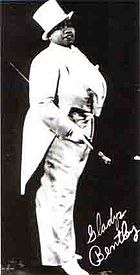
, and Gladys Bentley
Gladys Bentley
Gladys Bentley was an American blues singer during the Harlem Renaissance.-Biography:Bentley was born in Philadelphia, Pennsylvania, the daughter of American George L. Bentley and his wife, a Trinidadian, Mary Mote...
sang about affairs with women to visitors such as Tallulah Bankhead
Tallulah Bankhead
Tallulah Brockman Bankhead was an award-winning American actress of the stage and screen, talk-show host, and bonne vivante...
, Beatrice Lillie
Beatrice Lillie
Beatrice Gladys "Bea" Lillie was an actress and comedic performer. Following her 1920 marriage to Sir Robert Peel in England, she was known in private life as Lady Peel.-Early career:...
, and the soon-to-be-named Joan Crawford
Joan Crawford
Joan Crawford , born Lucille Fay LeSueur, was an American actress in film, television and theatre....
. Homosexuals began to draw comparisons between their newly recognized minority status and that of African Americans. Among African American residents of Harlem, lesbian relationships were common and tolerated, though not overtly embraced. Some women staged lavish wedding ceremonies, even filing licenses using masculine names with New York City. Most women, however, were married to men and participated in affairs with women regularly; bisexuality was more widely accepted than lesbianism.
Across town, Greenwich Village
Greenwich Village
Greenwich Village, , , , .in New York often simply called "the Village", is a largely residential neighborhood on the west side of Lower Manhattan in New York City. A large majority of the district is home to upper middle class families...
also saw a growing homosexual community; both Harlem and Greenwich Village provided furnished rooms for single men and women, which was a major factor in their development as centers for homosexual communities. The tenor was different in Greenwich Village than Harlem, however. Bohemians
Bohemianism
Bohemianism is the practice of an unconventional lifestyle, often in the company of like-minded people, with few permanent ties, involving musical, artistic or literary pursuits...
—intellectuals who rejected Victorian ideals—gathered in the Village. Homosexuals were predominantly male, although figures such as poet Edna St. Vincent Millay
Edna St. Vincent Millay
Edna St. Vincent Millay was an American lyrical poet, playwright and feminist. She received the Pulitzer Prize for Poetry, and was known for her activism and her many love affairs. She used the pseudonym Nancy Boyd for her prose work...
and social host Mabel Dodge were known for their affairs with women and promotion of tolerance of homosexuality. Women in the U.S. who could not visit Harlem or live in Greenwich Village for the first time were able to visit saloons in the 1920s without being considered prostitutes. The existence of a public space for women to socialize in bars that were known to cater to lesbians "became the single most important public manifestation of the subculture for many decades", according to historian Lillian Faderman
Lillian Faderman
Lillian Faderman is a scholar whose books on lesbian relationships and romantic friendship in history have earned critical praise and awards. Faderman is a professor of English at California State University in Fresno, California.-Early life:...
.
Great Depression
The primary component necessary to encourage lesbians to be public and seek other women was economic independence, which virtually disappeared in the 1930s with the Great DepressionGreat Depression
The Great Depression was a severe worldwide economic depression in the decade preceding World War II. The timing of the Great Depression varied across nations, but in most countries it started in about 1929 and lasted until the late 1930s or early 1940s...
. Most women in the U.S. found it necessary to marry, to a "front" such as a gay man where both could pursue homosexual relationships with public discretion, or to a man who expected a traditional wife. Independent women in the 1930s were generally seen as holding jobs that men should have. The social attitude made very small and close-knit communities in large cities that centered around bars, while simultaneously isolating women in other locales. Speaking of homosexuality in any context was socially forbidden, and women rarely discussed lesbianism even amongst themselves; they referred to openly gay people as "in the Life".Historian Vern Bullough
Vern Bullough
Vern Leroy Bullough was an American historian and sexologist.He was a distinguished professor emeritus at the State University of New York , an Outstanding Professor in the California State University, a past president of the Society for the Scientific Study of Sexuality, past Dean of natural and...
published a paper based on an unfinished study of mental and physical traits performed by a lesbian in Salt Lake City during the 1920s and 1930s. The compiler of the study reported on 23 of her colleagues, indicating there was an underground lesbian community in the conservative city. Bullough remarked that the information was being used to support the attitude that lesbians were not abnormal or maladjusted, but it also reflected that women included in the study strove in every way to conform to social gender expectations, viewing anyone who pushed the boundaries of respectability with hostility. Bullough wrote, "In fact, their very success in disguising their sexual orientation to the outside world leads us to hypothesize that lesbianism in the past was more prevalent than the sources might indicate, since society was so unsuspecting." (Bullough, Vern; Bullough, Bonnie [Summer 1977]. "Lesbianism in the 1920s and 1930s: A Newfound Study", Signs, p. 895–904.) Freudian psychoanalytic theory was pervasive in influencing doctors to consider homosexuality as a neurosis afflicting immature women. Homosexual subculture disappeared in Germany with the rise of the Nazis in 1933.
World War II

Women's Army Corps
The Women's Army Corps was the women's branch of the US Army. It was created as an auxiliary unit, the Women's Army Auxiliary Corps on 15 May 1942 by Public Law 554, and converted to full status as the WAC in 1943...
(WACs) and U.S. Navy's Women Accepted for Volunteer Emergency Service (WAVES). Unlike processes to screen out male homosexuals, which had been in place since the creation of the American military, there were no methods to identify or screen for lesbians; they were put into place gradually during World War II. Despite common attitudes regarding women's traditional roles in the 1930s, independent and masculine women were directly recruited by the military in the 1940s, and frailty discouraged. Some women were able to arrive at the recruiting station in a man's suit, deny ever having been in love with another woman, and be easily inducted. Sexual activity, however, was forbidden, and blue discharge
Blue discharge
A blue discharge was a form of administrative military discharge formerly issued by the United States beginning in 1916. It was neither honorable nor dishonorable. The blue ticket became the discharge of choice for commanders seeking to remove homosexual service members from the ranks...
was almost certain if one identified oneself as a lesbian. As women found each other, they formed into tight groups on base, socialized at service clubs, and began to use code words. Historian Allan Bérubé
Allan Berube
Allan Ronald Bérubé was an American historian, activist, independent scholar, self-described "community-based" researcher and college drop-out, and award-winning author, best known for his research and writing about homosexual members of the American Armed Forces during World War II...
documented that homosexuals in the armed forces either consciously or subconsciously refused to identify themselves as homosexual or lesbian, and also never spoke about others' orientation.
The most masculine women were not necessarily common, though they were visible so they tended to attract women interested in finding other lesbians. Women had to broach the subject about their interest in other women carefully, sometimes taking days to develop a common understanding without asking or stating anything outright. Women who did not enter the military were aggressively called upon to take industrial jobs left by men, in order to continue national productivity. The increased mobility, sophistication, and independence of many women during and after the war made it possible for women to live without husbands, something that would not have been feasible under different economic and social circumstances, further shaping lesbian networks and environments.
Postwar years
Communism
Communism is a social, political and economic ideology that aims at the establishment of a classless, moneyless, revolutionary and stateless socialist society structured upon common ownership of the means of production...
and psychoanalytic theory that had become pervasive in medical knowledge, homosexuality became an undesired characteristic of employees working for the U.S. government in 1950. Homosexuals were thought to be vulnerable targets to blackmail
Blackmail
In common usage, blackmail is a crime involving threats to reveal substantially true or false information about a person to the public, a family member, or associates unless a demand is met. It may be defined as coercion involving threats of physical harm, threat of criminal prosecution, or threats...
, and the government purged its employment ranks of open homosexuals, beginning a widespread effort to gather intelligence about employees' private lives. State and local governments followed suit, arresting people for congregating in bars and parks, and enacting laws against cross-dressing
Cross-dressing
Cross-dressing is the wearing of clothing and other accoutrement commonly associated with a gender within a particular society that is seen as different than the one usually presented by the dresser...
for men and women. The U.S. military and government conducted many interrogations, asking if women had ever had sexual relations with another woman and essentially equating even a one-time experience to a criminal identity, thereby severely delineating heterosexuals from homosexuals. In 1952 homosexuality was listed as a pathological emotional disturbance in the American Psychiatric Association
American Psychiatric Association
The American Psychiatric Association is the main professional organization of psychiatrists and trainee psychiatrists in the United States, and the most influential worldwide. Its some 38,000 members are mainly American but some are international...
's Diagnostic and Statistical Manual. The view that homosexuality was a curable sickness was widely believed in the medical community, general population, and among many lesbians themselves. Attitudes and practices to ferret out homosexuals in public service positions extended to Australia and Canada; lesbianism had been outlawed in the United Kingdom in 1921.
Very little information was available about homosexuality beyond medical and psychiatric texts. Community meeting places consisted of bars that were commonly raided by police once a month on average, with those arrested exposed in newspapers. In response, eight women in San Francisco met in their living rooms in 1955 to socialize and have a place to dance. When they decided to make it a regular meeting, they became the first organization for lesbians in the U.S., titled the Daughters of Bilitis
Daughters of Bilitis
The Daughters of Bilitis , was the first lesbian rights organization in the United States. It was formed in San Francisco in 1955, conceived as a social alternative to lesbian bars, which were considered illegal and thus subject to raids and police harassment...
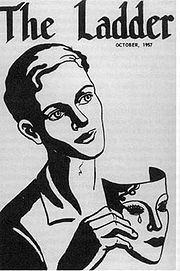
(DOB). The DOB began publishing a magazine titled The Ladder
The Ladder (magazine)
The Ladder was the first nationally distributed lesbian publication in the United States. It was published monthly from 1956 to 1970, and once every other month in 1971 and 1972. It was the primary publication and method of communication for the Daughters of Bilitis, the first lesbian organization...
in 1956; inside the front cover of every issue was their mission statement, the first of which stated was "Education of the variant". It was intended to provide women with knowledge about homosexuality—specifically relating to women, and famous lesbians in history. However, by 1956 the term "lesbian" had such a negative meaning that the DOB refused to use it as a descriptor, choosing "variant" instead. The DOB spread to Chicago, New York, and Los Angeles, and The Ladder was mailed to hundreds—eventually thousands—of DOB members discussing the nature of homosexuality, sometimes challenging the idea that it was a sickness, with readers offering their own reasons why they were lesbians, and suggesting ways to cope with the condition or society's response to it. British lesbians followed with the publication of Arena Three
Arena Three (magazine)
Arena Three was a British monthly publication founded by Esme Langley and Diana Chapman in 1963. It was written by and for homosexual women and published by the Minorities Research Group from 1963 to 1972.-See also:* in * Lesbian feminism...
beginning in 1964, with a similar mission.

Butch and femme
Butch and femme are LGBT terms describing respectively, masculine and feminine traits, behavior, style, expression, self-perception and so on. They are often used in the lesbian, bisexual and gay subcultures...
es: dressed in men's clothing and mirroring traditional masculine behavior. Others wore traditionally feminine clothing and assumed a more diminutive role as femmes. Butch and femme modes of socialization were so integral within lesbian bars that women who refused to choose between the two would be ignored, or at least unable to date anyone, and butch women becoming romantically involved with other butch women or femmes with other femmes was unacceptable. Butch women were not a novelty in the 1950s; even in Harlem and Greenwich Village in the 1920s some women assumed these personae. In the 1950s and 1960s, however, the roles were pervasive and not limited to North America: from 1940 to 1970, butch/femme bar culture flourished in Britain, though there were fewer class distinctions. They further identified members of a group that had been marginalized; women who had been rejected by most of society had an inside view of an exclusive group of people that took a high amount of knowledge to function in. Butch and femme were considered coarse by American lesbians of higher social standing during this period. Many wealthier women married to satisfy their familial obligations, and others escaped to Europe to live as expatriates.
Regardless of the lack of information about homosexuality in scholarly texts, another forum for learning about lesbianism was growing. A paperback book titled Women's Barracks describing a woman's experiences in the Free French Forces
Free French Forces
The Free French Forces were French partisans in World War II who decided to continue fighting against the forces of the Axis powers after the surrender of France and subsequent German occupation and, in the case of Vichy France, collaboration with the Germans.-Definition:In many sources, Free...
was published in 1950. It told of a lesbian relationship the author had witnessed. After 4.5 million copies were sold, it was consequently named in the House Select Committee on Current Pornographic Materials
House Select Committee on Current Pornographic Materials
The House Select Committee on Current Pornographic Materials, commonly known as the Gathings Committee, was a select committee of the United States House of Representatives active in 1952 and 1953. Representative Ezekiel C. Gathings, Democrat from Arkansas, was its chairman, appointed by Speaker...
in 1952. Its publisher, Gold Medal Books
Gold Medal Books
Gold Medal Books, launched by Fawcett Publications in 1950, is a U.S. book publisher known for introducing paperback originals, a publishing innovation at the time. Fawcett was also an independent newsstand distributor, and in 1949 the company negotiated a contract with New American Library to...
, followed with the novel Spring Fire
Spring Fire
Spring Fire, is a 1952 paperback novel written by Marijane Meaker, under the pseudonym "Vin Packer". It is often considered to be the first lesbian pulp novel, although it also addresses issues of conformity in 1950s American society...
in 1952, which sold 1.5 million copies. Gold Medal Books was overwhelmed with mail from women writing about the subject matter, and followed with more books, creating the genre of lesbian pulp fiction
Lesbian pulp fiction
Lesbian pulp fiction refers to any mid-20th century paperback novel with overtly lesbian themes and content. Lesbian pulp fiction was published in the 1950s and 60s by many of the same paperback publishing houses that other genres of fiction including Westerns, Romances, and Detective Fiction...
. Between 1955 and 1969 over 2,000 books were published using lesbianism as a topic, and they were sold in corner drugstores, train stations, bus stops, and newsstands all over the U.S. and Canada. Most were written by, and almost all were marketed to heterosexual men. Coded words and images were used on the covers. Instead of "lesbian", terms such as "strange", "twilight", "queer", and "third sex", were used in the titles, and cover art was invariably salacious. A handful of lesbian pulp fiction authors were women writing for lesbians, including Ann Bannon
Ann Bannon
Ann Bannon is an American author who, from 1957 to 1962, wrote six lesbian pulp fiction novels known as The Beebo Brinker Chronicles. The books' enduring popularity and impact on lesbian identity has earned her the title "Queen of Lesbian Pulp Fiction"...
, Valerie Taylor, Paula Christian, and Vin Packer/Ann Aldrich. Bannon, who also purchased lesbian pulp fiction, later stated that women identified the material iconically by the cover art. Many of the books used cultural references: naming places, terms, describing modes of dress and other codes to isolated women. As a result, pulp fiction helped to proliferate a lesbian identity simultaneously to lesbians and heterosexual readers.
Second wave feminism
The social rigidity of the 1950s and early 1960s encountered a backlash as social movements to improve the standing of African Americans, the poor, women, and gays all became prominent. Of the latter two, the gay rights movement and the feminist movement connected after a violent confrontation occurred in New York City in the 1969 Stonewall riotsStonewall riots
The Stonewall riots were a series of spontaneous, violent demonstrations against a police raid that took place in the early morning hours of June 28, 1969, at the Stonewall Inn, in the Greenwich Village neighborhood of New York City...
. What followed was a movement characterized by a surge of gay activism and feminist consciousness that further transformed the definition of lesbian.
The sexual revolution
Sexual revolution
The sexual revolution was a social movement that challenged traditional codes of behavior related to sexuality and interpersonal relationships throughout the Western world from the 1960s into the 1980s...
in the 1970s introduced the differentiation between identity and sexual behavior for women. Many women took advantage of their new social freedom to try new experiences. Women who previously identified as heterosexual tried sleeping with women, though many maintained their heterosexual identity. However, with the advent of second wave feminism, lesbian as a political identity grew to describe a social philosophy among women, often overshadowing sexual desire as a defining trait. A militant feminist organization named Radicalesbians published a manifesto
Manifesto
A manifesto is a public declaration of principles and intentions, often political in nature. Manifestos relating to religious belief are generally referred to as creeds. Manifestos may also be life stance-related.-Etymology:...
in 1970 entitled "The Woman-Identified Woman
The Woman-Identified Woman
"The Woman-Identified Woman" was a ten-paragraph manifesto, written by the Radicalesbians in 1970. It was first distributed during the "Lavender Menace" protest at the Second Congress to Unite Women, on May 1, 1970 in New York City...
" that declared "A lesbian is the rage of all women condensed to the point of explosion".A similar statement appeared in a militant feminist pamphlet in Leeds, England, stating "Our definition of a political lesbian is a woman-identified woman who does not fuck men. It does not mean compulsory sexual activity with women." (Jennings, p. 177.) Militant feminists expressed their disdain with an inherently sexist and patriarchal society, and concluded the most effective way to overcome sexism and attain the equality of women would be to deny men any power or pleasure from women. For women who subscribed to this philosophy—dubbing themselves lesbian-feminists
Lesbian feminism
Lesbian feminism is a cultural movement and critical perspective, most popular in the 1970s and early 1980s , that questions the position of lesbians and women in society. It particularly refutes heteronormativity, the assumption that everyone is "straight" and society should be structured to serve...
—lesbian was a term chosen by women to describe any woman who dedicated her approach to social interaction and political motivation to the welfare of women. Sexual desire was not the defining characteristic of a lesbian-feminist, but rather her focus on politics. Independence from men as oppressors was a central tenet of lesbian-feminism, and many believers strove to separate themselves physically and economically from traditional male-centered culture. In the ideal society, named Lesbian Nation, "woman" and "lesbian" were interchangeable.
In 1980, poet and essayist Adrienne Rich
Adrienne Rich
Adrienne Cecile Rich is an American poet, essayist and feminist. She has been called "one of the most widely read and influential poets of the second half of the 20th century."-Early life:...
expanded upon the political meaning of lesbian by proposing a continuum of lesbian existence based on "woman-identified experience". All relationships between women, Rich proposed, have some lesbian element, regardless if they claim a lesbian identity: mothers and daughters, women who work together, and women who nurse each other, for example. Such a perception of women relating to each other connects them through time and across cultures, and Rich considered heterosexuality a condition forced upon women by men. Several years earlier, DOB founders Del Martin and Phyllis Lyon
Del Martin and Phyllis Lyon
Dorothy Louise Taliaferro "Del" Martin and Phyllis Ann Lyon were an American lesbian couple known as feminist and gay-rights activists...
similarly relegated sexual acts as unnecessary in determining what a lesbian is, by providing their definition: "a woman whose primary erotic, psychological, emotional and social interest is in a member of her own sex, even though that interest may not be overtly expressed".
Although lesbian-feminism was a significant shift, not all lesbians agreed with it. Lesbian-feminism was a youth-oriented movement: its members were primarily college educated, with experience in New Left
New Left
The New Left was a term used mainly in the United Kingdom and United States in reference to activists, educators, agitators and others in the 1960s and 1970s who sought to implement a broad range of reforms, in contrast to earlier leftist or Marxist movements that had taken a more vanguardist...
and radical causes, but they had not seen any success in persuading radical organizations to take up women's issues. Many older lesbians who had acknowledged their sexuality in more conservative times felt maintaining their ways of coping in a homophobic world was more appropriate. The Daughters of Bilitis folded in 1970 over which direction to focus on: feminism or gay rights issues. As equality was a priority for lesbian-feminists, disparity of roles between men and women or butch and femme were viewed as patriarchal. Lesbian-feminists eschewed gender role play that had been pervasive in bars, as well as the perceived chauvinism of gay men; many lesbian-feminists refused to work with gay men, or take up their causes. However, lesbians who held a more essentialist view that they had been born homosexual and used the descriptor "lesbian" to define sexual attraction, often considered the separatist, angry opinions of lesbian-feminists to be detrimental to the cause of gay rights.
Female homosexuality without identity
The varied meanings of lesbian since the early 20th century have prompted some historians to revisit historic relationships between women before the wide usage of the word was defined by erotic proclivities. Discussion from historians caused further questioning of what qualifies as a lesbian relationship. As lesbian-feminists asserted, a sexual component was unnecessary in declaring oneself a lesbian if the primary and closest relationships were with women. When considering past relationships within appropriate historic context, there were times when love and sex were separate and unrelated notions. In 1989 an academic cohort named the Lesbian History Group wrote:Because of society's reluctance to admit that lesbians exist, a high degree of certainty is expected before historians or biographers are allowed to use the label. Evidence that would suffice in any other situation is inadequate here... A woman who never married, who lived with another woman, whose friends were mostly women, or
who moved in known lesbian or mixed gay circles, may well have been a lesbian. ... But this sort of evidence is not 'proof'. What our critics want is incontrovertible evidence of sexual activity between women. This is almost impossible to find.
Female sexuality is often not adequately represented in texts and documents. Until very recently, much of what has been documented about women's sexuality has been written by men, in the context of male understanding, and relevant to women's associations to men—as their wives, daughters, or mothers, for example. Often artistic representations of female sexuality suggest trends or ideas on broad scales, giving historians clues as to how widespread or accepted erotic relationships between women were.
Ancient Greece and Rome
History is often analyzed with contemporary ideologies; Ancient GreeceAncient Greece
Ancient Greece is a civilization belonging to a period of Greek history that lasted from the Archaic period of the 8th to 6th centuries BC to the end of antiquity. Immediately following this period was the beginning of the Early Middle Ages and the Byzantine era. Included in Ancient Greece is the...
as a subject enjoyed popularity by the ruling class in Britain during the 19th century. Based on their social priorities, British scholars interpreted ancient Greece as a westernized, white, and masculine society, and essentially removed women from historical importance. Women in Greece were sequestered with each other, and men with men. In this homosocial environment erotic and sexual relationships between males were common and recorded in literature, art, and philosophy. Hardly anything is recorded about homosexual activity between women. There is some speculation that similar relationships existed between women and girls. The poet Alcman
Alcman
Alcman was an Ancient Greek choral lyric poet from Sparta. He is the earliest representative of the Alexandrinian canon of the nine lyric poets.- Family :...
used the term aitis, as the feminine form of aites—which was the official term for the younger participant in a pederastic relationship. Aristophanes
Aristophanes
Aristophanes , son of Philippus, of the deme Cydathenaus, was a comic playwright of ancient Athens. Eleven of his forty plays survive virtually complete...
, in Plato
Plato
Plato , was a Classical Greek philosopher, mathematician, student of Socrates, writer of philosophical dialogues, and founder of the Academy in Athens, the first institution of higher learning in the Western world. Along with his mentor, Socrates, and his student, Aristotle, Plato helped to lay the...
's Symposium
Symposium (Plato)
The Symposium is a philosophical text by Plato dated c. 385–380 BCE. It concerns itself at one level with the genesis, purpose and nature of love....
, mentions women who love women, but uses the term trepesthai (to be focused on) instead of eros, which was applied to other erotic relationships between men, and between men and women.
Historian Nancy Rabinowitz argues that ancient Greek red vase
Pottery of Ancient Greece
As the result of its relative durability, pottery is a large part of the archaeological record of Ancient Greece, and because there is so much of it it has exerted a disproportionately large influence on our understanding of Greek society...
images portraying women with their arms around another woman's waist, or leaning on a woman's shoulders can be construed as expressions of romantic desire. Much of the daily lives of women in ancient Greece is unknown, specifically their expressions of sexuality. Although men participated in pederastic
Pederasty in ancient Greece
Pederasty in ancient Greece was a socially acknowledged relationship between an adult and a younger male usually in his teens. It was characteristic of the Archaic and Classical periods...
relationships outside of marriage, there is no clear evidence that women were allowed or encouraged to have same-sex relationships before or during marriage as long as their marital obligations were met. Women who appear on Greek pottery are depicted with affection, and in instances where women appear only with other women, their images are eroticized: bathing, touching one another, with dildo
Dildo
A dildo is a sex toy, often explicitly phallic in appearance, intended for bodily penetration during masturbation or sex with partners.- Description and uses :...
s placed in and around such scenes, and sometimes with imagery also seen in depictions of heterosexual marriage or pederastic seduction. Whether this eroticism is for the viewer or an accurate representation of life is unknown.
Women in Ancient Rome
Ancient Rome
Ancient Rome was a thriving civilization that grew on the Italian Peninsula as early as the 8th century BC. Located along the Mediterranean Sea and centered on the city of Rome, it expanded to one of the largest empires in the ancient world....
were similarly subject to men's definitions of sexuality. Modern scholarship indicates that men viewed female homosexuality with hostility. They considered women who engaged in sexual relations with other women to be biological oddities that would attempt to penetrate women—and sometimes men—with "monstrously enlarged" clitoris
Clitoris
The clitoris is a sexual organ that is present only in female mammals. In humans, the visible button-like portion is located near the anterior junction of the labia minora, above the opening of the urethra and vagina. Unlike the penis, which is homologous to the clitoris, the clitoris does not...
es. According to scholar James Butrica, lesbianism "challenged not only the Roman male's view of himself as the exclusive giver of sexual pleasure but also the most basic foundations of Rome's male-dominated culture". No historical documentation exists of women who had other women as sex partners.
Early Modern Europe

Speyer
Speyer is a city of Rhineland-Palatinate, Germany with approximately 50,000 inhabitants. Located beside the river Rhine, Speyer is 25 km south of Ludwigshafen and Mannheim. Founded by the Romans, it is one of Germany's oldest cities...
, in 1477. Forty days' penance
Penance
Penance is repentance of sins as well as the proper name of the Roman Catholic, Orthodox Christian, and Anglican Sacrament of Penance and Reconciliation/Confession. It also plays a part in non-sacramental confession among Lutherans and other Protestants...
was demanded of nuns who "rode" each other or were discovered to have touched each others' breasts. An Italian nun named Sister Benedetta Carlini
Benedetta Carlini
Benedetta Carlini was a Catholic mystic and lesbian nun, who lived in Counter-Reformation Italy during the 16th and seventeenth century. Judith C. Brown chronicled her life in Immodest Acts , which discussed the events that led to her archival significance for historians of women's spirituality...
was documented to have seduced many of her sisters when possessed by a Divine spirit named "Splenditello"; to end her relationships with other women, she was placed in solitary confinement for the last 40 years of her life. Female homoeroticism, however, was so common in English literature and theater that historians suggest it was fashionable for a period during the Renaissance
Renaissance
The Renaissance was a cultural movement that spanned roughly the 14th to the 17th century, beginning in Italy in the Late Middle Ages and later spreading to the rest of Europe. The term is also used more loosely to refer to the historical era, but since the changes of the Renaissance were not...
.
Ideas about women's sexuality were linked to contemporary understanding of female physiology. The vagina was considered an inward version of the penis; where nature's perfection created a man, often nature was thought to be trying to right itself by prolapsing the vagina to form a penis in some women. These sex changes were later thought to be cases of hermaphrodite
Hermaphrodite
In biology, a hermaphrodite is an organism that has reproductive organs normally associated with both male and female sexes.Many taxonomic groups of animals do not have separate sexes. In these groups, hermaphroditism is a normal condition, enabling a form of sexual reproduction in which both...
s, and hermaphroditism became synonymous with female same-sex desire. Medical consideration of hermaphroditism depended upon measurements of the clitoris
Clitoris
The clitoris is a sexual organ that is present only in female mammals. In humans, the visible button-like portion is located near the anterior junction of the labia minora, above the opening of the urethra and vagina. Unlike the penis, which is homologous to the clitoris, the clitoris does not...
; a longer, engorged clitoris was thought to be used by women to penetrate other women. Penetration was the focus of concern in all sexual acts, and a woman who was thought to have uncontrollable desires because of her engorged clitoris was called a "tribade" (literally, one who rubs). Not only was an abnormally engorged clitoris thought to create lusts in some women that led them to masturbate, but pamphlets warning women about masturbation
Masturbation
Masturbation refers to sexual stimulation of a person's own genitals, usually to the point of orgasm. The stimulation can be performed manually, by use of objects or tools, or by some combination of these methods. Masturbation is a common form of autoeroticism...
leading to such oversized organs were written as cautionary tales. For a while, masturbation and lesbian sex carried the same meaning.
Class distinction, however, became linked as the fashion of female homoeroticism passed. Tribades were simultaneously considered members of the lower class trying to ruin virtuous women, and representatives of an aristocracy corrupt with debauchery. Satirical writers began to suggest that political rivals (or more often, their wives) engaged in tribadism in order to harm their reputations. Queen Anne
Anne of Great Britain
Anne ascended the thrones of England, Scotland and Ireland on 8 March 1702. On 1 May 1707, under the Act of Union, two of her realms, England and Scotland, were united as a single sovereign state, the Kingdom of Great Britain.Anne's Catholic father, James II and VII, was deposed during the...
was rumored to have a passionate relationship with Sarah Churchill
Sarah Churchill, Duchess of Marlborough
Sarah Churchill , Duchess of Marlborough rose to be one of the most influential women in British history as a result of her close friendship with Queen Anne of Great Britain.Sarah's friendship and influence with Princess Anne was widely known, and leading public figures...
, Duchess of Marlborough, her closest adviser and confidante. When Churchill was ousted as the queen's favorite, she purportedly spread allegations of the queen having affairs with her bedchamberwomen. Marie Antoinette
Marie Antoinette
Marie Antoinette ; 2 November 1755 – 16 October 1793) was an Archduchess of Austria and the Queen of France and of Navarre. She was the fifteenth and penultimate child of Holy Roman Empress Maria Theresa and Holy Roman Emperor Francis I....
was also the subject of such speculation for some months between 1795 and 1796.
Female husbands
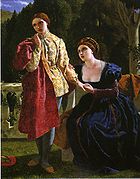
The Faerie Queene
The Faerie Queene is an incomplete English epic poem by Edmund Spenser. The first half was published in 1590, and a second installment was published in 1596. The Faerie Queene is notable for its form: it was the first work written in Spenserian stanza and is one of the longest poems in the English...
by Edmund Spenser
Edmund Spenser
Edmund Spenser was an English poet best known for The Faerie Queene, an epic poem and fantastical allegory celebrating the Tudor dynasty and Elizabeth I. He is recognised as one of the premier craftsmen of Modern English verse in its infancy, and one of the greatest poets in the English...
in 1590, and James Shirley
James Shirley
James Shirley was an English dramatist.He belonged to the great period of English dramatic literature, but, in Lamb's words, he "claims a place among the worthies of this period, not so much for any transcendent genius in himself, as that he was the last of a great race, all of whom spoke nearly...
's The Bird in a Cage
The Bird in a Cage
The Bird in a Cage, or The Beauties is a Caroline era comedy written by James Shirley, first published in 1633. The play is notable, even among Shirley's plays, for its lushness — what one critic has called "gay romanticism run mad."-History:...
(1633). Extraordinary cases during the Renaissance of women taking on male personae and going undetected for years or decades have been recorded.Whether these cases would be more accurately described in contemporary sociology as transgender
Transgender
Transgender is a general term applied to a variety of individuals, behaviors, and groups involving tendencies to vary from culturally conventional gender roles....
is debated, and based on the individual details of each case. If found, punishments ranged from death, to time in the pillory
Pillory
The pillory was a device made of a wooden or metal framework erected on a post, with holes for securing the head and hands, formerly used for punishment by public humiliation and often further physical abuse, sometimes lethal...
, to being ordered never to dress as a man again. Henry Fielding
Henry Fielding
Henry Fielding was an English novelist and dramatist known for his rich earthy humour and satirical prowess, and as the author of the novel Tom Jones....
wrote a pamphlet titled The Female Husband in 1746, based on the life of Mary Hamilton
Mary Hamilton (bigamist)
Mary Hamilton was the subject of a notorious 18th century case of bigamy and female cross-dressing, in which Hamilton, under the name of Charles, duped other women into marriage...
, who married women on three separate occasions, and was sentenced to public whipping in four separate towns and six months in jail. Similar examples were procured of Catharine Linck in Prussia in 1717, executed in 1721; Swiss Anne Grandjean married and relocated with her wife to Lyons, but was exposed by a woman with whom she had had a previous affair and sentenced to time in the stocks and prison. Queen Christina of Sweden
Christina of Sweden
Christina , later adopted the name Christina Alexandra, was Queen regnant of Swedes, Goths and Vandals, Grand Princess of Finland, and Duchess of Ingria, Estonia, Livonia and Karelia, from 1633 to 1654. She was the only surviving legitimate child of King Gustav II Adolph and his wife Maria Eleonora...
's tendency to dress as a man was well known during her time, and excused because of her noble birth; she was brought up as a male and there was speculation at the time that she was a hermaphrodite. Even after Christina abdicated the throne in 1654 to avoid marriage, she was known to pursue romantic relationships with women.
Some historians view cases of cross-dressing women to be manifestations of women seizing power they would naturally be unable to enjoy in feminine attire, or their way of making sense out of their desire for women. Lillian Faderman argues that Western society was threatened by women who rejected their feminine roles. Catharine Linck and other women who were accused of using dildos, such as two nuns in 16th century Spain executed for using "material instruments", were punished more severely than those who did not. Two marriages between women were recorded in Cheshire
Cheshire
Cheshire is a ceremonial county in North West England. Cheshire's county town is the city of Chester, although its largest town is Warrington. Other major towns include Widnes, Congleton, Crewe, Ellesmere Port, Runcorn, Macclesfield, Winsford, Northwich, and Wilmslow...
, England, in 1707 (between Hannah Wright and Anne Gaskill) and 1708 (between Ane Norton and Alice Pickford) with no comment about both parties being female. Reports of clergymen with lax standards who performed weddings—and wrote their suspicions about one member of the wedding party—continued to appear for the next century.
Outside of Europe women were able to dress as men and go undetected. Deborah Sampson
Deborah Sampson
Deborah Samson Gannett , better known as Deborah Sampson, was an American woman who impersonated a man in order to serve in the Continental Army during the American Revolutionary War. She is one of a small number of women with a documented record of military combat experience in that war...
fought in the American Revolution
American Revolution
The American Revolution was the political upheaval during the last half of the 18th century in which thirteen colonies in North America joined together to break free from the British Empire, combining to become the United States of America...
as a man named Robert Shurtleff, and pursued relationships with women. Edward De Lacy Evans was born female in Ireland, but took a male name during the voyage to Australia and lived as a man for 23 years in Victoria, marrying three times. Percy Redwood created a scandal in New Zealand in 1909 when he was found to be Amy Bock
Amy Bock
Amy Maud Bock was a Tasmanian-born New Zealand female confidence trickster and male impersonator, whose trials and cross-dressing interlude have made her a subject of perennial historical interest in her adopted country....
, who had married a woman from Port Molyneaux; newspapers argued whether it was a sign of insanity or an inherent character flaw.
Re-examining romantic friendships

Romantic friendship
The term romantic friendship refers to both very close but non-sexual relationship and at times physical relationship between friends, often involving a degree of physical closeness beyond that which is common in modern Western societies, and may include for example holding hands, cuddling,...
s, Boston marriage
Boston marriage
Boston marriage as a term is said to have been in use in New England in the decades spanning the late 19th and early 20th centuries to describe two women living together, independent of financial support from a man. The term was little known until the debut in 2000 of the David Mamet play of the...
s, or "sentimental friends", and were common in the U.S., Europe, and especially in England. Documentation of these relationships is possible by a large volume of letters written between women. Whether the relationship included any genital component was not a matter for public discourse, but women could form strong and exclusive bonds with each other and still be considered virtuous, innocent, and chaste; a similar relationship with a man would have destroyed a woman's reputation. In fact, these relationships were promoted as alternatives to and practice for a woman's marriage to a man.In a rare instance of sexuality being the focus of a romantic friendship, two Scottish schoolteachers in the early 19th century were accused by a student of visiting in the same bed, kissing, and making the bed shake. The student's grandmother reported the teachers to the authorities, who were skeptical that their actions were sexual in nature, or that they extended beyond the bounds of normal friendship: "Are we to say that every woman who has formed an intimate friendship and has slept in the same bed with another is guilty? Where is the innocent woman in Scotland?" (Aldrich, p. 233.)
One such relationship was between Lady Mary Wortley Montagu
Lady Mary Wortley Montagu
The Lady Mary Wortley Montagu was an English aristocrat and writer. Montagu is today chiefly remembered for her letters, particularly her letters from Turkey, as wife to the British ambassador, which have been described by Billie Melman as “the very first example of a secular work by a woman about...
, who wrote to Anne Wortley in 1709: "Nobody was so entirely, so faithfully yours ... I put in your lovers, for I don't allow it possible for a man to be so sincere as I am." Similarly, English poet Anna Seward
Anna Seward
Anna Seward was an English Romantic poet, often called the Swan of Lichfield.-Life:Seward was the elder daughter of Thomas Seward , prebendary of Lichfield and Salisbury, and author...
had a devoted friendship to Honora Sneyd, who was the subject of many of Seward's sonnets and poems. When Sneyd married despite Seward's protest, Seward's poems became angry. However, Seward continued to write about Sneyd long after her death, extolling Sneyd's beauty and their affection and friendship. As a young woman, writer and philosopher Mary Wollstonecraft
Mary Wollstonecraft
Mary Wollstonecraft was an eighteenth-century British writer, philosopher, and advocate of women's rights. During her brief career, she wrote novels, treatises, a travel narrative, a history of the French Revolution, a conduct book, and a children's book...
was attached to a woman named Fanny Blood. Writing to another woman by whom she had recently felt betrayed, Wollstonecraft declared, "The roses will bloom when there's peace in the breast, and the prospect of living with my Fanny gladdens my heart:—You know not how I love her."Wollstonecraft and Blood set up a girls' boarding school so they could live and work together, and Wollstonecraft named her first child after Blood. Wollstonecraft's first novel Mary: A Fiction
Mary: A Fiction
Mary: A Fiction is the only complete novel by the 18th-century British feminist Mary Wollstonecraft. It tells the tragic story of a heroine's successive "romantic friendships" with a woman and a man...
, in part, addressed her relationship with Fanny Blood.
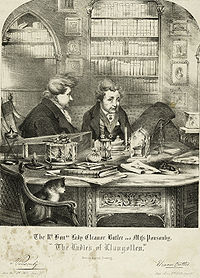
Ladies of Llangollen
The Ladies of Llangollen were two upper-class women from Ireland whose relationship scandalised and fascinated their contemporaries.-Early lives:...
. Butler and Ponsonby eloped in 1778, to the relief of Ponsonby's family (concerned about their reputation had she run away with a man) to live together in Wales for 51 years and be thought of as eccentrics. Their story was considered "the epitome of virtuous romantic friendship" and inspired poetry by Anna Seward and Henry Wadsworth Longfellow
Henry Wadsworth Longfellow
Henry Wadsworth Longfellow was an American poet and educator whose works include "Paul Revere's Ride", The Song of Hiawatha, and Evangeline...
. Diarist Anne Lister
Anne Lister
Anne Lister was a well-off Yorkshire landowner, diarist, mountaineer and traveller.Throughout her life she kept diaries which chronicled the details of her everyday life, including her lesbian relationships, her financial concerns, her industrial activities and her work improving Shibden Hall...
, captivated by Butler and Ponsonby, recorded her affairs with women between 1817 and 1840. Some of it was written in code, detailing her sexual relationships with Marianna Belcombe and Maria Barlow. Both Lister and Eleanor Butler were considered masculine by contemporary news reports, and though there were suspicions that these relationships were sapphist in nature, they were nonetheless praised in literature.
Romantic friendships were also popular in the U.S. Enigmatic poet Emily Dickinson
Emily Dickinson
Emily Elizabeth Dickinson was an American poet. Born in Amherst, Massachusetts, to a successful family with strong community ties, she lived a mostly introverted and reclusive life...
wrote over 300 letters and poems to Susan Gilbert, who later became her sister-in-law, and engaged in another romantic correspondence with Kate Scott Anthon. Anthon broke off their relationship the same month Dickinson entered self-imposed lifelong seclusion. Nearby in Hartford, Connecticut, African American freeborn women Addie Brown and Rebecca Primus left evidence of their passion in letters: "No kisses is like youres". In Georgia, Alice Baldy wrote to Josie Varner in 1870, "Do you know that if you touch me, or speak to me there is not a nerve of fibre in my body that does not respond with a thrill of delight?"
Around the turn of the 20th century the development of higher education provided opportunities for women. In all-female surroundings, a culture of romantic pursuit was fostered in women's colleges. Older students mentored younger ones, called on them socially, took them to all-women dances, and sent them flowers, cards, and poems that declared their undying love for each other. These were called "smashes" or "spoons", and they were written about quite frankly in stories for girls aspiring to attend college in publications such as Ladies Home Journal, a children's magazine titled St. Nicholas
St. Nicholas Magazine
St. Nicholas Magazine was a popular children's magazine, founded by Scribner's in 1873. The first editor was Mary Mapes Dodge, who continued her association with the magazine until her death in 1905. Dodge published work by the country's best writers, including Louisa May Alcott, Francis Hodgson...
, and a collection called Smith College Stories, without negative views. Enduring loyalty, devotion, and love were major components to these stories, and sexual acts beyond kissing were consistently absent. Women who had the option of a career instead of marriage labeled themselves New Women
New Woman
The New Woman was a feminist ideal that emerged in the late 19th century. The New Woman pushed the limits set by male-dominated society, especially as modeled in the plays of Norwegian Henrik Ibsen . "The New Woman sprang fully armed from Ibsen's brain," according to a joke by Max Beerbohm...
, and took their new opportunities very seriously.First Lady Eleanor Roosevelt
Eleanor Roosevelt
Anna Eleanor Roosevelt was the First Lady of the United States from 1933 to 1945. She supported the New Deal policies of her husband, distant cousin Franklin Delano Roosevelt, and became an advocate for civil rights. After her husband's death in 1945, Roosevelt continued to be an international...
exchanged rings with and wrote letters to journalist Lorena Hickok
Lorena Hickok
Lorena Alice Hickok was an American journalist and confidante of Eleanor Roosevelt. Her relationship with Roosevelt has been the subject of research.-Early life:...
, expressing her love and desire to kiss Hickock; her writings were in the style of romantic friendship. The view that Roosevelt's relationship with Hickok may have been sexual, therefore deserving of the lesbian label, created controversy among Roosevelt's biographers. (Faderman [1981], p. 297–313.) Faderman calls this period "the last breath of innocence" before 1920 when characterizations of female affection were connected to sexuality, marking lesbians as a unique and often unflattering group. Specifically, Faderman connects the growth of women's independence and their beginning to reject strictly prescribed roles in the Victorian era to the scientific designation of lesbianism as a type of aberrant sexual behavior.
Middle East
Female homosexual behavior may be present in every culture, although the concept of a lesbian as a woman who pairs exclusively with other women is not. Attitudes about female homosexual behavior are dependent upon women's roles in each society, and each culture's definition of sex. Women in the Middle East have been historically segregated from men. In the 7th and 8th centuries some extraordinary women dressed in male attire when gender roles were less strict, but the sexual roles that accompanied European women were not associated with Islamic women. The Caliphal court in BaghdadBaghdad
Baghdad is the capital of Iraq, as well as the coterminous Baghdad Governorate. The population of Baghdad in 2011 is approximately 7,216,040...
featured women who dressed as men, including false facial hair, but they competed with other women for the attentions of men. Highly intelligent women, according to the 12th century writings of Sharif al-Idrisi, were more likely to be lesbians; their intellectual prowess put them on a more even par with men. Relations between women who lived in harems, and fears of women being sexually intimate in Turkish baths were expressed in writings by men. Women, however, were mostly silent and men likewise rarely wrote about lesbian relationships. It is unclear to historians if the rare instances of lesbianism mentioned in literature are an accurate historical record or intended to serve as fantasies for men. A 1978 treatise about repression in Iran
Iran
Iran , officially the Islamic Republic of Iran , is a country in Southern and Western Asia. The name "Iran" has been in use natively since the Sassanian era and came into use internationally in 1935, before which the country was known to the Western world as Persia...
asserted that women were completely silenced: "In the whole of Iranian history, [no woman] has been allowed to speak out for such tendencies ... To attest to lesbian desires would be an unforgivable crime." Although the authors of Islamic Homosexualities argued this did not mean women could not engage in lesbian relationships, a lesbian anthropologist in 1991 visited Yemen
Yemen
The Republic of Yemen , commonly known as Yemen , is a country located in the Middle East, occupying the southwestern to southern end of the Arabian Peninsula. It is bordered by Saudi Arabia to the north, the Red Sea to the west, and Oman to the east....
and reported that women in the town she visited were unable to comprehend her romantic relationship to another woman. Women in Pakistan are expected to marry men; those who do not are ostracized. Women, however, may have intimate relations with other women as long as their wifely duties are met, their private matters are kept quiet, and the woman with whom they are involved is somehow related by family or logical interest to her lover.
The Americas
Indigenous people in North and South America conceptualized a third gender for men-women and women-men. These roles were recorded of the CoahuiltecanCoahuiltecan
Coahuiltecan or Paikawa was a proposed language family in John Wesley Powell's 1891 classification of Native American languages that consisted of Coahuilteco and Cotoname. The proposal was expanded to include Comecrudo, Karankawa, and Tonkawa...
Indians in Texas, Timucua
Timucua
The Timucua were a Native American people who lived in Northeast and North Central Florida and southeast Georgia. They were the largest indigenous group in that area and consisted of about 35 chiefdoms, many leading thousands of people. The various groups of Timucua spoke several dialects of the...
n in Florida, and Cueva
Cueva people
The Cueva were an indigenous people that lived in the Darién region of eastern Panamá. They were completely exterminated between 1510 and 1535 due to the effects of Spanish colonization....
in Panama. In Cree
Cree
The Cree are one of the largest groups of First Nations / Native Americans in North America, with 200,000 members living in Canada. In Canada, the major proportion of Cree live north and west of Lake Superior, in Ontario, Manitoba, Saskatchewan, Alberta and the Northwest Territories, although...
, the term for a man who took the role of a woman was ayekkwew; the Zuni
Zuni language
Zuni is a language of the Zuni people, indigenous to western New Mexico and eastern Arizona in the United States. It is spoken by around 9,500 people worldwide, especially in the vicinity of Zuni Pueblo, New Mexico, and much smaller numbers in parts of Arizona.Unlike most indigenous languages in...
word for a woman who took the role of a man was katsotse (boy-girl), and the Mohave give women the term hwame. The cross-gender roles have less to do with sexuality than with spirituality and occupation. A "two-spirit
Two-Spirit
Two-Spirit People , is an English term that emerged in 1990 out of the third annual inter-tribal Native American/First Nations gay/lesbian American conference in Winnipeg. It describes Indigenous North Americans who fulfill one of many mixed gender roles found traditionally among many Native...
" woman who has a relationship with a non cross-gender woman is thought to be a "hetero-gender" relationship.
In Latin America
Latin America
Latin America is a region of the Americas where Romance languages – particularly Spanish and Portuguese, and variably French – are primarily spoken. Latin America has an area of approximately 21,069,500 km² , almost 3.9% of the Earth's surface or 14.1% of its land surface area...
, lesbian consciousness and associations appeared in the 1970s, increasing while several countries transitioned to or reformed democratic governments. Even so, no regime in Central or South America, democratic or otherwise, has acknowledged gay and lesbian rights. Harassment and intimidation have been common even in places where homosexuality is legal, and laws against child corruption, morality, or "the good ways" (faltas a la moral o las buenas costumbres), have been used to persecute homosexuals. From the Hispanic perspective, the conflict between the lesbophobia
Lesbophobia
Lesbophobia comprises various forms of negativity toward lesbian women as individuals, as a couple or as a social group...
of feminists and the misogyny
Misogyny
Misogyny is the hatred or dislike of women or girls. Philogyny, meaning fondness, love or admiration towards women, is the antonym of misogyny. The term misandry is the term for men that is parallel to misogyny...
from gay men has created a difficult path for lesbians and associated groups.
Argentina
Argentina
Argentina , officially the Argentine Republic , is the second largest country in South America by land area, after Brazil. It is constituted as a federation of 23 provinces and an autonomous city, Buenos Aires...
was the first Latin American country with a gay rights group, Nuestro Mundo (NM, or Our World), created in 1969. Six mostly secret organizations concentrating on gay or lesbian issues were founded around this time, but persecution and harassment were continuous and grew worse with the dictatorship of Jorge Rafael Videla
Jorge Rafael Videla
Jorge Rafael Videla Redondo is a former senior commander in the Argentine Army who was the de facto President of Argentina from 1976 to 1981. He came to power in a coup d'état that deposed Isabel Martínez de Perón...
in 1976, when all groups were dissolved in the Dirty War
Dirty War
The Dirty War was a period of state-sponsored violence in Argentina from 1976 until 1983. Victims of the violence included several thousand left-wing activists, including trade unionists, students, journalists, Marxists, Peronist guerrillas and alleged sympathizers, either proved or suspected...
. Lesbian rights groups have gradually formed since 1986 to build a cohesive community that works to overcome philosophical differences with heterosexual women. The Latin American lesbian movement has been the most active in Mexico
Mexico
The United Mexican States , commonly known as Mexico , is a federal constitutional republic in North America. It is bordered on the north by the United States; on the south and west by the Pacific Ocean; on the southeast by Guatemala, Belize, and the Caribbean Sea; and on the east by the Gulf of...
, but has encountered similar problems in effectiveness and cohesion. While groups try to promote lesbian issues and concerns, they also face misogynistic attitudes from gay men and homophobic views from heterosexual women. In 1977, Lesbos, the first lesbian organization for Mexicans, was formed. Several incarnations of political groups promoting lesbian issues have evolved; 13 lesbian organizations were active in Mexico City in 1997. Ultimately, however, lesbian associations have had little influence both on the homosexual and feminist movements.
In Chile
Chile
Chile ,officially the Republic of Chile , is a country in South America occupying a long, narrow coastal strip between the Andes mountains to the east and the Pacific Ocean to the west. It borders Peru to the north, Bolivia to the northeast, Argentina to the east, and the Drake Passage in the far...
, the dictatorship of Augusto Pinochet
Augusto Pinochet
Augusto José Ramón Pinochet Ugarte, more commonly known as Augusto Pinochet , was a Chilean army general and dictator who assumed power in a coup d'état on 11 September 1973...
forbade the creation of lesbian groups until 1984, when Ayuquelén ("joy of being" in Mapuche) was first founded, prompted by the very public beating death of a woman amid shouts of "Damned lesbian!" from her attacker. The lesbian movement has been closely associated with the feminist movement in Chile, although the relationship has been sometimes strained. Ayuquelén worked with the International Lesbian Information Service
International Lesbian Information Service
The International Lesbian Information Service was international organization with the purpose to foster international lesbian organizing. It was started within ILGA in 1980...
, the International Lesbian, Gay, Bisexual, Trans and Intersex Association
International Lesbian, Gay, Bisexual, Trans and Intersex Association
The International Lesbian, Gay, Bisexual, Trans and Intersex Association is an international organization bringing together more than 750 LGBTI groups from around the world. It continues to be active in campaigning for LGBT rights on the international human rights and civil rights scene and...
, and the Chilean gay rights group Movimiento de Integración y Liberación Homosexual (Movement to Integrate and Liberate Homosexuals) to remove the sodomy law still in force in Chile. Lesbian consciousness began in Nicaragua
Nicaragua
Nicaragua is the largest country in the Central American American isthmus, bordered by Honduras to the north and Costa Rica to the south. The country is situated between 11 and 14 degrees north of the Equator in the Northern Hemisphere, which places it entirely within the tropics. The Pacific Ocean...
in 1986, when the Sandinista National Liberation Front
Sandinista National Liberation Front
The Sandinista National Liberation Front is a socialist political party in Nicaragua. Its members are called Sandinistas in both English and Spanish...
expelled gay men and lesbians from its midst. State persecution prevented the formation of associations until AIDS
AIDS
Acquired immune deficiency syndrome or acquired immunodeficiency syndrome is a disease of the human immune system caused by the human immunodeficiency virus...
became a concern, when educational efforts forced sexual minorities to band together. The first lesbian organization was Nosotras, founded in 1989. An effort to promote visibility from 1991 to 1992 provoked the government to declare homosexuality illegal in 1994, effectively ending the movement, until 2004, when Grupo Safo – Grupo de Mujeres Lesbianas de Nicaragua was created, four years before homosexuality became legal again.
The meetings of feminist lesbians of Latin America and the Caribbean, sometimes shortened to "Lesbian meetings", have been an important forum for the exchange of ideas for Latin American lesbians since the late 1980s. With rotating hosts and biannual gatherings, its main aims are the creation of communication networks, to change the situation of lesbians in Latin America (both legally and socially), to increase solidarity between lesbians and to destroy the existing myths about them.
Africa
Cross-gender roles and marriage between women has also been recorded in over 30 African societies. Women may marry other women, raise their children, and be generally thought of as men in societies in NigeriaNigeria
Nigeria , officially the Federal Republic of Nigeria, is a federal constitutional republic comprising 36 states and its Federal Capital Territory, Abuja. The country is located in West Africa and shares land borders with the Republic of Benin in the west, Chad and Cameroon in the east, and Niger in...
, Cameroon
Cameroon
Cameroon, officially the Republic of Cameroon , is a country in west Central Africa. It is bordered by Nigeria to the west; Chad to the northeast; the Central African Republic to the east; and Equatorial Guinea, Gabon, and the Republic of the Congo to the south. Cameroon's coastline lies on the...
, and Kenya
Kenya
Kenya , officially known as the Republic of Kenya, is a country in East Africa that lies on the equator, with the Indian Ocean to its south-east...
. The Hausa people
Hausa people
The Hausa are one of the largest ethnic groups in West Africa. They are a Sahelian people chiefly located in northern Nigeria and southeastern Niger, but having significant numbers living in regions of Cameroon, Ghana, Cote d'Ivoire, Chad and Sudan...
of Sudan
Sudan
Sudan , officially the Republic of the Sudan , is a country in North Africa, sometimes considered part of the Middle East politically. It is bordered by Egypt to the north, the Red Sea to the northeast, Eritrea and Ethiopia to the east, South Sudan to the south, the Central African Republic to the...
have a term equivalent to lesbian, kifi, that may also be applied to males to mean "neither party insists on a particular sexual role". Near the Congo River
Congo River
The Congo River is a river in Africa, and is the deepest river in the world, with measured depths in excess of . It is the second largest river in the world by volume of water discharged, though it has only one-fifth the volume of the world's largest river, the Amazon...
a female who participates in strong emotional or sexual relationships with another female among the Nkundo people is known as yaikya bonsángo (a woman who presses against another woman). Lesbian relationships are also known in matrilineal societies in Ghana
Ghana
Ghana , officially the Republic of Ghana, is a country located in West Africa. It is bordered by Côte d'Ivoire to the west, Burkina Faso to the north, Togo to the east, and the Gulf of Guinea to the south...
among the Akan people
Akan people
The Akan people are an ethnic group found predominately in Ghana and The Ivory Coast. Akans are the majority in both of these countries and overall have a population of over 20 million people.The Akan speak Kwa languages-Origin and ethnogenesis:...
. In Lesotho
Lesotho
Lesotho , officially the Kingdom of Lesotho, is a landlocked country and enclave, surrounded by the Republic of South Africa. It is just over in size with a population of approximately 2,067,000. Its capital and largest city is Maseru. Lesotho is a member of the Commonwealth of Nations. The name...
, females engage in what is commonly considered sexual behavior to the Western world: they kiss, sleep together, rub genitals, participate in cunnilingus
Cunnilingus
Cunnilingus is an oral sex act performed on a female. It involves the use by a sex partner of the mouth, lips and tongue to stimulate the female's clitoris, vulva, or vagina...
, and maintain their relationships with other females vigilantly. Since the people of Lesotho believe sex requires a penis, however, they do not consider their behavior sexual, nor label themselves lesbians. Colonization of Africa resulted in a cultural shift; aboriginal sexuality was no longer seen as fluid and dynamic but binary and set for life. Some women who identified as lesbian following colonization have been submitted to the curative effort of rape in the mindset that sex with men can fix lesbianism. Despite this paradigm shift, the government of South Africa was the first in the world to outlaw discrimination based on sexual orientation.
Asia
China before westernization was another society that segregated men from women. Historical Chinese culture has not recognized a concept of sexual orientation, or a framework to divide people based on their same-sex or opposite-sex attractions. Although there was a significant culture surrounding homosexual men, there was none for women. Outside of their duties to bear sons to their husbands, women were perceived as having no sexuality at all. This did not mean that women could not pursue sexual relationships with other women, but that such associations could not impose upon women's relationships to men. Rare references to lesbianism were written by Ying ShaoYing Shao
Ying Shao , also called Ling Shao in the Shi Yu, style name Zhongyuan , was a Chinese writer and historian of the late Eastern Han period , an author of the famous work Fengsu Tongyi, an encyclopedic work about the folk customs and legends that existed in the Eastern Han state...
, who identified same-sex relationships between women in imperial courts who behaved as husband and wife as dui shi (paired eating). "Golden Orchid Associations" in Southern China existed into the 20th century and promoted formal marriages between women, who were then allowed to adopt children. Westernization brought new ideas that all sexual behavior not resulting in reproduction was aberrant. The liberty of being employed in silk factories starting in 1865 allowed some women to style themselves tzu-shu nii (never to marry) and live in communes with other women. Other Chinese called them sou-hei (self-combers) for adopting hairstyles of married women. These communes passed because of the Great Depression and were subsequently discouraged by the communist government for being a relic of feudal China. In contemporary Chinese society, tongzhi (same goal or spirit) is the term used to refer to homosexuals; most Chinese are reluctant to divide this classification further to identify lesbians.
In Japan, the term rezubian, a Japanese pronunciation of "lesbian", was used during the 1920s. Westernization brought more independence for women and allowed some Japanese women to wear pants. The cognate tomboy
Tomboy
A tomboy is a girl who exhibits characteristics or behaviors considered typical of the gender role of a boy, including the wearing of typically masculine-oriented clothes and engaging in games and activities that are often physical in nature, and which are considered in many cultures to be the...
is used in the Philippines
Philippines
The Philippines , officially known as the Republic of the Philippines , is a country in Southeast Asia in the western Pacific Ocean. To its north across the Luzon Strait lies Taiwan. West across the South China Sea sits Vietnam...
, and particularly in Manila
Manila
Manila is the capital of the Philippines. It is one of the sixteen cities forming Metro Manila.Manila is located on the eastern shores of Manila Bay and is bordered by Navotas and Caloocan to the north, Quezon City to the northeast, San Juan and Mandaluyong to the east, Makati on the southeast,...
, to denote women who are more masculine. Virtuous women in Korea prioritize motherhood, chastity, and virginity; outside of this scope, very few women are free to express themselves through sexuality, although there is a growing organization for lesbians named Kkirikkiri. The term pondan is used in Malaysia to refer to gay men, but since there is no historical context to reference lesbians, the term is used for female homosexuals as well. As in many Asian countries, open homosexuality is discouraged in many social levels, so many Malaysians lead double lives. A 14th century Indian writing mentioning a lesbian couple who had a child as a result of their lovemaking is an exception to the general silence about female homosexuality. This invisibility disappeared with the release of a film titled Fire in 1996, prompting some theaters in India to be attacked by extremists. Terms used to label homosexuals are often rejected by Indian activists for being the result of imperialist influence, but most discourse on homosexuality centers on men. Women's rights groups in India continue to debate the legitimacy of including lesbian issues in their platforms, as lesbians and material focusing on female homosexuality are frequently suppressed.
The Kinsey Report
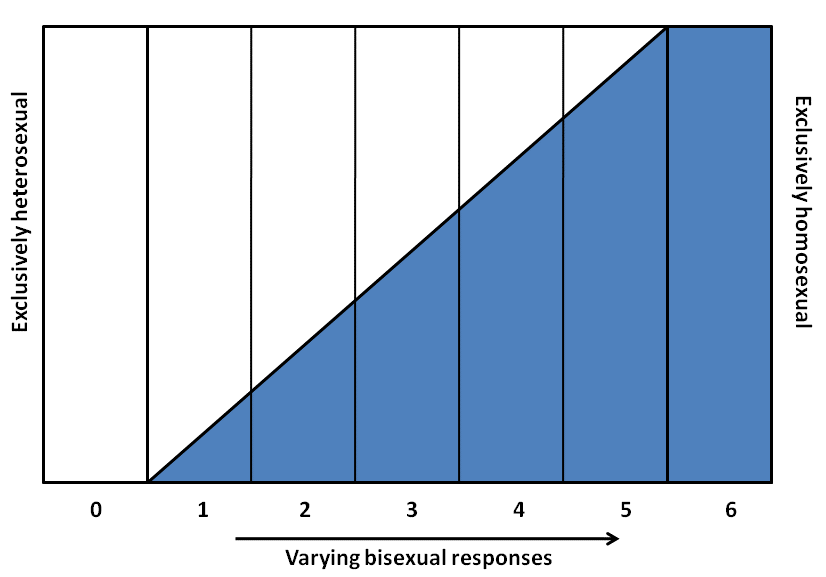
Alfred Kinsey
Alfred Charles Kinsey was an American biologist and professor of entomology and zoology, who in 1947 founded the Institute for Sex Research at Indiana University, now known as the Kinsey Institute for Research in Sex, Gender, and Reproduction, as well as producing the Kinsey Reports and the Kinsey...
and the staff of the Institute for Sex Research in a book titled Sexual Behavior in the Human Female, popularly known as part of the Kinsey Report. The Kinsey Report's dispassionate discussion of homosexuality as a form of human sexual behavior was revolutionary. Up to this study, only physicians and psychiatrists studied sexual behavior, and almost always the results were interpreted with a moral view.
Kinsey and his staff reported that 28% of women had been aroused by another female, and 19% had a sexual contact with another female.Sexual contact, according to Kinsey, included lip kissing, deep kissing, body touching, manual breast and genital stimulation, oral breast and genital stimulation, and object-vaginal penetration. (Kinsey, p. 466–467.) Of women who had sexual contact with another female, half to two-thirds of them had orgasm
Orgasm
Orgasm is the peak of the plateau phase of the sexual response cycle, characterized by an intense sensation of pleasure...
ed. Single women had the highest prevalence of homosexual activity, followed by women who were widowed, divorced, or separated. The lowest occurrence of sexual activity was among married women; those with previous homosexual experience reported they got married to stop homosexual activity. Most of the women who reported homosexual activity had not experienced it more than ten times. Fifty-one percent of women reporting homosexual experience had only one partner. Women with post-graduate education had a higher prevalence of homosexual experience, followed by women with a college education; the smallest occurrence was among women with education no higher than eighth grade.
Based on Kinsey's scale where 0 represents a person with an exclusively heterosexual response and 6 represents a person with an exclusively homosexual one, and numbers in between represent a gradient of responses with both sexes, 6% of those interviewed ranked as a 6: exclusively homosexual. Apart from those who ranked 0 (71%), the largest percentage in between 0 and 6 was 1 at approximately 15%. However, the Kinsey Report remarked that the ranking described a period in a person's life, and that a person's orientation may change. Among the criticisms the Kinsey Report received, a particular one addressed the Institute for Sex Research's tendency to use statistical sampling, which facilitated an over-representation of same-sex relationships by other researchers who did not adhere to Kinsey's qualifications of data.
The Hite Report
Twenty-three years later, in 1976, sexologist Shere HiteShere Hite
Shere Hite is an American-born German sex educator and feminist. Her sexological work has focused primarily on female sexuality. Hite builds upon biological studies of sex by Masters and Johnson and by Alfred Kinsey...
published a report on the sexual encounters of 3,019 women who had responded to questionnaires, under the title The Hite Report. Hite's questions differed from Kinsey's, focusing more on how women identified, or what they preferred rather than experience. Respondents to Hite's questions indicated that 8% preferred sex with women and 9% answered that they identified as bisexual or had sexual experiences with men and women, though they refused to indicate preference. Hite's conclusions are more based on respondents' comments than quantifiable data. She found it "striking" that many women who had no lesbian experiences indicated they were interested in sex with women, particularly because the question was not asked. Hite found the two most significant differences between respondents' experience with men and women were the focus on clitoral stimulation, and more emotional involvement and orgasmic responses. Since Hite performed her study during the popularity of feminism in the 1970s, she also acknowledged that women may have chosen the political identity of a lesbian.
Population estimates
Lesbians in the U.S. are estimated to be about 2.6% of the population, according to a National Opinion Research CenterNational Opinion Research Center
NORC at the University of Chicago, established in 1941 as the National Opinion Research Center, is one of the largest and most highly respected social research organizations in the United States. Its corporate headquarters are located on the University of Chicago campus...
survey of sexually active adults who had had same-sex experiences within the past year, completed in 2000. A survey of same-sex couples in the United States showed that between 2000 and 2005, the number of people claiming to be in same-sex relationships increased by 30%—five times the rate of population growth in the U.S. The study attributed the jump to people being more comfortable self-identifying as homosexual to the federal government.The study estimated the total population of gays, lesbians, and bisexuals at 8.8 million, but did not differentiate between men and women. (Gates, Gary [October 2006]. "Same-sex Couples and the Gay, Lesbian, Bisexual Population: New Estimates from the American Community Survey", The Williams Institute on Sexual Orientation Law and Public Policy, University of California Los Angeles, p. 1–25.) The government of the United Kingdom does not ask citizens to define their sexuality; only percentage estimates of 5–7% are provided. Estimates of lesbians are sometimes not differentiated in studies of same-sex households, such as those performed by the U.S. census, and estimates of total gay, lesbian, or bisexual population by the U.K. government. However, polls in Australia have recorded a range of self-identified lesbian or bisexual women from 1.3% to 2.2% of the total population.
Physical
In terms of medical issues, lesbians are referred to as women who have sex with womenWomen who have sex with women
Women who have sex with women is a term used to identify women who engage in sexual activities with other women, whether or not they identify themselves as lesbian or bisexual...
(WSW) because of the misconceptions and assumptions about women's sexuality and some women's hesitancy to disclose their accurate sexual histories even to a physician. Many self-identified lesbians neglect to see a physician because they do not participate in heterosexual activity and require no birth control
Birth control
Birth control is an umbrella term for several techniques and methods used to prevent fertilization or to interrupt pregnancy at various stages. Birth control techniques and methods include contraception , contragestion and abortion...
, which is the initiating factor for most women to seek consultation with a gynecologist when they become sexually active. As a result, many lesbians are not screened regularly with Pap smear
Pap smear
The Papanicolaou test is a screening test used in to detect pre-cancerous and cancerous processes in the endocervical canal of the female reproductive system. Changes can be treated, thus preventing cervical cancer...
s. The U.S. government reports that some lesbians neglect seeking medical screening in the U.S.; they lack health insurance because many employers do not offer health benefits to domestic partners.
The result of the lack of medical information on WSW is that medical professionals and some lesbians perceive lesbians as having lower risks of acquiring a sexually transmitted disease
Sexually transmitted disease
Sexually transmitted disease , also known as a sexually transmitted infection or venereal disease , is an illness that has a significant probability of transmission between humans by means of human sexual behavior, including vaginal intercourse, oral sex, and anal sex...
or types of cancer. When women do seek medical attention, medical professionals often fail to take a complete medical history. In a recent study of 2,345 lesbian and bisexual women, only 9.3% had claimed they had ever been asked their sexual orientation by a physician. A third of the respondents believed disclosing their sexual history would result in a negative reaction, and 30% had received a negative reaction from a medical professional after identifying themselves as lesbian or bisexual. A patient's complete history helps medical professionals identify higher risk areas and corrects assumptions about the personal histories of women. In a similar survey of 6,935 lesbians, 77% had had sexual contact with one or more male partners, and 6% had that contact within the previous year.Another summary of overall surveys found that women who identify as lesbian, 80–95% had previous sexual contact with men, and some report sexual behavior that was risky. (King, p. 221.)
Heart disease
Heart disease
Heart disease, cardiac disease or cardiopathy is an umbrella term for a variety of diseases affecting the heart. , it is the leading cause of death in the United States, England, Canada and Wales, accounting for 25.4% of the total deaths in the United States.-Types:-Coronary heart disease:Coronary...
is listed by the U.S. Department of Health and Human Services as the number one cause of death for all women. Factors that add to risk of heart disease include obesity
Obesity
Obesity is a medical condition in which excess body fat has accumulated to the extent that it may have an adverse effect on health, leading to reduced life expectancy and/or increased health problems...
and smoking
Smoking
Smoking is a practice in which a substance, most commonly tobacco or cannabis, is burned and the smoke is tasted or inhaled. This is primarily practised as a route of administration for recreational drug use, as combustion releases the active substances in drugs such as nicotine and makes them...
, both of which are more prevalent in lesbians. Studies show that lesbians have a higher body mass and are generally less concerned about weight issues than heterosexual women, and lesbians consider women with higher body masses to be more attractive than heterosexual women do. Lesbians are more likely to exercise regularly than heterosexual women, and lesbians do not generally exercise for aesthetic reasons, although heterosexual women do. Research is needed to determine specific causes of obesity in lesbians.
Lack of differentiation between homosexual and heterosexual women in medical studies that concentrate on health issues for women skews results for lesbians and non-lesbian women. Reports are inconclusive about occurrence of breast cancer
Breast cancer
Breast cancer is cancer originating from breast tissue, most commonly from the inner lining of milk ducts or the lobules that supply the ducts with milk. Cancers originating from ducts are known as ductal carcinomas; those originating from lobules are known as lobular carcinomas...
in lesbians. It has been determined, however, that the lower rate of lesbians tested by regular Pap smears makes it more difficult to detect cervical cancer
Cervical cancer
Cervical cancer is malignant neoplasm of the cervix uteri or cervical area. One of the most common symptoms is abnormal vaginal bleeding, but in some cases there may be no obvious symptoms until the cancer is in its advanced stages...
at early stages in lesbians. The risk factors for developing ovarian cancer
Ovarian cancer
Ovarian cancer is a cancerous growth arising from the ovary. Symptoms are frequently very subtle early on and may include: bloating, pelvic pain, difficulty eating and frequent urination, and are easily confused with other illnesses....
rates are higher in lesbians than heterosexual women, perhaps because many lesbians lack protective factors of pregnancy, abortion, contraceptives, breast feeding, and miscarriages.
Some sexually transmitted diseases are communicable between women, including human papillomavirus
Human papillomavirus
Human papillomavirus is a member of the papillomavirus family of viruses that is capable of infecting humans. Like all papillomaviruses, HPVs establish productive infections only in keratinocytes of the skin or mucous membranes...
(HPV)—specifically genital warts—squamous intraepithelial lesion
Squamous intraepithelial lesion
A squamous intraepithelial lesion is a term that refers to abnormal growth of epithelial cells on the surface of the cervix, commonly called squamous cells. This condition can lead to cervical cancer, but can be diagnosed using a Pap smear or a colposcopy...
s, trichomoniasis
Trichomoniasis
Trichomoniasis, sometimes referred to as "trich", is a common cause of vaginitis. It is a sexually transmitted disease, and is caused by the single-celled protozoan parasite Trichomonas vaginalis producing mechanical stress on host cells and then ingesting cell fragments after cell death...
, syphilis
Syphilis
Syphilis is a sexually transmitted infection caused by the spirochete bacterium Treponema pallidum subspecies pallidum. The primary route of transmission is through sexual contact; however, it may also be transmitted from mother to fetus during pregnancy or at birth, resulting in congenital syphilis...
, and herpes simplex virus
Herpes simplex virus
Herpes simplex virus 1 and 2 , also known as Human herpes virus 1 and 2 , are two members of the herpes virus family, Herpesviridae, that infect humans. Both HSV-1 and HSV-2 are ubiquitous and contagious...
(HSV). Transmission of specific sexually transmitted diseases among women who have sex with women depends on the sexual practices
Lesbian sexual practices
Lesbian sexual practices are sexual activities where the participants are only women. The participants can be lesbian or bisexual women, though some prefer to refer to themselves as women who have sex with women and dispense with sexual identification...
women engage in. Any object that comes in contact with cervical secretions, vaginal mucosa, or menstrual blood, including fingers or penetrative objects may transmit sexually transmitted diseases. Orogenital contact
Oral sex
Oral sex is sexual activity involving the stimulation of the genitalia of a sex partner by the use of the mouth, tongue, teeth or throat. Cunnilingus refers to oral sex performed on females while fellatio refer to oral sex performed on males. Anilingus refers to oral stimulation of a person's anus...
may indicate a higher risk of acquiring HSV, even among women who have had no prior sex with men. Bacterial vaginosis
Bacterial vaginosis
Bacterial vaginosis or less commonly vaginal bacteriosis is a disease of the vagina caused by bacteria. The U.S. Centers for Disease Control and Prevention states it is not clear what role sexual activity plays in the development. However, it is known that BV is associated with having a new sex...
(BV) occurs more often in lesbians, but it is unclear if BV is transmitted by sexual contact; it occurs in celibate as well as sexually active women. BV often occurs in both partners in a lesbian relationship; a recent study of women with BV found that 81% had partners with BV. Lesbians are not included in a category of frequency of human immunodeficiency virus (HIV) transmission, although transmission is possible through vaginal and cervical secretions. The highest rate of transmission of HIV to lesbians is among women who participate in intravenous drug use or have sexual intercourse with bisexual men.
Mental
Since medical literature began to describe homosexuality, it has often been approached from a view that sought to find an inherent psychopathology as the root cause, influenced by the theories of Sigmund Freud. Although he considered bisexuality inherent in all people, and said that most have phases of homosexual attraction or experimentation, exclusive same-sex attraction he attributed to stunted development resulting from trauma or parental conflicts.A 1966 survey of psychological literature on homosexuality began with Freud's 1924 theory that it is a fixation on the opposite sex parent. As Freud's views were the foundation of psychotherapy, further articles agreed with this, including one in 1951 that asserted that homosexuals are actually heterosexuals that play both gender roles, and homosexuals are attempting to perpetuate "infantile, incestuous fixation(s)" on relationships that are forbidden. (Zucker, Luise [July 1966], "Mental Health and Homosexuality", Journal of Sex Research 2 (2), p. 111–125.) Much literature on mental health and lesbians centered on their depressionClinical depression
Major depressive disorder is a mental disorder characterized by an all-encompassing low mood accompanied by low self-esteem, and by loss of interest or pleasure in normally enjoyable activities...
, substance abuse
Substance abuse
A substance-related disorder is an umbrella term used to describe several different conditions associated with several different substances .A substance related disorder is a condition in which an individual uses or abuses a...
, and suicide
Suicide
Suicide is the act of intentionally causing one's own death. Suicide is often committed out of despair or attributed to some underlying mental disorder, such as depression, bipolar disorder, schizophrenia, alcoholism, or drug abuse...
. Although these issues exist among lesbians, discussion about their causes shifted after homosexuality was removed from the Diagnostic and Statistical Manual in 1973. Instead, social ostracism, legal discrimination, internalization of negative stereotypes, and limited support structures indicate factors homosexuals face in Western societies that often adversely affect their mental health. Women who identify as lesbian report feeling significantly different and isolated during adolescence; these emotions have been cited as appearing on average at 15 years old in lesbians and 18 years old in women who identify as bisexual. On the whole, women tend to work through developing a self-concept internally, or with other women with whom they are intimate. Women also limit who they divulge their sexual identities to, and more often see being lesbian as a choice, as opposed to gay men, who work more externally and see being gay as outside their control.
Anxiety disorder
Anxiety disorder
Anxiety disorder is a blanket term covering several different forms of abnormal and pathological fear and anxiety. Conditions now considered anxiety disorders only came under the aegis of psychiatry at the end of the 19th century. Gelder, Mayou & Geddes explains that anxiety disorders are...
s and depression
Depression (mood)
Depression is a state of low mood and aversion to activity that can affect a person's thoughts, behaviour, feelings and physical well-being. Depressed people may feel sad, anxious, empty, hopeless, helpless, worthless, guilty, irritable, or restless...
are the most common mental health issues for women. Depression is reported among lesbians at a rate similar to heterosexual women, although generalized anxiety disorder is more likely to appear among lesbian and bisexual women than heterosexual women.Lesbian and bisexual women are also more likely to report symptoms of multiple disorders that include major depression, panic disorder, alcohol and drug abuse. (Cochran, et al., 2003) Depression is a more significant problem among women who feel they must hide their sexual orientation from friends and family, or experience compounded ethnic or religious discrimination, or endure relationship difficulties with no support system. Men's shaping of women's sexuality has proven to have an effect on how lesbians see their own bodies. Studies have shown that heterosexual men and lesbians have different standards for what they consider attractive in women. Lesbians who view themselves with male standards of female beauty may experience lower self-esteem, eating disorder
Eating disorder
Eating disorders refer to a group of conditions defined by abnormal eating habits that may involve either insufficient or excessive food intake to the detriment of an individual's physical and mental health. Bulimia nervosa, anorexia nervosa, and binge eating disorder are the most common specific...
s, and higher incidence of depression. More than half the respondents to a 1994 survey of health issues in lesbians reported they had suicidal thoughts
Suicidal ideation
Suicidal ideation is a common medical term for thoughts about suicide, which may be as detailed as a formulated plan, without the suicidal act itself. Although most people who undergo suicidal ideation do not commit suicide, some go on to make suicide attempts...
, and 18% had attempted suicide.
A population-based study completed by the National Alcohol Research Center found that women who identify as lesbian or bisexual are less likely to abstain from alcohol. Lesbians and bisexual women have a higher likelihood of reporting problems with alcohol, as well as not being satisfied with treatment for substance abuse programs. Many lesbian communities are centered in bars, and drinking is an activity that correlates to community participation for lesbians and bisexual women.
Media representation
Lesbians portrayed in literature, film, and television often shape contemporary thought about women's sexuality. The majority of media about lesbians is produced by men; women's publishing companies did not develop until the 1970s, films about lesbians made by women did not appear until the 1980s, and television shows portraying lesbians written by women only began to be created in the 21st century. As a result, homosexuality—particularly dealing with women—has been excluded because of symbolic annihilationSymbolic annihilation
Symbolic annihilation is the absence of representation, or underrepresentation, of some group of people in the media , understood in the social sciences to be a means of maintaining social inequality...
. When depictions of lesbians began to surface, they were often one-dimensional, simplified stereotypes.
Literature
In addition to Sappho's accomplishments,Sappho has also served as a subject of many works of literature by writers such as John DonneJohn Donne
John Donne 31 March 1631), English poet, satirist, lawyer, and priest, is now considered the preeminent representative of the metaphysical poets. His works are notable for their strong and sensual style and include sonnets, love poetry, religious poems, Latin translations, epigrams, elegies, songs,...
, Alexander Pope
Alexander Pope
Alexander Pope was an 18th-century English poet, best known for his satirical verse and for his translation of Homer. He is the third-most frequently quoted writer in The Oxford Dictionary of Quotations, after Shakespeare and Tennyson...
, Pierre Louÿs
Pierre Louÿs
Pierre Louÿs was a French poet and writer, most renowned for lesbian and classical themes in some of his writings. He is known as a writer who "expressed pagan sensuality with stylistic perfection."-Life:...
, and several anonymous writers, that have addressed her relationships with women and men. She has been used as an embodiment of same-sex desire, and as a character in fictions loosely based on her life. (Castle, pp. 125, 208, 252, 319, 566.) literary historian Jeannette Howard Foster
Jeannette Howard Foster
Jeannette Howard Foster was a researcher in the field of lesbian literature. She pioneered the study of popular fiction and ephemera in order to excavate lesbian themes both overt and covert, and her years of pioneering data collection culminated in her 1956 study Sex Variant Women in Literature,...
includes the Book of Ruth
Book of Ruth
The Book of Ruth is one of the books of the Hebrew Bible, Tanakh, or Old Testament. In the Jewish canon the Book of Ruth is included in the third division, or the Writings . In the Christian canon the Book of Ruth is placed between Judges and 1 Samuel...
, and ancient mythological tradition as examples of lesbianism in classical literature. Greek stories of the heavens often included a female figure whose virtue and virginity were unspoiled, who pursued more masculine interests, and who was followed by a dedicated group of maidens. Foster cites Camilla
Camilla (mythology)
In Roman mythology, Camilla of the Volsci was the daughter of King Metabus and Casmilla. Driven from his throne, Metabus was chased into the wilderness by armed Volsci, his infant daughter in his hands. The river Amasenus blocked his path, and, fearing for the child's welfare, Metabus bound her to...
and Diana
Diana (mythology)
In Roman mythology, Diana was the goddess of the hunt and moon and birthing, being associated with wild animals and woodland, and having the power to talk to and control animals. She was equated with the Greek goddess Artemis, though she had an independent origin in Italy...
, Artemis and Callisto
Callisto (mythology)
In Greek mythology, Callisto or Kallisto was a nymph of Artemis. Transformed into a bear and set among the stars, she was the bear-mother of the Arcadians, through her son Arcas.-Origin of the myth:...
, and Iphis
Iphis
Iphis was a name attributed to three individuals:-Daughter of Ligdus :According to Greek mythology and the Roman poet Ovid, who wrote about transformations in his Metamorphoses, Iphis was the daughter of Telethusa and Ligdus in Crete. Ligdus had already threatened to kill his pregnant wife's...
and Ianthe
Ianthe
Ianthe was a name attributed to three figures in Greek mythology.*Ianthe was a Cretan girl who was betrothed to Iphis. Iphis was a woman raised as a man; she also fell in love with Ianthe and prayed to the gods to allow the two women to marry...
as examples of female mythological figures who showed remarkable devotion to each other, or defied gender expectations. The Greeks are also given credit with spreading the story of a mythological race of women warriors named Amazons
Amazons
The Amazons are a nation of all-female warriors in Greek mythology and Classical antiquity. Herodotus placed them in a region bordering Scythia in Sarmatia...
. En-hedu-ana, a priestess in Ancient Iraq who dedicated herself to the Sumerian
Sumerian religion
Sumerian religion refers to the mythology, pantheon, rites and cosmology of the Sumerian civilization. The Sumerian religion influenced Mesopotamian mythology as a whole, surviving in the mythologies and religions of the Hurrians, Akkadians, Babylonians, Assyrians, and other culture...
goddess Inanna
Inanna
Inanna, also spelled Inana is the Sumerian goddess of sexual love, fertility, and warfare....
, has the distinction of signing the oldest-surviving signed poetry in history. She characterized herself as Inanna's spouse.
For ten centuries after the fall of the Roman Empire, lesbianism disappeared from literature. Foster points to the particularly strict view that Eve
Eve
Eve is the first woman created by God in the Book of Genesis.Eve may also refer to:-People:*Eve , a common given name and surname*Eve , American recording artist and actress-Places:...
—representative of all women—caused the downfall of mankind; original sin
Original sin
Original sin is, according to a Christian theological doctrine, humanity's state of sin resulting from the Fall of Man. This condition has been characterized in many ways, ranging from something as insignificant as a slight deficiency, or a tendency toward sin yet without collective guilt, referred...
among women was a particular concern, especially because women were perceived as creating life. During this time, women were largely illiterate and not encouraged to engage in intellectual pursuit, so men were responsible for shaping ideas about sexuality. In 15–16th-century French and English depictions of relationships between women (Lives of Gallant Ladies by Brantôme
Pierre de Bourdeille, seigneur de Brantôme
Pierre de Bourdeille, seigneur de Brantôme was a French historian, soldier and biographer.-Life:Brantôme was born in Périgord, Aquitaine, the third son of the baron de Bourdeille...
in 1665, John Cleland
John Cleland
John Cleland was an English novelist most famous and infamous as the author of Fanny Hill: or, the Memoirs of a Woman of Pleasure....
's 1749 erotica Memoirs of a Woman of Pleasure
Fanny Hill
Memoirs of a Woman of Pleasure is an erotic novel by John Cleland first published in England in 1748...
, L'Espion Anglais by various authors in 1778), writers' attitudes spanned from amused tolerance to arousal, whereupon a male character would participate to complete the act. Physical relationships between women were often encouraged; men felt no threat as they viewed sexual acts between women to be accepted when men were not available, and not comparable to fulfillment that could be achieved by sexual acts between men and women. At worst, if a woman became enamored of another woman, she became a tragic figure. Physical and therefore emotional satisfaction was considered impossible without a natural phallus. Male intervention into relationships between women was necessary only when women acted as men and demanded the same social privileges.
Honoré de Balzac
Honoré de Balzac was a French novelist and playwright. His magnum opus was a sequence of short stories and novels collectively entitled La Comédie humaine, which presents a panorama of French life in the years after the 1815 fall of Napoleon....
, in The Girl with the Golden Eyes
The Girl with the Golden Eyes
La Fille aux yeux d'or is a novella by Honoré de Balzac. It is the third part of the Thirteen series, which includes the short stories Ferragus and La Duchesse de Langeais...
(1835), employed lesbianism in his story about three people living amongst the moral degeneration of Paris, and again in Cousin Bette and Séraphîta
Séraphîta
Séraphîta is a French novel by Honoré de Balzac with themes of androgyny. It was published in the Revue de Paris in 1834.The work plunges into the fantastic and the supernatural self ....
. His work influenced novelist Théophile Gautier
Théophile Gautier
Pierre Jules Théophile Gautier was a French poet, dramatist, novelist, journalist, art critic and literary critic....
's Mademoiselle de Maupin, which provided the first description of a physical type that became associated with lesbians: tall, wide-shouldered, slim-hipped, and athletically inclined. Charles Baudelaire
Charles Baudelaire
Charles Baudelaire was a French poet who produced notable work as an essayist, art critic, and pioneering translator of Edgar Allan Poe. His most famous work, Les Fleurs du mal expresses the changing nature of beauty in modern, industrializing Paris during the nineteenth century...
repeatedly used lesbianism as a theme in his poems "Lesbos", "Femmes damnées 1" ("Damned Women"), and "Femmes damnées 2". Reflecting French society, as well as employing stock character associations, many of the lesbian characters in 19th-century French literature were prostitutes or courtesans: personifications of vice who died early, violent deaths in moral endings. Samuel Taylor Coleridge
Samuel Taylor Coleridge
Samuel Taylor Coleridge was an English poet, Romantic, literary critic and philosopher who, with his friend William Wordsworth, was a founder of the Romantic Movement in England and a member of the Lake Poets. He is probably best known for his poems The Rime of the Ancient Mariner and Kubla...
's 1816 poem "Christabel" and the novella Carmilla
Carmilla
Carmilla is a Gothic novella by Joseph Sheridan Le Fanu. First published in 1872, it tells the story of a young woman's susceptibility to the attentions of a female vampire named Carmilla...
(1872) by Joseph Sheridan Le Fanu both present lesbianism associated with vampirism. Portrayals of female homosexuality not only formed European consciousness about lesbianism, but Krafft-Ebbing cited the characters in Gustave Flaubert
Gustave Flaubert
Gustave Flaubert was a French writer who is counted among the greatest Western novelists. He is known especially for his first published novel, Madame Bovary , and for his scrupulous devotion to his art and style.-Early life and education:Flaubert was born on December 12, 1821, in Rouen,...
's Salammbo
Salammbô (novel)
Salammbô is a historical novel by Gustave Flaubert. It is set in Carthage during the third century BCE, immediately before and during the Mercenary Revolt which took place shortly after the First Punic War. Flaubert's main source was Book I of Polybius's Histories...
(1862) and Ernest Feydeau's Le Comte de Chalis (1867) as examples of lesbians because both novels feature female protagonists who do not adhere to social norms and express "contrary sexual feeling", although neither participated in same-sex desire or sexual behavior. Havelock Ellis used literary examples from Balzac and several French poets and writers to develop his framework to identify sexual inversion in women.
Gradually, women began to author their own thoughts and literary works about lesbian relationships. Until the publication of The Well of Loneliness, most major works involving lesbianism were penned by men. Foster suggests that women would have encountered suspicion about their own lives had they used same-sex love as a topic, and that some writers including Louise Labé
Louise Labé
Louise Labé, , also identified as La Belle Cordière, , was a female French poet of the Renaissance, born at Lyon, the daughter of a rich ropemaker, Pierre Charly, and his second wife, Etiennette Roybet...
, Charlotte Charke
Charlotte Charke
Charlotte Charke was an English actress, playwright, novelist, autobiographer, and noted transvestite. She acted on the stage from the age of 17, mainly in breeches roles, and took to wearing male clothing off the stage...
, and Margaret Fuller
Margaret Fuller
Sarah Margaret Fuller Ossoli, commonly known as Margaret Fuller, was an American journalist, critic, and women's rights advocate associated with the American transcendentalism movement. She was the first full-time American female book reviewer in journalism...
either changed the pronouns in their literary works to male, or made them ambiguous. Author George Sand
George Sand
Amantine Lucile Aurore Dupin, later Baroness Dudevant , best known by her pseudonym George Sand , was a French novelist and memoirist.-Life:...
was portrayed as a character in several works in the 19th century; writer Mario Praz
Mario Praz
Mario Praz KBE was an Italian-born critic of art and literature, and a scholar of English literature. His best-known book, The Romantic Agony , was a comprehensive survey of the erotic and morbid themes that characterized European authors of the late 18th and 19th centuries...
credited the popularity of lesbianism as a theme to Sand's appearance in Paris society in the 1830s.The cross-dressing Sand was also the subject of a few of Elizabeth Barret Browning's sonnets.(Castle, p. 426–427.) Charlotte Brontë
Charlotte Brontë
Charlotte Brontë was an English novelist and poet, the eldest of the three Brontë sisters who survived into adulthood, whose novels are English literature standards...
's Villette
Villette (novel)
Villette is a novel by Charlotte Brontë, published in 1853. After an unspecified family disaster, protagonist Lucy Snowe travels to the fictional city of Villette to teach at an all-girls school where she is unwillingly pulled into both adventure and romance...
in 1853 initiated a genre of boarding school stories
School story
The school story is a fiction genre centering on older pre-adolescent and adolescent school life, at its most popular in the first half of the twentieth century. While examples do exist in other countries, it is most commonly set in English boarding schools and mostly written in girls and boys sub...
with homoerotic themes.
In the 20th century, Katherine Mansfield
Katherine Mansfield
Kathleen Mansfield Beauchamp Murry was a prominent modernist writer of short fiction who was born and brought up in colonial New Zealand and wrote under the pen name of Katherine Mansfield. Mansfield left for Great Britain in 1908 where she encountered Modernist writers such as D.H. Lawrence and...
, Amy Lowell
Amy Lowell
Amy Lawrence Lowell was an American poet of the imagist school from Brookline, Massachusetts who posthumously won the Pulitzer Prize for Poetry in 1926.- Personal life:...
, Gertrude Stein
Gertrude Stein
Gertrude Stein was an American writer, poet and art collector who spent most of her life in France.-Early life:...
, H.D.
H.D.
H.D. was an American poet, novelist and memoirist known for her association with the early 20th century avant-garde Imagist group of poets such as Ezra Pound and Richard Aldington...
, Vita Sackville-West
Vita Sackville-West
The Hon Victoria Mary Sackville-West, Lady Nicolson, CH , best known as Vita Sackville-West, was an English author, poet and gardener. She won the Hawthornden Prize in 1927 and 1933...
, Virginia Woolf
Virginia Woolf
Adeline Virginia Woolf was an English author, essayist, publisher, and writer of short stories, regarded as one of the foremost modernist literary figures of the twentieth century....
, and Gale Wilhelm
Gale Wilhelm
Gale Wilhelm was an American writer most noted for two books that featured lesbian themes written in the 1930s: We Too Are Drifting and Torchlight to Valhalla.- Early life :...
wrote popular works that had same-sex relationships or gender transformations as themes. Some women, such as Marguerite Yourcenar
Marguerite Yourcenar
Marguerite Yourcenar was a Belgian-born French novelist and essayist. Winner of the Prix Femina and the Erasmus Prize, she was the first woman elected to the Académie française, in 1980, and the seventeenth person to occupy Seat 3.-Biography:Yourcenar was born Marguerite Antoinette Jeanne Marie...
and Mary Renault
Mary Renault
Mary Renault born Eileen Mary Challans, was an English writer best known for her historical novels set in Ancient Greece...
, wrote or translated works of fiction that focused on homosexual men, like some of the writings of Carson McCullers
Carson McCullers
Carson McCullers was an American writer. She wrote novels, short stories, and two plays, as well as essays and some poetry. Her first novel The Heart Is a Lonely Hunter explores the spiritual isolation of misfits and outcasts of the South...
. All three were involved in same-sex relationships, but their primary friendships were with gay men. Foster further asserts 1928 was a "peak year" for lesbian-themed literature; in addition to The Well of Loneliness, three other novels with lesbian themes were published in England: Elizabeth Bowen
Elizabeth Bowen
Elizabeth Dorothea Cole Bowen, CBE was an Irish novelist and short story writer.-Life:Elizabeth Bowen was born on 7 June 1899 at 15 Herbert Place in Dublin, Ireland and was baptized in the nearby St Stephen's Church on Upper Mount Street...
's The Hotel, Woolf's Orlando
Orlando: A Biography
Orlando: A Biography is an influential novel by Virginia Woolf, first published on 11 October 1928. A semi-biographical novel based in part on the life of Woolf's lover Vita Sackville-West, it is generally considered one of Woolf's most accessible novels...
, and Compton MacKenzie
Compton Mackenzie
Sir Compton Mackenzie, OBE was a writer and a Scottish nationalist.-Background:Compton Mackenzie was born in West Hartlepool, England, into a theatrical family of Mackenzies, but many of whose members used Compton as their stage surname, starting with his grandfather Henry Compton, a well-known...
's satirical novel Extraordinary Women. Unlike The Well of Loneliness, none of these novels were banned.A fifth novel in 1928, American author Djuna Barnes' Ladies Almanack
Ladies Almanack
Ladies Almanack, or Ladies Almanack: showing their Signs and their Tides; their Moons and their Changes; the Seasons as it is with them; their Eclipses and Equinoxes; as well as a full Record of diurnal and nocturnal Distempers, written & illustrated by a lady of fashion, written by Djuna Barnes in...
, is a roman à clef
Roman à clef
Roman à clef or roman à clé , French for "novel with a key", is a phrase used to describe a novel about real life, overlaid with a façade of fiction. The fictitious names in the novel represent real people, and the "key" is the relationship between the nonfiction and the fiction...
of a lesbian literary and artistic salon in Paris and circulated at first within those circles; Susan Sniader Lanser calls it a "sister-text" to Hall's landmark work, (Lanser, Susan Sniader [Autumn 1979], "Speaking in Tongues: 'Ladies Almanack' and the Language of Celebration". Frontiers: A Journal of Women Studies, 4 (3), pp. 39–46.) as Barnes includes a character based on Radclyffe Hall and passages that may be a response to The Well of Loneliness (Barnes, p. xxxi.)
As the paperback book came into fashion, lesbian themes were relegated to pulp fiction. Many of the pulp novels typically presented very unhappy women, or relationships that ended tragically. Marijane Meaker later wrote that she was told to make the relationship end badly in Spring Fire because the publishers were concerned about the books being confiscated by the U.S. Postal Service. Patricia Highsmith
Patricia Highsmith
Patricia Highsmith was an American novelist and short-story writer most widely known for her psychological thrillers, which led to more than two dozen film adaptations. Her first novel, Strangers on a Train, has been adapted for stage and screen numerous times, notably by Alfred Hitchcock in 1951...
, writing as Claire Morgan, wrote The Price of Salt
The Price of Salt
The Price of Salt is a romance novel by Patricia Highsmith, written under the pseudonym Claire Morgan. The author – known as a suspense writer following the publication of her previous book, Strangers on a Train – became notorious due to the story's latent lesbian content and happy...
in 1951 and refused to follow this directive, but instead used a pseudonym.
Following the Stonewall riots, lesbian themes in literature became much more diverse and complex, and shifted the focus of lesbianism from erotica for heterosexual men to works written by and for lesbians. Feminist magazines such as The Furies
The Furies Collective
The Furies Collective began in Washington, D.C. in the summer of 1971 to give a voice to lesbian separatism through its newspaper, The Furies. In the first issue in January 1972, contributor Ginny Berson gave voice to their view that:...
, and Sinister Wisdom
Sinister Wisdom
Sinister Wisdom is a multicultural, lesbian literary & art journal by and for lesbians. The magazine is the oldest surviving lesbian literary journal; now more than 30 years in print...
replaced The Ladder. Serious writers who used lesbian characters and plots included Rita Mae Brown
Rita Mae Brown
Rita Mae Brown is an American writer. She is best known for her first novel Rubyfruit Jungle. Published in 1973, it dealt with lesbian themes in an explicit manner unusual for the time...
's Rubyfruit Jungle
Rubyfruit Jungle
Rubyfruit Jungle is the first novel by Rita Mae Brown, remarkable, in its day, for its explicit lesbianism. The novel is a bildungsroman/autobiographical account of Brown's youth and emergence as a lesbian author...
(1973), which presents a feminist heroine who chooses to be a lesbian. Poet Audre Lorde
Audre Lorde
Audre Lorde was a Caribbean-American writer, poet and activist.-Life:...
confronts homophobia and racism in her works, and Cherríe Moraga
Cherríe Moraga
Cherríe L. Moraga is a Chicana writer, feminist activist, poet, essayist, and playwright.-Biography:Moraga was born in Whittier, California. She earned her Bachelor's degree from Immaculate Heart College in Los Angeles, California and her Master's from San Francisco State University in 1980...
is credited with being primarily responsible for bringing Latina perspectives to lesbian literature. Further changing values are evident in the writings of Dorothy Allison
Dorothy Allison
Dorothy Allison is an American writer, speaker, and member of the Fellowship of Southern Writers.-Early life:Dorothy E. Allison was born on April 11, 1949 in Greenville, South Carolina to Ruth Gibson Allison, who was fifteen at the time. Ruth was a poor and unmarried mother who worked as a...
, who focuses on child sexual abuse and deliberately provocative lesbian sadomasochism themes.
Film
Lesbianism, or the suggestion of it, began early in filmmaking. The same constructs of how lesbians were portrayed—or for what reasons—as what had appeared in literature were placed on women in the films. Women challenging their feminine roles was a device more easily accepted than men challenging masculine ones. Actresses appeared as men in male roles because of plot devices as early as 1914 in A Florida EnchantmentA Florida Enchantment
A Florida Enchantment is a silent film directed by and starring Sidney Drew and released by Vitagraph Studios. The film is based on the 1891 novel and 1896 play of the same name written by Fergus Redmond and Archibald Clavering Gunter....
featuring Edith Storey. In Morocco (1930) Marlene Dietrich
Marlene Dietrich
Marlene Dietrich was a German-American actress and singer.Dietrich remained popular throughout her long career by continually re-inventing herself, professionally and characteristically. In the Berlin of the 1920s, she acted on the stage and in silent films...
kisses another woman on the lips, and Katharine Hepburn
Katharine Hepburn
Katharine Houghton Hepburn was an American actress of film, stage, and television. In a career that spanned 62 years as a leading lady, she was best known for playing strong-willed, sophisticated women in both dramas and comedies...
plays a man in Christopher Strong
Christopher Strong
Christopher Strong is a 1933 RKO film, directed by Dorothy Arzner and starring Katharine Hepburn in her second screen role. The screenplay by Zoë Akins is adapted from the novel by Gilbert Frankau.-Synopsis:...
in 1933 and again in Sylvia Scarlett
Sylvia Scarlett
Sylvia Scarlett is a 1935 romantic comedy film starring Katharine Hepburn and Cary Grant, based on The Early Life and Adventures of Sylvia Scarlett, a novel by Compton MacKenzie. Directed by George Cukor, it was notorious as one of the most famous unsuccessful movies of the 1930s...
(1936). Hollywood films followed the same trend set by audiences who flocked to Harlem to see edgy shows that suggested bisexuality. Overt female homosexuality was introduced in 1929's Pandora's Box
Pandora's Box (film)
Pandora's Box is a 1929 German silent melodrama film based on Frank Wedekind's plays Erdgeist and Die Büchse der Pandora . Directed by Austrian filmmaker Georg Wilhelm Pabst, the film stars Louise Brooks, Fritz Kortner, and Francis Lederer...
between Louise Brooks
Louise Brooks
Mary Louise Brooks , generally known by her stage name Louise Brooks, was an American dancer, model, showgirl and silent film actress, noted for popularizing the bobbed haircut. Brooks is best known for her three feature roles including two G. W...
and Alice Roberts
Alice Roberts (actress)
Alice Roberts was a Belgian actress active from the late 1920s to the late 1930s.She may be best-remembered in Georg Wilhelm Pabst's silent German film Pandora's Box . The film was memorable due to the overt lesbian overtures between Roberts' character, the Countess Geschwitz, and Louise Brooks'...
. However, the development of the Hays Code in 1930 censored most references to homosexuality from film under the umbrella term "sex perversion". German films depicted homosexuality and were distributed throughout Europe, but 1931's Mädchen in Uniform was not distributed in the U.S. because of the depiction of an adolescent's love for a female teacher in boarding school.

Lillian Hellman
Lillian Florence "Lily" Hellman was an American playwright, linked throughout her life with many left-wing causes...
's play The Children's Hour
The Children's Hour (play)
The Children's Hour is a 1934 stage play written by Lillian Hellman. It is a drama set in an all-girls boarding school run by two women, Karen Wright and Martha Dobie. An angry student, Mary Tilford, runs away from the school and to avoid being sent back she tells her grandmother that the two...
was converted into a heterosexual love triangle and retitled These Three
These Three
These Three is a 1936 American drama film directed by William Wyler. The screenplay by Lillian Hellman is based on her 1934 play The Children's Hour....
. Biopic Queen Christina
Queen Christina (film)
Queen Christina is a Pre-Code Hollywood feature film loosely based on the life of 17th century Queen Christina of Sweden, produced in 1933, directed by Rouben Mamoulian, starring Swedish-born actress Greta Garbo, John Gilbert, Ian Keith and Lewis Stone. It was billed as Garbo's return to cinema...
in 1933, starring Greta Garbo
Greta Garbo
Greta Garbo , born Greta Lovisa Gustafsson, was a Swedish film actress. Garbo was an international star and icon during Hollywood's silent and classic periods. Many of Garbo's films were sensational hits, and all but three were profitable...
, veiled most of the speculation about Christina of Sweden's affairs with women. Homosexuality or lesbianism was never mentioned outright in the films while the Hays Code was enforced. The reason censors stated for removing a lesbian scene in 1954's The Pit of Loneliness
Olivia (film)
Olivia is a 1951 French film directed by Jacqueline Audry. It is based on the 1950 semi-autobiographical novel by Dorothy Bussy. It has been called a "landmark of lesbian representation".-Plot:...
was that it was, "Immoral, would tend to corrupt morals". The code was relaxed somewhat after 1961, and the next year William Wyler
William Wyler
William Wyler was a leading American motion picture director, producer, and screenwriter.Notable works included Ben-Hur , The Best Years of Our Lives , and Mrs. Miniver , all of which won Wyler Academy Awards for Best Director, and also won Best Picture...
remade The Children's Hour with Audrey Hepburn
Audrey Hepburn
Audrey Hepburn was a British actress and humanitarian. Although modest about her acting ability, Hepburn remains one of the world's most famous actresses of all time, remembered as a film and fashion icon of the twentieth century...
and Shirley MacLaine
Shirley MacLaine
Shirley MacLaine is an American film and theater actress, singer, dancer, activist and author, well-known for her beliefs in new age spirituality and reincarnation. She has written a large number of autobiographical works, many dealing with her spiritual beliefs as well as her Hollywood career...
. After MacLaine's character admits her love for Hepburn's, she hangs herself; this set a precedent for miserable endings in films addressing homosexuality. Gay characters also were often killed off at the end, such as the death of Sandy Dennis
Sandy Dennis
Sandra Dale “Sandy” Dennis was an American theater and film actress. In 1966, she won the Academy Award for Best Supporting Actress for her performance in Who's Afraid of Virginia Woolf?.-Early life:...
' character at the end of The Fox in 1968. If not victims, lesbians were depicted as villains or morally corrupt, such as portrayals of brothel madames by Barbara Stanwyck
Barbara Stanwyck
Barbara Stanwyck was an American actress. She was a film and television star, known during her 60-year career as a consummate and versatile professional with a strong screen presence, and a favorite of directors including Cecil B. DeMille, Fritz Lang and Frank Capra...
in Walk on the Wild Side
Walk on the Wild Side (film)
Walk on the Wild Side is a 1962 film directed by Edward Dmytryk, adapted from the 1956 novel A Walk on the Wild Side by Nelson Algren. The film had a star-studded cast, including Laurence Harvey, Capucine, Jane Fonda , Anne Baxter, and Barbara Stanwyck, and was scripted by John Fante. Nonetheless,...
from 1962 and Shelley Winters
Shelley Winters
Shelley Winters was an American actress who appeared in dozens of films, as well as on stage and television; her career spanned over 50 years until her death in 2006...
in The Balcony
The Balcony (film)
The Balcony is a 1963 cinematic adaptation of Jean Genet's play The Balcony, directed by Joseph Strick. It starred Shelley Winters, Peter Falk, Lee Grant and Leonard Nimoy. George J. Folsey was nominated for an Academy Award for Best Cinematography. Ben Maddow was nominated for a Writers Guild of...
in 1963. Lesbians as predators were presented in Rebecca (1940), women's prison films like Caged (1950), or in the character Rosa Klebb
Rosa Klebb
Colonel Rosa Klebb is a fictional character and the main antagonist from the James Bond film and novel From Russia with Love. She was played by Lotte Lenya in the film version...
in From Russia, With Love
From Russia with Love (film)
From Russia with Love is the second in the James Bond spy film series, and the second to star Sean Connery as the fictional MI6 agent James Bond. Released in 1963, the film was produced by Albert R. Broccoli and Harry Saltzman, and directed by Terence Young. It is based on the 1957 novel of the...
(1963). Lesbian vampire themes have reappeared in Dracula's Daughter
Dracula's Daughter
Dracula's Daughter is a 1936 American vampire horror film produced by Universal Studios, a sequel to the 1931 film Dracula. Directed by Lambert Hillyer from a screenplay by Garrett Fort, the film stars Otto Kruger, Gloria Holden, Marguerite Churchill and, as the only cast member to return from the...
(1936), Blood and Roses
Blood and Roses
Blood and Roses is a 1960 vampire film directed by Roger Vadim based upon the novella Carmilla by Irish writer Joseph Sheridan le Fanu...
(1960), Vampyros Lesbos
Vampyros Lesbos
Vampyros Lesbos is a 1971 erotic horror film directed and co-written by Jesús "Jess" Franco, inspired by Bram Stoker's short story Dracula's Guest.- Plot :...
(1971), and The Hunger (1983). Basic Instinct
Basic Instinct
Basic Instinct is a 1992 erotic thriller directed by Paul Verhoeven and written by Joe Eszterhas, and starring Michael Douglas and Sharon Stone....
(1991) featured a bisexual murderer played by Sharon Stone
Sharon Stone
Sharon Vonne Stone is an American actress, film producer, and former fashion model. She achieved international recognition for her role in the erotic thriller Basic Instinct...
; it was one of several films that set off a storm of protests about the depiction of gays as predators.
The first film to address lesbianism with significant depth was The Killing of Sister George
The Killing of Sister George
The Killing of Sister George is a 1964 play by Frank Marcus that was adapted as a 1968 film directed by Robert Aldrich.- Stage version :Sister George is a beloved character in the popular radio series Applehurst, a nurse who ministers to the medical needs and personal problems of the local villagers...
in 1968, which was filmed in The Gateways Club
Gateways club
The Gateways club was a noted lesbian nightclub located at 239 Kings Road on the corner of Bramerton Street, Chelsea, London, England. It was the longest-surviving such club in the world, opening in 1930 and legally becoming a "members club" in 1936...
, a longstanding lesbian pub in London. It is the first to claim a film character who identifies as a lesbian, and film historian Vito Russo
Vito Russo
Vito Russo was an American LGBT activist, film historian and author who is best remembered as the author of the book The Celluloid Closet ....
considers the film a complex treatment of a multifaceted character who is forced into silence about her openness by other lesbians. Personal Best in 1982, and Lianna
Lianna
Lianna is a drama film written and directed by John Sayles. The movie features Linda Griffiths, Jane Hallaren, Jon DeVries, among others.-Plot:...
in 1983 treat the lesbian relationships more sympathetically and show lesbian sex scenes, though in neither film are the relationships happy ones. Personal Best was criticized for engaging in the cliched plot device of one woman returning to a relationship with a man, implying that lesbianism is a phase, as well as treating the lesbian relationship with "undisguised voyeurism". More ambiguous portrayals of lesbian characters were seen in Silkwood
Silkwood
Silkwood is a 1983 American drama film directed by Mike Nichols. The screenplay by Nora Ephron and Alice Arlen was inspired by the true-life story of Karen Silkwood, who died in a suspicious car accident while investigating alleged wrongdoing at the Kerr-McGee plutonium plant where she...
(1983), The Color Purple
The Color Purple (film)
The Color Purple is a 1985 American period drama film directed by Steven Spielberg, based on the Pulitzer Prize-winning novel of the same name by Alice Walker. It was Spielberg's eighth film as a director , and was a change from the summer blockbusters for which he had become famous...
(1985), and Fried Green Tomatoes
Fried Green Tomatoes (film)
Fried Green Tomatoes is a 1991 comedy-drama film based on the novel Fried Green Tomatoes at the Whistle Stop Cafe by Fannie Flagg. It was released in the UK under the novel's full title. Directed by Jon Avnet and written by Fannie Flagg and Carol Sobieski, it stars Kathy Bates, Jessica Tandy,...
(1991), despite explicit lesbianism in the source material.
An era of independent filmmaking brought different stories, writers, and directors to films. Desert Hearts
Desert Hearts
Desert Hearts is a 1985 lesbian-themed romantic drama film loosely based on the Jane Rule novel Desert of the Heart. Directed by Donna Deitch, the film stars Helen Shaver and Patricia Charbonneau with a supporting performance by Audra Lindley....
arrived in 1985, to be one of the most successful. Directed by lesbian Donna Deitch
Donna Deitch
Donna Deitch is an American film and television director best known for her 1986 film Desert Hearts. The film was groundbreaking as one of the first releases to depict a lesbian love story in a generally mainstream, albeit art house, vein but with positive and respectful themes...
, it is loosely based on Jane Rule
Jane Rule
Jane Vance Rule, CM, OBC was a Canadian writer of lesbian-themed novels and non-fiction.-Biography:Born in Plainfield, New Jersey, Jane Vance Rule was the oldest daughter of Carlotta Jane and Arthur Richards Rule. She claimed she was a tomboy growing up and felt like an outsider for reaching six...
's novel Desert of the Heart
Desert of the Heart
Desert of the Heart is a 1964 lesbian-themed novel written by Jane Rule. The story was adapted loosely into the 1985 film Desert Hearts, directed by Donna Deitch. The book was originally published in hardback by Macmillan Canada...
. It received mixed critical commentary, but earned positive reviews from the gay press. The late 1980s and early 1990s ushered in a series of films treating gay and lesbian issues seriously, made by gays and lesbians, nicknamed New Queer Cinema
New Queer Cinema
New Queer Cinema is a term first coined by the academic B. Ruby Rich in Sight & Sound magazine in 1992 to define and describe a movement in queer-themed independent filmmaking in the early 1990s...
. Films using lesbians as a subject included Rose Troche
Rose Troche
Rose Troche is a film and television director, television producer, and screenwriter. She grew up in the suburbs of Chicago and attended film school, earning a degree from the University of Illinois in Chicago...
's avant garde romantic comedy
Romantic Comedy
Romantic Comedy can refer to* Romantic Comedy , a 1979 play written by Bernard Slade* Romantic Comedy , a 1983 film adapted from the play and starring Dudley Moore and Mary Steenburgen...
Go Fish
Go Fish (film)
Go Fish is a 1994 American lesbian-themed independent drama film. Directed and co-written by Rose Troche, the film tells the story of the interrelationships of a small group of lesbian friends in Chicago...
(1994) and the first film about African American lesbians, Cheryl Dunye
Cheryl Dunye
Cheryl Dunye is a film director, producer, screenwriter, editor and actress. Dunye is a lesbian and her work often concerns themes of race, sexuality and gender, particularly issues relating to black lesbians.Dunye was born in Liberia...
's The Watermelon Woman
The Watermelon Woman
The Watermelon Woman is a 1996 feature film by filmmaker Cheryl Dunye about Cheryl, a young black lesbian working a day job in a video store while trying to make a film about a black actress from the 1930s known for playing the stereotypical "mammy" roles relegated to black actresses during the...
, in 1995. Realism
Realism (arts)
Realism in the visual arts and literature refers to the general attempt to depict subjects "in accordance with secular, empirical rules", as they are considered to exist in third person objective reality, without embellishment or interpretation...
in films depicting lesbians developed further to include romance stories such as The Incredibly True Adventure of Two Girls in Love
The Incredibly True Adventure of Two Girls in Love
The Incredibly True Adventure of Two Girls in Love is a 1995 film, written and directed by Maria Maggenti, of the story of two very different high school girls who fall in love. It generated good notices and publicity at the 1995 Sundance Film Festival. It also launched the film careers of Laurel...
and When Night is Falling
When Night is Falling
When Night is Falling is a 1995 Canadian drama film directed by Patricia Rozema.-Plot:The film stars Pascale Bussières as Camille Baker, a university literature professor at a religious college struggling with both her tenure-track career and her troubled relationship with fellow professor Martin...
, both in 1995, Better Than Chocolate
Better Than Chocolate
Better Than Chocolate is a 1999 Canadian romantic comedy movie shot in Vancouver directed by Anne Wheeler.-Plot:Maggie has recently moved out on her own, and has started a relationship with another woman, Kim...
(1999), and the social satire But I'm A Cheerleader
But I'm a Cheerleader
But I'm a Cheerleader is a 1999 satirical romantic comedy film directed by Jamie Babbit and written by Brian Wayne Peterson. Natasha Lyonne stars as Megan Bloomfield, an apparently happy heterosexual high school cheerleader...
in 2001. A twist on the lesbian-as-predator theme was the added complexity of motivations of some lesbian characters in Peter Jackson
Peter Jackson
Sir Peter Robert Jackson, KNZM is a New Zealand film director, producer, actor, and screenwriter, known for his The Lord of the Rings film trilogy , adapted from the novel by J. R. R...
's Heavenly Creatures
Heavenly Creatures
Heavenly Creatures is a 1994 film directed by Peter Jackson, from a screenplay he co-wrote with his wife Fran Walsh, about the notorious 1954 Parker-Hulme murder case in Christchurch, New Zealand. Filmed on location in Christchurch, it features Melanie Lynskey and Kate Winslet in their screen debuts...
(1994), the Oscar-winning biopic of Aileen Wuornos
Aileen Wuornos
Aileen Carol Wuornos was an American serial killer who killed seven men in Florida in 1989 and 1990, claiming they raped or attempted to rape her while she was working as a prostitute...
, Monster
Monster (film)
Monster is a 2003 crime drama film about serial killer Aileen Wuornos, a former prostitute who was executed in Florida in 2002 for killing six men in the late 1980s and early 1990s. Wuornos was played by Charlize Theron and her fictionalized lover, Selby Wall, was played by Christina Ricci...
(2003), and the exploration of fluent sexuality and gender in Chasing Amy
Chasing Amy
Chasing Amy is a 1997 romantic comedy film written and directed by Kevin Smith. The central tension revolves around sexuality, sexual history, and evolving friendships. It is the third film in Smith's View Askewniverse series....
(1997), Kissing Jessica Stein
Kissing Jessica Stein
Kissing Jessica Stein is a 2001 independent romantic comedy film, written and co-produced by the film's stars, Jennifer Westfeldt and Heather Juergensen. The film also stars Tovah Feldshuh and is directed by Charles Herman-Wurmfeld...
(2001), and Boys Don't Cry
Boys Don't Cry (film)
Boys Don't Cry is a 1999 American independent romantic drama film directed by Kimberly Peirce and co-written by Andy Bienen. The film is a dramatization of the real-life story of Brandon Teena, a transgender man played by Hilary Swank, who pursues a relationship with a young woman, played by Chloë...
(1999).
Television
Homosexuality addressed by television started much later than films. Local talk shows in the late 1950s first addressed homosexuality by inviting panels of experts (usually not gay themselves) to discuss the problems of gay men in society. Lesbianism was rarely included. The first time a lesbian was portrayed on network television was the NBC drama The Eleventh HourThe Eleventh Hour (1962 TV series)
The Eleventh Hour is an American medical drama about psychiatry starring Wendell Corey, Jack Ging, and Ralph Bellamy, which aired sixty-two new episodes plus selected rebroadcasts on NBC from October 3, 1962, to September 9, 1964.-Series premise:...
in the early 1960s, in a teleplay about an actress who feels she is persecuted by her female director, and in distress, calls a psychiatrist who explains she is a latent lesbian who has deep-rooted guilt about her feelings for women. When she realizes this, however, she is able to pursue healthy heterosexual relationships. Invisibility for lesbians continued in the 1970s when homosexuality became the subject of dramatic portrayals, first with medical dramas (The Bold Ones
The Bold Ones: The New Doctors
The Bold Ones: The New Doctors is an American medical drama that lasted for four seasons on NBC, from 1969 to 1973.-Overview:The series focuses on the life of Dr. David Craig The Bold Ones: The New Doctors (also known as The New Doctors) is an American medical drama that lasted for four seasons on...
, Marcus Welby, M.D.
Marcus Welby, M.D.
Marcus Welby, M.D. is an American medical drama television program that aired on ABC from September 23, 1969, to July 29, 1976. It starred Robert Young as a family practitioner with a kind bedside manner, and was produced by David Victor and David J. O'Connell...
, Medical Center
Medical Center (TV series)
Medical Center is a medical drama series which aired on CBS from 1969 to 1976.-Synopsis:The show starred James Daly as Dr. Paul Lochner and Chad Everett as Dr. Joe Gannon, surgeons working in an otherwise unnamed university hospital in Los Angeles. The show focused both on the lives of the doctors...
) featuring primarily male patients coming out to doctors, or staff members coming out to other staff members. These shows allowed homosexuality to be discussed clinically, with the main characters guiding troubled gay characters or correcting homophobic antagonists, while simultaneously comparing homosexuality to psychosis, criminal behavior, or drug use.
Another stock plot device in the 1970s was the gay character in a police drama. They served as victims of blackmail or anti-gay violence, but more often as criminals. Beginning in the late 1960s with N.Y.P.D., Police Story, and Police Woman
Police Woman (TV series)
Police Woman is an American television police drama starring Angie Dickinson that ran on NBC for four seasons, from September 13, 1974, to March 29, 1978.-Synopsis:...
, the use of homosexuals in stories became much more prevalent, according to Vito Russo, as a response to their higher profiles in gay activism. Lesbians were included as villains, motivated to murder by their desires, internalized homophobia, or fear of being exposed as homosexual. One episode of Police Woman earned protests by the National Gay Task Force before it aired for portraying a trio of murderous lesbians who killed retirement home patients for their money. NBC edited the episode because of the protests, but a sit-in
Sit-in
A sit-in or sit-down is a form of protest that involves occupying seats or sitting down on the floor of an establishment.-Process:In a sit-in, protesters remain until they are evicted, usually by force, or arrested, or until their requests have been met...
was staged in the head of NBC's offices. In the middle of the 1970s, gays and lesbians began to appear as police officers or detectives, facing coming out issues. This did not extend to CBS' groundbreaking show Cagney & Lacey
Cagney & Lacey
Cagney & Lacey is an American television series that originally aired on the CBS television network for seven seasons from October 8, 1981 to May 16, 1988...
in 1982, starring two female police detectives. CBS production made conscious attempts to soften the characters so they would not appear to be lesbians. In 1991, a bisexual lawyer portrayed by Amanda Donohoe
Amanda Donohoe
Amanda Donohoe is an English film and television actress. She is known for her 1980s relationship with popstar Adam Ant and her later work on television — including L.A. Law and Emmerdale — and her roles in successful movies including Liar, Liar.-Early life:Donohoe was born in London, the daughter...
on L.A. Law
L.A. Law
L.A. Law is a US television legal drama that ran on NBC from September 15, 1986 to May 19, 1994. L.A. Law reflected the social and cultural ideologies of the 1980s and early 1990s and many of the cases featured on the show dealt with hot topic issues such as abortion, racism, gay rights,...
shared the first significant lesbian kiss
Lesbian kiss episode
The "lesbian kiss episode" is a sub-genre of the U.S. television media created in the 1990s. Beginning in 1991 with a kiss on L.A. Law episode "He's a Crowd" between C.J...
21 Jump Street
21 Jump Street
21 Jump Street is an American police procedural crime drama television series that aired on the Fox Network from April 12, 1987, to April 27, 1991, with a total of 103 episodes. The series focused on a squad of youthful-looking undercover police officers investigating crimes in high schools,...
included a kiss between series regular Holly Robinson Peete and guest star Katy Boyer
Katy Boyer
Katy Boyer is an American actress-Filmography:* Minority Report - Mother* Tripfall - Lonnie Campos* Three Secrets - Cassie...
in "A Change of Heart" (1990) but it did not inspire the critical or popular attention later such kisses would engender. (Capsuto, p. 235) on primetime television with Michele Greene
Michele Greene
Michele Dominguez Greene is an American actress, singer, and songwriter, perhaps most well-known for her role as attorney Abigail "Abby" Perkins in L.A. Law from 1986 - 1991. She returned to that role in 2002 for the TV "reunion" film L.A...
, stirring a controversy despite being labeled "chaste" by The Hollywood Reporter
The Hollywood Reporter
Formerly a daily trade magazine, The Hollywood Reporter re-launched in late 2010 as a unique hybrid publication serving the entertainment industry and a consumer audience...
.
The Many Loves of Dobie Gillis
The Many Loves of Dobie Gillis is an American sitcom that aired on CBS from 1959 to 1963. The series and some episode scripts were adapted from a 1951 collection of short stories of the same name, written by Max Shulman, that also inspired the 1953 film The Affairs of Dobie Gillis with Debbie...
, Miss Hathaway from The Beverly Hillbillies
The Beverly Hillbillies
The Beverly Hillbillies is an American situation comedy originally broadcast for nine seasons on CBS from 1962 to 1971, starring Buddy Ebsen, Irene Ryan, Donna Douglas, and Max Baer, Jr....
, and Jo from The Facts of Life
The Facts of Life (TV series)
The Facts of Life is an American sitcom that originally ran on the NBC television network from August 24, 1979 to May 7, 1988. A spin-off of the sitcom Diff'rent Strokes, the series' premise focused on Edna Garrett as she becomes a housemother at the fictional Eastland School, a prestigious...
. In the mid 1980s through the 1990s, sitcoms frequently employed a "coming out" episode, where a friend of one of the stars admits she is a lesbian, forcing the cast to deal with the issue. Designing Women
Designing Women
Designing Women is an American television sitcom that centered on the working and personal lives of four Southern women and one man in an interior design firm in Atlanta, Georgia. It aired on the CBS television network from September 29, 1986 until May 24, 1993. The show was created by head writer...
, The Golden Girls
The Golden Girls
The Golden Girls is an American sitcom created by Susan Harris, which originally aired on NBC from September 14, 1985, to May 9, 1992. Starring Bea Arthur, Betty White, Rue McClanahan and Estelle Getty, the show centers on four older women sharing a home in Miami, Florida...
, and Friends
Friends
Friends is an American sitcom created by David Crane and Marta Kauffman, which aired on NBC from September 22, 1994 to May 6, 2004. The series revolves around a group of friends in Manhattan. The series was produced by Bright/Kauffman/Crane Productions, in association with Warner Bros. Television...
used this device with women in particular. Recurring lesbian characters who came out were seen on Married With Children, Mad About You
Mad About You
Mad About You is an American sitcom that aired on NBC from September 23, 1992 to May 24, 1999. The show starred Paul Reiser and Helen Hunt as a newly married couple in New York City. Reiser played Paul Buchman, a documentary film maker. Hunt played Jamie Stemple Buchman, a public relations specialist...
, and Roseanne, in which a highly publicized episode
Don't Ask, Don't Tell (Roseanne)
"Don't Ask, Don't Tell" is an episode of the American situation comedy series Roseanne. Written by James Berg and Stan Zimmerman and directed by Philip Charles MacKenzie, "Don't Ask, Don't Tell" was the 18th episode of season 6. It follows lead character Roseanne Conner on her visit to a gay bar...
had ABC executives afraid a televised kiss between Roseanne and Mariel Hemingway
Mariel Hemingway
- Early life :Hemingway was born in Mill Valley, California, the third daughter of Byra Louise Hemingway and Jack Hemingway, a writer. Her sisters are Joan Hemingway and Margaux Hemingway...
would destroy ratings and ruin advertising. The episode was instead the week's highest rated. By far the sitcom with the most significant impact to the image of lesbians was Ellen. Publicity surrounding Ellen's coming out episode in 1997 was enormous; Ellen DeGeneres
Ellen DeGeneres
Ellen Lee DeGeneres is an American stand-up comedienne, television host and actress. She hosts the syndicated talk show The Ellen DeGeneres Show, and was also a judge on American Idol for one year, having joined the show in its ninth season....
appeared on the cover of Time
Time (magazine)
Time is an American news magazine. A European edition is published from London. Time Europe covers the Middle East, Africa and, since 2003, Latin America. An Asian edition is based in Hong Kong...
magazine the week before the airing of "The Puppy Episode
The Puppy Episode
"The Puppy Episode" is a two-part episode of the situation comedy television series Ellen. The episode details lead character Ellen Morgan's realization that she is a lesbian and her coming out. It was the 22nd and 23rd episode of the series' 4th season...
" with the headline "Yep, I'm Gay". Parties were held in many U.S. cities to watch the episode, and the opposition from conservative organizations was intense. It won an Emmy for writing, but as the show began to deal with Ellen Morgan's sexuality each week, network executives grew uncomfortable with the direction the show took and canceled it.
Dramas following L.A. Law began incorporating homosexual themes, particularly with continuing storylines on Relativity
Relativity (TV series)
Relativity is an American drama television series which followed a twenty-something couple, Isabel Lukens and Leo Roth , and the lives and loves of their friends and siblings...
, Picket Fences
Picket Fences
Picket Fences is a 60-minute American television drama about the residents of the fictional town of Rome, Wisconsin, created and produced by David E. Kelley. The show initially ran from September 18, 1992, to June 26, 1996, on the CBS television network in the United States...
, ER
ER (TV series)
ER is an American medical drama television series created by novelist Michael Crichton that aired on NBC from September 19, 1994 to April 2, 2009. It was produced by Constant c Productions and Amblin Entertainment, in association with Warner Bros. Television...
, and Star Trek: The Next Generation
Star Trek: The Next Generation
Star Trek: The Next Generation is an American science fiction television series created by Gene Roddenberry as part of the Star Trek franchise. Roddenberry, Rick Berman, and Michael Piller served as executive producers at different times throughout the production...
and Deep Space Nine
Star Trek: Deep Space Nine
Star Trek: Deep Space Nine is a science fiction television series set in the Star Trek universe...
, both of which tested the boundaries of sexuality and gender. A show directed at adolescents that had a particularly strong cult following was Buffy the Vampire Slayer. In the fourth season of Buffy, Tara
Tara Maclay
Tara Maclay is a fictional character created for the fantasy television series Buffy the Vampire Slayer . She was developed by Joss Whedon and portrayed by Amber Benson from the fourth to the sixth season until the character's death. Tara is a shy young woman with magical talents who falls in love...
and Willow
Willow Rosenberg
Willow Rosenberg is a fictional character created for the fantasy television series Buffy the Vampire Slayer . She was developed by Joss Whedon and portrayed throughout the TV series by Alyson Hannigan...
admit their love for each other without any special fanfare and the relationship is treated as are the other romantic relationships on the show. What followed was a series devoted solely to gay characters from network television. Showtime's American rendition of Queer as Folk ran for five years, from 2000 to 2005; two of the main characters were a lesbian couple. Showtime promoted the series as "No Limits", and Queer as Folk addressed homosexuality graphically. The aggressive advertising paid off as the show became the network's highest rated, doubling the numbers of other Showtime programs after the first season. In 2004, Showtime introduced The L Word
The L Word
The L Word is an American co-production television drama series originally shown on Showtime portraying the lives of a group of lesbian, bisexual, and transgender people and their friends, family and lovers in the trendy Greater Los Angeles, California city of West Hollywood...
, a dramatic series devoted to a group of lesbian and bisexual women, running its final season in 2009.
Lesbian chic and popular culture

Rita Mae Brown
Rita Mae Brown is an American writer. She is best known for her first novel Rubyfruit Jungle. Published in 1973, it dealt with lesbian themes in an explicit manner unusual for the time...
and Judy Nelson
Judy Nelson
Judy Hill Nelson is an author best known for her 1983-1991 romance with and eventual palimony suit against women's tennis star Martina Navratilova. After their break-up, Ms. Nelson authored the books Love Match: Nelson vs...
, and acquired as much press about her sexuality as she did her athletic achievements. Navratilova spurred what scholar Diane Hamer termed "constant preoccupation" in the press with determining the root of same-sex desire. Other public figures acknowledged their homosexuality and bisexuality, notably musicians k. d. lang and Melissa Etheridge
Melissa Etheridge
Melissa Lou Etheridge is an American rock singer-songwriter and musician.Etheridge is known for her mixture of confessional lyrics, pop-based folk-rock, and raspy, smoky vocals...
, and Madonna
Madonna (entertainer)
Madonna is an American singer-songwriter, actress and entrepreneur. Born in Bay City, Michigan, she moved to New York City in 1977 to pursue a career in modern dance. After performing in the music groups Breakfast Club and Emmy, she released her debut album in 1983...
's pushing of sexual boundaries in her performances and publications. In 1993, lang and self-professed heterosexual supermodel Cindy Crawford
Cindy Crawford
Cynthia Ann "Cindy" Crawford is an American model. Known for her trademark mole just above her lip, Crawford has adorned hundreds of magazine covers throughout her career. She was named #3 on VH1's 40 Hottest Hotties of the 90s...
posed for the cover of Vanity Fair
Vanity Fair (magazine)
Vanity Fair is a magazine of pop culture, fashion, and current affairs published by Condé Nast. The present Vanity Fair has been published since 1983 and there have been editions for four European countries as well as the U.S. edition. This revived the title which had ceased publication in 1935...
in a provocative arrangement that showed Crawford shaving lang's face, as lang lounged in a barber's chair wearing a pinstripe suit. The image "became an internationally recognized symbol of the phenomenon of lesbian chic", according to Hamer. The year 1994 marked a rise in lesbian visibility, particularly appealing to women with feminine appearances. Between 1992 and 1994, Mademoiselle
Mademoiselle (magazine)
Mademoiselle was an influential women's magazine first published in 1935 by Street and Smith and later acquired by Condé Nast Publications....
, Vogue
Vogue (magazine)
Vogue is a fashion and lifestyle magazine that is published monthly in 18 national and one regional edition by Condé Nast.-History:In 1892 Arthur Turnure founded Vogue as a weekly publication in the United States. When he died in 1909, Condé Montrose Nast picked up the magazine and slowly began...
, Cosmopolitan
Cosmopolitan (magazine)
Cosmopolitan is an international magazine for women. It was first published in 1886 in the United States as a family magazine, was later transformed into a literary magazine and eventually became a women's magazine in the late 1960s...
, Glamour
Glamour (magazine)
Glamour is a women's magazine published by Condé Nast Publications. Founded in 1939 in the United States, it was originally called Glamour of Hollywood....
, Newsweek
Newsweek
Newsweek is an American weekly news magazine published in New York City. It is distributed throughout the United States and internationally. It is the second-largest news weekly magazine in the U.S., having trailed Time in circulation and advertising revenue for most of its existence...
, and New York
New York (magazine)
New York is a weekly magazine principally concerned with the life, culture, politics, and style of New York City. Founded by Milton Glaser and Clay Felker in 1968 as a competitor to The New Yorker, it was brasher and less polite than that magazine, and established itself as a cradle of New...
magazines featured stories about women who admitted sexual histories with other women.
One analyst reasoned the recurrence of lesbian chic was due to the often-used homoerotic subtexts of gay male subculture being considered off limits because of AIDS
AIDS
Acquired immune deficiency syndrome or acquired immunodeficiency syndrome is a disease of the human immune system caused by the human immunodeficiency virus...
in the late 1980s and 1990s, joined with the distant memory of lesbians as they appeared in the 1970s: unattractive and militant. In short, lesbians became more attractive to general audiences when they ceased having political convictions. All the attention on feminine and glamorous women created what culture analyst Rodger Streitmatter characterizes as an unrealistic image of lesbians packaged by heterosexual men; the trend influenced an increase in the inclusion of lesbian material in pornography
Pornography
Pornography or porn is the explicit portrayal of sexual subject matter for the purposes of sexual arousal and erotic satisfaction.Pornography may use any of a variety of media, ranging from books, magazines, postcards, photos, sculpture, drawing, painting, animation, sound recording, film, video,...
aimed at men. A resurgence of lesbian visibility and sexual fluidity was noted in 2009 with celebrities such as Cynthia Nixon
Cynthia Nixon
Cynthia Ellen Nixon is an American actress, known for her portrayal of Miranda Hobbes in the HBO series Sex and the City . She has received two Screen Actors Guild Awards, two Emmy Awards, a Tony Award, and a Grammy Award....
and Lindsay Lohan
Lindsay Lohan
Lindsay Lohan is an American actress, pop singer and model. She began her career as a child fashion model before making her motion picture debut in Disney's 1998 remake of The Parent Trap at the age of 11...
commenting openly on their relationships with women, and reality television addressing same-sex relationships. Psychiatrists and feminist philosophers write that the rise in women acknowledging same-sex relationships is due to growing social acceptance, but also concede that "only a certain kind of lesbian—slim and elegant or butch in just the right androgynous way—is acceptable to mainstream culture".
Sexuality and lesbians
The presence of sexual activity between women as necessary to define a lesbian or a relationship continues to be debated. According to feminist writer Naomi McCormick, women's sexuality is constructed by men, whose primary indicator of lesbian sexual orientation is sexual experience with other women. The same indicator is not necessary to identify a woman as heterosexual, however. McCormick states that emotional, mental, and ideological connections between women are as important or more so than the genital. Nonetheless, in the 1980s, a significant movement rejected the desexualization of lesbianism by cultural feminists, causing a heated controversy called the Sex WarsFeminist Sex Wars
The Feminist Sex Wars and Lesbian Sex Wars, or simply the Sex Wars or Porn Wars, were the acrimonious debates within the feminist movement and lesbian community in the late 1970s through the 1980s around the issues of feminist strategies regarding sexuality, sexual representation, pornography,...
. Butch and femme roles returned, although not as strictly followed as they were in the 1950s. They became a mode of chosen sexual self-expression for some women in the 1990s. Once again, women felt safer claiming to be more sexually adventurous, and sexual flexibility became more accepted.
The focus of this debate often centers on a phenomenon named by sexologist Pepper Schwartz
Pepper Schwartz
Pepper Schwartz, PhD, is an American sociologist and sexologist teaching at the University of Washington in Seattle, Washington, United States. She is the author or co-author of numerous books, magazines, website columns, and a television personality on the subject of sexuality.Schwartz is notable...
in 1983. Schwartz found that long-term lesbian couples report having less sexual contact than heterosexual or homosexual male couples, calling this lesbian bed death
Lesbian bed death
Lesbian bed death is a term coined by University of Washington sociologist Pepper Schwartz in her 1983 book American Couples. According to Schwartz, lesbian couples in committed relationships have less sex than any other type of couple, and they generally experience less sexual intimacy the longer...
. However, lesbians dispute the study's definition of sexual contact, and introduced other factors such as deeper connections existing between women that make frequent sexual relations redundant, greater sexual fluidity in women causing them to move from heterosexual to bisexual to lesbian numerous times through their lives—or reject the labels entirely. Further arguments attested that the study was flawed and misrepresented accurate sexual contact between women, or sexual contact between women has increased since 1983 as many lesbians find themselves freer to sexually express themselves.
More discussion on gender and sexual orientation identity
Sexual orientation identity
Sexual orientation identity describes how persons identify their own sexuality. In addition, they may choose not to identify their sexual orientation, or dis-identify with a sexual orientation.This may or may not relate to their actual sexual orientation...
has affected how many women label or view themselves. Most people in western culture are taught that heterosexuality is an innate quality in all people. When a woman realizes her romantic and sexual attraction to another woman, it may cause an "existential crisis"; many who go through this adopt the identity of a lesbian, challenging what society has offered in stereotypes about homosexuals, to learn how to function within a homosexual subculture. Lesbians in Western cultures generally share an identity that parallels those built on ethnicity; they have a shared history and subculture, and similar experiences with discrimination which has caused many lesbians to reject heterosexual principles. This identity is unique from gay men and heterosexual women, and often creates tension with bisexual women. Social theorists note that often behavior and identity do not match: women may label themselves heterosexual but have sexual relations with women, self-identified lesbians may have sex with men, or women may find that what they considered an immutable sexual identity has changed over time. A 2001 article on differentiating lesbians for medical studies and health research suggested identifying lesbians using the three characteristics of identity only, sexual behavior only, or both combined. The article declined to include desire or attraction as it rarely has bearing on measurable health or psychosocial issues.
Families and politics
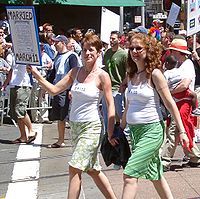
Family issues were significant concerns for lesbians when gay activism became more vocal in the 1960s and 1970s. Custody issues in particular were of interest since often courts would not award custody to mothers who were openly homosexual, even though the general procedure acknowledged children were awarded to the biological mother. Several studies performed as a result of custody disputes viewed how children grow up with same-sex parents compared to single mothers who did not identify as lesbians. They found that children's mental health, happiness, and overall adjustment is similar to children of divorced women who are not lesbians. Sexual orientation, gender identity, and sex roles of children who grow up with lesbian mothers are unaffected. Differences that were found include the fact that divorced lesbians tend to be living with a partner, fathers visit divorced lesbian mothers more often than divorced nonlesbian mothers, and lesbian mothers report a greater fear of losing their children through legal means.
Improving opportunities for growing families of same-sex couples has shaped the political landscape within the past ten years. A push for same-sex marriage
Same-sex marriage
Same-sex marriage is marriage between two persons of the same biological sex or social gender. Supporters of legal recognition for same-sex marriage typically refer to such recognition as marriage equality....
in western countries has replaced other political objectives. As of 2009, seven countries and four U.S. states offer same-sex marriage; civil unions are offered as an option in many European countries, U.S. states and individual municipalities. The ability to adopt domestically or internationally children or provide a home as a foster parent is also a political and family priority for many lesbians, as is improving access to artificial insemination
Artificial insemination
Artificial insemination, or AI, is the process by which sperm is placed into the reproductive tract of a female for the purpose of impregnating the female by using means other than sexual intercourse or natural insemination...
.
See also
- Biology and sexual orientationBiology and sexual orientationBiology and sexual orientation is the subject of research into the role of biology in the development of human sexual orientation. No simple, single cause for sexual orientation has been conclusively demonstrated, but research suggests that it is by a combination of genetic, hormonal, and...
- Lesbian sexual practicesLesbian sexual practicesLesbian sexual practices are sexual activities where the participants are only women. The participants can be lesbian or bisexual women, though some prefer to refer to themselves as women who have sex with women and dispense with sexual identification...
:Category:Lesbian organizations
- Lesbian science fiction
- Lesbianism in eroticaLesbianism in eroticaDepiction of lesbianism has been a relatively common theme in erotic art and pornography throughout history. Studies indicate that heterosexual men were more aroused by depictions involving lesbian sex than they are by depictions of heterosexual activity, while heterosexual and lesbian women were...
- List of lesbian periodicals
- Yuri (genre)
External links
- 'Late-Life Lesbians' Reveal Fluidity Of Sexuality - audio report by NPRNPRNPR, formerly National Public Radio, is a privately and publicly funded non-profit membership media organization that serves as a national syndicator to a network of 900 public radio stations in the United States. NPR was created in 1970, following congressional passage of the Public Broadcasting...