


Saadi (poet)

Encyclopedia
Abū-Muḥammad Muṣliḥ al-Dīn bin Abdallāh Shīrāzī better known by his pen-name as Saʿdī or, simply, Saadi, was one of the major Persian poets of the medieval period. He is not only famous in Persian-speaking
countries, but he has also been quoted in western sources. He is recognized for the quality of his writings, and for the depth of his social
and moral thoughts.
, his father died when he was an infant. Saadi experienced a youth of poverty and hardship, and left his native town at a young age for Baghdad
to pursue a better education. As a young man he was inducted to study at the famous an-Nizzāmīya
center of knowledge (1195–1226), where he excelled in Islamic Science
s, law
, governance
, history, Arabic literature
and theology.
The unsettled conditions following the Mongol invasion of Khwarezm
and Iran led him to wander for 30 years abroad through Anatolia
(he visited the Port of Adana
, and near Konya
he met proud Ghazi landlords), Syria
(he mentions the famine in Damascus
), Egypt
(of its music and Bazaar
s its clerics and elite class), and Iraq
(the port of Basra
and the Tigris
river). He also refers in his work about his travels in Sindh
(Pakistan across the Indus and Thar
with a Turkic Amir named Tughral), India (especially Somnath
where he encountered Brahmans) and Central Asia
(where he meets the survivors of the Mongol invasion in Khwarezm).
He also performed the pilgrimage to Mecca
and Medina
and also visited Jerusalem. Saadi traveled through war wrecked regions from 1271 to 1294. Due to Mongol invasions he lived in desolate areas and met caravans fearing for their lives on once lively silk trade routes. Saadi lived in isolated refugee camps where he met bandits, Imams, men who formerly owned great wealth or commanded armies, intellectuals, and ordinary people. While Mongol and European sources (such as Marco Polo
) gravitated to the potentates and courtly life of Ilkhanate
rule, Saadi mingled with the ordinary survivors of the war-torn region. He sat in remote teahouses late into the night and exchanged views with merchants, farmers, preachers, wayfarers, thieves, and Sufi mendicants. For twenty years or more, he continued the same schedule of preaching, advising, and learning, honing his sermons to reflect the wisdom and foibles of his people. Saadi's works reflects upon the lives of ordinary Iranians suffering displacement, plight, agony and conflict, during the turbulent times of Mongol invasion.
Saadi was also among those who witnessed first-hand accounts of Baghdad
's destruction by Mongol Ilkhanate invaders led by Hulagu during the year 1258. Saadi was captured by Crusaders
at Acre
where he spent 7 years as a slave digging trenches outside its fortress. He was later released after the Mamluk
s paid ransom for Muslim prisoners being held in Crusader dungeons.
When he reappeared in his native Shiraz he was an elderly man. Shiraz, under Atabak Abubakr Sa'd ibn Zangy (1231–60) was enjoying an era of relative tranquility. Saadi was not only welcomed to the city but was respected highly by the ruler and enumerated among the greats of the province. In response, Saadi took his nom de plume
from the name of the local prince, Sa'd ibn Zangi. Some of Saadi's most famous panegyrics were composed an initial gesture of gratitude in praise of the ruling house, and placed at the beginning of his Bustan. The remainder of Saadi's life seems to have been spent in Shiraz.
invasion of the Muslim World
, especially Khwarizm and Iran
, Saadi like many other Muslims was displaced by the ensuing conflict thus beginning a 30 year journey. He first took refuge at Damascus
and witnessed the famine
in one of the most efficient cities of the world. After the frightful Sack of Baghdad in 1258 by Hulegu and the Ilkhanate
Horde, Saadi visited Jerusalem and then set out on a pilgrimage to Mecca
and Medina
.
Saadi then visits Mamluk
Egypt
, of Sultan Baibars
. He mentions the Qadi
s, Mufti
s of Al-Azhar, the grand Bazaar
, music and art. At Halab Saadi joins a group of Sufis who had fought arduous battles with the Crusaders
. Further Saadi travels to Turkey
first, mentions the port city of Adana
and the wealthy Ghazi landowners in Anatolia
.
Saadi mentions Honey-gatherers in Azerbaijan
, fearful of Mongol plunder. Saadi finally returns to Iran where he meets his childhood companions in Isfahan and other cities. At Khorasan
Saadi befriends a Turkic
Emir
named Tughral. Saadi joins him and his men on their journey to Sindh
where he met Pir Puttur, a follower of the Persian Sufi grand master Shaikh Usman Marvandvi (1117–1274), Saadi then traveled across the Indus River
and when they reach the Thar Desert
, Tughral hires Hindu
sentinels. Tughral later enters service of the wealthy Delhi Sultanate
and Saadi is invited to Delhi
and later visits the Vizier
of Gujarat. During his stay in Gujarat Saadi learns more of the Hindus and visits the large temple of Somnath
; Saadi flees the temple due to an unpleasant encounter with the Brahmans.
Soon after Saadi returns to his native Shiraz
and earns the patronage of its leaders.
(The Rose Garden) in 1258. Bostan
is entirely in verse (epic metre) and consists of stories aptly illustrating the standard virtues recommended to Muslims (justice, liberality, modesty, contentment) as well as of reflections on the behaviour of dervishes and their ecstatic practices. Gulistan
is mainly in prose and contains stories and personal anecdotes. The text is interspersed with a variety of short poems, containing aphorisms, advice, and humorous reflections. Saadi demonstrates a profound awareness of the absurdity of human existence. The fate of those who depend on the changeable moods of kings is contrasted with the freedom of the dervishes.
Saadi is also remembered as a panegyrist and lyricist, the author of a number of odes portraying human experience, and also of particular odes such as the lament on the fall of Baghdad
after the Mongol invasion in 1258. His lyrics are found in Ghazaliyat (Lyrics) and his odes in Qasa'id (Odes). He is also known for a number of works in Arabic.
Of the Mongols he writes:
"after long I met him: O tiger-seizer!" I exclaimed, "what has made thee decrepit like an old fox?"
He laughed and said: "Since the days of war against the Mongols
, I have expelled the thoughts of fighting from my head. Then did I see the earth arrayed with spears like a forest of reeds. I raised like smoke the dust of conflict; but when Fortune does not favour, of what avail is fury? I am one who, in combat, could take with a spear a ring from the palm of the hand; but, as my star did not befriend me, they encircled me as with a ring. I seized the opportunity of flight, for only a fool strives with Fate. How could my helmet and cuirass aid me when my bright star favoured me not? When the key of victory is not in the hand, no one can break open the door of conquest with his arms.
"The enemy were a pack of leopards, and as strong as elephants. The heads of the heroes were encased in iron, as were also the hoofs of the horses. We urged on our Arab steeds like a cloud, and when the two armies encountered each other thou wouldst have said they had struck the sky down to the earth. From the raining of arrows, that descended like hail, the storm of death arose in every corner. Not one of our troops came out of the battle but his cuirass was soaked with blood. Not that our swords were blunt—it was the vengeance of stars of ill fortune. Overpowered, we surrendered, like a fish which, though protected by scales, is caught by the hook in the bait. Since Fortune averted her face, useless was our shield against the arrows of Fate."
Alexander Pushkin, one of Russia's most celebrated poets, quotes Saadi in his masterpiece Eugene Onegin
:
Saadi distinguished between the spiritual and the practical or mundane aspects of life. In his Bostan
, for example, spiritual Saadi uses the mundane world as a spring board to propel himself beyond the earthly realms. The images in Bostan
are delicate in nature and soothing. In the Gulistan
, on the other hand, mundane Saadi lowers the spiritual to touch the heart of his fellow wayfarers. Here the images are graphic and, thanks to Saadi's dexterity, remain concrete in the reader's mind. Realistically, too, there is a ring of truth in the division. The Sheikh preaching in the Khanqah
experiences a totally different world than the merchant passing through a town. The unique thing about Saadi is that he embodies both the Sufi Sheikh and the travelling merchant. They are, as he himself puts it, two almond kernels in the same shell.
Saadi's prose style, described as "simple but impossible to imitate" flows quite naturally and effortlessly. Its simplicity, however, is grounded in a semantic web consisting of synonymy, homophony
, and oxymoron
buttressed by internal rhythm
and external rhyme
something that Dr. Iraj Bashiri quite skillfully captures in his translation of the Prologue of the work:
 Chief among these works is Goethe's West-Oestlicher Divan. Andre du Ryer
was the first European to present Saadi to the West, by means of a partial French
translation of Gulistan in 1634. Adam Olearius
followed soon with a complete translation of the Bustan and the Gulistan into German
in 1654.
Ralph Waldo Emerson
was also an avid fan of Sadi's writings, contributing to some translated editions himself. Emerson, who read Saadi only in translation, compared his writing to the Bible
in terms of its wisdom and the beauty of its narrative.
Saadi is well known for his aphorisms, the most famous of which, Bani Adam, calls for breaking all barriers:
که در آفرینش ز یک گوهرند
Persian language
Persian is an Iranian language within the Indo-Iranian branch of the Indo-European languages. It is primarily spoken in Iran, Afghanistan, Tajikistan and countries which historically came under Persian influence...
countries, but he has also been quoted in western sources. He is recognized for the quality of his writings, and for the depth of his social
Social theory
Social theories are theoretical frameworks which are used to study and interpret social phenomena within a particular school of thought. An essential tool used by social scientists, theories relate to historical debates over the most valid and reliable methodologies , as well as the primacy of...
and moral thoughts.
Biography
A native of ShirazShiraz, Iran
Shiraz is the sixth most populous city in Iran and is the capital of Fars Province, the city's 2009 population was 1,455,073. Shiraz is located in the southwest of Iran on the Roodkhaneye Khoshk seasonal river...
, his father died when he was an infant. Saadi experienced a youth of poverty and hardship, and left his native town at a young age for Baghdad
Baghdad
Baghdad is the capital of Iraq, as well as the coterminous Baghdad Governorate. The population of Baghdad in 2011 is approximately 7,216,040...
to pursue a better education. As a young man he was inducted to study at the famous an-Nizzāmīya
Al-Nizamiyya of Baghdad
Al-Nizamiyya of Baghdad was one the first Islamic universities, established in July of 1091 when Nizam al-Mulk appointed the 33-year-old Al-Ghazali as a professor of the school....
center of knowledge (1195–1226), where he excelled in Islamic Science
Islamic science
Science in the medieval Islamic world, also known as Islamic science or Arabic science, is the science developed and practised in the Islamic world during the Islamic Golden Age . During this time, Indian, Iranian and especially Greek knowledge was translated into Arabic...
s, law
Law
Law is a system of rules and guidelines which are enforced through social institutions to govern behavior, wherever possible. It shapes politics, economics and society in numerous ways and serves as a social mediator of relations between people. Contract law regulates everything from buying a bus...
, governance
Governance
Governance is the act of governing. It relates to decisions that define expectations, grant power, or verify performance. It consists of either a separate process or part of management or leadership processes...
, history, Arabic literature
Arabic literature
Arabic literature is the writing produced, both prose and poetry, by writers in the Arabic language. The Arabic word used for literature is adab which is derived from a meaning of etiquette, and implies politeness, culture and enrichment....
and theology.
The unsettled conditions following the Mongol invasion of Khwarezm
Khwarezm
Khwarezm, or Chorasmia, is a large oasis region on the Amu Darya river delta in western Central Asia, which borders to the north the Aral Sea, to the east the Kyzylkum desert, to the south the Karakum desert and to the west the Ustyurt Plateau...
and Iran led him to wander for 30 years abroad through Anatolia
Anatolia
Anatolia is a geographic and historical term denoting the westernmost protrusion of Asia, comprising the majority of the Republic of Turkey...
(he visited the Port of Adana
Adana
Adana is a city in southern Turkey and a major agricultural and commercial center. The city is situated on the Seyhan River, 30 kilometres inland from the Mediterranean, in south-central Anatolia...
, and near Konya
Konya
Konya is a city in the Central Anatolia Region of Turkey. The metropolitan area in the entire Konya Province had a population of 1,036,027 as of 2010, making the city seventh most populous in Turkey.-Etymology:...
he met proud Ghazi landlords), Syria
Syria
Syria , officially the Syrian Arab Republic , is a country in Western Asia, bordering Lebanon and the Mediterranean Sea to the West, Turkey to the north, Iraq to the east, Jordan to the south, and Israel to the southwest....
(he mentions the famine in Damascus
Damascus
Damascus , commonly known in Syria as Al Sham , and as the City of Jasmine , is the capital and the second largest city of Syria after Aleppo, both are part of the country's 14 governorates. In addition to being one of the oldest continuously inhabited cities in the world, Damascus is a major...
), Egypt
Egypt
Egypt , officially the Arab Republic of Egypt, Arabic: , is a country mainly in North Africa, with the Sinai Peninsula forming a land bridge in Southwest Asia. Egypt is thus a transcontinental country, and a major power in Africa, the Mediterranean Basin, the Middle East and the Muslim world...
(of its music and Bazaar
Bazaar
A bazaar , Cypriot Greek: pantopoula) is a permanent merchandising area, marketplace, or street of shops where goods and services are exchanged or sold. The term is sometimes also used to refer to the "network of merchants, bankers and craftsmen" who work that area...
s its clerics and elite class), and Iraq
Iraq
Iraq ; officially the Republic of Iraq is a country in Western Asia spanning most of the northwestern end of the Zagros mountain range, the eastern part of the Syrian Desert and the northern part of the Arabian Desert....
(the port of Basra
Basra
Basra is the capital of Basra Governorate, in southern Iraq near Kuwait and Iran. It had an estimated population of two million as of 2009...
and the Tigris
Tigris
The Tigris River is the eastern member of the two great rivers that define Mesopotamia, the other being the Euphrates. The river flows south from the mountains of southeastern Turkey through Iraq.-Geography:...
river). He also refers in his work about his travels in Sindh
Sindh
Sindh historically referred to as Ba'ab-ul-Islam , is one of the four provinces of Pakistan and historically is home to the Sindhi people. It is also locally known as the "Mehran". Though Muslims form the largest religious group in Sindh, a good number of Christians, Zoroastrians and Hindus can...
(Pakistan across the Indus and Thar
Thar Desert
The Thar Desert |Punjab]] province. The Cholistan Desert adjoins the Thar desert spreading into Pakistani Punjab province.-Location and description:...
with a Turkic Amir named Tughral), India (especially Somnath
Somnath
The Somnath Temple located in the Prabhas Kshetra near Veraval in Saurashtra, on the western coast of Gujarat, India, is one of the twelve Jyotirlinga shrines of the God Shiva. Somnath means "The Protector of Moon God". The Somnath Temple is known as "the Shrine Eternal", having been destroyed...
where he encountered Brahmans) and Central Asia
Central Asia
Central Asia is a core region of the Asian continent from the Caspian Sea in the west, China in the east, Afghanistan in the south, and Russia in the north...
(where he meets the survivors of the Mongol invasion in Khwarezm).
He also performed the pilgrimage to Mecca
Mecca
Mecca is a city in the Hijaz and the capital of Makkah province in Saudi Arabia. The city is located inland from Jeddah in a narrow valley at a height of above sea level...
and Medina
Medina
Medina , or ; also transliterated as Madinah, or madinat al-nabi "the city of the prophet") is a city in the Hejaz region of western Saudi Arabia, and serves as the capital of the Al Madinah Province. It is the second holiest city in Islam, and the burial place of the Islamic Prophet Muhammad, and...
and also visited Jerusalem. Saadi traveled through war wrecked regions from 1271 to 1294. Due to Mongol invasions he lived in desolate areas and met caravans fearing for their lives on once lively silk trade routes. Saadi lived in isolated refugee camps where he met bandits, Imams, men who formerly owned great wealth or commanded armies, intellectuals, and ordinary people. While Mongol and European sources (such as Marco Polo
Marco Polo
Marco Polo was a Venetian merchant traveler from the Venetian Republic whose travels are recorded in Il Milione, a book which did much to introduce Europeans to Central Asia and China. He learned about trading whilst his father and uncle, Niccolò and Maffeo, travelled through Asia and apparently...
) gravitated to the potentates and courtly life of Ilkhanate
Ilkhanate
The Ilkhanate, also spelled Il-khanate , was a Mongol khanate established in Azerbaijan and Persia in the 13th century, considered a part of the Mongol Empire...
rule, Saadi mingled with the ordinary survivors of the war-torn region. He sat in remote teahouses late into the night and exchanged views with merchants, farmers, preachers, wayfarers, thieves, and Sufi mendicants. For twenty years or more, he continued the same schedule of preaching, advising, and learning, honing his sermons to reflect the wisdom and foibles of his people. Saadi's works reflects upon the lives of ordinary Iranians suffering displacement, plight, agony and conflict, during the turbulent times of Mongol invasion.
Saadi was also among those who witnessed first-hand accounts of Baghdad
Baghdad
Baghdad is the capital of Iraq, as well as the coterminous Baghdad Governorate. The population of Baghdad in 2011 is approximately 7,216,040...
's destruction by Mongol Ilkhanate invaders led by Hulagu during the year 1258. Saadi was captured by Crusaders
Crusaders
The Crusaders are a New Zealand professional rugby union team based in Christchurch that competes in the Super Rugby competition. They are the most successful team in Super Rugby history with seven titles...
at Acre
District of Acre
The Sanjak of Acre was a prefecture of the Ottoman Empire, located in modern-day northern Israel. The city of Acre was the sanjak's capital.Acre was captured by the Ottoman Sultan Selim I in 1517, but the city fell into disuse soon thereafter...
where he spent 7 years as a slave digging trenches outside its fortress. He was later released after the Mamluk
Mamluk
A Mamluk was a soldier of slave origin, who were predominantly Cumans/Kipchaks The "mamluk phenomenon", as David Ayalon dubbed the creation of the specific warrior...
s paid ransom for Muslim prisoners being held in Crusader dungeons.
When he reappeared in his native Shiraz he was an elderly man. Shiraz, under Atabak Abubakr Sa'd ibn Zangy (1231–60) was enjoying an era of relative tranquility. Saadi was not only welcomed to the city but was respected highly by the ruler and enumerated among the greats of the province. In response, Saadi took his nom de plume
Pen name
A pen name, nom de plume, or literary double, is a pseudonym adopted by an author. A pen name may be used to make the author's name more distinctive, to disguise his or her gender, to distance an author from some or all of his or her works, to protect the author from retribution for his or her...
from the name of the local prince, Sa'd ibn Zangi. Some of Saadi's most famous panegyrics were composed an initial gesture of gratitude in praise of the ruling house, and placed at the beginning of his Bustan. The remainder of Saadi's life seems to have been spent in Shiraz.
The Journey of Saadi Shirazi
Due to the Mongol EmpireMongol Empire
The Mongol Empire , initially named as Greater Mongol State was a great empire during the 13th and 14th centuries...
invasion of the Muslim World
Muslim world
The term Muslim world has several meanings. In a religious sense, it refers to those who adhere to the teachings of Islam, referred to as Muslims. In a cultural sense, it refers to Islamic civilization, inclusive of non-Muslims living in that civilization...
, especially Khwarizm and Iran
Iran
Iran , officially the Islamic Republic of Iran , is a country in Southern and Western Asia. The name "Iran" has been in use natively since the Sassanian era and came into use internationally in 1935, before which the country was known to the Western world as Persia...
, Saadi like many other Muslims was displaced by the ensuing conflict thus beginning a 30 year journey. He first took refuge at Damascus
Damascus
Damascus , commonly known in Syria as Al Sham , and as the City of Jasmine , is the capital and the second largest city of Syria after Aleppo, both are part of the country's 14 governorates. In addition to being one of the oldest continuously inhabited cities in the world, Damascus is a major...
and witnessed the famine
Famine
A famine is a widespread scarcity of food, caused by several factors including crop failure, overpopulation, or government policies. This phenomenon is usually accompanied or followed by regional malnutrition, starvation, epidemic, and increased mortality. Every continent in the world has...
in one of the most efficient cities of the world. After the frightful Sack of Baghdad in 1258 by Hulegu and the Ilkhanate
Ilkhanate
The Ilkhanate, also spelled Il-khanate , was a Mongol khanate established in Azerbaijan and Persia in the 13th century, considered a part of the Mongol Empire...
Horde, Saadi visited Jerusalem and then set out on a pilgrimage to Mecca
Mecca
Mecca is a city in the Hijaz and the capital of Makkah province in Saudi Arabia. The city is located inland from Jeddah in a narrow valley at a height of above sea level...
and Medina
Medina
Medina , or ; also transliterated as Madinah, or madinat al-nabi "the city of the prophet") is a city in the Hejaz region of western Saudi Arabia, and serves as the capital of the Al Madinah Province. It is the second holiest city in Islam, and the burial place of the Islamic Prophet Muhammad, and...
.
Saadi then visits Mamluk
Mamluk
A Mamluk was a soldier of slave origin, who were predominantly Cumans/Kipchaks The "mamluk phenomenon", as David Ayalon dubbed the creation of the specific warrior...
Egypt
Egypt
Egypt , officially the Arab Republic of Egypt, Arabic: , is a country mainly in North Africa, with the Sinai Peninsula forming a land bridge in Southwest Asia. Egypt is thus a transcontinental country, and a major power in Africa, the Mediterranean Basin, the Middle East and the Muslim world...
, of Sultan Baibars
Baibars
Baibars or Baybars , nicknamed Abu l-Futuh , was a Mamluk Sultan of Egypt. He was one of the commanders of the forces which inflicted a devastating defeat on the Seventh Crusade of King Louis IX of France and he led the vanguard of the Egyptian army at the Battle of Ain Jalut in 1260, which marked...
. He mentions the Qadi
Qadi
Qadi is a judge ruling in accordance with Islamic religious law appointed by the ruler of a Muslim country. Because Islam makes no distinction between religious and secular domains, qadis traditionally have jurisdiction over all legal matters involving Muslims...
s, Mufti
Mufti
A mufti is a Sunni Islamic scholar who is an interpreter or expounder of Islamic law . In religious administrative terms, a mufti is roughly equivalent to a deacon to a Sunni population...
s of Al-Azhar, the grand Bazaar
Bazaar
A bazaar , Cypriot Greek: pantopoula) is a permanent merchandising area, marketplace, or street of shops where goods and services are exchanged or sold. The term is sometimes also used to refer to the "network of merchants, bankers and craftsmen" who work that area...
, music and art. At Halab Saadi joins a group of Sufis who had fought arduous battles with the Crusaders
Crusaders
The Crusaders are a New Zealand professional rugby union team based in Christchurch that competes in the Super Rugby competition. They are the most successful team in Super Rugby history with seven titles...
. Further Saadi travels to Turkey
Turkey
Turkey , known officially as the Republic of Turkey , is a Eurasian country located in Western Asia and in East Thrace in Southeastern Europe...
first, mentions the port city of Adana
Adana
Adana is a city in southern Turkey and a major agricultural and commercial center. The city is situated on the Seyhan River, 30 kilometres inland from the Mediterranean, in south-central Anatolia...
and the wealthy Ghazi landowners in Anatolia
Anatolia
Anatolia is a geographic and historical term denoting the westernmost protrusion of Asia, comprising the majority of the Republic of Turkey...
.
Saadi mentions Honey-gatherers in Azerbaijan
Azerbaijan
Azerbaijan , officially the Republic of Azerbaijan is the largest country in the Caucasus region of Eurasia. Located at the crossroads of Western Asia and Eastern Europe, it is bounded by the Caspian Sea to the east, Russia to the north, Georgia to the northwest, Armenia to the west, and Iran to...
, fearful of Mongol plunder. Saadi finally returns to Iran where he meets his childhood companions in Isfahan and other cities. At Khorasan
Greater Khorasan
Greater Khorasan or Ancient Khorasan is a historical region of Greater Iran mentioned in sources from Sassanid and Islamic eras which "frequently" had a denotation wider than current three provinces of Khorasan in Iran...
Saadi befriends a Turkic
Turkic peoples
The Turkic peoples are peoples residing in northern, central and western Asia, southern Siberia and northwestern China and parts of eastern Europe. They speak languages belonging to the Turkic language family. They share, to varying degrees, certain cultural traits and historical backgrounds...
Emir
Emir
Emir , meaning "commander", "general", or "prince"; also transliterated as Amir, Aamir or Ameer) is a title of high office, used throughout the Muslim world...
named Tughral. Saadi joins him and his men on their journey to Sindh
Sindh
Sindh historically referred to as Ba'ab-ul-Islam , is one of the four provinces of Pakistan and historically is home to the Sindhi people. It is also locally known as the "Mehran". Though Muslims form the largest religious group in Sindh, a good number of Christians, Zoroastrians and Hindus can...
where he met Pir Puttur, a follower of the Persian Sufi grand master Shaikh Usman Marvandvi (1117–1274), Saadi then traveled across the Indus River
Indus River
The Indus River is a major river which flows through Pakistan. It also has courses through China and India.Originating in the Tibetan plateau of western China in the vicinity of Lake Mansarovar in Tibet Autonomous Region, the river runs a course through the Ladakh district of Jammu and Kashmir and...
and when they reach the Thar Desert
Thar Desert
The Thar Desert |Punjab]] province. The Cholistan Desert adjoins the Thar desert spreading into Pakistani Punjab province.-Location and description:...
, Tughral hires Hindu
Hindu
Hindu refers to an identity associated with the philosophical, religious and cultural systems that are indigenous to the Indian subcontinent. As used in the Constitution of India, the word "Hindu" is also attributed to all persons professing any Indian religion...
sentinels. Tughral later enters service of the wealthy Delhi Sultanate
Delhi Sultanate
The Delhi Sultanate is a term used to cover five short-lived, Delhi based kingdoms or sultanates, of Turkic origin in medieval India. The sultanates ruled from Delhi between 1206 and 1526, when the last was replaced by the Mughal dynasty...
and Saadi is invited to Delhi
Delhi
Delhi , officially National Capital Territory of Delhi , is the largest metropolis by area and the second-largest by population in India, next to Mumbai. It is the eighth largest metropolis in the world by population with 16,753,265 inhabitants in the Territory at the 2011 Census...
and later visits the Vizier
Vizier
A vizier or in Arabic script ; ; sometimes spelled vazir, vizir, vasir, wazir, vesir, or vezir) is a high-ranking political advisor or minister in a Muslim government....
of Gujarat. During his stay in Gujarat Saadi learns more of the Hindus and visits the large temple of Somnath
Somnath
The Somnath Temple located in the Prabhas Kshetra near Veraval in Saurashtra, on the western coast of Gujarat, India, is one of the twelve Jyotirlinga shrines of the God Shiva. Somnath means "The Protector of Moon God". The Somnath Temple is known as "the Shrine Eternal", having been destroyed...
; Saadi flees the temple due to an unpleasant encounter with the Brahmans.
Soon after Saadi returns to his native Shiraz
Shiraz
Shiraz may refer to:* Shiraz, Iran, a city in Iran* Shiraz County, an administrative subdivision of Iran* Vosketap, Armenia, formerly called ShirazPeople:* Hovhannes Shiraz, Armenian poet* Ara Shiraz, Armenian sculptor...
and earns the patronage of its leaders.
His works
His best known works are Bostan (The Orchard) completed in 1257 and GulistanGulistan of Sa'di
The Gulistan is a landmark literary work in Persian literature, perhaps its single most influential work of prose. Written in 1259 CE, it is one of two major works of the Persian poet Sa'di, considered one of the greatest medieval Persian poets. It is also one of his most popular books, and...
(The Rose Garden) in 1258. Bostan
Bostan
Bostan is a book of poetry by the Persian poet Saadi, completed in 1257.It was Saadi's first work, and its title means "the fruit orchard". The book contains the fruits of Saadi's long experience and his judgements upon life, and is illustrated by a vast collection of anecdotes. It includes...
is entirely in verse (epic metre) and consists of stories aptly illustrating the standard virtues recommended to Muslims (justice, liberality, modesty, contentment) as well as of reflections on the behaviour of dervishes and their ecstatic practices. Gulistan
Gulistan of Sa'di
The Gulistan is a landmark literary work in Persian literature, perhaps its single most influential work of prose. Written in 1259 CE, it is one of two major works of the Persian poet Sa'di, considered one of the greatest medieval Persian poets. It is also one of his most popular books, and...
is mainly in prose and contains stories and personal anecdotes. The text is interspersed with a variety of short poems, containing aphorisms, advice, and humorous reflections. Saadi demonstrates a profound awareness of the absurdity of human existence. The fate of those who depend on the changeable moods of kings is contrasted with the freedom of the dervishes.
Saadi is also remembered as a panegyrist and lyricist, the author of a number of odes portraying human experience, and also of particular odes such as the lament on the fall of Baghdad
Baghdad
Baghdad is the capital of Iraq, as well as the coterminous Baghdad Governorate. The population of Baghdad in 2011 is approximately 7,216,040...
after the Mongol invasion in 1258. His lyrics are found in Ghazaliyat (Lyrics) and his odes in Qasa'id (Odes). He is also known for a number of works in Arabic.
Of the Mongols he writes:
- In Isfahan I had a friend who was warlike, spirited, and shrewd. His hands and dagger were forever stained with blood. The hearts of his enemies were consumed by fear of him; even the tigers stood in awe of him. In battle he was like a sparrow among locusts; but in combat,
"after long I met him: O tiger-seizer!" I exclaimed, "what has made thee decrepit like an old fox?"
He laughed and said: "Since the days of war against the Mongols
Mongols
Mongols ) are a Central-East Asian ethnic group that lives mainly in the countries of Mongolia, China, and Russia. In China, ethnic Mongols can be found mainly in the central north region of China such as Inner Mongolia...
, I have expelled the thoughts of fighting from my head. Then did I see the earth arrayed with spears like a forest of reeds. I raised like smoke the dust of conflict; but when Fortune does not favour, of what avail is fury? I am one who, in combat, could take with a spear a ring from the palm of the hand; but, as my star did not befriend me, they encircled me as with a ring. I seized the opportunity of flight, for only a fool strives with Fate. How could my helmet and cuirass aid me when my bright star favoured me not? When the key of victory is not in the hand, no one can break open the door of conquest with his arms.
"The enemy were a pack of leopards, and as strong as elephants. The heads of the heroes were encased in iron, as were also the hoofs of the horses. We urged on our Arab steeds like a cloud, and when the two armies encountered each other thou wouldst have said they had struck the sky down to the earth. From the raining of arrows, that descended like hail, the storm of death arose in every corner. Not one of our troops came out of the battle but his cuirass was soaked with blood. Not that our swords were blunt—it was the vengeance of stars of ill fortune. Overpowered, we surrendered, like a fish which, though protected by scales, is caught by the hook in the bait. Since Fortune averted her face, useless was our shield against the arrows of Fate."
Alexander Pushkin, one of Russia's most celebrated poets, quotes Saadi in his masterpiece Eugene Onegin
Eugene Onegin
Eugene Onegin is a novel in verse written by Alexander Pushkin.It is a classic of Russian literature, and its eponymous protagonist has served as the model for a number of Russian literary heroes . It was published in serial form between 1825 and 1832...
:
as Saadi sang in earlier ages,
"some are far distant, some are dead".
Saadi distinguished between the spiritual and the practical or mundane aspects of life. In his Bostan
Bostan
Bostan is a book of poetry by the Persian poet Saadi, completed in 1257.It was Saadi's first work, and its title means "the fruit orchard". The book contains the fruits of Saadi's long experience and his judgements upon life, and is illustrated by a vast collection of anecdotes. It includes...
, for example, spiritual Saadi uses the mundane world as a spring board to propel himself beyond the earthly realms. The images in Bostan
Bostan
Bostan is a book of poetry by the Persian poet Saadi, completed in 1257.It was Saadi's first work, and its title means "the fruit orchard". The book contains the fruits of Saadi's long experience and his judgements upon life, and is illustrated by a vast collection of anecdotes. It includes...
are delicate in nature and soothing. In the Gulistan
Gulistan of Sa'di
The Gulistan is a landmark literary work in Persian literature, perhaps its single most influential work of prose. Written in 1259 CE, it is one of two major works of the Persian poet Sa'di, considered one of the greatest medieval Persian poets. It is also one of his most popular books, and...
, on the other hand, mundane Saadi lowers the spiritual to touch the heart of his fellow wayfarers. Here the images are graphic and, thanks to Saadi's dexterity, remain concrete in the reader's mind. Realistically, too, there is a ring of truth in the division. The Sheikh preaching in the Khanqah
Khanqah
A Khanqah, Khaniqah , ribat, zawiya, or tekke is a building designed specifically for gatherings of a Sufi brotherhood, or tariqa, and is a place for spiritual retreat and character reformation...
experiences a totally different world than the merchant passing through a town. The unique thing about Saadi is that he embodies both the Sufi Sheikh and the travelling merchant. They are, as he himself puts it, two almond kernels in the same shell.
Saadi's prose style, described as "simple but impossible to imitate" flows quite naturally and effortlessly. Its simplicity, however, is grounded in a semantic web consisting of synonymy, homophony
Homophony
In music, homophony is a texture in which two or more parts move together in harmony, the relationship between them creating chords. This is distinct from polyphony, in which parts move with rhythmic independence, and monophony, in which all parts move in parallel rhythm and pitch. A homophonic...
, and oxymoron
Oxymoron
An oxymoron is a figure of speech that combines contradictory terms...
buttressed by internal rhythm
Rhythm
Rhythm may be generally defined as a "movement marked by the regulated succession of strong and weak elements, or of opposite or different conditions." This general meaning of regular recurrence or pattern in time may be applied to a wide variety of cyclical natural phenomena having a periodicity or...
and external rhyme
Rhyme
A rhyme is a repetition of similar sounds in two or more words and is most often used in poetry and songs. The word "rhyme" may also refer to a short poem, such as a rhyming couplet or other brief rhyming poem such as nursery rhymes.-Etymology:...
something that Dr. Iraj Bashiri quite skillfully captures in his translation of the Prologue of the work:
Andre du Ryer
André Du Ryer was a French orientalist who wrote the third western translation of the Qur'an.-Works:* Grammaire turque * Gulistan, ou l'empire des roses * L'Alcoran de Mahomet -External links:...
was the first European to present Saadi to the West, by means of a partial French
French language
French is a Romance language spoken as a first language in France, the Romandy region in Switzerland, Wallonia and Brussels in Belgium, Monaco, the regions of Quebec and Acadia in Canada, and by various communities elsewhere. Second-language speakers of French are distributed throughout many parts...
translation of Gulistan in 1634. Adam Olearius
Adam Olearius
Adam Olearius , born Adam Ölschläger or Oehlschlaeger, was a German scholar, mathematician, geographer and librarian...
followed soon with a complete translation of the Bustan and the Gulistan into German
German language
German is a West Germanic language, related to and classified alongside English and Dutch. With an estimated 90 – 98 million native speakers, German is one of the world's major languages and is the most widely-spoken first language in the European Union....
in 1654.
Ralph Waldo Emerson
Ralph Waldo Emerson
Ralph Waldo Emerson was an American essayist, lecturer, and poet, who led the Transcendentalist movement of the mid-19th century...
was also an avid fan of Sadi's writings, contributing to some translated editions himself. Emerson, who read Saadi only in translation, compared his writing to the Bible
Bible
The Bible refers to any one of the collections of the primary religious texts of Judaism and Christianity. There is no common version of the Bible, as the individual books , their contents and their order vary among denominations...
in terms of its wisdom and the beauty of its narrative.
Saadi is well known for his aphorisms, the most famous of which, Bani Adam, calls for breaking all barriers:
که در آفرینش ز یک گوهرند
- چو عضوى به درد آورد روزگار
دگر عضوها را نماند قرار - تو کز محنت دیگران بی غمی
نشاید که نامت نهند آدمی
The poem is translated by M. Aryanpoor as:
- Human beings are members of a whole,
- In creation of one essence and soul.
- If one member is afflicted with pain,
- Other members uneasy will remain.
- If you've no sympathy for human pain,
- The name of human you cannot retain!
by H. Vahid Dastjerdi as:
- Adam's sons are body limbs, to say;
- For they're created of the same clay.
- Should one organ be troubled by pain,
- Others would suffer severe strain.
- Thou, careless of people's suffering,
- Deserve not the name, "human being".
and the last translation by Dr. Iraj Bashiri:
- Of One Essence is the Human Race,
- Thusly has Creation put the Base.
- One Limb impacted is sufficient,
- For all Others to feel the Mace.
- The Unconcern'd with Others' Plight,
- Are but Brutes with Human Face.
The translations above are attempts to preserve the rhyme scheme of the original while translating into English, but may distort the meaning. What follows is an attempt at a more literal translation of the original Persian:
"Human beings (children of Adam) are the parts of a body,
They are from the same species,
When one of these parties is reached and suffering,
Others can not find neither peace nor tranquility,
If the misery of others leaves you indifferent,
And without any trouble! Then:
It is unthinkable to call yourself a human being. "
More about Saadi
In his reference article entitled as Moments with Poet Saadai, Dr Saadat NourySaadat Noury
Saadat Noury , also spelled as Saadat Nouri, is an Iranian author, a poet, and a journalist. His full name is منوچهر سعا دت نوری Manouchehr Saadat Noury .-Early life and family:...
wrote that, "Saadi died in his hometown of Shiraz
Shiraz
Shiraz may refer to:* Shiraz, Iran, a city in Iran* Shiraz County, an administrative subdivision of Iran* Vosketap, Armenia, formerly called ShirazPeople:* Hovhannes Shiraz, Armenian poet* Ara Shiraz, Armenian sculptor...
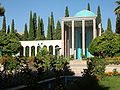
. Even from the very early days after the poet's death, the tomb of Saadi in Shiraz became a place of pilgrimage to lovers of poetry and literature. The tomb was firstly renovated during Karim Khan Zand (1750-1779), and it was then greatly elaborated in 1952 during Mohammad Reza Shah Pahlavi (1941-1979). "The tomb of Saadi of Shiraz will scent of love, even a thousand years after his death". That line of poetry composed by Saadi, inscribed on the gate leading into the garden surrounding the tomb, welcomes all those who enter to pay homage to this master of the Persian Poetry and Literature".
Obama and Saadi
U.S. PresidentPresident of the United States
The President of the United States of America is the head of state and head of government of the United States. The president leads the executive branch of the federal government and is the commander-in-chief of the United States Armed Forces....
Barack Obama
Barack Obama
Barack Hussein Obama II is the 44th and current President of the United States. He is the first African American to hold the office. Obama previously served as a United States Senator from Illinois, from January 2005 until he resigned following his victory in the 2008 presidential election.Born in...
quoted Saadi's Gulistan
Gulistan of Sa'di
The Gulistan is a landmark literary work in Persian literature, perhaps its single most influential work of prose. Written in 1259 CE, it is one of two major works of the Persian poet Sa'di, considered one of the greatest medieval Persian poets. It is also one of his most popular books, and...
in a videotaped Nowruz
Nowruz
Nowrūz is the name of the Iranian New Year in Iranian calendars and the corresponding traditional celebrations. Nowruz is also widely referred to as the Persian New Year....
(New Year's) greeting to the Iran
Iran
Iran , officially the Islamic Republic of Iran , is a country in Southern and Western Asia. The name "Iran" has been in use natively since the Sassanian era and came into use internationally in 1935, before which the country was known to the Western world as Persia...
ian people in March 2009: "There are those who insist that we be defined by our differences. But let us remember the words that were written by the poet Saadi, so many years ago: 'The children of Adam are limbs to each other, having been created of one essence.'"
See also
- List of Persian poets and authors
- Persian literaturePersian literaturePersian literature spans two-and-a-half millennia, though much of the pre-Islamic material has been lost. Its sources have been within historical Persia including present-day Iran as well as regions of Central Asia where the Persian language has historically been the national language...
- Persian literature in the WestPersian literature in the WestThe influence of Persian literature in Western culture is historically significant. In order to avoid what E.G. Browne calls "an altogether inadequate judgment of the intellectual activity of that ingenious and talented people" , many top calibre centers of academia throughout the world today from...
- Islamic scholars
- Riaz Ahmed Gohar ShahiRiaz Ahmed Gohar ShahiRiaz Ahmed Gohar Shahi is a spiritual leader, founder of the spiritual movements RAGS International and Anjuman Serfaroshan-e-Islam ....
External links
- The Bustan of Saadi, English translation, 74 p., Iran Chamber Society (PDF).
- The Golestan of Saadi, translated by Richard Francis BurtonRichard Francis BurtonCaptain Sir Richard Francis Burton KCMG FRGS was a British geographer, explorer, translator, writer, soldier, orientalist, cartographer, ethnologist, spy, linguist, poet, fencer and diplomat. He was known for his travels and explorations within Asia, Africa and the Americas as well as his...
, 213 p., Iran Chamber Society (PDF). - Golestan Saadi, the complete work, in Persian (ParsTech). This work can be freely downloaded (File size, compiled in pdf format: 485 KB).
- Saadi Shirazi, Sheikh Mosleh al-Din, Persian Language & Literature, Iran Chamber Society.
- The Gulistan of Sa'di
- Poems by Saadi English translations of Saadi's poetry.
- Saadi Photos
- Sa'di, Muslih al-Din, a biography by Professor Iraj BashiriIraj BashiriIraj Bashiri is Professor of History at the University of Minnesota, USA and one of the leading scholars in the fields of Central Asian Studies and Iranian Studies. Fluent in English, Persian/Tajik and several Turkic languages, Bashiri has been able to study and translate works otherwise...
, University of MinnesotaUniversity of MinnesotaThe University of Minnesota, Twin Cities is a public research university located in Minneapolis and St. Paul, Minnesota, United States. It is the oldest and largest part of the University of Minnesota system and has the fourth-largest main campus student body in the United States, with 52,557...
. - Sa'di and Shiraz
- Sa'di's Tomb in Shiraz
- Sa'di: A story about wealth vs. virtue - Translation from Washington State University
- Pictures of Sa'di's Tomb in Shiraz
- Scholarly article on Sa'di & his work, Encyclopædia IranicaEncyclopædia IranicaEncyclopædia Iranica is a project whose goal is to create a comprehensive and authoritative English language encyclopedia about the history, culture, and civilization of Iranian peoples from prehistory to modern times...
(Columbia UniversityColumbia UniversityColumbia University in the City of New York is a private, Ivy League university in Manhattan, New York City. Columbia is the oldest institution of higher learning in the state of New York, the fifth oldest in the United States, and one of the country's nine Colonial Colleges founded before the...
). - اشعار سعدی
- The Bustan of Sadi, tr. A. Hart Edwards, at sacred-texts.com
- complete Ghazals of Sheikh Saadi in original Persian single free pdf file uploaded by Javed Hussen