
Home      Discussion      Topics      Dictionary      Almanac
Signup       Login
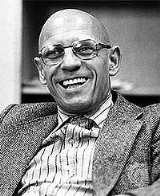
Michel Foucault

Michel Foucault

Overview
Michel Foucault born Paul-Michel Foucault (15 October 1926 – 25 June 1984), was a French philosopher, social theorist and historian of ideas. He held a chair at the Collège de France
Collège de France
The Collège de France is a higher education and research establishment located in Paris, France, in the 5th arrondissement, or Latin Quarter, across the street from the historical campus of La Sorbonne at the intersection of Rue Saint-Jacques and Rue des Écoles...

 with the title "History of Systems of Thought," and lectured at the University at Buffalo and the University of California, Berkeley
University of California, Berkeley
The University of California, Berkeley , is a teaching and research university established in 1868 and located in Berkeley, California, USA...

.
Discussion
Ask a question about 'Michel Foucault'
Start a new discussion about 'Michel Foucault'
Answer questions from other users
Full Discussion Forum
 
Unanswered Questions
Quotations

The soul is the prison of the body.

Discipline & Punish (1977) as translated by Alan Sheridan, p. 30

I'm very proud that some people think that I'm a danger for the intellectual health of students. When people start thinking of health in intellectual activities, I think there is something wrong. In their opinion I am a dangerous man, since I am a crypto-Marxist, an irrationalist, a nihilist.

Truth, Power, Self : An Interview with Michel Foucault (25 October 1982)

Qui définit le moment où j'écris?

How to define the moment that I write?

One can say that the author is an ideological product, since we represent him as the opposite of his historically real function. (When a historically given function is represented in a figure that inverts it, one has an ideological production.) The author is therefore the ideological figure by which one marks the manner in which we fear the proliferation of meaning.

"What is an author?" (1984)

There is object proof that homosexuality is more interesting than heterosexuality. It's that one knows a considerable number of heterosexuals who would wish to become homosexuals, whereas one knows very few homosexuals who would really like to become heterosexuals.

As quoted in Who's Who in Contemporary Gay & Lesbian History: From World War II to the Present Day (2001) by Robert Aldrich and Gary Wotherspoon ISBN 041522974X
Encyclopedia
Michel Foucault born Paul-Michel Foucault (15 October 1926 – 25 June 1984), was a French philosopher, social theorist and historian of ideas. He held a chair at the Collège de France
Collège de France
The Collège de France is a higher education and research establishment located in Paris, France, in the 5th arrondissement, or Latin Quarter, across the street from the historical campus of La Sorbonne at the intersection of Rue Saint-Jacques and Rue des Écoles...

 with the title "History of Systems of Thought," and lectured at the University at Buffalo and the University of California, Berkeley
University of California, Berkeley
The University of California, Berkeley , is a teaching and research university established in 1868 and located in Berkeley, California, USA...

.

Foucault is best known for his critical studies
Critical theory
Critical theory is an examination and critique of society and culture, drawing from knowledge across the social sciences and humanities. The term has two different meanings with different origins and histories: one originating in sociology and the other in literary criticism...

 of social institutions, most notably psychiatry
Psychiatry
Psychiatry is the medical specialty devoted to the study and treatment of mental disorders. These mental disorders include various affective, behavioural, cognitive and perceptual abnormalities...

, medicine, the human sciences and the prison system, as well as for his work
The History of Sexuality
The History of Sexuality is a three-volume series of books by French philosopher and historian Michel Foucault written between 1976 and 1984...

 on the history of human sexuality
History of human sexuality
The social construction of sexual behavior—its taboos, regulation and social and political impact—has had a profound effect on the various cultures of the world since prehistoric times.- Sources :...

. His writings on power
Power (sociology)
Power is a measurement of an entity's ability to control its environment, including the behavior of other entities. The term authority is often used for power perceived as legitimate by the social structure. Power can be seen as evil or unjust, but the exercise of power is accepted as endemic to...

, knowledge, and discourse have been widely influential in academic circles. In the 1960s Foucault was associated with structuralism
Structuralism
Structuralism originated in the structural linguistics of Ferdinand de Saussure and the subsequent Prague and Moscow schools of linguistics. Just as structural linguistics was facing serious challenges from the likes of Noam Chomsky and thus fading in importance in linguistics, structuralism...

, a movement from which he distanced himself. Foucault also rejected the poststructuralist and postmodernist labels later attributed to him, preferring to classify his thought as a critical history of modernity
Modernity
Modernity typically refers to a post-traditional, post-medieval historical period, one marked by the move from feudalism toward capitalism, industrialization, secularization, rationalization, the nation-state and its constituent institutions and forms of surveillance...

 rooted in Immanuel Kant
Immanuel Kant
Immanuel Kant was a German philosopher from Königsberg , researching, lecturing and writing on philosophy and anthropology at the end of the 18th Century Enlightenment....

. Foucault's project was particularly influenced by Nietzsche, his "genealogy of knowledge" being a direct allusion to Nietzsche's "genealogy of morality
On the Genealogy of Morality
On the Genealogy of Morality, or On the Genealogy of Morals , subtitled "A Polemic" , is a work by German philosopher Friedrich Nietzsche, composed and first published in 1887 with the intention of expanding and following through on certain new doctrines sketched out in his previous work Beyond...

". In a late interview he definitively stated: "I am a Nietzschean."

Foucault was listed as the most cited scholar in the humanities in 2007 by the ISI Web of Science.

Early life


Paul-Michel Foucault was born on 15 October 1926 in Poitiers
Poitiers
Poitiers is a city on the Clain river in west central France. It is a commune and the capital of the Vienne department and of the Poitou-Charentes region. The centre is picturesque and its streets are interesting for predominant remains of historical architecture, especially from the Romanesque...

, France, to a notable provincial family. His father, Paul Foucault, was an eminent surgeon
Surgeon
In medicine, a surgeon is a specialist in surgery. Surgery is a broad category of invasive medical treatment that involves the cutting of a body, whether human or animal, for a specific reason such as the removal of diseased tissue or to repair a tear or breakage...

 and hoped his son would join him in the profession. His early education was a mix of success and mediocrity until he attended the Jesuit
Society of Jesus
The Society of Jesus is a Catholic male religious order that follows the teachings of the Catholic Church. The members are called Jesuits, and are also known colloquially as "God's Army" and as "The Company," these being references to founder Ignatius of Loyola's military background and a...

 Collège Saint-Stanislas, where he excelled. During this period, Poitiers was part of Vichy France
Vichy France
Vichy France, Vichy Regime, or Vichy Government, are common terms used to describe the government of France that collaborated with the Axis powers from July 1940 to August 1944. This government succeeded the Third Republic and preceded the Provisional Government of the French Republic...

 and later came under German occupation. Foucault learned philosophy with Louis Girard.

After World War II
World War II
World War II, or the Second World War , was a global conflict lasting from 1939 to 1945, involving most of the world's nations—including all of the great powers—eventually forming two opposing military alliances: the Allies and the Axis...

, Foucault was admitted to the prestigious École Normale Supérieure
École Normale Supérieure
The École normale supérieure is one of the most prestigious French grandes écoles...

 (rue d'Ulm), the traditional gateway to an academic career in the humanities
Humanities
The humanities are academic disciplines that study the human condition, using methods that are primarily analytical, critical, or speculative, as distinguished from the mainly empirical approaches of the natural sciences....

 in France.

The École Normale Supérieure


Foucault's personal life during the École Normale was difficult—he suffered from acute depression
Clinical depression
Major depressive disorder is a mental disorder characterized by an all-encompassing low mood accompanied by low self-esteem, and by loss of interest or pleasure in normally enjoyable activities...

. As a result, he was taken to see a psychiatrist. During this time, Foucault became fascinated with psychology
Psychology
Psychology is the study of the mind and behavior. Its immediate goal is to understand individuals and groups by both establishing general principles and researching specific cases. For many, the ultimate goal of psychology is to benefit society...

. He earned a licence (degree equivalent to BA) in psychology, a very new qualification in France at the time, in addition to a degree in philosophy, in 1952. He was involved in clinical psychology, which exposed him to thinkers such as Ludwig Binswanger
Ludwig Binswanger
Ludwig Binswanger was a Swiss psychiatrist and pioneer in the field of existential psychology...

.

Foucault was a member of the French Communist Party
French Communist Party
The French Communist Party is a political party in France which advocates the principles of communism.Although its electoral support has declined in recent decades, the PCF retains a large membership, behind only that of the Union for a Popular Movement , and considerable influence in French...

 from 1950 to 1953. He was inducted into the party by his mentor Louis Althusser
Louis Althusser
Louis Pierre Althusser was a French Marxist philosopher. He was born in Algeria and studied at the École Normale Supérieure in Paris, where he eventually became Professor of Philosophy....

, but soon became disillusioned with both the politics and the philosophy of the party. Historian Emmanuel Le Roy Ladurie
Emmanuel Le Roy Ladurie
Emmanuel Le Roy Ladurie is a French historian whose work is mainly focused upon Languedoc in the ancien regime, particularly the history of the peasantry.-Early life and career:...

 reported that Foucault never actively participated in his cell, unlike many of his fellow party members.

Early career


Foucault failed at the agrégation
Agrégation
In France, the agrégation is a civil service competitive examination for some positions in the public education system. The laureates are known as agrégés...

 in 1950 but took it again and succeeded the following year. After a brief period lecturing at the École Normale, he took up a position at the Université Lille Nord de France
Université Lille Nord de France
The University of Lille -Nord de France , located in Lille, France, is a center for higher education, academic research and doctoral studies located over multiple campuses in the Academie de Lille....

, where from 1953 to 1954 he taught psychology. In 1954 Foucault published his first book, Maladie mentale et personnalité, a work he later disavowed. At this point, Foucault was not interested in a teaching career, and undertook a lengthy exile from France. In 1954 he served France as a cultural delegate to the University of Uppsala in Sweden (a position arranged for him by Georges Dumézil
Georges Dumézil
Georges Dumézil was a French comparative philologist best known for his analysis of sovereignty and power in Proto-Indo-European religion and society...

, who was to become a friend and mentor). He submitted his doctoral thesis in Uppsala, but it was rejected there. In 1958 Foucault left Uppsala and briefly held positions at Warsaw University and at the University of Hamburg
University of Hamburg
The University of Hamburg is a university in Hamburg, Germany. It was founded on 28 March 1919 by Wilhelm Stern and others. It grew out of the previous Allgemeines Vorlesungswesen and the Kolonialinstitut as well as the Akademisches Gymnasium. There are around 38,000 students as of the start of...

.

Foucault returned to France in 1960 to complete his doctorate and take up a post in philosophy at the University of Clermont-Ferrand
Blaise Pascal University
Blaise Pascal University , also known as"Université Blaise Pascal, Clermont-Ferrand II" or just Clermont-Ferrand II, is a public university with its main campus on in Clermont-Ferrand, France, with satellite locations in other parts of the region of Auvergne, including Vichy, Moulins, Montlucon,...

. There he met philosopher Daniel Defert
Daniel Defert
Daniel Defert is a prominent French AIDS activist and the founding president of the first AIDS awareness organization in France, AIDES. He started the organization after the death of his partner, the French philosopher Michel Foucault...

, who would become his partner of twenty years. In 1961 he earned his doctorate by submitting two theses (as is customary in France): a "major" thesis entitled Folie et déraison: Histoire de la folie à l'âge classique (Madness and Insanity: History of Madness in the Classical Age) and a "secondary" thesis that involved a translation of, and commentary on Kant's
Immanuel Kant
Immanuel Kant was a German philosopher from Königsberg , researching, lecturing and writing on philosophy and anthropology at the end of the 18th Century Enlightenment....

 Anthropology from a Pragmatic Point of View
Introduction to Kant's Anthropology
Introduction to Kant's Anthropology is an introductory essay to Michel Foucault's translation of Immanuel Kant's 1798 essay, Anthropology from a Pragmatic Point of View...

. Folie et déraison (Madness and Insanity – published in an abridged edition in English as Madness and Civilization
Madness and Civilization
Madness and Civilization: A History of Insanity in the Age of Reason by Michel Foucault, is the English edition of Histoire de la folie à l'âge classique, a 1964 abridged edition of the 1961 Folie et déraison: Histoire de la folie à l'âge classique. An English translation of the complete 1961...

and finally published unabridged as "History of Madness" by Routledge in 2006) was extremely well received. Foucault continued a vigorous publishing schedule. In 1963 he published Naissance de la Clinique (Birth of the Clinic), Raymond Roussel
Raymond Roussel
Raymond Roussel was a French poet, novelist, playwright, musician, and chess enthusiast. Through his novels, poems, and plays he exerted a profound influence on certain groups within 20th century French literature, including the Surrealists, Oulipo, and the authors of the nouveau...

, and a reissue of his 1954 volume (now entitled Maladie mentale et psychologie or, in English, "Mental Illness and Psychology"), which again, he later disavowed.

After Defert was posted to Tunisia
Tunisia
Tunisia , officially the Tunisian RepublicThe long name of Tunisia in other languages used in the country is: , is the northernmost country in Africa. It is a Maghreb country and is bordered by Algeria to the west, Libya to the southeast, and the Mediterranean Sea to the north and east. Its area...

 for his military service
Military service
Military service, in its simplest sense, is service by an individual or group in an army or other militia, whether as a chosen job or as a result of an involuntary draft . Some nations require a specific amount of military service from every citizen...

, Foucault moved to a position at the University of Tunis in 1965. He published Les Mots et les choses (The Order of Things
The Order of Things
The Order of Things is a book by Michel Foucault first published in 1966. The full title is Les Mots et les choses: Une archéologie des sciences humaines...

) during the height of interest in structuralism
Structuralism
Structuralism originated in the structural linguistics of Ferdinand de Saussure and the subsequent Prague and Moscow schools of linguistics. Just as structural linguistics was facing serious challenges from the likes of Noam Chomsky and thus fading in importance in linguistics, structuralism...

 in 1966, and Foucault was quickly grouped with scholars such as Jacques Lacan
Jacques Lacan
Jacques Marie Émile Lacan was a French psychoanalyst and psychiatrist who made prominent contributions to psychoanalysis and philosophy, and has been called "the most controversial psycho-analyst since Freud". Giving yearly seminars in Paris from 1953 to 1981, Lacan influenced France's...

, Claude Lévi-Strauss
Claude Lévi-Strauss
Claude Lévi-Strauss was a French anthropologist and ethnologist, and has been called, along with James George Frazer, the "father of modern anthropology"....

, and Roland Barthes
Roland Barthes
Roland Gérard Barthes was a French literary theorist, philosopher, critic, and semiotician. Barthes' ideas explored a diverse range of fields and he influenced the development of schools of theory including structuralism, semiotics, existentialism, social theory, Marxism, anthropology and...

 as the newest, latest wave of thinkers set to topple the existentialism
Existentialism
Existentialism is a term applied to a school of 19th- and 20th-century philosophers who, despite profound doctrinal differences, shared the belief that philosophical thinking begins with the human subject—not merely the thinking subject, but the acting, feeling, living human individual...

 popularized by Jean-Paul Sartre
Jean-Paul Sartre
Jean-Paul Charles Aymard Sartre was a French existentialist philosopher, playwright, novelist, screenwriter, political activist, biographer, and literary critic. He was one of the leading figures in 20th century French philosophy, particularly Marxism, and was one of the key figures in literary...

. Foucault made a number of skeptical comments about Marxism, which outraged a number of left wing critics, but later firmly rejected the "structuralist" label. He was still in Tunis
Tunis
Tunis is the capital of both the Tunisian Republic and the Tunis Governorate. It is Tunisia's largest city, with a population of 728,453 as of 2004; the greater metropolitan area holds some 2,412,500 inhabitants....

 during the May 1968 student riots, where he was profoundly affected by a local student revolt earlier in the same year. In the Autumn of 1968 he returned to France, where he published L'archéologie du savoir (The Archaeology of Knowledge
The Archaeology of Knowledge
The Archaeology of Knowledge is a book by philosopher Michel Foucault published in 1969. This volume was Foucault's main excursion into methodology, providing an anti-humanist excavation of the human sciences, particularly but not exclusively psychology and sociology...

) – a methodological treatise that included a response to his critics – in 1969.

Post-1968: as activist


In the aftermath of 1968, the French government created a new experimental university, Paris VIII, at Vincennes
Vincennes
Vincennes is a commune in the Val-de-Marne department in the eastern suburbs of Paris, France. It is located from the centre of Paris. It is one of the most densely populated municipalities in Europe.-History:...

 and appointed Foucault the first head of its philosophy department in December of that year. Foucault appointed mostly young leftist academics (such as Judith Miller
Judith Miller (philosopher)
Judith Miller is a French philosopher, and the daughter of Jacques Lacan — radical psychoanalyst, and wife to prominent Lacanian Jacques-Alain Miller....

) whose radicalism provoked the Ministry of Education, who objected to the fact that many of the course titles contained the phrase "Marxist-Leninist," and who decreed that students from Vincennes would not be eligible to become secondary school teachers. Foucault notoriously also joined students in occupying administration buildings and fighting with police.

Foucault's tenure at Vincennes was short-lived, as in 1970 he was elected to France's most prestigious academic body, the Collège de France
Collège de France
The Collège de France is a higher education and research establishment located in Paris, France, in the 5th arrondissement, or Latin Quarter, across the street from the historical campus of La Sorbonne at the intersection of Rue Saint-Jacques and Rue des Écoles...

, as Professor of the History of Systems of Thought. His political involvement increased, and his partner Defert joined the ultra-Maoist Gauche Proletarienne (GP). Foucault helped found the Prison Information Group ( or GIP) to provide a way for prisoners to voice their concerns. This coincided with Foucault's turn to the study of disciplinary institutions, with a book, Surveiller et Punir (Discipline and Punish
Discipline and Punish
Discipline and Punish: The Birth of the Prison is a book by philosopher Michel Foucault. Originally published in 1975 in France under the title Surveiller et punir: Naissance de la Prison, it was translated into English in 1977. It is an interrogation of the social and theoretical mechanisms behind...

), which "narrates" the micro-power structures that developed in Western societies since the 18th century, with a special focus on prisons and schools.

Later life


In the late 1970s, political activism in France trailed off with the disillusionment of many left wing intellectuals. A number of young Maoists abandoned their beliefs to become the so-called New Philosophers
New Philosophers
The New Philosophers is a term which refers to a generation of French philosophers who broke with Marxism in the early 1970s. They include André Glucksmann, Alain Finkielkraut, Pascal Bruckner, Bernard-Henri Lévy, Jean-Marie Benoist, Christian Jambet, Guy Lardreau and Jean-Paul Dollé...

, often citing Foucault as their major influence, a status Foucault had mixed feelings about. Foucault in this period embarked on a six-volume project The History of Sexuality
The History of Sexuality
The History of Sexuality is a three-volume series of books by French philosopher and historian Michel Foucault written between 1976 and 1984...

, which he never completed. Its first volume was published in French as La Volonté de Savoir (1976), then in English as The History of Sexuality: An Introduction (1978). The second and third volumes did not appear for another eight years, and they surprised readers by their subject matter (classical Greek and Latin texts), approach and style, particularly Foucault's focus on the human subject, a concept that some mistakenly believed he had previously neglected.

Foucault began to spend more time in the United States, at the University at Buffalo
University at Buffalo, The State University of New York
University at Buffalo, The State University of New York, also commonly known as the University at Buffalo or UB, is a public research university and a "University Center" in the State University of New York system. The university was founded by Millard Fillmore in 1846. UB has multiple campuses...

 (where he had lectured on his first ever visit to the United States in 1970) and especially at UC Berkeley. In 1975 he took LSD
LSD
Lysergic acid diethylamide, abbreviated LSD or LSD-25, also known as lysergide and colloquially as acid, is a semisynthetic psychedelic drug of the ergoline family, well known for its psychological effects which can include altered thinking processes, closed and open eye visuals, synaesthesia, an...

 at Zabriskie Point
Zabriskie Point
Zabriskie Point is a part of Amargosa Range located in east of Death Valley in Death Valley National Park in the United States noted for its erosional landscape...

 in Death Valley National Park
Death Valley National Park
Death Valley National Park is a national park in the U.S. states of California and Nevada located east of the Sierra Nevada in the arid Great Basin of the United States. The park protects the northwest corner of the Mojave Desert and contains a diverse desert environment of salt-flats, sand dunes,...

, later calling it the best experience of his life.

Iranian Revolution


In 1979 Foucault made two tours of Iran
Iran
Iran , officially the Islamic Republic of Iran , is a country in Southern and Western Asia. The name "Iran" has been in use natively since the Sassanian era and came into use internationally in 1935, before which the country was known to the Western world as Persia...

, undertaking extensive interviews with political protagonists in support of the new interim government established soon after the Iranian Revolution
Iranian Revolution
The Iranian Revolution refers to events involving the overthrow of Iran's monarchy under Shah Mohammad Reza Pahlavi and its replacement with an Islamic republic under Ayatollah Ruhollah Khomeini, the leader of the...

. In the tradition of Nietzsche and Georges Bataille
Georges Bataille
Georges Bataille was a French writer. His multifaceted work is linked to the domains of literature, anthropology, philosophy, economy, sociology and history of art...

, Foucault had embraced the artist who pushed the limits of rationality, and he wrote with great passion in defense of irrationalities that broke boundaries. In 1978, Foucault found such transgressive powers in the revolutionary figures Ayatollah Khomeini, Ali Shariati
Ali Shariati
Ali Shariati was an Iranian revolutionary and sociologist, who focused on the sociology of religion. He is held as one of the most influential Iranian intellectuals of the 20th century and has been called the 'ideologue of the Iranian Revolution'.-Biography:Ali....

 and the millions who risked death as they followed them in the course of the revolution. Both Foucault and the revolutionaries were highly critical of modernity and sought a new form of politics, they both also looked up to those who risked their lives for ideals; and both looked to the past for inspiration. Later on when Foucault went to Iran “to be there at the birth of a new form of ideas,” he wrote that the new “Muslim” style of politics could signal the beginning of a new form of “political spirituality,” not just for the Middle East, but also for Europe, which had adopted a secular politics ever since the French Revolution
French Revolution
The French Revolution , sometimes distinguished as the 'Great French Revolution' , was a period of radical social and political upheaval in France and Europe. The absolute monarchy that had ruled France for centuries collapsed in three years...

. Foucault recognized the enormous power of the new discourse of militant Islam, not just for Iran, but for the world. He wrote:
As an Islamic movement, it can set the entire region afire, overturn the most unstable regimes, and disturb the most solid. Islam which is not simply a religion, but an entire way of life, an adherence to a history and a civilization, has a good chance to become a gigantic powder keg, at the level of hundreds of millions of men. . . Indeed, it is also important to recognize that the demand for the 'legitimate rights of the Palestinian people' hardly stirred the Arab peoples. What it be if this cause encompassed the dynamism of an Islamic movement, something much stronger than those with a Marxist, Leninist, or Maoist character? (“A Powder Keg Called Islam”)
During his two trips to Iran, Foucault was commissioned as a special correspondent of a leading Italian newspaper and his articles appeared on the front page of that paper. His many essays on Iran, published in the Italian newspaper Corriere della Sera, only appeared in French in 1994 and then in English in 2005. These essays caused some controversy, with some commentators arguing that Foucault was insufficiently critical of the new regime. The more common attempts to bracket out Foucault's writings on Iran as "miscalculations," reminds some authors of what Foucault himself had criticized in his well known 1969 essay, "What is an Author?
What is an Author?
What is an Author? is an influential lecture given by French philosopher, sociologist and historian Michel Foucault on literary theoryThe work considers the relationship between author, text and reader; concluding that:...

" Foucault believed that when we include certain works in an author's career and exclude others that were written in a "different style," or were "inferior" (Foucault 1969, 111), we create a stylistic unity and a theoretical coherence. This is done by privileging certain writings as authentic and excluding others that do not fit our view of what the author ought to be: "The author is therefore the ideological figure by which one marks the manner in which we fear the proliferation of meaning" (Foucault 1969, 110). This controversy is frequently discussed in the Foucault literature.

Final years and death


In the philosopher's later years, interpreters of Foucault's work attempted to engage with the problems presented by the fact that the late Foucault seemed in tension with the philosopher's earlier work. When this issue was raised in a 1982 interview, Foucault remarked "When people say, 'Well, you thought this a few years ago and now you say something else,' my answer is… [laughs] 'Well, do you think I have worked hard all those years to say the same thing and not to be changed?'" He refused to identify himself as a philosopher, historian, structuralist, or Marxist, maintaining that "The main interest in life and work is to become someone else that you were not in the beginning." In a similar vein, he preferred not to claim that he was presenting a coherent and timeless block of knowledge; he rather desired his books "to be a kind of tool-box others can rummage through to find a tool they can use however they wish in their own area… I don't write for an audience, I write for users, not readers."

In 1992 James Miller
James Miller (academic)
James Miller is an American writer and academic. He is known for writing about Michel Foucault, philosophy as a way of life, social movements, popular culture, intellectual history, eighteenth century to the present; radical social theory and history of political philosophy...

 published a biography of Foucault that was greeted with controversy in part due to his claim that Foucault's experiences in the gay sadomasochism community during the time he taught at Berkeley directly influenced his political and philosophical works. Miller's book has been rebuked by certain Foucault scholars as being either simply misdirected, a sordid reading of his life and works, or as a politically motivated, intentional misreading.

Foucault died of an AIDS-related illness in Paris on 25 June 1984. He was the first high-profile French personality who was reported to have AIDS. Little was known about the disease at the time and there has been some controversy since. In the front-page article of Le Monde
Le Monde
Le Monde is a French daily evening newspaper owned by La Vie-Le Monde Group and edited in Paris. It is one of two French newspapers of record, and has generally been well respected since its first edition under founder Hubert Beuve-Méry on 19 December 1944...

announcing his death, there was no mention of AIDS, although it was implied that he died from a massive infection. Prior to his death, Foucault had destroyed most of his manuscripts, and in his will had prohibited the publication of what he might have overlooked.
His death is described by his close friend, Hervé Guibert
Hervé Guibert
Hervé Guibert was a homosexual French writer and photographer. The author of numerous novels and autobiographical studies, he played a considerable role in changing French public attitudes to AIDS...

, in A l'ami qui ne m'a pas sauvé la vie, under the name of Muzil.

Madness and Civilization


The English edition of Madness and Civilization is an abridged version of Folie et déraison: Histoire de la folie à l'âge classique, originally published in 1961. A full English translation titled The History of Madness has since been published by Routledge
Routledge
Routledge is a British publishing house which has operated under a succession of company names and latterly as an academic imprint. Its origins may be traced back to the 19th-century London bookseller George Routledge...

 in 2006. "Folie et deraison" originated as Foucault's doctoral dissertation; this was Foucault's first major book, mostly written while he was the Director of the Maison de France in Sweden. It examines ideas, practices, institutions, art and literature relating to madness
Insanity
Insanity, craziness or madness is a spectrum of behaviors characterized by certain abnormal mental or behavioral patterns. Insanity may manifest as violations of societal norms, including becoming a danger to themselves and others, though not all such acts are considered insanity...

 in Western history.

Foucault begins his history in the Middle Ages
Middle Ages
The Middle Ages is a periodization of European history from the 5th century to the 15th century. The Middle Ages follows the fall of the Western Roman Empire in 476 and precedes the Early Modern Era. It is the middle period of a three-period division of Western history: Classic, Medieval and Modern...

, noting the social and physical exclusion of lepers
Leprosy
Leprosy or Hansen's disease is a chronic disease caused by the bacteria Mycobacterium leprae and Mycobacterium lepromatosis. Named after physician Gerhard Armauer Hansen, leprosy is primarily a granulomatous disease of the peripheral nerves and mucosa of the upper respiratory tract; skin lesions...

. He argues that with the gradual disappearance of leprosy, madness came to occupy this excluded position. The ship of fools
Ship of Fools
The ship of fools is an allegory that has long been a fixture in Western literature and art. The allegory depicts a vessel populated by human inhabitants who are deranged, frivolous, or oblivious, passengers aboard a ship without a pilot, and seemingly ignorant of their own direction...

 in the 15th century is a literary version of one such exclusionary practice, namely that of sending mad people away in ships. In 17th century Europe, in a movement Foucault famously calls the "Great Confinement," "unreasonable" members of the population were institutionalised. In the 18th century, madness came to be seen as the reverse of Reason, and, finally, in the 19th century as mental illness
Mental illness
A mental disorder or mental illness is a psychological or behavioral pattern generally associated with subjective distress or disability that occurs in an individual, and which is not a part of normal development or culture. Such a disorder may consist of a combination of affective, behavioural,...

.

Foucault also argues that madness was silenced by Reason, losing its power to signify the limits of social order and to point to the truth. He examines the rise of scientific and "humanitarian" treatments of the insane, notably at the hands of Philippe Pinel
Philippe Pinel
Philippe Pinel was a French physician who was instrumental in the development of a more humane psychological approach to the custody and care of psychiatric patients, referred to today as moral therapy...

 and Samuel Tuke who he suggests started the conceptualization of madness as 'mental illness'. He claims that these new treatments were in fact no less controlling than previous methods. Pinel
Pinel
Pinel is the surname of:* Raquel Pinel, Spanish football forward currently playing for Valencia CF in the Spanish league* Marcel Pinel , French footballer* Suzanne Pinel, CM is a Canadian children's entertainer and citizenship judge...

's treatment of the mad amounted to an extended aversion therapy
Aversion therapy
Aversion therapy is a form of psychological treatment in which the patient is exposed to a stimulus while simultaneously being subjected to some form of discomfort...

, including such treatments as freezing showers and use of a straitjacket. In Foucault's view, this treatment amounted to repeated brutality until the pattern of judgment and punishment was internalized
Internalization
Internalization has different definitions depending on the field that the term is used in. Internalization is the opposite of externalization.- General :...

 by the patient.

The Birth of the Clinic


Foucault's second major book, The Birth of the Clinic: An Archaeology of Medical Perception (Naissance de la clinique: une archéologie du regard médical) was published in 1963 in France, and translated to English in 1973. Picking up from Madness and Civilization, The Birth of the Clinic traces the development of the medical profession, and specifically the institution of the clinique (translated as "clinic", but here largely referring to teaching hospitals). Its motif is the concept of the medical regard (translated by Alan Sheridan as "medical gaze"), traditionally limited to small, specialized institutions such as hospitals and prisons, but which Foucault examines as subjecting wider social spaces, governing the population en masse.

Death and The Labyrinth


Death and the Labyrinth: The World of Raymond Roussel was published in 1963, and translated into English in 1986. It is unique, being Foucault's only book-length work on literature. For Foucault this was "by far the book I wrote most easily and with the greatest pleasure." Here, Foucault explores theory, criticism and psychology through the texts of Raymond Roussel
Raymond Roussel
Raymond Roussel was a French poet, novelist, playwright, musician, and chess enthusiast. Through his novels, poems, and plays he exerted a profound influence on certain groups within 20th century French literature, including the Surrealists, Oulipo, and the authors of the nouveau...

, one of the fathers of experimental writing, whose work has been celebrated by the likes of Cocteau, Duchamp, Breton
André Breton
André Breton was a French writer and poet. He is known best as the founder of Surrealism. His writings include the first Surrealist Manifesto of 1924, in which he defined surrealism as "pure psychic automatism"....

, Robbe-Grillet, Gide
André Gide
André Paul Guillaume Gide was a French author and winner of the Nobel Prize in literature in 1947. Gide's career ranged from its beginnings in the symbolist movement, to the advent of anticolonialism between the two World Wars.Known for his fiction as well as his autobiographical works, Gide...

 and Giacometti.

The Order of Things


Foucault's Les Mots et les choses. Une archéologie des sciences humaines was published in 1966. It was translated into English and published by Pantheon Books
Pantheon Books
Pantheon Books is an American imprint with editorial independence that is part of the Knopf Doubleday Publishing Group.The current editor-in-chief at Pantheon Books is Dan Frank.-Overview:...

 in 1970 under the title The Order of Things: An Archaeology of the Human Sciences. Foucault had preferred L'Ordre des Choses for the original French title, but changed it as there was already another book by that name. The work broadly aims to provide an anti-humanist excavation of the human sciences, such as sociology
Sociology
Sociology is the study of society. It is a social science—a term with which it is sometimes synonymous—which uses various methods of empirical investigation and critical analysis to develop a body of knowledge about human social activity...

 and psychology
Psychology
Psychology is the study of the mind and behavior. Its immediate goal is to understand individuals and groups by both establishing general principles and researching specific cases. For many, the ultimate goal of psychology is to benefit society...

. It opens with an extended discussion of Diego Velázquez
Diego Velázquez
Diego Rodríguez de Silva y Velázquez was a Spanish painter who was the leading artist in the court of King Philip IV. He was an individualistic artist of the contemporary Baroque period, important as a portrait artist...

's painting Las Meninas
Las Meninas
Las Meninas is a 1656 painting by Diego Velázquez, the leading artist of the Spanish Golden Age, in the Museo del Prado in Madrid. The work's complex and enigmatic composition raises questions about reality and illusion, and creates an uncertain relationship between the viewer and the figures...

and the painting's complex arrangement of sight-lines, hiddenness and appearance. It then develops its central thesis: all periods of history have possessed specific underlying conditions of truth that constituted what could be expressed as discourse (for example art, science, culture, etc.). Foucault argues that these conditions of discourse have changed over time, in major and relatively sudden shifts, from one period's episteme
Episteme
Episteme, as distinguished from techne, is etymologically derived from the Greek word ἐπιστήμη for knowledge or science, which comes from the verb ἐπίσταμαι, "to know".- The Concept of an "Episteme" in Michel Foucault :...

to another. Foucault's Nietzschean critique of Enlightenment values in Les mots et les choses has been very influential in cultural studies and social work scholarship. It is in this book that Foucault claims that "man is only a recent invention" and that the "end of man" is at hand. The book made Foucault a prominent intellectual figure in France.

The Archaeology of Knowledge


Published in 1969, this volume was Foucault's main excursion into methodology
Methodology
Methodology is generally a guideline for solving a problem, with specificcomponents such as phases, tasks, methods, techniques and tools . It can be defined also as follows:...

, written as an outcome of discussions with the French Circle of Epistemology. Taking its point of departure in the French epistemological tradition, it makes few references to Anglo-American analytical philosophy except as to speech act
Speech act
Speech Act is a technical term in linguistics and the philosophy of language. The contemporary use of the term goes back to John L. Austin's doctrine of locutionary, illocutionary, and perlocutionary acts...

 theory, from which Foucault distances himself.

Foucault directs his analysis toward the "statement" (énoncé), which is the rules that render an expression (that is, a phrase
Phrase
In everyday speech, a phrase may refer to any group of words. In linguistics, a phrase is a group of words which form a constituent and so function as a single unit in the syntax of a sentence. A phrase is lower on the grammatical hierarchy than a clause....

, a proposition
Proposition
In logic and philosophy, the term proposition refers to either the "content" or "meaning" of a meaningful declarative sentence or the pattern of symbols, marks, or sounds that make up a meaningful declarative sentence...

 or a speech act ) discursively meaningful. This concept of meaning differs from the concept of signification : Though an expression is signifying, for instance "The gold mountain is in California" ), it may nevertheless be discursively meaningless and therefore have no existence within a certain discourse. For this reason, the "statement" is an existence function for discursive meaning . Being rules, the "statement" has a very special meaning in the Archaeology: it is not the expression itself, but the rules which make an expression discursively meaningful. These rules are not the syntax and semantics that makes an expression signifying. It is additional rules. In contrast to structuralists, Foucault demonstrates that the semantic and syntactic structures do not suffice to determine the discursive meaning of an expression . Depending on whether or not it complies with these rules of discursive meaning, a grammatically correct phrase may lack discursive meaning or, inversely, a grammatically incorrect sentence may be discursively meaningful - even meaningless letters, e.g. "QWERT" may have discursive meaning. Thus, the meaning of expressions depends on the conditions in which they emerge and exist within a field of discourse; the discursive meaning of an expression is reliant on the succession of statements that precede and follow it. In short, the "statements" Foucault analysed are not proposition
Proposition
In logic and philosophy, the term proposition refers to either the "content" or "meaning" of a meaningful declarative sentence or the pattern of symbols, marks, or sounds that make up a meaningful declarative sentence...

s, phrase
Phrase
In everyday speech, a phrase may refer to any group of words. In linguistics, a phrase is a group of words which form a constituent and so function as a single unit in the syntax of a sentence. A phrase is lower on the grammatical hierarchy than a clause....

s, or speech acts. Rather, "statements" constitute a network of rules establishing which expressions are discursively meaningful, and these rules are the preconditions for signifying propositions, utterances, or speech acts to have discursive meaning. However, "statements" are also 'events', because, like other rules, they appear (or disappear) at some time.

Foucault aims his analysis towards a huge organised dispersion of statements, called discursive formations. Foucault reiterates that the analysis he is outlining is only one possible procedure, and that he is not seeking to displace other ways of analysing discourse or render them as invalid.

According to Dreyfus and Rabinow, Foucault not only brackets out issues of truth
Truth
Truth has a variety of meanings, such as the state of being in accord with fact or reality. It can also mean having fidelity to an original or to a standard or ideal. In a common usage, it also means constancy or sincerity in action or character...

 (cf. Husserl), he also brackets out issues of meaning. However, Foucault does not bracket out discursive meaning. But, focusing on discursive meaning, Foucault did not look for a deeper meaning underneath discourse or for the source of meaning in some transcendental subject. Instead, Foucault analyzes the discursive and practical conditions for the existence of truth and discursive meaning. To show the principles of production of truth and discursive meaning in various discursive formations, he details how truth claims emerge during various epochs on the basis of what was actually said and written during these periods. He particularly describes the Renaissance
Renaissance
The Renaissance was a cultural movement that spanned roughly the 14th to the 17th century, beginning in Italy in the Late Middle Ages and later spreading to the rest of Europe. The term is also used more loosely to refer to the historical era, but since the changes of the Renaissance were not...

, the Age of Enlightenment
Age of Enlightenment
The Age of Enlightenment was an elite cultural movement of intellectuals in 18th century Europe that sought to mobilize the power of reason in order to reform society and advance knowledge. It promoted intellectual interchange and opposed intolerance and abuses in church and state...

, and the 20th century. He strives to avoid all interpretation and to depart from the goals of hermeneutics. This does not mean that Foucault denounces truth and discursive meaning, but just that truth
Truth
Truth has a variety of meanings, such as the state of being in accord with fact or reality. It can also mean having fidelity to an original or to a standard or ideal. In a common usage, it also means constancy or sincerity in action or character...

 and discursive meaning depend on the historical discursive and practical means of truth and meaning production. For instance, although they were radically different during Enlightenment as opposed to Modernity, there were indeed discursive meaning, truth and correct treatment of madness during both epochs (Madness and Civilization). This posture allows Foucault to denounce a priori concepts of the nature of the human subject and focus on the role of discursive practices in constituting subjectivity.

Foucault's relation to structuralism
Structuralism
Structuralism originated in the structural linguistics of Ferdinand de Saussure and the subsequent Prague and Moscow schools of linguistics. Just as structural linguistics was facing serious challenges from the likes of Noam Chomsky and thus fading in importance in linguistics, structuralism...

 seems somewhat ambiguous. However, in the preface to the English translation of Les Mots et les Choses (1970), he clearly disavowed structuralism
Structuralism
Structuralism originated in the structural linguistics of Ferdinand de Saussure and the subsequent Prague and Moscow schools of linguistics. Just as structural linguistics was facing serious challenges from the likes of Noam Chomsky and thus fading in importance in linguistics, structuralism...

:

In France certain half-witted 'commentators' persist in labelling me a 'structuralist'. I have been unable to get it into their tiny minds that I have used none of the methods, concepts, or key terms that characterize structural analysis.


Whereas structuralists search for homogeneity in a discursive entity, Foucault focuses on differences. Instead of asking what constitutes the specificity of European thought he asks what constitutes the differences developed within it and over time. Therefore, as a historical method, he refuses to examine statements outside of their historical context: the discursive formation. The meaning of a statement depends on the general rules that characterise the discursive formation to which it belongs. A discursive formation continually generates new statements, and some of these usher in changes in the discursive formation that may or may not be adopted. Therefore, to describe a discursive formation, Foucault also focuses on expelled and forgotten discourses that never happened to change the discursive formation (the genealogical analysis). Their differences from the dominant discourse also describe it. In this way one can describe specific systems that determine which types of statements emerge. In his Foucault (1986), Deleuze
Gilles Deleuze
Gilles Deleuze , was a French philosopher who, from the early 1960s until his death, wrote influentially on philosophy, literature, film, and fine art. His most popular works were the two volumes of Capitalism and Schizophrenia: Anti-Oedipus and A Thousand Plateaus , both co-written with Félix...

 describes The Archaeology of Knowledge as "the most decisive step yet taken in the theory-practice of multiplicities
Multiplicity (philosophy)
Multiplicity is a philosophical concept that Edmund Husserl and Henri Bergson developed by analogy with Riemann's description of the mathematical concept. It forms an important part of the philosophy of Gilles Deleuze, particularly in his collaboration with Félix Guattari, Capitalism and...

."

Discipline and Punish


Discipline and Punish: The Birth of the Prison was translated into English in 1977, from the French Surveiller et punir: Naissance de la prison, published in 1975. The book opens with a graphic description of the brutal public execution in 1757 of Robert-François Damiens
Robert-François Damiens
Robert-François Damiens was a French domestic servant whose attempted assassination of King Louis XV of France in 1757 culminated in his notorious and controversial public execution...

, who attempted to kill Louis XV
Louis XV of France
Louis XV was a Bourbon monarch who ruled as King of France and of Navarre from 1 September 1715 until his death. He succeeded his great-grandfather at the age of five, his first cousin Philippe II, Duke of Orléans, served as Regent of the kingdom until Louis's majority in 1723...

. Against this it juxtaposes a colourless prison timetable from just over 80 years later. Foucault then inquires how such a change in French society's punishment of convicts could have developed in such a short time. These are snapshots of two contrasting types of Foucault's "Technologies of Punishment." The first type, "Monarchical Punishment," involves the repression of the populace through brutal public displays of executions and torture
Torture
Torture is the act of inflicting severe pain as a means of punishment, revenge, forcing information or a confession, or simply as an act of cruelty. Throughout history, torture has often been used as a method of political re-education, interrogation, punishment, and coercion...

. The second, "Disciplinary Punishment," is what Foucault says is practiced in the modern era. Disciplinary punishment gives "professionals" (psychologists, programme facilitators, parole officers, etc.) power over the prisoner, most notably in that the prisoner's length of stay depends on the professionals' judgment. Foucault goes on to argue that Disciplinary punishment leads to self-policing by the populace as opposed to brutal displays of authority from the Monarchical period.

Foucault argues between the 17th and 18th centuries a new, more subtle form of power was being exercised transnationally. He calls this form of power discipline. Soldiers could be made and formed rather than just being chosen because of their natural characteristics. Knowledge and power are central to Foucault's analysis. He questions common concepts like justice or equality and asks where these concepts originated and who they benefit. The process of observing and evaluating individuals leads to more and more knowledge about peoples.

Foucault also compares modern society with Jeremy Bentham
Jeremy Bentham
Jeremy Bentham was an English jurist, philosopher, and legal and social reformer. He became a leading theorist in Anglo-American philosophy of law, and a political radical whose ideas influenced the development of welfarism...

's "Panopticon
Panopticon
The Panopticon is a type of building designed by English philosopher and social theorist Jeremy Bentham in the late eighteenth century. The concept of the design is to allow an observer to observe all inmates of an institution without them being able to tell whether or not they are being watched...

" design for prisons (which was unrealized in its original form, but nonetheless influential): in the Panopticon, a single guard can watch over many prisoners while the guard remains unseen. Ancient prisons have been replaced by clear and visible ones, but Foucault cautions that "visibility is a trap." It is through this visibility, Foucault writes, that modern society exercises its controlling systems of power and knowledge (terms Foucault believed to be so fundamentally connected that he often combined them in a single hyphenated concept, "power-knowledge"). Increasing visibility leads to power located on an increasingly individualized level, shown by the possibility for institutions to track individuals throughout their lives. Foucault suggests that a "carceral continuum" runs through modern society, from the maximum security prison, through secure accommodation, probation, social workers, police, and teachers, to our everyday working and domestic lives. All are connected by the (witting or unwitting) supervision (surveillance, application of norms of acceptable behaviour) of some humans by others.

The History of Sexuality


Three volumes of The History of Sexuality were published before Foucault's death in 1984. The first and most referenced volume, The Will to Knowledge (previously known as An Introduction in English – Histoire de la sexualité, 1: la volonté de savoir in French) was published in France in 1976, and translated in 1977, focusing primarily on the last two centuries, and the functioning of sexuality as an analytics of power related to the emergence of a science of sexuality (scientia sexualis) and the emergence of biopower
Biopower
Biopower was a term coined by French Social theorist and philosopher Michel Foucault it refers to the practice of modern states and their regulation of their subjects through "an explosion of numerous and diverse techniques for achieving the subjugations of bodies and the control of populations." ...

 in the West. In this volume he attacks the "repressive hypothesis", the widespread belief that we have "repressed" our natural sexual drives, particularly since the 19th century. He proposes that what is thought of as "repression" of sexuality actually constituted sexuality as a core feature of human identities, and produced a proliferation of discourse on the subject.

The second two volumes, The Use of Pleasure (Histoire de la sexualite, II: l'usage des plaisirs) and The Care of the Self (Histoire de la sexualité, III: le souci de soi) dealt with the role of sex in Greek
Ancient Greece
Ancient Greece is a civilization belonging to a period of Greek history that lasted from the Archaic period of the 8th to 6th centuries BC to the end of antiquity. Immediately following this period was the beginning of the Early Middle Ages and the Byzantine era. Included in Ancient Greece is the...

 and Roman
Roman Empire
The Roman Empire was the post-Republican period of the ancient Roman civilization, characterised by an autocratic form of government and large territorial holdings in Europe and around the Mediterranean....

 antiquity. Both were published in 1984, the year of Foucault's death, with the second volume being translated in 1985, and the third in 1986. In his lecture series from 1979 to 1980 Foucault extended his analysis of government to its 'wider sense of techniques and procedures designed to direct the behaviour of men', which involved a new consideration of the 'examination of conscience' and confession in early Christian literature. These themes of early Christian literature seemed to dominate Foucault's work, alongside his study of Greek and Roman literature, until the end of his life. However, Foucault's death left the work incomplete, and the planned fourth volume of his History of Sexuality on Christianity was never published. The fourth volume was to be entitled Confessions of the Flesh (Les aveux de la chair). The volume was almost complete before Foucault's death and a copy of it is privately held in the Foucault archive. It cannot be published under the restrictions of Foucault's estate.

Lectures


From 1970 until his death in 1984, from January to March of each year except 1977, Foucault gave a course of public lectures and seminars weekly at the Collège de France
Collège de France
The Collège de France is a higher education and research establishment located in Paris, France, in the 5th arrondissement, or Latin Quarter, across the street from the historical campus of La Sorbonne at the intersection of Rue Saint-Jacques and Rue des Écoles...

 as the condition of his tenure as professor there. All these lectures were tape-recorded, and Foucault's transcripts also survive. In 1997 these lectures began to be published in French; nine volumes have appeared so far. So far, eight sets of lectures have been published in English translation: Psychiatric Power 1973–1974, Abnormal 1974–1975, Society Must Be Defended 1975–1976, Security, Territory, Population 1977–1978, The Birth of Biopolitics 1978-1979, The Hermeneutics of the Subject 1981–1982, The Government of Self and Others 1982–1983, and The Courage of Truth 1983-1984. Society Must Be Defended and Security, Territory, Population pursued an analysis of the broader relationship between security
Security
Security is the degree of protection against danger, damage, loss, and crime. Security as a form of protection are structures and processes that provide or improve security as a condition. The Institute for Security and Open Methodologies in the OSSTMM 3 defines security as "a form of protection...

 and biopolitics
Biopolitics
The term "biopolitics" or "biopolitical" can refer to several different yet often compatible concepts.-Definitions:# In the work of Michel Foucault, the style of government that regulates populations through "biopower" .# In the works of Michael Hardt and Antonio Negri, anti-capitalist insurrection...

, explicitly politicizing the question of the birth of humankind raised in The Order of Things. In Security, Territory, Population, Foucault outlines his theory of governmentality
Governmentality
Governmentality is a concept first developed by the French philosopher Michel Foucault in the later years of his life, roughly between 1977 and his death in 1984, particularly in his lectures at the Collège de France during this time...

, and demonstrates the distinction between sovereignty
Sovereignty
Sovereignty is the quality of having supreme, independent authority over a geographic area, such as a territory. It can be found in a power to rule and make law that rests on a political fact for which no purely legal explanation can be provided...

, discipline, and governmentality as distinct modalities of state power. He argues that governmental state power can be genealogically linked to the 17th century state philosophy of raison d'etat and, ultimately, to the medieval Christian 'pastoral' concept of power. Notes of some of Foucault's lectures from University of California, Berkeley
University of California, Berkeley
The University of California, Berkeley , is a teaching and research university established in 1868 and located in Berkeley, California, USA...

 in 1983 have also appeared as Fearless Speech.

Key dialogues


Scholars have criticized Foucault's work on several grounds.

Certain theorists have questioned the extent to which Foucault may be regarded as an ethical 'neo-anarchist', the self-appointed architect of a "new politics of truth", or, to the contrary, a nihilistic and disobligating 'neo-functionalist
Structural functionalism
Structural functionalism is a broad perspective in sociology and anthropology which sets out to interpret society as a structure with interrelated parts. Functionalism addresses society as a whole in terms of the function of its constituent elements; namely norms, customs, traditions and institutions...

'. Jean-Paul Sartre
Jean-Paul Sartre
Jean-Paul Charles Aymard Sartre was a French existentialist philosopher, playwright, novelist, screenwriter, political activist, biographer, and literary critic. He was one of the leading figures in 20th century French philosophy, particularly Marxism, and was one of the key figures in literary...

, in a review of The Order of Things
The Order of Things
The Order of Things is a book by Michel Foucault first published in 1966. The full title is Les Mots et les choses: Une archéologie des sciences humaines...

, described the non-Marxist Foucault as "the last rampart of the bourgeoisie."

Jürgen Habermas
Jürgen Habermas
Jürgen Habermas is a German sociologist and philosopher in the tradition of critical theory and pragmatism. He is perhaps best known for his theory on the concepts of 'communicative rationality' and the 'public sphere'...

 has described Foucault as a "crypto-normativist", covertly reliant on the very Enlightenment
Age of Enlightenment
The Age of Enlightenment was an elite cultural movement of intellectuals in 18th century Europe that sought to mobilize the power of reason in order to reform society and advance knowledge. It promoted intellectual interchange and opposed intolerance and abuses in church and state...

 principles he attempts to deconstruct. Central to this problem is the way Foucault seemingly attempts to remain both Kantian and Nietzschean in his approach:
Philosopher Richard Rorty
Richard Rorty
Richard McKay Rorty was an American philosopher. He had a long and diverse academic career, including positions as Stuart Professor of Philosophy at Princeton, Kenan Professor of Humanities at the University of Virginia, and Professor of Comparative Literature at Stanford University...

 has argued that Foucault's 'archaeology of knowledge' is fundamentally negative, and thus fails to adequately establish any 'new' theory of knowledge per se. Rather, Foucault simply provides a few valuable maxims regarding the reading of history:

Links to critical theory


Foucault's discussions on power and discourse are often drawn upon by critical theorists
Critical theory
Critical theory is an examination and critique of society and culture, drawing from knowledge across the social sciences and humanities. The term has two different meanings with different origins and histories: one originating in sociology and the other in literary criticism...

. The critical theorist seeks to uncover power structures in order to strive for equality. By using discourse analysis
Discourse analysis
Discourse analysis , or discourse studies, is a general term for a number of approaches to analyzing written, spoken, signed language use or any significant semiotic event....

, power structures may be uncovered and analyzed for their truth claims. This is one of the ways that Foucault's work is linked to critical theory.

See also

  • Panopticism
    Panopticism
    Panopticism is a social theory originally developed by French philosopher Michel Foucault in his book, Discipline and Punish.-Background:...

  • Biopower
    Biopower
    Biopower was a term coined by French Social theorist and philosopher Michel Foucault it refers to the practice of modern states and their regulation of their subjects through "an explosion of numerous and diverse techniques for achieving the subjugations of bodies and the control of populations." ...

  • Dispositif
    Dispositif
    Michel Foucault generally uses the term "dispositif," "deployment," or "apparatus" to refer to the various institutional, physical and administrative mechanisms and knowledge structures which enhance and maintain the exercise of power within the social body.-Roots:...

  • Heterotopia (space)
    Heterotopia (space)
    Heterotopia is a concept in human geography elaborated by philosopher Michel Foucault to describe places and spaces that function in non-hegemonic conditions...

  • Governmentality
    Governmentality
    Governmentality is a concept first developed by the French philosopher Michel Foucault in the later years of his life, roughly between 1977 and his death in 1984, particularly in his lectures at the Collège de France during this time...

  • Foucault–Habermas debate
  • Ecogovernmentality
    Ecogovernmentality
    Ecogovernmentality, also spelled Eco-governmentality is a term used to denote the application of Foucault’s concepts of biopower and governmentality to the analysis of the regulation of social interactions with the natural world...

  • Georg Simmel
    Georg Simmel
    Georg Simmel was a major German sociologist, philosopher, and critic.Simmel was one of the first generation of German sociologists: his neo-Kantian approach laid the foundations for sociological antipositivism, asking 'What is society?' in a direct allusion to Kant's question 'What is nature?',...

  • Parrhesia
    Parrhesia
    In rhetoric, parrhesia is a figure of speech described as: to speak candidly or to ask forgiveness for so speaking. The term is borrowed from the Greek παρρησία meaning literally "to speak everything" and by extension "to speak freely," "to speak boldly," or "boldness." It implies not only...

  • Postsexualism
    Postsexualism (Michel Foucault)
    Postsexualism is understood to mean the French theorist Michel Foucault's sexual political views influenced by consciously artificial life identities, which is characterized by the escape of the "confessional" structure of sexuality...

  • Structuralism
    Structuralism
    Structuralism originated in the structural linguistics of Ferdinand de Saussure and the subsequent Prague and Moscow schools of linguistics. Just as structural linguistics was facing serious challenges from the likes of Noam Chomsky and thus fading in importance in linguistics, structuralism...

  • Gilles Deleuze
    Gilles Deleuze
    Gilles Deleuze , was a French philosopher who, from the early 1960s until his death, wrote influentially on philosophy, literature, film, and fine art. His most popular works were the two volumes of Capitalism and Schizophrenia: Anti-Oedipus and A Thousand Plateaus , both co-written with Félix...


Further reading

  • Artières, Philippe; Bert, Jean-François; Gros, Frédéric and Revel, Judith (ed.). Cahier Foucault. (L'Herne, 2011).
  • Braver, Lee. A Thing of This World: a History of Continental Anti-Realism. Northwestern University Press: 2007. This study covers Foucault and his contribution to the history of Continental Anti-Realism.
  • Carrette, Jeremy R. (ed.). Religion and culture: Michel Foucault. (Routledge, 1999).
  • Cusset, Francois. (Translated by Jeff Fort) French Theory: How Foucault, Derrida, Deleuze, & Co. Transformed the Intellectual Life of the United States. (Minneapolis: University of Minnesota Press, 2008)
  • Derrida, Jacques. Cogito and the History of Madness. In Alan Bass (tr.), Writing and Difference, pp. 31–63. (Chicago University Press, 1978).
  • Dillon, M. Foucault on Politics, Security and War, (Palgrave Macmillan, 2008).
  • Dreyfus, Herbert L. and Paul Rabinow. Michel Foucault: Beyond Structuralism and Hermeneutics, 2nd edition. (University of Chicago Press, 1983).
  • Elden, Stuart. ""Power, Nietzsche and the Greeks: Foucault’s Leçons sur la volonté de savoir", Berfrois, July 2011.
  • Eribon, Didier. Insult and the Making of the Gay Self (Duke University Press, 2004). The third part—about 150 pages of this book—is devoted to Foucault and a reinterpretation of his life and work.
  • Eribon, Didier. Michel Foucault (Cambridge MA: Harvard University Press, 1991). Considered in France, according to Le Monde, as the best biography of Foucault.
  • Flyvbjerg, Bent. ""Habermas and Foucault: Thinkers for Civil Society?", British Journal of Sociology, vol. 49, no. 2, June 1998, pp. 210–233.
  • Foucault, Michel. Sexual Morality and the Law
    Sexual Morality and the Law
    Sexual Morality and the Law is the transcription of a 1978 radio conversation in Paris between philosopher Michel Foucault, playwright/actor/lawyer Jean Danet, and novelist/gay activist Guy Hocquenghem, debating the idea of abolishing age of consent laws in France.In 1977, the issue was brought to...

     (originally published as La loi de la pudeur), is the Chapter 16 of Politics, Philosophy, Culture (see “Notes”), pp. 271–285.
  • Deleuze, Gilles
    Gilles Deleuze
    Gilles Deleuze , was a French philosopher who, from the early 1960s until his death, wrote influentially on philosophy, literature, film, and fine art. His most popular works were the two volumes of Capitalism and Schizophrenia: Anti-Oedipus and A Thousand Plateaus , both co-written with Félix...

     and Félix Guattari
    Félix Guattari
    Pierre-Félix Guattari was a French militant, an institutional psychotherapist, philosopher, and semiotician; he founded both schizoanalysis and ecosophy...

    . Anti-Oedipus. (Minneapolis: University of Minnesota Press, 1983).
  • Deleuze, Gilles
    Gilles Deleuze
    Gilles Deleuze , was a French philosopher who, from the early 1960s until his death, wrote influentially on philosophy, literature, film, and fine art. His most popular works were the two volumes of Capitalism and Schizophrenia: Anti-Oedipus and A Thousand Plateaus , both co-written with Félix...

    . Foucault. (Minneapolis: University of Minnesota Press, 1988).
  • Halperin, David M. Saint Foucault: Towards a Gay Hagiography (Oxford University Press, 1995).
  • Hoy, D. (Ed.). Foucault. (Oxford, Blackwell, 1986).
  • Hicks, Stephen R. C. Explaining Postmodernism: Skepticism and Socialism from Rousseau to Foucault (Scholargy Publishing, 2004).
  • Isenberg, Bo. ”Habermas on Foucault. Critical remarks” (Acta Sociologica, Vol. 34 (1991), No. 4:299–308). (SAGE Acta Sociologica)
  • Macey, David. The Lives of Michel Foucault (London: Hutchison, 1993)—This is the most detailed biography of Foucault.
  • MacIntyre, Alasdair (1990). Three Rival Versions of Moral Enquiry: Encyclopaedia, Genealogy, and Tradition. Notre Dame, IN: University of Notre Dame Press.
  • Merquior, J. G.
    José Guilherme Merquior
    José Guilherme Merquior was a Brazilian diplomat, academic, writer, literary critic and philosopher.-Biography:...

     Foucault, University of California Press, 1987 (A critical view of Foucault's work)
  • Milchman, Alan (Ed.). "Foucault and Heidegger." Contradictions Vol. 16 (Minneapolis: University of Minnesota Press, 2003).
  • Miller, James
    James Miller (academic)
    James Miller is an American writer and academic. He is known for writing about Michel Foucault, philosophy as a way of life, social movements, popular culture, intellectual history, eighteenth century to the present; radical social theory and history of political philosophy...

    , The Passion of Michel Foucault (London: HarperCollins, 1993)—A number of scholars have expressed reservations in relation to some of the sensational claims made in this biography.
  • O'Farrell, Clare. Michel Foucault. (London: Sage, 2005). Includes a chronology of Foucault's life and times and an extensive list of key terms in Foucault's work, which includes references to where these terms appear in his work.
  • Olssen, M.
    Mark Olssen
    Mark Olssen, AcSS, a political theorist, holds a professorial chair of Political Theory and Education Policy in the Department of Political, International and Policy Studies within the Faculty of Arts and Human Sciences at the University of Surrey....

     Toward a Global Thin Community: Nietzsche, Foucault and the cosmopolitan commitment, Paradigm Press, Boulder, Colorado, USA, October 2009
  • Elisabeth Roudinesco
    Elisabeth Roudinesco
    Élisabeth Roudinesco is a French academic historian and psychoanalyst. She is an independent guest researcher at University of Paris VII – Denis Diderot...

    , Philosophy in Turbulent Times: Canguilhem, Sartre, Foucault, Althusser, Deleuze, Derrida, Columbia University Press, New York, 2008.
  • Smart, B. Foucault. (Chichester, Ellis Horwood, 1985).
  • Sim, Stuart, & Van Loon, Borin. "Introducing Critical Theory". Thriplow: Icon Books Ltd., 2001
  • Veyne, Paul
    Paul Veyne
    Paul Veyne, born 13 June 1930 in Aix-en-Provence, is a French archaeologist and historian, and a specialist on Ancient Rome. A former student of the École normale supérieure and member of the École française de Rome, he is now honorary professor at the Collège de France.-Biography:From an ordinary...

    . Foucault. Sa pensée, sa personne. (Paris: Albin Michel, 2008).
  • Wilson, Timothy H. "Foucault, Genealogy, History." Philosophy Today, 39.2 (1995): 157–70.
  • Wolin, Richard. Telos 67, Foucault's Aesthetic Decisionism. New York: Telos Press Ltd., Spring 1987. (Telos Press).

External links


General sites (updated regularly):

Biographies:

Bibliographies:

Journals: