


Charter of Fundamental Rights of the European Union

Encyclopedia
The Charter of Fundamental Rights of the European Union enshrines certain political, social, and economic rights for European Union
(EU) citizens
and residents, into EU law. It was drafted by the European Convention
and solemnly proclaimed on 7 December 2000 by the European Parliament
, the Council of Ministers
and the European Commission
. However its then legal status was uncertain and it did not have full legal effect until the entry into force of the Treaty of Lisbon
on 1 December 2009.
Under the Charter, the European Union
(EU) must act and legislate consistently with the Charter and the EU's courts
will strike down EU legislation which contravenes it. The Charter only applies to EU member states when they are implementing EU law and does not extend the competences of the EU beyond the competences given to it in the treaties
.
handed down its decision in Costa v ENEL, in which the Court decided that Community law should take precedence over conflicting national law. This meant that national government could not escape what they had agreed to at a European level by enacting conflicting domestic measures, but it also potentially meant that the EEC legislator could legislate unhindered by the restrictions imposed by fundamental rights provisions enshrined in the constitutions of member states. This issue came to a head in 1970 in the case of Handelsgesellschaft case when a German court ruled that a piece of EEC legislation infringed the German Basic Law. On a reference from the German court, the ECJ ruled that whilst the application of Community law could not depend on its consistency with national constitutions, fundamental rights did form an "integral part of the general principles of [European Community] law" and that inconsistency with fundamental right could form the basis of a successful challenge to a European law.
In ruling as it did in Handelsgesellschaft the ECJ had, in effect, created a doctrine of unwritten rights which bound the Community institutions. While the court's fundamental rights jurisprudence was approved by the institutions in 1977 and a statement to that effect was inserted into the treaties by the Maastricht Treaty
, it was only in 1999 that the European Council
formally went about the process of initiating the drafting a codified catalogue of fundamental rights for the EU.
proposed that a "body composed of representatives of the Heads of State and Government and of the President of the Commission as well as of members of the European Parliament and national parliaments" would be set up to draft a fundamental rights charter. On being constituted in December of that year the "body" entitled itself the European Convention
.
The Convention adopted the draft on 2 October 2000 and it was solemnly proclaimed by the European Parliament, the Council of Ministers and the European Commission on 7 December 2000. It was at the same time, however, decided to defer making a decision on the Charter's legal status. However it did come with the political weight of having been approved by three powerful institutions and as such was regularly cited by the ECJ as a source of fundamental rights.
. After that treaty's failure, its replacement, the Lisbon Treaty, also gave force to the Charter albeit by referencing it an independent document rather than by incorporating it into the treaty itself. It should be noted, however, that both the version included in the Constitution and the one referenced by the Lisbon Treaty were amended versions.
On its coming into force with the Lisbon Treaty on 1 December 2009, Justice Commissioner
Viviane Reding
proposed that Commissioners should swear to uphold all EU treaties and the Charter. On 3 May 2010, the European Commission swore a solemn declaration at the European Court of Justice in Luxembourg, pledging to respect the EU Treaties and to be completely independent in carrying out their duties during their mandate. For the first time, the Commissioners also explicitly pledged to respect the new Charter of Fundamental Rights.
Several states insisted upon an opt-out from national application of the charter (see below for details).
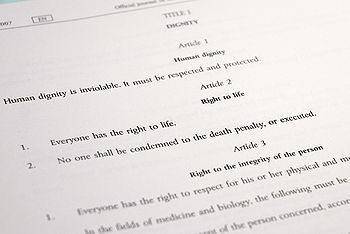 Following the entry into force of the Lisbon Treaty
in 2009 the fundamental rights' charter has the same legal value as the European Union treaties. The Charter referred to in the Treaty is an amended version of the 2000 document which was solemnly declared by the same three institutions a day before the signing of the Lisbon Treaty itself.
Article 51(1) of the Charter addresses the Charter to the EU's institutions, bodies established under EU law and, when implementing EU laws, the EU's member states. In addition both Article 6 of the amended Treaty of European Union and Article 51(2) of the Charter itself restrict the Charter from extending the competences of the EU. A consequence of this is that the EU will not be able to legislate to vindicate a right set out in the Charter unless the power to do such is set out in the Treaties proper. And individuals will not be able to take member states to court because they have failed to uphold the rights in the Charter unless the member state in question was implementing EU law. It is this last element of these that has been subject to the most debate.
The Charter is not the first outing for human jurisprudence in the EU. In interpreting the general principles of EU law described above, the European Court of Justice has already dealt the issue of whether those general principles applied to member states. Having ruled in Johnston v Royal Ulster Constabulary that a right to fair procedures was one of the general principles of EU law, in Kremzow v Austria the ECJ had to decide whether or not a member state were obliged to apply that principle in relation to a wrongful conviction for murder. Kremzow's lawyers argued that his case came within the scope of EU law on the grounds that his wrongful conviction and sentence had breached his right to free movement within the EU. The ECJ responded by saying that since the laws under which Kremzow had been convicted were not enacted to secure compliance with EU law, his predicament fell outside the scope of EU law.
It may be noted, however, that the wording in Kremzow, referring to the "field of application of EU law", differs from the wording in the Charter which refers to the implementation of EU law. Although the amended explanatory memorandum issued alongside the Charter in 2007 describes the wording used in the Charter as reflecting ECJ precedent.
and the United Kingdom
secured a protocol to the treaty relating to the application of the Charter of the Fundamental Rights in their respective countries. In October 2009 EU leaders agreed to amend the protocol at the time of the next accession treaty to include the Czech Republic.
The protocol contains two substantial provisions. The first—Article 1(1)—precludes both the domestic courts in Poland and the UK and the EU's courts from finding that "laws, regulations or administrative provisions, practices or action" in the countries to which it applies are inconsistent with the Charter. The second—Article 1(2)—says that the Title IV of the Charter, which contains economic and social rights, does not create justiciable rights.
All three countries to which the protocol applies or will apply, had different reasons for negotiating the protocol. The United Kingdom originally opposed a legally binding charter over concerns that it would result in a stream of British citizens going to the European Court of Justice in attempts to enforce their Charter rights in the UK, and in increased costs for business. While the British accepted a legally binding rights charter during the negotiations of the failed European Constitution
, they negotiated a protocol during the Lisbon negotiations which, according to the then British Minister for Europe, would ensure that the Charter would not extend the powers of the European Court of Justice over United Kingdom law.
Although their problems with the Charter related to its perceived liberal stance on social issues, in September 2007 the Polish government indicated that they wished to be included in the British protocol. In late 2009 EU leaders promised to amend the protocol so that it would apply to the Czech Republic in a measure designed to persuade the Czech President Vaclav Klaus
to sign the Lisbon Treaty. Klaus had previously voiced concerns that the Charter would allow the families of Germans who were expelled from territory within the modern day Czech Republic after the Second World War to challenge that expulsion before the EU's courts, and he requested an opt-out be added to the Lisbon Treaty to resolve the issue. The Czech President subsequently signed the treaty, although the protocol he requested has no connection with the one he was eventually offered. It might be noted in passing that there was never any prospect of the validity of the laws under which the German were expelled, the Beneš decrees
, being questioned.
There is considerable debate concerning what effect the protocol will actually have. One view, shared by Jan Jirásek, is that the protocol is an opt-out that excludes the application of the Charter to Poland and the United Kingdom. Another, shared by Ingolf Pernice, is that the protocol is an interpretative protocol which will either have limited or no legal consequence.
(ECHR), the case-law of the European Court of Justice
and pre-existing provisions of European Union law
.

, the European Commissioner for Justice, Freedom & Security
, wrote to the director of the FRA slamming the idea on cost and dignity grounds and instructing him to cancel the project.
European Union
The European Union is an economic and political union of 27 independent member states which are located primarily in Europe. The EU traces its origins from the European Coal and Steel Community and the European Economic Community , formed by six countries in 1958...
(EU) citizens
Citizenship of the European Union
Citizenship of the European Union was introduced by the Maastricht Treaty . European citizenship is supplementary to national citizenship and affords rights such as the right to vote in European elections, the right to free movement and the right to consular protection from other EU states'...
and residents, into EU law. It was drafted by the European Convention
European Convention (1999-2000)
The European Convention was the 1999 convention which drafted the Charter of Fundamental Rights of the European Union. The convention was called in 1999 by the Cologne European Council to consolidate rights for EU citizens and enshrine them at EU level....
and solemnly proclaimed on 7 December 2000 by the European Parliament
European Parliament
The European Parliament is the directly elected parliamentary institution of the European Union . Together with the Council of the European Union and the Commission, it exercises the legislative function of the EU and it has been described as one of the most powerful legislatures in the world...
, the Council of Ministers
Council of the European Union
The Council of the European Union is the institution in the legislature of the European Union representing the executives of member states, the other legislative body being the European Parliament. The Council is composed of twenty-seven national ministers...
and the European Commission
European Commission
The European Commission is the executive body of the European Union. The body is responsible for proposing legislation, implementing decisions, upholding the Union's treaties and the general day-to-day running of the Union....
. However its then legal status was uncertain and it did not have full legal effect until the entry into force of the Treaty of Lisbon
Treaty of Lisbon
The Treaty of Lisbon of 1668 was a peace treaty between Portugal and Spain, concluded at Lisbon on 13 February 1668, through the mediation of England, in which Spain recognized the sovereignty of Portugal's new ruling dynasty, the House of Braganza....
on 1 December 2009.
Under the Charter, the European Union
European Union
The European Union is an economic and political union of 27 independent member states which are located primarily in Europe. The EU traces its origins from the European Coal and Steel Community and the European Economic Community , formed by six countries in 1958...
(EU) must act and legislate consistently with the Charter and the EU's courts
Court of Justice of the European Union
The Court of Justice of the European Union is the institution of the European Union which encompasses the whole judiciary. Seated in Luxembourg, it has three sub-courts; the European Court of Justice, the General Court and the Civil Service Tribunal.The institution was originally established in...
will strike down EU legislation which contravenes it. The Charter only applies to EU member states when they are implementing EU law and does not extend the competences of the EU beyond the competences given to it in the treaties
Treaties of the European Union
The Treaties of the European Union are a set of international treaties between the European Union member states which sets out the EU's constitutional basis. They establish the various EU institutions together with their remit, procedures and objectives...
.
Background
The Treaty establishing the European Economic Community did not include any reference to fundamental or human rights. The EEC Treaty was written a few years after the failure of the European Defence Community Treaty and the European Political Community Treaty. This latter treaty had included rights provisions and Craig and de Búrca argue that, in light of that failure, the drafters of the EEC Treaty wished to eschew any implicitly political elements. However the idea that the purely economic end of the new EEC Treaty would be unlikely to have any implications for fundamental rights was soon to be tested.Court cases
Soon after the entry into force of the EEC Treaty, the Community established itself as a major political entity with policy ramifications beyond its economic aims. In 1964, the European Court of JusticeEuropean Court of Justice
The Court can sit in plenary session, as a Grand Chamber of 13 judges, or in chambers of three or five judges. Plenary sitting are now very rare, and the court mostly sits in chambers of three or five judges...
handed down its decision in Costa v ENEL, in which the Court decided that Community law should take precedence over conflicting national law. This meant that national government could not escape what they had agreed to at a European level by enacting conflicting domestic measures, but it also potentially meant that the EEC legislator could legislate unhindered by the restrictions imposed by fundamental rights provisions enshrined in the constitutions of member states. This issue came to a head in 1970 in the case of Handelsgesellschaft case when a German court ruled that a piece of EEC legislation infringed the German Basic Law. On a reference from the German court, the ECJ ruled that whilst the application of Community law could not depend on its consistency with national constitutions, fundamental rights did form an "integral part of the general principles of [European Community] law" and that inconsistency with fundamental right could form the basis of a successful challenge to a European law.
In ruling as it did in Handelsgesellschaft the ECJ had, in effect, created a doctrine of unwritten rights which bound the Community institutions. While the court's fundamental rights jurisprudence was approved by the institutions in 1977 and a statement to that effect was inserted into the treaties by the Maastricht Treaty
Maastricht Treaty
The Maastricht Treaty was signed on 7 February 1992 by the members of the European Community in Maastricht, Netherlands. On 9–10 December 1991, the same city hosted the European Council which drafted the treaty...
, it was only in 1999 that the European Council
European Council
The European Council is an institution of the European Union. It comprises the heads of state or government of the EU member states, along with the President of the European Commission and the President of the European Council, currently Herman Van Rompuy...
formally went about the process of initiating the drafting a codified catalogue of fundamental rights for the EU.
Proclamation
In 1999 the European CouncilEuropean Council
The European Council is an institution of the European Union. It comprises the heads of state or government of the EU member states, along with the President of the European Commission and the President of the European Council, currently Herman Van Rompuy...
proposed that a "body composed of representatives of the Heads of State and Government and of the President of the Commission as well as of members of the European Parliament and national parliaments" would be set up to draft a fundamental rights charter. On being constituted in December of that year the "body" entitled itself the European Convention
European Convention (1999-2000)
The European Convention was the 1999 convention which drafted the Charter of Fundamental Rights of the European Union. The convention was called in 1999 by the Cologne European Council to consolidate rights for EU citizens and enshrine them at EU level....
.
The Convention adopted the draft on 2 October 2000 and it was solemnly proclaimed by the European Parliament, the Council of Ministers and the European Commission on 7 December 2000. It was at the same time, however, decided to defer making a decision on the Charter's legal status. However it did come with the political weight of having been approved by three powerful institutions and as such was regularly cited by the ECJ as a source of fundamental rights.
Legal force
A modified Charter formed part of the defunct European ConstitutionTreaty establishing a Constitution for Europe
The Treaty establishing a Constitution for Europe , , was an unratified international treaty intended to create a consolidated constitution for the European Union...
. After that treaty's failure, its replacement, the Lisbon Treaty, also gave force to the Charter albeit by referencing it an independent document rather than by incorporating it into the treaty itself. It should be noted, however, that both the version included in the Constitution and the one referenced by the Lisbon Treaty were amended versions.
On its coming into force with the Lisbon Treaty on 1 December 2009, Justice Commissioner
European Commissioner for Justice, Freedom & Security
The Commissioner for Justice, Fundamental Rights and Citizenship is a post in the European Commission. The current commissioner is Viviane Reding....
Viviane Reding
Viviane Reding
Viviane Reding is a Luxembourgian politician, currently serving as European Commissioner for Justice, Fundamental Rights and Citizenship. Before starting a professional career as a journalist for the leading newspaper in Luxembourg, the Luxemburger Wort, she obtained a doctorate in human sciences...
proposed that Commissioners should swear to uphold all EU treaties and the Charter. On 3 May 2010, the European Commission swore a solemn declaration at the European Court of Justice in Luxembourg, pledging to respect the EU Treaties and to be completely independent in carrying out their duties during their mandate. For the first time, the Commissioners also explicitly pledged to respect the new Charter of Fundamental Rights.
Several states insisted upon an opt-out from national application of the charter (see below for details).
Legal status
Treaty of Lisbon
The Treaty of Lisbon of 1668 was a peace treaty between Portugal and Spain, concluded at Lisbon on 13 February 1668, through the mediation of England, in which Spain recognized the sovereignty of Portugal's new ruling dynasty, the House of Braganza....
in 2009 the fundamental rights' charter has the same legal value as the European Union treaties. The Charter referred to in the Treaty is an amended version of the 2000 document which was solemnly declared by the same three institutions a day before the signing of the Lisbon Treaty itself.
Article 51(1) of the Charter addresses the Charter to the EU's institutions, bodies established under EU law and, when implementing EU laws, the EU's member states. In addition both Article 6 of the amended Treaty of European Union and Article 51(2) of the Charter itself restrict the Charter from extending the competences of the EU. A consequence of this is that the EU will not be able to legislate to vindicate a right set out in the Charter unless the power to do such is set out in the Treaties proper. And individuals will not be able to take member states to court because they have failed to uphold the rights in the Charter unless the member state in question was implementing EU law. It is this last element of these that has been subject to the most debate.
The Charter is not the first outing for human jurisprudence in the EU. In interpreting the general principles of EU law described above, the European Court of Justice has already dealt the issue of whether those general principles applied to member states. Having ruled in Johnston v Royal Ulster Constabulary that a right to fair procedures was one of the general principles of EU law, in Kremzow v Austria the ECJ had to decide whether or not a member state were obliged to apply that principle in relation to a wrongful conviction for murder. Kremzow's lawyers argued that his case came within the scope of EU law on the grounds that his wrongful conviction and sentence had breached his right to free movement within the EU. The ECJ responded by saying that since the laws under which Kremzow had been convicted were not enacted to secure compliance with EU law, his predicament fell outside the scope of EU law.
It may be noted, however, that the wording in Kremzow, referring to the "field of application of EU law", differs from the wording in the Charter which refers to the implementation of EU law. Although the amended explanatory memorandum issued alongside the Charter in 2007 describes the wording used in the Charter as reflecting ECJ precedent.
The British, Czech and Polish protocol
In the negotiations leading up to the signing to the Lisbon Treaty, PolandPoland
Poland , officially the Republic of Poland , is a country in Central Europe bordered by Germany to the west; the Czech Republic and Slovakia to the south; Ukraine, Belarus and Lithuania to the east; and the Baltic Sea and Kaliningrad Oblast, a Russian exclave, to the north...
and the United Kingdom
United Kingdom
The United Kingdom of Great Britain and Northern IrelandIn the United Kingdom and Dependencies, other languages have been officially recognised as legitimate autochthonous languages under the European Charter for Regional or Minority Languages...
secured a protocol to the treaty relating to the application of the Charter of the Fundamental Rights in their respective countries. In October 2009 EU leaders agreed to amend the protocol at the time of the next accession treaty to include the Czech Republic.
The protocol contains two substantial provisions. The first—Article 1(1)—precludes both the domestic courts in Poland and the UK and the EU's courts from finding that "laws, regulations or administrative provisions, practices or action" in the countries to which it applies are inconsistent with the Charter. The second—Article 1(2)—says that the Title IV of the Charter, which contains economic and social rights, does not create justiciable rights.
All three countries to which the protocol applies or will apply, had different reasons for negotiating the protocol. The United Kingdom originally opposed a legally binding charter over concerns that it would result in a stream of British citizens going to the European Court of Justice in attempts to enforce their Charter rights in the UK, and in increased costs for business. While the British accepted a legally binding rights charter during the negotiations of the failed European Constitution
Treaty establishing a Constitution for Europe
The Treaty establishing a Constitution for Europe , , was an unratified international treaty intended to create a consolidated constitution for the European Union...
, they negotiated a protocol during the Lisbon negotiations which, according to the then British Minister for Europe, would ensure that the Charter would not extend the powers of the European Court of Justice over United Kingdom law.
Although their problems with the Charter related to its perceived liberal stance on social issues, in September 2007 the Polish government indicated that they wished to be included in the British protocol. In late 2009 EU leaders promised to amend the protocol so that it would apply to the Czech Republic in a measure designed to persuade the Czech President Vaclav Klaus
Václav Klaus
Václav Klaus is the second President of the Czech Republic and a former Prime Minister .An economist, he is co-founder of the Civic Democratic Party, the Czech Republic's largest center-right political party. Klaus is a eurosceptic, but he reluctantly endorsed the Lisbon treaty as president of...
to sign the Lisbon Treaty. Klaus had previously voiced concerns that the Charter would allow the families of Germans who were expelled from territory within the modern day Czech Republic after the Second World War to challenge that expulsion before the EU's courts, and he requested an opt-out be added to the Lisbon Treaty to resolve the issue. The Czech President subsequently signed the treaty, although the protocol he requested has no connection with the one he was eventually offered. It might be noted in passing that there was never any prospect of the validity of the laws under which the German were expelled, the Beneš decrees
Beneš decrees
Decrees of the President of the Republic , more commonly known as the Beneš decrees, were a series of laws that were drafted by the Czechoslovak Government-in-Exile in the absence of the Czechoslovak parliament during the German occupation of Czechoslovakia in World War II and issued by President...
, being questioned.
There is considerable debate concerning what effect the protocol will actually have. One view, shared by Jan Jirásek, is that the protocol is an opt-out that excludes the application of the Charter to Poland and the United Kingdom. Another, shared by Ingolf Pernice, is that the protocol is an interpretative protocol which will either have limited or no legal consequence.
The text
The Charter contains some 54 articles divided into seven titles. The first six titles deal with substantive rights under the headings: dignity, freedoms, equality, solidarity, citizens' rights and justice, while the last title deals with the interpretation and application of the Charter. Much of Charter is based on the European Convention on Human RightsEuropean Convention on Human Rights
The Convention for the Protection of Human Rights and Fundamental Freedoms is an international treaty to protect human rights and fundamental freedoms in Europe. Drafted in 1950 by the then newly formed Council of Europe, the convention entered into force on 3 September 1953...
(ECHR), the case-law of the European Court of Justice
European Court of Justice
The Court can sit in plenary session, as a Grand Chamber of 13 judges, or in chambers of three or five judges. Plenary sitting are now very rare, and the court mostly sits in chambers of three or five judges...
and pre-existing provisions of European Union law
European Union law
European Union law is a body of treaties and legislation, such as Regulations and Directives, which have direct effect or indirect effect on the laws of European Union member states. The three sources of European Union law are primary law, secondary law and supplementary law...
.
- The first title, dignity, guarantees the right to life and prohibits torture, slavery and the death penalty. Its provisions are mostly based on the ECHR, although Article 1 closely reflects Article 1 of the German Basic Law.
- The second title covers liberty, privacy, marriage, thought, expression, assembly, education, work, property and asylum.
- The third title covers equality, the rights of children and the elderly.
- The fourth title covers social and workers' rights including the right to fair working conditions, protection against unjustified dismissal, and access to health care.
- The fifth title covers the rights of the EU citizens such as the right to vote in election to the European ParliamentEuropean ParliamentThe European Parliament is the directly elected parliamentary institution of the European Union . Together with the Council of the European Union and the Commission, it exercises the legislative function of the EU and it has been described as one of the most powerful legislatures in the world...
and to move freely within the EU. It also includes several administrative rights such as a right to good administration, to access documents and to petition the European Parliament.
- The sixth title covers justice issues such as the right to an effective remedy, a fair trial, to the presumption of innocencePresumption of innocenceThe presumption of innocence, sometimes referred to by the Latin expression Ei incumbit probatio qui dicit, non qui negat, is the principle that one is considered innocent until proven guilty. Application of this principle is a legal right of the accused in a criminal trial, recognised in many...
, the principle of legality, non-retrospectivity and double jeopardyDouble jeopardyDouble jeopardy is a procedural defense that forbids a defendant from being tried again on the same, or similar charges following a legitimate acquittal or conviction...
.
- The seventh title concerns the interpretation and application of the Charter. These issues are dealt with above.
Poem
The EU has attempted to raise the profile of the charter so citizens are more aware of their rights, for example by publishing a mini version of the charter in all EU languages. The European Fundamental Rights Agency (FRA) had also put out a tender for poets to turn the Charter into an 80-minute long epic poem, with music, dance and multimedia elements. This was also to raise awareness and to simplify the legal text into more understandable language. However Viviane RedingViviane Reding
Viviane Reding is a Luxembourgian politician, currently serving as European Commissioner for Justice, Fundamental Rights and Citizenship. Before starting a professional career as a journalist for the leading newspaper in Luxembourg, the Luxemburger Wort, she obtained a doctorate in human sciences...
, the European Commissioner for Justice, Freedom & Security
European Commissioner for Justice, Freedom & Security
The Commissioner for Justice, Fundamental Rights and Citizenship is a post in the European Commission. The current commissioner is Viviane Reding....
, wrote to the director of the FRA slamming the idea on cost and dignity grounds and instructing him to cancel the project.
See also
- Capital punishment in the European Union
- Fundamental Rights Agency
- Four FreedomsFour Freedoms (European Union)The European Union's Internal Market seeks to guarantee the free movement of goods, capital, services, and people – the EU's four freedoms – within the EU's 27 member states.The Internal Market is intended to be conducive to increased competition, increased specialisation, larger...
- Fundamental right
- Three generations of human rightsThree generations of human rightsThe division of human rights into three generations was initially proposed in 1979 by the Czech jurist Karel Vasak at the International Institute of Human Rights in Strasbourg. He used the term at least as early as November 1977...
- LGBT rights in the European UnionLGBT rights in the European UnionLGBT rights in the European Union are protected under the European Union's treaties and law. Homosexuality is legal in all EU states and discrimination in employment has been banned since 2000...
External links
- Charter of Fundamental Rights of the European Union (and in PDF format).
- Charter of Fundamental Rights of the European Union as adapted at Lisbon
- European Parliament’s explanation of the Charter
- Detailed Guide to the EU Charter
- Official FAQs
- Charter of Fundamental Rights of the European Union European Navigator
- Community Charter of the Fundamental Social Rights of Workers