
All Topics  
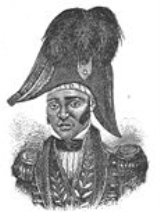
Jean-Jacques Dessalines

 
Jean Jacques Dessalines

   Email Print
   Bookmark   Link


Jean-Jacques Dessalines


Jean-Jacques Dessalines (20 September 1758 – 17 October 1806) was a leader of the Haitian Revolution
Haïtian Revolution

The Haitian Revolution was the only successful slave revolt in history. It established Haiti as the first republic ruled by blacks. At the time of the revolution, Haiti was known as Saint-Domingue and was a colony of France....
 and the first ruler of an independent Haiti
Haiti

Haiti , officially the Republic of Haiti , is a Haitian Creole language- and French language-speaking Caribbean country. Along with the Dominican Republic, it occupies the island of Hispaniola, in the Greater Antilles archipelago....
 under the 1801 constitution. He was autocratic in his rule and crowned himself Emperor of Haïti in 1805.

Beginning as Governor-General, Dessalines later named himself Emperor Jacques I of Haiti (1804 – 1806). He is remembered as one of the founding fathers of Haiti
Haiti

Haiti , officially the Republic of Haiti , is a Haitian Creole language- and French language-speaking Caribbean country. Along with the Dominican Republic, it occupies the island of Hispaniola, in the Greater Antilles archipelago....
.

Dessalines served as an officer in the French
France

France , officially the French Republic , is a country whose Metropolitan France is located in Western Europe and that also comprises various Overseas departments and territories of France....
 army when the colony was trying to withstand Spanish and British incursions.


Discussion
Ask a question about 'Jean-Jacques Dessalines'
Start a new discussion about 'Jean-Jacques Dessalines'
Answer questions from other users
Full Discussion Forum


Encyclopedia


Jean-Jacques Dessalines (20 September 1758 – 17 October 1806) was a leader of the Haitian Revolution
Haïtian Revolution

The Haitian Revolution was the only successful slave revolt in history. It established Haiti as the first republic ruled by blacks. At the time of the revolution, Haiti was known as Saint-Domingue and was a colony of France....
 and the first ruler of an independent Haiti
Haiti

Haiti , officially the Republic of Haiti , is a Haitian Creole language- and French language-speaking Caribbean country. Along with the Dominican Republic, it occupies the island of Hispaniola, in the Greater Antilles archipelago....
 under the 1801 constitution. He was autocratic in his rule and crowned himself Emperor of Haïti in 1805.

Beginning as Governor-General, Dessalines later named himself Emperor Jacques I of Haiti (1804 – 1806). He is remembered as one of the founding fathers of Haiti
Haiti

Haiti , officially the Republic of Haiti , is a Haitian Creole language- and French language-speaking Caribbean country. Along with the Dominican Republic, it occupies the island of Hispaniola, in the Greater Antilles archipelago....
.

Dessalines served as an officer in the French
France

France , officially the French Republic , is a country whose Metropolitan France is located in Western Europe and that also comprises various Overseas departments and territories of France....
 army when the colony was trying to withstand Spanish and British incursions. Later he rose to become a commander in the revolt against France. As Toussaint L'Ouverture
Toussaint L'Ouverture

Fran?ois-Dominique Toussaint Louverture , also Toussaint Br?da, Toussaint-Louverture was a leader of the Haitian Revolution. Born a slave in Saint-Domingue, in a long struggle for independence Toussaint led enslaved Africans to victory over Europeans, abolished slavery, and secured native control over the colony in 1797 while nom...
's principal lieutenant, he led many successful engagements, such as the Battle of Crête-à-Pierrot
Battle of Crête-à-Pierrot

The Battle of Cr?te-?-Pierrot was a major battle of the Haitian Revolution. The battle took place at the fort of Cr?te-?-Pierrot, east of Saint-Marc in the Artibonite River valley....
. He was known to employ brutal tactics against the enemy.

After the betrayal and capture of Toussaint Louverture in 1802, Dessalines became the leader of the revolution. He defeated French troops sent by Napoleon
Napoleon I of France

Napoleon Bonaparte later known as Emperor Napoleon I, was a military and political leader of France whose actions shaped European politics in the early 19th century....
 at the Battle of Vertières
Battle of Vertières

The Battle of Verti?res, the last major battle of the Second War of Haitian Independence, the final part of the Haitian Revolution. It was fought between Haitian rebels and Saint-Domingue expedition on 18 November 1803 at Verti?res....
 in 1803. Declaring Haiti an independent nation in 1804, Dessalines was chosen by a council of generals (blacks and mulatto
Mulatto

Mulatto denotes a person with one White people parent and one Black people parent or a person who has black ancestry and white ancestry. It is perceived as pejorative and demeaning in some cultures....
s) to assume the office of Governor-General. In September 1804, he proclaimed himself Emperor and ruled in that capacity until being assassinated in 1806.

Early life

Haitian tradition holds that Dessalines was born in Guinea
Guinea

Guinea, officially Republic of Guinea , is a country in West Africa formerly known as French Guinea. The country's current population is estimated at 10,211,437 ....
 and transported to Saint-Domingue as a slave. Most historians believe that he was born in Saint-Domingue to enslaved African parents. Dessalines was a slave on a plantation in the Plaine du Nord in Cormiers (now known as Cormier
Cormier

Cormier may refer to:In people:* Cedric Cormier , a former American football star at the University of Colorado at Boulder* Charles Cormier , a Quebec businessman and political figure...
), near the town of Grande-Rivière-du-Nord
Grande-Rivière-du-Nord

Grande-Rivi?re-du-Nord is a municipality in the Grande-Rivi?re-du-Nord Arrondissement, in the Nord Department of Haiti.References...
, where he was born as Jean-Jacques Duclos, the name of his father, who adopted it from his proprietor. The identity of his parents, as well as his region of origin in Africa, are not known, but most slaves imported to Haiti came from West Africa. His only known family member was an aunt, Victoria Montou, whom he affectionately called "Toya". Victoria Montou remained close to her nephew until her death in 1805. He also had two brothers, Louis and Joseph Duclos, who also took the name Dessalines. The first was the father of Maréchal de Camp Monsieur Raymond Dessalines, created 1st Baron
Baron

Baron is a specific title of nobility. The word baron comes from Old French baron, itself from Old High German and latin baro meaning " man, warrior"; it merged with cognate Old English language beorn meaning "nobleman."...
 de Louis Dessalines on 8 April 1811, Aide-de-Camp
Aide-de-camp

An aide-de-camp is a personal assistant, secretary, or adjutant to a person of high rank, usually a senior military officer or a head of state....
 to King Henry I
Henri Christophe

Henri Christophe was a key leader in the Haitian Revolution, winning independence from France in 1804. On 17 February 1807, after the creation of separate nation in the north Christophe was elected President of Ha?ti of the State of Haiti....
, Privy Council
Privy council

A privy council is a body that advises the head of state of a nation on how to exercise their Executive , typically, but not always, in the context of a monarchy....
or, Secretary-General of the Ministry of War
Ministry of War

A Ministry of War or Ministry for War is an administrative, supply and services agency of an army, as opposed to the entire military establishment....
 between 1811 and 1820 and Member of the Royal Chamber of Public Instruction between 1818 and 1820, who received the degree of Knight
Knight

File:Gothic armor 2.jpgKnight is the term for a social position originating in the Middle Ages. In the Commonwealth of Nations, knighthood is a non-heritable form of gentry....
 of the Order of St. Henry on 1 May 1811 and was killed by the revolutionaries at Cap-Henri on 10 October 1820. The second was the father of Maréchal de Camp Monsieur ... Dessalines, created 1st Baron de Joseph Dessalines in 1816, Chamberlain
Chamberlain (office)

A chamberlain is an officer in charge of managing a great house. In many countries there are ceremonial posts associated with the household of the sovereign....
 to Prince Jacques-Victor Henry, the Prince Royal of Haiti, and Major
Major

In many European languages, the term Major refers to a military rank, denoting seniority at one of usually various levels of rank, for example: "Sergeant-Major" denoting the most senior ranking sergeant of a large military unit; "Captain-Major", denoting a mid-level command status Officer ...
 of the Grenadiers de la Garde, who received the degree of Knight of the Order of St. Henry on 28 October 1815.

Working in the sugar cane fields as a laborer, Dessalines rose to the rank of commandeur or foreman. He worked on the plantation of a Frenchman named Henry Duclos until he was about 30 years old. During this time, Dessalines was known as Jacques Duclos; his last name was assigned by his master, as was custom among the whites. Duclos was then bought by a free black man named Dessalines, from whom he received the surname which he kept in freedom. From then on he was called Jean-Jacques Dessalines. The master Dessalines treated Jean-Jacques well. Jean-Jacques Dessalines worked for him for about three years, until the slave uprising of 1791, which spread across the Plaine du Nord.

Dessalines was embittered towards both whites and gens de couleur. After the defeat of French royalists during the Haitian Revolution, he ordered the killing of all royalists to ensure that Saint-Domingue would be a nation. Nonetheless, after declaring himself Governor-for-Life in 1804, Jean-Jacques Dessalines took his old master Dessalines into his house and gave him a job.

Revolution

In 1791, Jean-Jacques Dessalines joined the slave rebellion of the northern plains led by Jean François
Jean François

Jean Fran?ois Papillon was a leader of the 1791 Slave rebellion that began the Ha?tian Revolution.With Georges Biassou and Jeannot, he was among those whom Dutty Boukman prophesied would lead the revolution....
 Papillon and Georges Biassou
Georges Biassou

Georges Biassou was an early leader of the 1791 slave rising in Saint-Domingue that began the Ha?tian Revolution. With Jean Fran?ois and Jeannot, he was prophesied by the Haitian Vodou priest, Dutty Boukman, to lead the revolution....
. This rebellion was the first action of what would become the Haitian Revolution. Dessalines became a lieutenant in Papillon's army and followed him to Santo Domingo, where he enlisted to serve Spain
Spain

Spain or the Kingdom of Spain , is a country located in Southern Europe on the Iberian Peninsula.The Spanish constitution does not establish any official denomination of the country, even though Espa?a , Estado espa?ol and Naci?n espa?ola are used interchangeably....
's military forces against the French colony of Saint-Domingue.

It was then that Dessalines met the rising military commander Toussaint Bréda (later known as Toussaint Louverture), a mature man also born into slavery, who was fighting with Spanish forces on Hispaniola. These men wanted above all to defeat slavery. In 1794, after the French declared an end to slavery, Toussaint Louverture switched allegiances to the French. He fought for the French Republic against both the Spanish and British
United Kingdom

The United Kingdom of Great Britain and Northern Ireland, commonly known as the United Kingdom , the UK or Britain,is a sovereign state located off the northwestern coast of continental Europe....
. Dessalines followed, becoming a chief lieutenant to Toussaint Louverture and rising to the rank of brigadier general by 1799.

Dessalines commanded many successful engagements, including the captures of Jacmel
Jacmel

Jacmel, also known by its indigenous name of Yaquimel, is a city in southern Haiti founded in 1698. It is the capital of the Departments of Haiti of Sud-Est, Haiti....
, Petit Goâve
Petit Goâve

Petit Go?ve is a coastal town in Ouest Department, Ha?ti. It is located at around , some 68 km south of Port-au-Prince. The town has a population of approximately 12,000 inhabitants....
, Miragoane
Miragoane

Mirago?ne is a coastal town in western Ha?ti, in Nippes Department. It is regarded as one of the major ports in the trade in used goods. Bales of used clothing, shoes, appliances and used cars arrive at the port from Miami and other U.S....
 and Anse-à-Veau
Anse-à-Veau

Anse-?-Veau is a municipality in the Anse-?-Veau Arrondissement, in the Nippes Department of Haiti.It has 55,138 inhabitants.References...
. In 1801, Dessalines quickly ended an insurrection in the north led by Louverture's own nephew, General Moyse. Dessalines gained a reputation for his "take no prisoners" policy, and for burning homes and entire villages to the ground.

The rebellious slaves were able to restore most of Saint-Domingue to France, with Louverture in control and finally appointed by the French as Governor General of the colony. Louverture wanted Saint-Domingue to have more autonomy. He directed the creation of a new constitution to establish that, as well as rules for how the colony would operate under freedom. He also named himself as governor-for-life, while still swearing his loyalty to France.

The French government had been through changes and was led by Napoleon I, then calling himself First Consul. Many white and mulatto planters had been lobbying the government to reimpose slavery in Saint-Domingue. The French responded by dispatching an expeditionary force to restore French rule to the island, an army and ships led by General Charles Leclerc
Charles Leclerc

Charles Victor Emmanuel Leclerc was a List of French people general and husband to Pauline Bonaparte, sister to Napoleon I of France....
. Louverture and Dessalines fought against the invading French forces, with Dessalines defeating them at the battle for which he is most famous, Crête-à-Pierrot
Battle of Crête-à-Pierrot

The Battle of Cr?te-?-Pierrot was a major battle of the Haitian Revolution. The battle took place at the fort of Cr?te-?-Pierrot, east of Saint-Marc in the Artibonite River valley....
.

During the 11 March 1802 battle, Dessalines and his 1,300 men defended a small fort against 18,000 attackers. To motivate his troops at the start of the battle, he waved a lit torch near an open powder keg and declared that he would blow the fort up should the French break through. The defenders inflicted heavy casualties on the attacking army, but after a 20-day siege they were forced to abandon the fort due to a shortage of food and munitions. Nonetheless, the rebels were able to force their way through the enemy lines and into the Cahos Mountains, with their army still largely intact.

The French soldiers under Leclerc were accompanied by mulatto
Mulatto

Mulatto denotes a person with one White people parent and one Black people parent or a person who has black ancestry and white ancestry. It is perceived as pejorative and demeaning in some cultures....
 troops led by Créole mulattoes Alexandre Pétion
Alexandre Pétion

Alexandre Sab?s P?tion was President of the southern Republic of Haiti from 1806 until his death. He is considered as one of Haiti's founding fathers, together with Toussaint Louverture, Jean-Jacques Dessalines, and his rival Henri Christophe....
 and André Rigaud
André Rigaud

Andr? Rigaud was the leading Gens de couleur military leader during the Ha?tian Revolution. Among his prot?g?s were Alexandre P?tion and Jean-Pierre Boyer, both future List of Presidents of Ha?ti....
 from Saint-Domingue. Pétion and Rigaud, both wealthy with white fathers, had opposed Louverture's leadership. They and tried to establish separate independence in the South of Saint-Domingue, an area where wealthy gens de couleur
Gens de couleur

Gens de couleur is a French language term meaning "people of color." This is often a short form of gens de couleur libres . In practice, it can refer to Creole of color with Latin blood, and certain other free blacks....
 were concentrated in plantations. Toussaint Louverture's forces had defeated them three years earlier.

After the Battle of Crête-à-Pierrot, Dessalines defected from his long-time ally Louverture and briefly sided with Leclerc, Pétion, and Rigaud. When it became clear that the French intended to re-establish slavery on Saint-Domingue, as they had on Guadeloupe, Dessalines and Pétion switched sides again in October 1802, to oppose the French. Leclerc died of yellow fever, which also took many French troops.

The brutal tactics of Leclerc's successor, Rochambeau
Donatien-Marie-Joseph de Vimeur, vicomte de Rochambeau

Donatien-Marie-Joseph de Vimeur, Viscount de Rochambeau was a France soldier, the son of Jean-Baptiste Donatien de Vimeur, comte de Rochambeau....
, helped to unify rebel forces against the French. Dessalines, the leader of the Revolution after Toussaint's capture on 7 June 1802, commanded the rebel forces against a French army weakened by a yellow fever
Yellow fever

Yellow fever is an acute Virus disease. It is an important cause of hemorrhage illness in many African and South American countries despite existence of an effective vaccine....
 epidemic. His forces achieved a series of victories against the French, culminating in the last major battle of the revolution, the Battle of Vertières
Battle of Vertières

The Battle of Verti?res, the last major battle of the Second War of Haitian Independence, the final part of the Haitian Revolution. It was fought between Haitian rebels and Saint-Domingue expedition on 18 November 1803 at Verti?res....
. On 18 November 1803, black and mulatto forces under Dessalines and Pétion attacked the fort of Vertières, held by Rochambeau, near Cap François in the north. Rochambeau and his troops surrendered the next day. On 4 December 1803, the French colonial army of Napoleon Bonaparte surrendered its last remaining territory to Dessalines' forces. This officially ended the only slave rebellion in world history which successfully resulted in establishing an independent nation.

Emperor

On 1 January 1804, from the city of Gonaïves
Gonaïves

Gona?ves is a city in northern Haiti, the capital of the Artibonite Department. It has a population of about 104,825 people . The city's name derives from the original Amerindian name of Gonaibo....
, Dessalines officially declared the former colony's independence and renamed it "Haiti" after the indigenous Arawak
Arawak

The term Arawak , was used to designate some of the peoples encountered by the Spain in the West Indies in 1492 and thereafter. These include the Ta?no, who occupied the Greater Antilles and the Bahamas and Bimini Florida, the Nepoya and Suppoyo of Trinidad and the Igneri, who were supposed to have preceded the Caribs in the Lesser Anti...
 name. He had served as Governor-General of Saint-Domingue since 30 November 1803. After the declaration of independence, Dessalines named himself Governor-General-for-life of Haiti and served in that role until 22 September 1804, when he proclaimed himself Emperor of Haiti. He was crowned Emperor Jacques I in a coronation
Coronation

A coronation is a ceremony marking the investiture of a monarch with regal power, specifically involving the placement of a coronation crown upon his or her head, and the presentation of other items of regalia....
 ceremony on 6 October in the city of Le Cap. On 20 May 1805, his government released the Imperial Constitution, naming Jean-Jacques Dessalines emperor for life with the right to name his successor.

Dessalines tried hard to keep the sugar
Sugar

Sugar is a class of edible crystalline substances, mainly sucrose, lactose, and fructose. Human taste buds interpret its flavor as sweet. Sugar as a basic food carbohydrate primarily comes from sugar cane and from sugar beet, but also appears in fruit, honey, sorghum, sugar maple , and in many other sources....
 industry and plantation
Plantation

A plantation is usually a large farm or Estate , especially in a tropical or semitropical country, like Brazil or Nicaragua on which cotton, tobacco, lice coffee, sugar cane and the like are cultivated, usually by resident laborers....
s running and producing without slavery. Born into slavery and having worked under white masters for 30 years, as well as having seen many atrocities by all peoples, Dessalines did not trust the white French people. Dessalines declared Haiti an all-black nation and forbade whites from owning property or land there.

He enforced a harsh regimen of plantation labor, described by the historian Michel-Rolph Trouillot
Michel-Rolph Trouillot

Michel-Rolph Trouillot is an academic and Anthropology currently working as Professor of Anthropology and of Social Sciences at the University of Chicago....
 as caporalisme agraire (agrarian militarism). As had Toussaint Louverture, Dessalines demanded that all blacks either work as soldiers to protect the nation or as laborers on the plantations to generate crops and income to keep the nation going. His forces were strict in enforcing this, to the extent that some blacks felt as if they were again enslaved.

Dessalines believed in the tight regulation of foreign trade, which was essential for Haiti's sugar- and coffee
Coffee

Coffee is a brewed drink prepared from roasted seeds, commonly called coffee beans, of the Coffea. Caffeinated coffee has a stimulating effect in humans....
-based export economy. Like Toussaint Louverture, Dessalines encouraged merchants from Britain
United Kingdom

The United Kingdom of Great Britain and Northern Ireland, commonly known as the United Kingdom , the UK or Britain,is a sovereign state located off the northwestern coast of continental Europe....
 and the United States
United States

The United States of America is a Federal government constitutional republic comprising U.S. state and a federal district. The country is situated mostly in central North America, where its Contiguous United States and Washington, D.C., the Capital districts and territories, lie between the Pacific Ocean and Atlantic Oceans, Borders of the U...
 over those from France
France

France , officially the French Republic , is a country whose Metropolitan France is located in Western Europe and that also comprises various Overseas departments and territories of France....
. For his administration, Dessalines needed literate and educated officials and managers. He placed in these positions well-educated Haitians, who were disproportionately from the light-skinned elite, as gens de couleur were most likely to have been educated.

Death and legacy

Disaffected members of Dessalines' administration, including Alexandre Pétion
Alexandre Pétion

Alexandre Sab?s P?tion was President of the southern Republic of Haiti from 1806 until his death. He is considered as one of Haiti's founding fathers, together with Toussaint Louverture, Jean-Jacques Dessalines, and his rival Henri Christophe....
 and Henri Christophe
Henri Christophe

Henri Christophe was a key leader in the Haitian Revolution, winning independence from France in 1804. On 17 February 1807, after the creation of separate nation in the north Christophe was elected President of Ha?ti of the State of Haiti....
, began a conspiracy to overthrow the Emperor. Dessalines was assassinated north of the capital city, Port-au-Prince
Port-au-Prince

Port-au-Prince is the Capital and largest List of cities in Haiti of Haiti. Growth, especially in crowded slums in nearby plains and hillsides, has raised the population of the Port-au-Prince area to between 2.5 and 3 million....
, at Pont Larnage, (now known as Pont-Rouge) on 17 October 1806 on his way to fight the rebels. Some historians claim that he was actually killed at Pétion's house at Rue l'Enterrement after a meeting to negotiate the power and the future of the young nation. A monument at the northern entrance of the Haitian capital marks the place where the Emperor was killed. Défilée, a black woman from humble background, took the mutilated body of the Emperor to bury him.

Although reviled by generations of Haitians for his autocratic ways, by the beginning of the 20th century, Dessalines began to be reassessed as an icon of Haitian nationalism. The national anthem
National anthem

A national anthem is a generally patriotism musical composition that evokes and eulogizes the history, traditions and struggles of its people, recognized either by a nation's government as the official national song, or by convention through use by the people....
 of Haiti, La Dessalinienne
La Dessalinienne

La Dessalinienne is the national anthem of Haiti, honoring Jean-Jacques Dessalines. It was written by Justin Lh?risson and composed by Nicolas Geffrard and adopted in 1904....
, is named in his honor, as is the city of Dessalines
Dessalines

Dessalines can refer to:* Jean-Jacques Dessalines, a general and statesman of Haiti.** La Dessalinienne, the national anthem of Haiti named in his honor....
.

See also

  • History of Haiti
    History of Haiti

    The recorded history of Haiti began on December 5, 1492 when the European navigator Christopher Columbus happened upon a large island in the region of the western Atlantic Ocean that later came to be known as the Caribbean Sea....


External links

  • Dessalines genealogy
  • The Louverture Project
  • , Webster University
  • , full text openly available for all from the Digital Library of the Caribbean
    Digital Library of the Caribbean

    The Digital Library of the Caribbean was established by a committee of librarians, scholars, and archivists at a meeting held in San Juan, Puerto Rico on July 17, 2004....


|-