
All Topics  
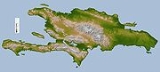
Hispaniola

 
Hispaniola

   Email Print
   Bookmark   Link


Hispaniola


Hispaniola (from Spanish
Spanish language

Spanish or Castilian is a Romance languages that originated in northern Spain, and gradually spread in the Kingdom of Castile and evolved into the principal language of government and trade....
, La Española) is the second-largest and most populous island
Island

An island or isle is any piece of land that is surrounded by water. Very small islands such as emergent land features on atolls are called islets....
 of the Antilles
Antilles

The Antilles Antillas in Spanish language; Antillen in Dutch language) refers to the islands forming the greater part of the Caribbean in the Caribbean Sea....
, lying between the islands of Cuba
Cuba

The Republic of Cuba is a country in the Caribbean. It consists of the island of Cuba , the island of Isla de la Juventud, and several adjacent small islands....
 to the west, and Puerto Rico
Puerto Rico

Puerto Rico , officially the Commonwealth of Puerto Rico , is a Autonomy Territories of the United States of the United States located in the northeastern Caribbean, east of the Dominican Republic and west of the Virgin Islands....
 to the east. It is located directly within the hurricane belt
Hurricane belt

The hurricane belt is an area in the Atlantic Ocean, including the Caribbean Sea and Gulf of Mexico, which is prone to hurricanes during the Atlantic hurricane season....
. The Republic of Haiti
Haiti

Haiti , officially the Republic of Haiti , is a Haitian Creole language- and French language-speaking Caribbean country. Along with the Dominican Republic, it occupies the island of Hispaniola, in the Greater Antilles archipelago....
 occupies the western third and the Dominican Republic
Dominican Republic

The Dominican Republic is a nation on the island of Hispaniola, part of the Greater Antilles archipelago in the Caribbean region. The western third of the island is occupied by the nation of Haiti, making Hispaniola one of two Caribbean islands that are List of divided islands, Saint Martin being the other....
 the eastern two-thirds of the island. Christopher Columbus
Christopher Columbus

Christopher Columbus was a Republic of Genoa navigator, colonialist and explorer whose voyages across the Atlantic Ocean?funded by Queen Isabella of Spain?led to general European awareness of the America in the Western Hemisphere....
 first arrived on the island in western Hispaniola (present day Haiti), on December 5, 1492, and on his second voyage in 1493 to eastern Hispaniola, founded the first Spanish
Spain

Spain or the Kingdom of Spain , is a country located in Southern Europe on the Iberian Peninsula.The Spanish constitution does not establish any official denomination of the country, even though Espa?a , Estado espa?ol and Naci?n espa?ola are used interchangeably....
 colony
Colony

In politics and in history, a colony is a Territory under the immediate political control of a state. For colonies in antiquity, city-states would often found their own colonies....
 (present day Dominican Republic) in the New World
New World

The New World is one of the names used for the non-Eurasian/non-African parts of the Earth, specifically the Americas and Australasia. When the term originated in the late 15th century, the Americas were new to the Europeans, who previously thought of the world as consisting only of Europe, Asia, and Africa ....
 on it.

island bears many Amerindian names that supposedly originated from the Taíno
Taíno

The Ta?nos were Indigenous peoples of the Americas of the Bahamas, Greater Antilles, and the northern Lesser Antilles. It is believed that the seafaring Ta?nos were relatives of the Arawakan people of South America....
 that once populated the island.


Discussion
Ask a question about 'Hispaniola'
Start a new discussion about 'Hispaniola'
Answer questions from other users
Full Discussion Forum


Recent Posts


Encyclopedia


Hispaniola (from Spanish
Spanish language

Spanish or Castilian is a Romance languages that originated in northern Spain, and gradually spread in the Kingdom of Castile and evolved into the principal language of government and trade....
, La Española) is the second-largest and most populous island
Island

An island or isle is any piece of land that is surrounded by water. Very small islands such as emergent land features on atolls are called islets....
 of the Antilles
Antilles

The Antilles Antillas in Spanish language; Antillen in Dutch language) refers to the islands forming the greater part of the Caribbean in the Caribbean Sea....
, lying between the islands of Cuba
Cuba

The Republic of Cuba is a country in the Caribbean. It consists of the island of Cuba , the island of Isla de la Juventud, and several adjacent small islands....
 to the west, and Puerto Rico
Puerto Rico

Puerto Rico , officially the Commonwealth of Puerto Rico , is a Autonomy Territories of the United States of the United States located in the northeastern Caribbean, east of the Dominican Republic and west of the Virgin Islands....
 to the east. It is located directly within the hurricane belt
Hurricane belt

The hurricane belt is an area in the Atlantic Ocean, including the Caribbean Sea and Gulf of Mexico, which is prone to hurricanes during the Atlantic hurricane season....
. The Republic of Haiti
Haiti

Haiti , officially the Republic of Haiti , is a Haitian Creole language- and French language-speaking Caribbean country. Along with the Dominican Republic, it occupies the island of Hispaniola, in the Greater Antilles archipelago....
 occupies the western third and the Dominican Republic
Dominican Republic

The Dominican Republic is a nation on the island of Hispaniola, part of the Greater Antilles archipelago in the Caribbean region. The western third of the island is occupied by the nation of Haiti, making Hispaniola one of two Caribbean islands that are List of divided islands, Saint Martin being the other....
 the eastern two-thirds of the island. Christopher Columbus
Christopher Columbus

Christopher Columbus was a Republic of Genoa navigator, colonialist and explorer whose voyages across the Atlantic Ocean?funded by Queen Isabella of Spain?led to general European awareness of the America in the Western Hemisphere....
 first arrived on the island in western Hispaniola (present day Haiti), on December 5, 1492, and on his second voyage in 1493 to eastern Hispaniola, founded the first Spanish
Spain

Spain or the Kingdom of Spain , is a country located in Southern Europe on the Iberian Peninsula.The Spanish constitution does not establish any official denomination of the country, even though Espa?a , Estado espa?ol and Naci?n espa?ola are used interchangeably....
 colony
Colony

In politics and in history, a colony is a Territory under the immediate political control of a state. For colonies in antiquity, city-states would often found their own colonies....
 (present day Dominican Republic) in the New World
New World

The New World is one of the names used for the non-Eurasian/non-African parts of the Earth, specifically the Americas and Australasia. When the term originated in the late 15th century, the Americas were new to the Europeans, who previously thought of the world as consisting only of Europe, Asia, and Africa ....
 on it.

Names of the island

The island bears many Amerindian names that supposedly originated from the Taíno
Taíno

The Ta?nos were Indigenous peoples of the Americas of the Bahamas, Greater Antilles, and the northern Lesser Antilles. It is believed that the seafaring Ta?nos were relatives of the Arawakan people of South America....
 that once populated the island. Gonzalo Fernández de Oviedo and Bartolomé de las Casas
Bartolomé de Las Casas

File:Bartolomedelascasas.jpgBartolom? de las Casas, Dominican Order , was a 16th-century Spanish Empire Dominican Order priest, and the first resident Bishop of Chiapas....
 documented that the island was called Haití ("Mountainous Land") by the Taíno
Taíno

The Ta?nos were Indigenous peoples of the Americas of the Bahamas, Greater Antilles, and the northern Lesser Antilles. It is believed that the seafaring Ta?nos were relatives of the Arawakan people of South America....
 inhabitants. Peter Martyr d'Anghiera
Peter Martyr d'Anghiera

Peter Martyr d'Anghiera was an Italy-born historian of Spain and of the discoveries of her representatives during the Age of Exploration. He wrote the first accounts of explorations in Central America and South America in a series of letters and reports, grouped in the original Latin publications of 1511 to 1530 into sets of ten chapters...
 added another name, Quizqueia (supposedly "Mother of all Lands") however later research shows that the word doesn't seem to have derived from the original Arawak
Arawak

The term Arawak , was used to designate some of the peoples encountered by the Spain in the West Indies in 1492 and thereafter. These include the Ta?no, who occupied the Greater Antilles and the Bahamas and Bimini Florida, the Nepoya and Suppoyo of Trinidad and the Igneri, who were supposed to have preceded the Caribs in the Lesser Anti...
 language.

Although Haití was the Taíno name verified to be used by the Amerindians on the island and was subsequently used by all three historians, evidence suggests that it probably was not the Taíno name of the whole island. Haití was the Taíno name of a region in what is now the northeastern section of present day Dominican Republic (now known as Los Haitises). In the oldest documented map of the island, created by Andrés de Morales, that region is named Montes de Haití ("Haiti Mountains"). Las Casas apparently named the whole island Haití on the basis of that particular region; d'Anghiera said that the name of one part was given to the whole island..

In the present day both terms are used to refer to their respective countries. The name "Haïti" was adopted as the official name of the republic of the same name
Haiti

Haiti , officially the Republic of Haiti , is a Haitian Creole language- and French language-speaking Caribbean country. Along with the Dominican Republic, it occupies the island of Hispaniola, in the Greater Antilles archipelago....
 by Haitian
Haitian

Haitian may refer to:* Something of, from, or related to the country of Haiti* A person from Haiti, or of Haitian descent. For information about the Haitian people, see Demographics of Haiti and Culture of Haiti....
 revolutionary Jean-Jacques Dessalines
Jean-Jacques Dessalines

Jean-Jacques Dessalines was a leader of the Haitian Revolution and the first ruler of an independent Haiti under the 1801 constitution. He was autocratic in his rule and crowned himself List of heads of state of Ha?ti in 1805....
 as an ode of tribute to the Amerindian predecessors. The word Quisqueya
Quisqueya

Quisqueya is a name for the island of Hispaniola in the Ta?no language meaning "mother of the earth", but also used to refer to the Dominican Republic, one of the two countries on this island....
 (from Quizqueia) is used to refer to the Dominican Republic
Dominican Republic

The Dominican Republic is a nation on the island of Hispaniola, part of the Greater Antilles archipelago in the Caribbean region. The western third of the island is occupied by the nation of Haiti, making Hispaniola one of two Caribbean islands that are List of divided islands, Saint Martin being the other....
.

When Columbus took possession of the island, he named it La Española, meaning "The Spanish (Island)". When d'Anghiera detailed his account of the island in Latin
Latin

Latin is an Italic language, historically spoken in Latium and Ancient Rome. Through the Military history of the Roman Empire, Latin spread throughout the Mediterranean and a large part of Europe....
, he translated the name as Hispaniola. Because Anghiera's literary work was translated into English
English language

English is a West Germanic language that originated in Anglo-Saxon England and has lingua franca status in many parts of the world as a result of the military, economic, scientific, political and cultural influence of the British Empire in the 18th, 19th and early 20th centuries and that of the United States from the mid 20th century onwa...
 and French
French language

French is a Romance language spoken around the world by around 80 million people as first language, by 190 million as second language, and by about another 200 million people as an acquired tongue, with significant speakers in 54 countries....
 in a short period of time, the name "Hispaniola" is the most frequently used term in English-speaking countries regarding the island in scientific and cartographic works.

The colonial terms Saint-Domingue and Santo Domingo are sometimes still applied when referring to the whole island when both names factually refer to their respective countries.

History

Christopher Columbus

Christopher Columbus was a Republic of Genoa navigator, colonialist and explorer whose voyages across the Atlantic Ocean?funded by Queen Isabella of Spain?led to general European awareness of the America in the Western Hemisphere....
 arrived at the island during his first voyage to America
Americas

The Americas are the region of the Western hemisphere that consists of the continents of North America and South America with their associated islands and regions....
 in 1492. During his arrival he founded the settlement of La Navidad
La Navidad

La Navidad was a settlement that Christopher Columbus and his men established in present day Haiti in 1492 from the remains of the Spanish Ship, the Santa Mar?a ....
 on the north coast of present day Haiti
Haiti

Haiti , officially the Republic of Haiti , is a Haitian Creole language- and French language-speaking Caribbean country. Along with the Dominican Republic, it occupies the island of Hispaniola, in the Greater Antilles archipelago....
. On his return the subsequent year, following the disbandment of La Navidad, Columbus quickly founded a second settlement farther east in present day Dominican Republic
Dominican Republic

The Dominican Republic is a nation on the island of Hispaniola, part of the Greater Antilles archipelago in the Caribbean region. The western third of the island is occupied by the nation of Haiti, making Hispaniola one of two Caribbean islands that are List of divided islands, Saint Martin being the other....
, La Isabela, which became the first permanent European settlement in the Americas.

The island was inhabited by the Taíno
Taíno

The Ta?nos were Indigenous peoples of the Americas of the Bahamas, Greater Antilles, and the northern Lesser Antilles. It is believed that the seafaring Ta?nos were relatives of the Arawakan people of South America....
s, one of the indigenous Arawak
Arawak

The term Arawak , was used to designate some of the peoples encountered by the Spain in the West Indies in 1492 and thereafter. These include the Ta?no, who occupied the Greater Antilles and the Bahamas and Bimini Florida, the Nepoya and Suppoyo of Trinidad and the Igneri, who were supposed to have preceded the Caribs in the Lesser Anti...
 peoples. The Taino were at first tolerant of Columbus and his crew, and helped him to construct La Navidad
La Navidad

La Navidad was a settlement that Christopher Columbus and his men established in present day Haiti in 1492 from the remains of the Spanish Ship, the Santa Mar?a ....
 on what is now Môle Saint-Nicolas
Môle Saint-Nicolas

M?le Saint-Nicolas is a town in the Republic of Haiti. It is the chief town of the M?le Saint-Nicolas Arrondissement in the Departments of Haiti of Nord-Ouest Department....
, Haiti, in December 1492. European colonization of the island began earnestly the following year, when 1,300 men arrived from Spain
Spain

Spain or the Kingdom of Spain , is a country located in Southern Europe on the Iberian Peninsula.The Spanish constitution does not establish any official denomination of the country, even though Espa?a , Estado espa?ol and Naci?n espa?ola are used interchangeably....
 under the watch of Bartolomeo Columbus
Bartolomeo Columbus

Bartholomew Columbus was an explorer and the younger brother of Christopher Columbus.File:Bartholomew Columbus.jpgIn the 1470s Bartholomew was a mapmaker in Lisbon, the principal center of cartography of the time, and conceived with his brother the "Enterprise of the Indies," a scheme to break the Portuguese Empire grip on the rich Orien...
. In 1496 the town of Nueva Isabela was founded. After being destroyed by a hurricane, it was rebuilt on the opposite side of the Ozama River and called Santo Domingo
Santo Domingo

Santo Domingo, or in full, Santo Domingo de Guzm?n, is the Capital and largest city in the Dominican Republic, and the second largest city in the Caribbean....
. It is the oldest permanent European settlement in the Americas. The Taino
Taíno

The Ta?nos were Indigenous peoples of the Americas of the Bahamas, Greater Antilles, and the northern Lesser Antilles. It is believed that the seafaring Ta?nos were relatives of the Arawakan people of South America....
 population of the island was rapidly decimated, owing to a combination of disease and harsh treatment by Spanish overlords. In 1501, the colony began to import African slaves, believing them more capable of performing physical labor. From an estimated initial population of 250,000 in 1492, the Arawaks had dropped by 1517 to 14,000.

As Spain conquered new regions on the mainland of the Americas, its interest in Hispaniola waned, and the colony's population grew slowly. By the early 17th century, the island and its smaller neighbors (notably Tortuga
Tortuga

Tortuga is a Caribbean island that forms part of Haiti, off the northwest coast of Hispaniola. It constitutes the commune of ?le de la Tortue in the Port-de-Paix arrondissement of the Nord-Ouest Department of Haiti....
) became regular stopping points for Caribbean pirates
Piracy in the Caribbean

The era of piracy in the Caribbean Sea began in the 17th century and died out in the 1720s after the navies of the nations of Western Europe with colonies in the Caribbean began combating pirates....
. In 1606, the king
King

King is a title for a head of state.King may also refer to:...
 of Spain ordered all inhabitants of Hispaniola to move close to Santo Domingo, to avoid interaction with pirates. Rather than secure the island, however, this resulted in French, English and Dutch pirates establishing bases on the now-abandoned north and west coasts of the island.

In 1665, French colonization of the island was officially recognized by King Louis XIV. The French colony was given the name Saint-Domingue
Saint-Domingue

Saint-Domingue was a French colonization of the Americas colony on the Caribbean island of Hispaniola from 1659 to 1804, when it became the independent nation of Haiti....
. In the 1697 Treaty of Ryswick, Spain formally ceded the western third of the island to France
France

France , officially the French Republic , is a country whose Metropolitan France is located in Western Europe and that also comprises various Overseas departments and territories of France....
. Saint-Domingue quickly came to overshadow the east in both wealth
Wealth

Wealth is an abundance of valuable material possessions or resources. The word is derived from the old English wela, which is from an Indo-European word stem....
 and population
Population

File:Population density.pngIn biology, a population is the collection of inter-breeding organisms of a particular species; in sociology, a collection of human beings....
. Nicknamed the "Pearl of the Antilles," it became the richest and most prosperous colony in the West Indies and one of the wealthiest in the world, cementing its status as the most important port in the Americas for goods and products flowing to and from Europe.

Geography


Hispaniola is the second-largest island in the Caribbean
Caribbean

The Caribbean is a region consisting of the Caribbean Sea, its islands , and the surrounding coasts. The region is located southeast of the Gulf of Mexico and Northern America, east of Central America, and to the north of South America....
 (after Cuba
Cuba

The Republic of Cuba is a country in the Caribbean. It consists of the island of Cuba , the island of Isla de la Juventud, and several adjacent small islands....
), with an area of 76,480 km². The island of Cuba lies 80 km to the northwest across the Windward Passage
Windward Passage

The Windward Passage is a strait in the Caribbean Sea, between the islands of Cuba and Hispaniola. The strait specifically lies between the easternmost region of Cuba and the northwest of Haiti....
; to the southwest lies Jamaica
Jamaica

Jamaica is an island nation of the Greater Antilles, in length and as much as in width situated in the Caribbean Sea. It is about south of Cuba, and west of the island of Hispaniola, on which Haiti and the Dominican Republic are situated....
, separated by the Jamaica Channel
Jamaica Channel

The Jamaica Channel is a strait separating the islands of Jamaica and Hispaniola, in the Caribbean Sea. Along with the Windward Passage to its north, it connects the Caribbean Sea to the Atlantic Ocean....
. Puerto Rico
Puerto Rico

Puerto Rico , officially the Commonwealth of Puerto Rico , is a Autonomy Territories of the United States of the United States located in the northeastern Caribbean, east of the Dominican Republic and west of the Virgin Islands....
 lies east of Hispaniola across the Mona Passage
Mona Passage

The Mona Passage is a strait that separates the islands of Hispaniola and Puerto Rico. The Mona Passage connects the Atlantic Ocean to the Caribbean Sea, and is an important shipping route between the Atlantic and the Panama Canal....
. The Bahamas
The Bahamas

The Bahamas, officially the Commonwealth of The Bahamas, is an independent, sovereign, English language-speaking country consisting of two thousand cays and seven hundred islands that form an archipelago....
 and Turks and Caicos Islands
Turks and Caicos Islands

The Turks and Caicos Islands are a British Overseas Territory consisting of two groups of tropical islands in the West Indies, the larger Caicos Islands and the smaller Turks Islands, known for tourism and as an offshore financial centre....
 lie to the north.

Cuba, Hispaniola, Jamaica, and Puerto Rico are collectively known as the Greater Antilles
Greater Antilles

File:LocationGreaterAntilles.pngThe Greater Antilles is one of three island groups in the Caribbean. Comprising Cuba, Jamaica, Hispaniola, and Puerto Rico--the four largest islands of the Antilles--the Greater Antilles constitutes almost 90% of the land mass of the entire West Indies....
. The Greater Antilles are made up of continent
Continent

A continent is one of several large landmasses on Earth. They are generally identified by convention rather than any strict criteria, with seven regions commonly regarded as continents ? they are : Asia, Africa, North America, South America, Antarctica, Europe, and Australia ....
al rock, as distinct from the Lesser Antilles
Lesser Antilles

The Lesser Antilles, also known as the Caribbees, are part of the Antilles, which together with the Bahamas, the Turks and Caicos Islands, and Greater Antilles form the West Indies....
, which are mostly young volcanic
Volcano

A volcano is an opening, or rupture, in a planet's surface or Crust , which allows hot, molten rock, ash, and gases to escape from below the surface....
 or coral island
Coral island

A coral island is the result of an atoll whose lagoon has dried up or been filled in with coral sand and detritus. This state is typically the last in the life cycle of an island, the first being volcanic and the second being an atoll....
s.

The island has five major mountain ranges: The Central Range, known in the Dominican Republic as the Cordillera Central
Cordillera Central, Dominican Republic

The Cordillera Central is the highest mountain range in the Dominican Republic and in all of the West Indies. Connected to the Massif du Nord in Haiti, it gradually bends southwards and finishes near the town of San Crist?bal, Dominican Republic on the Caribbean coastal plains....
, spans the central part of the island, extending from the south coast of the Dominican Republic into northwestern Haiti, where it is known as the Massif du Nord. This mountain range boasts the highest peak in the Antilles, Pico Duarte
Pico Duarte

Pico Duarte is the highest peak in all the Caribbean islands and tallest mountain in all of the Americas outside of the great western cordilleras ....
 at 3,087 meters (10,128 ft) above sea level
Sea level

Mean sea level is the average height of the sea, with reference to a suitable reference surface. Defining the reference level , however, involves complex measurement, and accurately determining MSL can prove difficult....
. The Cordillera Septentrional
Cordillera Septentrional

The Cordillera Septentrional runs parallel to the north coast, with extensions to the northwest, the Tortuga island, and to the southeast, the Saman? Peninsula where it becomes the Sierra de Saman?....
 runs parallel to the Central Range across the northern end of the Dominican Republic, extending into the Atlantic Ocean
Atlantic Ocean

The Atlantic Ocean is the second-largest of the world's oceanic divisions; with a total area of about 106.4 million square kilometres . It covers approximately one-fifth of the Earth's surface....
 as the Samaná
Samaná

Saman? is a Provinces of the Dominican Republic of the Dominican Republic. Its Capital is Samana, Dominican Republic, also known as Saman? City....
 Peninsula. The Cordillera Central and Cordillera Septentrional are separated by the lowlands of the Cibao Valley
Cibao

Cibao, usually referred as "El Cibao", is a region of the Dominican Republic located at the northern part of the country.The Ta?no word Cibao, meaning "place where rocks abound", was originally applied to the central mountain range, and used during the Spanish conquest to refer to the rich and fertile valley between the Central and Septentr...
 and the Atlantic coastal plains, which extend westward into Haiti as the Plaine du Nord (Northern Plain). The lowest of the ranges is the Cordillera Oriental, in the eastern part of the country.

The Sierra de Neiba rises in the southwest of the Dominican Republic, and continues northwest into Haiti, parallel to the Cordillera Central, as the Montagnes Noires, Chaîne des Matheux and the Montagnes du Trou d'Eau. The Plateau Central lies between the Massif du Nord and the Montagnes Noires, and the Plaine de l'Artibonite lies between the Montagnes Noires and the Chaîne des Matheux, opening westward toward the Gulf of Gonâve
Gulf of Gonâve

Gulf of Gon?ve is a large gulf along the western coast of Haiti, at . Haiti's capital city, Port-au-Prince, is located on the coast of the gulf....
.

The southern range begins in the southwestern most Dominican Republic as the Sierra de Bahoruco, and extends west into Haiti as the Massif de la Selle and the Massif de la Hotte, which form the mountainous spine of Haiti's southern peninsula. Pic de la Selle
Pic la Selle

Pic la Selle , also called Morne La Selle, is the highest peak in Haiti and the fourth highest in all the Caribbean with a height of 2,680 meters above sea level....
 is the highest peak in the southern range and the second highest peak in the Antilles and consequently the highest point in Haiti, at 2,680 meters (8,793 ft) above sea level. A depression
Depression (geology)

Depression in geology is a landform sunken or depressed below the surrounding area. Depressions may be formed by various mechanisms, and may be referred to by a variety of technical terms....
 runs parallel to the southern range, between the southern range and the Chaîne des Matheux-Sierra de Neiba. It is known as the Plaine du Cul-de-Sac in Haiti, and Haiti's capital Port-au-Prince
Port-au-Prince

Port-au-Prince is the Capital and largest List of cities in Haiti of Haiti. Growth, especially in crowded slums in nearby plains and hillsides, has raised the population of the Port-au-Prince area to between 2.5 and 3 million....
 lies at its western end. The depression is home to a chain of salt lake
Salt Lake

For a lake containing a high concentration of salt, see salt lake .More specifically, Salt Lake may refer to:...
s, including Lake Azuei
Etang Saumâtre

?tang Saum?tre , Haiti's largest lake, is located at in southeastern Haiti, bordering the Dominican Republic. The Salinity lake has an area of around 170 km? and is 29 km east of Port-au-Prince on the fertile Plaine du Cul-de-Sac....
 in Haiti and Lake Enriquillo
Lake Enriquillo

Lake Enriquillo is a lake in the Dominican Republic, it is one of only a few Seawater lakes in the world inhabited by american crocodiles. Lake Enriquillo is located in a rift valley that extends 79 miles from Port-au-Prince Bay in Haiti in the west to near Neiba Bay in the Dominican Republic in the east....
 in the Dominican Republic.

Ecology

The climate of Hispaniola is generally humid and tropical. The island has four distinct ecoregion
Ecoregion

An ecoregion , sometimes called a bioregion, is an ecology and geographically defined area smaller than a "realm" or "ecozone". Ecoregions cover relatively large areas of land or water, and contain characteristic, geographically distinct assemblages of natural community and species....
s. The Hispaniolan moist forests ecoregion covers approximately 50% of the island, especially the northern and eastern portions, predominantly in the lowlands but extending up to 2100 meters elevation. The Hispaniolan dry forests ecoregion occupies approximately 20% of the island, lying in the rain shadow
Rain shadow

For the Australian television series see Rain Shadow .A rain shadow or rainshadow, or more accurately, precipitation shadow, is a dry region of land that is leeward of a mountain range or other geographic feature, with respect to prevailing wind direction....
 of the mountains in the southern and western portion of the island and in the Cibao
Cibao

Cibao, usually referred as "El Cibao", is a region of the Dominican Republic located at the northern part of the country.The Ta?no word Cibao, meaning "place where rocks abound", was originally applied to the central mountain range, and used during the Spanish conquest to refer to the rich and fertile valley between the Central and Septentr...
 valley in the center-north of the island. The Hispaniolan pine forests
Hispaniolan pine forests

The Hispaniolan pine forests are a tropical and subtropical coniferous forests ecoregion found on the Caribbean island of Hispaniola. The ecoregion covers 11,600 km? or about 15% of the island....
 occupy the mountainous 15% of the island, above 850 meters elevation. The Enriquillo wetlands are a flooded grasslands and savannas
Flooded grasslands and savannas

Flooded grasslands and savannas are a biome, generally located at subtropical and tropical latitudes, where which are flooded seasonally or year-round....
 ecoregion that surround a chain of lakes and lagoons that includes Lake Enriquillo
Lake Enriquillo

Lake Enriquillo is a lake in the Dominican Republic, it is one of only a few Seawater lakes in the world inhabited by american crocodiles. Lake Enriquillo is located in a rift valley that extends 79 miles from Port-au-Prince Bay in Haiti in the west to near Neiba Bay in the Dominican Republic in the east....
, Rincón Lagoon, and Lake Caballero in the Dominican Republic and Lake Azuei
Etang Saumâtre

?tang Saum?tre , Haiti's largest lake, is located at in southeastern Haiti, bordering the Dominican Republic. The Salinity lake has an area of around 170 km? and is 29 km east of Port-au-Prince on the fertile Plaine du Cul-de-Sac....
 and Trou Caïman
Trou Caïman

Trou Ca?man , sometimes called Eau Gall?e by locals, is a saltwater lake in Haiti known for its excellent birdwatching opportunities. The lake is 9 km long, 3 km wide, and approximately 16 km? in area....
 in Haiti.

See also


  • Geography of Haiti
    Geography of Haiti

    The Haiti comprises the western third of the island of Hispaniola, west of the Dominican Republic. It is positioned between the Caribbean Sea and the Atlantic Ocean....
  • Geography of the Dominican Republic
    Geography of the Dominican Republic

    The Dominican Republic is a country in the Caribbean that occupies the eastern two-thirds of the Hispaniola island. It has an area of 48,442 km?, including offshore islands....


External links