


Algerian War of Independence

Encyclopedia
The Algerian War was a conflict between France and Algeria
n independence movements from 1954 to 1962, which led to Algeria's gaining its independence from France. An important decolonization war
, it was a complex conflict characterized by guerrilla warfare
, maquis
fighting, terrorism
against civilians, the use of torture on both sides, and counter-terrorism
operations by the French Army
. The conflict was also a civil war
between loyalist Algerians who believed in a French Algeria and their insurrectionist Algerian Muslim
counterparts. Effectively started by members of the National Liberation Front
(FLN) on November 1, 1954, during the Toussaint Rouge ("Red All Saints' Day"), the conflict shook the foundations of the French Fourth Republic
(1946–58) and led to its eventual collapse.
The war involved a large number of rival movements which fought against each other at different moments, such as on the independence side, when the FLN fought viciously against the Algerian National Movement
(MNA) in Algeria and in the Café Wars
on the French mainland; on the pro-French side, during its final months, when the conflict evolved into a civil war between pro-French hardliners in Algeria and supporters of General Charles de Gaulle
. The French Army split during two attempted coups, while the right-wing Organisation de l'armée secrète (OAS) fought against both the FLN and the French government's forces.
Under directives from Guy Mollet
's French Section of the Workers' International (SFIO) government and from François Mitterrand
, who was minister of the interior, the French Army initiated a campaign of "pacification" of what was considered at the time to be a full part of France. This "public-order operation" quickly grew to a full-scale war. Algerians, who had at first largely favored a peaceful resolution, turned increasingly toward the goal of independence, supported by other Arab countries and, more generally, by worldwide opinion fueled by anti-colonialist ideas. Meanwhile, the French were divided on the issues of "French Algeria
" (l'Algérie Française), specifically, concerning whether to keep the status-quo, negotiate a status intermediate between independence and complete integration in the French Republic, or allow complete independence. The French army finally obtained a military victory in the war, but the situation had changed, and Algerian independence could no longer be forestalled.
Because of the instability in France, the French Fourth Republic was dissolved. Charles de Gaulle
returned to power during the May 1958 crisis
and subsequently founded the Fifth Republic
with his Gaullist followers. De Gaulle's return to power was supposed to ensure Algeria's continued occupation and integration with the French Community
, which had replaced the French Union
and brought together the France's colonies
. However, de Gaulle progressively shifted in favor of Algerian independence, purportedly seeing it as inevitable. De Gaulle organized a vote for the Algerian people. The Algerians chose independence, and France engaged in negotiations with the FLN, leading to the March 1962 Evian Accords
, which resulted in the independence of Algeria.
After the failed April 1961 Algiers putsch
, organized by generals hostile to the negotiations headed by Michel Debré
's Gaullist government, the OAS (Organisation de l'armée secrète), which grouped various opponents of Algerian independence, initiated a campaign of bombings. It also initated peaceful strikes and demonstrations in Algeria in order to block the implementation of the Evian Accords and the exile of the pieds-noirs
(Algerians of European origin). Ahmed Ben Bella
, who had been arrested in 1956 along with other FLN leaders, became the first President of Algeria
.
To this day, the war has provided an important strategy frame for counter-insurgency
thinkers, while the use of torture by the French Army has provoked a moral and political debate on the legitimacy and effectiveness of such methods. This debate is far from being settled because torture was used by both sides.
The Algerian war was a founding event in modern Algerian history. It left long-standing scars in both French and Algerian societies and continues to affect some segments of society in both countries. It was not until June 1999, 37 years after the conclusion of the conflict, that the French National Assembly
officially acknowledged that a "war" had taken place, while the Paris massacre of 1961
was recognized by the French state only in October 2001. On the other hand, the Oran massacre of 1962
by the FLN has also not yet been recognized by the Algerian state. Relations between France and Algeria are still deeply marked by this conflict and its aftermath.
, the conquest was violent, marked by a "scorched earth
" policy designed to reduce the power of the Dey
; this included massacres, mass rapes, and other atrocities. Applauding Bugeaud's method, liberal
thinker Alexis de Tocqueville
could declare: "War in Africa is a science. Everyone is familiar with its rules and everyone can apply those rules with almost complete certainty of success. One of the greatest services that Field Marshal Bugeaud has rendered his country is to have spread, perfected and made everyone aware of this new science."
In 1834, Algeria became a French military colony and, in 1848, was declared by the constitution of 1848
to be an integral part of French territory and divided into three French departments (Algiers, Oran and Constantine). After Algeria was divided into the French departments, many French and other Europeans (Spanish, Italians, Maltese, and others) began to settle in Algeria.
Under the Second Empire
(1852–1871), the Code de l'indigénat
(Indigenous Code) was implemented by the Sénatus consulte of July 14, 1865. It allowed Muslims to apply for full French citizenship, a measure that few took, since it involved renouncing the right to be governed by sharia
law in personal matters and was considered a kind of apostasy
. Its first article stipulated
However, until 1870, fewer than 200 demands were registered by Muslims and 152 by Jewish Algerians.
The 1865 decree was then modified by the 1870 Crémieux decrees
, which granted French nationality to Jews living in one of the three Algerian departments. In 1881, the Code de l'Indigénat made the discrimination
official by creating specific penalities for indigenes and organizing the seizure or appropriation of their lands.
After the World War II, equality of rights was proclaimed by the Ordonnance of March 7, 1944 and later confirmed by the Loi Lamine Guèye of May 7, 1946, which granted French citizenship to all the subjects of France's territories and overseas departments, and by the 1946 Constitution. The Law of September 20, 1947 granted French citizenship to all Algerian subjects, who were not required to renounce their Muslim personal status.
Algeria was unique to France because, unlike all other overseas possessions acquired by France during the 19th century, only Algeria was considered an integral part of France in the same manner that Alaska and Hawaii are considered states in the United States of America, despite their geographic distance from the mainland.
s. With Wilson
's 1918 proclamation of the Fourteen Points
, whose fifth point proclaimed: "A free, open-minded, and absolutely impartial adjustment of all colonial claims, based upon a strict observance of the principle that in determining all such questions of sovereignty
the interests of the populations concerned must have equal weight with the equitable claims of the government whose title is to be determined", some Algerian intellectuals—dubbed oulémas began to nurture the desire for independence or, at least, autonomy
and self-rule.
Within this context, Hadj Abd el-Kadir, (grandson of Abd el-Kadir, spearheaded the resistance against the French in the first half of the 20th century. He was a member of the directing committee of the French Communist Party
(PCF)). In 1926, he founded the North African Star (Etoile nordafricaine) party, to which Messali Hadj
, also a member of the PCF and of its affiliated trade union, the Confédération générale du travail unitaire
(CGTU), joined the following year.
The North African Party broke from the PCF in 1928, before being dissolved in 1929 at Paris's demand. Amid growing discontent from the Algerian population, the Third Republic
(1871–1940) acknowledged some demands, and the Popular Front
initiated the Blum-Viollette proposal
in 1936 which was supposed to enlighten the Indigenous Code by giving French citizenship to a small number of Muslims. The pieds-noirs (Algerians of European origin), however, violently demonstrated against it; North African Party opposed it; these led to the project's abandonment. The independent party was dissolved in 1937, and its leaders were charged with the illegal reconstitution of a dissolved league, leading to Messali Hadj's 1937 founding of the Parti du peuple algérien
(Algerian People's Party, PPA), which, at this time, no longer espoused full independence but only an extensive autonomy. This new party was again dissolved in 1939. Under Vichy
, the French state attempted to abrogate the Crémieux decree in order to suppress the Jews' having French citizenship, but the measure was never implemented.
On the other hand, independent leader Ferhat Abbas
founded the Algerian Popular Union(Union populaire algérienne) in 1938, while writing in 1943 the Algerian People's Manifest (Manifeste du peuple algérien). Arrested after the Sétif massacre
of May 8, 1945, during which the French Army and Pied Noir mobs killed about 6,000 Algerians, Abbas founded the Democratic Union of the Algerian Manifesto
(UDMA) in 1946 and was elected as a deputy. Founded in 1954, the National Liberation Front
(FLN) succeeded Messali Hadj's Algerian People's Party (PPA), while its leaders created an armed wing, the Armée de Libération Nationale
(National Liberation Army) to engage in an armed struggle against French authority.
, the FLN broadcast a proclamation calling on Muslims in Algeria to join in a national struggle for the "restoration of the Algerian state – sovereign, democratic and social – within the framework of the principles of Islam." It was the reaction of Premier Pierre Mendès France (Radical-Socialist Party), who only a few months before had completed the liquidation of France's empire in Indochina
, which set the tone of French policy for five years. On November 12, he declared in the National Assembly: "One does not compromise when it comes to defending the internal peace of the nation, the unity and integrity of the Republic. The Algerian departments are part of the French Republic. They have been French for a long time, and they are irrevocably French.... Between them and metropolitan France there can be no conceivable secession." At first, and despite the Sétif massacre
of May 8, 1945 "that have between 20 000 and 45 000 deaths, according to other sources", and the pro-Independence struggle before World War II, most Algerians were in favor of a relative status-quo. While Messali Hadj had radicalized by forming the FLN, Ferhat Abbas maintained a more moderate, electoral strategy. Fewer than 500 fellaghas (pro-Independence fighters) could be counted at the beginning of the conflict. The Algerian population radicalized itself in particular because of the Main Rouge (Red Hand) terrorist attacks. This terrorist group engaged in anti-colonialist actions in all of the Maghreb
region (Morocco
, Tunisia
and Algeria), killing, for example, Tunisian activist Farhat Hached in 1952.
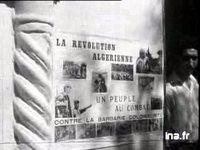 The FLN uprising presented nationalist groups with the question of whether to adopt armed revolt as the main course of action. During the first year of the war, Ferhat Abbas
's Democratic Union of the Algerian Manifesto
(UDMA), the ulema
, and the Algerian Communist Party
(PCA) maintained a friendly neutrality toward the FLN. The communists
, who had made no move to cooperate in the uprising at the start, later tried to infiltrate the FLN, but FLN leaders publicly repudiated the support of the party. In April 1956, Abbas flew to Cairo, where he formally joined the FLN. This action brought in many évolués who had supported the UDMA in the past. The AUMA
also threw the full weight of its prestige behind the FLN. Bendjelloul and the pro-integrationist moderates had already abandoned their efforts to mediate between the French and the rebels.
After the collapse of the MTLD, Messali Hadj
formed the leftist Mouvement National Algérien (MNA), which advocated a policy of violent revolution and total independence similar to that of the FLN. The Armée de Libération Nationale
(ALN), the military wing of the FLN, subsequently wiped out the MNA guerrilla
operation, and Messali Hadj's movement lost what little influence it had had in Algeria. However, the MNA gained the support of many Algerian workers in France through the Union Syndicale des Travailleurs Algériens (the Union
of Algerian Workers). The FLN also established a strong organization in France to oppose the MNA. The "Café wars
", resulting in nearly 5,000 deaths, were waged in France between the two rebel groups throughout the years of the War of Independence.
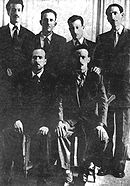 On the political front, the FLN worked to persuade — and to coerce — the Algerian masses to support the aims of the independence movement through contributions. FLN-influenced labor unions, professional associations, and students' and women's organizations were created to lead opinion in diverse segments of the population, but here too violent coercion was widely used. Frantz Fanon
, a psychiatrist from Martinique
who became the FLN's leading political theorist, provided a sophisticated intellectual justification for the use of violence in achieving national liberation He stated that only through violence could an oppressed people attain human status. From Cairo
, Ahmed Ben Bella
ordered the liquidation of potential interlocuteurs valables, those independent representatives of the Muslim
community acceptable to the French through whom a compromise or reforms within the system might be achieved.
As the FLN campaign of influence and terror spread through the countryside, many European farmers in the interior (called Pieds-Noirs
) sold their holdings and sought refuge in Algiers
and other Algerian cities. After a series of bloody, random massacres and bombings by Muslim Algerians in several towns and cities, the French Pieds-Noirs and urban French population began to demand that the French government engage in sterner countermeasures, including the proclamation of a state of emergency, capital punishment for political crimes, denunciation of all separatists, and most ominously, a call for 'tit-for-tat' reprisal operations by police, military, and para-military forces. Colon vigilante units, whose unauthorized activities were conducted with the passive cooperation of police authorities, carried out ratonnades (literally, rat-hunts, raton being a racist term for denigrating Muslim Algerians) against suspected FLN members of the Muslim community. The FLN terror and intimidation campaign gave these hunts strong motivation and starting points.
By 1955 effective political action groups within the Algerian colonial community succeeded in convincing many of the governors general sent by Paris that the military was not the way to resolve the conflict. A major success was the conversion of Jacques Soustelle
, who went to Algeria as governor general in January 1955 determined to restore peace. Soustelle, a one-time leftist and by 1955 an ardent Gaullist, began an ambitious reform program (the Soustelle Plan
) aimed at improving economic conditions among the Muslim population (Library of Congress).
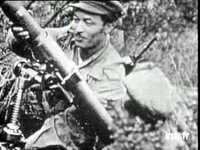 The FLN adopted tactics similar to those of nationalist groups in Asia, and the French did not realize the seriousness of the challenge they faced until 1955, when the FLN moved into urbanized areas. "An important watershed in the War of Independence was the massacre of Pieds-Noirs civilians
by the FLN near the town of Philippeville (now known as Skikda
) in August 1955. Before this operation, FLN policy was to attack only military and government-related targets. The commander of the Constantine
wilaya/region, however, decided a drastic escalation was needed. The killing by the FLN and its supporters of 123 people, including 71 French, including old women and babies, shocked Jacques Soustelle
into calling for more repressive measures against the rebels. The government claimed it killed 1,273 guerrillas in retaliation; according to the FLN and to The Times
magazine, 12,000 Algerians were massacred by the armed forces and police, as well as Pieds-Noirs gangs. Soustelle's repression was an early cause of the Algerian population's rallying to the FLN. After Philippeville, Soustelle declared sterner measures and an all-out war began. In 1956 demonstrations of French Algerians forced the French government to abolish an idea of reform.
Soustelle's successor, Governor General Lacoste, a socialist, abolished the Algerian Assembly. Lacoste saw the assembly, which was dominated by pieds-noirs
, as hindering the work of his administration, and he undertook to rule Algeria by decree. He favored stepping up French military operations and granted the army exceptional police powers—a concession of dubious legality under French law—to deal with the mounting political violence. At the same time, Lacoste proposed a new administrative structure that would give Algeria a degree of autonomy and a decentralized government. Whilst remaining an integral part of France, Algeria was to be divided into five districts, each of which would have a territorial assembly elected from a single slate of candidates. Deputies representing Algerian risings were able to delay until 1958 passage of the measure by the National Assembly of France.
In August/September 1956, the internal leadership of the FLN met to organize a formal policy-making body to synchronize the movement's political and military activities. The highest authority of the FLN was vested in the thirty-four-member National Council of the Algerian Revolution (Conseil National de la Révolution Algérienne, CNRA), within which the five-man Committee of Coordination and Enforcement (Comité de Coordination et d'Exécution, CCE) formed the executive. The externals, including Ben Bella, knew the conference was taking place but by chance or design on the part of the internals were unable to attend.
Meanwhile, in October 1956, the French Air Force
intercepted a Moroccan DC-3 that was flying to Tunis
, carrying Ahmed Ben Bella
, Mohammed Boudiaf, Mohamed Khider
and Hocine Aït Ahmed
, and forced it to land in Algiers. Lacoste had the FLN external political leaders arrested and imprisoned for the duration of the war. This action caused the remaining rebel leaders to harden their stance.
France took a more openly hostile view of Egypt
's President Gamal Abdel Nasser
's material and political assistance to the FLN, which some French analysts believed was the most important element in sustaining continued rebel activity in Algeria. This attitude was a factor in persuading France to participate in the November 1956 British attempt to seize the Suez Canal
during the Suez Crisis
.
During 1957 support for the FLN weakened as the breach between the internals and externals widened. To halt the drift, the FLN expanded its executive committee to include Abbas, as well as imprisoned political leaders such as Ben Bella. It also convinced communist and Arab members of the United Nations
(UN) to put diplomatic pressure on the French government to negotiate a cease-fire.
Writer, philosopher and playwright Albert Camus
, native of Algiers, often associated with existentialism
, tried unsuccessfully to persuade both sides to at least leave civilians alone, writing editorials against the use of torture in Combat
newspaper.
The FLN considered him a fool, and some Pied-Noir
s considered him a traitor. Nevertheless, in his speech when he received the Literature Nobel Prize in Oslo, Camus said that when faced with a radical choice he would eventually support his community. This statement made him lose his status among the left-wing intellectuals; when he died in 1960 in a car crash, the official thesis of an ordinary accident (a quick open-and-shut case) has left more than a few observers doubtful. His widow has claimed that Camus, though discreet, was in fact an ardent supporter of French Algeria in the last years of his life.
and also to plant bombs in public places. The most notable manifestation of the new urban campaign was the Battle of Algiers, which began on September 30, 1956, when three women, including Djamila Bouhired
and Zohra Drif
, simultaneously placed bombs at three sites including the downtown office of Air France
. The FLN carried out an average of 800 shootings and bombings per month through the spring of 1957 , resulting in many civilian casualties and inviting a crushing response from the authorities. The 1957 general strike, timed to coincide with, and influence, the UN debate on Algeria, was largely observed by Muslim workers and businesses .
General Jacques Massu
was instructed to use whatever methods deemed necessary to restore order in the city, find and eliminate terrorists. Using paratroopers, he broke the strike and then in the succeeding months systematically destroyed the FLN infrastructure in Algiers. But the FLN had succeeded in showing its ability to strike at the heart of French Algeria and to rally and force a mass response to its demands among urban Muslims. The publicity given to the brutal methods used by the army to win the Battle of Algiers, including the use of torture, a strong movement control and curfew called quadrillage and where all authority was under the military, created doubt in France about its role in Algeria. This doubt was strongly communicated to France by French sympathisers in Algiers who supported the idea of independence morally, financially and materially. What had been originally thought of as a simple "pacification
" or "public order operation" had turned into a fully fledged colonial war
to block the influence of the guerillas and had resulted in the introduction of torture.
During 1956 and 1957, the FLN successfully applied hit-and-run
tactics in accordance with guerrilla warfare
theory, which was at the time being formalized (in particular by Mao Zedong
) as "people's war". Whilst some of this was aimed at military targets, a significant amount was invested in a terror campaign against those in any way deemed to be supporting or encouraging French authority. This resulted in acts of sadistic torture and the most brutal violence against all including women and children. Specializing in ambushes and night raids and avoiding direct contact with superior French firepower, the internal forces targeted army patrols, military encampments, police posts, and colonial farms, mines, and factories, as well as transportation and communications facilities. Once an engagement was broken off, the guerrillas merged with the population in the countryside, in accordance with Mao's theories. Kidnapping was commonplace, as were the ritual murder and mutilation of civilians (see Torture section).
Although successful in engendering an atmosphere of fear and uncertainty within both communities in Algeria, the revolutionaries' coercive tactics suggested that they had not yet inspired the bulk of the Muslim people to revolt against French colonial rule. Gradually, however, the FLN gained control in certain sectors of the Aurès, the Kabylie
, and other mountainous areas around Constantine and south of Algiers and Oran
. In these places, the FLN established a simple but effective— although frequently temporary—military administration that was able to collect/extort taxes and food and to recruit manpower. But it was never able to hold large fixed positions. Algerians all over the country also initiated underground social, judicial, and civil organizations, gradually building their own state.
The loss of competent field commanders both on the battlefield and through defections and political purges created difficulties for the FLN. Moreover, power struggles in the early years of the war split leadership in the wilayat, particularly in the Aurès. Some officers created their own fiefdoms, using units under their command to settle old scores and engage in private wars against military rivals within the FLN.
bore the brunt of offensive counterinsurgency combat operations, approximately 170,000 Muslim Algerians also served in the regular French army, most of them volunteers. France also sent air force and naval units to the Algerian theater, including helicopters. In addition to service as a flying ambulance and cargo carrier, French forces utilized the helicopter
for the first time in a ground attack role in order to pursue and destroy fleeing FLN guerrilla units. The American military later used the same helicopter combat methods in Vietnam
. The French also used napalm
, which was depicted for the first time in the 2007 film L'Ennemi intime by Florent Emilio Siri
.
The French army resumed an important role in local Algerian administration through the Special Administration Section (Section Administrative Spécialisée, SAS), created in 1955. The SAS's mission was to establish contact with the Muslim population and weaken nationalist influence in the rural areas by asserting the "French presence" there. SAS officers—called képis bleus (blue caps)—also recruited and trained bands of loyal Muslim irregulars, known as harki
s. Armed with shotguns and using guerrilla tactics similar to those of the FLN, the harkis, who eventually numbered about 180,000 volunteers, more than the FLN effectives, were an ideal instrument of counterinsurgency warfare.
Harkis were mostly used in conventional formations, either in all-Algerian units commanded by French officers or in mixed units. Other uses included platoon
or smaller size units, attached to French battalions, in a similar way as the Kit Carson Scouts
by the US in Vietnam. A third use was an intelligence gathering role, with some reported minor pseudo-operations in support of their intelligence collection. According to U.S. military expert Lawrence E. Cline, however: "The extent of these pseudo-operations appears to have been very limited both in time and scope.... The most widespread use of pseudo type operations was during the 'Battle of Algiers' in 1957. The principal French employer of covert agents in Algiers was the Fifth Bureau, the psychological warfare
branch." The Fifth Bureau "made extensive use of "turned" FLN members, one such network being run by Captain Paul-Alain Leger of the 10th Paras. "Persuaded
" to work for the French forces included by the use of torture and threats against their family; these agents "mingled with FLN cadres. They planted incriminating forged documents, spread false rumors of treachery and fomented distrust.... As a frenzy of throat-cutting and disemboweling broke out among confused and suspicious FLN cadres, nationalist slaughtered nationalist from April to September 1957 and did France's work for her." But this type of operation involved individual operatives rather than organized covert units.
One organized pseudo-guerrilla unit, however, was created in December 1956 by the French DST
domestic intelligence agency. The Organization of the French Algerian Resistance (ORAF), a group of counter-terrorists had as its mission to carry out false flag
terrorist attacks with the aim of quashing any hopes of political compromise.
But it seemed that, as in Indochina, "the French focused on developing native guerrilla groups that would fight against the FLN", one of whom fought in the Southern Atlas Mountains
, equipped by the French Army.
The FLN also used pseudo-guerrilla strategies against the French Army on one occasion, with Force K, a group of 1,000 Algerians who volunteered to serve in Force K as guerrillas for the French. But most of these members were either already FLN members or were turned by the FLN, once enlisted. Corpses of purported FLN members displayed by the unit were in fact those of dissidents and members of other Algerian groups killed by the FLN. The French Army finally discovered the war ruse and tried to hunt down Force K members. However, some 600 managed to escape and join the FLN with weapons and equipment.
Late in 1957, General Raoul Salan
, commanding the French Army in Algeria, instituted a system of quadrillage (surveillance using a grid pattern), dividing the country into sectors, each permanently garrisoned by troops responsible for suppressing rebel operations in their assigned territory. Salan's methods sharply reduced the instances of FLN terrorism but tied down a large number of troops in static defense. Salan also constructed a heavily patrolled system of barriers to limit infiltration from Tunisia and Morocco. The best known of these was the Morice Line
(named for the French defense minister, André Morice), which consisted of an electrified fence, barbed wire, and mines over a 320-kilometer stretch of the Tunisian border.
The French military command ruthlessly applied the principle of collective responsibility to villages suspected of sheltering, supplying, or in any way cooperating with the guerrillas. Villages that could not be reached by mobile units were subject to aerial bombardment. FLN guerrillas that fled to caves or other remote hiding places were tracked and hunted down. In one episode, FLN guerrillas, who refused to surrender and withdraw from a cave complex, were dealt with by French Foreign Legion Pioneer troops, who, lacking flamethrowers or explosives, simply bricked up each cave, leaving the residents to die of suffocation.
Finding it impossible to protect all of Algeria's remote farms and villages, the French government also initiated a program of concentrating large segments of the rural population, including whole villages, in camps under military supervision to prevent them from voluntarily aiding the rebels — or to protect them from FLN extortion. In the three years (1957–60) during which the regroupement program was followed, more than 2 million Algerians were removed from their villages, mostly in the mountainous areas, and resettled in the plains, where many found it impossible to reestablish their accustomed economic or social situations. Living conditions in the fortified villages were poor. Hundreds of empty villages were devastated, and in hundreds of others, orchards and croplands not previously burned by French troops went to seed for lack of care. These population transfers were effective in denying the use of remote villages to FLN guerrillas, who had used them as a source of rations and manpower, but also caused significant resentment on the part of the displaced villagers. The disruptive social and economic effects of this massive relocation continued to be felt into a generation later.
The French Army shifted its tactics at the end of 1958 from dependence on quadrillage to the use of mobile forces deployed on massive search-and-destroy missions against FLN strongholds. Within the next year, Salan's successor, General Maurice Challe
, appeared to have suppressed major rebel resistance. But political developments had already overtaken the French Army's successes.
and increased the misgivings of the army and of the pied-noirs that the security of Algeria was being undermined by party politics. Army commanders chafed at what they took to be inadequate and incompetent political initiatives by the government in support of military efforts to end the rebellion. The feeling was widespread that another debacle like that of Indochina in 1954 was in the offing and that the government would order another precipitate pullout and sacrifice French honor to political expediency. Many saw in de Gaulle, who had not held office since 1946, the only public figure capable of rallying the nation and giving direction to the French government.
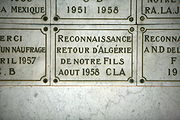 After his tour as governor general, Soustelle had returned to France to organize support for de Gaulle's return to power, while retaining close ties to the Army and the pied-noirs. By early 1958, he had organized a coup d'état
, bringing together dissident Army officers and pied-noirs with sympathetic Gaullists. An Army junta under General Massu seized power in Algiers on the night of May 13, thereafter known as the May 1958 crisis
. General Salan assumed leadership of a Committee of Public Safety formed to replace the civil authority and pressed the junta's demands that de Gaulle be named by French president René Coty
to head a government of national unionity invested with extraordinary powers to prevent the "abandonment of Algeria."
On May 24, French paratroopers from the Algerian corps landed on Corsica
, taking the French island in a bloodless action, Operation Corse. Subsequently, preparations were made in Algeria for Operation Resurrection
, which had as objectives the seizure of Paris and the removal of the French government. Resurrection was to be implemented if one of three scenarios occurred: if de Gaulle was not approved as leader of France by Parliament; if de Gaulle asked for military assistance to take power; or if it seemed that communist forces were making any move to take power in France. De Gaulle was approved by the French parliament on May 29, by 329 votes against 224, 15 hours before the projected launch of Operation Resurrection. This indicated that the French Fourth Republic by 1958 no longer had any support from the French Army in Algeria and was at its mercy even in civilian political matters. This decisive shift in the balance of power in civil-military relations in France in 1958, and the threat of force was the main, immediate factor in the return of de Gaulle to power in France.
De Gaulle immediately appointed a committee to draft a new constitution for France's Fifth Republic, which would be declared early the next year, with which Algeria would be associated but of which it would not form an integral part. All Muslims, including women, were registered for the first time on electoral rolls to participate in a referendum to be held on the new constitution in September 1958.
De Gaulle's initiative threatened the FLN with the prospect of losing the support of the growing numbers of Muslims, who were tired of the war and had never been more than lukewarm in their commitment to a totally independent Algeria. In reaction, the FLN set up the Provisional Government of the Algerian Republic
(Gouvernement Provisoire de la République Algérienne, GPRA), a government-in-exile headed by Abbas
and based in Tunis. Before the referendum, Abbas lobbied for international support for the GPRA, which was quickly recognized by Morocco
, Tunisia
, several other Arab countries, China, and a number of African and other Asian states but not by the Soviet Union.
ALN commandos committed numerous acts of sabotage in France in August, and the FLN mounted a desperate campaign of terror in Algeria to intimidate Muslims into boycott
ing the referendum. Despite threats of reprisal, however, 80 percent of the Muslim electorate turned out to vote in September, and of these 96 percent approved the constitution. In February 1959, de Gaulle was elected president of the new Fifth Republic. He visited Constantine in October to announce a program to end the war and create an Algeria closely linked to France. De Gaulle's call on the rebel leaders to end hostilities and to participate in elections was met with adamant refusal. "The problem of a cease-fire in Algeria is not simply a military problem", said the GPRA's Abbas. "It is essentially political, and negotiation must cover the whole question of Algeria." Secret discussions that had been underway were broken off.
In 1958–59 the French army had won military control in Algeria and was the closest it would be to victory. In late July 1959, during Operation Jumelles
Colonel Bigeard
, whose elite paratrooper unit fought at Dien Bien Phu
in 1954, told journalist Jean Lartéguy
(source):
During this period in France, however, opposition to the conflict was growing among many segments of the population, notably the leftists, with the French Communist Party
, then one of the country's strongest political forces, which was supporting the Algerian Revolution. Thousands of relatives of conscripts and reserve soldiers suffered loss and pain; revelations of torture and the indiscriminate brutality the army visited on the Muslim population prompted widespread revulsion, and a significant constituency supported the principle of national liberation. International pressure was also building on France to grant Algeria independence. Annually since 1955 the UN General Assembly had considered the Algerian question, and the FLN position was gaining support. France's seeming intransigence in settling a colonial war that tied down half the manpower of its armed forces was also a source of concern to its North Atlantic Treaty Organization allies. In a September 16, 1959, statement, de Gaulle dramatically reversed his stand and uttered the words "self-determination" as the third and preferred solution http://123helpme.com/view.asp?id=22721, which he envisioned as leading to majority rule in an Algeria formally associated with France. In Tunis, Abbas acknowledged that de Gaulle's statement might be accepted as a basis for settlement, but the French government refused to recognize the GPRA as the representative of Algeria's Muslim community.
and Jean-Jacques Susini
, café owner Joseph Ortiz, and lawyer Jean-Baptiste Biaggi staged an insurrection in the Algerian capital starting on January 24, 1960, and known in France as La semaine des barricades ("the week of barricades"). The ultras incorrectly believed that they would be supported by General Massu. The insurrection order was given by Colonel Jean Garde of the Fifth Bureau. As the army, police, and supporters stood by, civilian pied-noirs threw up barricades in the streets and seized government buildings. General Maurice Challe
, responsible for the Army in Algeria, declared Algiers under siege
but forbade the troops from firing on the insurgents. Nevertheless, 20 rioters were killed during a firing on the boulevard Laferrière. Eight arrest warrants were issued in Paris against the initiators of the insurrection. Jean-Marie Le Pen
, a member of parliament, who called for the barricades to be extended to Paris, and theorician Georges Sauge were then placed under custody.
In Paris on January 29, 1960, de Gaulle called on the army to remain loyal and rallied popular support for his Algerian policy in a televised address:
Most of the Army heeded his call, and the siege of Algiers ended on February 1 with Lagaillarde surrendering to General Challe's command of the French Army in Algeria. The loss of many ultra leaders who were imprisoned or transferred to other areas did not deter the French Algeria militants. Sent to prison in Paris and then paroled, Lagaillarde fled to Spain. There, with another French army officer, Raoul Salan
, who had entered clandestinely
, and with Jean-Jacques Susini, he created the Organisation de l'armée secrète (Secret Army Organization, OAS) on December 3, 1960, with the purpose to follow-up the fight for French Algeria. Highly organized and well-armed, the OAS stepped up its terrorist activities, which were directed against both Algerians and pro-government French citizens, as the move toward negotiated settlement of the war and self-determination gained momentum. To the FLN rebellion against France were added civil wars between extremists in the two communities and between the ultras and the French government in Algeria.
Beside Pierre Lagaillarde, Jean-Baptiste Biaggi was also imprisoned, while Alain de Sérigny got arrested, and Joseph Ortiz's FNF dissolved, as well as General Lionel Chassin's MP13. De Gaulle also modified the government, excluding Jacques Soustelle
, believed to be too pro-French Algeria, and granting the Minister of Information to Louis Terrenoire, who quit RTF
(French broadcasting TV). Pierre Messmer
, who had been member of the Foreign Legion
, was named Minister of Defense, and dissolved the Fifth Bureau, the psychological warfare
branch, which had ordered the rebellion. These units had theorized the principles of a counter-revolutionary war, including the use of torture. During the Indochina War (1947–54), officers such as Roger Trinquier
and Lionel-Max Chassin were inspired by Mao Zedong
's strategic doctrine and acquired knowledge of convince the population
to support the fight. The Fifth Bureau were organized by Jean Ousset
, French representant of the Opus Dei
, under the order of Permanent Secretary General of the National Defense (SGPDN) Geoffroy Chodron de Courcel
. The officers were initially formed in the Centre d'instruction et de préparation à la contre-guérilla (Arzew). Jacques Chaban-Delmas
added to that the Centre d'entraînement à la guerre subversive Jeanne-d'Arc (Center of Training to Subversive War Jeanne-d'Arc) in Philippeville
, Algeria, directed by Colonel Marcel Bigeard
. According to the Voltaire Network
, the Catholic stay-behind
Georges Sauge animated conferences there, and one could read on the walls of the center the following maxim: "This Army must be fanatic, despising luxury, animated by the spirit of the Crusades
" Pierre Messmer hence dissolved structures which had turned themselves against de Gaulle, leaving the "revolutionary war" to the exclusive responsibility of Gaullist General André Beaufre
.
The French army officers uprising can be understood as following; some officers, most notably from the paratroopers corps, felt betrayed by the government for the second time after Indochina (1947–1954). In some aspects the Dien Bien Phu
garrison was sacrificed with no metropolitan support, order was given to commanding officer General de Castries
to "let the affair die of its own, in serenity" ("laissez mourrir l'affaire d'elle même en sérénité").
The opposition of the MNEF student trade-union to the participation of the conscripts to the war led to a secession in May 1960, with the creation of the Fédération des étudiants nationalistes (FEN, Federation of Nationalist Students) around Dominique Venner
, a former member of Jeune Nation
and of MP-13, François d'Orcival and Alain de Benoist
, who would theorize in the 1980s the "New Right
" movement. The FEN then published the Manifeste de la classe 60.
A Front national pour l'Algérie française (FNAF, National Front for French Algeria) was created in June 1960 in Paris, gathering around former De Gaulle's Secretary Jacques Soustelle
Claude Dumont, Georges Sauge, Yvon Chautard, Jean-Louis Tixier-Vignancour
(who would present himself as far-right candidate in the 1965 presidential election
), Jacques Isorni, Victor Barthélemy
, François Brigneau and Jean-Marie Le Pen. Another ultra rebellion occurred in December 1960, which led de Gaulle to dissolve the FNAF.
After the publication of the Manifeste des 121 against the use of torture and the war, the opponents to the war created the Rassemblement de la gauche démocratique, which included the French Section of the Workers' International (SFIO) socialist party, the Radical-Socialist Party, Force ouvrière
(FO) trade union, Confédération Française des Travailleurs Chrétiens
trade-union, FEN
trade-union, etc., which supported de Gaulle against the ultras.
There exists a distinction between two different types of women who became involved, urban and rural. Urban women, who constituted about twenty percent of the overall force, had received some kind of education and usually chose to enter on the side of the FLN of their own accord. Largely illiterate rural women, on the other hand, the remaining eighty percent, due to their geographic location in respect to the operations of FLN often became involved in the conflict as a result of proximity paired with force.
Women operated in a number of different areas during the course of the rebellion. "Women participated actively as combatants, spies, fundraisers, as well as nurses, launderers, and cooks", "women assisted the male fighting forces in areas like transportation, communication and administration" the range of involvement by a woman could include both combatant and non-combatant roles. While the majority of the tasks that women undertook centered on the realm of the non-combatant, those that surrounded the limited number that took part in acts of violence were more frequently noticed. The reality was that "rural women in maquis [rural areas] support networks" contained the overwhelming majority of those who participated. This is not to marginalize those women who did engage in acts of violence but simply to illustrate that they constituted in the minority.
on January 8, 1961, which 75% of the voters (both in France and Algeria) approved and De Gaulle's government began secret peace negotiations with the FLN. In the Algerian départements 69.51% voted in favor of self-determination.
The "generals' putsch" in April 1961, aimed at canceling the government's negotiations with the FLN, marked the turning point in the official attitude toward the Algerian war. De Gaulle
was now prepared to abandon the pieds-noirs, the group that no previous French government was willing to write off. The army had been discredited by the putsch and kept a low profile politically throughout the rest of France's involvement with Algeria.
Talks with the FLN reopened at Évian
in May 1961; after several false starts, the French government decreed that a ceasefire would take effect on March 18, 1962. In their final form, the Évian Accords
allowed the pieds-noirs equal legal protection with Algerians over a three year period. These rights included respect for property, participation in public affairs, and a full range of civil and cultural rights. At the end of that period, however, all Algerian residents would be obliged to become Algerian citizens or be classified as aliens with the attendant loss of rights. The agreement also allowed France to establish military bases in Algeria even after the independence (including the nuclear test site of Regghane, the naval base of Mers-el-Kebir and the aerial base of Bou Sfer) and to have advantages on the Algerian oil.
In the second referendum on the independence of Algeria
held in June 1962 the French electorate approved the Evian Accords by an overwhelming 91 percent vote. On July 1, 1962, some 6 million of a total Algerian electorate of 6.5 million cast their ballots. The vote was nearly unanimous, with 5,992,115 votes for independence, 16,534 against, with most Pied-noirs and Harkis either having fled or abstained from voting. De Gaulle pronounced Algeria an independent country on July 3. The Provisional Executive, however, proclaimed July 5, the 132nd anniversary of the French entry into Algeria, as the day of national independence.
During the three months between the cease-fire and the French referendum on Algeria, the OAS unleashed a new terrorist campaign. The OAS sought to provoke a major breach in the ceasefire by the FLN but the terrorism now was aimed also against the French army and police enforcing the accords as well as against Muslims. It was the most wanton carnage that Algeria had witnessed in eight years of savage warfare. OAS operatives set off an average of 120 bombs per day in March, with targets including hospitals and schools. Ultimately, the terrorism failed in its objectives, and the OAS and the FLN concluded a truce on June 17, 1962. In the same month, more than 350,000 Pied-noir
s left Algeria.
Despite the Evian Accords guarantees towards the French citizens, after the end of June civilians became the target of systematic FLN attacks. It quickly became apparent to Europeans that the new government would not ensure their safety or enforce their rights. The Oran massacre of 1962
, four days after the vote, is the main example of deliberate strategy of killing to terrorize pieds-noirs and push them to leave. These tactics proved effective. Summer 1962 saw a rush to France. Within a year, 1.4 million refugees, including almost the entire Jewish community and some pro-French Muslims, had joined the exodus to France. Despite the declaration of Independence on July 5, 1962, the last French forces did not leave the Naval Base of Mers El Kébir until 1967. (The Evian Accords had permitted France to maintain its military presence for fifteen years—the withdrawal in 1967 was significantly ahead of schedule.)
(including indigenous Mizrachi
and Sephardi Jews
) and Harkis accounted for 13% of the total population of Algeria in 1962. For the sake of clarity, each group's exodus is described separately here, although their fate shared many common elements.
) that had been in Algeria for generations; it is sometimes used to include the indigenous Mizrachi
and Sephardi Jewish population as well, which likewise emigrated after 1962. The Europeans had arrived as immigrants from all over the western Mediterranean (particularly France, Spain, Italy and Malta
), starting in 1830. The Jews had arrived in several waves, some coming in Roman times starting in 600 BC and some had arrived as refugees from the Spanish Inquisition
, and had largely embraced French citizenship after the décret Crémieux in 1871. Some Jews were in fact indigenous Berbers who had embraced Judaism before the advent of Christianity. In 1959, the pieds-noirs numbered 1,025,000 (85% of European Christian descent, and 15% were made up of the indigenous Algerian population of Mizrachi
and Sephardi Jewish descent), and accounted for 10.4% of the total population of Algeria. In just a few months in 1962, 900,000 of them fled or left the country, the first third prior to the referendum, in the most massive relocation of population to Europe since the Second World War
. A motto used in the FLN propaganda designating the Pied-noirs community was "Suitcase or coffin" ("La valise ou le cercueil") – an expropriation of a term first coined years earlier by pied-noir "ultras" when rallying the European community to their hardcore line.
The French government claimed not to have anticipated that such a massive number would leave; at the most it said it estimated that perhaps 250–300,000 might choose to go to metropolitan France temporarily. Nothing was planned for their move to France, and many had to sleep in streets or abandoned farms on their arrival. A minority of departing pieds-noirs, including soldiers, destroyed their possessions before departure, applying scorched earth
policy in a sign of protestation and as a desperate symbolic try to leave no trace of over a century of European presence, but the vast majority of their goods and houses were left intact and abandoned to Algerians. Scenes of thousands of panicked people camping for weeks on the docks of Algerian harbors waiting for a space on a boat to France were common from April to August 1962. About 100,000 pieds-noirs chose to remain, but most of those gradually left over the 1960s and 1970s, primarily due to residual hostility against them, including machine-gunning of public places in Oran
.
 The so-called Harki
s, from the Algerian-Arabic dialect word harki (soldier), were the indigenous Muslim Algerians (as opposed to European-descended Catholics or indigenous Algerian Mizrachi
Sephardi Jews
) who fought as auxiliaries on the side of the French army. Some of these were veterans of the Free French Forces
who participated in the liberation of France during World War II or in the Indochina War. The term also came to include civilian indigenous Algerians who supported a French Algeria. According to French government figures, there were 236,000 Algerian Muslims serving in the French Army in 1962 (four times more than in the FLN), either in regular units (Spahis and Tirailleurs) or as irregulars (harkis and moghaznis). Some estimates suggest that, with their families, the indigenous Muslim loyalists may have numbered as many as 1 million
In 1962, around 91,000 Harkis fled or sailed to France, despite French policy against this. Pierre Messmer, minister of the armies and Louis Joxe, minister for Algerian affairs gave orders to this effect. The Harkis were seen as traitors by many Algerians, and many of those who stayed behind suffered severe reprisals after independence. French historians estimate that somewhere between 50,000 and 150,000 Harkis and members of their families were killed by the FLN or by lynch mobs in Algeria, often in atrocious circumstances or after torture, a climax being reached at the Oran massacre of 1962
. The abandonment of the "Harkis" both in terms of non-recognition of those who died defending a French Algeria and the neglect of those who escaped to France, remains an issue that France has not fully resolved—although the government of Jacques Chirac
made efforts to give recognition to the suffering of these former allies.
More than 12,000 Algerians died in internal FLN purges during the war. In France, an additional 5,000 died in the "café wars" between the FLN and rival Algerian groups. French sources also estimated that 70,000 Muslim civilians were killed or abducted and presumed killed, by the FLN.
Historians, like Alistair Horne
and Raymond Aron
, consider the actual number of war dead was far greater than the original FLN and official French estimates but was fewer than the 1 million adopted by the Algerian government. Horne has estimated Algerian casualties during the span of eight years to be around 700,000. Uncounted thousands of Muslim civilians lost their lives in French
Army ratissages, bombing raids, or vigilante reprisals. The war uprooted more than 2 million Algerians, who were forced to relocate in French camps or to flee into the Algerian hinterland, where many thousands died of starvation, disease, and exposure. In addition, large numbers of pro-French Muslims were murdered when the FLN settled accounts after independence.
quickly became more popular and thereby more powerful. In June 1962, he challenged the leadership of Premier Benyoucef Ben Khedda; this led to several disputes among his rivals in the FLN, which were quickly suppressed by Ben Bella's rapidly growing support, most notably within the armed forces. By September, Bella was in control of Algeria by all but name, was elected as premier in a one-sided election on September 20, and was recognised by the U.S. on September 29. Algeria was admitted as the 109th member of the United Nations
on October 8, 1962. Afterward, Ben Bella declared that Algeria would follow a neutral course in world politics; within a week he met with U.S. President John F. Kennedy
, requesting more aid for Algeria with Fidel Castro
and expressed approval of Castro's demands for the abandonment of Guantanamo Bay. Bella returned to Algeria with another request: that France withdraw from its bases there. In November, his government banned the party, providing that the FLN would be the only party allowed to function overtly. Shortly thereafter, in 1965, Bella was deposed and placed under house arrest (and later exiled) by Houari Boumédiènne, who served as president until his death in 1978. Algeria remained stable, though in a one-party state, until the violent civil war broke out in the 1990s.
For Algerians of many political factions, the legacy of their War of Independence was a legitimization or even sanctification of the unrestricted use of force in achieving a goal deemed to be justified. Once invoked against foreign colonialists, the same principle could also be turned with relative ease against fellow Algerians. The determination of the FLN to overthrow the colonial rule and the ruthlessness exhibited by both sides in that struggle were to be mirrored 30 years later by the determination of the FLN government to hold onto power, by the Islamist opposition to overthrow that rule, and by the brutal struggle which ensued.
, which started in 1830. Claude Bourdet
had denounced these acts on December 6, 1951, in the magazine L'Observateur, retorically asking: "Is there a Gestapo
in Algeria?" Torture had also been used on both sides during the First Indochina War
(1946–54)
D. Huf, in his seminal work on the subject, has argued that the use of torture was one of the major factors in developing French opposition to the war. Huf argues that "Such tactics sat uncomfortably with France's revolutionary history, and brought unbearable comparisons with Nazi Germany. The French national psyche would not tolerate any parallels between their experiences of occuaption and their colonial mastery of Algeria." General Paul Aussaresses
admitted in 2000 that the use of systematic torture techniques during the war and justified it. He also recognized the assassination of lawyer Ali Boumendjel and the head of the FLN in Algiers, Larbi Ben M'Hidi
, which had been disguised as suicides. Bigeard, who called FLN activists "savages", claimed torture was a "necessary evil." To the contrary, General Jacques Massu
denounced it, following Aussaresses's revelations and, before his death, pronounced himself in favor of an official condemnation of the use of torture during the war.
Bigeard's justification of torture has been criticized by various people, among whom Joseph Doré, archbishop of Strasbourg, and Marc Lienhard, president of the Lutherian Church of Augsbourg Confession in Alsace-Lorraine.
In June 2000, Bigeard declared that he was based in Sidi Ferruch
, known as a torture center and where Algerians were murdered. Bigeard qualified Louisette Ighilahriz's revelations, published in the Le Monde newspaper on June 20, 2000, as "lies." An ALN activist, Louisette Ighilahriz had been tortured by General Massu. She herself called Bigeard a "liar" and criticized his continuing denial of the use of torture 40 years later. However, since General Massu's revelations, Bigeard has now admitted the use of torture, although he denies having personally used it, and has declared: "You are striking the heart of an 84-year-old man." Bigeard also recognized that Larbi Ben M'Hidi
had been assassinated and that his death had been disguised as a suicide. Paul Teitgen, prefect of Algiers, also revealed that Bigeard's troops threw Algerians in the sea from helicopters, which resulted in brutalized corpses, found in open waters and nicknamed "crevettes Bigeard" ("Boigeard's shrimp"). This tactic was later theorized in Argentina by Admiral Luis María Mendía
, as "death flights."
was a favored torture.) Moreover, during the first two years of the conflict, the guerrillas killed about 6,000 Muslims and 1,000 non-Muslims according to a former paratrooper
.
tactics developed during the war were used afterward in other contexts, including the Argentine "Dirty War
" in the 1970s. In a book, journalist Marie-Monique Robin
alleges that French secret agents had taught Argentine intelligence agents counter-insurgency tactics, including the systemic use of torture, block-warden system, and other techniques, all employed during the 1957 Battle of Algiers
. The Battle of Algiers
film includes the documentation. Robin found the document proving that a secret military agreement tied France to Argentina from 1959 until 1981; the later is the date of the election of President François Mitterrand
.
on the war, including Jean-Charles Jauffret's book, La Guerre d'Algérie par les documents ("The Algerian War According to the Documents"), many remain inaccessible. This is contrary to the engagement of Prime Minister Lionel Jospin
's (Socialist Party, PS) on July 27, 1997. The recognition in 1999 by the National Assembly, in which the PS had obtained a majority during the 1997 legislative elections, permitted the Algerian War, at last, to enter the syllabi of French schools. The details of the Paris massacre of 1961
has only begun to emerge in the nation's memory, although access to the archives remains strongly restricted. The French state, which finally recognized 40 deaths, is a far way from giving free access to the archives. (In France, there is no such law such as the U.S.'s Freedom of Information Act.) However, it has been proved, including with David Assouline's limited access to the Paris archives, granted by Socialist Minister of Culture
Catherine Trautmann
), that at least 70 Algerians died during these events and 90 people by the second half of October 1961.
The Algerian War remains a contentious event today. According to historian Benjamin Stora
— who holds a Ph.D. degree in history and sociology, teaches at Paris VII
, and is one of the leading historians on the Algerian war — memories concerning the war remain fragmented, with no common ground to speak of, translated from French:
Even though Stora has counted 3,000 publications in French on the Algerian war, there still is no work produced with a French person and an Algerian cooperating with one another. Even though, according to Stora there can "no longer be talk about a 'war without a name'.... , a number of problems remain, especially the absence of sites in France to commemorate" the war. Furthermore, conflicts have arisen on an exact commemoration date to end the war. Although many sources as well as the French state place it on March 19, 1962, the Evian agreements, others point out that the massacres of harkis and the kidnapping of pied-noirs took place afterwards.
Stora further points out: "The phase of memorial reconciliation between the two sides of the sea is still a long way off." This was recently illustrated by the Union for a Popular Movement
's UMP vote of the February 23, 2005, the law on colonialism
, which asserted that colonialism had globally been "positive." Thus, a teacher in one of the elite high schools of Paris has declared:
Along side a heated debate in France, the February 23, 2005, law had the effect of jeopardizing the treaty of friendship that President Jacques Chirac
was supposed to sign with President Abdelaziz Bouteflika
— a treaty no longer on the agenda. Following this controversial law, Bouteflika has talked about a "cultural genocide
", particularly referring to the 1945 Sétif massacre
. Chirac finally had the law repealed through a complex institutional mechanism.
Another matter concerns the teaching of the war, as well as of colonialism and decolonization, in particular in French secondary schools
Hence, there is only one reference to racism
in a French textbook, one published by Bréal publishers for terminales students (those passing their baccalauréat
). This circumstance exists despite an institutional racism
, which is still pregnant in French society and demonstrated by SOS Racisme
's various tests concerning racial discrimination. Textbooks still refers to "them" as "Muslims" as "them" and the "French" as "us", despite the fact that Algerians held French nationality and that many French citizens today come from a Muslim background. Thus, many are not surprised that the first to speak about the October 17, 1961, massacre were music bands, including, but not only, hip-hop bands such as the famous Suprême NTM
("les Arabes dans la Seine") or politically engaged La Rumeur
. Indeed, the Algerian War is not even the subject of a specific chapter in textbook for terminales Henceforth, Benjamin Stora can state that:
The Algerian War and its consequences are thus fundamental to any understanding of the state of 21st-century France, as well as the social situation in the French suburbs
, the conditions of which were brought to world attention during the civil unrest in autumn 2005
. For the first time since the Algerian war, the head of state, President Chirac of the UMP party, proclaimed a state of emergency
, which was confirmed a few weeks later by the National Assembly
. (The only party to vote against its extension were the Communist Party and the Greens.)
In metropolitan France
in 1963, 43% of French Algerians lived in bidonvilles
(shanty towns). Thus, Azouz Begag
, the delegate minister for Equal Opportunities in the government of Prime Minister Dominique de Villepin
of the UMP party, wrote an autobiographic novel, Le Gone du Chaâba, about his experiences while living in a bidonville in the outskirts of Lyon. It is impossible to understand the third-generation of Algerian immigrants to France without recalling this bicultural experience
. An official parliamentary report on the "prevention of criminality", commanded by then Interior Minister Villepin and made by member of parliament Jacques-Alain Bénisti
, claimed that "Multilingualism
(bilinguisme) was a factor of criminality." (sic). Following outcries from many NGOs and left-wing sectors, the definitive version of the Bénisti report finally made multilingualism an asset rather than a fault.
Thus, the stakes of the contemporary debate on torture clearly appear in full light. After having denied its use during 40 years, the French state has finally recognized it; although, there was never an official proclamation about it. Paul Aussaresses
was sentenced following his justification of the use of torture for "apology of war crimes." But, the same as during the events of the time, the French state has claimed torture was an isolated act, instead of admitting its responsibility in the institutionalization of torture as a standard counter-insurgency method, which was used to break the population's morale and not, as Aussaresses has claimed, to "save lives" by gaining short-term information which would stop "terrorists"). The state now claims that it was a regrettable incident due to the context of the war. But various academic research has proved both theses false. "Torture in Algeria was engraved in the colonial act; it is a 'normal' illustration of an abnormal system", wrote Nicolas Bancel, Pascal Blanchard and Sandrine Lemaire, who discuss the phenomena of "human zoo
s." From the enfumades (smoking parlors) of the Darha caves in 1844 by Pélissier to the 1945 riots in Sétif, Guelma
, and Kherrata
, the repression in Algeria has used the same methods. Following the Sétif massacres, other riots against the European presence occurred in Guelma, Batna, Biskra, and Kherrata; they resulted in 103 deaths among the pied-noirs. The repression of these riots officially saw 1,500 other deaths, but N. Bancel, P. Blanchard and S. Lemaire estimate the number to be rather between 6,000 and 8,000
(INA), see Benjamin Stora's comments on their politically oriented creation. what about Benjamin Stora's own political orientation as admitted Trotskyist?
Algeria
Algeria , officially the People's Democratic Republic of Algeria , also formally referred to as the Democratic and Popular Republic of Algeria, is a country in the Maghreb region of Northwest Africa with Algiers as its capital.In terms of land area, it is the largest country in Africa and the Arab...
n independence movements from 1954 to 1962, which led to Algeria's gaining its independence from France. An important decolonization war
Wars of national liberation
In Marxist terminology, wars of national liberation or national liberation revolutions are conflicts fought by oppressed nationalities against imperial powers to establish separate sovereign states for the subjugated nationality. From a Western point of view, these same wars are called insurgencies...
, it was a complex conflict characterized by guerrilla warfare
Guerrilla warfare
Guerrilla warfare is a form of irregular warfare and refers to conflicts in which a small group of combatants including, but not limited to, armed civilians use military tactics, such as ambushes, sabotage, raids, the element of surprise, and extraordinary mobility to harass a larger and...
, maquis
Maquis (World War II)
The Maquis were the predominantly rural guerrilla bands of the French Resistance. Initially they were composed of men who had escaped into the mountains to avoid conscription into Vichy France's Service du travail obligatoire to provide forced labour for Germany...
fighting, terrorism
Terrorism
Terrorism is the systematic use of terror, especially as a means of coercion. In the international community, however, terrorism has no universally agreed, legally binding, criminal law definition...
against civilians, the use of torture on both sides, and counter-terrorism
Counter-terrorism
Counter-terrorism is the practices, tactics, techniques, and strategies that governments, militaries, police departments and corporations adopt to prevent or in response to terrorist threats and/or acts, both real and imputed.The tactic of terrorism is available to insurgents and governments...
operations by the French Army
French Army
The French Army, officially the Armée de Terre , is the land-based and largest component of the French Armed Forces.As of 2010, the army employs 123,100 regulars, 18,350 part-time reservists and 7,700 Legionnaires. All soldiers are professionals, following the suspension of conscription, voted in...
. The conflict was also a civil war
Civil war
A civil war is a war between organized groups within the same nation state or republic, or, less commonly, between two countries created from a formerly-united nation state....
between loyalist Algerians who believed in a French Algeria and their insurrectionist Algerian Muslim
Muslim
A Muslim, also spelled Moslem, is an adherent of Islam, a monotheistic, Abrahamic religion based on the Quran, which Muslims consider the verbatim word of God as revealed to prophet Muhammad. "Muslim" is the Arabic term for "submitter" .Muslims believe that God is one and incomparable...
counterparts. Effectively started by members of the National Liberation Front
National Liberation Front (Algeria)
The National Liberation Front is a socialist political party in Algeria. It was set up on November 1, 1954 as a merger of other smaller groups, to obtain independence for Algeria from France.- Anticolonial struggle :...
(FLN) on November 1, 1954, during the Toussaint Rouge ("Red All Saints' Day"), the conflict shook the foundations of the French Fourth Republic
French Fourth Republic
The French Fourth Republic was the republican government of France between 1946 and 1958, governed by the fourth republican constitution. It was in many ways a revival of the Third Republic, which was in place before World War II, and suffered many of the same problems...
(1946–58) and led to its eventual collapse.
The war involved a large number of rival movements which fought against each other at different moments, such as on the independence side, when the FLN fought viciously against the Algerian National Movement
Algerian National Movement
The Algerian National Movement was an organization founded to counteract the efforts of the Front de Libération Nationale . It was supported and, some say, partly financed by the French who used it to validate the claim that the FLN was not the sole representative of Algerian desires.It was...
(MNA) in Algeria and in the Café Wars
Café wars
The Café Wars took place during the Algerian War, as a part of the internal fighting in France between two rival Algerian nationalist movements, the MNA and the FLN ....
on the French mainland; on the pro-French side, during its final months, when the conflict evolved into a civil war between pro-French hardliners in Algeria and supporters of General Charles de Gaulle
Charles de Gaulle
Charles André Joseph Marie de Gaulle was a French general and statesman who led the Free French Forces during World War II. He later founded the French Fifth Republic in 1958 and served as its first President from 1959 to 1969....
. The French Army split during two attempted coups, while the right-wing Organisation de l'armée secrète (OAS) fought against both the FLN and the French government's forces.
Under directives from Guy Mollet
Guy Mollet
Guy Mollet was a French Socialist politician. He led the French Section of the Workers' International party from 1946 to 1969 and was Prime Minister in 1956–1957.-Early life and World War II:...
's French Section of the Workers' International (SFIO) government and from François Mitterrand
François Mitterrand
François Maurice Adrien Marie Mitterrand was the 21st President of the French Republic and ex officio Co-Prince of Andorra, serving from 1981 until 1995. He is the longest-serving President of France and, as leader of the Socialist Party, the only figure from the left so far elected President...
, who was minister of the interior, the French Army initiated a campaign of "pacification" of what was considered at the time to be a full part of France. This "public-order operation" quickly grew to a full-scale war. Algerians, who had at first largely favored a peaceful resolution, turned increasingly toward the goal of independence, supported by other Arab countries and, more generally, by worldwide opinion fueled by anti-colonialist ideas. Meanwhile, the French were divided on the issues of "French Algeria
French Algeria
French Algeria lasted from 1830 to 1962, under a variety of governmental systems. From 1848 until independence, the whole Mediterranean region of Algeria was administered as an integral part of France, much like Corsica and Réunion are to this day. The vast arid interior of Algeria, like the rest...
" (l'Algérie Française), specifically, concerning whether to keep the status-quo, negotiate a status intermediate between independence and complete integration in the French Republic, or allow complete independence. The French army finally obtained a military victory in the war, but the situation had changed, and Algerian independence could no longer be forestalled.
Because of the instability in France, the French Fourth Republic was dissolved. Charles de Gaulle
Charles de Gaulle
Charles André Joseph Marie de Gaulle was a French general and statesman who led the Free French Forces during World War II. He later founded the French Fifth Republic in 1958 and served as its first President from 1959 to 1969....
returned to power during the May 1958 crisis
May 1958 crisis
The May 1958 crisis was a political crisis in France during the turmoil of the Algerian War of Independence which led to the return of Charles de Gaulle to political responsibilities after a ten year absence...
and subsequently founded the Fifth Republic
French Fifth Republic
The Fifth Republic is the fifth and current republican constitution of France, introduced on 4 October 1958. The Fifth Republic emerged from the collapse of the French Fourth Republic, replacing the prior parliamentary government with a semi-presidential system...
with his Gaullist followers. De Gaulle's return to power was supposed to ensure Algeria's continued occupation and integration with the French Community
French Community
The French Community was an association of states known in French simply as La Communauté. In 1958 it replaced the French Union, which had itself succeeded the French colonial empire in 1946....
, which had replaced the French Union
French Union
The French Union was a political entity created by the French Fourth Republic to replace the old French colonial system, the "French Empire" and to abolish its "indigenous" status.-History:...
and brought together the France's colonies
French colonial empire
The French colonial empire was the set of territories outside Europe that were under French rule primarily from the 17th century to the late 1960s. In the 19th and 20th centuries, the colonial empire of France was the second-largest in the world behind the British Empire. The French colonial empire...
. However, de Gaulle progressively shifted in favor of Algerian independence, purportedly seeing it as inevitable. De Gaulle organized a vote for the Algerian people. The Algerians chose independence, and France engaged in negotiations with the FLN, leading to the March 1962 Evian Accords
Évian Accords
The Évian Accords comprise a treaty which was signed in 1962 in Évian-les-Bains, France by France and the F.L.N. . The Accords put an end to the Algerian War with a formal cease-fire proclaimed for March 19, and formalized the idea of cooperative exchange between the two countries...
, which resulted in the independence of Algeria.
After the failed April 1961 Algiers putsch
Algiers putsch
The Algiers putsch , also known as the Generals' putsch , was a failed coup d'état to overthrow French President Charles De Gaulle and establish an anti-communist military junta...
, organized by generals hostile to the negotiations headed by Michel Debré
Michel Debré
Michel Jean-Pierre Debré was a French Gaullist politician. He is considered the "father" of the current Constitution of France, and was the first Prime Minister of the Fifth Republic...
's Gaullist government, the OAS (Organisation de l'armée secrète), which grouped various opponents of Algerian independence, initiated a campaign of bombings. It also initated peaceful strikes and demonstrations in Algeria in order to block the implementation of the Evian Accords and the exile of the pieds-noirs
Pied-noir
Pied-Noir , plural Pieds-Noirs, pronounced , is a term referring to French citizens of various origins who lived in French Algeria before independence....
(Algerians of European origin). Ahmed Ben Bella
Ahmed Ben Bella
Mohamed Ahmed Ben Bella was a soldier and Algerian revolutionary, who became the first President of Algeria.-Youth:...
, who had been arrested in 1956 along with other FLN leaders, became the first President of Algeria
President of Algeria
The President of Algeria is the head of state and chief executive of Algeria, as well as the Commander-in-Chief of the Algerian armed forces.-History of the office:...
.
To this day, the war has provided an important strategy frame for counter-insurgency
Counter-insurgency
A counter-insurgency or counterinsurgency involves actions taken by the recognized government of a nation to contain or quell an insurgency taken up against it...
thinkers, while the use of torture by the French Army has provoked a moral and political debate on the legitimacy and effectiveness of such methods. This debate is far from being settled because torture was used by both sides.
The Algerian war was a founding event in modern Algerian history. It left long-standing scars in both French and Algerian societies and continues to affect some segments of society in both countries. It was not until June 1999, 37 years after the conclusion of the conflict, that the French National Assembly
French National Assembly
The French National Assembly is the lower house of the bicameral Parliament of France under the Fifth Republic. The upper house is the Senate ....
officially acknowledged that a "war" had taken place, while the Paris massacre of 1961
Paris massacre of 1961
The Paris massacre of 1961 was a massacre in Paris on 17 October 1961, during the Algerian War . Under orders from the head of the Parisian police, Maurice Papon, the French police attacked a demonstration of some 30,000 pro-FLN Algerians...
was recognized by the French state only in October 2001. On the other hand, the Oran massacre of 1962
Oran massacre of 1962
The Oran massacre of 1962 was a massacre of European—mostly French—civilians in Oran, Algeria on July 5, 1962, at the end of the Algerian War . Although the majority of deaths were European, Algerians were also massacred. Estimates of the death toll vary widely, from a low of 95 to a high of 3,500....
by the FLN has also not yet been recognized by the Algerian state. Relations between France and Algeria are still deeply marked by this conflict and its aftermath.
Conquest of Algeria
On the pretext of a slight to their consul, the French invaded Algiers in 1830. Directed by Marshall Bugeaud, who became the first Governor-General of AlgeriaColonial heads of Algeria
Beylerbey: Bey of beysKalifah: Governor acting in the absence of the BeylerbeyAga : Military CommanderFor continuation after independence, see: Presidents of Algeria-Sources:* http://www.rulers.org/rula1.html#algeria...
, the conquest was violent, marked by a "scorched earth
Scorched earth
A scorched earth policy is a military strategy or operational method which involves destroying anything that might be useful to the enemy while advancing through or withdrawing from an area...
" policy designed to reduce the power of the Dey
Dey
Dey was the title given to the rulers of the Regency of Algiers and Tripoli under the Ottoman Empire from 1671 onwards...
; this included massacres, mass rapes, and other atrocities. Applauding Bugeaud's method, liberal
Liberalism
Liberalism is the belief in the importance of liberty and equal rights. Liberals espouse a wide array of views depending on their understanding of these principles, but generally, liberals support ideas such as constitutionalism, liberal democracy, free and fair elections, human rights,...
thinker Alexis de Tocqueville
Alexis de Tocqueville
Alexis-Charles-Henri Clérel de Tocqueville was a French political thinker and historian best known for his Democracy in America and The Old Regime and the Revolution . In both of these works, he explored the effects of the rising equality of social conditions on the individual and the state in...
could declare: "War in Africa is a science. Everyone is familiar with its rules and everyone can apply those rules with almost complete certainty of success. One of the greatest services that Field Marshal Bugeaud has rendered his country is to have spread, perfected and made everyone aware of this new science."
In 1834, Algeria became a French military colony and, in 1848, was declared by the constitution of 1848
French Constitution of 1848
The Constitution of 1848 is the constitution passed in France on November 4, 1848 by the National Assembly, the constituent body of the Second French Republic...
to be an integral part of French territory and divided into three French departments (Algiers, Oran and Constantine). After Algeria was divided into the French departments, many French and other Europeans (Spanish, Italians, Maltese, and others) began to settle in Algeria.
Under the Second Empire
Second French Empire
The Second French Empire or French Empire was the Imperial Bonapartist regime of Napoleon III from 1852 to 1870, between the Second Republic and the Third Republic, in France.-Rule of Napoleon III:...
(1852–1871), the Code de l'indigénat
Indigénat
The Code de l'indigénat was a set of laws creating, in practice, an inferior legal status for natives of French Colonies from 1887 until 1944–1947. First put in place in Algeria, it was applied across the French Colonial Empire in 1887–1889...
(Indigenous Code) was implemented by the Sénatus consulte of July 14, 1865. It allowed Muslims to apply for full French citizenship, a measure that few took, since it involved renouncing the right to be governed by sharia
Sharia
Sharia law, is the moral code and religious law of Islam. Sharia is derived from two primary sources of Islamic law: the precepts set forth in the Quran, and the example set by the Islamic prophet Muhammad in the Sunnah. Fiqh jurisprudence interprets and extends the application of sharia to...
law in personal matters and was considered a kind of apostasy
Apostasy
Apostasy , 'a defection or revolt', from ἀπό, apo, 'away, apart', στάσις, stasis, 'stand, 'standing') is the formal disaffiliation from or abandonment or renunciation of a religion by a person. One who commits apostasy is known as an apostate. These terms have a pejorative implication in everyday...
. Its first article stipulated
: "The indigenous Muslim is French; however, he will continue to be subjected to Muslim law. He may be admitted to serve in the army (armée de terre) and the navy (armée de mer). He may be called to functions and civil employment in Algeria. He may, on his demand, be admitted to enjoyed the rights of a French citizen; in this case, he is subjected to the political and civil laws of France." (for French original, see below)
However, until 1870, fewer than 200 demands were registered by Muslims and 152 by Jewish Algerians.
The 1865 decree was then modified by the 1870 Crémieux decrees
Adolphe Crémieux
Adolphe Crémieux was a French-Jewish lawyer and statesman, and a staunch defender of the human rights of the Jews of France. - Biography :...
, which granted French nationality to Jews living in one of the three Algerian departments. In 1881, the Code de l'Indigénat made the discrimination
Discrimination
Discrimination is the prejudicial treatment of an individual based on their membership in a certain group or category. It involves the actual behaviors towards groups such as excluding or restricting members of one group from opportunities that are available to another group. The term began to be...
official by creating specific penalities for indigenes and organizing the seizure or appropriation of their lands.
After the World War II, equality of rights was proclaimed by the Ordonnance of March 7, 1944 and later confirmed by the Loi Lamine Guèye of May 7, 1946, which granted French citizenship to all the subjects of France's territories and overseas departments, and by the 1946 Constitution. The Law of September 20, 1947 granted French citizenship to all Algerian subjects, who were not required to renounce their Muslim personal status.
Algeria was unique to France because, unlike all other overseas possessions acquired by France during the 19th century, only Algeria was considered an integral part of France in the same manner that Alaska and Hawaii are considered states in the United States of America, despite their geographic distance from the mainland.
Algerian nationalism
Both native and European Algerians took part in World War I, fighting for France as tirailleurs. (Such regiments were created as early as 1842.)), tabors, goumiers, and spahiSpahi
Spahis were light cavalry regiments of the French army recruited primarily from the indigenous populations of Algeria, Tunisia and Morocco. The modern French Army retains one regiment of Spahis as an armoured unit, with personnel now recruited in mainland France...
s. With Wilson
Woodrow Wilson
Thomas Woodrow Wilson was the 28th President of the United States, from 1913 to 1921. A leader of the Progressive Movement, he served as President of Princeton University from 1902 to 1910, and then as the Governor of New Jersey from 1911 to 1913...
's 1918 proclamation of the Fourteen Points
Fourteen Points
The Fourteen Points was a speech given by United States President Woodrow Wilson to a joint session of Congress on January 8, 1918. The address was intended to assure the country that the Great War was being fought for a moral cause and for postwar peace in Europe...
, whose fifth point proclaimed: "A free, open-minded, and absolutely impartial adjustment of all colonial claims, based upon a strict observance of the principle that in determining all such questions of sovereignty
Sovereignty
Sovereignty is the quality of having supreme, independent authority over a geographic area, such as a territory. It can be found in a power to rule and make law that rests on a political fact for which no purely legal explanation can be provided...
the interests of the populations concerned must have equal weight with the equitable claims of the government whose title is to be determined", some Algerian intellectuals—dubbed oulémas began to nurture the desire for independence or, at least, autonomy
Autonomy
Autonomy is a concept found in moral, political and bioethical philosophy. Within these contexts, it is the capacity of a rational individual to make an informed, un-coerced decision...
and self-rule.
Within this context, Hadj Abd el-Kadir, (grandson of Abd el-Kadir, spearheaded the resistance against the French in the first half of the 20th century. He was a member of the directing committee of the French Communist Party
French Communist Party
The French Communist Party is a political party in France which advocates the principles of communism.Although its electoral support has declined in recent decades, the PCF retains a large membership, behind only that of the Union for a Popular Movement , and considerable influence in French...
(PCF)). In 1926, he founded the North African Star (Etoile nordafricaine) party, to which Messali Hadj
Messali Hadj
Ahmed Ben Messali Hadj was an Algerian nationalist politician dedicated to the independence of his homeland from France...
, also a member of the PCF and of its affiliated trade union, the Confédération générale du travail unitaire
Confédération générale du travail unitaire
Confédération générale du travail unitaire was a trade union confederation in France. CGTU emerged out of split in the Confédération générale du travail, which had been torn by confrontations between socialists and communists. CGTU was founded at a congress in Saint-Étienne in June 1922, and was...
(CGTU), joined the following year.
The North African Party broke from the PCF in 1928, before being dissolved in 1929 at Paris's demand. Amid growing discontent from the Algerian population, the Third Republic
French Third Republic
The French Third Republic was the republican government of France from 1870, when the Second French Empire collapsed due to the French defeat in the Franco-Prussian War, to 1940, when France was overrun by Nazi Germany during World War II, resulting in the German and Italian occupations of France...
(1871–1940) acknowledged some demands, and the Popular Front
Popular Front (France)
The Popular Front was an alliance of left-wing movements, including the French Communist Party , the French Section of the Workers' International and the Radical and Socialist Party, during the interwar period...
initiated the Blum-Viollette proposal
Blum-Viollette proposal
The Blum-Viollette proposal takes its name from Maurice Viollette, who acted as the French premier and governor-general of Algeria, which was the subject of the proposed legislation...
in 1936 which was supposed to enlighten the Indigenous Code by giving French citizenship to a small number of Muslims. The pieds-noirs (Algerians of European origin), however, violently demonstrated against it; North African Party opposed it; these led to the project's abandonment. The independent party was dissolved in 1937, and its leaders were charged with the illegal reconstitution of a dissolved league, leading to Messali Hadj's 1937 founding of the Parti du peuple algérien
Algerian People's Party
The Algerian People's Party , was a successor organization of the North African Star , led by veteran Algerian nationalist Messali Hadj. It was formed on March 11, 1937...
(Algerian People's Party, PPA), which, at this time, no longer espoused full independence but only an extensive autonomy. This new party was again dissolved in 1939. Under Vichy
Vichy France
Vichy France, Vichy Regime, or Vichy Government, are common terms used to describe the government of France that collaborated with the Axis powers from July 1940 to August 1944. This government succeeded the Third Republic and preceded the Provisional Government of the French Republic...
, the French state attempted to abrogate the Crémieux decree in order to suppress the Jews' having French citizenship, but the measure was never implemented.
On the other hand, independent leader Ferhat Abbas
Ferhat Abbas
Ferhat Abbas Kabyle: Ferḥat Σabbas, was an Algerian political leader and briefly acted in a provisional capacity as the yet-to-become independent country's President from 1958 to 1961.- Background :...
founded the Algerian Popular Union(Union populaire algérienne) in 1938, while writing in 1943 the Algerian People's Manifest (Manifeste du peuple algérien). Arrested after the Sétif massacre
Setif massacre
The Sétif massacre refers to widespread disturbances and killings in and around the Algerian market town of Sétif located to the west of Constantine in 1945. Shooting by the French authorities against local demonstrators occurred on 8 May 1945. Then, riots in the town itself were followed by...
of May 8, 1945, during which the French Army and Pied Noir mobs killed about 6,000 Algerians, Abbas founded the Democratic Union of the Algerian Manifesto
Democratic Union of the Algerian Manifesto
Democratic Union of the Algerian Manifesto was a political party in colonial Algeria founded in 1946 by Ferhat Abbas, who was than elected deputy. The UDMA reflected the change in Abbas' point of view...
(UDMA) in 1946 and was elected as a deputy. Founded in 1954, the National Liberation Front
National Liberation Front (Algeria)
The National Liberation Front is a socialist political party in Algeria. It was set up on November 1, 1954 as a merger of other smaller groups, to obtain independence for Algeria from France.- Anticolonial struggle :...
(FLN) succeeded Messali Hadj's Algerian People's Party (PPA), while its leaders created an armed wing, the Armée de Libération Nationale
Armée de Libération Nationale
The Armée de Libération Nationale or ALN was the armed wing of the nationalist Front de Libération National during the Algerian War of Independence...
(National Liberation Army) to engage in an armed struggle against French authority.
Beginning of hostilities
In the early morning hours of November 1, 1954, FLN maquisards (guerrillas) or "terrorists", as they were called by the French, launched attacks in various parts of Algeria against military and civilian targets in what became known as the Toussaint Sanglante (Bloody All-Saints' Day). They also attacked many French civilians, killing several. From CairoCairo
Cairo , is the capital of Egypt and the largest city in the Arab world and Africa, and the 16th largest metropolitan area in the world. Nicknamed "The City of a Thousand Minarets" for its preponderance of Islamic architecture, Cairo has long been a centre of the region's political and cultural life...
, the FLN broadcast a proclamation calling on Muslims in Algeria to join in a national struggle for the "restoration of the Algerian state – sovereign, democratic and social – within the framework of the principles of Islam." It was the reaction of Premier Pierre Mendès France (Radical-Socialist Party), who only a few months before had completed the liquidation of France's empire in Indochina
French Indochina
French Indochina was part of the French colonial empire in southeast Asia. A federation of the three Vietnamese regions, Tonkin , Annam , and Cochinchina , as well as Cambodia, was formed in 1887....
, which set the tone of French policy for five years. On November 12, he declared in the National Assembly: "One does not compromise when it comes to defending the internal peace of the nation, the unity and integrity of the Republic. The Algerian departments are part of the French Republic. They have been French for a long time, and they are irrevocably French.... Between them and metropolitan France there can be no conceivable secession." At first, and despite the Sétif massacre
Setif massacre
The Sétif massacre refers to widespread disturbances and killings in and around the Algerian market town of Sétif located to the west of Constantine in 1945. Shooting by the French authorities against local demonstrators occurred on 8 May 1945. Then, riots in the town itself were followed by...
of May 8, 1945 "that have between 20 000 and 45 000 deaths, according to other sources", and the pro-Independence struggle before World War II, most Algerians were in favor of a relative status-quo. While Messali Hadj had radicalized by forming the FLN, Ferhat Abbas maintained a more moderate, electoral strategy. Fewer than 500 fellaghas (pro-Independence fighters) could be counted at the beginning of the conflict. The Algerian population radicalized itself in particular because of the Main Rouge (Red Hand) terrorist attacks. This terrorist group engaged in anti-colonialist actions in all of the Maghreb
Maghreb
The Maghreb is the region of Northwest Africa, west of Egypt. It includes five countries: Morocco, Algeria, Tunisia, Libya, and Mauritania and the disputed territory of Western Sahara...
region (Morocco
Morocco
Morocco , officially the Kingdom of Morocco , is a country located in North Africa. It has a population of more than 32 million and an area of 710,850 km², and also primarily administers the disputed region of the Western Sahara...
, Tunisia
Tunisia
Tunisia , officially the Tunisian RepublicThe long name of Tunisia in other languages used in the country is: , is the northernmost country in Africa. It is a Maghreb country and is bordered by Algeria to the west, Libya to the southeast, and the Mediterranean Sea to the north and east. Its area...
and Algeria), killing, for example, Tunisian activist Farhat Hached in 1952.
The FLN
Ferhat Abbas
Ferhat Abbas Kabyle: Ferḥat Σabbas, was an Algerian political leader and briefly acted in a provisional capacity as the yet-to-become independent country's President from 1958 to 1961.- Background :...
's Democratic Union of the Algerian Manifesto
Democratic Union of the Algerian Manifesto
Democratic Union of the Algerian Manifesto was a political party in colonial Algeria founded in 1946 by Ferhat Abbas, who was than elected deputy. The UDMA reflected the change in Abbas' point of view...
(UDMA), the ulema
Ulema
Ulama , also spelt ulema, refers to the educated class of Muslim legal scholars engaged in the several fields of Islamic studies. They are best known as the arbiters of shari‘a law...
, and the Algerian Communist Party
Algerian Communist Party
The Algerian Communist Party was a communist party in Algeria. The PCA emerged in 1920 as an extension the French Communist Party and eventually became a separate entity in 1936 ....
(PCA) maintained a friendly neutrality toward the FLN. The communists
Communism
Communism is a social, political and economic ideology that aims at the establishment of a classless, moneyless, revolutionary and stateless socialist society structured upon common ownership of the means of production...
, who had made no move to cooperate in the uprising at the start, later tried to infiltrate the FLN, but FLN leaders publicly repudiated the support of the party. In April 1956, Abbas flew to Cairo, where he formally joined the FLN. This action brought in many évolués who had supported the UDMA in the past. The AUMA
Auma
Auma is a town in the district of Greiz, in Thuringia, Germany. It is situated 24 km southwest of Gera.-External links:*...
also threw the full weight of its prestige behind the FLN. Bendjelloul and the pro-integrationist moderates had already abandoned their efforts to mediate between the French and the rebels.
After the collapse of the MTLD, Messali Hadj
Messali Hadj
Ahmed Ben Messali Hadj was an Algerian nationalist politician dedicated to the independence of his homeland from France...
formed the leftist Mouvement National Algérien (MNA), which advocated a policy of violent revolution and total independence similar to that of the FLN. The Armée de Libération Nationale
Armée de Libération Nationale
The Armée de Libération Nationale or ALN was the armed wing of the nationalist Front de Libération National during the Algerian War of Independence...
(ALN), the military wing of the FLN, subsequently wiped out the MNA guerrilla
Guerrilla warfare
Guerrilla warfare is a form of irregular warfare and refers to conflicts in which a small group of combatants including, but not limited to, armed civilians use military tactics, such as ambushes, sabotage, raids, the element of surprise, and extraordinary mobility to harass a larger and...
operation, and Messali Hadj's movement lost what little influence it had had in Algeria. However, the MNA gained the support of many Algerian workers in France through the Union Syndicale des Travailleurs Algériens (the Union
Trade union
A trade union, trades union or labor union is an organization of workers that have banded together to achieve common goals such as better working conditions. The trade union, through its leadership, bargains with the employer on behalf of union members and negotiates labour contracts with...
of Algerian Workers). The FLN also established a strong organization in France to oppose the MNA. The "Café wars
Café wars
The Café Wars took place during the Algerian War, as a part of the internal fighting in France between two rival Algerian nationalist movements, the MNA and the FLN ....
", resulting in nearly 5,000 deaths, were waged in France between the two rebel groups throughout the years of the War of Independence.
Frantz Fanon
Frantz Fanon was a Martiniquo-Algerian psychiatrist, philosopher, revolutionary and writer whose work is influential in the fields of post-colonial studies, critical theory and Marxism...
, a psychiatrist from Martinique
Martinique
Martinique is an island in the eastern Caribbean Sea, with a land area of . Like Guadeloupe, it is an overseas region of France, consisting of a single overseas department. To the northwest lies Dominica, to the south St Lucia, and to the southeast Barbados...
who became the FLN's leading political theorist, provided a sophisticated intellectual justification for the use of violence in achieving national liberation He stated that only through violence could an oppressed people attain human status. From Cairo
Cairo
Cairo , is the capital of Egypt and the largest city in the Arab world and Africa, and the 16th largest metropolitan area in the world. Nicknamed "The City of a Thousand Minarets" for its preponderance of Islamic architecture, Cairo has long been a centre of the region's political and cultural life...
, Ahmed Ben Bella
Ahmed Ben Bella
Mohamed Ahmed Ben Bella was a soldier and Algerian revolutionary, who became the first President of Algeria.-Youth:...
ordered the liquidation of potential interlocuteurs valables, those independent representatives of the Muslim
Muslim
A Muslim, also spelled Moslem, is an adherent of Islam, a monotheistic, Abrahamic religion based on the Quran, which Muslims consider the verbatim word of God as revealed to prophet Muhammad. "Muslim" is the Arabic term for "submitter" .Muslims believe that God is one and incomparable...
community acceptable to the French through whom a compromise or reforms within the system might be achieved.
As the FLN campaign of influence and terror spread through the countryside, many European farmers in the interior (called Pieds-Noirs
Pied-noir
Pied-Noir , plural Pieds-Noirs, pronounced , is a term referring to French citizens of various origins who lived in French Algeria before independence....
) sold their holdings and sought refuge in Algiers
Algiers
' is the capital and largest city of Algeria. According to the 1998 census, the population of the city proper was 1,519,570 and that of the urban agglomeration was 2,135,630. In 2009, the population was about 3,500,000...
and other Algerian cities. After a series of bloody, random massacres and bombings by Muslim Algerians in several towns and cities, the French Pieds-Noirs and urban French population began to demand that the French government engage in sterner countermeasures, including the proclamation of a state of emergency, capital punishment for political crimes, denunciation of all separatists, and most ominously, a call for 'tit-for-tat' reprisal operations by police, military, and para-military forces. Colon vigilante units, whose unauthorized activities were conducted with the passive cooperation of police authorities, carried out ratonnades (literally, rat-hunts, raton being a racist term for denigrating Muslim Algerians) against suspected FLN members of the Muslim community. The FLN terror and intimidation campaign gave these hunts strong motivation and starting points.
By 1955 effective political action groups within the Algerian colonial community succeeded in convincing many of the governors general sent by Paris that the military was not the way to resolve the conflict. A major success was the conversion of Jacques Soustelle
Jacques Soustelle
Jacques Soustelle was an important and early figure of the Free French Forces and an anthropologist specializing in pre-Columbian civilizations. He became vice-director of the Musée de l'Homme in Paris in 1938. He was elected to the Académie française in 1983.- Biography :Jacques Soustelle was...
, who went to Algeria as governor general in January 1955 determined to restore peace. Soustelle, a one-time leftist and by 1955 an ardent Gaullist, began an ambitious reform program (the Soustelle Plan
Soustelle Plan
The Soustelle Plan was a reform program envisioned by Jacques Soustelle, then governor general of Algeria, for the improvement of several administrative, political, social and economic works with the emphasized integration of Muslim Algerians within the French system...
) aimed at improving economic conditions among the Muslim population (Library of Congress).
After the Philippeville massacre
Battle of Philippeville
The Battle of Philippeville was part of the Algerian War between France and Algerian rebels, primarily the National Liberation Front The battle took place on August 20, 1955 and centered on the Algerian town of Philippeville, though the FLN also made attacks on surrounding areas.-Prelude:The...
by the FLN near the town of Philippeville (now known as Skikda
Skikda
Skikda is a city in north eastern Algeria and a port on the Gulf of Stora, the ancient Sinus Numidicus. It was known as Philippeville until the end of the Algerian War of Independence in 1962...
) in August 1955. Before this operation, FLN policy was to attack only military and government-related targets. The commander of the Constantine
Constantine, Algeria
Constantine is the capital of Constantine Province in north-eastern Algeria. It was the capital of the same-named French département until 1962. Slightly inland, it is about 80 kilometres from the Mediterranean coast, on the banks of Rhumel river...
wilaya/region, however, decided a drastic escalation was needed. The killing by the FLN and its supporters of 123 people, including 71 French, including old women and babies, shocked Jacques Soustelle
Jacques Soustelle
Jacques Soustelle was an important and early figure of the Free French Forces and an anthropologist specializing in pre-Columbian civilizations. He became vice-director of the Musée de l'Homme in Paris in 1938. He was elected to the Académie française in 1983.- Biography :Jacques Soustelle was...
into calling for more repressive measures against the rebels. The government claimed it killed 1,273 guerrillas in retaliation; according to the FLN and to The Times
The Times
The Times is a British daily national newspaper, first published in London in 1785 under the title The Daily Universal Register . The Times and its sister paper The Sunday Times are published by Times Newspapers Limited, a subsidiary since 1981 of News International...
magazine, 12,000 Algerians were massacred by the armed forces and police, as well as Pieds-Noirs gangs. Soustelle's repression was an early cause of the Algerian population's rallying to the FLN. After Philippeville, Soustelle declared sterner measures and an all-out war began. In 1956 demonstrations of French Algerians forced the French government to abolish an idea of reform.
Soustelle's successor, Governor General Lacoste, a socialist, abolished the Algerian Assembly. Lacoste saw the assembly, which was dominated by pieds-noirs
Pied-noir
Pied-Noir , plural Pieds-Noirs, pronounced , is a term referring to French citizens of various origins who lived in French Algeria before independence....
, as hindering the work of his administration, and he undertook to rule Algeria by decree. He favored stepping up French military operations and granted the army exceptional police powers—a concession of dubious legality under French law—to deal with the mounting political violence. At the same time, Lacoste proposed a new administrative structure that would give Algeria a degree of autonomy and a decentralized government. Whilst remaining an integral part of France, Algeria was to be divided into five districts, each of which would have a territorial assembly elected from a single slate of candidates. Deputies representing Algerian risings were able to delay until 1958 passage of the measure by the National Assembly of France.
In August/September 1956, the internal leadership of the FLN met to organize a formal policy-making body to synchronize the movement's political and military activities. The highest authority of the FLN was vested in the thirty-four-member National Council of the Algerian Revolution (Conseil National de la Révolution Algérienne, CNRA), within which the five-man Committee of Coordination and Enforcement (Comité de Coordination et d'Exécution, CCE) formed the executive. The externals, including Ben Bella, knew the conference was taking place but by chance or design on the part of the internals were unable to attend.
Meanwhile, in October 1956, the French Air Force
French Air Force
The French Air Force , literally Army of the Air) is the air force of the French Armed Forces. It was formed in 1909 as the Service Aéronautique, a service arm of the French Army, then was made an independent military arm in 1933...
intercepted a Moroccan DC-3 that was flying to Tunis
Tunis
Tunis is the capital of both the Tunisian Republic and the Tunis Governorate. It is Tunisia's largest city, with a population of 728,453 as of 2004; the greater metropolitan area holds some 2,412,500 inhabitants....
, carrying Ahmed Ben Bella
Ahmed Ben Bella
Mohamed Ahmed Ben Bella was a soldier and Algerian revolutionary, who became the first President of Algeria.-Youth:...
, Mohammed Boudiaf, Mohamed Khider
Mohamed Khider
Mohamed Khider was an Algerian politician.-War years and imprisonment:Mohamed Khider was one of the original leaders of the Front de Libération nationale , having been previously active in its nationalist predecessors, the Étoile Nord-Africaine and Parti du Peuple Algerien of Messali Hadj...
and Hocine Aït Ahmed
Hocine Aït Ahmed
Hocine Aït Ahmed is an Algerian politician....
, and forced it to land in Algiers. Lacoste had the FLN external political leaders arrested and imprisoned for the duration of the war. This action caused the remaining rebel leaders to harden their stance.
France took a more openly hostile view of Egypt
Egypt
Egypt , officially the Arab Republic of Egypt, Arabic: , is a country mainly in North Africa, with the Sinai Peninsula forming a land bridge in Southwest Asia. Egypt is thus a transcontinental country, and a major power in Africa, the Mediterranean Basin, the Middle East and the Muslim world...
's President Gamal Abdel Nasser
Gamal Abdel Nasser
Gamal Abdel Nasser Hussein was the second President of Egypt from 1956 until his death. A colonel in the Egyptian army, Nasser led the Egyptian Revolution of 1952 along with Muhammad Naguib, the first president, which overthrew the monarchy of Egypt and Sudan, and heralded a new period of...
's material and political assistance to the FLN, which some French analysts believed was the most important element in sustaining continued rebel activity in Algeria. This attitude was a factor in persuading France to participate in the November 1956 British attempt to seize the Suez Canal
Suez Canal
The Suez Canal , also known by the nickname "The Highway to India", is an artificial sea-level waterway in Egypt, connecting the Mediterranean Sea and the Red Sea. Opened in November 1869 after 10 years of construction work, it allows water transportation between Europe and Asia without navigation...
during the Suez Crisis
Suez Crisis
The Suez Crisis, also referred to as the Tripartite Aggression, Suez War was an offensive war fought by France, the United Kingdom, and Israel against Egypt beginning on 29 October 1956. Less than a day after Israel invaded Egypt, Britain and France issued a joint ultimatum to Egypt and Israel,...
.
During 1957 support for the FLN weakened as the breach between the internals and externals widened. To halt the drift, the FLN expanded its executive committee to include Abbas, as well as imprisoned political leaders such as Ben Bella. It also convinced communist and Arab members of the United Nations
United Nations
The United Nations is an international organization whose stated aims are facilitating cooperation in international law, international security, economic development, social progress, human rights, and achievement of world peace...
(UN) to put diplomatic pressure on the French government to negotiate a cease-fire.
Writer, philosopher and playwright Albert Camus
Albert Camus
Albert Camus was a French author, journalist, and key philosopher of the 20th century. In 1949, Camus founded the Group for International Liaisons within the Revolutionary Union Movement, which was opposed to some tendencies of the Surrealist movement of André Breton.Camus was awarded the 1957...
, native of Algiers, often associated with existentialism
Existentialism
Existentialism is a term applied to a school of 19th- and 20th-century philosophers who, despite profound doctrinal differences, shared the belief that philosophical thinking begins with the human subject—not merely the thinking subject, but the acting, feeling, living human individual...
, tried unsuccessfully to persuade both sides to at least leave civilians alone, writing editorials against the use of torture in Combat
Combat (newspaper)
Combat was a French newspaper created during the Second World War. Originally a clandestine newspaper of the Resistance, it was headed by Albert Ollivier, Jean Bloch-Michel, Georges Altschuler and, most of all, Albert Camus, Jean-Paul Sartre, André Malraux, Emmanuel Mounier, and then Raymond Aron...
newspaper.
The FLN considered him a fool, and some Pied-Noir
Pied-noir
Pied-Noir , plural Pieds-Noirs, pronounced , is a term referring to French citizens of various origins who lived in French Algeria before independence....
s considered him a traitor. Nevertheless, in his speech when he received the Literature Nobel Prize in Oslo, Camus said that when faced with a radical choice he would eventually support his community. This statement made him lose his status among the left-wing intellectuals; when he died in 1960 in a car crash, the official thesis of an ordinary accident (a quick open-and-shut case) has left more than a few observers doubtful. His widow has claimed that Camus, though discreet, was in fact an ardent supporter of French Algeria in the last years of his life.
Battle of Algiers
To increase international and domestic French attention to their struggle, the FLN decided to bring the conflict to the cities and to call a nationwide general strikeGeneral strike
A general strike is a strike action by a critical mass of the labour force in a city, region, or country. While a general strike can be for political goals, economic goals, or both, it tends to gain its momentum from the ideological or class sympathies of the participants...
and also to plant bombs in public places. The most notable manifestation of the new urban campaign was the Battle of Algiers, which began on September 30, 1956, when three women, including Djamila Bouhired
Djamila Bouhired
Djamila Bouhired is an Algerian revolutionary.Bouhired is a nationalist who opposed French colonial rule of Algeria. Djamila Bouhired was raised in a middle-class family, she went to a French school and joined the Algerian National Liberation Front while a student activist. Later, she worked as a...
and Zohra Drif
Zohra Drif
Zohra Drif Bitat is a retired lawyer and the vice-president of the of the Council of the Nation, the upper house of the Algerian Parliament...
, simultaneously placed bombs at three sites including the downtown office of Air France
Air France
Air France , stylised as AIRFRANCE, is the French flag carrier headquartered in Tremblay-en-France, , and is one of the world's largest airlines. It is a subsidiary of the Air France-KLM Group and a founding member of the SkyTeam global airline alliance...
. The FLN carried out an average of 800 shootings and bombings per month through the spring of 1957 , resulting in many civilian casualties and inviting a crushing response from the authorities. The 1957 general strike, timed to coincide with, and influence, the UN debate on Algeria, was largely observed by Muslim workers and businesses .
General Jacques Massu
Jacques Massu
Jacques Émile Massu was a French general who fought in World War II, the First Indochina War, the Algerian War and the Suez crisis.-Early life:Jacques Massu was born in Châlons-sur-Marne to a family of military officers; his father was an artillery officer...
was instructed to use whatever methods deemed necessary to restore order in the city, find and eliminate terrorists. Using paratroopers, he broke the strike and then in the succeeding months systematically destroyed the FLN infrastructure in Algiers. But the FLN had succeeded in showing its ability to strike at the heart of French Algeria and to rally and force a mass response to its demands among urban Muslims. The publicity given to the brutal methods used by the army to win the Battle of Algiers, including the use of torture, a strong movement control and curfew called quadrillage and where all authority was under the military, created doubt in France about its role in Algeria. This doubt was strongly communicated to France by French sympathisers in Algiers who supported the idea of independence morally, financially and materially. What had been originally thought of as a simple "pacification
Peace
Peace is a state of harmony characterized by the lack of violent conflict. Commonly understood as the absence of hostility, peace also suggests the existence of healthy or newly healed interpersonal or international relationships, prosperity in matters of social or economic welfare, the...
" or "public order operation" had turned into a fully fledged colonial war
Colonial war
Colonial war is a blanket term relating to the various conflicts that arose as the result of overseas territories being settled by foreignpowers creating a colony...
to block the influence of the guerillas and had resulted in the introduction of torture.
Guerrilla war
From its origins in 1954 as ragtag maquisards numbering in the hundreds and armed with a motley assortment of hunting rifles and discarded French, German, and American light weapons, the FLN had evolved by 1957 into a disciplined fighting force of 40,000. More than 30,000 were organized along conventional lines in external units that were stationed in Moroccan and Tunisian sanctuaries , where they served primarily to divert some French manpower from the main theaters of guerrilla activity to guard against infiltration. The brunt of the fighting was borne by the internals in the wilayat; estimates of the numbers of internals range from 6,000 to more than 25,000.During 1956 and 1957, the FLN successfully applied hit-and-run
Hit-and-run tactics
Hit-and-run tactics is a tactical doctrine where the purpose of the combat involved is not to seize control of territory, but to inflict damage on a target and immediately exit the area to avoid the enemy's defense and/or retaliation.-History:...
tactics in accordance with guerrilla warfare
Guerrilla warfare
Guerrilla warfare is a form of irregular warfare and refers to conflicts in which a small group of combatants including, but not limited to, armed civilians use military tactics, such as ambushes, sabotage, raids, the element of surprise, and extraordinary mobility to harass a larger and...
theory, which was at the time being formalized (in particular by Mao Zedong
Mao Zedong
Mao Zedong, also transliterated as Mao Tse-tung , and commonly referred to as Chairman Mao , was a Chinese Communist revolutionary, guerrilla warfare strategist, Marxist political philosopher, and leader of the Chinese Revolution...
) as "people's war". Whilst some of this was aimed at military targets, a significant amount was invested in a terror campaign against those in any way deemed to be supporting or encouraging French authority. This resulted in acts of sadistic torture and the most brutal violence against all including women and children. Specializing in ambushes and night raids and avoiding direct contact with superior French firepower, the internal forces targeted army patrols, military encampments, police posts, and colonial farms, mines, and factories, as well as transportation and communications facilities. Once an engagement was broken off, the guerrillas merged with the population in the countryside, in accordance with Mao's theories. Kidnapping was commonplace, as were the ritual murder and mutilation of civilians (see Torture section).
Although successful in engendering an atmosphere of fear and uncertainty within both communities in Algeria, the revolutionaries' coercive tactics suggested that they had not yet inspired the bulk of the Muslim people to revolt against French colonial rule. Gradually, however, the FLN gained control in certain sectors of the Aurès, the Kabylie
Kabylie
Kabylie or Kabylia , is a region in the north of Algeria.It is part of the Tell Atlas and is located at the edge of the Mediterranean Sea. Kabylia covers several provinces of Algeria: the whole of Tizi Ouzou and Bejaia , most of Bouira and parts of the wilayas of Bordj Bou Arreridj, Jijel,...
, and other mountainous areas around Constantine and south of Algiers and Oran
Oran
Oran is a major city on the northwestern Mediterranean coast of Algeria, and the second largest city of the country.It is the capital of the Oran Province . The city has a population of 759,645 , while the metropolitan area has a population of approximately 1,500,000, making it the second largest...
. In these places, the FLN established a simple but effective— although frequently temporary—military administration that was able to collect/extort taxes and food and to recruit manpower. But it was never able to hold large fixed positions. Algerians all over the country also initiated underground social, judicial, and civil organizations, gradually building their own state.
The loss of competent field commanders both on the battlefield and through defections and political purges created difficulties for the FLN. Moreover, power struggles in the early years of the war split leadership in the wilayat, particularly in the Aurès. Some officers created their own fiefdoms, using units under their command to settle old scores and engage in private wars against military rivals within the FLN.
French counter-insurgency operations
Despite complaints from the military command in Algiers, the French government was reluctant for many months to admit that the Algerian situation was out of control and that what was viewed officially as a pacification operation had developed into a major war. By 1956 France had committed more than 400,000 troops to Algeria. Although the elite colonial infantry airborne units and the Foreign LegionFrench Foreign Legion
The French Foreign Legion is a unique military service wing of the French Army established in 1831. The foreign legion was exclusively created for foreign nationals willing to serve in the French Armed Forces...
bore the brunt of offensive counterinsurgency combat operations, approximately 170,000 Muslim Algerians also served in the regular French army, most of them volunteers. France also sent air force and naval units to the Algerian theater, including helicopters. In addition to service as a flying ambulance and cargo carrier, French forces utilized the helicopter
Helicopter
A helicopter is a type of rotorcraft in which lift and thrust are supplied by one or more engine-driven rotors. This allows the helicopter to take off and land vertically, to hover, and to fly forwards, backwards, and laterally...
for the first time in a ground attack role in order to pursue and destroy fleeing FLN guerrilla units. The American military later used the same helicopter combat methods in Vietnam
Vietnam War
The Vietnam War was a Cold War-era military conflict that occurred in Vietnam, Laos, and Cambodia from 1 November 1955 to the fall of Saigon on 30 April 1975. This war followed the First Indochina War and was fought between North Vietnam, supported by its communist allies, and the government of...
. The French also used napalm
Napalm
Napalm is a thickening/gelling agent generally mixed with gasoline or a similar fuel for use in an incendiary device, primarily as an anti-personnel weapon...
, which was depicted for the first time in the 2007 film L'Ennemi intime by Florent Emilio Siri
Florent Emilio Siri
Florent Emilio Siri is a French film director born in Lorraine.He studied cinema at the Sorbonne University and ESRA in Paris....
.
The French army resumed an important role in local Algerian administration through the Special Administration Section (Section Administrative Spécialisée, SAS), created in 1955. The SAS's mission was to establish contact with the Muslim population and weaken nationalist influence in the rural areas by asserting the "French presence" there. SAS officers—called képis bleus (blue caps)—also recruited and trained bands of loyal Muslim irregulars, known as harki
Harki
Harki is the generic term for Muslim Algerians who served as auxiliaries in the French Army during the Algerian War from 1954 to 1962...
s. Armed with shotguns and using guerrilla tactics similar to those of the FLN, the harkis, who eventually numbered about 180,000 volunteers, more than the FLN effectives, were an ideal instrument of counterinsurgency warfare.
Harkis were mostly used in conventional formations, either in all-Algerian units commanded by French officers or in mixed units. Other uses included platoon
Platoon
A platoon is a military unit typically composed of two to four sections or squads and containing 16 to 50 soldiers. Platoons are organized into a company, which typically consists of three, four or five platoons. A platoon is typically the smallest military unit led by a commissioned officer—the...
or smaller size units, attached to French battalions, in a similar way as the Kit Carson Scouts
Kit Carson Scouts
The Kit Carson Scouts belonged to a special program initially created by the U.S...
by the US in Vietnam. A third use was an intelligence gathering role, with some reported minor pseudo-operations in support of their intelligence collection. According to U.S. military expert Lawrence E. Cline, however: "The extent of these pseudo-operations appears to have been very limited both in time and scope.... The most widespread use of pseudo type operations was during the 'Battle of Algiers' in 1957. The principal French employer of covert agents in Algiers was the Fifth Bureau, the psychological warfare
Psychological warfare
Psychological warfare , or the basic aspects of modern psychological operations , have been known by many other names or terms, including Psy Ops, Political Warfare, “Hearts and Minds,” and Propaganda...
branch." The Fifth Bureau "made extensive use of "turned" FLN members, one such network being run by Captain Paul-Alain Leger of the 10th Paras. "Persuaded
Persuasion
Persuasion is a form of social influence. It is the process of guiding or bringing oneself or another toward the adoption of an idea, attitude, or action by rational and symbolic means.- Methods :...
" to work for the French forces included by the use of torture and threats against their family; these agents "mingled with FLN cadres. They planted incriminating forged documents, spread false rumors of treachery and fomented distrust.... As a frenzy of throat-cutting and disemboweling broke out among confused and suspicious FLN cadres, nationalist slaughtered nationalist from April to September 1957 and did France's work for her." But this type of operation involved individual operatives rather than organized covert units.
One organized pseudo-guerrilla unit, however, was created in December 1956 by the French DST
Direction de la surveillance du territoire
The Direction de la Surveillance du Territoire was a directorate of the French National Police operating as a domestic intelligence agency. It was responsible for counterespionage, counterterrorism and more generally the security of France against foreign threats and interference...
domestic intelligence agency. The Organization of the French Algerian Resistance (ORAF), a group of counter-terrorists had as its mission to carry out false flag
False flag
False flag operations are covert operations designed to deceive the public in such a way that the operations appear as though they are being carried out by other entities. The name is derived from the military concept of flying false colors; that is flying the flag of a country other than one's own...
terrorist attacks with the aim of quashing any hopes of political compromise.
But it seemed that, as in Indochina, "the French focused on developing native guerrilla groups that would fight against the FLN", one of whom fought in the Southern Atlas Mountains
Atlas Mountains
The Atlas Mountains is a mountain range across a northern stretch of Africa extending about through Morocco, Algeria, and Tunisia. The highest peak is Toubkal, with an elevation of in southwestern Morocco. The Atlas ranges separate the Mediterranean and Atlantic coastlines from the Sahara Desert...
, equipped by the French Army.
The FLN also used pseudo-guerrilla strategies against the French Army on one occasion, with Force K, a group of 1,000 Algerians who volunteered to serve in Force K as guerrillas for the French. But most of these members were either already FLN members or were turned by the FLN, once enlisted. Corpses of purported FLN members displayed by the unit were in fact those of dissidents and members of other Algerian groups killed by the FLN. The French Army finally discovered the war ruse and tried to hunt down Force K members. However, some 600 managed to escape and join the FLN with weapons and equipment.
Late in 1957, General Raoul Salan
Raoul Salan
Raoul Albin Louis Salan was a French Army general and the fourth French commanding general during the First Indochina War. Salan was one of four generals who organized the 1961 Algiers Putsch operation and then founded the Organisation de l'armée secrète....
, commanding the French Army in Algeria, instituted a system of quadrillage (surveillance using a grid pattern), dividing the country into sectors, each permanently garrisoned by troops responsible for suppressing rebel operations in their assigned territory. Salan's methods sharply reduced the instances of FLN terrorism but tied down a large number of troops in static defense. Salan also constructed a heavily patrolled system of barriers to limit infiltration from Tunisia and Morocco. The best known of these was the Morice Line
Morice Line
The Morice Line was a defensive line constructed in the 1950s and finished in September 1957. It was built to prevent Algerian FLN guerrillas from entering the French colony of Algeria from Tunisia and Morocco. It was named after the French Minister of Defence André Morice.-Design:The center of the...
(named for the French defense minister, André Morice), which consisted of an electrified fence, barbed wire, and mines over a 320-kilometer stretch of the Tunisian border.
The French military command ruthlessly applied the principle of collective responsibility to villages suspected of sheltering, supplying, or in any way cooperating with the guerrillas. Villages that could not be reached by mobile units were subject to aerial bombardment. FLN guerrillas that fled to caves or other remote hiding places were tracked and hunted down. In one episode, FLN guerrillas, who refused to surrender and withdraw from a cave complex, were dealt with by French Foreign Legion Pioneer troops, who, lacking flamethrowers or explosives, simply bricked up each cave, leaving the residents to die of suffocation.
Finding it impossible to protect all of Algeria's remote farms and villages, the French government also initiated a program of concentrating large segments of the rural population, including whole villages, in camps under military supervision to prevent them from voluntarily aiding the rebels — or to protect them from FLN extortion. In the three years (1957–60) during which the regroupement program was followed, more than 2 million Algerians were removed from their villages, mostly in the mountainous areas, and resettled in the plains, where many found it impossible to reestablish their accustomed economic or social situations. Living conditions in the fortified villages were poor. Hundreds of empty villages were devastated, and in hundreds of others, orchards and croplands not previously burned by French troops went to seed for lack of care. These population transfers were effective in denying the use of remote villages to FLN guerrillas, who had used them as a source of rations and manpower, but also caused significant resentment on the part of the displaced villagers. The disruptive social and economic effects of this massive relocation continued to be felt into a generation later.
The French Army shifted its tactics at the end of 1958 from dependence on quadrillage to the use of mobile forces deployed on massive search-and-destroy missions against FLN strongholds. Within the next year, Salan's successor, General Maurice Challe
Maurice Challe
Maurice Challe was a French general during the Algerian War, one of four generals who took part in the Algiers putsch...
, appeared to have suppressed major rebel resistance. But political developments had already overtaken the French Army's successes.
Fall of the Fourth Republic
Recurrent cabinet crises focused attention on the inherent instability of the French Fourth RepublicFrench Fourth Republic
The French Fourth Republic was the republican government of France between 1946 and 1958, governed by the fourth republican constitution. It was in many ways a revival of the Third Republic, which was in place before World War II, and suffered many of the same problems...
and increased the misgivings of the army and of the pied-noirs that the security of Algeria was being undermined by party politics. Army commanders chafed at what they took to be inadequate and incompetent political initiatives by the government in support of military efforts to end the rebellion. The feeling was widespread that another debacle like that of Indochina in 1954 was in the offing and that the government would order another precipitate pullout and sacrifice French honor to political expediency. Many saw in de Gaulle, who had not held office since 1946, the only public figure capable of rallying the nation and giving direction to the French government.
Coup d'état
A coup d'état state, literally: strike/blow of state)—also known as a coup, putsch, and overthrow—is the sudden, extrajudicial deposition of a government, usually by a small group of the existing state establishment—typically the military—to replace the deposed government with another body; either...
, bringing together dissident Army officers and pied-noirs with sympathetic Gaullists. An Army junta under General Massu seized power in Algiers on the night of May 13, thereafter known as the May 1958 crisis
May 1958 crisis
The May 1958 crisis was a political crisis in France during the turmoil of the Algerian War of Independence which led to the return of Charles de Gaulle to political responsibilities after a ten year absence...
. General Salan assumed leadership of a Committee of Public Safety formed to replace the civil authority and pressed the junta's demands that de Gaulle be named by French president René Coty
René Coty
René Jules Gustave Coty was President of France from 1954 to 1959. He was the second and last president under the French Fourth Republic.-Early life and politics:...
to head a government of national unionity invested with extraordinary powers to prevent the "abandonment of Algeria."
On May 24, French paratroopers from the Algerian corps landed on Corsica
Corsica
Corsica is an island in the Mediterranean Sea. It is located west of Italy, southeast of the French mainland, and north of the island of Sardinia....
, taking the French island in a bloodless action, Operation Corse. Subsequently, preparations were made in Algeria for Operation Resurrection
Operation Resurrection
Operation Resurrection was a planned military operation of the French Army that sought to take over the capital Paris in order to force the return of French leader Charles de Gaulle to head the government. Masterminded by Gen. Jacques Massu, the operation was preceded by the "Operation Corse",...
, which had as objectives the seizure of Paris and the removal of the French government. Resurrection was to be implemented if one of three scenarios occurred: if de Gaulle was not approved as leader of France by Parliament; if de Gaulle asked for military assistance to take power; or if it seemed that communist forces were making any move to take power in France. De Gaulle was approved by the French parliament on May 29, by 329 votes against 224, 15 hours before the projected launch of Operation Resurrection. This indicated that the French Fourth Republic by 1958 no longer had any support from the French Army in Algeria and was at its mercy even in civilian political matters. This decisive shift in the balance of power in civil-military relations in France in 1958, and the threat of force was the main, immediate factor in the return of de Gaulle to power in France.
De Gaulle
Many people, regardless of citizenship, greeted de Gaulle's return to power as the breakthrough needed to end the hostilities. On his June 4 trip to Algeria, de Gaulle calculatedly made an ambiguous and broad emotional appeal to all the inhabitants, declaring: "Je vous ai compris" ("I have understood you."). De Gaulle raised the hopes of the pied-noir and the professional military, disaffected by the indecisiveness of previous governments, with his exclamation of "Vive l'Algérie française" ("Long live French Algeria") to cheering crowds in Mostaganem. At the same time, he proposed economic, social, and political reforms to improve the situation of the Muslims. Nonetheless, de Gaulle later admitted to having harbored deep pessimism about the outcome of the Algerian situation even then. Meanwhile, he looked for a "third force" among the population of Algeria, uncontaminated by the FLN or the "ultras" (colon extremists) through whom a solution might be found.De Gaulle immediately appointed a committee to draft a new constitution for France's Fifth Republic, which would be declared early the next year, with which Algeria would be associated but of which it would not form an integral part. All Muslims, including women, were registered for the first time on electoral rolls to participate in a referendum to be held on the new constitution in September 1958.
De Gaulle's initiative threatened the FLN with the prospect of losing the support of the growing numbers of Muslims, who were tired of the war and had never been more than lukewarm in their commitment to a totally independent Algeria. In reaction, the FLN set up the Provisional Government of the Algerian Republic
Provisional Government of the Algerian Republic
The Provisional Government of the Algerian Republic was the government-in-exile of the Algerian Front de Libération Nationale during the latter part of the Algerian War of Independence .- Creation and purpose :The GPRA was set up in Cairo, Egypt, by the FLN on September 19, 1958, four years...
(Gouvernement Provisoire de la République Algérienne, GPRA), a government-in-exile headed by Abbas
Ferhat Abbas
Ferhat Abbas Kabyle: Ferḥat Σabbas, was an Algerian political leader and briefly acted in a provisional capacity as the yet-to-become independent country's President from 1958 to 1961.- Background :...
and based in Tunis. Before the referendum, Abbas lobbied for international support for the GPRA, which was quickly recognized by Morocco
Morocco
Morocco , officially the Kingdom of Morocco , is a country located in North Africa. It has a population of more than 32 million and an area of 710,850 km², and also primarily administers the disputed region of the Western Sahara...
, Tunisia
Tunisia
Tunisia , officially the Tunisian RepublicThe long name of Tunisia in other languages used in the country is: , is the northernmost country in Africa. It is a Maghreb country and is bordered by Algeria to the west, Libya to the southeast, and the Mediterranean Sea to the north and east. Its area...
, several other Arab countries, China, and a number of African and other Asian states but not by the Soviet Union.
ALN commandos committed numerous acts of sabotage in France in August, and the FLN mounted a desperate campaign of terror in Algeria to intimidate Muslims into boycott
Boycott
A boycott is an act of voluntarily abstaining from using, buying, or dealing with a person, organization, or country as an expression of protest, usually for political reasons...
ing the referendum. Despite threats of reprisal, however, 80 percent of the Muslim electorate turned out to vote in September, and of these 96 percent approved the constitution. In February 1959, de Gaulle was elected president of the new Fifth Republic. He visited Constantine in October to announce a program to end the war and create an Algeria closely linked to France. De Gaulle's call on the rebel leaders to end hostilities and to participate in elections was met with adamant refusal. "The problem of a cease-fire in Algeria is not simply a military problem", said the GPRA's Abbas. "It is essentially political, and negotiation must cover the whole question of Algeria." Secret discussions that had been underway were broken off.
In 1958–59 the French army had won military control in Algeria and was the closest it would be to victory. In late July 1959, during Operation Jumelles
Operation Jumelles
Operation Jumelles was a military operation which was part of the Algerian War in the Tizi Ouzou Province, Algeria. It lasted from 22 July 1959 to March 1960. It was fought between the FLN and the French Army.-Overview:...
Colonel Bigeard
Marcel Bigeard
Marcel "Bruno" Bigeard was a French military officer who fought in World War II, Indochina and Algeria. He was one of the commanders in the Battle of Dien Bien Phu and is thought by many to have been a dominating influence on French 'unconventional' warfare thinking from that time onwards...
, whose elite paratrooper unit fought at Dien Bien Phu
Dien Bien Phu
Điện Biên Phủ is a city in northwestern Vietnam. It is the capital of Dien Bien province, and is known for the events there during the First Indochina War, the Battle of Dien Bien Phu, during which the region was a breadbasket for the Việt Minh.-Population:...
in 1954, told journalist Jean Lartéguy
Jean Lartéguy
Jean Lartéguy was the nom de plume of Jean Pierre Lucien Osty, a French writer, journalist, and former soldier. He was born in 1920 in Maisons-Alfort, Val-de-Marne and died in 2011...
(source):
During this period in France, however, opposition to the conflict was growing among many segments of the population, notably the leftists, with the French Communist Party
French Communist Party
The French Communist Party is a political party in France which advocates the principles of communism.Although its electoral support has declined in recent decades, the PCF retains a large membership, behind only that of the Union for a Popular Movement , and considerable influence in French...
, then one of the country's strongest political forces, which was supporting the Algerian Revolution. Thousands of relatives of conscripts and reserve soldiers suffered loss and pain; revelations of torture and the indiscriminate brutality the army visited on the Muslim population prompted widespread revulsion, and a significant constituency supported the principle of national liberation. International pressure was also building on France to grant Algeria independence. Annually since 1955 the UN General Assembly had considered the Algerian question, and the FLN position was gaining support. France's seeming intransigence in settling a colonial war that tied down half the manpower of its armed forces was also a source of concern to its North Atlantic Treaty Organization allies. In a September 16, 1959, statement, de Gaulle dramatically reversed his stand and uttered the words "self-determination" as the third and preferred solution http://123helpme.com/view.asp?id=22721, which he envisioned as leading to majority rule in an Algeria formally associated with France. In Tunis, Abbas acknowledged that de Gaulle's statement might be accepted as a basis for settlement, but the French government refused to recognize the GPRA as the representative of Algeria's Muslim community.
The week of barricades
Convinced that de Gaulle had betrayed them, some units of European volunteers (Unités Territoriales) in Algiers led by student leaders Pierre LagaillardePierre Lagaillarde
Pierre Lagaillarde was French politician, and a founder of the Organisation armée secrète .Lagaillarde was a lawyer at Blida in Algeria, a reserve officer of the paratroopers, and an elected deputy of Algiers...
and Jean-Jacques Susini
Jean-Jacques Susini
Jean-Jacques Susini is a political figure and cofounder of the Organisation de l'armée secrète , a far-right organization opposing Algerian independence from France.-Life:...
, café owner Joseph Ortiz, and lawyer Jean-Baptiste Biaggi staged an insurrection in the Algerian capital starting on January 24, 1960, and known in France as La semaine des barricades ("the week of barricades"). The ultras incorrectly believed that they would be supported by General Massu. The insurrection order was given by Colonel Jean Garde of the Fifth Bureau. As the army, police, and supporters stood by, civilian pied-noirs threw up barricades in the streets and seized government buildings. General Maurice Challe
Maurice Challe
Maurice Challe was a French general during the Algerian War, one of four generals who took part in the Algiers putsch...
, responsible for the Army in Algeria, declared Algiers under siege
Siege
A siege is a military blockade of a city or fortress with the intent of conquering by attrition or assault. The term derives from sedere, Latin for "to sit". Generally speaking, siege warfare is a form of constant, low intensity conflict characterized by one party holding a strong, static...
but forbade the troops from firing on the insurgents. Nevertheless, 20 rioters were killed during a firing on the boulevard Laferrière. Eight arrest warrants were issued in Paris against the initiators of the insurrection. Jean-Marie Le Pen
Jean-Marie Le Pen
Jean-Marie Le Pen is a French far right-wing and nationalist politician who is founder and former president of the Front National party. Le Pen has run for the French presidency five times, most notably in 2002, when in a surprise upset he came second, polling more votes in the first round than...
, a member of parliament, who called for the barricades to be extended to Paris, and theorician Georges Sauge were then placed under custody.
In Paris on January 29, 1960, de Gaulle called on the army to remain loyal and rallied popular support for his Algerian policy in a televised address:
I took, in the name of France, the following decision — the Algerians will have the free choice of their destiny. When, in one way or another – by ceasefire or by complete crushing of the rebels – we will have put an end to the fighting, when, after a prolonged period of appeasement, the population will have become conscious of the stakes and, thanks to us, realised the necessary progress in political, economic, social, educational, and other domains. Then it will be the Algerians who will tell us what they want to be.... Your French of Algeria, how can you listen to the liars and the conspirators who tell you that, if you grant free choice to the Algerians, France and de Gaulle want to abandon you, retreat from Algeria, and deliver you to the rebellion?.... I say to all of our soldiers: your mission comprises neither equivocation nor interpretation. You have to liquidate the rebellious forces, which want to oust France from Algeria and impose on this country its dictatorship of misery and sterility.... Finally, I address myself to France. Well, well, my dear and old country, here we face together, once again, a serious ordeal. In virtue of the mandate that the people have given me and of the national legitimacy, which I have incarned for 20 years, I ask everyone to support me whatever happens.
Most of the Army heeded his call, and the siege of Algiers ended on February 1 with Lagaillarde surrendering to General Challe's command of the French Army in Algeria. The loss of many ultra leaders who were imprisoned or transferred to other areas did not deter the French Algeria militants. Sent to prison in Paris and then paroled, Lagaillarde fled to Spain. There, with another French army officer, Raoul Salan
Raoul Salan
Raoul Albin Louis Salan was a French Army general and the fourth French commanding general during the First Indochina War. Salan was one of four generals who organized the 1961 Algiers Putsch operation and then founded the Organisation de l'armée secrète....
, who had entered clandestinely
Clandestine operation
A clandestine operation is an intelligence or military operation carried out in such a way that the operation goes unnoticed.The United States Department of Defense Dictionary of Military and Associated Terms defines "clandestine operation" as "An operation sponsored or conducted by governmental...
, and with Jean-Jacques Susini, he created the Organisation de l'armée secrète (Secret Army Organization, OAS) on December 3, 1960, with the purpose to follow-up the fight for French Algeria. Highly organized and well-armed, the OAS stepped up its terrorist activities, which were directed against both Algerians and pro-government French citizens, as the move toward negotiated settlement of the war and self-determination gained momentum. To the FLN rebellion against France were added civil wars between extremists in the two communities and between the ultras and the French government in Algeria.
Beside Pierre Lagaillarde, Jean-Baptiste Biaggi was also imprisoned, while Alain de Sérigny got arrested, and Joseph Ortiz's FNF dissolved, as well as General Lionel Chassin's MP13. De Gaulle also modified the government, excluding Jacques Soustelle
Jacques Soustelle
Jacques Soustelle was an important and early figure of the Free French Forces and an anthropologist specializing in pre-Columbian civilizations. He became vice-director of the Musée de l'Homme in Paris in 1938. He was elected to the Académie française in 1983.- Biography :Jacques Soustelle was...
, believed to be too pro-French Algeria, and granting the Minister of Information to Louis Terrenoire, who quit RTF
Radiodiffusion-Télévision Française
Radiodiffusion-Télévision Française was the French national public broadcasting organization established on 9 February 1949 to replace the post-war "Radiodiffusion Française" , which had been founded in 1945...
(French broadcasting TV). Pierre Messmer
Pierre Messmer
Pierre Joseph Auguste Messmer was a French Gaullist politician. He served as Minister of Armies under Charles de Gaulle from 1960 to 1969 – the longest serving since Étienne François, duc de Choiseul under Louis XV – and then as Prime Minister under Georges Pompidou from 1972 to 1974...
, who had been member of the Foreign Legion
French Foreign Legion
The French Foreign Legion is a unique military service wing of the French Army established in 1831. The foreign legion was exclusively created for foreign nationals willing to serve in the French Armed Forces...
, was named Minister of Defense, and dissolved the Fifth Bureau, the psychological warfare
Psychological warfare
Psychological warfare , or the basic aspects of modern psychological operations , have been known by many other names or terms, including Psy Ops, Political Warfare, “Hearts and Minds,” and Propaganda...
branch, which had ordered the rebellion. These units had theorized the principles of a counter-revolutionary war, including the use of torture. During the Indochina War (1947–54), officers such as Roger Trinquier
Roger Trinquier
Roger Trinquier was a French Army officer during World War II, the First Indochina War and the Algerian War, serving mainly in airborne and Special forces units...
and Lionel-Max Chassin were inspired by Mao Zedong
Mao Zedong
Mao Zedong, also transliterated as Mao Tse-tung , and commonly referred to as Chairman Mao , was a Chinese Communist revolutionary, guerrilla warfare strategist, Marxist political philosopher, and leader of the Chinese Revolution...
's strategic doctrine and acquired knowledge of convince the population
Crowd psychology
Crowd psychology is a branch of social psychology. Ordinary people can typically gain direct power by acting collectively. Historically, because large groups of people have been able to bring about dramatic and sudden social change in a manner that bypasses established due process, they have also...
to support the fight. The Fifth Bureau were organized by Jean Ousset
Jean Ousset
Jean Ousset was a French ideologist of National Catholicism born in Porto, Portugal. He was an activist of the Action française monarchist movement in the 1930s, and personal secretary of its leader, Charles Maurras...
, French representant of the Opus Dei
Opus Dei
Opus Dei, formally known as The Prelature of the Holy Cross and Opus Dei , is an organization of the Catholic Church that teaches that everyone is called to holiness and that ordinary life is a path to sanctity. The majority of its membership are lay people, with secular priests under the...
, under the order of Permanent Secretary General of the National Defense (SGPDN) Geoffroy Chodron de Courcel
Geoffroy Chodron de Courcel
Geoffroy Chodron de Courcel , was a French diplomat. He was Aide-de-camp to General Charles de Gaulle in 1940 and escaped to Britain with the General on 17 June 1940 with the help of General Louis Spears. When de Gaulle established the Free French Forces in London, de Courcel was the first...
. The officers were initially formed in the Centre d'instruction et de préparation à la contre-guérilla (Arzew). Jacques Chaban-Delmas
Jacques Chaban-Delmas
Jacques Chaban-Delmas was a French Gaullist politician. He served as Prime Minister under Georges Pompidou from 1969 to 1972. In addition, for almost half a century, he was Mayor of Bordeaux and a deputy for the Gironde département....
added to that the Centre d'entraînement à la guerre subversive Jeanne-d'Arc (Center of Training to Subversive War Jeanne-d'Arc) in Philippeville
Skikda
Skikda is a city in north eastern Algeria and a port on the Gulf of Stora, the ancient Sinus Numidicus. It was known as Philippeville until the end of the Algerian War of Independence in 1962...
, Algeria, directed by Colonel Marcel Bigeard
Marcel Bigeard
Marcel "Bruno" Bigeard was a French military officer who fought in World War II, Indochina and Algeria. He was one of the commanders in the Battle of Dien Bien Phu and is thought by many to have been a dominating influence on French 'unconventional' warfare thinking from that time onwards...
. According to the Voltaire Network
Voltaire Network
The Réseau Voltaire is an international non-profit organisation, based in Paris. It stated aim is the promotion of freedom and secularism , that is separation of church and state, faith and politics...
, the Catholic stay-behind
Stay-behind
In a stay-behind operation, a country places secret operatives or organisations in its own territory, for use in the event that the territory is overrun by an enemy. If this occurs, the operatives would then form the basis of a resistance movement, or would act as spies from behind enemy lines...
Georges Sauge animated conferences there, and one could read on the walls of the center the following maxim: "This Army must be fanatic, despising luxury, animated by the spirit of the Crusades
Crusades
The Crusades were a series of religious wars, blessed by the Pope and the Catholic Church with the main goal of restoring Christian access to the holy places in and near Jerusalem...
" Pierre Messmer hence dissolved structures which had turned themselves against de Gaulle, leaving the "revolutionary war" to the exclusive responsibility of Gaullist General André Beaufre
André Beaufre
André Beaufre was a French general. Beaufre ended World War II with the rank of colonel....
.
The French army officers uprising can be understood as following; some officers, most notably from the paratroopers corps, felt betrayed by the government for the second time after Indochina (1947–1954). In some aspects the Dien Bien Phu
Dien Bien Phu
Điện Biên Phủ is a city in northwestern Vietnam. It is the capital of Dien Bien province, and is known for the events there during the First Indochina War, the Battle of Dien Bien Phu, during which the region was a breadbasket for the Việt Minh.-Population:...
garrison was sacrificed with no metropolitan support, order was given to commanding officer General de Castries
Christian de Castries
Christian Marie Ferdinand de la Croix de Castries was the French commander at the Battle of Dien Bien Phu in 1954. Castries was born into a distinguished military family and enlisted in the army at the age of 19. He was sent to the Saumur Cavalry School and in 1926 was commissioned an officer but...
to "let the affair die of its own, in serenity" ("laissez mourrir l'affaire d'elle même en sérénité").
The opposition of the MNEF student trade-union to the participation of the conscripts to the war led to a secession in May 1960, with the creation of the Fédération des étudiants nationalistes (FEN, Federation of Nationalist Students) around Dominique Venner
Dominique Venner
Dominique Venner is an award-winning French historian, journalist and writer. Venner is a former militant of the ultra-right and later became a European nationalist before withdrawing from politics to focus on a career as a historian. He specializes in military and political history...
, a former member of Jeune Nation
Jeune Nation
Jeune Nation was a French nationalist movement founded by Albert Heuclin, and with members including Jean Marot, Jacques Wagner and the brothers Sidos, François Sidos , Jacques Sidos and Pierre Sidos .-History:The emblem of Jeune Nation was the Celtic cross, "symbol of universal life" and an...
and of MP-13, François d'Orcival and Alain de Benoist
Alain de Benoist
Alain de Benoist is a French academic, philosopher, a founder of the Nouvelle Droite and head of the French think tank GRECE. Benoist is a critic of liberalism, free markets and egalitarianism.-Biography:...
, who would theorize in the 1980s the "New Right
New Right
New Right is used in several countries as a descriptive term for various policies or groups that are right-wing. It has also been used to describe the emergence of Eastern European parties after the collapse of communism.-Australia:...
" movement. The FEN then published the Manifeste de la classe 60.
A Front national pour l'Algérie française (FNAF, National Front for French Algeria) was created in June 1960 in Paris, gathering around former De Gaulle's Secretary Jacques Soustelle
Jacques Soustelle
Jacques Soustelle was an important and early figure of the Free French Forces and an anthropologist specializing in pre-Columbian civilizations. He became vice-director of the Musée de l'Homme in Paris in 1938. He was elected to the Académie française in 1983.- Biography :Jacques Soustelle was...
Claude Dumont, Georges Sauge, Yvon Chautard, Jean-Louis Tixier-Vignancour
Jean-Louis Tixier-Vignancour
Jean-Louis Tixier-Vignancour was a lawyer and French nationalist politician. He was a candidate in the 1965 French presidential election when his campaign manager was Jean-Marie Le Pen. He won 1,260,208 votes, which was 5.2% of the total, giving him fourth place after De Gaulle, Mitterrand and...
(who would present himself as far-right candidate in the 1965 presidential election
French presidential election, 1965
The 1965 French presidential election was the first presidential election by direct universal suffrage of the Fifth Republic. It was also the first presidential election by direct universal suffrage since the Second Republic in 1848. It was won by incumbent president Charles de Gaulle who resigned...
), Jacques Isorni, Victor Barthélemy
Victor Barthélemy
Victor Barthélemy was a French political activist, operative, and author. Originally a member of the French Communist Party and the Communist International, he moved to the fascist French Popular Party...
, François Brigneau and Jean-Marie Le Pen. Another ultra rebellion occurred in December 1960, which led de Gaulle to dissolve the FNAF.
After the publication of the Manifeste des 121 against the use of torture and the war, the opponents to the war created the Rassemblement de la gauche démocratique, which included the French Section of the Workers' International (SFIO) socialist party, the Radical-Socialist Party, Force ouvrière
Force Ouvrière
The General Confederation of Labor - Workers' Force is one of the five major union federations in France. In terms of following, it is the third behind the CGT and the CFDT....
(FO) trade union, Confédération Française des Travailleurs Chrétiens
Confédération Française des Travailleurs Chrétiens
-External links:*...
trade-union, FEN
Fen
A fen is a type of wetland fed by mineral-rich surface water or groundwater. Fens are characterised by their water chemistry, which is neutral or alkaline, with relatively high dissolved mineral levels but few other plant nutrients...
trade-union, etc., which supported de Gaulle against the ultras.
Role of women
Women fulfilled a number of different functions during the Algerian War. The majority of Muslim women who became active participants did so on the side of the National Liberation Front (FLN). The French included some women, both Muslim and French, in their war effort, but they were not as fully integrated, nor were they charged with the same breadth of tasks as their Algerian sisters. The total number of women involved in the conflict, as determined by post-war veteran registration, is numbered at 11,000, but it is possible that this number was significantly higher due to underreporting.There exists a distinction between two different types of women who became involved, urban and rural. Urban women, who constituted about twenty percent of the overall force, had received some kind of education and usually chose to enter on the side of the FLN of their own accord. Largely illiterate rural women, on the other hand, the remaining eighty percent, due to their geographic location in respect to the operations of FLN often became involved in the conflict as a result of proximity paired with force.
Women operated in a number of different areas during the course of the rebellion. "Women participated actively as combatants, spies, fundraisers, as well as nurses, launderers, and cooks", "women assisted the male fighting forces in areas like transportation, communication and administration" the range of involvement by a woman could include both combatant and non-combatant roles. While the majority of the tasks that women undertook centered on the realm of the non-combatant, those that surrounded the limited number that took part in acts of violence were more frequently noticed. The reality was that "rural women in maquis [rural areas] support networks" contained the overwhelming majority of those who participated. This is not to marginalize those women who did engage in acts of violence but simply to illustrate that they constituted in the minority.
End of the war
De Gaulle convoked the first referendum on the self-determination of AlgeriaFrench referendum on Algerian self-determination, 1961
A referendum on self-determination for Algeria was held in France on 8 January 1961. It was approved by 75.0% of voters overall and 69.5% in Algeria. Voter turnout was 92.2%.-Results:-Algeria:...
on January 8, 1961, which 75% of the voters (both in France and Algeria) approved and De Gaulle's government began secret peace negotiations with the FLN. In the Algerian départements 69.51% voted in favor of self-determination.
The "generals' putsch" in April 1961, aimed at canceling the government's negotiations with the FLN, marked the turning point in the official attitude toward the Algerian war. De Gaulle
Charles de Gaulle
Charles André Joseph Marie de Gaulle was a French general and statesman who led the Free French Forces during World War II. He later founded the French Fifth Republic in 1958 and served as its first President from 1959 to 1969....
was now prepared to abandon the pieds-noirs, the group that no previous French government was willing to write off. The army had been discredited by the putsch and kept a low profile politically throughout the rest of France's involvement with Algeria.
Talks with the FLN reopened at Évian
Évian-les-Bains
Évian-les-Bains or Évian is a commune in the northern part of the Haute-Savoie department in the Rhône-Alpes region in south-eastern France...
in May 1961; after several false starts, the French government decreed that a ceasefire would take effect on March 18, 1962. In their final form, the Évian Accords
Évian Accords
The Évian Accords comprise a treaty which was signed in 1962 in Évian-les-Bains, France by France and the F.L.N. . The Accords put an end to the Algerian War with a formal cease-fire proclaimed for March 19, and formalized the idea of cooperative exchange between the two countries...
allowed the pieds-noirs equal legal protection with Algerians over a three year period. These rights included respect for property, participation in public affairs, and a full range of civil and cultural rights. At the end of that period, however, all Algerian residents would be obliged to become Algerian citizens or be classified as aliens with the attendant loss of rights. The agreement also allowed France to establish military bases in Algeria even after the independence (including the nuclear test site of Regghane, the naval base of Mers-el-Kebir and the aerial base of Bou Sfer) and to have advantages on the Algerian oil.
In the second referendum on the independence of Algeria
French Évian Accords referendum, 1962
A referendum to approve the Évian Accords ending the Algerian War and granting self determination to Algeria was held in France on 8 April 1962...
held in June 1962 the French electorate approved the Evian Accords by an overwhelming 91 percent vote. On July 1, 1962, some 6 million of a total Algerian electorate of 6.5 million cast their ballots. The vote was nearly unanimous, with 5,992,115 votes for independence, 16,534 against, with most Pied-noirs and Harkis either having fled or abstained from voting. De Gaulle pronounced Algeria an independent country on July 3. The Provisional Executive, however, proclaimed July 5, the 132nd anniversary of the French entry into Algeria, as the day of national independence.
During the three months between the cease-fire and the French referendum on Algeria, the OAS unleashed a new terrorist campaign. The OAS sought to provoke a major breach in the ceasefire by the FLN but the terrorism now was aimed also against the French army and police enforcing the accords as well as against Muslims. It was the most wanton carnage that Algeria had witnessed in eight years of savage warfare. OAS operatives set off an average of 120 bombs per day in March, with targets including hospitals and schools. Ultimately, the terrorism failed in its objectives, and the OAS and the FLN concluded a truce on June 17, 1962. In the same month, more than 350,000 Pied-noir
Pied-noir
Pied-Noir , plural Pieds-Noirs, pronounced , is a term referring to French citizens of various origins who lived in French Algeria before independence....
s left Algeria.
Despite the Evian Accords guarantees towards the French citizens, after the end of June civilians became the target of systematic FLN attacks. It quickly became apparent to Europeans that the new government would not ensure their safety or enforce their rights. The Oran massacre of 1962
Oran massacre of 1962
The Oran massacre of 1962 was a massacre of European—mostly French—civilians in Oran, Algeria on July 5, 1962, at the end of the Algerian War . Although the majority of deaths were European, Algerians were also massacred. Estimates of the death toll vary widely, from a low of 95 to a high of 3,500....
, four days after the vote, is the main example of deliberate strategy of killing to terrorize pieds-noirs and push them to leave. These tactics proved effective. Summer 1962 saw a rush to France. Within a year, 1.4 million refugees, including almost the entire Jewish community and some pro-French Muslims, had joined the exodus to France. Despite the declaration of Independence on July 5, 1962, the last French forces did not leave the Naval Base of Mers El Kébir until 1967. (The Evian Accords had permitted France to maintain its military presence for fifteen years—the withdrawal in 1967 was significantly ahead of schedule.)
Pieds-Noirs' and Harkis' exodus
Pieds-NoirsPied-noir
Pied-Noir , plural Pieds-Noirs, pronounced , is a term referring to French citizens of various origins who lived in French Algeria before independence....
(including indigenous Mizrachi
Mizrahi Jews
Mizrahi Jews or Mizrahiyim, , also referred to as Adot HaMizrach are Jews descended from the Jewish communities of the Middle East, North Africa and the Caucasus...
and Sephardi Jews
Sephardi Jews
Sephardi Jews is a general term referring to the descendants of the Jews who lived in the Iberian Peninsula before their expulsion in the Spanish Inquisition. It can also refer to those who use a Sephardic style of liturgy or would otherwise define themselves in terms of the Jewish customs and...
) and Harkis accounted for 13% of the total population of Algeria in 1962. For the sake of clarity, each group's exodus is described separately here, although their fate shared many common elements.
Pieds-noirs
Pied-noir (literally "black foot") is a term used to name the European-descended population (mostly CatholicRoman Catholic Church
The Catholic Church, also known as the Roman Catholic Church, is the world's largest Christian church, with over a billion members. Led by the Pope, it defines its mission as spreading the gospel of Jesus Christ, administering the sacraments and exercising charity...
) that had been in Algeria for generations; it is sometimes used to include the indigenous Mizrachi
Mizrahi Jews
Mizrahi Jews or Mizrahiyim, , also referred to as Adot HaMizrach are Jews descended from the Jewish communities of the Middle East, North Africa and the Caucasus...
and Sephardi Jewish population as well, which likewise emigrated after 1962. The Europeans had arrived as immigrants from all over the western Mediterranean (particularly France, Spain, Italy and Malta
Malta
Malta , officially known as the Republic of Malta , is a Southern European country consisting of an archipelago situated in the centre of the Mediterranean, south of Sicily, east of Tunisia and north of Libya, with Gibraltar to the west and Alexandria to the east.Malta covers just over in...
), starting in 1830. The Jews had arrived in several waves, some coming in Roman times starting in 600 BC and some had arrived as refugees from the Spanish Inquisition
Spanish Inquisition
The Tribunal of the Holy Office of the Inquisition , commonly known as the Spanish Inquisition , was a tribunal established in 1480 by Catholic Monarchs Ferdinand II of Aragon and Isabella I of Castile. It was intended to maintain Catholic orthodoxy in their kingdoms, and to replace the Medieval...
, and had largely embraced French citizenship after the décret Crémieux in 1871. Some Jews were in fact indigenous Berbers who had embraced Judaism before the advent of Christianity. In 1959, the pieds-noirs numbered 1,025,000 (85% of European Christian descent, and 15% were made up of the indigenous Algerian population of Mizrachi
Mizrahi Jews
Mizrahi Jews or Mizrahiyim, , also referred to as Adot HaMizrach are Jews descended from the Jewish communities of the Middle East, North Africa and the Caucasus...
and Sephardi Jewish descent), and accounted for 10.4% of the total population of Algeria. In just a few months in 1962, 900,000 of them fled or left the country, the first third prior to the referendum, in the most massive relocation of population to Europe since the Second World War
World War II
World War II, or the Second World War , was a global conflict lasting from 1939 to 1945, involving most of the world's nations—including all of the great powers—eventually forming two opposing military alliances: the Allies and the Axis...
. A motto used in the FLN propaganda designating the Pied-noirs community was "Suitcase or coffin" ("La valise ou le cercueil") – an expropriation of a term first coined years earlier by pied-noir "ultras" when rallying the European community to their hardcore line.
The French government claimed not to have anticipated that such a massive number would leave; at the most it said it estimated that perhaps 250–300,000 might choose to go to metropolitan France temporarily. Nothing was planned for their move to France, and many had to sleep in streets or abandoned farms on their arrival. A minority of departing pieds-noirs, including soldiers, destroyed their possessions before departure, applying scorched earth
Scorched earth
A scorched earth policy is a military strategy or operational method which involves destroying anything that might be useful to the enemy while advancing through or withdrawing from an area...
policy in a sign of protestation and as a desperate symbolic try to leave no trace of over a century of European presence, but the vast majority of their goods and houses were left intact and abandoned to Algerians. Scenes of thousands of panicked people camping for weeks on the docks of Algerian harbors waiting for a space on a boat to France were common from April to August 1962. About 100,000 pieds-noirs chose to remain, but most of those gradually left over the 1960s and 1970s, primarily due to residual hostility against them, including machine-gunning of public places in Oran
Oran
Oran is a major city on the northwestern Mediterranean coast of Algeria, and the second largest city of the country.It is the capital of the Oran Province . The city has a population of 759,645 , while the metropolitan area has a population of approximately 1,500,000, making it the second largest...
.
Harkis
Harki
Harki is the generic term for Muslim Algerians who served as auxiliaries in the French Army during the Algerian War from 1954 to 1962...
s, from the Algerian-Arabic dialect word harki (soldier), were the indigenous Muslim Algerians (as opposed to European-descended Catholics or indigenous Algerian Mizrachi
Mizrahi Jews
Mizrahi Jews or Mizrahiyim, , also referred to as Adot HaMizrach are Jews descended from the Jewish communities of the Middle East, North Africa and the Caucasus...
Sephardi Jews
Jews
The Jews , also known as the Jewish people, are a nation and ethnoreligious group originating in the Israelites or Hebrews of the Ancient Near East. The Jewish ethnicity, nationality, and religion are strongly interrelated, as Judaism is the traditional faith of the Jewish nation...
) who fought as auxiliaries on the side of the French army. Some of these were veterans of the Free French Forces
Free French Forces
The Free French Forces were French partisans in World War II who decided to continue fighting against the forces of the Axis powers after the surrender of France and subsequent German occupation and, in the case of Vichy France, collaboration with the Germans.-Definition:In many sources, Free...
who participated in the liberation of France during World War II or in the Indochina War. The term also came to include civilian indigenous Algerians who supported a French Algeria. According to French government figures, there were 236,000 Algerian Muslims serving in the French Army in 1962 (four times more than in the FLN), either in regular units (Spahis and Tirailleurs) or as irregulars (harkis and moghaznis). Some estimates suggest that, with their families, the indigenous Muslim loyalists may have numbered as many as 1 million
In 1962, around 91,000 Harkis fled or sailed to France, despite French policy against this. Pierre Messmer, minister of the armies and Louis Joxe, minister for Algerian affairs gave orders to this effect. The Harkis were seen as traitors by many Algerians, and many of those who stayed behind suffered severe reprisals after independence. French historians estimate that somewhere between 50,000 and 150,000 Harkis and members of their families were killed by the FLN or by lynch mobs in Algeria, often in atrocious circumstances or after torture, a climax being reached at the Oran massacre of 1962
Oran massacre of 1962
The Oran massacre of 1962 was a massacre of European—mostly French—civilians in Oran, Algeria on July 5, 1962, at the end of the Algerian War . Although the majority of deaths were European, Algerians were also massacred. Estimates of the death toll vary widely, from a low of 95 to a high of 3,500....
. The abandonment of the "Harkis" both in terms of non-recognition of those who died defending a French Algeria and the neglect of those who escaped to France, remains an issue that France has not fully resolved—although the government of Jacques Chirac
Jacques Chirac
Jacques René Chirac is a French politician who served as President of France from 1995 to 2007. He previously served as Prime Minister of France from 1974 to 1976 and from 1986 to 1988 , and as Mayor of Paris from 1977 to 1995.After completing his studies of the DEA's degree at the...
made efforts to give recognition to the suffering of these former allies.
Death toll
While it is admitted that any attempt to estimate casualties in this war is nearly impossible, the FLN (National Liberation Front) estimated in 1964 that nearly eight years of revolution had cost 1.5 million dead from war-related causes. Some other French and Algerian sources later put the figure at approximately 960,000 dead, while French officials estimated it at 350,000. French military authorities listed their losses at nearly 28,600 dead (6,000 from non-combat-related causes) and 65,000 wounded. European-descended civilian casualties exceeded 10,000 (including 3,000 dead) in 42,000 recorded terrorist incidents. According to French official figures during the war, the Army, security forces and militias killed 141,000 presumed rebel combatants. But it is still unclear whether all the victims were actual fighters or merely civilians, mostly due to the Algerian press and the Second Bureau (the intelligence agency), which regarded every Moslem civilian as a rebel.More than 12,000 Algerians died in internal FLN purges during the war. In France, an additional 5,000 died in the "café wars" between the FLN and rival Algerian groups. French sources also estimated that 70,000 Muslim civilians were killed or abducted and presumed killed, by the FLN.
Historians, like Alistair Horne
Alistair Horne
Sir Alistair Allan Horne is a British historian of modern France. He is the son of Sir James Horne and Lady Auriol Horne ....
and Raymond Aron
Raymond Aron
Raymond-Claude-Ferdinand Aron was a French philosopher, sociologist, journalist and political scientist.He is best known for his 1955 book The Opium of the Intellectuals, the title of which inverts Karl Marx's claim that religion was the opium of the people -- in contrast, Aron argued that in...
, consider the actual number of war dead was far greater than the original FLN and official French estimates but was fewer than the 1 million adopted by the Algerian government. Horne has estimated Algerian casualties during the span of eight years to be around 700,000. Uncounted thousands of Muslim civilians lost their lives in French
Army ratissages, bombing raids, or vigilante reprisals. The war uprooted more than 2 million Algerians, who were forced to relocate in French camps or to flee into the Algerian hinterland, where many thousands died of starvation, disease, and exposure. In addition, large numbers of pro-French Muslims were murdered when the FLN settled accounts after independence.
Lasting effects in Algerian politics
After Algeria's independence was recognised, Ahmed Ben BellaAhmed Ben Bella
Mohamed Ahmed Ben Bella was a soldier and Algerian revolutionary, who became the first President of Algeria.-Youth:...
quickly became more popular and thereby more powerful. In June 1962, he challenged the leadership of Premier Benyoucef Ben Khedda; this led to several disputes among his rivals in the FLN, which were quickly suppressed by Ben Bella's rapidly growing support, most notably within the armed forces. By September, Bella was in control of Algeria by all but name, was elected as premier in a one-sided election on September 20, and was recognised by the U.S. on September 29. Algeria was admitted as the 109th member of the United Nations
United Nations
The United Nations is an international organization whose stated aims are facilitating cooperation in international law, international security, economic development, social progress, human rights, and achievement of world peace...
on October 8, 1962. Afterward, Ben Bella declared that Algeria would follow a neutral course in world politics; within a week he met with U.S. President John F. Kennedy
John F. Kennedy
John Fitzgerald "Jack" Kennedy , often referred to by his initials JFK, was the 35th President of the United States, serving from 1961 until his assassination in 1963....
, requesting more aid for Algeria with Fidel Castro
Fidel Castro
Fidel Alejandro Castro Ruz is a Cuban revolutionary and politician, having held the position of Prime Minister of Cuba from 1959 to 1976, and then President from 1976 to 2008. He also served as the First Secretary of the Communist Party of Cuba from the party's foundation in 1961 until 2011...
and expressed approval of Castro's demands for the abandonment of Guantanamo Bay. Bella returned to Algeria with another request: that France withdraw from its bases there. In November, his government banned the party, providing that the FLN would be the only party allowed to function overtly. Shortly thereafter, in 1965, Bella was deposed and placed under house arrest (and later exiled) by Houari Boumédiènne, who served as president until his death in 1978. Algeria remained stable, though in a one-party state, until the violent civil war broke out in the 1990s.
For Algerians of many political factions, the legacy of their War of Independence was a legitimization or even sanctification of the unrestricted use of force in achieving a goal deemed to be justified. Once invoked against foreign colonialists, the same principle could also be turned with relative ease against fellow Algerians. The determination of the FLN to overthrow the colonial rule and the ruthlessness exhibited by both sides in that struggle were to be mirrored 30 years later by the determination of the FLN government to hold onto power, by the Islamist opposition to overthrow that rule, and by the brutal struggle which ensued.
French use
Torture was a frequent process in use from the beginning of the colonization of AlgeriaFrench Algeria
French Algeria lasted from 1830 to 1962, under a variety of governmental systems. From 1848 until independence, the whole Mediterranean region of Algeria was administered as an integral part of France, much like Corsica and Réunion are to this day. The vast arid interior of Algeria, like the rest...
, which started in 1830. Claude Bourdet
Claude Bourdet
Claude Bourdet , son of the dramatic author Édouard Bourdet, was a writer, journalist, polemist, and a militant French politician, who was born in 1909 and died in 1996 in Paris. He was a son of the poet Catherine Pozzi....
had denounced these acts on December 6, 1951, in the magazine L'Observateur, retorically asking: "Is there a Gestapo
Gestapo
The Gestapo was the official secret police of Nazi Germany. Beginning on 20 April 1934, it was under the administration of the SS leader Heinrich Himmler in his position as Chief of German Police...
in Algeria?" Torture had also been used on both sides during the First Indochina War
First Indochina War
The First Indochina War was fought in French Indochina from December 19, 1946, until August 1, 1954, between the French Union's French Far East...
(1946–54)
D. Huf, in his seminal work on the subject, has argued that the use of torture was one of the major factors in developing French opposition to the war. Huf argues that "Such tactics sat uncomfortably with France's revolutionary history, and brought unbearable comparisons with Nazi Germany. The French national psyche would not tolerate any parallels between their experiences of occuaption and their colonial mastery of Algeria." General Paul Aussaresses
Paul Aussaresses
Paul Aussaresses is a retired French Army general, who fought during World War II, the First Indochina War and Algerian War...
admitted in 2000 that the use of systematic torture techniques during the war and justified it. He also recognized the assassination of lawyer Ali Boumendjel and the head of the FLN in Algiers, Larbi Ben M'Hidi
Larbi Ben M'hidi
Mohammed Larbi Ben M'hidi ), commonly known as Larbi Ben M'hidi or simply as Ben M'hidi, was a prominent Algerian leader during the war of independence. He was captured by French paratroopers in February 1957 , while supervising the guerilla actions of the FLN in the Battle of Algiers...
, which had been disguised as suicides. Bigeard, who called FLN activists "savages", claimed torture was a "necessary evil." To the contrary, General Jacques Massu
Jacques Massu
Jacques Émile Massu was a French general who fought in World War II, the First Indochina War, the Algerian War and the Suez crisis.-Early life:Jacques Massu was born in Châlons-sur-Marne to a family of military officers; his father was an artillery officer...
denounced it, following Aussaresses's revelations and, before his death, pronounced himself in favor of an official condemnation of the use of torture during the war.
Bigeard's justification of torture has been criticized by various people, among whom Joseph Doré, archbishop of Strasbourg, and Marc Lienhard, president of the Lutherian Church of Augsbourg Confession in Alsace-Lorraine.
In June 2000, Bigeard declared that he was based in Sidi Ferruch
Sidi Ferruch
Sidi Fredj is a coastal town in Algiers Province, Algeria. It is located within the territory of the municipality of Staouéli, on a presque-isle on the Mediterranean Sea....
, known as a torture center and where Algerians were murdered. Bigeard qualified Louisette Ighilahriz's revelations, published in the Le Monde newspaper on June 20, 2000, as "lies." An ALN activist, Louisette Ighilahriz had been tortured by General Massu. She herself called Bigeard a "liar" and criticized his continuing denial of the use of torture 40 years later. However, since General Massu's revelations, Bigeard has now admitted the use of torture, although he denies having personally used it, and has declared: "You are striking the heart of an 84-year-old man." Bigeard also recognized that Larbi Ben M'Hidi
Larbi Ben M'hidi
Mohammed Larbi Ben M'hidi ), commonly known as Larbi Ben M'hidi or simply as Ben M'hidi, was a prominent Algerian leader during the war of independence. He was captured by French paratroopers in February 1957 , while supervising the guerilla actions of the FLN in the Battle of Algiers...
had been assassinated and that his death had been disguised as a suicide. Paul Teitgen, prefect of Algiers, also revealed that Bigeard's troops threw Algerians in the sea from helicopters, which resulted in brutalized corpses, found in open waters and nicknamed "crevettes Bigeard" ("Boigeard's shrimp"). This tactic was later theorized in Argentina by Admiral Luis María Mendía
Luis María Mendía
Luis María Mendía was the Argentine Chief of Naval Operations in 1976-77, with the rank of vice-admiral. According to confessions gathered by Horacio Verbitsky and made by Adolfo Scilingo , Luis María Mendía was the architect of the "death flight" assassination method whereby the Argentine state...
, as "death flights."
Algerian use
Specializing in ambushes and night raids to avoid direct contact with superior French firepower, the internal forces targeted Army patrols, military encampments, police posts, and colonial farms, mines, and factories, as well as transportation and communications facilities. Kidnapping was commonplace, as were the ritual murder and mutilation of civilians. At first, the FLN targeted only Muslim officials of the colonial regime; later, they coerced, maimed, or killed village elders, government employees, and even simple peasants who simply refused to support them. (Cutting off ears and noses with a Douk-DoukDouk-Douk
The douk-douk is a French pocketknife of simple sheet-metal construction. It has been manufactured by the M. C. Cognet cutlery firm in Thiers, France, since 1929.-Design origins:...
was a favored torture.) Moreover, during the first two years of the conflict, the guerrillas killed about 6,000 Muslims and 1,000 non-Muslims according to a former paratrooper
Paratrooper
Paratroopers are soldiers trained in parachuting and generally operate as part of an airborne force.Paratroopers are used for tactical advantage as they can be inserted into the battlefield from the air, thereby allowing them to be positioned in areas not accessible by land...
.
"French school"
Counter-insurgencyCounter-insurgency
A counter-insurgency or counterinsurgency involves actions taken by the recognized government of a nation to contain or quell an insurgency taken up against it...
tactics developed during the war were used afterward in other contexts, including the Argentine "Dirty War
Dirty War
The Dirty War was a period of state-sponsored violence in Argentina from 1976 until 1983. Victims of the violence included several thousand left-wing activists, including trade unionists, students, journalists, Marxists, Peronist guerrillas and alleged sympathizers, either proved or suspected...
" in the 1970s. In a book, journalist Marie-Monique Robin
Marie-Monique Robin
Marie-Monique Robin is an award-winning French journalist. She received the Albert Londres Prize in 1995 for Voleurs d'yeux, an expose about organ theft...
alleges that French secret agents had taught Argentine intelligence agents counter-insurgency tactics, including the systemic use of torture, block-warden system, and other techniques, all employed during the 1957 Battle of Algiers
Battle of Algiers (1957)
The Battle of Algiers was a campaign of guerrilla warfare carried out by the National Liberation Front against the French Algerian authorities from late 1956 to late 1957. The conflict began as a series of hit-and-run attacks by the FLN against the French Police in Algiers. Violence escalated...
. The Battle of Algiers
The Battle of Algiers (film)
The Battle of Algiers is a 1966 war film based on occurrences during the Algerian War against French colonial occupation in North Africa, the most prominent being the titular Battle of Algiers. It was directed by Gillo Pontecorvo...
film includes the documentation. Robin found the document proving that a secret military agreement tied France to Argentina from 1959 until 1981; the later is the date of the election of President François Mitterrand
François Mitterrand
François Maurice Adrien Marie Mitterrand was the 21st President of the French Republic and ex officio Co-Prince of Andorra, serving from 1981 until 1995. He is the longest-serving President of France and, as leader of the Socialist Party, the only figure from the left so far elected President...
.
Historiography
Although the opening of the archives of the Ministry of Foreign Affairs after a 30-year lock-up has enabled some new historical researchHistoriography
Historiography refers either to the study of the history and methodology of history as a discipline, or to a body of historical work on a specialized topic...
on the war, including Jean-Charles Jauffret's book, La Guerre d'Algérie par les documents ("The Algerian War According to the Documents"), many remain inaccessible. This is contrary to the engagement of Prime Minister Lionel Jospin
Lionel Jospin
Lionel Jospin is a French politician, who served as Prime Minister of France from 1997 to 2002.Jospin was the Socialist Party candidate for President of France in the elections of 1995 and 2002. He was narrowly defeated in the final runoff election by Jacques Chirac in 1995...
's (Socialist Party, PS) on July 27, 1997. The recognition in 1999 by the National Assembly, in which the PS had obtained a majority during the 1997 legislative elections, permitted the Algerian War, at last, to enter the syllabi of French schools. The details of the Paris massacre of 1961
Paris massacre of 1961
The Paris massacre of 1961 was a massacre in Paris on 17 October 1961, during the Algerian War . Under orders from the head of the Parisian police, Maurice Papon, the French police attacked a demonstration of some 30,000 pro-FLN Algerians...
has only begun to emerge in the nation's memory, although access to the archives remains strongly restricted. The French state, which finally recognized 40 deaths, is a far way from giving free access to the archives. (In France, there is no such law such as the U.S.'s Freedom of Information Act.) However, it has been proved, including with David Assouline's limited access to the Paris archives, granted by Socialist Minister of Culture
Minister of Culture (France)
The Minister of Culture is, in the Government of France, the cabinet member in charge of national museums and monuments; promoting and protecting the arts in France and abroad; and managing the national archives and regional "maisons de culture"...
Catherine Trautmann
Catherine Trautmann
Catherine Trautmann is a former Minister of Culture of France and now Member of the European Parliament for the East of France.She was elected as mayor of Strasbourg in 1989, re-elected in 1995, then defeated in 2001....
), that at least 70 Algerians died during these events and 90 people by the second half of October 1961.
The Algerian War remains a contentious event today. According to historian Benjamin Stora
Benjamin Stora
Benjamin Stora is a French historian, expert on North Africa, who is widely considered one of the world's leading authorities on Algerian history. He was born in a Jewish family in Constantine, then in French Algeria, which left the country following its War of Independence in 1962. Stora holds...
— who holds a Ph.D. degree in history and sociology, teaches at Paris VII
University of Paris VII: Denis Diderot
Paris Diderot University, also known as Université Paris Diderot - Paris 7, is a French leading University located in Paris, France. It is one of the heirs of the Faculty of Sciences of the University of Paris , which was one of the earliest established in Europe, founded in the mid 12th century...
, and is one of the leading historians on the Algerian war — memories concerning the war remain fragmented, with no common ground to speak of, translated from French:
"There is no such thing as a history of the Algerian War; there is just a multitude of histories and personal paths through it. Everyone involved considers that they lived through it in their own way, and any attempt to understand the Algerian War globally is immediately rejected by protagonists."
Even though Stora has counted 3,000 publications in French on the Algerian war, there still is no work produced with a French person and an Algerian cooperating with one another. Even though, according to Stora there can "no longer be talk about a 'war without a name'.... , a number of problems remain, especially the absence of sites in France to commemorate" the war. Furthermore, conflicts have arisen on an exact commemoration date to end the war. Although many sources as well as the French state place it on March 19, 1962, the Evian agreements, others point out that the massacres of harkis and the kidnapping of pied-noirs took place afterwards.
Stora further points out: "The phase of memorial reconciliation between the two sides of the sea is still a long way off." This was recently illustrated by the Union for a Popular Movement
Union for a Popular Movement
The Union for a Popular Movement is a centre-right political party in France, and one of the two major contemporary political parties in the country along with the center-left Socialist Party...
's UMP vote of the February 23, 2005, the law on colonialism
French law on colonialism
The February 23, 2005, French law on colonialism was an act passed by the Union for a Popular Movement conservative majority, which imposed on high-school teachers to teach the "positive values" of colonialism to their students...
, which asserted that colonialism had globally been "positive." Thus, a teacher in one of the elite high schools of Paris has declared:
"Yes, colonization has had positive effects. After all, we did give to Algeria modern infrastructures, a system of education, libraries, social centers.... There were only 10% Algerian students in 1962? This is not much, of course, but it is not nothing either!"
Along side a heated debate in France, the February 23, 2005, law had the effect of jeopardizing the treaty of friendship that President Jacques Chirac
Jacques Chirac
Jacques René Chirac is a French politician who served as President of France from 1995 to 2007. He previously served as Prime Minister of France from 1974 to 1976 and from 1986 to 1988 , and as Mayor of Paris from 1977 to 1995.After completing his studies of the DEA's degree at the...
was supposed to sign with President Abdelaziz Bouteflika
Abdelaziz Bouteflika
Abdelaziz Bouteflika is the ninth President of Algeria. He has been in office since 1999. He continued emergency rule until 24 February 2011, and presided over the end of the bloody Algerian Civil War in 2002...
— a treaty no longer on the agenda. Following this controversial law, Bouteflika has talked about a "cultural genocide
Genocide
Genocide is defined as "the deliberate and systematic destruction, in whole or in part, of an ethnic, racial, religious, or national group", though what constitutes enough of a "part" to qualify as genocide has been subject to much debate by legal scholars...
", particularly referring to the 1945 Sétif massacre
Setif massacre
The Sétif massacre refers to widespread disturbances and killings in and around the Algerian market town of Sétif located to the west of Constantine in 1945. Shooting by the French authorities against local demonstrators occurred on 8 May 1945. Then, riots in the town itself were followed by...
. Chirac finally had the law repealed through a complex institutional mechanism.
Another matter concerns the teaching of the war, as well as of colonialism and decolonization, in particular in French secondary schools
Education in France
The French educational system is highly centralized, organized, and ramified. It is divided into three different stages:* the primary education ;* secondary education ;...
Hence, there is only one reference to racism
Racism
Racism is the belief that inherent different traits in human racial groups justify discrimination. In the modern English language, the term "racism" is used predominantly as a pejorative epithet. It is applied especially to the practice or advocacy of racial discrimination of a pernicious nature...
in a French textbook, one published by Bréal publishers for terminales students (those passing their baccalauréat
Baccalauréat
The baccalauréat , often known in France colloquially as le bac, is an academic qualification which French and international students take at the end of the lycée . It was introduced by Napoleon I in 1808. It is the main diploma required to pursue university studies...
). This circumstance exists despite an institutional racism
Institutional racism
Institutional racism describes any kind of system of inequality based on race. It can occur in institutions such as public government bodies, private business corporations , and universities . The term was coined by Black Power activist Stokely Carmichael in the late 1960s...
, which is still pregnant in French society and demonstrated by SOS Racisme
SOS Racisme
SOS Racisme is a French anti-racist NGO, founded in 1984. Its Spanish counterpart, SOS Racismo, is based in Barcelona.-Activities:SOS Racisme's main goal is to fight racial discrimination. Often the plaintiff in discrimination trials, the organization also offers support to immigrants and racial...
's various tests concerning racial discrimination. Textbooks still refers to "them" as "Muslims" as "them" and the "French" as "us", despite the fact that Algerians held French nationality and that many French citizens today come from a Muslim background. Thus, many are not surprised that the first to speak about the October 17, 1961, massacre were music bands, including, but not only, hip-hop bands such as the famous Suprême NTM
Suprême NTM
Suprême NTM is a French hip hop group formed in 1989 in the Seine-Saint-Denis département. The group comprises rappers Joey Starr and Kool Shen...
("les Arabes dans la Seine") or politically engaged La Rumeur
La Rumeur
La Rumeur is a french-language rap group from Élancourt ). Founded in 1997, the group is composed of four rappers, Ekoué, Hamé, Mourad, and Philippe, and two DJs, Kool M and Soul G....
. Indeed, the Algerian War is not even the subject of a specific chapter in textbook for terminales Henceforth, Benjamin Stora can state that:
"As Algerians do not appear in an "indigenous" condition, and their sub-citizens status, as the history of nationalist movementNationalism and resistance in Algeria-Algerian nationalism:A new generation of Muslim leadership emerged in Algeria at the time of World War I and grew to maturity during the 1920s and 1930s. It consisted of a small but influential class of évolués, other Algerians whose perception of themselves and their country had been shaped by...
, is never evocked as their being one of great figures of the resistance, such as Messali HadjMessali HadjAhmed Ben Messali Hadj was an Algerian nationalist politician dedicated to the independence of his homeland from France...
and Ferhat AbbasFerhat AbbasFerhat Abbas Kabyle: Ferḥat Σabbas, was an Algerian political leader and briefly acted in a provisional capacity as the yet-to-become independent country's President from 1958 to 1961.- Background :...
. They neither emerge nor are being given attention. No one is explaining to students what colonisation has been. We have prevented students from understanding why the decolonisation took place."
The Algerian War and its consequences are thus fundamental to any understanding of the state of 21st-century France, as well as the social situation in the French suburbs
Social situation in the French suburbs
Outside of Paris are large blocks of government-built public housing, known as banlieues. The banlieues house hundreds of thousands of individuals of North African descent...
, the conditions of which were brought to world attention during the civil unrest in autumn 2005
2005 civil unrest in France
The 2005 civil unrest in France of October and November was a series of riots by mostly Muslim North African youths in Paris and other French cities, involving mainly the burning of cars and public buildings at night starting on 27 October 2005 in Clichy-sous-Bois...
. For the first time since the Algerian war, the head of state, President Chirac of the UMP party, proclaimed a state of emergency
State of emergency
A state of emergency is a governmental declaration that may suspend some normal functions of the executive, legislative and judicial powers, alert citizens to change their normal behaviours, or order government agencies to implement emergency preparedness plans. It can also be used as a rationale...
, which was confirmed a few weeks later by the National Assembly
Deputies of the 12th French National Assembly
List in alphabetical order of the deputies of the 12th French National Assembly .-A:* Mr. Jean-Pierre Abelin, UDF, Vienne* Mr. Jean-Claude Abrioux, UMP, Seine-Saint-Denis* Mr. Bernard Accoyer, UMP, Haute-Savoie* Ms. Patricia Adam, socialist, Finistère...
. (The only party to vote against its extension were the Communist Party and the Greens.)
In metropolitan France
Metropolitan France
Metropolitan France is the part of France located in Europe. It can also be described as mainland France or as the French mainland and the island of Corsica...
in 1963, 43% of French Algerians lived in bidonvilles
Poverty in France
Poverty in France has fallen by 60% over thirty years. Although it affected 15% of the population in 1970, in 2001 only 6.1% were below the poverty line ....
(shanty towns). Thus, Azouz Begag
Azouz Begag
Azouz Begag, is a French writer, politician and researcher in economics and sociology at the CNRS. He was the delegate minister for equal opportunities of France in the government of French Prime Minister Dominique de Villepin till 5 April 2007...
, the delegate minister for Equal Opportunities in the government of Prime Minister Dominique de Villepin
Dominique de Villepin
Dominique Marie François René Galouzeau de Villepin is a French politician who served as the Prime Minister of France from 31 May 2005 to 17 May 2007....
of the UMP party, wrote an autobiographic novel, Le Gone du Chaâba, about his experiences while living in a bidonville in the outskirts of Lyon. It is impossible to understand the third-generation of Algerian immigrants to France without recalling this bicultural experience
Biculturalism
Biculturalism in sociology involves two originally distinct cultures in some form of co-existence.A policy recognizing, fostering or encouraging biculturalism typically emerges in countries that have emerged from a history of national or ethnic conflict in which neither side has gained complete...
. An official parliamentary report on the "prevention of criminality", commanded by then Interior Minister Villepin and made by member of parliament Jacques-Alain Bénisti
Jacques-Alain Bénisti
Jacques-Alain Bénisti is a member of the National Assembly of France. He represents the Val-de-Marne department, and is a member of the Union for a Popular Movement.-References:...
, claimed that "Multilingualism
Multilingualism
Multilingualism is the act of using, or promoting the use of, multiple languages, either by an individual speaker or by a community of speakers. Multilingual speakers outnumber monolingual speakers in the world's population. Multilingualism is becoming a social phenomenon governed by the needs of...
(bilinguisme) was a factor of criminality." (sic). Following outcries from many NGOs and left-wing sectors, the definitive version of the Bénisti report finally made multilingualism an asset rather than a fault.
Thus, the stakes of the contemporary debate on torture clearly appear in full light. After having denied its use during 40 years, the French state has finally recognized it; although, there was never an official proclamation about it. Paul Aussaresses
Paul Aussaresses
Paul Aussaresses is a retired French Army general, who fought during World War II, the First Indochina War and Algerian War...
was sentenced following his justification of the use of torture for "apology of war crimes." But, the same as during the events of the time, the French state has claimed torture was an isolated act, instead of admitting its responsibility in the institutionalization of torture as a standard counter-insurgency method, which was used to break the population's morale and not, as Aussaresses has claimed, to "save lives" by gaining short-term information which would stop "terrorists"). The state now claims that it was a regrettable incident due to the context of the war. But various academic research has proved both theses false. "Torture in Algeria was engraved in the colonial act; it is a 'normal' illustration of an abnormal system", wrote Nicolas Bancel, Pascal Blanchard and Sandrine Lemaire, who discuss the phenomena of "human zoo
Human zoo
Human zoos were 19th- and 20th-century public exhibits of humans, usually in a so-called natural or primitive state. The displays often emphasized the cultural differences between Europeans of Western civilisation and non-European peoples...
s." From the enfumades (smoking parlors) of the Darha caves in 1844 by Pélissier to the 1945 riots in Sétif, Guelma
Guelma
Guelma is the capital of Guelma Province and Guelma District, located in northeastern Algeria, about 65 kilometers from the Mediterranean coast...
, and Kherrata
Kherrata
Kherrata is a town in northern Algeria....
, the repression in Algeria has used the same methods. Following the Sétif massacres, other riots against the European presence occurred in Guelma, Batna, Biskra, and Kherrata; they resulted in 103 deaths among the pied-noirs. The repression of these riots officially saw 1,500 other deaths, but N. Bancel, P. Blanchard and S. Lemaire estimate the number to be rather between 6,000 and 8,000
INA archives
Note: concerning the audio and film archives from the Institut national de l'audiovisuelInstitut national de l'audiovisuel
The Institut national de l'audiovisuel , is a repository of all French radio and television audiovisual archives. Additionally it provides customers with a free and immediate access to archives of countries such as Afghanistan and Cambodia...
(INA), see Benjamin Stora's comments on their politically oriented creation. what about Benjamin Stora's own political orientation as admitted Trotskyist?
- Cinq Colonnes à la une, Rushes Interview Pied-Noir, ORTF, July 1, 1962
- Cinq Colonnes à la une, Rétrospective Algérie, ORTF, June 9, 1963 (concerning these INAInstitut national de l'audiovisuelThe Institut national de l'audiovisuel , is a repository of all French radio and television audiovisual archives. Additionally it provides customers with a free and immediate access to archives of countries such as Afghanistan and Cambodia...
archives, see also Benjamin Stora's warning about the conditions of creation of these images)
Contemporary publications
- Trinquier, RogerRoger TrinquierRoger Trinquier was a French Army officer during World War II, the First Indochina War and the Algerian War, serving mainly in airborne and Special forces units...
. Modern Warfare: A French View of Counterinsurgency (1961) - Leulliette, Pierre, St. Michael and the Dragon: Memoirs of a Paratrooper, Houghton Mifflin, 1964
- Galula, DavidDavid GalulaDavid Galula was a French military officer and scholar who was influential in developing the theory and practice of counterinsurgency warfare.-Life and career:...
, Counterinsurgency Warfare: Theory and Practice (1964) - Jouhaud, EdmondEdmond JouhaudEdmond Jouhaud was one of four French generals who briefly staged a putsch in Algeria in April 1961. As Army General he had been the Inspector General of the Air Force in French North Africa. After the failure of the putsch, he became the deputy of Raoul Salan in the Organisation de l'Armée Secrète...
. O Mon Pays Perdu: De Bou-Sfer a Tulle. Paris: Librarie Artheme Fayard, 1969. - Maignen, Etienne Treillis au djebel – Les Piliers de Tiahmaïne Yellow Concept, 2004.
English language
- Aussaresses, General Paul. The Battle of the Casbah, New York: Enigma Books, 2010, ISBN 978-1-929631-30-8.
- Maran, Rita (1989). TortureTortureTorture is the act of inflicting severe pain as a means of punishment, revenge, forcing information or a confession, or simply as an act of cruelty. Throughout history, torture has often been used as a method of political re-education, interrogation, punishment, and coercion...
. The role of ideologyIdeologyAn ideology is a set of ideas that constitutes one's goals, expectations, and actions. An ideology can be thought of as a comprehensive vision, as a way of looking at things , as in common sense and several philosophical tendencies , or a set of ideas proposed by the dominant class of a society to...
in the French-Algerian war, New York: Prager Publishers. - Windrow, MartinMartin WindrowMartin C. Windrow is a British historian, editor and author of several hundred books, articles and monographs, particularly those on organizational or physical details of military history, and the history of the post-war French Foreign Legion...
. The Algerian War 1954–62. London: Osprey Publishing, 1997. ISBN 1-85532-658-2 - Arslan Humbaraci. Algeria: a revolution that failed. London: Pall mall Press Ltd, 1966.
French language
Translations may be available for some of these works. See specific cases.- Benot, Yves (1994). Massacres coloniaux, La Découverte, coll. "Textes à l'appui", Paris.
- Jauffret, Jean-Charles. La Guerre d'Algérie par les documents (first tome, 1990; second tome, 1998; account here)
- Rey-Goldzeiguer, Annie (2001). Aux origines de la guerre d'Algérie, La Découverte, Paris.
- Robin, Marie-MoniqueMarie-Monique RobinMarie-Monique Robin is an award-winning French journalist. She received the Albert Londres Prize in 1995 for Voleurs d'yeux, an expose about organ theft...
. Escadrons de la mort, l'école française,453 pages. La Découverte (15 September 2004). Collection: Cahiers libres. (ISBN 2-7071-4163-1) (Spanish transl.: Los Escuadrones De La Muerte/ the Death Squadron), 539 pages. Sudamericana; Édition: Translatio (October 2005). (ISBN 950-07-2684-X) - Mekhaled, Boucif (1995). Chroniques d'un massacre. 8 mai 1945. Sétif, Guelma, Kherrata, SyrosSyrosSyros , or Siros or Syra is a Greek island in the Cyclades, in the Aegean Sea. It is located south-east of Athens. The area of the island is . The largest towns are Ermoupoli, Ano Syros, and Vari. Ermoupoli is the capital of the island and the Cyclades...
, Paris, 1995. - Slama, Alain-Gérard (1996). La Guerre d'Algérie. Histoire d'une déchirure, Gallimard, coll. "Découvertes", Paris.
- Vidal-Naquet, PierrePierre Vidal-NaquetPierre Emmanuel Vidal-Naquet was a French historian who began teaching at the École des hautes études en sciences sociales in 1969....
. La Torture sous la République (1970) and many others, more recent (see entry). - Roy, JulesJules RoyJules Roy was a French writer. "Prolific and polemical" Roy, born an Algerian pied noir and sent to a Roman Catholic seminary, used his experiences as the French colony and during his service in the Royal Air Force during the Second World War to inspire a number of his words...
(1960). "La guerre d'Algérie" ("The War in Algeria", 1961, Grove Press) - Etienne Maignen. Treillis au djebel- Les Piliers de Tiahmaïne Yellow Concept 2004.
- Gilbert Meynier. Histoire intérieure du FLN 1954–1962 Fayard 2004.
Films
- Le Petit SoldatLe Petit SoldatThe Little Soldier is a 1960 French film, written and directed by French filmmaker Jean-Luc Godard, but not released until 1963. It was Godard's first film with Anna Karina, who starred as Véronica Dreyer alongside Michel Subor ....
by Jean-Luc GodardJean-Luc GodardJean-Luc Godard is a French-Swiss film director, screenwriter and film critic. He is often identified with the 1960s French film movement, French Nouvelle Vague, or "New Wave"....
(1960 – banned until 1963Censorship in FranceFrance has a long history of governmental censorship, particularly in the 16th to 18th centuries, but today freedom of press is guaranteed by the French Constitution and instances of governmental censorship are relatively limited and isolated....
because of the presence of scenes of tortureTorture during the Algerian WarElements of the French Armed Forces as well as of the opposing Algerian National Liberation Front made use of torture during the Algerian War of Independence , creating an ongoing public controversy. Pierre Vidal-Naquet estimates that there were "possibly hundreds of thousands of instances of...
) - Octobre à Paris by Jacques Panijel (1961)
- Muriel (film)Muriel (film)Muriel is a 1963 French film directed by Alain Resnais. It was Resnais's third feature film, following Hiroshima mon amour and L'Année dernière à Marienbad , and in common with those films it explores the challenge of integrating a remembered or imagined past with the life of the present...
by Alain ResnaisAlain ResnaisAlain Resnais is a French film director whose career has extended over more than six decades. After training as a film editor in the mid-1940s, he went on to direct a number of short films which included Nuit et Brouillard , an influential documentary about the Nazi concentration camps.He began...
(1962) - Lost CommandLost CommandLost Command is a 1966 war film directed by Mark Robson and filmed in Spain. The screenplay was written by Nelson Gidding, based on the 1960 novel The Centurions by Jean Lartéguy...
aka Les Centurions (1966) - The Battle of AlgiersThe Battle of Algiers (film)The Battle of Algiers is a 1966 war film based on occurrences during the Algerian War against French colonial occupation in North Africa, the most prominent being the titular Battle of Algiers. It was directed by Gillo Pontecorvo...
by Gillo PontecorvoGillo PontecorvoGillo Pontecorvo was an Italian filmmaker. He worked as a film director for more than a decade before his best known film La battaglia di Algeri was released...
(1966) - Elise ou la vraie vie by Michel Drach (1970)
- Avoir 20 ans dans les Aurès by René Vautier (1972)
- La Guerre d'Algérie, a documentary film by Yves Courriére (1972)
- R.A.S. by Yves BoissetYves BoissetYves Boisset is a French film director and scriptwriter.French director Yves Boisset began his career as an assistant director. After working with such directors as Hossein, Cioampi and Clement, he began directing short films until the late 1960s when he made his feature film debut...
(1973) - Wild Reeds by André TéchinéAndré TéchinéAndré Téchiné , is a French screenwriter and film director. He has had a long and distinguished career that places him among the best post-New Wave French film directors....
(1994) - La Trahison by Philippe Faucon (2005, adapted from a novel by Claude Sales – on the presence of Muslim soldiers in the French Army)
- Nuit noire by Alain Tasma (2005, on the Paris massacre of 1961Paris massacre of 1961The Paris massacre of 1961 was a massacre in Paris on 17 October 1961, during the Algerian War . Under orders from the head of the Parisian police, Maurice Papon, the French police attacked a demonstration of some 30,000 pro-FLN Algerians...
) - Harkis by Alain Tasma (2006)
- Mon colonel by Laurent Herbier (2007)
- L'Ennemi IntimeL'Ennemi IntimeL'Ennemi intime is a 2007 French war film, directed by Florent Emilio Siri, starring Benoît Magimel, Albert Dupontel and Mohamed Fellag. It was filmed in France and Morocco.-Plot:The film is set in 1959 during the Algerian War...
by Florent Emilio SiriFlorent Emilio SiriFlorent Emilio Siri is a French film director born in Lorraine.He studied cinema at the Sorbonne University and ESRA in Paris....
(scenario by Patrick Rotman, 2007) - Cartouches GauloisesCartouches GauloisesCartouches gauloises , is a 2007 French film, filmed in Algeria and directed by Mehdi Charef. It was an official selection of the 2007 Cannes Film Festival.-Plot:...
by Mehdi Charef (2007)
See also
- Algiers putsch of 1961
- Armée de l'Air (Part III: End of empire in Indochina and Algeria, 1939–1962)
- Ahmed Ben BellaAhmed Ben BellaMohamed Ahmed Ben Bella was a soldier and Algerian revolutionary, who became the first President of Algeria.-Youth:...
- Comparison of Iraq War to the Algerian War of Independence
- Frantz FanonFrantz FanonFrantz Fanon was a Martiniquo-Algerian psychiatrist, philosopher, revolutionary and writer whose work is influential in the fields of post-colonial studies, critical theory and Marxism...
- Adolfo KaminskyAdolfo KaminskyAdolfo Kaminsky or Adolphe Kaminsky is a former French Resistance, specializing in the forgery of identity documents, who later went on to assist Jewish emigration to Israel and then to forge identity documents for the National Liberation Front and French draft dodgers during the Algerian War...
(1925–), famous forgerIdentity document forgeryIdentity document forgery is the process by which identity documents issued by governing bodies are copied and/or modified by persons not authorized to create such documents or engage in such modifications, for the purpose of deceiving those who would view the documents about the identity or status...
who worked for FLN, draft dodgers, etc., to make false ID - Nationalism and resistance in AlgeriaNationalism and resistance in Algeria-Algerian nationalism:A new generation of Muslim leadership emerged in Algeria at the time of World War I and grew to maturity during the 1920s and 1930s. It consisted of a small but influential class of évolués, other Algerians whose perception of themselves and their country had been shaped by...
- Nuclear weapons and France
- Paris massacre of 1961Paris massacre of 1961The Paris massacre of 1961 was a massacre in Paris on 17 October 1961, during the Algerian War . Under orders from the head of the Parisian police, Maurice Papon, the French police attacked a demonstration of some 30,000 pro-FLN Algerians...
- Oran massacre of 1962Oran massacre of 1962The Oran massacre of 1962 was a massacre of European—mostly French—civilians in Oran, Algeria on July 5, 1962, at the end of the Algerian War . Although the majority of deaths were European, Algerians were also massacred. Estimates of the death toll vary widely, from a low of 95 to a high of 3,500....
- Manifesto of the 121Manifesto of the 121The Manifesto of the 121 was an open letter signed by 121 intellectuals and published on 6 September 1960 in the magazine Vérité-Liberté. It called on the French government, then headed by the Gaullist Michel Debré, and public opinion to recognise the Algerian War as a legitimate struggle for...
- Torture during the Algerian WarTorture during the Algerian WarElements of the French Armed Forces as well as of the opposing Algerian National Liberation Front made use of torture during the Algerian War of Independence , creating an ongoing public controversy. Pierre Vidal-Naquet estimates that there were "possibly hundreds of thousands of instances of...
- Guerrilla warfareGuerrilla warfareGuerrilla warfare is a form of irregular warfare and refers to conflicts in which a small group of combatants including, but not limited to, armed civilians use military tactics, such as ambushes, sabotage, raids, the element of surprise, and extraordinary mobility to harass a larger and...
and Counter-insurgencyCounter-insurgencyA counter-insurgency or counterinsurgency involves actions taken by the recognized government of a nation to contain or quell an insurgency taken up against it... - History of Algeria since 1962History of Algeria since 1962-History of the People's Democratic Republic of Algeria, 1962–present:In preparation for independence, the CNRA had met in Tripoli in May 1962 to work out a plan for the FLN's transition from a liberation movement to a political party...
- French AlgeriaFrench AlgeriaFrench Algeria lasted from 1830 to 1962, under a variety of governmental systems. From 1848 until independence, the whole Mediterranean region of Algeria was administered as an integral part of France, much like Corsica and Réunion are to this day. The vast arid interior of Algeria, like the rest...
- Ethnic cleansingEthnic cleansingEthnic cleansing is a purposeful policy designed by one ethnic or religious group to remove by violent and terror-inspiring means the civilian population of another ethnic orreligious group from certain geographic areas....
- Evian Agreements
External links
- Algerian War Reading
- Algerian Independence Archive at marxists.org
- The Colonial System and Algerian Nationalism Photos of the Algerian War of Independence (ECPAD)
- Algerian National Liberation
- Pacification in Algeria: 1956–1958 by David Galula
- Audiovisual National Institute's declassified Algeria War archives (hundreds of free video: news rushes, interviews, official speeches, retrospectives, etc.)
- Algerian War Retrospective
- The African Activist Archive Project website has material related to Algeria including a 1960 photograph of Mary-Louise Hooper with the FLN underground. Go to Browse and under Africa Coverage choose Algeria.