


Cameroun

Encyclopedia
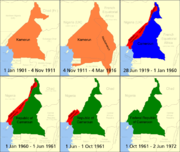
League of Nations mandate
A League of Nations mandate was a legal status for certain territories transferred from the control of one country to another following World War I, or the legal instruments that contained the internationally agreed-upon terms for administering the territory on behalf of the League...
in central Africa, now constituting the majority of the territory of the Republic of Cameroon
Cameroon
Cameroon, officially the Republic of Cameroon , is a country in west Central Africa. It is bordered by Nigeria to the west; Chad to the northeast; the Central African Republic to the east; and Equatorial Guinea, Gabon, and the Republic of the Congo to the south. Cameroon's coastline lies on the...
.
The area of present-day Cameroon was integrated to French Equatorial Africa
French Equatorial Africa
French Equatorial Africa or the AEF was the federation of French colonial possessions in Middle Africa, extending northwards from the Congo River to the Sahara Desert.-History:...
(AEF) during the "Scramble for Africa
Scramble for Africa
The Scramble for Africa, also known as the Race for Africa or Partition of Africa was a process of invasion, occupation, colonization and annexation of African territory by European powers during the New Imperialism period, between 1881 and World War I in 1914...
" at the end of the 19th century. However, in 1911 France ceded parts of the territory to German Cameroon, known as Neukamerun
Neukamerun
Neukamerun was the name of Central African territories ceded by France to Germany in 1911. Upon taking office in 1907, Theodor Seitz, governor of German Kamerun, advocated the acquisition of territories from the French Congo...
("New Kamerun
Kamerun
German Cameroon was a West African colony of the German Empire from 1884 to 1916 in the region of today's Republic of Cameroon.-History:-1800s:...
") as a result of the Agadir Crisis
Agadir Crisis
The Agadir Crisis, also called the Second Moroccan Crisis, or the Panthersprung, was the international tension sparked by the deployment of the German gunboat Panther, to the Moroccan port of Agadir on July 1, 1911.-Background:...
, and it became a German protectorate
Protectorate
In history, the term protectorate has two different meanings. In its earliest inception, which has been adopted by modern international law, it is an autonomous territory that is protected diplomatically or militarily against third parties by a stronger state or entity...
. During World War I
World War I
World War I , which was predominantly called the World War or the Great War from its occurrence until 1939, and the First World War or World War I thereafter, was a major war centred in Europe that began on 28 July 1914 and lasted until 11 November 1918...
, it was occupied by British and French troops, and later mandated
Mandate (international law)
In international law, a mandate is a binding obligation issued from an inter-governmental organization like the United Nations to a country which is bound to follow the instructions of the organization....
to each country by the League of Nations
League of Nations
The League of Nations was an intergovernmental organization founded as a result of the Paris Peace Conference that ended the First World War. It was the first permanent international organization whose principal mission was to maintain world peace...
in 1922. The British mandate was known as Cameroons
Cameroons
British Cameroons was a British Mandate territory in West Africa, now divided between Nigeria and Cameroon.The area of present-day Cameroon was claimed by Germany as a protectorate during the "Scramble for Africa" at the end of the 19th century...
and the French as Cameroun. Following World War II
World War II
World War II, or the Second World War , was a global conflict lasting from 1939 to 1945, involving most of the world's nations—including all of the great powers—eventually forming two opposing military alliances: the Allies and the Axis...
each of the mandate territories was made a United Nations Trust Territory. An insurrection headed by Ruben Um Nyobé
Ruben Um Nyobé
Ruben Um Nyobé was an anti-imperialist Cameroonian leader, slain by the French army on 13 September 1958, near his natal village of Boumnyebel, in the department of Nyong-et-Kellé in the maquis Bassa. He created on 10 April 1948 the Cameroon's People Union , which used armed struggle to obtain...
and the Union of the Peoples of Cameroon
Union of the Peoples of Cameroon
The Union of the Peoples of Cameroon is a political party in Cameroon.-History:UPC was founded on April 10, 1948, at a meeting in the bar Chez Sierra in Bassa. 12 men assisted the founding meeting, including Charles Assalé, Léonard Bouli, and Guillaume Bagal. The majority of the participants were...
(UPC) erupted in 1955, strongly repressed by the French Fourth Republic
French Fourth Republic
The French Fourth Republic was the republican government of France between 1946 and 1958, governed by the fourth republican constitution. It was in many ways a revival of the Third Republic, which was in place before World War II, and suffered many of the same problems...
. Cameroun became independent as the Republic of Cameroun in January, 1960 and in October, 1961 the southern part of British Cameroons joined to form the Federal Republic of Cameroon. The Muslim northern part of Cameroons had opted for union with Nigeria
Nigeria
Nigeria , officially the Federal Republic of Nigeria, is a federal constitutional republic comprising 36 states and its Federal Capital Territory, Abuja. The country is located in West Africa and shares land borders with the Republic of Benin in the west, Chad and Cameroon in the east, and Niger in...
in May the same year. The conflict with the UPC lasted until the 1970s.
Interwar period
After World War I, Cameroun was not integrated to French Equatorial AfricaFrench Equatorial Africa
French Equatorial Africa or the AEF was the federation of French colonial possessions in Middle Africa, extending northwards from the Congo River to the Sahara Desert.-History:...
(AEF) but made a "Comissariat de la République autonome" under French mandate. France enacted an assimilationist policy with the aim of having German presence forgotten, by teaching French on all of the territory and imposing French law, while pursuing the "indigenous politics", which consisted of keeping control of the judiciary system and of the police, while tolerating traditional law issues. The colonial administration also followed public health
Public health
Public health is "the science and art of preventing disease, prolonging life and promoting health through the organized efforts and informed choices of society, organizations, public and private, communities and individuals" . It is concerned with threats to health based on population health...
policies (Eugène Jamot
Eugene Jamot
Eugène Jamot was a French entomologist who played a major role in the prevention of sleeping sickness in Cameroun. He was born in the hamlet of La Borie, part of the commune of Saint-Sulpice-les-Champs, in the Creuse département of central France. Jamot trained as a medical doctor at the...
did some research on sleeping sickness) as well as encouraging Francophony. Charles Atangana
Charles Atangana
Charles Atangana , also known by his birth name, Ntsama, and his German name, Karl, was the paramount chief of the Ewondo and Bane ethnic groups during much of the colonial period in Cameroon...
, designed paramount chief
Paramount chief
A paramount chief is the highest-level traditional chief or political leader in a regional or local polity or country typically administered politically with a chief-based system. This definition is used occasionally in anthropological and archaeological theory to refer to the rulers of multiple...
by the Germans, and others local chiefs were invited to France, and Paul Soppo Priso named president of the JEUCAFRA (Cameroun French Youth). Charles Atangana would visit the 1931 Paris Colonial Exhibition and attend the 1935 French Colonial Conference
French Colonial Conference
-References:* Ahanda, Marie-Thérèse Assiga : . Bonaberi.com. Accessed 30 October 2006.* Maunier, René, transl. by Lorimer, E. A. . The Sociology of Colonies: An Introduction to the Study of Race Contact, Part One. London: Routledge....
. France took care to make disappear all remains of German presence, and aimed at eradicating any trace of Germanophilia. French racism became prevalent throughout the colony rather quickly, and anti-French sentiment followed and would be strengthened in the late 1940s.
After World War II: colonial tensions and beginning of the war
After World War II, Cameroun was made a United Nations Trust Territory and unified into the French UnionFrench Union
The French Union was a political entity created by the French Fourth Republic to replace the old French colonial system, the "French Empire" and to abolish its "indigenous" status.-History:...
. From the beginning of the 1940s, colonial authorities encouraged a policy of agricultural diversification
Agricultural diversification
In the agricultural context, diversification can be regarded as the re-allocation of some of a farm's productive resources, such as land, capital, farm equipment and paid labour, into new activities...
into monocultural crops: coffee
Coffee
Coffee is a brewed beverage with a dark,init brooo acidic flavor prepared from the roasted seeds of the coffee plant, colloquially called coffee beans. The beans are found in coffee cherries, which grow on trees cultivated in over 70 countries, primarily in equatorial Latin America, Southeast Asia,...
in the west and cotton
Cotton
Cotton is a soft, fluffy staple fiber that grows in a boll, or protective capsule, around the seeds of cotton plants of the genus Gossypium. The fiber is almost pure cellulose. The botanical purpose of cotton fiber is to aid in seed dispersal....
in the south. Construction of roads allowed for greater exploitation of wood
Wood
Wood is a hard, fibrous tissue found in many trees. It has been used for hundreds of thousands of years for both fuel and as a construction material. It is an organic material, a natural composite of cellulose fibers embedded in a matrix of lignin which resists compression...
. Of a total of three million inhabitants, the Cameroun territory counted 10% settlers, many who had been resident for decades, and approximatively 15,000 people linked to the colonial administration (civil servants, private agents, missionaries, etc.)
In 1946, a Representative Assembly of Cameroun (ARCAM) was constituted. Paul Ajoulat and Alexandre Douala Manga Bell were elected deputies of the French National Assembly
French National Assembly
The French National Assembly is the lower house of the bicameral Parliament of France under the Fifth Republic. The upper house is the Senate ....
. Some private and public schools were opened, while the best students were sent to Dakar
Dakar
Dakar is the capital city and largest city of Senegal. It is located on the Cap-Vert Peninsula on the Atlantic coast and is the westernmost city on the African mainland...
(Senegal) or France to study in college. The colonial administration also built electricity and water infrastructures in large cities. In 1952, the Representative Assembly became the Territorial Assembly of Cameroun (ATCAM).
The Union of the Peoples of Cameroon
Union of the Peoples of Cameroon
The Union of the Peoples of Cameroon is a political party in Cameroon.-History:UPC was founded on April 10, 1948, at a meeting in the bar Chez Sierra in Bassa. 12 men assisted the founding meeting, including Charles Assalé, Léonard Bouli, and Guillaume Bagal. The majority of the participants were...
(UPC), an anti-colonialist party created in 1948 and which struggled for unification of both Cameroon
Cameroon
Cameroon, officially the Republic of Cameroon , is a country in west Central Africa. It is bordered by Nigeria to the west; Chad to the northeast; the Central African Republic to the east; and Equatorial Guinea, Gabon, and the Republic of the Congo to the south. Cameroon's coastline lies on the...
s and for independence was outlawed in 1955. A colonial war
Colonial war
Colonial war is a blanket term relating to the various conflicts that arose as the result of overseas territories being settled by foreignpowers creating a colony...
then started and lasted for at least seven years, with the French Fourth Republic
French Fourth Republic
The French Fourth Republic was the republican government of France between 1946 and 1958, governed by the fourth republican constitution. It was in many ways a revival of the Third Republic, which was in place before World War II, and suffered many of the same problems...
leading a harsh repression of the anti-colonialist movement. The conflict found its roots in the opposition between the settlers and the Cameroonese trade-unionists in the cities. After the Brazzaville Conference of January 1944, during which the Provisional Government of the French Republic
Provisional Government of the French Republic
The Provisional Government of the French Republic was an interim government which governed France from 1944 to 1946, following the fall of Vichy France and prior to the Fourth French Republic....
(GPRF) issued several promises concerning progressive self-rule, the settlers organized themselves in 1945 in "General estates of colonisation" (Etats généraux de la colonisation").
A Cercle d'études marxistes (Marxist Study Circle) was created by Cameroonese in 1945, soon followed by the creation of the USCC (Union des syndicats confédérés du Cameroun, Union of Confederate Trade-Unions of Cameroon) at the initiative of the CGT
Confédération générale du travail
The General Confederation of Labour is a national trade union center, the first of the five major French confederations of trade unions.It is the largest in terms of votes , and second largest in terms of membership numbers.Its membership decreased to 650,000 members in 1995-96 The General...
trade-union. Conflicts erupted in September 1945, with the settlers violently debating with the French governor. Members of the USCC were arrested. In 1948, Ruben Um Nyobé
Ruben Um Nyobé
Ruben Um Nyobé was an anti-imperialist Cameroonian leader, slain by the French army on 13 September 1958, near his natal village of Boumnyebel, in the department of Nyong-et-Kellé in the maquis Bassa. He created on 10 April 1948 the Cameroon's People Union , which used armed struggle to obtain...
became the head of the resistance movement, with a nationalist and revolutionary program. Nyobé's UPC was at first only the local section of the African Democratic Rally
African Democratic Rally
The African Democratic Rally was a political party in French West Africa, led by Félix Houphouët-Boigny. Founded in Bamako in 1946, the RDA quickly became one of the most important forces for independence in the region. Initially a Pan-Africanist movement, the RDA ceased to function as a...
created in 1946. However, it refused to split, as did the African Democratic Rally, with the French Communist Party
French Communist Party
The French Communist Party is a political party in France which advocates the principles of communism.Although its electoral support has declined in recent decades, the PCF retains a large membership, behind only that of the Union for a Popular Movement , and considerable influence in French...
(PCF) in 1950. After some revolts and increasing tensions with the colonial administration, the UPC was outlawed on July 13, 1955 by the governor Roland Pré, forcing Nyobé into hiding, from where he led a guerrilla war against the French administration.
Self rule in 1956 and continuation of the war
In 1957-58, Pierre MessmerPierre Messmer
Pierre Joseph Auguste Messmer was a French Gaullist politician. He served as Minister of Armies under Charles de Gaulle from 1960 to 1969 – the longest serving since Étienne François, duc de Choiseul under Louis XV – and then as Prime Minister under Georges Pompidou from 1972 to 1974...
, a Gaullist and head of the haut-commissaire of Cameroun (executive branch of the French government) started a decolonisation process which went further than the 1956 loi-Defferre (Defferre Act). At the same time, the Fourth Republic was stranded in the Algerian War (1954-62). It managed to obtain support of Britain
United Kingdom
The United Kingdom of Great Britain and Northern IrelandIn the United Kingdom and Dependencies, other languages have been officially recognised as legitimate autochthonous languages under the European Charter for Regional or Minority Languages...
in Cameroon.
France granted internal autonomy in 1956, and the ATCAM became the Legislative Assembly of Cameroun (ALCM). André Marie Bbida became Prime minister in 1957, and Ahmadou Ahidjo
Ahmadou Ahidjo
Ahmadou Babatoura Ahidjo was the first President of Cameroon from 1960 until 1982.-Early life:Ahidjo was born in Garoua, a major river port along the Benue River in northern Cameroun, which was at the time a French mandate territory...
vice-Premier. Despite the requests by Rubem Um Nyobe, head of the UPC, the new government refused to legalize the UPC. André Bdida renounced in 1958, replaced by Ahidjo, while Um Nyobé was killed by a French commando in the "maquis" on September 13, 1958. Following his death, the UPC divided itself, while competing leaders, verbally in favor of Marxism revolution, radicalized the movement. Starting in 1959, the colonial war juxtaposed itself with a civil war, Ahmadou Ahidjo taking the place of France in the repression of the UPC. The successor of Nyobé, Félix-Roland Moumié
Félix-Roland Moumié
Félix-Roland Moumié was a Cameroonian leader, assassinated in Geneva on 3 November 1960 by the SDECE with thallium. Félix-Roland Moumié succeeded Ruben Um Nyobe, who was killed in September 1958, as leader of the Union des Populations du Cameroun .- See also :*Colonialism and...
, was assassinated in 1960 in Geneva by the SDECE, French secret services.
The insurrection continued after independence was granted, even though the UPC had been officially dismantled. The rebellion was really crushed only in the 1970s, after the death in the "maquis
Maquis
Maquis or macchia is a type of high ground in Corsica covered in thick vegetation, where privateers used to hide. The name has been adopted by a variety of guerilla movements in francophone countries.Maquis may also refer to:-Geography:...
" of Ossendé Afana in March 1966 and the public execution of Ernest Ouandié, a historic leader of the UPC, in January 1971.
Estimates about the number of victims of the war ranged around several tens of thousands of deaths, mainly after independence, although some have given numbers much higher (300 000 to 400 000, which exceeds the total number of inhabitants of Bamileke
Bamileke
The Bamileke is a folk whose native ancestral area is in the western highlands of Cameroon's West Province, west of the Noun River and southeast of the Bamboutos Mountains and in the Moungo region of the Littoral, Southwest, and Centre Provinces. They are a part of the Semi-Bantu ethnic groups...
, which was the main theater of operation.) Despite the efforts of writer Mongo Beti
Mongo Beti
Alexandre Biyidi Awala , known as Mongo Beti, was a Cameroonian writer.- Life :Though he lived in exile for many decades, Beti's life reveals an unflagging commitment to improvement of his home country...
, the war and the harsh repression by the French government has been overshadowed by the Algerian War, mostly because of the use of professional soldiers, the low number of Cameroonese immigrants in France requesting recognition of the crimes committed during the war, and, more recently, the fall of Communism.
Cameroun became independent on January 1, 1960, becoming the Republic of Cameroun. The civil war with the UPC lasted for years afterward.
See also
- CameroonCameroonCameroon, officially the Republic of Cameroon , is a country in west Central Africa. It is bordered by Nigeria to the west; Chad to the northeast; the Central African Republic to the east; and Equatorial Guinea, Gabon, and the Republic of the Congo to the south. Cameroon's coastline lies on the...
- CameroonsCameroonsBritish Cameroons was a British Mandate territory in West Africa, now divided between Nigeria and Cameroon.The area of present-day Cameroon was claimed by Germany as a protectorate during the "Scramble for Africa" at the end of the 19th century...
- French Cameroons (colony)French Cameroons (colony)French Cameroons was a French Mandate territory in West Africa, now divided between Nigeria and Cameroon.The area of present-day Cameroon was claimed by Germany as a protectorate during the "Scramble for Africa" at the end of the 19th century...
- French Colonial EmpireFrench colonial empireThe French colonial empire was the set of territories outside Europe that were under French rule primarily from the 17th century to the late 1960s. In the 19th and 20th centuries, the colonial empire of France was the second-largest in the world behind the British Empire. The French colonial empire...
- History of colonialismHistory of colonialismThe historical phenomenon of colonisation is one that stretches around the globe and across time, including such disparate peoples as the Hittites, the Incas and the British. European colonialism, or imperialism, began in the 15th century with the "Age of Discovery", led by Portuguese and Spanish...
- Algerian War
- List of French possessions and colonies