
All Topics  
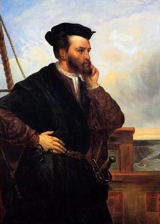
Jacques Cartier


   Email Print
   Bookmark   Link


Jacques Cartier


Jacques Cartier (December 31, 1491–September 1, 1557) was a French explorer who claimed what is now Canada
Canada

Canada is a country occupying most of northern North America, extending from the Atlantic Ocean in the east to the Pacific Ocean in the west and northward into the Arctic Ocean....
 for France
France

France , officially the French Republic , is a country whose Metropolitan France is located in Western Europe and that also comprises various Overseas departments and territories of France....
. He was the first non-native
Aboriginal peoples in Canada

Aboriginal people in Canada, also known as First Nations, Inuit and M?tis, are people who belong to recognized indigenous groups in the Canada Constitution Act, 1982, Section Twenty-five of the Canadian Charter of Rights and Freedoms and Section Thirty-five of the Constitution Act, 1982, respectively as First Nations, M?tis people , and...
 to describe and map the Gulf of Saint Lawrence
Gulf of Saint Lawrence

Gulf of Saint Lawrence , the world's largest estuary, is the outlet of North America's Great Lakes via the Saint Lawrence River into the Atlantic Ocean....
 and the shores of the Saint Lawrence River
Saint Lawrence River

Saint Lawrence River is a large river flowing approximately from southwest to northeast in the middle latitudes of North America, connecting the Great Lakes with the Atlantic Ocean....
, which he named "The Country of Canadas", after the Iroquois
Iroquoian languages

The Iroquoian languages are a First Nation and Native Americans in the United States language family. The language family, amongst others, includes Mohawk language, Wyandot language and Cherokee language....
 word the local natives used for the two big Iroquoian
St. Lawrence Iroquoians

The St. Lawrence Iroquoians lived, until the late 16th century, along the shores of the St. Lawrence River in Quebec and Ontario, Canada, and in New York State, United States....
 settlements he saw at Stadacona (Quebec City)
Stadacona

Stadacona was a 16th century St. Lawrence Iroquoians village near present-day Quebec City.Jacques Cartier reached this village on Stadacone on Sept....
 and at Hochelaga (Montreal Island)
Hochelaga (village)

Hochelaga was a St. Lawrence Iroquoians fortified village near present-day Montreal, Quebec, Canada. Its first Europe contact was by a France expedition led by Jacques Cartier in 1535....
.

ues Cartier was born in 1491 in Saint-Malo
Saint-Malo

Saint-Malo is a walled seaport city in Brittany in northwestern France on the English Channel. It is a sub-prefecture of the Ille-et-Vilaine Departments of France....
, the port on the extreme north-east coast of the duchy of Brittany
Brittany

Brittany is a former independent Celtic nations monarchy and duchy, now incorporated into France. It is also, more generally, the name of the cultural area whose limits correspond to the historic province and independent duchy....
, which was incorporated into France in 1532.


Discussion
Ask a question about 'Jacques Cartier'
Start a new discussion about 'Jacques Cartier'
Answer questions from other users
Full Discussion Forum


Recent Posts


Encyclopedia


Jacques Cartier (December 31, 1491–September 1, 1557) was a French explorer who claimed what is now Canada
Canada

Canada is a country occupying most of northern North America, extending from the Atlantic Ocean in the east to the Pacific Ocean in the west and northward into the Arctic Ocean....
 for France
France

France , officially the French Republic , is a country whose Metropolitan France is located in Western Europe and that also comprises various Overseas departments and territories of France....
. He was the first non-native
Aboriginal peoples in Canada

Aboriginal people in Canada, also known as First Nations, Inuit and M?tis, are people who belong to recognized indigenous groups in the Canada Constitution Act, 1982, Section Twenty-five of the Canadian Charter of Rights and Freedoms and Section Thirty-five of the Constitution Act, 1982, respectively as First Nations, M?tis people , and...
 to describe and map the Gulf of Saint Lawrence
Gulf of Saint Lawrence

Gulf of Saint Lawrence , the world's largest estuary, is the outlet of North America's Great Lakes via the Saint Lawrence River into the Atlantic Ocean....
 and the shores of the Saint Lawrence River
Saint Lawrence River

Saint Lawrence River is a large river flowing approximately from southwest to northeast in the middle latitudes of North America, connecting the Great Lakes with the Atlantic Ocean....
, which he named "The Country of Canadas", after the Iroquois
Iroquoian languages

The Iroquoian languages are a First Nation and Native Americans in the United States language family. The language family, amongst others, includes Mohawk language, Wyandot language and Cherokee language....
 word the local natives used for the two big Iroquoian
St. Lawrence Iroquoians

The St. Lawrence Iroquoians lived, until the late 16th century, along the shores of the St. Lawrence River in Quebec and Ontario, Canada, and in New York State, United States....
 settlements he saw at Stadacona (Quebec City)
Stadacona

Stadacona was a 16th century St. Lawrence Iroquoians village near present-day Quebec City.Jacques Cartier reached this village on Stadacone on Sept....
 and at Hochelaga (Montreal Island)
Hochelaga (village)

Hochelaga was a St. Lawrence Iroquoians fortified village near present-day Montreal, Quebec, Canada. Its first Europe contact was by a France expedition led by Jacques Cartier in 1535....
.

Biography

Jacques Cartier was born in 1491 in Saint-Malo
Saint-Malo

Saint-Malo is a walled seaport city in Brittany in northwestern France on the English Channel. It is a sub-prefecture of the Ille-et-Vilaine Departments of France....
, the port on the extreme north-east coast of the duchy of Brittany
Brittany

Brittany is a former independent Celtic nations monarchy and duchy, now incorporated into France. It is also, more generally, the name of the cultural area whose limits correspond to the historic province and independent duchy....
, which was incorporated into France in 1532. Cartier, who was a respectable mariner, improved his social status in 1520 by marrying Mary Catherine des Granches, member of a leading family. His good name in Saint-Malo is recognized by its frequent appearance on baptismal registers as godfather or witness.

First voyage, 1534

In 1532, the year Brittany was formally united with France, Cartier was introduced to King Francis I
Francis I

Francis I may refer to:* Francis I, Duke of Brittany * Francis I, Duke of Lorraine * Francis I of France * Francesco I de' Medici, Grand Duke of Tuscany ...
 by Jean le Veneur
Jean Le Veneur

Cardinal Jean Le Veneur was born into a noble family, his father being baron of Tilli?res, Valquier and Homme. Many of his close relatives were involved in the Church: an uncle and a brother were Bishops, and a cousin on his mother's side eventually became a Cardinal himself....
, bishop
Bishop (Catholic Church)

In the Catholic Church, a bishop is an Holy Orders Minister who holds the fullness of the Sacrament of Holy Orders and is responsible for teaching the faith and ruling the church....
 of Saint-Malo and abbot
Abbot

The word abbot, meaning father, is a title given to the head of a monastery in various traditions, including Christianity. The office may also be given as an honorary title to a clergyman who is not actually the head of a monastery....
 of Mont-Saint-Michel, at the Manoir de Brion
Manoir de Brion

The Manoir de Brion, also known as the Ch?teau de Brion, is an ancient Benedictine priory of the abbey of Mont Saint-Michel. It is located near the village of Gen?ts in Avranches, Basse-Normandie, and was founded in 1137 by the abbot Bernard du Bec....
. The king had previously commissioned the Florentine explorer Giovanni da Verrazzano to explore what is now the eastern coast of North America on behalf of France in 1524. Cartier is believed to have accompanied da Verrazzano on his expedition exploring the coast from South Carolina
South Carolina

South Carolina is a U.S. state in the Southern United States of the United States. It borders Georgia to the south and North Carolina to the north....
 to modern Maine
Maine

The State of Maine is a U.S. state in the New England region of the northeastern United States of America, bordering the Atlantic Ocean to the southeast, New Hampshire to the southwest, the Canadian provinces of Quebec to the northwest and New Brunswick to the northeast....
, Nova Scotia
Nova Scotia

Nova Scotia is a Canadian Provinces and territories of Canada located on Canada's southeastern coast. It is the most populous province in Atlantic Canada....
, and Newfoundland, and also on another voyage to Brazil
Brazil

Brazil , officially the Federative Republic of Brazil , is a country in South America. It is the List of countries and outlying territories by total area country by geographical area, occupying nearly half of South America, the List of countries by population country, and the fourth most populous democracy in the world....
. Le Veneur cited voyages Cartier had already made to Newfoundland and Brazil to demonstrate his ability to "lead ships to the discovery of new lands in the New World". In 1534, Cartier set sail under a commission from the king, hoping to discover a western passage to the wealthy markets of Asia. In the words of the commission, he was to "discover certain islands and lands where it is said that a great quantity of gold and other precious things are to be found". Starting on May 10 of that year, he explored parts of Newfoundland, the areas now known as the Canadian Atlantic provinces and the Gulf of St. Lawrence. During one stop at Îles aux Oiseaux (Islands of the Birds, now the Rochers-aux-Oiseaux federal bird sanctuary, northeast of Brion Island
Brion Island

Brion Island is in the middle of the Gulf of Saint Lawrence. The island is in the northern part of the Magdalen Islands archipelago belonging to the Canada province of Quebec....
 in the Magdalen Islands
Magdalen Islands

File:Magdalen Islands.pngThe Magdalen Islands form a small archipelago in the Gulf of Saint Lawrence with a land area of . Though closer to Prince Edward Island and Nova Scotia, the islands form part of the Canadian province of Quebec....
), his crew slaughtered around 1000 birds, most of them great auk
Great Auk

The Great Auk, Pinguinus impennis, formerly of the genus Razorbill, is a bird that became Extinction in the mid-19th century. It was the only species in the genus Pinguinus, a group which included several flightless giant auks from the Atlantic, to survive until modern times....
s (now extinct). Cartier's first encounter with aboriginal people, most likely the Mi'kmaq
Mi'kmaq

The M?kmaq , traditionally spelled Micmac in English, but Mi?kmaq by the M?kmaq of Nova Scotia, Miigmaq by the M?kmaq of New Brunswick, Mi?gmaq by the Listuguj Council in Quebec, or M?gmaq in some native literature, are a First Nations people, indigenous to northeastern New England, Canada's Atlantic Provin...
 , was brief and some trading occurred. On his second encounter Cartier panicked as 50 Mi'kmaq canoes surrounded one of his long boats. Despite the Mi'kmaq signs of peace Cartier ordered his men to shoot two warning shots over their heads. The Mi'kmaq paddled away. His third encounter took place on the shores of Gaspé Bay
Gaspé Bay

Gasp? Bay is a bay located on the northeast coast of the Gasp? Peninsula, Qu?bec, in the Gulf of St. Lawrence. The town of Gasp?, Quebec lies on a part of its southern shore, while most of its northern shore is in Forillon National Park....
 with the St. Lawrence Iroquoians
St. Lawrence Iroquoians

The St. Lawrence Iroquoians lived, until the late 16th century, along the shores of the St. Lawrence River in Quebec and Ontario, Canada, and in New York State, United States....
, where on July 24, without their assent, he planted a 10 meter cross bearing the words "Long Live the King of France" and took possession of the territory in the name of the king. The change in mood was a clear indication that the Iroquoians understood Cartier's actions. There is no historical consensus on exactly what happened next and exactly where, but during this trip he kidnapped Chief Donnacona's
Donnacona

Chief Donnacona was the chief of Stadacona, a St. Lawrence Iroquoians village located at the present site of Quebec City, Canada.When French explorer Jacques Cartier first arrived there in 1534....
 two sons. Donnacona at last agreed that they may be taken under the condition that they return with European goods to trade. He also began to build diplomatic relations with the natives. Cartier returned to France in September 1534, sure that he had reached an Asian coast.

Second voyage, 1535–1536

Jacques Cartier set sail for a second voyage on May 19 of the following year with three ships, 110 men, and the two native boys. Reaching the St. Lawrence
Saint Lawrence River

Saint Lawrence River is a large river flowing approximately from southwest to northeast in the middle latitudes of North America, connecting the Great Lakes with the Atlantic Ocean....
, he sailed up-river for the first time, and reached the Iroquoian village of Stadacona
Stadacona

Stadacona was a 16th century St. Lawrence Iroquoians village near present-day Quebec City.Jacques Cartier reached this village on Stadacone on Sept....
, where Chief Donnacona was reunited with his two sons.

Jacques Cartier left his main ships in a harbour close to Stadacona, and used his smallest ship to continue up-river and visit Hochelaga
Hochelaga (village)

Hochelaga was a St. Lawrence Iroquoians fortified village near present-day Montreal, Quebec, Canada. Its first Europe contact was by a France expedition led by Jacques Cartier in 1535....
 (now Montreal) where he arrived October 2, 1535. Hochelaga was far more impressive than the small and squalid village of Stadacona, and more than 1,000 Iroquoians came to the river edge to greet the Frenchmen. The site of their arrival has been confidently identified as the beginning of the Sainte-Marie Sault -- where the Jacques Cartier Bridge
Jacques Cartier Bridge

The Jacques Cartier Bridge is a steel truss cantilever bridge crossing the Saint Lawrence River from Montreal Island, Montreal, Quebec to the south shore at Longueuil, Quebec, Canada....
 now stands. The expedition could proceed no further, as the river was blocked by rapids. So certain was Cartier that the river was the Northwest Passage
Northwest Passage

The Northwest Passage is a sea route through the Arctic Ocean, along the northern coast of North America via waterways amidst the Canadian Arctic Archipelago, connecting the Atlantic Ocean and Pacific Oceans....
 and that the rapids were all that was preventing him from sailing to China
China

China is a Culture of China, an ancient civilization, and, depending on perspective, a national or multinational entity extending over a large area in East Asia....
 that these Lachine Rapids
Lachine Rapids

The Lachine Rapids are a series of rapids on the Saint Lawrence River, between the Island of Montreal and the south shore. They are located near the former city of Lachine, Quebec....
, near the town of Lachine, Quebec
Lachine, Quebec

Lachine was a city on the Island of Montreal in southwestern Quebec, Canada. It is now a borough within the city of Montreal.Geography...
, came to be named after the French word for China, La Chine.

After spending two days among the St. Lawrence Iroquoians
St. Lawrence Iroquoians

The St. Lawrence Iroquoians lived, until the late 16th century, along the shores of the St. Lawrence River in Quebec and Ontario, Canada, and in New York State, United States....
 of Hochelaga, Cartier returned to Stadacona on October 11. It is not known exactly when Cartier decided to spend the winter of 1535-1536 in Stadacona, and it was by then too late to return to France. Cartier and his men prepared for the winter by strengthening their fort, stacking firewood, and salting down game and fish.

During this winter, Cartier compiled a sort of gazetteer that included several pages on the manners of the natives -- in particular, their habit of wearing only leggings and loincloth
Loincloth

A loincloth is a one-piece male garment, sometimes kept in place by a Belt , which covers the genitals and, at least partially, the buttocks....
s even in the dead of winter.

From mid-November 1535 to mid-April 1536, the French fleet lay frozen solid at the mouth of the St. Charles River
Saint-Charles River

The Saint-Charles River is a river in Quebec, Canada that empties into the north bank of the Saint Lawrence River in the Vieux-Port section of Quebec City....
, under the Rock of Quebec. Ice was over a fathom
Fathom

A fathom is a Units of measurement of length in the Imperial unit , used especially for measuring the depth of water.There are 2 yards in a fathom....
 (1.8 m) thick on the river, with snow four feet (1.2 m) deep ashore. To add to the discomfort, scurvy
Scurvy

Scurvy is a disease resulting from a deficiency of vitamin C, which is required for the synthesis of collagen in humans. The chemical name for vitamin C, ascorbic acid, is derived from the Latin name of scurvy, scorbutus....
 broke out -- first among the Iroquoians, and then among the French. In his journal, Cartier states that by mid-February, "out of 110 that we were, not ten were well enough to help the others, a pitiful thing to see". Cartier estimated the number of natives dead at 50.

One of the natives who survived was Domagaya, the chief's son who had been taken to France the previous year. During a friendly visit by Domagaya to the French fort, Cartier enquired and learned from him that a concoction made from a tree known as annedda
Aneda

The evergreen aneda was used by Jacques Cartier and his men as a remedy against scurvy in the winter of 1535–1536. It is generally believed to have been Thuja occidentalis, a common tree in Quebec also known as Arborvitae....
 (probably arbor vitae
Thuja occidentalis

Thuja occidentalis is an evergreen Pinophyta tree, in the cypress family Cupressaceae, which is widely cultivated for use as an ornamental plant....
) would cure scurvy. This remedy likely saved the expedition from destruction, allowing 85 Frenchmen to survive the winter.

Ready to return to France in early May 1536, Cartier decided to take Chief Donnacona to France, so that he might personally tell the tale of a country further north, called the "Kingdom of Saguenay
Kingdom of Saguenay

The name "Kingdom of Saguenay" has its origin in an Algonquin legend, as recorded by the France during French colonisation in the sixteenth and seventeenth centuries....
", said to be full of gold
Gold

Gold is a chemical element with the symbol Au and atomic number 79. It is a highly sought-after precious metal, having been used as money, as a store of value, in jewelry, in sculpture, and for ornamentation since the beginning of recorded history....
, rubies and other treasures. After an arduous trip down the St. Lawrence and a three-week Atlantic crossing, Cartier and his men arrived in Saint-Malo on July 15, 1536, concluding the second, 14 month voyage, which was to be Cartier's most profitable.

Having already located the entrance to the St. Lawrence on his first voyage, he now opened up the greatest waterway for the European penetration of North America. He produced an intelligent estimate of the resources of Canada, both natural and human, albeit with a considerable exaggeration of its mineral wealth. While some of his actions toward the St. Lawrence Iroquoians were dishonourable, he did try at times to establish friendship with them and other native peoples living along the St. Lawrence river -- an indispensable preliminary to French settlement in their lands.

Third voyage, 1541–1542

On October 17, 1540, Francis I ordered the Breton navigator to return to Canada to lend weight to a colonization project of which he would be "captain general". However, January 15, 1541 saw Cartier supplanted by Jean-François de La Rocque de Roberval, a Huguenot courtier. Roberval was to lead the expedition, with Cartier as his subordinate. While Roberval waited for artillery and supplies, he gave permission to Cartier to sail on ahead with his ships.

On May 23, 1541, Cartier departed Saint-Malo on his third voyage with five ships. This time, any thought of finding a passage to the Orient was forgotten. The goals were now to find the "Kingdom of Saguenay" and its riches, and to establish a permanent settlement along the St. Lawrence River.

Anchoring at Stadacona, Cartier again met the Iroquoians
St. Lawrence Iroquoians

The St. Lawrence Iroquoians lived, until the late 16th century, along the shores of the St. Lawrence River in Quebec and Ontario, Canada, and in New York State, United States....
, but found their "show of joy" and their numbers worrisome, and decided not to build his settlement there. Sailing a few miles up-river to a spot he had previously observed, he decided to settle on the site of present-day Cap-Rouge, Quebec. The convicts and other colonists were landed, the cattle that had survived three months aboard ship were turned loose, earth was broken for a kitchen garden, and seeds of cabbage, turnip, and lettuce were planted. A fortified settlement was thus created and was named Charlesbourg-Royal. Another fort was also built on the cliff overlooking the settlement, for added protection.

The men also began collecting what they believed to be diamonds and gold, but which upon return to France were discovered to be merely quartz crystals and iron pyrites, respectively - which gave rise to a French expression: "faux comme les diamants du Canada" ("As false as Canadian diamonds"). Two of the ships were dispatched home with some of these minerals on September 2.

Having set tasks for everyone, Cartier left with the longboats for a reconnaissance in search of "Saguenay" on September 7. Having reached Hochelaga, he was prevented by bad weather and the numerous rapids from continuing up to the Ottawa River
Ottawa River

The Ottawa River is a river in the Canadian provinces of Ontario and Quebec. It defines for most of its length the border between these two provinces....
.

Returning to Charlesbourg-Royal, Cartier found the situation ominous. The Iroquoians no longer made friendly visits or peddled fish and game, but prowled about in a sinister manner. No records exist about the winter of 1541-1542 and the information must be gleaned from the few details provided by returning sailors. It seems the natives attacked and killed about 35 settlers before the Frenchmen could retreat behind their fortifications. Even though scurvy was cured through the native remedy (Thuja occidentalis
Thuja occidentalis

Thuja occidentalis is an evergreen Pinophyta tree, in the cypress family Cupressaceae, which is widely cultivated for use as an ornamental plant....
 infusion), the impression left is of a general misery, and of Cartier's growing conviction that he had insufficient manpower either to protect his base or to go in search of Saguenay Kingdom.

Cartier left for France in early June 1542, encountering Roberval and his ships along the Newfoundland coast. Despite Roberval's insistence that he accompany him back to Saguenay, Cartier slipped off under the cover of darkness and continued on to France, still convinced his vessels contained a wealth of gold and diamonds. He arrived there in October, in what proved to be his last voyage. Meanwhile, Roberval took command at Charlesbourg-Royal, but it was abandoned in 1543 after disease, foul weather and hostile natives drove the would-be settlers to despair.

Later life

Cartier spent the rest of his life in Saint-Malo and his nearby estate, where he often was useful as an interpreter in Portugese
Portuguese language

Portuguese is a Romance language that originated in what is now Galicia and Portugal. It is derived from the Latin language spoken by the Romanization Pre-Roman peoples of the Iberian Peninsula around 2000 years ago....
, and he died aged 65 or 66 on September 1, 1557 from an epidemic. No permanent European settlements were made in Canada before 1608, when Samuel Champlain founded Quebec City
Quebec City

Qu?bec or Quebec, also Quebec City or Qu?bec City , is the Capital of the Canada Provinces and territories of Canada of Quebec and is located within the Capitale-Nationale region....
. Cartier is interred in St. Vincent's Cathedral.

Legacy

Cartier was the first to document the name Canada
Canada's name

The name of Canada has been in use since the earliest European settlement in Canada, with the name originating from a First Nations word for "settlement", "village", or "land"....
 to designate the territory on the shores of the St-Lawrence River. The name is derived from the Huron-Iroquois
Iroquois

The Iroquois Confederacy is a group of First Nations/Native Americans in the United States that originally consisted of five nations: the Mohawk nation, the Oneida tribe, the Onondaga , the Cayuga nation, and the Seneca nation....
 word "kanata", or village, which was incorrectly interpreted as the native term for the newly discovered land. Cartier used the name to describe Stadacona, the surrounding land and the river itself. And Cartier named "Canadiens" the inhabitants (Iroquoians) he had seen there. Thereafter the name Canada was used to designate the small French colony on these shores, and the French colonists were called Canadiens, until the mid-nineteenth century, when the name started to be applied to the loyalist colonies on the Great Lakes
Great Lakes

The St. Lawrence River Great Lakes are a chain of fresh water lakes located in eastern North America, on the Canada ? United States border. Consisting of Lakes Lake Superior, Lake Michigan, Lake Huron, Lake Erie, and Lake Ontario, they form the largest group of freshwater lakes on Earth....
 and later to all of British North America
British North America

British North America consisted of the colonies and territories of the British Empire in continental North America after the end of the American Revolutionary War and the recognition of United States ....
. In this way Cartier is not strictly the European discoverer of Canada as this country is understood today, a vast federation stretching a mari usque ad mare
Coat of arms of Canada

The Royal Coat of Arms of Canada is, since 1921, the official coat of arms of the Monarchy of Canada, and thus also of Canada. It is closely modelled after the royal coat of arms of the United Kingdom with distinctive Canadian elements replacing or added to those derived from the British....
 (from sea to sea). Eastern parts had previously been visited by the Norse, as well as Basque, Galician and Breton fishermen, and perhaps the Corte-Real
Corte-Real

Corte-Real is a surname of Portugal origin, which means literally "Royal Court". It may refer to:* Gaspar Corte-Real , Portuguese explorer* Jer?nimo Corte-Real , Portuguese epic poet...
 brothers and John Cabot
John Cabot

Giovanni Caboto , known in English as John Cabot, was an Italy navigator and exploration commonly credited as the first European to discover North America, in 1497, notwithstanding Norsemen Leif Ericson's landing ....
 (in addition of course to the Natives who first inhabited the territory). Cartier's particular contribution to the discovery of Canada is as the first European to penetrate the continent, and more precisely the interior eastern region along the St. Lawrence River. His explorations consolidated France's claim of the territory that would later be colonized as New France
New France

The Viceroyalty of New France was the area French colonization of the Americas by France in North America during a period extending from the exploration of the Saint Lawrence River, by Jacques Cartier in 1534, to the cession of New France to Spain and Kingdom of Great Britain in 1763....
, and his third voyage produced the first documented European attempt at settling North America since the time of the Norse
L'Anse aux Meadows

L'Anse aux Meadows is an archaeological site on the northernmost tip of the island of Newfoundland in the Canada Provinces of Canada of Newfoundland and Labrador....
. But even to this extent, the title of discoverer is perhaps too enthusiastic, as the two sons of Donnacona guided Cartier in his first exploration of the inner continent (in the second voyage) through the St. Lawrence estuary up to the village of Stadacona.

The rapids that appeared to be blocking the path to China ["La Chine" in French] are known as the Lachine Rapids
Lachine Rapids

The Lachine Rapids are a series of rapids on the Saint Lawrence River, between the Island of Montreal and the south shore. They are located near the former city of Lachine, Quebec....
 to this day.

Cartier's professional abilities can be easily ascertained. Considering that Cartier made three voyages of exploration in dangerous and hitherto unknown waters without losing a ship, and that he entered and departed some 50 undiscovered harbors without serious mishap, he may be considered one of the most conscientious explorers of the period.

Cartier was also one of the first to formally acknowledge that the New World was a separate land mass from Europe/Asia.

Rediscovery of Cartier's first colony

On August 18, 2006, Quebec Premier Jean Charest
Jean Charest

John James Charest, Queen's Privy Council of Canada, Member of the National Assembly is a Canadian lawyer and politician from the provinces and territories of Canada of Quebec....
 announced that Canadian archaeologists had discovered the precise location of Cartier's lost first colony of Charlesbourg-Royal. The colony was built where the Cap Rouge river runs into the St. Lawrence River and is based on the discovery of burnt wooden timber remains that have been dated to the mid-16th century, and a fragment of a decorative Istoriato plate manufactured in Faenza
Faenza

Faenza is an Italy city and comune, in the province of Ravenna, Emilia-Romagna, situated 50 km southeast of Bologna.Faenza is noted for its manufacture of majolica ware glazed earthenware pottery, known from the name of the town as "faience"....
, Italy, between 1540 and 1550, that could only have belonged to a member of the French aristocracy in the colony. Most probably this was the Sieur de Roberval
Jean-François de la Roque de Roberval

Jean-Fran?ois de La Roque de Roberval was the first Lieutenant General of New France and a pirate....
, who replaced Cartier as the leader of the settlement. This colony was the first European settlement in modern day Canada. Its discovery has been hailed by archaeologists as the most important find in Canada since the c.1000 AD L'Anse aux Meadows
L'Anse aux Meadows

L'Anse aux Meadows is an archaeological site on the northernmost tip of the island of Newfoundland in the Canada Provinces of Canada of Newfoundland and Labrador....
 Viking village was unearthed in northern Newfoundland.

Ships

  • Grande Hermine
    Grande Hermine

    Grande Hermine was the name of the ship that it is supposed brought Jacques Cartier to Saint-Pierre and Miquelon on 15 June 1535. It is believed to be represented in the local flag of Saint Pierre and Miquelon ....
    • Built: France 1534; given in 1535 to Cartier by the King of France; used in the 1535-1536 and 1541-1542 voyages; replica 1967 built for "Expo 67" in Montréal; abandoned in 2001 from Saint-Charles River
      Saint-Charles River

      The Saint-Charles River is a river in Quebec, Canada that empties into the north bank of the Saint Lawrence River in the Vieux-Port section of Quebec City....
       (Québec City
      Quebec City

      Qu?bec or Quebec, also Quebec City or Qu?bec City , is the Capital of the Canada Provinces and territories of Canada of Quebec and is located within the Capitale-Nationale region....
      )
  • Petite Hermine
    • Built: France; used in the 1535-1536 voyage and abandoned in 1536 springtime by Cartier in Saint-Charles River
      Saint-Charles River

      The Saint-Charles River is a river in Quebec, Canada that empties into the north bank of the Saint Lawrence River in the Vieux-Port section of Quebec City....
       because too many of his sailors died in Québec City during last wintertime
  • Émérillon
    Emerillon

    Emerillon are a Tupi-Guarani languages people in French Guiana living on the banks of the Camopi and Tampok rivers. Their subsistence is based on horticulture, hunting and bow- and arrow-fishing....
    • Built: France; used in the 1535-1536 and 1541-1542 voyages
  • Georges
    Georges

    Georges, the French language name for George , may refer to:...
     (1541-1542)
    • Built: France; used the 1541-1542 voyage
  • Saint-Brieux
    • Built: France; used the 1541-1542 voyage


Monuments

  • Place Jacques-Cartier
    Place Jacques-Cartier

    Place Jacques-Cartier is a Town square located in Old Montreal in Montreal, Quebec, Canada, and an entrance to the Old Port of Montreal.The street is named for Jacques Cartier, a France Explorer popularly thought of as one of the major discoverers of Canada....
    , a major street in the Vieux Port
    Port

    ||-||-|-||-||-||-||-||-||-|}A port is a facility for receiving ships and transferring cargo. They are usually found at the edge of an ocean, sea, river, or lake....
     of Montreal
    Montreal

    Montreal, or Montr?al, is the largest city in the Provinces and territories of Canada of Quebec and the List of largest cities and second largest cities by country List of the 100 largest municipalities in Canada by population....
  • Jacques-Cartier River
    Jacques-Cartier River

    The Jacques-Cartier River is a river in the province of Quebec, Canada. It is 161 km long and its source is Jacques-Cartier Lake in Laurentides Wildlife Reserve, and flows in a predominantly southern direction before ending in the Saint Lawrence River at Donnacona, Quebec, about 30 km upstream from Quebec City....
  • Jacques-Cartier Bridge
  • Jacques-Cartier State Park
    Jacques Cartier State Park

    Jacques Cartier State Park is located in the Morristown , New York in Saint Lawrence County, New York. The park is located on the south bank of the St....
  • Cartier Pavilion, built in 1955, at Royal Military College Saint-Jean
  • Jacques Cartier Monument, Harrington Island


Popular references

In 2005, Cartier's Bref récit et succincte narration de la navigation faite en MDXXXV et MDXXXVI was named the most important book in Canadian history by the Literary Review of Canada
Literary Review of Canada

The Literary Review of Canada is a Canada magazine that publishes ten times a year. The magazine publishes essays and reviews of books on political, cultural and social topics, as well as Canadian poetry....
.

Jacques Cartier Island, located on the tip of the Great Northern Peninsula
Great Northern Peninsula

The Great Northern Peninsula is the largest and longest peninsula of the island of Newfoundland , Canada, approximately 225 km long and 80 km wide at its widest point and encompassing an area of 17,483 km?....
 in Newfoundland and Labrador
Newfoundland and Labrador

Newfoundland and Labrador is a Provinces and territories of Canada of Canada, on the country's Atlantic Ocean coast in northeastern North America....
 in the town of Quirpon
Quirpon, Newfoundland and Labrador

Quirpon is a small, picturesque community situated on the northern tip of the Great Northern Peninsula of Newfoundland in the province of Newfoundland and Labrador, Canada....
, is said to have been named by Jacques Cartier himself on one of his voyages through the Straits of Belle Isle during the 1530s.

The Tragically Hip
The Tragically Hip

The Tragically Hip is a Canada Rock music Musical ensemble from Kingston, Ontario, consisting of Gordon Downie , Paul Langlois , Rob Baker , Gord Sinclair and Johnny Fay ....
 reference Jacques Cartier in their song "Looking for a Place to Happen." The song deals with primitivism and colonialism in the context of European ideologies and mythic exploration narratives in line with Cartier's journey's to the "New World."

Sources


External links