
| |
Québec or Quebec, also Quebec City or Québec City (or Ville de Québec) ( or ), is the capital of the Canadian province of Quebec and is located within the Capitale-Nationale region. It is the second most populous city in the province after Montreal, which is about to the southwest. As of the 2006 Canadian Census, the city has a population of 491,142, and the metropolitan area has a population of 715,515.
The narrowing of the Saint Lawrence River approximate to Quebec City and Lévis, on the opposite bank, provided the name given to the city, Kébec, an Algonquin word meaning "where the river narrows".

Discussion
Ask a question about 'Quebec City'
Start a new discussion about 'Quebec City'
Answer questions from other users
|
Quotations
It's very important for folks to understand that when there's more trade, there's more commerce.
Quebec City, Canada, April 21, 2001

Encyclopedia
Québec or Quebec, also Quebec City or Québec City (or Ville de Québec) ( or ), is the capital of the Canadian province of Quebec and is located within the Capitale-Nationale region. It is the second most populous city in the province after Montreal, which is about to the southwest. As of the 2006 Canadian Census, the city has a population of 491,142, and the metropolitan area has a population of 715,515.
The narrowing of the Saint Lawrence River approximate to Quebec City and Lévis, on the opposite bank, provided the name given to the city, Kébec, an Algonquin word meaning "where the river narrows". Founded in 1608 by Samuel de Champlain, Quebec City is one of the oldest cities in North America. The ramparts surrounding Old Quebec (Vieux-Québec) are the only remaining fortified city walls in the Americas north of Mexico, and were declared a World Heritage Site by UNESCO in 1985 as the 'Historic District of Old Québec'.
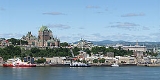
Quebec City is internationally known for its Summer Festival, Winter Carnival, and the Château Frontenac, a hotel which dominates the city skyline. The National Assembly of Quebec (provincial parliament), the Musée national des beaux-arts du Québec (National Museum of Fine Arts), and the Musée de la civilisation (Museum of Civilization) are found within or near Vieux-Québec. Among the other attractions near the city are Montmorency Falls and the Basilica of Sainte-Anne-de-Beaupré in the town of Sainte-Anne-de-Beaupré.
History
Early history: from Stadacona to Seven Years War
Quebec City is one of the oldest European settlements in North America. While many of the major cities in Mexico date from the sixteenth century, among cities in the U.S. and Canada only St. John's, Newfoundland and Labrador; Port Royal, Nova Scotia; St. Augustine, Florida; Santa Fe, New Mexico; Jamestown, Virginia and Tadoussac, Quebec were created earlier than Quebec City. However, Quebec City is the first to have been founded with the goal of receiving permanent settlement, and not as a commercial outpost, and therefore is considered to be the first European-built city in non-Spanish North America.
Quebec was founded by Samuel de Champlain on 3 July 1608 at the site of a long abandoned St. Lawrence Iroquoian settlement called Stadacona. It was to this settlement that the name "Canada" refers. Although called the cradle of the Francophone population in North America, the Acadian settlement at Port-Royal antedates it. The place seemed favourable to the establishment of a permanent colony.
Before Champlain, French explorer Jacques Cartier built a fort at the site in 1535, where he stayed for the winter before going back to France in spring 1536. He came back in 1541 with the goal of building a permanent settlement. This first settlement was abandoned less than one year after its foundation, in the summer 1542, due in large part to the hostility of the natives combined with the harsh living conditions during winter.
Quebec City was captured by the British in 1759 and held until 1763. It was the site of the Battle of the Plains of Abraham during the Seven Years' War, in which British troops under General James Wolfe defeated the French general Louis-Joseph de Montcalm and took the city. France ceded New France, including the city, to Britain in 1763.
At the end of French rule in 1763, the territory of present-day Quebec City was a world of contrasts. Forests, villages, fields and pastures surrounded the town of 8 000 inhabitants. The town distinguished itself by its monumental architecture, fortifications, muddy and filthy streets, affluent homes of masonry and shacks in the suburbs St-Jean and St-Roch. Despite its urbanity and its status as capital, Quebec City remained a small colonial city with close ties to its rural surroundings. Nearby inhabitants traded their farm surpluses and firewood for imported goods from France at the two city markets.
British rule
During the American Revolution, revolutionary troops from the southern colonies assaulted the British garrison in an attempt to 'liberate' Quebec City now known as the Battle of Quebec. The defeat of the revolutionaries from the south put an end to the hopes that the peoples of Quebec would rise and join the American Revolution so that Canada would join the Continental Congress and become part of the original United States Of America along with the other British colonies of continental North America. In effect, the outcome of the battle would be the effective split of British North America into two distinct political entities. Following the battle, Major General Isaac Brock further fortified Quebec City by strengthening the walls and building an elevated artillery battery known as the Citadelle of Quebec before the War of 1812. A series of Martello towers was also built on elevated terrain beyond the city walls to provide further artillery support effectively turning the city into a fortress. In the end, the city was not attacked during the war of 1812 but continued to house a large British garrison until 1871. The Citadel is still in use by the military and three of the Martello towers are still maintained as museums and tourist attractions.
In 1840, after the Province of Canada was formed, the role of capital was shared between Kingston, Montreal, Toronto, Ottawa and Quebec City (from 1852 to 1856 and from 1859 to 1866). In 1867, Ottawa (which was chosen to be the permanent capital of the Province of Canada) was chosen to be the capital of the Dominion of Canada. The Quebec Conference on Canadian Confederation was held here.
20th and 21st centuries
Quebec City was struck by the 1925 Charlevoix-Kamouraska earthquake.
During World War II, two conferences were held in Quebec City. The First Quebec Conference was held in 1943 with Franklin Delano Roosevelt (the United States' president at the time),Winston Churchill (the United Kingdom's prime minister), William Lyon Mackenzie King (Canada's prime minister) and T.V. Soong (China's minister of foreign affairs). The Second Quebec Conference was held in 1944, and was attended by Churchill and Roosevelt. They took place in the buildings of the Citadelle and of nearby Château Frontenac. A large part of the D-Day Landings plans were made during those meetings.
Capital
Throughout its over four hundred years of existence, Quebec City has served as a capital. From 1608 to 1627 and 1632 to 1763, it was capital of French Canada and all of New France, from 1763 to 1791, it was the capital of the Province of Quebec, from 1791 to 1841, it was the capital of Lower Canada, from 1852 to 1856 and from 1859 to 1866, it was capital of the Province of Canada and from 1867 to today, it has been capital of Quebec. By law, the government of Quebec considers the city of Quebec to be its national-capital, although the term "national" is seen by some as being inacurrate since Quebec is not a country and futhermore, they believe the term capital-national should be used only for Ottawa.
Geography
Quebec City is located in the Saint Lawrence River valley, on the north bank of the Saint Lawrence River near its meeting with the St. Charles River. The region is low-lying and flat. The river valley has rich, arable
soil, which makes this region the most fertile in the province. The Laurentian Mountains lie to the north of the city.
Upper Town lies on the top of Cap-Diamant (Cape Diamond) promontory. A high stone wall surrounds this portion of the city. The Plains of Abraham are located near the edge of the promontory. Lower Town is located at shore level, below Cap-Diamant.
Climate
Quebec City has a humid continental climate (Koppen climate classification Dfb) characterized by cold and snowy winters, warm and rather humid summers, and ample precipitation throughout the year. Quebec City is one of the snowiest cities in Canada (the mean annual snowfall is 384 cm) and is almost guaranteed a white Christmas. The prolonged winter season and ample snowfall led to the idea of establishing the Quebec Winter Carnival. The transitional seasons, spring and autumn, are rather short, although autumn produces spectacular foliage colours. The summer is the sunniest, and paradoxically, the wettest time of year.
Temperatures
Cityscape
On January 1, 2002, the former towns of Sainte-Foy, Beauport, Charlesbourg, Sillery, Loretteville, Val-Bélair, Cap-Rouge, Saint-Émile, Vanier, L'Ancienne-Lorette, Saint-Augustin-de-Desmaures and Lac-Saint-Charles were annexed by Quebec City. This was one of several municipal mergers which took place across Quebec on that date. Following a demerger referendum, L'Ancienne-Lorette and Saint-Augustin-de-Desmaures were reconstituted as separate municipalities on January 1, 2006, but the other former municipalities remain part of Quebec City.
Quebec City has thirty-four districts in eight boroughs.
Architecture
Much of the city's best architecture is located east of the fortification walls in Vieux-Québec (Old Quebec) and Place Royale. This area has a distinct European feel with its stone buildings and winding streets lined with shops and restaurants. Porte St-Louis and Porte St-Jean are the main gates through the walls from the modern section of downtown. West of the walls are the Parliament Hill district and the Plains of Abraham.
The Upper Town is linked by the Escalier «casse-cou» (literally "neck-breaking" steps) and the Old Quebec Funicular to the Lower Town, which includes such sites as the ancient Notre Dame des Victoires church, the historic Petit Champlain district, the port, and the Musée de la Civilisation (Museum of Civilization). The Lower Town is filled with original architecture and street designs, dating back to the city's beginnings. Murals and statues are also featured. The Lower Town is also noted for its wide variety of boutiques, many featuring hand-crafted goods.
Quebec City's skyline is dominated by the massive Château Frontenac Hotel, perched on top of Cap-Diamant. The hotel is beside the Terrasse Dufferin (Dufferin Terrace), a walkway along the edge of the cliff, offering beautiful views of the Saint Lawrence River.
The Terrasse Dufferin leads toward the nearby Plains of Abraham, site of the battle in which the British took Quebec from France, and the Citadelle of Quebec, a Canadian Forces installation and the federal vice-regal secondary residence. The Parliament Building, the meeting place of the Parliament of Quebec, is also near the Citadelle.
Near the Château Frontenac is Notre-Dame de Québec Cathedral, mother church of the Roman Catholic Archdiocese of Quebec. It is the first church in the New World to be raised to a basilica and is the primatial church of Canada.
Culture
Tourism Quebec City is known for its Winter Carnival and for its Saint-Jean-Baptiste Day celebrations.
Tourist attractions located near Quebec City include Montmorency Falls and the Basilica of Sainte-Anne-de-Beaupré.
Natural science sites Jardin zoologique du Québec, reopened in 2002 after two years of restorations but closed in 2006 after a political decision. It featured 750 specimens of 300 different species of animals. The zoo specialized in winged fauna and garden themes, but also presented several species of mammals. While it emphasizes the indigenous fauna of Quebec, one of its principal attractions was the Indo-Australian greenhouse, featuring fauna and flora from these areas.
Parc Aquarium du Québec, reopened in 2002 on a site overlooking the St. Lawrence River, presents more than 10,000 specimens of mammals, reptiles, fish and other aquatic fauna of North America and the Arctic. Polar bears and various species of seals of the Arctic sector and the "Large Ocean", a large basin offering visitors a view from underneath, form part of the principal attractions.
Museums
Sport
Teams
Former teams
Sporting events
- Challenge Bell, a women's WTA tennis tournament.
- Crashed Ice, an extreme downhill skating race
- Quebec City International Pee-Wee Tournament, a major minor hockey tournament.
- new international cycling stage race to be held in September 2008
The Quebec Nordiques played in the World Hockey Association (WHA) from 1972 to 1979 and then in the National Hockey League (NHL) from 1979 to 1995, maintaining a strong rivalry with the Montreal Canadiens, and the Buffalo Sabres. Due to financial problems, the team moved to Denver, Colorado in 1995, becoming Colorado Avalanche. There has been discussion of bringing a team back to the city, but former mayor Andrée Boucher had not supported the project. It is generally expected that Quebec City will need to build a new arena to get a new team, replacing the Colisée Pepsi, as well as organizing an ownership group.
There have been discussions around getting a Canadian Football League team. Quebec City is expected to be in competition with Moncton and Halifax for the franchise, though a new stadium would likely be needed as well. The local football team, the Rouge & Or of the Université Laval remains very popular.
Quebec City was appointed, together with Halifax, Nova Scotia, co-host of the 2008 IIHF World Championship. Quebec City played host to various games (Group A and Group D) and the semi-finals, the bronze game and the finals. The IIHF World Championships were last held in North America in 1962, by Denver and Colorado Springs, Colorado.
Quebec City was the host of the Special Olympics Canada National Winter Games, held from February 26 to March 1, 2008. This event brought together over 1,000 athletes, coaches and mission staff members from Canada’s 10 provinces and 3 territories as well as more than 600 volunteers. Competitions were held throughout the week in the following sports: curling, snowshoeing, cross-country skiing , downhill skiing, floor hockey, figure skating and speed skating. The snowsoeing and cross-country events were held on the Plains of Abraham, one of Canada's most historic sites. The athletes selected for the Games strove for a place in Team Canada’s training group at the 2009 Special Olympics World Winter Games.
Media
Economy
Most jobs in Quebec City are concentrated in public administration, defence, services, commerce, and transport. As the provincial capital, the city benefits from being a regional administrative and services centre: apropos, the provincial government is the largest employer in the city, employing 27,900 people as of 2007. CHUQ (the local hospital network) is the city's largest institutional employer, with more than 10,000 employees in 2007. In 2008, the unemployment rate in Quebec City was 4.5%, well below provincial and national averages (7.3% and 6.6%, respectively).
Around 10% of jobs are in manufacturing. Principal products include pulp and paper, processed food, metal/wood items, chemicals, electronics and electrical equipment, and printed materials.
Demographics
.]]
According to the 2006 census, there were 491,142 people residing in Quebec City proper, and 715,515 people in the city's census metropolitan area. Of this total, 48.2% were male and 51.8% were female. Children under five accounted for approximately 4.7% of the resident population of Quebec City. This compares with 5.2% in the province of Quebec, and 5.6% for Canada overall.
While Montreal is considered by many to have a bilingual population, with many of its residents having a working knowledge of both French and English, Quebec City and its surrounding region is largely Francophone. The large majority of city residents are native French-speakers. At the English community's peak during the 1860s, 40% of Quebec City's residents were Anglophone. Today, Anglophones only make up 1.5% of both the city and metropolitan area's population.
In mid-2001, 13.0% of the resident population in Quebec City was of retirement age (65 and over for males and females) compared with 13.2% in Canada. The average age is 39.5 years of age compared to 37.6 years of age for Canada as a whole.
In the five years between 1996 and 2001, the population of Quebec City grew by 1.6%, compared with an increase of 1.4% for the province of Quebec as a whole. Population density of Quebec City averaged 216.4 people per square kilometre, compared with an average of 5.3, for the province of Quebec as a whole.
At the time of that May 2001 census, the population of the Quebec City authority was 682,757, but was 710,700 when encompassing the Greater Quebec City Area, compared with a resident population in the province of Quebec of 7,237,479 people.
According to the 2001 census, over 90% of the population was Roman Catholic, along with very small Jewish and Protestant populations.
Quebec City's population by year | 1931
| 1941 | 1951 | 1961 | 1971 | 1981 | 1991 | 2001 | 2006 |
|---|
| 131 000 | 151 000 | 289 000 | 379 000 | 481 000 | 576 000 | 645,550 | 686 569 | 715 515 |
Government
.]]
, Quebec City]]
The current mayor of Quebec City is Régis Labeaume, who was elected in a special election on December 2, 2007, following the death in office of Andrée P. Boucher, an independent, on August 24. Jacques Joli-Coeur of the Renouveau municipal de Québec party served as interim mayor between Boucher's death and the by-election.
The current leader of the Renouveau municipal de Québec party, and leader of the majority group on Quebec City Council, is Jean-Marie Matte.
Education
Université Laval is located in the western end of the city, in the borough of Sainte-Foy. However, the school of architecture of Université Laval is located in Old Quebec. The central campus of the Université du Québec, originally in Sainte-Foy, is also, since the amalgamation, located in Quebec City, as are the Université du Québec's École nationale d'administration publique and Institut national de la recherche scientifique, as well as Télé-université, the distance learning component of the Université du Québec à Montréal.
Numerous CEGEPs are located in Quebec city, including Cégep François-Xavier-Garneau, Cégep O'Sullivan, Cégep Limoilou, Cégep de Sainte-Foy and Champlain-St. Lawrence College, as well as private institutions such as Collège Notre-Dame-de-Foy, Collège Mérici, Collège Bart, Collège CDI and Collège Multihexa.
Quebec City has the oldest educational institution for women in North America, the Ursulines of Quebec monastery, located at 12 Rue Donnacona.
Infrastructure
Air and sea
Quebec City is served by Jean Lesage International Airport, located in the West of the city.
The city also has a large major port on the St-Lawrence in the first, fifth and sixth boroughs.
Roads
Three bridges, the Quebec Bridge and Pierre Laporte Bridge connect the city with the south shore of the Saint Lawrence River, as does a ferry service to Lévis, and Orleans Island Bridge connects Quebec City with the Orleans Island. The city is a major hub in the Quebec provincial road network, fanning out from both sides of the river with an extensive autoroute system.
Several important motorways of the Quebec road network pass by Quebec City, of which Autoroute 40 connects it towards the west to Montreal and Route 175 connects it towards the north to Chicoutimi.
Three principal expressways cross the agglomeration from the north to the south (starting from the west): Autoroute Henri-IV, Autoroute Robert-Bourassa, and Autoroute Laurentienne. Three other motorways cross the western part of town (from north to south): Autoroute Félix Leclerc (known by the inhabitants as "Autoroute de la Capitale"), Autoroute Charest, as well as Champlain Boulevard, which goes along the river to the Downtown area, then another Autoroute called Dufferin-Montmorency allows easier access to the extreme east of the city.
Public transit
The Réseau de transport de la Capitale is responsible for public transit in the region. The RTC operates a fleet of buses and will eventually implement articulated buses. The RTC is studying the return of a tram system to help ease overcrowding on its busiest lines as well as attract new users to public transit. The $700-million revitalization project needs approval from higher levels of government since the city does not have the financial resources to fund such an ambitious project on its own.
Rail transport is operated by VIA Rail at the (Gare du Palais). The station is the eastern terminus of the railway's main Quebec City-Windsor Corridor.
An inter-city bus station, with connections to the provincial long-distance bus network, is adjacent to the train station.
Public safety
Quebec City is protected by Service de police de la Ville de Québec and Service de protection contre les incendies de Québec. Quebec City has one of the lowest crime rates in Canada. The city reported no murders in 2007, a streak that stretched back to October 31, 2006.
Partner cities
- Albany,NY, United States
- Beirut, Lebanon
- Bordeaux, Aquitaine, France (since 1962)
- Calgary, Alberta, Canada (since 1956)
- Cannes, France
- Changchun, China
- Iasi, Romania
- Guanajuato, Guanajuato, Mexico (since 2002)
- Hu?, Vietnam (since 2005)
- Liège, Belgium (since 2002)
- Bergen, Norway
- Montevideo, Uruguay (since 2000)
- Namur, Belgium (since 1999)
- Ouagadougou, Burkina Faso (since 2000)
- Paris, France (since 2003)
- Sousse, Tunisia (since 2004)
- St. Petersburg, Russia (since 2002)
- Xi'an, China (since 2001)
See also
External links
Multimedia
- on Preserving Quebec City (1976)
|