

.gif)
Louisiana (New France)

Encyclopedia
Louisiana or French Louisiana was an administrative district of New France
. Under French control from 1682–1763 and 1800–03, the area was named in honor of Louis XIV, by French explorer René-Robert Cavelier, Sieur de la Salle
. It originally covered an expansive territory that included most of the drainage basin of the Mississippi River
and stretched from the Great Lakes
to the Gulf of Mexico
and from the Appalachian Mountains
to the Rocky Mountains
. Louisiana was divided into two regions, known as Upper Louisiana (French: Haute-Louisiane), which began north of the Arkansas River
, and Lower Louisiana (French: Basse-Louisiane). The present-day U.S. state
of Louisiana
is named for the historical region, although it occupies only a small portion of the territory claimed by the French.
French exploration of the area began during the reign of Louis XIV, while French Louisiana was not greatly developed, due to a lack of human and financial resources. As a result of its defeat
, in the Seven Years' War
, France
was forced to cede the eastern part of the territory in 1763 to the victorious British
, and the western part to Spain
as compensation for that country's loss of Florida
. France
regained sovereignty of the western territory in the secret Treaty of San Ildefonso
of 1800. But, strained by obligations in Europe, Napoleon Bonaparte decided to sell the territory to the United States
in the Louisiana Purchase
of 1803, ending France's presence in Louisiana.
The United States ceded part of the Louisiana Purchase
to Great Britain
in the Treaty of 1818
, following the War of 1812
. This section lies above the 49th parallel north
in a portion of present-day Alberta
and Saskatchewan
.
 In the 18th century, Louisiana included most of the Mississippi River
Valley, from what is now the Midwestern United States
south to the coast of the Gulf of Mexico
. Demarcating the exact territory is difficult as it did not have formal, defined border
s in the modern sense. Within this vast territory, only two areas saw substantial French settlement: Upper Louisiana , also known as the Illinois Country
, which consisted of settlements in what are now the states of Missouri
, Illinois
, and Indiana
; and Lower Louisiana, which comprised parts of the modern states of Louisiana
, Arkansas
, Mississippi
, and Alabama
. Both areas were dominated numerically by Native American tribe
s.
Generally speaking, Louisiana bordered the Great Lakes
, particularly Lake Michigan
and Lake Erie
towards the north. On the east, the French colony was separated by the Appalachian Mountains
from the Thirteen British Colonies
. The Rocky Mountains
region marked the western extent of the French claim. Louisiana's southern border was formed by the Gulf of Mexico
, which served as the port
for the colony.
The colony was mostly flat, which aided European movement through the territory. Its average elevation is less than 1,000 metre
s. The territory becomes more mountainous towards the west, with the notable exception of the Ozark Mountains
, which are located in the mid-south.
, Illinois
, and Indiana
. French exploration of the area began with the 1673 expedition of Louis Joliet and Jacques Marquette
, which charted the upper Mississippi. Unlike Lower Louisiana, which received settlers from all over France and its empire, Upper Louisiana was primarily settled by colonists from French Canada. There was further substantial intermarriage and integration with natives of the Illinois peoples. French settlers were attracted by the availability of arable farmland as well as the forests abundant with animals suitable for hunting
and trapping. The region was initially governed as part of Canada, but was declared to be part of Louisiana in 1717. Between 1699 and 1760, six major settlements were established: Cahokia
, Kaskaskia
, Fort de Chartres
, Saint Philippe, and Prairie du Rocher
, all on the east side of the Mississippi River in present-day Illinois; and Ste. Genevieve
across the river in Missouri. By the 1720s a formal government infrastructure had formed; leaders of the towns reported to the commandant of Fort de Chartres, who in turn reported to the governor general of Louisiana in New Orleans
.
During the French and Indian War
(the Seven Years' War
), the British
occupied the portion of Upper Louisiana east of the Mississippi. Following their defeat in the war the French ceded the area, which became known as the Northwest Territory
, as well as all of Louisiana east of the river, to Britain in the Treaty of Paris
. As a result many of the French settlers in the region relocated to the west side of the Mississippi. Here they founded outposts such as the important settlement of St. Louis
. A separate treaty ceded Louisiana west of the river to Spain
, France's ally in the war, as compensation for the loss of Spanish Florida
to Britain. Even after France had lost its claim to Louisiana, settlement of Upper Louisiana by French-speakers continued. In 1800 Spain returned its part of Louisiana to France in the Third Treaty of San Ildefonso
, but France then sold it to the United States
in the Louisiana Purchase
of 1803. Through this time, but especially following the Louisiana Purchase, Creoles, as they called themselves, began to move further into the Missouri Ozarks, where they formed mining communities such as Mine à Breton
and La Vieille Mine (Old Mines).
A unique dialect, known as Missouri French
, developed in Upper Louisiana. It is distinguished from both Louisiana French and the various forms of Canadian French
, such as Acadian
. This continued to be spoken around the Midwest, particularly in Missouri, through the 20th century. It is nearly extinct today, with only a few elderly speakers still able to use it.
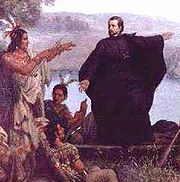 In 1660, France started a policy of expansion into the interior of North America
from what is now eastern Canada
. The objectives were to locate a Northwest passage
to China
; to exploit the territory's natural resources, such as fur
and mineral ores; and to convert
the native population to Catholicism
. Fur traders began exploring the pays d'en haut (upper country around the Great Lakes
) at the time. In 1659, Pierre-Esprit Radisson
and Médard Chouart des Groseilliers reached the western end of Lake Superior
. Priests founded mission
s, such as the Mission of Sault Sainte Marie
in 1668. On May 17, 1673, Louis Jolliet
and Jacques Marquette
began the exploration of the Mississippi River
, which they called the Sioux Tongo (the large river) or Michissipi. They reached the mouth of the Arkansas River
, and then returned upstream, having learned that the great river ran towards the Gulf of Mexico
and not towards the Pacific Ocean
as they had presumed. In 1675, Marquette founded a mission in the Native American village of Kaskaskias
on the Illinois River
. A permanent settlement was made by 1690.
In 1682, Cavelier de La Salle
and the Italian Henri de Tonti
descended to the Mississippi delta. They left Fort Crèvecoeur
on the Illinois River, accompanied by 23 Frenchmen and 18 Indians. They built Fort Prud'homme (later the city of Memphis
) and claimed French sovereignty on the whole of the valley, which they called Louisiane in honor of the Louis XIV of France
. They sealed alliances with the Quapaw
Indians. In April 1682, they arrived at the mouth of the Mississippi. La Salle eventually returned to Versailles
, where he convinced the Minister of the Marine to grant the command of Louisiana to him. He claimed that Louisiana was close to New Spain
by drawing a map indicating the Mississippi as much further west than it really is. With four ships and 320 emigrants, La Salle set sail for Louisiana. Unfortunately, La Salle was not able to find the mouth of the river in the Mississippi delta and attempted to establish a colony on the Texas coast. La Salle was assassinated in 1687 by members of his exploration party, reportedly near what is now Navasota, Texas
.
to administer Louisiana, a territory several times larger than Metropolitan France
. Louis XIV
and his successors tried to impose their absolutist
ambitions on the colony, often without giving the colonial administration enough financial means to do its work.
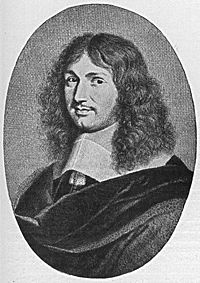 If the leaders of the Ancien Régime took control of, and sometimes encouraged, the colonization of New France
, it was for many different reasons. The reign of Henry IV
gave an important impetus to the colonisation of New France. Henry IV, the first Bourbon king, was personally interested in foreign affairs. In the 17th century, the ministers Richelieu and later Colbert
advanced colonial politics. Louis XIV and his ministers were worried about the size of the kingdom, over which they constantly competed with other European nations. European rivalry and a game of political alliances greatly marked the history of Louisiana, in direct and indirect ways. Within those shifting conditions, the French desire to limit British influence in the New World
was a constant in royal politics.
The Sun King took care to limit the appearance of intermediary bodies and countervailing powers in North America. He did not want an assembly of notables
or parliament
. In the 1660s, the colony was royal property. In 1685, Louis XIV banned all publishing in New France. Between 1712 and 1731, the French possession came under the control of Antoine Crozat
, a rich businessman, then under that of the Mississippi Company
(created by John Law
), which recruited immigrants to settle the colony. In 1731, Louisiana reverted to royal rule.
In contrast to Metropolitan France
, the government used laws in the colony based on those of Paris (rather egalitarian for the time). This served as an equaliser for a while; riots and revolts against authority were rare. But, the centralised government had difficulty maintaining communications over the long distance and sailing time which separated France from Louisiana. Toward the end of the 17th century and the beginning of the 18th, the colonists on the Gulf of Mexico
were left almost completely to fend for themselves; they counted far more on the assistance of the Native Americans than on France. The distance had its advantages: the colonists smuggled goods into the colony with impunity.
Jean-Baptiste Colbert
, Louis XIV's Minister of the Navy and Trade, was eager to stuff the coffers of the Crown. He dissolved the trading companies and took care to increase the production of the country and the colonies. Being a mercantilist
, he believed it was necessary to sell as much as possible and to reduce reliance on imports. He imposed a French monopoly on trade. Colbert wanted to reduce the expenditure of the monarchy. It was, however, necessary to invest much money and to mobilize important human resources retain the American colony. Much work was done on the economic infrastructure (factories, ports) in metropolitan France, but the investment was insufficient in Louisiana. No plan to facilitate the movement of goods or men was ever carried out. The French budget was exhausted because of the wars in Europe, but the colonists in Louisiana did not have to pay royal taxes and were free of the hated gabelle
.
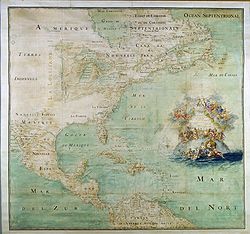 Under the Ancien Régime, Louisiana formed part of a larger colonial unit, the French empire in America: New France (Nouvelle France), which included a part of what is now Canada. New France was initially ruled by a viceroy: this post was occupied by the Duke of Ventadour (1625). It was then equipped with a government like the other possessions of the Bourbon
s. Its seat was in the city of Québec
until 1759. One Governor general, assisted by one intendant
, was charged with ruling this vast empire. In theory, Louisiana was subordinate to Canada. It was explored and populated chiefly by French-Canadian colonists, rather than settlers from Metropolitan France. Given the enormous distance between New Orleans and Quebec, communications were limited outside of the cities and forts.
French settlements were widely dispersed, giving them a relative autonomy in fact, if not in law. The government decided to divide rule of the vast, diverse colony of New France into five jurisdictions, including Louisiana. The Country of Illinois, located at the south of the Great Lakes, was added to Louisiana in 1717. The first "capital" of French Louisiana was Mobile. The seat of government was transferred to Biloxi in 1720, then to New Orleans in 1722, where the governor resided. This individual was the most eminent figure, but not the most powerful. He commanded troops and was responsible for diplomatic relations. The second authority was the police chief-director. His functions were similar to those of the intendant
s in France: administrators and representatives of the king, they managed justice, the police force and finances. They managed the budget, set prices, chaired the higher council (the Court of Justice) and organized the census
. Named by the king, the ordnance officer of Louisiana had broad capacities which sometimes came into conflict with those of the governor. The military stations of the interior were directed by commanders.
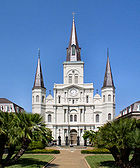 The French possessions of North America were under the authority of a single Catholic
diocese
, whose seat was in Quebec. The archbishop
, named and paid by the king, was spiritual head of all New France. With loose religious supervision, the fervor of the population was very weak; Louisianans tended to practice their faith much less than did their counterparts in France and Canada. The tithe, a tax by the clergy
on the congregations, produced less revenue than in France.
The Church nevertheless played an important part in the exploration of French Louisiana; it sent missions, primarily carried out by Jesuits, to convert Native Americans
. It also founded schools and hospitals: by 1720, the Ursulines
were operating a hospital in New Orleans. The church and its missionaries established contact with the numerous Amerindian tribes. Certain priests, such as Father Marquette in the 17th century, took part in exploratory missions. The Jesuits translated collections of prayers into numerous Amerindian languages for the purpose of converting the Native Americans. They also looked for ways to relate Indian practices to Christian worship, and helped show the Natives how these were related. A syncretic religion developed among new Christians. Sincere and permanent conversions were limited in number; many who received missionary instruction tended to assimilate the Holy Trinity into their belief of "spirits", or rejected the concept outright.
. At the end of the 17th century, there were likely no more than 100,000 to 200,000 Native Americans in Lower Louisiana. A small number of Native Americans were employed as slaves from the very start of the 18th century—in spite of official prohibition. These slaves were captured by rival tribes during raids and in battle. Sold to French colonists, they were often sent to Saint Domingue in the West Indies or, at times, to Canada. In Louisiana, planters generally preferred using African slaves, though some had Native American servants.
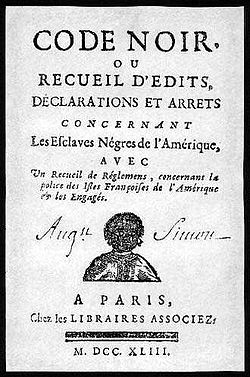 In 1717, John Law
, the French minister of finance, decided to import African slaves into Louisiana. His objective was to develop the plantation
economy of Lower Louisiana. The Company of the Indies held a monopoly of the slave trade in the area. It imported approximately 6,000 slaves from Africa between 1719 and 1743. A portion of these were sent to the Illinois Territory to cultivate the fields or to work the lead
mines. The economy of Lower Louisiana consequently became slave-dependent. As in other French colonies, the treatment of the slaves was regulated by the Code Noir
. The slaves often had a degree of autonomy beyond that suggested by the code. Initially, during public holidays, slaves were permitted to sell a portion of the crops they had cultivated. Some would hunt, cut wood or keep livestock far from the plantation. Lastly, although interracial marriages and regroupings of slaves were prohibited, planters and their workers often practiced cohabitation and kept mistresses. In the early years, there were few French women in the colony. The life and work of the slaves was difficult, with harvest season undoubtedly the hardest. The maintenance of canals for rice irrigation and travel also involved much labor.
Slave residences were modest; they slept on simple straw pallets. They typically had some trunks and kitchen utensils. The condition of the slaves depended on the treatment they received from their masters. When it was excessively cruel, the slaves often fled and hid in the marshes or in New Orleans. The Maroon
societies which runaway slaves founded were often short-lived; Louisiana did not have the larger and semi-permanent Maroon villages that developed in the West Indies. Meanwhile, slave revolts were not as frequent in this area as they were in the Caribbean. The possibility of being set free was rather low; the slaves could not purchase their freedom. One of the first slaves to be freed was Louis Congo
, who, in 1725, received freedom, land, and compensation in exchange for becoming the public executioner of New Orleans. Some freed slaves (notably women and former soldiers) formed small communities, which suffered from segregation
; justice was more severe against them, and they did not have right to possess weapons. Slaves contributed to the creolization of Louisianan society. They brought okra
from Africa, a plant common in the preparation of gumbo
. While the Code Noir required that the slaves receive a Christian education, many secretly practiced animism
and often combined elements of the two faiths.
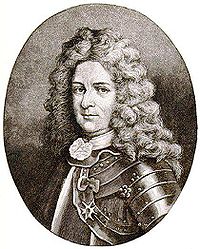
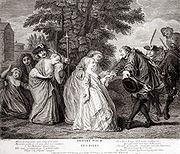 The commonly accepted definition of Louisiana Creole
today is the community whose members are a mixture of mainly French, Spanish, African, and Native-American heritage. Some individuals may not have each ethnic heritage, and some may have additional ancestries. It is estimated that 7,000 European immigrants settled in Louisiana during the 18th century - a number 100 times lower than the number of British colonists on the Atlantic coast. Louisiana attracted considerably fewer French colonists than did its West Indian colonies. After the crossing of the Atlantic Ocean
, which lasted several months, the colonists had several challenges ahead of them. Their living conditions were difficult: uprooted, they had to face a new, often hostile, environment. Many of these immigrants died during the maritime crossing or soon after their arrival.
Hurricanes, unknown in France, periodically struck the coast, destroying whole villages. The Mississippi Delta was plagued with periodic yellow fever
epidemics, to which malaria
and cholera
were added as part of the Eurasian diseases that arrived with the Europeans. These conditions slowed colonisation. Moreover, French villages and forts were not necessarily safe from enemy offensives. Attacks by Native Americans represented a real threat to the groups of isolated colonists; in 1729, the attacks on Natchez
killed 250 in Lower Louisiana. Forces of the Native American Natchez tribe took Fort Rosalie
(now Natchez, Mississippi
) by surprise, killing, among others, pregnant women. The French response ensued in the following two years, causing the Natchez to flee or be deported
as slaves to Saint Domingue.
Colonists were often young men, volunteers recruited in French ports or in Paris. Many served as indentured servant
s; they were required to remain in Louisiana for a length of time fixed by the contract of service. During this time, they were "temporary semi-slaves". To increase the colonial population, filles de la cassette, young Frenchwomen, were sent to the colony to marry soldiers there, and given a dowry
financed by the king. (This builds on the 17th century example in what is now Canada: about 800 filles du roi immigrated to New France
under the monetary sponsorship of Louis XIV
.) Comfort women were females "of easy virtue," vagrants or outlaws, and those without family arriving with a lettre de cachet
; they were sent by force to Louisiana, especially during the Régence
period early in the reign of Louis XV. Their stories inspired the novel Story of the Knight Of Grieux and Manon Lescaut, written by Abbé Prévost in 1731. In 1721, the ship La Baleine brought close to 90 women of childbearing age from the prison of La Salpetrière in Paris to Louisiana where most of them quickly found husbands amongst the residents of the colony. These women, many of whom were most likely prostitutes or felons, were known as The Baleine Brides. French Louisiana included communities of Swiss and German settlers; however, royal authorities never spoke of "Louisianans" but always of "French" to designate the population. After the Seven Years' War
, the settlement became a more mixed affair, with the population enriched with the arrival of various groups: Spanish settlers, refugees from Saint Domingue (particularly after 1791), opponents of the French Revolution
, and Cajuns. In 1785, 1,633 people of Acadian
origin were brought from France to New Orleans, 30 years after having been expelled from their homeland by the British. Other Acadians made it to the colony on their own; altogether, about 4,000 are thought to have settled in Louisiana.
was not imposed on the banks of the Mississippi, although the long lot land division scheme of the seigneurial system was adapted to some of the meandering rivers and bayous there. There were few corporation
s treated on a hierarchical basis and strictly regulated. Certain tradesmen managed to build fortunes rather quickly. The large planters of Louisiana were attached to the French way of life: they imported wigs and clothing fashionable in Paris. In the Country of Illinois, the wealthiest constructed stone-built houses and had several slaves. The largest traders mostly wound up settling in New Orleans.
because repression was severe. The army held a fundamental place in the control of the territory. Soldiers built forts and frequently negotiated with the Native Americans.
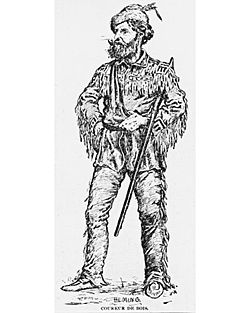 The coureurs des bois (literally "runners of the woods") played an important part, though not well documented, in the expansion of French influence in North America. By the end of the 17th century, these adventurers had journeyed the length of the Mississippi River. They were motivated by the hope of finding gold or of carrying out a profitable fur trade with the Indians. The fur trade, often practiced without authorization, was a difficult activity, carried on most of the time by young unmarried men. Many ultimately wished to go on to more sedentary agricultural activities. Meanwhile, a good number of them were integrated into native communities, learned the languages and took native wives. A well-known example is the French Canadian Toussaint Charbonneau
, husband to Sacagawea
, who gave birth to Jean-Baptiste. They took part in the Lewis and Clark Expedition
in 1804-1806.
, the Native Americans were regarded as subjects of the King of France, but in reality, they were largely autonomous due to their numerical superiority. The local authorities (governors, officers) did not have the means of imposing their decisions and often compromised. The tribes offered essential support for the French in Louisiana: they ensured the survival of the colonists, participated with them in the fur trade, were used as guides in expeditions. Their alliance was also essential in the fight against the British.
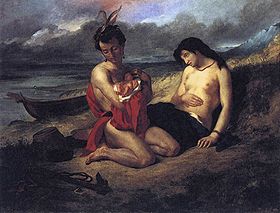 The two peoples influenced each other in many fields: the French learned the languages of the natives, who bought European goods (fabric, alcohol, firearms, etc.), and sometimes adopted their religion. The coureurs des bois and the soldiers borrowed canoes and moccasins. Many of them ate native food such as wild rice and various meats, like bear
and dog. The colonists were often dependent on the Native Americans for food. Creole cuisine is the heir of these mutual influences: thus, sagamité, for example, is a mix of corn pulp, bear fat and bacon. Today jambalaya
, a word of Seminole
origin, refers to a multitude of recipes calling for meat and rice, all very spicy. Sometimes shamans
succeeded in curing the colonists thanks to traditional remedies (application of fir tree gum on wounds and Royal Fern
on a rattlesnake bite).
Many colonists both admired and feared the military power of the Native Americans, but others scorned their culture and regarded them as racially less pure than the Whites. In 1735, interracial marriages without the approval of the authorities were prohibited in Louisiana. The Jesuit priests were often scandalized by the supposedly libertine ways of the Native Americans. In spite of some disagreements (the Indians killed pigs which devastated corn fields), and sometimes violent confrontations (War of the Foxes, Natchez uprisings and expeditions against the Chicachas), the relationship with the Native Americans was relatively good in Louisiana because the French were not numerous. French imperialism was expressed through some wars and the slavery of some Native Americans. But most of the time, the relationship was based on dialogue and negotiation.
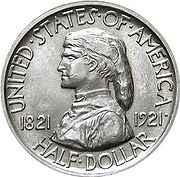 Louisiana could be divided into two main areas, both with well-differentiated economic systems.
, Kaskaskia
, Prairie du Rocher, and Sainte-Geneviève
). They cultivated the land with paid laborers, producing mostly corn and wheat. The fields were cleared with plough
s. They raised horses, cows and pigs, and also grew a little tobacco, hemp
, flax
and grapes (though most wine was still imported from France). Agriculture was at the mercy of the rough climate and periodic floods of the Mississippi.
The trading posts in the Illinois Country concentrated mostly on the fur trade. Placed at strategic points, they were modestly fortified. Only a few were made out of stone (Fort de Chartres, Fort Niagara). Like their American "mountain man
" counterparts, the coureurs des bois exchanged beaverskin or deer
pelts for weapons, cloth or shoddy goods, because the local economy was based on barter
. The skins and fur are later sold in the forts and cities of New France. The Illinois Country also produced salt and lead
and provided New Orleans with game.
and indigo
).
The rare shipments from France brought food (lard, wheat...), alcohol and various indispensable finished products (weapons, tools, cloth, clothing). Fur and various products came from the interior, and the port sent tobacco and indigo to the metropolis. But these exports remained on the whole relatively weak. New Orleans also still sold wood, rice and corn to the French West Indies.
in Europe. In North America, the war became known as the French and Indian War
. After some early victories from 1754 to 1757, thanks to help from their Native American allies, the French suffered several disastrous defeats in Canada
from 1758 to 1760, culminating in the surrender of the capital city, Montreal
. With the loss of Canada, defense of Louisiana became impossible.
The Treaty of Paris
, signed on 10 February 1763, formalized the eviction of the French from North America. Canada and the east bank of the Mississippi were handed over to Great Britain. New Orleans and the west bank of the river had been secretly given to Spain the previous year. This decision provoked the departure of a few settlers; however, the Spaniards effectively took control of their new territories rather late (in 1766), and there was not much Spanish immigration. To the East, the United States foresaw the conquest of the West; commercial navigation on the Mississippi was opened to Americans in 1795.
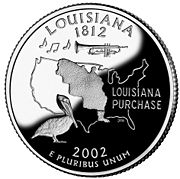
During the French Revolution
, Louisiana was agitated under Spanish control: certain French-speaking colonists sent petitions to the metropolis and the slaves attempted revolts in 1791 and 1795.
The Treaty of San Ildefonso
, signed in secrecy on October 1, 1800, envisaged the transfer of Western Louisiana as well as New Orleans to France in exchange for the Duchy of Parma
. However, Napoleon Bonaparte
soon decided not to keep the immense territory. The army he sent to take possession of the colony was first required to put down a revolution in Saint-Domingue
(now Haiti
); its failure to do so, coupled with the rupture of the Treaty of Amiens
with the United Kingdom, prompted him to decide to sell Louisiana to the young United States. This was done on April 30, 1803 for the sum of 80 million francs (15 million dollars). American sovereignty was established on December 20, 1803.
, Louisiana Creole French
and of Cajun French
is that which has been most threatened; for this reason, the CODOFIL (Council for the Development of French in Louisiana) was created in 1968. A subject of debate is the variety of French that should be taught: that of France, Canadian French
, standard Louisiana French or Cajun French. Today, many Cajun-dominated areas of Louisiana have formed associations with Acadian
communities in Canada, which send French professors to re-teach the language in the schools. In 2003, 7% of Louisianans were French-speaking, though most also spoke English. An estimated 25% of the state's population has some French ancestry, carrying a number of last names of French origin (e.g., LeBlanc, Cordier, Dion, Menard, Pineaux, Hébert, Ardoin, Roubideaux…).
 Many cities and villages have names of French origin. (See French in the United States
for a list of these.) They include St. Louis
, Detroit, Baton Rouge, New Orleans, Lafayette
, Mobile
, Des Moines
and Duluth
. The flag and the seal of the state of Minnesota
carry a French legend. The Iowa
state flag uses a variation of the French national flag as its base. Historical festivals and commemorations point out the French presence: in 1999, Louisiana celebrated the 300th anniversary of its foundation; in 2001, Detroit did the same. In 2003, the 200th anniversary of the Louisiana Purchase
was commemorated on numerous occasions as well as by a formal conference to recall its history. Certain places testify to a cultural inheritance left by the French; a prime example is the French Quarter
of New Orleans. Many French forts have been rebuilt and opened to visitors.
A key part of Louisianan culture finds its roots in the French period: Creole songs influenced the blues
and jazz
. Cajun music, often sung in French, remains very much alive today. New Orleans' Carnival
, with its height at Mardi Gras
, testifies to a long-lived Roman Catholic tradition.
New France
New France was the area colonized by France in North America during a period beginning with the exploration of the Saint Lawrence River by Jacques Cartier in 1534 and ending with the cession of New France to Spain and Great Britain in 1763...
. Under French control from 1682–1763 and 1800–03, the area was named in honor of Louis XIV, by French explorer René-Robert Cavelier, Sieur de la Salle
René-Robert Cavelier, Sieur de La Salle
René-Robert Cavelier, Sieur de La Salle, or Robert de LaSalle was a French explorer. He explored the Great Lakes region of the United States and Canada, the Mississippi River, and the Gulf of Mexico...
. It originally covered an expansive territory that included most of the drainage basin of the Mississippi River
Mississippi River
The Mississippi River is the largest river system in North America. Flowing entirely in the United States, this river rises in western Minnesota and meanders slowly southwards for to the Mississippi River Delta at the Gulf of Mexico. With its many tributaries, the Mississippi's watershed drains...
and stretched from the Great Lakes
Great Lakes
The Great Lakes are a collection of freshwater lakes located in northeastern North America, on the Canada – United States border. Consisting of Lakes Superior, Michigan, Huron, Erie, and Ontario, they form the largest group of freshwater lakes on Earth by total surface, coming in second by volume...
to the Gulf of Mexico
Gulf of Mexico
The Gulf of Mexico is a partially landlocked ocean basin largely surrounded by the North American continent and the island of Cuba. It is bounded on the northeast, north and northwest by the Gulf Coast of the United States, on the southwest and south by Mexico, and on the southeast by Cuba. In...
and from the Appalachian Mountains
Appalachian Mountains
The Appalachian Mountains #Whether the stressed vowel is or ,#Whether the "ch" is pronounced as a fricative or an affricate , and#Whether the final vowel is the monophthong or the diphthong .), often called the Appalachians, are a system of mountains in eastern North America. The Appalachians...
to the Rocky Mountains
Rocky Mountains
The Rocky Mountains are a major mountain range in western North America. The Rocky Mountains stretch more than from the northernmost part of British Columbia, in western Canada, to New Mexico, in the southwestern United States...
. Louisiana was divided into two regions, known as Upper Louisiana (French: Haute-Louisiane), which began north of the Arkansas River
Arkansas River
The Arkansas River is a major tributary of the Mississippi River. The Arkansas generally flows to the east and southeast as it traverses the U.S. states of Colorado, Kansas, Oklahoma, and Arkansas. The river's initial basin starts in the Western United States in Colorado, specifically the Arkansas...
, and Lower Louisiana (French: Basse-Louisiane). The present-day U.S. state
U.S. state
A U.S. state is any one of the 50 federated states of the United States of America that share sovereignty with the federal government. Because of this shared sovereignty, an American is a citizen both of the federal entity and of his or her state of domicile. Four states use the official title of...
of Louisiana
Louisiana
Louisiana is a state located in the southern region of the United States of America. Its capital is Baton Rouge and largest city is New Orleans. Louisiana is the only state in the U.S. with political subdivisions termed parishes, which are local governments equivalent to counties...
is named for the historical region, although it occupies only a small portion of the territory claimed by the French.
French exploration of the area began during the reign of Louis XIV, while French Louisiana was not greatly developed, due to a lack of human and financial resources. As a result of its defeat
France in the Seven Years War
France was one of the leading participants in the Seven Years' War which lasted between 1754 and 1763. France entered the war with hopes of achieving a lasting victory both in Europe against Prussia, Britain and their German Allies and across the globe against their major colonial rivals...
, in the Seven Years' War
Seven Years' War
The Seven Years' War was a global military war between 1756 and 1763, involving most of the great powers of the time and affecting Europe, North America, Central America, the West African coast, India, and the Philippines...
, France
Early Modern France
Kingdom of France is the early modern period of French history from the end of the 15th century to the end of the 18th century...
was forced to cede the eastern part of the territory in 1763 to the victorious British
Great Britain in the Seven Years War
The Kingdom of Great Britain was one of the major participants in the Seven Years' War which lasted between 1756 and 1763. Britain emerged from the war as the world's leading colonial power having gained a number of new territories at the Treaty of Paris in 1763 and established itself as the...
, and the western part to Spain
Spain
Spain , officially the Kingdom of Spain languages]] under the European Charter for Regional or Minority Languages. In each of these, Spain's official name is as follows:;;;;;;), is a country and member state of the European Union located in southwestern Europe on the Iberian Peninsula...
as compensation for that country's loss of Florida
Spanish Florida
Spanish Florida refers to the Spanish territory of Florida, which formed part of the Captaincy General of Cuba, the Viceroyalty of New Spain, and the Spanish Empire. Originally extending over what is now the southeastern United States, but with no defined boundaries, la Florida was a component of...
. France
French First Republic
The French First Republic was founded on 22 September 1792, by the newly established National Convention. The First Republic lasted until the declaration of the First French Empire in 1804 under Napoleon I...
regained sovereignty of the western territory in the secret Treaty of San Ildefonso
Third Treaty of San Ildefonso
The Third Treaty of San Ildefonso was a secretly negotiated treaty between France and Spain in which Spain returned the colonial territory of...
of 1800. But, strained by obligations in Europe, Napoleon Bonaparte decided to sell the territory to the United States
United States
The United States of America is a federal constitutional republic comprising fifty states and a federal district...
in the Louisiana Purchase
Louisiana Purchase
The Louisiana Purchase was the acquisition by the United States of America of of France's claim to the territory of Louisiana in 1803. The U.S...
of 1803, ending France's presence in Louisiana.
The United States ceded part of the Louisiana Purchase
Louisiana Purchase
The Louisiana Purchase was the acquisition by the United States of America of of France's claim to the territory of Louisiana in 1803. The U.S...
to Great Britain
United Kingdom of Great Britain and Ireland
The United Kingdom of Great Britain and Ireland was the formal name of the United Kingdom during the period when what is now the Republic of Ireland formed a part of it....
in the Treaty of 1818
Treaty of 1818
The Convention respecting fisheries, boundary and the restoration of slaves between the United States of America and the United Kingdom of Great Britain and Ireland, also known as the London Convention, Anglo-American Convention of 1818, Convention of 1818, or simply the Treaty of 1818, was a...
, following the War of 1812
War of 1812
The War of 1812 was a military conflict fought between the forces of the United States of America and those of the British Empire. The Americans declared war in 1812 for several reasons, including trade restrictions because of Britain's ongoing war with France, impressment of American merchant...
. This section lies above the 49th parallel north
49th parallel north
The 49th parallel north is a circle of latitude that is 49 degrees north of the Earth's equatorial plane. It crosses Europe, Asia, the Pacific Ocean, North America, and the Atlantic Ocean....
in a portion of present-day Alberta
Alberta
Alberta is a province of Canada. It had an estimated population of 3.7 million in 2010 making it the most populous of Canada's three prairie provinces...
and Saskatchewan
Saskatchewan
Saskatchewan is a prairie province in Canada, which has an area of . Saskatchewan is bordered on the west by Alberta, on the north by the Northwest Territories, on the east by Manitoba, and on the south by the U.S. states of Montana and North Dakota....
.
Nature and geography
Mississippi River
The Mississippi River is the largest river system in North America. Flowing entirely in the United States, this river rises in western Minnesota and meanders slowly southwards for to the Mississippi River Delta at the Gulf of Mexico. With its many tributaries, the Mississippi's watershed drains...
Valley, from what is now the Midwestern United States
Midwestern United States
The Midwestern United States is one of the four U.S. geographic regions defined by the United States Census Bureau, providing an official definition of the American Midwest....
south to the coast of the Gulf of Mexico
Gulf of Mexico
The Gulf of Mexico is a partially landlocked ocean basin largely surrounded by the North American continent and the island of Cuba. It is bounded on the northeast, north and northwest by the Gulf Coast of the United States, on the southwest and south by Mexico, and on the southeast by Cuba. In...
. Demarcating the exact territory is difficult as it did not have formal, defined border
Border
Borders define geographic boundaries of political entities or legal jurisdictions, such as governments, sovereign states, federated states and other subnational entities. Some borders—such as a state's internal administrative borders, or inter-state borders within the Schengen Area—are open and...
s in the modern sense. Within this vast territory, only two areas saw substantial French settlement: Upper Louisiana , also known as the Illinois Country
Illinois Country
The Illinois Country , also known as Upper Louisiana, was a region in what is now the Midwestern United States that was explored and settled by the French during the 17th and 18th centuries. The terms referred to the entire Upper Mississippi River watershed, though settlement was concentrated in...
, which consisted of settlements in what are now the states of Missouri
Missouri
Missouri is a US state located in the Midwestern United States, bordered by Iowa, Illinois, Kentucky, Tennessee, Arkansas, Oklahoma, Kansas and Nebraska. With a 2010 population of 5,988,927, Missouri is the 18th most populous state in the nation and the fifth most populous in the Midwest. It...
, Illinois
Illinois
Illinois is the fifth-most populous state of the United States of America, and is often noted for being a microcosm of the entire country. With Chicago in the northeast, small industrial cities and great agricultural productivity in central and northern Illinois, and natural resources like coal,...
, and Indiana
Indiana
Indiana is a US state, admitted to the United States as the 19th on December 11, 1816. It is located in the Midwestern United States and Great Lakes Region. With 6,483,802 residents, the state is ranked 15th in population and 16th in population density. Indiana is ranked 38th in land area and is...
; and Lower Louisiana, which comprised parts of the modern states of Louisiana
Louisiana
Louisiana is a state located in the southern region of the United States of America. Its capital is Baton Rouge and largest city is New Orleans. Louisiana is the only state in the U.S. with political subdivisions termed parishes, which are local governments equivalent to counties...
, Arkansas
Arkansas
Arkansas is a state located in the southern region of the United States. Its name is an Algonquian name of the Quapaw Indians. Arkansas shares borders with six states , and its eastern border is largely defined by the Mississippi River...
, Mississippi
Mississippi
Mississippi is a U.S. state located in the Southern United States. Jackson is the state capital and largest city. The name of the state derives from the Mississippi River, which flows along its western boundary, whose name comes from the Ojibwe word misi-ziibi...
, and Alabama
Alabama
Alabama is a state located in the southeastern region of the United States. It is bordered by Tennessee to the north, Georgia to the east, Florida and the Gulf of Mexico to the south, and Mississippi to the west. Alabama ranks 30th in total land area and ranks second in the size of its inland...
. Both areas were dominated numerically by Native American tribe
Tribe
A tribe, viewed historically or developmentally, consists of a social group existing before the development of, or outside of, states.Many anthropologists use the term tribal society to refer to societies organized largely on the basis of kinship, especially corporate descent groups .Some theorists...
s.
"At times, fewer than two hundred [French] soldiers were assigned to all of the colony, on both sides of the Mississippi. In the mid-1720s, Louisiana had some 2,500 French, plus 1,500 slaves. In contrast, Louisiana Indians numbered well over 35,000."
Generally speaking, Louisiana bordered the Great Lakes
Great Lakes
The Great Lakes are a collection of freshwater lakes located in northeastern North America, on the Canada – United States border. Consisting of Lakes Superior, Michigan, Huron, Erie, and Ontario, they form the largest group of freshwater lakes on Earth by total surface, coming in second by volume...
, particularly Lake Michigan
Lake Michigan
Lake Michigan is one of the five Great Lakes of North America and the only one located entirely within the United States. It is the second largest of the Great Lakes by volume and the third largest by surface area, after Lake Superior and Lake Huron...
and Lake Erie
Lake Erie
Lake Erie is the fourth largest lake of the five Great Lakes in North America, and the tenth largest globally. It is the southernmost, shallowest, and smallest by volume of the Great Lakes and therefore also has the shortest average water residence time. It is bounded on the north by the...
towards the north. On the east, the French colony was separated by the Appalachian Mountains
Appalachian Mountains
The Appalachian Mountains #Whether the stressed vowel is or ,#Whether the "ch" is pronounced as a fricative or an affricate , and#Whether the final vowel is the monophthong or the diphthong .), often called the Appalachians, are a system of mountains in eastern North America. The Appalachians...
from the Thirteen British Colonies
Thirteen Colonies
The Thirteen Colonies were English and later British colonies established on the Atlantic coast of North America between 1607 and 1733. They declared their independence in the American Revolution and formed the United States of America...
. The Rocky Mountains
Rocky Mountains
The Rocky Mountains are a major mountain range in western North America. The Rocky Mountains stretch more than from the northernmost part of British Columbia, in western Canada, to New Mexico, in the southwestern United States...
region marked the western extent of the French claim. Louisiana's southern border was formed by the Gulf of Mexico
Gulf of Mexico
The Gulf of Mexico is a partially landlocked ocean basin largely surrounded by the North American continent and the island of Cuba. It is bounded on the northeast, north and northwest by the Gulf Coast of the United States, on the southwest and south by Mexico, and on the southeast by Cuba. In...
, which served as the port
Port
A port is a location on a coast or shore containing one or more harbors where ships can dock and transfer people or cargo to or from land....
for the colony.
The colony was mostly flat, which aided European movement through the territory. Its average elevation is less than 1,000 metre
Metre
The metre , symbol m, is the base unit of length in the International System of Units . Originally intended to be one ten-millionth of the distance from the Earth's equator to the North Pole , its definition has been periodically refined to reflect growing knowledge of metrology...
s. The territory becomes more mountainous towards the west, with the notable exception of the Ozark Mountains
The Ozarks
The Ozarks are a physiographic and geologic highland region of the central United States. It covers much of the southern half of Missouri and an extensive portion of northwestern and north central Arkansas...
, which are located in the mid-south.
Upper Louisiana
Upper Louisiana, also known as the Illinois Country, comprised territory in the upper Mississippi River Valley, including settlements and fortifications in what are now the states of MissouriMissouri
Missouri is a US state located in the Midwestern United States, bordered by Iowa, Illinois, Kentucky, Tennessee, Arkansas, Oklahoma, Kansas and Nebraska. With a 2010 population of 5,988,927, Missouri is the 18th most populous state in the nation and the fifth most populous in the Midwest. It...
, Illinois
Illinois
Illinois is the fifth-most populous state of the United States of America, and is often noted for being a microcosm of the entire country. With Chicago in the northeast, small industrial cities and great agricultural productivity in central and northern Illinois, and natural resources like coal,...
, and Indiana
Indiana
Indiana is a US state, admitted to the United States as the 19th on December 11, 1816. It is located in the Midwestern United States and Great Lakes Region. With 6,483,802 residents, the state is ranked 15th in population and 16th in population density. Indiana is ranked 38th in land area and is...
. French exploration of the area began with the 1673 expedition of Louis Joliet and Jacques Marquette
Jacques Marquette
Father Jacques Marquette S.J. , sometimes known as Père Marquette, was a French Jesuit missionary who founded Michigan's first European settlement, Sault Ste. Marie, and later founded St. Ignace, Michigan...
, which charted the upper Mississippi. Unlike Lower Louisiana, which received settlers from all over France and its empire, Upper Louisiana was primarily settled by colonists from French Canada. There was further substantial intermarriage and integration with natives of the Illinois peoples. French settlers were attracted by the availability of arable farmland as well as the forests abundant with animals suitable for hunting
Hunting
Hunting is the practice of pursuing any living thing, usually wildlife, for food, recreation, or trade. In present-day use, the term refers to lawful hunting, as distinguished from poaching, which is the killing, trapping or capture of the hunted species contrary to applicable law...
and trapping. The region was initially governed as part of Canada, but was declared to be part of Louisiana in 1717. Between 1699 and 1760, six major settlements were established: Cahokia
Cahokia, Illinois
Cahokia is a village in St. Clair County, Illinois, United States. As of the 2000 census, the village had a population of 16,391. The name is a reference to one of the clans of the historic Illini confederacy, who were encountered by early French explorers to the region.Early European settlers also...
, Kaskaskia
Kaskaskia, Illinois
Kaskaskia is a village in Randolph County, Illinois, United States. In the 2010 census the population was 14, making it the second-smallest incorporated community in the State of Illinois in terms of population. A major French colonial town of the Illinois Country, its peak population was about...
, Fort de Chartres
Fort de Chartres
Fort de Chartres was a French fortification first built in 1720 on the east bank of the Mississippi River in present-day Illinois. The Fort de Chartres name was also applied to the two successive fortifications built nearby during the 18th century in the era of French colonial control over...
, Saint Philippe, and Prairie du Rocher
Prairie du Rocher, Illinois
Prairie du Rocher is a village in Randolph County, Illinois, United States. Founded in the French colonial period in the American Midwest, the community is located near bluffs that flank the east side of the Mississippi River along the floodplain often called the "American Bottom".Prairie du...
, all on the east side of the Mississippi River in present-day Illinois; and Ste. Genevieve
Ste. Genevieve, Missouri
Ste. Genevieve is a city in and the county seat of Ste. Genevieve County, Missouri, United States. The population was 11,654 at the 2000 census...
across the river in Missouri. By the 1720s a formal government infrastructure had formed; leaders of the towns reported to the commandant of Fort de Chartres, who in turn reported to the governor general of Louisiana in New Orleans
New Orleans, Louisiana
New Orleans is a major United States port and the largest city and metropolitan area in the state of Louisiana. The New Orleans metropolitan area has a population of 1,235,650 as of 2009, the 46th largest in the USA. The New Orleans – Metairie – Bogalusa combined statistical area has a population...
.
During the French and Indian War
French and Indian War
The French and Indian War is the common American name for the war between Great Britain and France in North America from 1754 to 1763. In 1756, the war erupted into the world-wide conflict known as the Seven Years' War and thus came to be regarded as the North American theater of that war...
(the Seven Years' War
Seven Years' War
The Seven Years' War was a global military war between 1756 and 1763, involving most of the great powers of the time and affecting Europe, North America, Central America, the West African coast, India, and the Philippines...
), the British
Kingdom of Great Britain
The former Kingdom of Great Britain, sometimes described as the 'United Kingdom of Great Britain', That the Two Kingdoms of Scotland and England, shall upon the 1st May next ensuing the date hereof, and forever after, be United into One Kingdom by the Name of GREAT BRITAIN. was a sovereign...
occupied the portion of Upper Louisiana east of the Mississippi. Following their defeat in the war the French ceded the area, which became known as the Northwest Territory
Northwest Territory
The Territory Northwest of the River Ohio, more commonly known as the Northwest Territory, was an organized incorporated territory of the United States that existed from July 13, 1787, until March 1, 1803, when the southeastern portion of the territory was admitted to the Union as the state of Ohio...
, as well as all of Louisiana east of the river, to Britain in the Treaty of Paris
Treaty of Paris (1763)
The Treaty of Paris, often called the Peace of Paris, or the Treaty of 1763, was signed on 10 February 1763, by the kingdoms of Great Britain, France and Spain, with Portugal in agreement. It ended the French and Indian War/Seven Years' War...
. As a result many of the French settlers in the region relocated to the west side of the Mississippi. Here they founded outposts such as the important settlement of St. Louis
St. Louis, Missouri
St. Louis is an independent city on the eastern border of Missouri, United States. With a population of 319,294, it was the 58th-largest U.S. city at the 2010 U.S. Census. The Greater St...
. A separate treaty ceded Louisiana west of the river to Spain
Spain
Spain , officially the Kingdom of Spain languages]] under the European Charter for Regional or Minority Languages. In each of these, Spain's official name is as follows:;;;;;;), is a country and member state of the European Union located in southwestern Europe on the Iberian Peninsula...
, France's ally in the war, as compensation for the loss of Spanish Florida
Spanish Florida
Spanish Florida refers to the Spanish territory of Florida, which formed part of the Captaincy General of Cuba, the Viceroyalty of New Spain, and the Spanish Empire. Originally extending over what is now the southeastern United States, but with no defined boundaries, la Florida was a component of...
to Britain. Even after France had lost its claim to Louisiana, settlement of Upper Louisiana by French-speakers continued. In 1800 Spain returned its part of Louisiana to France in the Third Treaty of San Ildefonso
Third Treaty of San Ildefonso
The Third Treaty of San Ildefonso was a secretly negotiated treaty between France and Spain in which Spain returned the colonial territory of...
, but France then sold it to the United States
United States
The United States of America is a federal constitutional republic comprising fifty states and a federal district...
in the Louisiana Purchase
Louisiana Purchase
The Louisiana Purchase was the acquisition by the United States of America of of France's claim to the territory of Louisiana in 1803. The U.S...
of 1803. Through this time, but especially following the Louisiana Purchase, Creoles, as they called themselves, began to move further into the Missouri Ozarks, where they formed mining communities such as Mine à Breton
Potosi, Missouri
Potosi is a city in Washington County, Missouri, United States. Potosi is about 10 miles north of Belgrade. The estimated population in July 2008 was 2,698. It was 2,662 at the 2000 census. It is the county seat of Washington County...
and La Vieille Mine (Old Mines).
A unique dialect, known as Missouri French
Missouri French
Missouri French is a nearly extinct variety of the French language formerly spoken in the upper Mississippi River Valley in the Midwestern United States, particularly in eastern Missouri. Once spoken widely across the region known as the Illinois Country or Upper Louisiana, the dialect is now...
, developed in Upper Louisiana. It is distinguished from both Louisiana French and the various forms of Canadian French
Canadian French
Canadian French is an umbrella term referring to the varieties of French spoken in Canada. French is the mother tongue of nearly seven million Canadians, a figure constituting roughly 22% of the national population. At the federal level it has co-official status alongside English...
, such as Acadian
Acadian French
Acadian French , is a regionalized dialect of Canadian French. It is spoken by the francophone population of the Canadian province of New Brunswick, by small minorities in areas in the Gaspé region of eastern Quebec, by small groups of francophones in Prince Edward Island, in several tiny pockets...
. This continued to be spoken around the Midwest, particularly in Missouri, through the 20th century. It is nearly extinct today, with only a few elderly speakers still able to use it.
17th century: Exploration
North America
North America is a continent wholly within the Northern Hemisphere and almost wholly within the Western Hemisphere. It is also considered a northern subcontinent of the Americas...
from what is now eastern Canada
Canada
Canada is a North American country consisting of ten provinces and three territories. Located in the northern part of the continent, it extends from the Atlantic Ocean in the east to the Pacific Ocean in the west, and northward into the Arctic Ocean...
. The objectives were to locate a Northwest passage
Northwest Passage
The Northwest Passage is a sea route through the Arctic Ocean, along the northern coast of North America via waterways amidst the Canadian Arctic Archipelago, connecting the Atlantic and Pacific Oceans...
to China
China
Chinese civilization may refer to:* China for more general discussion of the country.* Chinese culture* Greater China, the transnational community of ethnic Chinese.* History of China* Sinosphere, the area historically affected by Chinese culture...
; to exploit the territory's natural resources, such as fur
Fur trade
The fur trade is a worldwide industry dealing in the acquisition and sale of animal fur. Since the establishment of world market for in the early modern period furs of boreal, polar and cold temperate mammalian animals have been the most valued...
and mineral ores; and to convert
Convert
The convert or try, in American football known as "point after", and Canadian football "Point after touchdown", is a one-scrimmage down played immediately after a touchdown during which the scoring team is allowed to attempt to score an extra one point by kicking the ball through the uprights , or...
the native population to Catholicism
Catholicism
Catholicism is a broad term for the body of the Catholic faith, its theologies and doctrines, its liturgical, ethical, spiritual, and behavioral characteristics, as well as a religious people as a whole....
. Fur traders began exploring the pays d'en haut (upper country around the Great Lakes
Great Lakes
The Great Lakes are a collection of freshwater lakes located in northeastern North America, on the Canada – United States border. Consisting of Lakes Superior, Michigan, Huron, Erie, and Ontario, they form the largest group of freshwater lakes on Earth by total surface, coming in second by volume...
) at the time. In 1659, Pierre-Esprit Radisson
Pierre-Esprit Radisson
Pierre-Esprit Radisson was a French-Canadian fur trader and explorer. He is often linked to his brother-in-law Médard des Groseilliers who was about 20 years older. The decision of Radisson and Groseilliers to enter the English service led to the formation of the Hudson's Bay Company.Born near...
and Médard Chouart des Groseilliers reached the western end of Lake Superior
Lake Superior
Lake Superior is the largest of the five traditionally-demarcated Great Lakes of North America. It is bounded to the north by the Canadian province of Ontario and the U.S. state of Minnesota, and to the south by the U.S. states of Wisconsin and Michigan. It is the largest freshwater lake in the...
. Priests founded mission
Mission (station)
A religious mission or mission station is a location for missionary work.While primarily a Christian term, the concept of the religious "mission" is also used prominently by the Church of Scientology and their Scientology Missions International....
s, such as the Mission of Sault Sainte Marie
Sault Ste. Marie, Michigan
Sault Ste. Marie is a city in and the county seat of Chippewa County in the U.S. state of Michigan. It is in the north-eastern end of Michigan's Upper Peninsula, on the Canadian border, separated from its twin city of Sault Ste. Marie, Ontario, by the St. Marys River...
in 1668. On May 17, 1673, Louis Jolliet
Louis Jolliet
Louis Jolliet , also known as Louis Joliet, was a French Canadian explorer known for his discoveries in North America...
and Jacques Marquette
Jacques Marquette
Father Jacques Marquette S.J. , sometimes known as Père Marquette, was a French Jesuit missionary who founded Michigan's first European settlement, Sault Ste. Marie, and later founded St. Ignace, Michigan...
began the exploration of the Mississippi River
Mississippi River
The Mississippi River is the largest river system in North America. Flowing entirely in the United States, this river rises in western Minnesota and meanders slowly southwards for to the Mississippi River Delta at the Gulf of Mexico. With its many tributaries, the Mississippi's watershed drains...
, which they called the Sioux Tongo (the large river) or Michissipi. They reached the mouth of the Arkansas River
Arkansas River
The Arkansas River is a major tributary of the Mississippi River. The Arkansas generally flows to the east and southeast as it traverses the U.S. states of Colorado, Kansas, Oklahoma, and Arkansas. The river's initial basin starts in the Western United States in Colorado, specifically the Arkansas...
, and then returned upstream, having learned that the great river ran towards the Gulf of Mexico
Gulf of Mexico
The Gulf of Mexico is a partially landlocked ocean basin largely surrounded by the North American continent and the island of Cuba. It is bounded on the northeast, north and northwest by the Gulf Coast of the United States, on the southwest and south by Mexico, and on the southeast by Cuba. In...
and not towards the Pacific Ocean
Pacific Ocean
The Pacific Ocean is the largest of the Earth's oceanic divisions. It extends from the Arctic in the north to the Southern Ocean in the south, bounded by Asia and Australia in the west, and the Americas in the east.At 165.2 million square kilometres in area, this largest division of the World...
as they had presumed. In 1675, Marquette founded a mission in the Native American village of Kaskaskias
Kaskaskia, Illinois
Kaskaskia is a village in Randolph County, Illinois, United States. In the 2010 census the population was 14, making it the second-smallest incorporated community in the State of Illinois in terms of population. A major French colonial town of the Illinois Country, its peak population was about...
on the Illinois River
Illinois River
The Illinois River is a principal tributary of the Mississippi River, approximately long, in the State of Illinois. The river drains a large section of central Illinois, with a drainage basin of . This river was important among Native Americans and early French traders as the principal water route...
. A permanent settlement was made by 1690.
In 1682, Cavelier de La Salle
René-Robert Cavelier, Sieur de La Salle
René-Robert Cavelier, Sieur de La Salle, or Robert de LaSalle was a French explorer. He explored the Great Lakes region of the United States and Canada, the Mississippi River, and the Gulf of Mexico...
and the Italian Henri de Tonti
Henri de Tonti
Henri de Tonti was an Italian-born soldier, explorer, and fur trader in the service of France.-Early life:Henri de Tonti, a Sicilian, was mostly likely born near Gaeta, Italy in either 1649 or 1650. He was the son of Lorenzo de Tonti, a financier and former governor of Gaeta...
descended to the Mississippi delta. They left Fort Crèvecoeur
Fort Crevecoeur
Fort Crevecoeur was founded near the present site of Creve Coeur, a suburb of Peoria, Illinois, in January 1680.-Founding:...
on the Illinois River, accompanied by 23 Frenchmen and 18 Indians. They built Fort Prud'homme (later the city of Memphis
Memphis, Tennessee
Memphis is a city in the southwestern corner of the U.S. state of Tennessee, and the county seat of Shelby County. The city is located on the 4th Chickasaw Bluff, south of the confluence of the Wolf and Mississippi rivers....
) and claimed French sovereignty on the whole of the valley, which they called Louisiane in honor of the Louis XIV of France
Louis XIV of France
Louis XIV , known as Louis the Great or the Sun King , was a Bourbon monarch who ruled as King of France and Navarre. His reign, from 1643 to his death in 1715, began at the age of four and lasted seventy-two years, three months, and eighteen days...
. They sealed alliances with the Quapaw
Quapaw
The Quapaw people are a tribe of Native Americans who historically resided on the west side of the Mississippi River in what is now the state of Arkansas.They are federally recognized as the Quapaw Tribe of Indians.-Government:...
Indians. In April 1682, they arrived at the mouth of the Mississippi. La Salle eventually returned to Versailles
Versailles
Versailles , a city renowned for its château, the Palace of Versailles, was the de facto capital of the kingdom of France for over a century, from 1682 to 1789. It is now a wealthy suburb of Paris and remains an important administrative and judicial centre...
, where he convinced the Minister of the Marine to grant the command of Louisiana to him. He claimed that Louisiana was close to New Spain
New Spain
New Spain, formally called the Viceroyalty of New Spain , was a viceroyalty of the Spanish colonial empire, comprising primarily territories in what was known then as 'América Septentrional' or North America. Its capital was Mexico City, formerly Tenochtitlan, capital of the Aztec Empire...
by drawing a map indicating the Mississippi as much further west than it really is. With four ships and 320 emigrants, La Salle set sail for Louisiana. Unfortunately, La Salle was not able to find the mouth of the river in the Mississippi delta and attempted to establish a colony on the Texas coast. La Salle was assassinated in 1687 by members of his exploration party, reportedly near what is now Navasota, Texas
Navasota, Texas
Navasota is a city in Grimes County, Texas, United States. The population was 6,789 at the 2000 census. In 2005, the Texas Legislature named the city "The Blues Capital of Texas," in honor of the late Mance Lipscomb, a Navasota native and blues musician....
.
Summary chronology
- 1673: The Frenchmen Louis JollietLouis JollietLouis Jolliet , also known as Louis Joliet, was a French Canadian explorer known for his discoveries in North America...
and Jacques MarquetteJacques MarquetteFather Jacques Marquette S.J. , sometimes known as Père Marquette, was a French Jesuit missionary who founded Michigan's first European settlement, Sault Ste. Marie, and later founded St. Ignace, Michigan...
began the exploration of the Mississippi RiverMississippi RiverThe Mississippi River is the largest river system in North America. Flowing entirely in the United States, this river rises in western Minnesota and meanders slowly southwards for to the Mississippi River Delta at the Gulf of Mexico. With its many tributaries, the Mississippi's watershed drains...
. - 1682: René-Robert Cavelier, Sieur de la SalleRené-Robert Cavelier, Sieur de La SalleRené-Robert Cavelier, Sieur de La Salle, or Robert de LaSalle was a French explorer. He explored the Great Lakes region of the United States and Canada, the Mississippi River, and the Gulf of Mexico...
descended the Mississippi to its mouth. - 1699: Pierre Le Moyne, Sieur d'Iberville explored Louisiana coast and founds Fort MaurepasFort MaurepasNot to be confused with the Fort Maurepas built in 1699 by Bienville and Iberville in present-day Ocean Springs, Mississippi.Fort Maurepas was one of the first forts built by Pierre Gaultier de Varennes, sieur de La Vérendrye and his men. In 1733, they traveled from Fort St. Charles, which was...
at Old Biloxi (now in MississippiMississippiMississippi is a U.S. state located in the Southern United States. Jackson is the state capital and largest city. The name of the state derives from the Mississippi River, which flows along its western boundary, whose name comes from the Ojibwe word misi-ziibi...
) along the GulfGulf of MexicoThe Gulf of Mexico is a partially landlocked ocean basin largely surrounded by the North American continent and the island of Cuba. It is bounded on the northeast, north and northwest by the Gulf Coast of the United States, on the southwest and south by Mexico, and on the southeast by Cuba. In...
. - 1701: Antoine Laumet de La MotheAntoine Laumet de La Mothe, sieur de CadillacAntoine Laumet de La Mothe, sieur de Cadillac was a French explorer and adventurer in New France, now an area of North America stretching from Eastern Canada in the north to Louisiana in the south. Rising from a modest beginning in Acadia in 1683 as an explorer, trapper, and a trader of alcohol...
founded Detroit. - 1702: In January, MobileOld Mobile SiteThe Old Mobile Site was the location of the French settlement La Mobile and the associated Fort Louis de La Louisiane, in the French colony of New France in North America, from 1702 until 1712. The site is located in Le Moyne, Alabama, on the Mobile River in the Mobile-Tensaw River Delta...
(now in AlabamaAlabamaAlabama is a state located in the southeastern region of the United States. It is bordered by Tennessee to the north, Georgia to the east, Florida and the Gulf of Mexico to the south, and Mississippi to the west. Alabama ranks 30th in total land area and ranks second in the size of its inland...
) was founded as capital of Louisiana by J.B. Le Moyne de BienvilleJean-Baptiste Le Moyne, Sieur de BienvilleJean-Baptiste Le Moyne de Bienvillepronounce] was a colonizer, born in Montreal, Quebec and an early, repeated governor of French Louisiana, appointed 4 separate times during 1701-1743. He was a younger brother of explorer Pierre Le Moyne d'Iberville...
for his brother Iberville. - 1713: Étienne de Veniard, Sieur de BourgmontÉtienne de Veniard, Sieur de BourgmontÉtienne de Veniard, Sieur de Bourgmont was a French explorer who documented his travels on the Missouri and Platte rivers in North America and made the first European maps of these areas. He wrote two accounts of his travels, which included descriptions of the Native American tribes he encountered...
published first report on explorations of the Missouri River. - 1714: Natchitoches, the oldest permanent settlement in Louisiana, was founded by Louis Juchereau de St. Denis.
- 1717: Official drafting of blacks began in Louisiana, to assist native tribe slaves.
- 1718: New Orleans was founded, at crescent in river, to reduce flooding.
- 1719: At MobileMobile, AlabamaMobile is the third most populous city in the Southern US state of Alabama and is the county seat of Mobile County. It is located on the Mobile River and the central Gulf Coast of the United States. The population within the city limits was 195,111 during the 2010 census. It is the largest...
, slave ships of first black Africans landed. - 1720: Biloxi, MississippiBiloxi, MississippiBiloxi is a city in Harrison County, Mississippi, in the United States. The 2010 census recorded the population as 44,054. Along with Gulfport, Biloxi is a county seat of Harrison County....
became capital of French Louisiana. - 1720: Spanish Villasur expeditionVillasur expeditionThe Villasur expedition of 1720 was a Spanish military expedition intended to check the growing French presence on the Great Plains of central North America...
was slaughtered by Pawnee near Columbus, NebraskaColumbus, NebraskaColumbus is a city in east central Nebraska, United States. Its population was 22,111 at the 2010 census. It is the county seat of Platte County.-Pre-settlement history:...
effectively ending Spanish incursions into the territory until 1763. - 1723: New Orleans became the official capital of French Louisiana.
- 1723: Fort OrleansFort OrleansFort Orleans was a French fort in colonial North America, the first fort built by any European forces on the Missouri River. It was built near the mouth of the Grand River near present-day Brunswick. Intended to be the linchpin in the vast New France empire stretching from Montreal to New Mexico,...
established near Brunswick, MissouriBrunswick, MissouriBrunswick is a rural city in Carroll County, Missouri, United States. The population was 925 at the 2000 census. The Missouri Farmers Association was founded here in 1914. Today the city is considered the Pecan Capital of Missouri...
. - 1762: Treaty of Fontainebleau (1762)Treaty of Fontainebleau (1762)The Treaty of Fontainebleau was a secret agreement in which France ceded Louisiana to Spain. The treaty followed the last battle in the French and Indian War, the Battle of Signal Hill in September 1762, which confirmed British control of Canada. However, the associated Seven Years War continued...
signed, by which France secretly ceded Louisiana to Spain - 1763: Treaty of ParisTreaty of Paris (1763)The Treaty of Paris, often called the Peace of Paris, or the Treaty of 1763, was signed on 10 February 1763, by the kingdoms of Great Britain, France and Spain, with Portugal in agreement. It ended the French and Indian War/Seven Years' War...
signed by which France ceded the east side of the Mississippi and Canada to Great Britain prompting a CajunCajunCajuns are an ethnic group mainly living in the U.S. state of Louisiana, consisting of the descendants of Acadian exiles...
migration to French controlled New Orleans and the west side of the river. Louisiana, including New Orleans is ceded to Spain. - 1764: Pierre LaclèdePierre LaclèdePierre Laclède or Pierre Laclède Liguest was a French fur trader who, with his young assistant and "stepson" Auguste Chouteau, founded St...
founded St. LouisSt. Louis, MissouriSt. Louis is an independent city on the eastern border of Missouri, United States. With a population of 319,294, it was the 58th-largest U.S. city at the 2010 U.S. Census. The Greater St...
. - 1764: Terms of Treaty of Fontainebleau were revealed
- 1768: Creole and German settlers in the Rebellion of 1768Rebellion of 1768The Rebellion of 1768 was an unsuccessful attempt by Creole and German settlers around New Orleans, Louisiana to stop the handover of the French Louisiana Territory, as had been stipulated in the Treaty of Fontainebleau, to Spain in 1768....
forced the new Spanish governor to flee - 1769: Spain quelled the rebellion, executed the plotters and officially took possession imposing Spanish law
- 1778: France declared war on Great Britain, aiding the American revolutionAmerican Revolutionary WarThe American Revolutionary War , the American War of Independence, or simply the Revolutionary War, began as a war between the Kingdom of Great Britain and thirteen British colonies in North America, and ended in a global war between several European great powers.The war was the result of the...
- 1779: Spain declared war on Great Britain.
- 1788: Great New Orleans Fire (1788)Great New Orleans Fire (1788)The Great New Orleans Fire was a fire that destroyed 856 of the 1,100 structures in New Orleans, Louisiana on March 21, 1788, spanning the south central French Quarter from Burgundy to Chartres Street, almost to the riverfront buildings....
destroyed most of New Orleans which was subsequently rebuilt in Spanish style - 1800: Secret Treaty of San IldefonsoThird Treaty of San IldefonsoThe Third Treaty of San Ildefonso was a secretly negotiated treaty between France and Spain in which Spain returned the colonial territory of...
signed by which France regained Louisiana in 1803. - 1803: Napoléon Bonaparte sold Louisiana to the United States.
- 1804: Three Flags DayThree Flags DayThree Flags Day commemorates March 9 and 10, 1804, when Spain officially turned over the Louisiana Territory to France, which in turn ceded the territory to the United States in the Louisiana Purchase.The ceremony in St...
in St. Louis, when Spain officially ceded Louisiana to France, which then officially ceded it to the United States.
Political and administrative organization
It was not easy for an absolute monarchyAbsolute monarchy
Absolute monarchy is a monarchical form of government in which the monarch exercises ultimate governing authority as head of state and head of government, his or her power not being limited by a constitution or by the law. An absolute monarch thus wields unrestricted political power over the...
to administer Louisiana, a territory several times larger than Metropolitan France
Metropolitan France
Metropolitan France is the part of France located in Europe. It can also be described as mainland France or as the French mainland and the island of Corsica...
. Louis XIV
Louis XIV of France
Louis XIV , known as Louis the Great or the Sun King , was a Bourbon monarch who ruled as King of France and Navarre. His reign, from 1643 to his death in 1715, began at the age of four and lasted seventy-two years, three months, and eighteen days...
and his successors tried to impose their absolutist
Absolutism (European history)
Absolutism or The Age of Absolutism is a historiographical term used to describe a form of monarchical power that is unrestrained by all other institutions, such as churches, legislatures, or social elites...
ambitions on the colony, often without giving the colonial administration enough financial means to do its work.
Absolutism in Louisiana
New France
New France was the area colonized by France in North America during a period beginning with the exploration of the Saint Lawrence River by Jacques Cartier in 1534 and ending with the cession of New France to Spain and Great Britain in 1763...
, it was for many different reasons. The reign of Henry IV
Henry IV of France
Henry IV , Henri-Quatre, was King of France from 1589 to 1610 and King of Navarre from 1572 to 1610. He was the first monarch of the Bourbon branch of the Capetian dynasty in France....
gave an important impetus to the colonisation of New France. Henry IV, the first Bourbon king, was personally interested in foreign affairs. In the 17th century, the ministers Richelieu and later Colbert
Jean-Baptiste Colbert
Jean-Baptiste Colbert was a French politician who served as the Minister of Finances of France from 1665 to 1683 under the rule of King Louis XIV. His relentless hard work and thrift made him an esteemed minister. He achieved a reputation for his work of improving the state of French manufacturing...
advanced colonial politics. Louis XIV and his ministers were worried about the size of the kingdom, over which they constantly competed with other European nations. European rivalry and a game of political alliances greatly marked the history of Louisiana, in direct and indirect ways. Within those shifting conditions, the French desire to limit British influence in the New World
New World
The New World is one of the names used for the Western Hemisphere, specifically America and sometimes Oceania . The term originated in the late 15th century, when America had been recently discovered by European explorers, expanding the geographical horizon of the people of the European middle...
was a constant in royal politics.
The Sun King took care to limit the appearance of intermediary bodies and countervailing powers in North America. He did not want an assembly of notables
Assembly of Notables
The Assembly of Notables was a group of notables invited by the King of France to consult on matters of state.-History:Assemblies of Notables had met in 1583, 1596–97, 1617, 1626, 1787, and 1788. Like the Estates General, they served a consultative purpose only...
or parliament
Parliament
A parliament is a legislature, especially in those countries whose system of government is based on the Westminster system modeled after that of the United Kingdom. The name is derived from the French , the action of parler : a parlement is a discussion. The term came to mean a meeting at which...
. In the 1660s, the colony was royal property. In 1685, Louis XIV banned all publishing in New France. Between 1712 and 1731, the French possession came under the control of Antoine Crozat
Antoine Crozat
Antoine Crozat, marquis du Châtel , French founder of an immense fortune, was the first private proprietary owner of French Louisiana from 1712 to 1717....
, a rich businessman, then under that of the Mississippi Company
Mississippi Company
The "Mississippi Company" became the "Company of the West" and expanded as the "Company of the Indies" .-The Banque Royale:...
(created by John Law
John Law (economist)
John Law was a Scottish economist who believed that money was only a means of exchange that did not constitute wealth in itself and that national wealth depended on trade...
), which recruited immigrants to settle the colony. In 1731, Louisiana reverted to royal rule.
In contrast to Metropolitan France
Metropolitan France
Metropolitan France is the part of France located in Europe. It can also be described as mainland France or as the French mainland and the island of Corsica...
, the government used laws in the colony based on those of Paris (rather egalitarian for the time). This served as an equaliser for a while; riots and revolts against authority were rare. But, the centralised government had difficulty maintaining communications over the long distance and sailing time which separated France from Louisiana. Toward the end of the 17th century and the beginning of the 18th, the colonists on the Gulf of Mexico
Gulf of Mexico
The Gulf of Mexico is a partially landlocked ocean basin largely surrounded by the North American continent and the island of Cuba. It is bounded on the northeast, north and northwest by the Gulf Coast of the United States, on the southwest and south by Mexico, and on the southeast by Cuba. In...
were left almost completely to fend for themselves; they counted far more on the assistance of the Native Americans than on France. The distance had its advantages: the colonists smuggled goods into the colony with impunity.
Jean-Baptiste Colbert
Jean-Baptiste Colbert
Jean-Baptiste Colbert was a French politician who served as the Minister of Finances of France from 1665 to 1683 under the rule of King Louis XIV. His relentless hard work and thrift made him an esteemed minister. He achieved a reputation for his work of improving the state of French manufacturing...
, Louis XIV's Minister of the Navy and Trade, was eager to stuff the coffers of the Crown. He dissolved the trading companies and took care to increase the production of the country and the colonies. Being a mercantilist
Mercantilism
Mercantilism is the economic doctrine in which government control of foreign trade is of paramount importance for ensuring the prosperity and security of the state. In particular, it demands a positive balance of trade. Mercantilism dominated Western European economic policy and discourse from...
, he believed it was necessary to sell as much as possible and to reduce reliance on imports. He imposed a French monopoly on trade. Colbert wanted to reduce the expenditure of the monarchy. It was, however, necessary to invest much money and to mobilize important human resources retain the American colony. Much work was done on the economic infrastructure (factories, ports) in metropolitan France, but the investment was insufficient in Louisiana. No plan to facilitate the movement of goods or men was ever carried out. The French budget was exhausted because of the wars in Europe, but the colonists in Louisiana did not have to pay royal taxes and were free of the hated gabelle
Gabelle
The gabelle was a very unpopular tax on salt in France before 1790. The term gabelle derives from the Italian gabella , itself from the Arabic qabala....
.
Colonial administration
House of Bourbon
The House of Bourbon is a European royal house, a branch of the Capetian dynasty . Bourbon kings first ruled Navarre and France in the 16th century. By the 18th century, members of the Bourbon dynasty also held thrones in Spain, Naples, Sicily, and Parma...
s. Its seat was in the city of Québec
Quebec City
Quebec , also Québec, Quebec City or Québec City is the capital of the Canadian province of Quebec and is located within the Capitale-Nationale region. It is the second most populous city in Quebec after Montreal, which is about to the southwest...
until 1759. One Governor general, assisted by one intendant
Intendant
The title of intendant has been used in several countries through history. Traditionally, it refers to the holder of a public administrative office...
, was charged with ruling this vast empire. In theory, Louisiana was subordinate to Canada. It was explored and populated chiefly by French-Canadian colonists, rather than settlers from Metropolitan France. Given the enormous distance between New Orleans and Quebec, communications were limited outside of the cities and forts.
French settlements were widely dispersed, giving them a relative autonomy in fact, if not in law. The government decided to divide rule of the vast, diverse colony of New France into five jurisdictions, including Louisiana. The Country of Illinois, located at the south of the Great Lakes, was added to Louisiana in 1717. The first "capital" of French Louisiana was Mobile. The seat of government was transferred to Biloxi in 1720, then to New Orleans in 1722, where the governor resided. This individual was the most eminent figure, but not the most powerful. He commanded troops and was responsible for diplomatic relations. The second authority was the police chief-director. His functions were similar to those of the intendant
Intendant
The title of intendant has been used in several countries through history. Traditionally, it refers to the holder of a public administrative office...
s in France: administrators and representatives of the king, they managed justice, the police force and finances. They managed the budget, set prices, chaired the higher council (the Court of Justice) and organized the census
Census
A census is the procedure of systematically acquiring and recording information about the members of a given population. It is a regularly occurring and official count of a particular population. The term is used mostly in connection with national population and housing censuses; other common...
. Named by the king, the ordnance officer of Louisiana had broad capacities which sometimes came into conflict with those of the governor. The military stations of the interior were directed by commanders.
Religious establishment
Catholic
The word catholic comes from the Greek phrase , meaning "on the whole," "according to the whole" or "in general", and is a combination of the Greek words meaning "about" and meaning "whole"...
diocese
Diocese
A diocese is the district or see under the supervision of a bishop. It is divided into parishes.An archdiocese is more significant than a diocese. An archdiocese is presided over by an archbishop whose see may have or had importance due to size or historical significance...
, whose seat was in Quebec. The archbishop
Archbishop
An archbishop is a bishop of higher rank, but not of higher sacramental order above that of the three orders of deacon, priest , and bishop...
, named and paid by the king, was spiritual head of all New France. With loose religious supervision, the fervor of the population was very weak; Louisianans tended to practice their faith much less than did their counterparts in France and Canada. The tithe, a tax by the clergy
Clergy
Clergy is the generic term used to describe the formal religious leadership within a given religion. A clergyman, churchman or cleric is a member of the clergy, especially one who is a priest, preacher, pastor, or other religious professional....
on the congregations, produced less revenue than in France.
The Church nevertheless played an important part in the exploration of French Louisiana; it sent missions, primarily carried out by Jesuits, to convert Native Americans
Indigenous peoples of the Americas
The indigenous peoples of the Americas are the pre-Columbian inhabitants of North and South America, their descendants and other ethnic groups who are identified with those peoples. Indigenous peoples are known in Canada as Aboriginal peoples, and in the United States as Native Americans...
. It also founded schools and hospitals: by 1720, the Ursulines
Ursulines
The Ursulines are a Roman Catholic religious order for women founded at Brescia, Italy, by Saint Angela de Merici in November 1535, primarily for the education of girls and the care of the sick and needy. Their patron saint is Saint Ursula.-History:St Angela de Merici spent 17 years leading a...
were operating a hospital in New Orleans. The church and its missionaries established contact with the numerous Amerindian tribes. Certain priests, such as Father Marquette in the 17th century, took part in exploratory missions. The Jesuits translated collections of prayers into numerous Amerindian languages for the purpose of converting the Native Americans. They also looked for ways to relate Indian practices to Christian worship, and helped show the Natives how these were related. A syncretic religion developed among new Christians. Sincere and permanent conversions were limited in number; many who received missionary instruction tended to assimilate the Holy Trinity into their belief of "spirits", or rejected the concept outright.
Colonial society
It is difficult to estimate the total population of France's colonies in North America. While historians have relatively precise sources regarding the colonists and the slaves, it is on the other hand much more difficult to count the Native Americans. During the 18th century, the society of Louisiana became quite creolized.Native Americans
According to the demographer Russel Thornton, North America contained approximately seven million native inhabitants in 1500. The population plummeted from the 16th century onward, primarily because of the new infectious diseases carried by Europeans, to which the Native Americans had no acquired immunityImmunity (medical)
Immunity is a biological term that describes a state of having sufficient biological defenses to avoid infection, disease, or other unwanted biological invasion. Immunity involves both specific and non-specific components. The non-specific components act either as barriers or as eliminators of wide...
. At the end of the 17th century, there were likely no more than 100,000 to 200,000 Native Americans in Lower Louisiana. A small number of Native Americans were employed as slaves from the very start of the 18th century—in spite of official prohibition. These slaves were captured by rival tribes during raids and in battle. Sold to French colonists, they were often sent to Saint Domingue in the West Indies or, at times, to Canada. In Louisiana, planters generally preferred using African slaves, though some had Native American servants.
African slaves
John Law (economist)
John Law was a Scottish economist who believed that money was only a means of exchange that did not constitute wealth in itself and that national wealth depended on trade...
, the French minister of finance, decided to import African slaves into Louisiana. His objective was to develop the plantation
Plantation
A plantation is a long artificially established forest, farm or estate, where crops are grown for sale, often in distant markets rather than for local on-site consumption...
economy of Lower Louisiana. The Company of the Indies held a monopoly of the slave trade in the area. It imported approximately 6,000 slaves from Africa between 1719 and 1743. A portion of these were sent to the Illinois Territory to cultivate the fields or to work the lead
Lead
Lead is a main-group element in the carbon group with the symbol Pb and atomic number 82. Lead is a soft, malleable poor metal. It is also counted as one of the heavy metals. Metallic lead has a bluish-white color after being freshly cut, but it soon tarnishes to a dull grayish color when exposed...
mines. The economy of Lower Louisiana consequently became slave-dependent. As in other French colonies, the treatment of the slaves was regulated by the Code Noir
Code Noir
The Code noir was a decree originally passed by France's King Louis XIV in 1685. The Code Noir defined the conditions of slavery in the French colonial empire, restricted the activities of free Negroes, forbade the exercise of any religion other than Roman Catholicism , and ordered...
. The slaves often had a degree of autonomy beyond that suggested by the code. Initially, during public holidays, slaves were permitted to sell a portion of the crops they had cultivated. Some would hunt, cut wood or keep livestock far from the plantation. Lastly, although interracial marriages and regroupings of slaves were prohibited, planters and their workers often practiced cohabitation and kept mistresses. In the early years, there were few French women in the colony. The life and work of the slaves was difficult, with harvest season undoubtedly the hardest. The maintenance of canals for rice irrigation and travel also involved much labor.
Slave residences were modest; they slept on simple straw pallets. They typically had some trunks and kitchen utensils. The condition of the slaves depended on the treatment they received from their masters. When it was excessively cruel, the slaves often fled and hid in the marshes or in New Orleans. The Maroon
Maroon (people)
Maroons were runaway slaves in the West Indies, Central America, South America, and North America, who formed independent settlements together...
societies which runaway slaves founded were often short-lived; Louisiana did not have the larger and semi-permanent Maroon villages that developed in the West Indies. Meanwhile, slave revolts were not as frequent in this area as they were in the Caribbean. The possibility of being set free was rather low; the slaves could not purchase their freedom. One of the first slaves to be freed was Louis Congo
Louis Congo
Louis Congo was an African slave who was freed in 1725 from the Company of the Indies by Louisiana officials and who was appointed public executioner. He served in this office for at least twelve years, and was granted the authority to execute punishments to not only fellow Africans, but also white...
, who, in 1725, received freedom, land, and compensation in exchange for becoming the public executioner of New Orleans. Some freed slaves (notably women and former soldiers) formed small communities, which suffered from segregation
Racial segregation
Racial segregation is the separation of humans into racial groups in daily life. It may apply to activities such as eating in a restaurant, drinking from a water fountain, using a public toilet, attending school, going to the movies, or in the rental or purchase of a home...
; justice was more severe against them, and they did not have right to possess weapons. Slaves contributed to the creolization of Louisianan society. They brought okra
Okra
Okra is a flowering plant in the mallow family. It is valued for its edible green seed pods. The geographical origin of okra is disputed, with supporters of South Asian, Ethiopian and West African origins...
from Africa, a plant common in the preparation of gumbo
Gumbo
Gumbo is a stew or soup that originated in southern Louisiana during the 18th century. It consists primarily of a strongly-flavored stock, meat or shellfish, a thickener, and the vegetable holy trinity of celery, bell peppers, and onions...
. While the Code Noir required that the slaves receive a Christian education, many secretly practiced animism
Animism
Animism refers to the belief that non-human entities are spiritual beings, or at least embody some kind of life-principle....
and often combined elements of the two faiths.
Who were the creoles?
Louisiana Creole people
Louisiana Creole people refers to those who are descended from the colonial settlers in Louisiana, especially those of French and Spanish descent. The term was first used during colonial times by the settlers to refer to those who were born in the colony, as opposed to those born in the Old World...
today is the community whose members are a mixture of mainly French, Spanish, African, and Native-American heritage. Some individuals may not have each ethnic heritage, and some may have additional ancestries. It is estimated that 7,000 European immigrants settled in Louisiana during the 18th century - a number 100 times lower than the number of British colonists on the Atlantic coast. Louisiana attracted considerably fewer French colonists than did its West Indian colonies. After the crossing of the Atlantic Ocean
Atlantic Ocean
The Atlantic Ocean is the second-largest of the world's oceanic divisions. With a total area of about , it covers approximately 20% of the Earth's surface and about 26% of its water surface area...
, which lasted several months, the colonists had several challenges ahead of them. Their living conditions were difficult: uprooted, they had to face a new, often hostile, environment. Many of these immigrants died during the maritime crossing or soon after their arrival.
Hurricanes, unknown in France, periodically struck the coast, destroying whole villages. The Mississippi Delta was plagued with periodic yellow fever
Yellow fever
Yellow fever is an acute viral hemorrhagic disease. The virus is a 40 to 50 nm enveloped RNA virus with positive sense of the Flaviviridae family....
epidemics, to which malaria
Malaria
Malaria is a mosquito-borne infectious disease of humans and other animals caused by eukaryotic protists of the genus Plasmodium. The disease results from the multiplication of Plasmodium parasites within red blood cells, causing symptoms that typically include fever and headache, in severe cases...
and cholera
Cholera
Cholera is an infection of the small intestine that is caused by the bacterium Vibrio cholerae. The main symptoms are profuse watery diarrhea and vomiting. Transmission occurs primarily by drinking or eating water or food that has been contaminated by the diarrhea of an infected person or the feces...
were added as part of the Eurasian diseases that arrived with the Europeans. These conditions slowed colonisation. Moreover, French villages and forts were not necessarily safe from enemy offensives. Attacks by Native Americans represented a real threat to the groups of isolated colonists; in 1729, the attacks on Natchez
Natchez people
The Natchez are a Native American people who originally lived in the Natchez Bluffs area, near the present-day city of Natchez, Mississippi. They spoke a language isolate that has no known close relatives, although it may be very distantly related to the Muskogean languages of the Creek...
killed 250 in Lower Louisiana. Forces of the Native American Natchez tribe took Fort Rosalie
Fort Rosalie
Fort Rosalie was a French fort built in 1716 in the territory of the Natchez Native Americans. The present-day city of Natchez, Mississippi developed at this site. As part of the peace terms that ended the Natchez War of 1716, Jean-Baptiste Le Moyne, Sieur de Bienville required the Natchez to...
(now Natchez, Mississippi
Natchez, Mississippi
Natchez is the county seat of Adams County, Mississippi, United States. With a total population of 18,464 , it is the largest community and the only incorporated municipality within Adams County...
) by surprise, killing, among others, pregnant women. The French response ensued in the following two years, causing the Natchez to flee or be deported
Deportation
Deportation means the expulsion of a person or group of people from a place or country. Today it often refers to the expulsion of foreign nationals whereas the expulsion of nationals is called banishment, exile, or penal transportation...
as slaves to Saint Domingue.
Colonists were often young men, volunteers recruited in French ports or in Paris. Many served as indentured servant
Indentured servant
Indentured servitude refers to the historical practice of contracting to work for a fixed period of time, typically three to seven years, in exchange for transportation, food, clothing, lodging and other necessities during the term of indenture. Usually the father made the arrangements and signed...
s; they were required to remain in Louisiana for a length of time fixed by the contract of service. During this time, they were "temporary semi-slaves". To increase the colonial population, filles de la cassette, young Frenchwomen, were sent to the colony to marry soldiers there, and given a dowry
Dowry
A dowry is the money, goods, or estate that a woman brings forth to the marriage. It contrasts with bride price, which is paid to the bride's parents, and dower, which is property settled on the bride herself by the groom at the time of marriage. The same culture may simultaneously practice both...
financed by the king. (This builds on the 17th century example in what is now Canada: about 800 filles du roi immigrated to New France
New France
New France was the area colonized by France in North America during a period beginning with the exploration of the Saint Lawrence River by Jacques Cartier in 1534 and ending with the cession of New France to Spain and Great Britain in 1763...
under the monetary sponsorship of Louis XIV
Louis XIV of France
Louis XIV , known as Louis the Great or the Sun King , was a Bourbon monarch who ruled as King of France and Navarre. His reign, from 1643 to his death in 1715, began at the age of four and lasted seventy-two years, three months, and eighteen days...
.) Comfort women were females "of easy virtue," vagrants or outlaws, and those without family arriving with a lettre de cachet
Lettre de cachet
Lettres de cachet were letters signed by the king of France, countersigned by one of his ministers, and closed with the royal seal, or cachet...
; they were sent by force to Louisiana, especially during the Régence
Régence
The Régence is the period in French history between 1715 and 1723, when King Louis XV was a minor and the land was governed by a Regent, Philippe d'Orléans, the nephew of Louis XIV of France....
period early in the reign of Louis XV. Their stories inspired the novel Story of the Knight Of Grieux and Manon Lescaut, written by Abbé Prévost in 1731. In 1721, the ship La Baleine brought close to 90 women of childbearing age from the prison of La Salpetrière in Paris to Louisiana where most of them quickly found husbands amongst the residents of the colony. These women, many of whom were most likely prostitutes or felons, were known as The Baleine Brides. French Louisiana included communities of Swiss and German settlers; however, royal authorities never spoke of "Louisianans" but always of "French" to designate the population. After the Seven Years' War
Seven Years' War
The Seven Years' War was a global military war between 1756 and 1763, involving most of the great powers of the time and affecting Europe, North America, Central America, the West African coast, India, and the Philippines...
, the settlement became a more mixed affair, with the population enriched with the arrival of various groups: Spanish settlers, refugees from Saint Domingue (particularly after 1791), opponents of the French Revolution
French Revolution
The French Revolution , sometimes distinguished as the 'Great French Revolution' , was a period of radical social and political upheaval in France and Europe. The absolute monarchy that had ruled France for centuries collapsed in three years...
, and Cajuns. In 1785, 1,633 people of Acadian
Acadian
The Acadians are the descendants of the 17th-century French colonists who settled in Acadia . Acadia was a colony of New France...
origin were brought from France to New Orleans, 30 years after having been expelled from their homeland by the British. Other Acadians made it to the colony on their own; altogether, about 4,000 are thought to have settled in Louisiana.
Peasants, artisans, and merchants
Social mobility was easier in America than in France at the time. The seigneurial systemSeigneurial system of New France
The seigneurial system of New France was the semi-feudal system of land distribution used in the North American colonies of New France.-Introduction to New France:...
was not imposed on the banks of the Mississippi, although the long lot land division scheme of the seigneurial system was adapted to some of the meandering rivers and bayous there. There were few corporation
Corporation
A corporation is created under the laws of a state as a separate legal entity that has privileges and liabilities that are distinct from those of its members. There are many different forms of corporations, most of which are used to conduct business. Early corporations were established by charter...
s treated on a hierarchical basis and strictly regulated. Certain tradesmen managed to build fortunes rather quickly. The large planters of Louisiana were attached to the French way of life: they imported wigs and clothing fashionable in Paris. In the Country of Illinois, the wealthiest constructed stone-built houses and had several slaves. The largest traders mostly wound up settling in New Orleans.
French soldiers
The King sent the army in the event of conflict with the other colonial powers; in 1717, the colony of Mississippi counted 300 soldiers out of 550 people (Havard G, Vidal C, History of French America, p. 225.). However, the colonial army, like that of France, suffered from desertions. Certain soldiers fled to become coureurs de bois. There were few mutiniesMutiny
Mutiny is a conspiracy among members of a group of similarly situated individuals to openly oppose, change or overthrow an authority to which they are subject...
because repression was severe. The army held a fundamental place in the control of the territory. Soldiers built forts and frequently negotiated with the Native Americans.
Coureurs des bois
Toussaint Charbonneau
Toussaint Charbonneau was a French-Canadian explorer and trader, and a member of the Lewis and Clark Expedition. He is also known as the husband of Sacagawea.-Early years:...
, husband to Sacagawea
Sacagawea
Sacagawea ; was a Lemhi Shoshone woman, who accompanied the Lewis and Clark Expedition, acting as an interpreter and guide, in their exploration of the Western United States...
, who gave birth to Jean-Baptiste. They took part in the Lewis and Clark Expedition
Lewis and Clark Expedition
The Lewis and Clark Expedition, or ″Corps of Discovery Expedition" was the first transcontinental expedition to the Pacific Coast by the United States. Commissioned by President Thomas Jefferson and led by two Virginia-born veterans of Indian wars in the Ohio Valley, Meriwether Lewis and William...
in 1804-1806.
The French and the Native Americans
While Ancien Régime France wished to make Native Americans subjects of the king and good Christians, the distance from Metropolitan France and the sparseness of French settlement prevented movement in this direction. In official rhetoricRhetoric
Rhetoric is the art of discourse, an art that aims to improve the facility of speakers or writers who attempt to inform, persuade, or motivate particular audiences in specific situations. As a subject of formal study and a productive civic practice, rhetoric has played a central role in the Western...
, the Native Americans were regarded as subjects of the King of France, but in reality, they were largely autonomous due to their numerical superiority. The local authorities (governors, officers) did not have the means of imposing their decisions and often compromised. The tribes offered essential support for the French in Louisiana: they ensured the survival of the colonists, participated with them in the fur trade, were used as guides in expeditions. Their alliance was also essential in the fight against the British.
Bear
Bears are mammals of the family Ursidae. Bears are classified as caniforms, or doglike carnivorans, with the pinnipeds being their closest living relatives. Although there are only eight living species of bear, they are widespread, appearing in a wide variety of habitats throughout the Northern...
and dog. The colonists were often dependent on the Native Americans for food. Creole cuisine is the heir of these mutual influences: thus, sagamité, for example, is a mix of corn pulp, bear fat and bacon. Today jambalaya
Jambalaya
Jambalaya is a Louisiana Creole dish of Spanish and French influence. -Jambalaya varieties:Jambalaya is traditionally made in three parts, with meats and vegetables, and is completed by adding stock and rice. It is also a close cousin to the saffron colored paella found in Spanish culture...
, a word of Seminole
Seminole
The Seminole are a Native American people originally of Florida, who now reside primarily in that state and Oklahoma. The Seminole nation emerged in a process of ethnogenesis out of groups of Native Americans, most significantly Creeks from what is now Georgia and Alabama, who settled in Florida in...
origin, refers to a multitude of recipes calling for meat and rice, all very spicy. Sometimes shamans
Shamanism
Shamanism is an anthropological term referencing a range of beliefs and practices regarding communication with the spiritual world. To quote Eliade: "A first definition of this complex phenomenon, and perhaps the least hazardous, will be: shamanism = technique of ecstasy." Shamanism encompasses the...
succeeded in curing the colonists thanks to traditional remedies (application of fir tree gum on wounds and Royal Fern
Osmunda spectabilis
Osmunda spectabilis is a species of fern once thought to be the same as Osmunda regalis, but recent genetic studies have shown it to be a separate species. -Description:...
on a rattlesnake bite).
Many colonists both admired and feared the military power of the Native Americans, but others scorned their culture and regarded them as racially less pure than the Whites. In 1735, interracial marriages without the approval of the authorities were prohibited in Louisiana. The Jesuit priests were often scandalized by the supposedly libertine ways of the Native Americans. In spite of some disagreements (the Indians killed pigs which devastated corn fields), and sometimes violent confrontations (War of the Foxes, Natchez uprisings and expeditions against the Chicachas), the relationship with the Native Americans was relatively good in Louisiana because the French were not numerous. French imperialism was expressed through some wars and the slavery of some Native Americans. But most of the time, the relationship was based on dialogue and negotiation.
Economy of Louisiana
Illinois Country
This sparsely-settled northern area of French Louisiana, criss-crossed by the Mississippi and its affluents, was primarily devoted to cereals. The very few French farmers lived in villages (such as Fort de ChartresFort de Chartres
Fort de Chartres was a French fortification first built in 1720 on the east bank of the Mississippi River in present-day Illinois. The Fort de Chartres name was also applied to the two successive fortifications built nearby during the 18th century in the era of French colonial control over...
, Kaskaskia
Kaskaskia
The Kaskaskia were one of about a dozen cognate tribes that made up the Illiniwek Confederation or Illinois Confederation. Their longstanding homeland was in the Great Lakes region...
, Prairie du Rocher, and Sainte-Geneviève
Ste. Genevieve, Missouri
Ste. Genevieve is a city in and the county seat of Ste. Genevieve County, Missouri, United States. The population was 11,654 at the 2000 census...
). They cultivated the land with paid laborers, producing mostly corn and wheat. The fields were cleared with plough
Plough
The plough or plow is a tool used in farming for initial cultivation of soil in preparation for sowing seed or planting. It has been a basic instrument for most of recorded history, and represents one of the major advances in agriculture...
s. They raised horses, cows and pigs, and also grew a little tobacco, hemp
Hemp
Hemp is mostly used as a name for low tetrahydrocannabinol strains of the plant Cannabis sativa, of fiber and/or oilseed varieties. In modern times, hemp has been used for industrial purposes including paper, textiles, biodegradable plastics, construction, health food and fuel with modest...
, flax
Flax
Flax is a member of the genus Linum in the family Linaceae. It is native to the region extending from the eastern Mediterranean to India and was probably first domesticated in the Fertile Crescent...
and grapes (though most wine was still imported from France). Agriculture was at the mercy of the rough climate and periodic floods of the Mississippi.
The trading posts in the Illinois Country concentrated mostly on the fur trade. Placed at strategic points, they were modestly fortified. Only a few were made out of stone (Fort de Chartres, Fort Niagara). Like their American "mountain man
Mountain man
Mountain men were trappers and explorers who roamed the North American Rocky Mountains from about 1810 through the 1880s where they were instrumental in opening up the various Emigrant Trails allowing Americans in the east to settle the new territories of the far west by organized wagon trains...
" counterparts, the coureurs des bois exchanged beaverskin or deer
Deer
Deer are the ruminant mammals forming the family Cervidae. Species in the Cervidae family include white-tailed deer, elk, moose, red deer, reindeer, fallow deer, roe deer and chital. Male deer of all species and female reindeer grow and shed new antlers each year...
pelts for weapons, cloth or shoddy goods, because the local economy was based on barter
Barter
Barter is a method of exchange by which goods or services are directly exchanged for other goods or services without using a medium of exchange, such as money. It is usually bilateral, but may be multilateral, and usually exists parallel to monetary systems in most developed countries, though to a...
. The skins and fur are later sold in the forts and cities of New France. The Illinois Country also produced salt and lead
Lead
Lead is a main-group element in the carbon group with the symbol Pb and atomic number 82. Lead is a soft, malleable poor metal. It is also counted as one of the heavy metals. Metallic lead has a bluish-white color after being freshly cut, but it soon tarnishes to a dull grayish color when exposed...
and provided New Orleans with game.
A plantation economy
Lower Louisiana's enconomy was based on slave-owning plantations. The owners generally had their main residence in New Orleans and entrusted the supervision of the fields to a treasurer. The crops were varied and adapted to the climate and terrain. Part of the production was intended for use by Louisianans (corn, vegetables, rice, livestock), the rest being exported to France (especially tobaccoTobacco
Tobacco is an agricultural product processed from the leaves of plants in the genus Nicotiana. It can be consumed, used as a pesticide and, in the form of nicotine tartrate, used in some medicines...
and indigo
Indigofera
Indigofera is a large genus of about 700 species of flowering plants belonging to the family Fabaceae.The species are mostly shrubs, though some are herbaceous, and a few can become small trees up to tall. Most are dry-season or winter deciduous. The leaves are pinnate with 5–31 leaflets and the...
).
The economic role of New Orleans
New Orleans was the economic capital of Louisiana, though it remained a village for several decades. The colonists built infrastructure to encourage trade; a canal was dug in 1723. The stores on banks of the Mississippi also served as warehouses. The city exported pelts from the interior as well as products from the plantations. It was also, of course, a local hub of commerce. Its shops and markets sold whatever the plantations produced.The rare shipments from France brought food (lard, wheat...), alcohol and various indispensable finished products (weapons, tools, cloth, clothing). Fur and various products came from the interior, and the port sent tobacco and indigo to the metropolis. But these exports remained on the whole relatively weak. New Orleans also still sold wood, rice and corn to the French West Indies.
The Seven Years' War and its consequences
The hostility between the French and British flared up again two years before the beginning of the Seven Years' WarSeven Years' War
The Seven Years' War was a global military war between 1756 and 1763, involving most of the great powers of the time and affecting Europe, North America, Central America, the West African coast, India, and the Philippines...
in Europe. In North America, the war became known as the French and Indian War
French and Indian War
The French and Indian War is the common American name for the war between Great Britain and France in North America from 1754 to 1763. In 1756, the war erupted into the world-wide conflict known as the Seven Years' War and thus came to be regarded as the North American theater of that war...
. After some early victories from 1754 to 1757, thanks to help from their Native American allies, the French suffered several disastrous defeats in Canada
New France
New France was the area colonized by France in North America during a period beginning with the exploration of the Saint Lawrence River by Jacques Cartier in 1534 and ending with the cession of New France to Spain and Great Britain in 1763...
from 1758 to 1760, culminating in the surrender of the capital city, Montreal
Montreal
Montreal is a city in Canada. It is the largest city in the province of Quebec, the second-largest city in Canada and the seventh largest in North America...
. With the loss of Canada, defense of Louisiana became impossible.
The Treaty of Paris
Treaty of Paris (1763)
The Treaty of Paris, often called the Peace of Paris, or the Treaty of 1763, was signed on 10 February 1763, by the kingdoms of Great Britain, France and Spain, with Portugal in agreement. It ended the French and Indian War/Seven Years' War...
, signed on 10 February 1763, formalized the eviction of the French from North America. Canada and the east bank of the Mississippi were handed over to Great Britain. New Orleans and the west bank of the river had been secretly given to Spain the previous year. This decision provoked the departure of a few settlers; however, the Spaniards effectively took control of their new territories rather late (in 1766), and there was not much Spanish immigration. To the East, the United States foresaw the conquest of the West; commercial navigation on the Mississippi was opened to Americans in 1795.
The ephemeral renewal of French Louisiana
During the French Revolution
French Revolution
The French Revolution , sometimes distinguished as the 'Great French Revolution' , was a period of radical social and political upheaval in France and Europe. The absolute monarchy that had ruled France for centuries collapsed in three years...
, Louisiana was agitated under Spanish control: certain French-speaking colonists sent petitions to the metropolis and the slaves attempted revolts in 1791 and 1795.
The Treaty of San Ildefonso
Treaty of San Ildefonso
San Ildefonso is a town in central Spain, the summer residence of the Kings of Spain, where several treaties were signed; each is referred to, in context, as the Treaty of San Ildefonso...
, signed in secrecy on October 1, 1800, envisaged the transfer of Western Louisiana as well as New Orleans to France in exchange for the Duchy of Parma
Parma
Parma is a city in the Italian region of Emilia-Romagna famous for its ham, its cheese, its architecture and the fine countryside around it. This is the home of the University of Parma, one of the oldest universities in the world....
. However, Napoleon Bonaparte
Napoleon I
Napoleon Bonaparte was a French military and political leader during the latter stages of the French Revolution.As Napoleon I, he was Emperor of the French from 1804 to 1815...
soon decided not to keep the immense territory. The army he sent to take possession of the colony was first required to put down a revolution in Saint-Domingue
Saint-Domingue
The labour for these plantations was provided by an estimated 790,000 African slaves . Between 1764 and 1771, the average annual importation of slaves varied between 10,000-15,000; by 1786 it was about 28,000, and from 1787 onward, the colony received more than 40,000 slaves a year...
(now Haiti
Haiti
Haiti , officially the Republic of Haiti , is a Caribbean country. It occupies the western, smaller portion of the island of Hispaniola, in the Greater Antillean archipelago, which it shares with the Dominican Republic. Ayiti was the indigenous Taíno or Amerindian name for the island...
); its failure to do so, coupled with the rupture of the Treaty of Amiens
Treaty of Amiens
The Treaty of Amiens temporarily ended hostilities between the French Republic and the United Kingdom during the French Revolutionary Wars. It was signed in the city of Amiens on 25 March 1802 , by Joseph Bonaparte and the Marquess Cornwallis as a "Definitive Treaty of Peace"...
with the United Kingdom, prompted him to decide to sell Louisiana to the young United States. This was done on April 30, 1803 for the sum of 80 million francs (15 million dollars). American sovereignty was established on December 20, 1803.
French heritage today
French colonization in Louisiana left a cultural inheritance which has been celebrated significantly in recent decades. The heritage of the French languageFrench language
French is a Romance language spoken as a first language in France, the Romandy region in Switzerland, Wallonia and Brussels in Belgium, Monaco, the regions of Quebec and Acadia in Canada, and by various communities elsewhere. Second-language speakers of French are distributed throughout many parts...
, Louisiana Creole French
Louisiana Creole French
Louisiana Creole is a French Creole language spoken by the Louisiana Creole people of the state of Louisiana. The language consists of elements of French, Spanish, African, and Native American roots.-Geography:...
and of Cajun French
Cajun French
Cajun French is a variety or dialects of the French language spoken primarily in Louisiana, specifically in the southern and southwestern parishes....
is that which has been most threatened; for this reason, the CODOFIL (Council for the Development of French in Louisiana) was created in 1968. A subject of debate is the variety of French that should be taught: that of France, Canadian French
Canadian French
Canadian French is an umbrella term referring to the varieties of French spoken in Canada. French is the mother tongue of nearly seven million Canadians, a figure constituting roughly 22% of the national population. At the federal level it has co-official status alongside English...
, standard Louisiana French or Cajun French. Today, many Cajun-dominated areas of Louisiana have formed associations with Acadian
Acadian
The Acadians are the descendants of the 17th-century French colonists who settled in Acadia . Acadia was a colony of New France...
communities in Canada, which send French professors to re-teach the language in the schools. In 2003, 7% of Louisianans were French-speaking, though most also spoke English. An estimated 25% of the state's population has some French ancestry, carrying a number of last names of French origin (e.g., LeBlanc, Cordier, Dion, Menard, Pineaux, Hébert, Ardoin, Roubideaux…).
French in the United States
The French language is spoken as a minority language in the United States. According to year 2000 census figures, 1.6 million Americans over the age of five speak the language at home; making French the fourth most-spoken language in the country behind English, Spanish, and Chinese...
for a list of these.) They include St. Louis
St. Louis, Missouri
St. Louis is an independent city on the eastern border of Missouri, United States. With a population of 319,294, it was the 58th-largest U.S. city at the 2010 U.S. Census. The Greater St...
, Detroit, Baton Rouge, New Orleans, Lafayette
Lafayette, Louisiana
Lafayette is a city in and the parish seat of Lafayette Parish, Louisiana, United States, on the Vermilion River. The population was 120,623 at the 2010 census...
, Mobile
Mobile, Alabama
Mobile is the third most populous city in the Southern US state of Alabama and is the county seat of Mobile County. It is located on the Mobile River and the central Gulf Coast of the United States. The population within the city limits was 195,111 during the 2010 census. It is the largest...
, Des Moines
Des Moines, Iowa
Des Moines is the capital and the most populous city in the US state of Iowa. It is also the county seat of Polk County. A small portion of the city extends into Warren County. It was incorporated on September 22, 1851, as Fort Des Moines which was shortened to "Des Moines" in 1857...
and Duluth
Duluth, Minnesota
Duluth is a port city in the U.S. state of Minnesota and is the county seat of Saint Louis County. The fourth largest city in Minnesota, Duluth had a total population of 86,265 in the 2010 census. Duluth is also the second largest city that is located on Lake Superior after Thunder Bay, Ontario,...
. The flag and the seal of the state of Minnesota
Minnesota
Minnesota is a U.S. state located in the Midwestern United States. The twelfth largest state of the U.S., it is the twenty-first most populous, with 5.3 million residents. Minnesota was carved out of the eastern half of the Minnesota Territory and admitted to the Union as the thirty-second state...
carry a French legend. The Iowa
Iowa
Iowa is a state located in the Midwestern United States, an area often referred to as the "American Heartland". It derives its name from the Ioway people, one of the many American Indian tribes that occupied the state at the time of European exploration. Iowa was a part of the French colony of New...
state flag uses a variation of the French national flag as its base. Historical festivals and commemorations point out the French presence: in 1999, Louisiana celebrated the 300th anniversary of its foundation; in 2001, Detroit did the same. In 2003, the 200th anniversary of the Louisiana Purchase
Louisiana Purchase
The Louisiana Purchase was the acquisition by the United States of America of of France's claim to the territory of Louisiana in 1803. The U.S...
was commemorated on numerous occasions as well as by a formal conference to recall its history. Certain places testify to a cultural inheritance left by the French; a prime example is the French Quarter
French Quarter
The French Quarter, also known as Vieux Carré, is the oldest neighborhood in the city of New Orleans. When New Orleans was founded in 1718 by Jean-Baptiste Le Moyne de Bienville, the city was originally centered on the French Quarter, or the Vieux Carré as it was known then...
of New Orleans. Many French forts have been rebuilt and opened to visitors.
A key part of Louisianan culture finds its roots in the French period: Creole songs influenced the blues
Blues
Blues is the name given to both a musical form and a music genre that originated in African-American communities of primarily the "Deep South" of the United States at the end of the 19th century from spirituals, work songs, field hollers, shouts and chants, and rhymed simple narrative ballads...
and jazz
Jazz
Jazz is a musical style that originated at the beginning of the 20th century in African American communities in the Southern United States. It was born out of a mix of African and European music traditions. From its early development until the present, jazz has incorporated music from 19th and 20th...
. Cajun music, often sung in French, remains very much alive today. New Orleans' Carnival
Carnival
Carnaval is a festive season which occurs immediately before Lent; the main events are usually during February. Carnaval typically involves a public celebration or parade combining some elements of a circus, mask and public street party...
, with its height at Mardi Gras
New Orleans Mardi Gras
Mardi Gras in New Orleans, Louisiana, is a Carnival celebration well-known throughout the world.The New Orleans Carnival season, with roots in preparing for the start of the Christian season of Lent, starts after Twelfth Night, on Epiphany . It is a season of parades, balls , and king cake parties...
, testifies to a long-lived Roman Catholic tradition.
See also
- New FranceNew FranceNew France was the area colonized by France in North America during a period beginning with the exploration of the Saint Lawrence River by Jacques Cartier in 1534 and ending with the cession of New France to Spain and Great Britain in 1763...
- New Orleans
- British colonization of the AmericasBritish colonization of the AmericasBritish colonization of the Americas began in 1607 in Jamestown, Virginia and reached its peak when colonies had been established throughout the Americas...
- Louisiana PurchaseLouisiana PurchaseThe Louisiana Purchase was the acquisition by the United States of America of of France's claim to the territory of Louisiana in 1803. The U.S...
- List of French possessions and colonies