

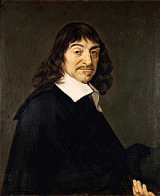
Rationalism

Encyclopedia
In epistemology and in its modern sense, rationalism is "any view appealing to reason
as a source of knowledge or justification" (Lacey 286). In more technical terms, it is a method or a theory
"in which the criterion of the truth is not sensory but intellectual and deductive" (Bourke 263). Different degrees of emphasis on this method or theory lead to a range of rationalist standpoints, from the moderate position "that reason has precedence over other ways of acquiring knowledge" to the more extreme position that reason is "the unique path to knowledge" (Audi 771). Given a pre-modern understanding of reason, "rationalism" is identical to philosophy
, the Socratic life of inquiry, or the zetetic (skeptical) clear interpretation of authority (open to the underlying or essential cause of things as they appear to our sense of certainty). In recent decades, Leo Strauss
sought to revive Classical Political Rationalism as a discipline that understands the task of reasoning, not as foundational, but as maieutic
. Rationalism should not be confused with rationality
, nor with rationalization
.
, rationalism is usually associated with the introduction of mathematical methods into philosophy, as in Descartes, Leibniz, and Spinoza (Bourke 263). This is commonly called continental rationalism, because it was predominant in the continental schools of Europe, whereas in Britain empiricism
dominated.
Rationalism is often contrasted with empiricism
. Taken very broadly these views are not mutually exclusive, since a philosopher can be both rationalist and empiricist (Lacey 286–287). Taken to extremes the empiricist view holds that all ideas come to us through experience, either through the external senses or through such inner sensations as pain and gratification, and thus that knowledge is essentially based on or derived from experience. At issue is the fundamental source of human knowledge, and the proper techniques for verifying what we think we know (see Epistemology).
Proponents of some varieties of rationalism argue that, starting with foundational basic principles, like the axioms of geometry
, one could deductively
derive the rest of all possible knowledge. The philosophers who held this view most clearly were Baruch Spinoza
and Gottfried Leibniz
, whose attempts to grapple with the epistemological and metaphysical problems raised by Descartes led to a development of the fundamental approach of rationalism. Both Spinoza and Leibniz asserted that, in principle, all knowledge, including scientific knowledge, could be gained through the use of reason alone, though they both observed that this was not possible in practice for human beings except in specific areas such as mathematics
. On the other hand, Leibniz admitted that "we are all mere Empirics in three fourths of our actions" (Monadology
§ 28, cited in Audi 772).
Rationalism is predicting and explaining behavior based on logic.
The task of the philosopher is to refine and eventually extract the irrational soul from its bondage, hence the need for moral development, and then to connect with the rational soul in order to become a complete person, manifesting the higher spiritual essence of the person while in the physical body. True rationalism is therefore not simply an intellectual process, but a shift in perception and a shift in the qualitative nature of the person. The rational soul perceives the world in a spiritual manner – it sees the Platonic Forms – or the essence of what things are. To know the world in this way requires that one first know oneself as a soul, hence the requirement to 'know thyself', i.e. to know who you truly are.
Socrates did not publish or write any of his thoughts, but he was constantly in discussion with others. He would usually start by asking a rhetorical, seemingly answerable question, to which the other would give an answer. Socrates would then continue to ask questions until all conflicts were resolved, or until the other could do nothing else but admit to not knowing the answer (which was what most of his discussions ended with). Socrates did not claim to know the answers, but that did not impair his ability to critically and rationally approach problems. His goal was to show that, ultimately, our intellectual approach to the world is flawed, and we must transcend this to obtain true knowledge of what things are.
. He also argued that although dream
s appear as real as sense experience, these dreams cannot provide persons with knowledge. Also, since conscious sense experience can be the cause of illusions, then sense experience itself can be doubtable. As a result, Descartes deduced that a rational pursuit of truth should doubt every belief about reality. He elaborated these beliefs in such works as Discourse on Method
, Meditations on First Philosophy
, and Principles of Philosophy
. Descartes developed a method to attain truths according to which nothing that cannot be recognised by the intellect (or reason
) can be classified as knowledge. These truths are gained "without any sensory experience", according to Descartes. Truths that are attained by reason are broken down into elements that intuition can grasp, which, through a purely deductive process, will result in clear truths about reality.
Descartes therefore argued, as a result of his method, that reason alone determined knowledge, and that this could be done independently of the senses. For instance, his famous dictum, cogito ergo sum
, is a conclusion reached a priori
and not through an inference from experience . This was, for Descartes, an irrefutable principle upon which to ground all forms of other knowledge. Descartes posited a metaphysical dualism, distinguishing between the substances of the human body ("res extensa") and the mind
or soul ("res cogitans"). This crucial distinction would be left unresolved and lead to what is known as the mind-body problem, since the two substances in the Cartesian system are independent of each other and irreducible.
is a systematic, logical, rational philosophy developed in seventeenth-century Europe
. Spinoza's philosophy is a system of ideas constructed upon basic building blocks with an internal consistency with which Spinoza tried to answer life's major questions and in which he proposed that "God exists only philosophically." He was heavily influenced by thinkers such as Descartes, Euclid
and Thomas Hobbes
, as well as theologians in the Jewish philosophical tradition such as Maimonides
. But his work was in many respects a departure from the Judeo-Christian
tradition. Many of Spinoza's ideas continue to vex thinkers today and many of his principles, particularly regarding the emotions, have implications for modern approaches to psychology
. Even top thinkers have found Spinoza's "geometrical method" difficult to comprehend: Goethe admitted that he "could not really understand what Spinoza was on about most of the time." His magnum opus
, Ethics
, contains unresolved obscurities and has a forbidding mathematical structure modeled on Euclid's geometry. Spinoza's philosophy attracted believers such as Albert Einstein
and much intellectual attention.
. He did not develop his system, however, independently of these advances. Leibniz rejected Cartesian dualism and denied the existence of a material world. In Leibniz's view there are infinitely many simple substances, which he called "monads
" (possibly taking the term from the work of Anne Conway
).
Leibniz developed his theory of monads in response to both Descartes and Spinoza. In rejecting this response he was forced to arrive at his own solution. Monads are the fundamental unit of reality, according to Leibniz, constituting both inanimate and animate things. These units of reality represent the universe, though they are not subject to the laws of causality or space (which he called "well-founded phenomena
"). Leibniz, therefore, introduced his principle of pre-established harmony
to account for apparent causality in the world.
, but after studying David Hume's
works, which "awoke [him] from [his] dogmatic slumbers", he developed a distinctive and very influential rationalism of his own, which attempted to synthesise the traditional rationalist and empiricist traditions.
Kant named his branch of epistemology Transcendental Idealism
, and he first laid out these views in his famous work The Critique of Pure Reason
. In it he argued that there were fundamental problems with both rationalist and empiricist dogma. To the rationalists he argued, broadly, that pure reason is flawed when it goes beyond its limits and claims to know those things that are necessarily beyond the realm of all possible experience: the existence of God, free will, and the immortality of the human soul. Kant referred to these objects as "The Thing in Itself" and goes on to argue that their status as objects beyond all possible experience by definition means we cannot know them. To the empiricist he argued that while it is correct that experience is fundamentally necessary for human knowledge, reason is necessary for processing that experience into coherent thought. He therefore concludes that both reason and experience are necessary for human knowledge.
In political contexts, the term rationalism is used to define the political belief that is mid-way between realism and internationalism
. It is used to describe the political belief that the world political order is not as chaotic as suggested by realists, but maintains a certain degree of order where nation-states do not violate others' sovereignty
unless absolutely necessary. Rationalism is often seen as the mid-point between realism and internationalism. Whereas internationalism advocates a purely global and orderly approach to international affairs, and realism a purely individual and chaotic approach, rationalism appears to combine these two philosophies.
Reason
Reason is a term that refers to the capacity human beings have to make sense of things, to establish and verify facts, and to change or justify practices, institutions, and beliefs. It is closely associated with such characteristically human activities as philosophy, science, language, ...
as a source of knowledge or justification" (Lacey 286). In more technical terms, it is a method or a theory
Theory
The English word theory was derived from a technical term in Ancient Greek philosophy. The word theoria, , meant "a looking at, viewing, beholding", and referring to contemplation or speculation, as opposed to action...
"in which the criterion of the truth is not sensory but intellectual and deductive" (Bourke 263). Different degrees of emphasis on this method or theory lead to a range of rationalist standpoints, from the moderate position "that reason has precedence over other ways of acquiring knowledge" to the more extreme position that reason is "the unique path to knowledge" (Audi 771). Given a pre-modern understanding of reason, "rationalism" is identical to philosophy
Philosophy
Philosophy is the study of general and fundamental problems, such as those connected with existence, knowledge, values, reason, mind, and language. Philosophy is distinguished from other ways of addressing such problems by its critical, generally systematic approach and its reliance on rational...
, the Socratic life of inquiry, or the zetetic (skeptical) clear interpretation of authority (open to the underlying or essential cause of things as they appear to our sense of certainty). In recent decades, Leo Strauss
Leo Strauss
Leo Strauss was a political philosopher and classicist who specialized in classical political philosophy. He was born in Germany to Jewish parents and later emigrated to the United States...
sought to revive Classical Political Rationalism as a discipline that understands the task of reasoning, not as foundational, but as maieutic
Maieutics
Maieutics is a pedagogical method based on the idea that the truth is latent in the mind of every human being due to innate reason but has to be "given birth" by answering intelligently proposed questions . The word is derived from the Greek "μαιευτικός", pertaining to midwifery.- Possible origin...
. Rationalism should not be confused with rationality
Rationality
In philosophy, rationality is the exercise of reason. It is the manner in which people derive conclusions when considering things deliberately. It also refers to the conformity of one's beliefs with one's reasons for belief, or with one's actions with one's reasons for action...
, nor with rationalization
Rationalization
Rationalization may refer to:*Rationalization , the means of transition from a traditional society into a rationalized one*Rationalization , the process of constructing a logical justification for a decision that was originally arrived at through a different mental process*Rationalization , an...
.
Background
Since the EnlightenmentAge of Enlightenment
The Age of Enlightenment was an elite cultural movement of intellectuals in 18th century Europe that sought to mobilize the power of reason in order to reform society and advance knowledge. It promoted intellectual interchange and opposed intolerance and abuses in church and state...
, rationalism is usually associated with the introduction of mathematical methods into philosophy, as in Descartes, Leibniz, and Spinoza (Bourke 263). This is commonly called continental rationalism, because it was predominant in the continental schools of Europe, whereas in Britain empiricism
Empiricism
Empiricism is a theory of knowledge that asserts that knowledge comes only or primarily via sensory experience. One of several views of epistemology, the study of human knowledge, along with rationalism, idealism and historicism, empiricism emphasizes the role of experience and evidence,...
dominated.
Rationalism is often contrasted with empiricism
Empiricism
Empiricism is a theory of knowledge that asserts that knowledge comes only or primarily via sensory experience. One of several views of epistemology, the study of human knowledge, along with rationalism, idealism and historicism, empiricism emphasizes the role of experience and evidence,...
. Taken very broadly these views are not mutually exclusive, since a philosopher can be both rationalist and empiricist (Lacey 286–287). Taken to extremes the empiricist view holds that all ideas come to us through experience, either through the external senses or through such inner sensations as pain and gratification, and thus that knowledge is essentially based on or derived from experience. At issue is the fundamental source of human knowledge, and the proper techniques for verifying what we think we know (see Epistemology).
Proponents of some varieties of rationalism argue that, starting with foundational basic principles, like the axioms of geometry
Geometry
Geometry arose as the field of knowledge dealing with spatial relationships. Geometry was one of the two fields of pre-modern mathematics, the other being the study of numbers ....
, one could deductively
Deductive reasoning
Deductive reasoning, also called deductive logic, is reasoning which constructs or evaluates deductive arguments. Deductive arguments are attempts to show that a conclusion necessarily follows from a set of premises or hypothesis...
derive the rest of all possible knowledge. The philosophers who held this view most clearly were Baruch Spinoza
Baruch Spinoza
Baruch de Spinoza and later Benedict de Spinoza was a Dutch Jewish philosopher. Revealing considerable scientific aptitude, the breadth and importance of Spinoza's work was not fully realized until years after his death...
and Gottfried Leibniz
Gottfried Leibniz
Gottfried Wilhelm Leibniz was a German philosopher and mathematician. He wrote in different languages, primarily in Latin , French and German ....
, whose attempts to grapple with the epistemological and metaphysical problems raised by Descartes led to a development of the fundamental approach of rationalism. Both Spinoza and Leibniz asserted that, in principle, all knowledge, including scientific knowledge, could be gained through the use of reason alone, though they both observed that this was not possible in practice for human beings except in specific areas such as mathematics
Mathematics
Mathematics is the study of quantity, space, structure, and change. Mathematicians seek out patterns and formulate new conjectures. Mathematicians resolve the truth or falsity of conjectures by mathematical proofs, which are arguments sufficient to convince other mathematicians of their validity...
. On the other hand, Leibniz admitted that "we are all mere Empirics in three fourths of our actions" (Monadology
Monadology
The Monadology is one of Gottfried Leibniz’s best known works representing his later philosophy. It is a short text which sketches in some 90 paragraphs a metaphysics of simple substances, or monads.- Text :...
§ 28, cited in Audi 772).
Rationalism is predicting and explaining behavior based on logic.
Philosophical usage
The distinction between rationalists and empiricists was drawn at a later period, and would not have been recognized by the philosophers involved. Also, the distinction was not as clear-cut as is sometimes suggested; for example, the three main rationalists were all committed to the importance of empirical science, and in many respects the empiricists were closer to Descartes in their methods and metaphysical theories than were Spinoza and Leibniz.Socrates (ca 470–399B.C.E.)
Socrates firmly believed that before humans can understand the world, they first need to understand themselves; the only way to accomplish that is with rational thought. To understand what this means, one must first appreciate the Greek understanding of the world. Humans are composed of two parts: a body and a soul. The soul itself has two principal parts: an Irrational part, which is the emotions and desires; and a Rational part, which is our true self. In our everyday experience, the irrational soul is drawn into the physical body by its desires and merged with it, so that our perception of the world is limited to that delivered by the physical senses. The rational soul is beyond our awareness, but sometimes communicates via images, dreams, and other means.The task of the philosopher is to refine and eventually extract the irrational soul from its bondage, hence the need for moral development, and then to connect with the rational soul in order to become a complete person, manifesting the higher spiritual essence of the person while in the physical body. True rationalism is therefore not simply an intellectual process, but a shift in perception and a shift in the qualitative nature of the person. The rational soul perceives the world in a spiritual manner – it sees the Platonic Forms – or the essence of what things are. To know the world in this way requires that one first know oneself as a soul, hence the requirement to 'know thyself', i.e. to know who you truly are.
Socrates did not publish or write any of his thoughts, but he was constantly in discussion with others. He would usually start by asking a rhetorical, seemingly answerable question, to which the other would give an answer. Socrates would then continue to ask questions until all conflicts were resolved, or until the other could do nothing else but admit to not knowing the answer (which was what most of his discussions ended with). Socrates did not claim to know the answers, but that did not impair his ability to critically and rationally approach problems. His goal was to show that, ultimately, our intellectual approach to the world is flawed, and we must transcend this to obtain true knowledge of what things are.
René Descartes (1596–1650)
Descartes thought that only knowledge of eternal truths including the truths of mathematics, and the epistemological and metaphysical foundations of the sciences could be attained by reason alone; other knowledge, the knowledge of physics, required experience of the world, aided by the scientific methodScientific method
Scientific method refers to a body of techniques for investigating phenomena, acquiring new knowledge, or correcting and integrating previous knowledge. To be termed scientific, a method of inquiry must be based on gathering empirical and measurable evidence subject to specific principles of...
. He also argued that although dream
Dream
Dreams are successions of images, ideas, emotions, and sensations that occur involuntarily in the mind during certain stages of sleep. The content and purpose of dreams are not definitively understood, though they have been a topic of scientific speculation, philosophical intrigue and religious...
s appear as real as sense experience, these dreams cannot provide persons with knowledge. Also, since conscious sense experience can be the cause of illusions, then sense experience itself can be doubtable. As a result, Descartes deduced that a rational pursuit of truth should doubt every belief about reality. He elaborated these beliefs in such works as Discourse on Method
Discourse on Method
The Discourse on the Method is a philosophical and autobiographical treatise published by René Descartes in 1637. Its full name is Discourse on the Method of Rightly Conducting One's Reason and of Seeking Truth in the Sciences .The Discourse on Method is best known...
, Meditations on First Philosophy
Meditations on First Philosophy
Meditations on First Philosophy is a philosophical treatise written by René Descartes and first published in 1641 . The French translation was published in 1647 as Méditations Metaphysiques...
, and Principles of Philosophy
Principles of Philosophy
Principles of Philosophy is a book by René Descartes. Written in Latin, it was published in 1644 and dedicated to Elisabeth of Bohemia, with whom Descartes had a long standing friendship. A French version followed in 1647. It set forth the principles of nature—the Laws of Physics--as Descartes...
. Descartes developed a method to attain truths according to which nothing that cannot be recognised by the intellect (or reason
Reason
Reason is a term that refers to the capacity human beings have to make sense of things, to establish and verify facts, and to change or justify practices, institutions, and beliefs. It is closely associated with such characteristically human activities as philosophy, science, language, ...
) can be classified as knowledge. These truths are gained "without any sensory experience", according to Descartes. Truths that are attained by reason are broken down into elements that intuition can grasp, which, through a purely deductive process, will result in clear truths about reality.
Descartes therefore argued, as a result of his method, that reason alone determined knowledge, and that this could be done independently of the senses. For instance, his famous dictum, cogito ergo sum
Cogito ergo sum
is a philosophical Latin statement proposed by . The simple meaning of the phrase is that someone wondering whether or not they exist is, in and of itself, proof that something, an "I", exists to do the thinking — However this "I" is not the more or less permanent person we call "I"...
, is a conclusion reached a priori
A priori and a posteriori (philosophy)
The terms a priori and a posteriori are used in philosophy to distinguish two types of knowledge, justifications or arguments...
and not through an inference from experience . This was, for Descartes, an irrefutable principle upon which to ground all forms of other knowledge. Descartes posited a metaphysical dualism, distinguishing between the substances of the human body ("res extensa") and the mind
Mind
The concept of mind is understood in many different ways by many different traditions, ranging from panpsychism and animism to traditional and organized religious views, as well as secular and materialist philosophies. Most agree that minds are constituted by conscious experience and intelligent...
or soul ("res cogitans"). This crucial distinction would be left unresolved and lead to what is known as the mind-body problem, since the two substances in the Cartesian system are independent of each other and irreducible.
Baruch Spinoza (1632–1677)
The philosophy of Baruch SpinozaBaruch Spinoza
Baruch de Spinoza and later Benedict de Spinoza was a Dutch Jewish philosopher. Revealing considerable scientific aptitude, the breadth and importance of Spinoza's work was not fully realized until years after his death...
is a systematic, logical, rational philosophy developed in seventeenth-century Europe
Europe
Europe is, by convention, one of the world's seven continents. Comprising the westernmost peninsula of Eurasia, Europe is generally 'divided' from Asia to its east by the watershed divides of the Ural and Caucasus Mountains, the Ural River, the Caspian and Black Seas, and the waterways connecting...
. Spinoza's philosophy is a system of ideas constructed upon basic building blocks with an internal consistency with which Spinoza tried to answer life's major questions and in which he proposed that "God exists only philosophically." He was heavily influenced by thinkers such as Descartes, Euclid
Euclid
Euclid , fl. 300 BC, also known as Euclid of Alexandria, was a Greek mathematician, often referred to as the "Father of Geometry". He was active in Alexandria during the reign of Ptolemy I...
and Thomas Hobbes
Thomas Hobbes
Thomas Hobbes of Malmesbury , in some older texts Thomas Hobbs of Malmsbury, was an English philosopher, best known today for his work on political philosophy...
, as well as theologians in the Jewish philosophical tradition such as Maimonides
Maimonides
Moses ben-Maimon, called Maimonides and also known as Mūsā ibn Maymūn in Arabic, or Rambam , was a preeminent medieval Jewish philosopher and one of the greatest Torah scholars and physicians of the Middle Ages...
. But his work was in many respects a departure from the Judeo-Christian
Judeo-Christian
Judeo-Christian is a term used in the United States since the 1940s to refer to standards of ethics said to be held in common by Judaism and Christianity, for example the Ten Commandments...
tradition. Many of Spinoza's ideas continue to vex thinkers today and many of his principles, particularly regarding the emotions, have implications for modern approaches to psychology
Psychology
Psychology is the study of the mind and behavior. Its immediate goal is to understand individuals and groups by both establishing general principles and researching specific cases. For many, the ultimate goal of psychology is to benefit society...
. Even top thinkers have found Spinoza's "geometrical method" difficult to comprehend: Goethe admitted that he "could not really understand what Spinoza was on about most of the time." His magnum opus
Masterpiece
Masterpiece in modern usage refers to a creation that has been given much critical praise, especially one that is considered the greatest work of a person's career or to a work of outstanding creativity, skill or workmanship....
, Ethics
Ethics (book)
Ethics is a philosophical book written by Benedict de Spinoza. It was written in Latin. Although it was published posthumously in 1677, it is his most famous work, and is considered his magnum opus....
, contains unresolved obscurities and has a forbidding mathematical structure modeled on Euclid's geometry. Spinoza's philosophy attracted believers such as Albert Einstein
Albert Einstein
Albert Einstein was a German-born theoretical physicist who developed the theory of general relativity, effecting a revolution in physics. For this achievement, Einstein is often regarded as the father of modern physics and one of the most prolific intellects in human history...
and much intellectual attention.
Gottfried Leibniz (1646–1716)
Leibniz was the last of the great Rationalists who contributed heavily to other fields such as mathematicsMathematics
Mathematics is the study of quantity, space, structure, and change. Mathematicians seek out patterns and formulate new conjectures. Mathematicians resolve the truth or falsity of conjectures by mathematical proofs, which are arguments sufficient to convince other mathematicians of their validity...
. He did not develop his system, however, independently of these advances. Leibniz rejected Cartesian dualism and denied the existence of a material world. In Leibniz's view there are infinitely many simple substances, which he called "monads
Monadology
The Monadology is one of Gottfried Leibniz’s best known works representing his later philosophy. It is a short text which sketches in some 90 paragraphs a metaphysics of simple substances, or monads.- Text :...
" (possibly taking the term from the work of Anne Conway
Anne Conway, Viscountess Conway
Anne Conway, Viscountess Conway was an English philosopher whose work, in the tradition of the Cambridge Platonists, was an influence on Leibniz....
).
Leibniz developed his theory of monads in response to both Descartes and Spinoza. In rejecting this response he was forced to arrive at his own solution. Monads are the fundamental unit of reality, according to Leibniz, constituting both inanimate and animate things. These units of reality represent the universe, though they are not subject to the laws of causality or space (which he called "well-founded phenomena
Well-founded phenomenon
Well-founded phenomena , in the philosophy of Gottfried Leibniz, are ways in which the world falsely appears to us, but which are grounded in the way the world actually is .For Leibniz, the universe is made up of an infinite number of simple substances or monads, each of which contains a...
"). Leibniz, therefore, introduced his principle of pre-established harmony
Pre-established harmony
Gottfried Leibniz's theory of pre-established harmony is a philosophical theory about causation under which every "substance" only affects itself, but all the substances in the world nevertheless seem to causally interact with each other because they have been programmed by God in advance to...
to account for apparent causality in the world.
Immanuel Kant (1724–1804)
Immanuel Kant started as a traditional rationalist, having studied the rationalists Leibniz and WolffChristian Wolff (philosopher)
Christian Wolff was a German philosopher.He was the most eminent German philosopher between Leibniz and Kant...
, but after studying David Hume's
David Hume
David Hume was a Scottish philosopher, historian, economist, and essayist, known especially for his philosophical empiricism and skepticism. He was one of the most important figures in the history of Western philosophy and the Scottish Enlightenment...
works, which "awoke [him] from [his] dogmatic slumbers", he developed a distinctive and very influential rationalism of his own, which attempted to synthesise the traditional rationalist and empiricist traditions.
Kant named his branch of epistemology Transcendental Idealism
Transcendental idealism
Transcendental idealism is a doctrine founded by German philosopher Immanuel Kant in the eighteenth century. Kant's doctrine maintains that human experience of things is similar to the way they appear to us — implying a fundamentally subject-based component, rather than being an activity that...
, and he first laid out these views in his famous work The Critique of Pure Reason
Critique of Pure Reason
The Critique of Pure Reason by Immanuel Kant, first published in 1781, second edition 1787, is considered one of the most influential works in the history of philosophy. Also referred to as Kant's "first critique," it was followed by the Critique of Practical Reason and the Critique of Judgement...
. In it he argued that there were fundamental problems with both rationalist and empiricist dogma. To the rationalists he argued, broadly, that pure reason is flawed when it goes beyond its limits and claims to know those things that are necessarily beyond the realm of all possible experience: the existence of God, free will, and the immortality of the human soul. Kant referred to these objects as "The Thing in Itself" and goes on to argue that their status as objects beyond all possible experience by definition means we cannot know them. To the empiricist he argued that while it is correct that experience is fundamentally necessary for human knowledge, reason is necessary for processing that experience into coherent thought. He therefore concludes that both reason and experience are necessary for human knowledge.
Political rationalism
Main article: Rationalism (politics)In political contexts, the term rationalism is used to define the political belief that is mid-way between realism and internationalism
Internationalism (politics)
Internationalism is a political movement which advocates a greater economic and political cooperation among nations for the theoretical benefit of all...
. It is used to describe the political belief that the world political order is not as chaotic as suggested by realists, but maintains a certain degree of order where nation-states do not violate others' sovereignty
Sovereignty
Sovereignty is the quality of having supreme, independent authority over a geographic area, such as a territory. It can be found in a power to rule and make law that rests on a political fact for which no purely legal explanation can be provided...
unless absolutely necessary. Rationalism is often seen as the mid-point between realism and internationalism. Whereas internationalism advocates a purely global and orderly approach to international affairs, and realism a purely individual and chaotic approach, rationalism appears to combine these two philosophies.
See also
- 17th-century philosophy17th-century philosophy17th-century philosophy in the Western world is generally regarded as being the start of modern philosophy, and a departure from the medieval approach, especially Scholasticism....
- Cartesian linguisticsCartesian linguisticsThe term Cartesian linguistics was coined with the publication of Cartesian Linguistics: A Chapter in the History of Rationalist Thought , a book on linguistics by Noam Chomsky, written with the purpose of deepening "our understanding of the nature of language and the mental processes and...
- Cult of reasonCult of ReasonThe Cult of Reason was an atheistic belief system established in France and intended as a replacement for Christianity during the French Revolution.-Origins:...
- Critical rationalismCritical rationalismCritical rationalism is an epistemological philosophy advanced by Karl Popper. Popper wrote about critical rationalism in his works, The Open Society and its Enemies Volume 2, and Conjectures and Refutations.- Criticism, not support :...
- CynicismCynicismCynicism , in its original form, refers to the beliefs of an ancient school of Greek philosophers known as the Cynics . Their philosophy was that the purpose of life was to live a life of Virtue in agreement with Nature. This meant rejecting all conventional desires for wealth, power, health, and...
- EmpiricismEmpiricismEmpiricism is a theory of knowledge that asserts that knowledge comes only or primarily via sensory experience. One of several views of epistemology, the study of human knowledge, along with rationalism, idealism and historicism, empiricism emphasizes the role of experience and evidence,...
- Higher criticism
- HumanismHumanismHumanism is an approach in study, philosophy, world view or practice that focuses on human values and concerns. In philosophy and social science, humanism is a perspective which affirms some notion of human nature, and is contrasted with anti-humanism....
- IdealismIdealismIn philosophy, idealism is the family of views which assert that reality, or reality as we can know it, is fundamentally mental, mentally constructed, or otherwise immaterial. Epistemologically, idealism manifests as a skepticism about the possibility of knowing any mind-independent thing...
- InnatismInnatismInnatism is a philosophical doctrine that holds that the mind is born with ideas/knowledge, and that therefore the mind is not a 'blank slate' at birth, as early empiricists such as John Locke claimed...
- Irrationalist
- Natural philosophyNatural philosophyNatural philosophy or the philosophy of nature , is a term applied to the study of nature and the physical universe that was dominant before the development of modern science...
- Nature versus nurtureNature versus nurtureThe nature versus nurture debate concerns the relative importance of an individual's innate qualities versus personal experiences The nature versus nurture debate concerns the relative importance of an individual's innate qualities ("nature," i.e. nativism, or innatism) versus personal experiences...
- NominalismNominalismNominalism is a metaphysical view in philosophy according to which general or abstract terms and predicates exist, while universals or abstract objects, which are sometimes thought to correspond to these terms, do not exist. Thus, there are at least two main versions of nominalism...
- Objectivity (philosophy)Objectivity (philosophy)Objectivity is a central philosophical concept which has been variously defined by sources. A proposition is generally considered to be objectively true when its truth conditions are met and are "mind-independent"—that is, not met by the judgment of a conscious entity or subject.- Objectivism...
- PanrationalismPanrationalismPanrationalism holds two premises true:# A rationalist accepts any position that can be justified or established by appeal to the rational criteria or authorities.# He accepts only those positions that can be so justified....
- Philosophical realismPhilosophical realismContemporary philosophical realism is the belief that our reality, or some aspect of it, is ontologically independent of our conceptual schemes, linguistic practices, beliefs, etc....
- Philosophy of SpinozaPhilosophy of SpinozaOne of the three great Rationalists, Spinoza's philosophy encompasses nearly every area of philosophical discourse, including metaphysics, epistemology, political philosophy, ethics, philosophy of mind and philosophy of science....
- Poverty of the stimulusPoverty of the stimulusIn linguistics, the poverty of the stimulus is the assertion that natural language grammar is unlearnable given the relatively limited data available to children learning a language, and therefore that this knowledge is supplemented with some sort of innate linguistic capacity...
- Platonic realismPlatonic realismPlatonic realism is a philosophical term usually used to refer to the idea of realism regarding the existence of universals or abstract objects after the Greek philosopher Plato , a student of Socrates. As universals were considered by Plato to be ideal forms, this stance is confusingly also called...
- Psychological nativismPsychological nativismIn the field of psychology, nativism is the view that certain skills or abilities are 'native' or hard wired into the brain at birth. This is in contrast to empiricism, the 'blank slate' or tabula rasa view, which states that the brain has inborn capabilities for learning from the environment but...
- Rationalist InternationalRationalist InternationalRationalist International is an organization with the stated aim to represent a rational view of the world, making the voice of reason heard and considered where public opinion is formed and decisions are made.- Rationalism :...
- Rational mysticismRational mysticismRational mysticism, which encompasses both rationalism and mysticism, is a term used by scholars, researchers, and other intellectuals, some of whom engage in studies of how altered states of consciousness or transcendence such as trance, visions, and prayer occur...
- RationalityRationalityIn philosophy, rationality is the exercise of reason. It is the manner in which people derive conclusions when considering things deliberately. It also refers to the conformity of one's beliefs with one's reasons for belief, or with one's actions with one's reasons for action...
- Rationality and powerRationality and powerRationality and Power: Democracy in Practice is a book authored by Oxford University professor Bent Flyvbjerg and published by The University of Chicago Press . The book is a study of how power influences rationality and democracy. The book's theory and method build on a tradition in power studies...
- Tabula rasaTabula rasaTabula rasa is the epistemological theory that individuals are born without built-in mental content and that their knowledge comes from experience and perception. Generally proponents of the tabula rasa thesis favour the "nurture" side of the nature versus nurture debate, when it comes to aspects...
External links
- Markie, Peter (2004), "Rationalism vs. Empiricism", Stanford Encyclopedia of Philosophy, Edward N. Zalta (ed.),
- John F. Hurst (1867), History of Rationalism Embracing a Survey of the Present State of Protestant Theology