

Theosis

Encyclopedia
In Christian theology
, divinization, deification, making divine or theosis is the transforming effect of divine grace
. This concept of salvation
is historical and fundamental for Christian understanding that is prominent in the Eastern Orthodox Church
and also in the Catholic Church, and is a doctrine of growing importance in certain Protestant denominations, being revived in Anglicanism
in the mid-19th century.
) and of the Gospel according to John on the indwelling of the Trinity (as in chapters 14-17).. In , Jesus himself quoted in saying "Ye are gods."
. As what he asserts is "just a small sample", he lists the following:
Referring to such declarations by the Fathers, the Oxford Dictionary of the Christian Church says that the central tenet of deification is that, through the incarnation of his Son, God has called human beings to share God's own life in the Son. It quotes Athanasius: "The Word became flesh … that we, partaking of his Spirit, might be deified" (De Decretis, 14); and Cyril of Alexandria: "We have all become partakers of Him, and have Him in ourselves through the Spirit. For this reason we have become partakers of the divine nature" (In Ioannem, 9).
Saint Augustine
pictured God telling him: "I am the food of grown men, grow, and thou shalt feed upon Me, nor shalt thou convert Me, like the food of thy flesh, into thee, but thou shalt be converted into Me." "To make human beings gods," Augustine said, "He was made man who was God" (sermon 192.1.1) This deification, he wrote, is granted by grace, not by making part of the divine essence: "It is clear that he called men gods being deified by his grace and not born of his substance. For he justified, who is just of himself and not from another, and he deifies, who is god of himself and not by participation in another. … If we have been made sons of god, we have been made gods; but this is by grace of adoption and not of the nature of our begetter" (en. Ps. 49.1.2).
The Fathers spoke of the process of deification as begun, at least by prolepsis
, in baptism, and so as already effected in the baptized. Clement of Alexandria
wrote: "Being baptized, we are illuminated; illuminated we become sons; being made sons, we are made perfect; being made perfect, we are made immortal. 'I', said He, 'have said that ye are gods, and all sons of the Highest." Hippolytus: "He (man) is made God by water and the Holy Spirit after the regeneration of the laver." "Thy body shall be immortal and incorruptible as well as thy soul. For thou hast become God."
However, full deification was seen as occurring only after death. Augustine said, "Our full adoption as sons will take place in the redemption of our body. We now have the first fruits of the spirit (Rom 8:29), by which we are indeed made sons of God. In other respects, however, since we are not yet finally saved, we are therefore not yet fully made new, not yet sons of God but children of the world."
says of it:
Divinization has been taught by Catholic theologians, including the most authoritative: Saint Thomas Aquinas
wrote: "The gift of grace surpasses every capability of created nature, since it is nothing short of a partaking of the Divine Nature, which exceeds every other nature. And thus it is impossible that any creature should cause grace. For it is as necessary that God alone should deify, bestowing a partaking of the Divine Nature by a participated likeness, as it is impossible that anything save fire should enkindle." He also wrote of God's "special love, whereby He draws the rational creature above the condition of its nature to a participation of the Divine good". And he quotes with approval the statement by Saint Augustine
, "God was made man, that man might be made God", saying that it was necessary for the restoration of the human race that the Word of God should become incarnate, since it is through Christ's humanity that full participation of the Divinity is bestowed on us.
Of a more modern Roman Catholic theologian it has been said: "The theological vision of Karl Rahner
, the German Jesuit whose thought has been so influential in the Roman Catholic Church and beyond over the last fifty years, has at its very core the symbol of theopoiesis. The process of divinization is the center of gravity around which move Rahner's understanding of creation, anthropology, Christology, ecclesiology, liturgy, and eschatology. The importance of this process for Rahner is such that we are justified in describing his overall theological project to be largely a matter of giving a coherent and contemporary account of divinization."
The Roman Rite
liturgy expresses the doctrine of divinization or theosis in the prayer said by the deacon or priest when preparing the Eucharistic chalice: "By the mystery of this water and wine may we come to share in the divinity of Christ who humbled himself to share in our humanity."
The Catholic Church teaches that God gives to some souls, even in the present life, a very special grace by which they can be mystically united to God even while yet alive: this is true mystical contemplation. This is seen as the culmination of the three states, or stages, of perfection through which the soul passes: the purgative way (that of cleansing or purification), the illuminative way (so called because in it the mind becomes more and more enlightened as to spiritual things and the practice of virtue), and the unitive way (that of union with God by love and the actual experience and exercise of that love).
The writings attributed to St. Dionysius the Areopagite were highly influential in the West, and their theses and arguments were adopted by Peter Lombard
, Alexander of Hales
, Albert the Great, St. Thomas Aquinas and St. Bonaventure. According to these writings, mystical knowledge must be distinguished from the rational knowledge by which we know God, not in his nature, but through the wonderful order of the universe, which is a participation of the divine ideas. Through the more perfect knowledge of God that is mystical knowledge, a knowledge beyond the attainments of reason even enlightened by faith, the soul contemplates directly the mysteries of divine light. In the present life this contemplation is possible only to a few privileged souls, through a very special grace of God: it is the θέωσις (theosis), μυστικὴ ἕνωσις (mystical union). Meister Eckhart
too taught a deification of man and an assimilation of the creature into the Creator through contemplation.
Deification, to which, in spite of its presence in the liturgical prayers of the West, Western theologians have given less attention than Eastern, is nevertheless prominent in the writing of Western mystics.
Saint Catherine of Siena
had God say: "They are like the burning coal that no one can put out once it is completely consumed in the furnace, because it has itself been turned into fire. So it is with these souls cast into the furnace of my charity, who keep nothing at all, not a bit of their own will, outside of me but are completely set afire in me. There is no one who can seize them or drag them out of my grace. They have been made one with me and I with them."
Saint John of the Cross
wrote: "In thus allowing God to work in it, the soul... is at once illumined and transformed in God, and God communicates to it His supernatural Being, in such wise that it appears to be God Himself, and has all that God Himself has. And this union comes to pass when God grants the soul this supernatural favour, that all the things of God and the soul are one in participant transformation; and the soul seems to be God rather than a soul, and is indeed God by participation; although it is true that its natural being, though thus transformed, is as distinct from the Being of God as it was before."
, an understanding of salvation in terms closely comparable to the Orthodox doctrine of theosis was recognized in the Anglican tradition, for example in the writings of Lancelot Andrewes
, who described salvation in terms vividly reminiscent of the early fathers:
Early during the Reformation
, thought was given to the doctrine of union with Christ (unio cum Christo) as the precursor to the entire process of salvation and sanctification
. This was especially so in the thought of John Calvin
.
Henry Scougal
's work The Life of God in the Soul of Man is sometimes cited as important in keeping alive among Protestants the ideas central to the doctrine. In the introductory passages of his book, Scougal describes "religion" in terms that evoke the doctrine of theosis:
Theosis as a doctrine developed in a distinctive direction among Methodists, and elsewhere in the pietist
movement which reawakened Protestant interest in the asceticism
of the early Catholic Church, and some of the mystical traditions of the West. Distinctively, in Wesleyan Protestantism
theosis sometimes implies the doctrine of entire sanctification which teaches, in summary, that it is the Christian's goal, in principle possible to achieve, to live without any (voluntary) sin
(Christian perfection
). In 1311 the Roman Catholic Council of Vienne
declared this notion, "that man in this present life can acquire so great and such a degree of perfection that he will be rendered inwardly sinless, and that he will not be able to advance farther in grace" (Denziger §471), to be a heresy
. Thus this particular Protestant (primarily Methodist) understanding of theosis is substantially different from that of the Roman Catholic, Orthodox, or Anglican Churches. This doctrine of Christian perfection
was sharply criticized by many in the Church of England
during the ministry of John Wesley
and continues to be controversial among Protestants and Anglicans to this day. Most Protestants do not believe in Christian perfection as Wesley described it and most Protestants also do not use the term theosis at all, though they refer to a similar doctrine by such terms as sanctification
, "adoption as sons", "union with Christ", and "filled with the Spirit". Dietrich Bonhoeffer
echoed the convictions of Athanasius when he wrote "He has become like a man, so that men should be like him." (The Cost of Discipleship
, 301)
Nevertheless, similarities of doctrine notwithstanding, within the whole of the conception of the Christian life which the idea of "theosis" is intended to comprehend, differences of doctrine are disclosed especially in differences of practice, between the East and West, and between Orthodoxy and Protestantism.
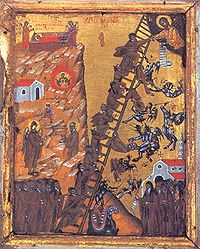 The teaching of deification or theosis in Eastern Orthodoxy refers to the attainment of likeness of God, union with God and/or reconciliation with God. Deification has three stages in its process of transformation: katharsis, theoria, theosis. Theosis as such is the goal, it is the purpose of life, and it is considered achievable only through a synergy (or cooperation) between humans' activities and God's uncreated energies (or operations). Theosis is an important concept in Orthodox theology deriving from the fact that Orthodox theology is of an explicitly mystical character. Theology in the Eastern Orthodox church is what is derived from saints or mystics of the tradition, and Eastern Orthodox consider that "no one who does not follow the path of union with God can be a theologian". In Eastern Orthodoxy, theology is not treated as an academic pursuit, but it is based on revelation (see gnosiology
), meaning that Orthodox theology and its theologians are validated by ascetic pursuits, rather than academic degrees (i.e. scholasticism
).
, the contemplation of the triune God, human beings come to know and experience what it means to be fully human (the created image of God); through their communion with Jesus Christ, God shares Himself with the human race, in order to conform them to all that He is in knowledge, righteousness, and holiness. As God became human, in all ways except sin, He will also make humans god (Holy or saintly), in all ways except his divine essence (uncaused or uncreatedness). St Irenaeus explained this doctrine in Against Heresies
, Book 5, in the Preface, "the Word of God, our Lord Jesus Christ, who did, through his transcendent love, become what we are, that He might bring us to be even what He is Himself."
, theosis goes beyond simply restoring people to their state before the Fall of Adam and Eve, teaching that because Christ united the human and divine natures in Jesus' person, it is now possible for someone to experience closer fellowship with God than Adam and Eve initially experienced in the Garden of Eden, and that people can become more like God than Adam and Eve were at that time. Some Orthodox theologians go so far as to say that Jesus would have become incarnate
for this reason alone, even if Adam and Eve had never sinned.
is most important as a way to establish a direct relationship with God. Living in the community of the church and partaking regularly of the sacraments, and especially the Eucharist
, is taken for granted. Also important is cultivating "prayer of the heart", and prayer that never ceases, as Paul exhorts the Thessalonians (1
and 2
). This unceasing prayer of the heart is a dominant theme in the writings of the Fathers, especially in those collected in the Philokalia
. It is considered that no one can reach theosis without an impeccable Christian living, crowned by faithful, warm, and, ultimately, silent (hesychast
), continuous Prayer of the Heart. The "doer" in deification is the Holy Spirit, with whom the human being joins his will to receive this transforming grace by praxis and prayer, and as Saint Gregory Palamas
teaches, the Christian mystics are deified as they become filled with the Light of Tabor of the Holy Spirit in the degree that they make themselves open to it by asceticism (divinization being not a one-sided act of God, but a loving cooperation between God and the advanced Christian, which Palamas considers a synergy). This synergeia
or co-operation between God and Man does not lead to mankind being absorbed into the God as was taught in earlier pagan forms of deification like Henosis
. Rather it expresses unity, in the complementary nature between the created and the creator. Acquisition of the Holy Spirit is key as the acquisition of the spirit leads to self-realization
.
in the Eastern Orthodox Church is centered on the enlightenment or deification, theosis of man.
Roman Catholic theologians have generally expressed a negative view of Hesychasm.
The (Hesychasm
) doctrine of Gregory Palamas
won almost no following in the West, and the distrustful attitude of Barlaam
in its regard prevailed among Western theologians, surviving into the early 20th century, as shown in Adrian Fortescue's article on hesychasm in the 1910 Catholic Encyclopedia
. In the same period, Siméon Vailhé described some aspects of the teaching of Palamas as "monstrous errors", "heresies" and "a resurrection of polytheism", and called the hesychast method for arriving at perfect contemplation
"no more than a crude form of auto-suggestion"
The twentieth century saw a remarkable change in the attitude of Roman Catholic theologians to Palamas, a "rehabilitation" of him that has led to increasing parts of the Western Church considering him a saint, even if uncanonized. Some Western scholars maintain that there is no conflict between Palamas's teaching and Roman Catholic thought. According to G. Philips, the essence-energies distinction is "a typical example of a perfectly admissible theological pluralism" that is compatible with the Roman Catholic magisterium. Jeffrey D. Finch claims that "the future of East-West rapprochement appears to be overcoming the modern polemics of neo-scholasticism and neo-Palamism". Some Western theologians have incorporated the theology of Palamas into their own thinking.
Among the treasures of "the venerable and ancient tradition of the Eastern Churches" with which Pope John Paul II
said Catholics should be familiar, so as to be nourished by it, he mentioned in particular "the teaching of the Cappadocian Fathers on divinization (which) passed into the tradition of all the Eastern Churches and is part of their common heritage. This can be summarized in the thought already expressed by Saint Irenaeus at the end of the second century: God passed into man so that man might pass over to God. This theology of divinization remains one of the achievements particularly dear to Eastern Christian thought."
teaches the doctrine of exaltation, by which is meant a very literal divinization. Certain similarities can be drawn between the two , though a significant different exists in that Mormons believe that humanity may not only achieve God's holiness and perfection but also his essential divinity or godhood. This doctrine stems from the movement's founder Joseph Smith, Jr., who taught that God the Father
is an advanced and glorified man. According to Smith, through obedience to Christ and the gradual acquisition of knowledge, the faithful may eventually become gods in the afterlife. Although they achieve this status, they are not worshipped, but continue to worship God and Christ. This belief is an essential charactristic of monolatrism
.
Christian universalist
There has been a modern revival of the concept of theosis (often called "manifest sonship" or "Christedness") among Christians who hold to the doctrine of universal reconciliation
or apocatastasis
, especially those with a background in the charismatic
Latter Rain Movement
or even the New Age
and New Thought
movements. The statement of faith of the Christian Universalist Association includes theosis in one of its points.
A minority of charismatic Christian universalists believe that the "return of Christ" is a corporate body of perfected human beings who are the "Manifested Sons of God" instead of a literal return of the person of Jesus, and that these Sons will reign on the earth and transform all other human beings from sin to perfection during an age that is coming soon (a particularly "universalistic" approach to millennialism
). Some liberal Christian
universalists with New Age leanings share a similar eschatology
.
Christian theology
- Divisions of Christian theology :There are many methods of categorizing different approaches to Christian theology. For a historical analysis, see the main article on the History of Christian theology.- Sub-disciplines :...
, divinization, deification, making divine or theosis is the transforming effect of divine grace
Divine grace
In Christian theology, grace is God’s gift of God’s self to humankind. It is understood by Christians to be a spontaneous gift from God to man - "generous, free and totally unexpected and undeserved" - that takes the form of divine favour, love and clemency. It is an attribute of God that is most...
. This concept of salvation
Salvation
Within religion salvation is the phenomenon of being saved from the undesirable condition of bondage or suffering experienced by the psyche or soul that has arisen as a result of unskillful or immoral actions generically referred to as sins. Salvation may also be called "deliverance" or...
is historical and fundamental for Christian understanding that is prominent in the Eastern Orthodox Church
Eastern Orthodox Church
The Orthodox Church, officially called the Orthodox Catholic Church and commonly referred to as the Eastern Orthodox Church, is the second largest Christian denomination in the world, with an estimated 300 million adherents mainly in the countries of Belarus, Bulgaria, Cyprus, Georgia, Greece,...
and also in the Catholic Church, and is a doctrine of growing importance in certain Protestant denominations, being revived in Anglicanism
Anglicanism
Anglicanism is a tradition within Christianity comprising churches with historical connections to the Church of England or similar beliefs, worship and church structures. The word Anglican originates in ecclesia anglicana, a medieval Latin phrase dating to at least 1246 that means the English...
in the mid-19th century.
Bible Support
explicitly speaks of becoming "partakers of the Divine nature". Closely allied are the teachings of Paul the Apostle that through the Spirit we are sons of God (as in chapter 8 of his Epistle to the RomansEpistle to the Romans
The Epistle of Paul to the Romans, often shortened to Romans, is the sixth book in the New Testament. Biblical scholars agree that it was composed by the Apostle Paul to explain that Salvation is offered through the Gospel of Jesus Christ...
) and of the Gospel according to John on the indwelling of the Trinity (as in chapters 14-17).. In , Jesus himself quoted in saying "Ye are gods."
Patristic writings
According to Jonathan Jacobs, there were many and varied appeals to divinization in the writings of the Church FathersChurch Fathers
The Church Fathers, Early Church Fathers, Christian Fathers, or Fathers of the Church were early and influential theologians, eminent Christian teachers and great bishops. Their scholarly works were used as a precedent for centuries to come...
. As what he asserts is "just a small sample", he lists the following:
- St. Irenaeus of Lyons stated that God "became what we are in order to make us what he is himself."
- St. Clement of Alexandria says that "he who obeys the Lord and follows the prophecy given through him . . . becomes a god while still moving about in the flesh."
- St. Athanasius wrote that "God became man so that men might become gods."
- St. Cyril of Alexandria says that we "are called 'temples of God' and indeed 'gods', and so we are."
- St. Basil the Great stated that "becoming a god" is the highest goal of all.
- St. Gregory of Nazianzus implores us to "become gods for (God's) sake, since (God) became man for our sake."
Referring to such declarations by the Fathers, the Oxford Dictionary of the Christian Church says that the central tenet of deification is that, through the incarnation of his Son, God has called human beings to share God's own life in the Son. It quotes Athanasius: "The Word became flesh … that we, partaking of his Spirit, might be deified" (De Decretis, 14); and Cyril of Alexandria: "We have all become partakers of Him, and have Him in ourselves through the Spirit. For this reason we have become partakers of the divine nature" (In Ioannem, 9).
Saint Augustine
Augustine of Hippo
Augustine of Hippo , also known as Augustine, St. Augustine, St. Austin, St. Augoustinos, Blessed Augustine, or St. Augustine the Blessed, was Bishop of Hippo Regius . He was a Latin-speaking philosopher and theologian who lived in the Roman Africa Province...
pictured God telling him: "I am the food of grown men, grow, and thou shalt feed upon Me, nor shalt thou convert Me, like the food of thy flesh, into thee, but thou shalt be converted into Me." "To make human beings gods," Augustine said, "He was made man who was God" (sermon 192.1.1) This deification, he wrote, is granted by grace, not by making part of the divine essence: "It is clear that he called men gods being deified by his grace and not born of his substance. For he justified, who is just of himself and not from another, and he deifies, who is god of himself and not by participation in another. … If we have been made sons of god, we have been made gods; but this is by grace of adoption and not of the nature of our begetter" (en. Ps. 49.1.2).
The Fathers spoke of the process of deification as begun, at least by prolepsis
Prolepsis
Prolepsis may refer to:* Flashforward, in storytelling, an interjected scene that takes the narrative forward* Prolepsis , 1975 work by Arrogance...
, in baptism, and so as already effected in the baptized. Clement of Alexandria
Clement of Alexandria
Titus Flavius Clemens , known as Clement of Alexandria , was a Christian theologian and the head of the noted Catechetical School of Alexandria. Clement is best remembered as the teacher of Origen...
wrote: "Being baptized, we are illuminated; illuminated we become sons; being made sons, we are made perfect; being made perfect, we are made immortal. 'I', said He, 'have said that ye are gods, and all sons of the Highest." Hippolytus: "He (man) is made God by water and the Holy Spirit after the regeneration of the laver." "Thy body shall be immortal and incorruptible as well as thy soul. For thou hast become God."
However, full deification was seen as occurring only after death. Augustine said, "Our full adoption as sons will take place in the redemption of our body. We now have the first fruits of the spirit (Rom 8:29), by which we are indeed made sons of God. In other respects, however, since we are not yet finally saved, we are therefore not yet fully made new, not yet sons of God but children of the world."
Roman Catholicism
The importance of divinization (theosis) in Roman Catholic teaching is evident from what the Catechism of the Catholic ChurchCatechism of the Catholic Church
The Catechism of the Catholic Church is the official text of the teachings of the Catholic Church. A provisional, "reference text" was issued by Pope John Paul II on October 11, 1992 — "the thirtieth anniversary of the opening of the Second Vatican Ecumenical Council" — with his apostolic...
says of it:
Divinization has been taught by Catholic theologians, including the most authoritative: Saint Thomas Aquinas
Thomas Aquinas
Thomas Aquinas, O.P. , also Thomas of Aquin or Aquino, was an Italian Dominican priest of the Catholic Church, and an immensely influential philosopher and theologian in the tradition of scholasticism, known as Doctor Angelicus, Doctor Communis, or Doctor Universalis...
wrote: "The gift of grace surpasses every capability of created nature, since it is nothing short of a partaking of the Divine Nature, which exceeds every other nature. And thus it is impossible that any creature should cause grace. For it is as necessary that God alone should deify, bestowing a partaking of the Divine Nature by a participated likeness, as it is impossible that anything save fire should enkindle." He also wrote of God's "special love, whereby He draws the rational creature above the condition of its nature to a participation of the Divine good". And he quotes with approval the statement by Saint Augustine
Augustine of Hippo
Augustine of Hippo , also known as Augustine, St. Augustine, St. Austin, St. Augoustinos, Blessed Augustine, or St. Augustine the Blessed, was Bishop of Hippo Regius . He was a Latin-speaking philosopher and theologian who lived in the Roman Africa Province...
, "God was made man, that man might be made God", saying that it was necessary for the restoration of the human race that the Word of God should become incarnate, since it is through Christ's humanity that full participation of the Divinity is bestowed on us.
Of a more modern Roman Catholic theologian it has been said: "The theological vision of Karl Rahner
Karl Rahner
Karl Rahner, SJ was a German Jesuit and theologian who, alongside Bernard Lonergan and Hans Urs von Balthasar, is considered one of the most influential Roman Catholic theologians of the 20th century...
, the German Jesuit whose thought has been so influential in the Roman Catholic Church and beyond over the last fifty years, has at its very core the symbol of theopoiesis. The process of divinization is the center of gravity around which move Rahner's understanding of creation, anthropology, Christology, ecclesiology, liturgy, and eschatology. The importance of this process for Rahner is such that we are justified in describing his overall theological project to be largely a matter of giving a coherent and contemporary account of divinization."
The Roman Rite
Roman Rite
The Roman Rite is the liturgical rite used in the Diocese of Rome in the Catholic Church. It is by far the most widespread of the Latin liturgical rites used within the Western or Latin autonomous particular Church, the particular Church that itself is also called the Latin Rite, and that is one of...
liturgy expresses the doctrine of divinization or theosis in the prayer said by the deacon or priest when preparing the Eucharistic chalice: "By the mystery of this water and wine may we come to share in the divinity of Christ who humbled himself to share in our humanity."
The Catholic Church teaches that God gives to some souls, even in the present life, a very special grace by which they can be mystically united to God even while yet alive: this is true mystical contemplation. This is seen as the culmination of the three states, or stages, of perfection through which the soul passes: the purgative way (that of cleansing or purification), the illuminative way (so called because in it the mind becomes more and more enlightened as to spiritual things and the practice of virtue), and the unitive way (that of union with God by love and the actual experience and exercise of that love).
The writings attributed to St. Dionysius the Areopagite were highly influential in the West, and their theses and arguments were adopted by Peter Lombard
Peter Lombard
Peter Lombard was a scholastic theologian and bishop and author of Four Books of Sentences, which became the standard textbook of theology, for which he is also known as Magister Sententiarum-Biography:Peter Lombard was born in Lumellogno , in...
, Alexander of Hales
Alexander of Hales
Alexander Hales also called Doctor Irrefragabilis and Theologorum Monarcha was a notable thinker important in the history of scholasticism and the Franciscan School.-Life:Alexander was born at Hales ,...
, Albert the Great, St. Thomas Aquinas and St. Bonaventure. According to these writings, mystical knowledge must be distinguished from the rational knowledge by which we know God, not in his nature, but through the wonderful order of the universe, which is a participation of the divine ideas. Through the more perfect knowledge of God that is mystical knowledge, a knowledge beyond the attainments of reason even enlightened by faith, the soul contemplates directly the mysteries of divine light. In the present life this contemplation is possible only to a few privileged souls, through a very special grace of God: it is the θέωσις (theosis), μυστικὴ ἕνωσις (mystical union). Meister Eckhart
Meister Eckhart
Eckhart von Hochheim O.P. , commonly known as Meister Eckhart, was a German theologian, philosopher and mystic, born near Gotha, in the Landgraviate of Thuringia in the Holy Roman Empire. Meister is German for "Master", referring to the academic title Magister in theologia he obtained in Paris...
too taught a deification of man and an assimilation of the creature into the Creator through contemplation.
Deification, to which, in spite of its presence in the liturgical prayers of the West, Western theologians have given less attention than Eastern, is nevertheless prominent in the writing of Western mystics.
Saint Catherine of Siena
Catherine of Siena
Saint Catherine of Siena, T.O.S.D, was a tertiary of the Dominican Order, and a Scholastic philosopher and theologian. She also worked to bring the papacy of Gregory XI back to Rome from its displacement in France, and to establish peace among the Italian city-states. She was proclaimed a Doctor...
had God say: "They are like the burning coal that no one can put out once it is completely consumed in the furnace, because it has itself been turned into fire. So it is with these souls cast into the furnace of my charity, who keep nothing at all, not a bit of their own will, outside of me but are completely set afire in me. There is no one who can seize them or drag them out of my grace. They have been made one with me and I with them."
Saint John of the Cross
John of the Cross
John of the Cross , born Juan de Yepes Álvarez, was a major figure of the Counter-Reformation, a Spanish mystic, Catholic saint, Carmelite friar and priest, born at Fontiveros, Old Castile....
wrote: "In thus allowing God to work in it, the soul... is at once illumined and transformed in God, and God communicates to it His supernatural Being, in such wise that it appears to be God Himself, and has all that God Himself has. And this union comes to pass when God grants the soul this supernatural favour, that all the things of God and the soul are one in participant transformation; and the soul seems to be God rather than a soul, and is indeed God by participation; although it is true that its natural being, though thus transformed, is as distinct from the Being of God as it was before."
Anglican views
Out of the English ReformationEnglish Reformation
The English Reformation was the series of events in 16th-century England by which the Church of England broke away from the authority of the Pope and the Roman Catholic Church....
, an understanding of salvation in terms closely comparable to the Orthodox doctrine of theosis was recognized in the Anglican tradition, for example in the writings of Lancelot Andrewes
Lancelot Andrewes
Lancelot Andrewes was an English bishop and scholar, who held high positions in the Church of England during the reigns of Queen Elizabeth I and King James I. During the latter's reign, Andrewes served successively as Bishop of Chichester, Ely and Winchester and oversaw the translation of the...
, who described salvation in terms vividly reminiscent of the early fathers:
- Whereby, as before He of ours, so now we of His are made partakers. He clothed with our flesh, and we invested with His Spirit. The great promise of the Old Testament accomplished, that He should partake our human nature; and the great and precious promise of the New, that we should be “consortes divinae naturae”, “partake his divine nature,” both are this day accomplished.
Protestant views
Protestants are generally less aware of the doctrinal line of thought of theosis, except for Methodists and Wesleyans, whose religious tradition has always placed strong emphasis on sanctification. Generally speaking, the Methodist/Wesleyan doctrine of sanctification is roughly equivalent to the Catholic/Eastern Orthodox concept of theosis or divinization.Early during the Reformation
Protestant Reformation
The Protestant Reformation was a 16th-century split within Western Christianity initiated by Martin Luther, John Calvin and other early Protestants. The efforts of the self-described "reformers", who objected to the doctrines, rituals and ecclesiastical structure of the Roman Catholic Church, led...
, thought was given to the doctrine of union with Christ (unio cum Christo) as the precursor to the entire process of salvation and sanctification
Sanctification
Sanctity is an ancient concept widespread among religions, a property of a thing or person sacred or set apart within the religion, from totem poles through temple vessels to days of the week, to a human believer who achieves this state. Sanctification is the act or process of acquiring sanctity,...
. This was especially so in the thought of John Calvin
John Calvin
John Calvin was an influential French theologian and pastor during the Protestant Reformation. He was a principal figure in the development of the system of Christian theology later called Calvinism. Originally trained as a humanist lawyer, he broke from the Roman Catholic Church around 1530...
.
Henry Scougal
Henry Scougal
Henry Scougal was a Scottish theologian, minister and author.Henry Scougal was the second son of Patrick Scougal and Margaret Wemys. His father was Bishop of Aberdeen for more than 20 years....
's work The Life of God in the Soul of Man is sometimes cited as important in keeping alive among Protestants the ideas central to the doctrine. In the introductory passages of his book, Scougal describes "religion" in terms that evoke the doctrine of theosis:
- "... a resemblance of the divine perfections, the image of the Almighty shining in the soul of man: ... a real participation of his nature, it is a beam of the eternal light, a drop of that infinite ocean of goodness; and they who are endued with it, may be said to have 'God dwelling in their souls', and 'Christ formed within them'."
Theosis as a doctrine developed in a distinctive direction among Methodists, and elsewhere in the pietist
Pietism
Pietism was a movement within Lutheranism, lasting from the late 17th century to the mid-18th century and later. It proved to be very influential throughout Protestantism and Anabaptism, inspiring not only Anglican priest John Wesley to begin the Methodist movement, but also Alexander Mack to...
movement which reawakened Protestant interest in the asceticism
Asceticism
Asceticism describes a lifestyle characterized by abstinence from various sorts of worldly pleasures often with the aim of pursuing religious and spiritual goals...
of the early Catholic Church, and some of the mystical traditions of the West. Distinctively, in Wesleyan Protestantism
Protestantism
Protestantism is one of the three major groupings within Christianity. It is a movement that began in Germany in the early 16th century as a reaction against medieval Roman Catholic doctrines and practices, especially in regards to salvation, justification, and ecclesiology.The doctrines of the...
theosis sometimes implies the doctrine of entire sanctification which teaches, in summary, that it is the Christian's goal, in principle possible to achieve, to live without any (voluntary) sin
Sin
In religion, sin is the violation or deviation of an eternal divine law or standard. The term sin may also refer to the state of having committed such a violation. Christians believe the moral code of conduct is decreed by God In religion, sin (also called peccancy) is the violation or deviation...
(Christian perfection
Christian perfection
Christian perfection, also known as perfect love; heart purity; the baptism of the Holy Spirit; the fullness of the blessing; Christian holiness; the second blessing; and entire sanctification, is a Christian doctrine which holds that the heart of the regenerant Christian may attain a state of...
). In 1311 the Roman Catholic Council of Vienne
Council of Vienne
The Council of Vienne was the fifteenth Ecumenical Council of the Roman Catholic Church that met between 1311 and 1312 in Vienne. Its principal act was to withdraw papal support for the Knights Templar on the instigation of Philip IV of France.-Background:...
declared this notion, "that man in this present life can acquire so great and such a degree of perfection that he will be rendered inwardly sinless, and that he will not be able to advance farther in grace" (Denziger §471), to be a heresy
Heresy
Heresy is a controversial or novel change to a system of beliefs, especially a religion, that conflicts with established dogma. It is distinct from apostasy, which is the formal denunciation of one's religion, principles or cause, and blasphemy, which is irreverence toward religion...
. Thus this particular Protestant (primarily Methodist) understanding of theosis is substantially different from that of the Roman Catholic, Orthodox, or Anglican Churches. This doctrine of Christian perfection
Christian perfection
Christian perfection, also known as perfect love; heart purity; the baptism of the Holy Spirit; the fullness of the blessing; Christian holiness; the second blessing; and entire sanctification, is a Christian doctrine which holds that the heart of the regenerant Christian may attain a state of...
was sharply criticized by many in the Church of England
Church of England
The Church of England is the officially established Christian church in England and the Mother Church of the worldwide Anglican Communion. The church considers itself within the tradition of Western Christianity and dates its formal establishment principally to the mission to England by St...
during the ministry of John Wesley
John Wesley
John Wesley was a Church of England cleric and Christian theologian. Wesley is largely credited, along with his brother Charles Wesley, as founding the Methodist movement which began when he took to open-air preaching in a similar manner to George Whitefield...
and continues to be controversial among Protestants and Anglicans to this day. Most Protestants do not believe in Christian perfection as Wesley described it and most Protestants also do not use the term theosis at all, though they refer to a similar doctrine by such terms as sanctification
Sanctification
Sanctity is an ancient concept widespread among religions, a property of a thing or person sacred or set apart within the religion, from totem poles through temple vessels to days of the week, to a human believer who achieves this state. Sanctification is the act or process of acquiring sanctity,...
, "adoption as sons", "union with Christ", and "filled with the Spirit". Dietrich Bonhoeffer
Dietrich Bonhoeffer
Dietrich Bonhoeffer was a German Lutheran pastor, theologian and martyr. He was a participant in the German resistance movement against Nazism and a founding member of the Confessing Church. He was involved in plans by members of the Abwehr to assassinate Adolf Hitler...
echoed the convictions of Athanasius when he wrote "He has become like a man, so that men should be like him." (The Cost of Discipleship
The Cost of Discipleship
The Cost of Discipleship is a book by the German Theologian Dietrich Bonhoeffer, considered a classic of Christian thought. The original German title is simply . It is centred around an exposition of the Sermon on the Mount, in which Bonhoeffer spells out what he believes it means to follow Christ...
, 301)
Nevertheless, similarities of doctrine notwithstanding, within the whole of the conception of the Christian life which the idea of "theosis" is intended to comprehend, differences of doctrine are disclosed especially in differences of practice, between the East and West, and between Orthodoxy and Protestantism.
Theosis
Gnosiology
The term gnosiology is a term of 18th Century aesthetics, currently used mainly in regard to Eastern Christianity.-Etymology:...
), meaning that Orthodox theology and its theologians are validated by ascetic pursuits, rather than academic degrees (i.e. scholasticism
Scholasticism
Scholasticism is a method of critical thought which dominated teaching by the academics of medieval universities in Europe from about 1100–1500, and a program of employing that method in articulating and defending orthodoxy in an increasingly pluralistic context...
).
Vision of God
Through theoriaTheoria
For other uses of the term "contemplation", see Contemplation Theoria is Greek for contemplation. It corresponds to the Latin word contemplatio, "looking at", "gazing at", "being aware of".- Introduction :...
, the contemplation of the triune God, human beings come to know and experience what it means to be fully human (the created image of God); through their communion with Jesus Christ, God shares Himself with the human race, in order to conform them to all that He is in knowledge, righteousness, and holiness. As God became human, in all ways except sin, He will also make humans god (Holy or saintly), in all ways except his divine essence (uncaused or uncreatedness). St Irenaeus explained this doctrine in Against Heresies
On the Detection and Overthrow of the So-Called Gnosis
On the Detection and Overthrow of the So-Called Gnosis, today also called On the Detection and Overthrow of Knowledge Falsely So Called , commonly called Against Heresies , is a five-volume work written by St. Irenaeus in the 2nd century...
, Book 5, in the Preface, "the Word of God, our Lord Jesus Christ, who did, through his transcendent love, become what we are, that He might bring us to be even what He is Himself."
As a Patristic and historical teaching
For many Church FathersChurch Fathers
The Church Fathers, Early Church Fathers, Christian Fathers, or Fathers of the Church were early and influential theologians, eminent Christian teachers and great bishops. Their scholarly works were used as a precedent for centuries to come...
, theosis goes beyond simply restoring people to their state before the Fall of Adam and Eve, teaching that because Christ united the human and divine natures in Jesus' person, it is now possible for someone to experience closer fellowship with God than Adam and Eve initially experienced in the Garden of Eden, and that people can become more like God than Adam and Eve were at that time. Some Orthodox theologians go so far as to say that Jesus would have become incarnate
Incarnation
Incarnation literally means embodied in flesh or taking on flesh. It refers to the conception and birth of a sentient creature who is the material manifestation of an entity, god or force whose original nature is immaterial....
for this reason alone, even if Adam and Eve had never sinned.
Ascetic practice
The journey toward theosis includes many forms of praxis. The most obvious form being Monasticism and Clergy. Of the Monastic tradition the practice of HesychasmHesychasm
Hesychasm is an eremitic tradition of prayer in the Eastern Orthodox Church, and some of the Eastern Catholic Churches, such as the Byzantine Rite, practised by the Hesychast Hesychasm is an eremitic tradition of prayer in the Eastern Orthodox Church, and some of the Eastern Catholic Churches,...
is most important as a way to establish a direct relationship with God. Living in the community of the church and partaking regularly of the sacraments, and especially the Eucharist
Eucharist
The Eucharist , also called Holy Communion, the Sacrament of the Altar, the Blessed Sacrament, the Lord's Supper, and other names, is a Christian sacrament or ordinance...
, is taken for granted. Also important is cultivating "prayer of the heart", and prayer that never ceases, as Paul exhorts the Thessalonians (1
First Epistle to the Thessalonians
The First Epistle to the Thessalonians, usually referred to simply as First Thessalonians and often written 1 Thessalonians, is a book from the New Testament of the Christian Bible....
and 2
Second Epistle to the Thessalonians
The Second Epistle of Paul to the Thessalonians, often referred to as Second Thessalonians and written 2 Thessalonians, is a book from the New Testament of the Christian Bible...
). This unceasing prayer of the heart is a dominant theme in the writings of the Fathers, especially in those collected in the Philokalia
Philokalia
The Philokalia is a collection of texts written between the 4th and 15th centuries by spiritual masters of the Eastern Orthodox hesychast tradition. They were originally written for the guidance and instruction of monks in "the practise of the contemplative life". The collection was compiled in...
. It is considered that no one can reach theosis without an impeccable Christian living, crowned by faithful, warm, and, ultimately, silent (hesychast
Hesychasm
Hesychasm is an eremitic tradition of prayer in the Eastern Orthodox Church, and some of the Eastern Catholic Churches, such as the Byzantine Rite, practised by the Hesychast Hesychasm is an eremitic tradition of prayer in the Eastern Orthodox Church, and some of the Eastern Catholic Churches,...
), continuous Prayer of the Heart. The "doer" in deification is the Holy Spirit, with whom the human being joins his will to receive this transforming grace by praxis and prayer, and as Saint Gregory Palamas
Gregory Palamas
Gregory Palamas was a monk of Mount Athos in Greece and later the Archbishop of Thessaloniki known as a preeminent theologian of Hesychasm. The teachings embodied in his writings defending Hesychasm against the attack of Barlaam are sometimes referred to as Palamism, his followers as Palamites...
teaches, the Christian mystics are deified as they become filled with the Light of Tabor of the Holy Spirit in the degree that they make themselves open to it by asceticism (divinization being not a one-sided act of God, but a loving cooperation between God and the advanced Christian, which Palamas considers a synergy). This synergeia
Synergy
Synergy may be defined as two or more things functioning together to produce a result not independently obtainable.The term synergy comes from the Greek word from , , meaning "working together".-Definitions and usages:...
or co-operation between God and Man does not lead to mankind being absorbed into the God as was taught in earlier pagan forms of deification like Henosis
Henosis
Henosis is the word for "oneness," "union," or "unity" in classical Greek, and is spelled identically in modern Greek where "Enosis" is particulary connected with the modern political "Unity" movement to unify Greece and Cyprus....
. Rather it expresses unity, in the complementary nature between the created and the creator. Acquisition of the Holy Spirit is key as the acquisition of the spirit leads to self-realization
Self-realization
Self-realization is a self-awakening.Self-realization may also refer to:* Self-Realization Fellowship, worldwide spiritual organization founded by Paramahansa Yogananda...
.
Western rejection of Eastern Orthodox hesychasm as a path to theosis
The practice of ascetic prayer called HesychasmHesychasm
Hesychasm is an eremitic tradition of prayer in the Eastern Orthodox Church, and some of the Eastern Catholic Churches, such as the Byzantine Rite, practised by the Hesychast Hesychasm is an eremitic tradition of prayer in the Eastern Orthodox Church, and some of the Eastern Catholic Churches,...
in the Eastern Orthodox Church is centered on the enlightenment or deification, theosis of man.
Roman Catholic theologians have generally expressed a negative view of Hesychasm.
The (Hesychasm
Hesychasm
Hesychasm is an eremitic tradition of prayer in the Eastern Orthodox Church, and some of the Eastern Catholic Churches, such as the Byzantine Rite, practised by the Hesychast Hesychasm is an eremitic tradition of prayer in the Eastern Orthodox Church, and some of the Eastern Catholic Churches,...
) doctrine of Gregory Palamas
Gregory Palamas
Gregory Palamas was a monk of Mount Athos in Greece and later the Archbishop of Thessaloniki known as a preeminent theologian of Hesychasm. The teachings embodied in his writings defending Hesychasm against the attack of Barlaam are sometimes referred to as Palamism, his followers as Palamites...
won almost no following in the West, and the distrustful attitude of Barlaam
Barlaam
Barlaam may refer to:*Barlaam of Seminara, Italian scholar and theologian , also known as Barlaam of Calabria, whose name as a layman was Bernardo Massari, brought an accusation of heresy against Gregory Palamas for the latter's defence of Hesychasm *Saint Barlaam, eventual companion of St...
in its regard prevailed among Western theologians, surviving into the early 20th century, as shown in Adrian Fortescue's article on hesychasm in the 1910 Catholic Encyclopedia
Catholic Encyclopedia
The Catholic Encyclopedia, also referred to as the Old Catholic Encyclopedia and the Original Catholic Encyclopedia, is an English-language encyclopedia published in the United States. The first volume appeared in March 1907 and the last three volumes appeared in 1912, followed by a master index...
. In the same period, Siméon Vailhé described some aspects of the teaching of Palamas as "monstrous errors", "heresies" and "a resurrection of polytheism", and called the hesychast method for arriving at perfect contemplation
Theoria
For other uses of the term "contemplation", see Contemplation Theoria is Greek for contemplation. It corresponds to the Latin word contemplatio, "looking at", "gazing at", "being aware of".- Introduction :...
"no more than a crude form of auto-suggestion"
The twentieth century saw a remarkable change in the attitude of Roman Catholic theologians to Palamas, a "rehabilitation" of him that has led to increasing parts of the Western Church considering him a saint, even if uncanonized. Some Western scholars maintain that there is no conflict between Palamas's teaching and Roman Catholic thought. According to G. Philips, the essence-energies distinction is "a typical example of a perfectly admissible theological pluralism" that is compatible with the Roman Catholic magisterium. Jeffrey D. Finch claims that "the future of East-West rapprochement appears to be overcoming the modern polemics of neo-scholasticism and neo-Palamism". Some Western theologians have incorporated the theology of Palamas into their own thinking.
Among the treasures of "the venerable and ancient tradition of the Eastern Churches" with which Pope John Paul II
Pope John Paul II
Blessed Pope John Paul II , born Karol Józef Wojtyła , reigned as Pope of the Catholic Church and Sovereign of Vatican City from 16 October 1978 until his death on 2 April 2005, at of age. His was the second-longest documented pontificate, which lasted ; only Pope Pius IX ...
said Catholics should be familiar, so as to be nourished by it, he mentioned in particular "the teaching of the Cappadocian Fathers on divinization (which) passed into the tradition of all the Eastern Churches and is part of their common heritage. This can be summarized in the thought already expressed by Saint Irenaeus at the end of the second century: God passed into man so that man might pass over to God. This theology of divinization remains one of the achievements particularly dear to Eastern Christian thought."
Mormon views
The Latter Day Saint movementLatter Day Saint movement
The Latter Day Saint movement is a group of independent churches tracing their origin to a Christian primitivist movement founded by Joseph Smith, Jr. in the late 1820s. Collectively, these churches have over 14 million members...
teaches the doctrine of exaltation, by which is meant a very literal divinization. Certain similarities can be drawn between the two , though a significant different exists in that Mormons believe that humanity may not only achieve God's holiness and perfection but also his essential divinity or godhood. This doctrine stems from the movement's founder Joseph Smith, Jr., who taught that God the Father
God the Father
God the Father is a gendered title given to God in many monotheistic religions, particularly patriarchal, Abrahamic ones. In Judaism, God is called Father because he is the creator, life-giver, law-giver, and protector...
is an advanced and glorified man. According to Smith, through obedience to Christ and the gradual acquisition of knowledge, the faithful may eventually become gods in the afterlife. Although they achieve this status, they are not worshipped, but continue to worship God and Christ. This belief is an essential charactristic of monolatrism
Monolatrism
Monolatrism or monolatry is the recognition of the existence of many gods, but with the consistent worship of only one deity...
.
Christian universalistChristian UniversalismChristian Universalism is a school of Christian theology which includes the belief in the doctrine of universal reconciliation, the view that all human beings or all fallen creatures will ultimately be restored to right relationship with God....
views
There has been a modern revival of the concept of theosis (often called "manifest sonship" or "Christedness") among Christians who hold to the doctrine of universal reconciliationUniversal reconciliation
In Christian theology, universal reconciliation is the doctrine that all sinful and alienated human souls—because of divine love and mercy—will ultimately be reconciled to God.Universal salvation may be related to the perception of a problem of Hell, standing opposed to ideas...
or apocatastasis
Apocatastasis
Apocatastasis is reconstitution, restitution, or restoration to the original or primordial condition.-Etymology and definition:The Liddell and Scott Lexicon entry, gives the following examples of usage:* “τοῦ ἐνδεοῦς” Aristotle MM, 1205a4; into its nature εἰς φύσιν id...
, especially those with a background in the charismatic
Charismatic movement
The term charismatic movement is used in varying senses to describe 20th century developments in various Christian denominations. It describes an ongoing international, cross-denominational/non-denominational Christian movement in which individual, historically mainstream congregations adopt...
Latter Rain Movement
Latter Rain Movement
The Latter Rain, also known as the New Order or New Order of the Latter Rain, was a post–World War II movement within Pentecostal Christianity which remains controversial to this day...
or even the New Age
New Age
The New Age movement is a Western spiritual movement that developed in the second half of the 20th century. Its central precepts have been described as "drawing on both Eastern and Western spiritual and metaphysical traditions and then infusing them with influences from self-help and motivational...
and New Thought
New Thought
New Thought promotes the ideas that "Infinite Intelligence" or "God" is ubiquitous, spirit is the totality of real things, true human selfhood is divine, divine thought is a force for good, sickness originates in the mind, and "right thinking" has a healing effect.Although New Thought is neither...
movements. The statement of faith of the Christian Universalist Association includes theosis in one of its points.
A minority of charismatic Christian universalists believe that the "return of Christ" is a corporate body of perfected human beings who are the "Manifested Sons of God" instead of a literal return of the person of Jesus, and that these Sons will reign on the earth and transform all other human beings from sin to perfection during an age that is coming soon (a particularly "universalistic" approach to millennialism
Millennialism
Millennialism , or chiliasm in Greek, is a belief held by some Christian denominations that there will be a Golden Age or Paradise on Earth in which "Christ will reign" for 1000 years prior to the final judgment and future eternal state...
). Some liberal Christian
Liberal Christianity
Liberal Christianity, sometimes called liberal theology, is an umbrella term covering diverse, philosophically and biblically informed religious movements and ideas within Christianity from the late 18th century and onward...
universalists with New Age leanings share a similar eschatology
Eschatology
Eschatology is a part of theology, philosophy, and futurology concerned with what are believed to be the final events in history, or the ultimate destiny of humanity, commonly referred to as the end of the world or the World to Come...
.
See also
- Related terms: ApotheosisApotheosisApotheosis is the glorification of a subject to divine level. The term has meanings in theology, where it refers to a belief, and in art, where it refers to a genre.In theology, the term apotheosis refers to the idea that an individual has been raised to godlike stature...
, Deification, SanctificationSanctificationSanctity is an ancient concept widespread among religions, a property of a thing or person sacred or set apart within the religion, from totem poles through temple vessels to days of the week, to a human believer who achieves this state. Sanctification is the act or process of acquiring sanctity,...
, ConsecrationConsecrationConsecration is the solemn dedication to a special purpose or service, usually religious. The word "consecration" literally means "to associate with the sacred". Persons, places, or things can be consecrated, and the term is used in various ways by different groups... - ApotheosisApotheosisApotheosis is the glorification of a subject to divine level. The term has meanings in theology, where it refers to a belief, and in art, where it refers to a genre.In theology, the term apotheosis refers to the idea that an individual has been raised to godlike stature...
(a non-Christian idea which compares human greatness to godlike status) - Beatific visionBeatific visionThe beatific vision - in Christian theology is the ultimate direct self communication of God to the individual person, when she or he reaches, as a member of redeemed humanity in the communion of saints, perfect salvation in its entirety, i.e. heaven...
- Christian perfectionChristian perfectionChristian perfection, also known as perfect love; heart purity; the baptism of the Holy Spirit; the fullness of the blessing; Christian holiness; the second blessing; and entire sanctification, is a Christian doctrine which holds that the heart of the regenerant Christian may attain a state of...
- Christian universalismChristian UniversalismChristian Universalism is a school of Christian theology which includes the belief in the doctrine of universal reconciliation, the view that all human beings or all fallen creatures will ultimately be restored to right relationship with God....
- Divine filiationDivine filiationDivine filiation is a Christian concept of becoming a "child of God". The concept implicates a share in the life and role of Jesus Christ. Divine filiation refers to the relationship between Jesus and God, specifically as the second person of the Trinity, "God the Son"...
- Entire sanctification
- Exaltation (Mormonism)Exaltation (Mormonism)Exaltation or Eternal Life is a belief among members of The Church of Jesus Christ of Latter-day Saints that mankind can return to live in God's presence and continue as families. Exaltation is believed to be what God desires for all humankind. The LDS Church teaches that through exaltation...
- HermitHermitA hermit is a person who lives, to some degree, in seclusion from society.In Christianity, the term was originally applied to a Christian who lives the eremitic life out of a religious conviction, namely the Desert Theology of the Old Testament .In the...
- HesychasmHesychasmHesychasm is an eremitic tradition of prayer in the Eastern Orthodox Church, and some of the Eastern Catholic Churches, such as the Byzantine Rite, practised by the Hesychast Hesychasm is an eremitic tradition of prayer in the Eastern Orthodox Church, and some of the Eastern Catholic Churches,...
- Holiness movementHoliness movementThe holiness movement refers to a set of beliefs and practices emerging from the Methodist Christian church in the mid 19th century. The movement is distinguished by its emphasis on John Wesley's doctrine of "Christian perfection" - the belief that it is possible to live free of voluntary sin - and...
- John of the CrossJohn of the CrossJohn of the Cross , born Juan de Yepes Álvarez, was a major figure of the Counter-Reformation, a Spanish mystic, Catholic saint, Carmelite friar and priest, born at Fontiveros, Old Castile....
- PoustiniaPoustiniaA poustinia is a small sparsely furnished cabin or room where one goes to pray and fast alone in the presence of God. The word poustinia has its origin in the Russian word for desert...
- SoteriologySoteriologyThe branch of Christian theology that deals with salvation and redemption is called Soteriology. It is derived from the Greek sōtērion + English -logy....
- Unio mystica
- Vladimir LosskyVladimir LosskyVladimir Nikolayevich Lossky was an influential Eastern Orthodox theologian in exile from Russia. He emphasized theosis as the main principle of Orthodox Christianity....
External links
- Book extract Nonviolent Atonement and the Victory of Christ by Brad Jersak, 2007
- Eastern Orthodoxy and Theosis
- Orthodoxwiki article
- Theiosis
- Some themes in Christian Mysticism
- Deification - online issue of Affirmation & Critique devoted entirely to the topic of theosis
- Luther and Theosis by Kurt E. Marquart (Concordia Theological Quarterly, July 2000)
- Theosis & Sanctification: John Wesley's Reformulation of a Patristic Doctrine by Michael Christensen
- God and Mankind Have Become One Race by NIKOLAOS P. VASSILIADIS
- Partakers of God by Panayiotis Christou
- King Follet Discourse at Brigham Young University
- Journal Of Discourses archive, Brigham Young University
- Partakers of the Divine Nature by Norman Russell