

English Reformation

Encyclopedia
The English Reformation was the series of events in 16th-century England
by which the Church of England
broke away from the authority of the Pope
and the Roman Catholic Church
.
These events were, in part, associated with the wider process of the European Protestant Reformation
, a religious and political movement which affected the practice of Christianity
across most of Europe during this period. Many factors contributed to the process: the decline of feudalism
and the rise of nationalism
, the rise of the common law
, the invention of the printing press
and increased circulation of the Bible
, the transmission of new knowledge and ideas among scholars and the upper and middle classes. However, the various phases of the English Reformation, which also covered Wales
and Ireland
, were largely driven by changes in government policy, to which public opinion gradually accommodated itself.
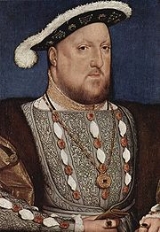
Based on Henry VIII
's desire for an annulment of his marriage, the English Reformation was at the outset more of a political affair than a theological dispute. The reality of political differences between Rome and England allowed growing theological disputes to come to the fore.
Immediately before the break with Rome, it was the Pope and general councils of the church that decided doctrine
. Church law was governed by the code of canon law with final jurisdiction in Rome. Church taxes were paid straight to Rome and it was the Pope who had the final say over the appointment of bishops. The split from Rome made the English monarch the Supreme Governor of the English church by "Royal Supremacy
", thereby making the Church of England
the established church of the nation. Doctrinal and legal disputes now rested with the monarch, and the papacy was deprived of revenue and the final say on the appointment of bishops.
The structure and theology of the church was a matter of fierce dispute for generations. These disputes were finally ended by a coup d'état (the "Glorious Revolution
") in 1688, from which emerged a church polity with an established church and a number of non-conformist
churches whose members at first suffered various civil disabilities which were only removed over time, as did the substantial minority who remained Roman Catholic in England, whose church organization remained illegal until the 19th century.

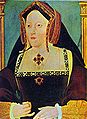 Henry VIII ascended the English throne in 1509 at the age of 17. He made a dynastic marriage with Catherine of Aragon
, widow of his brother Arthur, in June 1509, just before his coronation on Midsummer's Day. Unlike his father, who was secretive and conservative, the young Henry appeared to be the epitome of chivalry and sociability, seeking out the company of young men like himself; an observant Catholic, he heard up to five masses
a day (except during the hunting season); of "powerful but unoriginal mind", he allowed himself to be influenced by his advisors from whom he was never apart, by night or day; he was thus susceptible to whoever had his ear. Between his young contemporaries and the Lord Chancellor, Cardinal Thomas Wolsey, there was thus a state of hostility. As long as Wolsey had his ear, Henry's Catholicism was secure: in 1521 he had defended the Catholic Church from Martin Luther
's accusations of heresy
in a book he wrote, probably with considerable help from Thomas More
, entitled The Defence of the Seven Sacraments
, for which he was awarded the title "Defender of the Faith" (Fidei Defensor
) by Pope Leo X
. (Successive English and British monarchs have retained this title to the present, even after the Anglican Church broke away from Catholicism.) Wolsey's enemies at court included those who had been influenced by Lutheran ideas, among whom was the attractive, charismatic Anne Boleyn
.
Anne arrived at court in 1522, from years in Europe, as maid of honour to Queen Catherine
, a woman of "charm, style and wit, with will and savagery which made her a match for Henry". By the late 1520s, Henry wanted to have his marriage to Catherine annulled
. She had not produced a male heir who survived into adulthood and Henry wanted a son to secure the Tudor dynasty
. Before Henry's father (Henry VII
) ascended the throne, England had been beset by civil warfare
over rival claims to the English crown and Henry wanted to avoid a similar uncertainty over the succession. Catherine's only surviving child was Princess Mary
.
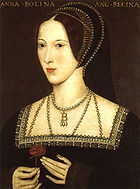 Henry claimed that this lack of a male heir was because his marriage was "blighted in the eyes of God". Catherine had been his late brother
's wife, and it was therefore against biblical teachings for Henry to have married her (Leviticus
20:21); a special dispensation
from Pope Julius II
had been needed to allow the wedding in the first place. Henry argued that this had been wrong and that his marriage had never been valid. In 1527 Henry asked Pope Clement VII
to annul the marriage, but the Pope refused. According to Canon Law
the Pope cannot annul a marriage on the basis of a canonical impediment
previously dispensed. Clement also feared the wrath of Catherine's nephew, Holy Roman Emperor
Charles V
, whose troops earlier that year had sacked Rome and briefly taken the Pope prisoner.
The combination of his "scruple of conscience" and his captivation by Anne Boleyn made his desire to rid himself of his Queen compelling. The indictment of his chancellor Cardinal Wolsey in 1529 for praemunire
(taking the authority of the Papacy above the Crown), and subsequent death in November 1530 on his way to London to answer a charge of high treason left Henry open to the opposing influences of the supporters of the Queen and those who countenanced the abandonment of the Roman allegiance, for whom an annulment was but an opportunity.
, successor to Wolsey, also wanted reform: he wanted new laws against heresy.
01.jpg) Cromwell was a lawyer and a Member of Parliament, an evangelical who saw how Parliament could be used to advance the Royal Supremacy, which Henry wanted, and to further evangelical beliefs and practices which both he and his friends wanted. One of his closest friends was Thomas Cranmer
Cromwell was a lawyer and a Member of Parliament, an evangelical who saw how Parliament could be used to advance the Royal Supremacy, which Henry wanted, and to further evangelical beliefs and practices which both he and his friends wanted. One of his closest friends was Thomas Cranmer
, soon to be Archbishop.
In the matter of the annulment, no progress seemed possible: the Pope seemed more afraid of Emperor Charles V than of Henry. Anne and Cromwell and their allies wished simply to ignore the Pope; but in October 1530 a meeting of clergy and lawyers advised that Parliament could not empower the archbishop to act against the Pope's prohibition. Henry thus resolved to bully the priests.
in order to secure their agreement to his annulment. Praemunire, which forbade obedience to the authority of foreign rulers, had been around since the 1392 Statute of Praemunire and had been used against individuals in the ordinary course of court proceedings. Now Henry, having first charged Queen Catherine's supporters, Bishop
s John Fisher
, John Clerk
, Nicholas West
and Henry Standish
and archdeacon of Exeter Adam Travers, then decided to proceed against the whole clergy. Henry claimed £100,000 from the Convocation
of Canterbury
of the Church of England
for their pardon, which was granted by the Convocation on 24 January 1531. The clergy wanted the payment to be spread over five years. Henry refused. The Convocation responded by withdrawing their payment altogether and demanded Henry fulfill certain guarantees before they agreed to give him the money. Henry refused these conditions, agreed only to the five-year period of payment and then, to the payment which Henry wanted the Convocation to accept, added five articles:
championed Catherine and the clergy; he had inserted into the first article, the phrase "as far as the word of God allows". In Convocation, however, Archbishop Warham requested a discussion but was met by a stunned silence; then Warham said, "He who is silent seems to consent", to which a clergyman responded, "Then we are all silent." The Convocation granted consent to the King's five articles and the payment on 8 March 1531. That same year Parliament passed the Pardon to Clergy Act 1531.
 The breaking of the power of Rome proceeded little by little. In 1532, Cromwell brought before Parliament the Supplication Against the Ordinaries
which listed nine grievances against the Church, including abuses of power and Convocation's independent legislative power. Finally, on 10 May, the King demanded of Convocation that the Church should renounce all authority to make laws and, on 15 May, the Submission of the Clergy
was subscribed, which recognised Royal Supremacy
over the church so that it could no longer make canon law
without royal licence, i.e. without the permission of the King; thus completely emasculating it as a law-making body. (This would subsequently be passed by the Parliament in 1534 and again in 1536.) The day after this More resigned as Chancellor, leaving Cromwell as Henry's chief minister. (Cromwell never became Chancellor; his power came – and was lost – through his informal relations with Henry.)
Several Acts of Parliament then followed. The Act in Conditional Restraint of Annates, which proposed that the clergy should pay no more than 5% of their first year's revenue (annates) to Rome proved at first controversial, and required Henry's presence in the House of Lords three times and the browbeating of the Commons. The Act in Restraint of Appeals
which was drafted by Cromwell, apart from outlawing appeals to Rome on ecclesiastical matters, declared that "this realm of England is an Empire, and so hath been accepted in the world, governed by one Supreme Head and King having the dignity and royal estate of the Imperial Crown of the same, unto whom a body politic compact of all sorts and degrees of people divided in terms and by names of Spirituality and Temporality, be bounden and owe to bear next to God a natural and humble obedience", thus declaring England an independent country in every respect. English historian Geoffrey Elton has called this Act an "essential ingredient" of the "Tudor revolution" in that it expounded a theory of national sovereignty
. The Act in Absolute Restraint of Annates outlawed all annates to Rome, and also ordered that if cathedral
s refused the King's nomination for bishop, they would be liable to punishment by praemunire. Finally in 1534 the Acts of Supremacy
made Henry "supreme head in earth of the Church of England" and disregarded any "usage, custom, foreign laws, foreign authority [or] prescription".
 Meanwhile, having taken Anne to France on a pre-nuptial honeymoon, Henry was married to her in Westminster Abbey in January 1533. This was made easier by the death of Archbishop Warham, a stalwart opponent of an annulment, after which Henry appointed Thomas Cranmer as his successor as Archbishop of Canterbury
; Cranmer was prepared to grant the annulment of the marriage to Catherine as Henry required. Anne gave birth to a daughter, Princess Elizabeth
, three months after the marriage. The Pope responded to the marriage by excommunicating both Henry and Cranmer from the Roman Catholic Church (11 July 1533). Henry was to be excommunicated again in December 1538.
Consequently in the same year the Act of First Fruits and Tenths transferred the taxes on ecclesiastical income from the Pope to the Crown. The Act Concerning Peter's Pence and Dispensations
outlawed the annual payment by landowners of one penny
to the Pope. This Act also reiterated that England had "no superior under God, but only your Grace" and that Henry's "imperial crown" had been diminished by "the unreasonable and uncharitable usurpations and exactions" of the Pope.
In case any of this should be resisted Parliament passed the Treasons Act 1534
which made it high treason punishable by death to deny Royal Supremacy; the following year Thomas More and John Fisher were executed under this legislation. Finally in 1536 Parliament passed the Act against the Pope's Authority which removed the last part of papal authority still legal. This was Rome's power in England to decide disputes concerning Scripture.
and his school were widely known and disputed in England. A major manifestation of theological radicalism in England was Lollardy, a movement deriving from the writings of John Wycliffe
, the 14th-century Bible translator, which stressed the primacy of Scripture
. But after the execution of Sir John Oldcastle
, leader of the Lollard rebellion of 1415, they never again had access to the levers of power and by the 15th century were much reduced in numbers and influence. There were still many Lollards about, especially in London and the Thames Valley, in Essex and Kent, Coventry, Bristol and even in the north, who would be receptive to the new ideas when they came, who looked for a reform in the lifestyle of the clergy. They emphasized the preaching of the word
over the sacrament of the altar
, holding the latter to be but a memorial, but they were not party to the actions of the government. Other ideas, critical of the papal supremacy
were held, not only by Lollards, but by those who wished to assert the supremacy of the secular state over the church but also by conciliarists such as Thomas More and, initially, Cranmer. Other Catholic reformists, including John Colet
, Dean of St Paul's, warned that heretics were not nearly so great a danger to the faith as the wicked and indolent lives of the clergy.
The impact of Luther's thinking was of a different order. The main plank of his thinking, justification by faith alone
rather than by good works, threatened the whole basis of the Catholic penitential system with its endowed masses and prayers for the dead as well as its doctrine of purgatory
. Faith, not pious acts, prayers or masses, in this view, can secure the grace of God. Moreover, printing, which had become widespread at the end of the previous century, meant that vernacular Bibles could be produced in quantity. A further English translation by William Tyndale
was banned but it was impossible to prevent copies from being smuggled and widely read. The Church could no longer effectively dictate its interpretation. A group in Cambridge, which met at the White Horse tavern from the mid-1520s and became known as "Little Germany", soon became influential. Its members included Robert Barnes, Hugh Latimer
, John Frith
and Thomas Bilney
, all eventually to be burned as heretics. Cranmer's change of mind, borne partly by his membership of the team negotiating for the annulment, finally came through his stay with Andreas Osiander
in Nuremberg in 1532. (Cranmer also secretly married Osiander's niece). Even then the position was complicated by the fact that the Lutherans were not in favour of the annulment. Cranmer (and Henry) felt obliged to seek assistance from Strasbourg and Basel, which brought him into contact with the more radical ideas associated with Zwingli.
Cromwell's programme, assisted by Anne Boleyn's influence over episcopal appointments, was not merely against the clergy and the power of Rome. He persuaded Henry that safety from political alliances that Rome might attempt to bring together lay in negotiations with the German Lutheran princes. There also seemed to be a possibility that Charles V, the Holy Roman Emperor, might act to avenge his rejected aunt (Queen Catherine) and enforce the Pope's excommunication. It never came to anything but it brought to England Lutheran ideas: three sacraments only – baptism, Eucharist and penance – which Henry was prepared to countenance in order to keep open the possibility of an alliance. More noticeable, and objectionable to many, were the Injunctions, first of 1536 and then 1538. The programme began with the abolition of many feast days, "the occasion of vice and idleness" which, particularly at harvest time, had an immediate effect on village life. The offerings to images were discouraged, as were pilgrimages – these injunctions took place while monasteries were being dissolved. In some places images were burned on the grounds that they were objects of superstitious devotion, candles lit before images were prohibited, Bibles in both English and Latin were to be bought. Thus did the Reformation begin to affect the towns and villages of England and, in many places, people did not like it.
s and nun
s, which became the ostensible justification for their suppression. The Church owned between one-fifth and one-third of the land in all England; Cromwell realised that he could bind the gentry and nobility to Royal Supremacy by selling to them the huge amount of Church lands, and that any reversion back to pre-Royal Supremacy would entail upsetting many of the powerful people in the realm. For these various reasons the Dissolution of the Monasteries
was begun in 1536 with the Dissolution of the Lesser Monasteries Act
, affecting smaller houses, those valued at less than £200 a year; the revenue was used by Henry to help build coastal defences (see Device Forts
) against expected invasion, and all their land was given to the Crown or sold to the aristocracy. Whereas the royal supremacy had raised few eyebrows, the attack on abbeys and priories affected lay people. Mobs attacked those sent to break up monastic buildings; the suppression commissioners were attacked by local people in several places. In Northern England
there were a series of uprisings by Catholics against the dissolutions in late 1536 and early 1537. In the autumn of 1536 there was a great muster, reckoned to be up to 40,000 in number, at Horncastle in Lincolnshire which was, with difficulty, dispersed by the nervous gentry. They had attempted without success to negotiate with the king by petition. The Pilgrimage of Grace
was a more serious matter. Revolt spread through Yorkshire, and the rebels gathered at York. Robert Aske
, their leader, negotiated the restoration of sixteen of the twenty six northern monasteries, which had actually been dissolved. However, the promises made to them by the Duke of Norfolk were ignored on the king's orders. Norfolk was instructed to put the rebellion down. Forty-seven of the Lincolnshire rebels were executed and 132 from the northern pilgrimage. Further rebellions took place in Cornwall in early 1537, and in Walsingham (in Norfolk) which received similar treatment.
It took Cromwell four years to complete the process. In 1539 he moved to the dissolution of the larger monasteries which had escaped earlier. Many houses gave up voluntarily, though some sought exemption by payment. When their houses were closed down some monks sought transfer to larger houses. Many became secular priests. A few, including eighteen Carthusian
s, refused and were killed to the last man.
, destruction, disputes within communities which led to violence, and radical challenge to all forms of faith were daily reported to Cromwell, something which he tried to hide from the King. Once Henry knew what was afoot, he acted. Thus at the end of 1538, a proclamation was issued forbidding free discussion of the Sacrament and forbidding clerical marriage, on pain of death. Henry personally presided at the trial of John Lambert
in November 1538 for denying the real presence
. At the same time, he shared in the drafting of a proclamation giving Anabaptists and Sacramentaries ten days to get out of the country. In 1539 Parliament passed the Six Articles reaffirming Catholic practices such as transubstantiation
, clerical celibacy
and the importance of confession
to a priest
and prescribed penalties if anyone denied them. Henry himself observed the Easter Triduum
in that year with some display. On 28 June 1540 Cromwell, his longtime advisor and loyal servant, was executed. Different reasons were advanced: that Cromwell would not enforce the Act of Six Articles; that he had supported Barnes, Latimer and other heretics; and that he was responsible for Henry's marriage to Anne of Cleves
, his fourth wife. Many other arrests under the Act followed. Cranmer lay low.
In 1540 Henry began his attack upon the free availability of the Bible. In 1536 Cromwell had instructed each parish to acquire "one book of the whole Bible of the largest volume in English" by Easter 1539. This instruction had been largely ignored, so a new version, the Great Bible
(largely William Tyndale
's English translation of the Hebrew
and Greek
Scriptures), was authorised in August 1537. But by 1539 Henry announced his desire to have it "corrected" (which Cranmer referred to the universities to undertake). Many parishes were, in any case, reluctant to set up English Bibles: now the mood of conservatism, which expressed itself in the fear that Bible reading led to heresy. Many Bibles which had been put in place were removed. By the 1543 Act for the Advancement of True Religion
, Henry restricted Bible reading to men and women of noble birth. He expressed his fears to Parliament in 1545 that "the Word of God, is disputed, rhymed, sung and jangled in every ale-house and tavern, contrary to the true meaning and doctrine of the same".
By 1546 the conservatives, the Duke of Norfolk, Wriothesly, Gardiner and Tunstall were in the ascendency and were, by the king's will, to be members of the regency council, on his death. But by the time he died in 1547, Edward Seymour, Earl of Hertford, brother of Jane Seymour
, Henry's third wife (and therefore uncle to the future Edward VI), managed, by a number of alliances with influential Protestants such as Lisle, to gain control over the Privy Council and persuaded Henry to change his will and to replace them as his executors by his supporters.
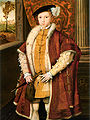 When Henry died in 1547, his nine-year-old son, Edward VI
, inherited the throne. Edward was a precocious child, who had been brought up as a Protestant, but was of little account politically. Seymour
was made Lord Protector. He was commissioned as virtual regent with near sovereign powers. Now made Duke of Somerset
, he proceeded at first hesitantly, partly because his powers were not unchallenged. When he acted it was because he saw the political advantage. The 1547 Injunctions against images were a more tightly drawn version of those of 1538 but they were more fiercely enforced, at first informally, and then by instruction. All images in churches were to be dismantled; stained glass
, shrines, and statue
s were defaced or destroyed; rood
s and often their lofts and screens were cut down; bells were taken down; vestments were prohibited and either burned or sold; church plate
was to be melted down or sold; the requirement of the clergy to be celibate
was lifted; processions were banned; and ashes and palms were prohibited. Chantries, means by which the saying of masses for the dead were endowed, were abolished completely. How well this was received is disputed; Dickens contends that people had "ceased to believe in intercessory masses for souls in purgatory"; others, such as Duffy, argue that the demolition of chantry chapels and the removal of images coincided with the activity of royal visitors. The evidence is often ambiguous. In 1549 Cranmer introduced a Book of Common Prayer
in English. In 1550 stone altars were replaced by wooden communion tables, a very public break with the past, as it changed the look and focus of church interiors.
Less visible, but still influential, was the new ordinal which provided for Protestant pastors rather than Catholic priests, an admittedly conservative adaptation of Bucer's draft; its Preface explicitly mentions the historic succession but it has been described as "another case of Cranmer's opportunist adoption of mediaeval forms for new purposes". In 1551 the episcopate was remodelled by the appointment of Protestants to the bench. This removed the obstacle to change which was the refusal of some bishops to enforce the regulations.
Henceforth, the Reformation proceeded apace. In 1552 the prayer book, which the conservative Bishop Stephen Gardiner
had approved from his prison cell as being "patient of a Catholic interpretation", was replaced by a second much more radical prayer book which altered the shape of the service so as to remove any sense of sacrifice. Edward's Parliament also repealed his father's Six Articles.
The enforcement of the new liturgy did not always take place without a struggle. Conformity was the order of the day, but in East Anglia and in Devon there were rebellions
, as also in Cornwall, to which many parishes sent their young men; they were put down only after considerable loss of life. In other places the causes of the rebellions were less easy to pin down but by July throughout southern England, there was "quavering quiet" which burst out into "stirs" in many places, most significantly in the so-called Kett's Rebellion
in Norwich. And apart from these more spectacular pieces of resistance, in some places chantry priests continued to say prayers and landowners to pay them to do so; opposition to the removal of images was widespread, so much so that when during the Commonwealth, William Dowsing
was commissioned to the task of image breaking in Suffolk, his task, as he records it, was enormous. In Kent and the southeast, compliance was mostly willing and for many, the sale of vestments and plate was an opportunity to make money (but it was also true that in London and Kent, Reformation ideas had permeated more deeply into popular thinking). The effect of the resistance was to topple Somerset as Lord Protector, so that in 1549 it was feared by some that the Reformation would cease. The prayer book was the tipping point. But Lisle, now made Earl of Warwick, was made Lord President of the Privy Council and, ever the opportunist (he was to die a public Catholic), he saw the further implementation of the reforming policy as a means of defeating his rivals.
Outwardly, the destruction and removals for sale had changed the church forever. Many churches had concealed their vestments and their silver, and had buried their stone altars. There were many disputes between the government and parishes over church property. Thus, when Edward died in July 1553 and the Duke of Northumberland attempted to have the Protestant Lady Jane Grey
made Queen, the unpopularity of the confiscations gave Mary the opportunity to have herself proclaimed Queen, first in Suffolk, and then in London to the acclamation of the crowds.
 From 1553, under the reign of Henry's Roman Catholic daughter, Mary I
, the Reformation legislation was repealed and Mary sought to achieve the reunion with Rome. Her first Act of Parliament was to retroactive
ly validate Henry's marriage to her mother and so legitimise her claim to the throne. Achieving her objective was however, not straightforward. The Pope was only prepared to accept reunion when church property disputes had been settled, which, in practice, meant allowing those who had bought former church property to keep it. Thus did Cardinal Pole arrive to become Archbishop of Canterbury in Cranmer's place. Mary could have had Cranmer, imprisoned as he was, tried and executed for treason – he had supported the claims of Lady Jane Grey – but she had resolved to have him tried for heresy
. His recantations of his Protestantism would have been a major coup for her. Unhappily for her, he unexpectedly withdrew his recantations at the last minute as he was to be burned at the stake, thus ruining her government's propaganda victory.
If Mary was to secure England for Catholicism, she needed an heir. On the advice of the Holy Roman Emperor
she married his son, Philip II of Spain
; she needed to prevent her Protestant half-sister Elizabeth from inheriting the Crown and thus returning England to Protestantism. There was opposition, and even a rebellion in Kent (led by Sir Thomas Wyatt
); even though it was provided that Philip would never inherit the kingdom if there was no heir, received no estates and had no coronation. He was there to provide an heir. But she never became pregnant; her apparent pregnancy was, in fact, the beginnings of stomach cancer. Ironically, another blow fell. Pope Julius died and his successor, Pope Paul IV
, declared war on Philip and recalled Pole to Rome to have him tried as a heretic. Mary refused to let him go. The support which she might have expected from a grateful Pope was thus denied her.
After 1555, the initial reconciling tone of the regime began to harden. The medieval heresy laws were restored. The so-called Marian Persecutions
of Protestants ensued and 283 Protestants were burnt at the stake for heresy. This resulted in the Queen becoming known as "Bloody Mary", due to the influence of John Foxe
, one of the Protestants who fled
Marian England. Foxe's Book of Martyrs
recorded the executions in such detail that it became Mary's epitaph; Convocation
subsequently ordered that Foxe's book should be placed in every cathedral in the land. In fact, while those who were executed after the revolts of 1536, and the St. David's Down rebellion of 1549, and the unknown number of monks who died for refusing to submit, may not have been tried for heresy, they certainly exceeded that number by some amount. Even so, the heroism of some of the martyrs was an example to those who witnessed them, so that in some places it was the burnings that set people against the regime.
There was a slow consolidation in Catholic strength in Mary's latter years. The reconciled Catholic Edmund Bonner
, Bishop of London, produced a catechism and a collection of homilies; the printing press was widely used to produce primers and other devotional materials; recruitment to the English clergy began to rise after almost a decade; repairs to long-neglected churches were begun. In the parishes "restoration and repair continued, new bells were bought, and churches' ales produced their bucolic profits". Commissioners visited to ensure that altars were restored, roods rebuilt and vestments and plate purchased. Moreover, Pole was determined to do more than remake the past. His insistence was on scripture, teaching and education and on improving the moral standards of the clergy. It is difficult to determine how far Catholic devotion, with its belief in the saints and in purgatory, had even been broken by the previous reigns; but certainties, especially those which drew upon men's purses, had been shaken: benefactions to the church did not return significantly; trust in clergy who had been prepared to change their minds and were now willing to leave their new wives – as they were required to do – was bound to have weakened. Few monasteries, chantries and gilds were reinstated. "Parish religion was marked by religious and cultural sterility", though some have observed enthusiasm, marred only by the poor harvests which produced poverty and want. Full restoration of the Catholic faith in England to its pre-Reformation state would take time. Consequently, Protestants secretly ministering to underground congregations, such as Thomas Bentham
, were planning for a long haul, a ministry of survival. Mary's death in November 1558, childless and without having made provision for a Catholic to succeed her, would undo her consolidation.
inherited the throne. One of the most important concerns during Elizabeth’s early reign was religion
. Elizabeth could not be Catholic, as that church considered her illegitimate. At the same time, she had observed the turmoil brought about by Edward's introduction of radical Protestant reforms. Communion with the Catholic Church was again severed by Elizabeth. She relied primarily on her chief advisors, Sir William Cecil, as her Secretary of State
, and Sir Nicholas Bacon, as the Lord Keeper of the Great Seal
, for direction on the matter. Chiefly she supported her Father's idea of reforming the church but made some minor adjustments such as it being illegal to be catholic etc.
In this way, Elizabeth and her advisors aimed at a church that included most opinions. Two groups were excluded. Catholics who remained loyal to the Pope were not to be tolerated. They were, in fact, regarded as traitors, because the Pope had refused to accept Elizabeth as Queen of England. Roman Catholics were given the hard choice of being loyal either to their church or their Country. For some priests it meant life on the run, in some cases death for treason. The other group not to be tolerated was made up of people who wanted reform to go much further, and who finally gave up on the Church of England. They could not see it as any longer a true church. They believed it had refused to obey the Bible, so they formed small groups of convinced believers outside the church. The response of the government was to use imprisonment and exile to try to crush these 'Separatists'.
Within the Church of England itself, three groups existed. Those who believed the form of the church was just what it should be included leaders like John Jewel and Richard Hooker. Others looked for opportunities to reintroduce some Catholic practices. Under the Stuart kings they were to have their chance. Others, who came to be called "Puritans", wanted to remove the traces of the old ways that still remained. The Stuart kings were to give them a rough passage. At the end of Elizabeth's reign, the Church of England was firmly in place, but within it were the seeds of future conflict.
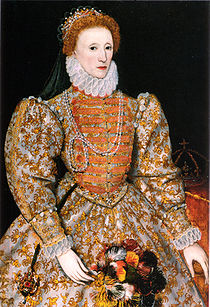 Parliament
was summoned in 1559 to consider the Reformation Bill and to create a new church. The Reformation Bill defined the Communion as a consubstantial
celebration as opposed to a transubstantial
celebration, included abuse of the pope
in the litany
, and ordered that ministers should not wear the surplice
or other Catholic vestments. It allowed ministers to marry, banned images from churches, and confirmed Elizabeth as Supreme Head of the Church of England
. The Bill met heavy resistance in the House of Lords
, as Roman Catholic bishop
s as well as the lay peers voted against it. They reworked much of the Bill, changed the litany to allow for a transubstantial belief in the Communion and refused to grant Elizabeth the title of Supreme Head of the Church. Parliament was prorogued over Easter, and when it resumed, the government entered two new bills into the Houses – the Act of Supremacy and the Act of Uniformity.
) of the bishops lost their posts, a hundred fellows of Oxford colleges were deprived; many dignitaries resigned rather than take the oath. The bishops who were removed from the ecclesiastical bench were replaced by appointees who would agree to the reforms.
On the question of images, Elizabeth's initial reaction was to allow crucifixes and candlesticks and the restoration of roods, but some of the new bishops whom she had elevated protested. In 1560 Edmund Grindal
, one of the Marian exiles now made Bishop of London
, was allowed to enforce the demolition of rood lofts in London and in 1561 the Queen herself ordered the demolition of all lofts. Thereafter, the determination to prevent any further restoration was evidenced by the more thoroughgoing destruction of rood
s, vestments, stone altars, dooms
, statues and other ornaments. The queen also appointed a new Privy Council
, removing many Roman Catholic counsellors by doing so. Under Elizabeth, factionalism in the Council and conflicts at court greatly diminished. The Act of Supremacy was passed without difficulty.
was to be used, was passed by only three votes. The Bill of Uniformity was more cautious than the initial Reformation Bill. It revoked the harsh laws proposed against Roman Catholics, it removed the abuse of the pope from the litany and kept the wording that allowed for both consubstantial and transubstantial belief in the Communion.
After Parliament was dismissed, Elizabeth and Cecil drafted the Royal Injunctions. These were additions to the settlement, and largely stressed continuity with the Catholic past – ministers were ordered to wear the surplice. Wafers, as opposed to ordinary baker's bread, were to be used as the bread at Communion. There had been opposition to the settlement in rural England, which for the most part was largely Roman Catholic, so the changes aimed for acceptance of the settlement. What succeeded more than anything else was the sheer length of Elizabeth's reign; while Mary had been able to impose her programme for a mere five years, Elizabeth had more than forty. Those who delayed, "looking for a new day" when restoration would again be commanded, were defeated by the passing of years.
ism, which encompassed those Protestants who, whilst they agreed that there should be one national church, felt that the church had been but partially reformed. Puritanism ranged from hostility to the content of the Prayer Book and "popish" ceremony, to a desire for church governance
to be radically reformed. Grindal was made Archbishop of Canterbury in 1575 and chose to oppose even the Queen in his desire to forward the Puritan agenda. "Bear with me, I beseech you Madam, if I choose rather to offend your earthly majesty than to offend the heavenly majesty of God", he ended a 6,000 word reproach to her. He was placed under house arrest for his trouble and though he was not deprived, his death in 1583 put an end to the hopes of his supporters. His successor, Archbishop Whitgift
more reflected the Queen's determination to discipline those who were unprepared to accept her settlement. A conformist, he imposed a degree of obedience on the clergy which apparently alarmed even the Queen's ministers, such as Lord Burghley. The Puritan cause was not helped even by its friends. The pseudonymous "Martin Marprelate
" tracts, which attacked conformist clergy with a libellous humorous tone, outraged senior Puritan clergy and set the government on an unsuccessful attempt to run the writer to earth. Incidentally, the defeat of the Spanish Armada
in 1588 made it more difficult for Puritans to resist the conclusion that since God "blew with his wind and they were scattered" he could not be too offended by the religious establishment in the land.
On the other side there were still huge numbers of Roman Catholics, some of whom conformed, bending with the times, hoping that there would be a fresh reverse; vestments were still hidden, golden candlesticks bequeathed, chalices kept. The Mass was still celebrated in some places alongside the new Communion service. It was, of course more difficult than hitherto. Both Roman Catholic priests and laity lived a double life, apparently conforming, but avoiding taking the oath of conformity. It was only as time passed that recusancy, refusal to attend Protestant services, became more common. The Jesuits and seminary priests, trained in Douai and Rome to make good the losses of English priests, encouraged this. By the 1570s an underground church was growing fast, as the Church of England became more Protestant and less bearable for Roman Catholics. Roman Catholics were still a sizeable minority. Only one public attempt to restore the old religion occurred: the Rising of the North
ern earls in 1569. It was a botched attempt; in spite of tumultuous crowds who greeted the rebels in Durham, the rebellion did not spread, the assistance they sought was not forthcoming, their communication with allies at Court was poor; they came nowhere near to setting Mary Stuart, whose presence might have rallied support, free from her imprisonment in Tutbury. The Roman Catholic Church's refusal to countenance occasional attendance at Protestant Services and the excommunication of Elizabeth by Pope Pius V
in 1570 presented the choice to Roman Catholics more starkly, and the arrival of the seminary priests, while it was a lifeline to many Roman Catholics, brought further trouble. Elizabeth's ministers took steps to stem the tide: fines for refusal to attend church were raised from 12 d. per service to £20 a month, fifty times an artisan's wage; it was now treason to be absolved from schism and reconciled to Rome; the execution of priests began – the first in 1577, four in 1581, eleven in 1582, two in 1583, six in 1584, fifty-three by 1590, and seventy more between 1601 and 1608. It became treasonable for a Roman Catholic priest ordained abroad to enter the country. Because the papacy had called for the deposing of the Queen, the choice for moderate Catholics lay between treason and damnation. Although considerably fewer than on the Continent, by British standards the List of Catholic martyrs of the English Reformation was extensive.
There is, of course, always some distance between legislation and its enforcement. The governmental attacks on recusancy
were mostly upon the gentry. Few recusants were actually fined; the fines that were imposed were often at reduced rates; the persecution eased; priests came to recognise that they should not refuse communion to occasional conformists. The persecutions did not extinguish the faith, but they tested it sorely. The huge number of Roman Catholics in East Anglia and the north in the 1560s disappeared into the general population in part because recusant priests largely served the great Roman Catholic houses, who alone could hide them. Without the mass and pastoral care, yeomen, artisans and husbandmen fell into conformism. Roman Catholicism, supported by foreign or expatriate priests, came to be seen as treasonous.
of 1559, from which had been removed some of the matters offensive to Catholics. The recusants had been removed from the centre of the stage. The new dispute was now between the Puritans (who wished to see an end of the prayer book and episcopacy), and this third party (the considerable body of people who looked kindly on the Elizabethan Settlement, who rejected "prophesyings", whose spirituality had been nourished by the Prayer Book and who preferred the governance of bishops).
It was between these two groups that, after Elizabeth's death in 1603, a new, more savage episode of the Reformation was in the process of gestation. During the reigns of the Stuart kings, James I
and Charles I
, the battle lines were to become more defined, leading ultimately to the English Civil War
, the first on English soil to engulf parts of the civilian population. The war was only partly about religion, but the abolition of prayer book and episcopacy by a Puritan Parliament was an element in the causes of the conflict. As historian MacCulloch has noted, the legacy of these tumultuous events can be recognised, throughout the Commonwealth
(1649–60) and the Restoration which followed it and beyond. This third party was to become the core of the restored Church of England, but at the price for further division.
Kingdom of England
The Kingdom of England was, from 927 to 1707, a sovereign state to the northwest of continental Europe. At its height, the Kingdom of England spanned the southern two-thirds of the island of Great Britain and several smaller outlying islands; what today comprises the legal jurisdiction of England...
by which the Church of England
Church of England
The Church of England is the officially established Christian church in England and the Mother Church of the worldwide Anglican Communion. The church considers itself within the tradition of Western Christianity and dates its formal establishment principally to the mission to England by St...
broke away from the authority of the Pope
Pope
The Pope is the Bishop of Rome, a position that makes him the leader of the worldwide Catholic Church . In the Catholic Church, the Pope is regarded as the successor of Saint Peter, the Apostle...
and the Roman Catholic Church
Roman Catholic Church
The Catholic Church, also known as the Roman Catholic Church, is the world's largest Christian church, with over a billion members. Led by the Pope, it defines its mission as spreading the gospel of Jesus Christ, administering the sacraments and exercising charity...
.
These events were, in part, associated with the wider process of the European Protestant Reformation
Protestant Reformation
The Protestant Reformation was a 16th-century split within Western Christianity initiated by Martin Luther, John Calvin and other early Protestants. The efforts of the self-described "reformers", who objected to the doctrines, rituals and ecclesiastical structure of the Roman Catholic Church, led...
, a religious and political movement which affected the practice of Christianity
Christianity
Christianity is a monotheistic religion based on the life and teachings of Jesus as presented in canonical gospels and other New Testament writings...
across most of Europe during this period. Many factors contributed to the process: the decline of feudalism
Feudalism
Feudalism was a set of legal and military customs in medieval Europe that flourished between the 9th and 15th centuries, which, broadly defined, was a system for ordering society around relationships derived from the holding of land in exchange for service or labour.Although derived from the...
and the rise of nationalism
Nationalism
Nationalism is a political ideology that involves a strong identification of a group of individuals with a political entity defined in national terms, i.e. a nation. In the 'modernist' image of the nation, it is nationalism that creates national identity. There are various definitions for what...
, the rise of the common law
Common law
Common law is law developed by judges through decisions of courts and similar tribunals rather than through legislative statutes or executive branch action...
, the invention of the printing press
Printing press
A printing press is a device for applying pressure to an inked surface resting upon a print medium , thereby transferring the ink...
and increased circulation of the Bible
Bible
The Bible refers to any one of the collections of the primary religious texts of Judaism and Christianity. There is no common version of the Bible, as the individual books , their contents and their order vary among denominations...
, the transmission of new knowledge and ideas among scholars and the upper and middle classes. However, the various phases of the English Reformation, which also covered Wales
Wales
Wales is a country that is part of the United Kingdom and the island of Great Britain, bordered by England to its east and the Atlantic Ocean and Irish Sea to its west. It has a population of three million, and a total area of 20,779 km²...
and Ireland
Ireland
Ireland is an island to the northwest of continental Europe. It is the third-largest island in Europe and the twentieth-largest island on Earth...
, were largely driven by changes in government policy, to which public opinion gradually accommodated itself.
Based on Henry VIII
Henry VIII of England
Henry VIII was King of England from 21 April 1509 until his death. He was Lord, and later King, of Ireland, as well as continuing the nominal claim by the English monarchs to the Kingdom of France...
's desire for an annulment of his marriage, the English Reformation was at the outset more of a political affair than a theological dispute. The reality of political differences between Rome and England allowed growing theological disputes to come to the fore.
Immediately before the break with Rome, it was the Pope and general councils of the church that decided doctrine
Doctrine
Doctrine is a codification of beliefs or a body of teachings or instructions, taught principles or positions, as the body of teachings in a branch of knowledge or belief system...
. Church law was governed by the code of canon law with final jurisdiction in Rome. Church taxes were paid straight to Rome and it was the Pope who had the final say over the appointment of bishops. The split from Rome made the English monarch the Supreme Governor of the English church by "Royal Supremacy
Acts of Supremacy
The first Act of Supremacy was a piece of legislation that granted King Henry VIII of England Royal Supremacy, which means that he was declared the supreme head of the Church of England. It is still the legal authority of the Sovereign of the United Kingdom...
", thereby making the Church of England
Church of England
The Church of England is the officially established Christian church in England and the Mother Church of the worldwide Anglican Communion. The church considers itself within the tradition of Western Christianity and dates its formal establishment principally to the mission to England by St...
the established church of the nation. Doctrinal and legal disputes now rested with the monarch, and the papacy was deprived of revenue and the final say on the appointment of bishops.
The structure and theology of the church was a matter of fierce dispute for generations. These disputes were finally ended by a coup d'état (the "Glorious Revolution
Glorious Revolution
The Glorious Revolution, also called the Revolution of 1688, is the overthrow of King James II of England by a union of English Parliamentarians with the Dutch stadtholder William III of Orange-Nassau...
") in 1688, from which emerged a church polity with an established church and a number of non-conformist
Nonconformism
Nonconformity is the refusal to "conform" to, or follow, the governance and usages of the Church of England by the Protestant Christians of England and Wales.- Origins and use:...
churches whose members at first suffered various civil disabilities which were only removed over time, as did the substantial minority who remained Roman Catholic in England, whose church organization remained illegal until the 19th century.
Role of Henry VIII and royal marriages
Catherine of Aragon
Catherine of Aragon , also known as Katherine or Katharine, was Queen consort of England as the first wife of King Henry VIII of England and Princess of Wales as the wife to Arthur, Prince of Wales...
, widow of his brother Arthur, in June 1509, just before his coronation on Midsummer's Day. Unlike his father, who was secretive and conservative, the young Henry appeared to be the epitome of chivalry and sociability, seeking out the company of young men like himself; an observant Catholic, he heard up to five masses
Mass (liturgy)
"Mass" is one of the names by which the sacrament of the Eucharist is called in the Roman Catholic Church: others are "Eucharist", the "Lord's Supper", the "Breaking of Bread", the "Eucharistic assembly ", the "memorial of the Lord's Passion and Resurrection", the "Holy Sacrifice", the "Holy and...
a day (except during the hunting season); of "powerful but unoriginal mind", he allowed himself to be influenced by his advisors from whom he was never apart, by night or day; he was thus susceptible to whoever had his ear. Between his young contemporaries and the Lord Chancellor, Cardinal Thomas Wolsey, there was thus a state of hostility. As long as Wolsey had his ear, Henry's Catholicism was secure: in 1521 he had defended the Catholic Church from Martin Luther
Martin Luther
Martin Luther was a German priest, professor of theology and iconic figure of the Protestant Reformation. He strongly disputed the claim that freedom from God's punishment for sin could be purchased with money. He confronted indulgence salesman Johann Tetzel with his Ninety-Five Theses in 1517...
's accusations of heresy
Heresy
Heresy is a controversial or novel change to a system of beliefs, especially a religion, that conflicts with established dogma. It is distinct from apostasy, which is the formal denunciation of one's religion, principles or cause, and blasphemy, which is irreverence toward religion...
in a book he wrote, probably with considerable help from Thomas More
Thomas More
Sir Thomas More , also known by Catholics as Saint Thomas More, was an English lawyer, social philosopher, author, statesman and noted Renaissance humanist. He was an important councillor to Henry VIII of England and, for three years toward the end of his life, Lord Chancellor...
, entitled The Defence of the Seven Sacraments
Defence of the Seven Sacraments
The Defence of the Seven Sacraments is a theological treatise written by King Henry VIII of England in 1521.Henry started to write it in 1519 while he was reading Martin Luther's attack on indulgences...
, for which he was awarded the title "Defender of the Faith" (Fidei Defensor
Fidei defensor
Fidei defensor is a Latin title which translates to Defender of the Faith in English and Défenseur de la Foi in French...
) by Pope Leo X
Pope Leo X
Pope Leo X , born Giovanni di Lorenzo de' Medici, was the Pope from 1513 to his death in 1521. He was the last non-priest to be elected Pope. He is known for granting indulgences for those who donated to reconstruct St. Peter's Basilica and his challenging of Martin Luther's 95 Theses...
. (Successive English and British monarchs have retained this title to the present, even after the Anglican Church broke away from Catholicism.) Wolsey's enemies at court included those who had been influenced by Lutheran ideas, among whom was the attractive, charismatic Anne Boleyn
Anne Boleyn
Anne Boleyn ;c.1501/1507 – 19 May 1536) was Queen of England from 1533 to 1536 as the second wife of Henry VIII of England and Marquess of Pembroke in her own right. Henry's marriage to Anne, and her subsequent execution, made her a key figure in the political and religious upheaval that was the...
.
Anne arrived at court in 1522, from years in Europe, as maid of honour to Queen Catherine
Catherine of Aragon
Catherine of Aragon , also known as Katherine or Katharine, was Queen consort of England as the first wife of King Henry VIII of England and Princess of Wales as the wife to Arthur, Prince of Wales...
, a woman of "charm, style and wit, with will and savagery which made her a match for Henry". By the late 1520s, Henry wanted to have his marriage to Catherine annulled
Annulment (Catholic Church)
In the Roman Catholic Church an annulment is the procedure, governed by the Church's Canon Law and the Catechism, whereby an ecclesial tribunal determines the sacrament of marriage was invalidly entered into. An annulment determines the Catholic marriage to be void at its inception...
. She had not produced a male heir who survived into adulthood and Henry wanted a son to secure the Tudor dynasty
Tudor dynasty
The Tudor dynasty or House of Tudor was a European royal house of Welsh origin that ruled the Kingdom of England and its realms, including the Lordship of Ireland, later the Kingdom of Ireland, from 1485 until 1603. Its first monarch was Henry Tudor, a descendant through his mother of a legitimised...
. Before Henry's father (Henry VII
Henry VII of England
Henry VII was King of England and Lord of Ireland from his seizing the crown on 22 August 1485 until his death on 21 April 1509, as the first monarch of the House of Tudor....
) ascended the throne, England had been beset by civil warfare
Wars of the Roses
The Wars of the Roses were a series of dynastic civil wars for the throne of England fought between supporters of two rival branches of the royal House of Plantagenet: the houses of Lancaster and York...
over rival claims to the English crown and Henry wanted to avoid a similar uncertainty over the succession. Catherine's only surviving child was Princess Mary
Mary I of England
Mary I was queen regnant of England and Ireland from July 1553 until her death.She was the only surviving child born of the ill-fated marriage of Henry VIII and his first wife Catherine of Aragon. Her younger half-brother, Edward VI, succeeded Henry in 1547...
.
Arthur, Prince of Wales
Arthur Tudor, Prince of Wales was the first son of King Henry VII of England and Elizabeth of York, and therefore, heir to the throne of England. As he predeceased his father, Arthur never became king...
's wife, and it was therefore against biblical teachings for Henry to have married her (Leviticus
Leviticus
The Book of Leviticus is the third book of the Hebrew Bible, and the third of five books of the Torah ....
20:21); a special dispensation
Dispensation (Catholic Church)
In the canon law of the Roman Catholic Church, a dispensation is the suspension by competent authority of general rules of law in particular cases...
from Pope Julius II
Pope Julius II
Pope Julius II , nicknamed "The Fearsome Pope" and "The Warrior Pope" , born Giuliano della Rovere, was Pope from 1503 to 1513...
had been needed to allow the wedding in the first place. Henry argued that this had been wrong and that his marriage had never been valid. In 1527 Henry asked Pope Clement VII
Pope Clement VII
Clement VII , born Giulio di Giuliano de' Medici, was a cardinal from 1513 to 1523 and was Pope from 1523 to 1534.-Early life:...
to annul the marriage, but the Pope refused. According to Canon Law
Canon law (Catholic Church)
The canon law of the Catholic Church, is a fully developed legal system, with all the necessary elements: courts, lawyers, judges, a fully articulated legal code and principles of legal interpretation. It lacks the necessary binding force present in most modern day legal systems. The academic...
the Pope cannot annul a marriage on the basis of a canonical impediment
Canonical impediment
In the Canon Law of the Catholic Church, a canonical impediment is a legal obstacle that prevents a sacrament from being performed validly and/or licitly. The term is used most frequently in relationship to the sacraments of Marriage and Holy Orders...
previously dispensed. Clement also feared the wrath of Catherine's nephew, Holy Roman Emperor
Holy Roman Emperor
The Holy Roman Emperor is a term used by historians to denote a medieval ruler who, as German King, had also received the title of "Emperor of the Romans" from the Pope...
Charles V
Charles V, Holy Roman Emperor
Charles V was ruler of the Holy Roman Empire from 1519 and, as Charles I, of the Spanish Empire from 1516 until his voluntary retirement and abdication in favor of his younger brother Ferdinand I and his son Philip II in 1556.As...
, whose troops earlier that year had sacked Rome and briefly taken the Pope prisoner.
The combination of his "scruple of conscience" and his captivation by Anne Boleyn made his desire to rid himself of his Queen compelling. The indictment of his chancellor Cardinal Wolsey in 1529 for praemunire
Praemunire
In English history, Praemunire or Praemunire facias was a law that prohibited the assertion or maintenance of papal jurisdiction, imperial or foreign, or some other alien jurisdiction or claim of supremacy in England, against the supremacy of the Monarch...
(taking the authority of the Papacy above the Crown), and subsequent death in November 1530 on his way to London to answer a charge of high treason left Henry open to the opposing influences of the supporters of the Queen and those who countenanced the abandonment of the Roman allegiance, for whom an annulment was but an opportunity.
Parliamentary debate and legislation
In 1529, the king summoned Parliament to deal with annulment, thus bringing together those who wanted reform but who disagreed what form it should take; it became known as the Reformation Parliament. There were Common lawyers who resented the privileges of the clergy to summon laity to their courts; there were those who had been influenced by Lutheran evangelicalism and were hostile to the theology of Rome; Thomas Cromwell was both. There were those, like Foxe and Stokesey, who argued for the Royal Supremacy over the English Church. Henry's Chancellor, Thomas MoreThomas More
Sir Thomas More , also known by Catholics as Saint Thomas More, was an English lawyer, social philosopher, author, statesman and noted Renaissance humanist. He was an important councillor to Henry VIII of England and, for three years toward the end of his life, Lord Chancellor...
, successor to Wolsey, also wanted reform: he wanted new laws against heresy.
Thomas Cranmer
Thomas Cranmer was a leader of the English Reformation and Archbishop of Canterbury during the reigns of Henry VIII, Edward VI and, for a short time, Mary I. He helped build a favourable case for Henry's divorce from Catherine of Aragon which resulted in the separation of the English Church from...
, soon to be Archbishop.
In the matter of the annulment, no progress seemed possible: the Pope seemed more afraid of Emperor Charles V than of Henry. Anne and Cromwell and their allies wished simply to ignore the Pope; but in October 1530 a meeting of clergy and lawyers advised that Parliament could not empower the archbishop to act against the Pope's prohibition. Henry thus resolved to bully the priests.
Actions by the king against English clergy
Having brought down Cardinal Wolsey, his Chancellor, Henry VIII finally resolved to charge the whole English clergy with praemunirePraemunire
In English history, Praemunire or Praemunire facias was a law that prohibited the assertion or maintenance of papal jurisdiction, imperial or foreign, or some other alien jurisdiction or claim of supremacy in England, against the supremacy of the Monarch...
in order to secure their agreement to his annulment. Praemunire, which forbade obedience to the authority of foreign rulers, had been around since the 1392 Statute of Praemunire and had been used against individuals in the ordinary course of court proceedings. Now Henry, having first charged Queen Catherine's supporters, Bishop
Bishop
A bishop is an ordained or consecrated member of the Christian clergy who is generally entrusted with a position of authority and oversight. Within the Catholic Church, Eastern Orthodox, Oriental Orthodox Churches, in the Assyrian Church of the East, in the Independent Catholic Churches, and in the...
s John Fisher
John Fisher
Saint John Fisher was an English Roman Catholic scholastic, bishop, cardinal and martyr. He shares his feast day with Saint Thomas More on 22 June in the Roman Catholic calendar of saints and 6 July on the Church of England calendar of saints...
, John Clerk
John Clerk (bishop)
John Clerk was an English bishop. He was educated at Cambridge University, and went on to serve under Cardinal Wolsey in a variety of capacities. He was also useful in a diplomatic capacity to both Wolsey and Henry VIII of England....
, Nicholas West
Nicholas West
Nicholas West , English bishop and diplomatist, was born at Putney, and educated at Eton and at King's College, Cambridge, of which he became a fellow in 1486....
and Henry Standish
Henry Standish
Henry Standish was an English Franciscan, who became Bishop of St. Asaph. He is known as an opponent of Erasmus in particular, and humanists in general....
and archdeacon of Exeter Adam Travers, then decided to proceed against the whole clergy. Henry claimed £100,000 from the Convocation
Convocation of the English Clergy
The Convocation of the English Clergy is a synodical assembly of the Church of England consisting of bishops and clergy.- Background and introduction :...
of Canterbury
Province of Canterbury
The Province of Canterbury, also called the Southern Province, is one of two ecclesiastical provinces making up the Church of England...
of the Church of England
Church of England
The Church of England is the officially established Christian church in England and the Mother Church of the worldwide Anglican Communion. The church considers itself within the tradition of Western Christianity and dates its formal establishment principally to the mission to England by St...
for their pardon, which was granted by the Convocation on 24 January 1531. The clergy wanted the payment to be spread over five years. Henry refused. The Convocation responded by withdrawing their payment altogether and demanded Henry fulfill certain guarantees before they agreed to give him the money. Henry refused these conditions, agreed only to the five-year period of payment and then, to the payment which Henry wanted the Convocation to accept, added five articles:
- that the clergy recognise Henry as the "sole protector and Supreme Head of the Church and clergy of England"
- that the King had spiritual jurisdictionJurisdictionJurisdiction is the practical authority granted to a formally constituted legal body or to a political leader to deal with and make pronouncements on legal matters and, by implication, to administer justice within a defined area of responsibility...
- that the privileges of the Church were upheld only if they did not detract from the royal prerogativeRoyal PrerogativeThe royal prerogative is a body of customary authority, privilege, and immunity, recognized in common law and, sometimes, in civil law jurisdictions possessing a monarchy as belonging to the sovereign alone. It is the means by which some of the executive powers of government, possessed by and...
and the laws of the realm - that the King pardonPardonClemency means the forgiveness of a crime or the cancellation of the penalty associated with it. It is a general concept that encompasses several related procedures: pardoning, commutation, remission and reprieves...
ed the clergy for violating the statute of praemunire, and - that the laityLaityIn religious organizations, the laity comprises all people who are not in the clergy. A person who is a member of a religious order who is not ordained legitimate clergy is considered as a member of the laity, even though they are members of a religious order .In the past in Christian cultures, the...
were also pardoned.
Further legislative acts
In Parliament, Bishop John FisherJohn Fisher
Saint John Fisher was an English Roman Catholic scholastic, bishop, cardinal and martyr. He shares his feast day with Saint Thomas More on 22 June in the Roman Catholic calendar of saints and 6 July on the Church of England calendar of saints...
championed Catherine and the clergy; he had inserted into the first article, the phrase "as far as the word of God allows". In Convocation, however, Archbishop Warham requested a discussion but was met by a stunned silence; then Warham said, "He who is silent seems to consent", to which a clergyman responded, "Then we are all silent." The Convocation granted consent to the King's five articles and the payment on 8 March 1531. That same year Parliament passed the Pardon to Clergy Act 1531.
Supplication against the Ordinaries
The Supplication against the Ordinaries was a petition passed by the House of Commons in 1532. It was the result of grievances against Church of England prelates and the clergy...
which listed nine grievances against the Church, including abuses of power and Convocation's independent legislative power. Finally, on 10 May, the King demanded of Convocation that the Church should renounce all authority to make laws and, on 15 May, the Submission of the Clergy
Submission of the Clergy
The Submission of the Clergy was a process by which the Church of England gave up their power to formulate church laws without the King's licence and assent. It was first passed by the Convocation of Canterbury in 1532 and then by the Reformation Parliament in 1534...
was subscribed, which recognised Royal Supremacy
Acts of Supremacy
The first Act of Supremacy was a piece of legislation that granted King Henry VIII of England Royal Supremacy, which means that he was declared the supreme head of the Church of England. It is still the legal authority of the Sovereign of the United Kingdom...
over the church so that it could no longer make canon law
Canon law
Canon law is the body of laws & regulations made or adopted by ecclesiastical authority, for the government of the Christian organization and its members. It is the internal ecclesiastical law governing the Catholic Church , the Eastern and Oriental Orthodox churches, and the Anglican Communion of...
without royal licence, i.e. without the permission of the King; thus completely emasculating it as a law-making body. (This would subsequently be passed by the Parliament in 1534 and again in 1536.) The day after this More resigned as Chancellor, leaving Cromwell as Henry's chief minister. (Cromwell never became Chancellor; his power came – and was lost – through his informal relations with Henry.)
Several Acts of Parliament then followed. The Act in Conditional Restraint of Annates, which proposed that the clergy should pay no more than 5% of their first year's revenue (annates) to Rome proved at first controversial, and required Henry's presence in the House of Lords three times and the browbeating of the Commons. The Act in Restraint of Appeals
Statute in Restraint of Appeals
The Statute in Restraint of Appeals – short title Ecclesiastical Appeals Act 1532 – was an English parliamentary Act of 1533, considered by many historians to be the key legal foundation of the English Reformation....
which was drafted by Cromwell, apart from outlawing appeals to Rome on ecclesiastical matters, declared that "this realm of England is an Empire, and so hath been accepted in the world, governed by one Supreme Head and King having the dignity and royal estate of the Imperial Crown of the same, unto whom a body politic compact of all sorts and degrees of people divided in terms and by names of Spirituality and Temporality, be bounden and owe to bear next to God a natural and humble obedience", thus declaring England an independent country in every respect. English historian Geoffrey Elton has called this Act an "essential ingredient" of the "Tudor revolution" in that it expounded a theory of national sovereignty
National sovereignty
National sovereignty is the doctrine that sovereignty belongs to and derives from the nation, an abstract entity normally linked to a physical territory and its past, present, and future citizens. It is an ideological concept or doctrine derived from liberal political theory...
. The Act in Absolute Restraint of Annates outlawed all annates to Rome, and also ordered that if cathedral
Cathedral
A cathedral is a Christian church that contains the seat of a bishop...
s refused the King's nomination for bishop, they would be liable to punishment by praemunire. Finally in 1534 the Acts of Supremacy
Acts of Supremacy
The first Act of Supremacy was a piece of legislation that granted King Henry VIII of England Royal Supremacy, which means that he was declared the supreme head of the Church of England. It is still the legal authority of the Sovereign of the United Kingdom...
made Henry "supreme head in earth of the Church of England" and disregarded any "usage, custom, foreign laws, foreign authority [or] prescription".
Archbishop of Canterbury
The Archbishop of Canterbury is the senior bishop and principal leader of the Church of England, the symbolic head of the worldwide Anglican Communion, and the diocesan bishop of the Diocese of Canterbury. In his role as head of the Anglican Communion, the archbishop leads the third largest group...
; Cranmer was prepared to grant the annulment of the marriage to Catherine as Henry required. Anne gave birth to a daughter, Princess Elizabeth
Elizabeth I of England
Elizabeth I was queen regnant of England and Ireland from 17 November 1558 until her death. Sometimes called The Virgin Queen, Gloriana, or Good Queen Bess, Elizabeth was the fifth and last monarch of the Tudor dynasty...
, three months after the marriage. The Pope responded to the marriage by excommunicating both Henry and Cranmer from the Roman Catholic Church (11 July 1533). Henry was to be excommunicated again in December 1538.
Consequently in the same year the Act of First Fruits and Tenths transferred the taxes on ecclesiastical income from the Pope to the Crown. The Act Concerning Peter's Pence and Dispensations
Act Concerning Peter's Pence and Dispensations
The Act Concerning Peter's Pence and Dispensations – short title Ecclesiastical Licences Act 1533 – was passed by the English Reformation Parliament in the early part of 1534 and outlawed the payment of Peter's Pence and other payments to Rome.-Description:Peter's Pence was originally an annual...
outlawed the annual payment by landowners of one penny
Peter's Pence
Peter's Pence is payment made more or less voluntarily to the Roman Catholic Church. It began under the Saxons in England and is seen in other countries. Though formally discontinued in England at the time of the Reformation, a post-Reformation payment of uncertain characteristics is seen in some...
to the Pope. This Act also reiterated that England had "no superior under God, but only your Grace" and that Henry's "imperial crown" had been diminished by "the unreasonable and uncharitable usurpations and exactions" of the Pope.
In case any of this should be resisted Parliament passed the Treasons Act 1534
Treasons Act 1534
The Treasons Act 1534 was an Act passed by the Parliament of England in 1534, during the reign of King Henry VIII.This Act was passed after the Act of Supremacy 1534, which made the king the "Only Head of the Church of England on Earth." The 1534 Act made it treason, punishable by death, to...
which made it high treason punishable by death to deny Royal Supremacy; the following year Thomas More and John Fisher were executed under this legislation. Finally in 1536 Parliament passed the Act against the Pope's Authority which removed the last part of papal authority still legal. This was Rome's power in England to decide disputes concerning Scripture.
Theological radicalism
The break with Rome was not, by itself, a Reformation. That was to come from the dissemination of ideas. The views of the German reformer Martin LutherMartin Luther
Martin Luther was a German priest, professor of theology and iconic figure of the Protestant Reformation. He strongly disputed the claim that freedom from God's punishment for sin could be purchased with money. He confronted indulgence salesman Johann Tetzel with his Ninety-Five Theses in 1517...
and his school were widely known and disputed in England. A major manifestation of theological radicalism in England was Lollardy, a movement deriving from the writings of John Wycliffe
John Wycliffe
John Wycliffe was an English Scholastic philosopher, theologian, lay preacher, translator, reformer and university teacher who was known as an early dissident in the Roman Catholic Church during the 14th century. His followers were known as Lollards, a somewhat rebellious movement, which preached...
, the 14th-century Bible translator, which stressed the primacy of Scripture
Prima scriptura
Prima scriptura is a doctrine that says canonized scripture is "first" or "above all" sources of divine revelation.Implicitly, this view acknowledges that, besides canonical scripture, there are other guides for what a believer should believe, and how he should live, such as the created order,...
. But after the execution of Sir John Oldcastle
John Oldcastle
Sir John Oldcastle , English Lollard leader, was son of Sir Richard Oldcastle of Almeley in northwest Herefordshire and grandson of another Sir John Oldcastle....
, leader of the Lollard rebellion of 1415, they never again had access to the levers of power and by the 15th century were much reduced in numbers and influence. There were still many Lollards about, especially in London and the Thames Valley, in Essex and Kent, Coventry, Bristol and even in the north, who would be receptive to the new ideas when they came, who looked for a reform in the lifestyle of the clergy. They emphasized the preaching of the word
Sermon
A sermon is an oration by a prophet or member of the clergy. Sermons address a Biblical, theological, religious, or moral topic, usually expounding on a type of belief, law or behavior within both past and present contexts...
over the sacrament of the altar
Eucharist
The Eucharist , also called Holy Communion, the Sacrament of the Altar, the Blessed Sacrament, the Lord's Supper, and other names, is a Christian sacrament or ordinance...
, holding the latter to be but a memorial, but they were not party to the actions of the government. Other ideas, critical of the papal supremacy
Papal supremacy
Papal supremacy refers to the doctrine of the Roman Catholic Church that the pope, by reason of his office as Vicar of Christ and as pastor of the entire Christian Church, has full, supreme, and universal power over the whole Church, a power which he can always exercise unhindered: that, in brief,...
were held, not only by Lollards, but by those who wished to assert the supremacy of the secular state over the church but also by conciliarists such as Thomas More and, initially, Cranmer. Other Catholic reformists, including John Colet
John Colet
John Colet was an English churchman and educational pioneer.Colet was an English scholar, Renaissance humanist, theologian, and Dean of St. Paul’s Cathedral, London. Colet wanted people to see the scripture as their guide through life. Furthermore, he wanted to restore theology and rejuvenate...
, Dean of St Paul's, warned that heretics were not nearly so great a danger to the faith as the wicked and indolent lives of the clergy.
The impact of Luther's thinking was of a different order. The main plank of his thinking, justification by faith alone
Sola fide
Sola fide , also historically known as the doctrine of justification by faith alone, is a Christian theological doctrine that distinguishes most Protestant denominations from Catholicism, Eastern Christianity, and some in the Restoration Movement.The doctrine of sola fide or "by faith alone"...
rather than by good works, threatened the whole basis of the Catholic penitential system with its endowed masses and prayers for the dead as well as its doctrine of purgatory
Purgatory
Purgatory is the condition or process of purification or temporary punishment in which, it is believed, the souls of those who die in a state of grace are made ready for Heaven...
. Faith, not pious acts, prayers or masses, in this view, can secure the grace of God. Moreover, printing, which had become widespread at the end of the previous century, meant that vernacular Bibles could be produced in quantity. A further English translation by William Tyndale
William Tyndale
William Tyndale was an English scholar and translator who became a leading figure in Protestant reformism towards the end of his life. He was influenced by the work of Desiderius Erasmus, who made the Greek New Testament available in Europe, and by Martin Luther...
was banned but it was impossible to prevent copies from being smuggled and widely read. The Church could no longer effectively dictate its interpretation. A group in Cambridge, which met at the White Horse tavern from the mid-1520s and became known as "Little Germany", soon became influential. Its members included Robert Barnes, Hugh Latimer
Hugh Latimer
Hugh Latimer was a Fellow of Clare College, Cambridge, Bishop of Worcester before the Reformation, and later Church of England chaplain to King Edward VI. In 1555, under Queen Mary, he was burnt at the stake, becoming one of the three Oxford Martyrs of Anglicanism.-Life:Latimer was born into a...
, John Frith
John Frith
John Frith was an English Protestant priest, writer, and martyr.Frith was an important contributor to the Christian debate on persecution and toleration in favour of the principle of religious toleration...
and Thomas Bilney
Thomas Bilney
Thomas Bilney was an English Christian martyr.- Education :Bilney was born in or after 1495 at or near Norwich. He was educated at Trinity Hall, Cambridge, graduating LL.B. and taking holy orders in 1519...
, all eventually to be burned as heretics. Cranmer's change of mind, borne partly by his membership of the team negotiating for the annulment, finally came through his stay with Andreas Osiander
Andreas Osiander
Andreas Osiander was a German Lutheran theologian.- Career :Born at Gunzenhausen in Franconia, Osiander studied at the University of Ingolstadt before being ordained as a priest in 1520. In the same year he began work at an Augustinian convent in Nuremberg as a Hebrew tutor. In 1522, he was...
in Nuremberg in 1532. (Cranmer also secretly married Osiander's niece). Even then the position was complicated by the fact that the Lutherans were not in favour of the annulment. Cranmer (and Henry) felt obliged to seek assistance from Strasbourg and Basel, which brought him into contact with the more radical ideas associated with Zwingli.
Cromwell's programme, assisted by Anne Boleyn's influence over episcopal appointments, was not merely against the clergy and the power of Rome. He persuaded Henry that safety from political alliances that Rome might attempt to bring together lay in negotiations with the German Lutheran princes. There also seemed to be a possibility that Charles V, the Holy Roman Emperor, might act to avenge his rejected aunt (Queen Catherine) and enforce the Pope's excommunication. It never came to anything but it brought to England Lutheran ideas: three sacraments only – baptism, Eucharist and penance – which Henry was prepared to countenance in order to keep open the possibility of an alliance. More noticeable, and objectionable to many, were the Injunctions, first of 1536 and then 1538. The programme began with the abolition of many feast days, "the occasion of vice and idleness" which, particularly at harvest time, had an immediate effect on village life. The offerings to images were discouraged, as were pilgrimages – these injunctions took place while monasteries were being dissolved. In some places images were burned on the grounds that they were objects of superstitious devotion, candles lit before images were prohibited, Bibles in both English and Latin were to be bought. Thus did the Reformation begin to affect the towns and villages of England and, in many places, people did not like it.
Dissolution of the Monasteries
In 1534, Cromwell initiated a Visitation of the Monasteries ostensibly to examine their character, in fact, to value their assets with a view to expropriation. The Crown was undergoing financial difficulties, and the wealth of the church, in contrast to its political weakness, made appropriation of church property both tempting and feasible. Suppression of monasteries in order to raise funds was not unknown previously. Cromwell had done the same thing on the instructions of Cardinal Wolsey to raise funds for two proposed colleges at Ipswich and Oxford years before. Now the Visitation allowed for an inventory of what the monasteries possessed, and the visiting commissioners claimed to have uncovered sexual immorality and financial impropriety amongst the monkMonk
A monk is a person who practices religious asceticism, living either alone or with any number of monks, while always maintaining some degree of physical separation from those not sharing the same purpose...
s and nun
Nun
A nun is a woman who has taken vows committing her to live a spiritual life. She may be an ascetic who voluntarily chooses to leave mainstream society and live her life in prayer and contemplation in a monastery or convent...
s, which became the ostensible justification for their suppression. The Church owned between one-fifth and one-third of the land in all England; Cromwell realised that he could bind the gentry and nobility to Royal Supremacy by selling to them the huge amount of Church lands, and that any reversion back to pre-Royal Supremacy would entail upsetting many of the powerful people in the realm. For these various reasons the Dissolution of the Monasteries
Dissolution of the Monasteries
The Dissolution of the Monasteries, sometimes referred to as the Suppression of the Monasteries, was the set of administrative and legal processes between 1536 and 1541 by which Henry VIII disbanded monasteries, priories, convents and friaries in England, Wales and Ireland; appropriated their...
was begun in 1536 with the Dissolution of the Lesser Monasteries Act
Dissolution of the Lesser Monasteries Act
The Act for the Dissolution of the Lesser Monasteries – was an Act of the English Reformation Parliament of 1535/36, the beginning of the legal process by which King Henry VIII set about the Dissolution of the Monasteries...
, affecting smaller houses, those valued at less than £200 a year; the revenue was used by Henry to help build coastal defences (see Device Forts
Device Forts
The Device Forts, also known as Henrician Castles, are a series of artillery fortifications built to defend the southern coast of England by Henry VIII. After his divorce of Catherine of Aragon England was left politically isolated, and the peace of Nice between France and Spain in 1538 aroused...
) against expected invasion, and all their land was given to the Crown or sold to the aristocracy. Whereas the royal supremacy had raised few eyebrows, the attack on abbeys and priories affected lay people. Mobs attacked those sent to break up monastic buildings; the suppression commissioners were attacked by local people in several places. In Northern England
Northern England
Northern England, also known as the North of England, the North or the North Country, is a cultural region of England. It is not an official government region, but rather an informal amalgamation of counties. The southern extent of the region is roughly the River Trent, while the North is bordered...
there were a series of uprisings by Catholics against the dissolutions in late 1536 and early 1537. In the autumn of 1536 there was a great muster, reckoned to be up to 40,000 in number, at Horncastle in Lincolnshire which was, with difficulty, dispersed by the nervous gentry. They had attempted without success to negotiate with the king by petition. The Pilgrimage of Grace
Pilgrimage of Grace
The Pilgrimage of Grace was a popular rising in York, Yorkshire during 1536, in protest against Henry VIII's break with the Roman Catholic Church and the Dissolution of the Monasteries, as well as other specific political, social and economic grievances. It was done in action against Thomas Cromwell...
was a more serious matter. Revolt spread through Yorkshire, and the rebels gathered at York. Robert Aske
Robert Aske (political leader)
Robert Aske was an English lawyer who became the leader of rebellion in York. He led the Pilgrimage of Grace in 1536 and was executed by Henry VIII for treason in 1537.-Biography:...
, their leader, negotiated the restoration of sixteen of the twenty six northern monasteries, which had actually been dissolved. However, the promises made to them by the Duke of Norfolk were ignored on the king's orders. Norfolk was instructed to put the rebellion down. Forty-seven of the Lincolnshire rebels were executed and 132 from the northern pilgrimage. Further rebellions took place in Cornwall in early 1537, and in Walsingham (in Norfolk) which received similar treatment.
It took Cromwell four years to complete the process. In 1539 he moved to the dissolution of the larger monasteries which had escaped earlier. Many houses gave up voluntarily, though some sought exemption by payment. When their houses were closed down some monks sought transfer to larger houses. Many became secular priests. A few, including eighteen Carthusian
Carthusian
The Carthusian Order, also called the Order of St. Bruno, is a Roman Catholic religious order of enclosed monastics. The order was founded by Saint Bruno of Cologne in 1084 and includes both monks and nuns...
s, refused and were killed to the last man.
Reformation reversed
The abolition of papal authority made way not for orderly change but for dissension and violence; iconoclasmIconoclasm
Iconoclasm is the deliberate destruction of religious icons and other symbols or monuments, usually with religious or political motives. It is a frequent component of major political or religious changes...
, destruction, disputes within communities which led to violence, and radical challenge to all forms of faith were daily reported to Cromwell, something which he tried to hide from the King. Once Henry knew what was afoot, he acted. Thus at the end of 1538, a proclamation was issued forbidding free discussion of the Sacrament and forbidding clerical marriage, on pain of death. Henry personally presided at the trial of John Lambert
John Lambert (Protestant martyr)
John Lambert was a Protestant martyr burnt to death on November 22 at Smithfield, London. He was considered a heretic by the Roman Catholic Church and Henry VIII's Church of England....
in November 1538 for denying the real presence
Real Presence
Real Presence is a term used in various Christian traditions to express belief that in the Eucharist, Jesus Christ is really present in what was previously just bread and wine, and not merely present in symbol, a figure of speech , or by his power .Not all Christian traditions accept this dogma...
. At the same time, he shared in the drafting of a proclamation giving Anabaptists and Sacramentaries ten days to get out of the country. In 1539 Parliament passed the Six Articles reaffirming Catholic practices such as transubstantiation
Transubstantiation
In Roman Catholic theology, transubstantiation means the change, in the Eucharist, of the substance of wheat bread and grape wine into the substance of the Body and Blood, respectively, of Jesus, while all that is accessible to the senses remains as before.The Eastern Orthodox...
, clerical celibacy
Clerical celibacy
Clerical celibacy is the discipline by which some or all members of the clergy in certain religions are required to be unmarried. Since these religions consider deliberate sexual thoughts, feelings, and behavior outside of marriage to be sinful, clerical celibacy also requires abstension from these...
and the importance of confession
Confession
This article is for the religious practice of confessing one's sins.Confession is the acknowledgment of sin or wrongs...
to a priest
Priest
A priest is a person authorized to perform the sacred rites of a religion, especially as a mediatory agent between humans and deities. They also have the authority or power to administer religious rites; in particular, rites of sacrifice to, and propitiation of, a deity or deities...
and prescribed penalties if anyone denied them. Henry himself observed the Easter Triduum
Easter Triduum
Easter Triduum, Holy Triduum, or Paschal Triduum is the period of three days that begins with the Mass of the Lord's Supper on the evening of Maundy Thursday and ends with evening prayer on Easter Sunday...
in that year with some display. On 28 June 1540 Cromwell, his longtime advisor and loyal servant, was executed. Different reasons were advanced: that Cromwell would not enforce the Act of Six Articles; that he had supported Barnes, Latimer and other heretics; and that he was responsible for Henry's marriage to Anne of Cleves
Anne of Cleves
Anne of Cleves was a German noblewoman and the fourth wife of Henry VIII of England and as such she was Queen of England from 6 January 1540 to 9 July 1540. The marriage was never consummated, and she was not crowned queen consort...
, his fourth wife. Many other arrests under the Act followed. Cranmer lay low.
In 1540 Henry began his attack upon the free availability of the Bible. In 1536 Cromwell had instructed each parish to acquire "one book of the whole Bible of the largest volume in English" by Easter 1539. This instruction had been largely ignored, so a new version, the Great Bible
Great Bible
The Great Bible was the first authorized edition of the Bible in English, authorized by King Henry VIII of England to be read aloud in the church services of the Church of England. The Great Bible was prepared by Myles Coverdale, working under commission of Sir Thomas Cromwell, Secretary to Henry...
(largely William Tyndale
William Tyndale
William Tyndale was an English scholar and translator who became a leading figure in Protestant reformism towards the end of his life. He was influenced by the work of Desiderius Erasmus, who made the Greek New Testament available in Europe, and by Martin Luther...
's English translation of the Hebrew
Hebrew language
Hebrew is a Semitic language of the Afroasiatic language family. Culturally, is it considered by Jews and other religious groups as the language of the Jewish people, though other Jewish languages had originated among diaspora Jews, and the Hebrew language is also used by non-Jewish groups, such...
and Greek
Greek language
Greek is an independent branch of the Indo-European family of languages. Native to the southern Balkans, it has the longest documented history of any Indo-European language, spanning 34 centuries of written records. Its writing system has been the Greek alphabet for the majority of its history;...
Scriptures), was authorised in August 1537. But by 1539 Henry announced his desire to have it "corrected" (which Cranmer referred to the universities to undertake). Many parishes were, in any case, reluctant to set up English Bibles: now the mood of conservatism, which expressed itself in the fear that Bible reading led to heresy. Many Bibles which had been put in place were removed. By the 1543 Act for the Advancement of True Religion
Act for the Advancement of True Religion
The Act for the Advancement of True Religion was an Act passed by the Parliament of England on 12 May 1543. It restricted the reading of the Bible to clerics, noblemen, the gentry and richer merchants. Women below gentry rank, servants, apprentices and generally poor people were forbidden to read it...
, Henry restricted Bible reading to men and women of noble birth. He expressed his fears to Parliament in 1545 that "the Word of God, is disputed, rhymed, sung and jangled in every ale-house and tavern, contrary to the true meaning and doctrine of the same".
By 1546 the conservatives, the Duke of Norfolk, Wriothesly, Gardiner and Tunstall were in the ascendency and were, by the king's will, to be members of the regency council, on his death. But by the time he died in 1547, Edward Seymour, Earl of Hertford, brother of Jane Seymour
Jane Seymour
Jane Seymour was Queen of England as the third wife of King Henry VIII. She succeeded Anne Boleyn as queen consort following the latter's execution for trumped up charges of high treason, incest and adultery in May 1536. She died of postnatal complications less than two weeks after the birth of...
, Henry's third wife (and therefore uncle to the future Edward VI), managed, by a number of alliances with influential Protestants such as Lisle, to gain control over the Privy Council and persuaded Henry to change his will and to replace them as his executors by his supporters.
Edward's Reformation
Edward VI of England
Edward VI was the King of England and Ireland from 28 January 1547 until his death. He was crowned on 20 February at the age of nine. The son of Henry VIII and Jane Seymour, Edward was the third monarch of the Tudor dynasty and England's first monarch who was raised as a Protestant...
, inherited the throne. Edward was a precocious child, who had been brought up as a Protestant, but was of little account politically. Seymour
Edward Seymour, 1st Duke of Somerset
Edward Seymour, 1st Duke of Somerset, 1st Earl of Hertford, 1st Viscount Beauchamp of Hache, KG, Earl Marshal was Lord Protector of England in the period between the death of Henry VIII in 1547 and his own indictment in 1549....
was made Lord Protector. He was commissioned as virtual regent with near sovereign powers. Now made Duke of Somerset
Duke of Somerset
Duke of Somerset is a title in the peerage of England that has been created several times. Derived from Somerset, it is particularly associated with two families; the Beauforts who held the title from the creation of 1448 and the Seymours, from the creation of 1547 and in whose name the title is...
, he proceeded at first hesitantly, partly because his powers were not unchallenged. When he acted it was because he saw the political advantage. The 1547 Injunctions against images were a more tightly drawn version of those of 1538 but they were more fiercely enforced, at first informally, and then by instruction. All images in churches were to be dismantled; stained glass
Stained glass
The term stained glass can refer to coloured glass as a material or to works produced from it. Throughout its thousand-year history, the term has been applied almost exclusively to the windows of churches and other significant buildings...
, shrines, and statue
Statue
A statue is a sculpture in the round representing a person or persons, an animal, an idea or an event, normally full-length, as opposed to a bust, and at least close to life-size, or larger...
s were defaced or destroyed; rood
Rood
A rood is a cross or crucifix, especially a large one in a church; a large sculpture or sometimes painting of the crucifixion of Jesus.Rood is an archaic word for pole, from Old English rōd "pole", specifically "cross", from Proto-Germanic *rodo, cognate to Old Saxon rōda, Old High German ruoda...
s and often their lofts and screens were cut down; bells were taken down; vestments were prohibited and either burned or sold; church plate
Chalice (cup)
A chalice is a goblet or footed cup intended to hold a drink. In general religious terms, it is intended for drinking during a ceremony.-Christian:...
was to be melted down or sold; the requirement of the clergy to be celibate
Clerical celibacy
Clerical celibacy is the discipline by which some or all members of the clergy in certain religions are required to be unmarried. Since these religions consider deliberate sexual thoughts, feelings, and behavior outside of marriage to be sinful, clerical celibacy also requires abstension from these...
was lifted; processions were banned; and ashes and palms were prohibited. Chantries, means by which the saying of masses for the dead were endowed, were abolished completely. How well this was received is disputed; Dickens contends that people had "ceased to believe in intercessory masses for souls in purgatory"; others, such as Duffy, argue that the demolition of chantry chapels and the removal of images coincided with the activity of royal visitors. The evidence is often ambiguous. In 1549 Cranmer introduced a Book of Common Prayer
Book of Common Prayer
The Book of Common Prayer is the short title of a number of related prayer books used in the Anglican Communion, as well as by the Continuing Anglican, "Anglican realignment" and other Anglican churches. The original book, published in 1549 , in the reign of Edward VI, was a product of the English...
in English. In 1550 stone altars were replaced by wooden communion tables, a very public break with the past, as it changed the look and focus of church interiors.
Less visible, but still influential, was the new ordinal which provided for Protestant pastors rather than Catholic priests, an admittedly conservative adaptation of Bucer's draft; its Preface explicitly mentions the historic succession but it has been described as "another case of Cranmer's opportunist adoption of mediaeval forms for new purposes". In 1551 the episcopate was remodelled by the appointment of Protestants to the bench. This removed the obstacle to change which was the refusal of some bishops to enforce the regulations.
Henceforth, the Reformation proceeded apace. In 1552 the prayer book, which the conservative Bishop Stephen Gardiner
Stephen Gardiner
Stephen Gardiner was an English Roman Catholic bishop and politician during the English Reformation period who served as Lord Chancellor during the reign of Queen Mary I of England.-Early life:...
had approved from his prison cell as being "patient of a Catholic interpretation", was replaced by a second much more radical prayer book which altered the shape of the service so as to remove any sense of sacrifice. Edward's Parliament also repealed his father's Six Articles.
The enforcement of the new liturgy did not always take place without a struggle. Conformity was the order of the day, but in East Anglia and in Devon there were rebellions
Prayer Book Rebellion
The Prayer Book Rebellion, Prayer Book Revolt, Prayer Book Rising, Western Rising or Western Rebellion was a popular revolt in Cornwall and Devon, in 1549. In 1549 the Book of Common Prayer, presenting the theology of the English Reformation, was introduced...
, as also in Cornwall, to which many parishes sent their young men; they were put down only after considerable loss of life. In other places the causes of the rebellions were less easy to pin down but by July throughout southern England, there was "quavering quiet" which burst out into "stirs" in many places, most significantly in the so-called Kett's Rebellion
Kett's Rebellion
Kett's Rebellion was a revolt in Norfolk, England during the reign of Edward VI. The rebellion was in response to the enclosure of land. It began in July 1549 but was eventually crushed by forces loyal to the English crown....
in Norwich. And apart from these more spectacular pieces of resistance, in some places chantry priests continued to say prayers and landowners to pay them to do so; opposition to the removal of images was widespread, so much so that when during the Commonwealth, William Dowsing
William Dowsing
William Dowsing was an English iconoclast who operated at the time of the English Civil War. Dowsing was a puritan soldier who was born in Laxfield, Suffolk...
was commissioned to the task of image breaking in Suffolk, his task, as he records it, was enormous. In Kent and the southeast, compliance was mostly willing and for many, the sale of vestments and plate was an opportunity to make money (but it was also true that in London and Kent, Reformation ideas had permeated more deeply into popular thinking). The effect of the resistance was to topple Somerset as Lord Protector, so that in 1549 it was feared by some that the Reformation would cease. The prayer book was the tipping point. But Lisle, now made Earl of Warwick, was made Lord President of the Privy Council and, ever the opportunist (he was to die a public Catholic), he saw the further implementation of the reforming policy as a means of defeating his rivals.
Outwardly, the destruction and removals for sale had changed the church forever. Many churches had concealed their vestments and their silver, and had buried their stone altars. There were many disputes between the government and parishes over church property. Thus, when Edward died in July 1553 and the Duke of Northumberland attempted to have the Protestant Lady Jane Grey
Lady Jane Grey
Lady Jane Grey , also known as The Nine Days' Queen, was an English noblewoman who was de facto monarch of England from 10 July until 19 July 1553 and was subsequently executed...
made Queen, the unpopularity of the confiscations gave Mary the opportunity to have herself proclaimed Queen, first in Suffolk, and then in London to the acclamation of the crowds.
Catholic Restoration
Mary I of England
Mary I was queen regnant of England and Ireland from July 1553 until her death.She was the only surviving child born of the ill-fated marriage of Henry VIII and his first wife Catherine of Aragon. Her younger half-brother, Edward VI, succeeded Henry in 1547...
, the Reformation legislation was repealed and Mary sought to achieve the reunion with Rome. Her first Act of Parliament was to retroactive
Ex post facto law
An ex post facto law or retroactive law is a law that retroactively changes the legal consequences of actions committed or relationships that existed prior to the enactment of the law...
ly validate Henry's marriage to her mother and so legitimise her claim to the throne. Achieving her objective was however, not straightforward. The Pope was only prepared to accept reunion when church property disputes had been settled, which, in practice, meant allowing those who had bought former church property to keep it. Thus did Cardinal Pole arrive to become Archbishop of Canterbury in Cranmer's place. Mary could have had Cranmer, imprisoned as he was, tried and executed for treason – he had supported the claims of Lady Jane Grey – but she had resolved to have him tried for heresy
Heresy
Heresy is a controversial or novel change to a system of beliefs, especially a religion, that conflicts with established dogma. It is distinct from apostasy, which is the formal denunciation of one's religion, principles or cause, and blasphemy, which is irreverence toward religion...
. His recantations of his Protestantism would have been a major coup for her. Unhappily for her, he unexpectedly withdrew his recantations at the last minute as he was to be burned at the stake, thus ruining her government's propaganda victory.
If Mary was to secure England for Catholicism, she needed an heir. On the advice of the Holy Roman Emperor
Charles V, Holy Roman Emperor
Charles V was ruler of the Holy Roman Empire from 1519 and, as Charles I, of the Spanish Empire from 1516 until his voluntary retirement and abdication in favor of his younger brother Ferdinand I and his son Philip II in 1556.As...
she married his son, Philip II of Spain
Philip II of Spain
Philip II was King of Spain, Portugal, Naples, Sicily, and, while married to Mary I, King of England and Ireland. He was lord of the Seventeen Provinces from 1556 until 1581, holding various titles for the individual territories such as duke or count....
; she needed to prevent her Protestant half-sister Elizabeth from inheriting the Crown and thus returning England to Protestantism. There was opposition, and even a rebellion in Kent (led by Sir Thomas Wyatt
Wyatt's rebellion
Wyatt's Rebellion was a popular uprising in England in 1554, named after Thomas Wyatt the younger, one of its leaders. The rebellion arose out of concern over Queen Mary I's determination to marry Philip II of Spain, which was an unpopular policy with the English...
); even though it was provided that Philip would never inherit the kingdom if there was no heir, received no estates and had no coronation. He was there to provide an heir. But she never became pregnant; her apparent pregnancy was, in fact, the beginnings of stomach cancer. Ironically, another blow fell. Pope Julius died and his successor, Pope Paul IV
Pope Paul IV
Pope Paul IV, C.R. , né Giovanni Pietro Carafa, was Pope from 23 May 1555 until his death.-Early life:Giovanni Pietro Carafa was born in Capriglia Irpina, near Avellino, into a prominent noble family of Naples...
, declared war on Philip and recalled Pole to Rome to have him tried as a heretic. Mary refused to let him go. The support which she might have expected from a grateful Pope was thus denied her.
After 1555, the initial reconciling tone of the regime began to harden. The medieval heresy laws were restored. The so-called Marian Persecutions
Marian Persecutions
The Marian Persecutions were carried out against religious reformers, Protestants, and other dissenters for their heretical beliefs during the reign of Mary I of England. The excesses of this period were mythologized in the historical record of Foxe's Book of Martyrs...
of Protestants ensued and 283 Protestants were burnt at the stake for heresy. This resulted in the Queen becoming known as "Bloody Mary", due to the influence of John Foxe
John Foxe
John Foxe was an English historian and martyrologist, the author of what is popularly known as Foxe's Book of Martyrs, , an account of Christian martyrs throughout Western history but emphasizing the sufferings of English Protestants and proto-Protestants from the fourteenth century through the...
, one of the Protestants who fled
Marian exiles
The Marian Exiles were English Calvinist Protestants who fled to the continent during the reign of Queen Mary I.-Exile communities:According to English historian John Strype, more than 800 Protestants fled to the continent, mainly to the Low Countries, Germany, Switzerland, and France, and joined...
Marian England. Foxe's Book of Martyrs
Foxe's Book of Martyrs
The Book of Martyrs, by John Foxe, more accurately Acts and Monuments, is an account from a Protestant point of view of Christian church history and martyrology...
recorded the executions in such detail that it became Mary's epitaph; Convocation
Convocation of the English Clergy
The Convocation of the English Clergy is a synodical assembly of the Church of England consisting of bishops and clergy.- Background and introduction :...
subsequently ordered that Foxe's book should be placed in every cathedral in the land. In fact, while those who were executed after the revolts of 1536, and the St. David's Down rebellion of 1549, and the unknown number of monks who died for refusing to submit, may not have been tried for heresy, they certainly exceeded that number by some amount. Even so, the heroism of some of the martyrs was an example to those who witnessed them, so that in some places it was the burnings that set people against the regime.
There was a slow consolidation in Catholic strength in Mary's latter years. The reconciled Catholic Edmund Bonner
Edmund Bonner
Edmund Bonner , Bishop of London, was an English bishop. Initially an instrumental figure in the schism of Henry VIII from Rome, he was antagonized by the Protestant reforms introduced by Somerset and reconciled himself to Roman Catholicism...
, Bishop of London, produced a catechism and a collection of homilies; the printing press was widely used to produce primers and other devotional materials; recruitment to the English clergy began to rise after almost a decade; repairs to long-neglected churches were begun. In the parishes "restoration and repair continued, new bells were bought, and churches' ales produced their bucolic profits". Commissioners visited to ensure that altars were restored, roods rebuilt and vestments and plate purchased. Moreover, Pole was determined to do more than remake the past. His insistence was on scripture, teaching and education and on improving the moral standards of the clergy. It is difficult to determine how far Catholic devotion, with its belief in the saints and in purgatory, had even been broken by the previous reigns; but certainties, especially those which drew upon men's purses, had been shaken: benefactions to the church did not return significantly; trust in clergy who had been prepared to change their minds and were now willing to leave their new wives – as they were required to do – was bound to have weakened. Few monasteries, chantries and gilds were reinstated. "Parish religion was marked by religious and cultural sterility", though some have observed enthusiasm, marred only by the poor harvests which produced poverty and want. Full restoration of the Catholic faith in England to its pre-Reformation state would take time. Consequently, Protestants secretly ministering to underground congregations, such as Thomas Bentham
Thomas Bentham
Thomas Bentham , Bishop of Coventry, was a Protestant minister, one of the Marian exiles, who continued secretly ministering to an underground congregation in London...
, were planning for a long haul, a ministry of survival. Mary's death in November 1558, childless and without having made provision for a Catholic to succeed her, would undo her consolidation.
Elizabethan Settlement
Following Mary's childless death, her half-sister ElizabethElizabeth I of England
Elizabeth I was queen regnant of England and Ireland from 17 November 1558 until her death. Sometimes called The Virgin Queen, Gloriana, or Good Queen Bess, Elizabeth was the fifth and last monarch of the Tudor dynasty...
inherited the throne. One of the most important concerns during Elizabeth’s early reign was religion
Christianity
Christianity is a monotheistic religion based on the life and teachings of Jesus as presented in canonical gospels and other New Testament writings...
. Elizabeth could not be Catholic, as that church considered her illegitimate. At the same time, she had observed the turmoil brought about by Edward's introduction of radical Protestant reforms. Communion with the Catholic Church was again severed by Elizabeth. She relied primarily on her chief advisors, Sir William Cecil, as her Secretary of State
Secretary of State
Secretary of State or State Secretary is a commonly used title for a senior or mid-level post in governments around the world. The role varies between countries, and in some cases there are multiple Secretaries of State in the Government....
, and Sir Nicholas Bacon, as the Lord Keeper of the Great Seal
Lord Keeper of the Great Seal
The Lord Keeper of the Great Seal of England, and later of Great Britain, was formerly an officer of the English Crown charged with physical custody of the Great Seal of England. This evolved into one of the Great Officers of State....
, for direction on the matter. Chiefly she supported her Father's idea of reforming the church but made some minor adjustments such as it being illegal to be catholic etc.
In this way, Elizabeth and her advisors aimed at a church that included most opinions. Two groups were excluded. Catholics who remained loyal to the Pope were not to be tolerated. They were, in fact, regarded as traitors, because the Pope had refused to accept Elizabeth as Queen of England. Roman Catholics were given the hard choice of being loyal either to their church or their Country. For some priests it meant life on the run, in some cases death for treason. The other group not to be tolerated was made up of people who wanted reform to go much further, and who finally gave up on the Church of England. They could not see it as any longer a true church. They believed it had refused to obey the Bible, so they formed small groups of convinced believers outside the church. The response of the government was to use imprisonment and exile to try to crush these 'Separatists'.
Within the Church of England itself, three groups existed. Those who believed the form of the church was just what it should be included leaders like John Jewel and Richard Hooker. Others looked for opportunities to reintroduce some Catholic practices. Under the Stuart kings they were to have their chance. Others, who came to be called "Puritans", wanted to remove the traces of the old ways that still remained. The Stuart kings were to give them a rough passage. At the end of Elizabeth's reign, the Church of England was firmly in place, but within it were the seeds of future conflict.
Parliament of England
The Parliament of England was the legislature of the Kingdom of England. In 1066, William of Normandy introduced a feudal system, by which he sought the advice of a council of tenants-in-chief and ecclesiastics before making laws...
was summoned in 1559 to consider the Reformation Bill and to create a new church. The Reformation Bill defined the Communion as a consubstantial
Consubstantiation
Consubstantiation is a theological doctrine that attempts to describe the nature of the Christian Eucharist in concrete metaphysical terms. It holds that during the sacrament, the fundamental "substance" of the body and blood of Christ are present alongside the substance of the bread and wine,...
celebration as opposed to a transubstantial
Transubstantiation
In Roman Catholic theology, transubstantiation means the change, in the Eucharist, of the substance of wheat bread and grape wine into the substance of the Body and Blood, respectively, of Jesus, while all that is accessible to the senses remains as before.The Eastern Orthodox...
celebration, included abuse of the pope
Pope
The Pope is the Bishop of Rome, a position that makes him the leader of the worldwide Catholic Church . In the Catholic Church, the Pope is regarded as the successor of Saint Peter, the Apostle...
in the litany
Litany
A litany, in Christian worship and some forms of Jewish worship, is a form of prayer used in services and processions, and consisting of a number of petitions...
, and ordered that ministers should not wear the surplice
Surplice
A surplice is a liturgical vestment of the Western Christian Church...
or other Catholic vestments. It allowed ministers to marry, banned images from churches, and confirmed Elizabeth as Supreme Head of the Church of England
Church of England
The Church of England is the officially established Christian church in England and the Mother Church of the worldwide Anglican Communion. The church considers itself within the tradition of Western Christianity and dates its formal establishment principally to the mission to England by St...
. The Bill met heavy resistance in the House of Lords
House of Lords
The House of Lords is the upper house of the Parliament of the United Kingdom. Like the House of Commons, it meets in the Palace of Westminster....
, as Roman Catholic bishop
Bishop
A bishop is an ordained or consecrated member of the Christian clergy who is generally entrusted with a position of authority and oversight. Within the Catholic Church, Eastern Orthodox, Oriental Orthodox Churches, in the Assyrian Church of the East, in the Independent Catholic Churches, and in the...
s as well as the lay peers voted against it. They reworked much of the Bill, changed the litany to allow for a transubstantial belief in the Communion and refused to grant Elizabeth the title of Supreme Head of the Church. Parliament was prorogued over Easter, and when it resumed, the government entered two new bills into the Houses – the Act of Supremacy and the Act of Uniformity.
Act of Supremacy
The Act of Supremacy validated ten Acts that Mary had repealed and confirmed Elizabeth as Supreme Governor of the Church of England. Supreme Governor was a suitably equivocal title that made Elizabeth head of the Church without ever saying she was. This was important for two reasons: (1) it satisfied those who felt that a woman could not rule the church, and (2) it acted in a conciliatory way toward English Catholics. For the clergy, Elizabeth's changes were more wholesale than those of her half-brother, Edward, had been. All but one (Anthony KitchinAnthony Kitchin
Anthony Kitchin , also known as Anthony Dunstone, was a mid-16th century Abbot of Eynsham Abbey and Bishop of Llandaff in both the Roman Catholic Church and the Church of England....
) of the bishops lost their posts, a hundred fellows of Oxford colleges were deprived; many dignitaries resigned rather than take the oath. The bishops who were removed from the ecclesiastical bench were replaced by appointees who would agree to the reforms.
On the question of images, Elizabeth's initial reaction was to allow crucifixes and candlesticks and the restoration of roods, but some of the new bishops whom she had elevated protested. In 1560 Edmund Grindal
Edmund Grindal
Edmund Grindal was an English church leader who successively held the posts of Bishop of London, Archbishop of York and Archbishop of Canterbury during the reign of Elizabeth I of England.-Early life to the death of Edward VI:...
, one of the Marian exiles now made Bishop of London
Bishop of London
The Bishop of London is the ordinary of the Church of England Diocese of London in the Province of Canterbury.The diocese covers 458 km² of 17 boroughs of Greater London north of the River Thames and a small part of the County of Surrey...
, was allowed to enforce the demolition of rood lofts in London and in 1561 the Queen herself ordered the demolition of all lofts. Thereafter, the determination to prevent any further restoration was evidenced by the more thoroughgoing destruction of rood
Rood
A rood is a cross or crucifix, especially a large one in a church; a large sculpture or sometimes painting of the crucifixion of Jesus.Rood is an archaic word for pole, from Old English rōd "pole", specifically "cross", from Proto-Germanic *rodo, cognate to Old Saxon rōda, Old High German ruoda...
s, vestments, stone altars, dooms
Doom (painting)
A Doom is a traditional English term for a painting or other image of the Last Judgment, an event in Christian eschatology. Christ judges souls, and then sends them to either Heaven or Hell...
, statues and other ornaments. The queen also appointed a new Privy Council
Privy council
A privy council is a body that advises the head of state of a nation, typically, but not always, in the context of a monarchic government. The word "privy" means "private" or "secret"; thus, a privy council was originally a committee of the monarch's closest advisors to give confidential advice on...
, removing many Roman Catholic counsellors by doing so. Under Elizabeth, factionalism in the Council and conflicts at court greatly diminished. The Act of Supremacy was passed without difficulty.
Act of Uniformity 1558
However, the Act of Uniformity 1558 which forced people to attend Sunday service in an Anglican church, at which a new version of the Book of Common PrayerBook of Common Prayer
The Book of Common Prayer is the short title of a number of related prayer books used in the Anglican Communion, as well as by the Continuing Anglican, "Anglican realignment" and other Anglican churches. The original book, published in 1549 , in the reign of Edward VI, was a product of the English...
was to be used, was passed by only three votes. The Bill of Uniformity was more cautious than the initial Reformation Bill. It revoked the harsh laws proposed against Roman Catholics, it removed the abuse of the pope from the litany and kept the wording that allowed for both consubstantial and transubstantial belief in the Communion.
After Parliament was dismissed, Elizabeth and Cecil drafted the Royal Injunctions. These were additions to the settlement, and largely stressed continuity with the Catholic past – ministers were ordered to wear the surplice. Wafers, as opposed to ordinary baker's bread, were to be used as the bread at Communion. There had been opposition to the settlement in rural England, which for the most part was largely Roman Catholic, so the changes aimed for acceptance of the settlement. What succeeded more than anything else was the sheer length of Elizabeth's reign; while Mary had been able to impose her programme for a mere five years, Elizabeth had more than forty. Those who delayed, "looking for a new day" when restoration would again be commanded, were defeated by the passing of years.
Puritans and Roman Catholics
Elizabeth's reign saw the emergence of PuritanPuritan
The Puritans were a significant grouping of English Protestants in the 16th and 17th centuries. Puritanism in this sense was founded by some Marian exiles from the clergy shortly after the accession of Elizabeth I of England in 1558, as an activist movement within the Church of England...
ism, which encompassed those Protestants who, whilst they agreed that there should be one national church, felt that the church had been but partially reformed. Puritanism ranged from hostility to the content of the Prayer Book and "popish" ceremony, to a desire for church governance
Ecclesiastical polity
Ecclesiastical polity is the operational and governance structure of a church or Christian denomination. It also denotes the ministerial structure of the church and the authority relationships between churches...
to be radically reformed. Grindal was made Archbishop of Canterbury in 1575 and chose to oppose even the Queen in his desire to forward the Puritan agenda. "Bear with me, I beseech you Madam, if I choose rather to offend your earthly majesty than to offend the heavenly majesty of God", he ended a 6,000 word reproach to her. He was placed under house arrest for his trouble and though he was not deprived, his death in 1583 put an end to the hopes of his supporters. His successor, Archbishop Whitgift
John Whitgift
John Whitgift was the Archbishop of Canterbury from 1583 to his death. Noted for his hospitality, he was somewhat ostentatious in his habits, sometimes visiting Canterbury and other towns attended by a retinue of 800 horsemen...
more reflected the Queen's determination to discipline those who were unprepared to accept her settlement. A conformist, he imposed a degree of obedience on the clergy which apparently alarmed even the Queen's ministers, such as Lord Burghley. The Puritan cause was not helped even by its friends. The pseudonymous "Martin Marprelate
Martin Marprelate
Martin Marprelate was the name used by the anonymous author or authors of the seven Marprelate tracts which circulated illegally in England in the years 1588 and 1589...
" tracts, which attacked conformist clergy with a libellous humorous tone, outraged senior Puritan clergy and set the government on an unsuccessful attempt to run the writer to earth. Incidentally, the defeat of the Spanish Armada
Spanish Armada
This article refers to the Battle of Gravelines, for the modern navy of Spain, see Spanish NavyThe Spanish Armada was the Spanish fleet that sailed against England under the command of the Duke of Medina Sidonia in 1588, with the intention of overthrowing Elizabeth I of England to stop English...
in 1588 made it more difficult for Puritans to resist the conclusion that since God "blew with his wind and they were scattered" he could not be too offended by the religious establishment in the land.
On the other side there were still huge numbers of Roman Catholics, some of whom conformed, bending with the times, hoping that there would be a fresh reverse; vestments were still hidden, golden candlesticks bequeathed, chalices kept. The Mass was still celebrated in some places alongside the new Communion service. It was, of course more difficult than hitherto. Both Roman Catholic priests and laity lived a double life, apparently conforming, but avoiding taking the oath of conformity. It was only as time passed that recusancy, refusal to attend Protestant services, became more common. The Jesuits and seminary priests, trained in Douai and Rome to make good the losses of English priests, encouraged this. By the 1570s an underground church was growing fast, as the Church of England became more Protestant and less bearable for Roman Catholics. Roman Catholics were still a sizeable minority. Only one public attempt to restore the old religion occurred: the Rising of the North
Rising of the North
The Rising of the North of 1569, also called the Revolt of the Northern Earls or Northern Rebellion, was an unsuccessful attempt by Catholic nobles from Northern England to depose Queen Elizabeth I of England and replace her with Mary, Queen of Scots.-Background:When Elizabeth I succeeded her...
ern earls in 1569. It was a botched attempt; in spite of tumultuous crowds who greeted the rebels in Durham, the rebellion did not spread, the assistance they sought was not forthcoming, their communication with allies at Court was poor; they came nowhere near to setting Mary Stuart, whose presence might have rallied support, free from her imprisonment in Tutbury. The Roman Catholic Church's refusal to countenance occasional attendance at Protestant Services and the excommunication of Elizabeth by Pope Pius V
Pope Pius V
Pope Saint Pius V , born Antonio Ghislieri , was Pope from 1566 to 1572 and is a saint of the Catholic Church. He is chiefly notable for his role in the Council of Trent, the Counter-Reformation, and the standardization of the Roman liturgy within the Latin Church...
in 1570 presented the choice to Roman Catholics more starkly, and the arrival of the seminary priests, while it was a lifeline to many Roman Catholics, brought further trouble. Elizabeth's ministers took steps to stem the tide: fines for refusal to attend church were raised from 12 d. per service to £20 a month, fifty times an artisan's wage; it was now treason to be absolved from schism and reconciled to Rome; the execution of priests began – the first in 1577, four in 1581, eleven in 1582, two in 1583, six in 1584, fifty-three by 1590, and seventy more between 1601 and 1608. It became treasonable for a Roman Catholic priest ordained abroad to enter the country. Because the papacy had called for the deposing of the Queen, the choice for moderate Catholics lay between treason and damnation. Although considerably fewer than on the Continent, by British standards the List of Catholic martyrs of the English Reformation was extensive.
There is, of course, always some distance between legislation and its enforcement. The governmental attacks on recusancy
Recusancy
In the history of England and Wales, the recusancy was the state of those who refused to attend Anglican services. The individuals were known as "recusants"...
were mostly upon the gentry. Few recusants were actually fined; the fines that were imposed were often at reduced rates; the persecution eased; priests came to recognise that they should not refuse communion to occasional conformists. The persecutions did not extinguish the faith, but they tested it sorely. The huge number of Roman Catholics in East Anglia and the north in the 1560s disappeared into the general population in part because recusant priests largely served the great Roman Catholic houses, who alone could hide them. Without the mass and pastoral care, yeomen, artisans and husbandmen fell into conformism. Roman Catholicism, supported by foreign or expatriate priests, came to be seen as treasonous.
Legacy
By the time of Elizabeth's death a third party had emerged, "perfectly hostile" to Puritans, but not adherent to Rome. It preferred the revised Book of Common PrayerBook of Common Prayer
The Book of Common Prayer is the short title of a number of related prayer books used in the Anglican Communion, as well as by the Continuing Anglican, "Anglican realignment" and other Anglican churches. The original book, published in 1549 , in the reign of Edward VI, was a product of the English...
of 1559, from which had been removed some of the matters offensive to Catholics. The recusants had been removed from the centre of the stage. The new dispute was now between the Puritans (who wished to see an end of the prayer book and episcopacy), and this third party (the considerable body of people who looked kindly on the Elizabethan Settlement, who rejected "prophesyings", whose spirituality had been nourished by the Prayer Book and who preferred the governance of bishops).
It was between these two groups that, after Elizabeth's death in 1603, a new, more savage episode of the Reformation was in the process of gestation. During the reigns of the Stuart kings, James I
James I of England
James VI and I was King of Scots as James VI from 24 July 1567 and King of England and Ireland as James I from the union of the English and Scottish crowns on 24 March 1603...
and Charles I
Charles I of England
Charles I was King of England, King of Scotland, and King of Ireland from 27 March 1625 until his execution in 1649. Charles engaged in a struggle for power with the Parliament of England, attempting to obtain royal revenue whilst Parliament sought to curb his Royal prerogative which Charles...
, the battle lines were to become more defined, leading ultimately to the English Civil War
English Civil War
The English Civil War was a series of armed conflicts and political machinations between Parliamentarians and Royalists...
, the first on English soil to engulf parts of the civilian population. The war was only partly about religion, but the abolition of prayer book and episcopacy by a Puritan Parliament was an element in the causes of the conflict. As historian MacCulloch has noted, the legacy of these tumultuous events can be recognised, throughout the Commonwealth
Commonwealth of England
The Commonwealth of England was the republic which ruled first England, and then Ireland and Scotland from 1649 to 1660. Between 1653–1659 it was known as the Commonwealth of England, Scotland and Ireland...
(1649–60) and the Restoration which followed it and beyond. This third party was to become the core of the restored Church of England, but at the price for further division.
Historiography
- Haigh, Christopher. "The Recent Historiography of the English Reformation," Historical Journal Vol. 25, No. 4 (Dec., 1982), pp. 995-1007 in JSTOR
- Marshall, Peter. "(Re)defining the English Reformation," Journal of British Studies, July 2009, Vol. 48#3 pp 564–586
External links
- The History of the Reformation of the Church of England by Gilbert BurnetGilbert BurnetGilbert Burnet was a Scottish theologian and historian, and Bishop of Salisbury. He was fluent in Dutch, French, Latin, Greek, and Hebrew. Burnet was respected as a cleric, a preacher, and an academic, as well as a writer and historian...
(Oxford University Press, 1829): Volume I,Volume I, Part II, Volume II, Volume II, Part II, Volume III Volume III, Part II - Ecclesiastical Memorials, Relating Chiefly to Religion, and the Reformation of It, and the Emergencies of the Church of England, Under King Henry VIII, King Edward VI, and Queen Mary I by John StrypeJohn StrypeJohn Strype was an English historian and biographer. He was a cousin of Robert Knox, a famous sailor.Born in Houndsditch, London, he was the son of John Strype, or van Stryp, a member of a Huguenot family whom, in order to escape religious persecution within Brabant, had settled in East London...
(Clarendon Press, 1822): Vol. I, Pt. I, Vol. I, Pt. II, Vol. II, Pt. I, Vol. II, Pt. II, Vol. III, Pt. I, Vol. III, Pt. II - Annals of the Reformation and Establishment of Religion, and Other Various Occurrences in the Church of England, During Queen Elizabeth's Happy Reign by John StrypeJohn StrypeJohn Strype was an English historian and biographer. He was a cousin of Robert Knox, a famous sailor.Born in Houndsditch, London, he was the son of John Strype, or van Stryp, a member of a Huguenot family whom, in order to escape religious persecution within Brabant, had settled in East London...
(1824 ed.): Vol. I, Pt. I, Vol. I, Pt. II, Vol. II, Pt. I, Vol. II., Pt. II, Vol. III, Pt. I, Vol. III, Pt. II, Vol. IV
See also
- Religion in EnglandReligion in EnglandChristianity is the most widely practiced and declared religion in England. The Anglican Church of England is the established church of England holding a special constitutional position for the United Kingdom. After Christianity, religions with the most adherents are Islam, Hinduism, Sikhism,...
- History of EnglandHistory of EnglandThe history of England concerns the study of the human past in one of Europe's oldest and most influential national territories. What is now England, a country within the United Kingdom, was inhabited by Neanderthals 230,000 years ago. Continuous human habitation dates to around 12,000 years ago,...
- Scottish ReformationScottish ReformationThe Scottish Reformation was Scotland's formal break with the Papacy in 1560, and the events surrounding this. It was part of the wider European Protestant Reformation; and in Scotland's case culminated ecclesiastically in the re-establishment of the church along Reformed lines, and politically in...
- Reformation in SwitzerlandReformation in SwitzerlandThe Protestant Reformation in Switzerland was promoted initially by Huldrych Zwingli, who gained the support of the magistrate and population of Zürich in the 1520s. It led to significant changes in civil life and state matters in Zürich and spread to several other cantons of the Old Swiss...
- Dissolution of the MonasteriesDissolution of the MonasteriesThe Dissolution of the Monasteries, sometimes referred to as the Suppression of the Monasteries, was the set of administrative and legal processes between 1536 and 1541 by which Henry VIII disbanded monasteries, priories, convents and friaries in England, Wales and Ireland; appropriated their...
- Roman Catholicism in England and Wales
- Cestui que
- Charter of LibertiesCharter of LibertiesThe Charter of Liberties, also called the Coronation Charter, was a written proclamation by Henry I of England, issued upon his accession to the throne in 1100. It sought to bind the King to certain laws regarding the treatment of church officials and nobles...
- Concordat of WormsConcordat of WormsThe Concordat of Worms, sometimes called the Pactum Calixtinum by papal historians, was an agreement between Pope Calixtus II and Holy Roman Emperor Henry V on September 23, 1122 near the city of Worms...
- Statutes of MortmainStatutes of MortmainThe Statutes of Mortmain were two enactments, in 1279 and 1290, by King Edward I of England aimed at preserving the kingdom's revenues by preventing land from passing into the possession of the Church. In Medieval England, feudal estates generated taxes upon the inheritance or granting of the estate...
- Gunpowder PlotGunpowder PlotThe Gunpowder Plot of 1605, in earlier centuries often called the Gunpowder Treason Plot or the Jesuit Treason, was a failed assassination attempt against King James I of England and VI of Scotland by a group of provincial English Catholics led by Robert Catesby.The plan was to blow up the House of...