


Germanic Christianity

Encyclopedia
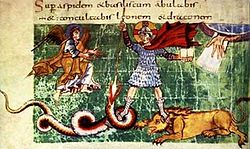
Christianization
The historical phenomenon of Christianization is the conversion of individuals to Christianity or the conversion of entire peoples at once...
in the course of Late Antiquity
Late Antiquity
Late Antiquity is a periodization used by historians to describe the time of transition from Classical Antiquity to the Middle Ages, in both mainland Europe and the Mediterranean world. Precise boundaries for the period are a matter of debate, but noted historian of the period Peter Brown proposed...
and the Early Middle Ages
Early Middle Ages
The Early Middle Ages was the period of European history lasting from the 5th century to approximately 1000. The Early Middle Ages followed the decline of the Western Roman Empire and preceded the High Middle Ages...
. By the 8th century, England and the Frankish Empire
Frankish Empire
Francia or Frankia, later also called the Frankish Empire , Frankish Kingdom , Frankish Realm or occasionally Frankland, was the territory inhabited and ruled by the Franks from the 3rd to the 10th century...
were (officially) Christian, and by AD 1100 Germanic paganism
Germanic paganism
Germanic paganism refers to the theology and religious practices of the Germanic peoples of north-western Europe from the Iron Age until their Christianization during the Medieval period...
had also ceased to have political influence in Scandinavia
Scandinavia
Scandinavia is a cultural, historical and ethno-linguistic region in northern Europe that includes the three kingdoms of Denmark, Norway and Sweden, characterized by their common ethno-cultural heritage and language. Modern Norway and Sweden proper are situated on the Scandinavian Peninsula,...
.
History
In the 4th century, the early process of ChristianizationChristianization
The historical phenomenon of Christianization is the conversion of individuals to Christianity or the conversion of entire peoples at once...
of the various Germanic people
Germanic peoples
The Germanic peoples are an Indo-European ethno-linguistic group of Northern European origin, identified by their use of the Indo-European Germanic languages which diversified out of Proto-Germanic during the Pre-Roman Iron Age.Originating about 1800 BCE from the Corded Ware Culture on the North...
was partly facilitated by the prestige of the Christian Roman Empire
Roman Empire
The Roman Empire was the post-Republican period of the ancient Roman civilization, characterised by an autocratic form of government and large territorial holdings in Europe and around the Mediterranean....
amongst European pagans. Until the decline of the Roman Empire
Decline of the Roman Empire
The decline of the Roman Empire refers to the gradual societal collapse of the Western Roman Empire. Many theories of causality prevail, but most concern the disintegration of political, economic, military, and other social institutions, in tandem with foreign invasions and usurpers from within the...
, the Germanic tribe
Tribe
A tribe, viewed historically or developmentally, consists of a social group existing before the development of, or outside of, states.Many anthropologists use the term tribal society to refer to societies organized largely on the basis of kinship, especially corporate descent groups .Some theorists...
s who had migrated there (with the exceptions of the Saxons
Saxons
The Saxons were a confederation of Germanic tribes originating on the North German plain. The Saxons earliest known area of settlement is Northern Albingia, an area approximately that of modern Holstein...
, Franks
Franks
The Franks were a confederation of Germanic tribes first attested in the third century AD as living north and east of the Lower Rhine River. From the third to fifth centuries some Franks raided Roman territory while other Franks joined the Roman troops in Gaul. Only the Salian Franks formed a...
, and Lombards
Lombards
The Lombards , also referred to as Longobards, were a Germanic tribe of Scandinavian origin, who from 568 to 774 ruled a Kingdom in Italy...
, see below) had converted to Christianity. Many of them, notably the Goths
Goths
The Goths were an East Germanic tribe of Scandinavian origin whose two branches, the Visigoths and the Ostrogoths, played an important role in the fall of the Roman Empire and the emergence of Medieval Europe....
and Vandals
Vandals
The Vandals were an East Germanic tribe that entered the late Roman Empire during the 5th century. The Vandals under king Genseric entered Africa in 429 and by 439 established a kingdom which included the Roman Africa province, besides the islands of Sicily, Corsica, Sardinia and the Balearics....
, adopted Arianism
Arianism
Arianism is the theological teaching attributed to Arius , a Christian presbyter from Alexandria, Egypt, concerning the relationship of the entities of the Trinity and the precise nature of the Son of God as being a subordinate entity to God the Father...
instead of the Trinitarian
Trinity
The Christian doctrine of the Trinity defines God as three divine persons : the Father, the Son , and the Holy Spirit. The three persons are distinct yet coexist in unity, and are co-equal, co-eternal and consubstantial . Put another way, the three persons of the Trinity are of one being...
(a.k.a. Nicene or orthodox) beliefs that were dogmatically defined by the Catholic Church in the Nicene Creed
Nicene Creed
The Nicene Creed is the creed or profession of faith that is most widely used in Christian liturgy. It is called Nicene because, in its original form, it was adopted in the city of Nicaea by the first ecumenical council, which met there in the year 325.The Nicene Creed has been normative to the...
. The gradual rise of Germanic Christianity was, at times, voluntary, particularly amongst groups associated with the Roman Empire.
From the 6th century, Germanic tribes were converted (and re-converted) by missionaries
Missionary
A missionary is a member of a religious group sent into an area to do evangelism or ministries of service, such as education, literacy, social justice, health care and economic development. The word "mission" originates from 1598 when the Jesuits sent members abroad, derived from the Latin...
of the Catholic Church.
Many Goths converted to Christianity as individuals outside the Roman Empire. Most members of other tribes converted to Christianity when their respective tribes settled within the Empire, and most Franks and Anglo-Saxons converted a few generations later. During the later centuries following the Fall of Rome, as schism
Schism
- Religion :* Schism , a division or a split, usually between people belonging to an organization or movement, most frequently applied to a break of communion between two sections of Christianity that were previously a single body...
between the diocese
Diocese
A diocese is the district or see under the supervision of a bishop. It is divided into parishes.An archdiocese is more significant than a diocese. An archdiocese is presided over by an archbishop whose see may have or had importance due to size or historical significance...
s loyal to the Pope of Rome
Pope
The Pope is the Bishop of Rome, a position that makes him the leader of the worldwide Catholic Church . In the Catholic Church, the Pope is regarded as the successor of Saint Peter, the Apostle...
in the West and those loyal to the other Patriarch
Patriarch
Originally a patriarch was a man who exercised autocratic authority as a pater familias over an extended family. The system of such rule of families by senior males is called patriarchy. This is a Greek word, a compound of πατριά , "lineage, descent", esp...
s in the East
Eastern Orthodox Church
The Orthodox Church, officially called the Orthodox Catholic Church and commonly referred to as the Eastern Orthodox Church, is the second largest Christian denomination in the world, with an estimated 300 million adherents mainly in the countries of Belarus, Bulgaria, Cyprus, Georgia, Greece,...
, most of the Germanic peoples (excepting the Crimean Goths
Crimean Goths
Crimean Goths were those Gothic tribes who remained in the lands around the Black Sea, especially in Crimea. They were the least-powerful, least-known, and almost paradoxically, the longest-lasting of the Gothic communities...
and a few other eastern groups) would gradually become strongly allied with the Catholic Church in the West, particularly as a result of the reign of Charlemagne
Charlemagne
Charlemagne was King of the Franks from 768 and Emperor of the Romans from 800 to his death in 814. He expanded the Frankish kingdom into an empire that incorporated much of Western and Central Europe. During his reign, he conquered Italy and was crowned by Pope Leo III on 25 December 800...
.
Goths
In the 3rd century, East-Germanic peoples migrated into Scythia. Gothic culture and identity emerged from various East-Germanic, local, and Roman influences. In the same period, Gothic raiders took captives among the Romans, including many Christians, (and Roman-supported raiders took captives among the Goths).Wulfila or Ulfilas
Ulfilas
Ulfilas, or Gothic Wulfila , bishop, missionary, and Bible translator, was a Goth or half-Goth and half-Greek from Cappadocia who had spent time inside the Roman Empire at the peak of the Arian controversy. Ulfilas was ordained a bishop by Eusebius of Nicomedia and returned to his people to work...
was the son or grandson of Christian captives from Sadagolthina in Cappadocia. In 337 or 341, Wulfila became the first bishop of the (Christian) Goths. By 348, one of the (Pagan) Gothic kings (reikos) began persecuting the Christian Goths, and Wulfila and many other Christian Goths fled to Moesia Secunda (in modern Bulgaria
Bulgaria
Bulgaria , officially the Republic of Bulgaria , is a parliamentary democracy within a unitary constitutional republic in Southeast Europe. The country borders Romania to the north, Serbia and Macedonia to the west, Greece and Turkey to the south, as well as the Black Sea to the east...
) in the Roman Empire. Other Christians, including Wereka, Batwin
Wereka and Batwin
Wereka and Batwin were two of several Christian Gothic martyrs burned alive in church by the local district royal officer and sacred pontiff, otherwise known as goði, *Wingureiks in the 370s...
, and Saba
Sabbas the Goth
Sabbas the Goth is a martyr and Christian saint.He was born in 334 to Christian parents in a village in the Buzău river valley and lived in what is now the Wallachia region in Romania...
, died in later persecutions.
Between 348 and 383, Wulfila translated the Bible into the Gothic language
Gothic language
Gothic is an extinct Germanic language that was spoken by the Goths. It is known primarily from the Codex Argenteus, a 6th-century copy of a 4th-century Bible translation, and is the only East Germanic language with a sizable Text corpus...
. Thus some Arian Christians in the west used the vernacular languages, in this case including Gothic and Latin, for services, as did Christians in the eastern Roman provinces, while most Christians in the western provinces used Latin.
Franks & Alamanni
The FranksFranks
The Franks were a confederation of Germanic tribes first attested in the third century AD as living north and east of the Lower Rhine River. From the third to fifth centuries some Franks raided Roman territory while other Franks joined the Roman troops in Gaul. Only the Salian Franks formed a...
and their ruling Merovingian dynasty, that had migrated to Gaul
Gaul
Gaul was a region of Western Europe during the Iron Age and Roman era, encompassing present day France, Luxembourg and Belgium, most of Switzerland, the western part of Northern Italy, as well as the parts of the Netherlands and Germany on the left bank of the Rhine. The Gauls were the speakers of...
from the 3rd century had remained pagan at first. On Christmas 498, however, Clovis I
Clovis I
Clovis Leuthwig was the first King of the Franks to unite all the Frankish tribes under one ruler, changing the leadership from a group of royal chieftains, to rule by kings, ensuring that the kingship was held by his heirs. He was also the first Catholic King to rule over Gaul . He was the son...
following his victory at the Battle of Tolbiac
Battle of Tolbiac
The Battle of Tolbiac was fought between the Franks under Clovis I and the Alamanni, traditionally set in 496. The site of "Tolbiac", or "Tulpiacum" is usually given as Zülpich, North Rhine-Westphalia, about 60km east of the present German-Belgian frontier, which is not implausible...
converted to the orthodox faith of the Catholic Church and let himself be baptised at Rheims. The details of this event have been passed down by Gregory of Tours
Gregory of Tours
Saint Gregory of Tours was a Gallo-Roman historian and Bishop of Tours, which made him a leading prelate of Gaul. He was born Georgius Florentius, later adding the name Gregorius in honour of his maternal great-grandfather...
.
The Alamanni
Alamanni
The Alamanni, Allemanni, or Alemanni were originally an alliance of Germanic tribes located around the upper Rhine river . One of the earliest references to them is the cognomen Alamannicus assumed by Roman Emperor Caracalla, who ruled the Roman Empire from 211 to 217 and claimed thereby to be...
became Christians only after a period of syncretism during the 7th century, by gradual emulation of the new religion of the Merovingian èlite.
The Lombards
Lombards
The Lombards , also referred to as Longobards, were a Germanic tribe of Scandinavian origin, who from 568 to 774 ruled a Kingdom in Italy...
adopted Catholic Christianity as they entered Italy
Italy
Italy , officially the Italian Republic languages]] under the European Charter for Regional or Minority Languages. In each of these, Italy's official name is as follows:;;;;;;;;), is a unitary parliamentary republic in South-Central Europe. To the north it borders France, Switzerland, Austria and...
, also during the 6th century.
In the 8th century, the Franks
Franks
The Franks were a confederation of Germanic tribes first attested in the third century AD as living north and east of the Lower Rhine River. From the third to fifth centuries some Franks raided Roman territory while other Franks joined the Roman troops in Gaul. Only the Salian Franks formed a...
became standard-bearers of Roman Catholic Christianity in Western Europe, waging wars on its behalf against Arian Christians, Islam
Islam
Islam . The most common are and . : Arabic pronunciation varies regionally. The first vowel ranges from ~~. The second vowel ranges from ~~~...
ic invaders, and pagan Germanic peoples such as the Saxons
Saxons
The Saxons were a confederation of Germanic tribes originating on the North German plain. The Saxons earliest known area of settlement is Northern Albingia, an area approximately that of modern Holstein...
and Frisians
Frisians
The Frisians are a Germanic ethnic group native to the coastal parts of the Netherlands and Germany. They are concentrated in the Dutch provinces of Friesland and Groningen and, in Germany, East Frisia and North Frisia, that was a part of Denmark until 1864. They inhabit an area known as Frisia...
. Until 1066, when the Danes and the Norse
Norsemen
Norsemen is used to refer to the group of people as a whole who spoke what is now called the Old Norse language belonging to the North Germanic branch of Indo-European languages, especially Norwegian, Icelandic, Faroese, Swedish and Danish in their earlier forms.The meaning of Norseman was "people...
had lost their foothold in Britain
Great Britain
Great Britain or Britain is an island situated to the northwest of Continental Europe. It is the ninth largest island in the world, and the largest European island, as well as the largest of the British Isles...
, theological and missionary work in Germany
Germany
Germany , officially the Federal Republic of Germany , is a federal parliamentary republic in Europe. The country consists of 16 states while the capital and largest city is Berlin. Germany covers an area of 357,021 km2 and has a largely temperate seasonal climate...
was largely organized by Anglo-Saxon mission
Anglo-Saxon mission
Anglo-Saxon missionaries were instrumental in the spread of Christianity in the Frankish Empire during the 8th century, continuing the work of Hiberno-Scottish missionaries which had been spreading Celtic Christianity across the Frankish Empire as well as in Scotland and Anglo-Saxon England itself...
aries, with mixed success. A key event was the felling of Thor's Oak
Thor's Oak
The Donar Oak was a legendary oak tree sacred to the Germanic tribe of the Chatti, ancestors of the Hessians, and an important sacred site of the pagan Germanic peoples....
in 723 near Fritzlar
Fritzlar
Fritzlar is a small German town in the Schwalm-Eder district in northern Hesse, north of Frankfurt, with a storied history. It can reasonably be argued that the town is the site where the Christianization of northern Germany began and the birthplace of the German empire as a political entity.The...
by Boniface, apostle of the Germans and first archbishop of Mainz.
Eventually, the conversion was imposed by armed force and successfully completed by Charles the Great (Charlemagne
Charlemagne
Charlemagne was King of the Franks from 768 and Emperor of the Romans from 800 to his death in 814. He expanded the Frankish kingdom into an empire that incorporated much of Western and Central Europe. During his reign, he conquered Italy and was crowned by Pope Leo III on 25 December 800...
) and the Franks in a series of campaigns (the Saxon Wars
Saxon Wars
The Saxon Wars were the campaigns and insurrections of the more than thirty years from 772, when Charlemagne first entered Saxony with the intent to conquer, to 804, when the last rebellion of disaffected tribesmen was crushed. In all, eighteen battles were fought in what is now northwestern Germany...
), starting in 772 with the destruction of their Irminsul
Irminsul
An Irminsul was a kind of pillar which is attested as playing an important role in the Germanic paganism of the Saxon people. The oldest chronicle describing an Irminsul refers to it as a tree trunk erected in the open air...
and culminating in the defeat and massacre of Saxon leaders at the Bloody Verdict of Verden
Bloody Verdict of Verden
The Massacre of Verden, Bloodbath of Verden, or Bloody Verdict of Verden was a massacre of 4,500 captive rebel Saxons in 782. During the Saxon Wars, the Saxons rebelled against Charlemagne's invasion and subsequent attempts to Christianize them from their native Germanic paganism...
in 787 and the subjugation of this large tribe by forced population movements of Saxons into Frankish territory and vice-versa.
England
Christianization of Anglo-Saxon England began around AD 600, influenced by the Gregorian missionGregorian mission
The Gregorian mission, sometimes known as the Augustinian mission, was the missionary endeavour sent by Pope Gregory the Great to the Anglo-Saxons in 596 AD. Headed by Augustine of Canterbury, its goal was to convert the Anglo-Saxons to Christianity. By the death of the last missionary in 653, they...
from the south-east and the Hiberno-Scottish mission
Hiberno-Scottish mission
The Hiberno-Scottish mission was a mission led by Irish and Scottish monks which spread Christianity and established monasteries in Great Britain and continental Europe during the Middle Ages...
from the north-west. Gregory I sent the first Archbishop of Canterbury
Archbishop of Canterbury
The Archbishop of Canterbury is the senior bishop and principal leader of the Church of England, the symbolic head of the worldwide Anglican Communion, and the diocesan bishop of the Diocese of Canterbury. In his role as head of the Anglican Communion, the archbishop leads the third largest group...
, Augustine
Augustine of Canterbury
Augustine of Canterbury was a Benedictine monk who became the first Archbishop of Canterbury in the year 597...
, to southern England in 597. The process of conversion usually proceeded from the top of the social hierarchy downwards, generally peacefully, with a local ruler choosing to convert, whereupon his subjects then also nominally became Christian. This process was often only partial, perhaps due to confusion as to the nature of the new religion, or for a desire to take the best of both traditions. A famous case being that of king Raedwald of East Anglia
Kingdom of the East Angles
The Kingdom of East Anglia, also known as the Kingdom of the East Angles , was a small independent Anglo-Saxon kingdom that comprised what are now the English counties of Norfolk and Suffolk and perhaps the eastern part of the Fens...
, who had a Christian altar erected within his pagan temple. His suspected burial place at Sutton Hoo
Sutton Hoo
Sutton Hoo, near to Woodbridge, in the English county of Suffolk, is the site of two 6th and early 7th century cemeteries. One contained an undisturbed ship burial including a wealth of Anglo-Saxon artefacts of outstanding art-historical and archaeological significance, now held in the British...
shows definite influences of both Christian and pagan burial rites.
The last pagan Anglo-Saxon king, the Jutish
Jutes
The Jutes, Iuti, or Iutæ were a Germanic people who, according to Bede, were one of the three most powerful Germanic peoples of their time, the other two being the Saxons and the Angles...
king Arwald
Arwald
Arwald was the last Jutish King of the Isle of Wight and last pagan king in Anglo-Saxon England until the Vikings in the 9th century. His name may have been "Arwald" or "Atwald" - Bede's script is often difficult to read...
of the Isle of Wight
Isle of Wight
The Isle of Wight is a county and the largest island of England, located in the English Channel, on average about 2–4 miles off the south coast of the county of Hampshire, separated from the mainland by a strait called the Solent...
, was killed in battle in 686 fighting against the imposition of Christianity in his kingdom.
During the prolonged period of Viking incursions and settlement of Anglo-Saxon England pagan ideas and religious rites made something of a comeback, mainly in the Danelaw
Danelaw
The Danelaw, as recorded in the Anglo-Saxon Chronicle , is a historical name given to the part of England in which the laws of the "Danes" held sway and dominated those of the Anglo-Saxons. It is contrasted with "West Saxon law" and "Mercian law". The term has been extended by modern historians to...
during the 9th century and particularly in the Kingdom of Northumbria, whose last king to rule it as an independent state was Eric Bloodaxe
Eric Bloodaxe
Eric Haraldsson , nicknamed ‘Bloodaxe’ , was a 10th-century Scandinavian ruler. He is thought to have had short-lived terms as the second king of Norway and possibly as the last independent ruler of the kingdom of Northumbria Eric Haraldsson (Eric, anglicised form of ; died 954), nicknamed...
, a Viking, probably pagan and ruler until 954 AD.
Scandinavia
Scandinavia was the last part of Germanic Europe to convert and most resistant. From the High Middle AgesHigh Middle Ages
The High Middle Ages was the period of European history around the 11th, 12th, and 13th centuries . The High Middle Ages were preceded by the Early Middle Ages and followed by the Late Middle Ages, which by convention end around 1500....
, the territories of Northern Europe
Northern Europe
Northern Europe is the northern part or region of Europe. Northern Europe typically refers to the seven countries in the northern part of the European subcontinent which includes Denmark, Estonia, Latvia, Lithuania, Norway, Finland and Sweden...
were gradually converted to Christianity under German leadership, and made into nation states under the Church's guidance, finalized in the Northern Crusades
Northern Crusades
The Northern Crusades or Baltic Crusades were crusades undertaken by the Christian kings of Denmark and Sweden, the German Livonian and Teutonic military orders, and their allies against the pagan peoples of Northern Europe around the southern and eastern shores of the Baltic Sea...
.
Later, German and Scandinavia
Scandinavia
Scandinavia is a cultural, historical and ethno-linguistic region in northern Europe that includes the three kingdoms of Denmark, Norway and Sweden, characterized by their common ethno-cultural heritage and language. Modern Norway and Sweden proper are situated on the Scandinavian Peninsula,...
n noblemen extended their power to also Finnic
Finnic peoples
The Finnic or Fennic peoples were historic ethnic groups who spoke various languages traditionally classified as Finno-Permic...
, Samic
Sami people
The Sami people, also spelled Sámi, or Saami, are the arctic indigenous people inhabiting Sápmi, which today encompasses parts of far northern Sweden, Norway, Finland, the Kola Peninsula of Russia, and the border area between south and middle Sweden and Norway. The Sámi are Europe’s northernmost...
, Baltic
Balts
The Balts or Baltic peoples , defined as speakers of one of the Baltic languages, a branch of the Indo-European language family, are descended from a group of Indo-European tribes who settled the area between the Jutland peninsula in the west and Moscow, Oka and Volga rivers basins in the east...
and some Slavic peoples
Slavic peoples
The Slavic people are an Indo-European panethnicity living in Eastern Europe, Southeast Europe, North Asia and Central Asia. The term Slavic represents a broad ethno-linguistic group of people, who speak languages belonging to the Slavic language family and share, to varying degrees, certain...
.
Characteristics
Not only because it had an immense impact on the history of EuropeHistory of Europe
History of Europe describes the history of humans inhabiting the European continent since it was first populated in prehistoric times to present, with the first human settlement between 45,000 and 25,000 BC.-Overview:...
, the Baptism of Clovis deserves a second look. It may also serve to highlight two important characteristics of the Christianization of Europe. Clovis I' wife Clotilde
Clotilde
Saint Clotilde , also known as Clothilde, Clotilda, Clotild, Rotilde or Chroctechildis, was the second wife of the Frankish king Clovis I...
was Roman Catholic and did have an important role in the conversion of her husband. Long before his own baptism, Clovis had allowed that his sons became baptised. However, the decisive reason for Clovis to adopt the Christian faith was the belief that he received spiritual battle aid from Christ
Christ
Christ is the English term for the Greek meaning "the anointed one". It is a translation of the Hebrew , usually transliterated into English as Messiah or Mashiach...
. In the Battle of Tolbiac
Battle of Tolbiac
The Battle of Tolbiac was fought between the Franks under Clovis I and the Alamanni, traditionally set in 496. The site of "Tolbiac", or "Tulpiacum" is usually given as Zülpich, North Rhine-Westphalia, about 60km east of the present German-Belgian frontier, which is not implausible...
he came in such difficulties that he prayed to Christ for victory. Clovis was victorious, and afterward he had himself instructed in the Christian faith by Saint Remigius
Saint Remigius
Saint Remigius, Remy or Remi, , was Bishop of Reims and Apostle of the Franks, . On 24 December 496 he baptised Clovis I, King of the Franks...
.
That a Commander-in-chief
Commander-in-Chief
A commander-in-chief is the commander of a nation's military forces or significant element of those forces. In the latter case, the force element may be defined as those forces within a particular region or those forces which are associated by function. As a practical term it refers to the military...
would attribute his victory to the Christian God is a recurring motive since the Constantinian shift
Constantinian shift
Constantinian shift is a term used by Anabaptist and Post-Christendom theologians to describe the political and theological aspects of the 4th-century process of Constantine's legalization of Christianity. The term was popularized by the Mennonite theologian John H...
. Although the New Testament
New Testament
The New Testament is the second major division of the Christian biblical canon, the first such division being the much longer Old Testament....
nowhere mentions that divine battle aid could be gained from Christ, the Christian cross was known as a trophy to bestow victory since Constantine I
Constantine I
Constantine the Great , also known as Constantine I or Saint Constantine, was Roman Emperor from 306 to 337. Well known for being the first Roman emperor to convert to Christianity, Constantine and co-Emperor Licinius issued the Edict of Milan in 313, which proclaimed religious tolerance of all...
and the Battle of the Milvian Bridge.
However, that a pagan like Clovis, could ask Christ for help also shows the adaptability of the Germanic polytheism. In the polytheistic Germanic tradition, if Odin failed, one absolutely could try it with Christ for once. The Christian sense of religious exclusiveness, as obvious from the First Commandment, was unknown to the pagans. As a result, pagans could be pragmatic and almost utilitarian in their religious decisions. A good example for this are several Thor's Hammer
Thor's Hammer
Thor's Hammer may refer to:* Mjölnir, the hammer wielded by Thor in Norse mythology*Thor's Hammer , a garage rock band from Iceland*Thorr's Hammer, a death/doom band from Ballard, Washington...
with engraved crosses, worn as an amulet
Amulet
An amulet, similar to a talisman , is any object intended to bring good luck or protection to its owner.Potential amulets include gems, especially engraved gems, statues, coins, drawings, pendants, rings, plants and animals; even words said in certain occasions—for example: vade retro satana—, to...
, that archaeologists have found in Scandinavia. Another exemplary event happened during Ansgar
Ansgar
Saint Ansgar, Anskar or Oscar, was an Archbishop of Hamburg-Bremen. The see of Hamburg was designated a "Mission to bring Christianity to the North", and Ansgar became known as the "Apostle of the North".-Life:After his mother’s early death Ansgar was brought up in Corbie Abbey, and made rapid...
's second stay in Birka
Birka
During the Viking Age, Birka , on the island of Björkö in Sweden, was an important trading center which handled goods from Scandinavia as well as Central and Eastern Europe and the Orient. Björkö is located in Lake Mälaren, 30 kilometers west of contemporary Stockholm, in the municipality of Ekerö...
: A pagan priest demanded from the locals, that they did not participate in the cult of the foreign Christian God. If they did not have enough gods yet, they should elevate one of their deceased kings, Erik
Erik Refilsson
Erik Refilsson was a semi-legendary king of Sweden of the House of Munsö, who would have lived in the early 9th century. One of the few surviving Scandinavian sources that deal with Swedish kings from this time is Hervarar saga...
, to be a god.
The baptism of Clovis I also highlights the sacral
Sacred
Holiness, or sanctity, is in general the state of being holy or sacred...
role of the Germanic king. A Germanic king was not only a political ruler, but also held the highest religious 'office' for his people. He was seen as of divine descent, was the leader of the religious cult
Cult (religious practice)
In traditional usage, the cult of a religion, quite apart from its sacred writings , its theology or myths, or the personal faith of its believers, is the totality of external religious practice and observance, the neglect of which is the definition of impiety. Cult in this primary sense is...
and was responsible for the fertility of the land and military victory. Accordingly, the conversion of their leader had a strong impact on his people. If he considered it appropriate to adopt the Christian belief, this also was a good idea for them.
Unlike the history of Christianity in the Roman Empire, conversion of the Germanic tribes in general took place "top to bottom" (Fletcher1999:236), in the sense that missionaries aimed at converting Germanic nobility first, which would then impose their new faith on the general population progressively. This is attributable to the sacral position of the king in Germanic paganism
Germanic paganism
Germanic paganism refers to the theology and religious practices of the Germanic peoples of north-western Europe from the Iron Age until their Christianization during the Medieval period...
: The king is charged with interacting with the divine on behalf of his people, so that the general population saw nothing wrong with their kings choosing alternate modes of worship (Padberg 1998:29; though Fletcher 1999:238 would rather attribute the motivation for conversion to the workings of loyalty-for-reward ethics that underpinned the relationship between a king and his retinue).
Consequently, Christianity had to be made palatable to these Migration Age warlords as a heroic religion of conquerors, a rather straightforward task, considering the military splendour of the Roman Empire
Roman Empire
The Roman Empire was the post-Republican period of the ancient Roman civilization, characterised by an autocratic form of government and large territorial holdings in Europe and around the Mediterranean....
.
Thus early Germanic Christianity was presented as an alternative to native Germanic paganism
Germanic paganism
Germanic paganism refers to the theology and religious practices of the Germanic peoples of north-western Europe from the Iron Age until their Christianization during the Medieval period...
and elements were syncretized, for examples parallels between Woden
Woden
Woden or Wodan is a major deity of Anglo-Saxon and Continental Germanic polytheism. Together with his Norse counterpart Odin, Woden represents a development of the Proto-Germanic god *Wōdanaz....
and Christ
Christ
Christ is the English term for the Greek meaning "the anointed one". It is a translation of the Hebrew , usually transliterated into English as Messiah or Mashiach...
. A fine illustration of these tendencies is the Anglo-Saxon
Old English language
Old English or Anglo-Saxon is an early form of the English language that was spoken and written by the Anglo-Saxons and their descendants in parts of what are now England and southeastern Scotland between at least the mid-5th century and the mid-12th century...
poem Dream of the Rood
Dream of the Rood
The Dream of the Rood is one of the earliest Christian poems in the corpus of Old English literature and an example of the genre of dream poetry. Like most Old English poetry, it is written in alliterative verse. Rood is from the Old English rod "pole", specifically "crucifix"...
, where Jesus is cast in the heroic model of a Germanic warrior, who faces his death unflinchingly and even eagerly. The Cross
Cross
A cross is a geometrical figure consisting of two lines or bars perpendicular to each other, dividing one or two of the lines in half. The lines usually run vertically and horizontally; if they run obliquely, the design is technically termed a saltire, although the arms of a saltire need not meet...
, speaking as if it were a member of Christ's band of retainers, accepts its fate as it watches its Creator die, and then explains that Christ's death was not a defeat but a victory. This is in direct correspondence to the Germanic pagan ideals of fealty to one's lord.
Later developments
In the German Holy Roman EmpireHoly Roman Empire
The Holy Roman Empire was a realm that existed from 962 to 1806 in Central Europe.It was ruled by the Holy Roman Emperor. Its character changed during the Middle Ages and the Early Modern period, when the power of the emperor gradually weakened in favour of the princes...
of the High Middle Ages, there was a chronic power-struggle between the Emperor and the Pope, known as the Investiture Controversy
Investiture Controversy
The Investiture Controversy or Investiture Contest was the most significant conflict between Church and state in medieval Europe. In the 11th and 12th centuries, a series of Popes challenged the authority of European monarchies over control of appointments, or investitures, of church officials such...
.
From the 16th century the Protestant Reformation
Protestant Reformation
The Protestant Reformation was a 16th-century split within Western Christianity initiated by Martin Luther, John Calvin and other early Protestants. The efforts of the self-described "reformers", who objected to the doctrines, rituals and ecclesiastical structure of the Roman Catholic Church, led...
erupted, which took hold almost exclusively in territories where Germanic languages are spoken (Germany, Scandinavia, Britain). The last German Emperor to be crowned by the Pope was Maximilian I
Maximilian I, Holy Roman Emperor
Maximilian I , the son of Frederick III, Holy Roman Emperor and Eleanor of Portugal, was King of the Romans from 1486 and Holy Roman Emperor from 1493 until his death, though he was never in fact crowned by the Pope, the journey to Rome always being too risky...
in 1493. The religious division eventually generated The Thirty Years War (1618–1648) which ultimately led to the Peace of Westphalia
Peace of Westphalia
The Peace of Westphalia was a series of peace treaties signed between May and October of 1648 in Osnabrück and Münster. These treaties ended the Thirty Years' War in the Holy Roman Empire, and the Eighty Years' War between Spain and the Dutch Republic, with Spain formally recognizing the...
(1646) and the confessional division of Germanic Christianity that exists to this day: most of Austria
Austria
Austria , officially the Republic of Austria , is a landlocked country of roughly 8.4 million people in Central Europe. It is bordered by the Czech Republic and Germany to the north, Slovakia and Hungary to the east, Slovenia and Italy to the south, and Switzerland and Liechtenstein to the...
, Luxembourg
Luxembourg
Luxembourg , officially the Grand Duchy of Luxembourg , is a landlocked country in western Europe, bordered by Belgium, France, and Germany. It has two principal regions: the Oesling in the North as part of the Ardennes massif, and the Gutland in the south...
, Southern (especially, Bavaria
Bavaria
Bavaria, formally the Free State of Bavaria is a state of Germany, located in the southeast of Germany. With an area of , it is the largest state by area, forming almost 20% of the total land area of Germany...
) and Western Germany (notably Saarland
Saarland
Saarland is one of the sixteen states of Germany. The capital is Saarbrücken. It has an area of 2570 km² and 1,045,000 inhabitants. In both area and population, it is the smallest state in Germany other than the city-states...
and Rheinland part of Nordrhein-Westfalen) remained Catholic while Northern and Eastern Germany (notably Prussia
Prussia
Prussia was a German kingdom and historic state originating out of the Duchy of Prussia and the Margraviate of Brandenburg. For centuries, the House of Hohenzollern ruled Prussia, successfully expanding its size by way of an unusually well-organized and effective army. Prussia shaped the history...
) remained Lutheran. Under the Peace, the religion of the Lutheran or Catholic ruler determined the religion of his subjects. The current German Pope, Benedict XVI, who was born in Southern Germany (Bavaria), is a product of this confessional division. The Romance speaking territories remained Catholic (with the exception of Geneva
Geneva
Geneva In the national languages of Switzerland the city is known as Genf , Ginevra and Genevra is the second-most-populous city in Switzerland and is the most populous city of Romandie, the French-speaking part of Switzerland...
, where Calvinism
Calvinism
Calvinism is a Protestant theological system and an approach to the Christian life...
originated) while Scandinavia remained Lutheran.
List of missionaries
Christian Missionaries to Germanic peoples:to the Goths
- UlfilasUlfilasUlfilas, or Gothic Wulfila , bishop, missionary, and Bible translator, was a Goth or half-Goth and half-Greek from Cappadocia who had spent time inside the Roman Empire at the peak of the Arian controversy. Ulfilas was ordained a bishop by Eusebius of Nicomedia and returned to his people to work...
(Gothic, 341-383)
to the Lombards
- Saint Severinus of Noricum (5th century)
- Eugippus
to the Alamanni
- Fridolin of SäckingenFridolin of SäckingenSaint Fridolin, otherwise Fridolin of Säckingen, traditionally believed to have been born in Ireland, was a missionary, and the founder of Säckingen Abbey, Baden, in the 6th or 7th century. He is honoured as the apostle of the Alamanns.-Life:...
- ColumbanusColumbanusColumbanus was an Irish missionary notable for founding a number of monasteries on the European continent from around 590 in the Frankish and Lombard kingdoms, most notably Luxeuil and Bobbio , and stands as an exemplar of Irish missionary activity in early medieval Europe.He spread among the...
(Irish, 6th century)- Saint GallSaint GallSaint Gall, Gallen, or Gallus was an Irish disciple and one of the traditionally twelve companions of Saint Columbanus on his mission from Ireland to the continent. Saint Deicolus is called an older brother of Gall.-Biography:...
- Saint Gall
to the Anglo-Saxons (see Anglo-Saxon Christianity)
- Liuhard of Canterbury (6th century)
- Augustine of CanterburyAugustine of CanterburyAugustine of Canterbury was a Benedictine monk who became the first Archbishop of Canterbury in the year 597...
(597-604)- Laurence of CanterburyLaurence of CanterburyLaurence was the second Archbishop of Canterbury from about 604 to 619. He was a member of the Gregorian mission sent from Italy to England to Christianize the Anglo-Saxons from their native Anglo-Saxon paganism, although the date of his arrival is disputed...
- MellitusMellitusMellitus was the first Bishop of London in the Saxon period, the third Archbishop of Canterbury, and a member of the Gregorian mission sent to England to convert the Anglo-Saxons from their native paganism to Christianity. He arrived in 601 AD with a group of clergymen sent to augment the mission,...
- JustusJustusJustus was the fourth Archbishop of Canterbury. He was sent from Italy to England by Pope Gregory the Great, on a mission to Christianize the Anglo-Saxons from their native Anglo-Saxon paganism, probably arriving with the second group of missionaries despatched in 601...
- Laurence of Canterbury
- Chad of MerciaChad of MerciaChad was a prominent 7th century Anglo-Saxon churchman, who became abbot of several monasteries, Bishop of the Northumbrians and subsequently Bishop of the Mercians and Lindsey People. He was later canonized as a saint. He was the brother of Cedd, also a saint...
(7th century) - Saint HonoriusSaint HonoriusHonorius was a member of the Gregorian mission to Christianize the Anglo-Saxons from their native Anglo-Saxon paganism in 597 AD who later became Archbishop of Canterbury. During his archiepiscopate, he consecrated the first native English bishop of Rochester as well as helping the missionary...
(7th century) - Aidan of LindisfarneAidan of LindisfarneKnown as Saint Aidan of Lindisfarne, Aidan the Apostle of Northumbria , was the founder and first bishop of the monastery on the island of Lindisfarne in England. A Christian missionary, he is credited with restoring Christianity to Northumbria. Aidan is the Anglicised form of the original Old...
(7th century)
to the Frankish Empire (see Hiberno-Scottish
Hiberno-Scottish mission
The Hiberno-Scottish mission was a mission led by Irish and Scottish monks which spread Christianity and established monasteries in Great Britain and continental Europe during the Middle Ages...
, Anglo-Saxon mission
Anglo-Saxon mission
Anglo-Saxon missionaries were instrumental in the spread of Christianity in the Frankish Empire during the 8th century, continuing the work of Hiberno-Scottish missionaries which had been spreading Celtic Christianity across the Frankish Empire as well as in Scotland and Anglo-Saxon England itself...
)
- Saint Trudpert (Irish, 7th century)
- Saint Rumbold
- Saint BonifaceSaint BonifaceSaint Boniface , the Apostle of the Germans, born Winfrid, Wynfrith, or Wynfryth in the kingdom of Wessex, probably at Crediton , was a missionary who propagated Christianity in the Frankish Empire during the 8th century. He is the patron saint of Germany and the first archbishop of Mainz...
(English, 8th century)- Saint WalpurgaSaint WalpurgaSaint Walpurga or Walburga , also spelled Valderburg or Guibor, was an English missionary to the Frankish Empire. She was canonized on 1 May ca. 870 by Pope Adrian II...
, Saint Willibald and Saint Winibald (English siblings assisting St Boniface)
- Saint Walpurga
- Saint Wilfried
- Saint Willibrord
- Saint Willehad
- Saint Lebuin
- Saint Liudger
- Saint Ewald
- Saint Suitbert of Kaiserswerth
- Saint PirminSaint PirminSaint Pirmin , also named Pirminius, was a monk, strongly influenced by Celtic Christianity and Saint Amand.-Biography:...
(8th century) - CharlemagneCharlemagneCharlemagne was King of the Franks from 768 and Emperor of the Romans from 800 to his death in 814. He expanded the Frankish kingdom into an empire that incorporated much of Western and Central Europe. During his reign, he conquered Italy and was crowned by Pope Leo III on 25 December 800...
to the Bavarians
- Saint Corbinian (8th century)
to Scandinavia
- AnsgarAnsgarSaint Ansgar, Anskar or Oscar, was an Archbishop of Hamburg-Bremen. The see of Hamburg was designated a "Mission to bring Christianity to the North", and Ansgar became known as the "Apostle of the North".-Life:After his mother’s early death Ansgar was brought up in Corbie Abbey, and made rapid...
(9th century) - Adam of BremenAdam of BremenAdam of Bremen was a German medieval chronicler. He lived and worked in the second half of the eleventh century. He is most famous for his chronicle Gesta Hammaburgensis Ecclesiae Pontificum .-Background:Little is known of his life other than hints from his own chronicles...
(11th century)
See also
- ArianismArianismArianism is the theological teaching attributed to Arius , a Christian presbyter from Alexandria, Egypt, concerning the relationship of the entities of the Trinity and the precise nature of the Son of God as being a subordinate entity to God the Father...
- Cuius regio, eius religioCuius regio, eius religioCuius regio, eius religio is a phrase in Latin translated as "Whose realm, his religion", meaning the religion of the ruler dictated the religion of the ruled...
- Donar Oak
- Germanic paganismGermanic paganismGermanic paganism refers to the theology and religious practices of the Germanic peoples of north-western Europe from the Iron Age until their Christianization during the Medieval period...
- MuspilliMuspilliMuspilli is one of but two surviving pieces of Old High German epic poetry , dating to around 870. One large fragment of the text has survived in the margins and empty pages of a codex marked as the possession of Louis the German and now in the Bayerische Staatsbibliothek . The beginning and end of...
- Protestant ReformationProtestant ReformationThe Protestant Reformation was a 16th-century split within Western Christianity initiated by Martin Luther, John Calvin and other early Protestants. The efforts of the self-described "reformers", who objected to the doctrines, rituals and ecclesiastical structure of the Roman Catholic Church, led...
- Catholic Reformation
- Christianization of ScandinaviaChristianization of ScandinaviaThe Christianization of Scandinavia took place between the 8th and the 12th century. The realms of Scandinavia proper, Denmark, Norway and Sweden, established their own Archdioceses, responsible directly to the Pope, in 1104, 1154 and 1164, respectively...