
All Topics  
Battle of Monte Cassino

 
Battle of Monte Cassino

   Email Print
   Bookmark   Link


Battle of Monte Cassino


The Battle of Monte Cassino (also known as the Battle for Rome and the Battle for Cassino) was a costly series of four battles during World War II
World War II

World War II, or the Second World War , was a global military conflict which involved a Participants in World War II, including all of the great powers, organised into two opposing military alliances: the Allies of World War II and the Axis powers....
, fought by the Allies
Allies of World War II

The Allies of World War II were the countries officially opposed to the Axis powers of World War II during the World War II. Within the ranks of the Allies powers, the British Empire, the Soviet Union, and the United States of America were known as "The Big Three"....
 with the intention of breaking through the Winter Line
Winter Line

The Winter Line was a series of Germany military fortifications in Italy, constructed during World War II by Organisation Todt. The main line of fortification, called the Gustav Line, ran across Italy from just north of where the Garigliano River flows into the Tyrrhenian Sea in the west, through the Apennine Mountains to the mouth of...
 and seizing Rome
Rome

Rome is the capital city of Italy and Lazio, and is Italy's largest and most populous city, with 2,724,347 residents in an urban area of some ....
.

In the beginning of 1944, the western half of the Gustav Line was being anchored by Germans holding the Rapido, Liri and Garigliano valleys and certain surrounding peaks and ridges, but not the historic abbey of Monte Cassino
Monte Cassino

Monte Cassino is a rocky hill about 130 km southeast of Rome, Italy, c. 2 km to the west of the town of Cassino, Italy and 520 m altitude....
, founded in AD 524 by St.


Discussion
Ask a question about 'Battle of Monte Cassino'
Start a new discussion about 'Battle of Monte Cassino'
Answer questions from other users
Full Discussion Forum


Encyclopedia


The Battle of Monte Cassino (also known as the Battle for Rome and the Battle for Cassino) was a costly series of four battles during World War II
World War II

World War II, or the Second World War , was a global military conflict which involved a Participants in World War II, including all of the great powers, organised into two opposing military alliances: the Allies of World War II and the Axis powers....
, fought by the Allies
Allies of World War II

The Allies of World War II were the countries officially opposed to the Axis powers of World War II during the World War II. Within the ranks of the Allies powers, the British Empire, the Soviet Union, and the United States of America were known as "The Big Three"....
 with the intention of breaking through the Winter Line
Winter Line

The Winter Line was a series of Germany military fortifications in Italy, constructed during World War II by Organisation Todt. The main line of fortification, called the Gustav Line, ran across Italy from just north of where the Garigliano River flows into the Tyrrhenian Sea in the west, through the Apennine Mountains to the mouth of...
 and seizing Rome
Rome

Rome is the capital city of Italy and Lazio, and is Italy's largest and most populous city, with 2,724,347 residents in an urban area of some ....
.

In the beginning of 1944, the western half of the Gustav Line was being anchored by Germans holding the Rapido, Liri and Garigliano valleys and certain surrounding peaks and ridges, but not the historic abbey of Monte Cassino
Monte Cassino

Monte Cassino is a rocky hill about 130 km southeast of Rome, Italy, c. 2 km to the west of the town of Cassino, Italy and 520 m altitude....
, founded in AD 524 by St. Benedict, although they manned defensive positions set into the steep slopes below the abbey walls. On February 15 the monastery, high on a peak overlooking the town of Cassino, was destroyed by 1400 tons of bombs dropped by American B-17, B-25, and B-26
B-26 Marauder

The Martin B-26 Marauder was a World War II twin-engine medium bomber built by the Glenn L. Martin Company.The first US medium bomber used in the Pacific War in early 1942, it was also used in the Mediterranean Theatre of World War II and in Western Front ....
 bombers. The bombing was based on the fear that the abbey was being used as a lookout post for the Axis
Axis Powers

The Axis powers were those countries that were opposed to the Allies of World War II during World War II. The three major Axis powers - Nazi Germany, Kingdom of Italy , and Empire of Japan - were part of a military alliance on the signing of the Tripartite Pact in September 1940, which officially founded the Axis powers....
 defenders (this position evolved over time to admit that Axis military was not garrisoned there). Two days after the bombing, German paratroopers
Fallschirmjäger

File:Bundesarchiv Bild 101I-527-2348-21, Kreta, Fallschirmj?ger vor Start mit Ju 52.jpg are Germany paratroopers. Fallschirmj?ger of Germany in World War II were the first to be committed in large-scale airborne operations....
 poured into the ruins to defend it. From January 17 to May 18, the Gustav defenses were assaulted four times by Allied troops. These operations resulted in casualties of over 54,000 Allied and 20,000 German soldiers.

Background

The Allied landings in Italy in September 1943 by two Allied armies commanded by General Sir Harold Alexander, Commander-in-Chief Allied Armies in Italy
Allied Armies in Italy

Allied Armies in Italy, commanded by Field Marshal Sir Harold Alexander, was the title of the highest Allied field headquarters in Italy, during the middle part of that campaign....
, were followed by an advance northward on two fronts, one on each side of the central mountain range forming the "spine" of Italy. On the western front, the U.S. 5th Army, commanded by Lieutenant-General Mark W. Clark, moved from the main base of Naples
Naples

Naples is a city in southern Italy, the capital of the region of Campania and of the province of Naples. The city is known for its rich history, art, culture and gastronomy, playing an important role throughout much of its existence; it is over 2,800 years old....
 up the Italian "boot" and in the east General Sir Bernard Montgomery's British 8th Army advanced up the Adriatic
Adriatic Sea

The Adriatic Sea is a body of water separating the Italian Peninsula from the Balkan peninsula, and the system of the Apennine Mountains from that of the Dinaric Alps and adjacent ranges....
 coast.

5th Army made slow progress in the face of difficult terrain, wet weather and skillful German defenses. The Germans were fighting from a series of prepared positions in a manner designed to inflict maximum damage, then pulling back and so buying time for the construction of the Winter Line defensive positions south of Rome
Rome

Rome is the capital city of Italy and Lazio, and is Italy's largest and most populous city, with 2,724,347 residents in an urban area of some ....
. The original estimates that Rome would fall by October 1943 proved much too optimistic.

Although in the east the Winter Line had been breached on the British 8th Army's Adriatic front and Ortona was captured
Battle of Ortona

The Battle of Ortona was a small, yet extremely fierce, battle fought between Germany Fallschirmj?ger of the German 1st Parachute Division under Generalleutnant Richard Heidrich, and assaulting Canada forces from the 1st Canadian Infantry Division under Major General Chris Vokes....
, the advance had ground to a halt with the onset of winter blizzards at the end of December, making close air support and movement in the jagged terrain impossible. The route to Rome from the east using Route 5 was thus excluded as a viable option leaving the routes from Naples to Rome, highways 6 and 7, as the only possibilities; highway 7 (the old Roman Appian Way
Appian Way

The Appian Way was one of the earliest and strategically most important Roman roads of the ancient Roman Republic. It connected Rome to Brindisi, Apulia, in southeast Italy....
) followed along the west coast but south of Rome ran into the Pontine Marshes which the Germans had flooded. Highway 6 ran through the Liri
Liri

The Liri is one of the principal rivers of central Italy, flowing into the Tyrrhenian Sea a little below Minturno under the name Garigliano.The Liri's source is in the Monte Camiciola in the Monti Simbruini of central Apennine Mountains : in the nearby is the Lake Fucino, of which it has been sometimes, but erroneously, regarded as a subt...
 valley. Dominating the south entrance to this valley was the hill mass behind the town of Cassino. Excellent observation from the peaks of several hills allowed the German defenders to detect Allied movement, prevent any advance northward, and direct artillery
Artillery

Artillery is a military Combat Arms which employs any apparatus, machine, an assortment of tools or instruments, a system or systems used as weapons for the discharge of large projectiles in combat as a major contribution of fire power within the overall military capability of an armed force....
 fire on Allied units. Running across the Allied line of advance was the fast flowing Rapido River
Rapido River

The Rapido is a short river which flows through the Ciociaria in the Italy province of Frosinone.Its source is close to border between Lazio and Molise on the slopes of the Mainarde mountains....
 which rose in the central Apennine mountains
Apennine mountains

The Apennines or Apennine Mountains is a mountain range stretching 1000 km from the north to the south of Italy along its east coast, traversing the entire peninsula, and forming the backbone of the country....
, flowed through Cassino and across the entrance to the Liri valley (where the Liri
Liri

The Liri is one of the principal rivers of central Italy, flowing into the Tyrrhenian Sea a little below Minturno under the name Garigliano.The Liri's source is in the Monte Camiciola in the Monti Simbruini of central Apennine Mountains : in the nearby is the Lake Fucino, of which it has been sometimes, but erroneously, regarded as a subt...
 joined the Rapido) after which its name changed to the River Garigliano (often referred to as the "Gari" by the Allies) and it continued to the sea. With its heavily fortified mountain defenses, difficult river crossings (not only was the river fast flowing, but the Germans had temporarily diverted the Rapido at the head of the valley so as to flood the valley bottom and make conditions underfoot most difficult for any attackers), Cassino formed a linchpin of the Gustav Line, the most formidable line of the defensive positions making up the Winter Line.

Because of the historical significance of the Benedictine
Benedictine

Benedictine refers to the spirituality and consecrated life in accordance with the Rule of St Benedict, written by Benedict of Nursia in the sixth century for the cenobitic communities he founded in central Italy....
 monastery
Monastery

Monastery , a term derived from the Greek language word ???ast?????, neut. of ???ast????? - monasterios denotes the building, or complex of buildings, that houses a room reserved for prayer as well as the domestic quarters and workplace of Monk, whether monks or nuns, and whether living in Cenobium or alone ....
, in December 1943, the German commander-in-chief in Italy, Field Marshall Albert Kesselring
Albert Kesselring

Albert Kesselring was a Luftwaffe Generalfeldmarschall during World War II. Nicknamed "Smiling Albert", he was one of the most skilful generals of Nazi Germany....
, ordered German units not to include the monastery itself in German defensive positions, and informed the Allies accordingly. Controversy exists regarding the extent to which this order was followed.

Some Allied reconnaissance aircraft reported seeing German troops inside the monastery. The monastery had excellent observation of the surrounding hills and valleys, and thus was a natural site for German artillery observers. What is clear is that once the monastery was destroyed the Germans occupied it and made use of the rubble to build defensive positions. Ultimately, however, the military arguments leading to the monastery's destruction rested on its potential threat (real or imagined) rather than its actual state of occupation.

First battle


Plans and preparation

The plan of U.S. 5th Army commander General Clark was for British X Corps
X Corps (United Kingdom)

The X Corps was a British Army formation in World War I and was later reformed in 1942 during the North African campaign of World War II as part of the Eighth Army ....
, on the left of a twenty mile (30 km) front, to attack on January 17, 1944, across the Garigliano near the coast (British 5th and British 56th Infantry Divisions). British 46th Infantry Division was to attack on the night of January 19 across the Garigliano below its junction with the Liri in support of the main attack by U.S. II Corps on their right. The main central thrust by U.S. II Corps would commence on January 20 with 36th (Texas) U.S. Infantry Division making an assault across the swollen Rapido river five miles (8 km) downstream of Cassino. Simultaneously the French Expeditionary Corps
French Expeditionary Corps (1943-1944)

The French Expeditionary Corps , also known as the French Expeditionary Corps in Italy , was an expeditionary force composed of French soldiers that fought in the Italian Campaign during World War II under the command of Alphonse Juin....
, under General Alphonse Juin
Alphonse Juin

Alphonse Pierre Juin was a Marshal of France....
 would continue its "right hook" move towards Monte Cairo, the hinge to the Gustav and Hitler defensive lines
Hitler Line

The Hitler Line was a Germany defensive line in central Italy during the Second World War. The strong points of the line were at Aquino and Piedmont....
. In truth, Clark did not believe there was much chance of an early breakthrough, but he felt that the attacks would draw German reserves away from the Rome area in time for the attack on Anzio
Operation Shingle

Operation Shingle , during the Italian Campaign of World War II, was an Allies of World War II amphibious landing against Axis powers forces in the area of Anzio, Italy and Nettuno, Italy....
 where U.S. VI Corps (British 1st and U.S. 3rd Infantry Divisions) was due to make an amphibious landing on January 22. It was hoped that the Anzio landing, with the benefit of surprise and a rapid move inland to the Alban Hills
Alban Hills

The Alban Hills are the site of a quiescent volcano in Italy, located 20 km southeast of Rome and about 24 km north of Anzio, Italy.The dominant peak is the Monte Cavo, at 950 m ....
, which command both routes 6 and 7, would so threaten the Gustav defenders' rear and supply lines that it might just unsettle the German commanders and cause them to withdraw from the Gustav Line to positions north of Rome. Whilst this would have been consistent with the German tactics of the previous three months, Allied intelligence had not understood that the strategy of fighting retreat had been for the sole purpose of providing time to prepare the Gustav line where the Germans intended to stand firm. The intelligence assessment of Allied prospects were therefore over-optimistic.

The Fifth Army had only reached the Gustav line on January 15, having taken six weeks of heavy fighting to advance the last seven miles (11 km) through the Bernhardt Line
Bernhardt Line

The Bernhardt Line was a Nazi Germany defensive line in Italy during World War II. Having reached the Bernhardt Line at the start of December 1943, it took until mid-January 1944 for Fifth United States Army to fight their way to the next line of defenses, the Gustav Line....
 positions during which time they had sustained 16,000 casualties. They hardly had time to prepare the new assault, let alone take the rest and reorganization they really needed after three months of attritional fighting north from Naples
Naples

Naples is a city in southern Italy, the capital of the region of Campania and of the province of Naples. The city is known for its rich history, art, culture and gastronomy, playing an important role throughout much of its existence; it is over 2,800 years old....
. However, because the Allied Chiefs of Staff would only make landing craft available until early February, the Anzio landing had to take place in late January with the coordinated attack on the Gustav line some three days earlier.

First assault: X Corps on the left, 17 January

The first assault was made on January 17. Near the coast, British X Corps (56th and 5th Divisions) forced a crossing of the Garigliano (followed some two days later by British 46th Division on their right) causing General von Senger, commander of German XIV Panzer Corps and responsible for the Gustav defences on the south western half of the line, some serious concern as to the ability of the German 94th Infantry Division to hold the line. Responding to Senger's concerns, Kesselring ordered the 29th
German 29th Infantry Division

Created as the 29th Infantry Division in the fall of 1936, and upgraded to 29th Motorized Infantry Division in the fall of 1937. It was mobilized in August 1939 for the Invasion of Poland ....
 and 90th
German 90th Light Infantry Division

The '90th Light Infantry Division' was created in August 1941 as 'Division zbV Africa', from units already in Africa under the control of Divisions-Kommando z.b.V....
 Panzer Grenadier Divisions from the Rome area to provide reinforcement. There is some speculation as to what might have been if X Corps had had the reserves available to exploit their success and make a decisive breakthrough. The corps did not have the extra men, but there would certainly have been time to alter the overall battle plan and cancel or modify the central attack by U.S. II Corps to make men available to force the issue in the south before the German reinforcements were able to get into position. As it happened, 5th Army HQ failed to appreciate the frailty of the German position, and the plan was unchanged. The two divisions from Rome arrived by January 21 and stabilized the German position in the south. In one respect, however, the plan was working in that Kesselring's reserves had been drawn south. The three divisions of X Corps sustained 4,000 casualties during the period of the first battle.

Main attack: II Corps in the centre, 20 January


The central thrust by U.S. 36th Division commenced three hours after sunset on January 20. The lack of time to prepare meant that the approach to the river was still hazardous from uncleared mines and booby traps, and the highly technical business of an opposed river crossing lacked the necessary planning and rehearsal. Although a battalion of the 143rd Regiment was able to get across the Rapido on the south side of San Angelo and two companies of the 141st Regiment on the north side, they were isolated for most of the time, and at no time was Allied armor able to get across the river, leaving them highly vulnerable to counterattacking tanks and self-propelled guns of General Rodt's 15th Panzer Grenadier Division. The southern group was forced back across the river by mid-morning of January 21. Maj. Gen. Geoffrey Keyes
Geoffrey Keyes

Geoffrey Keyes was a United States Army General who commanded the II Corps during World War II.He was born in Fort Bayard, New Mexico and graduated from West Point in 1913....
, commanding II Corps, pressed Maj. Gen. Fred Walker of 36th Division to renew the attack immediately. Once again the two regiments attacked but with no more success against the well dug-in 15th Panzer Grenadier Division: 143rd Regiment got the equivalent of two battalions across, but once again there was no armored support, and they were devastated when daylight came the next day. The 141st Regiment also crossed in two battalion strength, and despite the lack of armored support managed to advance 1 km (0.5 miles). However, with the coming of daylight, they too were cut down, and by the evening of January 22 the regiment had virtually ceased to exist with 40 men making it back to the Allied lines. The assault had been a costly failure, with 36th Division losing 2,100 men killed, wounded and missing in 48 hours.

II Corps try north of Cassino: 24 January

The next attack was launched on January 24. The U.S. II Corps, with 34th Infantry Division under Maj. Gen. Charles W. Ryder spearheading the attack and French colonial troops on its right flank, launched an assault across the flooded Rapido valley north of Cassino and into the mountains behind with the intention of then wheeling to the left and attacking Monte Cassino from high ground. Whilst the task of crossing the river would be easier in that the Rapido upstream of Cassino was fordable, the flooding made movement on the approaches each side very difficult. In particular, armor could only move on paths laid with steel matting, and it took eight days of bloody fighting across the waterlogged ground for 34th Division to push back General Franck's 44th Infantry Division
German 44th Infantry Division

The 44th Infantry Division was formed on April 1, 1938 in Vienna, and was destroyed with the German Sixth Army at Stalingrad in January 1943. Like all the divisions lost in the Stalingrad disaster, it was reformed using other formations and usually a cadre of specialists who had been evacuated by air before the 6th Army's surrender....
 to establish a foothold in the mountains.

French Corps halted on the right flank

On the right, the French made good initial progress against the German 5th Mountain Division
German 5th Mountain Division

The German 5th Mountain Division was established in the Austrian German Tyrol in October 1940, out of regiments taken from the German 1st Mountain Division and the German 10th Infantry Division....
, commanded by General Julius Ringel
Julius Ringel

Julius "Papa" Ringel was an Austrian-born Germany General of Gebirgsj?ger . He commanded the 3rd Mountain Division , 5th Mountain Division , German LXIX Corps, Wehrkreis XI and the German Army Corps Ringel....
, gaining positions on the slopes of their key objective, Monte Cifalco. Forward units of the 3rd Algerian Division had also by-passed Monte Cifalco to capture Monte Belvedere and Colle Abate. General Juin was convinced that Cassino could be bypassed and the German defenses unhinged by this northerly route but his request for reserves to maintain the momentum of his advance was refused and the one available reserve regiment (from 36th Division) was sent to reinforce 34th Division. By January 31 the French had ground to a halt with Monte Cifalco, which had a clear view of the French and U.S. flanks and supply lines, still in German hands. The two French divisions sustained 2,500 casualties in their struggles around Monte Belvedere.

II Corps in the mountains north of Cassino

It became U.S. 34th Division's task (joined by 142nd Regiment of 36th Division) to fight southward along the linked hilltops towards the intersecting ridge on the south end of which was Monastery Hill. They could then break through down into the Liri valley behind the Gustav Line defenses. It was very tough going: the mountains were rocky, strewn with boulders and cut by ravines and gullies. Digging foxholes on the rocky ground was out of the question, and each feature was exposed to fire from surrounding high points. The ravines were no better since the gorse
Gorse

Gorse comprises a genus of about 20 species of evergreen shrubs in the subfamily Faboideae of the pea family Fabaceae, native to western Europe and northwest Africa, with the majority of species in Iberian Peninsula....
 growing there, far from giving cover, had been sown with mines, booby-traps and hidden barbed wire by the defenders. The Germans had had three months to prepare their defensive positions using dynamite and to stockpile ammunition and stores. There was no natural shelter, and the weather was wet and freezing cold.

By early February, American infantry had captured a strategic point near the hamlet of San Onofrio, less than a mile from the abbey, and by February 7 a battalion had reached Point 445, a round top hill immediately below the monastery and no more than away. An American squad managed a reconnaissance right up against the cliff-like abbey walls, with the monks observing German and American patrols exchanging fire. However, attempts to take Monte Cassino were broken by overwhelming machine gun fire from the slopes below the monastery. Despite their fierce fighting, the 34th Division never managed to take the final redoubts on Hill 593 (known to the Germans as Calvary Mount), held by the 3rd battalion of the German 2nd Parachute Regiment, the dominating point of the ridge to the monastery.

Aftermath

On February 11, after a final unsuccessful 3 day assault on Monastery Hill and Cassino town, the Americans were withdrawn. U.S. II Corps, after two and a half weeks of torrid battle, was fought out. The performance of 34th Division in the mountains is considered to rank as one of the finest feats of arms carried out by any soldiers during the war. In return they sustained losses of about 80% in the Infantry battalions, some 2,200 casualties.

At the height of the battle in the first days of February General von Senger und Etterlin had moved 90th Division from the Garigliano front to north of Cassino and had been so alarmed at the rate of attrition, he had "...mustered all the weight of my authority to request that the Battle of Cassino should be broken off and that we should occupy a quite new line. ... a position, in fact, north of the Anzio bridgehead". Kesselring refused the request. At the crucial moment von Senger was able to throw in the 71st Infantry Division whilst leaving 15th Panzer Grenadiers (whom they had been due to relieve) in place.

During the battle there had been occasions when, with more astute use of reserves, promising positions might have been turned into decisive moves. Some historians suggest this failure to capitalize on initial success could be put down to General Clark's lack of experience. However, it is more likely that he just had too much to do, being responsible for both the Cassino and Anzio offensives. This view is supported by General Truscott's inability, as related below, to get hold of him for discussions at a vital juncture of the Anzio breakout at the time of the fourth Cassino battle. Whilst General Alexander chose (for perfectly logical co-ordination arguments) to have Cassino and Anzio under a single army commander and splitting the Gustav line front between U.S. 5th and British 8th Armies, Kesselring chose to create a separate 14th Army
German Fourteenth Army

The 14th Army was a World War II field army.The 14th Army was activated on August 1 1939 with General Wilhelm List in command and saw service in Poland until the Polish surrender on October 13 1939....
 under Gen. Eberhard von Mackensen
Eberhard von Mackensen

Eberhard von Mackensen was a Germany general who served in World War II....
 to fight at Anzio whilst leaving the Gustav line in the sole hands of Gen. Heinrich von Vietinghoff
Heinrich von Vietinghoff

Heinrich Gottfried von Vietinghoff genannt Scheel was a Germany Colonel-General of the German Army during the Second World War....
's 10th Army.

The withdrawn American units were replaced by the New Zealand Corps (2nd New Zealand Division
New Zealand 2nd Division

The 2nd New Zealand Division was New Zealand's major land formation during much of World War II. Commanded for most of its existence by Lieutenant General Sir Bernard Freyberg, it fought in most of the major campaigns of the Middle East Theatre of World War II and Mediterranean Theatre of World War II theatre s from 1940 to 1945....
 and 4th Indian Division
Indian 4th Infantry Division

The Indian 4th Infantry Division, also known as the Red Eagle Division, was an infantry division of the British Indian Army. The lineage of the unit is kept alive through a division of the Indian Army....
) from the British 8th Army on the Adriatic front. The New Zealand Corps was commanded by Lt. Gen. Bernard Freyberg.

Second battle (Operation Avenger)


Background

With U.S. VI Corps under heavy threat at Anzio, Freyberg was under equal pressure to launch a relieving action at Cassino. Once again, therefore, the battle commenced without the attackers being fully prepared. As well, Corps HQ did not fully appreciate the difficulty in getting 4th Indian Division into place in the mountains and supplying them on the ridges and valleys north of Cassino (using mules across 7 miles (11 km) of goat tracks over terrain in full view of the monastery, exposed to accurate artillery fire — hence the naming of Death Valley). This was evidenced in the writing of Maj. Gen. Howard Kippenberger
Howard Kippenberger

Major-General Sir Howard Karl Kippenberger, Order of the British Empire, Order of the Bath, Distinguished Service Order, Efficiency Decoration, , known as Kip, served as a New Zealand soldier in both World Wars....
, commander of New Zealand 2nd Division, after the war:

Freyberg's plan was a continuation of the first battle: an attack from the north along the mountain ridges and an attack from the southeast along the railway line and to capture the railway station across the Rapido less than a mile south of Cassino town. Success would pinch out Cassino town and open up the Liri valley. However, Freyberg had informed his superiors that he believed, given the circumstances, there was no better than a 50% chance of success for the offensive.

Destruction of the abbey

Increasingly, the opinions of certain Allied officers were fixed on the great abbey of Monte Cassino: in their view it was the abbey—and its presumed use as a German artillery observation point—that prevented the breach of the ‘Gustav Line'.

The British press and C. L. Sulzberger
C. L. Sulzberger

File:SulzbergerCeausescu.jpgCyrus Leo Sulzberger II was a United States journalist, diarist, and author, and a member of the family that owns the New York Times....
 of The New York Times
The New York Times

The New York Times is an American daily newspaper published in New York City. The largest metropolitan newspaper in the United States, "The Gray Lady"?named for its staid appearance and style?is regarded as a national newspaper of record....
 frequently and convincingly and in (often manufactured) detail wrote of German observation posts and artillery positions inside the abbey. The commander in chief of the Mediterranean Allied Air Forces Lieutenant-General Ira C. Eaker accompanied by Lieutenant-General Jacob L. Devers
Jacob L. Devers

General officer Jacob "Jake" Loucks Devers , who is best remembered for his command of the 6th Army Group in Europe during World War II, graduated 39th out of 103 graduates from the United States Military Academy in 1909 as a classmate of George S....
 (deputy to General Sir Henry Maitland Wilson, the Supreme Allied Commander of the Mediterranean Theater) personally observed during a fly-over “a radio mast [...] German uniforms hanging on a clothesline in the abbey courtyard; [and] machine gun emplacements from the abbey walls.” Major-General Geoffrey Keyes
Geoffrey Keyes

Geoffrey Keyes was a United States Army General who commanded the II Corps during World War II.He was born in Fort Bayard, New Mexico and graduated from West Point in 1913....
 of U.S. II Corps also flew over the monastery several times; he then reported to Fifth Army G-2 that he had seen no evidence the Germans were in the abbey. When informed of others who had claimed to have seen Germans in the abbey, he stated: “They’ve been looking so long they’re seeing things."

The view in New Zealand Corps HQ, as articulated in the writings of Major-General Kippenberger, was that the monastery was probably being used as the German's main vantage point for artillery spotting, since it was so perfectly situated for the purpose that no army could refrain from using it. There is no clear evidence to this effect, but he went on to write that from a military point of view the current state of occupancy of the monastery was immaterial:

Major-General Francis Tuker
Francis Tuker

Sir Francis Ivan Simms Tuker, KCIE CB DSO OBE was a British Indian Army officer.Born on 4 July 1894 and educated at Brighton College, of which he was in later life a governor, Tuker served in the Indian Army and was most famous for commanding the Indian 4th Infantry Division during the Western Desert Campaign and Italian Campaign s of the S...
, whose 4th Indian Division would have the task of attacking Monastery Hill, had made his own appreciation of the situation. In the absence of detailed intelligence at U.S. 5th Army HQ, he had found a book dated 1879 in a Naples bookshop giving details of the construction of the abbey. In his memorandum to Freyberg he concluded that regardless of whether the monastery was currently occupied by the Germans, it should be demolished to prevent its effective occupation. He also pointed out that with 150 foot (45 m) high walls made of masonry at least 10 feet (3 m) thick, there was no practical means for field engineers to deal with the place, and that bombing with "blockbuster" bombs would be the only solution since 1,000 pound bombs would be "next to useless".

On February 11, 1944, the acting commander of 4th Indian Division, Brigadier Harry Dimoline
Harry Kenneth Dimoline

Brigadier Harry Kenneth Dimoline Order of the British Empire Order of the British Empire Distinguished Service Order Territorial Decoration Colonial Police Medal was an artillery officer in the British Army and British Indian Army during World War II....
, requested the bombing of the abbey of Monte Cassino. Tuker reiterated again his case for bombing the monastery from his hospital bed in Caserta, where he was suffering a severe attack of a recurrent tropical fever. Freyberg transmitted his request on February 12. Freyberg's request for an air attack, however, was greatly expanded by air force planners, and probably supported by Ira Eaker and Jacob L. Devers. They sought to use the opportunity to showcase the abilities of U.S. Army air power to support ground operations. Lieutenant-General Mark W. Clark of Fifth Army and his chief of staff Major-General Alfred Gruenther
Alfred Gruenther

Alfred Maximilian Gruenther was the youngest World War II Major General and after the war, as a four-star General, served as the Supreme Allied Commander Europe in Europe from 1953 to 1956....
 remained unconvinced of the “military necessity”. When handing over the U.S. II Corps position to the New Zealand Corps, Brigadier Butler, deputy commander of U.S. 34th Division, had said "I don't know, but I don't believe the enemy is in the convent. All the fire has been from the slopes of the hill below the wall". Clark pinned down the Commander-in-Chief Allied Armies in Italy
Allied Armies in Italy

Allied Armies in Italy, commanded by Field Marshal Sir Harold Alexander, was the title of the highest Allied field headquarters in Italy, during the middle part of that campaign....
, General Sir Harold Alexander: “You give me a direct order and we’ll do it.” He did.

The bombing mission in the morning of February 15, 1944 involved 142 B-17 Flying Fortress
B-17 Flying Fortress

The Boeing B-17 Flying Fortress is a four-engine heavy bomber aircraft developed for the United States Army Air Corps . Competing against Douglas Aircraft Company and Glenn L....
es together with 47 B-25 Mitchell
B-25 Mitchell

The North American B-25 Mitchell was an American twin-engined medium bomber manufactured by North American Aviation. It was used by many Allies of World War II air forces, in every theater of World War II, as well as many other air forces after the war ended, and saw service across four decades....
 and 40 B-26 Marauder
B-26 Marauder

The Martin B-26 Marauder was a World War II twin-engine medium bomber built by the Glenn L. Martin Company.The first US medium bomber used in the Pacific War in early 1942, it was also used in the Mediterranean Theatre of World War II and in Western Front ....
 medium bombers. In all they dropped 1,150 tons of high explosives and incendiary bombs on the abbey, reducing the entire top of Monte Cassino to a smoking mass of rubble. Between bomb runs, the II Corps artillery pounded the mountain. Many Allied soldiers and war correspondents cheered as they observed the spectacle. Eaker and Devers watched; Juin was heard to remark “... no, they’ll never get anywhere this way.” Clark and Gruenther refused to be on the scene and stayed at their headquarters. That same afternoon and the next day, in an aggressive follow-up, further artillery barrages and additional tonnage onto the ruins by 59 fighter bombers convulsed the rubble of the great abbey.

The air raid however, had not been coordinated between the air and ground commands, with the timing driven by the Air Force projecting it as a separate operation, considering the weather and to be fitted in with other requirements on other fronts and theaters and without reference to the ground forces (indeed, the Indian troops on the Snake's Head were taken by surprise when the bombing actually started). The raid took place two days before the New Zealand Corps was ready to launch their main assault. Many of the troops had only taken over their positions from U.S. II Corps on February 13, and besides the difficulties in the mountains, preparations in the valley had also been held up by difficulties in supplying the newly installed troops with sufficient material for a full-scale assault because of incessantly foul weather, flooding, and waterlogged ground.

After the bombing

Pope Pius XII was silent after the bombing; however, his secretary of state, Cardinal Maglione
Luigi Cardinal Maglione

Luigi Maglione was an Italy Cardinal of the Roman Catholic Church. He served as the Cardinal Secretary of State under Pope Pius XII from 1939 until his death, and was elevated to the Cardinal in 1935....
, bluntly stated to the senior U.S. diplomat to the Vatican
Holy See

The Holy See is the episcopal jurisdiction of the Bishop of Rome, commonly known as the Pope, and is the preeminent episcopal see of the Roman Catholic Church, forming the central government of the Church....
, Harold Tittmann, that the bombing was “a colossal blunder . . . a piece of a gross stupidity.”

What is certain from every investigation that followed since the event, is the fact that the only people killed in the monastery by the bombing were Italian civilians seeking refuge in the abbey. There is no evidence that the bombs dropped on the Monte Cassino monastery that day killed German troops. However, given the imprecision of bombing in those days (it was estimated that only 10% of the bombs from the heavy bombers, bombing from high altitude, hit the monastery) bombs did fall elsewhere and killed German and Allied troops alike. Indeed, sixteen bombs hit the Fifth Army compound at Presenzano 17 miles (27 km) from Monte Cassino and exploded only yards away from the trailer where Gen. Clark was doing paperwork at his desk.

On the day after the bombing at first light, most of the civilians still alive fled the ruins. Only about 40 people remained: the six monks who survived in the deep vaults of the abbey, their 79 year old abbot, Gregorio Diamare, three tenant farmer families, orphaned or abandoned children, the badly wounded and the dying. After artillery barrages, renewed bombing and attacks on the ridge by 4th Indian Division, the monks decided to leave their ruined home with the others who could move at 07:30 on February 17. The old abbot was leading the group down the mule path towards the Liri Valley, reciting the rosary. After they arrived at a German first-aid station, some of the badly wounded who had been carried by the monks were taken away in a military ambulance. After meeting with German officers, including the commander of XIV Panzer Corps, Lieutenant-General Fridolin von Senger und Etterlin, the monks were driven to the monastery of Sant'Anselmo. One monk, Carlomanno Pellagalli, returned to the abbey; when he was later seen wandering the ruins, the German paratroopers thought he was a ghost. After April 3, he was not seen anymore.

Paratroopers of German 1st Parachute Division then occupied the ruins of the abbey and turned it into a fortress, which became a serious problem for the attacking allied forces.

Battle

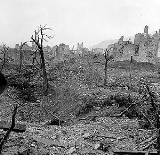
Monte Cassino Troops
On the night following the bombing, a company of the 1st battalion Royal Sussex Regiment
Royal Sussex Regiment

The Royal Sussex Regiment, a regiment in the British Army , was formed in 1881 from the 35th Regiment of Foot and the 107th Regiment of Foot ....
 (one of the British elements in 4th Indian Division) attacked the key point 593 from their position away on Snakeshead Ridge. The assault failed, with the company sustaining 50% casualties.

The following night the Sussex Regiment was ordered to attack in battalion strength. There was a calamitous start. Artillery could not be used in direct support targeting point 593 because of the proximity and risk of shelling friendly troops. It was planned therefore to shell point 575 which had been providing supporting fire to the defenders of point 593. The topography of the land meant that shells fired at 575 had to pass very low over Snakeshead ridge, and in the event some fell among the gathering assault companies. After reorganising, the attack went in at midnight. The fighting was brutal and often hand to hand, but the determined defence held and the Sussex battalion was beaten off, once again sustaining over 50% casualties. Over the two nights, the Sussex Regiment lost 12 out of 15 officers and 162 out of 313 men who took part in the attack.

On the night of February 17 the main assault took place. The 4/6 Rajputana Rifles
Rajputana Rifles

The Rajputana Rifles are the most senior rifle regiment of the Indian Army. They were formerly called the 6th Rajputana Rifles when part of the British Indian Army....
 would take on the assault of point 593 with the depleted Sussex Regiment held in reserve to pass through them to attack point 444 once 593 had been taken. In the meantime, the 1/2 Gurkha Rifles
2nd King Edward VII's Own Gurkha Rifles (The Sirmoor Rifles)

The 2nd King Edward VII's Own Gurkha Rifles was a regiment of the British Indian Army before being transferred to the British Army on India's independence....
 and 1/9 Gurkha Rifles were to sweep across the slopes and ravines in a direct assault on the monastery. This latter was across appalling terrain, but it was hoped that the Gurkhas, from the Himalayas and so expert in mountain terrain, would succeed. This proved a faint hope. Once again the fighting was brutal, but no progress was made and casualties heavy. The Rajputanas lost 196 officers and men, the 1/9 Gurkhas 149 and the 1/2 Gurkhas 96. It became clear that the attack had failed, and on February 18 Brigadier Dimoline and Freyberg called off the attacks on Monastery Hill.

In the other half of the main assault the two companies from 28th (Maori) Battalion from the New Zealand Division forced a crossing of the Rapido and attempted to gain the railroad station in Cassino town; they succeeded but crucially were unable to throw a bridge across the final gap in the railway causeway before daylight so were without armoured support. With the help of a constant smoke-screen laid down by Allied artillery to hide their positions from the German artillery on Monastery Hill they were able to hold their position for much of the day. However their isolation and lack of armoured support and anti-tank guns when the armoured counter-attack came in the afternoon of February 18 made their position hopeless. They were ordered to pull back to the river when it became clear to headquarters that both the attempts to break through (in the mountains and along the causeway) would not succeed. It had been very close. The Germans had been very alarmed by the capture of the station and, from a conversation on record between Kesselring and 10th Army commander von Vietinghoff, had not expected their counterattack to succeed.

Third battle


Plans

For the third battle, it was decided that whilst the winter weather persisted, forcing the Rapido downstream of Cassino town was an unattractive option (after the unhappy experiences in the first two battles). The "right hook" in the mountains had also been a costly failure, and it was decided to launch twin attacks from the north along the Rapido valley: one towards the fortified Cassino town and the other towards Monastery Hill. The idea was to clear the path through the bottleneck between these two features to allow access towards the station on the south and so to the Liri valley. British 78th Infantry Division, which had arrived in late February and placed under the command of New Zealand Corps, would then cross the Rapido downstream of Cassino and start the push to Rome.

None of the Allied commanders were very happy with the plan, but it was hoped that an unprecedented preliminary bombing by heavy bombers would prove the trump. Three clear days of good weather were required and for twenty one successive days the assault was postponed as the troops waited in the freezing wet positions for a favourable weather forecast. Matters were not helped by the loss of Major-General Kippenberger, commanding 2 New Zealand Division, wounded by an anti-personnel mine and losing both his feet. He was replaced by Brigadier Graham Parkinson. The good news was that the German counter-attack at Anzio had failed and been called off.

The battle

The third battle began March 15. After a bombardment of 750 tons of 1,000-pound bombs with delayed action fuses, starting at 08:30 and lasting three and a half hours, the New Zealanders advanced behind a creeping artillery barrage from 746 artillery pieces. Success depended on taking advantage of the paralysing effect of the bombing. However, the defences rallied more quickly than expected, and the Allied armour was held up by bomb craters. Nevertheless success was there for the New Zealanders' taking, but by the time a follow-up assault on the left had been ordered that evening it was too late: defenses had reorganised, and more critically, the rain, contrary to forecast, had started again. Torrents of rain flooded bomb craters, turned rubble into a morass and blotted out communications, the radio sets being incapable of surviving the constant immersion. The dark rain clouds also blotted out the moonlight, hindering the task of clearing routes through the ruins. On the right, the New Zealanders had captured Castle Hill and point 165, and as planned, elements of Indian 4th Infantry Division, now commanded by Major-General Alexander Galloway, had passed through to attack point 236 and thence to point 435, Hangman's Hill. In the confusion of the height, a company of the 1/9 Gurkha Rifles had taken a track avoiding point 236 and captured point 435 whilst the assault on point 236 by the 1/6 Rajputana Rifles
Rajputana Rifles

The Rajputana Rifles are the most senior rifle regiment of the Indian Army. They were formerly called the 6th Rajputana Rifles when part of the British Indian Army....
 had been beaten off.

By the end of March 17 things looked better. The Gurkhas held Hangman's Hill (point 435), from the monastery, in battalion strength (although their lines of supply were compromised by the German positions at point 236 and in the northern part of the town), and whilst the town was still fiercely defended, New Zealand units and armour had got through the bottleneck and captured the station. However, the Germans were still able to reinforce their troops in the town and were proving adept at slipping snipers back into parts of the town that had been supposedly been cleared.

March 19 was planned for the decisive blow in the town and on the monastery, including a surprise attack by tanks of 20th Armoured Brigade working their way along the track from Cairo to Albaneta Farm (which had been prepared by engineer units under the cover of darkness) and from there towards the Abbey. However, a surprise and fiercely pressed counterattack from the monastery on Castle Hill by the impressive German 1st Parachute Division completely disrupted any possibility of an assault on the monastery from the Castle and Hangman's Hill whilst the tanks, lacking infantry support, were all knocked out by mid-afternoon. In the town the attackers made little progress, and overall the initiative was passing to the Germans whose positions close to Castle Hill, which was the gateway to the position on Monastery Hill, crippled any prospects of early success.

On 20 March Freyberg committed elements of 78th Infantry Division to the battle; firstly to provide a greater troop presence in the town so that cleared areas would not be reinfiltrated by the Germans, and secondly to reinforce Castle Hill to allow troops to be released to close off the two routes between Castle Hill and Points 175 and 165 being used by the Germans to reinforce the defenders in the town. The Allied commanders felt they were on the brink of success as grim fighting continued through 21 March. However, the defenders were resolute and the attack on Point 445 to block the German reinforcement route had narrowly failed whilst in the town Allied gains were measured only house by house.

On 23 March Alexander met with his commanders. A range of opinions were expressed as to the possibility of victory but it was evident that the New Zealand and Indian Divisions were exhausted, nearing the end of their tether. Freyberg was convinced that the battle could not be kept going and he called off the attack. The German 1st Parachute Division, some weeks later described by General Alexander, the Italian theater commander, in a conversation with General Kippenberger as "...the best Division in the German Army...", had taken a mauling, but it had won.

Aftermath

The next three days were spent stabilising the front, extracting the isolated Gurkhas from Hangman's Hill and the detachment from New Zealand 24 Battalion which had held Point 202 in similar isolation. The Allied line was reorganised with the exhausted 4th Indian Division and 2 New Zealand Division withdrawn and replaced respectively in the mountains by British 78th Division and in the town by British 1st Guards Brigade. In their time on the Cassino front line 4th Indian Division had lost 3,000 men and the New Zealand Division 1,600 men killed, missing and wounded.

The German defenders too had paid a heavy price. The German XIV Corps War Diary for 23 March noted that the battalions in the front line had strengths varying between 40 and 120 men.

Fourth and final battle


Alexander's strategy

General Alexander's strategy in Italy was Circumstances allowed him the time to prepare a major offensive to achieve this. His plan was to shift the bulk of the British 8th Army, commanded by Lt. Gen. Oliver Leese
Oliver Leese

Lieutenant-General Sir Oliver William Hargreaves Leese, 3rd Baronet Order of the Bath, Order of the British Empire, Distinguished Service Order was a United Kingdom general during World War II....
, from the Adriatic front across the spine of Italy to join the U.S. 5th Army and attack along a 20 mile (30 km) front between Cassino and the sea. The 5th Army (U.S. II Corps and French Expeditionary Corps) would be on the left and the 8th Army (XIII Corps
XIII Corps (United Kingdom)

XIII Corps was a British infantry corps during World War I and World War II....
 and 2nd Polish Corps) on the right. With the arrival of spring the weather, ground conditions were improved and it would be possible to deploy large formations and armour effectively.

Planning and preparation

The plan for Operation Diadem was that U.S. II Corps on the left would attack up the coast along the line of Route 7 towards Rome. The French Corps to their right would attack from the bridgehead across the Garigliano originally created by X Corps in the first battle in January into the Aurunci Mountains
Aurunci Mountains

The Aurunci Mountains is mountain range of southern Lazio, in central Italy. They are part of the Antiapennines, a group running from the Apennine Mountains chain to the Tyrrhenian Sea....
 which formed a barrier between the coastal plain and the Liri Valley. British XIII Corps in the centre right of the front would attack along the Liri valley whilst on the right 2nd Polish Corps (3rd and 5th Division) commanded by Lt. Gen. Wladyslaw Anders
Wladyslaw Anders

Lieutenant-General Wladyslaw Anders CB was a General in the Poland Army and later in life a politician with the Polish government-in-exile in London....
, which had relieved 78th Division in the mountains behind Cassino on April 24, would attempt the task which had defeated 4th Indian Division in February, isolate the monastery and push round behind it into the Liri valley to link with XIII Corps' thrust and pinch out the Cassino position. It was hoped that being a much larger force than their 4th Indian Division predecessors they would be able to saturate the German defences which would as a result be unable to give supporting fire to each other's positions. Improved weather, ground conditions and supply would also be important factors. Once again, the pinching manoeuvre by the Polish and British Corps were key to the overall success. Canadian I Corps would be held in reserve ready to exploit the expected breakthrough. Once the German Tenth Army had been defeated, U.S. VI Corps would break out of the Anzio beachhead to cut off the retreating Germans in the Alban Hills
Alban Hills

The Alban Hills are the site of a quiescent volcano in Italy, located 20 km southeast of Rome and about 24 km north of Anzio, Italy.The dominant peak is the Monte Cavo, at 950 m ....
.

The large troop movements required for this took two months to execute. They had to be carried out in small units to maintain secrecy and surprise. U.S. 36th Division was sent on amphibious assault training, and road signposts and dummy radio signal traffic were created to give the impression that a seaborne landing was being planned for north of Rome. This was planned to keep German reserves held back from the Gustav line. Movements of troops in forward areas were confined to the hours of darkness and armoured units moving from the Adriatic front left behind dummy tanks and vehicles so the vacated areas appeared unchanged to enemy aerial reconnaissance. The deception was successful. As late as the second day of the final Cassino battle, Kesselring estimated the Allies had six divisions facing his four on the Cassino front. In fact there were thirteen.

Battle

The first assault (May 11–May 12) on Cassino opened at 23:00 with a massive artillery bombardment of 1,000 guns on the 8th Army front and 600 guns on the 5th Army front, manned by British, Americans, Poles, New Zealanders, South Africans, and French. Within an hour and a half the attack was in motion in all four sectors. By daylight U.S. II Corps had made little progress, but their 5th Army colleagues, the French Corps, had achieved their objectives and were fanning out in the Aurunci Mountains towards the 8th Army to their right, rolling up the German positions between the two armies. On the 8th Army front, XIII Corps had made two strongly opposed crossings of the Rapido (by British 4th Infantry Division and 8th Indian Division
Indian 8th Infantry Division

The 8th Indian Infantry Division is a Division of the Indian Army which specialises in tactics and operations in mountainous territory.Originally formed in Meerut on 25 October 1940 under Major-General Charles Offley Harvey as part of the British Indian Army the Division was disbanded at the end of World War II but re-formed again in 1962...
). Crucially, the engineers of Dudley Russell
Dudley Russell

Lieutenant-General Sir Dudley Russell Order of the British Empire, Order of the Bath, Distinguished Service Order, Military Cross was an officer in the British and Indian Armies during World War I and World War II....
's 8th Indian Division had by the morning succeeded in bridging the river enabling the armour of 1st Canadian Armoured Brigade
1st Canadian Armoured Brigade

Shortly after forming, the 1st Canadian Tank Brigade was redesignated 1st Canadian Armoured Brigade. It took part in British Eighth Army?s assault landing on the toe of Italy in Operation Baytown....
 to cross and provide the vital element (so missed by the Americans in the first battle and New Zealanders in the second battle) to beat off the inevitable counterattacks from German tanks that would come. In the mountains above Cassino for three days Polish infantry attacks made little progress and brought heavy losses to both sides; Col. Heilmann of 4th Parachute Regiment calling the destroyed town a "miniature Verdun
Battle of Verdun

The Battle of Verdun was one of the most critical List of World War I Battles in World War I on the Western Front . It was fought between the German Army and France armies, from 21 February to 15 December 1916, on hilly terrain north of the city of Verdun in northeastern France....
." To this day the Polish effort is a source of great pride for the Polish Nation.

By the afternoon of May 12, the Rapido bridgeheads were increasing despite furious counterattacks whilst the attrition on the coast and in the mountains continued. By May 13 the pressure was starting to tell. The German right wing began to give way to the 5th Army. The French Corps had captured Monte Maio and were now in a position to give material flank assistance to the 8th Army against whom Kesselring had thrown every available reserve in order to buy time to switch to his second prepared defensive position, the Hitler Line
Hitler Line

The Hitler Line was a Germany defensive line in central Italy during the Second World War. The strong points of the line were at Aquino and Piedmont....
, some eight miles (13 km) to the rear. On May 14 Moroccan
Moroccan

Moroccan may refer to:* Something of, from, or related to Morocco, ia country located in North Africa** A person from Morocco, or of Moroccan descent....
 Goumier
Goumier

Goumier is a term used for Morocco soldiers, who served in auxiliary units attached to the French Army, between 1908 and 1956. The term was also occasionally used to designate native soldiers in the French army of the French Sudan and French Upper Volta during the colonial era....
s, travelling through the mountains parallel to the Liri valley, ground which was undefended because it was not thought possible to traverse such terrain, outflanked
Flanking maneuver

In military tactics, a flanking Maneuver warfare, also called a wiktionary:flank attack, is an attack on the sides of an opposing force....
 the German defense materially assisting XIII Corps in the valley. In 1943 the Goumiers were colonial troops
Colonial troops

File:Affiche-troupes-coloniales-IMG 0929.jpgColonial troops or colonial army refers to various military units recruited from, or used as garrison troops in, colonial territories....
 formed into four Groups of Moroccan Tabors (GTM), each consisting of three loosely organised Tabors (roughly equivalent to a battalion) specialised in mountain warfare. Juin's French Expeditionary Corps consisted of the Command of Moroccan Goumiers (CGM) (with the 1st, 3rd and 4th GTM) of General Augustin Guillaume totalling some 7,800 fighting men, broadly the same infantry strength as a division, and 4 more conventional divisions: the 2nd Moroccan Infantry Division (2 DIM), the 3rd Algerian Infantry Division (3 DIA), the 4th Moroccan Mountain Division (4 DMM) and the 1st Free French Division
1st Free French Division

The 1st Free French Division was one of the principal units of the Free French Forces during World War II, and the first Free French unit of divisional size....
 (1 DM). On May 15 British 78 Division came into the XIII Corps line from reserve passing through the bridgehead divisions to execute the turning move to isolate Cassino from the Liri valley. On May 17 the Polish Division renewed their assault in the mountains. By the early hours of May 18, 78 Division and the Polish Corps had linked up in the Liri valley 2 miles (3 km) west of Cassino town.

In the early morning of May 18 a reconnaissance
Reconnaissance

Reconnaissance is a military and medical term denoting exploration conducted to gain information. Militarily, its shorthand Australian, Canadian, and British form is recce , its American usage form is recon ....
 group of Polish 12th Podolia
Podolia

The region of Podolia is a historical region in the west-central and south-west portions of present-day Ukraine, corresponding to Khmelnytskyi Oblast and Vinnytsia Oblast....
n Uhlans
Polish cavalry

The Polish cavalry can trace its origins back to the days of Medieval mounted knights. Poland had always been a country of flatlands and fields and mounted forces operate well in this environment....
 Regiment found the monastery abandoned and raised an improvised regimental pennant over its ruins. The last German paratroops (said to be approximately 200 in number), with supply lines threatened by the advance up the Liri valley, had withdrawn the night before to take up new defensive positions on the Hitler Line. The only remnants of the defenders were a group of emaciated German wounded who had been too sick to move.

Hitler line

The 8th Army units advanced up the Liri valley and the 5th Army up the coast to the Hitler defensive line (renamed the Senger Line at Hitler's insistence to minimise the significance if it was penetrated). An immediate follow-up assault failed and 8th Army then decided to take some time to re-organise. Getting 20,000 vehicles and 2,000 tanks through the broken Gustav Line was a major job taking several days. The next assault on the line commenced on May 23 with the Polish Corps attacking Piedimonte (defended by the redoubtable 1st Parachute Division) on the right and 1st Canadian Infantry Division
1st Canadian Infantry Division

The 1st Canadian Infantry Division was a formation mobilized on 1 September, 1939 for service in the Second World War. The division was also reactivated twice during the Cold War....
 (fresh from 8th Army reserve) in the centre. On May 24, the Canadians had breached the line, and 5th Canadian (Armoured) Division
5th Canadian (Armoured) Division

5th Canadian Division was a Canadian division during World War II. Following its redesignation from '1st Canadian Armoured Division', the bulk proceeded overseas in one main convoy, arriving in the UK at the end of November 1941....
 poured through the gap. On May 25 the Poles took Piedimonte, and the line collapsed. The way was clear for the advance northwards on Rome and beyond.

Aftermath

Polish Flag Monte Cassino2

Anzio breakout

As the Canadians and Poles launched their attack on May 23, General Lucian Truscott
Lucian Truscott

Lucian King Truscott, Jr. was a United States Army General officer, who successively commanded the U.S. 3rd Infantry Division, VI Corps , U.S. Fifteenth Army and U.S....
, who had replaced Lt. Gen. John P. Lucas
John P. Lucas

John Porter "Old Luke" Lucas was a General and the commander of VI Corps during World War II.Lucas, a graduate of United States Military Academy, class of 1911, originally was in the cavalry, but transferred to field artillery....
 as commander of U.S. VI Corps, launched a two pronged attack using five (three U.S. and two British) of the seven divisions in the bridgehead at Anzio. The German Fourteenth Army facing this thrust was without any armoured divisions because Kesselring had sent his armour south to help the German Tenth Army in the Cassino action. A single armoured division, the 26th Panzer
German 23rd Infantry Division

This article contains information about various German infantries....
, was in transit from north of Rome where it had been held anticipating the non-existent seaborn landing the Allies had faked and so was unavailable to fight.

Clark captures Rome but fails to trap German 10th Army

By May 25, with the Tenth Army in full retreat, VI Corps were as planned driving eastwards to cut them off. By the next day they would have been astride the line of retreat and the Tenth Army with all Kesselring's reserves committed to them, would have been trapped. At this point, astonishingly, General Mark Clark ordered Truscott to change his line of attack from a northeasterly one to Valmontone on Route 6 to a northwesterly one directly towards Rome. Reasons for Clark's decision are unclear and controversy surrounds the issue. Most commentators point to Clark's ambition to be the first to arrive in Rome although some suggest he was concerned to give a necessary respite to his tired troops (notwithstanding the new direction of attack required his troops to make a frontal attack on the Germans' prepared defenses on the Caesar C line
Caesar C line

The Caesar Line was the last Germany line of defence in Italy before Rome during the Second World War. It extended from the west coast near Ostia , over the Alban Hills south of Rome, from Valmontone to Avezzano and then to Pescara on the Adriatic Sea coast....
). Truscott later wrote in his memoirs that Clark "was fearful that the British were laying devious plans to be first into Rome," a sentiment somewhat reinforced in Clark's own writings. However, Alexander had clearly laid down the Army boundaries before the battle, and Rome was allocated to the Fifth Army. The 8th Army was constantly reminded that their job was to engage the Tenth Army, destroy as much of it as possible and then bypass Rome to continue the pursuit northwards (which in fact they did , harrying the retreating German Tenth Army for some 225 miles (360 km) towards Perugia
Perugia

Perugia is the capital city of the region of Umbria in central Italy, near the Tiber river, and the capital of the province of Perugia. The city symbol is the griffin, which can be seen in the form of plaques and statues on buildings around the city....
 in 6 weeks).

At the time, Truscott was shocked, writing later He went on to write An opportunity was indeed missed and seven divisions of the Tenth Army were able to make their way to the next line of defence, the Trasimene Line
Trasimene Line

The Trasimene Line was a German defensive line during the Italian Campaign of World War II. It was also sometimes known as the Albert Line....
 where they were able to link up with the Fourteenth army and then make a fighting withdrawal to the formidable Gothic Line
Gothic Line

The Gothic Line, also known as Linea Gotica, formed Field Marshal Albert Kesselring's last major line of defence in the final stages of World War II along the summits of the Apennine Mountains during the fighting retreat of Nazi Germany's forces in Italy against the Allied Armies in Italy commanded by General Sir Harold Alexander,...
 north of Florence
Florence

Florence is the Capital city of the Italy Regions of Italy of Tuscany and of the provinces of Italy Province of Florence. It is the most populous city in Tuscany and has a population of 364,779 ....
.

Rome fell on June 4, 1944, just two days before the Normandy invasion
Battle of Normandy

The Invasion of Normandy was the invasion and establishment of Western Allies forces in Normandy, France, during Operation Overlord in World War II....
.

Legacy


Evacuation of the abbey

In the course of the battles, the historic monastery of Monte Cassino
Monte Cassino

Monte Cassino is a rocky hill about 130 km southeast of Rome, Italy, c. 2 km to the west of the town of Cassino, Italy and 520 m altitude....
, where St. Benedict first established the rule that ordered monasticism
Monasticism

Monasticism is the religion practice in which one renounces world pursuits in order to fully devote one's life to spiritual work. The origin of the word is from Ancient Greek, and the idea was originally related to Christian monks....
 in the west, was entirely destroyed by the U.S. Army Air Forces. (This was not the first time that monastery had been destroyed. The Saracens had burned it down more than a millennium earlier, in 883, and it was also sacked at least twice, once by the army of Napoleon.) Prior to the offensive, German Lieutenant Colonel Julius Schlegel had initiated a transfer from the monastery of the library (which consisted of approximately 1,200 documents and books including manuscripts of Cicero
Cicero

Marcus Tullius Cicero was a Ancient Rome philosopher, statesman, lawyer, political theorist, and Constitution of the Roman Republic. Cicero is widely considered one of Rome's greatest rhetoric and prose stylists....
, Horace
Horace

This article is about the Roman poet Horace. For other uses, see Horace .Quintus Horatius Flaccus, , known in the English language world as Horace, was the leading Roman Empire Lyric poetry during the time of Augustus....
, Virgil
Virgil

Publius Vergilius Maro was a classical Roman poet, best known for three major works?the Bucolics , the Georgics and the Aeneid?although several Appendix Vergiliana are also attributed to him....
 and Seneca
Seneca the Younger

Lucius Annaeus Seneca was a Ancient Rome Stoicism philosopher, statesman, dramatist, and in one work humorist, of the Silver Age of Latin literature....
) and further art treasures (including masterpieces by Titian
Titian

File:Tizian 090.jpg Tiziano Vecelli or Tiziano Vecellio, born 1473/1490 , died 27 August 1576, better known as Titian , was the leading painter of the 16th-century Venice school of the Italian Renaissance....
, Raphael
Raphael

Raphael Sanzio, usually known by his first name alone was an Italy Painting and architect of the High Renaissance, celebrated for the perfection and grace of his paintings and drawings....
, Tintoretto
Tintoretto

Tintoretto was one of the greatest painters of the Venetian school and probably the last great painter of the Italian Renaissance. For his phenomenal energy in painting he was termed Il Furioso, and his dramatic use of perspectival space and special lighting effects make him a precursor of baroque art....
, Ghirlandajo, Brueghel
Brueghel

Brueghel, Bruegel or Breughel was the name of several Dutch people/Flanders Paintings from the same family line:* Pieter Bruegel the Elder — The most famous member of the family and the only one to sign his paintings as 'Bruegel' without the H....
, and Leonardo da Vinci
Leonardo da Vinci

Leonardo di ser Piero da Vinci was an Italy polymath, being a scientist, mathematician, engineer, inventor, anatomist, Painting, sculptor, architect, botanist, musician and writer....
) to the Vatican
Vatican City

Vatican City , officially the State of the Vatican City , is a Landlocked country sovereignty city-state whose territory consists of a walled enclave within the city of Rome, the Capital of Italy....
 in Rome in order to prevent them from being destroyed.

While the original manuscripts and rare artifacts were safely removed from the site, there were several sick and bed-ridden monks and nuns who remained in the monastery. Several of the healthier nuns refused to leave the bedsides of the sick unless they too could be removed. After very limited, unsuccessful attempts by German
Germany

Germany , officially the Federal Republic of Germany , is a country in Central Europe. It is bordered to the north by the North Sea, Denmark, and the Baltic Sea; to the east by Poland and the Czech Republic; to the south by Austria and Switzerland; and to the west by France, Luxembourg, Belgium, and the Netherlands....
 officers
Officer (armed forces)

An officer is a member of an Armed forces who holds a position of authority.Commissioned officers derive authority directly from a sovereignty power and, as such, hold a Letters patent charging them with the duties and responsibilities of a specific office or position....
 to have the healthier nuns evacuate, German forces retreated down the north side of the mountain late on May 11, leaving the ill nuns in the complex. Several Catholic
Catholic

Catholic is an adjective derived from the Greek language adjective , meaning "whole" or "complete". In the context of Christianity ecclesiology, it has a rich history and several usages....
 German soldiers protested this order, but it was ironically a 36-year old Lutheran Obergefreiter
Obergefreiter

Obergefreiter is rank of the Germany and Switzerland militaries which dates from the 19th century....
 of the German 305th Infantry Division, 305th Artillery Regiment who defied the order to abandon the nuns. Eugen Schmid of Stuttgart
Stuttgart

Stuttgart is the capital of the state of Baden-W?rttemberg in southern Germany. The list of cities in Germany, Stuttgart has a population of 590,429 while the metropolitan area referred to as Stuttgart Region has a population of 2.7 million ....
, a veteran of the Battle of Stalingrad who was one of the few surviving members of the 305th to return to action, told his superior officers that he could not in good conscience let the ill nuns succumb to bombing. German officers refused to give Schmid any motorized equipment or personnel assistance, telling him that he would undertake the operation solo and at his own risk. At around 0100 on May 12, Schmid borrowed a rickety, wooden cart and horse from a nearby farmer and defiantly organized a squad of mostly privates
Private (rank)

A Private is a soldier of the lowest military rank . The term dates from the Middle Ages, where privates were known as "private soldiers" who were either hired, conscripted, or feudalism into service by a nobleman forming an army....
 to accompany him to the monastery. Once at the top, Schmid pleaded with the nuns to come, telling them that he brought a cart to evacuate the ill monks and nuns, along with each of the attending nuns. Schmid and his team carried the ill nuns and monks to the cart. They slowly started down the mountain, reaching the north side of Monte Cassino
Monte Cassino

Monte Cassino is a rocky hill about 130 km southeast of Rome, Italy, c. 2 km to the west of the town of Cassino, Italy and 520 m altitude....
 by around 0700 on May 12. Schmid was given no decorations by German authorities for his daring rescue, but received a centuries-old, gold medal bearing the likeness of St. Benedict from the Mother Superior
Mother Superior

A mother superior is an abbess or other nun in charge of a Christian religious order or congregation, a convent or house of women under vows.Mother superior may also refer to:...
 of Monte Cassino
Monte Cassino

Monte Cassino is a rocky hill about 130 km southeast of Rome, Italy, c. 2 km to the west of the town of Cassino, Italy and 520 m altitude....
, who placed the medal around his neck and said a short prayer with him and his volunteers. She wished for them health and safety, and that they each return home with God's will and with the praise and thanks of each of the nuns and brothers of Monte Cassino
Monte Cassino

Monte Cassino is a rocky hill about 130 km southeast of Rome, Italy, c. 2 km to the west of the town of Cassino, Italy and 520 m altitude....
.

United States military history reviews

The U.S. government’s official position on the bombing of Monte Cassino underwent remarkable changes over a quarter century. The certainty of “irrefutable evidence” of German use of the abbey was removed from the record in 1961 by the Office of the Chief of Military History. A congressional inquiry to the same office in the 20th anniversary year of the bombing produced the statement: “It appears that no German troops, except a small military police detachment, were actually inside the abbey” before the bombing. The final correction to the U.S. Army’s official record was made in 1969 and concluded that “the abbey was actually unoccupied by German troops.”

Wojtek

Among the huge variety of troops serving at Monte Cassino, probably the strangest was a bear from Iran
Iran

Iran , officially the Islamic Republic of Iran and formerly known internationally as Persian Empire until 1935, is a country in Central Eurasia, located on the northeastern shore of the Persian Gulf and the southern shore of the Caspian Sea....
, called Wojtek. Raised by and enlisted into the 22nd Artillery Supply Company of the Polish II Corps
Polish II Corps

Polish II Corps , 1943–1947, was a major tactical and operational unit of the Polish contribution to World War II during World War II. It was commanded by Lieutenant General Wladyslaw Anders and by 1945 it grew to well over 75,000 soldiers....
, he carried artillery shells during the battle.

Marocchinate


The day following the battle, the Goumier
Goumier

Goumier is a term used for Morocco soldiers, who served in auxiliary units attached to the French Army, between 1908 and 1956. The term was also occasionally used to designate native soldiers in the French army of the French Sudan and French Upper Volta during the colonial era....
s, French Moroccan colonial troops attached to the French Expeditionary Forces, rampaged through the surrounding hills, plundering the countryside. Several horrific crimes against the Italian peasants were committed, such as rape, murder and torture. Such crimes became known in Italy by the adjective Marocchinate
Marocchinate

Marocchinate is a term applied to the victims of the mass rape committed after the Battle of Monte Cassino in Italy by Goumiers, Morocco colonial troops of the French Expeditionary Corps , commanded by General Alphonse Juin....
 meaning to be "act committed by Moroccans".

War graves and memorials

Polish Bugler Monte Cassino
Krzyz Montecassino Polska
Immediately after the cessation of fighting at Monte Cassino, the Polish government in Exile
Polish government in Exile

File:Herb Rzeczypospolitej Polskiej .pngThe Polish Government in exile was the government of Poland after History of Poland at the start of World War II ....
 (in London) created the Monte Cassino campaign cross
Monte Cassino campaign cross

The Monte Cassino Commemorative Cross is a commemorative medal awarded to all soldiers of the Polish II Corps who fought in the battle of Monte Cassino and the battles for Piedimonte and Passo Corno....
 to commemorate the Polish part in the capture of the strategic point. It was also during this time that Polish song-writer Feliks Konarski
Feliks Konarski

Feliks Konarski was a Poland poet, songwriter, and cabaret performer....
, who had taken part in the fighting there, wrote his anthem Czerwone maki na Monte Cassino
Czerwone maki na Monte Cassino

Czerwone maki na Monte Cassino is one of the most famous Polish military songs from the period of World War II, created in 1944 during the late phases of the battle of Monte Cassino....
 (The Red Poppies on Monte Cassino). Later, an imposing Polish cemetery
Polish cemetery at Monte Cassino

The Polish cemetery at Monte Cassino contains graves of more than one thousand Poles who died while storming the abbey in May 1944, during the Battle of Monte Cassino....
 was laid out; this is prominently visible to anybody surveying the area from the restored monastery.

The Commonwealth War Graves
Commonwealth War Graves Commission

The Commonwealth War Graves Commission is a joint governmental organisation responsible for marking and maintaining the graves of members of the Commonwealth of Nations' military forces that died in the two world wars, to build memorials to those with no known grave, and to keep records of the war dead....
 cemetery on the western outskirts of Cassino is the final resting place of the British, New Zealand, Canadian, Indian, Gurkha and South African casualties. The French and Italians are on Route 6 in the Liri Valley; the Americans are at Anzio. The German cemetery is approximately 2 miles (3 km) north of Cassino in the Rapido Valley.

In 2006, a memorial was unveiled in Rome honouring the Allied forces that fought and died to liberate the city.

Literary inspiration

The destruction of the abbey was the inspiration for Walter M. Miller Jr.
Walter M. Miller, Jr.

Walter Michael Miller, Jr. was an United States science fiction author. Today he is primarily known for A Canticle for Leibowitz, the only novel he published in his lifetime....
 to write his critically acclaimed novel A Canticle for Leibowitz
A Canticle for Leibowitz

A Canticle for Leibowitz is a post-apocalyptic science fiction science fiction novel by American Walter M. Miller, Jr., first published in 1960 in literature....
, which gives a view of monastic life in a post-apocalyptic world. He served as a bomber crew member in the U.S. Army Air Forces during the battle, and it was his traumatic first-hand experience of the destruction of the monastery that led to him writing the book.

See also

  • Barbara Line
    Barbara Line

    During World War II, the Barbara Line was a series of Germany military fortifications in Italy, some ten to twenty miles south of the Gustav Line, and a similar distance north of the Volturno Line....
  • Brazilian Expeditionary Force
    Brazilian Expeditionary Force

    The Brazilian Expeditionary warfare or BEF was the 25,300-man force formed by the Brazilian Brazilian Navy, Brazilian Army and Brazilian Air Force that fought alongside the Allied forces in the World War II....
  • Bernhardt Line
    Bernhardt Line

    The Bernhardt Line was a Nazi Germany defensive line in Italy during World War II. Having reached the Bernhardt Line at the start of December 1943, it took until mid-January 1944 for Fifth United States Army to fight their way to the next line of defenses, the Gustav Line....
  • European Theatre of World War II
    European Theatre of World War II

    The European Theatre of Operations was a huge area of heavy fighting across Europe; during World War II, from Nazi Germany Invasion of Poland on September 1, 1939 until the end of World War II in Europe with the German unconditional surrender on May 8, 1945 ....
  • Italian Campaign (World War II)
    Italian Campaign (World War II)

    The Italian Campaign of World War II was the name of Allies operations in and around Italy, from History of Italy as a monarchy and in the World Wars#Italy and the Second World War ....
  • Battle of San Pietro Infine
    Battle of San Pietro Infine

    The Battle of San Pietro Infine was a major engagement from 8?17 December, 1943, in the Italian Campaign of World War II involving Allied Forces attacking from the south against heavily fortified positions of the German "Winter Line" in and around the town of San Pietro Infine, just south of Monte Cassino about halfway bet...
  • Operation Shingle
    Operation Shingle

    Operation Shingle , during the Italian Campaign of World War II, was an Allies of World War II amphibious landing against Axis powers forces in the area of Anzio, Italy and Nettuno, Italy....
  • Winter Line
    Winter Line

    The Winter Line was a series of Germany military fortifications in Italy, constructed during World War II by Organisation Todt. The main line of fortification, called the Gustav Line, ran across Italy from just north of where the Garigliano River flows into the Tyrrhenian Sea in the west, through the Apennine Mountains to the mouth of...
  • The Cassino Band of Northumbria Army Cadet Force
    The Cassino Band of Northumbria Army Cadet Force

    The Cassino Band of Northumbria Army Cadet Force is a Cadet-Youth Band.The band was formed in 2000, by George Morrison and Consisted of Cadets from various cadet detachement in Northumbria ACF's catchment area....
  • Mass Rape Of Italian Women By Free French Forces
    Marocchinate

    Marocchinate is a term applied to the victims of the mass rape committed after the Battle of Monte Cassino in Italy by Goumiers, Morocco colonial troops of the French Expeditionary Corps , commanded by General Alphonse Juin....


English

  • Atkinson, Rick : The Day of Battle: The War in Sicily and Italy, 1943-1944. New York: Henry Holt. ISBN 0-8050-6289-0.****
  • Muhm, Gerhard : German Tactics in the Italian Campaign , http://www.larchivio.org/xoom/gerhardmuhm2.htm*


French


German


Italian

  • Gerhard Muhm, La tattica tedesca nella campagna d'Italia, in Linea gotica avamposto dei Balcani, a cura di Amedeo Montemaggi - Edizioni Civitas, Roma 1993
  • DAL VOLTURNO A CASSINO, Gli avvenimenti della campagna d'Italia (1943-45) collegati alla battaglia di Cassino. http://www.dalvolturnoacassino.it/


New Zealand


Polish


Belarusian


External links

  • SMU's contain , including
  • The Polish II Corps' battle for the monastery


  • Google Videos.