

German General Staff

Encyclopedia
The German General Staff was an institution whose rise and development gave the German armed forces a decided advantage over its adversaries. The Staff amounted to its best "weapon" for nearly a century and a half.
In a narrow sense, the General Staff (Großer Generalstab, literally "Great General Staff") was a full-time body at the head of the Prussian Army
and later, the German Army
, responsible for the continuous study of all aspects of war
, and for drawing up and reviewing plans for mobilization or campaign. It existed unofficially from 1806, and was formally established by law in 1814, the first General Staff
in existence. It was distinguished by the formal selection of its officers by intelligence and proven merit
rather than patronage or wealth, and by the exhaustive and rigorously structured training which its staff officers undertook.
The Prussian General Staff also enjoyed greater freedom from political control than its contemporaries, and this autonomy was enshrined in law on the establishment of the German Empire
in 1871. It came to be regarded as the home of German militarism in the aftermath of the First World War
, and the victors attempted to suppress the institution. It nevertheless survived to play its accustomed part in the rearmament of Germany and the Second World War
.
In a broader sense, the Prussian General Staff corps consisted of those officers qualified to perform staff duties, and formed a unique military fraternity. Their exhaustive training was designed not only to weed out the less motivated or less able candidates, but also to produce a body of professional military experts with common methods and outlook, and an almost monastic dedication to their profession. General Staff–qualified officers would alternate between line and staff duties but would remain life-long members of this special organization. As staff officers, their uniform featured distinctive double-wide carmine trouser stripes.
Until the end of the German Empire
, social and political convention often placed members of noble or royal households in command of its armies or corps but the actual responsibility for the planning and conduct of operations lay with the formation's staff officers. For other European armies which lacked this professionally trained Staff Corps, the same conventions were often a recipe for disaster. Even the Army of the French Second Empire, whose senior officers had supposedly reached high rank as a result of bravery and success on the battlefield, was crushed by the Prussian and other German armies in a campaign which highlighted their poor administration and planning, and lack of professional education.
The Chief of Staff of a Prussian formation in the field had the right to disagree, in writing, with the plans or orders of the commander of the formation, and appeal to the commander of the next highest formation (which might ultimately be the King, or Emperor, who would be guided by the Head of the Great General Staff). This served as a check on incompetence and also served for the objecting officer to officially disassociate himself with a flawed plan. Only the most stubborn commanders would not give way before this threat.
For these reasons, Prussian and German military victories would often be credited professionally to the Chief of Staff, rather than to the nominal commander of an army. Often the commander of an army was himself a member of the General Staff, but it was now institutionally recognized that not only was command leadership important, but effective staff work was a significant key to success in both pre-war planning and in wartime operations.
brought success in battle to Prussian arms, his successors did not have his talent, and this led to an inevitable decline in the generalship of the Army. Without competent operational and logistical planning, no amount of individual soldierly discipline or battlefield bravery could save the army from the combination of superior generalship and staff work of a talented adversary. Reformers in the army began to write and lecture on the need to preserve and somehow institutionalize the military talent that had brought martial glory to Prussia. For a small group of reformers, critical decision making had to be removed from arbitrary winds of chance and placed in the hands of institutionalized military excellence. The country could no longer afford to wait until a war started to gather military staff talent. One carefully selected professional staff would do the work of planning logistics and training the Army in peace as well as in war.
From the last years of the eighteenth century, it became the practice to assign military experts to assist the generals of Prussia's Army. This was largely at the instigation of comparatively junior but gifted officers such as Gerhard von Scharnhorst
and August von Gneisenau
. Nevertheless, such measures were insufficient to overcome the inefficiency of the Army, which was commanded by aged veterans of the campaigns of Frederick the Great, almost half a century earlier.
In 1806, the Prussian Army was defeated by Napoleon Bonaparte at the Battle of Jena, and in the aftermath of this defeat, the Prussian Army and state largely collapsed. After the Peace of Tilsit in 1807, King Frederick William III
appointed Scharnhorst, Gneisenau, Prime Minister Baron von und zum Stein
, and several promising young officers to his Military Reorganization Commission. Although Prussia's military strength and freedom of action was severely restricted by the peace terms imposed at Tilsit, this Commission nevertheless acted as a General Staff to plan and implement the reconstruction of the Prussian Army.
As part of its measures, introductory military schools in Berlin, Königsberg and Breslau, and the Academy for Young Officers (later the Kriegsakademie), open to all applicants of merit, were founded for the intellectual training of staff officers. In most non-Prussian military academies of the time, the emphasis of the training syllabus was the preparation of junior artillery and engineering officers, not strategic planners.
Although Prussian commanders of forces were still appointed by rigid seniority or royal patronage, each Army, Korps and Division commander had a staff-trained officer assigned as his Adjutant. Scharnhorst intended that they "support incompetent Generals, providing the talents that might otherwise be wanting among leaders and commanders". The unlikely pairing of the erratic but popular Field Marshal Blücher
as Commander in Chief with Lieutenant General von Gneisenau as his Chief of Staff showed this system to its best advantage.
(the Prussian War Academy, an early Staff college
). One of the early directors of the Kriegsakademie was Karl von Clausewitz, a Reformer on the Military Reorganization Commission. From his studies and experiences of the Napoleonic Wars
, he provided a syllabus which became the central doctrine from which the staff worked. This standardisation of doctrine (which itself was a philosophy, rather than a narrow prescribed set of rules such as those laid down by Henri Jomini) was one of the distinguishing features of the Prussian General Staff model.
In 1816, the Reformer Karl von Grolman organised the Staff into the Eastern (Russia), Southern (Austria) and Western (France and possibly West German states) Divisions, which continually planned for likely and unlikely scenarios. As early as 1843, when Europe had been largely at peace for nearly thirty years and most major nations had no plans for war, observers noted sheaves of orders at the Prussian War Ministry, already made out to cover all foreseeable contingencies and requiring only a signature and a date stamp to be put into effect.
The General Staff was always a small, elite body, numbering only fifty or so officers on its establishment and rarely exceeding one hundred officers. Only one or two officers were permanently assigned to the General Staff, described in official returns as des Generalstabs ("of the General Staff") at any time; most were attached to the General Staff from their parent regiments, although usually for several years at a time, and were listed as im Generalstab ("on the General Staff"). When the General Staff was required to take the field during major campaigns, it remained a small but effective body. During the Franco-Prussian War
for example, the portion of the Staff which accompanied the headquarters of the King (as commander-in-chief) and was responsible for the direction of armies which totalled 850,000 men, consisted of the Chief of Staff himself, a Quartermaster-General and an Intendant-General whose duties were not directly concerned with military operations, three heads of departments, eleven other officers, ten draughtsmen, seven clerks and fifty-nine other ranks (orderlies, messengers etc).
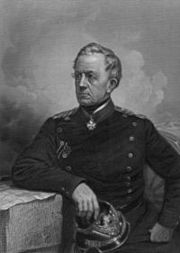 In 1857, Helmuth von Moltke, a widely travelled officer who was a confidante of King William I
, was appointed Chief of the General Staff. Under his control, the existing staff system was expanded and consolidated.
Each year, the Prussian Army's top 120 junior officers were selected by competitive examination to attend the Kriegsakademie. The academic standards at this institution were so severe that fewer than half the entrants graduated successfully. From this elite, von Moltke selected the best 12 for his personal training as General Staff officers. They attended theoretical studies, annual manoeuvres, "war rides" (a system of tactical exercises without troops in the field) under Moltke himself, and war games and map exercises known as Kriegsspiele
.
Although these officers subsequently alternated between regimental and staff duties, they could be relied upon to think and act exactly as von Moltke had taught them when they became the Chiefs of Staff of major formations. Moltke himself referred to them as the "nervous system" of the Prussian Army. In the victories which the Prussian Army was to gain against Austrian Empire
and France
, von Moltke needed only to issue brief directives to the main formations, leaving the staffs at the subordinate headquarters to implement the details according to the doctrines and methods he had laid down, while the Supreme Commands of his opponents became bogged down in a mountain of paperwork and trivia as they tried to control the entire army from a single overworked headquarters.
Von Moltke's wide experience also prompted the General Staff to consider fields of study outside the purely military, and rapidly adapt them to military use. Immediately upon his appointment, he established the Abteilung (section or department) which studied and promoted the development of railway networks within Prussia and incorporated them into its deployment plans. He also formed telegraphic, and other scientific and technical departments within the General Staff and a Historical division, which analysed past and current conflicts and published accounts of them and lessons learned.
The General Staff reformed by von Moltke was the most effective in Europe, an autonomous institution dedicated solely to the efficient execution of war, unlike in other countries, whose staffs were often fettered by meddling courtiers, parliaments and government officials. On the contrary, the General Staff itself had a powerful effect on Prussian, and later German, politics.
's conflict with Prussia and Austria over the Schleswig-Holstein Question
, vindicated von Moltke's concepts of operations and led to an overhaul of the command arrangements of the Prussian Army. Von Moltke envisaged a rapid attack to prevent the Danes falling back behind water obstacles which the Prussian Navy could not overcome. A rigid system of seniority placed Friedrich Graf von Wrangel
, widely regarded as being in his dotage, in command. He ignored all von Moltke's directives and his own staff's advice, and by allowing the Danish Army to withdraw at its leisure, prolonged the war for several months. The resulting post mortem was to ensure a better (though not infallible) system for appointing commanders.
(1866) became almost inevitable after the end of hostilities with Denmark. Many Prussians regarded the war as a sad necessity. Von Moltke, describing his reasons for confidence to War Minister Albrecht von Roon, stated, "We have the inestimable advantage of being able to carry our Field Army of 285,000 men over five railway lines and of virtually concentrating them in twenty-five days ... Austria has only one railway line and it will take her forty-five days to assemble 200,000 men". Although there were inevitable mistakes and confusion on the battlefield, von Moltke's pre-war calculations were proved correct, and the Austrian army was brought to battle at Königgrätz
and destroyed.
In contrast to the Prussian staff, Austrian staff officers gained their posts either by membership of one of the six hundred aristocratic families
which controlled the Austrian Empire's wealth and patronage, or after uninspiring training which made them into plodding, rule-bound clerks. In all aspects of preparation, planning and execution, their muddled efforts compared badly with that of their Prussian counterparts.
In reviewing Prussian deficiencies against the Austrians, the General Staff made several improvements to increase the strategic and tactical proficiency of the King's army. Cavalry
would no longer be held in reserve, but would actively screen the army's movements at all levels, make first contact with the enemy, and constantly observe hostile activities. Newly developed rifled
artillery
would no longer be placed in the rear of the order of march for employment behind the infantry; instead, a significant detachment would travel with the advanced guard of the leading corps or other major element, and the remainder would march with the front of the main body, providing immediate artillery coverage of the advanced guard on contact and of the main body during subsequent deployment on the field. A renewed emphasis was placed on maintaining contact with subordinate and superior commands, so that commanders always were informed of units' locations on the battlefield, reducing the "fog of war
" effect. Finally, the introduction of the infantry rifle marked a revolution in weapons effect, so that von Moltke made the following analysis in 1865:
was undoubtedly startled by the Prussian victory over Austria, and urgently sought to reform their army to face the conflict with Prussia which seemed inevitable and imminent. Their senior officers entirely failed to grasp the methods of the Prussian General Staff. The Chief of Staff of the French Army, Marechal Edmond Leboeuf
, fatuously stated in 1870 that the French Army was ready for war, "down to the last gaiter button". In the event, at the outset of the Franco-Prussian War
, 462,000 German soldiers concentrated flawlessly on the French frontier while only 270,000 French soldiers could be moved to face them, the French army having lost (or mislaid) 100,000 stragglers before a shot was fired through poor planning and administration.
During the war, there were again the inevitable mistakes due to the "fog of war", but German formations moved with a speed and precision which French staff officers, accustomed only to moving battalion-sized punitive columns, could not match. In the French (and British) armies of the time, there was an anti-intellectual prejudice in favour of brave and unimaginative regimental officers over intelligent and well-trained staff officers. The French Army paid dearly for this bias in 1870 and 1871.
The end result of strategic preparation by von Moltke and diplomatic overtures by Chancellor Otto von Bismarck
was the unification
of all the independent German states and the creation of a German Empire
under Prussian control. King Wilhelm I was proclaimed "German Emperor" on 18 January 1871, in the Hall of Mirrors
of the Palace of Versailles
following the Prussian victory. This victory surprised many military professionals around the world, since France had been considered a great military power, while Prussia was widely considered a lesser power, despite its military successes under Friedrich Wilhelm III
, in 1813–15 over Napoleon, and more recently over Austria during the Seven Weeks' War of 1866. Most states hastened to adopt Prussian staff methods and structures, with mixed success.
Concurrently, von Moltke pushed for reassessment and self-improvement of Prussian military units to maintain tactical superiority relative to other nations' units, introducing his concept of Auftragstaktik
or mission-oriented tactics, to promote initiative as a well-defined leadership doctrine at all levels of command, written into every Prussian tactical manual published after the Franco-Prussian War:
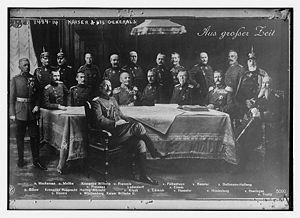 With unification the Prussian General Staff became the Imperial German General Staff and began preparing for what seemed to be another inevitable war with France, which was intent on revenge and recovery of the provinces annexed by Germany. Bismarck's continuing diplomatic intrigues prevented any hostile European coalition forming against Germany, but with his departure in 1890, France eventually gained Russia as an ally.
Germany then was at risk of being at war on both Eastern and Western fronts. To meet this threat, Chief of Staff Alfred von Schlieffen drew up and continually refined the Schlieffen Plan
to meet this eventuality. The plan has been accused of being too rigid. Manuel de Landa
, in War in the Age of Intelligent Machines
(1991), argued that the Prussian army now favoured the Jominian theory, which gave preeminence to the Army
and to its autonomy, compared to the civilian control
advocated by Clausewitz. Thus, centralization of decision was preferred over decentralization allowing local initiative.
To an extent, the General Staff became obsessed with perfecting the methods which had gained victory in the late nineteenth century. Although he maintained an icy formal demeanour, von Moltke the Elder had been a flexible and innovative thinker in many fields. Von Schlieffen by comparison was a single-minded and narrow military specialist. The Schlieffen Plan committed Germany to an early outright offensive against France while Russia was still mobilising
, and also required an unprovoked invasion of neutral Belgium
, to make it possible to rapidly surround and annihilate the French army. The rigidity of the plan, based around a minutely detailed mobilisation schedule and railway timetable, prevented any political moves which might have averted hostilities, as Kaiser William discovered on the eve of the war when he considered not invading France in order to avoid Great Britain joining Germany's enemies. Additionally, it failed to take adequate account of logistics and the inability of horse-drawn transport to supply troops far from railheads.
Nor had the General Staff considered in advance of the war, the use of potential allies such as Turkey, or dissident factions within the French, British and Russian empires, to distract or weaken the Allied war effort. "A swift victory over the main armies in the main theatre of war was the German General Staff's solution for all outside difficulties, and absolved them from thinking of war in its wider aspects."
, did not compensate for logistic flaws nor provide contingencies in case of the failure of their original plan to achieve quick success. Although superior German staff work at division, corps and army level throughout the First World War contributed to their continuous run of successes until very near the end of the war, the German nation collapsed under the strain. Thus the German General Staff lost the war of attrition
against the Entente cordiale
formed by France and the UK, in part due to logistics
reasons. Focusing exclusively on military aspects of the war, the General Staff ignored political needs, which were to be discovered during the war itself, for example with the women on the home-front.
A consequence of wartime attrition was the premature deployment of Kriegsakademie students to army and corps general staffs, some of them before reaching their second year curriculum. Later, standards for General Staff assignment were altered due to the closure of the Kriegsakademie, to allow examined officers to serve on staff apprenticeships, raising concerns that these new General Staff Corps officers were not evaluated or trained at the level of those they were replacing.
was defeated in 1918, the 1919 Treaty of Versailles
specifically forbade the creation or recreation of the General Staff. Despite this, the German officer corps led by Hans von Seeckt
, the chief of the Weimar Republic
s army, carefully set about planning the next war in a camouflaged general staff hidden within the Truppenamt
("troop office"), an innocent-looking human-resources bureau within the small army permitted by the peace accord.
When Adolf Hitler
came to power in 1933 all he had to do was to follow the Truppenamt/General Staff plan to build up the Nazi war machine. However, the General Staff advised Hitler that the German army would be fully modernised and ready by 1944 or 1945 only. As a result most artillery pieces were still horse drawn at the outbreak of war in 1939. Throughout the War, the German industry was unable to furnish small arms in sufficient quantities, forcing the Army to rely heavily on older weapons, prizes of war
, and adaptations of former designs produced in conquered countries, thus producing an arsenal filled with a stunning array of incompatible pieces, unlike the smaller number of standard small arms used by the Allies
.
by contrast, its influence was less at the start than it had been at the start of World War I and actually declined during the war.
In part this was due to the increasing pre-eminence of the other branches of the German armed forces, in particular of the Luftwaffe
. The commander in chief of the Luftwaffe, Hitler's friend and political colleague Hermann Göring
, always had personal influence with Hitler which no Army leader had. Perhaps more important was the generally conservative political outlook of the Army's leaders, who had an ambivalent attitude towards the Nazi party (and the unruly SA
, the party's political militia). While the General Staff welcomed Hitler's expansion of the army and his suppression of the SA, they were opposed to many of his wilder schemes and continually urged caution. Hitler curtailed the Army's traditional independence early, by the fortuitous disgrace of the commander in chief of the armed forces, Werner von Blomberg
, and the false accusations of homosexuality against the commander in chief of the army, Werner von Fritsch
. (The combined scandals were known as the Blomberg-Fritsch Affair
.)
The armed forces command structure was changed by Hitler, with an Armed Forces HQ (the Oberkommando der Wehrmacht
, usually contracted to OKW, placed over the army command Oberkommando des Heeres
or OKH, and the other service commands. While in theory a joint headquarters to coordinate the work of all the services was desirable, for example to determine industrial and manpower priorities and avoid duplication of effort, OKW was increasingly used as an alternate Army planning staff by Hitler. At the same time, OKW failed in its task of overseeing the overall war effort, resulting in wasteful diversion of resources by several competing and unregulated bodies responsible only to themselves or to Hitler alone.
While the traditional German staff administration and planning was to contribute greatly to the early German successes, many of these triumphs were presented as the result of Hitler's personal intervention and the initiative of comparatively junior officers who were opposed to the restraint of the General Staff.
After 1941, OKH was largely responsible for operations on the Eastern Front
only (and administration of the army as a whole), while OKW directed operations on the other fronts. As there were now effectively two general staffs, often competing with each other, arbitration of all disputes was in the hands of Hitler, further increasing his personal power.
, the General Staff
sit under the German Defence Staff and are based at the Federal Ministry of Defence
in Bonn
.
In a narrow sense, the General Staff (Großer Generalstab, literally "Great General Staff") was a full-time body at the head of the Prussian Army
Prussian Army
The Royal Prussian Army was the army of the Kingdom of Prussia. It was vital to the development of Brandenburg-Prussia as a European power.The Prussian Army had its roots in the meager mercenary forces of Brandenburg during the Thirty Years' War...
and later, the German Army
German Army
The German Army is the land component of the armed forces of the Federal Republic of Germany. Following the disbanding of the Wehrmacht after World War II, it was re-established in 1955 as the Bundesheer, part of the newly formed West German Bundeswehr along with the Navy and the Air Force...
, responsible for the continuous study of all aspects of war
War
War is a state of organized, armed, and often prolonged conflict carried on between states, nations, or other parties typified by extreme aggression, social disruption, and usually high mortality. War should be understood as an actual, intentional and widespread armed conflict between political...
, and for drawing up and reviewing plans for mobilization or campaign. It existed unofficially from 1806, and was formally established by law in 1814, the first General Staff
General Staff
A military staff, often referred to as General Staff, Army Staff, Navy Staff or Air Staff within the individual services, is a group of officers and enlisted personnel that provides a bi-directional flow of information between a commanding officer and subordinate military units...
in existence. It was distinguished by the formal selection of its officers by intelligence and proven merit
Merit system
The merit system is the process of promoting and hiring government employees based on their ability to perform a job, rather than on their political connections. It is the opposite of the spoils system.- History :...
rather than patronage or wealth, and by the exhaustive and rigorously structured training which its staff officers undertook.
The Prussian General Staff also enjoyed greater freedom from political control than its contemporaries, and this autonomy was enshrined in law on the establishment of the German Empire
German Empire
The German Empire refers to Germany during the "Second Reich" period from the unification of Germany and proclamation of Wilhelm I as German Emperor on 18 January 1871, to 1918, when it became a federal republic after defeat in World War I and the abdication of the Emperor, Wilhelm II.The German...
in 1871. It came to be regarded as the home of German militarism in the aftermath of the First World War
World War I
World War I , which was predominantly called the World War or the Great War from its occurrence until 1939, and the First World War or World War I thereafter, was a major war centred in Europe that began on 28 July 1914 and lasted until 11 November 1918...
, and the victors attempted to suppress the institution. It nevertheless survived to play its accustomed part in the rearmament of Germany and the Second World War
World War II
World War II, or the Second World War , was a global conflict lasting from 1939 to 1945, involving most of the world's nations—including all of the great powers—eventually forming two opposing military alliances: the Allies and the Axis...
.
In a broader sense, the Prussian General Staff corps consisted of those officers qualified to perform staff duties, and formed a unique military fraternity. Their exhaustive training was designed not only to weed out the less motivated or less able candidates, but also to produce a body of professional military experts with common methods and outlook, and an almost monastic dedication to their profession. General Staff–qualified officers would alternate between line and staff duties but would remain life-long members of this special organization. As staff officers, their uniform featured distinctive double-wide carmine trouser stripes.
Until the end of the German Empire
German Empire
The German Empire refers to Germany during the "Second Reich" period from the unification of Germany and proclamation of Wilhelm I as German Emperor on 18 January 1871, to 1918, when it became a federal republic after defeat in World War I and the abdication of the Emperor, Wilhelm II.The German...
, social and political convention often placed members of noble or royal households in command of its armies or corps but the actual responsibility for the planning and conduct of operations lay with the formation's staff officers. For other European armies which lacked this professionally trained Staff Corps, the same conventions were often a recipe for disaster. Even the Army of the French Second Empire, whose senior officers had supposedly reached high rank as a result of bravery and success on the battlefield, was crushed by the Prussian and other German armies in a campaign which highlighted their poor administration and planning, and lack of professional education.
The Chief of Staff of a Prussian formation in the field had the right to disagree, in writing, with the plans or orders of the commander of the formation, and appeal to the commander of the next highest formation (which might ultimately be the King, or Emperor, who would be guided by the Head of the Great General Staff). This served as a check on incompetence and also served for the objecting officer to officially disassociate himself with a flawed plan. Only the most stubborn commanders would not give way before this threat.
For these reasons, Prussian and German military victories would often be credited professionally to the Chief of Staff, rather than to the nominal commander of an army. Often the commander of an army was himself a member of the General Staff, but it was now institutionally recognized that not only was command leadership important, but effective staff work was a significant key to success in both pre-war planning and in wartime operations.
Early history
The development of a corps of full-time military professionals, working in peace and war on all aspects of operations and logistics planning, was the outgrowth of experience on the battlefield in the seventeenth and eighteenth centuries. Before the nineteenth century, success on the battlefield was largely the result of the military competence of whichever king was in power. While Frederick the GreatFrederick II of Prussia
Frederick II was a King in Prussia and a King of Prussia from the Hohenzollern dynasty. In his role as a prince-elector of the Holy Roman Empire, he was also Elector of Brandenburg. He was in personal union the sovereign prince of the Principality of Neuchâtel...
brought success in battle to Prussian arms, his successors did not have his talent, and this led to an inevitable decline in the generalship of the Army. Without competent operational and logistical planning, no amount of individual soldierly discipline or battlefield bravery could save the army from the combination of superior generalship and staff work of a talented adversary. Reformers in the army began to write and lecture on the need to preserve and somehow institutionalize the military talent that had brought martial glory to Prussia. For a small group of reformers, critical decision making had to be removed from arbitrary winds of chance and placed in the hands of institutionalized military excellence. The country could no longer afford to wait until a war started to gather military staff talent. One carefully selected professional staff would do the work of planning logistics and training the Army in peace as well as in war.
From the last years of the eighteenth century, it became the practice to assign military experts to assist the generals of Prussia's Army. This was largely at the instigation of comparatively junior but gifted officers such as Gerhard von Scharnhorst
Gerhard von Scharnhorst
Gerhard Johann David Waitz von Scharnhorst was a general in Prussian service, Chief of the Prussian General Staff, noted for both his writings, his reforms of the Prussian army, and his leadership during the Napoleonic Wars....
and August von Gneisenau
August von Gneisenau
August Wilhelm Antonius Graf Neidhardt von Gneisenau was a Prussian field marshal. He was a prominent figure in the reform of the Prussian military and the War of Liberation.-Early life:...
. Nevertheless, such measures were insufficient to overcome the inefficiency of the Army, which was commanded by aged veterans of the campaigns of Frederick the Great, almost half a century earlier.
In 1806, the Prussian Army was defeated by Napoleon Bonaparte at the Battle of Jena, and in the aftermath of this defeat, the Prussian Army and state largely collapsed. After the Peace of Tilsit in 1807, King Frederick William III
Frederick William III of Prussia
Frederick William III was king of Prussia from 1797 to 1840. He was in personal union the sovereign prince of the Principality of Neuchâtel .-Early life:...
appointed Scharnhorst, Gneisenau, Prime Minister Baron von und zum Stein
Heinrich Friedrich Karl Reichsfreiherr vom und zum Stein
Heinrich Friedrich Karl Reichsfreiherr vom und zum Stein , commonly known as Baron vom Stein, was a Prussian statesman who introduced the Prussian reforms that paved the way for the unification of Germany...
, and several promising young officers to his Military Reorganization Commission. Although Prussia's military strength and freedom of action was severely restricted by the peace terms imposed at Tilsit, this Commission nevertheless acted as a General Staff to plan and implement the reconstruction of the Prussian Army.
As part of its measures, introductory military schools in Berlin, Königsberg and Breslau, and the Academy for Young Officers (later the Kriegsakademie), open to all applicants of merit, were founded for the intellectual training of staff officers. In most non-Prussian military academies of the time, the emphasis of the training syllabus was the preparation of junior artillery and engineering officers, not strategic planners.
Although Prussian commanders of forces were still appointed by rigid seniority or royal patronage, each Army, Korps and Division commander had a staff-trained officer assigned as his Adjutant. Scharnhorst intended that they "support incompetent Generals, providing the talents that might otherwise be wanting among leaders and commanders". The unlikely pairing of the erratic but popular Field Marshal Blücher
Gebhard Leberecht von Blücher
Gebhard Leberecht von Blücher, Fürst von Wahlstatt , Graf , later elevated to Fürst von Wahlstatt, was a Prussian Generalfeldmarschall who led his army against Napoleon I at the Battle of the Nations at Leipzig in 1813 and at the Battle of Waterloo in 1815 with the Duke of Wellington.He is...
as Commander in Chief with Lieutenant General von Gneisenau as his Chief of Staff showed this system to its best advantage.
Establishment
After the defeat of Napoleon, the General Staff was formally established. Entry to it followed completion of a course at the Preußische KriegsakademiePreußische Kriegsakademie
The Prussian Military Academy or Prussian War Academy was the military academy and staff college of the Kingdom of Prussia. Founded by Gerhard von Scharnhorst in Berlin on October 15, 1810, it was restructured after World War I and dissolved following World War II...
(the Prussian War Academy, an early Staff college
Staff college
Staff colleges train military officers in the administrative, staff and policy aspects of their profession. It is usual for such training to occur at several levels in a career...
). One of the early directors of the Kriegsakademie was Karl von Clausewitz, a Reformer on the Military Reorganization Commission. From his studies and experiences of the Napoleonic Wars
Napoleonic Wars
The Napoleonic Wars were a series of wars declared against Napoleon's French Empire by opposing coalitions that ran from 1803 to 1815. As a continuation of the wars sparked by the French Revolution of 1789, they revolutionised European armies and played out on an unprecedented scale, mainly due to...
, he provided a syllabus which became the central doctrine from which the staff worked. This standardisation of doctrine (which itself was a philosophy, rather than a narrow prescribed set of rules such as those laid down by Henri Jomini) was one of the distinguishing features of the Prussian General Staff model.
In 1816, the Reformer Karl von Grolman organised the Staff into the Eastern (Russia), Southern (Austria) and Western (France and possibly West German states) Divisions, which continually planned for likely and unlikely scenarios. As early as 1843, when Europe had been largely at peace for nearly thirty years and most major nations had no plans for war, observers noted sheaves of orders at the Prussian War Ministry, already made out to cover all foreseeable contingencies and requiring only a signature and a date stamp to be put into effect.
The General Staff was always a small, elite body, numbering only fifty or so officers on its establishment and rarely exceeding one hundred officers. Only one or two officers were permanently assigned to the General Staff, described in official returns as des Generalstabs ("of the General Staff") at any time; most were attached to the General Staff from their parent regiments, although usually for several years at a time, and were listed as im Generalstab ("on the General Staff"). When the General Staff was required to take the field during major campaigns, it remained a small but effective body. During the Franco-Prussian War
Franco-Prussian War
The Franco-Prussian War or Franco-German War, often referred to in France as the 1870 War was a conflict between the Second French Empire and the Kingdom of Prussia. Prussia was aided by the North German Confederation, of which it was a member, and the South German states of Baden, Württemberg and...
for example, the portion of the Staff which accompanied the headquarters of the King (as commander-in-chief) and was responsible for the direction of armies which totalled 850,000 men, consisted of the Chief of Staff himself, a Quartermaster-General and an Intendant-General whose duties were not directly concerned with military operations, three heads of departments, eleven other officers, ten draughtsmen, seven clerks and fifty-nine other ranks (orderlies, messengers etc).
Von Moltke the Elder
William I, German Emperor
William I, also known as Wilhelm I , of the House of Hohenzollern was the King of Prussia and the first German Emperor .Under the leadership of William and his Chancellor Otto von Bismarck, Prussia achieved the unification of Germany and the...
, was appointed Chief of the General Staff. Under his control, the existing staff system was expanded and consolidated.
Each year, the Prussian Army's top 120 junior officers were selected by competitive examination to attend the Kriegsakademie. The academic standards at this institution were so severe that fewer than half the entrants graduated successfully. From this elite, von Moltke selected the best 12 for his personal training as General Staff officers. They attended theoretical studies, annual manoeuvres, "war rides" (a system of tactical exercises without troops in the field) under Moltke himself, and war games and map exercises known as Kriegsspiele
Kriegspiel (wargame)
Kriegsspiel, from the German word for wargame, was a system used for training officers in the Prussian army. The first set of rules was created in 1812 and named Instructions for the Representation of Tactical Maneuvers under the Guise of a Wargame. It was originally produced and developed further...
.
Although these officers subsequently alternated between regimental and staff duties, they could be relied upon to think and act exactly as von Moltke had taught them when they became the Chiefs of Staff of major formations. Moltke himself referred to them as the "nervous system" of the Prussian Army. In the victories which the Prussian Army was to gain against Austrian Empire
Austrian Empire
The Austrian Empire was a modern era successor empire, which was centered on what is today's Austria and which officially lasted from 1804 to 1867. It was followed by the Empire of Austria-Hungary, whose proclamation was a diplomatic move that elevated Hungary's status within the Austrian Empire...
and France
France
The French Republic , The French Republic , The French Republic , (commonly known as France , is a unitary semi-presidential republic in Western Europe with several overseas territories and islands located on other continents and in the Indian, Pacific, and Atlantic oceans. Metropolitan France...
, von Moltke needed only to issue brief directives to the main formations, leaving the staffs at the subordinate headquarters to implement the details according to the doctrines and methods he had laid down, while the Supreme Commands of his opponents became bogged down in a mountain of paperwork and trivia as they tried to control the entire army from a single overworked headquarters.
Von Moltke's wide experience also prompted the General Staff to consider fields of study outside the purely military, and rapidly adapt them to military use. Immediately upon his appointment, he established the Abteilung (section or department) which studied and promoted the development of railway networks within Prussia and incorporated them into its deployment plans. He also formed telegraphic, and other scientific and technical departments within the General Staff and a Historical division, which analysed past and current conflicts and published accounts of them and lessons learned.
The General Staff reformed by von Moltke was the most effective in Europe, an autonomous institution dedicated solely to the efficient execution of war, unlike in other countries, whose staffs were often fettered by meddling courtiers, parliaments and government officials. On the contrary, the General Staff itself had a powerful effect on Prussian, and later German, politics.
War with Denmark
The Second Schleswig War (1864), the political origins of which lay in DenmarkDenmark
Denmark is a Scandinavian country in Northern Europe. The countries of Denmark and Greenland, as well as the Faroe Islands, constitute the Kingdom of Denmark . It is the southernmost of the Nordic countries, southwest of Sweden and south of Norway, and bordered to the south by Germany. Denmark...
's conflict with Prussia and Austria over the Schleswig-Holstein Question
Schleswig-Holstein Question
The Schleswig-Holstein Question was a complex of diplomatic and other issues arising in the 19th century from the relations of two duchies, Schleswig and Holstein , to the Danish crown and to the German Confederation....
, vindicated von Moltke's concepts of operations and led to an overhaul of the command arrangements of the Prussian Army. Von Moltke envisaged a rapid attack to prevent the Danes falling back behind water obstacles which the Prussian Navy could not overcome. A rigid system of seniority placed Friedrich Graf von Wrangel
Friedrich Graf von Wrangel
Friedrich Heinrich Ernst Graf von Wrangel was a Generalfeldmarschall of the Prussian Army. He was nicknamed Papa Wrangel....
, widely regarded as being in his dotage, in command. He ignored all von Moltke's directives and his own staff's advice, and by allowing the Danish Army to withdraw at its leisure, prolonged the war for several months. The resulting post mortem was to ensure a better (though not infallible) system for appointing commanders.
Seven Weeks War
The War between Prussia and AustriaAustro-Prussian War
The Austro-Prussian War was a war fought in 1866 between the German Confederation under the leadership of the Austrian Empire and its German allies on one side and the Kingdom of Prussia with its German allies and Italy on the...
(1866) became almost inevitable after the end of hostilities with Denmark. Many Prussians regarded the war as a sad necessity. Von Moltke, describing his reasons for confidence to War Minister Albrecht von Roon, stated, "We have the inestimable advantage of being able to carry our Field Army of 285,000 men over five railway lines and of virtually concentrating them in twenty-five days ... Austria has only one railway line and it will take her forty-five days to assemble 200,000 men". Although there were inevitable mistakes and confusion on the battlefield, von Moltke's pre-war calculations were proved correct, and the Austrian army was brought to battle at Königgrätz
Battle of Königgrätz
The Battle of Königgrätz , also known as the Battle of Sadowa, Sadová, or Hradec Králové, was the decisive battle of the Austro-Prussian War, in which the Kingdom of Prussia defeated the Austrian Empire...
and destroyed.
In contrast to the Prussian staff, Austrian staff officers gained their posts either by membership of one of the six hundred aristocratic families
Austrian nobility
Historically, the Austrian nobility was a privileged social class in Austria. The nobility was officially abolished in 1919 after the fall of the Austro-Hungarian Empire. Former noble families and their descendants are still a part of Austrian society today, but they no longer retain any specific...
which controlled the Austrian Empire's wealth and patronage, or after uninspiring training which made them into plodding, rule-bound clerks. In all aspects of preparation, planning and execution, their muddled efforts compared badly with that of their Prussian counterparts.
Prussian staff analysis and army improvements
In reviewing Prussian deficiencies against the Austrians, the General Staff made several improvements to increase the strategic and tactical proficiency of the King's army. Cavalry
Cavalry
Cavalry or horsemen were soldiers or warriors who fought mounted on horseback. Cavalry were historically the third oldest and the most mobile of the combat arms...
would no longer be held in reserve, but would actively screen the army's movements at all levels, make first contact with the enemy, and constantly observe hostile activities. Newly developed rifled
Rifling
Rifling is the process of making helical grooves in the barrel of a gun or firearm, which imparts a spin to a projectile around its long axis...
artillery
Artillery
Originally applied to any group of infantry primarily armed with projectile weapons, artillery has over time become limited in meaning to refer only to those engines of war that operate by projection of munitions far beyond the range of effect of personal weapons...
would no longer be placed in the rear of the order of march for employment behind the infantry; instead, a significant detachment would travel with the advanced guard of the leading corps or other major element, and the remainder would march with the front of the main body, providing immediate artillery coverage of the advanced guard on contact and of the main body during subsequent deployment on the field. A renewed emphasis was placed on maintaining contact with subordinate and superior commands, so that commanders always were informed of units' locations on the battlefield, reducing the "fog of war
Fog of war
The fog of war is a term used to describe the uncertainty in situation awareness experienced by participants in military operations. The term seeks to capture the uncertainty regarding own capability, adversary capability, and adversary intent during an engagement, operation, or campaign...
" effect. Finally, the introduction of the infantry rifle marked a revolution in weapons effect, so that von Moltke made the following analysis in 1865:
The attack of a position is becoming notably more difficult than its defense. The defensive during the first phase of battle offers a decisive superiority. The task of a skillful offensive will consist of forcing our foe to attack a position chosen by us, and only when casualties, demoralization, and exhaustion have drained his strength will we ourselves take up the tactical offensive.... Our strategy must be offensive, our tactics defensive.
Franco-Prussian War
The government of Napoleon III of FranceNapoleon III of France
Louis-Napoléon Bonaparte was the President of the French Second Republic and as Napoleon III, the ruler of the Second French Empire. He was the nephew and heir of Napoleon I, christened as Charles Louis Napoléon Bonaparte...
was undoubtedly startled by the Prussian victory over Austria, and urgently sought to reform their army to face the conflict with Prussia which seemed inevitable and imminent. Their senior officers entirely failed to grasp the methods of the Prussian General Staff. The Chief of Staff of the French Army, Marechal Edmond Leboeuf
Edmond Leboeuf
Edmond Leboeuf was a marshal of France. He was born at Paris, passed through the École polytechnique and the school of Metz, and distinguished himself as an artillery officer in Algerian warfare, becoming colonel in 1852...
, fatuously stated in 1870 that the French Army was ready for war, "down to the last gaiter button". In the event, at the outset of the Franco-Prussian War
Franco-Prussian War
The Franco-Prussian War or Franco-German War, often referred to in France as the 1870 War was a conflict between the Second French Empire and the Kingdom of Prussia. Prussia was aided by the North German Confederation, of which it was a member, and the South German states of Baden, Württemberg and...
, 462,000 German soldiers concentrated flawlessly on the French frontier while only 270,000 French soldiers could be moved to face them, the French army having lost (or mislaid) 100,000 stragglers before a shot was fired through poor planning and administration.
During the war, there were again the inevitable mistakes due to the "fog of war", but German formations moved with a speed and precision which French staff officers, accustomed only to moving battalion-sized punitive columns, could not match. In the French (and British) armies of the time, there was an anti-intellectual prejudice in favour of brave and unimaginative regimental officers over intelligent and well-trained staff officers. The French Army paid dearly for this bias in 1870 and 1871.
The end result of strategic preparation by von Moltke and diplomatic overtures by Chancellor Otto von Bismarck
Otto von Bismarck
Otto Eduard Leopold, Prince of Bismarck, Duke of Lauenburg , simply known as Otto von Bismarck, was a Prussian-German statesman whose actions unified Germany, made it a major player in world affairs, and created a balance of power that kept Europe at peace after 1871.As Minister President of...
was the unification
Unification of Germany
The formal unification of Germany into a politically and administratively integrated nation state officially occurred on 18 January 1871 at the Versailles Palace's Hall of Mirrors in France. Princes of the German states gathered there to proclaim Wilhelm of Prussia as Emperor Wilhelm of the German...
of all the independent German states and the creation of a German Empire
German Empire
The German Empire refers to Germany during the "Second Reich" period from the unification of Germany and proclamation of Wilhelm I as German Emperor on 18 January 1871, to 1918, when it became a federal republic after defeat in World War I and the abdication of the Emperor, Wilhelm II.The German...
under Prussian control. King Wilhelm I was proclaimed "German Emperor" on 18 January 1871, in the Hall of Mirrors
Hall of Mirrors (Palace of Versailles)
The Hall of Mirrors is the central gallery of the Palace of Versailles and is renowned as being one of the most famous rooms in the world.As the principal and most remarkable feature of King Louis XIV of France's third building campaign of the Palace of Versailles , construction of the Hall of...
of the Palace of Versailles
Palace of Versailles
The Palace of Versailles , or simply Versailles, is a royal château in Versailles in the Île-de-France region of France. In French it is the Château de Versailles....
following the Prussian victory. This victory surprised many military professionals around the world, since France had been considered a great military power, while Prussia was widely considered a lesser power, despite its military successes under Friedrich Wilhelm III
Frederick William III of Prussia
Frederick William III was king of Prussia from 1797 to 1840. He was in personal union the sovereign prince of the Principality of Neuchâtel .-Early life:...
, in 1813–15 over Napoleon, and more recently over Austria during the Seven Weeks' War of 1866. Most states hastened to adopt Prussian staff methods and structures, with mixed success.
Concurrently, von Moltke pushed for reassessment and self-improvement of Prussian military units to maintain tactical superiority relative to other nations' units, introducing his concept of Auftragstaktik
Mission-type tactics
Mission-type tactics , have been a central component of the tactics of German armed forces since the 19th century. The term Auftragstaktik was coined by opponents of the development of mission-type tactics...
or mission-oriented tactics, to promote initiative as a well-defined leadership doctrine at all levels of command, written into every Prussian tactical manual published after the Franco-Prussian War:
A favorable situation will never be exploited if commanders wait for orders. The highest commander and the youngest soldier must always be conscious of the fact that omission and inactivity are worse than resorting to the wrong expedient.
From Unification to World War I
Germany then was at risk of being at war on both Eastern and Western fronts. To meet this threat, Chief of Staff Alfred von Schlieffen drew up and continually refined the Schlieffen Plan
Schlieffen Plan
The Schlieffen Plan was the German General Staff's early 20th century overall strategic plan for victory in a possible future war in which the German Empire might find itself fighting on two fronts: France to the west and Russia to the east...
to meet this eventuality. The plan has been accused of being too rigid. Manuel de Landa
Manuel de Landa
Manuel De Landa, , is a writer, artist and philosopher who has lived in New York since 1975. He is presently the Gilles Deleuze Chair of Contemporary Philosophy and Science at the European Graduate School in Saas-Fee, Switzerland; a lecturer at the Canisius College in Buffalo, New York; a lecturer...
, in War in the Age of Intelligent Machines
War in the Age of Intelligent Machines
War in the Age of Intelligent Machines is a book by Manuel de Landa that traces the history of warfare and of technology. It is influenced in part by Michel Foucault's Discipline and Punish , and also reinterprets the concepts of war machines and the machinic phylum, introduced in Deleuze and...
(1991), argued that the Prussian army now favoured the Jominian theory, which gave preeminence to the Army
Army
An army An army An army (from Latin arma "arms, weapons" via Old French armée, "armed" (feminine), in the broadest sense, is the land-based military of a nation or state. It may also include other branches of the military such as the air force via means of aviation corps...
and to its autonomy, compared to the civilian control
Civilian control of the military
Civilian control of the military is a doctrine in military and political science that places ultimate responsibility for a country's strategic decision-making in the hands of the civilian political leadership, rather than professional military officers. One author, paraphrasing Samuel P...
advocated by Clausewitz. Thus, centralization of decision was preferred over decentralization allowing local initiative.
To an extent, the General Staff became obsessed with perfecting the methods which had gained victory in the late nineteenth century. Although he maintained an icy formal demeanour, von Moltke the Elder had been a flexible and innovative thinker in many fields. Von Schlieffen by comparison was a single-minded and narrow military specialist. The Schlieffen Plan committed Germany to an early outright offensive against France while Russia was still mobilising
Mobilization
Mobilization is the act of assembling and making both troops and supplies ready for war. The word mobilization was first used, in a military context, in order to describe the preparation of the Prussian army during the 1850s and 1860s. Mobilization theories and techniques have continuously changed...
, and also required an unprovoked invasion of neutral Belgium
Belgium
Belgium , officially the Kingdom of Belgium, is a federal state in Western Europe. It is a founding member of the European Union and hosts the EU's headquarters, and those of several other major international organisations such as NATO.Belgium is also a member of, or affiliated to, many...
, to make it possible to rapidly surround and annihilate the French army. The rigidity of the plan, based around a minutely detailed mobilisation schedule and railway timetable, prevented any political moves which might have averted hostilities, as Kaiser William discovered on the eve of the war when he considered not invading France in order to avoid Great Britain joining Germany's enemies. Additionally, it failed to take adequate account of logistics and the inability of horse-drawn transport to supply troops far from railheads.
Nor had the General Staff considered in advance of the war, the use of potential allies such as Turkey, or dissident factions within the French, British and Russian empires, to distract or weaken the Allied war effort. "A swift victory over the main armies in the main theatre of war was the German General Staff's solution for all outside difficulties, and absolved them from thinking of war in its wider aspects."
World War I
The General Staff under von Schlieffen, and subsequently under Helmuth von Moltke the YoungerHelmuth von Moltke the Younger
Helmuth Johann Ludwig von Moltke , also known as Moltke the Younger, was a nephew of Field Marshal Count Moltke and served as the Chief of the German General Staff from 1906 to 1914. The two are often differentiated as Moltke the Elder and Moltke the Younger...
, did not compensate for logistic flaws nor provide contingencies in case of the failure of their original plan to achieve quick success. Although superior German staff work at division, corps and army level throughout the First World War contributed to their continuous run of successes until very near the end of the war, the German nation collapsed under the strain. Thus the German General Staff lost the war of attrition
War of Attrition
The international community and both countries attempted to find a diplomatic solution to the conflict. The Jarring Mission of the United Nations was supposed to ensure that the terms of UN Security Council Resolution 242 would be observed, but by late 1970 it was clear that this mission had been...
against the Entente cordiale
Entente Cordiale
The Entente Cordiale was a series of agreements signed on 8 April 1904 between the United Kingdom and the French Republic. Beyond the immediate concerns of colonial expansion addressed by the agreement, the signing of the Entente Cordiale marked the end of almost a millennium of intermittent...
formed by France and the UK, in part due to logistics
Logistics
Logistics is the management of the flow of goods between the point of origin and the point of destination in order to meet the requirements of customers or corporations. Logistics involves the integration of information, transportation, inventory, warehousing, material handling, and packaging, and...
reasons. Focusing exclusively on military aspects of the war, the General Staff ignored political needs, which were to be discovered during the war itself, for example with the women on the home-front.
A consequence of wartime attrition was the premature deployment of Kriegsakademie students to army and corps general staffs, some of them before reaching their second year curriculum. Later, standards for General Staff assignment were altered due to the closure of the Kriegsakademie, to allow examined officers to serve on staff apprenticeships, raising concerns that these new General Staff Corps officers were not evaluated or trained at the level of those they were replacing.
Between the Wars
When GermanyGermany
Germany , officially the Federal Republic of Germany , is a federal parliamentary republic in Europe. The country consists of 16 states while the capital and largest city is Berlin. Germany covers an area of 357,021 km2 and has a largely temperate seasonal climate...
was defeated in 1918, the 1919 Treaty of Versailles
Treaty of Versailles
The Treaty of Versailles was one of the peace treaties at the end of World War I. It ended the state of war between Germany and the Allied Powers. It was signed on 28 June 1919, exactly five years after the assassination of Archduke Franz Ferdinand. The other Central Powers on the German side of...
specifically forbade the creation or recreation of the General Staff. Despite this, the German officer corps led by Hans von Seeckt
Hans von Seeckt
Johannes Friedrich "Hans" von Seeckt was a German military officer noted for his organization of the German Army during the Weimar Republic.-Early life:...
, the chief of the Weimar Republic
Weimar Republic
The Weimar Republic is the name given by historians to the parliamentary republic established in 1919 in Germany to replace the imperial form of government...
s army, carefully set about planning the next war in a camouflaged general staff hidden within the Truppenamt
Truppenamt
The Truppenamt or 'Troop Office' was the cover organisation for the German General Staff from 1919 through until 1933 when the General Staff was re-created. This subterfuge was deemed necessary in order for Germany to be seen to meet the requirements of the Versailles Treaty...
("troop office"), an innocent-looking human-resources bureau within the small army permitted by the peace accord.
When Adolf Hitler
Adolf Hitler
Adolf Hitler was an Austrian-born German politician and the leader of the National Socialist German Workers Party , commonly referred to as the Nazi Party). He was Chancellor of Germany from 1933 to 1945, and head of state from 1934 to 1945...
came to power in 1933 all he had to do was to follow the Truppenamt/General Staff plan to build up the Nazi war machine. However, the General Staff advised Hitler that the German army would be fully modernised and ready by 1944 or 1945 only. As a result most artillery pieces were still horse drawn at the outbreak of war in 1939. Throughout the War, the German industry was unable to furnish small arms in sufficient quantities, forcing the Army to rely heavily on older weapons, prizes of war
Prize of war
A prize of war is a piece of military property seized by the victorious party after a war or battle, typically at sea. This term was used nearly exclusively in terms of a captured ship during the 18th and 19th centuries....
, and adaptations of former designs produced in conquered countries, thus producing an arsenal filled with a stunning array of incompatible pieces, unlike the smaller number of standard small arms used by the Allies
Allies of World War II
The Allies of World War II were the countries that opposed the Axis powers during the Second World War . Former Axis states contributing to the Allied victory are not considered Allied states...
.
World War II
Towards the end of World War I, the General Staff had almost wholly usurped the political power of the state. In World War IIWorld War II
World War II, or the Second World War , was a global conflict lasting from 1939 to 1945, involving most of the world's nations—including all of the great powers—eventually forming two opposing military alliances: the Allies and the Axis...
by contrast, its influence was less at the start than it had been at the start of World War I and actually declined during the war.
In part this was due to the increasing pre-eminence of the other branches of the German armed forces, in particular of the Luftwaffe
Luftwaffe
Luftwaffe is a generic German term for an air force. It is also the official name for two of the four historic German air forces, the Wehrmacht air arm founded in 1935 and disbanded in 1946; and the current Bundeswehr air arm founded in 1956....
. The commander in chief of the Luftwaffe, Hitler's friend and political colleague Hermann Göring
Hermann Göring
Hermann Wilhelm Göring, was a German politician, military leader, and a leading member of the Nazi Party. He was a veteran of World War I as an ace fighter pilot, and a recipient of the coveted Pour le Mérite, also known as "The Blue Max"...
, always had personal influence with Hitler which no Army leader had. Perhaps more important was the generally conservative political outlook of the Army's leaders, who had an ambivalent attitude towards the Nazi party (and the unruly SA
Sturmabteilung
The Sturmabteilung functioned as a paramilitary organization of the National Socialist German Workers' Party . It played a key role in Adolf Hitler's rise to power in the 1920s and 1930s...
, the party's political militia). While the General Staff welcomed Hitler's expansion of the army and his suppression of the SA, they were opposed to many of his wilder schemes and continually urged caution. Hitler curtailed the Army's traditional independence early, by the fortuitous disgrace of the commander in chief of the armed forces, Werner von Blomberg
Werner von Blomberg
Werner Eduard Fritz von Blomberg was a German Generalfeldmarschall, Minister of War and Commander-in-Chief of the Armed Forces until January 1938.-Early life:...
, and the false accusations of homosexuality against the commander in chief of the army, Werner von Fritsch
Werner von Fritsch
Werner Thomas Ludwig Freiherr von Fritsch was a prominent Wehrmacht officer, member of the German High Command, and the second German general to be killed during World War II.-Early life:...
. (The combined scandals were known as the Blomberg-Fritsch Affair
Blomberg-Fritsch Affair
The Blomberg–Fritsch Affair were two related scandals in early 1938 that resulted in the subjugation of the German Armed Forces to dictator Adolf Hitler...
.)
The armed forces command structure was changed by Hitler, with an Armed Forces HQ (the Oberkommando der Wehrmacht
Oberkommando der Wehrmacht
The Oberkommando der Wehrmacht was part of the command structure of the armed forces of Nazi Germany during World War II.- Genesis :...
, usually contracted to OKW, placed over the army command Oberkommando des Heeres
Oberkommando des Heeres
The Oberkommando des Heeres was Nazi Germany's High Command of the Army from 1936 to 1945. The Oberkommando der Wehrmacht commanded OKH only in theory...
or OKH, and the other service commands. While in theory a joint headquarters to coordinate the work of all the services was desirable, for example to determine industrial and manpower priorities and avoid duplication of effort, OKW was increasingly used as an alternate Army planning staff by Hitler. At the same time, OKW failed in its task of overseeing the overall war effort, resulting in wasteful diversion of resources by several competing and unregulated bodies responsible only to themselves or to Hitler alone.
While the traditional German staff administration and planning was to contribute greatly to the early German successes, many of these triumphs were presented as the result of Hitler's personal intervention and the initiative of comparatively junior officers who were opposed to the restraint of the General Staff.
After 1941, OKH was largely responsible for operations on the Eastern Front
Eastern Front (World War II)
The Eastern Front of World War II was a theatre of World War II between the European Axis powers and co-belligerent Finland against the Soviet Union, Poland, and some other Allies which encompassed Northern, Southern and Eastern Europe from 22 June 1941 to 9 May 1945...
only (and administration of the army as a whole), while OKW directed operations on the other fronts. As there were now effectively two general staffs, often competing with each other, arbitration of all disputes was in the hands of Hitler, further increasing his personal power.
Bundeswehr
Under the post-war organisation of the BundeswehrBundeswehr
The Bundeswehr consists of the unified armed forces of Germany and their civil administration and procurement authorities...
, the General Staff
General Staff (Germany)
The General Staff of the German Army is a department of the Federal Ministry of Defence and one of the five staff headquarters in the military command of the Bundeswehr...
sit under the German Defence Staff and are based at the Federal Ministry of Defence
Federal Ministry of Defence (Germany)
The Federal Ministry of Defence is a top-level federal agency, headed by the Federal Minister of Defence as a member of the Cabinet of Germany...
in Bonn
Bonn
Bonn is the 19th largest city in Germany. Located in the Cologne/Bonn Region, about 25 kilometres south of Cologne on the river Rhine in the State of North Rhine-Westphalia, it was the capital of West Germany from 1949 to 1990 and the official seat of government of united Germany from 1990 to 1999....
.
Chiefs of the Prussian General Staff (1808–1871)
- Gerhard von Scharnhorst (1 March 1808 –17 June 1810)
- Karl von HakeKarl Georg Albrecht Ernst von HakeKarl Georg Albrecht Ernst von Hake was a Prussian general and Minister of War.Hake was born on the estate of Flatow in the Margraviate of Brandenburg. He entered the Prussian Army in 1785...
(17 June 1810 – March 1812) - Gustav von RauchGustav von RauchGustav von Rauch was a Prussian general, chief of staff from 1812-1813, and Minister of War from 1837 to 1841. His daughter Rosalie, married Prince Albert of Prussia as second, morgantic, wife in 1850....
(March 1812 – March 1813) - Gerhard von Scharnhorst (March 1813 – 28 June 1813)
- August von GneisenauAugust von GneisenauAugust Wilhelm Antonius Graf Neidhardt von Gneisenau was a Prussian field marshal. He was a prominent figure in the reform of the Prussian military and the War of Liberation.-Early life:...
(28 June 1813 – 3 June 1814) - Karl von Grolman (3 June 1814 – November 1819)
- Johann Rühle von Lilienstern (November 1819 – 11 January 1821)
- Karl von Müffling (11 January 1821 – 29 January 1829)
- Wilhelm von Krauseneck (29 January 1829 – 13 May 1848)
- Karl von ReyherKarl von ReyherKarl Friedrich Wilhelm Reyher was a Prussian officer who served as Prussian Minister of War in the government of Gottfried Ludolf Camphausen during the Revolution of 1848. After 1848 he also served as Prussian chief of staff....
(13 May 1848 – 7 October 1857) - Helmuth von Moltke (the elder)Helmuth von Moltke the ElderHelmuth Karl Bernhard Graf von Moltke was a German Field Marshal. The chief of staff of the Prussian Army for thirty years, he is regarded as one of the great strategists of the latter 19th century, and the creator of a new, more modern method of directing armies in the field...
(7 October 1857 – 10 August 1888)
Chiefs of the German General Staff (1871–1919)
- Helmuth von MoltkeHelmuth von MoltkeHelmuth von Moltke may refer to:*Helmuth Graf von Moltke *Helmuth Johann Ludwig von Moltke *Helmuth James Graf von Moltke...
(7 October 1857 – 10 August 1888) - Alfred von Waldersee (10 August 1888 – 7 February 1891)
- Alfred von Schlieffen (7 February 1891 – 1 January 1906)
- Helmuth von Moltke (the younger) (1 January 1906 - 14 September 1914)
- Erich von FalkenhaynErich von FalkenhaynErich von Falkenhayn was a German soldier and Chief of the General Staff during World War I. He became a military writer after World War I.-Early life:...
(14 September 1914 – 29 August 1916) - Paul von HindenburgPaul von HindenburgPaul Ludwig Hans Anton von Beneckendorff und von Hindenburg , known universally as Paul von Hindenburg was a Prussian-German field marshal, statesman, and politician, and served as the second President of Germany from 1925 to 1934....
(29 August 1916 – 3 July 1919) - Wilhelm GroenerWilhelm GroenerKarl Eduard Wilhelm Groener was a German soldier and politician.-Biography:He was born in Ludwigsburg in the Kingdom of Württemberg, the son of a regimental paymaster. He entered the Württemberg Army in 1884, and attended the War Academy from 1893 to 1897, whereupon he was appointed to the General...
(3 July 1919 – 7 July 1919) - Hans von SeecktHans von SeecktJohannes Friedrich "Hans" von Seeckt was a German military officer noted for his organization of the German Army during the Weimar Republic.-Early life:...
(7 July 1919 - 15 July 1919)
Chiefs of Troop Office (1919–1933)
- Hans von SeecktHans von SeecktJohannes Friedrich "Hans" von Seeckt was a German military officer noted for his organization of the German Army during the Weimar Republic.-Early life:...
(11 October 1919 – 26 March 1920) - Wilhelm HeyeWilhelm HeyeAugust Wilhelm Heye was a German officer who rose to the rank of Generaloberst and became head of the Army Command within the Ministry of the Reichswehr in the Weimar Republic....
(26 March 1920 – February 1923) - Otto Hasse (February 1923 – October 1925)
- Wilhelm Wetzell (October 1925 – 27 January 1927)
- Werner von BlombergWerner von BlombergWerner Eduard Fritz von Blomberg was a German Generalfeldmarschall, Minister of War and Commander-in-Chief of the Armed Forces until January 1938.-Early life:...
(27 January 1927 – 30 September 1929) - Baron Kurt von Hammerstein–EquordKurt von Hammerstein-EquordKurt Gebhard Adolf Philipp Freiherr von Hammerstein-Equord was a German general who served for a period as Commander-in-Chief of the Reichswehr...
(30 September 1929 – 31 October 1930) - Wilhelm AdamWilhelm Adam (Soldier)Wilhelm Adam was a German army officer who served in the Bavarian Army, the Reichswehr and the Wehrmacht....
(31 October 1930 – 30 September 1933)
Chiefs of Staff of the Army High Command (OKH) (1933–1945)
- Ludwig BeckLudwig BeckGeneraloberst Ludwig August Theodor Beck was a German general and Chief of the German General Staff during the early years of the Nazi regime in Germany before World War II....
(1 October 1933 – 31 August 1938) - Franz HalderFranz HalderFranz Halder was a German General and the head of the Army General Staff from 1938 until September, 1942, when he was dismissed after frequent disagreements with Adolf Hitler.-Early life:...
(1 September 1938 – 24 September 1942) - Kurt ZeitzlerKurt ZeitzlerKurt Zeitzler was an officer in the German Reichswehr and its successor the Wehrmacht, most prominent for being the Chief of the Army General Staff from 1942 to 1944.- World War I and after :...
(24 September 1942 – 10 June 1944) - Adolf HeusingerAdolf HeusingerAdolf Heusinger was a German General. He briefly served as Chief of the General Staff of the Army during World War II and served as the first Inspector General of the Bundeswehr, the West German armed forces, from 1957 to 1961...
(10 June 1944 – 21 July 1944) - Heinz GuderianHeinz GuderianHeinz Wilhelm Guderian was a German general during World War II. He was a pioneer in the development of armored warfare, and was the leading proponent of tanks and mechanization in the Wehrmacht . Germany's panzer forces were raised and organized under his direction as Chief of Mobile Forces...
(21 July 1944 – 28 March 1945) - Hans KrebsHans Krebs (general)Hans Krebs was a German Army general of infantry who served during World War II.-Early life:Krebs was born in Helmstedt. He volunteered for service in the Imperial German Army in 1914, was promoted to lieutenant in 1915, and to first lieutenant in 1925...
(1 April 1945 – 30 April 1945)
Readings
- Bucholz, Arden. Hans Delbrück and the German Military Establishment: War Images in Conflict. Iowa City: University of Iowa Press, 1985.
- Bucholz, Arden. Moltke, Schlieffen and Prussian War Planning. New York: Berg, 1991 largely derivative in nature (Goerlitz and others) but easy reading (New York: Crown ISBN shown)
- Hughes, Daniel J., ed. Moltke on the Art of War: Selected Writings. Novato, CA: Presidio, 1993.
- Mombauer, Annika. Helmuth von Moltke and the Origins of the First World War. Cambridge, GB: Cambridge University Press, 2001.
- Stoneman, Mark R. “Wilhelm Groener, Officering, and the Schlieffen Plan.” PhD diss., Georgetown University, 2006. abstract
- Wawro, Geoffrey. The Austro-Prussian War: Austria's War with Prussia and Italy in 1866. Cambridge, GB: Cambridge University Press, 1996.
External links
- Operations Upon the Sea by Franz Edelsheim