

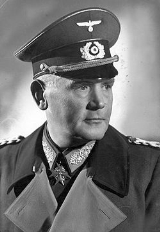
Werner von Blomberg

Encyclopedia
Werner Eduard Fritz von Blomberg (2 September 1878 – 14 March 1946) was a German
Generalfeldmarschall, Minister of War and Commander-in-Chief of the Armed Forces until January 1938.
, Pomerania, Prussia
(present-day Stargard Szczeciński
, West Pomeranian Voivodeship
), Werner von Blomberg joined the army at a young age and attended the Prussian Military Academy in 1904. In April 1904, he married Charlotte Hellmich.
during World War I
, Blomberg was awarded the Pour le Mérite
. In 1920, Blomberg was appointed Chief of Staff of the Döberitz Brigade, and in 1921 was made Chief of Staff of the Stuttgart
Army Area. In 1925, Blomberg was made Chief of Army Training by General Hans von Seeckt
. By 1927, Blomberg was a major-general and Chief of the Troop Office. In 1928, Blomberg visited the Soviet Union, where he was much impressed by the high status of the Red Army, and left a convinced believer in the value of dictatorship as the prerequisite for military power. After arguing with the powerful General Kurt von Schleicher
in 1929, however, Blomberg was removed from his post and made military commander of East Prussia
. During his time as commander of Wehrkreis I, the military district which comprised East Prussia, Blomberg fell under the influence of a Nazi-sympathizing Lutheran chaplain, Ludwig Müller, who introduced Blomberg to National Socialism. Blomberg cared little for Nazi doctrines per se, his support for the Nazis being motivated by his belief that only a dictatorship could make Germany a great military power, and that the Nazis were the best party to create a dictatorship for Germany. In 1931, Blomberg visited the U.S., where he openly proclaimed his belief in the certainty and the benefits of a Nazi government for Germany. Blomberg's first wife Charlotte died on 11 May 1932 leaving him with two sons and three daughters. In 1932, Blomberg served as part of the German delegation to the World Disarmament Conference
in Geneva
, where during his time as the German chief military delegate, he not only continued his pro-Nazi remarks to the press, but used his status of chief military delegate to communicate his views to Paul von Hindenburg
, whose position as President made him Supreme Commander in Chief.
In late January 1933, Blomberg was recalled from the World Disarmament Conference to return to Berlin by President von Hindenburg, who did so without informing the Chancellor, General von Schleicher or the Army Commander, General Kurt von Hammerstein. Upon learning of this, Schleicher guessed correctly that the order to recall Blomberg to Berlin meant his government was doomed. When Blomberg arrived at the railroad station in Berlin, he was met at by Major von Kuntzen ordering him to report at once to the Defence Ministry on behalf of General von Hammerstein, and by Major Oskar von Hindenburg
ordering him to report at once to the Presidential palace. Over Kuntzen's protests, Blomberg chose to go with Hindenburg to meet his father, who swore him in as Defence Minister.
In 1933, Blomberg rose to national prominence when he was appointed Minister of Defense in Adolf Hitler
's government. Blomberg became one of Hitler's most devoted followers, and worked feverishly to expand the size and power of the army. In 1933 Blomberg was made a colonel general
for his services. In February 1934, acting on his own initiative, Blomberg had all of the Jews serving in the Reichswehr given an automatic and immediate dishonorable discharge. In this way, 74 Jewish soldiers lost their jobs for no other reason than there were Jewish. The Law for the Restoration of the Professional Civil Service
had excluded those Jews who were World War I veterans, so Blomberg's discharge order was his way getting arould the law. In 1935, Blomberg worked hard to ensure that the Wehrmacht complied with Nuremberg Laws
by preventing so-called Mischling
from serving.
Blomberg had a reputation as something of a lackey to Hitler. As such, he was nicknamed "Rubber Lion" by some of his critics in the army who were less than enthusiastic about Hitler. One of the few notable exceptions was during the run-up to the Night of the Long Knives
in 1934. In early June, Reichspräsident
Paul von Hindenburg
decided that unless Hitler did something to end the growing political tension in Germany, he would declare martial law and turn over control of the government to the army. Blomberg, who had been known to oppose the growing power of the SA, was chosen to inform Hitler of this decision on the president's behalf.
 In the same year, after Hindenburg's death, he personally ordered all soldiers in the army to pledge the Reichswehreid
(oath of allegiance) not to Volk and Fatherland, but to the new Führer Adolf Hitler, which is thought to have limited later opposition to Hitler.
In 1935, the Ministry of Defense was renamed the Ministry of War; Blomberg also took the title of Commander-in-Chief of the Armed Forces. In 1936, the loyal Blomberg was the first Generalfeldmarschall appointed by Hitler.
Unfortunately for Blomberg, his position as the ranking officer of the Third Reich alienated Hermann Göring
and Heinrich Himmler
, who conspired to oust him from power. Göring, in particular, had ambitions of becoming Commander-in-Chief himself. On 5 November 1937, the conference between the Reichs top military-foreign policy leadership and Hitler recorded in the so-called Hossbach Memorandum
occurred. At the conference, Hitler stated that it was the time for war, or, more accurately, wars, as what Hitler envisioned were a series of localized wars in Central and Eastern Europe in the near future. Hitler argued that because these wars were necessary to provide Germany with Lebensraum
, autarky
and the arms race
with France and Britain made it imperative to act before the Western powers developed an insurmountable lead in the arms race. Of those invited to the conference, objections arose from the Foreign Minister Konstantin von Neurath
, Blomberg and the Army Commander in Chief, General Werner von Fritsch
that any German aggression in Eastern Europe was bound to trigger a war with France because of the French alliance system in Eastern Europe, the so-called cordon sanitaire
, and if a Franco-German war broke out, then Britain was almost certain to intervene rather than risk the prospect of France's defeat. Moreover, it was objected that Hitler's assumption that Britain and France would just ignore the projected wars because they had started their re-armament later than Germany was flawed Accordingly, Fritsch, Blomberg and Neurath advised Hitler to wait until Germany had more time to re-arm before pursuing a high-risk strategy of localized wars that was likely to trigger a general war before Germany was ready (none of those present at the conference had any moral objections to Hitler's strategy, with which they were in basic agreement; only the question of timing divided them). After the Hossbach Memorandum
meeting of November 1937, Blomberg was one of the few who criticised Hitler's plans to go to war no later than 1942, much to Hitler's displeasure.
Göring and Himmler struck in January 1938, when on 12 January Blomberg, then 59, married Erna Gruhn (sometimes referred to as "Eva" or "Margarete"), a 26-year-old typist and secretary. A police officer discovered that Gruhn in 1932 had posed for pornographic photos (taken by a Jew with whom she was living at the time) and reported this to the Gestapo
and Göring (who had served as best man to Blomberg at the wedding). It has long been claimed that Frau von Blomberg had a criminal record for prostitution, but this is false; Göring chose to misrepresent Frau Blomberg's criminal record as being for prostitution as a way of smearing her husband. Göring then informed Hitler (who had also been a witness at the wedding), and Hitler ordered Blomberg to annul
the marriage in order to avoid a scandal and to preserve the integrity of the army. Blomberg refused to annul the marriage, and consequently resigned all of his posts on 27 January 1938 when Göring threatened to make his wife's past public knowledge.
A few days later, Göring and Himmler accused Commander-in-Chief of the Army Werner von Fritsch
of being a homosexual. Hitler used these opportunities for major reorganization of the Wehrmacht
. Fritsch was later acquitted; together the events became known as the Blomberg-Fritsch Affair
.
Blomberg and his wife were subsequently exiled for a year to the isle of Capri
. Spending World War II
in obscurity, Blomberg was captured by the Allies
in 1945, after which time he gave evidence at the Nuremberg Trials
. While in detention at Nuremberg
, Blomberg died of cancer
in 14 March 1946 and was buried without ceremony in an unmarked grave
. Later, his remains were cremated and interred in his residence in Bad Wiessee
.
His daughter Dorothea became engaged to Leutnant Karl-Heinz Keitel
—General Wilhelm Keitel
's eldest son—in January 1938. They were married in May the same year.
Germany
Germany , officially the Federal Republic of Germany , is a federal parliamentary republic in Europe. The country consists of 16 states while the capital and largest city is Berlin. Germany covers an area of 357,021 km2 and has a largely temperate seasonal climate...
Generalfeldmarschall, Minister of War and Commander-in-Chief of the Armed Forces until January 1938.
Early life
Born in StargardStargard Szczecinski
Stargard Szczeciński is a city in northwestern Poland, with a population of 71,017 . Situated on the Ina River it is the capital of Stargard County and since 1999 has been in the West Pomeranian Voivodeship; prior to that it was in the Szczecin Voivodeship...
, Pomerania, Prussia
Kingdom of Prussia
The Kingdom of Prussia was a German kingdom from 1701 to 1918. Until the defeat of Germany in World War I, it comprised almost two-thirds of the area of the German Empire...
(present-day Stargard Szczeciński
Stargard Szczecinski
Stargard Szczeciński is a city in northwestern Poland, with a population of 71,017 . Situated on the Ina River it is the capital of Stargard County and since 1999 has been in the West Pomeranian Voivodeship; prior to that it was in the Szczecin Voivodeship...
, West Pomeranian Voivodeship
West Pomeranian Voivodeship
West Pomeranian Voivodeship, , is a voivodeship in northwestern Poland. It borders on Pomeranian Voivodeship to the east, Greater Poland Voivodeship to the southeast, Lubusz Voivodeship to the south, the German federal-state of Mecklenburg-West Pomerania to the west, and the Baltic Sea to the north...
), Werner von Blomberg joined the army at a young age and attended the Prussian Military Academy in 1904. In April 1904, he married Charlotte Hellmich.
Military career
After graduating in 1907, Blomberg entered the General Staff in 1908. Serving with distinction on the Western FrontWestern Front (World War I)
Following the outbreak of World War I in 1914, the German Army opened the Western Front by first invading Luxembourg and Belgium, then gaining military control of important industrial regions in France. The tide of the advance was dramatically turned with the Battle of the Marne...
during World War I
World War I
World War I , which was predominantly called the World War or the Great War from its occurrence until 1939, and the First World War or World War I thereafter, was a major war centred in Europe that began on 28 July 1914 and lasted until 11 November 1918...
, Blomberg was awarded the Pour le Mérite
Pour le Mérite
The Pour le Mérite, known informally as the Blue Max , was the Kingdom of Prussia's highest military order for German soldiers until the end of World War I....
. In 1920, Blomberg was appointed Chief of Staff of the Döberitz Brigade, and in 1921 was made Chief of Staff of the Stuttgart
Stuttgart
Stuttgart is the capital of the state of Baden-Württemberg in southern Germany. The sixth-largest city in Germany, Stuttgart has a population of 600,038 while the metropolitan area has a population of 5.3 million ....
Army Area. In 1925, Blomberg was made Chief of Army Training by General Hans von Seeckt
Hans von Seeckt
Johannes Friedrich "Hans" von Seeckt was a German military officer noted for his organization of the German Army during the Weimar Republic.-Early life:...
. By 1927, Blomberg was a major-general and Chief of the Troop Office. In 1928, Blomberg visited the Soviet Union, where he was much impressed by the high status of the Red Army, and left a convinced believer in the value of dictatorship as the prerequisite for military power. After arguing with the powerful General Kurt von Schleicher
Kurt von Schleicher
Kurt von Schleicher was a German general and the last Chancellor of Germany during the era of the Weimar Republic. Seventeen months after his resignation, he was assassinated by order of his successor, Adolf Hitler, in the Night of the Long Knives....
in 1929, however, Blomberg was removed from his post and made military commander of East Prussia
East Prussia
East Prussia is the main part of the region of Prussia along the southeastern Baltic Coast from the 13th century to the end of World War II in May 1945. From 1772–1829 and 1878–1945, the Province of East Prussia was part of the German state of Prussia. The capital city was Königsberg.East Prussia...
. During his time as commander of Wehrkreis I, the military district which comprised East Prussia, Blomberg fell under the influence of a Nazi-sympathizing Lutheran chaplain, Ludwig Müller, who introduced Blomberg to National Socialism. Blomberg cared little for Nazi doctrines per se, his support for the Nazis being motivated by his belief that only a dictatorship could make Germany a great military power, and that the Nazis were the best party to create a dictatorship for Germany. In 1931, Blomberg visited the U.S., where he openly proclaimed his belief in the certainty and the benefits of a Nazi government for Germany. Blomberg's first wife Charlotte died on 11 May 1932 leaving him with two sons and three daughters. In 1932, Blomberg served as part of the German delegation to the World Disarmament Conference
World Disarmament Conference
The Conference for the Reduction and Limitation of Armaments of 1932-34 was an effort by member states of the League of Nations, together with the U.S. and the Soviet Union, to actualize the ideology of disarmament...
in Geneva
Geneva
Geneva In the national languages of Switzerland the city is known as Genf , Ginevra and Genevra is the second-most-populous city in Switzerland and is the most populous city of Romandie, the French-speaking part of Switzerland...
, where during his time as the German chief military delegate, he not only continued his pro-Nazi remarks to the press, but used his status of chief military delegate to communicate his views to Paul von Hindenburg
Paul von Hindenburg
Paul Ludwig Hans Anton von Beneckendorff und von Hindenburg , known universally as Paul von Hindenburg was a Prussian-German field marshal, statesman, and politician, and served as the second President of Germany from 1925 to 1934....
, whose position as President made him Supreme Commander in Chief.
In late January 1933, Blomberg was recalled from the World Disarmament Conference to return to Berlin by President von Hindenburg, who did so without informing the Chancellor, General von Schleicher or the Army Commander, General Kurt von Hammerstein. Upon learning of this, Schleicher guessed correctly that the order to recall Blomberg to Berlin meant his government was doomed. When Blomberg arrived at the railroad station in Berlin, he was met at by Major von Kuntzen ordering him to report at once to the Defence Ministry on behalf of General von Hammerstein, and by Major Oskar von Hindenburg
Oskar von Hindenburg
Generalleutnant Oskar von Beneckendorff und von Hindenburg was the politically powerful son and aide-de-camp to Field Marshal and President of Germany Paul von Hindenburg....
ordering him to report at once to the Presidential palace. Over Kuntzen's protests, Blomberg chose to go with Hindenburg to meet his father, who swore him in as Defence Minister.
In 1933, Blomberg rose to national prominence when he was appointed Minister of Defense in Adolf Hitler
Adolf Hitler
Adolf Hitler was an Austrian-born German politician and the leader of the National Socialist German Workers Party , commonly referred to as the Nazi Party). He was Chancellor of Germany from 1933 to 1945, and head of state from 1934 to 1945...
's government. Blomberg became one of Hitler's most devoted followers, and worked feverishly to expand the size and power of the army. In 1933 Blomberg was made a colonel general
Colonel General
Colonel General is a senior rank of General. North Korea and Russia are two countries which have used the rank extensively throughout their histories...
for his services. In February 1934, acting on his own initiative, Blomberg had all of the Jews serving in the Reichswehr given an automatic and immediate dishonorable discharge. In this way, 74 Jewish soldiers lost their jobs for no other reason than there were Jewish. The Law for the Restoration of the Professional Civil Service
Law for the Restoration of the Professional Civil Service
The Law for the Restoration of the Professional Civil Service , also known as Civil Service Law, Civil Service Restoration Act, and Law to Re-establish the Civil Service, was a law passed by the National Socialist regime on April 7, 1933, two months after Adolf...
had excluded those Jews who were World War I veterans, so Blomberg's discharge order was his way getting arould the law. In 1935, Blomberg worked hard to ensure that the Wehrmacht complied with Nuremberg Laws
Nuremberg Laws
The Nuremberg Laws of 1935 were antisemitic laws in Nazi Germany introduced at the annual Nuremberg Rally of the Nazi Party. After the takeover of power in 1933 by Hitler, Nazism became an official ideology incorporating scientific racism and antisemitism...
by preventing so-called Mischling
Mischling
Mischling was the German term used during the Third Reich to denote persons deemed to have only partial Aryan ancestry. The word has essentially the same origin as mestee in English, mestizo in Spanish and métis in French...
from serving.
Blomberg had a reputation as something of a lackey to Hitler. As such, he was nicknamed "Rubber Lion" by some of his critics in the army who were less than enthusiastic about Hitler. One of the few notable exceptions was during the run-up to the Night of the Long Knives
Night of the Long Knives
The Night of the Long Knives , sometimes called "Operation Hummingbird " or in Germany the "Röhm-Putsch," was a purge that took place in Nazi Germany between June 30 and July 2, 1934, when the Nazi regime carried out a series of political murders...
in 1934. In early June, Reichspräsident
Reichspräsident
The Reichspräsident was the German head of state under the Weimar constitution, which was officially in force from 1919 to 1945. In English he was usually simply referred to as the President of Germany...
Paul von Hindenburg
Paul von Hindenburg
Paul Ludwig Hans Anton von Beneckendorff und von Hindenburg , known universally as Paul von Hindenburg was a Prussian-German field marshal, statesman, and politician, and served as the second President of Germany from 1925 to 1934....
decided that unless Hitler did something to end the growing political tension in Germany, he would declare martial law and turn over control of the government to the army. Blomberg, who had been known to oppose the growing power of the SA, was chosen to inform Hitler of this decision on the president's behalf.
Reichswehreid
The Reichswehreid and from August 1934 Führereid was the name for three different versions of the oath of allegiance of the German Forces, called Reichswehr from 1919 to 1935, and then Wehrmacht until 1945.- 1919–1933 :...
(oath of allegiance) not to Volk and Fatherland, but to the new Führer Adolf Hitler, which is thought to have limited later opposition to Hitler.
In 1935, the Ministry of Defense was renamed the Ministry of War; Blomberg also took the title of Commander-in-Chief of the Armed Forces. In 1936, the loyal Blomberg was the first Generalfeldmarschall appointed by Hitler.
Unfortunately for Blomberg, his position as the ranking officer of the Third Reich alienated Hermann Göring
Hermann Göring
Hermann Wilhelm Göring, was a German politician, military leader, and a leading member of the Nazi Party. He was a veteran of World War I as an ace fighter pilot, and a recipient of the coveted Pour le Mérite, also known as "The Blue Max"...
and Heinrich Himmler
Heinrich Himmler
Heinrich Luitpold Himmler was Reichsführer of the SS, a military commander, and a leading member of the Nazi Party. As Chief of the German Police and the Minister of the Interior from 1943, Himmler oversaw all internal and external police and security forces, including the Gestapo...
, who conspired to oust him from power. Göring, in particular, had ambitions of becoming Commander-in-Chief himself. On 5 November 1937, the conference between the Reichs top military-foreign policy leadership and Hitler recorded in the so-called Hossbach Memorandum
Hossbach Memorandum
The Hossbach Memorandum was the summary of a meeting on November 5, 1937 between German dictator Adolf Hitler and his military and foreign policy leadership where Hitler's future expansionist policies were outlined. The meeting marked a turning point in Hitler's foreign policies, which then began...
occurred. At the conference, Hitler stated that it was the time for war, or, more accurately, wars, as what Hitler envisioned were a series of localized wars in Central and Eastern Europe in the near future. Hitler argued that because these wars were necessary to provide Germany with Lebensraum
Lebensraum
was one of the major political ideas of Adolf Hitler, and an important component of Nazi ideology. It served as the motivation for the expansionist policies of Nazi Germany, aiming to provide extra space for the growth of the German population, for a Greater Germany...
, autarky
Autarky
Autarky is the quality of being self-sufficient. Usually the term is applied to political states or their economic policies. Autarky exists whenever an entity can survive or continue its activities without external assistance. Autarky is not necessarily economic. For example, a military autarky...
and the arms race
Arms race
The term arms race, in its original usage, describes a competition between two or more parties for the best armed forces. Each party competes to produce larger numbers of weapons, greater armies, or superior military technology in a technological escalation...
with France and Britain made it imperative to act before the Western powers developed an insurmountable lead in the arms race. Of those invited to the conference, objections arose from the Foreign Minister Konstantin von Neurath
Konstantin von Neurath
Konstantin Freiherr von Neurath was a German diplomat remembered mostly for having served as Foreign minister of Germany between 1932 and 1938...
, Blomberg and the Army Commander in Chief, General Werner von Fritsch
Werner von Fritsch
Werner Thomas Ludwig Freiherr von Fritsch was a prominent Wehrmacht officer, member of the German High Command, and the second German general to be killed during World War II.-Early life:...
that any German aggression in Eastern Europe was bound to trigger a war with France because of the French alliance system in Eastern Europe, the so-called cordon sanitaire
Cordon sanitaire
Cordon sanitaire — or quarantine line — is a French phrase that, literally translated, means "sanitary cordon". Though in French it originally denoted a barrier implemented to stop the spread of disease, it has often been used in English in a metaphorical sense to refer to attempts to prevent the...
, and if a Franco-German war broke out, then Britain was almost certain to intervene rather than risk the prospect of France's defeat. Moreover, it was objected that Hitler's assumption that Britain and France would just ignore the projected wars because they had started their re-armament later than Germany was flawed Accordingly, Fritsch, Blomberg and Neurath advised Hitler to wait until Germany had more time to re-arm before pursuing a high-risk strategy of localized wars that was likely to trigger a general war before Germany was ready (none of those present at the conference had any moral objections to Hitler's strategy, with which they were in basic agreement; only the question of timing divided them). After the Hossbach Memorandum
Hossbach Memorandum
The Hossbach Memorandum was the summary of a meeting on November 5, 1937 between German dictator Adolf Hitler and his military and foreign policy leadership where Hitler's future expansionist policies were outlined. The meeting marked a turning point in Hitler's foreign policies, which then began...
meeting of November 1937, Blomberg was one of the few who criticised Hitler's plans to go to war no later than 1942, much to Hitler's displeasure.
Göring and Himmler struck in January 1938, when on 12 January Blomberg, then 59, married Erna Gruhn (sometimes referred to as "Eva" or "Margarete"), a 26-year-old typist and secretary. A police officer discovered that Gruhn in 1932 had posed for pornographic photos (taken by a Jew with whom she was living at the time) and reported this to the Gestapo
Gestapo
The Gestapo was the official secret police of Nazi Germany. Beginning on 20 April 1934, it was under the administration of the SS leader Heinrich Himmler in his position as Chief of German Police...
and Göring (who had served as best man to Blomberg at the wedding). It has long been claimed that Frau von Blomberg had a criminal record for prostitution, but this is false; Göring chose to misrepresent Frau Blomberg's criminal record as being for prostitution as a way of smearing her husband. Göring then informed Hitler (who had also been a witness at the wedding), and Hitler ordered Blomberg to annul
Annulment
Annulment is a legal procedure for declaring a marriage null and void. Unlike divorce, it is usually retroactive, meaning that an annulled marriage is considered to be invalid from the beginning almost as if it had never taken place...
the marriage in order to avoid a scandal and to preserve the integrity of the army. Blomberg refused to annul the marriage, and consequently resigned all of his posts on 27 January 1938 when Göring threatened to make his wife's past public knowledge.
A few days later, Göring and Himmler accused Commander-in-Chief of the Army Werner von Fritsch
Werner von Fritsch
Werner Thomas Ludwig Freiherr von Fritsch was a prominent Wehrmacht officer, member of the German High Command, and the second German general to be killed during World War II.-Early life:...
of being a homosexual. Hitler used these opportunities for major reorganization of the Wehrmacht
Wehrmacht
The Wehrmacht – from , to defend and , the might/power) were the unified armed forces of Nazi Germany from 1935 to 1945. It consisted of the Heer , the Kriegsmarine and the Luftwaffe .-Origin and use of the term:...
. Fritsch was later acquitted; together the events became known as the Blomberg-Fritsch Affair
Blomberg-Fritsch Affair
The Blomberg–Fritsch Affair were two related scandals in early 1938 that resulted in the subjugation of the German Armed Forces to dictator Adolf Hitler...
.
Blomberg and his wife were subsequently exiled for a year to the isle of Capri
Capri
Capri is an Italian island in the Tyrrhenian Sea off the Sorrentine Peninsula, on the south side of the Gulf of Naples, in the Campania region of Southern Italy...
. Spending World War II
World War II
World War II, or the Second World War , was a global conflict lasting from 1939 to 1945, involving most of the world's nations—including all of the great powers—eventually forming two opposing military alliances: the Allies and the Axis...
in obscurity, Blomberg was captured by the Allies
Allies
In everyday English usage, allies are people, groups, or nations that have joined together in an association for mutual benefit or to achieve some common purpose, whether or not explicit agreement has been worked out between them...
in 1945, after which time he gave evidence at the Nuremberg Trials
Nuremberg Trials
The Nuremberg Trials were a series of military tribunals, held by the victorious Allied forces of World War II, most notable for the prosecution of prominent members of the political, military, and economic leadership of the defeated Nazi Germany....
. While in detention at Nuremberg
Nuremberg
Nuremberg[p] is a city in the German state of Bavaria, in the administrative region of Middle Franconia. Situated on the Pegnitz river and the Rhine–Main–Danube Canal, it is located about north of Munich and is Franconia's largest city. The population is 505,664...
, Blomberg died of cancer
Cancer
Cancer , known medically as a malignant neoplasm, is a large group of different diseases, all involving unregulated cell growth. In cancer, cells divide and grow uncontrollably, forming malignant tumors, and invade nearby parts of the body. The cancer may also spread to more distant parts of the...
in 14 March 1946 and was buried without ceremony in an unmarked grave
Unmarked grave
The phrase unmarked grave has metaphorical meaning in the context of cultures that mark burial sites.As a figure of speech, a common meaning of the term "unmarked grave" is consignment to oblivion, i.e., an ignominious end. A grave monument is a sign of respect and fondness, erected with the...
. Later, his remains were cremated and interred in his residence in Bad Wiessee
Bad Wiessee
Bad Wiessee is a spa town on Lake Tegernsee, Bavaria, Germany. The name "Bad" means for "spa" or "baths", while "Wiessee" derives from "West See", meaning "western part of the lake"....
.
His daughter Dorothea became engaged to Leutnant Karl-Heinz Keitel
Karl-Heinz Keitel
Karl-Heinz Keitel was a Sturmbannführer in the Waffen-SS during World War II.-Military service:...
—General Wilhelm Keitel
Wilhelm Keitel
Wilhelm Bodewin Gustav Keitel was a German field marshal . As head of the Oberkommando der Wehrmacht and de facto war minister, he was one of Germany's most senior military leaders during World War II...
's eldest son—in January 1938. They were married in May the same year.
Dates of rank
- Leutnant - 13 March 1897
- OberleutnantOberleutnantOberleutnant is a junior officer rank in the militaries of Germany, Switzerland and Austria. In the German Army, it dates from the early 19th century. Translated as "Senior Lieutenant", the rank is typically bestowed upon commissioned officers after five to six years of active duty...
- 18 May 1907 - HauptmannHauptmannHauptmann is a German word usually translated as captain when it is used as an officer's rank in the German, Austrian and Swiss armies. While "haupt" in contemporary German means "main", it also has the dated meaning of "head", i.e...
- 20 March 1911 - MajorMajorMajor is a rank of commissioned officer, with corresponding ranks existing in almost every military in the world.When used unhyphenated, in conjunction with no other indicator of rank, the term refers to the rank just senior to that of an Army captain and just below the rank of lieutenant colonel. ...
- 22 March 1916 - OberstleutnantOberstleutnantOberstleutnant is a German Army and Air Force rank equal to Lieutenant Colonel, above Major, and below Oberst.There are two paygrade associated to the rank of Oberstleutnant...
- 20 December 1920 - OberstOberstOberst is a military rank in several German-speaking and Scandinavian countries, equivalent to Colonel. It is currently used by both the ground and air forces of Austria, Germany, Switzerland, Denmark and Norway. The Swedish rank överste is a direct translation, as are the Finnish rank eversti...
- 1 April 1925 - Generalmajor - 1 April 1928
- GeneralleutnantLieutenant GeneralLieutenant General is a military rank used in many countries. The rank traces its origins to the Middle Ages where the title of Lieutenant General was held by the second in command on the battlefield, who was normally subordinate to a Captain General....
- 1 October 1929 - General der InfanterieGeneral der InfanterieGeneral of the Infantry is a military rank of a General officer and refers to:* General of the Infantry * General of the Infantry...
- 30 January 1933 - Generaloberst - 31 August 1933
- Generalfeldmarschall - 20 April 1936
Flags
Werner von Blomberg had flags as Minister of War and Commander-In-Chief of the German Armed Forces.Sources
- Wheeler-Bennett, Sir JohnJohn Wheeler-BennettSir John Wheeler Wheeler-Bennett , GCVO, CMG, OBE, FBA, FRSL was a conservative English historian of German and diplomatic history, and the official biographer of King George VI.-Early career:...
, The Nemesis of Power: The German Army in Politics 1918-1945 Palgrave Macmillan, London, 1953, 1964, 2005 - schoah.de