
All Topics  
North African campaign

 
North African Campaign

   Email Print
   Bookmark   Link


North African campaign


During World War II
World War II

World War II, or the Second World War , was a global military conflict which involved a Participants in World War II, including all of the great powers, organised into two opposing military alliances: the Allies of World War II and the Axis powers....
, the North African Campaign took place in North Africa
North Africa

North Africa or Northern Africa is the northernmost region of the African continent, separated by the Sahara from Sub-Saharan Africa.Geopolitically, the United Nations subregion of Northern Africa includes the following seven countries or territories:...
 from 10 June 1940 to 16 May 1943. It included campaigns fought in the Libyan
Libya

Libya , officially the Great Socialist People's Libyan Arab Jamahiriya , is a country located in North Africa. Bordering the Mediterranean Sea to the north, Libya lies between Egypt to the east, Sudan to the southeast, Chad and Niger to the south, and Algeria and Tunisia to the west....
 and Egyptian
Egypt

Egypt is a country mainly in North Africa, with the Sinai Peninsula forming a land bridge in Western Asia. Covering an area of about , Egypt borders the Mediterranean Sea to the north, the Gaza Strip and Israel to the northeast, the Red Sea to the east, Sudan to the south and Libya to the west....
 deserts (Western Desert Campaign
Western Desert Campaign

The Western Desert Campaign, also known as the Desert War was the initial stage of the North African Campaign of World War II.From the start, the Western Desert Campaign was a continuous back-and-forth struggle....
 also known as the Desert War) and in Morocco
Morocco

Morocco , officially the Kingdom of Morocco , is a country located in North Africa with a population of nearly 34 million and an area just under 447,000 km2....
 and Algeria
Algeria

Algeria , officially the People's Democratic Republic of Algeria, is a country located in North Africa. It is the largest country of the Mediterranean sea, second largest in the Arab World, and the second largest on the African continent and the eleventh-largest country in the world in terms of land area....
 (Operation Torch
Operation Torch

Operation Torch was the United Kingdom-United States invasion of French North Africa in World War II during the North African Campaign, started 8 November 1942....
) and Tunisia
Tunisia

Tunisia , officially the Tunisian Republic , is a country located in North Africa. It is bordered by Algeria to the west and Libya to the southeast....
 (Tunisia Campaign
Tunisia Campaign

The Tunisia Campaign was a series of World War II battles that took place in Tunisia in the North African Campaign of World War II, between Axis Powers and Allied forces....
).

The campaign was fought between the Allies
Allies of World War II

The Allies of World War II were the countries officially opposed to the Axis powers of World War II during the World War II. Within the ranks of the Allies powers, the British Empire, the Soviet Union, and the United States of America were known as "The Big Three"....
 and Axis powers. The Allied war effort was dominated by the British Commonwealth
Commonwealth of Nations

The Commonwealth of Nations, also known as the Commonwealth or the British Commonwealth, is an intergovernmental organization of fifty-three independent member states....
 and exiles from German–occupied Europe
German–occupied Europe

German?occupied Europe refers to the countries of Europe which were military occupation by the military forces of Nazi Germany at various times during World War II between 1939 and 1945....
. The United States entered the war in 1941 and began direct military assistance in North Africa, on 11 May 1942.

Fighting in North Africa started with the Italian
Kingdom of Italy (1861–1946)

The Kingdom of Italy was a state forged in 1861 by the Italian unification under the influence of the Kingdom of Sardinia; it existed until 1946 when the Italians opted for a republican constitution....
 declaration of war on 10 June 1940.


Discussion
Ask a question about 'North African campaign'
Start a new discussion about 'North African campaign'
Answer questions from other users
Full Discussion Forum


Recent Posts


Encyclopedia


During World War II
World War II

World War II, or the Second World War , was a global military conflict which involved a Participants in World War II, including all of the great powers, organised into two opposing military alliances: the Allies of World War II and the Axis powers....
, the North African Campaign took place in North Africa
North Africa

North Africa or Northern Africa is the northernmost region of the African continent, separated by the Sahara from Sub-Saharan Africa.Geopolitically, the United Nations subregion of Northern Africa includes the following seven countries or territories:...
 from 10 June 1940 to 16 May 1943. It included campaigns fought in the Libyan
Libya

Libya , officially the Great Socialist People's Libyan Arab Jamahiriya , is a country located in North Africa. Bordering the Mediterranean Sea to the north, Libya lies between Egypt to the east, Sudan to the southeast, Chad and Niger to the south, and Algeria and Tunisia to the west....
 and Egyptian
Egypt

Egypt is a country mainly in North Africa, with the Sinai Peninsula forming a land bridge in Western Asia. Covering an area of about , Egypt borders the Mediterranean Sea to the north, the Gaza Strip and Israel to the northeast, the Red Sea to the east, Sudan to the south and Libya to the west....
 deserts (Western Desert Campaign
Western Desert Campaign

The Western Desert Campaign, also known as the Desert War was the initial stage of the North African Campaign of World War II.From the start, the Western Desert Campaign was a continuous back-and-forth struggle....
 also known as the Desert War) and in Morocco
Morocco

Morocco , officially the Kingdom of Morocco , is a country located in North Africa with a population of nearly 34 million and an area just under 447,000 km2....
 and Algeria
Algeria

Algeria , officially the People's Democratic Republic of Algeria, is a country located in North Africa. It is the largest country of the Mediterranean sea, second largest in the Arab World, and the second largest on the African continent and the eleventh-largest country in the world in terms of land area....
 (Operation Torch
Operation Torch

Operation Torch was the United Kingdom-United States invasion of French North Africa in World War II during the North African Campaign, started 8 November 1942....
) and Tunisia
Tunisia

Tunisia , officially the Tunisian Republic , is a country located in North Africa. It is bordered by Algeria to the west and Libya to the southeast....
 (Tunisia Campaign
Tunisia Campaign

The Tunisia Campaign was a series of World War II battles that took place in Tunisia in the North African Campaign of World War II, between Axis Powers and Allied forces....
).

The campaign was fought between the Allies
Allies of World War II

The Allies of World War II were the countries officially opposed to the Axis powers of World War II during the World War II. Within the ranks of the Allies powers, the British Empire, the Soviet Union, and the United States of America were known as "The Big Three"....
 and Axis powers. The Allied war effort was dominated by the British Commonwealth
Commonwealth of Nations

The Commonwealth of Nations, also known as the Commonwealth or the British Commonwealth, is an intergovernmental organization of fifty-three independent member states....
 and exiles from German–occupied Europe
German–occupied Europe

German?occupied Europe refers to the countries of Europe which were military occupation by the military forces of Nazi Germany at various times during World War II between 1939 and 1945....
. The United States entered the war in 1941 and began direct military assistance in North Africa, on 11 May 1942.

Fighting in North Africa started with the Italian
Kingdom of Italy (1861–1946)

The Kingdom of Italy was a state forged in 1861 by the Italian unification under the influence of the Kingdom of Sardinia; it existed until 1946 when the Italians opted for a republican constitution....
 declaration of war on 10 June 1940. On 14 June, the British Army
British Army

The British Army is the Army branch of the British Armed Forces. It came into being with the unification of the Kingdoms of Kingdom of England and Kingdom of Scotland into the Kingdom of Great Britain in 1707....
's 11th Hussars
11th Hussars

The 11th Hussars was a Cavalry regiments of the British Army of the British Army....
 (assisted by elements of the 1st Royal Tank Regiment
1st Royal Tank Regiment

The 1st Royal Tank Regiment is an Cavalry regiments of the British Army of the British Army. It is part of the Royal Tank Regiment, itself part of the Royal Armoured Corps....
) crossed the border into Libya
Libya

Libya , officially the Great Socialist People's Libyan Arab Jamahiriya , is a country located in North Africa. Bordering the Mediterranean Sea to the north, Libya lies between Egypt to the east, Sudan to the southeast, Chad and Niger to the south, and Algeria and Tunisia to the west....
 and captured the Italian Fort Capuzzo
Fort Capuzzo

Fort Capuzzo was a fortification in the Kingdom of Italy colony of Libya, near the Libyan-Egypt border. It is famous for its role during World War II....
. This was followed by an Italian offensive into Egypt and then in December 1940 by a Commonwealth counteroffensive, Operation Compass
Operation Compass

Operation Compass was the first major Allies of World War II military operation of the Western Desert Campaign during World War II. It resulted in United Kingdom and Commonwealth of Nations forces pushing across a great stretch of Libya and capturing almost all of Cyrenaica and over 113,000 Italian soldiers and over 700 guns with very few c...
. During Operation Compass, the Italian Tenth Army
Tenth Army

Tenth Army or 10th Army may refer to:* Tenth Army * Tenth Army * 10th Army * 10th Army * 10th Guards Army * Tenth United States Army...
 was destroyed and the German
Nazi Germany

Nazi Germany and the Third Reich are the colloquial English names for Germany under the regime of Adolf Hitler and the Nazi Party , which established a Totalitarianism dictatorship that existed from 1933 to 1945....
 Afrika Korps
Afrika Korps

The German Afrikakorps was the original German blocking force in Libya and Tunisia during the North African Campaign of World War II. The force was kept as a distinct formation and became the main German contribution to Panzer Army Africa which evolved into the German-Italian Panzer Army and Army Group Africa....
, commanded by Field Marshal
Generalfeldmarschall

Generalfeldmarschall was a rank in the armies of several Germany states, the Holy Roman Empire, and the Austrian Empire. The rank was the equivalent to a Grand Admiral in the German Navy....
 Erwin Rommel
Erwin Rommel

Erwin Johannes Eugen Rommel , was perhaps the most famous Germany Generalfeldmarschall of World War II. He was the commander of the Afrika Korps and became known for the skillful military campaigns he waged on behalf of the Wehrmacht in North Africa....
, was dispatched to North Africa, during Operation Sonnenblume
Operation Sonnenblume

Operation Sunflower was the deployment of German troops to North African Campaign in February 1941, during World War II. These troops reinforced the remaining Italian forces in Libya after the Italian Tenth Army was destroyed by British attacks during Operation Compass....
, to bolster the Italian forces and prevent a complete Axis defeat.

A back-and-forth series of battles for control of Libya
Libya

Libya , officially the Great Socialist People's Libyan Arab Jamahiriya , is a country located in North Africa. Bordering the Mediterranean Sea to the north, Libya lies between Egypt to the east, Sudan to the southeast, Chad and Niger to the south, and Algeria and Tunisia to the west....
 and parts of Egypt
Egypt

Egypt is a country mainly in North Africa, with the Sinai Peninsula forming a land bridge in Western Asia. Covering an area of about , Egypt borders the Mediterranean Sea to the north, the Gaza Strip and Israel to the northeast, the Red Sea to the east, Sudan to the south and Libya to the west....
 followed, climaxing in the Second Battle of El Alamein
Second Battle of El Alamein

The Second Battle of El Alamein marked a major turning point in the Western Desert Campaign of World War II. The battle lasted from 23 October to 5 November 1942....
 when British Commonwealth
Commonwealth of Nations

The Commonwealth of Nations, also known as the Commonwealth or the British Commonwealth, is an intergovernmental organization of fifty-three independent member states....
 forces under the command of Lieutenant-General Bernard Montgomery, delivered a decisive defeat to the Axis forces and pushed the Axis forces back to Tunisia
Tunisia

Tunisia , officially the Tunisian Republic , is a country located in North Africa. It is bordered by Algeria to the west and Libya to the southeast....
. Following the Allied landings in North West Africa, Operation Torch
Operation Torch

Operation Torch was the United Kingdom-United States invasion of French North Africa in World War II during the North African Campaign, started 8 November 1942....
, in late 1942 under the command of General Dwight Eisenhower
Dwight D. Eisenhower

Dwight David ?Ike? Eisenhower was the List of Presidents of the United States President of the United States from 1953 until 1961 and a General of the Army in the United States Army....
, and after Allied battles against Vichy France
Vichy France

Vichy France, or the Vichy regime are the common terms used to describe the government of France from July 1940 to August 1944. This government, which succeeded the French Third Republic, officially called itself the French State , in contrast with the previous designation, "French Republic." Marshal of France Philippe P?tain pro...
 forces (which subsequently joined the Allies), the combined Allied forces encircled the Axis forces in northern Tunisia and forced their surrender.

By making the Axis powers fight on a second front in North Africa, the Western Allies provided some relief to the Soviet Union
Soviet Union

The Union of Soviet Socialist Republics was a Constitution of the Soviet Union socialist state that existed in Eurasia from 1922 to 1991.The name is a translation of the , romanization of Russian Soyuz Sovetskikh Sotsialisticheskikh Respublik, abbreviated ????, SSSR....
 fighting the Axis on the Eastern Front
Eastern Front (World War II)

The Eastern Front of World War II was a Theatre between the German Reich and the Soviet Union which encompassed Central Europe and eastern Europe from 22 June 1941 to 9 May 1945....
. Information learned from the British Ultra
Ultra

Ultra was the name used by the United Kingdom for intelligence resulting from decryption of encrypted Nazi Germany radio communications in World War II....
 codebreaking operation was a major contributor to Allied success in the North African campaign.

Western Desert Campaign


The Northern African Campaign was strategically important for both the Allies and the Axis powers. The Allies used the campaign as a step towards a second front against the Axis powers in "Fortress Europe", and it helped to ease Axis pressure on the Eastern Front
Eastern Front (World War II)

The Eastern Front of World War II was a Theatre between the German Reich and the Soviet Union which encompassed Central Europe and eastern Europe from 22 June 1941 to 9 May 1945....
. The Axis powers had planned to dominate the Mediterranean through control of Gibraltar
Gibraltar

Gibraltar is a British overseas territory located near the southernmost tip of the Iberian Peninsula overlooking the Strait of Gibraltar. The territory shares a border with Spain to the north....
 and the Suez Canal
Suez Canal

The Suez Canal is a canal in Egypt. Opened in November 1869, it allows water transportation between Europe and Asia without navigating around Africa or carrying goods overland between the Mediterranean and the Red Sea....
 and planned to follow a successful campaign in North Africa with a strike north to the rich oil fields of the Middle East. This would have cut off nearby oil supplies to the Allies, and would have tremendously increased the oil supplies available for the Axis war machine.

On 13 September 1940 Italy launched the Tenth Army stationed in Libya in a 200,000 troop invasion into the British protectorate of Egypt and set up defensive forts at Sidi Barrani
Sidi Barrani

Sidi Barrani is a village in Egypt, near the Mediterranean Sea, about95 km east of the border with Libya, and around 240 km from Tobruk....
. But Italian general Graziani
Rodolfo Graziani

Rodolfo Graziani, Marquess di Neghelli , was an officer in the Kingdom of Italy Regio Esercito who led military expeditions in Africa before and during World War II....
, with little intelligence on the state of Allied forces there, chose not to continue further towards Cairo
Cairo

Cairo , which means "the triumphant", is the Cairo and largest city of Egypt.It is the most populous metropolitan area in Egypt and is also one of the most populous in the world....
.

The Allied forces were outnumbered, 36,000 men compared to a total of 200,000. Nevertheless at the end of 1940 they launched a counter-attack, Operation Compass
Operation Compass

Operation Compass was the first major Allies of World War II military operation of the Western Desert Campaign during World War II. It resulted in United Kingdom and Commonwealth of Nations forces pushing across a great stretch of Libya and capturing almost all of Cyrenaica and over 113,000 Italian soldiers and over 700 guns with very few c...
. It was more successful than expected and resulted in the destruction of most of the Italian Tenth Army, and the advance of the Allied forces to El Agheila
El Agheila

El Agheila is a coastal city at the bottom of the Gulf of Sidra in far western Cyrenaica, Libya. It is currently known as Al-?Uqaylah, and was the capital of the former Districts of Libya of the same name, then it was in Ajdabiya District, but as of 2007 El Agheila is within the enlarged Al Wahat District....
. The stunning defeat did not go unnoticed and fresh Italian troops under Uldo Capzoni together with German troops, the Deutsches Afrikakorps under Erwin Rommel
Erwin Rommel

Erwin Johannes Eugen Rommel , was perhaps the most famous Germany Generalfeldmarschall of World War II. He was the commander of the Afrika Korps and became known for the skillful military campaigns he waged on behalf of the Wehrmacht in North Africa....
 were sent in to reinforce the Italian forces in western Libya. At the same time the forces who had just routed the Italians were withdrawn from the Western Desert, an Australian infantry division was sent to reinforce the Greek armies fighting the Axis invasion of Greece
Battle of Greece

The Battle of Greece was a World War II battle that occurred on the Greek mainland and in southern Albania. The battle was fought between the Allies of World War II and Axis powers of World War II forces....
 while the 7th Armoured Division was sent to the Nile Delta to refit, they were replaced by two inexperienced and weakened divisions.

Although Rommel had been ordered to simply hold the line, an armoured reconnaissance soon became a fully fledged offensive from El Agheila in March 1941 which, with the exception of Tobruk
Siege of Tobruk

The Siege of Tobruk was a lengthy confrontation between Axis Powers and Allies of World War II forces in North Africa during the Western Desert Campaign of World War II....
, managed to press the Allies beyond Sallum
Sallum

Sallum or As Sallum is a village in Egypt, near the Mediterranean Sea, east of the border with Libya, and around 145 km from Tobruk....
 back into Egypt, effectively putting both sides back at their approximate pre-war positions.

The Allied forces launched a small attack, Operation Brevity
Operation Brevity

Operation Brevity was a limited offensive conducted in mid-May 1941, during the Western Desert Campaign of World War II. Conceived by the commander-in-chief of the British Middle East Command, General Archibald Wavell, Brevity was intended to be a rapid blow against weak Axis powers front-line forces in the Sallum?Fort Capuzzo?Bardia, Libya a...
, in an attempt to push the Axis forces back over the border, but this failed. This was followed up by a larger scale offensive, Operation Battleaxe
Operation Battleaxe

Operation Battleaxe was a British Army operation during the World War II in June 1941 with the goal of clearing eastern Cyrenaica of Nazi Germany and Kingdom of Italy forces; one of the main benefits of this would be the lifting of the siege of Tobruk....
, intended to relieve the siege at Tobruk, which also failed.

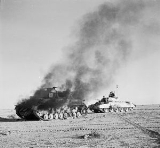
Iwm E 6724 Crusader 19411126
During the ensuing stalemate, the Allied forces reorganised. Archibald Wavell was succeeded as commander in chief Middle East Command
Middle East Command

The Middle East Command was a British Army Command established prior to World War II in Egypt. Its primary role was to command British land forces and co-ordinate with the relevant naval and air commands to defend British interests in the Middle East and eastern Mediterranean....
 by Claude Auchinleck
Claude Auchinleck

Field Marshal Sir Claude John Eyre Auchinleck, Order of the Bath, Order of the Indian Empire, Order of the Star of India, Distinguished Service Order, Order of the British Empire , nicknamed The Auk, was a British army commander during World War II....
 and the Western Desert Force was reinforced with a second Corps to form the new Eighth Army
British Eighth Army

The Eighth Army was one of the best-known formations in World War II, fighting in the North African campaign and Italian Campaign s.It was a United Kingdom formation, and was always commanded by British generals....
, which was at this time made up of units from the British Army, Australian Army
Australian Army

The Australian Army is Australia's military land force. It is part of the Australian Defence Force along with the Royal Australian Navy and the Royal Australian Air Force....
, the British Indian Army
British Indian Army

The Indian Army was the principal army of the British Raj in India during the last half-century before the Partition of India of India in 1947....
, the New Zealand Army
New Zealand Army

New Zealand Army , is the land armed force of the Military of New Zealand and comprises around 4,500 regular personnel and 2,500 non-regulars and civilians....
 and the South African Army
South African Army

The South African Army is the army of South Africa, first formed after the Union of South Africa was created in 1910.The South African military evolved within the tradition of frontier warfare fought by popular militias and small irregular military commando forces, reinforced by the Afrikaner historical distrust of large standing armies....
. There was also a brigade of Free French under Marie-Pierre Koenig. The new formation launched a new offensive, Operation Crusader
Operation Crusader

Operation Crusader was an operation launched by the British Eighth Army between 18 November – 30 December 1941. The operation successfully relieved the 1941 Siege of Tobruk....
, in November 1941 and by January 1942 recaptured all of the territory recently acquired by the Germans and Italians. Once again, the front line
Front line

The Forward Line of Troops, is a term parlanced by most armed forces worldwide. It is a battlespace control that designates the forward-most friendly and hostile forces that are presently on the battlespace during an armed conflict or war; whether it be regular infantry or reconnaissance....
 was at El Agheila.

After receiving supplies and reinforcements from Tripoli
Tripoli

Tripoli is the largest and Capital city of Libya.Tripoli has a population of 1.69 million. The city is located in the northwest of the country on the edge of the desert, on a point of rocky land projecting into the Mediterranean Sea and forming a bay....
, the Axis again attacked. Defeating the Allies at Gazala
Battle of Gazala

The Battle of Gazala was an important battle of the World War II Western Desert Campaign, fought around the port of Tobruk in Libya from May 26 to June 21, 1942....
 in June and capturing Tobruk. The Axis forces drove the Eighth Army back past the border of Egypt where their advance was stopped in July only from Alexandria
Alexandria

Alexandria , with a population of 4.1 million, is the second-largest city in Egypt, and is the country's largest seaport, serving about 80% of Egypt's imports and exports....
 in the First Battle of El Alamein
First Battle of El Alamein

The First Battle of El Alamein 1–27 July 1942 was a battle of the Western Desert Campaign of the Second World War, fought between Axis powers of World War II commanded by Erwin Rommel, and Allies of World War II commanded by Claude Auchinleck....
.

General Claude Auchinleck
Claude Auchinleck

Field Marshal Sir Claude John Eyre Auchinleck, Order of the Bath, Order of the Indian Empire, Order of the Star of India, Distinguished Service Order, Order of the British Empire , nicknamed The Auk, was a British army commander during World War II....
, had personally assumed command of the Eighth Army following the defeat at Gazala, was sacked following the First Battle of El Alamein and was replaced by General Harold Alexander. Lieutenant-General William Gott
William Gott

Lieutenant-General William Henry Ewart "Strafer" Gott Order of the Bath, Order of the British Empire, Distinguished Service Order and medal bar, Military Cross was a British Army officer during both the World War I and World War II, reaching the rank of lieutenant-general when serving in the British Eighth Army....
 was given command of the Eighth Army, however he was killed en route to taking up his command and was replaced by Lieutenant-General Bernard Montgomery.

The Axis forces made a new attempt to break through to Cairo at the end of June at Alam Halfa
Battle of Alam Halfa

The Battle of Alam el Halfa took place between August 30 and September 5, 1942 south of El Alamein during the Western Desert Campaign of World War II....
 but were pushed back. After a period of build up and training, the Eighth launched a major offensive, decisively defeating the German-Italian army during the Second Battle of El Alamein
Second Battle of El Alamein

The Second Battle of El Alamein marked a major turning point in the Western Desert Campaign of World War II. The battle lasted from 23 October to 5 November 1942....
 in late October 1942. The Eighth Army then pushed the Axis forces westward, capturing Tripoli in mid January 1943. By February, Eighth Army was facing the German-Italian Panzer Army near the Mareth Line
Mareth Line

The Mareth Line was a system of fortifications built by the French between the towns of Medenine and Gab?s in southern Tunisia, prior to World War II....
 and came under command of General Harold Alexander's 18th Army Group for the concluding phase of the war in North Africa, the Tunisia Campaign
Tunisia Campaign

The Tunisia Campaign was a series of World War II battles that took place in Tunisia in the North African Campaign of World War II, between Axis Powers and Allied forces....
.

Operation Torch


Operation Torch started on 8 November 1942, and finished on 11 November 1942. In an attempt to pincer German and Italian forces, Allied forces (American and British Commonwealth), landed in Vichy
Vichy France

Vichy France, or the Vichy regime are the common terms used to describe the government of France from July 1940 to August 1944. This government, which succeeded the French Third Republic, officially called itself the French State , in contrast with the previous designation, "French Republic." Marshal of France Philippe P?tain pro...
-held French North Africa under the assumption that there would be little to no resistance. Nevertheless, Vichy French forces put up a strong and bloody resistance to Allied forces in Oran
Oran

Oran is a city on the Mediterranean Sea coast in northwestern Algeria. Oran marked the largest westernmost metropolitan area of the then Ottoman Empire....
 and Morocco
Morocco

Morocco , officially the Kingdom of Morocco , is a country located in North Africa with a population of nearly 34 million and an area just under 447,000 km2....
. But not in Algiers
Algiers

Algiers Nicknamed El-Bahdja or Alger la Blanche for the glistening white of its buildings as seen rising up from the sea, Algiers is situated on the west side of a bay of the Mediterranean Sea....
, where a coup d'état
Coup d'état

A coup d??tat , often simply called a coup, is the sudden unconstitutional overthrow of a government by a part of the state establishment – usually the military – to replace the branch of the stricken government, either with another civil government or with a military government....
 by the French resistance on 8 November succeeded in neutralizing the French XIX Corps before the landing, and arresting the Vichy commanders. Consequently the landings met no practical opposition in Algiers and the city was captured on the first day along with the entire Vichy African command. After three days of talks and threats, General Mark Clark, and Eisenhower
Dwight D. Eisenhower

Dwight David ?Ike? Eisenhower was the List of Presidents of the United States President of the United States from 1953 until 1961 and a General of the Army in the United States Army....
, compelled the Vichy Admiral François Darlan
François Darlan

Fran?ois Darlan was a France naval officer. Darlan rose through the French Navy, ultimately becoming Admiral of the Fleet, and was a major figure of the Vichy France regime during World War II....
 (and General Alphonse Juin
Alphonse Juin

Alphonse Pierre Juin was a Marshal of France....
) to order the cessation of armed resistance in Oran and Morocco by French forces on 10 November and 11 with the proviso that Darlan would be head of a Free French administration.

The Allied landings prompted the Axis occupation of Vichy France (Case Anton
Case Anton

Operation Anton was the codename for the military occupation of Vichy France carried out by Nazi Germany and Italian Fascism in 1942....
). In addition the French fleet was captured at Toulon by the Italians something which did them little good as the main portion of the fleet had been scuttled
Scuttling of the French fleet in Toulon

The French fleet in Military port of Toulon was scuttled on 27 November 1942 on the order of the Admiralty of Vichy France to avoid capture by Nazi Germany forces....
 to prevent their use by the Axis. The Vichy army in North Africa joined the Allies (see Free French Forces
Free French Forces

File:Croix de Lorraine2.svgThe Free French Forces were France fighters in World War II who decided to continue fighting against Axis powers of World War II forces after the Armistice with France and subsequent German occupation of France in World War II....
).

Tunisian Campaign

17 November 1942-13 May 1943.

Following the Operation Torch landings, (from early November 1942), the Germans and Italians initiated a build up of troops in Tunisia to fill the vacuum left by Vichy troops which had withdrawn. During this period of weakness, the Allies decided against a rapid advance into Tunisia while they wrestled with the Vichy authorities. Many of the Allied soldiers were tied up in garrison duties because of the uncertain status and intentions of the Vichy forces.

Tigeritanktunis
By mid-November the Allies were able to advance into Tunisia but only in single division strength. In early December the Eastern Task Force of British 78th Infantry Division
British 78th Infantry Division

The British 78th Infantry Division, also known as the Battleaxe Division, fought in the Second World War in North Africa and Italy....
 and elements of U.S. 1st Armored Division had advanced eastwards to within 30 km of Tunis. By this time the Axis had one German and five Italian divisions from Europe in Tunisia to reinforce the defenders. The Allies were demolished.

During the winter there followed a period of stalemate during which time both sides continued to build up their forces. By the new year, the Allied task force had become U.S. First Army
U.S. First Army

The First United States Army was a Army#Field Army of the United States Army. It now serves a mobilization, readiness and training command....
 with two British, six U.S., one French Corps, and soldiers from other Allied nations.

In the second half of February, in eastern Tunisia, Rommel and von Arnim had some successes against the mainly inexperienced French and U.S. Corps, most notably in routing the US II Corps commanded by Major-General Lloyd Fredendall
Lloyd Fredendall

Lloyd Fredendall was an United States General Officer during World War II. Major General Fredendall is best known for his command of the Central Task Force landings during Operation Torch, and his command of the II Corps during the early stages of the Tunisia Campaign....
 at the Battle of the Kasserine Pass
Battle of the Kasserine Pass

The Battle of Kasserine Pass took place in World War II during the Tunisia Campaign. It was, in fact, a series of battles fought around Kasserine Pass, a two-mile wide gap in the Grand Dorsal chain of the Atlas Mountains in west central Tunisia....
.

By the beginning of March the Eighth Army, advancing westwards along the North African coast, had reached the Tunisian border. Rommel and von Arnim found themselves in an Allied "two army" pincer. They were outflanked, outmanned and outgunned. The British Eighth Army shattered the Axis defense on the Mareth Line
Mareth Line

The Mareth Line was a system of fortifications built by the French between the towns of Medenine and Gab?s in southern Tunisia, prior to World War II....
 in late March and 1st Army in central Tunisia launched their main offensive in mid April to squeeze the Axis forces until their resistance in Africa collapsed. The Axis forces surrendered on 13 May 1943 yielding over 275,000 prisoners of war. This huge loss of experienced troops greatly reduced the military capacity of the Axis powers, although the largest percentage of Axis troops escaped Tunisia. This defeat in Africa led to all Italian colonies in Africa being captured.

Aftermath

After victory by the Allies in the North African Campaign, the stage was set for the Italian Campaign
Italian Campaign (World War II)

The Italian Campaign of World War II was the name of Allies operations in and around Italy, from History of Italy as a monarchy and in the World Wars#Italy and the Second World War ....
 to begin. The invasion of Sicily
Allied invasion of Sicily

The Allied invasion of Sicily, codenamed Operation Husky, was a major World War II campaign, in which the Allies of World War II took Sicily from the Axis ....
 followed two months later.

See also


Footnotes


External links

  • General sites on the North African Campaign
  • Home of General Hans-Jürgen von Arnim
    Hans-Jürgen von Arnim

    Hans-J?rgen von Arnim was a Germany colonel-general of cavalry who served during World War II....
    's Staff Car
  • The Royal Sussex Regimental Association