


Kazan

Encyclopedia
Kazan is the capital
and largest city of the Republic of Tatarstan, Russia
. With a population of 1,143,546 (2010 Census preliminary results), it is the eighth most populous city in Russia. Kazan lies at the confluence
of the Volga
and Kazanka River
s in European Russia. In April 2009, the Russian Patent Office granted Kazan the right to brand itself as the "Third Capital" of Russia. In 2009 it was chosen as the "sports capital of Russia" and it still is referred to as. The Kazan Kremlin
is a World Heritage Site
.
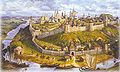 There is a long-running dispute as to whether Kazan was founded by the Muslim
Volga Bulgars in the early Middle Ages
or by the Tatars of the Golden Horde
in the mid-15th century, as written records before the latter period are sparse. If there was a Bulgar city on the site, estimates of the date of its foundation range from the early 11th century to the late 13th century (see Iske Qazan
). It was a border post between Volga Bulgaria
and two Finnic tribes, the (Mari and the Udmurt
). Another vexatious question is where the citadel was built originally. Archaeological explorations have produced evidence of urban settlement in three parts of the modern city: in the Kremlin
; in Bişbalta at the site of the modern Zilantaw monastery; and near the Qaban lake. The oldest of these seems to be the Kremlin
.
If Kazan existed in the 11th and 12th centuries, it could have been a stop on a Volga trade route
from Scandinavia
to Baghdad
. It was a trade center, and possibly a major city for Bulgar
settlers in the Kazan region, although their capital was further south at the city of Bolğar
.
After the Mongols devastated the Bolğar and Bilär
areas in the 13th century, migrants resettled Kazan. Kazan became a center of a duchy which was a dependency of the Golden Horde. Two centuries later, in the 1430s, Hordian Tatars (such as Ghiasetdin of Kazan
) usurped power from its Bolghar dynasty.
Some Tatars also went to Lithuania
, brought by Vytautas the Great
.
In 1438, after the destruction of the Golden Horde, Kazan became the capital of the powerful Khanate of Kazan
. The city bazaar, Taş Ayaq (Stone Leg)' became the most important trade center in the region, especially for furniture. The citadel and Bolaq
channel were reconstructed, giving the city a strong defensive capacity. The Russians managed to occupy the city briefly several times.
Russia
under Ivan the Terrible conquered the city for good and the majority of the population was massacred. During the governorship of Alexander Gorbatyi-Shuisky
, most of the khanates's Tatar residents were killed or forcibly Christianized. Mosque
s and palaces were ruined. The surviving Tatar population was moved to a place 50 kilometres (31.1 mi) away from the city and this place was forcibly settled by Russian farmers and soldiers. Tatars in the Russian service
were settled in the Tatar Bistäse settlement near the city's wall. Later Tatar merchants and handicraft masters also settled there. During this period, Kazan was largely destroyed as a result of several great fires. After one of them in 1579, the icon Our Lady of Kazan
was discovered in the city.
In the early 17th century, at the beginning of the Time of Troubles
in Russia, the Tsardom of Kazan declared independence with the help of the Russian population, but this independence was suppressed by Kuzma Minin in 1612..
. After Peter the Great's visit, the city became a center of shipbuilding for the Caspian fleet. The major Russian poet Gavrila Romanovich Derzhavin was born in Kazan in 1743, the son of a poor country squire of Tatar ancestry though himself having a thoroughly Russian identity. Kazan was largely destroyed in
1774 as a result of the Pugachev revolt, a revolt by border troops and peasants led by the Don Cossack ataman
(captain) Yemelyan Pugachev
, but was rebuilt soon afterwards, during the reign of Catherine the Great. Catherine also decreed that mosques could again be built in Kazan, the first being Marjani Mosque. In the beginning of the 19th century Kazan State University and printing press were founded by Alexander I
. It became an important center for Oriental Studies
in Russia. The Qur'an
was first printed in Kazan in 1801. Kazan became an industrial center and peasants migrated there to join its industrial workforce. In 1875, a horse tramway appeared; 1899 saw the installation of a tram
way. After the Russian Revolution of 1905
, Tatars were allowed to revive Kazan as a Tatar cultural center. The first Tatar theater and the first Tatar newspaper appeared.
centers. In 1918, Kazan was a capital of the Idel-Ural State
, which was suppressed by the Bolshevist government. In the Kazan Operation
of August 1918, it was briefly occupied by Czechoslovak Legions
. In 1920 (after the October Revolution
), Kazan became the center of Tatar Autonomous Soviet Socialist Republic
. In the 1920s and 1930s, most of the city's mosques and churches were destroyed, as occurred elsewhere in the USSR
. During World War II
, many industrial plants and factories to the west were relocated in Kazan, making the city a center of the military industry, producing tanks and planes
. After the war Kazan consolidated as an industrial and scientific center. In 1979, the city's population reached one million.
, Kazan again became the center of Tatar culture, and separatist tendencies intensified. With the return of the capitalism era Kazan became one the most important centers of the Russian Federation. The city came up from 10th to 6th position in population ranking of Russian cities. In the late 2000s the city earned the right to host both the 2013 Summer Universiade
and 2018 FIFA World Cup
.
, was dedicated in the Kazan Kremlin
, the holiest copy of Our Lady of Kazan
was returned to the city, the "Millennium Bridge"
was inaugurated that year, and Kazan Metro
began operation.
, circa 48.8 percent and Tatars circa 47.5 percent. The populace of Kazan includes Chuvash
, Ukrainians
, Azeri, and Jews. Predominant faiths of Kazan city are Sunni Islam
and Eastern Orthodoxy with Catholicism
, Protestantism
, Judaism
, Krishnaism
, and the Bahá'í Faith
also counted among the faithful of Kazan.
and Russian language
s are widely spoken in the city. Russian is understood by everyone except for some older Tatars. Tatar is widely spoken mainly by Tatars.
(Köppen climate classification
Dfb) with long cold winters and warm, often hot dry summers. The warmest month is July with daily mean temperature near 20 °C (68 °F), coldest - January -12 °C.
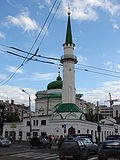 The city has a citadel
(Russian: кремль, tr. kreml', or sometimes Tatar: kirman), which was declared a World Heritage Site
in 2000. Major monuments in the kremlin are the 5-domed 6-columned Annunciation Cathedral (1561–62) and the mysterious leaning Soyembika Tower
, named after the last queen of Kazan and regarded as the city's most conspicuous landmark.
Also of interest are the towers and walls, erected in the 16th and 17th centuries but later reconstructed; the Qol-Şarif mosque
, which is already rebuilt inside the citadel;
remains of the Saviour Monastery (its splendid 16th-century cathedral having been demolished by the Bolsheviks) with the Spasskaya Tower; and the Governor
's House (1843–53), designed by Konstantin Thon
, now the Palace of the President
of Tatarstan
.
Next door, the ornate baroque Sts-Peter-and-Paul's Cathedral on Qawi Nacmi Street and Marcani mosque on Qayum Nasiri Street date back to the 18th century.
canal and Lake Qaban. The first district (Qazan Bistäse or Kazanskiy Posad), historically Russian, is situated on the hill, the second (İske Tatar Bistäse or Staro-Tatarskaya Sloboda), historically Tatar, is situated between the Bolaq and the Volga. Mosques, such as Nurullah, Soltan, Bornay
, Apanay, Äcem, Märcani, İske Taş, Zäñgär are in the Tatar district. Churches, such as Blagoveschenskaya, Varvarinskaya, Nikol'skaya, Tikhvinskaya, are mostly in the Russian part of the city. The main city-centre streets are Bauman, Kremlyovskaya, Dzerzhinsky, Tuqay, Puşkin
, Butlerov, Gorkiy, Karl Marx and Märcani.
An old legend says that in 1552, before the Russian invasion, wealthy Tatars (baylar) hid gold and silver in Lake Qaban.
There are also 49 music schools, 10 fine-arts schools and 43 sports schools.
Kazan Federal University (founded in 1804) is third oldest university in Russia after Saint Petersburg State University
(1724) and Moscow State University (1755). In 2009 KFU got Federal status as main university of Volga Region
.
Some other prominent universities are:
), the discovery of the electron paramagnetic resonance (Yevgeny Zavoisky
) and acoustic paramagnetic resonance (Altshuler) and many others. City hosts:
has been the mayor of Kazan since November 17, 2005
in construction and accumulated investment. City's Gross Regional Product
had reached 306 bln roubles (~$10 bln) in 2010.
Total banking capital of Kazan banks is third in Russia. The main industries of the city are: mechanical engineering, chemical, petrochemical, light and food industries. An innovative economy is represented by the largest IT-park in Russia which is one of the largest of its kind amongst Eastern Europe science park
s. Kazan ranks 174th (highest in Russia) in Mercer
’s Worldwide Quality of Living Survey.
is located 26 kilometers from the city centre. It is a hub for Tatarstan Airlines
and Kazan Air Enterprise
and hosts 11 air companies. Airport is connected with city by bus route #97.
There is also the Kazan Borisoglebskoye airfield, home to Kazan Aircraft Production Association
, a major aircraft factory, famous in the past as "Aircraft Plant 22" ("22nd Zavod").
Adjacent to it lies huge aircraft engines plant ("16th Zavod"). Currently it produces versions of Tupolev 204 and 214 aircraft, rather unsuccessful version of Boeing 757 single-aisle aircraft. In the past an Ilyushin-62, four-engine Russian mainliner, Typolev-160 "Black Jack" supersonic strategic bomber and Tu-22M tactic bomber were also produced here. Both these plants and adjacent workers' housing make a whole city district known as "Aviastroitelny" ("Aircraft Builders").
, Ulyanovsk
, Yoshkar-Ola
and Yekaterinburg
by railways.
Main railway station "Kazan passazhirsky" is located in the city centre and includes main building (built in 1896), commuter trains terminal, ticket office building and some other technical buildings. Station serves 36 intercity trains and more than 8 million passengers per annum.
There is a second terminal in the northern part of city, it serves only one intercity train. Reconstruction of the Northern terminal has been frozen.
Kazan city has also 19 platforms for commuter trains
, Ufa
, Tolyatti
, Orenburg
, Ulyanovsk
, Cheboksary
, Sterlitamak
, Buzuluk
, Baki
and Aktobe
. It is planned to build new stations in the East, West and North districts instead of Central for relieving city centre.
and Ufa
(E-22
), Orenburg
(R-239), Ul'yanovsk (R-241) and Igra (R-242). There are also R-175 federal highway and «Northern Europe — Western China» (in construction) route near the city.
There are five bridges across the Kazanka (Qazansu) river in the city, and one bridge connecting Kazan with the opposite bank of the Volga.
. Consulate-General of Turkey
.
for:
}
}
}
}
}
}
}
}
}
with:
Al Qalyubiyah
(Egypt
), since 2001 Al Minufiyah
(Egypt
), since 1997 Antalya
(Turkey
), since 2003 Astana
(Kazakhstan
), since 2004 Braunschweig
(Germany
), since 1988 College Station, Texas
(USA), since 1990
Donetsk
(Ukraine
), since 2002 Eskişehir
(Turkey
), since 1997 Hangzhou
(People's Republic of China
), since 2002 Istanbul
(Turkey
), since 2002 Tabriz
(Iran
), since 2009
Kazan has also partner relations with the following cities and regions:
Almaty
(Kazakhstan
), since 1996 Arkhangelsk
(Russia
), since 1999 Astrakhan
(Russia
), since 1997 Baku
(Azerbaijan
), since 2003 Bishkek
(Kyrgyzstan
), since 1998 Chelyabinsk
(Russia
), since 2002 Evpatoria (Ukraine
), since 1998 Ivanovo
(Russia
), since 1997 Jūrmala
(Latvia
), since 2002 Kabul
(Afghanistan
), since 2005 Krasnoyarsk
(Russia
), since 2001 Nizhny Novgorod
(Russia
), since 1997 Oryol
(Russia
), since 2010
Orenburg
(Russia
), since 2001 Samara
(Russia
), since 1998 Saratov
(Russia
), since 1999 Shumen Province
(Bulgaria
), since 2003 Tashkent
(Uzbekistan
), since 1998 Ufa
(Russia
), since 1999 Ulan-Ude
(Russia
), since 2003 Ulyanovsk
(Russia
), since 1998 Urbino
(Italy
), since 2001 Volgograd
(Russia
), since 2005 Yaroslavl
(Russia
), since 2003 Yoshkar-Ola
(Russia
), since 2002
Kazan has an Alliance française
centre.
Kazan has an American Corner.http://amcorners.ru/ac104/
Capital City
Capital City was a television show produced by Euston Films which focused on the lives of investment bankers in London living and working on the corporate trading floor for the fictional international bank Shane-Longman....
and largest city of the Republic of Tatarstan, Russia
Russia
Russia or , officially known as both Russia and the Russian Federation , is a country in northern Eurasia. It is a federal semi-presidential republic, comprising 83 federal subjects...
. With a population of 1,143,546 (2010 Census preliminary results), it is the eighth most populous city in Russia. Kazan lies at the confluence
Confluence
Confluence, in geography, describes the meeting of two or more bodies of water.Confluence may also refer to:* Confluence , a property of term rewriting systems...
of the Volga
Volga River
The Volga is the largest river in Europe in terms of length, discharge, and watershed. It flows through central Russia, and is widely viewed as the national river of Russia. Out of the twenty largest cities of Russia, eleven, including the capital Moscow, are situated in the Volga's drainage...
and Kazanka River
Kazanka River
Kazanka or Qazansu is a river in the Republic of Tatarstan, Russia, a left tributary of the Volga. Kazanka begins near the village of Bimeri in Arsk District and flows into the Samara Reservoir in Kazan, near the Kazan Kremlin. Another towns on the Kazanka are Arsk and historical Iske Kazan. The...
s in European Russia. In April 2009, the Russian Patent Office granted Kazan the right to brand itself as the "Third Capital" of Russia. In 2009 it was chosen as the "sports capital of Russia" and it still is referred to as. The Kazan Kremlin
Kazan Kremlin
The Kazan Kremlin is the chief historic citadel of Tatarstan, situated in the city of Kazan. It was built on behest of Ivan the Terrible on the ruins of the former castle of Kazan khans...
is a World Heritage Site
World Heritage Site
A UNESCO World Heritage Site is a place that is listed by the UNESCO as of special cultural or physical significance...
.
Etymology
The origin of the name Kazan is uncertain. The most accepted legends derive it from the Bulgarian (and also modern Tatar) word qazan, which means 'boiler' or 'cauldron'.Middle Ages
Muslim
A Muslim, also spelled Moslem, is an adherent of Islam, a monotheistic, Abrahamic religion based on the Quran, which Muslims consider the verbatim word of God as revealed to prophet Muhammad. "Muslim" is the Arabic term for "submitter" .Muslims believe that God is one and incomparable...
Volga Bulgars in the early Middle Ages
Middle Ages
The Middle Ages is a periodization of European history from the 5th century to the 15th century. The Middle Ages follows the fall of the Western Roman Empire in 476 and precedes the Early Modern Era. It is the middle period of a three-period division of Western history: Classic, Medieval and Modern...
or by the Tatars of the Golden Horde
Golden Horde
The Golden Horde was a Mongol and later Turkicized khanate that formed the north-western sector of the Mongol Empire...
in the mid-15th century, as written records before the latter period are sparse. If there was a Bulgar city on the site, estimates of the date of its foundation range from the early 11th century to the late 13th century (see Iske Qazan
Iske Qazan
İske Qazan , was a Bolghar-Tatar city in the 13-16th centuries, situated on the banks of the Qazansu river in the Qazan artı or Zakazanye region, in what is today the Russian Federation republic of Tatarstan .In 18th century Tatar literature, İske Qazan was said to have been founded by the brothers...
). It was a border post between Volga Bulgaria
Volga Bulgaria
Volga Bulgaria, or Volga–Kama Bolghar, is a historic Bulgar state that existed between the seventh and thirteenth centuries around the confluence of the Volga and Kama rivers in what is now Russia.-Origin:...
and two Finnic tribes, the (Mari and the Udmurt
Udmurt people
The Udmurts are a people who speak the Udmurt language. Through history they have been known in Russian as Chud Otyatskaya , Otyaks, or Votyaks , and in Tatar as Ar....
). Another vexatious question is where the citadel was built originally. Archaeological explorations have produced evidence of urban settlement in three parts of the modern city: in the Kremlin
Kazan Kremlin
The Kazan Kremlin is the chief historic citadel of Tatarstan, situated in the city of Kazan. It was built on behest of Ivan the Terrible on the ruins of the former castle of Kazan khans...
; in Bişbalta at the site of the modern Zilantaw monastery; and near the Qaban lake. The oldest of these seems to be the Kremlin
Kazan Kremlin
The Kazan Kremlin is the chief historic citadel of Tatarstan, situated in the city of Kazan. It was built on behest of Ivan the Terrible on the ruins of the former castle of Kazan khans...
.
If Kazan existed in the 11th and 12th centuries, it could have been a stop on a Volga trade route
Volga trade route
In the Middle Ages, the Volga trade route connected Northern Europe and Northwestern Russia with the Caspian Sea, via the Volga River. The Rus used this route to trade with Muslim countries on the southern shores of the Caspian Sea, sometimes penetrating as far as Baghdad...
from Scandinavia
Scandinavia
Scandinavia is a cultural, historical and ethno-linguistic region in northern Europe that includes the three kingdoms of Denmark, Norway and Sweden, characterized by their common ethno-cultural heritage and language. Modern Norway and Sweden proper are situated on the Scandinavian Peninsula,...
to Baghdad
Baghdad
Baghdad is the capital of Iraq, as well as the coterminous Baghdad Governorate. The population of Baghdad in 2011 is approximately 7,216,040...
. It was a trade center, and possibly a major city for Bulgar
Bulgars
The Bulgars were a semi-nomadic who flourished in the Pontic Steppe and the Volga basin in the 7th century.The Bulgars emerge after the collapse of the Hunnic Empire in the 5th century....
settlers in the Kazan region, although their capital was further south at the city of Bolğar
Bolghar
Bolghar was intermittently capital of Volga Bulgaria from the 8th to the 15th centuries, along with Bilyar and Nur-Suvar. It was situated on the bank of the Volga River, about 30 km downstream from its confluence with the Kama River and some 130 km from modern Kazan...
.
After the Mongols devastated the Bolğar and Bilär
Bilär
Bilär was a medieval city in Volga Bulgaria and its second capital before the Mongol invasion of Volga Bulgaria. It was located on the left bank of the Small Cheremshan River in modern-day Alexeyevsky District of the Republic of Tatarstan.The city was founded by the indigenous Bilyar tribe of the...
areas in the 13th century, migrants resettled Kazan. Kazan became a center of a duchy which was a dependency of the Golden Horde. Two centuries later, in the 1430s, Hordian Tatars (such as Ghiasetdin of Kazan
Ghiasetdin of Kazan
Ghiasetdin , was a ruler of Kazan, Ghiasetdin Ulus from the 1420s. He was a son of Khan Shadibak . After the death of Idegay in 1419 he usurped the throne of the Kazan Duchy. He also struggled against Olug Moxammat Khan for the leadership of the Golden Horde, and died in this struggle....
) usurped power from its Bolghar dynasty.
Some Tatars also went to Lithuania
Grand Duchy of Lithuania
The Grand Duchy of Lithuania was a European state from the 12th /13th century until 1569 and then as a constituent part of Polish-Lithuanian Commonwealth until 1791 when Constitution of May 3, 1791 abolished it in favor of unitary state. It was founded by the Lithuanians, one of the polytheistic...
, brought by Vytautas the Great
Vytautas the Great
Vytautas ; styled "the Great" from the 15th century onwards; c. 1350 October 27, 1430) was one of the most famous rulers of medieval Lithuania. Vytautas was the ruler of the Grand Duchy of Lithuania which chiefly encompassed the Lithuanians and Ruthenians...
.
In 1438, after the destruction of the Golden Horde, Kazan became the capital of the powerful Khanate of Kazan
Khanate of Kazan
The Khanate of Kazan was a medieval Tatar state which occupied the territory of former Volga Bulgaria between 1438 and 1552. Its khans were the patrilineal descendants of Toqa Temür, the thirteenth son of Jochi and grandson of Genghis Khan. The khanate covered contemporary Tatarstan, Mari El,...
. The city bazaar, Taş Ayaq (Stone Leg)' became the most important trade center in the region, especially for furniture. The citadel and Bolaq
Bolaq
The Bolaq is a canal that once flowed from the northern part of Birge Qaban to Kazanka , today is an isolated channel in downtown Kazan.The modern length of Bolaq is 1550 m, width is 24 m...
channel were reconstructed, giving the city a strong defensive capacity. The Russians managed to occupy the city briefly several times.
Russian Tsardom times
As a result of the Siege of Kazan (1552)Siege of Kazan (1552)
The siege of Kazan in 1552 was the final battle of Russo-Kazan Wars. It led to the fall of Kazan Khanate. However, it was not the last battle on the khanate's territory. After the fall of Kazan, rebel governments formed in Çalım and Mişätamaq, and a new khan was invited from the Nogais...
Russia
Russia
Russia or , officially known as both Russia and the Russian Federation , is a country in northern Eurasia. It is a federal semi-presidential republic, comprising 83 federal subjects...
under Ivan the Terrible conquered the city for good and the majority of the population was massacred. During the governorship of Alexander Gorbatyi-Shuisky
Alexander Gorbatyi-Shuisky
Prince Alexander Borisovich Gorbatyi-Shuisky was probably the most celebrated and popular general of Ivan the Terrible. The town of Gorbatov in Nizhny Novgorod Oblast bears his name....
, most of the khanates's Tatar residents were killed or forcibly Christianized. Mosque
Mosque
A mosque is a place of worship for followers of Islam. The word is likely to have entered the English language through French , from Portuguese , from Spanish , and from Berber , ultimately originating in — . The Arabic word masjid literally means a place of prostration...
s and palaces were ruined. The surviving Tatar population was moved to a place 50 kilometres (31.1 mi) away from the city and this place was forcibly settled by Russian farmers and soldiers. Tatars in the Russian service
Serving Tatars
Serving Tatars were a class of ethnically Tatars state servants in Muscovy and Russia in 14th-18th centuries.Originally this class was formed Tatar nobles from Golden Horde and Tatar khanates that enjoyed membership of the Russian service class. Later, qara xalıq peasants of Kazan Khanate...
were settled in the Tatar Bistäse settlement near the city's wall. Later Tatar merchants and handicraft masters also settled there. During this period, Kazan was largely destroyed as a result of several great fires. After one of them in 1579, the icon Our Lady of Kazan
Our Lady of Kazan
Our Lady of Kazan, also called Theotokos of Kazan , was a holy icon of the highest stature within the Russian Orthodox Church, representing the Virgin Mary as the protector and patroness of the city of Kazan. Copies of the image are also venerated in the Catholic Church...
was discovered in the city.
In the early 17th century, at the beginning of the Time of Troubles
Time of Troubles
The Time of Troubles was a period of Russian history comprising the years of interregnum between the death of the last Russian Tsar of the Rurik Dynasty, Feodor Ivanovich, in 1598, and the establishment of the Romanov Dynasty in 1613. In 1601-1603, Russia suffered a famine that killed one-third...
in Russia, the Tsardom of Kazan declared independence with the help of the Russian population, but this independence was suppressed by Kuzma Minin in 1612..
Russian Empire times
In 1708, the Tsardom of Kazan was abolished, and Kazan became the center of a guberniyaKazan Governorate
The Kazan Governorate or Government of Kazan was a governorate of Imperial Russia from 1708–1920, with the city of Kazan as its capital.-History:...
. After Peter the Great's visit, the city became a center of shipbuilding for the Caspian fleet. The major Russian poet Gavrila Romanovich Derzhavin was born in Kazan in 1743, the son of a poor country squire of Tatar ancestry though himself having a thoroughly Russian identity. Kazan was largely destroyed in
Battle of Kazan (1774)
The Battle of Kazan was a major battle during the Pugachev Rebellion. It took place on 12–15 July 1774 in Kazan, Russia, and the surrounding area. The first stage began in the morning of 12 July, when rebels under Yemelyan Pugachev defeated government troops and besieged them in the Kazan Kremlin....
1774 as a result of the Pugachev revolt, a revolt by border troops and peasants led by the Don Cossack ataman
Ataman
Ataman was a commander title of the Ukrainian People's Army, Cossack, and haidamak leaders, who were in essence the Cossacks...
(captain) Yemelyan Pugachev
Yemelyan Pugachev
Yemelyan Ivanovich Pugachov , was a pretender to the Russian throne who led a great Cossack insurrection during the reign of Catherine II...
, but was rebuilt soon afterwards, during the reign of Catherine the Great. Catherine also decreed that mosques could again be built in Kazan, the first being Marjani Mosque. In the beginning of the 19th century Kazan State University and printing press were founded by Alexander I
Alexander I of Russia
Alexander I of Russia , served as Emperor of Russia from 23 March 1801 to 1 December 1825 and the first Russian King of Poland from 1815 to 1825. He was also the first Russian Grand Duke of Finland and Lithuania....
. It became an important center for Oriental Studies
Oriental studies
Oriental studies is the academic field of study that embraces Near Eastern and Far Eastern societies and cultures, languages, peoples, history and archaeology; in recent years the subject has often been turned into the newer terms of Asian studies and Middle Eastern studies...
in Russia. The Qur'an
Qur'an
The Quran , also transliterated Qur'an, Koran, Alcoran, Qur’ān, Coran, Kuran, and al-Qur’ān, is the central religious text of Islam, which Muslims consider the verbatim word of God . It is regarded widely as the finest piece of literature in the Arabic language...
was first printed in Kazan in 1801. Kazan became an industrial center and peasants migrated there to join its industrial workforce. In 1875, a horse tramway appeared; 1899 saw the installation of a tram
Tram
A tram is a passenger rail vehicle which runs on tracks along public urban streets and also sometimes on separate rights of way. It may also run between cities and/or towns , and/or partially grade separated even in the cities...
way. After the Russian Revolution of 1905
Russian Revolution of 1905
The 1905 Russian Revolution was a wave of mass political and social unrest that spread through vast areas of the Russian Empire. Some of it was directed against the government, while some was undirected. It included worker strikes, peasant unrest, and military mutinies...
, Tatars were allowed to revive Kazan as a Tatar cultural center. The first Tatar theater and the first Tatar newspaper appeared.
Soviet period
In 1917 Kazan became one of the revolutionOctober Revolution
The October Revolution , also known as the Great October Socialist Revolution , Red October, the October Uprising or the Bolshevik Revolution, was a political revolution and a part of the Russian Revolution of 1917...
centers. In 1918, Kazan was a capital of the Idel-Ural State
Idel-Ural State
The Idel-Ural State was a short-lived Tatar republic with its centre in Kazan that united Tatars, Bashkirs and the Chuvash in the turmoil of the Russian Civil War. Often viewed as an attempt to recreate the Khanate of Kazan, the republic was proclaimed on December 12, 1917, by a Congress of Muslims...
, which was suppressed by the Bolshevist government. In the Kazan Operation
Kazan Operation
Kazan Operation was the Red Army's offensive against the Czechoslovak Legion and the People Army of Komuch during the Russian Civil War.- Background :...
of August 1918, it was briefly occupied by Czechoslovak Legions
Czechoslovak Legions
The Czechoslovak Legions were volunteer armed forces composed predominantly of Czechs and Slovaks fighting together with the Entente powers during World War I...
. In 1920 (after the October Revolution
October Revolution
The October Revolution , also known as the Great October Socialist Revolution , Red October, the October Uprising or the Bolshevik Revolution, was a political revolution and a part of the Russian Revolution of 1917...
), Kazan became the center of Tatar Autonomous Soviet Socialist Republic
Tatar Autonomous Soviet Socialist Republic
Tatar Autonomous Soviet Socialist Republic was part of the Russian Soviet Federative Socialist Republic. It was created on May 27, 1920...
. In the 1920s and 1930s, most of the city's mosques and churches were destroyed, as occurred elsewhere in the USSR
Soviet Union
The Soviet Union , officially the Union of Soviet Socialist Republics , was a constitutionally socialist state that existed in Eurasia between 1922 and 1991....
. During World War II
World War II
World War II, or the Second World War , was a global conflict lasting from 1939 to 1945, involving most of the world's nations—including all of the great powers—eventually forming two opposing military alliances: the Allies and the Axis...
, many industrial plants and factories to the west were relocated in Kazan, making the city a center of the military industry, producing tanks and planes
Fixed-wing aircraft
A fixed-wing aircraft is an aircraft capable of flight using wings that generate lift due to the vehicle's forward airspeed. Fixed-wing aircraft are distinct from rotary-wing aircraft in which wings rotate about a fixed mast and ornithopters in which lift is generated by flapping wings.A powered...
. After the war Kazan consolidated as an industrial and scientific center. In 1979, the city's population reached one million.
Modern times
In the late 1980s and in the 1990s, after the dissolution of the USSRSoviet Union
The Soviet Union , officially the Union of Soviet Socialist Republics , was a constitutionally socialist state that existed in Eurasia between 1922 and 1991....
, Kazan again became the center of Tatar culture, and separatist tendencies intensified. With the return of the capitalism era Kazan became one the most important centers of the Russian Federation. The city came up from 10th to 6th position in population ranking of Russian cities. In the late 2000s the city earned the right to host both the 2013 Summer Universiade
2013 Summer Universiade
The 2013 Summer Universiade, the XXVII Summer Universiade, is scheduled for Kazan, Russia. Kazan is a capital of the Republic of Tatarstan is located 800 km east of Moscow, the federal capital, is a busy hub. The city has the biggest student community in the region.-Bid selection:The cities of...
and 2018 FIFA World Cup
2018 FIFA World Cup
The bidding process for the 2018 and 2022 FIFA World Cups was the process by which the locations for the 2018 and 2022 FIFA World Cups were selected. The process began officially in March 2009; eleven bids from thirteen countries were received, including one which was withdrawn and one that was...
.
Millennium of Kazan
Since 2000, the city has been undergoing a total renovation. The historical center, including its Kremlin, has been rebuilt. Kazan celebrated its millennium in 2005, after a city-organised historical commission settled on 1005 as the official year of the city's founding. During the millennium celebrations, one of the largest mosque in Russia, QolsharifQolsharif mosque
The Qolşärif mosque located in Kazan Kremlin, was reputed to be -at the time of its construction- the largest mosque in Russia, and in Europe outside of Istanbul.-History:...
, was dedicated in the Kazan Kremlin
Kazan Kremlin
The Kazan Kremlin is the chief historic citadel of Tatarstan, situated in the city of Kazan. It was built on behest of Ivan the Terrible on the ruins of the former castle of Kazan khans...
, the holiest copy of Our Lady of Kazan
Our Lady of Kazan
Our Lady of Kazan, also called Theotokos of Kazan , was a holy icon of the highest stature within the Russian Orthodox Church, representing the Virgin Mary as the protector and patroness of the city of Kazan. Copies of the image are also venerated in the Catholic Church...
was returned to the city, the "Millennium Bridge"
Millennium Bridge (Kazan)
The Millennium Bridge is a cable-stayed bridge that spans Kazanka River, in Kazan, Tatarstan, Russia. Its name originates from Kazan's thousand anniversary, widely celebrated in 2005 and the shape of its M-like pylon....
was inaugurated that year, and Kazan Metro
Kazan Metro
Kazan Metro is a rapid-transit system that serves the city of Kazan, Republic of Tatarstan, Russia. Opened on August 27, 2005, it is the newest system in Russia, and the first one to open after the breakup of the Soviet Union.-Planning:...
began operation.
Demographics
Ethnicity and religion
The city's population consists mostly of ethnic RussiansRussians
The Russian people are an East Slavic ethnic group native to Russia, speaking the Russian language and primarily living in Russia and neighboring countries....
, circa 48.8 percent and Tatars circa 47.5 percent. The populace of Kazan includes Chuvash
Chuvash people
The Chuvash people are a Turkic ethnic group, native to an area stretching from the Volga Region to Siberia. Most of them live in Republic of Chuvashia and surrounding areas, although Chuvash communities may be found throughout all Russia.- Etymology :...
, Ukrainians
Ukraine
Ukraine is a country in Eastern Europe. It has an area of 603,628 km², making it the second largest contiguous country on the European continent, after Russia...
, Azeri, and Jews. Predominant faiths of Kazan city are Sunni Islam
Sunni Islam
Sunni Islam is the largest branch of Islam. Sunni Muslims are referred to in Arabic as ʾAhl ūs-Sunnah wa āl-Ǧamāʿah or ʾAhl ūs-Sunnah for short; in English, they are known as Sunni Muslims, Sunnis or Sunnites....
and Eastern Orthodoxy with Catholicism
Catholicism
Catholicism is a broad term for the body of the Catholic faith, its theologies and doctrines, its liturgical, ethical, spiritual, and behavioral characteristics, as well as a religious people as a whole....
, Protestantism
Protestantism
Protestantism is one of the three major groupings within Christianity. It is a movement that began in Germany in the early 16th century as a reaction against medieval Roman Catholic doctrines and practices, especially in regards to salvation, justification, and ecclesiology.The doctrines of the...
, Judaism
Judaism
Judaism ) is the "religion, philosophy, and way of life" of the Jewish people...
, Krishnaism
Krishnaism
Krishnaism is a group of Hindu denominations within Vaishnavism, centered on devotion to Radha Krishna or other forms of Krishna, identified with Vishnu.The central text of Krishnaism is the Bhagavad Gita....
, and the Bahá'í Faith
Bahá'í Faith
The Bahá'í Faith is a monotheistic religion founded by Bahá'u'lláh in 19th-century Persia, emphasizing the spiritual unity of all humankind. There are an estimated five to six million Bahá'ís around the world in more than 200 countries and territories....
also counted among the faithful of Kazan.
Languages
TatarTatar language
The Tatar language , or more specifically Kazan Tatar, is a Turkic language spoken by the Tatars of historical Kazan Khanate, including modern Tatarstan and Bashkiria...
and Russian language
Russian language
Russian is a Slavic language used primarily in Russia, Belarus, Uzbekistan, Kazakhstan, Tajikistan and Kyrgyzstan. It is an unofficial but widely spoken language in Ukraine, Moldova, Latvia, Turkmenistan and Estonia and, to a lesser extent, the other countries that were once constituent republics...
s are widely spoken in the city. Russian is understood by everyone except for some older Tatars. Tatar is widely spoken mainly by Tatars.
Population
Population:| Year | Population |
|---|---|
| 1550 | 50,000 |
| 1557 | 7,000 |
| 1800 | 40,000 |
| 1830 | 43,900 |
| 1839 | 51,600 |
| 1859 | 60,600 |
| 1862 | 63,100 |
| 1883 | 140,000 |
| 1897 | 130,000 |
| 1917 | 206,600 |
| 1926 | 179,000 |
| 1939 | 398,000 |
| 1959 | 667,000 |
| 1979 | 989,000 |
| 1989 | 1,094,378 (census) |
| 1997 | 1,076,000 |
| 2000 | 1,089,500 |
| 2002 | 1,105,289 (census) |
| 2008 | 1,120,200 |
| 2009 | 1,130,717 |
| 2010 | 1,143,600 (census) |
Climate
Kazan has a humid continental climateHumid continental climate
A humid continental climate is a climatic region typified by large seasonal temperature differences, with warm to hot summers and cold winters....
(Köppen climate classification
Köppen climate classification
The Köppen climate classification is one of the most widely used climate classification systems. It was first published by Crimea German climatologist Wladimir Köppen in 1884, with several later modifications by Köppen himself, notably in 1918 and 1936...
Dfb) with long cold winters and warm, often hot dry summers. The warmest month is July with daily mean temperature near 20 °C (68 °F), coldest - January -12 °C.
Kremlin
Kazan Kremlin
The Kazan Kremlin is the chief historic citadel of Tatarstan, situated in the city of Kazan. It was built on behest of Ivan the Terrible on the ruins of the former castle of Kazan khans...
(Russian: кремль, tr. kreml', or sometimes Tatar: kirman), which was declared a World Heritage Site
World Heritage Site
A UNESCO World Heritage Site is a place that is listed by the UNESCO as of special cultural or physical significance...
in 2000. Major monuments in the kremlin are the 5-domed 6-columned Annunciation Cathedral (1561–62) and the mysterious leaning Soyembika Tower
Söyembikä Tower
Söyembikä Tower , also called the Khan's Mosque , is probably the most familiar landmark and architectural symbol of Kazan. Once the highest structure of that city's kremlin, it used to be one of the so-called leaning towers. By the early 20th century, its inclination was estimated at...
, named after the last queen of Kazan and regarded as the city's most conspicuous landmark.
Also of interest are the towers and walls, erected in the 16th and 17th centuries but later reconstructed; the Qol-Şarif mosque
Qolsharif mosque
The Qolşärif mosque located in Kazan Kremlin, was reputed to be -at the time of its construction- the largest mosque in Russia, and in Europe outside of Istanbul.-History:...
, which is already rebuilt inside the citadel;
remains of the Saviour Monastery (its splendid 16th-century cathedral having been demolished by the Bolsheviks) with the Spasskaya Tower; and the Governor
Governor
A governor is a governing official, usually the executive of a non-sovereign level of government, ranking under the head of state...
's House (1843–53), designed by Konstantin Thon
Konstantin Thon
Konstantin Andreyevich Thon, also spelled Ton was an official architect of Imperial Russia during the reign of Nicholas I. His major works include the Cathedral of Christ the Saviour, the Grand Kremlin Palace and the Kremlin Armoury in Moscow....
, now the Palace of the President
President
A president is a leader of an organization, company, trade union, university, or country.Etymologically, a president is one who presides, who sits in leadership...
of Tatarstan
Tatarstan
The Republic of Tatarstan is a federal subject of Russia located in the Volga Federal District. Its capital is the city of Kazan, which is one of Russia's largest and most prosperous cities. The republic borders with Kirov, Ulyanovsk, Samara, and Orenburg Oblasts, and with the Mari El, Udmurt,...
.
Next door, the ornate baroque Sts-Peter-and-Paul's Cathedral on Qawi Nacmi Street and Marcani mosque on Qayum Nasiri Street date back to the 18th century.
Bistä or Posad
Central Kazan is divided into two districts by the BolaqBolaq
The Bolaq is a canal that once flowed from the northern part of Birge Qaban to Kazanka , today is an isolated channel in downtown Kazan.The modern length of Bolaq is 1550 m, width is 24 m...
canal and Lake Qaban. The first district (Qazan Bistäse or Kazanskiy Posad), historically Russian, is situated on the hill, the second (İske Tatar Bistäse or Staro-Tatarskaya Sloboda), historically Tatar, is situated between the Bolaq and the Volga. Mosques, such as Nurullah, Soltan, Bornay
Bornay Mosque
The Bornay Mosque , also spelled Burnayevskaya Mosque is a mosque in Kazan, Tatarstan, Russia.-History:...
, Apanay, Äcem, Märcani, İske Taş, Zäñgär are in the Tatar district. Churches, such as Blagoveschenskaya, Varvarinskaya, Nikol'skaya, Tikhvinskaya, are mostly in the Russian part of the city. The main city-centre streets are Bauman, Kremlyovskaya, Dzerzhinsky, Tuqay, Puşkin
Pushkin Street, Kazan
Pushkina Street is the main street of Kazan, the capital of the Republic of Tatarstan, Russia. The street runs from the Qaban lake to the south-west, to Kazanka River in the north. The street is one of the busiest in Kazan and is a major shopping area....
, Butlerov, Gorkiy, Karl Marx and Märcani.
An old legend says that in 1552, before the Russian invasion, wealthy Tatars (baylar) hid gold and silver in Lake Qaban.
Wooden Kazan
In the beginning of 1990s most of Central Kazan was covered by wooden buildings, usually consisting of two floors. There was a historical environment of Kazan citizens, but not the best place to live in. During the Republican programme "The liquidation of ramshackle apartments" most of them (unlike other Russian cities), especially in Central Kazan, where the land is not cheap, were destroyed and their population was moved to new areas at the suburb of the city (Azino, Azino-2, Quartal 39). Nearly 100,000 citizens resettled by this programme.Other major buildings
Another significant building in central Kazan is the former "Smolentzev and Shmelev" tea house and hotel, now the Shalyapin Palace Hotel. It is located at 7/80 Universitetskaya Street, at the corner of Universitetskaya and Bauman. A major landmark of late-19th and early-20th century commercial architecture, it consists of two portions. The original portion, built for a merchant named Usmanov in the 1860s, was bought by the inter-related families of Efim Smolentzev and Pavel and Nikolai Shmelev in 1899. They operated a store selling, among other things, tea. In 1910, the Smolentevs and Shmelevs constructed another portion, designed by architect Vasili Trifonov, and operated a hotel there. After the Russian Revolution, the building eventually became the Hotel Soviet and after 2000 it was heavily renovated to reopen as the Shalyapin Palace Hotel.Cityscape
Primary and secondary education
Primary and secondary education system of Kazan includes:- 282 nurseries, most of which are municipal
- 178 schools, 2 of which are private
- 28 vocational technical schools
- 15 colleges
- 10 special colleges
There are also 49 music schools, 10 fine-arts schools and 43 sports schools.
Higher education
There are 44 institutes of higher education in Kazan, including 19 branches of universities from other cities. More than 140 000 students are educated in the city.Kazan Federal University (founded in 1804) is third oldest university in Russia after Saint Petersburg State University
Saint Petersburg State University
Saint Petersburg State University is a Russian federal state-owned higher education institution based in Saint Petersburg and one of the oldest and largest universities in Russia....
(1724) and Moscow State University (1755). In 2009 KFU got Federal status as main university of Volga Region
Volga Federal District
Volga Federal District is one of the eight federal districts of Russia. It forms the southeastern part of European Russia. Its population was 29,900,400 according to the 2010 Census, living on an area of...
.
Some other prominent universities are:
- Kazan State Technical UniversityKazan State Technical UniversityKazan State Technical University named after A. N. Tupolev was established in 1932. The history of the university is closely related to the progress of Russian aeronautics. Until the recent time, it was well known as Kazan Aviation Institute...
- founded in 1932. In 2009 it got status of National university; - Kazan State Medical UniversityKazan State Medical UniversityBased primarily in Kazan, Tatarstan, Russia, the Kazan State Medical University is a federal university made up of seven faculties.Kazan State Medical University is a multifunctionaland multi-eveled state institution of...
- founded in 1814 as a department within Kazan State University; - Kazan State Technological UniversityKazan State Technological UniversityKazan National Research Technological University, KNRTU is an innovational scientific educational complex. The University comprises 15 academic and research institutes; runs over 100 Specialist, Bachelor’s, Master’s Degree and Ph.D. programs; enrolls over 27 thousand undergraduate and graduate...
- founded in 1919 on the base of pre-existing vocational school; - Kazan State ConservatoryKazan ConservatoryThe N.G. Zhiganov Kazan State Conservatory is a higher musical education institution in Kazan, Tatarstan, Russia. The conservatory was founded in 1945 by prominent Soviet Tatar composer Najip Jihanov who was a rector of the institution during 1945-1988...
- founded in 1945;
Science
Kazan is a major scientific centre in Russia. Kazan formed a big number of scientific areas and schools (mathematical, chemical, medical, linguistic, geological, geobotanical, etc.). It is subject of special pride: the creation of non-Euclidean geometry (Nikolai Lobachevsky), the discovery of the chemical element ruthenium (Claus), the theory about the structure of organic compounds (Aleksandr ButlerovAleksandr Butlerov
Aleksandr Mikhailovich Butlerov was a Russian chemist, one of the principal creators of the theory of chemical structure , the first to incorporate double bonds into structural formulas, the discoverer of hexamine , and the discoverer of the formose reaction.The...
), the discovery of the electron paramagnetic resonance (Yevgeny Zavoisky
Yevgeny Zavoisky
Yevgeny Konstantinovich Zavoisky was a Soviet physicist known for discovery of electron paramagnetic resonance in 1944. He likely observed nuclear magnetic resonance in 1941, well before Felix Bloch and Edward Mills Purcell, but dismissed the results as not reproducible...
) and acoustic paramagnetic resonance (Altshuler) and many others. City hosts:
- Kazan Science Centre of Russian Academy of SciencesRussian Academy of SciencesThe Russian Academy of Sciences consists of the national academy of Russia and a network of scientific research institutes from across the Russian Federation as well as auxiliary scientific and social units like libraries, publishers and hospitals....
, since 1945. It includes 5 academical institutions. - Tatarstan Academy of Sciences, since 1991. It includes 7 local departments with 13 academical institutions (also, 21 organisations are under the guidance of TAS) and one branch in UlyanovskUlyanovskUlyanovsk The city is the birthplace of Vladimir Lenin , for whom it is named.-History:Simbirsk was founded in 1648 by the boyar Bogdan Khitrovo. The fort of "Simbirsk" was strategically placed on a hill on the Western bank of the Volga River...
.
Administrative division
Kazan is divided into seven districts:| No. | District | Population | |
|---|---|---|---|
| 1 | Aviastroitelny | 113,371 | 38.91 |
| 2 | Vakhitovsky | 86,235 | 25.82 |
| 3 | Kirovsky | 109,066 | 108.79 |
| 4 | Moskovsky | 130,424 | 38.81 |
| 5 | Novo-Savinovsky | 203,038 | 20.66 |
| 6 | Privolzhsky | 227,841 | 115.77 |
| 7 | Sovetsky Sovetsky City District, Kazan Sovetsky City District is a city district of Kazan, the capital of the Republic of Tatarstan, Russia. It occupies the northeastern and eastern parts of Kazan, and is the most populous districts of the city. The area of the city district is... |
275,571 | 167.00 |
Mayor
Mayor is the head of the city. İlsur MetşinIlsur Metsin
Ilsur Metshin is a Tatarstan statesman. He was born in Tübän Kama. Since 1993 he worked in Kazan as a politician. Since 1998 he was Mayor of Nizhnekamsk and Nizhnekamsky District and chairman of the Nizhnekamsk Council. Since 2005 November 17 he is the Mayor of Kazan, replacing Kamil Isxaqov....
has been the mayor of Kazan since November 17, 2005
Executive committee
Executive committee is a municipal body of the executive organs. Committee's head is Alexey Pesoshin.Tatarstan government
Kazan hosts Tatarstan President's residence and administration (in Kremlin), Tatarstan's Cabinet of Ministers and Council of State (on Freedom square).Economy
Kazan is one of the largest industrial and financial centres of Russia, and a leading city of the Volga economic regionVolga economic region
Volga economic region tr.: Povolzhsky ekonomichesky rayon) is one of twelve economic regions of Russia.-Composition:*Astrakhan Oblast*Republic of Kalmykia*Penza Oblast*Samara Oblast*Saratov Oblast*Republic of Tatarstan*Ulyanovsk Oblast...
in construction and accumulated investment. City's Gross Regional Product
Gross Regional Product
A metropolitan area's gross regional product, i.e. GMP or GRP, is one of several measures of the size of its economy. Similar to GDP, GRP is defined as the market value of all final goods and services produced within a metropolitan area in a given period of time.-See also:*List of European...
had reached 306 bln roubles (~$10 bln) in 2010.
Total banking capital of Kazan banks is third in Russia. The main industries of the city are: mechanical engineering, chemical, petrochemical, light and food industries. An innovative economy is represented by the largest IT-park in Russia which is one of the largest of its kind amongst Eastern Europe science park
Science park
A research park, science park, or science and technology park is an area with a collection of buildings dedicated to scientific research on a business footing. There are many approximate synonyms for "science park", including research park, technology park, technopolis and biomedical park...
s. Kazan ranks 174th (highest in Russia) in Mercer
Mercer (consulting firm)
Mercer is a human resource and related financial services consulting firm, headquartered in New York City. The firm operates internationally in more than 40 countries, with more than 19,000 employees, and is the world's largest human resource consulting firm....
’s Worldwide Quality of Living Survey.
Kazan International Airport
Kazan International AirportKazan International Airport
Kazan International Airport ; IATA: KZN, ICAO: UWKD) is an airport located in Tatarstan, Russia, located 25 km southeast of Kazan. The current airport main terminal building was opened in 1979, and has served international flights since 1985. The airport was renovated for the Kazan millenium...
is located 26 kilometers from the city centre. It is a hub for Tatarstan Airlines
Tatarstan Airlines
Tatarstan Airlines is an airline based on the grounds of Kazan International Airport in Kazan, Tatarstan, Russia. It was founded in 1993, and is the regional airline of the Republic of Tatarstan, part of the Russian Federation.-Destinations:...
and Kazan Air Enterprise
Kazan Air Enterprise
Kazan Air Enterprise is an airline based in Kazan, Tatarstan, Russia. It operates air taxi services and aerial work. Its main base is Kazan International Airport.- Fleet :As of March 2011 the Kazan Air Enterprise fleet includes :*1 Bell 407...
and hosts 11 air companies. Airport is connected with city by bus route #97.
There is also the Kazan Borisoglebskoye airfield, home to Kazan Aircraft Production Association
Kazan Aircraft Production Association
Kazan Aircraft Production Association is an aircraft manufacturer based in Kazan, Russia.-Overview:KAPO currently produces Tu-214 passenger planes and Tu-160 strategic bombers. There are also plans to start producing Tu-334 regional airliners and Tu-330 freighters.The company was established in...
, a major aircraft factory, famous in the past as "Aircraft Plant 22" ("22nd Zavod").
Adjacent to it lies huge aircraft engines plant ("16th Zavod"). Currently it produces versions of Tupolev 204 and 214 aircraft, rather unsuccessful version of Boeing 757 single-aisle aircraft. In the past an Ilyushin-62, four-engine Russian mainliner, Typolev-160 "Black Jack" supersonic strategic bomber and Tu-22M tactic bomber were also produced here. Both these plants and adjacent workers' housing make a whole city district known as "Aviastroitelny" ("Aircraft Builders").
Railways
Kazan is connected with MoscowMoscow
Moscow is the capital, the most populous city, and the most populous federal subject of Russia. The city is a major political, economic, cultural, scientific, religious, financial, educational, and transportation centre of Russia and the continent...
, Ulyanovsk
Ulyanovsk
Ulyanovsk The city is the birthplace of Vladimir Lenin , for whom it is named.-History:Simbirsk was founded in 1648 by the boyar Bogdan Khitrovo. The fort of "Simbirsk" was strategically placed on a hill on the Western bank of the Volga River...
, Yoshkar-Ola
Yoshkar-Ola
Yoshkar-Ola is the capital city of the Mari El Republic, Russia. Population: Yoshkar-Ola means red city in Mari. The current name is the third to have been given to the city. The city was known as Tsaryovokokshaysk before 1919 and as Krasnokokshaysk between 1919 and 1927...
and Yekaterinburg
Yekaterinburg
Yekaterinburg is a major city in the central part of Russia, the administrative center of Sverdlovsk Oblast. Situated on the eastern side of the Ural mountain range, it is the main industrial and cultural center of the Urals Federal District with a population of 1,350,136 , making it Russia's...
by railways.
Main railway station "Kazan passazhirsky" is located in the city centre and includes main building (built in 1896), commuter trains terminal, ticket office building and some other technical buildings. Station serves 36 intercity trains and more than 8 million passengers per annum.
There is a second terminal in the northern part of city, it serves only one intercity train. Reconstruction of the Northern terminal has been frozen.
Kazan city has also 19 platforms for commuter trains
Riverside station
Station serves intercity ships and commuter boats. Pneumocushion boats are used in winter time. Daily passenger turnover reaches 6 thousands.Bus station
There are two bus stations in Kazan — Central and Southern. Bus routes connect Kazan with all districts of Tatarstan, SamaraSamara, Russia
Samara , is the sixth largest city in Russia. It is situated in the southeastern part of European Russia at the confluence of the Volga and Samara Rivers. Samara is the administrative center of Samara Oblast. Population: . The metropolitan area of Samara-Tolyatti-Syzran within Samara Oblast...
, Ufa
Ufa
-Demographics:Nationally, dominated by Russian , Bashkirs and Tatars . In addition, numerous are Ukrainians , Chuvash , Mari , Belarusians , Mordovians , Armenian , Germans , Jews , Azeris .-Government and administration:Local...
, Tolyatti
Tolyatti
Tolyatti , also known as Togliatti, is a city in Samara Oblast, Russia. It serves as the administrative center of Stavropolsky District, although it is administratively separate from it...
, Orenburg
Orenburg
Orenburg is a city on the Ural River and the administrative center of Orenburg Oblast, Russia. It lies southeast of Moscow, very close to the border with Kazakhstan. Population: 546,987 ; 549,361 ; Highest point: 154.4 m...
, Ulyanovsk
Ulyanovsk
Ulyanovsk The city is the birthplace of Vladimir Lenin , for whom it is named.-History:Simbirsk was founded in 1648 by the boyar Bogdan Khitrovo. The fort of "Simbirsk" was strategically placed on a hill on the Western bank of the Volga River...
, Cheboksary
Cheboksary
-Twin towns/sister cities:Cheboksary is twinned with: Eger in Hungary Antalya in Turkey Santa Clara in CubaAlso Partnerships are shown with: Rundu in Namibia -External links:****...
, Sterlitamak
Sterlitamak
Sterlitamak is the second largest city in the Republic of Bashkortostan, Russia, located on the left bank of the Belaya River , from Ufa. The city's name comes from the Bashkir language and literally means "mouth of the river Sterlya". Population: Sterlitamak was founded in 1766 as a port for the...
, Buzuluk
Buzuluk
Buzuluk is a town in Orenburg Oblast, Russia, located on the Samara, Buzuluk, and Domashka Rivers northwest of Orenburg. Population: It was founded in 1736 as the fortress of Buzulukskaya on the Samara River near the mouth of the Buzuluk River along Russia's southern frontier. It was later moved...
, Baki
Baki
-Geography:* Baku, the capital of Azerbaijan * Baki, Somalia, the capital of the Baki district of the Awdal region*Baki, Afghanistan* Baki, Sukoharjo, a subdistrict in Sukoharjo Regency, Jawa Tengah, Indonesia....
and Aktobe
Aktobe
Aktobe , formerly known as Aktyubinsk , is a city on the Ilek River in Kazakhstan. With a population of 277,700, it is the capital of Aktobe Province. Aktobe has a mixed ethnic community, including Kazakhs, Russians, Ukrainians, Tatars, Uyghurs, Chechens, Armenians, Jews and Greeks...
. It is planned to build new stations in the East, West and North districts instead of Central for relieving city centre.
Highways
There are federal highway connections to MoscowMoscow
Moscow is the capital, the most populous city, and the most populous federal subject of Russia. The city is a major political, economic, cultural, scientific, religious, financial, educational, and transportation centre of Russia and the continent...
and Ufa
Ufa
-Demographics:Nationally, dominated by Russian , Bashkirs and Tatars . In addition, numerous are Ukrainians , Chuvash , Mari , Belarusians , Mordovians , Armenian , Germans , Jews , Azeris .-Government and administration:Local...
(E-22
European route E22
The European route E 22 is one of the longest European routes. It has a length of about . Many of the E-roads have been extended into Asia since the year 2000; the E 22 was extended on 24 June 2002.-United Kingdom:...
), Orenburg
Orenburg
Orenburg is a city on the Ural River and the administrative center of Orenburg Oblast, Russia. It lies southeast of Moscow, very close to the border with Kazakhstan. Population: 546,987 ; 549,361 ; Highest point: 154.4 m...
(R-239), Ul'yanovsk (R-241) and Igra (R-242). There are also R-175 federal highway and «Northern Europe — Western China» (in construction) route near the city.
There are five bridges across the Kazanka (Qazansu) river in the city, and one bridge connecting Kazan with the opposite bank of the Volga.
Public transit
- A single-line Kazan MetroKazan MetroKazan Metro is a rapid-transit system that serves the city of Kazan, Republic of Tatarstan, Russia. Opened on August 27, 2005, it is the newest system in Russia, and the first one to open after the breakup of the Soviet Union.-Planning:...
, the north-southeast Central Line, opened on 27 August 2005. The Kazan Metro has seven stations, but there are plans to extend the line in both directions and is due to cross the Kazanka river with the stations "Dekabristov", "Moskovskaya", "Aviastroitel`naya" in 2012. Single trip costs 13-15 rub. - The Kazan tramTramA tram is a passenger rail vehicle which runs on tracks along public urban streets and also sometimes on separate rights of way. It may also run between cities and/or towns , and/or partially grade separated even in the cities...
system was founded in 1899. 8 routes use 187 km (116.2 mi) of lines and 197 tramcars. Single trip costs 10-12 rub. Rolling stock: LM-99, 71-60871-608The 71-608 is the modern Russian motor four-axle high-floor tramcar. These rail vehicles are produced by Ust'-Katav Vagon-building plant . "KTM" means Kirov Motor Tramcar...
, 71-605. - The Kazan trolleybusTrolleybusA trolleybus is an electric bus that draws its electricity from overhead wires using spring-loaded trolley poles. Two wires and poles are required to complete the electrical circuit...
(electric bus) system was founded in 1948. 355 km (220.59 mi) of lines are used for 14 routes. Single trip costs 13-15 rub. Vehicles: ZIU-682, Trolza-5275-05 "Optima", VMZ-5298.01-50 "Avangard". - The Kazan bus system was totally renovated in 2007. 91 routes have an aggregate length of 1981 km. All 1444 buses are colored red. Single trip costs 16-18 rub. Unlike in most Western cities, public bus routes are not municipal, operated by private companies and therefore are very efficient. Most of buses are imported, produced by "Golden DragonGolden Dragon (company)Xiamen Golden Dragon Bus is a company in China established in 1992 in developing, manufacturing and selling large-and-medium-sized luxury buses, it is a subsidiary company of King Long United Automotive Industry....
", "HigerHiger Bus Company LimitedHIGER BUS Company Limited is a Chinese bus manufacturer, subsidary of the King Long Group. The company was founded in 1998 and now supplies buses to 65 countries and territories in South Asia, Middle East, Africa, Russia, East Europe and the Americas....
", "NefAZ", "MAZMinsk Automobile PlantMinsk Automobile Plant is a state-run automotive manufacturer association in Belarus, one of the largest in Eastern and Central Europe.-History:...
", "Yutong", "HyundaiHyundai Motor CompanyHyundai Motor Company is a Korean multinational automaker based in Seoul, South Korea which, along with Kia, comprises the Hyundai Kia Automotive Group, the world's fourth largest automaker as of 2009. As of 2011, it is the world's fastest growing automaker for two years running...
", "BogdanBogdan (bus)Bohdan is the brand of the Ukrainian buses and trolleybuses made by Bogdan Corporation. The original two front-engine/rear-wheel drive models are powered by Isuzu and marketed outside Ukraine under Isuzu brand. Large city buses, such as the rear-engined Bohdan A145 and Bohdan A1445, are also...
"
Sports
Men's teams:- Ice hockeyIce hockeyIce hockey, often referred to as hockey, is a team sport played on ice, in which skaters use wooden or composite sticks to shoot a hard rubber puck into their opponent's net. The game is played between two teams of six players each. Five members of each team skate up and down the ice trying to take...
(KHL) - Ak Bars Kazan (2-time KHL champions; 4-time champion; 2007 IIHF European Champions CupIIHF European Champions CupThe IIHF European Champions Cup was an annual event organized by the International Ice Hockey Federation , which took place during a long weekend in early January. The winner was considered the official club champion of Europe by the IIHF...
& 2008 IIHF Continental Cup winner) - Football (Russian Premier LeagueRussian Premier LeagueThe Russian Premier League , currently called SOGAZ Russian Football Championship due to sponsorship reasons, is the top division of Russian football. There are 16 teams in the competition...
) - FC Rubin KazanFC Rubin KazanFC Rubin Kazan is a Russian association football club based in the city of Kazan . Rubin won the Russian Premier League championship in 2008 and 2009.-History:...
(2-time champion) - BasketballBasketballBasketball is a team sport in which two teams of five players try to score points by throwing or "shooting" a ball through the top of a basketball hoop while following a set of rules...
(Russian Basketball Super LeagueRussian Basketball Super LeagueThe Russian Basketball SuperLeague is a men's professional basketball league that was the pre-eminent league of Russian professional basketball until 2010...
) - UNICS KazanUNICS KazanUNICS Kazan is a professional basketball club in Kazan, Russia playing in the PBL. Their home arena is Basket Hall Arena.Though officially the professional club was founded in 1991 , UNICS traces its origin back to KSU's college team Burevestnik which participated in USSR student championships...
(2-time Cup holder; 2004 FIBA Europe LeagueEuroChallengeThe EuroChallenge is the 3rd tier level transnational men's professional club basketball competition in Europe. It is organized and run by FIBA Europe...
winner; 2011 Eurocup winner) - VolleyballVolleyballVolleyball is a team sport in which two teams of six players are separated by a net. Each team tries to score points by grounding a ball on the other team's court under organized rules.The complete rules are extensive...
(Russian Superleague) - VC Zenit Kazan (3-time champion; 2008 CEV Champions LeagueCEV Champions LeagueThe CEV Champions League, or Indesit European Champions League is the top official competition for men's Volleyball clubs of Europe and takes place every year.-Formula:In the first round take part 24 teams shared in 6 group stage....
winner) - Water poloWater poloWater polo is a team water sport. The playing team consists of six field players and one goalkeeper. The winner of the game is the team that scores more goals. Game play involves swimming, treading water , players passing the ball while being defended by opponents, and scoring by throwing into a...
(Higher League) - SintezSintez KazanSintez is a Russian professional water polo club from Kazan, Tatarstan. The club was formed in 1974 and plays in Russia's highest division since 1993...
(2007 champion; 2005 Cup holder; 2007 LEN CupLEN CupThe LEN Cup is a second-tier European water polo club competition run by the Ligue Européenne de Natation for those clubs who did not qualify for the LEN Euroleague. The cup was inaugurated in 1992...
winner) - BandyBandyBandy is a team winter sport played on ice, in which skaters use sticks to direct a ball into the opposing team's goal.The rules of the game have many similarities to those of association football: the game is played on a rectangle of ice the same size as a football field. Each team has 11 players,...
(Russian Bandy League) - Dynamo (2009 Russian Cup holder, 2009 FIB Champions CupFIB Champions CupFIB Champions Cup is international bandy tournament held annually in September on indoor Dina-Arena in Edsbyn, Sweden from 2004 when 8 strongest clubs from Sweden and Russia competed for Cup for the first time. Next year the format was changed expanding the number of participants to 12...
winner, 2010 Bandy World CupBandy World CupThe Bandy World Cup is held every year in Ljusdal in Sweden. 2009 and 2010 it will be played indoors in Sandviken until Ljusdal get their indoor arena...
winner, 2011 Russian Bandy League winner) - RugbyRugby footballRugby football is a style of football named after Rugby School in the United Kingdom. It is seen most prominently in two current sports, rugby league and rugby union.-History:...
(Russian League) - StrelaKazan ArrowsKazan Arrows, sometimes called Strela Kazan, are a rugby league and rugby union club from Kazan, Tatarstan in Russia. They were formed in 1989 and currently play in the Russian Championship, the top-tier of rugby league in Russia....
(6-time champion) - Field hockeyField hockeyField Hockey, or Hockey, is a team sport in which a team of players attempts to score goals by hitting, pushing or flicking a ball into an opposing team's goal using sticks...
(Russian League) - Dinamo (5-time champion) - Team handballTeam handballHandball is a team sport in which two teams of seven players each pass a ball to throw it into the goal of the other team...
- KAI-Zilant (dissolved in 2008); - FutsalFutsalFutsal is a variant of association football that is played on a smaller pitch and mainly played indoors. Its name is a portmanteau of the Portuguese futebol de salão and the Spanish fútbol de salón , which can be translated as "hall football" or "indoor football"...
- Privolzhanin (dissolved in 2004);
Famous athletes
- Alexander Burmistrov - Hockey player (NHL; Winnipeg JetsWinnipeg JetsThe Winnipeg Jets were a professional ice hockey team based in Winnipeg, Manitoba, Canada. They began play in the World Hockey Association in 1972, moving to the National Hockey League in 1979 following the collapse of the WHA...
, Atlanta ThrashersAtlanta ThrashersThe Atlanta Thrashers were a professional ice hockey team based in Atlanta, Georgia, United States. Atlanta was granted a franchise in the National Hockey League on June 25, 1997, and became the league's 28th franchise when it began play in the 1999–2000 NHL season...
; OHLOntario Hockey LeagueThe Ontario Hockey League is one of the three Major Junior ice hockey leagues which constitute the Canadian Hockey League. The league is for players aged 15-20.The OHL also operates under the Ontario Hockey Federation of Hockey Canada....
; Barrie ColtsBarrie ColtsThe Barrie Colts are a junior ice hockey team in Ontario Hockey League, based in Barrie, Ontario, Canada. There were two previous Barrie Colts team which played Junior A & B hockey in the Ontario Hockey Association, one from 1907 until 1910 and another from the 1920s to 1940s.-Original Colts:The...
) - Viktor KolotovViktor KolotovViktor Mikhailovich Kolotov was the Soviet footballer who spent the most and the best of his years in Ukraine....
- football player - Ruslan NigmatullinRuslan NigmatullinRuslan Karimovich Nigmatullin is a retired association footballer who played goalkeeper of Tatar ethnicity. He has appeared for the Russian national team 24 times and was their starting keeper at the 2002 World Cup...
- football player - Denis ArkhipovDenis ArkhipovDenis Mikhailovich Arkhipov is a Russian professional ice hockey player currently playing for Neftekhimik Nizhnekamsk of the Kontinental Hockey League .-Playing career:Arkhipov was selected 60th overall in the third round of the 1998 NHL Entry Draft...
- hockey player - Svetlana DeminaSvetlana DeminaSvetlana Aleksandrovna Demina is a Russian sport shooter, specializing in the skeet shootings event. She won the silver medal at the 2000 Olympic Games in the skeet event. She has competed at five Olympic Games: 1988, 1996, 2000, 2004 and 2008 ....
- sport shooter
Infrastructure
- Central stadiumCentral Stadium (Kazan)Central Stadium is a multi-purpose stadium in Kazan, Russia. It is currently used mostly for football matches and is the home ground of FC Rubin Kazan. Western half of the tribunes is covered with canopy...
- olympic stadium, capacity 30,133. Home ground for FC «Rubin»FC Rubin KazanFC Rubin Kazan is a Russian association football club based in the city of Kazan . Rubin won the Russian Premier League championship in 2008 and 2009.-History:...
. Also, new football arenaNew Rubin Kazan StadiumNew Rubin Kazan Stadium is the working name of a new stadium in Kazan, Russia that is currently under construction. Once completed in 2012 it will host football matches, especially the Russian Premier League side Rubin Kazan's home games. It will also host the 2013 Summer Universiade football...
with capacity 45,000 is under construction and has to be ready in 2012-2013. - TatNeft ArenaTatNeft ArenaTatNeft Arena is an indoor sporting arena located in Kazan, Russia. The capacity of the arena is 10,000 and was opened in 2005. The arena is home to Ak Bars Kazan of the Kontinental Hockey League.-External links:**...
- indoor sporting arena, capacity 10,000. Home to HSC «Aq Bars»Aq Bars KazanAk Bars Kazan is a professional ice hockey team based in Kazan, in the Republic of Tatarstan, a federal subject of the Russian Federation. They are a current member of the Kontinental Hockey League.... - Basket-HallBasket-Hall ArenaBasket-Hall Arena is a basketball specialized indoor arena in Kazan, Tatarstan, Russia.Opened in August 2003. It is primarily used for basketball and is the home arena of the UNICS Kazan. It holds 7,500 people in the main arena and 1,500 in the small one....
- indoor sporting arena, capacity 7,000 (large hall) and 1,500 (small hall). Home to BC «UNICS»UNICS KazanUNICS Kazan is a professional basketball club in Kazan, Russia playing in the PBL. Their home arena is Basket Hall Arena.Though officially the professional club was founded in 1991 , UNICS traces its origin back to KSU's college team Burevestnik which participated in USSR student championships... - «Rubin» stadium, capacity 10,000. Home to FC «Rubin-2»FC Rubin-2 KazanFC Rubin-2 Kazan is a Russian association football club from Kazan, founded in 1997. Currently, it plays in the Russian Second Division, where it has been playing since 2004. It is a farm club of FC Rubin Kazan.-Current squad:...
- Volleyball center, capacity 4,600. Home to VC «Zenit» and WVC «Dynamo-Kazan»
- Field Hockey centre, capacity 2,700.
- «Raketa» and «Trudovye Rezervy» ice stadiums
Important events
- Kazan is the host city for the 2013 Summer Universiade2013 Summer UniversiadeThe 2013 Summer Universiade, the XXVII Summer Universiade, is scheduled for Kazan, Russia. Kazan is a capital of the Republic of Tatarstan is located 800 km east of Moscow, the federal capital, is a busy hub. The city has the biggest student community in the region.-Bid selection:The cities of...
, 2015 World Aquatics Championships2015 World Aquatics ChampionshipsThe 2015 World Aquatics Championships — 16th FINA World Aquatics Championships will be held in Kazan, Russia in summer 2015.It was announced on July 15, 2011 on the biennial General Congress of FINA, scheduled in Shanghai — host-city of the 2011 World Aquatics Championships. Kazan defeated rival...
, 2017 FIFA Confederations Cup2017 FIFA Confederations CupThe 2017 FIFA Confederations Cup is expected to be held in June 2017, as a prelude to the 2018 FIFA World Cup. The host will be Russia as announced on 2 December 2010.- Qualified Teams :...
and 2018 FIFA World Cup2018 FIFA World CupThe bidding process for the 2018 and 2022 FIFA World Cups was the process by which the locations for the 2018 and 2022 FIFA World Cups were selected. The process began officially in March 2009; eleven bids from thirteen countries were received, including one which was withdrawn and one that was...
. - 2011 European Weightlifting Championships2011 European Weightlifting ChampionshipsThe 2011 European Weightlifting Championships was held in Kazan, Russia from 11 April to 17 April 2011. It was the 90th edition of the event, which was first staged in 1896.-Schedule:MONDAY 11, APRIL*10.00-11.30 Women / 48 kg / Group B...
- 2005Bandy World Championship 2005The Bandy World Championship 2005 for men was played in Russia on 30 January-6 February 2005. Sweden became champions.-Premier tour:* 30 January * 11.00 ' - 2-2 * 14.00 ' - 6-2* 19.00 ' - 19-1* 31 January...
and 2011Bandy World Championship 2011The 2011 Bandy World Championship was an edition of the top annual event in international bandy, held between January 23 and January 30, 2011, in Kazan, Russia. 11 countries participated in the 2010 championships: Finland, Kazakhstan, Norway, Russia, Sweden, the United States and Canada, Hungary,...
Bandy World ChampionshipsBandy World ChampionshipsThe Bandy World Championships are a competition between bandy-playing nations. The tournament is administrated by the Federation of International Bandy.... - 2010 finswimming European championship
- 2008 ice hockey juniors world championship
- 2008 boxing students world championship
- 2007 field hockey Europe championship
Consulates
Two consulates general are found in Kazan. Consulate-General of IranIran
Iran , officially the Islamic Republic of Iran , is a country in Southern and Western Asia. The name "Iran" has been in use natively since the Sassanian era and came into use internationally in 1935, before which the country was known to the Western world as Persia...
. Consulate-General of Turkey
Turkey
Turkey , known officially as the Republic of Turkey , is a Eurasian country located in Western Asia and in East Thrace in Southeastern Europe...
.
Visa centers
Italian Visa Center in Kazan. Joint Visa Application Center of European UnionEuropean Union
The European Union is an economic and political union of 27 independent member states which are located primarily in Europe. The EU traces its origins from the European Coal and Steel Community and the European Economic Community , formed by six countries in 1958...
for:
}
}
}
}
}
}
}
}
}
Twin towns/sister cities
Kazan is twinnedTown twinning
Twin towns and sister cities are two of many terms used to describe the cooperative agreements between towns, cities, and even counties in geographically and politically distinct areas to promote cultural and commercial ties.- Terminology :...
with:
Al Qalyubiyah
Al Qalyubiyah
Qalyubia Governorate is one of the governorates of Egypt. Located in Lower Egypt, it is situated north of Cairo in the Nile Delta region. Its capital is Banha.-Cities:Cities in the Qalyubia Governorate include:* Banha* Khanka* Qaha* Qalyub...
(Egypt
Egypt
Egypt , officially the Arab Republic of Egypt, Arabic: , is a country mainly in North Africa, with the Sinai Peninsula forming a land bridge in Southwest Asia. Egypt is thus a transcontinental country, and a major power in Africa, the Mediterranean Basin, the Middle East and the Muslim world...
), since 2001 Al Minufiyah
Al Minufiyah
Monufia Governorate is one of the governorates of Egypt. It is located in the northern part of the country in the Nile Delta, to the south of Gharbia governorate and to the north of Cairo. The governorate is named after Monuf, an ancient city which was the capital of the governorate until 1826...
(Egypt
Egypt
Egypt , officially the Arab Republic of Egypt, Arabic: , is a country mainly in North Africa, with the Sinai Peninsula forming a land bridge in Southwest Asia. Egypt is thus a transcontinental country, and a major power in Africa, the Mediterranean Basin, the Middle East and the Muslim world...
), since 1997 Antalya
Antalya
Antalya is a city on the Mediterranean coast of southwestern Turkey. With a population 1,001,318 as of 2010. It is the eighth most populous city in Turkey and country's biggest international sea resort.- History :...
(Turkey
Turkey
Turkey , known officially as the Republic of Turkey , is a Eurasian country located in Western Asia and in East Thrace in Southeastern Europe...
), since 2003 Astana
Astana
Astana , formerly known as Akmola , Tselinograd and Akmolinsk , is the capital and second largest city of Kazakhstan, with an officially estimated population of 708,794 as of 1 August 2010...
(Kazakhstan
Kazakhstan
Kazakhstan , officially the Republic of Kazakhstan, is a transcontinental country in Central Asia and Eastern Europe. Ranked as the ninth largest country in the world, it is also the world's largest landlocked country; its territory of is greater than Western Europe...
), since 2004 Braunschweig
Braunschweig
Braunschweig , is a city of 247,400 people, located in the federal-state of Lower Saxony, Germany. It is located north of the Harz mountains at the farthest navigable point of the Oker river, which connects to the North Sea via the rivers Aller and Weser....
(Germany
Germany
Germany , officially the Federal Republic of Germany , is a federal parliamentary republic in Europe. The country consists of 16 states while the capital and largest city is Berlin. Germany covers an area of 357,021 km2 and has a largely temperate seasonal climate...
), since 1988 College Station, Texas
College Station, Texas
College Station is a city in Brazos County, Texas, situated in East Central Texas in the heart of the Brazos Valley. The city is located within the most populated region of Texas, near three of the 10 largest cities in the United States - Houston, Dallas, and San Antonio...
(USA), since 1990
Donetsk
Donetsk
Donetsk , is a large city in eastern Ukraine on the Kalmius river. Administratively, it is a center of Donetsk Oblast, while historically, it is the unofficial capital and largest city of the economic and cultural Donets Basin region...
(Ukraine
Ukraine
Ukraine is a country in Eastern Europe. It has an area of 603,628 km², making it the second largest contiguous country on the European continent, after Russia...
), since 2002 Eskişehir
Eskisehir
Eskişehir is a city in northwestern Turkey and the capital of the Eskişehir Province. According to the 2009 census, the population of the city is 631,905. The city is located on the banks of the Porsuk River, 792 m above sea level, where it overlooks the fertile Phrygian Valley. In the nearby...
(Turkey
Turkey
Turkey , known officially as the Republic of Turkey , is a Eurasian country located in Western Asia and in East Thrace in Southeastern Europe...
), since 1997 Hangzhou
Hangzhou
Hangzhou , formerly transliterated as Hangchow, is the capital and largest city of Zhejiang Province in Eastern China. Governed as a sub-provincial city, and as of 2010, its entire administrative division or prefecture had a registered population of 8.7 million people...
(People's Republic of China
People's Republic of China
China , officially the People's Republic of China , is the most populous country in the world, with over 1.3 billion citizens. Located in East Asia, the country covers approximately 9.6 million square kilometres...
), since 2002 Istanbul
Istanbul
Istanbul , historically known as Byzantium and Constantinople , is the largest city of Turkey. Istanbul metropolitan province had 13.26 million people living in it as of December, 2010, which is 18% of Turkey's population and the 3rd largest metropolitan area in Europe after London and...
(Turkey
Turkey
Turkey , known officially as the Republic of Turkey , is a Eurasian country located in Western Asia and in East Thrace in Southeastern Europe...
), since 2002 Tabriz
Tabriz
Tabriz is the fourth largest city and one of the historical capitals of Iran and the capital of East Azerbaijan Province. Situated at an altitude of 1,350 meters at the junction of the Quri River and Aji River, it was the second largest city in Iran until the late 1960s, one of its former...
(Iran
Iran
Iran , officially the Islamic Republic of Iran , is a country in Southern and Western Asia. The name "Iran" has been in use natively since the Sassanian era and came into use internationally in 1935, before which the country was known to the Western world as Persia...
), since 2009
Kazan has also partner relations with the following cities and regions:
Almaty
Almaty
Almaty , also known by its former names Verny and Alma-Ata , is the former capital of Kazakhstan and the nation's largest city, with a population of 1,348,500...
(Kazakhstan
Kazakhstan
Kazakhstan , officially the Republic of Kazakhstan, is a transcontinental country in Central Asia and Eastern Europe. Ranked as the ninth largest country in the world, it is also the world's largest landlocked country; its territory of is greater than Western Europe...
), since 1996 Arkhangelsk
Arkhangelsk
Arkhangelsk , formerly known as Archangel in English, is a city and the administrative center of Arkhangelsk Oblast, Russia. It lies on both banks of the Northern Dvina River near its exit into the White Sea in the north of European Russia. The city spreads for over along the banks of the river...
(Russia
Russia
Russia or , officially known as both Russia and the Russian Federation , is a country in northern Eurasia. It is a federal semi-presidential republic, comprising 83 federal subjects...
), since 1999 Astrakhan
Astrakhan
Astrakhan is a major city in southern European Russia and the administrative center of Astrakhan Oblast. The city lies on the left bank of the Volga River, close to where it discharges into the Caspian Sea at an altitude of below the sea level. Population:...
(Russia
Russia
Russia or , officially known as both Russia and the Russian Federation , is a country in northern Eurasia. It is a federal semi-presidential republic, comprising 83 federal subjects...
), since 1997 Baku
Baku
Baku , sometimes spelled as Baki or Bakou, is the capital and largest city of Azerbaijan, as well as the largest city on the Caspian Sea and of the Caucasus region. It is located on the southern shore of the Absheron Peninsula, which projects into the Caspian Sea. The city consists of two principal...
(Azerbaijan
Azerbaijan
Azerbaijan , officially the Republic of Azerbaijan is the largest country in the Caucasus region of Eurasia. Located at the crossroads of Western Asia and Eastern Europe, it is bounded by the Caspian Sea to the east, Russia to the north, Georgia to the northwest, Armenia to the west, and Iran to...
), since 2003 Bishkek
Bishkek
Bishkek , formerly Pishpek and Frunze, is the capital and the largest city of Kyrgyzstan.Bishkek is also the administrative centre of Chuy Province which surrounds the city, even though the city itself is not part of the province but rather a province-level unit of Kyrgyzstan.The name is thought to...
(Kyrgyzstan
Kyrgyzstan
Kyrgyzstan , officially the Kyrgyz Republic is one of the world's six independent Turkic states . Located in Central Asia, landlocked and mountainous, Kyrgyzstan is bordered by Kazakhstan to the north, Uzbekistan to the west, Tajikistan to the southwest and China to the east...
), since 1998 Chelyabinsk
Chelyabinsk
Chelyabinsk is a city and the administrative center of Chelyabinsk Oblast, Russia, located in the northwestern side of the oblast, south of Yekaterinburg, just to the east of the Ural Mountains, on the Miass River. Population: -History:...
(Russia
Russia
Russia or , officially known as both Russia and the Russian Federation , is a country in northern Eurasia. It is a federal semi-presidential republic, comprising 83 federal subjects...
), since 2002 Evpatoria (Ukraine
Ukraine
Ukraine is a country in Eastern Europe. It has an area of 603,628 km², making it the second largest contiguous country on the European continent, after Russia...
), since 1998 Ivanovo
Ivanovo
Ivanovo is a city and the administrative center of Ivanovo Oblast, Russia. Population: Ivanovo has traditionally been called the textile capital of Russia. Since most textile workers are women, it has also been known as the "City of Brides"...
(Russia
Russia
Russia or , officially known as both Russia and the Russian Federation , is a country in northern Eurasia. It is a federal semi-presidential republic, comprising 83 federal subjects...
), since 1997 Jūrmala
Jurmala
Jūrmala is a city in Latvia, about 25 kilometers west of Riga. Jūrmala is a resort town stretching and sandwiched between the Gulf of Riga and the Lielupe River...
(Latvia
Latvia
Latvia , officially the Republic of Latvia , is a country in the Baltic region of Northern Europe. It is bordered to the north by Estonia , to the south by Lithuania , to the east by the Russian Federation , to the southeast by Belarus and shares maritime borders to the west with Sweden...
), since 2002 Kabul
Kabul
Kabul , spelt Caubul in some classic literatures, is the capital and largest city of Afghanistan. It is also the capital of the Kabul Province, located in the eastern section of Afghanistan...
(Afghanistan
Afghanistan
Afghanistan , officially the Islamic Republic of Afghanistan, is a landlocked country located in the centre of Asia, forming South Asia, Central Asia and the Middle East. With a population of about 29 million, it has an area of , making it the 42nd most populous and 41st largest nation in the world...
), since 2005 Krasnoyarsk
Krasnoyarsk
Krasnoyarsk is a city and the administrative center of Krasnoyarsk Krai, Russia, located on the Yenisei River. It is the third largest city in Siberia, with the population of 973,891. Krasnoyarsk is an important junction of the Trans-Siberian Railway and one of Russia's largest producers of...
(Russia
Russia
Russia or , officially known as both Russia and the Russian Federation , is a country in northern Eurasia. It is a federal semi-presidential republic, comprising 83 federal subjects...
), since 2001 Nizhny Novgorod
Nizhny Novgorod
Nizhny Novgorod , colloquially shortened to Nizhny, is, with the population of 1,250,615, the fifth largest city in Russia, ranking after Moscow, St. Petersburg, Novosibirsk, and Yekaterinburg...
(Russia
Russia
Russia or , officially known as both Russia and the Russian Federation , is a country in northern Eurasia. It is a federal semi-presidential republic, comprising 83 federal subjects...
), since 1997 Oryol
Oryol
Oryol or Orel is a city and the administrative center of Oryol Oblast, Russia, located on the Oka River, approximately south-southwest of Moscow...
(Russia
Russia
Russia or , officially known as both Russia and the Russian Federation , is a country in northern Eurasia. It is a federal semi-presidential republic, comprising 83 federal subjects...
), since 2010
Orenburg
Orenburg
Orenburg is a city on the Ural River and the administrative center of Orenburg Oblast, Russia. It lies southeast of Moscow, very close to the border with Kazakhstan. Population: 546,987 ; 549,361 ; Highest point: 154.4 m...
(Russia
Russia
Russia or , officially known as both Russia and the Russian Federation , is a country in northern Eurasia. It is a federal semi-presidential republic, comprising 83 federal subjects...
), since 2001 Samara
Samara, Russia
Samara , is the sixth largest city in Russia. It is situated in the southeastern part of European Russia at the confluence of the Volga and Samara Rivers. Samara is the administrative center of Samara Oblast. Population: . The metropolitan area of Samara-Tolyatti-Syzran within Samara Oblast...
(Russia
Russia
Russia or , officially known as both Russia and the Russian Federation , is a country in northern Eurasia. It is a federal semi-presidential republic, comprising 83 federal subjects...
), since 1998 Saratov
Saratov
-Modern Saratov:The Saratov region is highly industrialized, due in part to the rich in natural and industrial resources of the area. The region is also one of the more important and largest cultural and scientific centres in Russia...
(Russia
Russia
Russia or , officially known as both Russia and the Russian Federation , is a country in northern Eurasia. It is a federal semi-presidential republic, comprising 83 federal subjects...
), since 1999 Shumen Province
Shumen Province
-Religion:Religious adherence in the province according to 2001 census:-Transportation:Shumen lies on the main route between Varna and Sofia and is served by numerous trains and buses serving the city. The city is also very well connected with Istanbul which serves the large Turkish community in...
(Bulgaria
Bulgaria
Bulgaria , officially the Republic of Bulgaria , is a parliamentary democracy within a unitary constitutional republic in Southeast Europe. The country borders Romania to the north, Serbia and Macedonia to the west, Greece and Turkey to the south, as well as the Black Sea to the east...
), since 2003 Tashkent
Tashkent
Tashkent is the capital of Uzbekistan and of the Tashkent Province. The officially registered population of the city in 2008 was about 2.2 million. Unofficial sources estimate the actual population may be as much as 4.45 million.-Early Islamic History:...
(Uzbekistan
Uzbekistan
Uzbekistan , officially the Republic of Uzbekistan is a doubly landlocked country in Central Asia and one of the six independent Turkic states. It shares borders with Kazakhstan to the west and to the north, Kyrgyzstan and Tajikistan to the east, and Afghanistan and Turkmenistan to the south....
), since 1998 Ufa
Ufa
-Demographics:Nationally, dominated by Russian , Bashkirs and Tatars . In addition, numerous are Ukrainians , Chuvash , Mari , Belarusians , Mordovians , Armenian , Germans , Jews , Azeris .-Government and administration:Local...
(Russia
Russia
Russia or , officially known as both Russia and the Russian Federation , is a country in northern Eurasia. It is a federal semi-presidential republic, comprising 83 federal subjects...
), since 1999 Ulan-Ude
Ulan-Ude
Ulan-Ude is the capital city of the Republic of Buryatia, Russia, located about southeast of Lake Baikal on the Uda River at its confluence with the Selenga...
(Russia
Russia
Russia or , officially known as both Russia and the Russian Federation , is a country in northern Eurasia. It is a federal semi-presidential republic, comprising 83 federal subjects...
), since 2003 Ulyanovsk
Ulyanovsk
Ulyanovsk The city is the birthplace of Vladimir Lenin , for whom it is named.-History:Simbirsk was founded in 1648 by the boyar Bogdan Khitrovo. The fort of "Simbirsk" was strategically placed on a hill on the Western bank of the Volga River...
(Russia
Russia
Russia or , officially known as both Russia and the Russian Federation , is a country in northern Eurasia. It is a federal semi-presidential republic, comprising 83 federal subjects...
), since 1998 Urbino
Urbino
Urbino is a walled city in the Marche region of Italy, south-west of Pesaro, a World Heritage Site notable for a remarkable historical legacy of independent Renaissance culture, especially under the patronage of Federico da Montefeltro, duke of Urbino from 1444 to 1482...
(Italy
Italy
Italy , officially the Italian Republic languages]] under the European Charter for Regional or Minority Languages. In each of these, Italy's official name is as follows:;;;;;;;;), is a unitary parliamentary republic in South-Central Europe. To the north it borders France, Switzerland, Austria and...
), since 2001 Volgograd
Volgograd
Volgograd , formerly called Tsaritsyn and Stalingrad is an important industrial city and the administrative center of Volgograd Oblast, Russia. It is long, north to south, situated on the western bank of the Volga River...
(Russia
Russia
Russia or , officially known as both Russia and the Russian Federation , is a country in northern Eurasia. It is a federal semi-presidential republic, comprising 83 federal subjects...
), since 2005 Yaroslavl
Yaroslavl
Yaroslavl is a city and the administrative center of Yaroslavl Oblast, Russia, located northeast of Moscow. The historical part of the city, a World Heritage Site, is located at the confluence of the Volga and the Kotorosl Rivers. It is one of the Golden Ring cities, a group of historic cities...
(Russia
Russia
Russia or , officially known as both Russia and the Russian Federation , is a country in northern Eurasia. It is a federal semi-presidential republic, comprising 83 federal subjects...
), since 2003 Yoshkar-Ola
Yoshkar-Ola
Yoshkar-Ola is the capital city of the Mari El Republic, Russia. Population: Yoshkar-Ola means red city in Mari. The current name is the third to have been given to the city. The city was known as Tsaryovokokshaysk before 1919 and as Krasnokokshaysk between 1919 and 1927...
(Russia
Russia
Russia or , officially known as both Russia and the Russian Federation , is a country in northern Eurasia. It is a federal semi-presidential republic, comprising 83 federal subjects...
), since 2002
International organisations membership
- Organization of World Heritage CitiesOrganization of World Heritage CitiesThe Organization of World Heritage Cities was founded on September 8, 1993 in Fez, Morocco. As of December 31, 2007, the organization was made up of 233 cities in which are located sites included on the UNESCO World Heritage List...
- United Cities and Local GovernmentsUnited Cities and Local GovernmentsUnited Cities and Local Governments is an umbrella organisation for cities, local governments and municipal associations throughout the world...
- Twin Cities International Association
- Historic Cities International Association
- General Conference of Mayors for Peace
Kazan has an Alliance française
Alliance française
The Alliance française , or AF, is an international organisation that aims to promote French language and culture around the world. created in Paris on 21 July 1883, its primary concern is teaching French as a second language and is headquartered in Paris -History:The Alliance was created in Paris...
centre.
Kazan has an American Corner.http://amcorners.ru/ac104/
External links
Virtual Guide around Kazan for tourists The Kazan Times: Business and political news from Kazan, Tatarstan, Russia and all over the World Kazan city tourist portal The City of Kazan Kazan millenium Universiade Kazan 2013- Kazan 1000 years old
- The history of Islamic religion in Kazan
- Kazan - Global Stroll
- Images of the Kazan Kremlin and famous Mosque Interactive Google Maps Kazan Kremlin
- http://www.kazan-memory.uni-tuebingen.de/indexee.html - Student project about Kazan's history (central aspects: memory, religion)
- map of Kazan
- The architecture of Kazan (in rus)
- Russia - Republic of Tatarstan - Kazan - photo galleries