
All Topics  
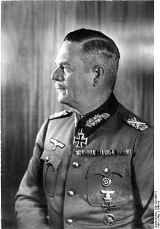
Wilhelm Keitel


   Email Print
   Bookmark   Link


Wilhelm Keitel


Wilhelm Bodewin Johann Gustav Keitel was a GermanGermany

Germany , officially the Federal Republic of Germany , is a country in central Europe....
 field marshalField Marshal

A Field Marshal is a military officer usually of the highest rank, one step above a full General, Army General or Colonel Ge...
. As head of the High Command of the Armed ForcesOberkommando der Wehrmacht

Oberkommando der Wehrmacht or OKW was part of the command structure of the German armed forces during World War I...
, he was one of Germany's most senior military leaders during World War IIWorld War II

World War II, or the Second World War, was a worldwide conflict fought between the Allied Powers and the Axis Powers ,...
. At the allied court at NurembergNuremberg Trials

The Nuremberg Trials were the trials of the Nazi officials involved in the Holocaust during World War II....
 he was tried, sentenced to death and hanged as a major war criminal.
BiographyEarly life and careerKeitel was born in Helmscherode, BrunswickDuchy of Brunswick

Brunswick was a historical state in Germany, established as a duchy by the Congress of Vienna in 1815....
, German EmpireGerman Empire

The German Empire is the name conventionally given in English to the German state from the time of the proclamation of Will...
, the son of Carl Keitel, a middle-class landowner, and his wife Apollonia Vissering. After completing his education in GöttingenGöttingen

Gttingen is a city in Lower Saxony, Germany....
, he embarked on a military career in 1901, becoming a Fahnenjunker (Cadet Officer), joining the 6th Lower-Saxon Field Artillery Regiment. He married Lisa Fontaine, a wealthy landowner's daughter, in 1909. Together they had six children, one of whom died in infancy.


Discussion
Ask a question about 'Wilhelm Keitel'
Start a new discussion about 'Wilhelm Keitel'
Answer questions from other users
Full Discussion Forum


Timeline

1946   Died


Encyclopedia


Wilhelm Bodewin Johann Gustav Keitel was a GermanGermany

Germany , officially the Federal Republic of Germany , is a country in central Europe....
 field marshalField Marshal

A Field Marshal is a military officer usually of the highest rank, one step above a full General, Army General or Colonel Ge...
. As head of the High Command of the Armed ForcesOberkommando der Wehrmacht

Oberkommando der Wehrmacht or OKW was part of the command structure of the German armed forces during World War I...
, he was one of Germany's most senior military leaders during World War IIWorld War II

World War II, or the Second World War, was a worldwide conflict fought between the Allied Powers and the Axis Powers ,...
. At the allied court at NurembergNuremberg Trials

The Nuremberg Trials were the trials of the Nazi officials involved in the Holocaust during World War II....
 he was tried, sentenced to death and hanged as a major war criminal.

Biography

Early life and career

Keitel was born in Helmscherode, BrunswickDuchy of Brunswick

Brunswick was a historical state in Germany, established as a duchy by the Congress of Vienna in 1815....
, German EmpireGerman Empire

The German Empire is the name conventionally given in English to the German state from the time of the proclamation of Will...
, the son of Carl Keitel, a middle-class landowner, and his wife Apollonia Vissering. After completing his education in GöttingenGöttingen

Gttingen is a city in Lower Saxony, Germany....
, he embarked on a military career in 1901, becoming a Fahnenjunker (Cadet Officer), joining the 6th Lower-Saxon Field Artillery Regiment. He married Lisa Fontaine, a wealthy landowner's daughter, in 1909. Together they had six children, one of whom died in infancy. During World War IWorld War I Overview

World War I, also known as the First World War, the Great War and "The War to End All Wars" was a global m...
 Keitel served on the Western front with the Field Artillery Regiment No. 46. In September 1914, during the fighting in FlandersFlanders

Flanders has several main meanings:...
, he was seriously wounded in his right forearm by a shell fragment.

Keitel recovered, and thereafter was posted to the German General StaffGerman General Staff

The German General Staff, Groer Generalstab, literally, Great General Staff was an institution whose rise and deve...
 in early 1915. After World War I ended, he stayed in the newly created ReichswehrReichswehr

The Reichswehr listen formed the military organization of Germany from 1919 until 1935, when the government rebranded it as ...
, and played a part in organizing FreikorpsFreikorps Summary

The designation of Freikorps was originally applied to voluntary armies....
 frontier guard units on the PolishFacts About Poland

Poland , officially the Republic of Poland , is a country located in Central Europe....
 border. Keitel also served as a divisional general staff officer, and later taught at the Hanover Cavalry School for two years.

In late 1924, Keitel was transferred to the Ministry of DefenceList of German defence ministers

This page contains a List of German defence ministers...
 (Reichswehrministerium), serving with the Troop Office, the post-VersaillesTreaty of Versailles

The Treaty of Versailles was the peace treaty which officially ended World War I between the Allied and Associated Powers a...
 disguised General StaffGerman General Staff

The German General Staff, Groer Generalstab, literally, Great General Staff was an institution whose rise and deve...
. He was soon promoted to the head of the organizational department, a post he retained after the NaziNazism Overview

National Socialism, commonly shortened to Nazism or Naziism, originated as a fascist movement in Europe, and re...
 seizure of powerMachtergreifung

Machtergreifung is a German word meaning seizure of power....
 in 1933. In 1935, based on a recommendation by Werner von FritschWerner von Fritsch

Werner Freiherr von Fritsch was a prominent Wehrmacht officer, member of German High Command and the first German general to...
, Keitel was promoted to Lieutenant-General and appointed as the departmental head of the Wehrmachtsamt (Armed Forces Office) which had the responsibility over all three branches of the armed forces.

OKW and World War II

In 1937, Keitel received a promotion to General and, in the following year, he assumed the position of Chief of the Supreme Command of the Armed Forces (Oberkommando der WehrmachtOberkommando der Wehrmacht

Oberkommando der Wehrmacht or OKW was part of the command structure of the German armed forces during World War I...
, or OKW) in the wake of the Blomberg-Fritsch AffairBlomberg-Fritsch Affair

The Blomberg-Fritsch Affair were two scandals that resulted in the subjugation of the German Wehrmacht to Adolf Hitler....
, and the replacement of the Ministry of WarList of German defence ministers

This page contains a List of German defence ministers...
 (Reichskriegsministerium) with the OKW.

For a brief period in October 1938, Keitel was the Military Governor of the SudetenlandSudetenland

Sudetenland was the name used in the first half of the 20th century for the regions inhabited mostly by Germans in the bord...
, but in February 1938 Keitel again became Commander-in-Chief of the OKW, the post he retained until surrender in 1945. Shortly following his appointment he convinced Hitler to appoint his close friend, Heinrich von Brauchitsch, as the Commander-in-Chief of the Army.

In 1940, following the conclusion of the French campaignBattle of France Overview

In World War II, the Battle of France, also known as the Fall of France, was the German and Italian invasion of France...
, he was promoted to Field Marshal along with a number of Adolf HitlerAdolf Hitler

Adolf Hitler was Chancellor of Germany from 1933, and Fhrer of Germany from 1934 until his death....
's other generals. Unusually for a non-field commander, Keitel was awarded the Knight's CrossKnight's Cross of the Iron Cross

The Knight's Cross of the Iron Cross recognized extreme battlefield bravery or successful leadership during the Third Reich ...
, for having arranged the armistice with France.

During World War IIWorld War II

World War II, or the Second World War, was a worldwide conflict fought between the Allied Powers and the Axis Powers ,...
, Keitel was one of the primary planners of the Wehrmacht campaigns and operations on the westernWestern Front (World War II)

During World War II, the Western Front was the theater of fighting west of Germany, encompassing the United Kingdom, France,...
 and the eastern frontsEastern Front (World War II)

The Eastern Front of World War II was the theatre of war covering the conflict in central and eastern Europe from June 22, 1...
, but proved to be weak and cautious: he advised Hitler against invading FranceBattle of France

In World War II, the Battle of France, also known as the Fall of France, was the German and Italian invasion of France...
 and opposed Operation BarbarossaOperation Barbarossa

Operation Barbarossa was the codename for Nazi Germany's invasion of the Soviet Union during World War II that commenced on...
. Both times he backed down in the face of Hitler and tendered his resignation: the FührerFührer

Fhrer is a proper noun meaning "leader" or "guide" in the German language....
 refused to accept it.

After participation in the planning and execution of the Operation BarbarossaOperation Barbarossa

Operation Barbarossa was the codename for Nazi Germany's invasion of the Soviet Union during World War II that commenced on...
, in 1942 he attempted to convince Hitler in defence of the actions of Field Marshal Wilhelm ListWilhelm List

Siegmund Wilhelm von List, was a German field marshal during World War II....
, whose army was struggling to extricate themselves from inconclusive and bloody fighting in the Battle of the CaucasusBattle of the Caucasus

The Battle of Caucasus is a generic name for a series of operations during the Great Patriotic War....
. Keitel's defence of List was his last act of defiance to Hitler, for after that he never again challenged one of Hitler's orders, and was referred to by his colleagues as "Lakaitel" ("Lackey-tel" or "Little Lackey") and as the "nodding donkey".

Keitel signed numerous orders of dubious legality under the laws of war, the most infamous being the notorious Commissar OrderCommissar Order

The Commissar Order was an order given by Adolf Hitler on June 6, 1941, prior to Operation Barbarossa, that any captured Sov...
, and unquestionably allowed Heinrich HimmlerFacts About Heinrich Himmler

Heinrich Luitpold Himmler was the commander of the German Schutzstaffel and one of the most powerful men in Nazi Germa...
 a free hand with his racial controls and ensuing terror in captured Soviet UnionSoviet Union

The Union of Soviet Socialist Republics , more commonly known as the Soviet Union, was a Communist state that existed...
 territory. Another was the order to have any of the French pilots fighting for the Normandie-NiemenNormandie-Niemen

The Normandie-Niemen squadron is a fighter squadron of the French Air Force....
 fighter regiment in the USSRSoviet Union

The Union of Soviet Socialist Republics , more commonly known as the Soviet Union, was a Communist state that existed...
 executed instead of their being treated as prisoners of war.

Keitel accepted Hitler's directive for Operation Citadel in 1943 despite strong opposition from several field officers who argued that neither the troops nor the new tanks on which Hitler staked his reliance for victory were ready.

Keitel was also instrumental in foiling the attempted coup of the July 20 plot in 1944, which attempted to assassinate Hitler. Keitel then sat on the following Army Court of Honour that handed many officers, including Field Marshal Erwin von WitzlebenFacts About Erwin von Witzleben

Job-Wilhelm Georg "Erwin" von Witzleben was a German army officer and in the Second World War an Army commander and a resist...
, over to Roland FreislerFacts About Roland Freisler

Roland Freisler was a prominent Nazi....
's notorious People's Court.

In April and May 1945, during the Battle for Berlin, Keitel urged various German generals to attack the Soviet forces and relieve Berlin. But, so late in the war, none of the generals urged by Keitel commanded forces that were capable of saving the German capital: not Gotthard HeinriciGotthard Heinrici

Gotthard Heinrici was a General in the German Army during World War II. ...
's Army Group VistulaFacts About Army Group Vistula

The Army Group Vistula was formed in 1945 to protect Berlin from the advancing Soviet armies marching from the Vistula ' ...
, not Felix SteinerFelix Steiner

Felix Martin Julius Steiner was a German Heer and Waffen-SS officer who served in both World War I and World War II....
's Army Detachment SteinerArmy Detachment Steiner

Army Detachment Steiner , was a temporary military unit, something more than a corps but less than an army, created on paper...
, not Walther WenckWalther Wenck

Walther Wenck was the youngest General in the German Army during the Second World War....
's 12th Army, nor Theodor BusseTheodor Busse

General der Infanterie Theodor Busse....
's 9th Army.

After the suicide deaths of German dictator Adolf HitlerAdolf Hitler

Adolf Hitler was Chancellor of Germany from 1933, and Fhrer of Germany from 1934 until his death....
 on 30 April and Joseph GoebbelsJoseph Goebbels

Paul Joseph Goebbels was Adolf Hitler's Propaganda Minister in Nazi Germany....
 on 1 May, Keitel became a member of the short-lived Flensburg governmentFlensburg government

The Flensburg government was the short-lived administration that attempted to rule Germany in May 1945 following the suicide...
 controlled by German President (ReichspräsidentReichspräsident

The Reichsprsident was the German head of state during the period of the 1919-1933 Weimar Republic and the title was lat...
) Karl DönitzKarl Dönitz

Karl Dnitz ; September 16, 1891 – December 24, 1980) was a German naval leader, famous for his command of the Kriegsma...
.

On May 8, 1945, Dönitz authorized Keitel to sign the second instrument of unconditional surrender in Berlin. On the previous day, Alfred JodlAlfred Jodl Summary

Alfred Jodl was a Wehrmacht leader....
 had signed an instrument of unconditional surrender in Rheims, FranceFrance

France, officially the French Republic, is a country whose metropolitan territory is located in Western Europe and whi...
.

Nazi connections

As a military officer, Keitel was prohibited by law from joining the NSDAP. However, after the Wehrmacht's rapid early successes on the Russian FrontEastern Front (World War II)

The Eastern Front of World War II was the theatre of war covering the conflict in central and eastern Europe from June 22, 1...
, he was given a "Golden" (Honorary) NSDAP membership badge by Adolf Hitler, who was seeking to link military successes to political successes. In 1944, German laws were changed and military officers were encouraged to seek NSDAP membership. Keitel claimed he did so as a formality at the Nuremberg TrialsNuremberg Trials Summary

The Nuremberg Trials were the trials of the Nazi officials involved in the Holocaust during World War II....
, but never received formal party membership. He was one of only two people to receive honorary party membership status.

Before the execution Keitel published Mein Leben: Pflichterfullung bis zum Untergang: Hitlers Feldmarschall und Chef des Oberkommandos der Wehrmacht in Selbstzeugnissen, otherwise known in English as In the Service of the Reich, and was later re-edited as The Memoirs of Field-Marshal Keitel by Walter Görlitz from a translation by David IrvingDavid Irving Summary

David John Cawdell Irving is a British Holocaust denier and author of several books about the military history of World War ...
 as the author in 1965. Another work by Keitel later published in English was //Questionnaire on the Ardennes offensive//

Trial and execution

Four days after the surrender, Keitel was arrested. He soon faced the International Military TribunalNuremberg Trials

The Nuremberg Trials were the trials of the Nazi officials involved in the Holocaust during World War II....
 (IMT), which charged him with a number of offences:
  • Conspiracy to commit crimes against peace;
  • Planning, initiating and waging wars of aggressionWar of aggression

    The crime of a war of aggression is listed in Article 5.1 of the Rome Statute of the International Criminal Court as one of ...
    ;
  • War crimes; and,
  • Crimes against humanity.


The IMT rejected Keitel's defence that he was following orders in conformity to "the leadership principle" (FührerprinzipFührerprinzip

The Fhrerprinzip, the German name for the leader principle, refers to a system with a hierarchy of leaders that res...
) and found him guilty on all charges. To underscore the criminal rather than military nature of Keitel's acts, the Allies denied his request to be shot by firing squad. Instead, he was executed by hangingHanging

Hanging is a form of execution or a method of committing suicide....
. Keitel's last words were:

"Ich rufe den Allmächtigen an, er möge sich des deutschen Volkes erbarmen. Über zwei Millionen deutsche Soldaten sind vor mir für ihr Vaterland in den Tod gegangen. Ich folge meinen Söhnen nach. Alles für Deutschland!",

which translates roughly to:

"I call on God Almighty to have mercy on the German people. More than two million German soldiers went to their death for the fatherland before me. I follow now my sons—all for Germany (Alles für Deutschland)."

Legacy

When moving to the United States and Australia after World War II, some of Keitel's family changed their last name to Keetle so as to not be associated with his crimes. Many of his descendants still go by this last name.

Portrayal in popular culture

Wilhelm Keitel has been portrayed by the following actors in film, television and theater productions;
  • Leopold Hainisch in the 1955 West GermanWest Germany Overview

    West Germany was the informal English name for the Federal Republic of Germany, or FRG from 1949 to 1990....
     film Der Letzte Akt (Hitler: The Last Ten Days)
  • Tadeusz Bialoszczynski in the 19711971 in film

    The year 1971 in film involved some significant events....
     Polish film Epilogue at Nurnberg
  • Raymond Adamson in the 1973 BritishUnited Kingdom

    The United Kingdom of Great Britain and Northern Ireland is a country and sovereign state that lies off the northwest coast...
     television production The Death of Adolf Hitler
  • Frank FontaineFrank Fontaine

    Frank Fontaine was a American comedian and singer....
     in the 20002000 in television

    The year 2000 in television involved some significant events....
     Canadian/U.S. T.V. production Nuremberg
  • Dieter MannDieter Mann Summary

    Dieter Mann is a German actor.Since 1984 he belongs to the famous Deutsches Theater Berlin. ...
     in the 2004 GermanGermany

    Germany , officially the Federal Republic of Germany , is a country in central Europe....
     film Downfall (Der Untergang)Downfall (film)

    ; in addition, it loosely conveys events described in the memoirs of [[Sieg...
  • Miroslav Kosev in the 20062006 in television

    The year 2006 in television involved some significant events....
     British television docudrama

See also

  • War crimes of the WehrmachtWar crimes of the Wehrmacht

    War crimes of the Wehrmacht are those crimes made by German armed forces during World War II....


Bibliography

  • BARBAROSSA. By Alan Clark. Perennial, 2002. ISBN: 0-688-04268-6
  • Hitler and Russia. By Trumbull Higgins. The Macmillan Company, 1966.
  • The World War II. Desk Reference. Eisenhower Center director Douglas Brinkley. Editor Mickael E. Haskey. Grand Central Press, 2004.
  • The story of World War II. By Donald L. Miller. Simon & Schuster, 2006. ISBN: 10: 0-74322718-2.
  • Scourched earth. By Paul Carell. Schiffer Military History, 1994. ISBN: 0-88740-598-3

External links

  • , Keitel autobiography