
All Topics  
Battleship

 
Battleship

   Email Print
   Bookmark   Link


Battleship


A battleship is a large, heavily armored
Armour

Armour or armor is protective covering used to prevent damage from being inflicted to an individual or a vehicle through use of direct contact weapons or projectiles, usually during combat....
 warship
Warship

A warship is a ship that is built and primarily intended for combat. Warships are usually built in a completely different way than cargo ship....
 with a main battery
Artillery battery

In military organizations, an artillery battery is a unit of guns, mortar s, or rockets, so grouped in order to facilitate better battlefield communication and command and control, as well as to provide dispersion for its constituent gunnery crews and their systems....
 consisting of the largest calibre of gun
GUN

Gun is a Revisionist Western-themed video game developed by Neversoft. It was published by Activision for the Xbox, Xbox 360, Nintendo GameCube, Microsoft Windows and PlayStation 2....
s. Battleships were larger, better armed, and better armored than cruiser
Cruiser

A cruiser is a large type of warship, which had its prime period from the late 19th century to the end of the Cold War. The first cruisers were intended for individual raiding and protection missions on the seas....
s and destroyer
Destroyer

In navy terminology, a destroyer is a fast and maneuverable yet long-endurance warship intended to escort larger vessels in a Naval fleet, convoy or battle group and defend them against smaller, short-range but powerful attackers ....
s.

Battleship design continually evolved to incorporate and adapt technological advances to maintain an edge.


Discussion
Ask a question about 'Battleship'
Start a new discussion about 'Battleship'
Answer questions from other users
Full Discussion Forum


Recent Posts


Encyclopedia


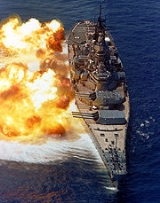
Bb61 Uss Iowa Bb61 Broadside Usn
A battleship is a large, heavily armored
Armour

Armour or armor is protective covering used to prevent damage from being inflicted to an individual or a vehicle through use of direct contact weapons or projectiles, usually during combat....
 warship
Warship

A warship is a ship that is built and primarily intended for combat. Warships are usually built in a completely different way than cargo ship....
 with a main battery
Artillery battery

In military organizations, an artillery battery is a unit of guns, mortar s, or rockets, so grouped in order to facilitate better battlefield communication and command and control, as well as to provide dispersion for its constituent gunnery crews and their systems....
 consisting of the largest calibre of gun
GUN

Gun is a Revisionist Western-themed video game developed by Neversoft. It was published by Activision for the Xbox, Xbox 360, Nintendo GameCube, Microsoft Windows and PlayStation 2....
s. Battleships were larger, better armed, and better armored than cruiser
Cruiser

A cruiser is a large type of warship, which had its prime period from the late 19th century to the end of the Cold War. The first cruisers were intended for individual raiding and protection missions on the seas....
s and destroyer
Destroyer

In navy terminology, a destroyer is a fast and maneuverable yet long-endurance warship intended to escort larger vessels in a Naval fleet, convoy or battle group and defend them against smaller, short-range but powerful attackers ....
s.

Battleship design continually evolved to incorporate and adapt technological advances to maintain an edge. The word battleship was coined around 1794 and is a shortened form of line-of-battle ship
Ship of the line

A ship-of-the-line was a type of naval warship constructed from the 17th century through the mid-19th century, to take part in the Naval tactics in the Age of Sail known as the line of battle, in which two columns of opposing warships would maneuver to bring the greatest weight of broadside guns to bear....
, the dominant wooden warship during the Age of Sail
Age of Sail

The Age of Sail was the period in which international trade and naval warfare were dominated by sailing ships, lasting from the 16th to the mid 19th century....
. The term came into formal use in the late 1880s to describe a type of ironclad warship
Ironclad warship

An ironclad was a steam engine warship in the latter part of the 19th century, protected by iron or steel iron armour.The ironclad was developed as a result of the vulnerability of wooden warships to explosive or incendiary shell ....
, now referred to as pre-dreadnought battleships. In 1906, the launch of HMS Dreadnought
HMS Dreadnought (1906)

The sixth HMS Dreadnought of the Royal Navy was a battleship that revolutionised naval power when she entered service in 1906. Dreadnought represented such a marked advance in naval technology that her name came to be associated with an entire generation of battleships, the "dreadnoughts", as well as the class of ships named af...
 heralded a revolution in battleship design, and subsequent types were referred to as dreadnought
Dreadnought

Dreadnought may refer to:* Dreadnought, a type of battleship of the early 20th century, following the launch of the HMS Dreadnought in 1906...
s.

Battleships were a potent symbol of naval
Navy

A navy is the branch of a nation's military forces principally designated for naval warfare and amphibious warfare; namely, lake- or ocean-borne combat operations and related functions....
 dominance and national might, and for decades the battleship was a major factor in both diplomacy
Diplomacy

Diplomacy is the art and practice of conducting negotiations between representatives of groups or states. It usually refers to international diplomacy, the conduct of international relations through the intercession of professional diplomats with regard to issues of peace-making, trade, war, economics and culture....
 and military strategy
Military strategy

Military strategy is a policy implemented by military organizations to pursue desired Strategic goal s. Derived from the Greek language strategos, strategy when it appeared in use during the 18th century, was seen in its narrow sense as the "art of the general", 'the art of arrangement' of troops....
. The global arms race
Arms race

The term arms race, in its original usage, describes a competition between two or more parties for real or apparent military supremacy. Each party competes to produce larger numbers of weapons, greater armies, or superior military technology in a technological escalation....
 in battleship construction in the early 20th century was one of the causes of World War I
World War I

World War I, or the First World War , was a global military conflict which involved the Great powers, organized into two opposing military alliances: the Allies of World War I and the Central Powers....
, which saw a clash of huge battle fleets at the Battle of Jutland
Battle of Jutland

The Battle of Jutland was the largest naval battle of World War I and the only full-scale clash of battleships in that war. It was only the second major fleet action between steel battleships in any war, following the Battle of Tsushima in 1905, but was also the last....
. The Naval Treaties
Treaty for the Limitation of Naval Armament

The Limitation of Naval Armament included many separate treaties. In general, the treaties involved the United States, United Kingdom, Japan, and France....
 of the 1920s and 1930s limited the number of battleships but did not end the evolution of design. Both the Allies
Allies of World War II

The Allies of World War II were the countries officially opposed to the Axis powers of World War II during the World War II. Within the ranks of the Allies powers, the British Empire, the Soviet Union, and the United States of America were known as "The Big Three"....
 and the Axis Powers
Axis Powers

The Axis powers were those countries that were opposed to the Allies of World War II during World War II. The three major Axis powers - Nazi Germany, Kingdom of Italy , and Empire of Japan - were part of a military alliance on the signing of the Tripartite Pact in September 1940, which officially founded the Axis powers....
 deployed battleships of old construction and new during World War II
World War II

World War II, or the Second World War , was a global military conflict which involved a Participants in World War II, including all of the great powers, organised into two opposing military alliances: the Allies of World War II and the Axis powers....
.

Nevertheless, some historians and naval theorists question the value of the battleship. The Battle of Tsushima
Battle of Tsushima

The Battle of Tsushima , commonly known as the ?Sea of Japan Naval Battle? in Japan and the ?Battle of Tsushima Strait? elsewhere, was the last and most decisive sea battle of the Russo-Japanese War of 1904?1905....
 was the only decisive clash between steel battleship fleets and, apart from the indecisive Battle of Jutland
Battle of Jutland

The Battle of Jutland was the largest naval battle of World War I and the only full-scale clash of battleships in that war. It was only the second major fleet action between steel battleships in any war, following the Battle of Tsushima in 1905, but was also the last....
, there were few great dreadnought clashes. Despite their great firepower and protection, dreadnoughts were increasingly vulnerable to much smaller, cheaper ordnance and craft: initially the torpedo
Torpedo

Note: Prior to 1900, in naval usage "torpedo" could also refer to what today is called a naval mine. For that usage, see naval mine.The modern torpedo is a self-propelled explosive projectile weapon, launched above or below the water surface, propelled underwater toward a target, and designed to detonate on contact or in proximity t...
 and the naval mine
Naval mine

A naval mine is a self-contained explosive device placed in water to destroy ships or submarines. Unlike depth charges, mines are deposited and left to wait until they are triggered by the approach of or contact with an enemy ship....
, and later aircraft
Aircraft

An aircraft is a vehicle which is able to flight by being supported by the air, or in general, the atmosphere, of a planet. Examples include balloons, airplanes and helicopters....
 and the guided missile
Guided Missile

Guided Missile is a London based independent record label set up by Paul Kearney in 1994 in music.Guided Missile has always focused on 'the underground', preferring to put out a steady flow of considered and quality releases and developing the numerous and now essential GM...
. The growing range of engagement led to the battleship's replacement as the leading capital ship
Capital ship

File:HMS Ark Royal USS Nimitz Norfolk2 1978.jpegThe capital ships of a navy are its "important" warships; the ones with the heaviest firepower and armor....
 by the aircraft carrier
Aircraft carrier

An aircraft carrier is a warship designed with a primary mission of deploying and recovering aircraft, acting as a seagoing airbase. Aircraft carriers thus allow a navy force to project air power great distances without having to depend on local bases for staging aircraft operations....
 during World War II; battleships were retained by the United States Navy
United States Navy

The United States Navy is the navy of the United States Armed Forces. It is one of the seven uniformed services of the United States. The U.S. Navy currently has approximately 331,682 personnel on active duty as of 31 December 2008 and 124,000 in the United States Navy Reserve....
 into the Cold War
Cold War

The Cold War was the continuing state of conflict, tension and competition that existed between a number of world powers, including the United States, the Soviet Union, People's Republic of China, France, United Kingdom and those countries' respective allies from the mid-1940s to the early 1990s....
 only for fire support
Fire support

Fire support is long-range firepower provided to a front-line military unit. Typically, fire support is provided by artillery or close air support , and is used to shape the battlefield or, more optimistically, define the battle....
 purposes. The last battleships were removed from the U.S. Naval Vessel Register
Naval Vessel Register

The Naval Vessel Register is the official inventory of ships and service craft in custody of or titled by the United States Navy. It contains information on ships and service craft that make up the official inventory of the Navy from the time a vessel is authorized through its life cycle and disposal....
 in March 2006.

Ships of the line

A ship of the line was a large, unarmoured wood
Wood

Wood is an organic material; in the strict sense wood is produced as secondary xylem in the stems of woody plants, notably trees but also shrubs, etc....
en sailing ship on which was mounted a battery
Artillery battery

In military organizations, an artillery battery is a unit of guns, mortar s, or rockets, so grouped in order to facilitate better battlefield communication and command and control, as well as to provide dispersion for its constituent gunnery crews and their systems....
 of up to 120 smoothbore
Smoothbore

A smoothbore weapon is one which has a gun barrel without rifling. Smoothbores range from handheld firearms to powerful tank guns and large artillery mortar s....
 gun
GUN

Gun is a Revisionist Western-themed video game developed by Neversoft. It was published by Activision for the Xbox, Xbox 360, Nintendo GameCube, Microsoft Windows and PlayStation 2....
s and carronade
Carronade

The carronade was a short smoothbore, cast iron cannon, developed for the Royal Navy by the Carron Company, an ironworks in Falkirk, Scotland, UK....
s. The ship of the line was a gradual evolution of a basic design that dates back to the 1400s, and, apart from growing in size, it changed little between the adoption of line of battle
Line of battle

In naval warfare, the line of battle is a Military tactic in which the ships of the fleet form a line, end-to-end. Its origins are traditionally ascribed to the navy of the Commonwealth of England, especially to General at Sea Robert Blake who wrote the Sailing and Fighting Instructions of 1653....
 tactics in the early 17th century and the end of the sailing battleship's heyday in the 1830s. From 1794, the alternative term 'line of battle ship' was contracted (informally at first) to 'battle ship' or 'battleship'. The sheer number of guns fired broadside
Broadside

A broadside is the side of a ship; the artillery battery of cannon on one side of a warship; or their simultaneous fire in naval warfare....
 meant that a sailing battleship could wreck any wooden vessel, smashing its hull
Hull (watercraft)

A hull is the watertight body of a ship or boat. It is a central concept in floating vessels as it provides the buoyancy that keeps the vessel from sinking....
 and masts
Mast (sailing)

The mast of a sailing ship is a tall, vertical, or near vertical, spar, or arrangement of spars, which supports the sails. Large ships have several masts, with the size and configuration depending on the style of ship....
 and killing its crew. However, the effective range of the guns was as little as a few hundred yards, and the battle tactics of sailing ships depended entirely on the wind.

The first major change to the ship of the line concept was the introduction of steam power as an auxiliary propulsion system
Marine propulsion

Marine propulsion is the act of moving a floating object over or through water. Propulsion devices can take many forms including: propeller, water jet , paddle wheel, sails, Punt , paddles, oars and, experimentally, magnetohydrodynamic drive....
. Steam power was gradually introduced to the navy in the first half of the 19th century, initially for small craft and later for frigate
Frigate

A frigate is a warship. The term has been used for warships of many sizes and roles over the past few centuries.In the 18th century, the term referred to ships which were as long as a ship-of-the-line and were square rig on all three masts , but were faster and with lighter armament, used for patrolling and escort....
s. The French Navy
French Navy

The French Navy, officially the Marine nationale and often called La Royale , is the maritime arm of the French military. It consists of a full range of vessels, from patrol boats to guided missile frigates, and includes one nuclear aircraft carrier and ten nuclear submarines ....
 introduced steam to the line of battle with the 90-gun Le Napoléon
Le Napoléon (1850)

Le Napol?on was a 90-gun ship of the line of the French Navy, and the very first purpose-built steam battleship in the world . She is also considered the first true steam battleship, and the first screw battleship ever ....
 in 1850 — the first true steam battleship. Napoleon was armed as a conventional ship-of-the-line, but her steam engines could give her a speed of , regardless of the wind conditions: a potentially decisive advantage in a naval engagement. The introduction of steam accelerated the growth in size of battleships. France and the United Kingdom
United Kingdom of Great Britain and Ireland

The United Kingdom of Great Britain and Ireland was the formal name and the state form of the United Kingdom from 1 January 1801 until 12 April 1927....
 were the only two countries to develop fleets of wooden steam screw battleships, although several other navies made some use of a mixture of screw battleships and paddle-steamer frigates. These included Russia
Russian Empire

File:Russian Emperor Flag.jpgFile:Romanov Flag.svgThe Russian Empire was a state that existed from 1721 until the Russian Revolution of 1917....
, Turkey
Ottoman Empire

The Ottoman Empire , also known by its contemporaries as the Turkish Empire or Turkey , was an empire that lasted from 1299?1923. It was Treaty of Lausanne by the Republic of Turkey, which was officially proclaimed on October 29, 1923....
, Sweden
Sweden

Sweden , officially the Kingdom of Sweden , is a Nordic countries on the Scandinavian Peninsula in Northern Europe. Sweden has land borders with Norway to the west and Finland to the northeast, and it is connected to Denmark by the ?resund Bridge in the south....
, Naples
Kingdom of Naples

The Kingdom of Naples is the modern day name for a polity which existed on the southern part of the Italian peninsula. Also known contemporaneously, and somewhat confusingly, as the Kingdom of Sicily, this kingdom was founded after the secession of the island of Sicily from the old Kingdom of Sicily as a result of the Sicilian Vespers...
, Prussia
Kingdom of Prussia

The Kingdom of Prussia was a Germany monarchy from 1701 to 1918 and, from 1871, was the leading state of the German Empire, comprising almost two-thirds of the area of the empire....
, Denmark
Denmark

Denmark is a Scandinavian country in northern Europe and the senior member of the Kingdom of Denmark. It is the southernmost of the Nordic countries....
 and Austria
Austrian Empire

The Austrian Empire was a periodization successor state empire founded on a remnant of the Holy Roman Empire centered on what is today's Austria that officially lasted from 1804 to 1867....
.

Ironclads

The adoption of steam power was only one of a number of technological advances which revolutionized warship design in the 19th century. The ship of the line was overtaken by the ironclad
Ironclad warship

An ironclad was a steam engine warship in the latter part of the 19th century, protected by iron or steel iron armour.The ironclad was developed as a result of the vulnerability of wooden warships to explosive or incendiary shell ....
: powered by steam, protected by metal armor, and armed with guns firing high-explosive shells
Shell (projectile)

A shell is a payload-carrying projectile, which, as opposed to Round shot, contains an explosive or other filling, though modern usage includes large solid projectiles previously termed shot ....
.

Explosive shells
Wooden-hulled ships stood up comparatively well to solid shot
Lead shot

Lead shot is a collective term for small balls of lead. It is used primarily as projectiles in shotguns, but is also used for a variety of other purposes....
, as shown in the 1866 battle of Lissa
Battle of Lissa (1866)

The Battle of Lissa took place on 20 July 1866 in the Adriatic Sea near the island of Vis and was a decisive victory for an outnumbered Austrian Empire force over a superior Regia Marina force....
, where the old Austrian steam battleship Kaiser ranged across a confused battlefield, rammed an Italian
Kingdom of Italy (1861–1946)

The Kingdom of Italy was a state forged in 1861 by the Italian unification under the influence of the Kingdom of Sardinia; it existed until 1946 when the Italians opted for a republican constitution....
 ironclad and took a pounding of several 300 pound
Pound (mass)

The pound or pound-mass is a Units of measurement of massused in the Imperial unit, United States customary units and other systems of measurement....
 shots at point blank range. Despite losing her bowsprit
Bowsprit

The bowsprit, or boltsprit, of a sailing vessel is a pole extending forward from the vessel's prow. It provides an anchor point for the forestay, allowing the mast to be stepped further forward on the hull....
 and her foremast, and being set on fire, she was ready for action again the very next day. By contrast, guns which fired explosive or incendiary shells were a major threat to wooden ships, and these weapons became widespread in the 1840s. In the Crimean War
Crimean War

The Crimean War, also known in Russia as the Oriental War was fought between the Russian Empire on one side and an alliance of France, the United Kingdom of Great Britain and Ireland, the Kingdom of Sardinia, and the Ottoman Empire on the other....
, the Russian Black Sea Fleet destroyed a flotilla of wooden Turkish ships with explosive shells at the Battle of Sinop
Battle of Sinop

The naval Battle of Sinop took place on 30 November 1853 at Sinop, a sea port in northern Turkey, when Imperial Russian battleships struck and annihilated a patrol force of Ottoman Empire frigates anchored in the harbor....
 in 1853. Later in the war, French ironclad floating batteries used similar weapons against the defenses at the Battle of Kinburn
Battle of Kinburn (1855)

The Battle of Kinburn/Kil-Bouroun was a naval engagement during the final stage of the Crimean War. It took place on the tip of the Kinburn on October 17, 1855....
.

Iron armor and construction
Hms Warrior
The development of high-explosive shells made the use of iron armor
Armour

Armour or armor is protective covering used to prevent damage from being inflicted to an individual or a vehicle through use of direct contact weapons or projectiles, usually during combat....
 plate on warships necessary. In 1859 France
France

France , officially the French Republic , is a country whose Metropolitan France is located in Western Europe and that also comprises various Overseas departments and territories of France....
 launched La Gloire, the first ocean-going ironclad warship. She had the profile of a ship of the line, cut to one deck due to weight considerations. Although made of wood and reliant on sail for most of her journeys, La Gloire was fitted with a propeller, and her wooden hull was protected by a layer of thick iron armor. Gloire prompted further innovation from the Royal Navy
Royal Navy

The Royal Navy of the United Kingdom is the oldest of the British Armed Forces . From the mid-18th century until well into the 20th century, it was the most powerful navy in the world, playing a key part in establishing the British Empire as the dominant world power from 1815 until the early 1940s....
, anxious to prevent France from gaining a technological lead.

The superior armored frigate Warrior
HMS Warrior (1860)

HMS Warrior was the first iron-hulled, armour-plated warship, built for the Royal Navy in response to the first ironclad warship, the French La Gloire, launched a year earlier....
 followed La Gloire by only fourteen months, and both nations embarked on a program of building new ironclads and converting existing screw ships of the line to armored frigates. Within two years, Italy, Austria, Spain
Spanish Empire

The Spanish Empire was one of the largest empires in world history, and one of the first global empires. It included territories and colonies ruled by Spain in Europe, the Americas, Africa, Asia and Oceania between the 15th and late 19th centuries....
 and Russia had all ordered ironclad warships, and by the time of the famous clash of the USS Monitor
USS Monitor

USS Monitor was the first ironclad warship warship commissioned by the United States Navy. She is most famous for her participation in the first-ever naval battle between two ironclad warships, the Battle of Hampton Roads on March 9, 1862 during the American Civil War, in which Monitor fought the ironclad CSS Virginia of the Confedera...
 and the CSS Virginia
CSS Virginia

CSS Virginia was a steam-powered Floating battery design ironclad warship of the Confederate States Navy during the American Civil War .She was one of the participants in the Battle of Hampton Roads in March, 1862 opposite the USS Monitor....
 at the Battle of Hampton Roads
Battle of Hampton Roads

The Battle of Hampton Roads, often referred to as the Battle of Monitor and Merrimack , was the most noted and arguably the most important naval battle of the American Civil War from the standpoint of the development of navies....
 at least eight navies possessed ironclad ships.
Leredoutablephoto
Navies experimented with the positioning of guns, in turrets
Gun turret

A gun turret is a device that protects the crew or mechanism of a artillery and at the same time lets the weapon be aimed and fired in many directions....
 (like the USS Monitor), central-batteries or barbette
Barbette

A barbette is a protective circular armour feature around a cannon or heavy artillery gun. The name comes from the French language phrase en barbette referring to the practice of firing a field gun over a parapet rather than through an opening ....
s, or with the ram
Naval ram

A naval ram was a weapon carried by varied types of ships, dating back to antiquity. The weapon consisted of an underwater prolongation of the bow of the ship to form an armoured beak, usually between six and twelve feet in length....
 as the principal weapon. As steam technology developed, masts were gradually removed from battleship designs. By the mid-1870s steel was used as a construction material alongside iron and wood. The French Navy's Redoutable
French battleship Redoutable (1876)

Redoutable was a central battery and barbette ship of the French Navy. She was the first warship in the world to use steel as the principal building material ....
, laid down in 1873 and launched in 1876, was a central battery
Artillery battery

In military organizations, an artillery battery is a unit of guns, mortar s, or rockets, so grouped in order to facilitate better battlefield communication and command and control, as well as to provide dispersion for its constituent gunnery crews and their systems....
 and barbette warship which became the first battleship in the world to use steel as the principal building material.

The pre-dreadnought battleship
, built in 1892, was the first battleship of the U.S. Navy. Photochrom
Photochrom

Photochrom prints are colorized images produced from black and white photographic negatives via the direct photographic transfer of a negative on to Lithography printing plates....
 print c. 1898.]]
Hms Agamemnon (1908) Profile Drawing
The term "battleship" was officially adopted by the Royal Navy in the re-classification of 1892. By the 1890s, there was an increasing similarity between battleship designs, and the type now known as the 'pre-dreadnought battleship' emerged. These were heavily armored ships, mounting a mixed battery of guns in turrets, and without sails. The typical first-class battleship of the pre-dreadnought era displaced 15,000 to 17,000 ton
Ton

Units of massThere are several similar units of mass or volume called the ton:Others*The long ton is used for petroleum products such as aviation fuel....
s, had a speed of , and an armament of four guns in two turrets fore and aft with a mixed-caliber secondary battery amidships around the superstructure. An early design with superficial similarity to the pre-dreadnought is the British Devastation-class
Devastation class battleship

The two United Kingdom Devastation-class battleships of the 1870s were the first class of ocean-going capital ship which did not carry sails, and the first which mounted the entire main armament on top of the hull rather than inside it....
 of 1871. However, it was not until the 1890s that the widespread adoption of steel construction and hardened steel armor meant that a turret-ship could combine heavy armament and protection with high speed and good seakeeping.

The slow-firing main guns were the principal weapons for battleship-to-battleship combat. The intermediate and secondary batteries had two roles. Against major ships, it was thought a 'hail of fire' from quick-firing secondary weapons could distract enemy gun crews by inflicting damage to the superstructure, and they would be more effective against smaller ships such as cruiser
Cruiser

A cruiser is a large type of warship, which had its prime period from the late 19th century to the end of the Cold War. The first cruisers were intended for individual raiding and protection missions on the seas....
s. Smaller guns (12-pounders and smaller) were reserved for protecting the battleship against the threat of torpedo attack from destroyer
Destroyer

In navy terminology, a destroyer is a fast and maneuverable yet long-endurance warship intended to escort larger vessels in a Naval fleet, convoy or battle group and defend them against smaller, short-range but powerful attackers ....
s and torpedo boat
Torpedo boat

A torpedo boat is a relatively small and fast navy ship designed to carry torpedoes into battle. The first designs rammed enemy ships with explosive spar torpedoes, and later designs launched self-propelled Torpedo#Self-propelled torpedoeses....
s.

The beginning of the pre-dreadnought era coincided with an attempt by Britain to re-assert her naval dominance. For many years previously, Britain had taken naval supremacy for granted. Expensive naval projects were criticised by political leaders of all inclinations. However, in 1888 a war scare with France and the build-up of the Russian navy gave added impetus to naval construction, and the British Naval Defence Act of 1889 laid down a new fleet including eight new battleships. The principle that Britain's navy should be more powerful than the two next most powerful fleets combined was established. This policy was designed to deter France and Russia from building more battleships, but both nations nevertheless expanded their fleets with more and better pre-dreadnoughts in the 1890s.

In the last years of the 19th century and the first years of the 20th, the escalation in the building of battleships became an arms race
Arms race

The term arms race, in its original usage, describes a competition between two or more parties for real or apparent military supremacy. Each party competes to produce larger numbers of weapons, greater armies, or superior military technology in a technological escalation....
 between Britain and Germany
German Empire

The German Empire is the name commonly used in English to describe Germany from the unification of Germany and proclamation of William I, German Emperor as German Emperor on 18 January 1871, to 1918, when it became Weimar republic after defeat in World War I and the abdication of William II, German Emperor ....
. The German naval laws of 1890 and 1898 authorised a fleet of 38 battleships, a vital threat to the balance of naval power. Britain answered with further shipbuilding, but by the end of the pre-dreadnought era, British supremacy at sea had markedly weakened. In 1883, the United Kingdom had 38 battleships, twice as many as France and almost as many as the rest of the world put together. By 1897, Britain's lead was far smaller due to competition from France, Germany, and Russia, as well as the development of pre-dreadnought fleets in Italy, the United States
United States

The United States of America is a Federal government constitutional republic comprising U.S. state and a federal district. The country is situated mostly in central North America, where its Contiguous United States and Washington, D.C., the Capital districts and territories, lie between the Pacific Ocean and Atlantic Oceans, Borders of the U...
 and Japan
Empire of Japan

The Empire of Japan was a Japanese political entity that existed during the period from the Meiji Restoration in 1868 until its defeat in World War II in 1945....
. Turkey, Spain, Sweden, Denmark, Norway
Norway

Norway , officially the Kingdom of Norway, is a constitutional monarchy in Northern Europe that occupies the western portion of the Scandinavian Peninsula....
, the Netherlands
Netherlands

The Netherlands is a country that is part of the Kingdom of the Netherlands. It is a parliamentary democratic constitutional monarchy. The Netherlands is located in North-West Europe, and bordered by the North Sea to the north and west, Belgium to the south, and Germany to the east....
, Chile
Chile

Chile, officially the Republic of Chile , is a country in South America occupying a long and narrow coastal strip wedged between the Andes mountains and the Pacific Ocean....
 and Brazil
Brazil

Brazil , officially the Federative Republic of Brazil , is a country in South America. It is the List of countries and outlying territories by total area country by geographical area, occupying nearly half of South America, the List of countries by population country, and the fourth most populous democracy in the world....
 all had second-rate fleets led by armored cruiser
Armored cruiser

The armored cruiser, or armoured cruiser , is a type of cruiser, a warship. The armored cruiser is protected by a belt armor of vehicle armor, in addition to the armored deck and protective coal bunkers that define the protected cruiser....
s, coastal defence ship
Coastal defence ship

Coastal defence ships were warships built for the purpose of coastal defence, mostly in the period 1860?1920. They were small cruiser-sized warships which sacrificed speed and range for armour and armament, built by nations which could not afford battleships or which needed specially-suited shallow-draught vessels small enough to operate cl...
s or monitors
Monitor (warship)

A monitor was a type of relatively small warship which was neither fast nor strongly armoured but carried disproportionately large guns and was used by some navies from the 1860s until the end of the World War II....
.

Pre-dreadnoughts continued the technical innovations of the ironclad. Turrets, armor plate, and steam engine
Steam engine

File:Steam-powered fire engine.jpgA steam engine is a heat engine that performs mechanical work using steam as its working fluid.Steam engines have a long history, going back at least 2000 years....
s were all improved over the years, and torpedo
Torpedo

Note: Prior to 1900, in naval usage "torpedo" could also refer to what today is called a naval mine. For that usage, see naval mine.The modern torpedo is a self-propelled explosive projectile weapon, launched above or below the water surface, propelled underwater toward a target, and designed to detonate on contact or in proximity t...
 tubes were introduced. A small number of designs, including the American Kearsarge
Kearsarge class battleship

Kearsarge-class battleships were battleships built for the United States Navy at the beginning of the 20th century. Its first ship, the , was commissioned in 1900....
 and Virginia
Virginia class battleship

The Virginia class battleship was designed to be the first truly seagoing List of battleships of the United States Navy. Five ships were commissioned between 1906 and 1907....
 classes, experimented with all or part of the 8-inch intermediate battery superimposed over the 12-inch primary. Results were poor: recoil factors and blast effects resulted in the 8-inch battery being completely unusable, and the inability to train the primary and intermediate armaments on different targets led to significant tactical limitations. Even though such innovative designs saved weight (a key reason for their inception), they proved too cumbersome in practice.

The Dreadnought era

In 1906, the revolutionary , created as a result of pressure from Admiral John A. Fisher, made existing battleships obsolete. Combining an 'all-big-gun' armament of ten 12-inch (305 mm) rifles with unprecedented speed and protection, she prompted navies worldwide to re-evaluate their battleship building programmes. While the Japanese had laid down an all-big-gun battleship (Satsuma) in 1904, and the concept of an all-big-gun ship had been in circulation for several years, it had yet to be validated in combat. Dreadnought sparked a new arms race
Arms race

The term arms race, in its original usage, describes a competition between two or more parties for real or apparent military supremacy. Each party competes to produce larger numbers of weapons, greater armies, or superior military technology in a technological escalation....
, principally between Britain and Germany but reflected worldwide, as the new class of warships became a crucial element of national power.

Technical development continued rapidly through the dreadnought era, with step changes in armament, armor and propulsion. Ten years after Dreadnoughts commissioning, much more powerful ships, the super-dreadnoughts, were being built.

The origin of Dreadnought

Vittoriocuniberti001
In the first years of the 20th century, several navies worldwide experimented with the idea of a new type of battleship with a uniform armament of very heavy guns.

General Vittorio Cuniberti
Vittorio Cuniberti

Vittorio Emanuele Cuniberti was an Italy military officer who envisioned the concept of the all big gun battleship, best exemplified by HMS Dreadnought ....
, the Italian Navy's chief naval architect, articulated the concept of an all-big-gun battleship in 1903. When the
Regia Marina
Regia Marina

The Regia Marina Italiana dates from the proclamation of the Kingdom of Italy in 1861 after Italian unification . In 1946, with the birth of the Italy , the Royal Navy changed its name as it was now the Navy of the Italian Republic ....
did not pursue his ideas, Cuniberti wrote an article in Jane's
Jane's Fighting Ships

Jane's Fighting Ships is an annual reference book of information on all the world's warships arranged by nation, including information on ship's names, dimensions, armaments, silhouettes and photographs, etc....
 proposing an "ideal" future British battleship, a large armored warship of 17,000 tons, armed solely with a single caliber main battery (twelve 12-inch guns), carrying belt armor
Belt armor

Belt armor is a layer of armour-plating outside the hull of warships, typically on battleships, battlecruisers, cruisers and some aircraft carriers....
, and capable of 24 knots
Knot (speed)

The knot is a unit of speed equal to one nautical mile per hour. Its kn abbreviation is preferred by American and Canadian maritime authorities, and by the Institute of Electrical and Electronics Engineers; however, the kt and kts abbreviations also are used....
 (44 km/h).

The Russo-Japanese War
Russo-Japanese War

The Russo-Japanese War or the Manchurian Campaign in some English sources, was a conflict that grew out of the rival imperialism ambitions of the Russian Empire and the Empire of Japan over Manchuria and Korea....
 provided operational experience to validate the 'all-big-gun' concept. At the Yellow Sea
Battle of the Yellow Sea

The Battle of the Yellow Sea , a major Naval battle of the Russo-Japanese War, was fought on 10 August 1904. In the Russian Navy, it was referred to as the Battle of 28 July....
 and Tsushima
Battle of Tsushima

The Battle of Tsushima , commonly known as the ?Sea of Japan Naval Battle? in Japan and the ?Battle of Tsushima Strait? elsewhere, was the last and most decisive sea battle of the Russo-Japanese War of 1904?1905....
, pre-dreadnoughts exchanged volleys at ranges of 7,600–12,000 yd (7 to 11 km), beyond the range of the secondary batteries. It is often held that these engagements demonstrated the importance of the gun over its smaller counterparts, though some historians take the view secondary batteries were just as important as the larger weapons.

In Japan, the two battleships of the 1903-4 Programme were in fact the first to be laid down as all-big-gun designs, with eight 12-inch guns. However, the design had armour which was considered too thin, demanding a substantial redesign. The financial pressures of the Russo-Japanese War and the short supply of 12-inch guns which had to be imported from Britain meant these ships were completed with a mixed 10- and 12-inch armament. The 1903-4 design also retained traditional triple-expansion steam engines.
Ijn Satsuma
As early as 1904, First Sea Lord
First Sea Lord

The First Sea Lord is the professional head of the Royal Navy and the whole Naval Service. He also holds the title of Chief of Naval Staff and is known by the abbreviations 1SL/CNS....
 Sir John A. "Jackie" Fisher had been convinced of the need for fast, powerful ships with an all-big-gun armament. If Tsushima influenced his thinking, it was to persuade him of the need to standardise on guns. Fisher's concern was submarine
Submarine

A submarine is a watercraft capable of independent operation below water. It differs from a submersible, which has only limited underwater capability....
s and destroyer
Destroyer

In navy terminology, a destroyer is a fast and maneuverable yet long-endurance warship intended to escort larger vessels in a Naval fleet, convoy or battle group and defend them against smaller, short-range but powerful attackers ....
s equipped with torpedoes that outranged battleship guns, making speed imperative for capital ship
Capital ship

File:HMS Ark Royal USS Nimitz Norfolk2 1978.jpegThe capital ships of a navy are its "important" warships; the ones with the heaviest firepower and armor....
s. Fisher's preferred option was his brainchild, the battlecruiser
Battlecruiser

Battlecruisers were large warships in the first half of the 20th century that were first introduced by the Royal Navy. The battlecruiser was developed as the successor to the armoured cruisers, but their evolution was more closely linked to that of the dreadnought battleships....
: lightly armored but heavily armed with eight 12 inch guns and propelled to by steam turbine
Steam turbine

A steam turbine is a mechanical device that extracts thermal energy from pressurized steam, and converts it into rotary motion. Its modern manifestation was invented by Charles Algernon Parsons in 1884....
s.

It was to prove this revolutionary technology that
Dreadnought was designed in January 1905, laid down in October 1905 and sped to completion by 1906. She carried ten 12 inch guns, had an 11-inch armour belt, and was the first large ship powered by turbines. She mounted her guns in five turrets; three on the centerline (one forward, two aft) and two on the wings, giving her at her launch twice the broadside
Broadside

A broadside is the side of a ship; the artillery battery of cannon on one side of a warship; or their simultaneous fire in naval warfare....
 of anything else afloat. She retained a number of 12-pound (3-inch, 76 mm) quick-firing
British ordnance terms

This article explains terms used to describe the British Armed Forces' ordnance used in World War I and World War II. Note that the terms may have slightly different meanings in the military of other countries....
 guns for use against destroyers and torpedo-boats. Her armor was heavy enough for her to go head-to-head with any other ship afloat in a gun battle, and conceivably win.

Hms Dreadnought (1911) Profile Drawing
Dreadnought was to have been followed by three Invincible
Invincible class battlecruiser

The three Invincible class battlecruisers were built for the Royal Navy and entered service in 1908 as the world's first battlecruisers. They were the brainchild of John Fisher, 1st Baron Fisher, the man who had sponsored the construction of the world's first "all big gun" warship, ....
-class battlecruiser
Battlecruiser

Battlecruisers were large warships in the first half of the 20th century that were first introduced by the Royal Navy. The battlecruiser was developed as the successor to the armoured cruisers, but their evolution was more closely linked to that of the dreadnought battleships....
s, their construction delayed to allow lessons from
Dreadnought to be used in their design. While Fisher may have intended Dreadnought to be the last Royal Navy battleship, the design was so successful he found little support for his plan to switch to a battlecruiser navy. Although there were some problems with the ship (the wing turrets had limited arcs of fire and strained the hull when firing a full broadside, and the top of the thickest armour belt lay below the waterline at full load), the Royal Navy promptly commissioned another six ships to a similar design in the Bellerophon
Bellerophon class battleship

The Bellerophon class consisted of three battleships built in 1906 and 1907 for the Royal Navy.The three ships of the Bellerophon class were near carbon copies of ....
 and
St Vincent
St. Vincent class battleship

The St. Vincent class battleships consisted of three ships of the Royal Navy laid down in 1908, and completed between May 1909 and April 1910....
 classes.

An American design, , authorized in 1905 and laid down in December 1906, was another of the first dreadnoughts, but she and her sister, , were not launched until 1908. Both used triple-expansion engines and had superior layout of their super-firing main battery, dispensing with
Dreadnought
s wing turrets. They thus retained the same broadside, despite having two fewer guns.

The dreadnought arms race

In 1897, before the revolution in design brought about by HMS Dreadnought, the Royal Navy had 62 battleships in commission or building, a lead of 26 over France and 50 over Germany. In 1906, the Royal Navy owned the field with Dreadnought. The new class of ship prompted an arms race with major strategic consequences. Major naval powers raced to build their own dreadnoughts to catch up with the United Kingdom. Possession of modern battleships was not only vital to naval power, but also, as with nuclear weapons today, represented a nation's standing in the world. Germany, France, Russia, Italy, Austria, and the United States all began dreadnought programmes; and second-rank powers including Turkey, Argentina
Argentina

Argentina, officially the Argentine Republic , is a country in South America, constituted as a federation of 23 provinces and an autonomous city....
, Brazil, and Chile commissioned dreadnoughts to be built in British and American yards.

World War I


The First World War was an anticlimax for the great dreadnought fleets. There was no decisive clash of modern battlefleets to compare with the Battle of Tsushima
Battle of Tsushima

The Battle of Tsushima , commonly known as the ?Sea of Japan Naval Battle? in Japan and the ?Battle of Tsushima Strait? elsewhere, was the last and most decisive sea battle of the Russo-Japanese War of 1904?1905....
. The role of battleships was marginal to the great land struggle in France and Russia; and it was equally marginal to the First Battle of the Atlantic
First Battle of the Atlantic

The First Battle of the Atlantic was a naval warfare campaign of World War I, largely fought in the seas around the British Isles and in the Atlantic Ocean....
, the battle between German submarines
U-boat

U-boat is the anglicized#Loanwords version of the German language word , itself an abbreviation of Unterseeboot , and refers to military submarines operated by Germany, particularly in World War I and World War II....
 and British merchant shipping.

By virtue of geography, the Royal Navy could keep the German High Seas Fleet
High Seas Fleet

The High Seas Fleet was the main battle fleet of the Kaiserliche Marine during World War I. The fleet was based at Wilhelmshaven in the Jadebusen, and commanded by Admirals Friedrich von Ingenohl , Hugo von Pohl , Reinhard Scheer , and Franz von Hipper ....
 bottled up in the North Sea
North Sea

The North Sea is a marginal sea, epeiric sea on the European continental shelf. The Dover Strait and the English Channel in the south and the Norwegian Sea in the north connect it to the Atlantic Ocean....
 with relative ease. Both sides were aware that, because of the greater number of British dreadnoughts, a full fleet engagement would likely result in a British victory. The German strategy was therefore to try to provoke an engagement on their terms: either to induce a part of the Grand Fleet to enter battle alone, or to fight a pitched battle near the German coastline, where friendly minefields, torpedo-boats and submarines could be used to even the odds. The first two years of war saw conflict in the North Sea limited to skirmishes by battlecruiser
Battlecruiser

Battlecruisers were large warships in the first half of the 20th century that were first introduced by the Royal Navy. The battlecruiser was developed as the successor to the armoured cruisers, but their evolution was more closely linked to that of the dreadnought battleships....
s at the Battle of Heligoland Bight
Battle of Heligoland Bight

The First Battle of Heligoland Bight was the first naval battle of the World War I, fought on 28 August 1914, after the Great Britain planned to attack German Empire patrols off the north-west German coast....
 and Battle of Dogger Bank
Battle of Dogger Bank (1915)

The Battle of Dogger Bank was a naval battle fought near the Dogger Bank in the North Sea on 24 January 1915, during the World War I, between squadrons of the British Grand Fleet and the Kaiserliche Marine....
 and raids on the English coast. In the summer of 1916, a further attempt to draw British ships into battle on German terms resulted in a clash of the battlefleets in the Battle of Jutland
Battle of Jutland

The Battle of Jutland was the largest naval battle of World War I and the only full-scale clash of battleships in that war. It was only the second major fleet action between steel battleships in any war, following the Battle of Tsushima in 1905, but was also the last....
: an indecisive engagement.

In the other naval theatres there were no decisive pitched battles. In the Black Sea
Black Sea

The Black Sea is an inland sea sea bounded by southeastern Europe, the Caucasus and the Anatolia and is ultimately connected to the Atlantic Ocean via the Mediterranean Sea and Aegean Seas and various straits....
, engagement between Russian
Russian Empire

File:Russian Emperor Flag.jpgFile:Romanov Flag.svgThe Russian Empire was a state that existed from 1721 until the Russian Revolution of 1917....
 and Turkish
Ottoman Empire

The Ottoman Empire , also known by its contemporaries as the Turkish Empire or Turkey , was an empire that lasted from 1299?1923. It was Treaty of Lausanne by the Republic of Turkey, which was officially proclaimed on October 29, 1923....
 battleships was restricted to skirmishes. In the Baltic
Baltic Sea

The Baltic Sea is a brackish inland sea located in Northern Europe, from 53?N to 66?N latitude and from 20?E to 26?E longitude. It is bounded by the Scandinavian Peninsula, the mainland of Europe, and the Denmark islands....
, action was largely limited to the raiding of convoys, and the laying of defensive minefields; the only significant clash of battleship squadrons there was the Battle of Moon Sound
Battle of Moon Sound

The Battle of Moon Sound was a naval battle in World War I, fought in the autumn of 1917 between German Empire and Russian Empire forces in the Baltic Sea....
 at which one Russian pre-dreadnought was lost. The Adriatic
Adriatic Sea

The Adriatic Sea is a body of water separating the Italian Peninsula from the Balkan peninsula, and the system of the Apennine Mountains from that of the Dinaric Alps and adjacent ranges....
 was in a sense the mirror of the North Sea: the Austro-Hungarian
Austria-Hungary

Austria-Hungary, also known as the Austro-Hungarian Empire, the Dual Monarchy or the Kaiserlich und k?niglich Monarchy was a state in Central Europe ruled by the House of Habsburg, constitutionally a personal union between the crowns of the Austrian Empire and the Kingdom of Hungary....
 dreadnought fleet remained bottled up by the British and French blockade. And in the Mediterranean
Mediterranean Sea

The Mediterranean Sea is a sea or Ocean off the Atlantic Ocean surrounded by the Mediterranean region and almost completely enclosed by land: on the north by Europe, on the south by Africa, and on the east by Asia....
, the most important use of battleships was in support of the amphibious assault on Gallipoli
Battle of Gallipoli

The Gallipoli Campaign took place at Gallipoli peninsula in Turkey from 25 April 1915 to 9 January 1916, during the World War I. A joint British Empire and French operation was mounted to capture the Ottoman Empire capital of Constantinople , and secure a sea route to Russia....
.

The course of the war also illustrated the vulnerability of battleships to cheaper weapons. In September 1914, the potential threat posed to capital ship
Capital ship

File:HMS Ark Royal USS Nimitz Norfolk2 1978.jpegThe capital ships of a navy are its "important" warships; the ones with the heaviest firepower and armor....
s by German U-boats was confirmed by successful attacks on British cruisers, including the sinking of three British armoured cruisers by the German submarine U-9
Unterseeboot 9 (1910)

SM U-9 was a Germany German Type U 9 submarine U-boat built for the Kaiserliche Marine. Her construction was ordered on 15 July 1908 and her keel was laid down by Kaiserliche Werft in Danzig....
 in less than an hour. Sea mines proved a threat the next month, when the recently commissioned British super-dreadnought Audacious
HMS Audacious (1912)

HMS Audacious was a King George V class battleship battleship of the Royal Navy. The vessel did not survive its first conflict, being sunk by a naval mine off the northern coast of Donegal in Ireland in 1914....
 struck a mine. By the end of October, the British had changed their strategy and tactics in the North Sea to reduce the risk of U-boat attack. While the Battle of Jutland
Battle of Jutland

The Battle of Jutland was the largest naval battle of World War I and the only full-scale clash of battleships in that war. It was only the second major fleet action between steel battleships in any war, following the Battle of Tsushima in 1905, but was also the last....
 was among the last major battleship engagements in history (Tsushima
Battle of Tsushima

The Battle of Tsushima , commonly known as the ?Sea of Japan Naval Battle? in Japan and the ?Battle of Tsushima Strait? elsewhere, was the last and most decisive sea battle of the Russo-Japanese War of 1904?1905....
, Battle of Surigao Strait), the German plan for the battle relied on U-boat attacks on the British fleet; and the escape of the German fleet from the superior British firepower was effected by the German cruisers and destroyers closing on British battleships, causing them to turn away to avoid the threat of torpedo attack. Further near-misses from submarine attacks on battleships and casualties amongst cruisers led to growing paranoia in the Royal Navy about the vulnerability of battleships. By October 1916, the Royal Navy had essentially abandoned the North Sea, instructing the Grand Fleet not to go south of the Farne Islands
Farne Islands

The Farne Islands are a group of islands off the coast of Northumberland, England. There are between 15 to 20 or more islands depending on the state of the tide....
 unless adequately protected by destroyers.

The German High Seas Fleet, for their part, were determined not to engage the British without the assistance of submarines; and since the submarines were needed more for raiding commercial traffic, the fleet stayed in port for the remainder of the war. Other theatres equally showed the role of small craft in damaging or destroying dreadnoughts. The two Austrian dreadnoughts lost in 1918 were the casualties of torpedo boats and of frogmen
Frogman

A frogman is someone who is trained to dive or swim in a military capacity which can include combat. Such personnel are also known by the more formal names of combat diver or combat swimmer....
. The Allied
Allies of World War I

File:Map Europe alliances 1914-en.svgThe Entente Powers were the countries at war with the Central Powers during World War I. The main allies were the Russian Empire, French Third Republic, the British Empire, Kingdom of Italy , the Empire of Japan, and the United States....
 capital ships lost in Gallipoli were sunk by mines and torpedo, while a Turkish pre-dreadnought was caught in the Dardanelles
Dardanelles

.The Dardanelles , formerly known as the Hellespont, is a narrow strait in northwestern Turkey connecting the Aegean Sea to the Sea of Marmara....
 by a British submarine.

The inter-war period


For many years, Germany
Weimar Republic

The Weimar Republic was the democracy and republican period of Germany from 1919 to 1933. Following World War I, the republic emerged from the German Revolution in November 1918....
 simply had no battleships. The Armistice with Germany
Armistice with Germany (Compiègne)

The armistice treaty between the Allies and German Empire was signed in a railway carriage in Compi?gne Forest on 11 November 1918, and marked the end of the World War I on the Western Front ....
 required that most of the High Seas Fleet be disarmed and interned in a neutral port; largely because no neutral port could be found, the ships remained in British custody in Scapa Flow
Scapa Flow

Scapa Flow is a body of water in the Orkney, Scotland, United Kingdom, sheltered by the islands of Orkney Mainland, Graemsay, Burray, South Ronaldsay and Hoy....
, Scotland
Scotland

conventional_long_name = ScotlandAlba|common_name= Scotland|image_flag = Flag of Scotland.svg|flag_width = 130px...
. The Treaty of Versailles
Treaty of Versailles

The Treaty of Versailles was one of the peace treaty at the end of World War I. It ended the declaration of war between German Empire and Allies of World War I....
 specified that the ships should be handed over to the British. Instead, most of them were scuttled
Scuttling

Scuttling is the act of deliberately sinking a ship by allowing water to flow into the Hull . This can be achieved in several ways - valves or hatches can be opened to the sea, or holes may be ripped into the hull with brute force or with explosives....
 by their German crews on 21 June 1919 just before the signature of the peace treaty. The treaty also limited the German Navy, and prevented Germany from building or possessing any capital ship
Capital ship

File:HMS Ark Royal USS Nimitz Norfolk2 1978.jpegThe capital ships of a navy are its "important" warships; the ones with the heaviest firepower and armor....
s.

Hms Nelson (1931) Profile Drawing
The inter-war period saw the battleship subjected to strict international limitations to prevent a costly arms race breaking out.

While the victors were not limited by the Treaty of Versailles, many of the major naval powers were crippled after the war. Faced with the prospect of a naval arms race against Great Britain and Japan, which would in turn have led to a possible Pacific war, the United States was keen to conclude the Washington Naval Treaty
Washington Naval Treaty

The Washington Naval Treaty, also known as the Five-Power Treaty, limited the naval armaments of its five signatories: the United States of America, the British Empire, the Empire of Japan, the French Third Republic, and the Kingdom of Italy ....
 of 1922. This treaty limited the number and size of battleships that each major nation could possess, and required Britain to accept parity with the U.S. and to abandon the British alliance with Japan. The Washington treaty was followed by a series of other naval treaties, including the First Geneva Naval Conference
Geneva Naval Conference

The Geneva Naval Conference was a conference held to discuss naval arms limitation, held in Geneva, Switzerland, in 1927. This is a separate conference from the later general disarmament conference, the Geneva Conference ....
 (1927), the First London Naval Treaty
London Naval Treaty

The London Naval Treaty was an agreement between the United Kingdom, the Empire of Japan, France, Italy and the United States, signed on April 22, 1930, which regulated submarine warfare and limited naval shipbuilding....
 (1930), the Second Geneva Naval Conference (1932), and finally the Second London Naval Treaty
Second London Naval Treaty

The Second London Naval Disarmament Conference opened in London, the United Kingdom, on December 9, 1935. It resulted in the Second London Naval Treaty which was signed on March 25, 1936....
 (1936), which all set limits on major warships. These treaties became effectively obsolete on 1 September 1939 at the beginning of World War II
World War II

World War II, or the Second World War , was a global military conflict which involved a Participants in World War II, including all of the great powers, organised into two opposing military alliances: the Allies of World War II and the Axis powers....
, but the ship classifications that had been agreed upon still apply. The treaty limitations meant that fewer new battleships were launched from 1919–1939 than from 1905–1914. The treaties also inhibited development by putting maximum limits on the weights of ships. Designs like the projected British N3 battleship, the first American South Dakota-class
South Dakota class battleship (1920)

The first South Dakota class was a class of six battleships, none of which were ever completed. They would have been the largest, fastest, most heavily armed and armored battleships in the US Navy in the period between the two world wars....
, and the Japanese Kii-class
Kii class battleship

The Kii-class was a planned battleship design of the Imperial Japanese Navy. Planned in 1921, the first two vessels Kii and Owari would have been laid down in 1923 and 1922 respectively, and two un-named ships known as No.11 and No.12 were also planned....
—all of which continued the trend to larger ships with bigger guns and thicker armor—never got off the drawing board. Those designs which were commissioned during this period were referred to as treaty battleship
Treaty battleship

A treaty battleship was a battleship built in the 1920s or 1930s under the terms of one of a number of international treaty governing warship construction....
s
.

Rise of air power

Ostfriesland Bombed By Mitchells Team P19
As early as 1914, the British Admiral Percy Scott
Percy Scott

Admiral Sir Percy Moreton Scott, 1st Baronet Order of the Bath Royal Victorian Order was a United Kingdom Royal Navy officer and a pioneer in modern Naval artillery....
 predicted that battleships would soon be made irrelevant by aeroplanes
Military aviation

Military aviation is the use of aircraft and other flying machines for the purposes of conducting or enabling warfare, including national airlift capacity to provide logistical supply to forces stationed in a theater or along a front....
. By the end of World War I, aeroplanes had successfully adopted the torpedo as a weapon. A proposed attack on the German fleet at anchor in 1918 using the Sopwith Cuckoo
Sopwith Cuckoo

The Sopwith T.1 Cuckoo was a United Kingdom biplane torpedo bomber used by the Royal Naval Air Service , and its successor organization, the Royal Air Force ....
 carrier-borne torpedo-bomber was considered and rejected—but it was not long before such a technique was adopted.

In the 1920s, General Billy Mitchell
Billy Mitchell

William Lendrum "Billy" Mitchell was an American general who is regarded as the father of the U.S. Air Force. He is one of the most famous and most controversial figures in the history of American airpower....
 of the United States Army Air Corps
United States Army Air Corps

The United States Army Air Corps was the predecessor of the United States Army Air Forces from 1926-41, which in turn was the forerunner of today's United States Air Force , established in 1947....
, believing that air forces had rendered navies around the world obsolete, testified in front of Congress that "1,000 bombardment airplanes can be built and operated for about the price of one battleship" and that a squadron of these bombers could sink a battleship, making for more efficient use of government funds. This infuriated the U.S. Navy, but Mitchell was nevertheless allowed to conduct a careful series of bombing tests alongside Navy and Marine
United States Marine Corps

The United States Marine Corps is a branch of the United States Armed Forces responsible for providing Military power projection from the sea, using the mobility of the United States Navy to rapidly deliver Marine Air-Ground Task Force....
 bombers. In 1921, he bombed and sank numerous ships, including the "unsinkable" German World War I battleship Ostfriesland
SMS Ostfriesland

SMS Ostfriesland, later USS Ostfriesland as a prize of war, was a Helgoland class battleship dreadnought battleship of the Kaiserliche Marine ....
 and the American pre-dreadnought .

Although Mitchell had required "war-time conditions", the ships sunk were obsolete, stationary, defenseless and had no damage control. The sinking of Ostfriesland was accomplished by violating an agreement that would have allowed Navy engineers to examine the effects of various munitions: Mitchell's airmen disregarded the rules, and sank the ship within minutes in a coordinated attack. The stunt made headlines, and Mitchell declared, "No surface vessels can exist wherever air forces acting from land bases are able to attack them." While far from conclusive, Mitchell's test was significant because it put proponents of the battleship against naval aviation on the back foot. Rear Admiral William A. Moffett
William A. Moffett

William Adger Moffett was an United States admiral notable as the architect of naval aviation in the United States Navy....
 used public relations against Mitchell to make headway toward expansion of the U.S. Navy's nascent aircraft carrier program.

Rearmament

The Royal Navy
Royal Navy

The Royal Navy of the United Kingdom is the oldest of the British Armed Forces . From the mid-18th century until well into the 20th century, it was the most powerful navy in the world, playing a key part in establishing the British Empire as the dominant world power from 1815 until the early 1940s....
, United States Navy
United States Navy

The United States Navy is the navy of the United States Armed Forces. It is one of the seven uniformed services of the United States. The U.S. Navy currently has approximately 331,682 personnel on active duty as of 31 December 2008 and 124,000 in the United States Navy Reserve....
, and Imperial Japanese Navy
Imperial Japanese Navy

The origins of the Imperial Japanese Navy trace back to early interactions with nations on the Asia, beginning in the early history of Japan#Feudal Japan and reaching a peak of activity during the 16th and 17th centuries at a time of cultural diffusion with European power during the Age of Discovery....
 extensively upgraded and modernized their World War I-era battleships during the 1930s. Among new features were tower height and stability such that optical rangefinder equipment for gunnery control could be used, deck plating was increased especially around turrets against plunging fire and aerial bombing, anti-aircraft weapons added. Some British ships received a large block superstructure nicknamed the "Queen Anne's castle", such as in the Queen Elizabeth
HMS Queen Elizabeth (1913)

HMS Queen Elizabeth was the lead ship of the Queen Elizabeth class battleship of HMS Dreadnought battleships, named in honour of Elizabeth I of England....
 and Warspite, which would be used in the new conning towers of the King George V
King George V class battleship (1939)

The King George V-class battleships were the penultimate battleship design completed for the Royal Navy . Five ships of the class were commissioned: HMS King George V , HMS Prince of Wales , HMS Duke of York , HMS Howe , and HMS Anson ....
 fast battleships. External bulges were added to improve both buoyancy to counteract weight increase and provide underwater protection against mines and torpedoes. The Japanese rebuilt all of their battleships, plus their battlecruisers, with distinctive "pagoda
Pagoda

A pagoda is the general term in the English language for a tiered tower with multiple eaves common in China, Japan, Korea, Vietnam, and other parts of Asia....
" structures, though the received a more modern bridge tower that would influence the new Yamato
Yamato class battleship

The were battleships of the Imperial Japanese Navy constructed and operated during World War II. Displacing 72,800 metric tons at full-load, the vessels of the class were the largest, heaviest, and most heavily-armed battleships ever constructed....
 battleships. Bulges were fitted, including steel tube array to improve both underwater and vertical protection along waterline. The U.S. experimented with cage masts
Lattice mast

Lattice masts, or cage masts, are a type of observation mast common on major warships in the early 20th century. They were used most prominently on American dreadnought battleships and armored cruisers of the World War I era....
 and later tripod masts, though after Pearl Harbor
Attack on Pearl Harbor

The attack on Pearl Harbor was a surprise military strike conducted by the Empire of Japan Imperial Japanese Navy against the United States' naval base at Pearl Harbor, Hawaii, on the morning of Sunday, December 7, 1941, later resulting in the United States becoming militarily involved in World War II....
 some of the most severely damaged ships such as West Virginia
USS West Virginia (BB-48)

USS West Virginia , a , was the second ship of the United States Navy named in honor of West Virginia.Her keel was laid down on 12 April 1920 by the Northrop Grumman Newport News and Drydock Company of Newport News, Virginia....
 and California
USS California (BB-44)

USS California , a Tennessee class battleship, was the fifth ship of the United States Navy named in honor of California. Beginning as the flagship of the U.S....
 were rebuilt to a similar appearance to their Iowa class
Iowa class battleship

The Iowa class battleships were a class of six fast battleships ordered by the United States Navy in 1939 and 1940 to escort the Fast Carrier Task Forces that would operate in the Pacific War of World War II....
 contemporaries(called tower masts). Radar, which was effective beyond visual contact and was effective in complete darkness or adverse weather conditions, was introduced to supplement optical fire control.

Even when war threatened again in the late 1930s, battleship construction did not regain the level of importance which it had held in the years before World War I. The "building holiday" imposed by the naval treaties meant that the building capacity of dockyards worldwide was relatively reduced, and the strategic position had changed. The development of the strategic bomber
Strategic bomber

A strategic bomber is a heavy type aircraft designed to drop large amounts of Bomb onto a distant target for the purposes of debilitating an enemy's capacity to wage war....
 meant that the navy was no longer the only method of projecting power overseas, and the development of the aircraft carrier
Aircraft carrier

An aircraft carrier is a warship designed with a primary mission of deploying and recovering aircraft, acting as a seagoing airbase. Aircraft carriers thus allow a navy force to project air power great distances without having to depend on local bases for staging aircraft operations....
 meant that battleships had a rival for the resources available for capital ship construction.
Rnvittorio Veneto
In Germany
Nazi Germany

Nazi Germany and the Third Reich are the colloquial English names for Germany under the regime of Adolf Hitler and the Nazi Party , which established a Totalitarianism dictatorship that existed from 1933 to 1945....
, the ambitious Plan Z
Plan Z

Plan Z was the name given to the planned re-equipment and expansion of the Nazi German Navy ordered by Adolf Hitler on January 27, 1939. The plan called for a Kriegsmarine of ten battleships, four aircraft carriers, three battlecruisers, 44 light cruisers, eight heavy cruisers, 68 destroyers and 249 U-boats by 1944 that was meant to challen...
 for naval rearmament was abandoned in favour of a strategy of submarine warfare supplemented by the use of battlecruisers and Bismarck
Bismarck class battleship

The Bismarck class battleships were a Ship class of battleships built by Nazi Germany around the onset of World War II. In terms of full-load displacement, the Bismarck-class ships were the third-largest battleships ever completed, behind the Empire of Japan Yamato class battleship and the United States Iowa class battleship....
-class battleships as commerce raiders. In Britain, the most pressing need was for air defenses and convoy escorts to safeguard the civilian population from bombing or starvation, and re-armament construction plans consisted of five ships of the King George V
King George V class battleship (1939)

The King George V-class battleships were the penultimate battleship design completed for the Royal Navy . Five ships of the class were commissioned: HMS King George V , HMS Prince of Wales , HMS Duke of York , HMS Howe , and HMS Anson ....
 class. It was in the Mediterranean that navies remained most committed to battleship warfare. France intended to build six battleships of the Dunkerque
Dunkerque class battleship

The Dunkerque class was a new type of warship of the French Navy, labelled as "fast battleship". Not as large as other contemporary battleships, they were designed to counter the threat of the German pocket battleships of the Deutschland class cruiser....
 and Richelieu
Richelieu class battleship

The Richelieu class battleships were the last and largest of the battleships of the French Navy, staying in service into the 60s....
 classes, and the Italians two Littorio
Littorio class battleship

The Littorio was a class of battleship of the Regia Marina, the Italy navy, the most modern used by Italy during World War II.The Littorios were developed in response to the French French battleship Dunkerque, with a second pair ordered in response to the Richelieu class battleships....
-class ships. Neither navy built significant aircraft carriers. The U.S. preferred to spend limited funds on aircraft carriers until the South Dakota
South Dakota class battleship (1939)

Construction of the second South Dakota-class began shortly before World War II. Built with Fiscal Year 1939 appropriations, they were more compact and better protected than the preceding , but had the same main battery of nine 16 inch 45-caliber guns in triple turrets....
 class. Japan, also prioritising aircraft carriers, nevertheless began work on three mammoth Yamato
Yamato class battleship

The were battleships of the Imperial Japanese Navy constructed and operated during World War II. Displacing 72,800 metric tons at full-load, the vessels of the class were the largest, heaviest, and most heavily-armed battleships ever constructed....
 class ships (although the third, Shinano
Japanese aircraft carrier Shinano

Shinano , named after the ancient Shinano Province, was an aircraft carrier of the Imperial Japanese Navy during World War II. Initially laid down as the third of the Yamato class battleship, Shinano's partially complete hull was converted to an aircraft carrier in 1942, midway through construction....
, was later completed as a carrier).

At the outbreak of the Spanish Civil War
Spanish Civil War

The Spanish Civil War was a major conflict in Spain that started after an attempted coup d'?tat by a group of Spanish Army generals, supported by the conservative Spanish Confederation of the Autonomous Right , Carlist groups and the fascistic Falange, against the government of the Second Spanish Republic, then under the leadership of pr...
, the Spanish
Second Spanish Republic

The Second Spanish Republic was the system of government in Spain between April 14 1931, when King of Spain Alfonso XIII of Spain left the country following local and municipal elections in which republican candidates won the majority of votes in urban areas and April 1 1939, when the last of the Republican forces surrendered to Nationalist...
 navy consisted of only two small dreadnought battleships, España and Jaime I. España (originally named Alfonso XIII), by then in reserve at the northwestern naval base of El Ferrol, fell into Nationalist
Spain under Franco

Francisco Franco became the undisputed dictator of Spain when he defeated the Second Spanish Republic in the Spanish Civil War. Franco declared an official end of hostilities on April 1 1939, and reworked the name of the republic into the ?Spanish State,? a new moniker attempting to distinguish the new regime from both the monarchy and the republic...
 hands in July 1936. The crew aboard Jaime I murdered their officers, mutinied, and joined the Republican Navy. Thus each side had one battleship; however, the Republican Navy generally lacked experienced officers. The Spanish battleships mainly restricted themselves to mutual blockades, convoy escort duties, and shore bombardment, rarely in direct fighting against other surface units. In April 1937, España ran onto a mine laid by friendly forces, and sank with little loss of life. In May 1937, Jaime I was damaged by Nationalist air attacks and a grounding incident. The ship was forced to go back to port to be repaired. There she was again hit by several aerial bombs. It was then decided to tow the battleship to a more secure port, but during the transport she suffered an internal explosion that caused 300 deaths and her total loss. Several Italian and German capital ships participated in the non-intervention blockade. On 29 May 1937, two Republican aircraft managed to bomb the German pocket battleship outside Ibiza
Ibiza

Ibiza is an island and town located in the Mediterranean Sea about 80 km off the coast of Spain. It is the third largest of the Balearic Islands autonomous community ....
, causing severe damage and loss of life. retaliated two days later by bombarding Almería
Almería

Almer?a is the capital of the Almer?a , Spain. It is located in southeastern Spain on the Mediterranean Sea....
, causing much destruction, and the resulting Deutschland incident
Deutschland incident

The Deutschland incident of 1937 occurred in May of that year, during the Spanish Civil War.On May 29, 1937, the Fuerza A?rea de la Rep?blica Espa?ola attacked Spanish State air bases and the port of Ibiza, in the Spanish Mediterranean Sea....
 meant the end of German and Italian support for non-intervention.

World War II

Uss Pennsylvania Moving Into Lingayen Gulf
German battleships — obsolete pre-dreadnought
Pre-dreadnought

File:USS Texas2.jpgPre-dreadnought battleship is the general term for all of the types of sea going battleships built between the mid-1890s and 1905....
s — fired the first shots of World War II with the bombardment of the Polish garrison at Westerplatte
Westerplatte

Westerplatte is a peninsula in Gdansk, Poland, located on Baltic Sea coast at the river mouth of the Dead Vistula , in the Gdansk harbour channel....
; and the final surrender of the Japanese Empire took place aboard a United States Navy battleship, the . Between those two events, it had become clear that aircraft carriers were the new principal ships of the fleet and that battleships now performed a secondary role.

Battleships played a part in major engagements in Atlantic, Pacific and Mediterranean theatres; in the Atlantic, the Germans used their battleships as independent commerce raiders. However, clashes between battleships were of little strategic importance. The Battle of the Atlantic
Second Battle of the Atlantic

The Battle of the Atlantic was the longest continuous military campaignof World War II,running from 1939 through the defeat of Nazism Nazi Germany in 1945, and was at its height from mid-1940 through to the end of 1943....
 was fought between destroyers and submarines, and most of the decisive fleet clashes of the Pacific war were determined by aircraft carrier
Aircraft carrier

An aircraft carrier is a warship designed with a primary mission of deploying and recovering aircraft, acting as a seagoing airbase. Aircraft carriers thus allow a navy force to project air power great distances without having to depend on local bases for staging aircraft operations....
s.

In the first year of the war, armored warships defied predictions that aircraft would dominate naval warfare. Scharnhorst
German battlecruiser Scharnhorst

Scharnhorst was a famous World War II capital ship, the lead of Scharnhorst class warship , referred to as either a light battleship or a battlecruiser of the German Kriegsmarine....
 and Gneisenau
German battlecruiser Gneisenau

Gneisenau was a World War II Scharnhorst class warship capital ship, referred to as either a light battleship or battlecruiser of the German Kriegsmarine....
 surprised and sank the aircraft carrier Glorious off western Norway
Norway

Norway , officially the Kingdom of Norway, is a constitutional monarchy in Northern Europe that occupies the western portion of the Scandinavian Peninsula....
 in June 1940. This engagement marked the last time a fleet carrier was sunk by surface gunnery. In the Attack on Mers-el-Kébir, British battleships opened fire on the French battleships harboured in Algiers with their own heavy guns, and later pursued fleeing French ships with planes from aircraft carriers.

The rest of the War saw many demonstrations of the maturity of the aircraft carrier and its potential against battleships. The British air attack on the Italian naval base at Taranto
Battle of Taranto

The naval Battle of Taranto took place on the night of 11 November 1940 – 12 November 1940 during World War II. The Royal Navy launched the first all-aircraft naval attack in history, flying a small number of aircraft from an aircraft carrier in the Mediterranean Sea and attacking the Italy fleet at harbour in Taranto....
 sank one Italian battleship and damaged two more. The same Swordfish
Fairey Swordfish

The Fairey Swordfish was a torpedo bomber built by the Fairey Aviation and used by the Fleet Air Arm of the Royal Navy during World War II. Affectionately known as the Stringbag by its crews, it was outdated by 1939, but achieved some spectacular successes during the war, notably the destruction of the Regia Marina in the Battle of Taran...
 torpedo bombers played a crucial role in sinking the German commerce-raider .

On 7 December 1941 the Japanese launched a surprise attack on Pearl Harbor
Attack on Pearl Harbor

The attack on Pearl Harbor was a surprise military strike conducted by the Empire of Japan Imperial Japanese Navy against the United States' naval base at Pearl Harbor, Hawaii, on the morning of Sunday, December 7, 1941, later resulting in the United States becoming militarily involved in World War II....
. Within a short time five of eight U.S. battleships were sunk or sinking, with the rest damaged. The American aircraft carriers were out to sea, however, and evaded detection. They in turn would take up the fight, eventually turning the tide of the war in the Pacific
Pacific Ocean

The Pacific Ocean is the largest of the Earth's oceanic divisions. Its name is derived from the Latin name Mare Pacificum, "peaceful sea", bestowed upon it by the Portugal explorer Ferdinand Magellan....
. The sinking of the British battleship Prince of Wales
Sinking of Prince of Wales and Repulse

The sinking of Prince of Wales and Repulse was a World War II naval warfare which illustrated the effectiveness of aerial warfare against navy forces that were not protected by air cover and the resulting importance of including an aircraft carrier in any major fleet action....
 and her escort, the battlecruiser HMS Repulse, demonstrated the vulnerability of a battleship to air attack while at sea without sufficient air cover, finally settling the argument begun by Mitchell in 1921. Both ships were on their way to attack the Japanese amphibious force that had invaded Malaya
Battle of Malaya

The Battle of Malaya was a campaign fought by Allies of World War II and Empire of Japan forces in British Malaya, from December 8 1941 to January 31 1942 during the World War II....
 when they were caught by Japanese land-based bomber
Bomber

A bomber is a military aircraft designed to attack ground and sea targets, primarily by dropping bombs on them....
s and fighters
Fighter aircraft

A fighter aircraft is a military aircraft designed primarily for air-to-air combat with other aircraft, as opposed to a bomber, which is designed primarily to attack ground targets by dropping bombs....
 on 10 December 1941.

At many of the crucial battles of the Pacific, for instance Coral Sea
Battle of the Coral Sea

The Battle of the Coral Sea, fought between May 4 ? May 8, 1942, was a major naval battle in the Pacific War of World War II between the Imperial Japanese Navy and the Allies of World War II forces of the United States Navy and the Royal Australian Navy....
 and Midway
Battle of Midway

The Battle of Midway was a major naval battle, widely regarded as the most important of the Pacific Theater of Operations of World War II. It took place from 4 June to 7 June 1942, approximately one month after the Battle of the Coral Sea and exactly six months after Empire of Japan's attack on Pearl Harbor....
, battleships were either absent or overshadowed as carriers launched wave after wave of planes into the attack at a range of hundreds of miles. Battleships in the Pacific ended up primarily performing shore bombardment and anti-aircraft defense for the carriers. Even the largest battleships ever constructed, Japan's Yamato class
Yamato class battleship

The were battleships of the Imperial Japanese Navy constructed and operated during World War II. Displacing 72,800 metric tons at full-load, the vessels of the class were the largest, heaviest, and most heavily-armed battleships ever constructed....
, which carried a main battery of nine 18-inch (46 cm) guns and were designed as a principal strategic weapon, were never given a chance to show their potential.

The Cold War


After World War II, several navies retained battleships, but it became clear that they were not worth the considerable cost. During the war it had been demonstrated that battleship-on-battleship engagements like Leyte Gulf
Battle of Leyte Gulf

The Battle of Leyte Gulf, also called the "Battles for Leyte Gulf", and formerly as the "Second Battle of the Philippine Sea", is generally considered to be the largest naval battle of World War II and also, by some criteria, the largest naval battle in history....
 or the sinking of the Hood
HMS Hood (51)

HMS Hood was a battlecruiser of the Royal Navy, and considered the pride of the Royal Navy in the interwar period and during the early period of World War II....
 were the exception and not the rule, and that engagement ranges were becoming longer and longer, making heavy gun armament irrelevant. The armor of a battleship was equally irrelevant in the face of a nuclear attack
Nuclear warfare

Nuclear warfare, or atomic warfare refers to the strategy for fighting or deterring military conflicts and terrorism when nuclear weapons are present....
, and nuclear missiles with a range of or more could be mounted on the Soviet and by the end of the 1950s.

The remaining battleships met a variety of ends. and were sunk during the testing of nuclear weapons in Operation Crossroads
Operation Crossroads

Operation Crossroads was a series of nuclear weapon tests conducted by the United States and nuclear weapons at Bikini Atoll in the summer of 1946....
 in 1946. Both battleships proved resistant to nuclear air burst but vulnerable to underwater nuclear explosions. The Italian Giulio Cesare
Italian battleship Giulio Cesare

Giulio Cesare was an Italy Conte di Cavour class battleship battleship that served in the Regia Marina in both World Wars before joining the Soviet Navy as the Novorossiysk....
 was taken by the Soviets as reparations and renamed Novorossiysk; she was sunk by a German mine in the Black Sea
Black Sea

The Black Sea is an inland sea sea bounded by southeastern Europe, the Caucasus and the Anatolia and is ultimately connected to the Atlantic Ocean via the Mediterranean Sea and Aegean Seas and various straits....
 on 29 October 1955. The two Andrea Doria class
Andrea Doria class battleship

The Andrea Doria class was a ship class of battleships of the Regia Marina . Two were built in the La Spezia and Castellammare di Stabia shipyards between 1912 and 1915....
 ships were scrapped in 1956. The French Lorraine
French battleship Lorraine

The Lorraine was a French Navy battleship of the Bretagne class battleship named in honour of the region of Lorraine in France....
 was scrapped in 1954, Richelieu in 1968, and Jean Bart in 1970. The United Kingdom's four surviving King George V class
King George V class battleship (1939)

The King George V-class battleships were the penultimate battleship design completed for the Royal Navy . Five ships of the class were commissioned: HMS King George V , HMS Prince of Wales , HMS Duke of York , HMS Howe , and HMS Anson ....
 ships were scrapped in 1957, and Vanguard followed in 1960. All other surviving British battleships had been sold or broken up by 1949. The Soviet Union's Petropavlovsk
Battleship Petropavlovsk (1914)

The Petropavlovsk was a Russian battleship of the Gangut class battleship. She was later renamed the Marat.The Petropavlovsk was built by the Baltic Shipyard, in St.Petersburg....
 was scrapped in 1953, Sevastopol
Sevastopol (disambiguation)

Sevastopol is a port city in Crimea, Ukraine.Sevastopol may also refer to:Places:*Sevastopol, Indiana, USA*Sevastopol, Wisconsin, USA...
 in 1957 and Oktyabrskaya Revolutsiya (back under her original name, Gangut, since 1942) in 1956-7. Brazil's Minas Gerais was scrapped in Genoa in 1953, and her sister ship São Paulo
Brazilian battleship Sao Paulo

The Brazilian battleship S?o Paulo was built between 1907?1909, and Ship commissioning in July 1910. Built by Vickers in Barrow-in-Furness, United Kingdom, it was an early dreadnought....
 sank during a storm in the Atlantic en route to the breakers in Italy in 1951. Argentina kept its two Rivadavia class
Rivadavia class battleship

The Rivadavia class was a Ship class of two battleships of the Argentine Navy , the ARA Rivadavia and the ARA Moreno. Argentina response to Brazil Minas Gerais class battleship of two ships during the period of naval competition in South America prior to World War I, they were equal in firepower to the Minas Gerais class battleship, but...
 ships until 1956 and Chile kept Almirante Latorre
Chilean battleship Almirante Latorre

The Almirante Latorre was a battleship which served with the Chilean Navy from after World War I through World War II into the late 1950s....
 (formerly HMS Canada) until 1959. The Turkish
Turkey

Turkey , known officially as the Republic of Turkey , is a Eurasian country that stretches across the Anatolian peninsula in southwest Asia and Thrace in the Balkans region of Southern Europe....
 battlecruiser Yavuz (formerly Goeben
SMS Goeben

SMS Goeben was a SMS Moltke -class battlecruiser of the Kaiserliche Marine , launched in 1911 and named after the Franco-Prussian War general August von Goeben....
, launched in 1911) was scrapped in 1976 after an offer to sell her back to Germany was refused. Sweden had several small coastal-defense battleships, one of which, Gustav V
HMS Gustav V

HMS Gustav V was a Sverige class coastal defence ship coastal defence ship of the Swedish navy....
, survived until 1970. The Soviets scrapped four large incomplete cruisers in the late 1950s, whilst plans to build a number of new Stalingrad-class battlecruisers were abandoned following the death of Joseph Stalin
Joseph Stalin

Joseph Stalin was the General Secretary of the Communist Party of the Soviet Union's Central Committee of the Communist Party of the Soviet Union from 1922 until his death in 1953....
 in 1953. The three old German battleships , , and Hessen
SMS Hessen

SMS Hessen"SMS" stands for "Seiner Majest?t Schiff", or "His Majesty's Ship" in German. was the third of five pre-dreadnought battleships of the Braunschweig class battleship....
 all met similar ends. Hessen was taken over by the Soviet Union and renamed Tsel. She was scrapped in 1960. Schleswig-Holstein was renamed Borodino, and was used as a target ship until 1960. Schlesien, too, was used as a target ship. She was broken up between 1952 and 1957.

The Iowa class battleships
Iowa class battleship

The Iowa class battleships were a class of six fast battleships ordered by the United States Navy in 1939 and 1940 to escort the Fast Carrier Task Forces that would operate in the Pacific War of World War II....
 gained a new lease of life in the U.S. Navy as fire support ships. Shipborne artillery support is considered by the U.S. Marine Corps
United States Marine Corps

The United States Marine Corps is a branch of the United States Armed Forces responsible for providing Military power projection from the sea, using the mobility of the United States Navy to rapidly deliver Marine Air-Ground Task Force....
 as more accurate, more effective and less expensive than aerial strikes. Radar
Radar

Radar is a system that uses electromagnetic radiation waves to identify the range, altitude, direction, or speed of both moving and fixed objects such as aircraft, ships, motor vehicles, weather formations, and terrain....
 and computer-controlled gunfire could be aimed with pinpoint accuracy to target. The U.S. recommissioned all four Iowa class battleships for the Korean War
Korean War

The Korean War refers to a period of military conflict between North Korea and South Korea regimes, with major hostilities lasting from June 25, 1950 until the armistice signed on July 27, 1953....
 and the for the Vietnam War
Vietnam War

The Vietnam War, also known as the Second Indochina Wars, the Vietnam Conflict, or often in Vietnam the American War occurred in Vietnam, Laos and Cambodia from 1959 to April 30, 1975....
. These were primarily used for shore bombardment, New Jersey firing seven times more rounds against shore targets in Vietnam than she had in the Second World War.

As part of Navy Secretary
United States Secretary of the Navy

The United States Secretary of the Navy is the civilian head of the United States Department of the Navy. The position was a member of the President of the United States United States Cabinet until 1947, when the Navy, Army, and newly created Air Force were placed in the United States Department of Defense and the Secretary of the Navy was...
 John F. Lehman's effort to build a 600-ship Navy
600-ship Navy

The 600 Ship Navy was a military strategy plan of the United States Navy during the 1980s to rebuild its fleet after cutbacks that followed the end of the Vietnam War....
 in the 1980s, and in response to the commissioning of Kirov
Soviet battlecruiser Kirov

Kirov, the lead ship of the Kirov class battlecruiser of missile cruisers, is one of the major and biggest surface warships of the Russian Navy, though it was originally built for the Soviet Navy....
 by the Soviet Union, the United States recommissioned all four Iowa class battleships. On several occasions, battleships were support ships in carrier battle group
Carrier battle group

A carrier battle group consists of an aircraft carrier and its escorts....
s, or led their own battleship battle group
Battleship battle group

A battleship battle group was a formation used by the United States Navy, after the recommissioning of the Iowa class battleship. The BBG was similar to a carrier battle group, except for the fact that a battleship, rather than an aircraft carrier, was the center of the naval formation....
. These were modernized to carry Tomahawk missiles, with New Jersey seeing action bombarding Lebanon
Lebanon

Lebanon , officially the Republic of Lebanon or Lebanese Republic , is a country in Western Asia, on the eastern shore of the Mediterranean Sea....
 in 1983 and 1984, while and fired their 16 inch (406 mm) guns at land targets and launched missiles in the Gulf War
Gulf War

"Persian Gulf War" and "First Gulf War" redirect here. For other uses, see Persian Gulf War .The Persian Gulf War was a United Nations-authorized military conflict between Iraq and a Coalition of Gulf War from 34 nations commissioned with expelling Iraqi forces from Kuwait after Iraq's Invasion of Kuwait of Kuwait in August 1990....
 of 1991. Wisconsin served as the TLAM strike commander for the Persian Gulf, directing the sequence of launches that marked the opening of Operation Desert Storm and fired a total of 24 TLAMs during the first two days of the campaign. This will most likely be the last combat action ever by a battleship. The primary threat to the battleships were Iraqi shore based surface-to-surface missiles; Missouri was targeted by two Iraq
Iraq

Iraq , officially the Republic of Iraq , is a country in Western Asia spanning most of the northwestern end of the Zagros Mountains, the eastern part of the Syrian Desert and the northern part of the Arabian Desert....
i Silkworm missile
Silkworm missile

The HY-2 Haiying , known in Western media as the Silkworm missile, is an anti-ship missile series. The missile is also designated as C-201....
s, with one missing and another being intercepted by the British destroyer .

All four Iowas were decommissioned in the early 1990s, making them the last battleships to see active service. USS Iowa and USS Wisconsin were, until fiscal year 2006, maintained to a standard where they could be rapidly returned to service as fire support vessels, pending the development of a superior fire support vessel. The U.S. Marine Corps believes that the current naval surface fire support gun and missile programs will not be able to provide adequate fire support for an amphibious assault
Amphibious warfare

Amphibious warfare is the utilization of naval firepower, logistics and strategy to project military power ashore. In previous eras it stood as the primary method of delivering troops to non-contiguous enemy-held terrain....
 or onshore operations.

Today


With the decommissioning of the last Iowas, no battleships remain in service (including in reserve) with any navy worldwide. A number are preserved as museum ship
Museum ship

A museum ship, or sometimes memorial ship, is a ship that has been preserved and converted into a museum open to the public, for educational or memorial purposes....
s, either afloat or in dry-dock. The U.S. has a large number of battleships on display: , , , , , , and . Missouri and New Jersey are now museums at Pearl Harbor
Pearl Harbor

Pearl Harbor is a harbor on the island of Oahu, Hawaii, west of Honolulu, Hawaii. Much of the harbor and surrounding lands is a United States Navy deep-water naval base....
 and Camden, New Jersey
Camden, New Jersey

The City of Camden is the county seat of Camden County, New Jersey, New Jersey, in the United States. It is located just across the Delaware River from Philadelphia, Pennsylvania, Pennsylvania....
, respectively. Wisconsin is a museum (at Norfolk, Virginia
Norfolk, Virginia

Norfolk is an independent city in the Virginia in the United States. With a population of 234,403 as of the United States Census 2000, it is Virginia's second-largest incorporated city....
), and was recently removed from the Naval Vessel Register
Naval Vessel Register

The Naval Vessel Register is the official inventory of ships and service craft in custody of or titled by the United States Navy. It contains information on ships and service craft that make up the official inventory of the Navy from the time a vessel is authorized through its life cycle and disposal....
; however, pending donation, the public can still only tour the deck, since the rest of the ship is closed off for dehumidification. The only other true battleship on display is the Japanese pre-Dreadnought .

Battleships in strategy and doctrine


Doctrine

Battleships were the embodiment of sea power. For Alfred Thayer Mahan
Alfred Thayer Mahan

Alfred Thayer Mahan was a United States Navy flag officer, Geostrategy, and educator. His ideas on the importance of sea power influenced navies around the world, and helped prompt naval buildups before World War I....
 and his followers, a strong navy was vital to the success of a nation, and control of the seas was vital for the projection of force on land and overseas. Mahan's theory dictated that the role of the battleship was to sweep the enemy from the seas. While the work of escorting, blockading
Blockade

A blockade is an effort to cut off the communications of a particular area, by force. It is distinct from a siege in that a blockade is usually directed at an entire country or region, not a fortress or city....
 and raiding might be done by cruiser
Cruiser

A cruiser is a large type of warship, which had its prime period from the late 19th century to the end of the Cold War. The first cruisers were intended for individual raiding and protection missions on the seas....
s or smaller vessels, the presence of the battleship was a potential threat. (This came to be known as a "fleet in being
Fleet in being

In naval warfare, a fleet in being is a naval force that extends a controlling influence without ever leaving port. Were the fleet to leave port and face the enemy, it might lose in battle and no longer influence the enemy's actions, but by simply remaining safely in port the enemy is forced to continually deploy forces to guard against it....
".) Mahan went on to say victory could only be achieved by engagements between battleships (which came to be known as the "decisive battle" doctrine in some navies
Imperial Japanese Navy

The origins of the Imperial Japanese Navy trace back to early interactions with nations on the Asia, beginning in the early history of Japan#Feudal Japan and reaching a peak of activity during the 16th and 17th centuries at a time of cultural diffusion with European power during the Age of Discovery....
), while guerre de course (developed by the Jeune Ecole
Jeune Ecole

The Jeune ?cole was a French naval school of thought developed during the 19th century. The concept, born from the naval rivalry between United Kingdom of Great Britain and Ireland and France , advocated for the use of small, powerfully equipped units to combat larger battleship fleet, and commerce raiders capable of suffocating the trade of...
) could never succeed.

Mahan was highly influential in naval and political circles throughout the age of the battleship, calling for a large fleet of the most powerful battleships possible. Mahan's work developed in the late 1880s, and by the end of the 1890s it had a massive international impact, in the end adopted by many major navies (notably the British, American, German, and Japanese). The strength of Mahanian opinion was important in the development of the battleships arms races, and equally important in the agreement of the Powers to limit battleship numbers in the interwar era.

A related concept was a "fleet in being": the idea a fleet of battleships could simply by its presence tie down superior enemy resources. This in turn was believed to be able to tip the balance of a conflict even without a decisive battle. This suggested even for inferior naval powers a battleship fleet could have important strategic impact.

Tactics

While the role of battleships in both World Wars reflected Mahanian doctrine, the details of battleship deployment were more complex. Unlike the ship-of-the-line, the battleships of the late 19th and early 20th centuries had significant vulnerability to torpedoes and mines, weapons which could be used by relatively small and inexpensive craft. The Jeune Ecole
Jeune Ecole

The Jeune ?cole was a French naval school of thought developed during the 19th century. The concept, born from the naval rivalry between United Kingdom of Great Britain and Ireland and France , advocated for the use of small, powerfully equipped units to combat larger battleship fleet, and commerce raiders capable of suffocating the trade of...
 school of thought of the 1870s and 1880s recommended the placing of torpedo boat
Torpedo boat

A torpedo boat is a relatively small and fast navy ship designed to carry torpedoes into battle. The first designs rammed enemy ships with explosive spar torpedoes, and later designs launched self-propelled Torpedo#Self-propelled torpedoeses....
s alongside battleships; the boats would hide behind the battleships until gun-smoke obscured visibility enough for them to dart out and fire their torpedoes. While this concept was vitiated by the development of smokeless propellant, the threat from more capable torpedo craft (later including submarines) remained. By the 1890s the Royal Navy had developed the first destroyer
Destroyer

In navy terminology, a destroyer is a fast and maneuverable yet long-endurance warship intended to escort larger vessels in a Naval fleet, convoy or battle group and defend them against smaller, short-range but powerful attackers ....
s, small ships designed to intercept and drive off any attacking torpedo boats. During the First World War and subsequently, battleships were rarely deployed without a protective screen of destroyers.

Battleship doctrine emphasised the concentration of the battlegroup. In order for this concentrated force to be able to bring its power to bear on a reluctant opponent (or to avoid an encounter with a stronger enemy fleet), battlefleets needed some means of locating enemy ships beyond horizon range. This was provided by scouting forces; at various stages battlecruisers, cruisers, destroyers, airship
Airship

An airship or dirigible is a aerostat that can be steered and propelled through the air using rudders and propellers or other thrust. Unlike other aerodynamics aircraft such as fixed-wing aircraft and helicopters, which produce lift by moving a wing, or airfoil, through the air, aerostatic aircraft, such as airships and Balloon , stay...
s, submarines and aircraft were all used. (With the development of radio, direction finding
Direction finding

Direction finding refers to the establishment of the direction from which a received signal was transmitted. This can refer to radio or other forms of wireless communication....
 and traffic analysis
Traffic analysis

Traffic analysis is the process of intercepting and examining messages in order to deduce information from patterns in communication. It can be performed even when the messages are encrypted and cannot be cryptanalysis....
 would come into play, as well, so even shore stations, broadly speaking, joined the battlegroup.) So for most of their history, battleships operated surrounded by squadrons of destroyers and cruisers. The North Sea campaign of the First World War illustrates how, despite this support, the threat of mine and torpedo attack, and the failure to integrate or appreciate the capabilities of new techniques, seriously inhibited the operations of the Royal Navy Grand Fleet, the greatest battleship fleet of its time.

Strategic and diplomatic impact

The presence of battleships had a great psychological and diplomatic impact. Similar to possessing nuclear weapon
Nuclear weapon

A nuclear weapon is an explosive device that derives its destructive force from nuclear reactions, either nuclear fission or a combination of fission and nuclear fusion....
s today, the ownership of battleships served to enhance a nation's force projection.

Even during the Cold War
Cold War

The Cold War was the continuing state of conflict, tension and competition that existed between a number of world powers, including the United States, the Soviet Union, People's Republic of China, France, United Kingdom and those countries' respective allies from the mid-1940s to the early 1990s....
, the psychological impact of a battleship was significant. In 1946, USS Missouri was dispatched to deliver the remains of the ambassador from Turkey, and her presence in Turkish and Greek
Greece

Greece , officially the Hellenic Republic , is a country in southeastern Europe, situated on the southern end of the Balkans. It has borders with Albania, Bulgaria and the former Yugoslav Republic of Macedonia to the north, and Turkey to the east....
 waters staved off a possible Soviet thrust into the Balkan
Balkans

The Balkans is the historical name of a geographic subregion of southeastern Europe. The region takes its name from the Balkan Mountains, which run through the centre of Bulgaria into eastern Serbia....
 region. In September 1983, when Druze
Druze

The Druze are a religious community found primarily in Syria, Lebanon, Jordan, Israel and in the Palestinian territories whose traditional religion is said to have begun as an offshoot of Islam, but is unique in its incorporation of Gnosticism, Neoplatonism and other philosophies, similar to other followers of Ismaili Shi'a Islam....
 militia in Lebanon
Lebanon

Lebanon , officially the Republic of Lebanon or Lebanese Republic , is a country in Western Asia, on the eastern shore of the Mediterranean Sea....
's Shouf Mountains fired upon U.S. Marine peacekeepers, the arrival of USS New Jersey stopped the firing. Gunfire from New Jersey later killed militia leaders.

Value for money

Battleships were the largest and most complex, and hence the most expensive warships of their time; as a result, the value of investment in battleships has always been contested. As the French politician Etienne Lamy wrote in 1879, The construction of battleships is so costly, their effectiveness so uncertain and of such short duration, that the enterprise of creating an armored fleet seems to leave fruitless the perseverance of a people. The Jeune Ecole
Jeune Ecole

The Jeune ?cole was a French naval school of thought developed during the 19th century. The concept, born from the naval rivalry between United Kingdom of Great Britain and Ireland and France , advocated for the use of small, powerfully equipped units to combat larger battleship fleet, and commerce raiders capable of suffocating the trade of...
 school of thought of the 1870s and 1880s sought alternatives to the crippling expense and debatable utility of a conventional battlefleet. It proposed what would nowadays be termed a sea denial
Sea denial

Sea denial is a military term describing attempts to deny an enemy's ability to use the sea but at the same time making no attempt to control the sea itself....
 strategy, based on fast, long-ranged cruisers for commerce raiding and torpedo boat flotillas to attack enemy ships attempting to blockade French ports. The ideas of the Jeune Ecole were ahead of their time; it was not until the 20th century that efficient mines, torpedoes, submarines, and aircraft were available that allowed similar ideas to be effectively implemented.

The determination of powers such as the German Empire
German Empire

The German Empire is the name commonly used in English to describe Germany from the unification of Germany and proclamation of William I, German Emperor as German Emperor on 18 January 1871, to 1918, when it became Weimar republic after defeat in World War I and the abdication of William II, German Emperor ....
 to build battlefleets with which to confront much stronger rivals has been criticised by historians, who emphasise the futility of investment in a battlefleet which has no chance of matching its opponent in an actual battle. According to this view, attempts by a weaker navy to compete head-to-head with a stronger one in battleship construction simply wasted resources which could have been better invested in attacking the enemy's points of weakness. In Germany's case, the British dependence on massive imports of food and raw materials proved to be a near-fatal weakness, once Germany had accepted the political risk of unrestricted submarine warfare
Unrestricted submarine warfare

Unrestricted submarine warfare is a type of naval warfare in which submarines sink merchant ships without warning, as opposed to attacks per Prize regulations....
 against commercial shipping. Although the U-boat offensive in 1917–18 was ultimately defeated, it was successful in causing huge material loss and forcing the Allies to divert vast resources into anti-submarine warfare
Anti-submarine warfare

Anti-submarine warfare is a branch of naval warfare that uses surface warships, aircraft, or other submarines to find, track and then damage or destroy enemy submarines....
. This success, though not ultimately decisive, was nevertheless in sharp contrast to the inability of the German battlefleet to challenge the supremacy of Britain's far stronger fleet.

See also

  • List of battleships
    List of battleships

    The list of battleships includes all battleships since 1859, listed alphabetically. The list also contains battlecruisers which share most of the characteristics of a battleship or have otherwise been referred to as battleships....
  • List of battleships by country
    List of battleships by country

    This table lists all battleships and their predecessors from approximately 1399 onward:The lists include all carracks, galleons, ships of the line, turret/barbette ships, pre-dreadnoughts, dreadnoughts, pocket battleships and coastal defence ships....
  • List of battleship classes
    List of battleship classes

    The list of battleship classes includes all Battleship#Ironclads ship class listed in chronological order by first commission. Classes which did not enter service are listed by the date of cancellation or last work on the project....
  • List of sunken battleships
    List of sunken battleships

    The battleship was the key strategic weapon of the late 19th and early 20th centuries. Large numbers of battleships were built by the major military powers, in particular Britain, France, Germany, Russia, Italy, Spain, Japan, and the United States....
  • Arsenal ship
    Arsenal ship

    An arsenal ship is a concept for a floating missile platform intended to have as many as five hundred vertical launching system for mid-sized missiles, most likely cruise missiles....


External links