

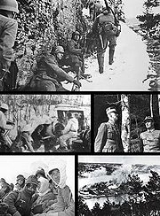
Norwegian Campaign

Encyclopedia
The Norwegian Campaign was a military campaign
that was fought in Norway
during the Second World War
between the Allies
and Germany
, after the latter's invasion of the country. In April 1940, the United Kingdom
and France
came to Norway's aid with an expeditionary force. Despite moderate success in the northern parts of Norway, Germany's invasion of France
the following June compelled the Allies to withdraw and the Norwegian government to seek exile in London. The campaign subsequently ended with the occupation of Norway by Germany, and the continued fighting of exiled Norwegian forces from abroad. The conflict occurred between 9 April and 10 June 1940, the 62 days of fighting making Norway the nation that withstood a German invasion for the longest period of time, aside from the Soviet Union
.
, and two days after Germany invaded Poland
on 1 September 1939, both western nations declared war against Germany. However, neither country opened up a western front, and no major engagements occurred between the sides for several months in what became known as the Phoney War. Winston Churchill
in particular wished to move the war into a more active phase, in contrast to Prime Minister Neville Chamberlain
.
During this time, both sides were looking for secondary fronts. For the Allies, in particular the French, it was based on a desire to avoid repeating the trench warfare of the First World War
, which had occurred along the Franco-German border
. For the Germans, most of the military high command did not believe that it had the resources to launch an assault on France so soon. Norway was an area that each side viewed as a prime location to strike the other.
Following the outbreak of the Second World War, the Norwegian government had mobilized parts of the Norwegian Army
and all bar two of the Royal Norwegian Navy
's warships. The Norwegian Army Air Service
and the Royal Norwegian Navy Air Service
were also called up to protect Norwegian neutrality from violations by the warring parties. The first such violations were the sinkings in Norwegian territorial waters of several British ships by German U-boat
s. In the following months aircraft from all the warring parties violated Norwegian neutrality.
Almost immediately after the outbreak of war the British began pressuring the Norwegian government to provide the United Kingdom with the services of the Norwegian merchant navy, themselves being in dire need of shipping. Following protracted negotiations between 25 September and 20 November 1939, the Norwegians agreed to charter 150 tankers, as well as other ships with a tonnage of 450,000 gross tons. The Norwegian government's concern for the country's supply lines played an important role in persuading them to accept the agreement.
was frozen over. Narvik became of greater significance to the British when it became apparent that Operation Catherine, a plan to gain control of the Baltic Sea, would not be practical. Second, the ports in Norway could serve as a hole in the blockade
of Germany, allowing access to the Atlantic Ocean
.
, which during the winter was shipped primarily from the Norwegian port of Narvik
. By securing access to Norwegian ports, the Germans could more easily obtain the supply of iron ore they needed for their war effort.
Erich Raeder
had pointed out several times in 1939 the potential danger to Germany of Britain seizing the initiative and launching its own invasion in Scandinavia - if the powerful Royal Navy had bases at Bergen
, Narvik and Trondheim
, the North Sea
would be virtually closed to Germany, and the Kriegsmarine
would be at risk even in the Baltic.
notable of the previous conflict. Norway had particular strategic importance to the Germans during the Battle of the Atlantic. Norwegian air bases allowed German reconnaissance aircraft to operate far over the North Atlantic, while German U-boat
s and surface ships operating out of Norwegian naval bases were able to break the British blockade line across the North Sea
and attack convoys heading to Great Britain
.
on 30 November 1939, the Allies found themselves aligned with Norway and Sweden
in support of Finland against the much larger aggressor.
After the outbreak of war between Finland and the Soviet Union, Norway mobilized larger land forces than what had initially been considered necessary. By early 1940 the 6th Division in Finnmark
and Troms
fielded 9,500 troops to defend against Soviet attack, positioned mostly in the eastern regions of Finnmark. Parts of the 6th Division's forces remained in Finnmark even after the German invasion, guarding against a possible Soviet attack. During the Winter War the Norwegian authorities secretly broke with the country's own neutrality by sending the Finns a shipment of 12 Ehrhardt 7.5 cm Model 1901
artillery pieces and 12,000 shells, as well as allowing the British to use Norwegian territory to transfer aircraft and other weaponry to Finland.
This presented an opportunity to the Allies who, while genuinely sympathetic to Finland, also saw an opportunity to use the pretence of sending troop support to additionally occupy ore fields in Sweden and ports in Norway. The plan, promoted by the British General Edmund Ironside
, included two divisions landing at Narvik, five battalions somewhere in Mid-Norway, and another two divisions at Trondheim. The French government pushed for action to be taken to confront the German away from France.
This movement caused the Germans concern. The Molotov-Ribbentrop Pact
had placed Finland within the Soviet sphere of interest, and the Germans therefore claimed neutrality in the conflict. This policy caused a rise in anti-German sentiment throughout Scandinavia, since it was commonly believed that the Germans were allied with the Soviets. Fears began to crop up in German high command that Norway and Sweden would then allow Allied troop movement to aid Finland.
The proposed Allied deployments never occurred, after protests from both Norway and Sweden, when the issue of transfers of troops through their territory was suggested. With the Moscow Peace Treaty
on 12 March 1940, the Finland-related Allied plans were dropped. The abandonment of the planned landings put immense French pressure on Neville Chamberlain's British government, and eventually led to the Allied mining of the Norwegian coast on 8 April.
Großadmiral Erich Raeder, however, argued for an invasion. He believed that the Norwegian ports would be of crucial importance for Germany in a war with the United Kingdom.
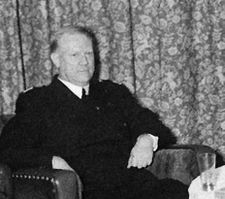 On 14 December 1939, Raeder introduced Adolf Hitler
to Vidkun Quisling
, a pro-Nazi former defence minister
from Norway. Quisling proposed a pan-German cooperation between Nazi-Germany and Norway. In second meeting, four days later on 18 December 1939, Quisling and Hitler discussed the threat of an Allied invasion of Norway.
After the first meeting with Quisling, Hitler ordered the Oberkommando der Wehrmacht
to begin investigating possible invasion plans of Norway. Meeting Quisling was central in igniting Hitler's interest in conquering Norway. The first comprehensive German plan for the occupation of Norway, Studie Nord, ordered by Hitler on 14 December 1939, was completed by 10 January 1940. On 27 January, Hitler ordered that a new plan, named Weserübung, be developed. Work on Weserübung began on 5 February.
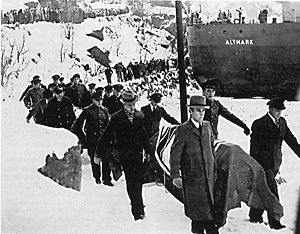 The Altmark Incident
occurred in the early hours of 16 February 1940 when the Royal Navy destroyer
HMS Cossack
entered Norwegian territorial waters, to intercept the German auxiliary ship German naval tanker Altmark
. Boarding Altmark in the Jøssingfjord
. Altmark had spent the preceding months operating as a fleet oiler for the German cruiser Admiral Graf Spee
while the latter was acting as a commerce raider in the South Atlantic. When Altmark began the return journey to Germany she carried 299 prisoners taken from the Allied ships sunk by Admiral Graf Spee. Altmark entered Norwegian territorial waters near the Trondheimsfjord
on 10 January 1940, flying the German national flag. A Norwegian naval escort was provided as Altmark proceeded southwards, hugging the Norwegian coastline. As Altmark was nearing Bergen harbour on 14 February, the Norwegian naval authorities demanded to inspect the German ship. Even though international law did not ban the transfer of prisoners of war through neutral waters, the German captain refused inspection. This led the naval commander in Bergen, Admiral Carsten Tank-Nielsen
, to deny Altmark access to the restricted-access war harbour. Tank-Nielsen was however overruled by his superior, Commanding Admiral Henry Diesen
, and Altmark was escorted through the harbour. According to Norwegian neutrality regulations the state-operated ship of the warring parties were not allowed to enter a number of strategically important Norwegian ports. This clear violation of Norwegian neutrality was allowed because Admiral Diesen feared that the British would intercept Altmark if she was forced to sail closer to the edge of the Norwegian territorial waters.
The next day, 15 February, Altmark was spotted by three British aircraft. The discovery of the ship's location led the Royal Navy to send six destroyers to the area. In order to escape the approaching warships, Altmark fled into the Jøssingfjord. At the time Altmark was escorted by three Norwegian warships, the torpedo boats Kjell
and Skarv and the patrol boat Firern. As Cossack entered the fjord at 22:20 local time, the Norwegian vessels did not intervene when the British boarded Altmark. The boarding action led to the freeing of 299 Allied prisoners of war held on the German ship. The boarding party killed seven Germans in the process.
Following the incident, the Germans sent strong protests to the Norwegian government. The Norwegians on their hand sent protests to the British government. While Norwegian, Swedish and American experts in international law described the British action as a violation of Norwegian neutrality, the United Kingdom declared that incident was at the most a technical violation that had been morally justified.
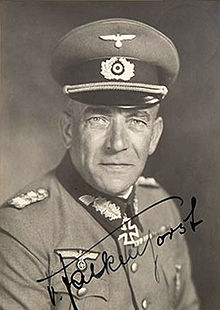
The Altmark Incident led to the Germans speeding up their planning for an invasion of Norway. On 21 February, General Nikolaus von Falkenhorst
was placed in charge of planning the invasion and in command of the land-based forces. The official approval for the invasion and occupation of Denmark
and Norway was signed by Hitler on 1 March.
, the Allies determined that any occupation of Norway or Sweden would likely do more harm than good, possibly driving the neutral countries into alliance with Germany. However, the new French prime minister
, Paul Reynaud
, took a more aggressive stance than his predecessor and wanted some form of action taken against Germany. Churchill was a strong agitator for attacking and occupying Norway, because he wanted the battles and fighting moved away from Britain and France to avoid devastation of their territory, as in the last war. He saw the way into Germany from the north.
It was agreed to utilise Churchill's naval mining plan, Operation Wilfred
, designed to remove the sanctuary of the Leads and force transport ships into international waters where the Royal Navy
could engage and destroy them. Accompanying this would be Plan R 4
, an operation where, upon almost certain German counteraction to Operation Wilfred, the Allies would then proceed to occupy Trondheim and Bergen, and destroy the strategically important Sola Air Station
near Stavanger
.
The Allies disagreed over the additional Operation Royal Marine, where mines would also be placed in the Rhine River. While the British supported this operation, the French were against it, since they also depended on the Rhine and feared German reprisals on French soil. Because of this delay, Operation Wilfred, originally scheduled for 5 April, was delayed until 8 April when the British agreed to perform the Norwegian operations separately from those on the continent.
Already in low-priority planning for considerable time, Operation Weserübung found a new sense of urgency after the Altmark Incident. The main goals of the invasion were to secure the ports and ore fields, with Narvik as a priority, and to establish firm control over the country to prevent collaboration with the Allies. It was to be presented as an armed protection of Norway's neutrality.
One of the subjects of some internal debate by the German military planners was the need to occupy Denmark as part of the greater plan. Denmark was considered vital because its location facilitated greater air and naval control of the area. While some wanted to simply pressure Denmark to acquiesce, it was eventually determined that it would be safer for the operation if Denmark were captured by force.
Another matter that caused additional rework of the plan was Fall Gelb, the proposed invasion of northern France and the Low Countries
, which would require the bulk of German forces. Because some forces were needed for both invasions, Weserübung could not occur at the same time as Gelb, and because the nights were shortening as spring approached, which were vital cover for the naval forces, it therefore had to be sooner. Eventually, on 2 April, 9 April was decided to be the day of the invasion (Wesertag), and 04:15 (Norwegian time) would be the hour of the landings (Weserzeit).
In Norway, the plan called for the capture of six primary targets by amphibious
landings: Oslo
, Kristiansand
, Egersund
, Bergen, Trondheim and Narvik. Additionally, supporting Fallschirmjäger
troops were to capture other key locations such as airfields at Fornebu
outside of Oslo and Sola outside of Stavanger. The plan was designed to quickly overwhelm the Norwegian defenders and occupy these vital areas before any form of organized resistance could be mounted. The following forces were thus organized:
Additionally, the battleship
s Scharnhorst
and Gneisenau
would escort Gruppe 1 and Gruppe 2 as they travelled together, and there would also be several echelons of tankers carrying additional troops, fuel and military equipment.
Against Denmark, two motorized brigades would be used to capture bridges and troops; the Luftwaffe
would be sent to capture Copenhagen
; and paratroops would be used to capture the airfields in the north. While there were also several groups organized for this invasion, none of them contained any large ships.
It was hoped that Germany could avoid armed confrontation with the native populations in both countries, and German troops were instructed only to fire if fired upon.
and artillery units. Most of the Kriegsmarine' s major units were also deployed to the campaign.
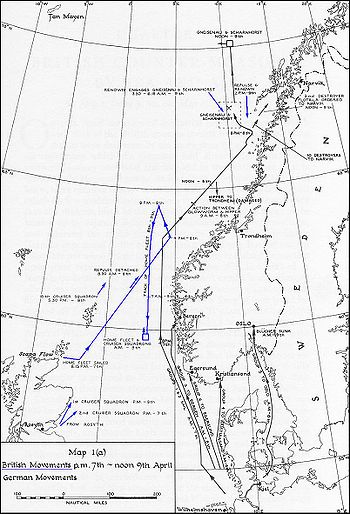 The German invasion first started on 3 April 1940, when covert supply vessels began to head out in advance of the main force. The Allies initiated their plans on the following day, with sixteen Allied submarines ordered to the Skagerrak
and Kattegat
to serve as a screen and advance warning for a German response to Operation Wilfred
, which was launched the following day when Admiral William Whitworth
in HMS Renown
set out from Scapa Flow
for the Vestfjord
with twelve destroyers.
On 7 April, bad weather began to develop in the region, blanketing the area with a thick fog and causing rough seas making travel difficult. Renown' s force soon got caught in a heavy snowstorm, and HMS Glowworm
, one of the destroyer escorts, had to drop out of formation to search for a man swept overboard. However, the weather aided the Germans, providing a screen for their forces, and in the early morning they sent out Gruppe 1 and Gruppe 2, who had the largest distance to travel.
Though the weather did make reconnaissance difficult, the two German groups were discovered 170 kilometres (105 mi) south of the Naze
(the southernmost part of Norway) slightly after 08:00 by Royal Air Force
patrols and reported as one cruiser and six destroyers. A trailing squad of bombers sent out to attack the German ships found them 125 kilometres (78 mi) farther north than they had been before. No damage was done during the attack, but the German groups strength was reassessed as being one battlecruiser, two cruisers and ten destroyers. Because of a strict enforcement of radio silence
, the bombers were not able to report this until 17:30.
On learning of the German movement, the Admiralty
came to the conclusion that the Germans were attempting to break the blockade that the Allies had placed on Germany and use their fleet to disrupt Atlantic trade route
s. Admiral Sir Charles Forbes, Commander-in-Chief
of the British Home Fleet, was notified of this and set out to intercept them at 20:15.
With both sides unaware of the magnitude of the situation, they proceeded as planned. Renown arrived at the Vestfjord late that night and maintained position near the entrance while the minelaying destroyers proceeded to their task. Meanwhile, the Germans launched the remainder of their invasion force. The first direct contact between the two sides occurred the next morning without either side's intention.
Glowworm, on its way to rejoin Renown, happened to come up behind the Bernd von Arnim
and then the Hans Lüdemann
in the heavy fog around 08:00 on 8 April. Immediately a skirmish broke out and the German destroyers fled, signalling for help. The request was soon answered by Admiral Hipper, which quickly crippled Glowworm. During the action, Glowworm rammed Admiral Hipper. Significant damage was done to Hipper' s starboard, and Glowworm was destroyed by a close range salvo immediately afterwards. During its fight Glowworm had broken radio silence and informed the Admiralty of her situation. She was not able to complete her transmission though, and all the Admiralty knew was that Glowworm had been confronted by a large German ship, shots were fired, and contact with the destroyer could not be re-established. In response, the Admiralty ordered Renown and its single destroyer escort (the other two had gone to friendly ports for fuel) to abandon its post at the Vestfjord and head to Glowworm' s last known location. At 10:45, the remaining eight destroyers of the minelaying force were ordered to join as well.
In the morning of 8 April, the Polish submarine Orzeł
confronted and sank the clandestine German troop transport ship Rio de Janeiro
off the southern Norwegian port of Lillesand
. In the wreckage it discovered uniformed German soldiers and various military supplies. Though Orzeł reported the incident to the Admiralty, they were too concerned by the situation with Glowworm and the presumed German breakout to give it much thought and did not pass the information along. Many of the German soldiers from the wreck were rescued by Norwegian fishing boats and the destroyer Odin. On interrogation the survivors disclosed that they were assigned to protect Bergen from the Allies. This information was passed on to Oslo where the Norwegian Parliament ignored the sinking due to being distracted by the British mining operations off the Norwegian coast.
At 14:00, the Admiralty received word that aerial reconnaissance had located a group of German ships a considerable distance west-northwest of Trondheim, bearing west. This reinforced the notion that the Germans were indeed intending a break out, and the Home Fleet changed direction from northeast to northwest to again try to intercept. Additionally, Churchill cancelled Plan R 4 and ordered the four cruisers carrying the soldiers and their supplies to disembark their cargo and join the Home Fleet. In actuality, the German ships, Gruppe 2, were only performing delaying circling manoeuvres in order to approach their destination of Trondheim at the designated time.
That night, after learning of numerous sightings of German ships south of Norway, Charles Forbes began to doubt the validity of the break out idea, and he ordered the Home Fleet to head south to the Skagerrak. He also ordered HMS Repulse
, along with another cruiser and a few destroyers, to head north and join Renown.
At 23:00, as Forbes was just learning of the incident with Orzeł, Gruppe 5 was confronted by the Norwegian patrol vessel Pol III
at the entrance to the Oslofjord
. Pol III quickly sent an alarm to the coastal batteries on Rauøy (Rauøy island) and opened fire on the torpedo boat
Albatros with her single gun shortly before colliding with it. Albatros and two of her companions responded with anti-aircraft
fire, killing the Norwegian captain and setting Pol III on fire. Gruppe 5 continued into the Oslofjord and cleared the outer batteries without incident. Several of the smaller German ships then broke off in order to capture the bypassed fortifications along with Horten.
This activity did not go unnoticed, and soon reports had reached Oslo, leading to a midnight session of the Norwegian cabinet. At this meeting, the cabinet issued orders for the mobilization of four of the six field brigades of the Norwegian Army. The members of the cabinet failed to understand that the partial mobilization they had ordered would, according to the regulations in place, be carried out in secret and without public declarations. Troops would be issued their mobilization orders by post. The only member of the cabinet with in-depth knowledge of the mobilization system, defence minister Birger Ljungberg
, failed to explain the procedure to his colleagues. He would later be heavily criticized for this oversight, which led to unnecessary delays in the Norwegian mobilization. Prior to the cabinet meeting, Ljungberg had dismissed repeated demands for a total and immediate mobilization, made by the chief of the general staff, Rasmus Hatledal
. Hatledal had approached Ljungberg on 5, 6 and 8 April, asking the defence minister to request the cabinet to issue orders for mobilization. The issue had been discussed in the evening of 8 April, after the Commanding General, Kristian Laake
, had joined the calls for a mobilization. At that time the mobilization had been limited to two field battalions in Østfold
, further delaying the larger-scale call-up of troops. When Laake's call for mobilization was finally accepted at some time between 03:30 to 04:00 on 9 April, the Commanding General assumed, like defence minister Ljungberg, that the cabinet knew that they were issuing a partial and silent mobilization. The poor communication between the Norwegian armed forces and the civilian authorities caused much confusion in the early days of the German invasion.
At about this time, further north, Renown was heading back to Vestfjord after reaching Glowworm' s last known location and not finding anything. Heavy seas had caused Whitworth to sail more north than normal and had separated him from his destroyers when he encountered Scharnhorst and Gneisenau. Renown engaged the two battleships off the Lofoten Archipelago
, and during the short battle
Renown scored several hits on the German vessels, forcing them to flee north. Renown attempted to pursue, but the German warships used their superior speed to escape.
leading to Narvik, the ten German destroyers of Gruppe 1 made their approach. With Renown and her escorts earlier diverted to investigate Glowworm incident, no British ships stood in their way, and they entered the area unopposed. By the time they had reached the inner area near Narvik, most of the destroyers had peeled off from the main formation to capture the outer batteries of the Ofotfjord, leaving only three to contend with the two old Norwegian coastal defence ship
s standing guard in Narvik harbour, Eidsvold
and Norge
. Though antiquated, the two coastal defence ships were quite capable of taking on the much more lightly armed and armoured destroyers. After a quick parlance with the captain of Eidsvold, Odd Isaachsen Willoch
, the German ships opened fire pre-emptively on the coastal defence ship, sinking her after hitting her with three torpedoes. Norge entered into the fray shortly after and began to fire on the destroyers, but her marksmen were inexperienced and she did not hit the Germans ships before being sunk by a salvo of torpedoes from the German destroyers.
Following the sinking of EIdsvold and Norge, the commander of Narvik, Konrad Sundlo
, surrendered the land forces in the town without a fight.
At Trondheim, Gruppe 2 also faced only minor resistance to their landings. In the Trondheimsfjord
, Admiral Hipper engaged the defensive batteries while her destroyers sped past them at 25 knots (49 km/h). A well placed shot by Admiral Hipper severed the power cables for the searchlights and rendered the guns ineffective. Only one destroyer received a hit during the landing.
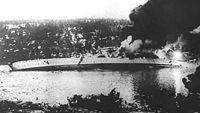 At Bergen, the defensive fortifications put up stiffer resistance to Gruppe 3
' s approach and the light cruiser Königsberg and the artillery training ship Bremse were damaged, the former seriously. The lack of working lights reduced the effectiveness of the guns though, and the landing ships were able to dock without much opposition. The fortifications were surrendered soon after, when Luftwaffe units arrived.
The fortifications at Kristiansand put up an even more resolute fight, twice repulsing the landing and damaging Karlsruhe, nearly running the cruiser aground. Confusion soon sprung up though when the Norwegians received the order not to fire on British and French ships and the Germans began to use Norwegian codes they had captured at Horten. The Germans used this opportunity to quickly reach the harbour and unload their troops, capturing the town by 11:00.
Gruppe 5 encountered the most serious resistance
at the inner defensive fortifications of the Oslofjord, in the vicinity of Drøbak
. Blücher, leading the group, approached the forts assuming that they would be taken by surprise and not respond in time, as had been the case with those in the outer fjord. It was not until the cruiser was at point blank range that Oscarsborg Fortress
opened fire, connecting with every shot. Within a matter of minutes, Blücher was crippled and burning heavily. The damaged cruiser was sunk by a salvo of antiquated, 40-year-old torpedoes launched from land-based torpedo tube
s. She carried much of the administrative personnel intended both for the occupation of Norway and also for the headquarters of the army division assigned to seize Oslo. The cruiser Lützow, also damaged in the attack and believing Blücher had entered a minefield, withdrew with Gruppe 5, twelve miles (19 km) south to Sonsbukten
where she unloaded her troops. This distance delayed the arrival of the main German invasion force for Oslo by over 24 hours, though Oslo would still be captured less than twelve hours after the loss of Blücher by troops flown into Fornebu Airfield.
The delay induced by the Norwegian forces gave time for the royal family, Parliament, and with them the national treasury
, to flee the capital and continue the fighting against the invasion force.
Fornebu Airfield was originally supposed to be secured by paratroops an hour before the first troops were flown in, but the initial force became lost in the fog and did not arrive. Regardless, the airfield was not heavily defended and the German soldiers who did arrive captured it promptly. The Norwegian Army Air Service's Jagevingen fighter flight based on Fornebu Airfield resisted with their Gloster Gladiator
biplane fighters until ammunition ran out and then flew off to whatever secondary airfields available. The ground personnel of the Fighter Wing soon ran out of ammunition for their anti aircraft machine guns as well, in the general confusion and stress to make the fighters ready for action no one had the presence of mind or the time to issue small-arms ammunition for the personal weapons of the ground personnel. Resistance at Fornebu Airfield came to an end. Norwegian attempts to mount a counter-attack were half-hearted and effectively came to nothing. On learning of this, Oslo itself was declared an open city
and soon fully surrendered.
For Gruppe 6 at Egersund and the paratroops at Stavanger, there was no significant opposition and they quickly captured their targets.
.jpg) The German plans for the invasion and occupation of Norway relied heavily on air power. In order to secure the Skagerrak strait between Norway and Denmark, the air bases in Denmark had to be seized. The domination of this strait would prevent the Royal Navy from interfering with the main supply lines of the invasion forces. In this respect, the occupation of Denmark was considered to be vital. The capture of Aalborg Airport
The German plans for the invasion and occupation of Norway relied heavily on air power. In order to secure the Skagerrak strait between Norway and Denmark, the air bases in Denmark had to be seized. The domination of this strait would prevent the Royal Navy from interfering with the main supply lines of the invasion forces. In this respect, the occupation of Denmark was considered to be vital. The capture of Aalborg Airport
was considered as particularly important in this respect.
The German Wehrmacht
crossed the Danish border around 04:15 hours on 9 April. In a coordinated operation, German troops disembarked at the docks of Langelinie
in the Danish capital, Copenhagen
, and began occupying the city. German paratroops also captured Aalborg Airport. Simultaneously, an ultimatum was presented by the German ambassador to King Christian X
. Reports describing the German plans had been submitted to the government a few days earlier but were ignored. The Danish army was small, ill-prepared and used obsolete equipment but resisted in several parts of the country; most importantly, the Royal Guards located at Amalienborg Palace
in Copenhagen, and forces in the vicinity of Haderslev
in South Jutland. By 06:00, the small Danish Air Force
had been taken out and more than 30 German bombers were threatening to drop their bombs over Copenhagen. King Christian X, having consulted with Prime Minister Thorvald Stauning
, Foreign Minister P. Munch and the commanders of the army and the navy, decided to capitulate, believing that further resistance would only result in a useless loss of Danish lives. The Danish public was taken completely by surprise by the occupation, and was instructed by the government to cooperate with the German authorities. Germany's occupation of Denmark
was completed on 10 April and lasted until 5 May 1945.
An important part of the Danish commercial navy escaped the occupation, as Arnold Peter Møller
, President of the Mærsk
shipping company, on 8 April instructed his ships on the high seas to move to Allied or neutral ports if at all possible.
In a pre-emptive move to prevent a German invasion, on 12 April 1940 British forces occupied
the Faroe Islands
, then a Danish amt
(county). The Danish county governor and the Faroese parliament Løgting
governed the islands for the duration of the war.
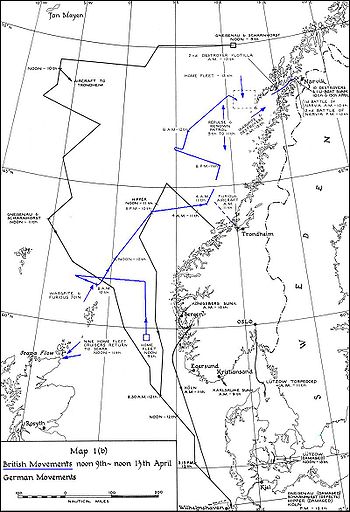 Soon after this, the German landings at Trondheim, Bergen, and Stavanger, as well as the skirmishes in the Oslofjord became known. Not willing to disperse too thinly due to the unknown location of the two German battleships, the Home Fleet chose to focus on nearby Bergen and dispatched an attack force. Royal Air Force reconnaissance soon reported stronger opposition than anticipated, and this, along with the possibility that the Germans might be controlling the shore defences, caused them to recall the force and instead use the aircraft carrier
HMS Furious
to launch torpedo bombers at the enemy ships. The attack never commenced though, as Luftwaffe bombers launched an assault of their own against the Home Fleet first. This attack sank the destroyer HMS Gurkha
and then forced the Home Fleet to withdraw north when their anti-aircraft measures proved ineffective. This German air superiority in the area led the British to decide that all southern regions had to be left to submarines and the RAF, while surface vessels would concentrate on the north.
In addition to the German landings in south and central Norway, the Admiralty was also informed via press reports that a single German destroyer was in Narvik. In response to this they ordered the 2nd Destroyer Flotilla, mostly consisting of ships previously serving as escort destroyers for Operation Wilfred
, to engage. This flotilla, under the command of Captain
Bernard Warburton-Lee
, had already detached from the Renown
during its pursuit of the Scharnhorst and Gneisenau
, being ordered to guard the entrance to the Vestfjord. At 16:00 on 9 April, the flotilla sent an officer ashore at Tranøy
fifty miles west of Narvik and learned from the locals that the German force was 4–6 destroyers and a submarine. Warburton-Lee sent these findings back to the Admiralty, concluding with his intention to attack the next day at "dawn, high water", which would give him the element of surprise and protection against any mines. This decision was approved by the Admiralty in a telegram that night.
Early the following morning, Warburton-Lee led his flagship, HMS Hardy, and four other destroyers into the Ofotfjord. At 04:30, he arrived at Narvik harbour and entered along with HMS Hunter
and HMS Havock
, leaving HMS Hotspur
and HMS Hostile
to guard the entrance and watch the shore batteries. The fog and snow were extremely heavy, allowing Warburton-Lee's force to approach undetected. When they arrived at the harbour itself they found five German destroyers and opened fire, starting the First Battle of Narvik
. Warburton-Lee's ships made three passes on the enemy ships, being joined after the first by Hotspur and Hostile, and sank two of the destroyers, disabled one more, and sank six tankers and supply ships. The German commander, Commodore Friedrich Bonte
, lost his life when his flagship Wilhelm Heidkamp
was sunk. Warburton-Lee's flotilla then left the harbour, almost untouched.
At 06:00, the 2nd Destroyer Flotilla was making their way back to the entrance of the Vestfjord when from the Herjangsfjord
behind them three German destroyers emerged, commanded by Commander Erich Bey
, and a few minutes later two more arrived in front of them, surrounding Warburton-Lee's force. Hardy was the first ship to be hit and was quickly taken out of action, beached by one of her officers after she was crippled. Hunter was the next ship put out of commission, coming to a dead halt in the water after several hits. Hotspur was then hit and received damage to her steering system, causing her to crash into Hunter. Several more hits were registered on the pair until Hotspur was able to reverse out of the wreck. Hostile and Havock meanwhile had raced ahead, but turned about and came back to aid the retreat of Hotspur. The German ships having received a few hits and, more importantly, being critically short of fuel, were not able to pursue. As they exited the Ofotfjord, the three British destroyers managed to sink the German supply ship Rauenfels.
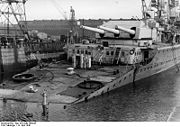 Shortly after the First Battle of Narvik, two more German ships were sunk by British forces. During the night of 9/10 April, the submarine HMS Truant
intercepted and sank the light cruiser Karlsruhe shortly after it had left Kristiansand. On 10 April, the Fleet Air Arm
made a long range attack from their base at Hatston in the Orkney Islands against German warships in Bergen harbour. The attack sank the disabled German light cruiser Königsberg; recorded as the first major warship sunk by aircraft in war.
On 10 April, Furious and the battleship HMS Warspite
joined the Home Fleet and another air attack was made against Trondheim in hopes of sinking Admiral Hipper. Admiral Hipper, however, had already managed to escape through the watch set up outside of the port and was on her way back to Germany when the attack was launched; none of the remaining German destroyers or support ships were hit in the assault. Better luck was had in the south when HMS Spearfish
severely damaged the heavy cruiser Lützow at midnight on 11 April, putting the German ship out of commission for a year.
With it becoming more evident the German fleet had slipped out of Norwegian waters, Home Fleet continued north to Narvik in the hopes of catching the remaining destroyers. En route the ships suffered further harassment from German bombers, forcing them to divert course west away from the shoreline. By 12 April, they were in range of Narvik and an aerial attack on Narvik from Furious was attempted, but the results were disappointing. It was instead decided to send in the battleship Warspite and a powerful escort force, to be commanded by Whitworth.
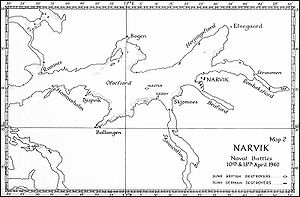 On the morning of 13 April, Whitworth's force entered the Vestfjord using Warspite
' s scouting aircraft to guide the way. Aside from locating two of the German destroyers, the scouting aircraft also sank an enemy submarine, the first such occurrence. Warspite's destroyers travelled three miles (5 km) in advance of the battleship and were the first to engage their German counterparts which had come to meet them, thus starting the Second Battle of Narvik
. Though neither side inflicted notable damage, the German ships were running low on ammunition and were gradually pushed back to the harbour. By that afternoon, most attempted to flee up the Rombaksfjord, the only exception being the Hermann Künne
which beached itself as it made for the Herjangsfjord and was destroyed by HMS Eskimo
. Four British destroyers continued to chase the German ships up through the Rombaksfjord, Eskimo soon damaged by the waiting opposition. However, the German situation was hopeless, having run out of fuel and ammunition, and by the time the remaining British ships arrived their crews had abandoned and scuttled their ships. By 18:30 the British ships were making their way out of the now cleared fjord.
. With the government now fugitive, Vidkun Quisling
used the opportunity to take control of a radio broadcasting station and announce a coup, with himself as the new Prime Minister of Norway
. Quisling's coup and his list of new ministers was announced at at 19:32. On 15 April the Administrative Council
was appointed by the Supreme Court of Norway
to deal with the civilian administration of the occupied areas of Norway, and Quisling resigned.
 In the evening of 9 April, the Norwegian Government moved to Elverum
, believing Hamar to be insecure. All German demands were rejected and the Elverum Authorization
was passed by the members of the parliament, giving the cabinet wide-ranging powers to make decisions until the next time the Parliament could be assembled under ordinary circumstances. However, the bleakness of the situation prompted them to agree to continued negotiations with the Germans, set for the following day. As a precaution Colonel
Otto Ruge
, Inspector General of the Norwegian Infantry, set up a roadblock about 110 kilometres (68.4 mi) north of Oslo, at Midtskogen
. The Norwegian position was soon attacked by a small detachment of German troops, led by Eberhard Spiller, the air attaché
for the German Embassy, who were racing north in an attempt to capture King
Haakon VII
. A skirmish broke out and the Germans turned back after Spiller was mortally wounded. On 10 April, the final negotiations between the Norwegians and Germans failed after the Norwegian delegates, led by Haakon VII, refused to accept the German demand for recognition of Quisling's new government. The same day, panic broke out in German-occupied Oslo, following rumours of incoming British bombers. In what has since been known as "the panic day" the city's population fled to the surrounding countryside, not returning until late the same evening or the next day. Similar rumours led to mass panic in Egersund and other occupied coastal cities. The origins of the rumours have never been uncovered.
On 11 April, the day after the German-Norwegian negotiations had broken down, 19 German bombers attacked Elverum. The two-hour bombing raid left the town centre in ruins and 41 people dead. The same day 11 Luftwaffe bombers also attacked the town of Nybergsund
, in an attempt at killing the Norwegian King, Crown Prince and cabinet.
One of the final acts of the Norwegian authorities before dispersement was the promotion on 10 April of Otto Ruge to the rank of Major General
and appointment to Commanding General of the Norwegian Army, responsible for overseeing the resistance to the German invasion. Ruge replaced the 65-year-old General Kristian Laake as Commanding General, the latter having been heavily criticized for what was considered to be passive behaviour during the initial hours of the invasion. Elements in the Norwegian cabinet considered General Laake to be a defeatist
. Following the appointment of Ruge the Norwegian attitude became clear, with orders to stop the German advance being issued. With the Germans in control of the largest cities, ports and airfields, as well as most of the arms depots and communication networks, repulsing them outright would be impossible. Ruge instead decided that his only chance lay in playing for time, stalling the Germans until reinforcements from the United Kingdom and France could arrive.
On 11 April, after receiving reinforcements in Oslo, General Falkenhorst's offensive began; its goal was to link up Germany's scattered forces before the Norwegians could effectively mobilize or any major Allied intervention could take place. His first task was to secure the Oslofjord area, then to use the 196th and 163rd Infantry Divisions to establish contact with the forces at Trondheim.
, after conferring with Otto Ruge, wanted to assault Trondheim in Central Norway while Churchill insisted on reclaiming Narvik. It was decided to send troops to both locations as a compromise. Admiral Lord Cork was in overall command of the Allied operations.
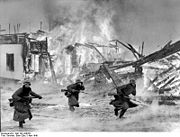 After the appointment of Ruge as Commanding General on 10 April, the Norwegian strategy was to fight delaying actions against the Germans advancing northwards from Oslo to link up with the invasion forces at Trondheim. The main aim of the Norwegian effort in Eastern Norway was to give the Allies enough time to recapture Trondheim, and start a counter-offensive against the German main force in the Oslo area. The region surrounding the Oslofjord was defended by the 1st Division
, commanded by Major General Carl Johan Erichsen. The rest of the region was covered by the 2nd Division, commanded by Major General Jacob Hvinden Haug
. Having been prevented from mobilizing in an orderly fashion by the German invasion, improvised Norwegian units were sent into action against the Germans. Several of the units facing the German advance were led by officers especially selected by Ruge to replace commanders who had failed to show sufficient initiative and aggression in the early days of the campaign. The German offensive aimed at linking up their forces in Oslo and Trondheim began on 14 April, with an advance north from Oslo towards the Gudbrandsdalen and Østerdalen
valleys. Hønefoss
was the first town to fall to the advancing German forces. North of Hønefoss the Germans began meeting Norwegian resistance, first delaying actions and later units fighting organized defensive actions. During intense fighting with heavy casualties on both sides, troops of the Norwegian Infantry Regiment 16 blunted the German advance at the village of Haugsbygd on 15 April. The Germans only broke through the Norwegian lines at Haugsbygd the next day after employing panzers for the first time in Norway. Lacking anti-tank weapons, the Norwegian troops could not hold back the German attack.
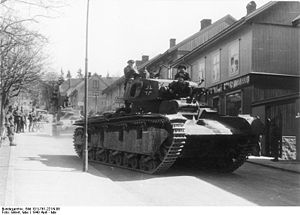 The basis for the Norwegian strategy started collapsing when on 13 and 14 April the 3,000 troops of the 1st Division in Østfold evacuated across the Swedish border without orders, and was interned by the neutral Swedes
. The same day that the 1st Division began crossing into Sweden, the two battalions of Infantry Regiment no. 3 at Heistadmoen Army Camp
in Kongsberg
capitulated. The 3rd Division, commanded by Major General Einar Liljedahl and tasked with defending Southern Norway, surrendered to the Germans in Setesdal
on 15 April, having seen no action up to that point. Some 2,000 soldiers marched into captivity in the Setesdal capitulation. With the abandonment on 20 April of the Franco-British plans for recapturing the central Norwegian city of Trondheim, Ruge's strategy became practically infeasible.
With the calling off of the Allied plans for recapturing Trondheim, British forces which had been landed at Åndalsnes moved into Eastern Norway. By 20 April three British half-battalions had moved as far south as Fåberg
, near the town of Lillehammer
. The main British units deployed to Eastern Norway in April 1940 were the Territorials of the 148th Infantry Brigade and the regular 15th Infantry Brigade. In a series of battles with Norwegian and British forces over the next weeks the Germans pushed northwards from Oslo, their main effort through the Gudbrandsdal
valley. Particularly heavy fighting took place in places like Tretten
, Fåvang
, Vinstra
, Kvam
, Sjoa
and Otta
. Other German units broke through the Valdres
and Østerdal valleys, in the former case after heavy fighting and an initially successful Norwegian counter attack.
During their advance northwards from Oslo the Germans regularly broke down Norwegian resistance using air strikes. Junkers Ju 87
dive bomber
s proved particularly effective in demoralizing Norwegian troops opposing the advance. The Norwegian forces' almost complete lack of anti-aircraft weapons allowed the German aircraft to operate with near impunity. Likewise, when German panzers were employed the Norwegians had no regular countermeasures. The British No. 263 Squadron RAF
fighter squadron set up base on the frozen lake Lesjaskogsvatnet
on 24 April to challenge the German air supremacy, but many of the squadron's aircraft were destroyed by German bombing on 25 April. The four Gladiators that survived to be evacuated to Setnesmoen army base near Åndalsnes were out of operation by the end of 26 April. Setnesmoen was bombed and knocked out by the Luftwaffe on 29 April.
, ordered a total mobilization. During mid-April the 6,000-strong Norwegian 4th Division, responsible for the defence of Western Norway, was mobilized around the town of Voss
in Hordaland
. The 4th Division was the only military district outside of Northern Norway to be mobilized completely and in an orderly fashion. The soldiers of the 4th Division managed to repulse the initial German push along the Bergen Line railway line connecting Western and Eastern Norway.
A British vanguard force arrived at Åndalsnes on 12 April. The main landing landing of Sickleforce, consisting primarily of the British 148th Infantry Brigade and commanded by Major General Bernard Paget
, occurred on 17 April.
After covering the British landings, Steffens planned an offensive aimed at recapturing Bergen. To achieve this aim the 4th Division had a total mobilized force of 6,361 soldiers and 554 horses. General Steffens' plans were made redundant when General Ruge on 16 April ordered most of the division's forces to be redeployed to Valdres and Hallingdal
, in order to reinforce the main front in Eastern Norway. The focus of the remaining forces in Western Norway became to prevent the Germans from advancing from the areas around Bergen. Norwegian naval forces, organized into three regional commands by Admiral Tank-Nielsen, prevented German intrusions into Hardangerfjord
and Sognefjord
. In total the Royal Norwegian Navy fielded some 17-18 warships and five to six aircraft in Western Norway following the German capture of Bergen. After the Luftwaffe bombed and severely damaged Voss on 23 April, inflicting civilian casualties, the Germans captured the town on 25 April. On 28 and 29 April the undefended port town of Kristiansund
was also heavily bombed by the Luftwaffe, as was the nearby port of Molde
, which functioned as the headquarters of the Norwegian government and King.
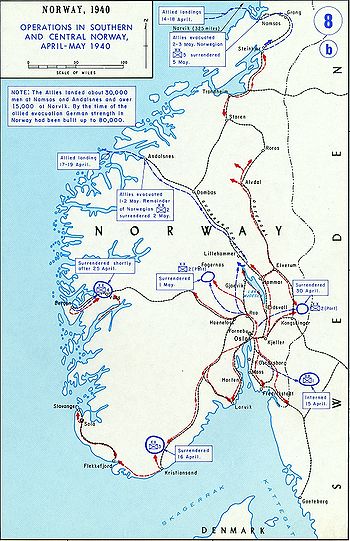 The original plans for the campaign in Central Norway called for a three pronged attack against Trondheim by Allied forces while the Norwegians contained the German forces to the south. It was called Operation Hammer, and would land Allied troops at Namsos
to the north (Mauriceforce), Åndalsnes
to the south (Sickleforce), and around Trondheim itself (Hammerforce). This plan was quickly changed though, as it was felt that a direct assault on Trondheim would be far too risky and therefore only the northern and southern forces would be used.
In order to block the expected allied landings the Oberkommando der Wehrmacht ordered a Fallschirmjäger company to make a combat drop on the railway junction of Dombås in the north of the Gudbrandsdal
valley. The force landed on 14 April and managed to block the rail and road network in Central Norway for five days
before being forced to surrender to the Norwegian Army on 19 April.
In the waning hours of 14 April, Mauriceforce, composed primarily of the British 146th Infantry Brigade
and commanded by Major General Adrian Carton de Wiart
made their initial landings at the Norwegian port town of Namsos
. During the trip the force had been transferred to destroyers instead of bulky transport ships due to the narrow waters of the fjord leading to Namsos; in the confusion of the transfer a great deal of their supplies and even the brigade commander were misplaced.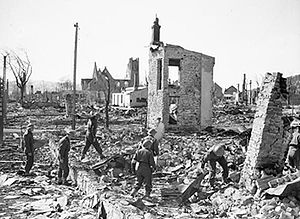 Another great problem for Mauriceforce was the lack of air support
and effective anti-aircraft defences, something of which the Luftwaffe took full advantage. On 17 April the force moved forward from Namsos to positions around the village of Follafoss
and the town of Steinkjer
. French troops arrived at Namsos late on 19 April. On 20 April German aircraft bombed Namsos, destroying most of the houses in the town centre, and large portions of the supply storage for allied troops, leaving de Wiart without a base. Regardless, he moved 80 miles (128.7 km) inland to Steinkjer and linked up with the Norwegian 5th Division. Constant aerial harassment prevented any kind of offensive from taking place though, and on 21 April Mauriceforce was attacked by the German 181st Division
from Trondheim. De Wiart was forced to fall back from these assaults, leaving Steinkjer for the Germans. On 21 and 22 April Steinkjer was bombed by the Luftwaffe, leaving four fifths of the town in ruins and more than 2,000 people homeless. By 24 April Steinkjer and the surrounding areas had been occupied by the Germans.
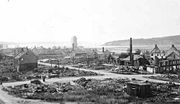
and central regions of Norway. The Allied retreat was covered by Norwegian forces, which were then demobilized to avoid having the soldiers taken prisoner by the Germans. On 30 April the Germans advancing from Oslo and Trondheim linked up. Having evacuated from Molde during German air attacks on 29 April, King Haakon VII and his government arrived in Tromsø in Northern Norway by 1 May. For the remaining weeks of the Norwegian Campaign Tromsø was the de facto
capital of Norway, as the headquarters of the King and cabinet. Sickleforce managed to return to Åndalsnes and escape by 2 May at 02:00, only a few hours before the German 196th Division captured the port. The western Norwegian port had been subjected to heavy German bombing between 23 and 26 April, and had been burning until 27 April. The village of Veblungsnes
and the area around Åndalsnes train station suffered particularly heavy damage. Mauriceforce, their convoys delayed by thick fog, were evacuated from Namsos on 2 May, though two of their rescue ships, the French destroyer Bison and the British destroyer Afridi
were sunk by Junkers Ju 87 dive bombers.
Organized Norwegian military resistance in the central and southern parts of Norway ceased on 5 May, with the capitulation of the forces fighting at Hegra
in Sør-Trøndelag
and at Vinjesvingen
in Telemark
.
The failure of the central campaign is considered one of the direct causes of the Norway Debate
, which resulted in the resignation of British Prime Minister Neville Chamberlain and the appointment of Winston Churchill to the office.
faced the German invasion forces at Narvik. Following the German invasion General Fleischer assumed the position as commander-in-chief of all Norwegian forces in Northern Norway. The Norwegian counter-offensive against the Germans at Narvik was hampered by Fleischer's decision to retain significant forces in Eastern Finnmark to guard against a possible Soviet attack in the far north.
Along with the Allied landings at Åndalsnes and Namsos, aimed against Trondheim, further forces were deployed to the north of Norway. These forces were tasked with the objective of recapturing Narvik. Like the campaign in the south, the Narvik expedition also faced numerous obstacles.
One of the first problems faced by the Allies was the fact that the command was not unified, or even truly organized. Naval forces in the area were led by Admiral of the Fleet
William Boyle, 12th Earl of Cork
who had been ordered to rid the area of the Germans as soon as possible. In contrast, the commander of the ground forces, Major General Pierse Mackesy, was ordered not to land his forces in any area strongly held by the Germans and to avoid damaging populated areas. The two met on 15 April to determine the best course of action. Boyle argued for an immediate assault on Narvik and Mackesy countered that such a move would lead to the decimation of his attacking troops. Boyle eventually conceded to Mackesy's viewpoint.
Mackesy's force was originally codenamed Avonforce, later Rupertforce. The force consisted of the 24th Guards Brigade, as well as French and Polish units led by Brigadier Antoine Béthouart
. The main force began landing at Harstad
, a port town on the island of Hinnøya
, on 14 April. The first German air attacks on Harstad began on 16 April, but anti-aircraft defences prevented serious damage. Only in late May did the Germans succeed in causing destruction in Harstad; a raid on 20 May destroying oil tanks and civilian houses and another raid on 23 May hitting Allied shipping in the harbour.
In the meantime, the Royal Navy had started off on a considerably better note. On 15 April, it captured a German U-boat (U-49) which contained documents detailing the dispositions of all U-boats in the Norwegian Sea
, effectively removing them as a threat.
After the Allied failure in Central Norway, more preparation was given to the northern forces. Air cover was provided by two squadrons of carrier-transported fighters operating from Bardufoss Air Station
, the re-equipped No. 263 Squadron RAF with Gloster Gladiators and No. 46 Squadron RAF
with Hawker Hurricane
s.
As part of the Allied counter-offensive in Northern Norway, French forces made an amphibious landing at Bjerkvik
on 13 May. The naval gunfire
from supporting Allied warships destroyed most of the village and killed 14 civilians before the Germans were dislodged from Bjerkvik.
On 28 May, two French and one Norwegian battalion attacked and recaptured Narvik from the Germans. To the south of the city Polish troops advanced eastwards along the Beisfjord
. Other Norwegian troops were pushing the Germans back towards the Swedish border near Bjørnfjell. However, the German invasion of France and the Low Countries had immensely altered the overall situation of the war and the importance of Norway was considerably lessened. On 25 May, three days before the recapture of Narvik, the Allied commanders had received orders to evacuate from Norway. The attack on the city was in part carried out to mask from the German the Allies' intention of leaving Norway. Among those who argued against evacuating Norway was Winston Churchill, who later expressed that the decision had been a mistake. Shortly after the 28 May Allied recapture of Narvik, the city was bombed and heavily damaged by the Luftwaffe.
While the Norwegian and Allied forces were advancing at Narvik, German forces were moving swiftly northwards through Nordland
to relieve Dietl's besieged troops. The captured Værnes Air Station
near Trondheim was rapidly expanded and improved to provide the Luftwaffe with a base from which to support the Narvik sector. In the evening of 27 May the port city of Bodø
was bombed and strafed
by the Luftwaffe, causing massive damage and leaving 5,000 people homeless. Bodø was soon after captured by the advancing German units, and a British-operated improvised air strip fell into German hands. The air strip at Bodø provided the Germans with an air base much closer to the Narvik fighting, and was of great significance for their continued advance northwards
Operation Alphabet
, the general Allied retreat from Norway, had been approved on 24 May. The Norwegian authorities were only informed of the decision on 1 June. After a meeting on 7 June where the decision to carry on the fight abroad was made, King Haakon VII, Crown Prince Olav
and the Norwegian cabinet left Norway on the British cruiser Devonshire
and went into exile in the United Kingdom. Without supplies from the Allies the Norwegian Army would soon have been unable to continue the fight. Both the King and the Crown Prince had considered the possibility of remaining in Norway, but had been persuaded by the British diplomat Cecil Dormer
to instead follow the government into exile. The Crown Prince suggested that he should remain and assist the Administrative Council in easing the effects of the occupation, but due to the King's old age it was decided that they both had to go into exile, in order to avoid complications should the King die while abroad. By 8 June, after destroying rail lines and port facilities, all Allied troops had been evacuated. The Germans had launched Operation Juno
to relieve pressure on the Narvik garrison and, after discovering the evacuation, shifted the mission to a hunt and sunk two British destroyers and the aircraft carrier Glorious
. Before the British warships were sunk, however, the destroyer Acasta
torpedoed and damaged Scharnhorst. Shortly after the encounter the British submarine Clyde
intercepted the German ships and torpedoed Gneisenau, causing severe damage.
The Norwegian forces on the mainland capitulated to the Germans on 10 June 1940. Units fighting on the front had been ordered to disengage in the early hours of 8 June. Fighting ceased at 24:00 on 9 June. The formal capitulation agreement for forces fighting in mainland Norway was signed at the Bristol Hotel in Trondheim at 17:00 on 10 June 1940. Lieutenant Colonel Ragnvald Roscher Nielsen
signed for the Norwegian forces, Colonel Erich Buschenhagen
for the German side. A capitulation agreement for the Norwegian forces fighting at Narvik was also signed the same day, at Bjørnfjell. The signatories of this agreement, the last local capitulation of Norwegian troops during the campaign, were General Eduard Dietl for the Germans, and Lieutenant Colonel Harald Wrede Holm for the Norwegians. The 62-day campaign made Norway the country to withstand a German invasion for the longest period of time, aside from the Soviet Union.
, which proved increasingly efficient during the later years of occupation. The resistance to the German occupation began in the autumn of 1940, steadily gaining strength and becoming better organized. Despite the Gestapo
infiltrating and destroying many of the early organizations, the resistance movement survived and grew. The last year of the war saw an increase in sabotage
actions by the exile government-aligned Norwegian resistance organization Milorg
, although the organization's main goal was to retain intact guerilla forces to aid an Allied invasion of Norway. In addition to Milorg, many independent, mostly communist, resistance groups operated in occupied Norway, attacking German targets without coordinating with the exiled Norwegian authorities.
The civilian side of the German occupation of Norway was organized through the establishment of the Reichskommissariat Norwegen
, lead from 24 April by Josef Terboven
. The Germans attempted to make the exiled Norwegian authorities irrelevant, especially targeting the King. Weeks after the end of the Norwegian Campaign the Germans pressured the presidency of the Norwegian parliament to issue a request that Haakon VII abdicate. On 3 July Haakon VII turned down the request, and on 8 July gave a speech on BBC Radio proclaiming his answer. "The King's No", as it became known, encouraged resistance to the occupation and the Norwegian collaborators. The Administrative Council, appointed by the Norwegian Supreme Court on 15 April to stand in for the Norwegian government in the occupied territories, functioned until 25 September. After that date the Norwegian partner of the occupying Germans was the fascist Quisling regime
, in one form or another.
The Royal Norwegian Navy
and Royal Norwegian Air Force
were re-established in Britain - based on the remnants of forces saved from the Norwegian Campaign. The forces soon saw extensive combat in the convoy-battles of the North Atlantic and in the air-war over Europe. The ranks of the Navy and Air Force was swollen by a steady trickle of refugees making their way out of occupied Norway, and their equipment brought up to standard by British and American aircraft and ships. From a force of 15 ships in June 1940, the Royal Norwegian Navy had expanded to 58 warships by the end of the Second World War in Europe. The ships were manned by around 7,000 crew members. In all 118 warships had been under Norwegian command at one time or another during the war years.
Norwegian squadrons flew with the Royal Air Force Fighter
and Coastal
Commands. The Norwegian-manned 331 Squadron
and 332 Squadron
operated Hawker Hurricane
and Supermarine Spitfire
fighter aircraft. The naval 330 Squadron and 333 Squadron
flew Northrop N-3PB
patrol bombers, Consolidated PBY Catalina and Short Sunderland
flying boats and de Havilland Mosquito
fighter bombers. Individual Norwegians flew with British air units. In November 1944 the Royal Norwegian Naval Air Service and the Norwegian Army Air Service, having been under a unified command since March 1941, were amalgamated to form the Royal Norwegian Air Force
(RNoAF). At the end of the war some 2,700 personnel served in the RNoAF.
A c. 4,000 strong Norwegian Army was also re-established in Scotland
. However, with the exception of a small number of special forces, it saw little action for the rest of the war. A reinforced company from the Scotland-based Norwegian Army participated in the liberation of Finnmark (the northernmost county of Norway) during the winter of 1944–45. Finnmark and the northern parts of Troms county had been forcibly evacuated by the Germans in a scorched earth operation following an offensive by the Red Army
against occupied Finnmark in October 1944. The offensive had captured the north-eastern town of Kirkenes
from the occupying German forces. After the arrival of the 300 troops from Scotland, further troops were moved in from Sweden and mobilized locally. At the end of the war, the Norwegian forces in Finnmark totalled 3,000. In the course of this operation, there were some minor skirmishes with German rear guards and patrols.
In neutral Sweden there was also a Norwegian build-up of forces in the last two years of the war through the so called "police troops
" established with the support of Swedish authorities. The term "police" served as a cover up for what in reality was pure military training of a force mustering around 13,000 well trained and equipped troops by VE-day. In 1945 around 1,300 "police troops" took part in the Liberation of Finnmark.
Aside from the regular Norwegian forces, the main armed resistance movement in Norway, the exile government-controlled Milorg, fielded some 40,000 combatants at the end of the war. In November 1941 Milorg had been declared by the exiled Norwegian government to be the fourth branch of the Norwegian Armed Forces.
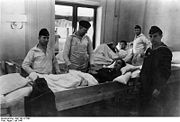 The official German casualties for the Norwegian Campaign totalled 5,296. Of these 1,317 were killed on land, while 2,375 were lost at sea. 1,604 were listed as wounded.
The German casualties at sea were particularly heavy, with the sinking of one of the Kriegsmarine' s two heavy cruisers, two of its six light cruisers, 10 of its 20 destroyers and six U-boats.
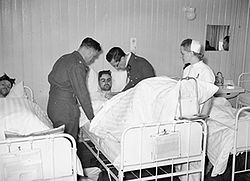 The Norwegian and Allied casualties of the Norwegian Campaign totalled around 6,602. The British lost 1,869 killed, wounded and missing on land and approximately 2,500 at sea, while the French and Polish lost 533 killed, wounded and missing. On the side of the Norwegian there were around 1,700 casualties, of whom 860 were killed. Some 400 Norwegian civilians were also killed, mostly in German bombing raids.
On the naval side of the Norwegian casualties, the Royal Norwegian Navy, fielding 121 mostly outdated ships at the outset of the German invasion, was virtually wiped out during the campaign. Only 15 warships, including a captured German fishing trawler
, with some 600 men had managed to evacuate to the United Kingdom by the end of the fighting. The remaining Norwegian naval vessels were sunk in action, scuttled by their own crews, or captured by the Germans. Among the warships sunk in action during the campaign were two coastal defence ship
s and two destroyers. Seven torpedo boats were also sunk or scuttled, while the remaining ten were captured by the Germans. Only one of the nine Norwegian submarines managed to escape to the United Kingdom, the other eight being scuttled or captured.
The British lost one aircraft carrier, two cruisers, seven destroyers and a submarine but with their much larger fleet could absorb the losses to a much greater degree than Germany.
The French Navy
lost one large destroyer during the campaign, and a cruiser severely damaged. The exiled Polish Navy
also lost the destroyer Grom.
At sea the invasion proved a significant setback. For the Kriegsmarine the campaign led to crippling losses, leaving the Kriegsmarine with a surface force of one heavy cruiser, two light cruisers and four destroyers operational. This left the navy weakened during the summer months when Hitler was pursuing plans for an invasion of Britain
.
The greatest cost of the campaign on land came in the need to keep most of the invasion troops in Norway for occupation duties
away from the fronts. On the whole the campaign was a costly enterprise with limited benefit for the victor.
Through the Norwegian government's Nortraship
system, the Allies also gained the services of the Norwegian merchant navy, the fourth largest in the world. The 1,028-ship strong Nortraship was established on 22 April. The Nortraship fleet consisted of some 85% of the pre-war Norwegian merchant fleet, the remaining 15% having been in Norway when the Germans invaded and been unable to escape. The Nortraship vessels were crewed by 27,000 sailors. In total 43 free Norwegian ships were sunk during the Norwegian Campaign, while another 29 were interned by the neutral Swedes. Nortraship gave the Norwegian government-in-exile economic independence and a basis for continued resistance from abroad.
The Allies achieved a partial success at Narvik. The Germans had destroyed much of the port facilities there before their loss of the city on 28 May. Shipping from the port was stopped for a period of six months, although the Allies had believed it would be out of operation for a year.
The German occupation of Norway was to prove a thorn in the side of the Allies during the next few years. Bombers based at Sola had a round trip of about 600 miles to Rattray Head
in north-east Scotland, instead of a round trip of over 1000 miles from the nearest airfield on German soil, on the island of Sylt
, and the east of Scotland and coastal shipping suffered from bombing raids, most from Norway, until 1943. After the fall of Norway, Scotland (especially the fleet bases at Scapa Flow and Rosyth
) were seen as much more vulnerable to a diversionary assault by air- and sea-borne troops. German commerce raiders used Norway as a staging base to reach the North Atlantic with impunity. After Germany invaded the Soviet Union
in 1941, air bases in Norway were also used to interdict the Allied Arctic convoys
there, inflicting painful losses to shipping.
Military campaign
In the military sciences, the term military campaign applies to large scale, long duration, significant military strategy plan incorporating a series of inter-related military operations or battles forming a distinct part of a larger conflict often called a war...
that was fought in Norway
Norway
Norway , officially the Kingdom of Norway, is a Nordic unitary constitutional monarchy whose territory comprises the western portion of the Scandinavian Peninsula, Jan Mayen, and the Arctic archipelago of Svalbard and Bouvet Island. Norway has a total area of and a population of about 4.9 million...
during the Second World War
World War II
World War II, or the Second World War , was a global conflict lasting from 1939 to 1945, involving most of the world's nations—including all of the great powers—eventually forming two opposing military alliances: the Allies and the Axis...
between the Allies
Allies of World War II
The Allies of World War II were the countries that opposed the Axis powers during the Second World War . Former Axis states contributing to the Allied victory are not considered Allied states...
and Germany
Nazi Germany
Nazi Germany , also known as the Third Reich , but officially called German Reich from 1933 to 1943 and Greater German Reich from 26 June 1943 onward, is the name commonly used to refer to the state of Germany from 1933 to 1945, when it was a totalitarian dictatorship ruled by...
, after the latter's invasion of the country. In April 1940, the United Kingdom
United Kingdom
The United Kingdom of Great Britain and Northern IrelandIn the United Kingdom and Dependencies, other languages have been officially recognised as legitimate autochthonous languages under the European Charter for Regional or Minority Languages...
and France
France
The French Republic , The French Republic , The French Republic , (commonly known as France , is a unitary semi-presidential republic in Western Europe with several overseas territories and islands located on other continents and in the Indian, Pacific, and Atlantic oceans. Metropolitan France...
came to Norway's aid with an expeditionary force. Despite moderate success in the northern parts of Norway, Germany's invasion of France
Battle of France
In the Second World War, the Battle of France was the German invasion of France and the Low Countries, beginning on 10 May 1940, which ended the Phoney War. The battle consisted of two main operations. In the first, Fall Gelb , German armoured units pushed through the Ardennes, to cut off and...
the following June compelled the Allies to withdraw and the Norwegian government to seek exile in London. The campaign subsequently ended with the occupation of Norway by Germany, and the continued fighting of exiled Norwegian forces from abroad. The conflict occurred between 9 April and 10 June 1940, the 62 days of fighting making Norway the nation that withstood a German invasion for the longest period of time, aside from the Soviet Union
Soviet Union
The Soviet Union , officially the Union of Soviet Socialist Republics , was a constitutionally socialist state that existed in Eurasia between 1922 and 1991....
.
Outbreak of the Second World War
Both Britain and France had signed military assistance treaties with PolandSecond Polish Republic
The Second Polish Republic, Second Commonwealth of Poland or interwar Poland refers to Poland between the two world wars; a period in Polish history in which Poland was restored as an independent state. Officially known as the Republic of Poland or the Commonwealth of Poland , the Polish state was...
, and two days after Germany invaded Poland
Invasion of Poland (1939)
The Invasion of Poland, also known as the September Campaign or 1939 Defensive War in Poland and the Poland Campaign in Germany, was an invasion of Poland by Germany, the Soviet Union, and a small Slovak contingent that marked the start of World War II in Europe...
on 1 September 1939, both western nations declared war against Germany. However, neither country opened up a western front, and no major engagements occurred between the sides for several months in what became known as the Phoney War. Winston Churchill
Winston Churchill
Sir Winston Leonard Spencer-Churchill, was a predominantly Conservative British politician and statesman known for his leadership of the United Kingdom during the Second World War. He is widely regarded as one of the greatest wartime leaders of the century and served as Prime Minister twice...
in particular wished to move the war into a more active phase, in contrast to Prime Minister Neville Chamberlain
Neville Chamberlain
Arthur Neville Chamberlain FRS was a British Conservative politician who served as Prime Minister of the United Kingdom from May 1937 to May 1940. Chamberlain is best known for his appeasement foreign policy, and in particular for his signing of the Munich Agreement in 1938, conceding the...
.
During this time, both sides were looking for secondary fronts. For the Allies, in particular the French, it was based on a desire to avoid repeating the trench warfare of the First World War
World War I
World War I , which was predominantly called the World War or the Great War from its occurrence until 1939, and the First World War or World War I thereafter, was a major war centred in Europe that began on 28 July 1914 and lasted until 11 November 1918...
, which had occurred along the Franco-German border
Western Front (World War I)
Following the outbreak of World War I in 1914, the German Army opened the Western Front by first invading Luxembourg and Belgium, then gaining military control of important industrial regions in France. The tide of the advance was dramatically turned with the Battle of the Marne...
. For the Germans, most of the military high command did not believe that it had the resources to launch an assault on France so soon. Norway was an area that each side viewed as a prime location to strike the other.
Following the outbreak of the Second World War, the Norwegian government had mobilized parts of the Norwegian Army
Norwegian Army
Norway achieved full independence in 1905, and in the first century of its short life has contributed to two major conflicts, the Cold War and the War on Terror. The Norwegian Army currently operates in the north of Norway and in Afghanistan as well as in Eastern Europe. The Army is the oldest of...
and all bar two of the Royal Norwegian Navy
Royal Norwegian Navy
The Royal Norwegian Navy is the branch of the Norwegian Defence Force responsible for naval operations. , the RNoN consists of approximately 3,700 personnel and 70 vessels, including 5 heavy frigates, 6 submarines, 14 patrol boats, 4 minesweepers, 4 minehunters, 1 mine detection vessel, 4 support...
's warships. The Norwegian Army Air Service
Norwegian Army Air Service
The Norwegian Army Air Service ' was established in 1914. Its main base and aircraft factory was at Kjeller. On 10 November 1944 the NoAAS was joined with the Royal Norwegian Navy Air Service to form the Royal Norwegian Air Force....
and the Royal Norwegian Navy Air Service
Royal Norwegian Navy Air Service
The Royal Norwegian Navy Air Service was alongside the Norwegian Army Air Service the forerunner to the modern-day Royal Norwegian Air Force.- History :...
were also called up to protect Norwegian neutrality from violations by the warring parties. The first such violations were the sinkings in Norwegian territorial waters of several British ships by German U-boat
U-boat
U-boat is the anglicized version of the German word U-Boot , itself an abbreviation of Unterseeboot , and refers to military submarines operated by Germany, particularly in World War I and World War II...
s. In the following months aircraft from all the warring parties violated Norwegian neutrality.
Almost immediately after the outbreak of war the British began pressuring the Norwegian government to provide the United Kingdom with the services of the Norwegian merchant navy, themselves being in dire need of shipping. Following protracted negotiations between 25 September and 20 November 1939, the Norwegians agreed to charter 150 tankers, as well as other ships with a tonnage of 450,000 gross tons. The Norwegian government's concern for the country's supply lines played an important role in persuading them to accept the agreement.
Value of Norway
Norway, though neutral, was considered strategically important for both sides of the war for two main reasons. First was the importance of the port of Narvik, from which large quantities of Swedish iron ore, on which Germany depended, were exported; this route was especially important during the winter months when the Baltic SeaBaltic Sea
The Baltic Sea is a brackish mediterranean sea located in Northern Europe, from 53°N to 66°N latitude and from 20°E to 26°E longitude. It is bounded by the Scandinavian Peninsula, the mainland of Europe, and the Danish islands. It drains into the Kattegat by way of the Øresund, the Great Belt and...
was frozen over. Narvik became of greater significance to the British when it became apparent that Operation Catherine, a plan to gain control of the Baltic Sea, would not be practical. Second, the ports in Norway could serve as a hole in the blockade
Blockade
A blockade is an effort to cut off food, supplies, war material or communications from a particular area by force, either in part or totally. A blockade should not be confused with an embargo or sanctions, which are legal barriers to trade, and is distinct from a siege in that a blockade is usually...
of Germany, allowing access to the Atlantic Ocean
Atlantic Ocean
The Atlantic Ocean is the second-largest of the world's oceanic divisions. With a total area of about , it covers approximately 20% of the Earth's surface and about 26% of its water surface area...
.
Iron ore
The principal reason for Germany's invasion of Norway was its dependence on Swedish iron oreSwedish iron ore during World War II
Swedish iron ore was an important economic factor in the European Theatre of World War II. Both the Allies and the Third Reich were keen on the control of the mining district in northernmost Sweden, surrounding the mining towns of Gällivare and Kiruna...
, which during the winter was shipped primarily from the Norwegian port of Narvik
Narvik
is the third largest city and municipality in Nordland county, Norway by population. Narvik is located on the shores of the Narvik Fjord . The municipality is part of the Ofoten traditional region of North Norway, inside the arctic circle...
. By securing access to Norwegian ports, the Germans could more easily obtain the supply of iron ore they needed for their war effort.
Sea power
Control of Norway was considered to be crucially important to Germany's ability to use its sea power effectively against the Allies, particularly Britain. While Norway was strictly neutral, and unoccupied by either of the fighting powers, there was no threat. But the weakness of the Norwegian coastal defences, and the inability of her field army to resist effectively a determined invasion by a stronger power were clear. GroßadmiralGrand Admiral
Grand admiral is a historic naval rank, generally being the highest such rank present in any particular country. Its most notable use was in Germany — the German word is Großadmiral.-France:...
Erich Raeder
Erich Raeder
Erich Johann Albert Raeder was a naval leader in Germany before and during World War II. Raeder attained the highest possible naval rank—that of Großadmiral — in 1939, becoming the first person to hold that rank since Alfred von Tirpitz...
had pointed out several times in 1939 the potential danger to Germany of Britain seizing the initiative and launching its own invasion in Scandinavia - if the powerful Royal Navy had bases at Bergen
Bergen
Bergen is the second largest city in Norway with a population of as of , . Bergen is the administrative centre of Hordaland county. Greater Bergen or Bergen Metropolitan Area as defined by Statistics Norway, has a population of as of , ....
, Narvik and Trondheim
Trondheim
Trondheim , historically, Nidaros and Trondhjem, is a city and municipality in Sør-Trøndelag county, Norway. With a population of 173,486, it is the third most populous municipality and city in the country, although the fourth largest metropolitan area. It is the administrative centre of...
, the North Sea
North Sea
In the southwest, beyond the Straits of Dover, the North Sea becomes the English Channel connecting to the Atlantic Ocean. In the east, it connects to the Baltic Sea via the Skagerrak and Kattegat, narrow straits that separate Denmark from Norway and Sweden respectively...
would be virtually closed to Germany, and the Kriegsmarine
Kriegsmarine
The Kriegsmarine was the name of the German Navy during the Nazi regime . It superseded the Kaiserliche Marine of World War I and the post-war Reichsmarine. The Kriegsmarine was one of three official branches of the Wehrmacht, the unified armed forces of Nazi Germany.The Kriegsmarine grew rapidly...
would be at risk even in the Baltic.
Battlefield away from France
A successful invasion of Norway by either side had the potential to strike a blow against the other without getting bogged down in the large-scale trench warfareTrench warfare
Trench warfare is a form of occupied fighting lines, consisting largely of trenches, in which troops are largely immune to the enemy's small arms fire and are substantially sheltered from artillery...
notable of the previous conflict. Norway had particular strategic importance to the Germans during the Battle of the Atlantic. Norwegian air bases allowed German reconnaissance aircraft to operate far over the North Atlantic, while German U-boat
U-boat
U-boat is the anglicized version of the German word U-Boot , itself an abbreviation of Unterseeboot , and refers to military submarines operated by Germany, particularly in World War I and World War II...
s and surface ships operating out of Norwegian naval bases were able to break the British blockade line across the North Sea
North Sea
In the southwest, beyond the Straits of Dover, the North Sea becomes the English Channel connecting to the Atlantic Ocean. In the east, it connects to the Baltic Sea via the Skagerrak and Kattegat, narrow straits that separate Denmark from Norway and Sweden respectively...
and attack convoys heading to Great Britain
Great Britain
Great Britain or Britain is an island situated to the northwest of Continental Europe. It is the ninth largest island in the world, and the largest European island, as well as the largest of the British Isles...
.
Winter War
When the Soviet Union started its attack against FinlandFinland
Finland , officially the Republic of Finland, is a Nordic country situated in the Fennoscandian region of Northern Europe. It is bordered by Sweden in the west, Norway in the north and Russia in the east, while Estonia lies to its south across the Gulf of Finland.Around 5.4 million people reside...
on 30 November 1939, the Allies found themselves aligned with Norway and Sweden
Sweden
Sweden , officially the Kingdom of Sweden , is a Nordic country on the Scandinavian Peninsula in Northern Europe. Sweden borders with Norway and Finland and is connected to Denmark by a bridge-tunnel across the Öresund....
in support of Finland against the much larger aggressor.
After the outbreak of war between Finland and the Soviet Union, Norway mobilized larger land forces than what had initially been considered necessary. By early 1940 the 6th Division in Finnmark
Finnmark
or Finnmárku is a county in the extreme northeast of Norway. By land it borders Troms county to the west, Finland to the south and Russia to the east, and by water, the Norwegian Sea to the northwest, and the Barents Sea to the north and northeast.The county was formerly known as Finmarkens...
and Troms
Troms
or Romsa is a county in North Norway, bordering Finnmark to the northeast and Nordland in the southwest. To the south is Norrbotten Län in Sweden and further southeast is a shorter border with Lapland Province in Finland. To the west is the Norwegian Sea...
fielded 9,500 troops to defend against Soviet attack, positioned mostly in the eastern regions of Finnmark. Parts of the 6th Division's forces remained in Finnmark even after the German invasion, guarding against a possible Soviet attack. During the Winter War the Norwegian authorities secretly broke with the country's own neutrality by sending the Finns a shipment of 12 Ehrhardt 7.5 cm Model 1901
Ehrhardt 7.5 cm Model 1901
The Ehrhardt 7.5 cm Model 1901 was a field gun designed by the German company Rheinische Metallwaren- und Maschinenfabrik and sold to Norway in 1901. It remained the main field artillery gun of the Norwegian Army until the German invasion of Norway in 1940. The Germans impressed the surviving...
artillery pieces and 12,000 shells, as well as allowing the British to use Norwegian territory to transfer aircraft and other weaponry to Finland.
This presented an opportunity to the Allies who, while genuinely sympathetic to Finland, also saw an opportunity to use the pretence of sending troop support to additionally occupy ore fields in Sweden and ports in Norway. The plan, promoted by the British General Edmund Ironside
Edmund Ironside, 1st Baron Ironside
Field Marshal William Edmund Ironside, 1st Baron Ironside GCB, CMG, CBE, DSO, was a British Army officer who served as Chief of the Imperial General Staff during the first year of the Second World War....
, included two divisions landing at Narvik, five battalions somewhere in Mid-Norway, and another two divisions at Trondheim. The French government pushed for action to be taken to confront the German away from France.
This movement caused the Germans concern. The Molotov-Ribbentrop Pact
Molotov-Ribbentrop Pact
The Molotov–Ribbentrop Pact, named after the Soviet foreign minister Vyacheslav Molotov and the German foreign minister Joachim von Ribbentrop, was an agreement officially titled the Treaty of Non-Aggression between Germany and the Soviet Union and signed in Moscow in the late hours of 23 August 1939...
had placed Finland within the Soviet sphere of interest, and the Germans therefore claimed neutrality in the conflict. This policy caused a rise in anti-German sentiment throughout Scandinavia, since it was commonly believed that the Germans were allied with the Soviets. Fears began to crop up in German high command that Norway and Sweden would then allow Allied troop movement to aid Finland.
The proposed Allied deployments never occurred, after protests from both Norway and Sweden, when the issue of transfers of troops through their territory was suggested. With the Moscow Peace Treaty
Moscow Peace Treaty (1940)
The Moscow Peace Treaty was signed by Finland and the Soviet Union on 12 March 1940, and the ratifications were exchanged on 21 March. It marked the end of the 105-day Winter War. The treaty ceded parts of Finland to the Soviet Union. However, it preserved Finland's independence, ending the Soviet...
on 12 March 1940, the Finland-related Allied plans were dropped. The abandonment of the planned landings put immense French pressure on Neville Chamberlain's British government, and eventually led to the Allied mining of the Norwegian coast on 8 April.
Vidkun Quisling and initial German investigation
It was originally thought by the German High Command that having Norway remain neutral was in its interest. As long as the Allies did not enter Norwegian waters, there would be safe passage for merchant vessels travelling along the Norwegian coast to ship the ore that Germany was importing.Großadmiral Erich Raeder, however, argued for an invasion. He believed that the Norwegian ports would be of crucial importance for Germany in a war with the United Kingdom.
Adolf Hitler
Adolf Hitler was an Austrian-born German politician and the leader of the National Socialist German Workers Party , commonly referred to as the Nazi Party). He was Chancellor of Germany from 1933 to 1945, and head of state from 1934 to 1945...
to Vidkun Quisling
Vidkun Quisling
Vidkun Abraham Lauritz Jonssøn Quisling was a Norwegian politician. On 9 April 1940, with the German invasion of Norway in progress, he seized power in a Nazi-backed coup d'etat that garnered him international infamy. From 1942 to 1945 he served as Minister-President, working with the occupying...
, a pro-Nazi former defence minister
Defence minister
A defence minister is a person in a cabinet position in charge of a Ministry of Defence, which regulates the armed forces in some sovereign nations...
from Norway. Quisling proposed a pan-German cooperation between Nazi-Germany and Norway. In second meeting, four days later on 18 December 1939, Quisling and Hitler discussed the threat of an Allied invasion of Norway.
After the first meeting with Quisling, Hitler ordered the Oberkommando der Wehrmacht
Oberkommando der Wehrmacht
The Oberkommando der Wehrmacht was part of the command structure of the armed forces of Nazi Germany during World War II.- Genesis :...
to begin investigating possible invasion plans of Norway. Meeting Quisling was central in igniting Hitler's interest in conquering Norway. The first comprehensive German plan for the occupation of Norway, Studie Nord, ordered by Hitler on 14 December 1939, was completed by 10 January 1940. On 27 January, Hitler ordered that a new plan, named Weserübung, be developed. Work on Weserübung began on 5 February.
Altmark Incident
Altmark Incident
The Altmark Incident was a naval skirmish of World War II between the United Kingdom and Nazi Germany, which happened on 16 February 1940. It took place in what were, at that time, neutral Norwegian waters...
occurred in the early hours of 16 February 1940 when the Royal Navy destroyer
Destroyer
In naval terminology, a destroyer is a fast and maneuverable yet long-endurance warship intended to escort larger vessels in a fleet, convoy or battle group and defend them against smaller, powerful, short-range attackers. Destroyers, originally called torpedo-boat destroyers in 1892, evolved from...
HMS Cossack
HMS Cossack (F03)
HMS Cossack was a Tribal-class destroyer which became famous for the boarding of the German supply ship Altmark in Norwegian waters, and the associated rescue of sailors originally captured by the Admiral Graf Spee....
entered Norwegian territorial waters, to intercept the German auxiliary ship German naval tanker Altmark
German tanker Altmark
Altmark was a German oil tanker and supply vessel, one of five of a class built between 1937 and 1939. She is best known for her support of the German commerce raider, the "pocket battleship" and her subsequent involvement in the "Altmark Incident"....
. Boarding Altmark in the Jøssingfjord
Jøssingfjord
Jøssingfjord is a fjord located within the municipality of Sokndal in south-western Norway.The fjord is known as the location of the Altmark Incident, where, during World War II, on February 16, 1940, the British destroyer Cossack managed to free prisoners taken by the Admiral Graf Spee from the...
. Altmark had spent the preceding months operating as a fleet oiler for the German cruiser Admiral Graf Spee
German cruiser Admiral Graf Spee
Admiral Graf Spee was a Deutschland-class heavy cruiser which served with the Kriegsmarine of Nazi Germany during World War II. The vessel was named after Admiral Maximilian von Spee, commander of the East Asia Squadron that fought the battles of Coronel and Falkland Islands in World War I...
while the latter was acting as a commerce raider in the South Atlantic. When Altmark began the return journey to Germany she carried 299 prisoners taken from the Allied ships sunk by Admiral Graf Spee. Altmark entered Norwegian territorial waters near the Trondheimsfjord
Trondheimsfjord
The Trondheimsfjord , an inlet of the Norwegian Sea, is Norway's third longest fjord at long. It is located in the west central part of the country, and it stretches from Ørland in west to Steinkjer in north, passing the city of Trondheim on its way...
on 10 January 1940, flying the German national flag. A Norwegian naval escort was provided as Altmark proceeded southwards, hugging the Norwegian coastline. As Altmark was nearing Bergen harbour on 14 February, the Norwegian naval authorities demanded to inspect the German ship. Even though international law did not ban the transfer of prisoners of war through neutral waters, the German captain refused inspection. This led the naval commander in Bergen, Admiral Carsten Tank-Nielsen
Carsten Tank-Nielsen
Carsten Tank-Nielsen was a Norwegian naval officer, submarine pioneer and Rear admiral. He was born in Horten, and was the grandson of Carsten Tank Nielsen. He was chief of the Norwegian Navy's first submarine Kobben from 1909 to 1913. He was decorated Knight, First Class of the Order of St. Olav...
, to deny Altmark access to the restricted-access war harbour. Tank-Nielsen was however overruled by his superior, Commanding Admiral Henry Diesen
Henry Diesen
Henry Edward Diesen was a Norwegian naval officer.He was born in Trondhjem as a son of telegrapher Edward Diesen and Johanne Christophine Stenersen...
, and Altmark was escorted through the harbour. According to Norwegian neutrality regulations the state-operated ship of the warring parties were not allowed to enter a number of strategically important Norwegian ports. This clear violation of Norwegian neutrality was allowed because Admiral Diesen feared that the British would intercept Altmark if she was forced to sail closer to the edge of the Norwegian territorial waters.
The next day, 15 February, Altmark was spotted by three British aircraft. The discovery of the ship's location led the Royal Navy to send six destroyers to the area. In order to escape the approaching warships, Altmark fled into the Jøssingfjord. At the time Altmark was escorted by three Norwegian warships, the torpedo boats Kjell
HNoMS Kjell
HNoMS Kjell was the final ship of twenty-seven 2nd class torpedo boats built for the Royal Norwegian Navy, launched at the Royal Norwegian Navy's shipyard in Horten on 12 March 1912 with build number 106...
and Skarv and the patrol boat Firern. As Cossack entered the fjord at 22:20 local time, the Norwegian vessels did not intervene when the British boarded Altmark. The boarding action led to the freeing of 299 Allied prisoners of war held on the German ship. The boarding party killed seven Germans in the process.
Following the incident, the Germans sent strong protests to the Norwegian government. The Norwegians on their hand sent protests to the British government. While Norwegian, Swedish and American experts in international law described the British action as a violation of Norwegian neutrality, the United Kingdom declared that incident was at the most a technical violation that had been morally justified.
The Altmark Incident led to the Germans speeding up their planning for an invasion of Norway. On 21 February, General Nikolaus von Falkenhorst
Nikolaus von Falkenhorst
Nikolaus von Falkenhorst was a German General who planned Operation Weserübung, the invasion of Denmark and Norway in 1940...
was placed in charge of planning the invasion and in command of the land-based forces. The official approval for the invasion and occupation of Denmark
Denmark
Denmark is a Scandinavian country in Northern Europe. The countries of Denmark and Greenland, as well as the Faroe Islands, constitute the Kingdom of Denmark . It is the southernmost of the Nordic countries, southwest of Sweden and south of Norway, and bordered to the south by Germany. Denmark...
and Norway was signed by Hitler on 1 March.
Allied plans
With the end of the Winter WarWinter War
The Winter War was a military conflict between the Soviet Union and Finland. It began with a Soviet offensive on 30 November 1939 – three months after the start of World War II and the Soviet invasion of Poland – and ended on 13 March 1940 with the Moscow Peace Treaty...
, the Allies determined that any occupation of Norway or Sweden would likely do more harm than good, possibly driving the neutral countries into alliance with Germany. However, the new French prime minister
Prime Minister of France
The Prime Minister of France in the Fifth Republic is the head of government and of the Council of Ministers of France. The head of state is the President of the French Republic...
, Paul Reynaud
Paul Reynaud
Paul Reynaud was a French politician and lawyer prominent in the interwar period, noted for his stances on economic liberalism and militant opposition to Germany. He was the penultimate Prime Minister of the Third Republic and vice-president of the Democratic Republican Alliance center-right...
, took a more aggressive stance than his predecessor and wanted some form of action taken against Germany. Churchill was a strong agitator for attacking and occupying Norway, because he wanted the battles and fighting moved away from Britain and France to avoid devastation of their territory, as in the last war. He saw the way into Germany from the north.
It was agreed to utilise Churchill's naval mining plan, Operation Wilfred
Operation Wilfred
Operation Wilfred was a British naval operation during World War II that involved the mining of the channel between Norway and her offshore islands in order to prevent the transport of swedish iron ore through neutral Norwegian waters to be used to sustain the German war effort...
, designed to remove the sanctuary of the Leads and force transport ships into international waters where the Royal Navy
Royal Navy
The Royal Navy is the naval warfare service branch of the British Armed Forces. Founded in the 16th century, it is the oldest service branch and is known as the Senior Service...
could engage and destroy them. Accompanying this would be Plan R 4
Plan R 4
Plan R 4 was the World War II British plan for an invasion of the neutral state of Norway in April 1940. Earlier the British had planned a similar intervention with France during the Winter War.-Background:...
, an operation where, upon almost certain German counteraction to Operation Wilfred, the Allies would then proceed to occupy Trondheim and Bergen, and destroy the strategically important Sola Air Station
Sola Air Station
Sola Air Station in Sola municipality in Norway is operated by the Royal Norwegian Air Force. Air Wing 134 is stationed at Sola along with helicopter Squadron 330....
near Stavanger
Stavanger
Stavanger is a city and municipality in the county of Rogaland, Norway.Stavanger municipality has a population of 126,469. There are 197,852 people living in the Stavanger conurbation, making Stavanger the fourth largest city, but the third largest urban area, in Norway...
.
The Allies disagreed over the additional Operation Royal Marine, where mines would also be placed in the Rhine River. While the British supported this operation, the French were against it, since they also depended on the Rhine and feared German reprisals on French soil. Because of this delay, Operation Wilfred, originally scheduled for 5 April, was delayed until 8 April when the British agreed to perform the Norwegian operations separately from those on the continent.
German plans
Already in low-priority planning for considerable time, Operation Weserübung found a new sense of urgency after the Altmark Incident. The main goals of the invasion were to secure the ports and ore fields, with Narvik as a priority, and to establish firm control over the country to prevent collaboration with the Allies. It was to be presented as an armed protection of Norway's neutrality.
One of the subjects of some internal debate by the German military planners was the need to occupy Denmark as part of the greater plan. Denmark was considered vital because its location facilitated greater air and naval control of the area. While some wanted to simply pressure Denmark to acquiesce, it was eventually determined that it would be safer for the operation if Denmark were captured by force.
Another matter that caused additional rework of the plan was Fall Gelb, the proposed invasion of northern France and the Low Countries
Low Countries
The Low Countries are the historical lands around the low-lying delta of the Rhine, Scheldt, and Meuse rivers, including the modern countries of Belgium, the Netherlands, Luxembourg and parts of northern France and western Germany....
, which would require the bulk of German forces. Because some forces were needed for both invasions, Weserübung could not occur at the same time as Gelb, and because the nights were shortening as spring approached, which were vital cover for the naval forces, it therefore had to be sooner. Eventually, on 2 April, 9 April was decided to be the day of the invasion (Wesertag), and 04:15 (Norwegian time) would be the hour of the landings (Weserzeit).
In Norway, the plan called for the capture of six primary targets by amphibious
Amphibious warfare
Amphibious warfare is the use of naval firepower, logistics and strategy to project military power ashore. In previous eras it stood as the primary method of delivering troops to non-contiguous enemy-held terrain...
landings: Oslo
Oslo
Oslo is a municipality, as well as the capital and most populous city in Norway. As a municipality , it was established on 1 January 1838. Founded around 1048 by King Harald III of Norway, the city was largely destroyed by fire in 1624. The city was moved under the reign of Denmark–Norway's King...
, Kristiansand
Kristiansand
-History:As indicated by archeological findings in the city, the Kristiansand area has been settled at least since 400 AD. A royal farm is known to have been situated on Oddernes as early as 800, and the first church was built around 1040...
, Egersund
Egersund
The town of Egersund was established as a municipality January 1, 1838 . It was merged with the surrounding municipality of Eigersund January 1, 1965....
, Bergen, Trondheim and Narvik. Additionally, supporting Fallschirmjäger
Fallschirmjäger
are German paratroopers. Together with the Gebirgsjäger they are perceived as the elite infantry units of the German Army....
troops were to capture other key locations such as airfields at Fornebu
Oslo Airport, Fornebu
Oslo Airport, Fornebu was the main airport serving Oslo and Eastern Norway from 1 June 1939 to 7 October 1998. It was then replaced by Oslo Airport, Gardermoen and the area has since been redeveloped. The airport was located at Fornebu in Bærum, from the city center. Fornebu had two runways, one...
outside of Oslo and Sola outside of Stavanger. The plan was designed to quickly overwhelm the Norwegian defenders and occupy these vital areas before any form of organized resistance could be mounted. The following forces were thus organized:
- Gruppe 1: Ten destroyers transporting 2,000 GebirgsjägerGebirgsjägerGebirgsjäger, in English Mountain Riflemen, is the German designation for mountain infantry. The word Jäger is the traditional German term for rifleman...
troops commanded by General Eduard DietlEduard DietlEduard Dietl was a German general of World War II. He was born in Bad Aibling, Bavaria. He was also a recipient of the Knight's Cross of the Iron Cross with Oak Leaves and Swords...
to Narvik - Gruppe 2: The heavy cruiserHeavy cruiserThe heavy cruiser was a type of cruiser, a naval warship designed for long range, high speed and an armament of naval guns roughly 203mm calibre . The heavy cruiser can be seen as a lineage of ship design from 1915 until 1945, although the term 'heavy cruiser' only came into formal use in 1930...
Admiral HipperGerman cruiser Admiral HipperAdmiral Hipper, the first of five ships of her class, was the lead ship of the Admiral Hipper–class of heavy cruisers which served with the German Kriegsmarine during World War II. The ship was laid down at the Blohm & Voss shipyard in Hamburg in July 1935 and launched February 1937; Admiral Hipper...
and four destroyers to Trondheim - Gruppe 3: The light cruiserLight cruiserA light cruiser is a type of small- or medium-sized warship. The term is a shortening of the phrase "light armored cruiser", describing a small ship that carried armor in the same way as an armored cruiser: a protective belt and deck...
s KölnGerman cruiser KölnKöln was a German light cruiser prior to and during World War II, one of three K-Class cruisers named after cities starting with the letter K. This ship was named after the city of Köln . The others in her class were the Königsberg and the Karlsruhe...
and KönigsbergGerman cruiser KönigsbergKönigsberg was a light cruiser of the in the German Reichsmarine and Kriegsmarine. Her sisterships were Köln and Karlsruhe.After a number of foreign visits in the 1930s, the ship operated along the Spanish coast from November 1936 to January 1937 during the Spanish Civil War...
, with several smaller support vessels to Bergen - Gruppe 4: The light cruiser KarlsruheGerman cruiser KarlsruheKarlsruhe was a light cruiser of the German K class in World War II, the other ships in class being and . The K class were the first cruisers of the German navy to employ electric arc welding techniques and a newly designed triple gun turrets were installed...
and several smaller support vessels to Kristiansand - Gruppe 5: The heavy cruisers BlücherGerman cruiser BlücherBlücher was the second of five heavy cruisers of the German Kriegsmarine, built after the rise of the Nazi Party and the repudiation of the Treaty of Versailles. Named for Gebhard Leberecht von Blücher, the victor of the Battle of Waterloo, the ship was laid down in August 1936 and launched in...
and LützowGerman pocket battleship DeutschlandDeutschland was the lead ship of her class of heavy cruisers which served with the Kriegsmarine of Nazi Germany during World War II. Ordered by the Weimar government for the Reichsmarine, she was laid down at the Deutsche Werke shipyard in Kiel in February 1929 and completed by April 1933...
, the light cruiser EmdenGerman cruiser EmdenThe German light cruiser Emden was the only ship of its class. The third cruiser to bear the name Emden was the first new warship built in Germany after World War I....
and several smaller support vessels to Oslo - Gruppe 6: Four minesweepers to Egersund
Additionally, the battleship
Battleship
A battleship is a large armored warship with a main battery consisting of heavy caliber guns. Battleships were larger, better armed and armored than cruisers and destroyers. As the largest armed ships in a fleet, battleships were used to attain command of the sea and represented the apex of a...
s Scharnhorst
German battleship Scharnhorst
Scharnhorst was a German capital ship, alternatively described as a battleship and battlecruiser, of the German Kriegsmarine. She was the lead ship of her class, which included one other ship, Gneisenau. The ship was built at the Kriegsmarinewerft dockyard in Wilhelmshaven; she was laid down on 15...
and Gneisenau
German battleship Gneisenau
Gneisenau was a German capital ship, alternatively described as a battleship and battlecruiser, of the German Kriegsmarine. She was the second vessel of her class, which included one other ship, Scharnhorst. The ship was built at the Deutsche Werke dockyard in Kiel; she was laid down on 6 May 1935...
would escort Gruppe 1 and Gruppe 2 as they travelled together, and there would also be several echelons of tankers carrying additional troops, fuel and military equipment.
Against Denmark, two motorized brigades would be used to capture bridges and troops; the Luftwaffe
Luftwaffe
Luftwaffe is a generic German term for an air force. It is also the official name for two of the four historic German air forces, the Wehrmacht air arm founded in 1935 and disbanded in 1946; and the current Bundeswehr air arm founded in 1956....
would be sent to capture Copenhagen
Copenhagen
Copenhagen is the capital and largest city of Denmark, with an urban population of 1,199,224 and a metropolitan population of 1,930,260 . With the completion of the transnational Øresund Bridge in 2000, Copenhagen has become the centre of the increasingly integrating Øresund Region...
; and paratroops would be used to capture the airfields in the north. While there were also several groups organized for this invasion, none of them contained any large ships.
It was hoped that Germany could avoid armed confrontation with the native populations in both countries, and German troops were instructed only to fire if fired upon.
German
The German forces used in the campaign were some 100,000 troops in seven divisions and one Fallschirmjäger battalion, as well as panzerPanzer
A Panzer is a German language word that, when used as a noun, means "tank". When it is used as an adjective, it means either tank or "armoured" .- Etymology :...
and artillery units. Most of the Kriegsmarine
Norwegian and Allied
The Norwegian Armed Forces fielded around 55,000 combatants involved in the fighting, mainly in six infantry divisions. The Allied expeditionary force to Norway numbered around 38,000 men.Fleet movements
Skagerrak
The Skagerrak is a strait running between Norway and the southwest coast of Sweden and the Jutland peninsula of Denmark, connecting the North Sea and the Kattegat sea area, which leads to the Baltic Sea.-Name:...
and Kattegat
Kattegat
The Kattegat , or Kattegatt is a sea area bounded by the Jutland peninsula and the Straits islands of Denmark on the west and south, and the provinces of Västergötland, Scania, Halland and Bohuslän in Sweden on the east. The Baltic Sea drains into the Kattegat through the Øresund and the Danish...
to serve as a screen and advance warning for a German response to Operation Wilfred
Operation Wilfred
Operation Wilfred was a British naval operation during World War II that involved the mining of the channel between Norway and her offshore islands in order to prevent the transport of swedish iron ore through neutral Norwegian waters to be used to sustain the German war effort...
, which was launched the following day when Admiral William Whitworth
William Whitworth
Admiral Sir William Jock Whitworth KCB DSO was a senior Royal Navy officer who went on to be Second Sea Lord and Chief of Naval Personnel.-Naval career:...
in HMS Renown
HMS Renown (1916)
HMS Renown was the lead ship of her class of battlecruisers of the Royal Navy built during the First World War. She was originally laid down as an improved version of the s. Her construction was suspended on the outbreak of war on the grounds she would not be ready in a timely manner...
set out from Scapa Flow
Scapa Flow
right|thumb|Scapa Flow viewed from its eastern endScapa Flow is a body of water in the Orkney Islands, Scotland, United Kingdom, sheltered by the islands of Mainland, Graemsay, Burray, South Ronaldsay and Hoy. It is about...
for the Vestfjord
Vestfjord
Vestfjord is a Norwegian fjord, which would be described as a firth or an open bight of sea between the Lofoten archipelago and mainland Norway, northwest of Bodø...
with twelve destroyers.
On 7 April, bad weather began to develop in the region, blanketing the area with a thick fog and causing rough seas making travel difficult. Renown
HMS Glowworm (H92)
HMS Glowworm was a G-class destroyer built for the Royal Navy in the mid-1930s. During the Spanish Civil War the ship spent part of 1936 and 1937 in Spanish waters, enforcing the arms blockade imposed by Britain and France on both sides of the conflict...
, one of the destroyer escorts, had to drop out of formation to search for a man swept overboard. However, the weather aided the Germans, providing a screen for their forces, and in the early morning they sent out Gruppe 1 and Gruppe 2, who had the largest distance to travel.
Though the weather did make reconnaissance difficult, the two German groups were discovered 170 kilometres (105 mi) south of the Naze
Lindesnes
Lindesnes is a municipality in the county of Vest-Agder, Norway. Lindesnes was created as a new municipality on 1 January 1964 after the merger of the older municipalities of Spangereid, Sør-Audnedal, and Vigmostad....
(the southernmost part of Norway) slightly after 08:00 by Royal Air Force
Royal Air Force
The Royal Air Force is the aerial warfare service branch of the British Armed Forces. Formed on 1 April 1918, it is the oldest independent air force in the world...
patrols and reported as one cruiser and six destroyers. A trailing squad of bombers sent out to attack the German ships found them 125 kilometres (78 mi) farther north than they had been before. No damage was done during the attack, but the German groups strength was reassessed as being one battlecruiser, two cruisers and ten destroyers. Because of a strict enforcement of radio silence
Radio silence
In telecommunications, radio silence is a status in which all fixed or mobile radio stations in an area are asked to stop transmitting for safety or security reasons.The term "radio station" may include anything capable of transmitting a radio signal....
, the bombers were not able to report this until 17:30.
On learning of the German movement, the Admiralty
Admiralty
The Admiralty was formerly the authority in the Kingdom of England, and later in the United Kingdom, responsible for the command of the Royal Navy...
came to the conclusion that the Germans were attempting to break the blockade that the Allies had placed on Germany and use their fleet to disrupt Atlantic trade route
Trade route
A trade route is a logistical network identified as a series of pathways and stoppages used for the commercial transport of cargo. Allowing goods to reach distant markets, a single trade route contains long distance arteries which may further be connected to several smaller networks of commercial...
s. Admiral Sir Charles Forbes, Commander-in-Chief
Commander-in-Chief
A commander-in-chief is the commander of a nation's military forces or significant element of those forces. In the latter case, the force element may be defined as those forces within a particular region or those forces which are associated by function. As a practical term it refers to the military...
of the British Home Fleet, was notified of this and set out to intercept them at 20:15.
With both sides unaware of the magnitude of the situation, they proceeded as planned. Renown arrived at the Vestfjord late that night and maintained position near the entrance while the minelaying destroyers proceeded to their task. Meanwhile, the Germans launched the remainder of their invasion force. The first direct contact between the two sides occurred the next morning without either side's intention.
Glowworm, on its way to rejoin Renown, happened to come up behind the Bernd von Arnim
German destroyer Z11 Bernd von Arnim
Z11 Bernd von Arnim was a built for the German Navy in the late 1930s. At the beginning of World War II, the ship was initially deployed to blockade the Polish coast, but she was quickly transferred to the German Bight to lay minefields in German waters...
and then the Hans Lüdemann
German destroyer Z18 Hans Lüdemann
Z17 Hans Lüdemann was a built for the Kriegsmarine in the late 1930s.-External links:*...
in the heavy fog around 08:00 on 8 April. Immediately a skirmish broke out and the German destroyers fled, signalling for help. The request was soon answered by Admiral Hipper, which quickly crippled Glowworm. During the action, Glowworm rammed Admiral Hipper. Significant damage was done to Hipper
In the morning of 8 April, the Polish submarine Orzeł
ORP Orzel
ORP Orzeł was the lead ship of her class of submarines serving in the Polish Navy during World War II. Her name means Eagle in Polish. The boat is best known for the Orzeł incident, her escape from internment in neutral Estonia during the early stages of the Second World War.-History:Orzeł was laid...
confronted and sank the clandestine German troop transport ship Rio de Janeiro
MS Rio de Janeiro (1914)
MS Rio de Janeiro was a German cargo ship, owned by the shipping company Hamburg Süd and home ported in Stettin. She was launched on 3 April 1914 as Santa Ines and later renamed Rio de Janeiro...
off the southern Norwegian port of Lillesand
Lillesand
is a town and municipality in Aust-Agder county, Norway. It is part of the traditional district of Sørlandet. The administrative center of the municipality is the town of Lillesand.-General information:...
. In the wreckage it discovered uniformed German soldiers and various military supplies. Though Orzeł reported the incident to the Admiralty, they were too concerned by the situation with Glowworm and the presumed German breakout to give it much thought and did not pass the information along. Many of the German soldiers from the wreck were rescued by Norwegian fishing boats and the destroyer Odin. On interrogation the survivors disclosed that they were assigned to protect Bergen from the Allies. This information was passed on to Oslo where the Norwegian Parliament ignored the sinking due to being distracted by the British mining operations off the Norwegian coast.
At 14:00, the Admiralty received word that aerial reconnaissance had located a group of German ships a considerable distance west-northwest of Trondheim, bearing west. This reinforced the notion that the Germans were indeed intending a break out, and the Home Fleet changed direction from northeast to northwest to again try to intercept. Additionally, Churchill cancelled Plan R 4 and ordered the four cruisers carrying the soldiers and their supplies to disembark their cargo and join the Home Fleet. In actuality, the German ships, Gruppe 2, were only performing delaying circling manoeuvres in order to approach their destination of Trondheim at the designated time.
That night, after learning of numerous sightings of German ships south of Norway, Charles Forbes began to doubt the validity of the break out idea, and he ordered the Home Fleet to head south to the Skagerrak. He also ordered HMS Repulse
HMS Repulse (1916)
HMS Repulse was a Renown-class battlecruiser of the Royal Navy built during the First World War. She was originally laid down as an improved version of the s. Her construction was suspended on the outbreak of war on the grounds she would not be ready in a timely manner...
, along with another cruiser and a few destroyers, to head north and join Renown.
At 23:00, as Forbes was just learning of the incident with Orzeł, Gruppe 5 was confronted by the Norwegian patrol vessel Pol III
HNoMS Pol III
Pol III was a patrol boat of the Royal Norwegian Navy, used for guarding the inlet of the Oslofjord in early April 1940. She was a small vessel, originally a whaler, of 214 tons...
at the entrance to the Oslofjord
Oslofjord
The Oslofjord is a bay in the south-east of Norway, stretching from an imaginary line between the Torbjørnskjær and Færder lighthouses and down to Langesund in the south to Oslo in the north....
. Pol III quickly sent an alarm to the coastal batteries on Rauøy (Rauøy island) and opened fire on the torpedo boat
German torpedoboats of World War II
The German torpedoboats of World War II were armed principally, if not exclusively, with torpedoes and varied widely in size. They should not be confused with the larger destroyers, nor with the smaller, torpedo-armed Schnellboote .-Raubvogel and Raubtier :The six Raubvogel class torpedo boats were...
Albatros with her single gun shortly before colliding with it. Albatros and two of her companions responded with anti-aircraft
Anti-aircraft warfare
NATO defines air defence as "all measures designed to nullify or reduce the effectiveness of hostile air action." They include ground and air based weapon systems, associated sensor systems, command and control arrangements and passive measures. It may be to protect naval, ground and air forces...
fire, killing the Norwegian captain and setting Pol III on fire. Gruppe 5 continued into the Oslofjord and cleared the outer batteries without incident. Several of the smaller German ships then broke off in order to capture the bypassed fortifications along with Horten.
This activity did not go unnoticed, and soon reports had reached Oslo, leading to a midnight session of the Norwegian cabinet. At this meeting, the cabinet issued orders for the mobilization of four of the six field brigades of the Norwegian Army. The members of the cabinet failed to understand that the partial mobilization they had ordered would, according to the regulations in place, be carried out in secret and without public declarations. Troops would be issued their mobilization orders by post. The only member of the cabinet with in-depth knowledge of the mobilization system, defence minister Birger Ljungberg
Birger Ljungberg
Birger Ljungberg was the Norwegian Minister of Defense 1939–1942....
, failed to explain the procedure to his colleagues. He would later be heavily criticized for this oversight, which led to unnecessary delays in the Norwegian mobilization. Prior to the cabinet meeting, Ljungberg had dismissed repeated demands for a total and immediate mobilization, made by the chief of the general staff, Rasmus Hatledal
Rasmus Hatledal
Rasmus Hatledal was a Norwegian topographer and military officer. He was born in Stryn. He was appointed colonel and chief of the general staff in 1938. The post-war investigation committee, Undersøkelseskommisjonen av 1945, appreciated Hatledal's mobilizing efforts in 1940. He was decorated...
. Hatledal had approached Ljungberg on 5, 6 and 8 April, asking the defence minister to request the cabinet to issue orders for mobilization. The issue had been discussed in the evening of 8 April, after the Commanding General, Kristian Laake
Kristian Laake
Kristian Kristiansen Laake was a Norwegian military officer. He is best known for having commanded the Norwegian Army in the first days after the German invasion of Norway on 9 April 1940, and for having been replaced because of what was seen by the leading Norwegian politicians as passive...
, had joined the calls for a mobilization. At that time the mobilization had been limited to two field battalions in Østfold
Østfold
is a county in southeastern Norway, bordering Akershus and southwestern Sweden , while Buskerud and Vestfold is on the other side of the bay. The seat of the county administration is Sarpsborg, and Fredrikstad is the largest city.Many manufacturing facilities are situated here. Moss and...
, further delaying the larger-scale call-up of troops. When Laake's call for mobilization was finally accepted at some time between 03:30 to 04:00 on 9 April, the Commanding General assumed, like defence minister Ljungberg, that the cabinet knew that they were issuing a partial and silent mobilization. The poor communication between the Norwegian armed forces and the civilian authorities caused much confusion in the early days of the German invasion.
At about this time, further north, Renown was heading back to Vestfjord after reaching Glowworm
Lofoten
Lofoten is an archipelago and a traditional district in the county of Nordland, Norway. Though lying within the Arctic Circle, the archipelago experiences one of the world's largest elevated temperature anomalies relative to its high latitude.-Etymology:...
, and during the short battle
Action off Lofoten
The Action off Lofoten was a naval battle fought between the German Kriegsmarine and the British Royal Navy off the southern coast of the Lofoten Islands, Norway during World War II...
Renown scored several hits on the German vessels, forcing them to flee north. Renown attempted to pursue, but the German warships used their superior speed to escape.
Weserzeit
In the OfotfjordOfotfjord
Ofotfjord or Narvik Fjord, an inlet of the Norwegian sea north of the Arctic circle, is Norway's 12th longest fjord, long, and the 18th deepest, with a maximum depth of . Along the shores of this fjord is the major town of Narvik...
leading to Narvik, the ten German destroyers of Gruppe 1 made their approach. With Renown and her escorts earlier diverted to investigate Glowworm incident, no British ships stood in their way, and they entered the area unopposed. By the time they had reached the inner area near Narvik, most of the destroyers had peeled off from the main formation to capture the outer batteries of the Ofotfjord, leaving only three to contend with the two old Norwegian coastal defence ship
Coastal defence ship
Coastal defence ships were warships built for the purpose of coastal defence, mostly during the period from 1860 to 1920. They were small, often cruiser-sized warships that sacrificed speed and range for armour and armament...
s standing guard in Narvik harbour, Eidsvold
HNoMS Eidsvold
HNoMS Eidsvold, or Panserskipet Eidsvold in Norwegian, was a coastal defence ship and the lead ship of her class, serving in the Royal Norwegian Navy...
and Norge
HNoMS Norge
HNoMS Norge was a coastal defence ship of the Eidsvold class in the Royal Norwegian Navy. Built by Armstrong Whitworth at Newcastle on Tyne in 1899, she was obsolete when torpedoed and sunk by German destroyers in Narvik harbour on 9 April 1940.-Description:Built as part of the general rearmament...
. Though antiquated, the two coastal defence ships were quite capable of taking on the much more lightly armed and armoured destroyers. After a quick parlance with the captain of Eidsvold, Odd Isaachsen Willoch
Odd Isaachsen Willoch
Odd Isaachsen Willoch was a Norwegian naval officer who commanded one of the two coastal defence ships defending Narvik during the German invasion of Norway on 9 April 1940.-Personal life:...
, the German ships opened fire pre-emptively on the coastal defence ship, sinking her after hitting her with three torpedoes. Norge entered into the fray shortly after and began to fire on the destroyers, but her marksmen were inexperienced and she did not hit the Germans ships before being sunk by a salvo of torpedoes from the German destroyers.
Following the sinking of EIdsvold and Norge, the commander of Narvik, Konrad Sundlo
Konrad Sundlo
Konrad Sundlo was a Norwegian officer and politician in Nasjonal Samling before and during Second World War...
, surrendered the land forces in the town without a fight.
At Trondheim, Gruppe 2 also faced only minor resistance to their landings. In the Trondheimsfjord
Trondheimsfjord
The Trondheimsfjord , an inlet of the Norwegian Sea, is Norway's third longest fjord at long. It is located in the west central part of the country, and it stretches from Ørland in west to Steinkjer in north, passing the city of Trondheim on its way...
, Admiral Hipper engaged the defensive batteries while her destroyers sped past them at 25 knots (49 km/h). A well placed shot by Admiral Hipper severed the power cables for the searchlights and rendered the guns ineffective. Only one destroyer received a hit during the landing.
The fortifications at Kristiansand put up an even more resolute fight, twice repulsing the landing and damaging Karlsruhe, nearly running the cruiser aground. Confusion soon sprung up though when the Norwegians received the order not to fire on British and French ships and the Germans began to use Norwegian codes they had captured at Horten. The Germans used this opportunity to quickly reach the harbour and unload their troops, capturing the town by 11:00.
Gruppe 5 encountered the most serious resistance
Battle of Drøbak sound
The Battle of Drøbak Sound took place in the northernmost part of the Oslofjord on 9 April 1940, on the first day of the German invasion of Norway...
at the inner defensive fortifications of the Oslofjord, in the vicinity of Drøbak
Drøbak
Drøbak is an unincorporated city and the centre of the municipality of Frogn, in Akershus county, Norway. The city is located along the Oslofjord, and has 13,358 inhabitants....
. Blücher, leading the group, approached the forts assuming that they would be taken by surprise and not respond in time, as had been the case with those in the outer fjord. It was not until the cruiser was at point blank range that Oscarsborg Fortress
Oscarsborg Fortress
Oscarsborg Fortress is a coastal fortress in the Oslofjord, close to the small town of Drøbak. The fortress is situated on two small islets, and on the mainland to the west and east, in the fjord and was military territory until 2003 when it was made a publicly available resort island...
opened fire, connecting with every shot. Within a matter of minutes, Blücher was crippled and burning heavily. The damaged cruiser was sunk by a salvo of antiquated, 40-year-old torpedoes launched from land-based torpedo tube
Torpedo tube
A torpedo tube is a device for launching torpedoes. There are two main types of torpedo tube: underwater tubes fitted to submarines and some surface ships, and deck-mounted units installed aboard surface vessels...
s. She carried much of the administrative personnel intended both for the occupation of Norway and also for the headquarters of the army division assigned to seize Oslo. The cruiser Lützow, also damaged in the attack and believing Blücher had entered a minefield, withdrew with Gruppe 5, twelve miles (19 km) south to Sonsbukten
Son, Norway
Son is an old town, and a former municipality. It is located in Vestby municipality in Akershus.- Overview :Son is located at the Oslofjord, 50 kilometres south of the Norwegian capital Oslo, just north of Moss and near the border of Østfold, and is located west of the village of Hølen. Before the...
where she unloaded her troops. This distance delayed the arrival of the main German invasion force for Oslo by over 24 hours, though Oslo would still be captured less than twelve hours after the loss of Blücher by troops flown into Fornebu Airfield.
The delay induced by the Norwegian forces gave time for the royal family, Parliament, and with them the national treasury
Flight of the Norwegian National Treasury
The National Treasury of Norway consisted of in 1940 value worth of gold weighing around 50 tons. The entire gold deposit was stored at Norges Bank's main vault at their headquarters in Oslo. During the increasing tension of the 1930s, plans were made to make the deposit more mobile...
, to flee the capital and continue the fighting against the invasion force.
Fornebu Airfield was originally supposed to be secured by paratroops an hour before the first troops were flown in, but the initial force became lost in the fog and did not arrive. Regardless, the airfield was not heavily defended and the German soldiers who did arrive captured it promptly. The Norwegian Army Air Service's Jagevingen fighter flight based on Fornebu Airfield resisted with their Gloster Gladiator
Gloster Gladiator
The Gloster Gladiator was a British-built biplane fighter. It was used by the Royal Air Force and the Royal Navy and was exported to a number of other air forces during the late 1930s. It was the RAF's last biplane fighter aircraft and was rendered obsolete by newer monoplane designs even as it...
biplane fighters until ammunition ran out and then flew off to whatever secondary airfields available. The ground personnel of the Fighter Wing soon ran out of ammunition for their anti aircraft machine guns as well, in the general confusion and stress to make the fighters ready for action no one had the presence of mind or the time to issue small-arms ammunition for the personal weapons of the ground personnel. Resistance at Fornebu Airfield came to an end. Norwegian attempts to mount a counter-attack were half-hearted and effectively came to nothing. On learning of this, Oslo itself was declared an open city
Open city
In war, in the event of the imminent capture of a city, the government/military structure of the nation that controls the city will sometimes declare it an open city, thus announcing that they have abandoned all defensive efforts....
and soon fully surrendered.
For Gruppe 6 at Egersund and the paratroops at Stavanger, there was no significant opposition and they quickly captured their targets.
Conquest of Denmark
Aalborg Airport
Aalborg Airport is a dual-use airport located in Nørresundby, Denmark, which is northwest of Aalborg. Aalborg Airport is the third largest airport in Denmark with approximately 1.4 million travellers per year.-Duty Free Shopping:...
was considered as particularly important in this respect.
The German Wehrmacht
Wehrmacht
The Wehrmacht – from , to defend and , the might/power) were the unified armed forces of Nazi Germany from 1935 to 1945. It consisted of the Heer , the Kriegsmarine and the Luftwaffe .-Origin and use of the term:...
crossed the Danish border around 04:15 hours on 9 April. In a coordinated operation, German troops disembarked at the docks of Langelinie
Langelinie
Langelinie is a pier, promenade and park in central Copenhagen, Denmark, and home of the statue of The Little Mermaid. The area has for centuries been a popular destination for excursions and strolls in Copenhagen...
in the Danish capital, Copenhagen
Copenhagen
Copenhagen is the capital and largest city of Denmark, with an urban population of 1,199,224 and a metropolitan population of 1,930,260 . With the completion of the transnational Øresund Bridge in 2000, Copenhagen has become the centre of the increasingly integrating Øresund Region...
, and began occupying the city. German paratroops also captured Aalborg Airport. Simultaneously, an ultimatum was presented by the German ambassador to King Christian X
Christian X of Denmark
Christian X was King of Denmark from 1912 to 1947 and the only King of Iceland between 1918 and 1944....
. Reports describing the German plans had been submitted to the government a few days earlier but were ignored. The Danish army was small, ill-prepared and used obsolete equipment but resisted in several parts of the country; most importantly, the Royal Guards located at Amalienborg Palace
Amalienborg Palace
Amalienborg Palace is the winter home of the Danish royal family, and is located in Copenhagen, Denmark. It consists of four identical classicizing palace façades with rococo interiors around an octagonal courtyard ; in the centre of the square is a monumental equestrian statue of Amalienborg's...
in Copenhagen, and forces in the vicinity of Haderslev
Haderslev
Haderslev is a town and municipality on the east coast of the Jutland peninsula in south Denmark. Also included is the island of Årø as well as several other smaller islands in the Little Belt. The municipality covers and has a population of 56,414 . Its mayor is Jens Christian Gjesing,...
in South Jutland. By 06:00, the small Danish Air Force
Royal Danish Air Force
The Royal Danish Air Force is the air force of Denmark with the capability to undertake homeland defense and homeland security roles as well international operations.-History:...
had been taken out and more than 30 German bombers were threatening to drop their bombs over Copenhagen. King Christian X, having consulted with Prime Minister Thorvald Stauning
Thorvald Stauning
Thorvald August Marinus Stauning was the first social democratic Prime Minister of Denmark. He served as Prime Minister from 1924 to 1926 and again from 1929 until his death in 1942....
, Foreign Minister P. Munch and the commanders of the army and the navy, decided to capitulate, believing that further resistance would only result in a useless loss of Danish lives. The Danish public was taken completely by surprise by the occupation, and was instructed by the government to cooperate with the German authorities. Germany's occupation of Denmark
Occupation of Denmark
Nazi Germany's occupation of Denmark began with Operation Weserübung on 9 April 1940, and lasted until German forces withdrew at the end of World War II following their surrender to the Allies on 5 May 1945. Contrary to the situation in other countries under German occupation, most Danish...
was completed on 10 April and lasted until 5 May 1945.
An important part of the Danish commercial navy escaped the occupation, as Arnold Peter Møller
Arnold Peter Møller
Arnold Peter Møller, commonly known as A. P. Møller, was a Danish shipping magnate, businessman who was the founder of the A.P. Moller-Maersk Group in 1904.-Biography:...
, President of the Mærsk
A.P. Moller-Maersk Group
A.P. Moller – Maersk Group , also known as Maersk , is a Danish business conglomerate. A.P. Moller – Maersk Group has activities in a variety of business sectors, primarily within the transportation and energy sectors. It is the largest container ship operator and supply vessel operator in the...
shipping company, on 8 April instructed his ships on the high seas to move to Allied or neutral ports if at all possible.
In a pre-emptive move to prevent a German invasion, on 12 April 1940 British forces occupied
British occupation of the Faroe Islands in World War II
The British occupation of the Faroe Islands in World War II, also known as "Operation Valentine," was implemented immediately following the German invasion of Denmark and Norway....
the Faroe Islands
Faroe Islands
The Faroe Islands are an island group situated between the Norwegian Sea and the North Atlantic Ocean, approximately halfway between Scotland and Iceland. The Faroe Islands are a self-governing territory within the Kingdom of Denmark, along with Denmark proper and Greenland...
, then a Danish amt
Amt (subnational entity)
Amt is a type of administrative division governing a group of municipalities, today only found in Germany, but formerly also common in northern European countries. Its size and functions differ by country and the term is roughly equivalent to a U.S...
(county). The Danish county governor and the Faroese parliament Løgting
Løgting
Løgting is the unicameral parliament of the Faroe Islands, a self-ruling dependency of Denmark.The name literally means "Law Thing" - that is, a law assembly - and derives from Old Norse lǫgþing, which was a name given to ancient assemblies. A ting or Þing has existed on the Faroe Islands for over...
governed the islands for the duration of the war.
Allied response
Aircraft carrier
An aircraft carrier is a warship designed with a primary mission of deploying and recovering aircraft, acting as a seagoing airbase. Aircraft carriers thus allow a naval force to project air power worldwide without having to depend on local bases for staging aircraft operations...
HMS Furious
HMS Furious (47)
HMS Furious was a modified cruiser built for the Royal Navy during the First World War. Designed to support the Baltic Project championed by the First Sea Lord of the Admiralty, Lord John Fisher, they were very lightly armoured and armed with only a few heavy guns. Furious was modified while...
to launch torpedo bombers at the enemy ships. The attack never commenced though, as Luftwaffe bombers launched an assault of their own against the Home Fleet first. This attack sank the destroyer HMS Gurkha
HMS Gurkha (F20)
HMS Gurkha was a Tribal class destroyer that saw active service in the Norway Campaign in 1940, where she was sunk.Gurkha served with the 4th Destroyer Flotilla in the Mediterranean where she was involved in exercises and port visits until the outbreak of war...
and then forced the Home Fleet to withdraw north when their anti-aircraft measures proved ineffective. This German air superiority in the area led the British to decide that all southern regions had to be left to submarines and the RAF, while surface vessels would concentrate on the north.
In addition to the German landings in south and central Norway, the Admiralty was also informed via press reports that a single German destroyer was in Narvik. In response to this they ordered the 2nd Destroyer Flotilla, mostly consisting of ships previously serving as escort destroyers for Operation Wilfred
Operation Wilfred
Operation Wilfred was a British naval operation during World War II that involved the mining of the channel between Norway and her offshore islands in order to prevent the transport of swedish iron ore through neutral Norwegian waters to be used to sustain the German war effort...
, to engage. This flotilla, under the command of Captain
Captain (Royal Navy)
Captain is a senior officer rank of the Royal Navy. It ranks above Commander and below Commodore and has a NATO ranking code of OF-5. The rank is equivalent to a Colonel in the British Army or Royal Marines and to a Group Captain in the Royal Air Force. The rank of Group Captain is based on the...
Bernard Warburton-Lee
Bernard Warburton-Lee
Captain Bernard Armitage Warburton Warburton-Lee VC was a Welsh recipient of the Victoria Cross, the highest and most prestigious award for gallantry in the face of the enemy that can be awarded to British and Commonwealth forces.-Spanish Civil War:In 1936 due to the outbreak of the Spanish Civil...
, had already detached from the Renown
HMS Renown (1916)
HMS Renown was the lead ship of her class of battlecruisers of the Royal Navy built during the First World War. She was originally laid down as an improved version of the s. Her construction was suspended on the outbreak of war on the grounds she would not be ready in a timely manner...
during its pursuit of the Scharnhorst and Gneisenau
German battleship Gneisenau
Gneisenau was a German capital ship, alternatively described as a battleship and battlecruiser, of the German Kriegsmarine. She was the second vessel of her class, which included one other ship, Scharnhorst. The ship was built at the Deutsche Werke dockyard in Kiel; she was laid down on 6 May 1935...
, being ordered to guard the entrance to the Vestfjord. At 16:00 on 9 April, the flotilla sent an officer ashore at Tranøy
Tranøy
Tranøy is a municipality in Troms county, Norway. The municipality is situated on the southern coast of the island Senja. The municipal centre is the village of Vangsvik in the east. Stonglandseidet and Å in the west are other population centers. The now abandoned island of Tranøya, with its 18th...
fifty miles west of Narvik and learned from the locals that the German force was 4–6 destroyers and a submarine. Warburton-Lee sent these findings back to the Admiralty, concluding with his intention to attack the next day at "dawn, high water", which would give him the element of surprise and protection against any mines. This decision was approved by the Admiralty in a telegram that night.
Early the following morning, Warburton-Lee led his flagship, HMS Hardy, and four other destroyers into the Ofotfjord. At 04:30, he arrived at Narvik harbour and entered along with HMS Hunter
HMS Hunter (H35)
HMS Hunter was a H-class destroyer built for the Royal Navy in the mid-1930s. During the Spanish Civil War of 1936–1939 the ship enforced the arms blockade imposed on both sides by Britain and France, until she struck a mine in May 1937. She was under repair for the next year and a half, after...
and HMS Havock
HMS Havock (H43)
HMS Havock was an H-class destroyer built for the British Royal Navy in the mid-1930s. During the Spanish Civil War of 1936–1939, the ship enforced the arms blockade imposed by Britain and France on both sides as part of the Mediterranean Fleet...
, leaving HMS Hotspur
HMS Hotspur (H01)
HMS Hotspur was an H-class destroyer built for the Royal Navy during the 1930s. During the Spanish Civil War of 1936–1939 the ship spent considerable time in Spanish waters, enforcing the arms blockade imposed by Britain and France on both sides of the conflict...
and HMS Hostile
HMS Hostile (H55)
HMS Hostile was an H-class destroyer built for the Royal Navy in the 1930s. During the Spanish Civil War of 1936–1939 the ship spent considerable time in Spanish waters, enforcing the arms blockade imposed by Britain and France on both sides of the conflict...
to guard the entrance and watch the shore batteries. The fog and snow were extremely heavy, allowing Warburton-Lee's force to approach undetected. When they arrived at the harbour itself they found five German destroyers and opened fire, starting the First Battle of Narvik
Battles of Narvik
The Battles of Narvik were fought from 9 April-8 June 1940 as a naval battle in the Ofotfjord and as a land battle in the mountains surrounding the north Norwegian city of Narvik as part of the Norwegian Campaign of the Second World War....
. Warburton-Lee's ships made three passes on the enemy ships, being joined after the first by Hotspur and Hostile, and sank two of the destroyers, disabled one more, and sank six tankers and supply ships. The German commander, Commodore Friedrich Bonte
Friedrich Bonte
Friedrich Bonte was the German naval officer commanding the destroyer flotilla that transported invasion troops to Narvik during the German invasion of Norway in April 1940.-Naval career:...
, lost his life when his flagship Wilhelm Heidkamp
German destroyer Z21 Wilhelm Heidkamp
Z21 Wilhelm Heidkamp was a built for the Kriegsmarine in the late 1930s.-External links:*...
was sunk. Warburton-Lee's flotilla then left the harbour, almost untouched.
At 06:00, the 2nd Destroyer Flotilla was making their way back to the entrance of the Vestfjord when from the Herjangsfjord
Herjangsfjord
Herjangsfjord, or Herjangen, is a fjord branch of the Ofotfjord in the municipality of Narvik in Nordland county, Norway. The fjord has a length of about 10 kilometres. Among the villages along the fjord are Bjerkvik and Herjangen....
behind them three German destroyers emerged, commanded by Commander Erich Bey
Erich Bey
Erich Bey was a German naval officer who most notably served as a commander of the Kriegsmarine's destroyer forces and commanded the battleship Scharnhorst in the Battle of North Cape on 26 December 1943, during which the German ship was sunk. He was killed during that action. Bey was also a...
, and a few minutes later two more arrived in front of them, surrounding Warburton-Lee's force. Hardy was the first ship to be hit and was quickly taken out of action, beached by one of her officers after she was crippled. Hunter was the next ship put out of commission, coming to a dead halt in the water after several hits. Hotspur was then hit and received damage to her steering system, causing her to crash into Hunter. Several more hits were registered on the pair until Hotspur was able to reverse out of the wreck. Hostile and Havock meanwhile had raced ahead, but turned about and came back to aid the retreat of Hotspur. The German ships having received a few hits and, more importantly, being critically short of fuel, were not able to pursue. As they exited the Ofotfjord, the three British destroyers managed to sink the German supply ship Rauenfels.
HMS Truant (N68)
HMS Truant was a T-class submarine of the Royal Navy. She was laid down by Vickers Armstrong, Barrow and launched on the 5 May 1939.-Career:...
intercepted and sank the light cruiser Karlsruhe shortly after it had left Kristiansand. On 10 April, the Fleet Air Arm
Fleet Air Arm
The Fleet Air Arm is the branch of the British Royal Navy responsible for the operation of naval aircraft. The Fleet Air Arm currently operates the AgustaWestland Merlin, Westland Sea King and Westland Lynx helicopters...
made a long range attack from their base at Hatston in the Orkney Islands against German warships in Bergen harbour. The attack sank the disabled German light cruiser Königsberg; recorded as the first major warship sunk by aircraft in war.
On 10 April, Furious and the battleship HMS Warspite
HMS Warspite (1913)
HMS Warspite was a Queen Elizabeth-class battleship of the British Royal Navy. During World War II Warspite gained the nickname "The Grand Old Lady" after a comment made by Admiral Sir Andrew Cunningham in 1943....
joined the Home Fleet and another air attack was made against Trondheim in hopes of sinking Admiral Hipper. Admiral Hipper, however, had already managed to escape through the watch set up outside of the port and was on her way back to Germany when the attack was launched; none of the remaining German destroyers or support ships were hit in the assault. Better luck was had in the south when HMS Spearfish
HMS Spearfish (69S)
HMS Spearfish was a Royal Navy S-class submarine which was launched April 21, 1936 and fought in World War II. Spearfish is one of 12 boats named in the song Twelve Little S-Boats...
severely damaged the heavy cruiser Lützow at midnight on 11 April, putting the German ship out of commission for a year.
With it becoming more evident the German fleet had slipped out of Norwegian waters, Home Fleet continued north to Narvik in the hopes of catching the remaining destroyers. En route the ships suffered further harassment from German bombers, forcing them to divert course west away from the shoreline. By 12 April, they were in range of Narvik and an aerial attack on Narvik from Furious was attempted, but the results were disappointing. It was instead decided to send in the battleship Warspite and a powerful escort force, to be commanded by Whitworth.
Battles of Narvik
The Battles of Narvik were fought from 9 April-8 June 1940 as a naval battle in the Ofotfjord and as a land battle in the mountains surrounding the north Norwegian city of Narvik as part of the Norwegian Campaign of the Second World War....
. Though neither side inflicted notable damage, the German ships were running low on ammunition and were gradually pushed back to the harbour. By that afternoon, most attempted to flee up the Rombaksfjord, the only exception being the Hermann Künne
German destroyer Z19 Hermann Künne
Z19 Hermann Künne was a built for the Kriegsmarine in the late 1930s.-External links:*...
which beached itself as it made for the Herjangsfjord and was destroyed by HMS Eskimo
HMS Eskimo (F75)
HMS Eskimo was a Tribal-class destroyer, laid down by the High Walker Yard of Vickers Armstrong at Newcastle-on-Tyne on 5 August 1936...
. Four British destroyers continued to chase the German ships up through the Rombaksfjord, Eskimo soon damaged by the waiting opposition. However, the German situation was hopeless, having run out of fuel and ammunition, and by the time the remaining British ships arrived their crews had abandoned and scuttled their ships. By 18:30 the British ships were making their way out of the now cleared fjord.
Norwegian situation
The German invasions for the most part achieved their goal of simultaneous assault and caught the Norwegian forces off guard, a situation not aided by the Norwegian Governments' order for only a partial mobilization. Not all was lost for the Allies though, as the repulsion of the German Gruppe 5 in the Oslofjord gave a few additional hours of time which the Norwegians used to evacuate the Royal family and the Norwegian Government to HamarHamar
is a town and municipality in Hedmark county, Norway. It is part of the traditional region of Hedmarken. The administrative centre of the municipality is the town of Hamar. The municipality of Hamar was separated from Vang as a town and municipality of its own in 1849...
. With the government now fugitive, Vidkun Quisling
Vidkun Quisling
Vidkun Abraham Lauritz Jonssøn Quisling was a Norwegian politician. On 9 April 1940, with the German invasion of Norway in progress, he seized power in a Nazi-backed coup d'etat that garnered him international infamy. From 1942 to 1945 he served as Minister-President, working with the occupying...
used the opportunity to take control of a radio broadcasting station and announce a coup, with himself as the new Prime Minister of Norway
Prime Minister of Norway
The Prime Minister of Norway is the political leader of Norway and the Head of His Majesty's Government. The Prime Minister and Cabinet are collectively accountable for their policies and actions to the Sovereign, to Stortinget , to their political party, and ultimately the...
. Quisling's coup and his list of new ministers was announced at at 19:32. On 15 April the Administrative Council
Administrative Council (Norway)
The Administrative Council was a council established by the Supreme Court to govern Norway. The council was established on 15 April 1940, replacing Quisling's First Cabinet, and sat until 25 September, when it was replaced by the Reichskommissariat Norwegen headed by Josef Terboven. The council...
was appointed by the Supreme Court of Norway
Supreme Court of Norway
The Supreme Court of Norway was established in 1815 on the basis of the Constitution of Norway's §88, prescribing an independent judiciary. It is located in Oslo and is Norway's highest court...
to deal with the civilian administration of the occupied areas of Norway, and Quisling resigned.
Elverum
is a town and municipality in Hedmark county, Norway. It is part of the traditional region of Østerdalen. The administrative centre of the municipality is the town of Elverum...
, believing Hamar to be insecure. All German demands were rejected and the Elverum Authorization
Elverum Authorization
The Elverum Authorization allowed the Norwegian executive branch to temporarily and legitimately assert absolute authority while removed from the capitol, Oslo...
was passed by the members of the parliament, giving the cabinet wide-ranging powers to make decisions until the next time the Parliament could be assembled under ordinary circumstances. However, the bleakness of the situation prompted them to agree to continued negotiations with the Germans, set for the following day. As a precaution Colonel
Colonel
Colonel , abbreviated Col or COL, is a military rank of a senior commissioned officer. It or a corresponding rank exists in most armies and in many air forces; the naval equivalent rank is generally "Captain". It is also used in some police forces and other paramilitary rank structures...
Otto Ruge
Otto Ruge
Otto Ruge was a Norwegian general. He was Commander-in-chief of the Royal Norwegian Armed Forces after Nazi Germany's assault on Norway in April 1940.-Background:...
, Inspector General of the Norwegian Infantry, set up a roadblock about 110 kilometres (68.4 mi) north of Oslo, at Midtskogen
Battle of Midtskogen
The Battle of Midtskogen was the battle fought on the night between 9 and 10 April 1940 during the Second World War between a German raiding party and an improvised Norwegian force. the site of the battle was Midtskogen farm, situated approximately west of the town Elverum at the mouth of the...
. The Norwegian position was soon attacked by a small detachment of German troops, led by Eberhard Spiller, the air attaché
Air attaché
An air attaché is an Air Force officer who is part of a diplomatic mission; this post is normally filled by a high-ranking officer.An air attaché typically represents the chief of his home air force in the foreign country where he serves. The day-to-day responsibilities include maintaining contacts...
for the German Embassy, who were racing north in an attempt to capture King
Monarch
A monarch is the person who heads a monarchy. This is a form of government in which a state or polity is ruled or controlled by an individual who typically inherits the throne by birth and occasionally rules for life or until abdication...
Haakon VII
Haakon VII of Norway
Haakon VII , known as Prince Carl of Denmark until 1905, was the first king of Norway after the 1905 dissolution of the personal union with Sweden. He was a member of the House of Schleswig-Holstein-Sonderburg-Glücksburg...
. A skirmish broke out and the Germans turned back after Spiller was mortally wounded. On 10 April, the final negotiations between the Norwegians and Germans failed after the Norwegian delegates, led by Haakon VII, refused to accept the German demand for recognition of Quisling's new government. The same day, panic broke out in German-occupied Oslo, following rumours of incoming British bombers. In what has since been known as "the panic day" the city's population fled to the surrounding countryside, not returning until late the same evening or the next day. Similar rumours led to mass panic in Egersund and other occupied coastal cities. The origins of the rumours have never been uncovered.
On 11 April, the day after the German-Norwegian negotiations had broken down, 19 German bombers attacked Elverum. The two-hour bombing raid left the town centre in ruins and 41 people dead. The same day 11 Luftwaffe bombers also attacked the town of Nybergsund
Nybergsund
Nybergsund is a village in the municipality of Trysil, Norway. Its population is 329. It is located by the Trysil River, a few kilometres south of the centre Innbygda....
, in an attempt at killing the Norwegian King, Crown Prince and cabinet.
One of the final acts of the Norwegian authorities before dispersement was the promotion on 10 April of Otto Ruge to the rank of Major General
Major General
Major general or major-general is a military rank used in many countries. It is derived from the older rank of sergeant major general. A major general is a high-ranking officer, normally subordinate to the rank of lieutenant general and senior to the ranks of brigadier and brigadier general...
and appointment to Commanding General of the Norwegian Army, responsible for overseeing the resistance to the German invasion. Ruge replaced the 65-year-old General Kristian Laake as Commanding General, the latter having been heavily criticized for what was considered to be passive behaviour during the initial hours of the invasion. Elements in the Norwegian cabinet considered General Laake to be a defeatist
Defeatism
Defeatism is acceptance of defeat without struggle. In everyday use, defeatism has negative connotation and is often linked to treason and pessimism, or even a hopeless situation such as a Catch-22...
. Following the appointment of Ruge the Norwegian attitude became clear, with orders to stop the German advance being issued. With the Germans in control of the largest cities, ports and airfields, as well as most of the arms depots and communication networks, repulsing them outright would be impossible. Ruge instead decided that his only chance lay in playing for time, stalling the Germans until reinforcements from the United Kingdom and France could arrive.
On 11 April, after receiving reinforcements in Oslo, General Falkenhorst's offensive began; its goal was to link up Germany's scattered forces before the Norwegians could effectively mobilize or any major Allied intervention could take place. His first task was to secure the Oslofjord area, then to use the 196th and 163rd Infantry Divisions to establish contact with the forces at Trondheim.
Ground campaign
When the nature of the German invasion became apparent to the British military, it began to make preparations for a counter-attack. Dissension amongst the various branches was strong though, as the British ArmyBritish Army
The British Army is the land warfare branch of Her Majesty's Armed Forces in the United Kingdom. It came into being with the unification of the Kingdom of England and Scotland into the Kingdom of Great Britain in 1707. The new British Army incorporated Regiments that had already existed in England...
, after conferring with Otto Ruge, wanted to assault Trondheim in Central Norway while Churchill insisted on reclaiming Narvik. It was decided to send troops to both locations as a compromise. Admiral Lord Cork was in overall command of the Allied operations.
Campaign in Eastern Norway
1st Division (Norway)
The Norwegian 1st Division is a former unit in the Norwegian Army, responsible for the defence of Eastern Norway along with 2nd Division.Following the German invasion of Norway in 1940 the Norwegian 1st Division, commanded by Major General Carl Johan Erichsen, was responsible for defending the land...
, commanded by Major General Carl Johan Erichsen. The rest of the region was covered by the 2nd Division, commanded by Major General Jacob Hvinden Haug
Jacob Hvinden Haug
Jacob Hvinden Haug was a Norwegian military officer, born in Christiania. He was Major General and commander of the Norwegian 2nd Division from 1936. During the Norwegian Campaign in 1940 he was Head of the operations at Mjøsa and the armed resistance in Gudbrandsdalen.-References:...
. Having been prevented from mobilizing in an orderly fashion by the German invasion, improvised Norwegian units were sent into action against the Germans. Several of the units facing the German advance were led by officers especially selected by Ruge to replace commanders who had failed to show sufficient initiative and aggression in the early days of the campaign. The German offensive aimed at linking up their forces in Oslo and Trondheim began on 14 April, with an advance north from Oslo towards the Gudbrandsdalen and Østerdalen
Østerdalen
Østerdalen is a valley and traditional district in Hedmark County, in Eastern Norway. It consisting of the municipalities Rendalen, Alvdal, Folldal,Tynset, Tolga and Os in the north, Elverum, Stor-Elvdal, Engerdal, Trysil and Åmot in the south.-Geography:...
valleys. Hønefoss
Hønefoss
Hønefoss is a city in Buskerud county, Norway, and the center of the municipality of Ringerike.In 1852, Hønefoss received town status and was separated from Norderhov. Hønefoss celebrated its 150th year of township in 2002...
was the first town to fall to the advancing German forces. North of Hønefoss the Germans began meeting Norwegian resistance, first delaying actions and later units fighting organized defensive actions. During intense fighting with heavy casualties on both sides, troops of the Norwegian Infantry Regiment 16 blunted the German advance at the village of Haugsbygd on 15 April. The Germans only broke through the Norwegian lines at Haugsbygd the next day after employing panzers for the first time in Norway. Lacking anti-tank weapons, the Norwegian troops could not hold back the German attack.
Sweden during World War II
Sweden during World War II maintained a policy of neutrality. When the Second World War began on September 1, 1939, the fate of Sweden was unclear...
. The same day that the 1st Division began crossing into Sweden, the two battalions of Infantry Regiment no. 3 at Heistadmoen Army Camp
Heistadmoen
Heistadmoen is a Norwegian military encampment in Kongsberg, in the county of Buskerud, Norway. Heistadmoen currently provides able quarters for the Telemark and Buskerud Home Guard District . The camp is large and modern, most of the buildings have been recently refurbished...
in Kongsberg
Kongsberg
is a town and municipality in Buskerud county, Norway. It is located at the southern end of the traditional region of Numedal. The administrative centre of the municipality is the town of Kongsberg....
capitulated. The 3rd Division, commanded by Major General Einar Liljedahl and tasked with defending Southern Norway, surrendered to the Germans in Setesdal
Setesdal
Setesdal is a valley and a traditional district in Aust-Agder County in southern Norway. It consists of the municipalities of Bykle, Valle, Bygland, Iveland, and Evje og Hornnes....
on 15 April, having seen no action up to that point. Some 2,000 soldiers marched into captivity in the Setesdal capitulation. With the abandonment on 20 April of the Franco-British plans for recapturing the central Norwegian city of Trondheim, Ruge's strategy became practically infeasible.
With the calling off of the Allied plans for recapturing Trondheim, British forces which had been landed at Åndalsnes moved into Eastern Norway. By 20 April three British half-battalions had moved as far south as Fåberg
Fåberg
Fåberg is a village and former municipality in Oppland county, Norway.The parish of Faaberg was established as a municipality January 1, 1838 . On January 1, 1964 Fåberg was incorporated into the neighboring municipality Lillehammer. Prior to the merger Fåberg had 13,381 inhabitants.The district...
, near the town of Lillehammer
Lillehammer
is a town and municipality in Oppland county, Norway, globally known for hosting the 1994 Winter Olympics. It is part of the traditional region of Gudbrandsdal. The administrative centre of the municipality is the town of Lillehammer. As of May 2011, the population of the town of Lillehammer was...
. The main British units deployed to Eastern Norway in April 1940 were the Territorials of the 148th Infantry Brigade and the regular 15th Infantry Brigade. In a series of battles with Norwegian and British forces over the next weeks the Germans pushed northwards from Oslo, their main effort through the Gudbrandsdal
Gudbrandsdal
The Gudbrandsdalen is a valley and traditional district in the Norwegian county of Oppland. The valley is oriented in a north-westerly direction from Lillehammer at Mjøsa, extending 230 km toward Romsdal...
valley. Particularly heavy fighting took place in places like Tretten
Tretten
Tretten is a parish and a small village in the northern part of the Øyer municipality, Norway.Its population is 880. Tretten is located on the Losna lake, which is part of the Gudbrandsdalslågen river. The village had its own sports team Tretten IL until 1990, when a merger created Øyer-Tretten...
, Fåvang
Fåvang
Fåvang is a village and parish in the municipality of Ringebu, in Oppland county, Norway.-History:Fåvang is located in south of the valley and traditional district of Gudbrandsdalen, 51 kilometers north of Lillehammer...
, Vinstra
Vinstra
Vinstra is the name of both a village and a river in Gudbrandsdalen. The village lies in Nord-Fron municipality in Oppland County, Norway. The administrative centre of Nord-Fron, the population is 2449. The village has rail connections via the Dovre railroad and has a high school. Highway E6...
, Kvam
Kvam, Oppland
Kvam is a village in Gudbrandsdalen situated along the Gudbrandsdalslågen river. The place lies in Nord-Fron municipality in Oppland County, Norway. During the military campaign in Norway in 1940, Kvam was the scene of a large military action between German and British soldiers. The place has a...
, Sjoa
Sjoa
The Sjoa river provides the outlet from lake Gjende at Gjendesheim in the Jotunheimen mountains of Norway's Jotunheim National Park. It flows eastward into the Gudbrandsdalslågen river via the Heidal traditional district in the Gudbrandsdal....
and Otta
Otta, Norway
is a town in the municipality of Sel in the county of Oppland in Norway. It has about 2,750 inhabitants. The Otta river joins the Gudbrandsdalslågen river at Otta. Next to Otta lies the massive Rondane, which became the first national park in Norway in 1962, and which has several mountains over...
. Other German units broke through the Valdres
Valdres
Valdres is a traditional district in central, southern Norway, situated between Gudbrandsdal and Hallingdal.Administratively, Valdres belongs to Oppland. It consists of the municipalities Nord-Aurdal, Sør-Aurdal, Øystre Slidre, Vestre Slidre, Vang and Etnedal. The main town in the region is...
and Østerdal valleys, in the former case after heavy fighting and an initially successful Norwegian counter attack.
During their advance northwards from Oslo the Germans regularly broke down Norwegian resistance using air strikes. Junkers Ju 87
Junkers Ju 87
The Junkers Ju 87 or Stuka was a two-man German ground-attack aircraft...
dive bomber
Dive bomber
A dive bomber is a bomber aircraft that dives directly at its targets in order to provide greater accuracy for the bomb it drops. Diving towards the target reduces the distance the bomb has to fall, which is the primary factor in determining the accuracy of the drop...
s proved particularly effective in demoralizing Norwegian troops opposing the advance. The Norwegian forces' almost complete lack of anti-aircraft weapons allowed the German aircraft to operate with near impunity. Likewise, when German panzers were employed the Norwegians had no regular countermeasures. The British No. 263 Squadron RAF
No. 263 Squadron RAF
No 263 Squadron was an Royal Air Force fighter squadron formed in Italy towards the end of World War I. After being disbanded in 1919 it reformed in 1939 flying mainly strike and heavy fighter aircraft until becoming No 1 Squadron in 1958.-First World War:...
fighter squadron set up base on the frozen lake Lesjaskogsvatnet
Lesjaskogsvatnet
Lesjaskogsvatnet is a lake which serves as the headwaters for Gudbrandsdalslågen . Gudbrandsdalslågen flows through the Gudbrandsdal valley bottom, ending in lake Mjøsa....
on 24 April to challenge the German air supremacy, but many of the squadron's aircraft were destroyed by German bombing on 25 April. The four Gladiators that survived to be evacuated to Setnesmoen army base near Åndalsnes were out of operation by the end of 26 April. Setnesmoen was bombed and knocked out by the Luftwaffe on 29 April.
Norwegian collapse in Southern Norway
After their capture of Kristiansand on 9 April the battalion-strong German invasion force in Southern Norway permitted the evacuation of the civilian population from the city. At the same time the Germans moved to secure the areas surrounding Kristiansand. After several days of confusion and episodes of panic among the Norwegian troops, despite the complete absence of fighting, the 2,000 men of the defending 3rd Division in Setesdal surrendered unconditionally on 15 April.Campaign in Western Norway
The important western cities of Bergen and Stavanger were captured by the Germans on 9 April. Some 2,000 German soldiers occupied Bergen and captured the Norwegian arms depots there. The small Norwegian infantry forces in Bergen retreated eastwards, blowing up two railway bridges and sections of road after them. Despite the loss of the cities, the regional commander, General William SteffensWilliam Steffens
William Steffens was a Norwegian military officer, born in Christiania. He was Major General and commander of the Norwegian 4th Division from 1935. During the Norwegian Campaign in 1940 he was Head of the Armed Forces in Western Norway...
, ordered a total mobilization. During mid-April the 6,000-strong Norwegian 4th Division, responsible for the defence of Western Norway, was mobilized around the town of Voss
Voss
is a municipality in Hordaland county, Norway. It is part of the traditional district of Voss. The administrative center of the municipality is the village of Vossevangen....
in Hordaland
Hordaland
is a county in Norway, bordering Sogn og Fjordane, Buskerud, Telemark and Rogaland. Hordaland is the third largest county after Akershus and Oslo by population. The county administration is located in Bergen...
. The 4th Division was the only military district outside of Northern Norway to be mobilized completely and in an orderly fashion. The soldiers of the 4th Division managed to repulse the initial German push along the Bergen Line railway line connecting Western and Eastern Norway.
A British vanguard force arrived at Åndalsnes on 12 April. The main landing landing of Sickleforce, consisting primarily of the British 148th Infantry Brigade and commanded by Major General Bernard Paget
Bernard Paget
General Sir Bernard Charles Tolver Paget GCB, DSO, MC was a British officer who served in both the First and Second World Wars.-Military career:...
, occurred on 17 April.
After covering the British landings, Steffens planned an offensive aimed at recapturing Bergen. To achieve this aim the 4th Division had a total mobilized force of 6,361 soldiers and 554 horses. General Steffens' plans were made redundant when General Ruge on 16 April ordered most of the division's forces to be redeployed to Valdres and Hallingdal
Hallingdal
Hallingdal is a valley and traditional district in Buskerud county in Norway. It consists of the municipalities of Flå, Nes, Gol, Hemsedal, Ål and Hol.-History:Ancient routes went to Vestlandet through Valdres and Hallingdal and down Røldal to Odda...
, in order to reinforce the main front in Eastern Norway. The focus of the remaining forces in Western Norway became to prevent the Germans from advancing from the areas around Bergen. Norwegian naval forces, organized into three regional commands by Admiral Tank-Nielsen, prevented German intrusions into Hardangerfjord
Hardangerfjord
With a length of , the Hardangerfjord in the county of Hordaland in Norway is the third largest fjord in the world and the second largest in Norway. The surrounding district is called Hardanger....
and Sognefjord
Sognefjord
The Sognefjord is the largest fjord in Norway, and the second longest in the world. Located in Sogn og Fjordane county, it stretches inland to the small village of Skjolden...
. In total the Royal Norwegian Navy fielded some 17-18 warships and five to six aircraft in Western Norway following the German capture of Bergen. After the Luftwaffe bombed and severely damaged Voss on 23 April, inflicting civilian casualties, the Germans captured the town on 25 April. On 28 and 29 April the undefended port town of Kristiansund
Kristiansund
Kristiansund is a city and municipality on the western coast of Norway, in the Nordmøre district of Møre og Romsdal county. It was officially awarded township status in 1742, and it is still the major town for the region. The administrative center of the municipality is the city of Kristiansund...
was also heavily bombed by the Luftwaffe, as was the nearby port of Molde
Molde
is a city and municipality in Møre og Romsdal county, Norway. It is part of the Romsdal region. The municipality is located on the Romsdal Peninsula, surrounding the Fannefjord and Moldefjord...
, which functioned as the headquarters of the Norwegian government and King.
Campaign in Central Norway
Namsos campaign
In April and early May, 1940 Namsos and its surrounding area were the scene of heavy fighting between Anglo-French, Polish and Norwegian naval and military forces on the one hand, and German military, naval and air forces on the other...
to the north (Mauriceforce), Åndalsnes
Battle of Åndalsnes
The Battle of Åndalsnes took place in Åndalsnes in Romsdal, Norway in 1940 during the Norwegian Campaign of World War II.After the German invasion of Norway in April 1940, British troops landed in Åndalsnes as part of a pincer movement to take mid-Norwegian city Trondheim...
to the south (Sickleforce), and around Trondheim itself (Hammerforce). This plan was quickly changed though, as it was felt that a direct assault on Trondheim would be far too risky and therefore only the northern and southern forces would be used.
In order to block the expected allied landings the Oberkommando der Wehrmacht ordered a Fallschirmjäger company to make a combat drop on the railway junction of Dombås in the north of the Gudbrandsdal
Gudbrandsdal
The Gudbrandsdalen is a valley and traditional district in the Norwegian county of Oppland. The valley is oriented in a north-westerly direction from Lillehammer at Mjøsa, extending 230 km toward Romsdal...
valley. The force landed on 14 April and managed to block the rail and road network in Central Norway for five days
Battle of Dombås
The Battle of Dombås was fought between Norwegian Army infantry forces and German Fallschirmjäger paratroops in mid-April 1940. As part of their conquest of Norway south of Trondheim, and as a countermeasure against reported allied landings in the Romsdal area of south western Norway, the Germans...
before being forced to surrender to the Norwegian Army on 19 April.
In the waning hours of 14 April, Mauriceforce, composed primarily of the British 146th Infantry Brigade
146th Infantry Brigade (United Kingdom)
The 146th Infantry Brigade was a formation active during the First World War, the Second World War, and with the Territorial Army during the early part of the Cold War.-Second World War :...
and commanded by Major General Adrian Carton de Wiart
Adrian Carton de Wiart
Lieutenant-General Sir Adrian Carton de Wiart VC, KBE, CB, CMG, DSO , was a British officer of Belgian and Irish descent...
made their initial landings at the Norwegian port town of Namsos
Namsos
is a town and municipality in Nord-Trøndelag county, Norway. It is part of the Namdalen region. The administrative centre of the municipality is the town of Namsos. Other villages in the municipality include Bangsund, Klinga, Ramsvika, Skomsvoll, and Spillum....
. During the trip the force had been transferred to destroyers instead of bulky transport ships due to the narrow waters of the fjord leading to Namsos; in the confusion of the transfer a great deal of their supplies and even the brigade commander were misplaced.
Air Support
Air Support is a 1992 computer game for the Amiga and Atari ST. It is a top-down strategy game, with a first-person mode available for special missions. The game takes place during a retrofuturistic 21st century where all wars are fought in virtual reality. The game was given mostly positive...
and effective anti-aircraft defences, something of which the Luftwaffe took full advantage. On 17 April the force moved forward from Namsos to positions around the village of Follafoss
Follafoss
Follafoss is a village located in the municipality of Verran in Nord-Trøndelag county, Norway. The village has a population of 402. The population density of the village is ....
and the town of Steinkjer
Steinkjer
is a town and a municipality in Nord-Trøndelag county, Norway. It is part of the Innherad region. The administrative centre of the municipality is the town of Steinkjer, which is also the seat of the county government...
. French troops arrived at Namsos late on 19 April. On 20 April German aircraft bombed Namsos, destroying most of the houses in the town centre, and large portions of the supply storage for allied troops, leaving de Wiart without a base. Regardless, he moved 80 miles (128.7 km) inland to Steinkjer and linked up with the Norwegian 5th Division. Constant aerial harassment prevented any kind of offensive from taking place though, and on 21 April Mauriceforce was attacked by the German 181st Division
181st Infantry Division (Germany)
The 181st Infantry Division was a German division in World War II. It was formed on 1 December 1939.-181...
from Trondheim. De Wiart was forced to fall back from these assaults, leaving Steinkjer for the Germans. On 21 and 22 April Steinkjer was bombed by the Luftwaffe, leaving four fifths of the town in ruins and more than 2,000 people homeless. By 24 April Steinkjer and the surrounding areas had been occupied by the Germans.
End of the campaign in Central and South Norway
By 28 April, with both groups checked by the Germans, the Allied leadership decided to withdraw all British and French forces from the southernSouth Norway
South Norway is the southern third of Norway, consisting of the regions Vestlandet, Østlandet and Sørlandet. South Norway has no administrative functions, and does not constitute a cultural or linguistic region - as opposed to Central Norway/Trøndelag and particularly North Norway...
and central regions of Norway. The Allied retreat was covered by Norwegian forces, which were then demobilized to avoid having the soldiers taken prisoner by the Germans. On 30 April the Germans advancing from Oslo and Trondheim linked up. Having evacuated from Molde during German air attacks on 29 April, King Haakon VII and his government arrived in Tromsø in Northern Norway by 1 May. For the remaining weeks of the Norwegian Campaign Tromsø was the de facto
De facto
De facto is a Latin expression that means "concerning fact." In law, it often means "in practice but not necessarily ordained by law" or "in practice or actuality, but not officially established." It is commonly used in contrast to de jure when referring to matters of law, governance, or...
capital of Norway, as the headquarters of the King and cabinet. Sickleforce managed to return to Åndalsnes and escape by 2 May at 02:00, only a few hours before the German 196th Division captured the port. The western Norwegian port had been subjected to heavy German bombing between 23 and 26 April, and had been burning until 27 April. The village of Veblungsnes
Veblungsnes
Veblungsnes is a village located along the Romsdalsfjord just across the Rauma River from the town of Åndalsnes in the municipality of Rauma in Møre og Romsdal county, Norway. The highway runs through the village on its way from Åndalsnes southwest to Innfjorden. Veblungsnes is home to the...
and the area around Åndalsnes train station suffered particularly heavy damage. Mauriceforce, their convoys delayed by thick fog, were evacuated from Namsos on 2 May, though two of their rescue ships, the French destroyer Bison and the British destroyer Afridi
HMS Afridi (F07)
HMS Afridi was a Tribal-class destroyer of the Royal Navy. She served in the Second World War and was an early casualty, being sunk in an air attack off Norway in May 1940.- Construction :...
were sunk by Junkers Ju 87 dive bombers.
Organized Norwegian military resistance in the central and southern parts of Norway ceased on 5 May, with the capitulation of the forces fighting at Hegra
Battle of Hegra Fortress
The Battle of Hegra Fortress was a twenty-five day engagement in the 1940 Norwegian Campaign which saw a small force of Norwegian volunteers fighting superior German forces...
in Sør-Trøndelag
Sør-Trøndelag
- References :...
and at Vinjesvingen
Battle of Vinjesvingen
The Battle of Vinjesvingen took place in May 1940 in Telemark county, Norway. It became one of the two last strongholds of Norwegian resistance in southern Norway during World War II, alongside the struggle of Hegra Fortress. Vinjesvingen was a battle in the Norwegian Campaign.-Before the...
in Telemark
Telemark
is a county in Norway, bordering Vestfold, Buskerud, Hordaland, Rogaland and Aust-Agder. The county administration is in Skien. Until 1919 the county was known as Bratsberg amt.-Location:...
.
The failure of the central campaign is considered one of the direct causes of the Norway Debate
Norway Debate
The Norway Debate, sometimes called the Narvik Debate, was a famous debate in the British House of Commons that took place in May 1940. It led to the formation of a widely-based National Government led by Winston Churchill which was to govern Britain until the end of World War II in Europe...
, which resulted in the resignation of British Prime Minister Neville Chamberlain and the appointment of Winston Churchill to the office.
Campaign in Northern Norway
In Northern Norway the Norwegian 6th division, commanded by General Carl Gustav FleischerCarl Gustav Fleischer
Carl Gustav Fleischer KCB was a Norwegian general and the first land commander to win a major victory against the Germans in the Second World War...
faced the German invasion forces at Narvik. Following the German invasion General Fleischer assumed the position as commander-in-chief of all Norwegian forces in Northern Norway. The Norwegian counter-offensive against the Germans at Narvik was hampered by Fleischer's decision to retain significant forces in Eastern Finnmark to guard against a possible Soviet attack in the far north.
Along with the Allied landings at Åndalsnes and Namsos, aimed against Trondheim, further forces were deployed to the north of Norway. These forces were tasked with the objective of recapturing Narvik. Like the campaign in the south, the Narvik expedition also faced numerous obstacles.
One of the first problems faced by the Allies was the fact that the command was not unified, or even truly organized. Naval forces in the area were led by Admiral of the Fleet
Admiral of the Fleet (Royal Navy)
Admiral of the fleet is the highest rank of the British Royal Navy and other navies, which equates to the NATO rank code OF-10. The rank still exists in the Royal Navy but routine appointments ceased in 1996....
William Boyle, 12th Earl of Cork
William Boyle, 12th Earl of Cork
Admiral of the Fleet William Henry Dudley Boyle, 12th Earl of Cork, 12th Earl of Orrery GCB GCVO RN was a career Royal Navy officer who had achieved the rank of full Admiral before succeeding a cousin in 1934 to the family titles, chief of which is Earl of Cork...
who had been ordered to rid the area of the Germans as soon as possible. In contrast, the commander of the ground forces, Major General Pierse Mackesy, was ordered not to land his forces in any area strongly held by the Germans and to avoid damaging populated areas. The two met on 15 April to determine the best course of action. Boyle argued for an immediate assault on Narvik and Mackesy countered that such a move would lead to the decimation of his attacking troops. Boyle eventually conceded to Mackesy's viewpoint.
Mackesy's force was originally codenamed Avonforce, later Rupertforce. The force consisted of the 24th Guards Brigade, as well as French and Polish units led by Brigadier Antoine Béthouart
Antoine Béthouart
Marie Émile Antoine Béthouart was a French Army general who served during World War I and World War II....
. The main force began landing at Harstad
Harstad
is the second largest city and municipality by population, in Troms county, Norway – the city is also the third largest in North Norway. Thus Harstad is the natural centre for its district. Situated approximately north of the Arctic Circle, the city celebrated its 100th anniversary in...
, a port town on the island of Hinnøya
Hinnøya
-Geography and environment:Covering an area of , it is the fourth-largest island in the country, and the largest off the mainland. The western part of the island is in the Vesterålen district, while the southwestern part is in Lofoten. As of 2006, it had a population of 31,851, of which the only...
, on 14 April. The first German air attacks on Harstad began on 16 April, but anti-aircraft defences prevented serious damage. Only in late May did the Germans succeed in causing destruction in Harstad; a raid on 20 May destroying oil tanks and civilian houses and another raid on 23 May hitting Allied shipping in the harbour.
In the meantime, the Royal Navy had started off on a considerably better note. On 15 April, it captured a German U-boat (U-49) which contained documents detailing the dispositions of all U-boats in the Norwegian Sea
Norwegian Sea
The Norwegian Sea is a marginal sea in the North Atlantic Ocean, northwest of Norway. It is located between the North Sea and the Greenland Sea and adjoins the North Atlantic Ocean to the west and the Barents Sea to the northeast. In the southwest, it is separated from the Atlantic Ocean by a...
, effectively removing them as a threat.
After the Allied failure in Central Norway, more preparation was given to the northern forces. Air cover was provided by two squadrons of carrier-transported fighters operating from Bardufoss Air Station
Bardufoss Air Station
Bardufoss Air Station is located in the municipality of Målselv in Troms county in Northern Norway. It is the location for the 139th Air Wing and two helicopter squadrons; the 337 Squadron operating Lynx MK 86 for the Norwegian Coast Guard and the 339 Squadron equipped with Bell 412SPs...
, the re-equipped No. 263 Squadron RAF with Gloster Gladiators and No. 46 Squadron RAF
No. 46 Squadron RAF
No. 46 Squadron of the Royal Flying Corps and the Royal Air Force, formed in 1916, was disbanded and re-formed three times before its last disbandment in 1975. It served in both World War I and World War II.- World War I :...
with Hawker Hurricane
Hawker Hurricane
The Hawker Hurricane is a British single-seat fighter aircraft that was designed and predominantly built by Hawker Aircraft Ltd for the Royal Air Force...
s.
As part of the Allied counter-offensive in Northern Norway, French forces made an amphibious landing at Bjerkvik
Bjerkvik
Bjerkvik is a village in the municipality of Narvik, Norway. Its population is 1,220. Bjerkvik is located at the head of Herjangsfjorden, an arm of Ofotfjord in the northeastern corner of Nordland county. There is less than 20 km to the border with Troms...
on 13 May. The naval gunfire
Naval gunfire support
Naval gunfire support is the use of naval artillery to provide fire support for amphibious assault and other troops operating within their range. NGFS is one of a number of disciplines encompassed by the term Naval Fires...
from supporting Allied warships destroyed most of the village and killed 14 civilians before the Germans were dislodged from Bjerkvik.
On 28 May, two French and one Norwegian battalion attacked and recaptured Narvik from the Germans. To the south of the city Polish troops advanced eastwards along the Beisfjord
Beisfjord
Beisfjord is a village approx. from the town of Narvik, Norway. It has about 800 inhabitants. The village is situated by Beisfjorden an arm of Ofotfjorden, and is served by Beisfjord Bridge....
. Other Norwegian troops were pushing the Germans back towards the Swedish border near Bjørnfjell. However, the German invasion of France and the Low Countries had immensely altered the overall situation of the war and the importance of Norway was considerably lessened. On 25 May, three days before the recapture of Narvik, the Allied commanders had received orders to evacuate from Norway. The attack on the city was in part carried out to mask from the German the Allies' intention of leaving Norway. Among those who argued against evacuating Norway was Winston Churchill, who later expressed that the decision had been a mistake. Shortly after the 28 May Allied recapture of Narvik, the city was bombed and heavily damaged by the Luftwaffe.
While the Norwegian and Allied forces were advancing at Narvik, German forces were moving swiftly northwards through Nordland
Nordland
is a county in Norway in the North Norway region, bordering Troms in the north, Nord-Trøndelag in the south, Norrbottens län in Sweden to the east, Västerbottens län to the southeast, and the Atlantic Ocean to the west. The county was formerly known as Nordlandene amt. The county administration is...
to relieve Dietl's besieged troops. The captured Værnes Air Station
Værnes Air Station
Værnes Air Station is an air station of the Royal Norwegian Air Force located in Stjørdal, Norway. It is co-located with Trondheim Airport, Værnes, which is owned and operated by Avinor. As an air station, the aerodrome is primarily used for the Marine Corps Preposition Program Norway, which...
near Trondheim was rapidly expanded and improved to provide the Luftwaffe with a base from which to support the Narvik sector. In the evening of 27 May the port city of Bodø
Bodø
is a city and a municipality in Nordland county, Norway. It is part of the Salten region.The city of Bodø was established as a municipality on 1 January 1838 . Bodin was merged with Bodø on 1 January 1968. Skjerstad was merged with Bodø on 1 January 2005...
was bombed and strafed
Strafing
Strafing is the practice of attacking ground targets from low-flying aircraft using aircraft-mounted automatic weapons. This means, that although ground attack using automatic weapons fire is very often accompanied with bombing or rocket fire, the term "strafing" does not specifically include the...
by the Luftwaffe, causing massive damage and leaving 5,000 people homeless. Bodø was soon after captured by the advancing German units, and a British-operated improvised air strip fell into German hands. The air strip at Bodø provided the Germans with an air base much closer to the Narvik fighting, and was of great significance for their continued advance northwards
Operation Alphabet
Operation Alphabet
Operation Alphabet was an evacuation, authorized on May 24, 1940, of Allied troops from the harbour of Narvik in northern Norway marking the success of Nazi Germany's Operation Weserübung of April 9 and the end of the Allied campaign in Norway during World War II...
, the general Allied retreat from Norway, had been approved on 24 May. The Norwegian authorities were only informed of the decision on 1 June. After a meeting on 7 June where the decision to carry on the fight abroad was made, King Haakon VII, Crown Prince Olav
Olav V of Norway
Olav V was the king of Norway from 1957 until his death. A member of the House of Schleswig-Holstein-Sonderburg-Glücksburg, Olav was born in the United Kingdom as the son of King Haakon VII of Norway and Queen Maud of Norway...
and the Norwegian cabinet left Norway on the British cruiser Devonshire
HMS Devonshire (39)
HMS Devonshire was a County-class heavy cruiser of the Royal Navy. She was part of the London subgroup of the County class, and saw service in the Second World War.-Early career:...
and went into exile in the United Kingdom. Without supplies from the Allies the Norwegian Army would soon have been unable to continue the fight. Both the King and the Crown Prince had considered the possibility of remaining in Norway, but had been persuaded by the British diplomat Cecil Dormer
Cecil Dormer
Sir Cecil Dormer was the British Minister to Norway between 1934 and 1941. After the German invasion of Norway in April 1940 he joined the Norway's government and King on their move northwards, and followed the government into exile in London in June 1940. He was appointed Ambassador to Poland's...
to instead follow the government into exile. The Crown Prince suggested that he should remain and assist the Administrative Council in easing the effects of the occupation, but due to the King's old age it was decided that they both had to go into exile, in order to avoid complications should the King die while abroad. By 8 June, after destroying rail lines and port facilities, all Allied troops had been evacuated. The Germans had launched Operation Juno
Operation Juno
Operation Juno was a German naval offensive late in the Norwegian Campaign. The German ships involved were the battlecruisers and , the heavy cruiser and the destroyers Karl Galster, Hans Lody, Erich Steinbrinck and Hermann Schoemann....
to relieve pressure on the Narvik garrison and, after discovering the evacuation, shifted the mission to a hunt and sunk two British destroyers and the aircraft carrier Glorious
HMS Glorious (77)
HMS Glorious was the second of the cruisers built for the British Royal Navy during the First World War. Designed to support the Baltic Project championed by the First Sea Lord, Lord Fisher, they were very lightly armoured and armed with only a few heavy guns. Glorious was completed in late 1916...
. Before the British warships were sunk, however, the destroyer Acasta
HMS Acasta (H09)
HMS Acasta , the third ship to bear that name, launched in 1929, was an A-class destroyer built for the Royal Navy. She served in the Second World War and was sunk on 8 June 1940 in action against the German warships and , while escorting the aircraft carrier...
torpedoed and damaged Scharnhorst. Shortly after the encounter the British submarine Clyde
HMS Clyde (N12)
HMS Clyde was an ocean-going submarine of the River Class. She was built by Vickers Armstrong, Barrow and launched on 15 March 1934. Building was completed on 12 April 1935.-Service history:...
intercepted the German ships and torpedoed Gneisenau, causing severe damage.
The Norwegian forces on the mainland capitulated to the Germans on 10 June 1940. Units fighting on the front had been ordered to disengage in the early hours of 8 June. Fighting ceased at 24:00 on 9 June. The formal capitulation agreement for forces fighting in mainland Norway was signed at the Bristol Hotel in Trondheim at 17:00 on 10 June 1940. Lieutenant Colonel Ragnvald Roscher Nielsen
Ragnvald Roscher Nielsen
Ragnvald Roscher Nielsen was a Norwegian military officer, born in Fredrikshald. He served at the general staff from 1915 to 1930 and from 1938 to 1940. He was given the task to negotiate with the Germans on the armistice in 1940. From 1942 to 1945 he was a prisoner-of-war in German custody...
signed for the Norwegian forces, Colonel Erich Buschenhagen
Erich Buschenhagen
Erich Buschenhagen was a German general who commanded the LII Corps during World War II. He was also a recipient of the Knight's Cross of the Iron Cross with Oak Leaves. The Knight's Cross of the Iron Cross and its higher grade Oak Leaves was awarded to recognise extreme battlefield bravery or...
for the German side. A capitulation agreement for the Norwegian forces fighting at Narvik was also signed the same day, at Bjørnfjell. The signatories of this agreement, the last local capitulation of Norwegian troops during the campaign, were General Eduard Dietl for the Germans, and Lieutenant Colonel Harald Wrede Holm for the Norwegians. The 62-day campaign made Norway the country to withstand a German invasion for the longest period of time, aside from the Soviet Union.
Occupation
With the capitulation of Norway's mainland army a German occupation of the country began. Although the regular Norwegian armed forces in mainland Norway laid down their arms in June 1940, there was a fairly prominent resistance movementNorwegian resistance movement
The Norwegian resistance to the occupation of Norway by Nazi Germany began after Operation Weserübung in 1940 and ended in 1945. It took several forms:...
, which proved increasingly efficient during the later years of occupation. The resistance to the German occupation began in the autumn of 1940, steadily gaining strength and becoming better organized. Despite the Gestapo
Gestapo
The Gestapo was the official secret police of Nazi Germany. Beginning on 20 April 1934, it was under the administration of the SS leader Heinrich Himmler in his position as Chief of German Police...
infiltrating and destroying many of the early organizations, the resistance movement survived and grew. The last year of the war saw an increase in sabotage
Sabotage
Sabotage is a deliberate action aimed at weakening another entity through subversion, obstruction, disruption, or destruction. In a workplace setting, sabotage is the conscious withdrawal of efficiency generally directed at causing some change in workplace conditions. One who engages in sabotage is...
actions by the exile government-aligned Norwegian resistance organization Milorg
Milorg
Milorg was the main Norwegian resistance movement in World War II....
, although the organization's main goal was to retain intact guerilla forces to aid an Allied invasion of Norway. In addition to Milorg, many independent, mostly communist, resistance groups operated in occupied Norway, attacking German targets without coordinating with the exiled Norwegian authorities.
The civilian side of the German occupation of Norway was organized through the establishment of the Reichskommissariat Norwegen
Reichskommissariat Norwegen
The Reichskommissariat Norwegen, literally "Reich Commissariat of Norway", was the civilian occupation regime set up by Nazi Germany in German-occupied Norway during World War II. Its full title in German was the Reichskommissariat für die besetzten norwegischen Gebiete...
, lead from 24 April by Josef Terboven
Josef Terboven
Josef Antonius Heinrich Terboven was a Nazi leader, best known as the Reichskommissar during the German occupation of Norway.-Early life:...
. The Germans attempted to make the exiled Norwegian authorities irrelevant, especially targeting the King. Weeks after the end of the Norwegian Campaign the Germans pressured the presidency of the Norwegian parliament to issue a request that Haakon VII abdicate. On 3 July Haakon VII turned down the request, and on 8 July gave a speech on BBC Radio proclaiming his answer. "The King's No", as it became known, encouraged resistance to the occupation and the Norwegian collaborators. The Administrative Council, appointed by the Norwegian Supreme Court on 15 April to stand in for the Norwegian government in the occupied territories, functioned until 25 September. After that date the Norwegian partner of the occupying Germans was the fascist Quisling regime
Quisling regime
The Quisling regime, or the Quisling government are common names used to refer to the collaborationist government led by Vidkun Quisling in occupied Norway during the Second World War. The official name of the regime from 1 February 1942 until its dissolution in May 1945 was Nasjonale regjering...
, in one form or another.
The Royal Norwegian Navy
Royal Norwegian Navy
The Royal Norwegian Navy is the branch of the Norwegian Defence Force responsible for naval operations. , the RNoN consists of approximately 3,700 personnel and 70 vessels, including 5 heavy frigates, 6 submarines, 14 patrol boats, 4 minesweepers, 4 minehunters, 1 mine detection vessel, 4 support...
and Royal Norwegian Air Force
Royal Norwegian Air Force
The Royal Norwegian Air Force is the air force of Norway. It was established as a separate arm of the Norwegian armed forces on 10 November 1944. The RNoAF's peace force is approximately 1,430 employees . 600 personnel also serve their draft period in the RNoAF...
were re-established in Britain - based on the remnants of forces saved from the Norwegian Campaign. The forces soon saw extensive combat in the convoy-battles of the North Atlantic and in the air-war over Europe. The ranks of the Navy and Air Force was swollen by a steady trickle of refugees making their way out of occupied Norway, and their equipment brought up to standard by British and American aircraft and ships. From a force of 15 ships in June 1940, the Royal Norwegian Navy had expanded to 58 warships by the end of the Second World War in Europe. The ships were manned by around 7,000 crew members. In all 118 warships had been under Norwegian command at one time or another during the war years.
Norwegian squadrons flew with the Royal Air Force Fighter
RAF Fighter Command
RAF Fighter Command was one of three functional commands of the Royal Air Force. It was formed in 1936 to allow more specialised control of fighter aircraft. It served throughout the Second World War, gaining recognition in the Battle of Britain. The Command continued until 17 November 1943, when...
and Coastal
RAF Coastal Command
RAF Coastal Command was a formation within the Royal Air Force . Founded in 1936, it was the RAF's premier maritime arm, after the Royal Navy's secondment of the Fleet Air Arm in 1937. Naval aviation was neglected in the inter-war period, 1919–1939, and as a consequence the service did not receive...
Commands. The Norwegian-manned 331 Squadron
No. 331 Squadron RAF
In honour of the achievements of the World War II squadrons, the RNoAF has maintained RAF squadron names, including a 331st Fighter Squadron, now flying F-16s and based at Bodø Main Air Station.-Aircraft operated during RAF service:*1941 Hawker Hurricane I & IIB...
and 332 Squadron
No. 332 Squadron RAF
-Notable pilots:*Sgt Per Bergsland *Sgt Carl Sejersted Bødtker *Sgt Jan Staubo*Cpt Finn Thorsager*Lt Soren Kjell Liby*Lt Marius Eriksen*Gunnar Piltingsrud*Fnr Ola Gert Aanjesen*Maj Reidar Emil From-Bibliography:...
operated Hawker Hurricane
Hawker Hurricane
The Hawker Hurricane is a British single-seat fighter aircraft that was designed and predominantly built by Hawker Aircraft Ltd for the Royal Air Force...
and Supermarine Spitfire
Supermarine Spitfire
The Supermarine Spitfire is a British single-seat fighter aircraft that was used by the Royal Air Force and many other Allied countries throughout the Second World War. The Spitfire continued to be used as a front line fighter and in secondary roles into the 1950s...
fighter aircraft. The naval 330 Squadron and 333 Squadron
No. 333 Squadron RAF
No. 333 Squadron RAF was a Royal Air Force squadron of the Second World War. After the war it became 333 Squadron of the Royal Norwegian Air Force.-Formation:...
flew Northrop N-3PB
Northrop N-3PB
The Northrop N-3PB Nomad was a single-engined American floatplane of the 1940s. Northrop developed the N-3PB as an export model based on the earlier Northrop A-17 design. A total of 24 were purchased by Norway, but were not delivered until after the Fall of Norway during the Second World War...
patrol bombers, Consolidated PBY Catalina and Short Sunderland
Short Sunderland
The Short S.25 Sunderland was a British flying boat patrol bomber developed for the Royal Air Force by Short Brothers. It took its service name from the town and port of Sunderland in northeast England....
flying boats and de Havilland Mosquito
De Havilland Mosquito
The de Havilland DH.98 Mosquito was a British multi-role combat aircraft that served during the Second World War and the postwar era. It was known affectionately as the "Mossie" to its crews and was also nicknamed "The Wooden Wonder"...
fighter bombers. Individual Norwegians flew with British air units. In November 1944 the Royal Norwegian Naval Air Service and the Norwegian Army Air Service, having been under a unified command since March 1941, were amalgamated to form the Royal Norwegian Air Force
Royal Norwegian Air Force
The Royal Norwegian Air Force is the air force of Norway. It was established as a separate arm of the Norwegian armed forces on 10 November 1944. The RNoAF's peace force is approximately 1,430 employees . 600 personnel also serve their draft period in the RNoAF...
(RNoAF). At the end of the war some 2,700 personnel served in the RNoAF.
A c. 4,000 strong Norwegian Army was also re-established in Scotland
Scotland
Scotland is a country that is part of the United Kingdom. Occupying the northern third of the island of Great Britain, it shares a border with England to the south and is bounded by the North Sea to the east, the Atlantic Ocean to the north and west, and the North Channel and Irish Sea to the...
. However, with the exception of a small number of special forces, it saw little action for the rest of the war. A reinforced company from the Scotland-based Norwegian Army participated in the liberation of Finnmark (the northernmost county of Norway) during the winter of 1944–45. Finnmark and the northern parts of Troms county had been forcibly evacuated by the Germans in a scorched earth operation following an offensive by the Red Army
Red Army
The Workers' and Peasants' Red Army started out as the Soviet Union's revolutionary communist combat groups during the Russian Civil War of 1918-1922. It grew into the national army of the Soviet Union. By the 1930s the Red Army was among the largest armies in history.The "Red Army" name refers to...
against occupied Finnmark in October 1944. The offensive had captured the north-eastern town of Kirkenes
Kirkenes
is a town in the municipality of Sør-Varanger in the county of Finnmark in the far northeast of Norway...
from the occupying German forces. After the arrival of the 300 troops from Scotland, further troops were moved in from Sweden and mobilized locally. At the end of the war, the Norwegian forces in Finnmark totalled 3,000. In the course of this operation, there were some minor skirmishes with German rear guards and patrols.
In neutral Sweden there was also a Norwegian build-up of forces in the last two years of the war through the so called "police troops
Norwegian police troops in Sweden during World War II
The Norwegian police troops in Sweden during World War II consisted of around 13,000 troops, recruited from Norwegian refugees and trained at a number of secret camps in Sweden.-Background:...
" established with the support of Swedish authorities. The term "police" served as a cover up for what in reality was pure military training of a force mustering around 13,000 well trained and equipped troops by VE-day. In 1945 around 1,300 "police troops" took part in the Liberation of Finnmark.
Aside from the regular Norwegian forces, the main armed resistance movement in Norway, the exile government-controlled Milorg, fielded some 40,000 combatants at the end of the war. In November 1941 Milorg had been declared by the exiled Norwegian government to be the fourth branch of the Norwegian Armed Forces.
German
The German casualties at sea were particularly heavy, with the sinking of one of the Kriegsmarine
Norwegian and Allied
On the naval side of the Norwegian casualties, the Royal Norwegian Navy, fielding 121 mostly outdated ships at the outset of the German invasion, was virtually wiped out during the campaign. Only 15 warships, including a captured German fishing trawler
HNoMS Honningsvåg
HNoMS Honningsvåg was a naval trawler that served throughout the Second World War as a patrol boat in the Royal Norwegian Navy. She was launched at the North Sea harbour of Wesermünde in Hanover, Germany in February 1940 as the fishing trawler Malangen and was captured by Norwegian militiamen at...
, with some 600 men had managed to evacuate to the United Kingdom by the end of the fighting. The remaining Norwegian naval vessels were sunk in action, scuttled by their own crews, or captured by the Germans. Among the warships sunk in action during the campaign were two coastal defence ship
Coastal defence ship
Coastal defence ships were warships built for the purpose of coastal defence, mostly during the period from 1860 to 1920. They were small, often cruiser-sized warships that sacrificed speed and range for armour and armament...
s and two destroyers. Seven torpedo boats were also sunk or scuttled, while the remaining ten were captured by the Germans. Only one of the nine Norwegian submarines managed to escape to the United Kingdom, the other eight being scuttled or captured.
The British lost one aircraft carrier, two cruisers, seven destroyers and a submarine but with their much larger fleet could absorb the losses to a much greater degree than Germany.
The French Navy
French Navy
The French Navy, officially the Marine nationale and often called La Royale is the maritime arm of the French military. It includes a full range of fighting vessels, from patrol boats to a nuclear powered aircraft carrier and 10 nuclear-powered submarines, four of which are capable of launching...
lost one large destroyer during the campaign, and a cruiser severely damaged. The exiled Polish Navy
Polish Navy
The Marynarka Wojenna Rzeczypospolitej Polskiej - MW RP Polish Navy, is the branch of Republic of Poland Armed Forces responsible for naval operations...
also lost the destroyer Grom.
Analysis
The operation as planned was a decisive success for Germany. Both Denmark and Norway were occupied. Surprise was almost complete, particularly in Denmark.At sea the invasion proved a significant setback. For the Kriegsmarine the campaign led to crippling losses, leaving the Kriegsmarine with a surface force of one heavy cruiser, two light cruisers and four destroyers operational. This left the navy weakened during the summer months when Hitler was pursuing plans for an invasion of Britain
Operation Sealion
Operation Sea Lion was Germany's plan to invade the United Kingdom during the Second World War, beginning in 1940. To have had any chance of success, however, the operation would have required air and naval supremacy over the English Channel...
.
The greatest cost of the campaign on land came in the need to keep most of the invasion troops in Norway for occupation duties
Occupation of Norway by Nazi Germany
The occupation of Norway by Nazi Germany started with the German invasion of Norway on April 9, 1940, and ended on May 8, 1945, after the capitulation of German forces in Europe. Throughout this period, Norway was continuously occupied by the Wehrmacht...
away from the fronts. On the whole the campaign was a costly enterprise with limited benefit for the victor.
Through the Norwegian government's Nortraship
Nortraship
The Norwegian Shipping and Trade Mission was established in London in April 1940 to administer the Norwegian merchant fleet outside German-controlled areas. Nortraship operated some 1,000 vessels and was the largest shipping company in the world. It is credited for giving a major contribution to...
system, the Allies also gained the services of the Norwegian merchant navy, the fourth largest in the world. The 1,028-ship strong Nortraship was established on 22 April. The Nortraship fleet consisted of some 85% of the pre-war Norwegian merchant fleet, the remaining 15% having been in Norway when the Germans invaded and been unable to escape. The Nortraship vessels were crewed by 27,000 sailors. In total 43 free Norwegian ships were sunk during the Norwegian Campaign, while another 29 were interned by the neutral Swedes. Nortraship gave the Norwegian government-in-exile economic independence and a basis for continued resistance from abroad.
The Allies achieved a partial success at Narvik. The Germans had destroyed much of the port facilities there before their loss of the city on 28 May. Shipping from the port was stopped for a period of six months, although the Allies had believed it would be out of operation for a year.
The German occupation of Norway was to prove a thorn in the side of the Allies during the next few years. Bombers based at Sola had a round trip of about 600 miles to Rattray Head
Rattray Head
Rattray Head is a headland in Buchan, Aberdeenshire, on the north east coast Scotland. To north lies Strathbeg Bay and Rattray Bay is to its south...
in north-east Scotland, instead of a round trip of over 1000 miles from the nearest airfield on German soil, on the island of Sylt
Sylt
Sylt is an island in northern Germany, part of Nordfriesland district, Schleswig-Holstein, and well known for the distinctive shape of its shoreline. It belongs to the North Frisian Islands and is the largest island in North Frisia...
, and the east of Scotland and coastal shipping suffered from bombing raids, most from Norway, until 1943. After the fall of Norway, Scotland (especially the fleet bases at Scapa Flow and Rosyth
Rosyth
Rosyth is a town located on the Firth of Forth, three miles south of the centre of Dunfermline. According to an estimate taken in 2008, the town has a population of 12,790....
) were seen as much more vulnerable to a diversionary assault by air- and sea-borne troops. German commerce raiders used Norway as a staging base to reach the North Atlantic with impunity. After Germany invaded the Soviet Union
Operation Barbarossa
Operation Barbarossa was the code name for Germany's invasion of the Soviet Union during World War II that began on 22 June 1941. Over 4.5 million troops of the Axis powers invaded the USSR along a front., the largest invasion in the history of warfare...
in 1941, air bases in Norway were also used to interdict the Allied Arctic convoys
Arctic convoys of World War II
The Arctic convoys of World War II travelled from the United Kingdom and North America to the northern ports of the Soviet Union—Arkhangelsk and Murmansk. There were 78 convoys between August 1941 and May 1945...
there, inflicting painful losses to shipping.
In fiction
- The 1942 film The Day Will DawnThe Day Will DawnThe Day Will Dawn, released in the U.S. as The Avengers, is a 1942 war film set in Norway during World War II. It stars Ralph Richardson, Deborah Kerr, Hugh Williams and Griffith Jones, and was directed by Harold French from a script written by Anatole de Grunwald, Patrick Kirwan and Terence...
is largely set in Norway just before and just after the invasion. - The invasion and the following occupation are depicted in the John SteinbeckJohn SteinbeckJohn Ernst Steinbeck, Jr. was an American writer. He is widely known for the Pulitzer Prize-winning novel The Grapes of Wrath and East of Eden and the novella Of Mice and Men...
novel The Moon is DownThe Moon Is DownThe Moon Is Down, a novel by John Steinbeck fashioned for adaption for the theatre and for which Steinbeck received the Norwegian Haakon VII Cross of freedom, was published by Viking Press in March 1942...
, although neither Germany nor Norway are referred to by name. - Paul Milner, a major character in the wartime crime drama Foyle's WarFoyle's WarFoyle's War is a British detective drama television series set during World War II, created by screenwriter and author Anthony Horowitz, and was commissioned by ITV after the long-running series Inspector Morse came to an end in 2000. It has aired on ITV since 2002...
, served in the Norwegian Campaign and lost a leg there. - The 2008 film Max ManusMax Manus (film)Max Manus is a Norwegian 2008 biographic war film based on the real events of the life of resistance fighter Max Manus . The story follows Manus from the Winter War against the Soviet Union, through the outbreak of World War II and the German occupation of Norway until peacetime in 1945...
(English title: Man of War) is a biographic war film based on the real events of the life of Norwegian resistance fighter Max ManusMax ManusMaximo Guillermo "Max" Manus DSO, MC & Bar was a Norwegian resistance fighter during World War II.Manus was born in Bergen to a Norwegian father and a Danish mother...
(1914–96), who fought in the Norwegian Campaign. - The adventure novel Biggles Defies the Swastika by Captain W. E. JohnsW. E. JohnsWilliam Earl Johns was an English pilot and writer of adventure stories, usually written under the name Captain W. E. Johns. He is best remembered as the creator of the ace pilot and adventurer Biggles.-Early life:...
portrays the protagonist Squadron Leader Bigglesworth's (BigglesBiggles"Biggles" , a pilot and adventurer, is the title character and main hero of the Biggles series of youth-oriented adventure books written by W. E. Johns....
) adventures while trying to escape from Norway after getting stuck in the country during the German invasion. The novel contains several references to the occupation of Oslo, the battles at Narvik and the British naval response to the campaign.
Further reading
- Dickens, P. (Capt.) (1974) Narvik : battles in the fjords, Sea battles in close-up, 9, London: Ian Allan, ISBN 0-7110-0484-6
- Elting, J.R. (1981) Battles for Scandinavia, World War II Series, Alexandria, VA: Time-Life Books, ISBN 0-80943-395-8
- Hubatsch, W. (1960) Weserübung: die deutsche Besetzung von Dänemark und Norwegen 1940, Studien und Dokumente zur Geschichte des Zweiten Weltkrieges, 7, 2nd Ed., Göttingen : Musterschmidt-Verlag, 586 p.
- Moulton, J.L. (Maj. Gen.) (1966) The Norwegian campaign of 1940 : a study of warfare in three dimensions, London: Eyre & Spottiswoode, 328 p.
- Ottmer, H.-M. (1994) Weserübung: der deutsche Angriff auf Dänemark und Norwegen im April 1940, Operationen des Zweiten Weltkrieges, 1, München : Oldenbourg, ISBN 3-486-56092-1
- Ziemke, E.F. (1960) The German northern theater of operations 1940-1945, Department of the Army pamphlet, 20-271, Washington, D.C. : U.S. Govt Printing Office, 342 p., LCCN 60-060912
External links
- NAVAL-HISTORY.NET - NORWEGIAN CAMPAIGN 1940
- MagWeb.com - The German Invasion of Norway, 1940
- Achtung Panzer! - German Panzer Unit in Norway April - June 1940
- Defense Technical Information Center - Operation Weserübung and the Origins of Joint Warfare
- THE DAWN OF DECISIVE AIRPOWER DURING JOINT MILITARY OPERATIONS
- Halford Mackinder's Necessary War An essay describing the political manoeuvers behind the Norwegian Campaign
- United States Department of State Foreign relations of the United States diplomatic papers, 1940. General Volume I Pg. 136 onwards provides original documents which show how the conflict began.
- Torpedo Crisis of the U-Boats During Norwegian Campaign