
All Topics  
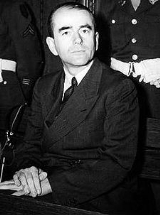
Albert Speer

 
Albert Speer

   Email Print
   Bookmark   Link


Albert Speer


Albert Speer (born Berthold Konrad Hermann Albert Speer and ; March 19, 1905 – September 1, 1981) was a German
Germany

Germany , officially the Federal Republic of Germany , is a country in Central Europe. It is bordered to the north by the North Sea, Denmark, and the Baltic Sea; to the east by Poland and the Czech Republic; to the south by Austria and Switzerland; and to the west by France, Luxembourg, Belgium, and the Netherlands....
 architect
Architect

An architect is trained and licenced in planning and designing buildings, and participates in supervising the construction of a building. Etymologically, architect derives from the Latin architectus, itself derived from the Greek arkhitekton , i.e....
 who was, for part of World War II
World War II

World War II, or the Second World War , was a global military conflict which involved a Participants in World War II, including all of the great powers, organised into two opposing military alliances: the Allies of World War II and the Axis powers....
, Minister of Armaments and War Production for the Third Reich
Nazi Germany

Nazi Germany and the Third Reich are the colloquial English names for Germany under the regime of Adolf Hitler and the Nazi Party , which established a Totalitarianism dictatorship that existed from 1933 to 1945....
. Speer was Adolf Hitler
Adolf Hitler

Adolf Hitler was an Austrian-born Germany politician and the leader of the National Socialist German Workers Party , popularly known as the Nazi Party....
's chief architect before assuming ministerial office. As "the Nazi who said sorry", he accepted responsibility at the Nuremberg trials
Nuremberg Trials

The Nuremberg Trials were a series of trials, or tribunals, most notable for the prosecution of prominent members of the political, military, and economic leadership of Nazi Germany after its defeat in World War II....
 and in his memoirs for crimes of the Nazi regime. His level of involvement in the persecution of the Jews, and his level of knowledge of the Holocaust
The Holocaust

The Holocaust , also known as , Churben is the term generally used to describe the genocide of approximately six million European Jews during World War II, as part of a program of deliberate extermination planned and executed by Nazi Germany under Adolf Hitler....
 remain matters of dispute.

Speer joined the Nazi Party in 1931.


Discussion
Ask a question about 'Albert Speer'
Start a new discussion about 'Albert Speer'
Answer questions from other users
Full Discussion Forum


Encyclopedia


Albert Speer (born Berthold Konrad Hermann Albert Speer and ; March 19, 1905 – September 1, 1981) was a German
Germany

Germany , officially the Federal Republic of Germany , is a country in Central Europe. It is bordered to the north by the North Sea, Denmark, and the Baltic Sea; to the east by Poland and the Czech Republic; to the south by Austria and Switzerland; and to the west by France, Luxembourg, Belgium, and the Netherlands....
 architect
Architect

An architect is trained and licenced in planning and designing buildings, and participates in supervising the construction of a building. Etymologically, architect derives from the Latin architectus, itself derived from the Greek arkhitekton , i.e....
 who was, for part of World War II
World War II

World War II, or the Second World War , was a global military conflict which involved a Participants in World War II, including all of the great powers, organised into two opposing military alliances: the Allies of World War II and the Axis powers....
, Minister of Armaments and War Production for the Third Reich
Nazi Germany

Nazi Germany and the Third Reich are the colloquial English names for Germany under the regime of Adolf Hitler and the Nazi Party , which established a Totalitarianism dictatorship that existed from 1933 to 1945....
. Speer was Adolf Hitler
Adolf Hitler

Adolf Hitler was an Austrian-born Germany politician and the leader of the National Socialist German Workers Party , popularly known as the Nazi Party....
's chief architect before assuming ministerial office. As "the Nazi who said sorry", he accepted responsibility at the Nuremberg trials
Nuremberg Trials

The Nuremberg Trials were a series of trials, or tribunals, most notable for the prosecution of prominent members of the political, military, and economic leadership of Nazi Germany after its defeat in World War II....
 and in his memoirs for crimes of the Nazi regime. His level of involvement in the persecution of the Jews, and his level of knowledge of the Holocaust
The Holocaust

The Holocaust , also known as , Churben is the term generally used to describe the genocide of approximately six million European Jews during World War II, as part of a program of deliberate extermination planned and executed by Nazi Germany under Adolf Hitler....
 remain matters of dispute.

Speer joined the Nazi Party in 1931. His architectural skills made him increasingly prominent within the Party and he became a member of Hitler's inner circle. The dictator commissioned him to design and construct a number of structures, including the Reich Chancellery
Reich Chancellery

File:Bundesarchiv Bild 183-2005-1017-526, Berlin, Reichskanzlei.jpgThe Reich Chancellery was the traditional name of the office of the Germany Chancellor of Germany ....
 and the Zeppelinfeld
Nazi party rally grounds

The Nazi party rally grounds form a site in the southeast of Nuremberg , where the Nuremberg Rally were held from 1933 until 1938. It includes the Nazi party rally grounds#Congress Hall, the Zeppelin Field, the M?rzfeld , the Deutsches Stadion , the former Stadion der Hitlerjugend and the Gro?e Stra?e ....
 stadium in Nuremberg
Nuremberg

Nuremberg is a city in the Germany State of Bavaria, in the Regierungsbezirk of Middle Franconia. It is situated on the Pegnitz River river and the Rhine?Main?Danube Canal and is Franconia's largest city....
 where Party rallies were held. Speer also made plans to reconstruct Berlin
Welthauptstadt Germania

Welthauptstadt Germania was the name Adolf Hitler gave to the projected renewal of the German capital Berlin, part of his vision for the future of Germany after the planned victory in World War II....
 on a grand scale, with huge buildings, wide boulevards, and a reorganised transportation system.

As Hitler's Minister of Armaments and War Production, Speer was so successful that Germany's war production continued to increase despite massive and devastating Allied
Allies of World War II

The Allies of World War II were the countries officially opposed to the Axis powers of World War II during the World War II. Within the ranks of the Allies powers, the British Empire, the Soviet Union, and the United States of America were known as "The Big Three"....
 bombing. After the war, he was tried at Nuremberg and sentenced to 20 years in prison for his role in the Nazi regime, principally for the use of forced labour. He served most of his sentence at Spandau Prison
Spandau Prison

Spandau Prison was a prison situated in the Boroughs of Berlin of Spandau in western Berlin, constructed in 1876 and demolished in 1987 after the death of its last prisoner, Rudolf Hess, to prevent it from becoming a neo-Nazi shrine....
 in West Berlin
West Berlin

West Berlin was the name given to the western part of Berlin between 1949 and 1990. It consisted of the American, British, and French occupation sectors established in 1945....
.

Following his release from Spandau in 1966, Speer published two bestselling autobiographical works, Inside the Third Reich
Inside the Third Reich

Inside the Third Reich is a memoir written by Albert Speer, the Nazism Minister of Armaments from 1942 to 1945, serving as Hitler's main architect before this period....
 and Spandau: The Secret Diaries
Spandau: The Secret Diaries

Spandau: The Secret Diaries was a 1976 best selling book by Albert Speer. While it principally deals with Speer's time while incarcerated at Spandau Prison, it also contains much material on his role in the Third Reich and his relationship with Adolf Hitler....
, detailing his often close personal relationship with Hitler, and providing readers and historians with a unique perspective within the workings of the Nazi regime. He later wrote a third book, Infiltration, about the SS
Schutzstaffel

The , abbreviated SS- or - was a major Nazi organization under Adolf Hitler and the Nazi Party. The SS grew from a small paramilitary unit to a powerful force that served as the F?hrer's "Praetorian Guard," the Nazi Party's "Shield Squadron" and a force that, fielding almost a million men, managed to exert as much political influence as th...
. Speer died of natural causes in 1981 while on a visit to London.

Early years

Speer was born in Mannheim, Germany
Mannheim

Mannheim is a city in Germany. With 327,318 inhabitants it is the second-largest city in the state of Baden-W?rttemberg after the capital Stuttgart....
, into a wealthy middle class family. He was the second of three sons of Albert and Luise Speer. In 1918, the family moved permanently to their summer home, Schloss-Wolfsbrunnenweg, in Heidelberg
Heidelberg

Heidelberg is a city in Baden-W?rttemberg, Germany. As of 2006, over 140,000 people live within the city's area. The town of Heidelberg is an administrative district of its own....
. According to Henry T. King
Henry T. King

Henry T. King Jr. was a U.S. Prosecutor at the Nuremberg Trials and is a legal practitioner and an academic writer....
, deputy prosecutor at Nuremberg who later wrote a book about Speer, "Love and warmth were lacking in the household of Speer's youth." Speer originally wanted to become a mathematician, but his father said if Speer chose this occupation he would "lead a life without money, without a position, and without a future". Instead, Speer followed in the footsteps of his father and grandfather and studied architecture.

Speer began his architectural studies at the University of Karlsruhe
University of Karlsruhe

The University of Karlsruhe, also known as Fridericiana, was founded in 1825. It recently merged with Forschungszentrum Karlsruhe to form the new institution, Karlsruhe Institute of Technology ....
 instead of a more highly acclaimed institution because the hyperinflation
Hyperinflation

File:Bundesarchiv Bild 102-00104, Inflation, Tapezieren mit Geldscheinen.jpgIn economics, hyperinflation is inflation that is very high or "out of control", a condition in which prices increase rapidly as a currency loses its value....
 crisis of 1923 limited his parents' income. In 1924 when the crisis had abated, he transferred to the "much more reputable" Technical University of Munich
Technical University of Munich

Technische Universit?t M?nchen is a research university with campuses in Munich, Garching, and Weihenstephan.TUM is among the highest acclaimed universities in Germany, producing several Nobel Laureates including Gerhard Ertl who in 2007 received the Nobel Prize in Chemistry....
. In 1925 he transferred again, this time to the Technical University of Berlin
Technical University of Berlin

The Technical University of Berlin is located in Berlin, Germany.It was founded in 1879 and, with nearly 30,000 students, is one of the largest technical universities in Germany....
 where he studied under Heinrich Tessenow
Heinrich Tessenow

Heinrich Tessenow was a Germany architect, professor, and urban planner active in the Weimar era....
, whom Speer greatly admired. After passing his exams in 1927, Speer became Tessenow's assistant, a high honor for a man of 22. As Tessenow's assistant, Speer taught some of his classes while continuing his own postgraduate studies. In Munich, and continuing in Berlin, Speer began a close friendship, ultimately spanning over 50 years, with Rudolf Wolters
Rudolf Wolters

Rudolf Wolters was a Germany architect and government official, known for his longtime association with fellow architect and Nazi Germany official Albert Speer....
, who also studied under Tessenow.

In the summer of 1922, Speer began to date Margarete Weber (1905–1987). The relationship was frowned upon by Speer's class-conscious mother, who felt the Webers were socially inferior (Herr Weber was a successful craftsman who employed 50 workers). Despite this opposition, the two married in Berlin on August 28, 1928, but seven years elapsed before Margarete Speer was first invited to stay at her in-laws' home.

Nazi architect


Joining the Nazis (1930–1934)


Speer stated he was apolitical when he was a young man, and that he attended a Berlin Nazi rally in December 1930 at the urging of some of his students. He was surprised to find Hitler dressed in a neat blue suit, rather than the brown uniform
Sturmabteilung

The , abbreviated SA, , functioned as a paramilitary organization of the Nazi Party the Germany Nazism. They played a key role in Adolf Hitler's rise to power in the 1930s....
 seen on Nazi Party posters, and was greatly impressed, not only with Hitler's proposals, but also with the man himself. Several weeks later he attended another rally, though this one was presided over by Joseph Goebbels
Joseph Goebbels

Paul Joseph Goebbels was a German people politician and Reich Minister of Propaganda in Nazi Germany from 1933 to 1945. He was one of German dictator Adolf Hitler's closest associates and most devout followers....
. Speer was disturbed by the way Goebbels whipped the crowd into a frenzy. Despite this unease, Speer could not shake the impression Hitler had made on him. On March 1, 1931, he applied to join the Nazi Party and became member number 474,481.

Speer's first Nazi Party position was as head of the Party's motorist association
National Socialist Motor Corps

The National Socialist Motor Corps , also known as the National Socialist Drivers Corps, was a paramilitary organization of the National Socialist German Workers Party that existed from 1931 to 1945....
 for the Berlin suburb of Wannsee
Wannsee

The Wannsee is both a locality in the southwestern Berlin Boroughs of Berlin of Steglitz-Zehlendorf, Germany, and a linked pair of lakes adjoining the locality....
; he was in fact the only Nazi in the town with a car. Speer reported to the Party's leader for the West End of Berlin
Westend (Berlin)

Westend is a locality of the Berlin boroughs of Berlin Charlottenburg-Wilmersdorf situated on the Spandauer Berg, the northern peak of the Teltow plateau between the river valleys of Spree and Havel....
, Karl Hanke
Karl Hanke

Karl August Hanke was an official of the National Socialist German Workers Party . He served as Governor and Region Leader of Lower Silesia from 1940 to 1945 and as the final Reichsf?hrer-SS for a few days in 1945....
, who hired Speer — without fee — to redecorate a villa he had just rented. Hanke was enthusiastic about the resulting work.

In 1931, Speer surrendered his position as Tessenow's assistant due to pay cuts and moved to Mannheim, hoping to use his father's connections to get commissions. He had little success, and his father gave him a job as manager of the elder Speer's properties. In July 1932, the Speers visited Berlin to help out the Party prior to the Reichstag
Reichstag (institution)

The Reichstag was the parliament of the Holy Roman Empire, the North German Confederation, and of Germany until 1945. The main chamber of the German parliament is now called Bundestag , but the building in which it meets is still called "Reichstag" ....
 elections. While they were there, Hanke recommended the young architect to Goebbels to help renovate the Party's Berlin headquarters. Speer, who had been about to leave with his wife for a vacation in East Prussia
East Prussia

East Prussia refers to the main part of the Prussia along the southeastern Baltic Sea from the 13th century to 1945. From 1772?1829 and 1878?1945, the Province of East Prussia was a province of the Germany state of Prussia....
, agreed to do the work. When the commission was completed, Speer returned to Mannheim and remained there as Hitler took office
Machtergreifung

Machtergreifung is a German language word meaning "seizure of power". It is normally used specifically to refer to the Nazism takeover of power in Weimar Germany on January 30 1933....
 in January 1933.

After the Nazis took control, Hanke recalled Speer to Berlin. Goebbels, the new Propaganda Minister, commissioned Speer to renovate his Ministry's building on Wilhelmplatz
Wilhelmplatz

File:Wilhelmplatz, Berlin, vor 1906.jpgFile:Berlin U Bahn Station LOC27104u.jpgWilhelmplatz is a former square in the Mitte district of Berlin, Germany at the corner of Wilhelmstrasse and Vo?stra?e....
. Speer also designed the 1933 May Day commemoration in Berlin. In Inside the Third Reich, he wrote that, on seeing the original design for the Berlin rally on Hanke's desk, he remarked that the site would resemble a Schützenfest
Schützenfest

A Sch?tzenfest is an annual traditional festival celebrated in Germany's western L?nder , as well as in Bavaria, and also in other, mostly German-speaking, countries....
 — a rifle club meet. Hanke, now Goebbels' State Secretary
Secretary of State

Secretary of State is a commonly used title for a member of government. The role varies between countries, and in some cases there are multiple Secretaries of State in the government....
, challenged him to create a better design. As Speer learned later, Hitler was enthusiastic about Speer's design (which used giant flags), though Goebbels took credit for it. Tessenow was dismissive: "Do you think you have created something? It's showy, that's all."

The organizers of the 1933 Nuremberg Nazi Party rally
Nuremberg Rally

The Nuremberg Rally was the annual rally of the National Socialist German Workers Party in the years 1923 to 1938 in Germany. Especially after Hitler's rise to power in 1933, they were large propaganda events by the state....
 asked Speer to submit designs for the rally, bringing him into contact with Hitler for the first time. Neither the organizers nor Rudolf Hess
Rudolf Hess

Rudolf Walter Richard Hess was a prominent figure in Nazi Germany, acting as Adolf Hitler's Deputy F?hrer in the Nazi Party. On the eve of war with the Soviet Union, he flew solo to Scotland in an attempt to negotiate peace with the United Kingdom, but instead was arrested....
 were willing to decide whether to approve the plans, and Hess sent Speer to Hitler's Munich apartment to seek his approval. When Speer entered, the new Chancellor
Chancellor of Germany (German Reich)

The head of government of the German Reich was called Reich Chancellor or short Chancellor from 1871 until 1945. This designation stems from the German chancellor tradition from the Middle Ages and the early modern era....
 was busy cleaning a pistol, which he briefly laid aside to cast a short, interested glance at the plans, approving them without even looking at the young architect. This work won Speer his first national post, as Nazi Party "Commissioner for the Artistic and Technical Presentation of Party Rallies and Demonstrations".

Speer's next major assignment was as liaison to the Berlin building trades for Paul Troost
Paul Troost

File:Bundesarchiv B145 Bild-F051643-0881, Paul Ludwig Troost, Relief.jpgPaul Ludwig Troost , born in Wuppertal, was a Germany architect. An extremely tall, spare-looking, reserved Westphalian with a close-shaven head, Troost belonged to a school of architects, Peter Behrens and Walter Gropius who, even before 1914, reacted sharply against th...
's renovation of the Chancellery. As Chancellor, Hitler had a residence in the building and came by every day to be briefed by Speer and the building supervisor on the progress of the renovations. After one of these briefings, Hitler invited Speer to lunch, to the architect's great excitement. Hitler evinced considerable interest in Speer during the luncheon, and later told Speer that he had been looking for a young architect capable of carrying out his architectural dreams for the new Germany. Speer quickly became part of Hitler's inner circle; he was expected to call on Hitler in the morning for a walk or chat, to provide consultation on architectural matters, and to discuss Hitler's ideas. Most days he was invited to dinner.

The two men found much in common: Hitler spoke of Speer as a "kindred spirit" for whom he had always maintained "the warmest human feelings". The young, ambitious architect was dazzled by his rapid rise and close proximity to Hitler, which guaranteed him a flood of commissions from the government and from the very highest ranks of the Party. Speer testified at Nuremberg, "I belonged to a circle which consisted of other artists and his personal staff. If Hitler had had any friends at all, I certainly would have been one of his close friends."

First Architect of the Third Reich (1934–1939)


When Troost died on January 21, 1934, Speer effectively replaced him as the Party's chief architect. Hitler appointed Speer as head of the Chief Office for Construction, which placed him nominally on Hess's staff.

One of Speer's first commissions after Troost's death was the Zeppelinfeld stadium—the Nuremberg
Nuremberg

Nuremberg is a city in the Germany State of Bavaria, in the Regierungsbezirk of Middle Franconia. It is situated on the Pegnitz River river and the Rhine?Main?Danube Canal and is Franconia's largest city....
 parade grounds
Nazi party rally grounds

The Nazi party rally grounds form a site in the southeast of Nuremberg , where the Nuremberg Rally were held from 1933 until 1938. It includes the Nazi party rally grounds#Congress Hall, the Zeppelin Field, the M?rzfeld , the Deutsches Stadion , the former Stadion der Hitlerjugend and the Gro?e Stra?e ....
 seen in Leni Riefenstahl
Leni Riefenstahl

Helene Bertha Amalie "Leni" Riefenstahl was a Germany film director, actress and dancer widely noted for her aesthetics and innovations as a filmmaker....
's propaganda masterpiece Triumph of the Will
Triumph of the Will

Triumph of the Will is a propaganda film made by Leni Riefenstahl. It chronicles the 1934 Nazi Party Congress in Nuremberg. The film contains excerpts from speeches given by various List of Nazi Party leaders and officials at the Congress, including portions of speeches by Adolf Hitler, interspersed with footage of massed party members....
. This huge work was capable of holding 340,000 people. The tribune
Tribune (architecture)

Tribune is an ambiguous often misused architecture term which can have several meanings.The word stems from medieval Latin tribuna, from classical Latin tribunal, the elevated placing of a Tribune or other Roman magistrate's seat for official functions such as throne....
 was influenced by the Pergamon Altar
Pergamon Altar

The Great Altar of Pergamon, a massive stone podium about one hundred feet long and thirty-five feet high, was originally built in the 2nd century BCE in the Ancient Greece city of Pergamon in north-western Anatolia, 25.74 kilometers from the Aegean Sea....
 in Anatolia
Anatolia

Anatolia or Asia Minor is a region of Western Asia, comprising most of the modern Republic of Turkey. It is a geographic region bounded by the Black Sea to the north, the Caucasus to the northeast, the Aegean Sea to the west, the Mediterranean Sea to the south, and the Iranian plateau to the east and southeast....
, but was magnified to an enormous scale. Speer insisted that as many events as possible be held at night, both to give greater prominence to his lighting effects and to hide the individual Nazis, many of whom were overweight. Speer surrounded the site with 130 anti-aircraft searchlight
Searchlight

A searchlight is an apparatus with reflectors for projecting a powerful beam of light of approximately parallel rays in a particular direction,...
s. This created the effect of a "cathedral of light
Cathedral of light

The Cathedral of Light was the term used to describe the main aesthetic feature of the Nuremberg Rallies. It consisted of 130 anti-aircraft searchlights, at intervals of forty feet, aimed skyward to create a series of vertical bars that surrounded the audience....
" or, as it was called by British
United Kingdom

The United Kingdom of Great Britain and Northern Ireland, commonly known as the United Kingdom , the UK or Britain,is a sovereign state located off the northwestern coast of continental Europe....
 Ambassador
Ambassador

An ambassador is the highest ranking diplomat who represents their country. They are usually accredited to a Sovereignty or government, or to an international organization, to serve as the official representative of their country....
 Sir Neville Henderson
Nevile Henderson

File:Bundesarchiv Bild 183-C06536, Sir Nevile Henderson.jpgThe Rt Hon Sir Nevile Meyrick Henderson, Order of St Michael and St George was the Ambassador of the Great Britain to Germany from 1937 to 1939....
, a "cathedral of ice". Speer described this as his most beautiful work, and as the only one that has stood the test of time.

Nuremberg was to be the site of many more official Nazi buildings, most of which were never built; for example, the German Stadium
Deutsches Stadion

The Deutsches Stadion was a monumental stadium designed by Albert Speer for the Nazi party rally grounds in Nuremberg. Its construction began in September 1937, and was slated for completion in 1943....
 would have accommodated 400,000 spectators, while an even larger rally ground would have held half a million Nazis. While planning these structures, Speer invented the concept of "ruin value
Ruin value

Ruin value is the concept that a building be designed such that if it eventually collapsed, it would leave behind aesthetically pleasing ruins that would last far longer without any maintenance at all....
": that major buildings should be constructed in such a way that they would leave aesthetically pleasing ruins for thousands of years into the future. Such ruins would be a testament to the greatness of the Third Reich, just as ancient Greek
Ancient Greece

The term Ancient Greece refers to the period of History of Greece lasting from the Greek Dark Ages ca. 1100 BC and the Dorian invasion, to 146 BC and the Roman Republic conquest of Greece after the Battle of Corinth ....
 or Roman
Ancient Rome

Ancient Rome was a civilization that grew out of a small agricultural community founded on the Italian Peninsula as early as the 10th century BC....
 ruins were symbols of the greatness of those civilizations. Hitler enthusiastically embraced this concept, and ordered that all the Reich's important buildings be constructed in accord with it.

Speer could not avoid seeing the brutal excesses of the Nazi regime, although they had little effect on him. Shortly after the Night of the Long Knives
Night of the Long Knives

The Night of the Long Knives or "Operation Hummingbird", was a purge that took place in Nazi Germany between June 30 and July 2, 1934, when the Nazi Party regime carried out a series of political executions, most of those killed being members of the Sturmabteilung , the paramilitary Brownshirts....
, Hitler ordered Speer to take workmen and go to the building housing the offices of Vice-Chancellor
Vice-Chancellor of Germany

The Vice-Chancellor of Germany in Germany is the second highest position in the cabinet, at least according to the protocol.In case of the Chancellor of Germany 's absence, the Vice-Chancellor acts in his place, for instance heading cabinet meetings....
 Franz von Papen
Franz von Papen

was a Germany nobleman, Catholic Monarchism politician, General Staff officer, and diplomat, who served as Chancellor of Germany in 1932 and as Vice-Chancellor in 1933-1934....
 to begin its conversion into a security headquarters, even though it was still occupied by von Papen's officials. Speer and his group entered the building, to be confronted with a pool of blood, apparently from the body of Herbert von Bose
Herbert von Bose

Herbert von Bose was head of the press division of the Vice Chancellery in Germany under Vice Chancellor Franz von Papen.As one of Papen's close associates, Bose contributed to the vice chancellor's Marburg speech at the University of Marburg on June 17, 1934, which criticized some of the excesses of Nazi Party rule and called for a ces...
, von Papen's secretary, who had been killed there. Speer related that the sight had no effect on him, other than to cause him to avoid that room.

When Hitler deprecated Werner March's design for the Olympic Stadium for the 1936 Summer Olympics
1936 Summer Olympics

The 1936 Summer Olympics, officially known as the Games of the XI Olympiad, an international multi-sport event which was held in 1936 in Berlin, Nazi Germany....
  as too modernistic
Modern architecture

Modern architecture is a set of building styles with similar characteristics, primarily the simplification of form and the elimination of Ornament ....
, Speer modified the plans by adding a stone exterior. Speer designed the German Pavilion for the 1937 international exposition in Paris. The German and Soviet
Soviet Union

The Union of Soviet Socialist Republics was a Constitution of the Soviet Union socialist state that existed in Eurasia from 1922 to 1991.The name is a translation of the , romanization of Russian Soyuz Sovetskikh Sotsialisticheskikh Respublik, abbreviated ????, SSSR....
 pavilion sites were opposite each other. On learning (through a clandestine look at the Soviet plans) that the Soviet design included two colossal figures
Worker and Kolkhoz Woman

Worker and Kolkhoz Woman is a 24.5 meter high sculpture made from stainless steel by Vera Mukhina for the Exposition Internationale des Arts et Techniques dans la Vie Moderne in Paris, and subsequently moved to Moscow....
 seemingly about to overrun the German site, Speer modified his design to include a cubic mass which would check their advance, with a huge eagle on top looking down on the Soviet figures. Both pavilions were awarded gold medals for their designs.

In 1937, Hitler appointed Speer as General Building Inspector for the Reich Capital with the rank of undersecretary of state in the Reich government. The position carried with it extraordinary powers over the Berlin city government and made Speer answerable to Hitler alone. It also made Speer a member of the Reichstag, though the body by then had little effective power. Hitler ordered Speer to make plans to rebuild Berlin. The plans centered around a three-mile long grand boulevard running from north to south, which Speer called the Prachtstrasse, or Street of Magnificence; he also referred to it as the "North-South Axis". At the north end of the boulevard, Speer planned to build the Volkshalle
Volkshalle

File:Bundesarchiv Bild 146-1986-029-02, "Germania", Modell "Gro?e Halle".jpgThe , also called or , was a huge monumental building planned, but never built, by Adolf Hitler and his architect Albert Speer....
, a huge assembly hall with a dome which would have been over high, with floor space for 180,000 people. At the southern end of the avenue would be a huge triumphal arch; it would be almost high, and able to fit the Arc de Triomphe
Arc de Triomphe

The Arc de Triomphe is a monument in Paris, France that stands in the centre of the Place Charles de Gaulle, also known as the Place de l'?toile....
 inside its opening. The outbreak of World War II
World War II

World War II, or the Second World War , was a global military conflict which involved a Participants in World War II, including all of the great powers, organised into two opposing military alliances: the Allies of World War II and the Axis powers....
 in 1939 led to the postponement, and eventual abandonment, of these plans. Part of the land for the boulevard was to be obtained by consolidating Berlin's railway system. Speer hired Wolters as part of his design team, with special responsibility for the Prachtstrasse. When Speer's father saw the model for the new Berlin, he said to his son, "You've all gone completely insane."

In January 1938, Hitler asked Speer to build a new Reich Chancellery on the same site as the existing structure, and said he needed it for urgent foreign policy reasons no later than his next New Year's reception for diplomats on January 10, 1939. This was a huge undertaking, especially since the existing Chancellery was in full operation. After consultation with his assistants, Speer agreed. Although the site could not be cleared until April, Speer was successful in building the large, impressive structure in nine months. The structure included the "Marble Gallery": at 146 metres long, almost twice as long as the Hall of Mirrors
Hall of Mirrors (Palace of Versailles)

The Hall of Mirrors is the central gallery of the Palace of Versailles and is one of the most famous rooms in the world.As the principal and most remarkable feature of King Louis XIV of France?s third building campaign of the Palace of Versailles , construction of the Hall of Mirrors began in 1678 ....
 in the Palace of Versailles
Palace of Versailles

The Palace of Versailles, or simply Versailles, is a royal ch?teau in Versailles, the ?le-de-France region of France. In French language, it is known as the Ch?teau de Versailles....
. Speer employed thousands of workers in two shifts. Hitler, who had remained away from the project, was overwhelmed when Speer turned it over, fully furnished, two days early. Tessenow was less impressed, suggesting to Speer that he should have taken nine years over the project. The second Chancellery was damaged by the Battle of Berlin
Battle of Berlin

The Battle of Berlin was the final Strategic offensive of the European Theatre of World War II of World War II and was designated the Berlin Strategic Offensive Operation by the Soviet Union.The last offensive of the European war was the Prague Offensive on 6?11 May 1945, when the Red Army, with the help of Poland, Romanian, and...
 in 1945 and was eventually dismantled by the Soviets, its stone used for a war memorial
Soviet War Memorial (Treptower Park)

The Soviet War Memorial , is a vast war memorial and military cemetery in Berlin's Treptower Park. It was built to the design of the Soviet Union architect Yakov Belopolsky to commemorate 5,000 of the 80,000 Soviet Union soldiers who fell in the Battle of Berlin in April-May 1945....
.

During the Chancellery project, the pogrom
Pogrom

A pogrom is a form of riot directed against a particular group, whether ethnic, religious, or other, and characterized by the killing and destruction of their homes, businesses, and religious centers....
 of Kristallnacht
Kristallnacht

File:1938 Interior of Berlin synagogue after Kristallnacht.jpgKristallnacht or the Night of Broken Glass or "night of shattered crystal" was a pogrom in Nazi Germany on November 9?10, 1938....
 took place. Speer would make no mention of it in the first draft of Inside the Third Reich, and it was only on the urgent advice of his publisher that he added a mention of seeing the ruins of the Central Synagogue in Berlin from his car.

Wartime architect (1939–1942)


Speer supported the German invasion of Poland and subsequent war
World War II

World War II, or the Second World War , was a global military conflict which involved a Participants in World War II, including all of the great powers, organised into two opposing military alliances: the Allies of World War II and the Axis powers....
, though he recognized that it would lead to the postponement, at the least, of his architectural dreams. In his later years, Speer, talking with his biographer-to-be Gitta Sereny
Gitta Sereny

Gitta Sereny is an Austria-born British biographer, historian and journalist whose writing focuses mainly on the Holocaust and child abuse. She is a stepdaughter of the economist Ludwig von Mises....
, explained how he felt in 1939: "Of course I was perfectly aware that [Hitler] sought world domination ... [A]t that time I asked for nothing better. That was the whole point of my buildings. They would have looked grotesque if Hitler had sat still in Germany. All I wanted was for this great man to dominate the globe."

Speer placed his department at the disposal of the Wehrmacht
Wehrmacht

Wehrmacht was the name of the unified armed forces of Germany from 1935 to 1945. It consisted of the Heer , the Kriegsmarine and the Luftwaffe ....
. When Hitler remonstrated, and said it was not for Speer to decide how his workers should be used, Speer simply ignored him. Among Speer's innovations were quick-reaction squads to construct roads or clear away debris; before long, these units would be used to clear bomb sites. As the war progressed, initially to great German success, Speer continued preliminary work on the Berlin and Nuremberg plans, at Hitler's insistence, but failed to convince him of the need to suspend peacetime construction projects. Speer also oversaw the construction of buildings for the Wehrmacht and Luftwaffe
Luftwaffe

is a generic German term for an air force. It is also the official name for two of the four historic German air forces, the Wehrmacht air arm founded in 1933 and disbanded in 1946; and the current Bundeswehr air arm founded in 1956....
, and developed a considerable organization to deal with this work.

In 1940, Joseph Stalin
Joseph Stalin

Joseph Stalin was the General Secretary of the Communist Party of the Soviet Union's Central Committee of the Communist Party of the Soviet Union from 1922 until his death in 1953....
 proposed that Speer pay a visit to Moscow. Stalin had been particularly impressed by Speer's work in Paris, and wished to meet the "Architect of the Reich". Hitler, alternating between amusement and anger, did not allow Speer to go, fearing that Stalin would put Speer in a "rat hole" until a new Moscow arose. When Germany invaded the Soviet Union
Operation Barbarossa

Operation Barbarossa was the code name for Nazi Germany's invasion of the Soviet Union during World War II that commenced on 22 June 1941. Over 4.5 million troops of the Axis powers invaded the USSR along a 2,900 kilometer front ....
 in 1941, Speer came to doubt, despite Hitler's reassurances, that his projects for Berlin would ever be completed.

Minister of Armaments


Appointment and increasing power

On February 8, 1942, Minister of Armaments Fritz Todt
Fritz Todt

Fritz Todt was a Germany engineer and senior Nazism figure, the founder of Organisation Todt. He died in a plane crash during World War II....
 died in a plane crash shortly after taking off from Hitler's eastern headquarters at Rastenburg
Ketrzyn

Ketrzyn is a town in northeastern Poland with 28,351 inhabitants . Situated in the Warmian-Masurian Voivodeship , Ketrzyn was previously in Olsztyn Voivodeship ....
. Speer, who had arrived in Rastenburg the previous evening, had accepted Todt's offer to fly with him to Berlin, but had canceled some hours before takeoff (Speer stated in his memoirs that the cancellation was due to exhaustion from travel and a late-night meeting with Hitler). Later that day, Hitler appointed Speer as Todt's successor to all of his posts. In Inside the Third Reich, Speer recounts his meeting with Hitler and his reluctance to take ministerial office, only doing so because Hitler commanded it. Speer also states that Hermann Göring
Hermann Göring

Hermann Wilhelm G?ring was a Germany politician, military leader and a leading member of the Nazi Party. Among many offices, he was Hitler's designated successor and commander of the Luftwaffe ....
 raced to Hitler's headquarters on hearing of Todt's death, hoping to claim Todt's powers. Hitler instead presented Göring with the fait accompli of Speer's appointment, causing Göring to leave without even attending Todt's funeral.

At the time of Speer's accession to the office, the German economy, unlike the British one, was not fully geared for war production. Consumer goods were still being produced at nearly as high a level as during peacetime. No fewer than five "Supreme Authorities" had jurisdiction over armament production — one of which, the Ministry of Economic Affairs, had declared in November 1941 that conditions did not permit an increase in armament production. Few women were employed in the factories, which were running only one shift. One evening soon after his appointment, Speer went to visit a Berlin armament factory; he found no one on the premises.

Speer overcame these difficulties by centralizing power over the war economy in himself. Factories were given autonomy, or as Speer put it, "self-responsibility", and each factory concentrated on a single product. Backed by Hitler's strong support (the dictator stated, "Speer, I'll sign anything that comes from you"), he divided the armament field according to weapon system, with experts rather than civil servants overseeing each department. No department head could be older than 55 — anyone older being susceptible to "routine and arrogance" — and no deputy older than 40. Over these departments was a central planning committee headed by Speer, which took increasing responsibility for war production, and as time went by, for the German economy itself. According to the minutes of a conference at Wehrmacht High Command in March 1942, "It is only Speer's word that counts nowadays. He can interfere in all departments. Already he overrides all departments ... On the whole, Speer's attitude is to the point." Goebbels would note in his diary in June 1943, "Speer is still tops with the Führer. He is truly a genius with organization." Speer was so successful in his position that by late 1943, he was widely regarded among the Nazi elite as a possible successor to Hitler.

While Speer had tremendous power, he was of course subordinate to Hitler. Nazi officials sometimes went around Speer by seeking direct orders from the dictator. When Speer ordered peacetime building work suspended, the Gauleiter
Gauleiter

A Gauleiter was the party leader of a regional branch of the NSDAP or the head of a Gau or of a Reichsgau....
s
(Nazi Party district leaders) obtained an exemption for their pet projects. When Speer sought the appointment of Hanke as a labor czar to optimize the use of German labor, Hitler, under the influence of Martin Bormann
Martin Bormann

Martin Ludwig Bormann was a prominent Nazi official. He became head of the Party Chancellery and private secretary to Adolf Hitler. He gained Hitler's trust and derived immense power within the Third Reich by controlling access to the F?hrer....
, instead appointed Fritz Sauckel
Fritz Sauckel

Ernst Friedrich Christoph "Fritz" Sauckel was a Nazi war criminal, who organized the systematic slavery of millions from lands occupied by Nazi Germany....
. Rather than increasing female labor and taking other steps to better organize German labor, as Speer favored, Sauckel advocated importing labor from the occupied nations — and did so, obtaining workers for (among other things) Speer's armament factories, using the most brutal methods.

tank.]] On December 10, 1943, Speer visited the underground Mittelwerk
Mittelwerk

Central Works was the underground WWII rocket and aircraft factory operated by the government CentralAdditional Nazi Germany plans for V-2 rocket production at the Operation Bellicose and the Kaiserwald concentration camp Salaspils#World War II near Riga were never fulfilled....
 V-2 rocket
V-2 rocket

The V-2 rocket was the first ballistic missile and first man-made object to achieve sub-orbital spaceflight, the progenitor of all modern rockets....
 factory that used concentration camp labor. Shocked by the conditions there (5.7 percent of the work force died that month), and to ensure the workers were in good enough shape to perform the labor, Speer ordered improved conditions for the workers and the construction of the above-ground Dora camp
Mittelbau-Dora

Mittelbau-Dora was a Nazi Germany labour camp that provided workers for the Mittelwerk V-2 rocket factory in the Kohnstein, situated near Nordhausen, Germany....
. In spite of these changes, half of the workers at Mittelwerk eventually died. Speer later commented, "[t]he conditions for these prisoners were in fact barbarous, and a sense of profound involvement and personal guilt seizes me whenever I think of them."

By 1943, the Allies had gained air superiority over Germany, and bombings of German cities and industry had become commonplace. However, the Allies in their strategic bombing campaign
Strategic bombing during World War II

Strategic bombing during World War II was greater in scale than any wartime attack the world had previously witnessed. The strategic bombing campaigns conducted by Nazi Germany, the United Kingdom, the United States and the Empire of Japan used conventional weapons, Incendiary bomb, and nuclear weapons....
 did not concentrate on industry, and Speer, with his improvisational skill, was able to overcome bombing losses. In spite of these losses, German production of tanks more than doubled in 1943, production of planes increased by 80 percent, and production time for submarine
Submarine

A submarine is a watercraft capable of independent operation below water. It differs from a submersible, which has only limited underwater capability....
s was reduced from one year to two months. Production would continue to increase until the second half of 1944, by which time enough equipment to supply 270 army divisions was being produced—although the Wehrmacht had only 150 divisions in the field.

In January 1944, Speer fell ill with complications from an inflamed knee, and was away from the office for three months. During his absence, a number of his rivals (notably Göring, Bormann, and SS chief Heinrich Himmler
Heinrich Himmler

Heinrich Luitpold Himmler was a Nazi Germany German politician and head of the Schutzstaffel. He was one of the most powerful men in Nazi Germany, competing with Hermann G?ring, Martin Bormann and Joseph Goebbels....
) attempted to have some of his powers permanently transferred to them. In April, they succeeded in having him deprived of responsibility for construction, and Speer promptly sent Hitler a bitter letter, concluding with an offer of his resignation. Judging Speer indispensable to the war effort, Field Marshal Erhard Milch
Erhard Milch

Erhard Milch was a Germany field marshal who oversaw the development of the Luftwaffe as part of the re-armament of Germany following World War I....
 persuaded Hitler to try to get his minister to reconsider. Hitler sent Milch to Speer with a message not addressing the dispute but instead stating that he still regarded Speer as highly as ever. According to Milch, upon hearing the message, Speer burst out, "The Führer
Führer

F?hrer is "leader" or "guide" in the German language, derived from the verb 'to lead'. In standard German it is , but in English it is usually ....
 can kiss my ass!" After a lengthy argument, Milch persuaded Speer to withdraw his offer of resignation, on the condition his powers were restored. On April 23, 1944, Speer went to see Hitler who agreed that "everything [will] stay as it was, [Speer will] remain the head of all German construction". According to Speer, while he was successful in this debate, Hitler had also won, "because he wanted and needed me back in his corner, and he got me".

Fall of the Reich


Speer's name was included on the list of members of a post-Hitler government drawn up by the conspirators behind the July 1944 assassination plot to kill Hitler. However, the list had a question mark and the annotation "to be won over" by his name, which likely saved him from the extensive purges that followed the scheme's failure.

By February 1945, Speer, who had long concluded that the war was lost, was working to supply areas about to be occupied with food and materials to get them through the hard times ahead. On March 19, 1945, Hitler issued his Nero Decree
Nero Decree

The Nero Decree was issued by Adolf Hitler on March 19, 1945 ordering the destruction of German infrastructure to prevent their use by Allied forces as they penetrated deep within Germany....
, ordering a scorched earth
Scorched earth

A scorched earth policy is a military strategy or operational method which involves destroying anything that might be useful to the enemy while advancing through or withdrawing from an area....
 policy in both Germany and the occupied territories. Hitler's order, by its terms, deprived Speer of any power to interfere with the decree, and Speer went to confront Hitler, telling him the war was lost. Hitler gave Speer 24 hours to reconsider his position, and when the two met the following day, Speer answered, "I stand unconditionally behind you." However, he demanded the exclusive power to implement the Nero Decree, and Hitler signed an order to that effect. Using this order, Speer worked to persuade generals and Gauleiters to evade the Nero Decree and avoid needless sacrifice of personnel and destruction of industry that would be needed after the war.

Speer managed to reach a relatively safe area near Hamburg
Hamburg

Hamburg is the second-largest city in Germany , and is the Largest cities of the European Union by population within city limits. The city is home to approximately 1.8 million people, while the Hamburg metropolitan area has more than 4.3 million inhabitants....
 as the Nazi regime finally collapsed, but decided on a final, risky visit to Berlin to see Hitler one more time. Speer stated at Nuremberg, "I felt that it was my duty not to run away like a coward, but to stand up to him again." Speer visited the Führerbunker
Führerbunker

The F?hrerbunker is a common name for a complex of subterranean rooms in Berlin, Germany, where German dictator Adolf Hitler and his wife Eva Braun Death of Adolf Hitler during World War II....
 on April 22. Hitler seemed calm and somewhat distracted, and the two had a long, disjointed conversation in which the dictator defended his actions and informed Speer of his intent to commit suicide and have his body burned. In the published edition of Inside the Third Reich, Speer relates that he confessed to Hitler that he had defied the Nero Decree, but then assured Hitler of his personal loyalty, bringing tears to the dictator's eyes. However, Speer biographer Gitta Sereny notes, "Psychologically, it is possible that this is the way he remembered the occasion, because it was how he would have liked to behave, and the way he would have liked Hitler to react. But the fact is that none of it happened; our witness to this is Speer himself." Sereny goes on to note that Speer's original draft of his memoirs lacks the confession and Hitler's tearful reaction, and contains an explicit denial that any confession or emotional exchange took place, as had been alleged in a French magazine article.

The following morning, Speer left the Führerbunker, with Hitler curtly bidding him farewell. Speer toured the damaged Chancellery one last time before leaving Berlin to return to Hamburg. On April 29, the day before his suicide, Hitler prepared his final political testament
Last will and testament of Adolf Hitler

The last will and testament of Adolf Hitler was dictated by Adolf Hitler to his secretary Traudl Junge in his Berlin F?hrerbunker on April 29 1945, the day he and Eva Braun married....
. That document excluded Speer from the Cabinet and specified that Speer was to be replaced by his subordinate, Karl-Otto Saur
Karl Saur

Karl-Otto Saur was State Secretary in the Reich Ministry for armaments and war production in Germany during the Nazi era and de jure last defence minister of the Third Reich....
.

Nuremberg trial


After Hitler's death, Speer offered his services to the so-called Flensburg Government
Flensburg government

The Flensburg government was the provisional government that attempted to rule Nazi Germany during most of May 1945 at the very End of World War II in Europe of World War II....
, headed by Hitler's successor, Karl Dönitz
Karl Dönitz

Karl D?nitz was a Germany naval Commander who served in the Kaiserliche Marine during World War I and commanded the German Navy during the second half of World War II....
, and took a significant role in that short-lived regime. On May 15, the Americans arrived and asked Speer if he would be willing to provide information on the effects of the air war. Speer agreed, and over the next several days, provided information on a broad range of subjects. It was not until May 23, long after the surrender of German troops, that the Allies arrested the members of the Flensburg Government and brought Nazi Germany to a formal end.

Speer was taken to several internment centers for Nazi officials and interrogated. In September 1945, Speer was told that he would be tried for war crime
War crime

War crimes are "violations of the laws or customs of war"; including but not limited to "murder, the ill-treatment or deportation of civilian residents of an occupied territory to slave labor camps", "the murder or ill-treatment of prisoner of war", the killing of hostages, "the wanton destruction of cities, towns and villages, and any devast...
s, and several days later, he was taken to Nuremberg and incarcerated there. Speer was indicted
Indictment

In the common law legal system, an indictment is a formal accusation that a person has committed a criminal offense. In those jurisdictions which retain the concept of a felony, the serious criminal offense would be a felony; those jurisdictions which have abolished the concept of a felony often substitute the concept of an indictable offenc...
 on all four possible counts: first, participating in a common plan or conspiracy
Conspiracy (crime)

In the criminal law, a conspiracy is an agreement between natural persons to break the law at some time in the future, and, in some cases, with at least one overt act in furtherance of that agreement....
 for the accomplishment of crime against peace
Crime against peace

A crime against peace, in international law, refers to "planning, preparation, initiation, or waging of War of aggression, or a war in violation of international treaties, agreements or assurances, or participation in a common plan or conspiracy for the accomplishment of any of the foregoing" ....
, second, planning, initiating and waging wars of aggression
War of aggression

A war of aggression is a military conflict waged absent the justification of self-defense. Waging such a war of aggression is a crime under the customary international law....
 and other crimes against peace, third, war crimes, and lastly, crimes against humanity
Crime against humanity

Crimes against humanity, as defined by the Rome Statute of the International Criminal Court Explanatory Memorandum, "are particularly odious offences in that they constitute a serious attack on human dignity or grave humiliation or a degradation of one or more human beings....
.

U.S. Supreme Court
Supreme Court of the United States

The Supreme Court of the United States is the highest judicial body in the United States, and leads the federal United States federal courts. It consists of the Chief Justice of the United States and eight Associate Justice of the Supreme Court of the United States, who are nominated by the President of the United States and confirmed with th...
 Justice
Associate Justice

Associate Justice or Associate Judge is the title for a member of a judicial panel who is not the Chief Justice in some jurisdictions. The title "Associate Justice" is used for members of the United States Supreme Court and some state supreme courts, and for some other courts in Commonwealth of Nations countries....
 Robert Jackson
Robert H. Jackson

Robert Houghwout Jackson was United States Attorney General and an Associate Justice of the Supreme Court of the United States of the Supreme Court of the United States ....
, the chief U.S. prosecutor at Nuremberg, alleged, "Speer joined in planning and executing the program to dragoon prisoners of war and foreign workers into German war industries, which waxed in output while the workers waned in starvation." Speer's attorney, Dr. Hans Flächsner, presented Speer as an artist thrust into political life, who had always remained a non-ideologue and who had been promised by Hitler that he could return to architecture after the war. During his testimony, Speer accepted responsibility for the Nazi regime's actions:

In political life, there is a responsibility for a man's own sector. For that he is of course fully responsible. But beyond that there is a collective responsibility when he has been one of the leaders. Who else is to be held responsible for the course of events, if not the closest associates around the Chief of State?


An observer at the trial, journalist and author William L. Shirer
William L. Shirer

William Lawrence Shirer was an United States journalist and historian. He became known for his broadcasts on CBS from the German capital of Berlin through the first year of World War II....
, wrote that, compared to his codefendants, Speer “made the most straightforward impression of all and ... during the long trial spoke honestly and with no attempt to shirk his responsibility and his guilt”. Speer also testified that he had planned to kill Hitler in early 1945 by dropping a canister of poison gas into the bunker's air intake. He said his efforts were frustrated by a high wall that had been built around the air intake. Speer stated his motive was despair at realizing that Hitler intended to take the German people down with him. Speer's supposed assassination plan subsequently met with some skepticism, with Speer's architectural rival Hermann Giesler
Hermann Giesler

File:Bundesarchiv Bild 183-2008-0218-501, Hermann Giesler.jpgHermann Giesler was a German architect during the Nazi era, one of the two architects most favored and rewarded by Adolf Hitler ....
 sneering, "the second most powerful man in the state did not have a ladder."

Speer was found guilty of war crimes and crimes against humanity, though he was acquitted on the other two counts. On October 1, 1946, he was sentenced to 20 years' imprisonment. While three of the eight judges (two Soviet and one American
Francis Biddle

Francis Beverley Biddle was an United States lawyer and judge who was United States Attorney General during World War II and who served as the primary American judge during the postwar Nuremberg trials....
) initially advocated the death penalty for Speer, the other judges did not, and a compromise sentence was reached "after two days' discussion and some rather bitter horse-trading".

The court's judgment stated that:
... in the closing stages of the war [Speer] was one of the few men who had the courage to tell Hitler that the war was lost and to take steps to prevent the senseless destruction of production facilities, both in occupied territories and in Germany. He carried out his opposition to Hitler's scorched earth program ... by deliberately sabotaging it at considerable personal risk.


Twelve of the defendants were sentenced to death (including Bormann, in absentia) and three acquitted; only seven of the defendants were sentenced to imprisonment. They languished in the cells at Nuremberg as the Allies debated where, and under what conditions, they should be incarcerated.

Imprisonment


On July 18, 1947, Speer and his six fellow prisoners, all former high officials of the Nazi regime, were flown from Nuremberg to Berlin under heavy guard. The prisoners were taken to Spandau Prison in the British Sector of what would become West Berlin
West Berlin

West Berlin was the name given to the western part of Berlin between 1949 and 1990. It consisted of the American, British, and French occupation sectors established in 1945....
, where they would be designated by number, with Speer given Number Five. Initially, the prisoners were kept in solitary confinement for all but half an hour a day, and were not permitted to address each other or their guards. As time passed, the strict regimen was relaxed, especially during the three months in four that the three Western powers were in control; the four occupying powers
Allied Control Council

The Allied Control Council or Allied Control Authority, known in German language as the Alliierter Kontrollrat, also referred to as the Four Powers , was a military occupation governing body of the Allied Occupation Zones in Germany after the end of World War II in Europe; the members were the United States, the United Kingdo...
 took overall control on a monthly rotation. Speer considered himself an outcast among his fellow prisoners for his acceptance of responsibility at Nuremberg.

Speer made a deliberate effort to make as productive a use of his time as possible. He wrote, "I am obsessed with the idea of using this time of confinement for writing a book of major importance ... That could mean transforming prison cell into scholar's den." The prisoners were forbidden to write memoirs, and mail was severely limited and censored. However, due to an offer from a sympathetic orderly, Speer was able to have his writings, which eventually amounted to 20,000 sheets, sent to Wolters. By 1954, Speer had completed his memoirs, which became the basis of Inside the Third Reich, and which Wolters arranged to have transcribed onto 1,100 typewritten pages. He was also able to send letters and financial instructions, and to obtain writing paper and letters from the outside. His many letters to his children, all secretly transmitted, eventually formed the basis for Spandau: The Secret Diaries.

With the draft memoir complete and clandestinely transmitted, Speer sought a new project. He found one while taking his daily exercise, walking in circles around the prison yard. Measuring the path's distance carefully, Speer set out to walk the distance from Berlin to Heidelberg. He then expanded his idea into a worldwide journey, visualizing the places he was "traveling" through while walking the path around the prison yard. Speer ordered guidebooks and other materials about the nations through which he imagined he was passing, so as to envision as accurate a picture as possible. Meticulously calculating every meter traveled, and mapping distances to the real-world geography, he began in northern Germany, passed through Asia by a southern route before entering Siberia, then crossed the Bering Strait
Bering Strait

The Bering Strait is a sea strait between Cape Dezhnev, Chukotka Autonomous Okrug, the easternmost point of the Asian continent and Cape Prince of Wales, Alaska, the westernmost point of the North American continent, with latitude of about 65? 40' north, slightly south of the polar circle....
 and continued southwards, finally ending his sentence 35 kilometers south of Guadalajara
Guadalajara, Jalisco

Guadalajara is the capital city of the Mexico state of Jalisco, and the seat of the municipality of Guadalajara. The city is located in the central region of the state and in the western-Pacific area of Mexico....
, Mexico.

Speer devoted much of his time and energy to reading; Spandau Prison had no library so books were sent from Spandau's municipal library. From 1952 the prisoners were also able to order books from the Berlin central library in Wilmersdorf
Wilmersdorf

Wilmersdorf is an inner city locality of Berlin, formerly a borough by itself but since Berlin's 2001 administrative reform a part of the new Boroughs of Berlin of Charlottenburg-Wilmersdorf....
. Speer was a voracious reader and he completed well over 500 books in the first three years at Spandau alone. He read classic novels, travelogues, books on ancient Egypt
Ancient Egypt

Ancient Egypt was an Ancient history civilization in eastern North Africa, concentrated along the lower reaches of the Nile in what is now the modern nation of Egypt....
, and biographies of such figures as Lucas Cranach
Lucas Cranach the Elder

Lucas Cranach the Elder was a Germany Painting and printmaker in woodcut and engraving. He was born Lucas Sunder at Kronach in upper Franconia, and learned the art of drawing from his father....
, Friedrich Preller
Friedrich Preller

Friedrich Preller may refer to one of two German painters:*Friedrich Preller the Elder , landscape painter, etcher and professor*Friedrich Preller the Younger , landscape and marine painter...
, and Genghis Khan
Genghis Khan

Genghis Khan , born , was the founder, Khan and Khagan of the Mongol Empire, the World's largest empires contiguous empire in history....
. Speer took to the prison garden for enjoyment and work, at first to do something constructive while afflicted with writer's block. He was allowed to build an ambitious garden, transforming what he initially described as a "wilderness" into what the American commander at Spandau described as "Speer's Garden of Eden
Garden of Eden

The Garden of Eden is a location described in the Book of Genesis as being the place where the first man, Adam , and his wife, Eve , lived after they were created by God....
".

Speer's supporters maintained a continual call for his release. Among those who pledged support for Speer's sentence to be commuted were Charles de Gaulle
Charles de Gaulle

Charles Andr? Joseph Marie de Gaulle , , was a French people general and statesman who led the Free French Forces during World War II. He later founded the French Fifth Republic in 1958 and served as its first President of France from 1959 to 1969....
, U.S. diplomat George Ball, former U.S. High Commissioner John J. McCloy
John J. McCloy

John Jay McCloy was a lawyer and banker who later became a prominent United States presidential advisor. He was known for his opposition to the World War II atomic bombing of Japan, his refusal to endorse compensation to the 110,000 Japanese-Americans who were held in internment camps within the USA, and his refusal as Assistant Secretary...
, and former Nuremberg prosecutor Hartley Shawcross
Hartley Shawcross, Baron Shawcross

Hartley William Shawcross, Baron Shawcross, Order of the British Empire, Privy Council of the United Kingdom, King's Counsel , was a United Kingdom barrister and politician and the lead British prosecutor at the Nuremberg Trials....
. Willy Brandt
Willy Brandt

Willy Brandt, born Herbert Ernst Karl Frahm , was a Germany politician, Chancellor of Germany of West Germany 1969–1974, and leader of the Social Democratic Party of Germany 1964–1987....
 was a strong advocate of Speer's, supporting his release, sending flowers to his daughter
Hilde Schramm

Hilde Schramm is a German politician. Internationally she is most known as the daughter of Albert Speer, who was a member of Adolf Hitler's inner circle, he served as the Third Reich's Chief Architect then as Minister of War & Armaments....
 on the day of his release, and putting an end to the de-Nazification proceedings against Speer, which could have caused his property to be confiscated. A reduced sentence required the consent of all four of the occupying powers, and the Soviets adamantly opposed any such proposal. Speer served his full sentence, and was released on the stroke of midnight as October 1, 1966 began.

Release and later life

Speer's release from prison was a worldwide media event, as reporters and photographers crowded both the street outside Spandau and the lobby of the Berlin hotel where Speer spent his first hours of freedom in over 20 years. However, Speer said little, reserving most comments for a major interview published in Der Spiegel
Der Spiegel

Der Spiegel is a German weekly magazine, published in Hamburg. It is one of Europe's largest weekly magazines with a circulation of more than one million per week....
 in November 1966, in which he again took personal responsibility for crimes of the Nazi regime. Abandoning plans to return to architecture (two proposed partners died shortly before his release), he revised his Spandau writings into two autobiographical
Autobiography

An autobiography is a biography written by its subject . The term was first used by the poet Robert Southey in 1809 in the English language Periodical publication Quarterly Review, but the form goes back to antiquity....
 books, and later researched and published a third work, about Himmler and the SS. His books, most notably Inside the Third Reich (in German, Erinnerungen, or Reminiscences) and Spandau: The Secret Diaries, provide a unique and personal look into the personalities of the Nazi era, and have become much valued by historians. Speer was aided in shaping the works by Joachim Fest
Joachim Fest

Joachim Clemens Fest , Germany historian, journalist, critic and editor, is best known for his writings and public commentary on Nazi Germany, including an important biography of Adolf Hitler and books about Albert Speer and the German Resistance....
 and Wolf Jobst Siedler
Wolf Jobst Siedler

Wolf Jobst Siedler is a German publisher and writer.He studied at the Freie Universit?t Berlin and worked as a journalist. His house Wolf Jobst Siedler Verlag was bought in 1989 by Bertelsmann AG....
 from the publishing house Ullstein.

Following the publication of his bestselling books, he donated a considerable amount of money to Jewish charities. According to Siedler, these donations were as high as 80% of his royalties. Speer kept the donations anonymous, both for fear of rejection, and for fear of being called a hypocrite.

As early as 1953, when Wolters strongly objected to Speer referring to Hitler in the memoirs draft as a criminal, Speer had predicted that were the writings to be published, he would lose a "good many friends". This came to pass, as following the publication of Inside the Third Reich, close friends, such as Wolters and sculptor Arno Breker
Arno Breker

Arno Breker was a German sculptor, best known for his public works in Nazi Germany, which were endorsed by the authorities as the antithesis of so-called "degenerate art"....
, distanced themselves from him. Hans Baur
Hans Baur

Hans Baur was German dictator Adolf Hitler's Aviator during his political campaigns of the 1920s and 1930s, later his personal pilot and leader of the "Reichsregierung" squadron....
, Hitler's personal pilot, suggested, "Speer must have taken leave of his senses." Wolters wondered that Speer did not now "walk through life in a hair shirt, distributing his fortune among the victims of National Socialism, forswear all the vanities and pleasures of life and live on locusts and wild honey".

Speer made himself widely available to historians and other enquirers. He did an extensive, in-depth interview for the June 1971 issue of Playboy
Playboy

Playboy is an American men's magazine, founded in Chicago, Illinois, by Hugh Hefner and his associates, which has grown into Playboy Enterprises, with a presence in nearly every medium....
 magazine, in which he stated, "If I didn't see it, then it was because I didn't want to see it." In October 1973, Speer made his first trip to Britain, flying to London under an assumed name to be interviewed on the BBC Midweek program by Ludovic Kennedy
Ludovic Kennedy

Sir Ludovic Henry Coverley Kennedy is a United Kingdom journalist, Presenter, and author. He was knighthood in 1994 for services to journalism....
. Upon arrival, he was detained for almost 8 hours at Heathrow Airport
London Heathrow Airport

London Heathrow Airport or Heathrow , located in the London Borough of Hillingdon, is the largest and Busiest airports in the United Kingdom by total passenger traffic airport in the United Kingdom....
 when British immigration authorities discovered his true identity. The Home Secretary
Home Secretary

The Secretary of State for the Home Department, commonly known as the Home Secretary, is the minister in charge of the United Kingdom Home Office and is one of the Great Offices of State....
, Robert Carr
Robert Carr

Leonard Robert Carr, Baron Carr of Hadley, Privy Council of the United Kingdom is a British Conservative Party politician.Robert Carr was educated at Gonville and Caius College, Cambridge where he read Natural science, graduating in 1938....
, allowed Speer into the country for 48 hours. While in London eight years later to participate in another BBC program, Speer suffered a stroke
Stroke

A stroke is the rapidly developing loss of brain function due to a disturbance in the blood supply to the brain. According to the National Stroke Association, a "stroke" occurs when a blood clot blocks and artery or a blood vessel breaks, interrupting blood flow to an area of the brain....
 and died on September 1, 1981.

Even to the end of his life, Speer continued to question his actions under Hitler. In his final book, Infiltration, he asks, "What would have happened if Hitler had asked me to make decisions that required the utmost hardness? ... How far would I have gone? ... If I had occupied a different position, to what extent would I have ordered atrocities if Hitler had told me to do so?" Speer does not answer the questions.

Legacy and controversy


Architectural legacy

Berlin Treptow Ehrenmal 11
Little remains of Speer's architectural works, other than the plans and photographs. No buildings designed by Speer in the Nazi era remain in Berlin; a double row of lampposts along the Strasse des 17. Juni
Straße des 17. Juni

The Stra?e des 17. Juni is a street in central Berlin, the capital of Germany. It is the western continuation of the Unter den Linden. It runs east-west through the Tiergarten, a large forest park to the west of the city centre....
 designed by Speer still stands. The tribune of the Zeppelinfeld stadium in Nuremberg, though partly demolished, may also be seen.

Actions regarding the Jews

As General Building Inspector, Speer was responsible for the Central Department for Resettlement. From 1939 onwards, the Department used the Nuremberg Laws
Nuremberg Laws

The Nuremberg Laws of 1935 were laws passed in Nazi Germany. They used a pseudoscience basis to discriminate against Jewish people. The laws classified people as German if all four of their grandparents were of "German blood" , while people were classified as Jews if they descended from three or four Jewish grandparents ....
 to evict Jewish tenants of non-Jewish landlords in Berlin, to make way for non-Jewish tenants displaced by redevelopment or bombing. Eventually, 75,000 Jews were displaced by these measures. Speer was aware of these activities, and inquired as to their progress. At least one original memo from Speer so inquiring still exists, as does the Chronicle of the Department's activities, kept by Wolters.

Following his release from Spandau, Speer presented to the German Federal Archives
German Federal Archives

The German Federal Archives or Bundesarchiv are the National Archives of Germany. They were established at the current location in Koblenz in 1952....
 an edited version of the Chronicle, stripped by Wolters of any mention of the Jews. When historian David Irving
David Irving

David John Cawdell Irving is a United Kingdom writer specializing in the military history of World War II. His interpretations of the Nazi Germany have proved highly controversial due to allegations of undue sympathy for the Third Reich and antisemitism, and because of his involvement in the Holocaust denial movement....
 discovered discrepancies between the edited Chronicle and other documents, Wolters explained the situation to Speer, who responded by suggesting to Wolters that the relevant pages of the original Chronicle should "cease to exist". Wolters did not destroy the Chronicle, and, as his friendship with Speer deteriorated, allowed access to the original Chronicle to doctoral student Matthias Schmidt (who, after obtaining his doctorate, developed his thesis into a book, Albert Speer: The End of a Myth). Speer considered Wolters' actions to be a "betrayal" and a "stab in the back". The original Chronicle reached the Archives in 1983, after both Speer and Wolters had died.

Knowledge of the Holocaust

Speer maintained at Nuremberg and in his memoirs that he had no actual knowledge of the Holocaust. In Inside the Third Reich, he wrote that in mid-1944, he was told by Hanke (by then Gauleiter of Lower Silesia
Lower Silesia

Lower Silesia is the northwestern part of the historical and geographical region of Silesia; Upper Silesia is to the southeast. Throughout its history Lower Silesia has been under the control of medieval Poland, Bohemia, Habsburg Monarchy, Kingdom of Prussia, and German Reich, and after 1945 was split between Poland and Germany....
) that the minister should never accept an invitation to inspect a concentration camp in neighboring Upper Silesia
Upper Silesia

Upper Silesia is the southeastern part of the historical and geographical region of Silesia; Lower Silesia is to the northwest. Since the 9th century, Upper Silesia has been part of Greater Moravia, Kingdom of Bohemia, Poland, Holy Roman Empire, Habsburg Monarchy, Kingdom of Prussia, and later of unified German Reich....
, as "he had seen something there which he was not permitted to describe and moreover could not describe". Speer later concluded that Hanke must have been speaking of Auschwitz
Auschwitz concentration camp

Auschwitz-Birkenau was the largest of Nazi Germany's Nazi concentration campss. Its remains are located in Poland approximately 50 kilometers west of Krak?w and 286 kilometers south of Warsaw....
, and blamed himself for not inquiring further of Hanke or seeking information from Himmler or Hitler:

"These seconds [when Hanke told Speer this, and Speer did not inquire] were uppermost in my mind when I stated to the international court at the Nuremberg Trial that, as an important member of the leadership of the Reich, I had to share the total responsibility for all that had happened. For from that moment on I was inescapably contaminated morally; from fear of discovering something which might have made me turn from my course, I had closed my eyes ... Because I failed at that time, I still feel, to this day, responsible for Auschwitz in a wholly personal sense."


Much of the controversy over Speer's knowledge of the Holocaust has centered around his presence at the Posen Conference
Posen Conference

The Posen Conference was a meeting attended by SS-Reichsf?hrer Heinrich Himmler, Nazi Party officials and Gauleiters on October 6, 1943 in the city of Posen in Reichsgau Posen ....
 on October 6, 1943, at which Himmler gave a speech
Posen speech

On October 4, 1943, Heinrich Himmler, leader of the Schutzstaffel , gave a three-hour speech at occupied Poznan where the Reichsf?hrer-SS spoke to the assembled SS-Gruppenf?hrer....
 detailing the ongoing Holocaust to Nazi leaders. Himmler said, "The grave decision had to be taken to cause this people to vanish from the earth ... In the lands we occupy, the Jewish question will be dealt with by the end of the year." Speer is mentioned several times in the speech, and Himmler seems to address him directly. In Inside the Third Reich, Speer mentions his own address to the officials (which took place earlier in the day) but does not mention Himmler's speech.

In 1971, American historian Erich Goldhagen published an article arguing that Speer was present for Himmler's speech. According to Fest in his biography of Speer, "Goldhagen's accusation certainly would have been more convincing" had he not placed supposed incriminating statements linking Speer with the Holocaust in quotation marks, attributed to Himmler, which were in fact invented by Goldhagen. In response, after considerable research in the German Federal Archives in Koblenz
Koblenz

Koblenz is a city situated on both banks of the Rhine at its confluence with the Moselle River, where the Deutsches Eck and its monument are situated....
, Speer said he had left Posen around noon (long before Himmler's speech) in order to journey to Hitler's headquarters at Rastenburg. In Inside the Third Reich, published before the Goldhagen article, Speer recalled that on the evening after the conference, many Nazi officials were so drunk that they needed help boarding the special train which was to take them to a meeting with Hitler. One of his biographers, Dan van der Vat
Dan van der Vat

Daniel Francis Jeroen van der Vat is a journalist and military history, primarily naval history. Van der Vat grew up in Nazi-German The Netherlands in World War II....
, suggests this necessarily implies he must have still been present at Posen then, and must have heard Himmler's speech. In response to Goldhagen's article, Speer had alleged that in writing Inside the Third Reich, he erred in reporting an incident that happened at another conference at Posen a year later, as happening in 1943.

In 2005, British newspaper The Daily Telegraph
The Daily Telegraph

The Daily Telegraph is a British broadsheet newspaper, founded in 1855. Excepting the Financial Times and The Herald , it is the only remaining national daily newspaper printed on traditional newsprint in the broadsheet format in the United Kingdom, as most other broadsheet publications have converted to the smaller tabloid/Compa...
 reported that documents had surfaced indicating that Speer had approved the allocation of materials for the expansion of Auschwitz after two of his assistants toured the facility on a day when almost a thousand Jews were murdered. The documents supposedly bore annotations in Speer's own handwriting. Speer biographer Gitta Sereny
Gitta Sereny

Gitta Sereny is an Austria-born British biographer, historian and journalist whose writing focuses mainly on the Holocaust and child abuse. She is a stepdaughter of the economist Ludwig von Mises....
 stated that, due to his massive workload, Speer would not have been personally aware of such activities.

The debate over Speer's knowledge of, or complicity in, the Holocaust made him a symbol for people who were involved with the Nazi regime yet did not have (or claimed not to have had) an active part in the regime's atrocities. As film director Heinrich Breloer remarked, "[Speer created] a market for people who said, 'Believe me, I didn't know anything about [the Holocaust]. Just look at the Führer's friend, he didn't know about it either.'"

External links

  • : affidavit, sworn and signed at Munich on June 15, 1977, translated from the German original at the Jewish Virtual Library
    Jewish Virtual Library

    The Jewish Virtual Library is an online encyclopedia published by the American-Israeli Cooperative Enterprise . It was established in 1993 and is a comprehensive Web site covering Israel, the Jewish people and Jewish culture....
    .
  • : Interactive maps and 3D reconstructions of Speer's buildings in Berlin
  • Docudrama with allegations on his role e.g., construction of Auschwitz