

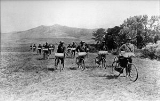
Bicycle infantry

Encyclopedia
Bicycle infantry are infantry
soldier
s who maneuver on (or, usually more correctly, between) battlefields using bicycle
s. The term dates from the late 19th century, when the "safety bicycle
" became popular in Europe
, the United States
and Australia
. Historically, bicycles lessened the need for horses, fuel and vehicle maintenance. Though their use has waned over the years in many armies, they continue to be used in unconventional armies such as militias.
 Numerous experiment
s were carried out to determine the possible role of bicycles and cycling
within military establishments because bicycles can carry more equipment and travel longer than walking soldiers until in 1894 a turning point occurred due to improved resilience of pneumatics
and the shorter sturdier construction of the frame. To some extent, bicyclists took over the functions of dragoons, especially as messengers and scouts, substituting for horses in warfare
. Bicycle units or detachments were formed at the end of the 19th century by all European armies and the US armed forces.
The United Kingdom
employed bicycle troops in militia
or territorial units, but not in regular units. In France
, several experimental units were created, starting in 1886. They attempted to adopt folding bicycles early on. In the United States, the most extensive experimentation on bicycle units was carried out by a 1st Lieutenant Moss, of the 25th United States Infantry (Colored) (an African American
infantry regiment with white
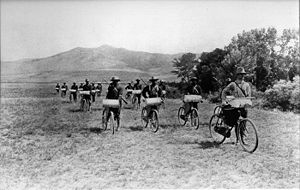
officers). Using a variety of cycle models, Lt. Moss and his troops carried out extensive bicycle journeys covering between 500 and 1,000 miles (800 to 1,600 km). Late in the 19th century, the United States Army tested the bicycle's suitability for cross-country troop transport. Buffalo Soldier
s stationed in Montana
rode bicycles across roadless landscapes for hundreds of miles at high speed.
The first known use of the bicycle in combat occurred during the Jameson Raid
, in which cyclists carried messages. In the Second Boer War
, military cyclists were used primarily as scouts and messengers. One unit patrolled railroad lines on specially constructed tandem bicycle
s that were fixed to the rails. Several raids were conducted by cycle-mounted infantry on both sides; the most famous unit was the Theron se Verkenningskorps (Theron Reconnaissance Corps) or TVK, a Boer unit led by the scout Daniel Theron
, whom British commander Lord Roberts
described as "the hardest thorn in the flesh of the British advance." Roberts placed a reward of £1,000 on Theron's head—dead or alive—and dispatched 4,000 soldiers to find and eliminate the TVK.
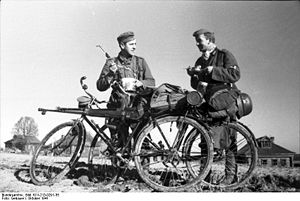 During World War I
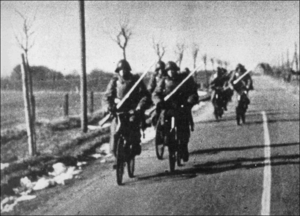
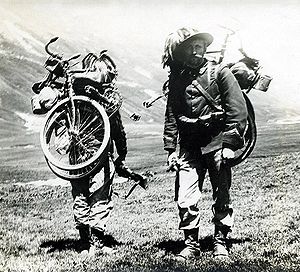
, cycle-mounted infantry, scouts, messengers and ambulance carriers were extensively used by all combatants. Italy
used bicycles with the Bersaglieri
(light infantry units) until the end of the war. German
Army
Jäger
(light infantry) battalions each had a bicycle company (Radfahr-Kompanie) at the outbreak of the war, and additional companies were raised during the war bringing the total to 80 companies, a number of which were formed into eight Radfahr-Bataillonen (bicycle battalions). In its aftermath, the German Army conducted a study on the use of the cycle and published its findings in a report entitled Die Radfahrertruppe. The British Army
had cyclist companies in its divisions, and later a whole division became The Cyclist Division
.
In its 1937 invasion of China
, Japan
employed some 50,000 bicycle troops. Early in World War II
their southern campaign
through Malaya
en route to capturing
Singapore
in 1941 was largely dependent on bicycle-riding soldiers. In both efforts bicycles allowed quiet and flexible transport of thousands of troops who were then able to surprise and confuse the defenders. Bicycles also made few demands on the Japanese war machine, needing neither trucks, nor ships to transport them, nor precious petroleum
. Although the Japanese were under orders not to embark for Malaya with bicycles, for fear of slowing up amphibious landings, they knew from intelligence that bicycles were plentiful in Malaya and moved to systematically confiscate bicycles from civilians and retailers as soon as they landed. Using bicycles, the Japanese troops were able to move faster than the withdrawing Allied Forces, often successfully cutting off their retreat. The speed of Japanese advance, usually along plantation roads, native paths and over improvised bridges, also caught Allied Forces defending the main roads and river crossings by surprise, by attacking them from the rear. However there were one or two cases of Australian troops turning the tables on the Japanese by isolating cycle troops from their accompanying motorised forces after blowing up bridges over rivers.
The Finnish Army
utilized bicycles extensively during the Continuation War
and Lapland War
. Bicycles were used as a means of transportation in Jaeger Battalions, divisional Light Detachments and regimental organic Jaeger Companies. Bicycle units spearheaded the advances of 1941 against Soviet Union. Especially successful was the 1st Jaeger Brigade which was reinforced with a tank battalion and an anti-tank battalion, providing rapid movement through limited road network. During winter time these units, like the rest of the infantry, switched to skis.
Within 1942-1944 bicycles were also added to regimental equipment pools. During the Summer 1944 battles against the Soviet Union, bicycles provided quick mobility for reserves and counter-attacks. In Autumn 1944 bicycle troops of the Jaeger Brigade spearheaded the Finnish advance through Lapland against the Germans; tanks had to be left behind due to the German destruction of the Finnish road network.
The hastily assembled German Volksgrenadier
divisions had a battalion of bicycle infantry, to have some mobile reserve.
Allied use of the bicycle in World War II was limited, but included supplying folding bicycles to paratroopers and to messengers behind friendly lines. The term, "bomber bikes" came into use during this period, as US forces dropped bicycles out of planes to reach troops behind enemy lines.
By 1939, the Swedish army
operated six bicycle infantry regiments. They were equipped with domestically produced Swedish military bicycle
s. Most common was the m/42, an upright, one-speed roadster
produced by several large Swedish
bicycle manufacturers. These regiments were decommissioned between 1948 and 1952, and the bicycles remained for general use in the Army, or transferred to the Home Guard
. Beginning in the 1970s, the Army began to sell these as military surplus. They became very popular as cheap and low-maintenance transportation, especially among students. Responding to its popularity and limited supply, an unrelated company, Kronan
, began to produce a modernized version of the m/42 in 1997.
conflicts and unconventional warfare
, where the cycle's ability to carry large, about 400 lb (181.4 kg), loads of supplies at the speed of a pedestrian
make it vastly useful for lightly equipped forces. For many years the Viet Cong and North Vietnamese Army used bicycles to ferry supplies down the "Ho Chi Minh trail
", avoiding the repeated attacks of United States and Allied bombing raids. When heavily loaded with supplies such as sacks of rice, these bicycles were seldom rideable, but were pushed by a tender walking alongside. With especially bulky cargo, tenders sometimes attached bamboo poles to the bike for tiller-like steering (this method can still be seen practiced in China today). Vietnam
ese "cargo bikes" were rebuilt in jungle workshops with reinforced frames to carry heavy loads over all terrain.
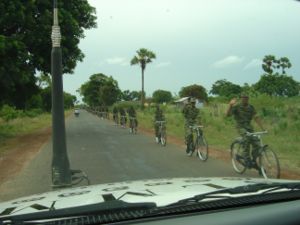 Bicycles continue in military use today, primarily as an easy alternative for transport on long flightlines. The use of the cycle as an infantry transport tool continued into the 21st century with the Swiss
Army's Bicycle Regiment, which maintained drills for infantry movement and attack until 2001, when the decision was made to phase the unit out.
Finnish defence forces still train all conscripts to use bicycle and skis.
The LTTE Tamil Tigers
made use of bicycle mobility in the fighting in Sri Lanka. The Sri Lankan army also has a bicycle unit. They are mainly stationed and deployed in high security zones in the capital city Colombo. The theory and the basis of their usage is still not well known.
Although in the United States, bicycles aren't used any more for combat, the long tradition of mixed terrain bicycle travel championed by the military has been transformed into civilian adventure travel. Mixed Terrain Cycle-Touring
has seen a resurgence in popularity often adopting a military style ultralight and flexible approach to long variable terrain routes.
Infantry
Infantrymen are soldiers who are specifically trained for the role of fighting on foot to engage the enemy face to face and have historically borne the brunt of the casualties of combat in wars. As the oldest branch of combat arms, they are the backbone of armies...
soldier
Soldier
A soldier is a member of the land component of national armed forces; whereas a soldier hired for service in a foreign army would be termed a mercenary...
s who maneuver on (or, usually more correctly, between) battlefields using bicycle
Bicycle
A bicycle, also known as a bike, pushbike or cycle, is a human-powered, pedal-driven, single-track vehicle, having two wheels attached to a frame, one behind the other. A person who rides a bicycle is called a cyclist, or bicyclist....
s. The term dates from the late 19th century, when the "safety bicycle
Safety bicycle
A safety bicycle is a type of bicycle that became very popular beginning in the late 1880s as an alternative to the penny-farthing or ordinary and is now the most common type of bicycle. Early bicycles of this style were known as safety bicycles because they were noted for, and marketed as, being...
" became popular in Europe
Europe
Europe is, by convention, one of the world's seven continents. Comprising the westernmost peninsula of Eurasia, Europe is generally 'divided' from Asia to its east by the watershed divides of the Ural and Caucasus Mountains, the Ural River, the Caspian and Black Seas, and the waterways connecting...
, the United States
United States
The United States of America is a federal constitutional republic comprising fifty states and a federal district...
and Australia
Australia
Australia , officially the Commonwealth of Australia, is a country in the Southern Hemisphere comprising the mainland of the Australian continent, the island of Tasmania, and numerous smaller islands in the Indian and Pacific Oceans. It is the world's sixth-largest country by total area...
. Historically, bicycles lessened the need for horses, fuel and vehicle maintenance. Though their use has waned over the years in many armies, they continue to be used in unconventional armies such as militias.
Origins
Experiment
An experiment is a methodical procedure carried out with the goal of verifying, falsifying, or establishing the validity of a hypothesis. Experiments vary greatly in their goal and scale, but always rely on repeatable procedure and logical analysis of the results...
s were carried out to determine the possible role of bicycles and cycling
Cycling
Cycling, also called bicycling or biking, is the use of bicycles for transport, recreation, or for sport. Persons engaged in cycling are cyclists or bicyclists...
within military establishments because bicycles can carry more equipment and travel longer than walking soldiers until in 1894 a turning point occurred due to improved resilience of pneumatics
Pneumatics
Pneumatics is a branch of technology, which deals with the study and application of use of pressurized gas to effect mechanical motion.Pneumatic systems are extensively used in industry, where factories are commonly plumbed with compressed air or compressed inert gases...
and the shorter sturdier construction of the frame. To some extent, bicyclists took over the functions of dragoons, especially as messengers and scouts, substituting for horses in warfare
Horses in warfare
The first use of horses in warfare occurred over 5,000 years ago. The earliest evidence of horses ridden in warfare dates from Eurasia between 4000 and 3000 BC. A Sumerian illustration of warfare from 2500 BC depicts some type of equine pulling wagons...
. Bicycle units or detachments were formed at the end of the 19th century by all European armies and the US armed forces.
The United Kingdom
United Kingdom
The United Kingdom of Great Britain and Northern IrelandIn the United Kingdom and Dependencies, other languages have been officially recognised as legitimate autochthonous languages under the European Charter for Regional or Minority Languages...
employed bicycle troops in militia
Militia
The term militia is commonly used today to refer to a military force composed of ordinary citizens to provide defense, emergency law enforcement, or paramilitary service, in times of emergency without being paid a regular salary or committed to a fixed term of service. It is a polyseme with...
or territorial units, but not in regular units. In France
France
The French Republic , The French Republic , The French Republic , (commonly known as France , is a unitary semi-presidential republic in Western Europe with several overseas territories and islands located on other continents and in the Indian, Pacific, and Atlantic oceans. Metropolitan France...
, several experimental units were created, starting in 1886. They attempted to adopt folding bicycles early on. In the United States, the most extensive experimentation on bicycle units was carried out by a 1st Lieutenant Moss, of the 25th United States Infantry (Colored) (an African American
African American
African Americans are citizens or residents of the United States who have at least partial ancestry from any of the native populations of Sub-Saharan Africa and are the direct descendants of enslaved Africans within the boundaries of the present United States...
infantry regiment with white
White people
White people is a term which usually refers to human beings characterized, at least in part, by the light pigmentation of their skin...
officers). Using a variety of cycle models, Lt. Moss and his troops carried out extensive bicycle journeys covering between 500 and 1,000 miles (800 to 1,600 km). Late in the 19th century, the United States Army tested the bicycle's suitability for cross-country troop transport. Buffalo Soldier
Buffalo Soldier
Buffalo Soldiers originally were members of the U.S. 10th Cavalry Regiment of the United States Army, formed on September 21, 1866 at Fort Leavenworth, Kansas....
s stationed in Montana
Montana
Montana is a state in the Western United States. The western third of Montana contains numerous mountain ranges. Smaller, "island ranges" are found in the central third of the state, for a total of 77 named ranges of the Rocky Mountains. This geographical fact is reflected in the state's name,...
rode bicycles across roadless landscapes for hundreds of miles at high speed.
The first known use of the bicycle in combat occurred during the Jameson Raid
Jameson Raid
The Jameson Raid was a botched raid on Paul Kruger's Transvaal Republic carried out by a British colonial statesman Leander Starr Jameson and his Rhodesian and Bechuanaland policemen over the New Year weekend of 1895–96...
, in which cyclists carried messages. In the Second Boer War
Second Boer War
The Second Boer War was fought from 11 October 1899 until 31 May 1902 between the British Empire and the Afrikaans-speaking Dutch settlers of two independent Boer republics, the South African Republic and the Orange Free State...
, military cyclists were used primarily as scouts and messengers. One unit patrolled railroad lines on specially constructed tandem bicycle
Tandem bicycle
The tandem bicycle or twin is a form of bicycle designed to be ridden by more than one person. The term tandem refers to the seating arrangement , not the number of riders. A bike with two riders side-by-side is called a sociable.-History:Patents related to tandem bicycles date from the late 19th...
s that were fixed to the rails. Several raids were conducted by cycle-mounted infantry on both sides; the most famous unit was the Theron se Verkenningskorps (Theron Reconnaissance Corps) or TVK, a Boer unit led by the scout Daniel Theron
Daniel Theron
Daniël Johannes Stephanus Theron, , often called Danie Theron, was born in Tulbagh, Cape Colony, and raised in Bethlehem, Orange Free State. He is best known as the driving force behind the formation of a military bicycle corps used by the Boer Army for scouting and relaying messages...
, whom British commander Lord Roberts
Frederick Roberts, 1st Earl Roberts
Field Marshal Frederick Sleigh Roberts, 1st Earl Roberts, Bt, VC, KG, KP, GCB, OM, GCSI, GCIE, KStJ, PC was a distinguished Indian born British soldier who regarded himself as Anglo-Irish and one of the most successful British commanders of the 19th century.-Early life:Born at Cawnpore, India, on...
described as "the hardest thorn in the flesh of the British advance." Roberts placed a reward of £1,000 on Theron's head—dead or alive—and dispatched 4,000 soldiers to find and eliminate the TVK.
World Wars
World War I
World War I , which was predominantly called the World War or the Great War from its occurrence until 1939, and the First World War or World War I thereafter, was a major war centred in Europe that began on 28 July 1914 and lasted until 11 November 1918...
, cycle-mounted infantry, scouts, messengers and ambulance carriers were extensively used by all combatants. Italy
Italy
Italy , officially the Italian Republic languages]] under the European Charter for Regional or Minority Languages. In each of these, Italy's official name is as follows:;;;;;;;;), is a unitary parliamentary republic in South-Central Europe. To the north it borders France, Switzerland, Austria and...
used bicycles with the Bersaglieri
Bersaglieri
The Bersaglieri are a corps of the Italian Army originally created by General Alessandro La Marmora on 18 June 1836 to serve in the Piedmontese Army, later to become the Royal Italian Army...
(light infantry units) until the end of the war. German
Germany
Germany , officially the Federal Republic of Germany , is a federal parliamentary republic in Europe. The country consists of 16 states while the capital and largest city is Berlin. Germany covers an area of 357,021 km2 and has a largely temperate seasonal climate...
Army
German Army
The German Army is the land component of the armed forces of the Federal Republic of Germany. Following the disbanding of the Wehrmacht after World War II, it was re-established in 1955 as the Bundesheer, part of the newly formed West German Bundeswehr along with the Navy and the Air Force...
Jäger
Jäger (military)
Jäger is a term that was adopted in the Enlightenment era in German-speaking states and others influenced by German military practice to describe a kind of light infantry, and it has continued in that use since then....
(light infantry) battalions each had a bicycle company (Radfahr-Kompanie) at the outbreak of the war, and additional companies were raised during the war bringing the total to 80 companies, a number of which were formed into eight Radfahr-Bataillonen (bicycle battalions). In its aftermath, the German Army conducted a study on the use of the cycle and published its findings in a report entitled Die Radfahrertruppe. The British Army
British Army during World War I
The British Army during World War I fought the largest and most costly war in its long history. Unlike the French and German Armies, its units were made up exclusively of volunteers—as opposed to conscripts—at the beginning of the conflict...
had cyclist companies in its divisions, and later a whole division became The Cyclist Division
2/2nd Mounted Division
The 2/2nd Mounted Division was a British cavalry division composed of Yeomanry and Territorial Force units active during World War I.It was formed on 6 March 1915 as a replacement/depot formation for the 2nd Mounted Division which was being sent abroad on active service...
.
In its 1937 invasion of China
Second Sino-Japanese War
The Second Sino-Japanese War was a military conflict fought primarily between the Republic of China and the Empire of Japan. From 1937 to 1941, China fought Japan with some economic help from Germany , the Soviet Union and the United States...
, Japan
Japan
Japan is an island nation in East Asia. Located in the Pacific Ocean, it lies to the east of the Sea of Japan, China, North Korea, South Korea and Russia, stretching from the Sea of Okhotsk in the north to the East China Sea and Taiwan in the south...
employed some 50,000 bicycle troops. Early in World War II
World War II
World War II, or the Second World War , was a global conflict lasting from 1939 to 1945, involving most of the world's nations—including all of the great powers—eventually forming two opposing military alliances: the Allies and the Axis...
their southern campaign
Battle of Malaya
The Malayan Campaign was a campaign fought by Allied and Japanese forces in Malaya, from 8 December 1941 – 31 January 1942 during the Second World War. The campaign was dominated by land battles between British Commonwealth army units, and the Imperial Japanese Army...
through Malaya
British Malaya
British Malaya loosely described a set of states on the Malay Peninsula and the Island of Singapore that were brought under British control between the 18th and the 20th centuries...
en route to capturing
Battle of Singapore
The Battle of Singapore was fought in the South-East Asian theatre of the Second World War when the Empire of Japan invaded the Allied stronghold of Singapore. Singapore was the major British military base in Southeast Asia and nicknamed the "Gibraltar of the East"...
Singapore
Singapore
Singapore , officially the Republic of Singapore, is a Southeast Asian city-state off the southern tip of the Malay Peninsula, north of the equator. An island country made up of 63 islands, it is separated from Malaysia by the Straits of Johor to its north and from Indonesia's Riau Islands by the...
in 1941 was largely dependent on bicycle-riding soldiers. In both efforts bicycles allowed quiet and flexible transport of thousands of troops who were then able to surprise and confuse the defenders. Bicycles also made few demands on the Japanese war machine, needing neither trucks, nor ships to transport them, nor precious petroleum
Petroleum
Petroleum or crude oil is a naturally occurring, flammable liquid consisting of a complex mixture of hydrocarbons of various molecular weights and other liquid organic compounds, that are found in geologic formations beneath the Earth's surface. Petroleum is recovered mostly through oil drilling...
. Although the Japanese were under orders not to embark for Malaya with bicycles, for fear of slowing up amphibious landings, they knew from intelligence that bicycles were plentiful in Malaya and moved to systematically confiscate bicycles from civilians and retailers as soon as they landed. Using bicycles, the Japanese troops were able to move faster than the withdrawing Allied Forces, often successfully cutting off their retreat. The speed of Japanese advance, usually along plantation roads, native paths and over improvised bridges, also caught Allied Forces defending the main roads and river crossings by surprise, by attacking them from the rear. However there were one or two cases of Australian troops turning the tables on the Japanese by isolating cycle troops from their accompanying motorised forces after blowing up bridges over rivers.
The Finnish Army
Finnish Army
The Finnish Army is the land forces branch of the Finnish Defence Forces.Today's Army is divided into six branches: the infantry , field artillery, anti-aircraft artillery, engineers, signals, and materiel troops.-History of the Finnish Army:Between 1809 and 1917 Finland was an autonomous part of...
utilized bicycles extensively during the Continuation War
Continuation War
The Continuation War was the second of two wars fought between Finland and the Soviet Union during World War II.At the time of the war, the Finnish side used the name to make clear its perceived relationship to the preceding Winter War...
and Lapland War
Lapland War
The Lapland War were the hostilities between Finland and Nazi Germany between September 1944 and April 1945, fought in Finland's northernmost Lapland Province. While the Finns saw this as a separate conflict much like the Continuation War, German forces considered their actions to be part of the...
. Bicycles were used as a means of transportation in Jaeger Battalions, divisional Light Detachments and regimental organic Jaeger Companies. Bicycle units spearheaded the advances of 1941 against Soviet Union. Especially successful was the 1st Jaeger Brigade which was reinforced with a tank battalion and an anti-tank battalion, providing rapid movement through limited road network. During winter time these units, like the rest of the infantry, switched to skis.
Within 1942-1944 bicycles were also added to regimental equipment pools. During the Summer 1944 battles against the Soviet Union, bicycles provided quick mobility for reserves and counter-attacks. In Autumn 1944 bicycle troops of the Jaeger Brigade spearheaded the Finnish advance through Lapland against the Germans; tanks had to be left behind due to the German destruction of the Finnish road network.
The hastily assembled German Volksgrenadier
Volksgrenadier
Volksgrenadier was the name given to a type of German Army division formed in the Autumn of 1944 after the double loss of Army Group Center to the Soviets in Operation Bagration and the Fifth Panzer Army to the Allies in Normandy. The name itself was intended to build morale, appealing at once to...
divisions had a battalion of bicycle infantry, to have some mobile reserve.
Allied use of the bicycle in World War II was limited, but included supplying folding bicycles to paratroopers and to messengers behind friendly lines. The term, "bomber bikes" came into use during this period, as US forces dropped bicycles out of planes to reach troops behind enemy lines.
By 1939, the Swedish army
Swedish Army
The Swedish Army is one of the oldest standing armies in the world and a branch of the Swedish Armed Forces; it is in charge of land operations. General Sverker Göranson is the Supreme Commander-in-Chief of the Army.- Organization :...
operated six bicycle infantry regiments. They were equipped with domestically produced Swedish military bicycle
Swedish military bicycle
Swedish military bicycles , or Swedish army bicycles, have been used in the Swedish military for over a century.-History:The first bicycles in the Swedish military were privately owned or bought for testing purposes. Bicycle infantry were first introduced in 1901, when a Gotlandic infantry...
s. Most common was the m/42, an upright, one-speed roadster
Roadster (bicycle)
A roadster, aka English roadster, is a type of utility bicycle once common in Britain and still very common in Asia, Africa, Denmark and the Netherlands, however, during the past several years, traditionally styled roadster bicycles have gained considerable popularity in the United States and...
produced by several large Swedish
Sweden
Sweden , officially the Kingdom of Sweden , is a Nordic country on the Scandinavian Peninsula in Northern Europe. Sweden borders with Norway and Finland and is connected to Denmark by a bridge-tunnel across the Öresund....
bicycle manufacturers. These regiments were decommissioned between 1948 and 1952, and the bicycles remained for general use in the Army, or transferred to the Home Guard
Swedish Home Guard
The Swedish Home Guard is a part of the Swedish Armed Forces. The Home Guard consists of local defence units under the leadership of the armed forces, as well as 23 national auxiliary defence organizations.-History:...
. Beginning in the 1970s, the Army began to sell these as military surplus. They became very popular as cheap and low-maintenance transportation, especially among students. Responding to its popularity and limited supply, an unrelated company, Kronan
Kronan
Kronan usually means the Swedish word for Crown , be can also mean:* Kronan , Swedish warship sunk in the Baltic Sea * Kronan , a Swedish bicycle brand* Swedish nickname for the Swedish military...
, began to produce a modernized version of the m/42 in 1997.
Later uses
Although much used in World War I, bicycles were largely superseded by motorized transport in more modern armies. In the past few decades, however, they have taken on a new life as a "weapon of the people" in guerrillaGuerrilla warfare
Guerrilla warfare is a form of irregular warfare and refers to conflicts in which a small group of combatants including, but not limited to, armed civilians use military tactics, such as ambushes, sabotage, raids, the element of surprise, and extraordinary mobility to harass a larger and...
conflicts and unconventional warfare
Unconventional warfare
Unconventional warfare is the opposite of conventional warfare. Where conventional warfare is used to reduce an opponent's military capability, unconventional warfare is an attempt to achieve military victory through acquiescence, capitulation, or clandestine support for one side of an existing...
, where the cycle's ability to carry large, about 400 lb (181.4 kg), loads of supplies at the speed of a pedestrian
Pedestrian
A pedestrian is a person traveling on foot, whether walking or running. In some communities, those traveling using roller skates or skateboards are also considered to be pedestrians. In modern times, the term mostly refers to someone walking on a road or footpath, but this was not the case...
make it vastly useful for lightly equipped forces. For many years the Viet Cong and North Vietnamese Army used bicycles to ferry supplies down the "Ho Chi Minh trail
Ho Chi Minh trail
The Ho Chi Minh trail was a logistical system that ran from the Democratic Republic of Vietnam to the Republic of Vietnam through the neighboring kingdoms of Laos and Cambodia...
", avoiding the repeated attacks of United States and Allied bombing raids. When heavily loaded with supplies such as sacks of rice, these bicycles were seldom rideable, but were pushed by a tender walking alongside. With especially bulky cargo, tenders sometimes attached bamboo poles to the bike for tiller-like steering (this method can still be seen practiced in China today). Vietnam
Vietnam
Vietnam – sometimes spelled Viet Nam , officially the Socialist Republic of Vietnam – is the easternmost country on the Indochina Peninsula in Southeast Asia. It is bordered by China to the north, Laos to the northwest, Cambodia to the southwest, and the South China Sea –...
ese "cargo bikes" were rebuilt in jungle workshops with reinforced frames to carry heavy loads over all terrain.
Modern times
Switzerland
Switzerland name of one of the Swiss cantons. ; ; ; or ), in its full name the Swiss Confederation , is a federal republic consisting of 26 cantons, with Bern as the seat of the federal authorities. The country is situated in Western Europe,Or Central Europe depending on the definition....
Army's Bicycle Regiment, which maintained drills for infantry movement and attack until 2001, when the decision was made to phase the unit out.
Finnish defence forces still train all conscripts to use bicycle and skis.
The LTTE Tamil Tigers
Liberation Tigers of Tamil Eelam
The Liberation Tigers of Tamil Eelam was a separatist militant organization formerly based in northern Sri Lanka. Founded in May 1976 by Vellupillai Prabhakaran, it waged a violent secessionist and nationalist campaign to create an independent state in the north and east of Sri Lanka for Tamil...
made use of bicycle mobility in the fighting in Sri Lanka. The Sri Lankan army also has a bicycle unit. They are mainly stationed and deployed in high security zones in the capital city Colombo. The theory and the basis of their usage is still not well known.
Although in the United States, bicycles aren't used any more for combat, the long tradition of mixed terrain bicycle travel championed by the military has been transformed into civilian adventure travel. Mixed Terrain Cycle-Touring
Mixed Terrain Cycle-Touring
Mixed Terrain Cycle-Touring, nicknamed “rough riding” in North America and "rough stuff" in Europe, involves cycling over a variety of surfaces and topography on a single route, with a single bicycle. The recent popularity of mixed terrain touring is in part a reaction against the increasing...
has seen a resurgence in popularity often adopting a military style ultralight and flexible approach to long variable terrain routes.