
All Topics  
Strategic bombing

 
Strategic Bombing

   Email Print
   Bookmark   Link


Strategic bombing


Strategic bombing is a military strategy
Military strategy

Military strategy is a policy implemented by military organizations to pursue desired Strategic goal s. Derived from the Greek language strategos, strategy when it appeared in use during the 18th century, was seen in its narrow sense as the "art of the general", 'the art of arrangement' of troops....
 used in a total war
Total war

Total war is a war of unlimited scope in which a belligerent engages in a mobilization of all available Factors of productions at their disposal, whether human, industrial, agricultural, military, natural, technological, or otherwise, in order to entirely destroy or render beyond use their rival's capacity to continue resistance....
 with the goal of defeating an enemy nation-state by destroying its economic ability to wage war rather than destroying its land or naval forces. It is a systematically organized and executed attack from the air which can utilize strategic bomber
Strategic bomber

A strategic bomber is a heavy type aircraft designed to drop large amounts of Bomb onto a distant target for the purposes of debilitating an enemy's capacity to wage war....
s, cruise missile
Cruise missile

A cruise missile is a guided missile missile that carries an explosive payload and uses a lifting wing and a propulsion system, usually a jet engine, to allow sustained flight; it is essentially a flying bomb....
s, or nuclear-armed fighter-bomber aircraft to attack targets deemed vital to an enemy's war-making capacity. It differs from terror bombing in that the latter targets the enemy civilian population, either to bend it to the aggressor's will or to punish it for political actions, such as the World War II bombing of Rotterdam to force its surrender, or the 1941 bombing of Belgrade
Bombing of Belgrade in World War II

The city of Belgrade was bombed during two campaigns in World War II, the first undertaken by the History of the Luftwaffe during World War II in 1941, and the latter by Strategic bombing during World War II in 1944....
 for "treachery".

e the distinction between tactical
Military tactics

Military tactics are the techniques for using weapons or military units in combination for engaging and defeating an Enemy in battle. Changes in philosophy and technology over time have been reflected in changes to military tactics....
, operational, and strategic
Strategy

A strategy is a plan of action designed to achieve a particular Objective .Strategy is different from Tactic . In military terms, tactics is concerned with the conduct of an engagement while strategy is concerned with how different engagements are linked....
 bombing can be blurred, they are distinct methodologies generally used for different purposes.


Discussion
Ask a question about 'Strategic bombing'
Start a new discussion about 'Strategic bombing'
Answer questions from other users
Full Discussion Forum


Encyclopedia


Strategic bombing is a military strategy
Military strategy

Military strategy is a policy implemented by military organizations to pursue desired Strategic goal s. Derived from the Greek language strategos, strategy when it appeared in use during the 18th century, was seen in its narrow sense as the "art of the general", 'the art of arrangement' of troops....
 used in a total war
Total war

Total war is a war of unlimited scope in which a belligerent engages in a mobilization of all available Factors of productions at their disposal, whether human, industrial, agricultural, military, natural, technological, or otherwise, in order to entirely destroy or render beyond use their rival's capacity to continue resistance....
 with the goal of defeating an enemy nation-state by destroying its economic ability to wage war rather than destroying its land or naval forces. It is a systematically organized and executed attack from the air which can utilize strategic bomber
Strategic bomber

A strategic bomber is a heavy type aircraft designed to drop large amounts of Bomb onto a distant target for the purposes of debilitating an enemy's capacity to wage war....
s, cruise missile
Cruise missile

A cruise missile is a guided missile missile that carries an explosive payload and uses a lifting wing and a propulsion system, usually a jet engine, to allow sustained flight; it is essentially a flying bomb....
s, or nuclear-armed fighter-bomber aircraft to attack targets deemed vital to an enemy's war-making capacity. It differs from terror bombing in that the latter targets the enemy civilian population, either to bend it to the aggressor's will or to punish it for political actions, such as the World War II bombing of Rotterdam to force its surrender, or the 1941 bombing of Belgrade
Bombing of Belgrade in World War II

The city of Belgrade was bombed during two campaigns in World War II, the first undertaken by the History of the Luftwaffe during World War II in 1941, and the latter by Strategic bombing during World War II in 1944....
 for "treachery".

Strategic bombing

While the distinction between tactical
Military tactics

Military tactics are the techniques for using weapons or military units in combination for engaging and defeating an Enemy in battle. Changes in philosophy and technology over time have been reflected in changes to military tactics....
, operational, and strategic
Strategy

A strategy is a plan of action designed to achieve a particular Objective .Strategy is different from Tactic . In military terms, tactics is concerned with the conduct of an engagement while strategy is concerned with how different engagements are linked....
 bombing can be blurred, they are distinct methodologies generally used for different purposes. Strategic bombing is a methodology distinct from both tactical bombing and the use of strategic air assets in an operational capacity. Such a strategy usually involves sustained attacks over a period of time on targets that affect a nation's overall warmaking capability, such as factories
Factory

A factory or manufacturing plant is an industry building where workers manufacturing Good or supervise machines Process Manufacturing one product into another....
, railroads
Rail transport

Rail transport is the conveyance of passengers and goods by means of wheeled vehicles running along railways . Rail transport is part of the logistics chain, which facilitates international trade and economic growth....
, oil industries
Oil refinery

An oil refinery is an industrial process plant where crude oil is processed and refined into more useful petroleum products, such as gasoline, diesel fuel, asphalt, heating oil, kerosene, and liquefied petroleum gas....
, and other resources. Less frequently, individual strategic attacks are made against singular targets, such as Britain's Bomber Command
Bomber Command

Bomber Command is an organizational military unit, generally subordinate to the air force of a country. Many countries have a "Bomber Command", although the most famous ones were in United Kingdom and the United States....
 attacks against the Ruhr dams in May, 1943.

As strategic bombing aims to undermine an enemy nation-state's ability to wage war, strategic bombers need to be able to reach targets throughout most or all of that nation, and so have tended to be larger, longer-ranged aircraft. Strategic bombers have also been used to support major military ground operations, such as the isolation of Normandy through the bombing of transportation hubs throughout northern France in support of the D-Day
D-Day

D-Day is a term often used in military parlance to denote the day on which a combat attack or operation is to be initiated. "D-Day" often represents a variable , designating the day upon which some significant event will occur or has occurred; see Military designation of days and hours for similar terms....
 invasion, or the carpet bombing of the Axis front lines west of St. Lo in support of Operation Cobra
Operation Cobra

Operation Cobra was the codename for an offensive launched by the First United States Army eight weeks after the D-Day landings, during the Normandy Campaign of World War II....
.

An aerial attack strategy of deliberately bombing and/or strafing civilian targets in order to break the morale of an enemy, make its civilian population panic, bend the enemy's political leadership to the attacker's will, or to "punish" an enemy, while strategic in nature, is more correctly termed terror bombing
Terror bombing

Terror bombing is a strategy of deliberately bombing and/or strafing civilian targets in order to break the morale of the enemy, make its civilian population panic, bend the enemy's political leadership to the attacker's will, or to "punish" an enemy....
.

Methods used to deliver ordnance

There are three basic methods used to deliver ordnance onto targets in a strategic bombing campaign. The first is by gravity-dropping large numbers of iron bombs
Gravity bomb

A gravity bomb is an aircraft-delivered bomb that does not contain a guidance system and hence, simply follows a Ballistics trajectory.This described all aircraft bombs in general service until the latter half of World War II, and the vast majority until the late 1980s....
 or "dumb bombs", using strategic bombers. The second is through the use of more precise ordnance, precision-guided munition
Precision-guided munition

Precision-guided munitions are guided weapons intended to precisely hit a specific target, and to minimise damage to things other than the target....
s (so-called smart bombs); cruise missile
Cruise missile

A cruise missile is a guided missile missile that carries an explosive payload and uses a lifting wing and a propulsion system, usually a jet engine, to allow sustained flight; it is essentially a flying bomb....
s fall into this category, though they are not always air-launched. The third method involves the use of nuclear ordnance, either onto a battlefield in a method similar to carpet bombing, or onto a strategic target, as with iron bombs in WW II. Although the deployment of nuclear weapons from aircraft falls into the category of strategic bombing, and likely represents the ultimate form of both strategic and terror bombing, the term strategic bombing is generally used in reference to the release of non-nuclear air-ground ordnance from strategic aircraft. Area attack by multiple bombers is based upon detailed calculations of the intended Damage Expectancy or "DE" directed by the Air Tasking Order (ATO) used in a military strategy. To achieve a particular DE, planners select a bomb type based on that particular weapon's damage mechanism - blast/fragmentation or incendiary, for example. Planners then calculate the Single Sortie Probability of Damage (SSPD) and extrapolate from there, adding sorties until the probability of damage meets or exceeds the required DE. As weapons have grown more precise, the need for mass formations dropping masses of bombs has decreased, and it is now possible for a single bomb to accomplish what in the past took many bombers. In fact, one B-52
B-52 Stratofortress

The Boeing B-52 Stratofortress is a long-range, subsonic, jet engine, strategic bomber operated by the United States Air Force since 1955.Beginning with the successful contract bid on 5 June 1946, the B-52 went through several design steps; from a straight wing aircraft powered by six turboprop engines to the final prototype YB-52, with ei...
 can now drop a single bomb from many miles away that can be programmed to strike a target as small as a window or doorway from a chosen direction and at a preselected angle. This can focus the blast in a given direction and can dramatically reduce the risk of collateral damage to other buildings and consequent unintended civilian casualties.

Strategic bombing by multiple modern strategic bombers like the B-52 can be likened to an hour during the Somme bottled into a thirty-second time period. However, some believe this delivery method has been rather ineffective in attacking a nation's warmaking capability, due to the imprecise nature of the attack. Others cite the destruction of enemy infrastructure, resources expended on civil defense and physical protection of sites, and the reallocation of military resources away from the battlefield in order to staff response and air and ground antiaircraft assets as proof of its efficacy. In either case, the unintended mass civilian casualties
Collateral damage

Collateral damage is damage that is unintended or incidental to the intended outcome. The term originated in the U.S. military, but it has since expanded into broader use....
, terror caused, and ethical questions raised draws adverse long-term attention to the morality of strategic bombing.

Carpet bombing
Carpet bombing

Carpet bombing refers to the tactical bombing of a strategic area usually by the use of large numbers of unguided gravity bombs, often with a high proportion of incendiary devices....
, often confused with strategic bombing, is the use of strategic air assets for operational objectives in support of ground forces. Its use during Operation Cobra is the best-known example. Carpet bombing is viewed ambivalently by ground forces, due to the nigh-inevitable friendly casualties caused by bombers dropping their ordnance short of the aiming point, either through error or "bomb creep".

The use of "smart" weapons is preferred by some nations for two reasons. First, it can be less devastating. Due to the greater accuracy (the smaller CEP
Circular error probable

In the military science of ballistics, circular error probable or circular error probability is an intuitive measure of a weapon system's Accuracy and precision....
) of precision guided weapons, there is less risk of civilian casualties. The second reason is the more-focused damage associated with precision weapons. Strategic bombing can destroy an entire block, but miss the vital components of a factory. Precision weapons can attack precise components of designated targets, increasing the likelihood of a successful attack. However, the 'shock' value of precision bombing is less severe than of area bombing. Unless multiple precision weapons are used, an enemy may seek cover or disperse to different parts of the targeted area. Additionally, area bombing can have an initial significant psychological effect, as the bombing of cities early in World War II terrified their citizens.

History and origins


World War I


Strategic bombing was first used in World War I, though it was not understood in its present form. The first strategic bombing mission of the war was likely the dropping of five bombs on the Gare L'Est train station in Paris on August 30, 1914. Within a year or so, specialized aircraft and dedicated bomber
Bomber

A bomber is a military aircraft designed to attack ground and sea targets, primarily by dropping bombs on them....
 squadrons were in service on both sides. These were generally used for tactical bombing: the aim was that of directly harming enemy troops, strongpoints, or equipment, usually within a relatively small distance of the front line. Eventually, attention turned to the possibility of causing indirect harm to the enemy by systematically attacking vital rear-area resources.

The first-ever dirigible aerial bombardment of civilians was on January 19, 1915, in which two German Zeppelin
Zeppelin

For the English rock group, please see Led Zeppelin. For other meanings please see Zeppelin .A Zeppelin is a type of rigid airship pioneered by the German Count Ferdinand von Zeppelin in the early 20th century, based on designs he had outlined in 1874, designs he had detailed in 1893, and that were reviewed by committee in 1894, which h...
s dropped 24 fifty-kilogram (110 pound) high-explosive bombs and ineffective three-kilogram incendiaries on the Eastern England towns of Great Yarmouth
Great Yarmouth

Great Yarmouth, often known to locals as Yarmouth, is a coastal town in Norfolk, England. It is at the mouth of the River Yare, 20 miles east of Norwich....
, Sheringham
Sheringham

Sheringham is a seaside town in Norfolk, England, located west of Cromer.Historically, the parish of Sheringham comprised the two villages of Upper Sheringham, a farming community, and Lower Sheringham, which combined farming with fishing....
, King's Lynn
King's Lynn

King's Lynn is a town and port in Norfolk, England. Over the years, the town has been known variously as Bishop's Lynn and Lynn Regis, while it is frequently referred to by locals as simply Lynn, the Celtic languages word for lake....
, and the surrounding villages. In all, four people were killed, sixteen injured, and monetary damage was estimated at £7,740 (about US$36,000 at the time). German dirigibles also bombed Liepaja
Liepaja

Liepaja is a city in western Latvia on the Baltic sea and the administrative center of Liepaja district. It is the largest city in the Kurzeme region of Latvia, the third largest city in Latvia after Riga and Daugavpils and an important ice-free port....
 in Latvia on the Eastern Front in January, 1915.

There were a further nineteen raids in 1915, in which 37 tons of bombs were dropped, killing 181 people and injuring 455. Raids continued in 1916. London was accidentally bombed in May, and, in July, the Kaiser allowed directed raids against urban centers. There were 23 airship raids in 1916, in which 125 tons of ordnance were dropped, killing 293 people and injuring 691. Gradually British air defenses improved. In 1917 and 1918, there were only 11 Zeppelin raids against England, and the final raid occurred on August 5, 1918, which resulted in the death of KK Peter Strasser
Peter Strasser

Peter Strasser Chief Commander of Germany's Luftschiffer airforce during World War I, operating bombing campaigns from 1915 to 1918....
, commander of the German Naval Airship Department. By the end of the war, 51 raids had been undertaken, in which 5,806 bombs were dropped, killing 557 people and injuring 1,358. The Zeppelin raids were complemented by the Gotha
Gotha G

The Gotha G.V was a heavy bomber used by the Luftstreitkr?fte during World War I....
 bomber, which was the first heavier-than-air bomber to be used for strategic bombing. It has been argued that the raids were effective far beyond the material damage caused, in diverting and hampering wartime production, and diverting twelve squadrons and over 10,000 men to air defenses.

The French army on June 15, 1915 attacked the German town of Karlsruhe
Karlsruhe

Karlsruhe is a city in the south west of Germany, in the States of Germany Baden-W?rttemberg, located near the France-German border.Founded in 1715 as Karlsruhe Palace, the surrounding town became the seat of two of the highest courts in Germany, the Federal Constitutional Court of Germany whose decisions have the force of a law, and the...
, killing 29 civilians and wounding 58. Further raids followed until the Armistice in 1918. In a raid in the afternoon of June 22, 1916 the pilots used outdated maps and bombed the location of the abandoned railway station, where a circus
Circus

File:Faroe stamp 416 circus.jpgA circus is commonly a traveling company of performers that may include acrobatics, clowns, trained animals, trapeze acts, hoopers, tightrope walkers, juggling, unicyclists and other stunt-oriented artists....
 tent was placed, killing 120 persons, most of them children.

In contrast, the British launched their own form of strategic bombing. At the start of the war, there were attacks by bombers of the Royal Navy Air Service (RNAS) against the Zeppelin production lines and their sheds at Cologne and Dusseldorf on September 22 and October 8, 1914. In late 1915, the order was given for attacks on German industrial targets and the 41st Wing was formed from units of the RNAS and Royal Flying Corps
Royal Flying Corps

The Royal Flying Corps was the over-land air arm of the British military during most of the First World War. During the early part of the war, the RFC's responsibilities were centred on support of the British Army, via artillery cooperation and photographic reconnaissance....
. The RNAS took to strategic bombing in bigger way than the RFC who were focussed on supporting the infantry actions of the Western Front. At first the RNAS attacked the German submarines in their moorings then steelworks further in targeting the origin of the submarines themselves.

In early 1918 they operated their "round the clock" bombing raid; with lighter bombs attacking the town of Trier
Trier

Trier is a city in Germany on the banks of the Moselle River. It is the oldest city in Germany, founded in or before 16 BC. Trier is not the only city claiming to be Germany's oldest, but it is the only one that bases this assertion on having the longest history as a city, as opposed to a mere settlement or army camp....
 by day and large HP O/400s attacking by night. In April 1918, the Independent Force was created, an expanded bombing group that by the end of the war had aircraft that could reach Berlin but were never used.

Following the war, the concept of strategic bombing developed. The calculations which were performed on the number of dead to the weight of bombs dropped would have a profound effect on the attitudes of the British authorities and population in the interwar years, because as bombers became larger it was fully expected that deaths from aerial bombardment would approach those anticipated in the Cold War
Cold War

The Cold War was the continuing state of conflict, tension and competition that existed between a number of world powers, including the United States, the Soviet Union, People's Republic of China, France, United Kingdom and those countries' respective allies from the mid-1940s to the early 1990s....
 from the use of nuclear weapons. The fear of aerial attack on such a scale was one of the fundamental driving forces of British appeasement
Appeasement

Appeasement is "the policy of settling international quarrels by admitting and satisfying grievances through rational negotiation and compromise, thereby avoiding the resort to an armed conflict which would be expensive, bloody, and possibly dangerous." The term is most often applied to the foreign policy of United Kingdom Prime Minister of t...
 in the 1930s.

Period between the world wars

In the period between the two world wars, military thinkers from several nations advocated strategic bombing as the logical and obvious way to employ aircraft. Domestic political considerations saw to it that the British worked harder on the concept than most. The British
United Kingdom

The United Kingdom of Great Britain and Northern Ireland, commonly known as the United Kingdom , the UK or Britain,is a sovereign state located off the northwestern coast of continental Europe....
 Royal Flying Corps
Royal Flying Corps

The Royal Flying Corps was the over-land air arm of the British military during most of the First World War. During the early part of the war, the RFC's responsibilities were centred on support of the British Army, via artillery cooperation and photographic reconnaissance....
 and Royal Naval Air Service
Royal Naval Air Service

The Royal Naval Air Service or RNAS was the air arm of the Royal Navy until near the end of World War I, when it merged with the British Army's Royal Flying Corps to form a new service , the Royal Air Force....
 of the Great War had been merged in 1918 to create a separate air force, which spent much of the following two decades fighting for survival in an environment of severe government spending constraints. Royal Air Force leaders, in particular Air Chief Marshal Hugh Trenchard, believed the key to retaining their independence from the senior services was to lay stress on what they saw as the unique ability of a modern air force to win wars by unaided strategic bombing. As the speed and altitude of bombers increased in proportion to fighter aircraft, the prevailing strategic understanding became "the bomber will always get through
The bomber will always get through

The bomber will always get through was a phrase used by Stanley Baldwin in a speech to the Parliament of the United Kingdom in 1932:The argument was that, regardless of air defences, sufficient raiders will survive to rain destruction on cities....
." Although anti-aircraft guns and fighter aircraft had proved effective in the Great War, it was accepted there was little warring nations could do to prevent massive civilian casualties from strategic bombing. High civilian morale and retaliation in kind were seen as the only answers. (A later generation would revisit this, as Mutual Assured Destruction
Mutual assured destruction

Mutually assured destruction is a doctrine of military strategy in which a full-scale use of nuclear weapons by two opposing sides would effectively result in the destruction of both the attacker and the defender....
.)

In Europe, the air power prophet General Giulio Douhet
Giulio Douhet

General Giulio Douhet was an Italian air power theorist. He was a key proponent of strategic bombing in aerial warfare....
 asserted the basic principle of strategic bombing was the offensive, and there was no defence against carpet bombing
Carpet bombing

Carpet bombing refers to the tactical bombing of a strategic area usually by the use of large numbers of unguided gravity bombs, often with a high proportion of incendiary devices....
 and poison gas attacks. Douhet's apocalyptic predictions found fertile soil in France, Germany, and the United States, where excerpts from his book The Command of the Air (1921) were published. These visions of cities laid waste by bombing also gripped the popular imagination and found expression in novel
Novel

File:2009 stapelweise Neuerscheinungen im Buchladen.JPGA novel is today a long narrative in literary prose. The genre has historical roots both in the fields of the medieval and early modern Romance and in the tradition of the novella....
s such as Douhet's The War of 19-- (1930) and H.G. Wells's The Shape of Things to Come
The Shape of Things to Come

The Shape of Things to Come is a work of science fiction by H. G. Wells, published in 1933, which speculates on future events from 1933 until the year 2106....
 (1933) (filmed by Alexander Korda
Alexander Korda

Sir Alexander Korda was a Hungarian-born film director and film producer. He was a leading figure in the British film industry, the founder of London Films and the owner of British Lion, a film distributing company....
 as Things to Come
Things to Come

Things to Come is a United Kingdom science fiction film, produced by Alexander Korda and directed by William Cameron Menzies. The screenplay was written by H....
 (1936)).

Douhet's proposals were hugely influential amongst airforce enthusiasts, arguing as they did that the bombing air arm was the most important, powerful and invulnerable part of any military. He envisaged future wars as lasting a matter of a few weeks. While each opposing Army and Navy fought an inglorious holding campaign, the respective Air Forces would dismantle their enemies' country, and if one side did not rapidly surrender, both would be so weak after the first few days that the war would effectively cease. Fighter aircraft would be relegated to spotting patrols, but would be essentially powerless to resist the mighty bombers. In support of this theory he argued for targeting of the civilian population as much as any military target, since a nation's morale was as important a resource as its weapons. Paradoxically, he suggested that this would actually reduce total casualties, since "The time would soon come when, to put an end to horror and suffering, the people themselves, driven by the instinct of self-preservation, would rise up and demand an end to the war...". As a result of Douhet's proposals airforces allocated greater resources to their bomber squadrons than to their fighters, and the 'dashing young pilots' promoted in propaganda of the time were invariably bomber pilots.

Pre-war planners, on the whole, vastly overestimated the damage bombers could do, and underestimated the resilience of civilian populations. The speed and altitude of modern bombers, and the difficulty of hitting a target while under attack from improved ground fire and fighters which had yet to be built was not appreciated. Jingoistic national pride played a major role: for example, at a time when Germany was still disarmed and France was Britain's only European rival, Trenchard boasted, "the French in a bombing duel would probably squeal before we did". At the time, the expectation was any new war would be brief and very savage. A British Cabinet planning document in 1938 predicted that, if war with Germany broke out, 35% of British homes would be hit by bombs in the first three weeks. (This type of expectation should be kept in mind when considering the conduct of the European leaders who appeased
Appeasement

Appeasement is "the policy of settling international quarrels by admitting and satisfying grievances through rational negotiation and compromise, thereby avoiding the resort to an armed conflict which would be expensive, bloody, and possibly dangerous." The term is most often applied to the foreign policy of United Kingdom Prime Minister of t...
 Hitler in the late 1930s.)

Douhet's theories were tested at Guernica
Bombing of Guernica

The bombing of Guernica was an Aerial bombing of cities on the Basque Country town of Guernica , causing widespread destruction and civilian deaths during the Spanish Civil War....
 and Guangzhou
Guangzhou

'Guangzhou' is the Capital and a sub-provincial city of Guangdong Province of China in the northern and southern China part of the People's Republic of China....
, which produced international outrage, but not the surrender of the nation that was bombed. They were more successful in Mesopotamia
Mesopotamia

Mesopotamia is the area of the Tigris-Euphrates river system, along the Tigris and Euphrates rivers, largely corresponding to modern Iraq, as well as some parts of northeastern Syria, some parts of southeastern Turkey, and some parts of the Khuzestan Province of southwestern Iran....
 (modern-day Iraq
Iraq

Iraq , officially the Republic of Iraq , is a country in Western Asia spanning most of the northwestern end of the Zagros Mountains, the eastern part of the Syrian Desert and the northern part of the Arabian Desert....
) where RAF bombers used conventional bombs, gas bombs, and strafed civilian populations identified as engaging in guerrilla uprisings. Arthur Harris
Arthur Travers Harris

Marshal of the Royal Air Force Sir Arthur Travers Harris, 1st Baronet Order of the Bath Order of the British Empire Air Force Cross RAF , commonly known as "Bomber" Harris by the press, and often within the RAF as "Butcher" Harris, was Air Officer Commanding of RAF Bomber Command and later a Marshal of the Royal Air Force during...
, a young RAF squadron commander (later nicknamed "Bomber")
List of military figures by nickname

This is a list of military figures by nickname....
, reported after a mission in 1924, "The Arab and Kurd now know what real bombing means, in casualties and damage. They know that within 45 minutes a full-sized village can be practically wiped out and a third of its inhabitants killed or injured." Bombing as a military strategy proved to be an effective and efficient way for the British to police their Middle East
Middle East

File:GreaterMiddleEast1.pngThe Middle East is a region that spans southwestern Asia, western Asia, and northeastern Africa. It has no clear boundaries, often used as a synonym to Near East, in opposition to Far East....
 protectorates in the 1920s. Fewer men were required as compared to ground forces.

World War II

Wwii Schweinfurt Raid
The strategic bombing conducted in World War II was unlike anything the world had seen before. The campaigns conducted in Europe, in China
Bombing of Chongqing

The bombing of Chongqing was part of an Imperial Japanese Army Air Service and Imperial Japanese Navy Air Service terror bombing operation on the China provisional capital of Chongqing authorized by the Imperial General Headquarters....
 and at the end of the war over Japan, could involve thousands of aircraft dropping tens of thousands of tons of munitions over a single city.

Strategic-bombing campaigns were conducted in Europe and Asia. The Germans and Japanese made use of mostly twin-engined bombers with a payload generally less than 5000 pounds, and never produced larger craft to any great extent. By comparison, the British and Americans (who started the war with predominantly similarly-sized bombers) developed their strategic force based upon much larger four-engined bombers for their strategic campaigns. The payload carried by these planes ranged from 2.7 tons for the B-17 Flying Fortress
B-17 Flying Fortress

The Boeing B-17 Flying Fortress is a four-engine heavy bomber aircraft developed for the United States Army Air Corps . Competing against Douglas Aircraft Company and Glenn L....
, to 8 tons for the Avro Lancaster
Avro Lancaster

The Avro Lancaster was a United Kingdom four-engine World War II bomber aircraft made initially by Avro for the British Royal Air Force . It first saw active service in 1942, and together with the Handley-Page Halifax it was one of the main heavy bombers of the RAF, the Royal Canadian Air Force and squadrons from other Commonwealth of Nations...
 and 9 tons for the B-29 Superfortress
B-29 Superfortress

The Boeing B-29 Superfortress was a four-engine Fixed-wing aircraft#Propeller aircraft heavy bomber that was flown by the United States Military in World War II and the Korean War, and by other nations afterwards....
, with some specialty aircraft, such as the 'Special B' Avro Lancaster
Avro Lancaster

The Avro Lancaster was a United Kingdom four-engine World War II bomber aircraft made initially by Avro for the British Royal Air Force . It first saw active service in 1942, and together with the Handley-Page Halifax it was one of the main heavy bombers of the RAF, the Royal Canadian Air Force and squadrons from other Commonwealth of Nations...
 carrying an 11-ton (9,979 kg) Grand Slam bomb
Grand Slam bomb

The Grand Slam was a 22,000 Pound earth quake bomb used by RAF Bomber Command against strategic targets during the World War II.It was a scaled up version of the Tallboy bomb and closer to the original size that the bomb inventor Barnes Wallis had envisaged when he first developed his earthquake bomb idea....
.

During the first year of the war in Europe, strategic bombing was developed through trial and error. The Luftwaffe
Luftwaffe

is a generic German term for an air force. It is also the official name for two of the four historic German air forces, the Wehrmacht air arm founded in 1933 and disbanded in 1946; and the current Bundeswehr air arm founded in 1956....
 had been attacking both civilian and military targets from the very first day of the war, when Germany invaded Poland on 1 September 1939. A strategic-bombing campaign was launched to break British morale and achieve a peace agreement after the Luftwaffe proved unable to defeat the RAF
Royal Air Force

The Royal Air Force is the United Kingdom's air force, the oldest independent air force in the world. Formed on 1 April 1918, the RAF has taken a significant role in British military history ever since, playing a large part in World War II and in more recent conflicts....
 in the air, and the proposed invasion of Great Britain had to be indefinitely postponed. Initially, the raids took place in daylight, then changed to night bombing attacks when losses became unsustainable. The RAF, initially espousing a precision-bombing doctrine, also switched to night bombing due to excessive losses. After the Butt Report
Butt Report

The Butt Report was a report prepared during World War II which revealed the wide-spread failure of bombers to deliver their payloads to the correct target....
 (released in September, 1941) proved the inadequacy of Bomber Command
RAF Bomber Command

RAF Bomber Command was the organisation that controlled the Royal Air Force's bomber forces from 1936 to 1968. During World War II, the command destroyed a significant proportion of Nazi Germany's industries and many German cities, and in the 1960s, was at the peak of its postwar power with the V bombers and a supplemental force of English E...
 training and equipment to carry it out, the RAF adopted an area-attack strategy, attempting to break German civilian morale. The United States Army Air Forces
United States Army Air Forces

The United States Army Air Forces was the military aviation arm of the United States of America during and immediately after World War II. The direct precursor to the United States Air Force, its peak size was over 2.4 million men and women in service and nearly 80,000 aircraft in 1944, and 783 domestic bases in December 1943....
 adopted a policy of daylight precision bombing for greater accuracy as, for example, during the Schweinfurt
Schweinfurt

Schweinfurt is a city in the Lower Franconia region of Bavaria in Germany on the right bank of the canalized Main, which is here spanned by several bridges, 27 km northeast of W?rzburg....
 raids. That doctrine, which included the fallacious theory that bombers could adequately defend themselves against air attack with their own armament, entailed much higher American losses until long-range fighter escorts became available.

Strategic bombing was initially a way of taking the war into Europe while Allied ground forces were no closer to fighting Germans there than North Africa. Between them, the Allied air forces claimed to be able to bomb around the clock. In fact, few targets were ever hit by British and American forces the same day, the strategic isolation of Normandy on D-Day
D-Day

D-Day is a term often used in military parlance to denote the day on which a combat attack or operation is to be initiated. "D-Day" often represents a variable , designating the day upon which some significant event will occur or has occurred; see Military designation of days and hours for similar terms....
 and the the bombing of Dresden
Bombing of Dresden in World War II

The Bombing of Dresden by the British Royal Air Force and United States Army Air Force between 13 February and 15 February 1945, 12 weeks before the German Instrument of Surrender of the Armed Forces of Nazi Germany, remains one of the most controversial Allied actions of the World War II....
 in February, 1945 being exceptions rather than the rule. There were generally no coordinated plans for "around the clock" bombing of any target.

Even single missions have been considered to constitute strategic bombing. The British bombing of Peenemünde
Peenemünde

Peenem?nde is a village in the northeast of the Germany part of the Usedom island. It stands near the mouth of the Peene river, on the easternmost part of the German Baltic Sea coast....
 was such an event, as was the bombing of the Ruhr dams. The Peenemünde mission delayed Nazi Germany's V-2
V-2 rocket

The V-2 rocket was the first ballistic missile and first man-made object to achieve sub-orbital spaceflight, the progenitor of all modern rockets....
 program enough it did not become a factor in the outcome of the war.

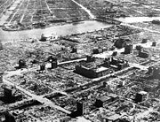
Strategic bombing in Europe never reached the decisive completeness the American campaign against Japan achieved, helped in part by the fragility of Japanese housing
Housing in Japan

Housing in Japan includes modern and traditional styles. Two patterns of residences are predominant in contemporary Japan: the single-family detached house and the multiple-unit building, either owned by an individual or corporation and rented as apartments to tenants, or owned by occupants....
, which was particularly vulnerable to firebombing
Firebombing

Firebombing is a bombing technique designed to damage a target, generally an urban area, through the use of fire, caused by incendiary devices, rather than from the blast effect of large bombs....
 through the use of incendiary bombs. The destruction of German infrastructure
Infrastructure

Infrastructure can be defined as the basic physical and organizational structures needed for the operation of a society or enterprise , or the services and facilities necessary for an economy to function....
 became apparent, but the Allied campaign against Germany only really succeeded when the Allies began targeting oil refineries and transportation in the last year of the war. At the same time, strategic bombing of Germany was used as a morale booster for the Allies in the period before the land war resumed in Western Europe.

If the Imperial Japanese Navy Air Service
Imperial Japanese Navy Air Service

The Imperial Japanese Navy Air Service was the air arm of the Imperial Japanese Navy during World War II, the organization was responsible for the operation of naval aircraft and the conduct of aerial warfare in the Pacific War....
 and the Imperial Japanese Army Air Service
Imperial Japanese Army Air Service

The =HistoryThe Imperial Japanese Army made use of hot air balloons for observation balloon purposes in the Russo-Japanese War on 1904-1905 and purchased its first aircraft, a Farman biplane, in 1910....
 frequently used strategic bombing over large Chinese cities such as Shanghai
Battle of Shanghai

The Battle of Shanghai was the first of the twenty-two major engagements fought between the National Revolutionary Army, Republic of China and the Imperial Japanese Army, Empire of Japan during the Second Sino-Japanese War....
, Guangzhou
Guangzhou

'Guangzhou' is the Capital and a sub-provincial city of Guangdong Province of China in the northern and southern China part of the People's Republic of China....
, Nanjing
Nanjing

is the capital city of China's Jiangsu province of China, and a city with a prominent place in Chinese history and Chinese culture. Nanjing served as the capital of China during several historical periods and is listed as one of the Historical capitals of China....
, and Chongqing
Bombing of Chongqing

The bombing of Chongqing was part of an Imperial Japanese Army Air Service and Imperial Japanese Navy Air Service terror bombing operation on the China provisional capital of Chongqing authorized by the Imperial General Headquarters....
, in the Pacific theatre
Pacific Theatre

Theatre may refer to:* Pacific War, the part of World War II fought in the Pacific Ocean, its islands, and East Asia between 1937 and 1945* Pacific Theater of Operations, a United States Navy command during the Pacific War...
, organized strategic bombing on a large scale by the Japanese seldom occurred. The Japanese military in most places advanced quickly enough that a strategic bombing campaign was unnecessary. In those places where it was required, the smaller Japanese bombers (in comparison to British and American types) did not carry a bombload sufficient to inflict the sort of damage regularly occurring at that point in the war in Europe, or later in Japan.

The development of the B-29 gave the United States a bomber with sufficient range to reach the Japanese Home Islands from the safety of American bases in the Pacific or Western China. The capture of the Japanese island of Iwo Jima
Iwo Jima

Iwo Jima is an island of the Japanese Volcano Islands chain, which makes up the southern end of the Ogasawara Islands. The island is located 1,200 kilometers south of mainland Tokyo and administered as part of Bonin Islands, one of eight villages of Tokyo....
 further enhanced the capabilities that the Americans possessed in their strategic bombing campaign. Conventional bombs and incendiary bombs were used against Japan to devastating effect.

Cold War

Nuclear weapon
Nuclear weapon

A nuclear weapon is an explosive device that derives its destructive force from nuclear reactions, either nuclear fission or a combination of fission and nuclear fusion....
s defined strategic bombing during the Cold War
Cold War

The Cold War was the continuing state of conflict, tension and competition that existed between a number of world powers, including the United States, the Soviet Union, People's Republic of China, France, United Kingdom and those countries' respective allies from the mid-1940s to the early 1990s....
. The age of the massive strategic bombing campaign had come to an end. It was replaced by more devastating attacks using improved sighting and weapons technology. Strategic bombing by the Great Powers also became politically indefensible. The political fallout resulting from the destruction being broadcast on the evening news
Evening News

Evening News may refer to:In television news:*CBS Evening News, an American news broadcast*ITV Evening News, a UK news broadcast...
 ended more than one strategic bombing campaign.

In the Vietnam war, the strategic bombing of North Vietnam in Operation Rolling Thunder
Operation Rolling Thunder

Operation Rolling Thunder was the title of a gradual and sustained U.S. 2nd Air Division , U.S. Navy, and Republic of Vietnam Air Force aerial bombardment campaign conducted against the Democratic Republic of Vietnam from 2 March 1965 until 1 November 1968, during the Vietnam War....
 could have been more extensive, but fear by the Johnson Administration of the entry of China into the war (and misapprehension of the nature and technique of strategic bombing) led to restrictions on the selection of targets, as well as only a gradual escalation of intensity. The aim of the bombing campaign was to demoralize the North Vietnamese, damage their economy, and reduce their capacity to support the war in the hope that they would negotiate for peace, but it failed to have those effects. The Nixon Administration
Richard Nixon

Richard Milhous Nixon was the List of Presidents of the United States President of the United States and the only president to resign the office....
 continued this sort of limited strategic bombing during the two Operation Linebacker
Operation Linebacker

Operation Linebacker was the title of a U.S. Seventh Air Force and U.S. Navy Task Force 77 aerial interdiction campaign conducted against the Democratic Republic of Vietnam from 9 May to 23 October 1972, during the Vietnam War....
 campaigns. Images such as that of Kim Phuc Phan Thi (although this incident was the result of close air support
Close air support

In military tactics, close air support is defined as air action by fixed or rotary winged aircraft against hostile targets that are in close proximity to friendly forces, and which requires detailed integration of each air mission with fire and movement of these forces....
 rather than strategic bombing) disturbed the American public enough to demand a stop to the campaign.

Due to this, and the ineffectiveness of carpet bombing
Carpet bombing

Carpet bombing refers to the tactical bombing of a strategic area usually by the use of large numbers of unguided gravity bombs, often with a high proportion of incendiary devices....
 (partly because of a lack of identifiable targets), new precision weapons were developed. The new weapons allowed more effective and efficient bombing with reduced civilian
Civilian

A civilian under international humanitarian law is a person who is not a member of his or her country's armed forces. The term is also often used colloquially to refer to people who are not members of a particular profession or occupation, especially by law enforcement agency, which often use rank structures similar to those of military units...
 casualties. High civilian casualties had always been the hallmark
Hallmark

A hallmark is a mark or series of marks struck on items made of precious metals — platinum, gold, silver and in some nations, palladium....
 of strategic bombing, but later in the Cold War, this began to change.

The Israeli Air Force
Israeli Air Force

The Israeli Air Force is the air force of the Israel Defense Forces. The current Commander in Chief is Aluf Ido Nehoshtan. The Israeli Air Force has approximately 700 aircraft....
 used strategic bombing during its brief but intense wars with its neighbors during the Six Day and Yom Kippur
Yom Kippur War

The Yom Kippur War, Ramadan War or October War , also known as the 1973 Arab-Israeli War and the Fourth Arab-Israeli War, was fought from October 6 to October 26, 1973 by a coalition of Arab states led by Egypt and Syria against Israel....
 wars. Strategic bombing was entering a new phase of high-intensity attacks, specifically targeting factories
Factory

A factory or manufacturing plant is an industry building where workers manufacturing Good or supervise machines Process Manufacturing one product into another....
 taking years and millions of dollars to build.

Post-Cold War

Strategic bombing in the post-Cold War era is defined by American advances in and the use of smart munitions. Beginning with the First Gulf War
Gulf War

"Persian Gulf War" and "First Gulf War" redirect here. For other uses, see Persian Gulf War .The Persian Gulf War was a United Nations-authorized military conflict between Iraq and a Coalition of Gulf War from 34 nations commissioned with expelling Iraqi forces from Kuwait after Iraq's Invasion of Kuwait of Kuwait in August 1990....
, and then more frequently in the Kosovo War
Kosovo War

Kosovo War occurred after the Rambouillet Agreement failed in February 1999. The term Kosovo War or Kosovo Conflict is used to describe two sequential and at times parallel armed conflicts in Kosovo:...
 and the initial phases of the 2003 Invasion of Iraq
2003 invasion of Iraq

The 2003 invasion of Iraq, from March 20 to May 1, 2003, was spearheaded by the United States, backed by United Kingdom forces and smaller contingents from Australia, Spain, Poland and Denmark....
, strategic bombing campaigns were notable for the heavy use of precision weaponry by those countries that possessed them. Although bombing campaigns were still strategic in their aims, the widespread area bombing tactics of World War II had mostly disappeared. This led to significantly fewer civilian casualties associated with previous bombing campaigns, though it has not brought about a complete end to civilian deaths or collateral property damage. Additionally, strategic bombing via smart munitions is now possible through the use of aircraft that have been considered traditionally tactical in nature such as the F-16 Fighting Falcon
F-16 Fighting Falcon

The Lockheed Martin F-16 Fighting Falcon is a Multirole combat aircraft jet aircraft fighter aircraft originally developed by General Dynamics for the United States Air Force....
 or F-15E Strike Eagle
F-15E Strike Eagle

The F-15E Strike Eagle is a 1980s United States all-weather strike fighter, designed for long-range Air interdiction of enemy ground targets deep behind enemy lines....
, which had been used during Operation Desert Storm, Operation Allied Force
Operation Allied Force

The NATO bombing of Yugoslavia was NATO's military operation against the Federal Republic of Yugoslavia. The strikes lasted from March 24, 1999 to June 11, 1999....
, Operation Enduring Freedom
Operation Enduring Freedom

Operation Enduring Freedom is the official name used by the U.S. Government for its contribution to the War in Afghanistan , together with three smaller military actions, under the umbrella of its War on Terrorism ....
 and Operation Iraqi Freedom to destroy targets that would have required large formations of strategic bombers during WWII. Some people refer to such pinpoint destruction of strategic, logistical or communications/command targets as "strategic interdiction" in order to distinguish from the large concentrated use of conventional or nuclear weapons against highly concentrated population centers
Terror bombing

Terror bombing is a strategy of deliberately bombing and/or strafing civilian targets in order to break the morale of the enemy, make its civilian population panic, bend the enemy's political leadership to the attacker's will, or to "punish" an enemy....
 or industrial targets, which is what "strategic bombing" had traditionally connoted during WWII and the Cold War. That said, such bombing still may have a place, as evidenced during the 2008 South Ossetia war
2008 South Ossetia war

The 2008 South Ossetia War, also known as August War, Five-Day War, Georgia-Russia Conflict or Russia-Georgia War, was an war between Georgia on the one side, and Russian Federation together with Separatism in South Ossetia and Abkhazia on the other....
 when Russian aircraft attacked the shipbuilding center of Poti
Poti

Poti is a port city in Georgia , located on the eastern Black Sea coast in the mkhare of Samegrelo-Zemo Svaneti in the west of the country. Built near the site of the Ancient Greece colony of Phasis , the city has become a major port city and industrial center since the early 20th century....
.

Technological advances

With the advent of precision-guided munition
Precision-guided munition

Precision-guided munitions are guided weapons intended to precisely hit a specific target, and to minimise damage to things other than the target....
s, many feel that strategic bombing has once again become a viable military strategy. Exactly how precise precision munitions are is still open to question. However, others predict that 21st century warfare will more often be asymmetrical, and therefore viable strategic bombing options may not exist.

A further question is raised when some see the blurring of strategic and tactical targets and missions, particularly when tactical aircraft are frequently used to carry out strikes on targets with significant strategic importance as a result of technological advances in aircraft design and munition guidance and penetration. For example, tactical strike aircraft such as F-16s were frequently used to destroy command and communications bunkers during Operation Iraqi Freedom while large "strategic" bombers such as the B-1 and B-52 were frequently used to provide sustained close air support at high altitude during Operation Enduring Freedom
Operation Enduring Freedom

Operation Enduring Freedom is the official name used by the U.S. Government for its contribution to the War in Afghanistan , together with three smaller military actions, under the umbrella of its War on Terrorism ....
.

Strategic bombing events

Among the controversial instances of strategic bombing (and it should be noted that there is still significant controversy over whether all of these events even constitute strategic bombing, as opposed to other forms, such as terror bombing) are:
  • Strategic bombing of "uncivilized tribes" during the British mandate
    League of Nations mandate

    A League of Nations mandate refers to a legal status for certain territories transferred from the control of one country to another following World War I, or the legal instruments that contained the terms for administering the territory on behalf of the League....
     of Iraq
    Iraq

    Iraq , officially the Republic of Iraq , is a country in Western Asia spanning most of the northwestern end of the Zagros Mountains, the eastern part of the Syrian Desert and the northern part of the Arabian Desert....
  • Spanish Civil War
    Spanish Civil War

    The Spanish Civil War was a major conflict in Spain that started after an attempted coup d'?tat by a group of Spanish Army generals, supported by the conservative Spanish Confederation of the Autonomous Right , Carlist groups and the fascistic Falange, against the government of the Second Spanish Republic, then under the leadership of pr...
    • The Bombing of Guernica
      Bombing of Guernica

      The bombing of Guernica was an Aerial bombing of cities on the Basque Country town of Guernica , causing widespread destruction and civilian deaths during the Spanish Civil War....
      : the first aerial bombardment in history in which a civilian population was targeted with the apparent intent of producing civilian casualties.
  • World War II
    • The Japanese bombing of Wuhan
      Battle of Wuhan

      The Battle of Wuhan , popularly known to Chinese people as the Defense of Wuhan , and to the Japanese people as the Invasion of Wuhan , was a large-scale battle of the Second Sino-Japanese War....
    • The Japanese bombing of Chongqing
      Bombing of Chongqing

      The bombing of Chongqing was part of an Imperial Japanese Army Air Service and Imperial Japanese Navy Air Service terror bombing operation on the China provisional capital of Chongqing authorized by the Imperial General Headquarters....
    • The Japanese attack on Pearl Harbor
      Attack on Pearl Harbor

      The attack on Pearl Harbor was a surprise military strike conducted by the Empire of Japan Imperial Japanese Navy against the United States' naval base at Pearl Harbor, Hawaii, on the morning of Sunday, December 7, 1941, later resulting in the United States becoming militarily involved in World War II....
    • The German bombing of Warsaw
      Warsaw

      Warsaw is the Capital and World's largest cities of Poland. It is located on the Vistula River roughly from both the Baltic Sea coast and the Carpathian Mountains....
    • The German bombing of Rotterdam
    • German attacks on the UK during The Blitz
      The Blitz

      The Blitz was the sustained bombing of United Kingdom by Nazi Germany between 7 September 1940 and 10 May 1941, in World War II. While the "Blitz" hit many towns and cities across the country, it began with the bombing of London for 57 consecutive nights ....
       and afterwards, through the V-1 and V-2 attacks in the last year of the war.
    • The German bombing of Belgrade
      Belgrade

      Belgrade is the capital and largest city of Serbia. The city lies on international waterway, at the confluence of the Sava River and Danube rivers, where the Pannonian Plain meets the Balkan Peninsula....
    • The German bombing of Moscow.
    • Allied bombing of Hamburg
      Bombing of Hamburg in World War II

      The large port city of Hamburg, Germany, was very heavily bombed many times by the Royal Air Force and the United States Army Air Forces during World War II....
    • Allied bombing of Berlin
    • Allied bombing of Dresden
      Bombing of Dresden in World War II

      The Bombing of Dresden by the British Royal Air Force and United States Army Air Force between 13 February and 15 February 1945, 12 weeks before the German Instrument of Surrender of the Armed Forces of Nazi Germany, remains one of the most controversial Allied actions of the World War II....
    • Allied bombing of Milan
      Milan

      Milan is the second largest city of Italy, located in the plains of Lombardy. It is the capital in the Province of Milan, as well as the Regions of Italy capital of Lombardy....
      .
    • United States bombing of Tokyo
      Doolittle Raid

      The Doolittle Raid, 18 April 1942, was the first airstrike by the United States to strike a Japanese home island during World War II. It demonstrated that Japan itself was vulnerable to Allies of World War II air attack and provided an expedient means for U.S....
    • United States bombing of Tokyo
      Bombing of Tokyo in World War II

      The bombing of Tokyo by the United States Army Air Forces took place at several times during the Pacific War of World War II and included the most destructive bombing raid in history....
    • United States bombing of Kobe
      Bombing of Kobe in World War II

      On March 17, 1945, 331 United States B-29 Superfortress launched a firebombing attack against the city of Kobe, Japan. Of the city's residents, 8,841 were confirmed to have been killed in the resulting firestorms, which destroyed an area of three square miles and included 21% of Kobe's urban area....
    • United States atomic bombings of Hiroshima and Nagasaki
      Atomic bombings of Hiroshima and Nagasaki

      The atomic bombings of Hiroshima and Nagasaki were nuclear warfares near the end of World War II against the Empire of Japan by the United States at the executive order of President of the United States Harry S....
  • Vietnam war
    Vietnam War

    The Vietnam War, also known as the Second Indochina Wars, the Vietnam Conflict, or often in Vietnam the American War occurred in Vietnam, Laos and Cambodia from 1959 to April 30, 1975....
    • United States bombing of the Ho Chi Minh Trail
      Ho Chi Minh trail

      Ho Chi Minh Trail The Ho Chi Minh trail was a path that ran from the Democratic Republic of Vietnam to the Republic of Vietnam through the neighboring kingdoms of Laos and Cambodia....
    • United States bombing of Hanoi
      Hanoi

      Hanoi , estimated population 3,398,889 , is the Capital of Vietnam. From 1010 until 1802, with a few brief interruptions, it was the political centre of an independent Vietnam....
    • United States bombing of Cambodia
      Cambodia

      The Kingdom of Cambodia is a country in South East Asia with a population of over 13 million people. The kingdom's capital and largest city is Phnom Penh....
  • Allied bombing of Iraq during the first Gulf War
    Gulf War

    "Persian Gulf War" and "First Gulf War" redirect here. For other uses, see Persian Gulf War .The Persian Gulf War was a United Nations-authorized military conflict between Iraq and a Coalition of Gulf War from 34 nations commissioned with expelling Iraqi forces from Kuwait after Iraq's Invasion of Kuwait of Kuwait in August 1990....
    • Strategic bombing of civilian targets in Iraq
      Iraq

      Iraq , officially the Republic of Iraq , is a country in Western Asia spanning most of the northwestern end of the Zagros Mountains, the eastern part of the Syrian Desert and the northern part of the Arabian Desert....
  • Yugoslav Wars
    Yugoslav wars

    The Yugoslav Wars were a series of violent conflicts in the territory of the former Socialist Federal Republic of Yugoslavia that took place between 1991 and 2001....
     (1991-1999)
    • NATO bombing of Republika Srpska
      NATO bombing of Republika Srpska

      The 1995 NATO bombing in Bosnia and Herzegovina was a sustained military campaign conducted by the North-Atlantic military organization to undermine the military capability of the Bosnian Serb Army who threatened and attacked UN-designated "United Nations Safe Areas" in Bosnia and Herzegovina....
       (1995) (Operation Deliberate Force)
    • Kosovo War
      Kosovo War

      Kosovo War occurred after the Rambouillet Agreement failed in February 1999. The term Kosovo War or Kosovo Conflict is used to describe two sequential and at times parallel armed conflicts in Kosovo:...
       (1999)
      • NATO
        NATO

        The North Atlantic Treaty Organization , also called the Atlantic Alliance, is a military alliance established by the signing of the North Atlantic Treaty on 4 April 1949....
         bombing of industry and other civilian infrastructure in Serbia
        Serbia

        Serbia , officially the Republic of Serbia , is a country in Central Europe and Balkans Europe, covering the southern part of the Pannonian Plain and the central part of the Balkans....
        . Examples include the bombing of the Chinese embassy
        NATO Bombing of the Chinese embassy in Belgrade

        On May 7, 1999 in Operation Allied Force, NATO bombs hit the People's Republic of China Embassy in Belgrade, killing three PRC citizens and outraging the PRC public....
         in Belgrade
        Belgrade

        Belgrade is the capital and largest city of Serbia. The city lies on international waterway, at the confluence of the Sava River and Danube rivers, where the Pannonian Plain meets the Balkan Peninsula....
         (claimed to have been done by mistake) and the deliberate bombing of the main TV
        Television

        Television is a widely used telecommunication mass-media for transmitting and receiving moving , either monochrome or color, usually accompanied by sound....
         center in Belgrade
        Belgrade

        Belgrade is the capital and largest city of Serbia. The city lies on international waterway, at the confluence of the Sava River and Danube rivers, where the Pannonian Plain meets the Balkan Peninsula....
        .
  • The 2003 invasion of Iraq
    2003 invasion of Iraq

    The 2003 invasion of Iraq, from March 20 to May 1, 2003, was spearheaded by the United States, backed by United Kingdom forces and smaller contingents from Australia, Spain, Poland and Denmark....
    • Precision laser
      Laser

      A laser is a device that emits light through a process called stimulated emission. The term laser is an acronym for light amplification by stimulated emission of radiation....
       and GPS guided bombs were used extensively, not only to damage and destroy Saddam Hussein
      Saddam Hussein

      Saddam Hussein Abd al-Majid al-Tikriti was the President of Iraq of Iraq from 16 July 1979 until 9 April 2003.A leading member of the revolutionary Ba'ath Party, which espoused secular pan-Arabism, economic modernization, and Arab socialism, Saddam played a key role in the 1968 coup that brought the party to long-term power....
      's army but also to damage infrastructure such as communications, utilities, and various government buildings. The campaign moved into asymmetric warfare
      Asymmetric warfare

      Asymmetric warfare originally referred to war between two or more belligerents whose relative military power differs significantly. Contemporary military thinkers tend to broaden...
       once strategic targets no longer existed or were not viable targets.


Pioneers of strategic bombing

  • Henry H. "Hap" Arnold
    Henry H. Arnold

    Henry Harley "Hap" Arnold, Order of the Bath, was a 5 star rank general officer holding the grades of General of the Army and later General of the Air Force....
    , USAAF
  • Giulio Douhet
    Giulio Douhet

    General Giulio Douhet was an Italian air power theorist. He was a key proponent of strategic bombing in aerial warfare....
    , Regia Aeronautica
    Regia Aeronautica

    The Italian Royal Air Force was the name of the air force of the Kingdom of Italy . It was established as a service independent of the Regio Esercito from 1923 until 1946....
     (Italy)
  • Arthur "Bomber" Harris
    Arthur Travers Harris

    Marshal of the Royal Air Force Sir Arthur Travers Harris, 1st Baronet Order of the Bath Order of the British Empire Air Force Cross RAF , commonly known as "Bomber" Harris by the press, and often within the RAF as "Butcher" Harris, was Air Officer Commanding of RAF Bomber Command and later a Marshal of the Royal Air Force during...
    , RAF
    Royal Air Force

    The Royal Air Force is the United Kingdom's air force, the oldest independent air force in the world. Formed on 1 April 1918, the RAF has taken a significant role in British military history ever since, playing a large part in World War II and in more recent conflicts....
  • Curtis LeMay, USAAF
  • Billy Mitchell
    Billy Mitchell

    William Lendrum "Billy" Mitchell was an American general who is regarded as the father of the U.S. Air Force. He is one of the most famous and most controversial figures in the history of American airpower....
    , USAAC
  • Carl Spaatz
    Carl Spaatz

    Carl Andrew "Tooey" Spaatz Order of the British Empire was an United States World War II general and the first Chief of Staff of the United States Air Force....
    , USAAF
  • Hugh Trenchard, RAF
    Royal Air Force

    The Royal Air Force is the United Kingdom's air force, the oldest independent air force in the world. Formed on 1 April 1918, the RAF has taken a significant role in British military history ever since, playing a large part in World War II and in more recent conflicts....


See also


  • Air raid shelter
  • Air raid siren
  • Air raid precautions
    Air Raid Precautions

    Air Raid Precautions was an organisation in the United Kingdom set up as an aid in the prelude to the Second World War dedicated to the protection of civilians from the danger of Aerial bombing of cities#European theatre....
  • Airstrike
    Airstrike

    An airstrike is a military strike by air forces on either a suspected or a confirmed enemy ground position. Airstrikes are commonly delivered from aircraft such as bombers, ground attack aircraft, strike fighters, and helicopters....
  • Aerial bomb
    Aerial bomb

    An aerial bomb is a kind of bomb designed to travel through the air with predictable trajectories, usually designed to be dropped from an aircraft....
  • Aerial bombing
    Aerial bombing

    Aerial bombing may refer to:*Short-term air-to-ground attacks known as Airstrikes*Longer-term Strategic bombing campaigns...
  • Aerial bombing of cities
    Aerial bombing of cities

    The aerial bombing of cities began in 1911, developed through World War I, grew to a vast scale in World War II, and continues to the present day....
  • Area bombardment
    Area bombardment

    Aerial area bombardment is the policy of indiscriminate bombing of an enemy's cities, for the purpose of destroying the enemy's means of producing military materiel, communications, government centres and civilian morale....
  • Carpet bombing
    Carpet bombing

    Carpet bombing refers to the tactical bombing of a strategic area usually by the use of large numbers of unguided gravity bombs, often with a high proportion of incendiary devices....
  • Civilian deaths by aerial bombing
    Civilian deaths by aerial bombing

    This article is a list of civilian deaths by aerial bombing which includes ground to ground long range missiles and rockets....
  • Firebombing
    Firebombing

    Firebombing is a bombing technique designed to damage a target, generally an urban area, through the use of fire, caused by incendiary devices, rather than from the blast effect of large bombs....
  • Strategic Air Command
    Strategic Air Command

    The Strategic Air Command was both a major command in the United States Air Force and a "specified command" in the United States Department of Defense....
     (USA)
  • Strategic Bombing Survey
    Strategic bombing survey

    The term strategic bombing survey refers to a series of American examinations of many topics related to their involvement in World War II. The primary purpose of the survey was to determine the effectiveness of Allied, and more specifically American, strategic bombing campaigns in Europe and in Asia against the Axis powers....
  • Tactical bombing
    Tactical bombing

    Tactical bombing uses aircraft to attack troops and military equipment in the battle zone. This is in contrast to strategic bombing, which attacks an enemy's cities and factories to debilitate the enemy's capacity to wage war as well as the civilian population's will to continue the war....
  • Terror bombing
    Terror bombing

    Terror bombing is a strategy of deliberately bombing and/or strafing civilian targets in order to break the morale of the enemy, make its civilian population panic, bend the enemy's political leadership to the attacker's will, or to "punish" an enemy....


Further reading

  • Spaight. James M. G. Bles, 1944. ASIN: B0007IVW7K (Spaight was Principal Assistant Secretary of the Air Ministry) (U.K)