
All Topics  
Destroyer

 
Destroyer

   Email Print
   Bookmark   Link


Destroyer


In naval
Navy

A navy is the branch of a nation's military forces principally designated for naval warfare and amphibious warfare; namely, lake- or ocean-borne combat operations and related functions....
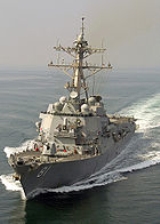
 terminology, a destroyer is a fast and maneuverable yet long-endurance warship
Warship

A warship is a ship that is built and primarily intended for combat. Warships are usually built in a completely different way than cargo ship....
 intended to escort larger vessels in a fleet
Naval fleet

A fleet, or naval fleet, is a large formation of warships, and the largest formation in any navy. A fleet at sea is the direct equivalent of an army on land....
, convoy
Convoy

A convoy is a group of vehicles traveling together for mutual support and protection. Often, a convoy is organized with armed defensive support, though it may also be used in a non-military sense, for example when driving through remote areas....
 or battle group
Battle group

Battle group may refer to:* Carrier battle group, an aircraft carrier and its escorts, examples of which are:** the Abraham Lincoln Battle Group...
 and defend them against smaller, short-range but powerful attackers (originally torpedo boat
Torpedo boat

A torpedo boat is a relatively small and fast navy ship designed to carry torpedoes into battle. The first designs rammed enemy ships with explosive spar torpedoes, and later designs launched self-propelled Torpedo#Self-propelled torpedoeses....
s, later submarine
Submarine

A submarine is a watercraft capable of independent operation below water. It differs from a submersible, which has only limited underwater capability....
s and aircraft
Aircraft

An aircraft is a vehicle which is able to flight by being supported by the air, or in general, the atmosphere, of a planet. Examples include balloons, airplanes and helicopters....
).

Before World War II
World War II

World War II, or the Second World War , was a global military conflict which involved a Participants in World War II, including all of the great powers, organised into two opposing military alliances: the Allies of World War II and the Axis powers....
, destroyers were light vessels without the endurance for unattended ocean operations; typically a number of destroyers and a single destroyer tender
Destroyer tender

Destroyer tender is a ship designed to provide maintenance support to a flotilla of destroyers or other small warships. The use of this class has faded from its peak in the first half of the 20th century as the roles of small combatants have evolved ....
 operated together.


Discussion
Ask a question about 'Destroyer'
Start a new discussion about 'Destroyer'
Answer questions from other users
Full Discussion Forum


Encyclopedia


In naval
Navy

A navy is the branch of a nation's military forces principally designated for naval warfare and amphibious warfare; namely, lake- or ocean-borne combat operations and related functions....
 terminology, a destroyer is a fast and maneuverable yet long-endurance warship
Warship

A warship is a ship that is built and primarily intended for combat. Warships are usually built in a completely different way than cargo ship....
 intended to escort larger vessels in a fleet
Naval fleet

A fleet, or naval fleet, is a large formation of warships, and the largest formation in any navy. A fleet at sea is the direct equivalent of an army on land....
, convoy
Convoy

A convoy is a group of vehicles traveling together for mutual support and protection. Often, a convoy is organized with armed defensive support, though it may also be used in a non-military sense, for example when driving through remote areas....
 or battle group
Battle group

Battle group may refer to:* Carrier battle group, an aircraft carrier and its escorts, examples of which are:** the Abraham Lincoln Battle Group...
 and defend them against smaller, short-range but powerful attackers (originally torpedo boat
Torpedo boat

A torpedo boat is a relatively small and fast navy ship designed to carry torpedoes into battle. The first designs rammed enemy ships with explosive spar torpedoes, and later designs launched self-propelled Torpedo#Self-propelled torpedoeses....
s, later submarine
Submarine

A submarine is a watercraft capable of independent operation below water. It differs from a submersible, which has only limited underwater capability....
s and aircraft
Aircraft

An aircraft is a vehicle which is able to flight by being supported by the air, or in general, the atmosphere, of a planet. Examples include balloons, airplanes and helicopters....
).

Before World War II
World War II

World War II, or the Second World War , was a global military conflict which involved a Participants in World War II, including all of the great powers, organised into two opposing military alliances: the Allies of World War II and the Axis powers....
, destroyers were light vessels without the endurance for unattended ocean operations; typically a number of destroyers and a single destroyer tender
Destroyer tender

Destroyer tender is a ship designed to provide maintenance support to a flotilla of destroyers or other small warships. The use of this class has faded from its peak in the first half of the 20th century as the roles of small combatants have evolved ....
 operated together. During and after the war, larger and more powerful destroyers capable of independent operation were built, particularly as cruiser
Cruiser

A cruiser is a large type of warship, which had its prime period from the late 19th century to the end of the Cold War. The first cruisers were intended for individual raiding and protection missions on the seas....
s ceased to be used in the 1950s and 60s.

At the dawn of the 21st Century, destroyers are the heaviest surface combatant
Surface combatant

Surface combatants denotes a subset of Navy fighting ships; generally speaking, they are ships built to fight other ships, submarines or aircraft, and can carry out several other missions including counter-narcotics operations and maritime interdiction....
 ships in general use, with only four nations (the United States
United States Navy

The United States Navy is the navy of the United States Armed Forces. It is one of the seven uniformed services of the United States. The U.S. Navy currently has approximately 331,682 personnel on active duty as of 31 December 2008 and 124,000 in the United States Navy Reserve....
, Russia
Russian Navy

The Russian Navy or VMF is the Navy of the Russian Armed Forces. The international designation of Russian naval vessels is "RFS" - "Russian Federation Ship"....
, France
French Navy

The French Navy, officially the Marine nationale and often called La Royale , is the maritime arm of the French military. It consists of a full range of vessels, from patrol boats to guided missile frigates, and includes one nuclear aircraft carrier and ten nuclear submarines ....
 and Peru
Peruvian Navy

The Peruvian Navy is the branch of the Peruvian Military of Peru tasked with surveillance, patrol and defense on lakes, rivers and the Pacific Ocean up to 200 nautical miles from the Peruvian littoral....
) operating the heavier class cruisers and none operating battleship
Battleship

A battleship is a large, heavily armour warship with a main artillery battery consisting of the largest calibre of guns. Battleships were larger, better armed, and better armored than cruisers and destroyers....
s or true battlecruiser
Battlecruiser

Battlecruisers were large warships in the first half of the 20th century that were first introduced by the Royal Navy. The battlecruiser was developed as the successor to the armoured cruisers, but their evolution was more closely linked to that of the dreadnought battleships....
s. Modern destroyers, also known as guided missile destroyer
Guided missile destroyer

A guided missile destroyer is a destroyer designed to launch guided missiles. Many are also equipped to carry out Anti-submarine warfare, Anti-aircraft warfare, and ASUW Modern Naval tactics....
s, are equivalent in tonnage but vastly superior in firepower to cruisers of the World War II era, capable of carrying nuclear missiles.

Early history


The emergence and development of the destroyer, up until World War II, was related to the invention of the self-propelled torpedo
Torpedo

Note: Prior to 1900, in naval usage "torpedo" could also refer to what today is called a naval mine. For that usage, see naval mine.The modern torpedo is a self-propelled explosive projectile weapon, launched above or below the water surface, propelled underwater toward a target, and designed to detonate on contact or in proximity t...
 in the 1860s. A navy now had the potential to destroy a superior enemy battle fleet using steam launches to drop torpedoes. Fast boats armed with torpedoes were built and called torpedo boat
Torpedo boat

A torpedo boat is a relatively small and fast navy ship designed to carry torpedoes into battle. The first designs rammed enemy ships with explosive spar torpedoes, and later designs launched self-propelled Torpedo#Self-propelled torpedoeses....
s. By the 1880s, these had evolved into small ships of 50-100 tons, fast enough to evade enemy picket boats, but still weighing a lot.

At first, the danger to a battle fleet was considered only to exist when at anchor, but as faster and longer range torpedoes were developed, the threat extended to cruising at sea. In response to this new threat more heavily-gunned picket boats called "catchers" were built which were used to escort the battle fleet at sea. They needed the same seaworthiness and endurance, and as they necessarily became larger, they became officially designated "torpedo boat destroyers", soon contracted to destroyer in English. The anti-torpedo boat origin of this type of ship is retained in its name in other languages, including French
French language

French is a Romance language spoken around the world by around 80 million people as first language, by 190 million as second language, and by about another 200 million people as an acquired tongue, with significant speakers in 54 countries....
 (contre-torpilleur), Italian
Italian language

Italian is a Romance languages spoken by about 63 million people as a first language, primarily in Italy. In Switzerland, Italian is one of four Linguistic geography of Switzerlands....
 (cacciatorpediniere), Spanish
Spanish language

Spanish or Castilian is a Romance languages that originated in northern Spain, and gradually spread in the Kingdom of Castile and evolved into the principal language of government and trade....
 (cazatorpedero), Portuguese
Portuguese language

Portuguese is a Romance language that originated in what is now Galicia and Portugal. It is derived from the Latin language spoken by the Romanization Pre-Roman peoples of the Iberian Peninsula around 2000 years ago....
 (contratorpedeiro), Polish
Polish language

Polish , an official language of Poland, has the largest number of speakers of any West Slavic languages. Polish-speakers use the language in a uniform manner through most of Poland, and it has a regular orthography....
 (kontrtorpedowiec), Czech
Czech language

Czech is a West Slavic language with about 12 million native speakers; it is the majority language in the Czech Republic and spoken by Czech people worldwide....
 (torpédoborec), Greek
Greek language

Greek is an Indo-European languages native to the southern Balkan peninsula, the language of the Greek people. It forms an independent branch within Indo-European....
 (antitorpiliko,a?t?t??p?????) and so on.

Once destroyers became more than just catchers guarding an anchorage, it was realized that they were also ideal to take over the role of torpedo boats themselves, so they were fitted with torpedo tubes as well as guns. At that time, and even into World War I
World War I

World War I, or the First World War , was a global military conflict which involved the Great powers, organized into two opposing military alliances: the Allies of World War I and the Central Powers....
, the only function of destroyers was to protect their own battle fleet from enemy torpedo attacks and to make such attacks on the battleships of the enemy. The task of escorting merchant convoys was still in the future.

An important development came in 1884 with HMS Swift, a large torpedo boat with six 47 mm quick-firing guns and three torpedo tubes. While still not fast enough to engage torpedo boats reliably, she at least had the armament to deal with them.

Kotaka
The Japanese Kotaka (Falcon) of 1885 was "the forerunner of torpedo boat destroyers that appeared a decade later". Designed to Japanese specifications and ordered from the London Yarrow shipyards in 1885, she was transported in parts to Japan, where she was assembled and launched in 1887. She was armed with four 1-pounder (37 mm) quick-firing guns and six torpedo
Torpedo

Note: Prior to 1900, in naval usage "torpedo" could also refer to what today is called a naval mine. For that usage, see naval mine.The modern torpedo is a self-propelled explosive projectile weapon, launched above or below the water surface, propelled underwater toward a target, and designed to detonate on contact or in proximity t...
 tubes, reached 19 knots (35 km/h), and at 203 tons, was the largest torpedo boat yet. In her trials in 1889, Kotaka demonstrated that she could go beyond a role of coastal defense, and was capable of following larger ships on the high seas. The Yarrow shipyards, builder of the parts for the Kotaka, "considered Japan to have effectively invented the destroyer".

Contratorpederodestructor
Almost immediately after the order of Kotaka was placed, Fernando Villaamil
Fernando Villaamil

Fernando Villaamil was a Spanish people naval officer, remembered for his internationally recognized professionalism, for being the designer of the first destroyer warship in history and for his heroic death in the naval Battle of Santiago de Cuba of the Spanish-American war, being the highest Spanish officer to suffer this fate in that ev...
, second officer of the Ministry of the Navy of Spain
Spanish Navy

The Spanish Armada is the maritime arm of the Military of Spain, one of the oldest active naval forces in the world. The Armada is responsible for notable achievements in world history such as the discovery of America, the first world circumnavigation, and the discovery of a maritime path from the Far East to America ....
 where he was put in charge of developing the concept of a new ship designed to combat torpedo boats, placed an order for a large torpedo gunboat in November 1885, with the British builder James and George Thompson, of Clydebank
Clydebank

Clydebank is a town in West Dunbartonshire, in the Central Lowlands of Scotland. Situated on the north bank of the River Clyde, Clydebank borders Dumbarton, the town with which it was combined to form West Dunbartonshire, as well as the town of Milngavie in East Dunbartonshire, and the Yoker and Drumchapel districts of the adjacent City of G...
, not far from where the Yarrow shipyards would move from London twenty years later. The ship, named Destructor (literally Destroyer), was laid down at the end of the year, launched in 1886, and commissioned in 1887. Her displacement was 380 tons, and she was armed with one 90 mm Hontoria cannon, four 57 mm Nordenfelt cannon, two 37 mm Hotchkiss gun
Hotchkiss gun

The Hotchkiss gun can refer to different products of the Hotchkiss et Cie arms company starting in the late 1800s. It usually refers to the 1.65-inch light mountain gun; there was also a 3-inch Hotchkiss gun....
s and 3 Schwarzkopf torpedo tubes. Her complement was 60 men. In terms of gunnery, speed (22.5 knots in trials) and dimensions, the specific design to chase torpedo boats and her high seas capabilities, Destructor is widely considered the first destroyer ever built.

The Spanish Destructor is thought to have influenced the designation and concept of later destroyers developed by the British Navy.

Shortly afterwards, Britain began experiments with the Rattlesnake class 'torpedo boat catcher', a class of 17 large torpedo boats - the first precursors of destroyers to be built as a class, rather than as single ships. On tests, Rattlesnake proved to be marginally faster than torpedo boats, but not fast enough to be decisive.

Hms Havock (1893)
The first ships to bear the formal designation "Torpedo boat destroyer" (TBD) were the Havock class
Havock class destroyer

The Havock class was a ship class of destroyer of the United Kingdom Royal Navy. The two ships, HMS Havock and HMS Hornet , built in London in 1893 by Yarrow & Company, were the first TBDs in the Royal Navy....
 of two ships of the Royal Navy
Royal Navy

The Royal Navy of the United Kingdom is the oldest of the British Armed Forces . From the mid-18th century until well into the 20th century, it was the most powerful navy in the world, playing a key part in establishing the British Empire as the dominant world power from 1815 until the early 1940s....
, developed in 1892 under the newly appointed Third Sea Lord
Third Sea Lord

The Third Sea Lord and Controller of the Navy was formerly the Naval Lord and member of the Board of Admiralty responsible for procurement and mat?riel in the United Kingdom Royal Navy....
 Rear Admiral
Rear Admiral

Rear Admiral is a naval commissioned officer rank above that of a Commodore and Captain , and below that of a Vice Admiral. It is the lowest form of Admiral....
 "Jackie" Fisher, and launched by Yarrows in London in 1893. Havock had a 240 tons displacement, a speed of 27 knots (50 km/h), and was armed with a single 12-pounder (76 mm) gun
12-pounder gun

12-pounder gun or 12-pdr, usually denoting a gun which fired a projectile of approximately 12 pounds, may refer to:* A Twelve-pound cannon sized for a 12 pound ball, see Naval artillery in the Age of Sail...
, three 6-pounders (57 mm), and three 46 cm torpedo tubes. She also had the range and speed to effectively travel with a battle fleet.

The French navy, an extensive user of torpedo boats, built its first destroyer in 1899, with the Durandal-class 'torpilleur d'escadre'.

The United States
United States

The United States of America is a Federal government constitutional republic comprising U.S. state and a federal district. The country is situated mostly in central North America, where its Contiguous United States and Washington, D.C., the Capital districts and territories, lie between the Pacific Ocean and Atlantic Oceans, Borders of the U...
 commissioned its first destroyer, USS Bainbridge
USS Bainbridge (DD-1)

The second USS Bainbridge was the first destroyer in the United States Navy and the lead ship of Bainbridge class destroyer. She was named for William Bainbridge....
, Destroyer No. 1, in 1902 and by 1906 there were 16 destroyers in service with the US Navy.

Pre World War I


Destroyer design evolved around the turn of the 20th century in several key ways. The first was the introduction of the steam turbine
Steam turbine

A steam turbine is a mechanical device that extracts thermal energy from pressurized steam, and converts it into rotary motion. Its modern manifestation was invented by Charles Algernon Parsons in 1884....
. The spectacular unauthorized demonstration of the turbine powered Turbinia
Turbinia

Turbinia was the first steam turbine powered steamship. Built as an experimental vessel in 1894, and easily the fastest ship in the world at that time, Turbinia was demonstrated dramatically at the Spithead Navy Review in 1897 and set the standard for the next generation of steamships, the majority of which were turbine powered....
 at the 1897 Spithead Navy Review, which, significantly, was of torpedo boat size, prompted the Royal Navy to order a prototype turbine powered destroyer, HMS Viper
Viper class destroyer

The Viper class was a group of two Torpedo Boat Destroyers built for the United Kingdom Royal Navy in 1899.They were notable for being the first warships to use steam turbine propulsion....
 of 1899. This was the first turbine warship of any kind and achieved a remarkable on sea trials. By 1910 the turbine had been widely adopted by all navies for their faster ships.

The second development was the replacement of the boat-style turtleback foredeck by a raised forecastle
Forecastle

Forecastle, also spelled fo'c's'le , originally meant the upper deck of a sailing ship, forward of the foremast. The syncope of the word is common among nautical terms due to the nature of their pronunciation during the age of sail by sailors with strong accents and varying language skills....
, which provided better sea-keeping as well as more space below deck.

Uss Perkins (dd 26)
The British experimented with oil propulsion for the Tribal class
Tribal class destroyer (1905)

The Tribal or F class was a ship class of destroyer built for the Royal Navy. Twelve ships were built between 1905 and 1908 and all saw service during World War I, where they saw action in the North Sea and English Channel as part of the 6th Flotilla and Dover Patrols....
 of 1905 but switched temporarily back to coal for the later Beagle class
Beagle class destroyer

The Beagle class was a ship class of sixteen destroyers of the Royal Navy, all ordered under the 1908-1909 Programme and launched in 1909 and 1910....
 in 1909. Other navies also adopted oil, for instance the USN with the Paulding class
Paulding class destroyer

The Paulding-class destroyers were a modification of the Smith class destroyer. The newer class burned oil rather than coal, lightening the ships and making them faster....
 of 1909. In spite of all this variety, destroyers adopted a largely similar pattern. The hull was long and narrow, with a relatively shallow draft. The bow was either raised in a forecastle or covered under a turtleback; underneath this were the crew spaces, extending 1/4 to 1/3 the way along the hull. Aft of the crew spaces was as much engine space as the technology of the time would allow: several boilers and engines or turbines. Above deck, one or more quick-firing guns were mounted in the bows, in front of the bridge; several more were mounted amidships and astern. Two torpedo tube mountings (later on, multiple mountings) were generally found amidships.

Between 1890 and 1914 destroyers became markedly larger: initially 300 tons was a good size, but by the start of the First World War 1000 tons was not unusual. However, construction remained focused on putting the biggest possible engines into a small hull, resulting in a somewhat flimsy construction. Often hulls were built of steel only 1/8in thick.

By 1910 the steam-driven displacement (i.e. not hydroplaning
Hydroplaning

Hydroplaning and hydroplane may refer to:* Hydroplaning , a loss of steering or braking control when a layer of water prevents direct contact between road vehicle or aircraft tires and the road or runway surface...
) torpedo boat had become redundant as a separate type. Germany nevertheless continued to build such torpedo boats until the end of WW1, although these were effectively small coastal destroyers. In fact Germany never distinguished between the two types, giving them pennant numbers in the same series and never giving names to destroyers. Ultimately the term torpedo boat came to be attached to a quite different vessel - the very fast hydroplaning motor driven MTB
Motor Torpedo Boat

Motor Torpedo Boat was the name given to fast torpedo boats by the Royal Navy, the Royal Canadian Navy and the US Navy.During World War II the US Navy boats were usually called by their hull classification symbol of "PT" and are covered under PT boat though the class type was still 'motor torpedo boat'....
.

Life on early destroyers


Early destroyers were extremely cramped places to live. In the Havock-class no crew member could ever get undisturbed rest, with officers sleeping on cushioned chairs around the wardroom instead of beds. Spray and condensation made life miserable. The first British class to have separate cabins for officers, or a heating stove for the captain, was the River class
River class destroyer

The River-class destroyer was a heterogeneous class of torpedo boat destroyer built to assorted builders' designs for the Royal Navy at the turn of the 20th century, which saw extensive service in World War I....
 of 1902.

Early Destroyer tactics and engagements


The destroyer's initial purpose was to protect against torpedo boats, but navies soon appreciated the flexibility of the fast, multi-purpose vessel that resulted. Vice-Admiral Sir Baldwin Walker laid down for the Royal Navy:
  • Screening the advance of a fleet when hostile torpedo craft are about
  • Searching a hostile coast along which a fleet might pass
  • Watching an enemy's port for the purpose of harassing his torpedo craft and preventing their return
  • Attacking an enemy fleet


The destroyer's first major use came in the devastating Japanese attack on the Russian fleet in Port Arthur
Battle of Port Arthur

The Battle of Port Arthur was the starting battle of the Russo-Japanese War. It began with a surprise night attack by a squadron of Imperial Japanese Navy destroyers on the Imperial Russian Navyn fleet anchored at L?shunkou, Manchuria, and continued with an engagement of major surface combatants the following morning....
 at the opening of the Russo-Japanese War
Russo-Japanese War

The Russo-Japanese War or the Manchurian Campaign in some English sources, was a conflict that grew out of the rival imperialism ambitions of the Russian Empire and the Empire of Japan over Manchuria and Korea....
 in 1904. Three destroyer divisions attacked the Russian fleet in port, firing a total of 18 torpedoes, and severely damaging two Russian battleships.

World War I

Wickes Dd75
While capital ship engagements were scarce in World War I, destroyer units were almost continually engaged in raiding and patrol actions. The first shot of the war at sea was fired on 5 August 1914 by a destroyer of the 2nd Flotilla, Lance
HMS Lance (1914)

HMS Lance was a Laforey class destroyer destroyer of the United Kingdom Royal Navy. In company with HMS Landrail she fired the first British shot of the First World War on 5 August 1914....
, in an engagement with the German auxiliary minelayer
Minelayer

Minelaying is the act of deploying explosive mines. Historically this has been carried out by ships, submarines and aircraft. Additionally, the term Minelayer refers specifically to a naval ship used for deploying naval mines....
 Königin Luise. The first British naval casualty was Amphion
HMS Amphion (1911)

HMS Amphion was an Active class cruiser scout cruiser of the Royal Navy. She was built at Pembroke Dockyard and launched on 4 December 1911....
, the light cruiser leading the 3rd Flotilla, which ran into a mine laid by Königin Luise.

Destroyers were involved in the skirmishes that prompted the Battle of Heligoland Bight
Battle of Heligoland Bight

The First Battle of Heligoland Bight was the first naval battle of the World War I, fought on 28 August 1914, after the Great Britain planned to attack German Empire patrols off the north-west German coast....
, and filled a range of roles in the Battle of Gallipoli
Battle of Gallipoli

The Gallipoli Campaign took place at Gallipoli peninsula in Turkey from 25 April 1915 to 9 January 1916, during the World War I. A joint British Empire and French operation was mounted to capture the Ottoman Empire capital of Constantinople , and secure a sea route to Russia....
, acting as troop’s transports and fire support vessels, as well as their fleet-screening role. Over 80 British destroyers and 60 German torpedo-boats took part in the Battle of Jutland
Battle of Jutland

The Battle of Jutland was the largest naval battle of World War I and the only full-scale clash of battleships in that war. It was only the second major fleet action between steel battleships in any war, following the Battle of Tsushima in 1905, but was also the last....
, which involved pitched small-boat actions between the main fleets, and several foolhardy attacks by unsupported destroyers on capital ships. Jutland also concluded with a messy night action between the German High Seas Fleet and part of the British destroyer screen.

The threat evolved by World War I
World War I

World War I, or the First World War , was a global military conflict which involved the Great powers, organized into two opposing military alliances: the Allies of World War I and the Central Powers....
 with the development of the submarine
Submarine

A submarine is a watercraft capable of independent operation below water. It differs from a submersible, which has only limited underwater capability....
, or U-boat
U-boat

U-boat is the anglicized#Loanwords version of the German language word , itself an abbreviation of Unterseeboot , and refers to military submarines operated by Germany, particularly in World War I and World War II....
. The submarine had the potential to hide from gunfire and close underwater to fire torpedoes. Early-war destroyers had the speed and armament to intercept submarines before they submerged, either by gunfire or by ramming. Destroyers also had a shallow enough draft that torpedoes would find it difficult to hit them.

The desire to attack submarines underwater led to rapid destroyer evolution during the war, which were quickly equipped with strengthened bows for ramming, depth charge
Depth charge

The depth charge is an anti-submarine weapon intended to defeat its target by the shock of exploding near it. Most use explosives and a Fuse_%28explosives%29#Munition_fuzes set to go off at a predetermined depth....
s and hydrophone
Hydrophone

A hydrophone is a microphone designed to be used underwater for recording or listening to underwater sound. Most hydrophones are based on a piezoelectric transducer that generates electricity when subjected to a pressure change....
s for identifying submarine targets. The first submarine casualty to a destroyer was the German U-19, rammed by Badger on 29 October 1914. While U-19 was only damaged, the next month Garry successfully sank U-18. The first depth-charge sinking was on 4 December 1916, when UC-19
SM UC-19

SM UC-19 was a German German Type UC II submarine minelayer submarine or U-boat in the German Imperial Navy during World War I. The U-boat was ordered on 26 August 1915 and was launch ed on 15 March 1916....
 was sunk by Llewellyn.

The submarine threat meant that many destroyers spent their time on anti-submarine patrol; once Germany adopted unrestricted submarine warfare
Unrestricted submarine warfare

Unrestricted submarine warfare is a type of naval warfare in which submarines sink merchant ships without warning, as opposed to attacks per Prize regulations....
 in January 1917, destroyers were called on to escort merchant convoy
Convoy

A convoy is a group of vehicles traveling together for mutual support and protection. Often, a convoy is organized with armed defensive support, though it may also be used in a non-military sense, for example when driving through remote areas....
s. US Navy destroyers were among the first American units to be dispatched upon the American entry to the war, and a squadron of Japanese destroyers even joined Allied patrols in the Mediterranean. Patrol duty was far from safe; of the 67 British destroyers lost in the war, collisions accounted for 18, while 12 were wrecked.

At the end of the war the state-of-the-art was represented by the British W class
V and W class destroyer

The V and W class was an amalgam of six similar ship class of destroyer built for the Royal Navy under the War Emergency Programme of the World War I and generally treated as one class....
.

Inter-war

The trend during World War I had been towards larger destroyers with heavier armaments. A number of opportunities to fire at capital ships had been missed during the War, because destroyers had expended all their torpedoes in an initial salvo. The British 'V' & 'W' classes
V and W class destroyer

The V and W class was an amalgam of six similar ship class of destroyer built for the Royal Navy under the War Emergency Programme of the World War I and generally treated as one class....
 of the late war had sought to address this by mounting six torpedo tubes in two triple mounts, instead of the four or two on earlier models. The 'V' and 'W's set the standard of destroyer building well into the 1920s. The next major innovation came with the Japanese Fubuki class or 'special type', designed in 1923 and delivered in 1928. The design was initially noted for its powerful armament of six five-inch (127 mm) guns and three triple torpedo mounts. The second batch of the class gave the guns high-angle turrets for anti-aircraft warfare, and the oxygen-fueled 'Long Lance' Type 93 torpedo
Type 93 torpedo

The Type 93 was a 610 mm diameter torpedo of the Imperial Japanese Navy. Called the "Long Lance" by most modern English language naval histories , it was the most advanced torpedo in the world at the time....
. The later Hatsuharu class
Hatsuharu class destroyer

The Hatsuharu class destroyers were a class of destroyers in the service of the Japanese Imperial Navy before and during World War II. The ships were laid down between 1931 and 1933, and completed between 1933 and 1935....
 of 1931 further improved the torpedo armament by storing its reload torpedoes close at hand in the superstructure, allowing reloading within 15 minutes.

Most other nations replied with similar larger ships. The US Porter class adopted twin five-inch (127 mm) guns, and the subsequent Mahan class
Mahan class destroyer

The Mahan-class destroyers served in the United States Navy before and during World War II.The 18 ships were built by various shipyards between 1935 and 1937....
 and Gridley class
Gridley class destroyer

The Gridley-class destroyers were a class of four 1500-ton destroyers in the United States Navy.The initial two ships were laid down on June 3, 1935 and commissioned in 1937....
 (the latter of 1934) increased the number of torpedo tubes to 12 and 16 respectively.
Fantasque
In the Mediterranean, the Italian Navy's building of very fast light cruisers of the Condottieri class
Condottieri class cruiser

The Condottieri class was a sequence of five, different, light cruiser classes of the Regia Marina, although these classes show a clear line of evolution....
 prompted the French to produce exceptional destroyer designs. The French had long been keen on large destroyers, with their Chacal class
Chacal class destroyer

The Chacal-class, sometimes known as the Jaguar class, were a group of six French navy large destroyers built commencing 1923. Designed as larger, more capable counterparts to the Bourrasque class destroyers, they set a standard for French destroyer design until the mid-1930s....
 of 1922 displacing over 2,000 tons and carrying 130 mm guns; a further three similar classes were produced around 1930. The Le Fantasque
Le Fantasque (1935)

The Fantasque was a large destroyer of the French Navy which served during the Second World War. Le Fantasque class destroyer is the fastest type of destroyer ever built....
 class of 1935 carried five guns and nine torpedo tubes, but could achieve speeds of , which remains the record speed for a steamship and for any destroyer. The Italians' own destroyers were almost as swift, most Italian designs of the 1930s being rated at over , while carrying torpedoes and either four or six 120 mm guns.

Germany started to build destroyers again during the 1930s as part of Hitler's rearmament program. The Germans were also fond of large destroyers, but while the initial Type 1934
German World War II destroyers

At the outbreak of the World War II, the Nazi Germany Navy, the Kriegsmarine, had 21 destroyers . These had all been built in the 1930s, making them modern vessels....
 displaced over 3,000 tons, their armament was equal to smaller vessels. This changed from the Type 1936 onwards, which mounted heavy 150 mm guns. German destroyers also used innovative high-pressure steam machinery: while this should have helped their efficiency, it more often resulted in mechanical problems.

Once German and Japanese rearmament became clear, the British and American navies consciously focused on building destroyers that were smaller but more numerous than those used by other nations. The British built a series of destroyers (the A Class
A class destroyer

The A class was a ship class of eight destroyers built for the Royal Navy as part of the 1927 naval programme. A ninth ship, HMS Codrington , was built to an enlarged design to act as the flotilla leader....
 to I Class
I class destroyer

The I class was a ship class of eight destroyers plus a flotilla leader of the British Royal Navy ordered under the 1935 naval programme, laid down in 1936 and completed in 1937 and 1938....
) which were about 1,400 tons standard displacement, had four guns and eight torpedo tubes; the American Benson class
Benson class destroyer

The Benson class was a class of 30 destroyers of the United States Navy built 1939–1943. The first ship of the class was the USS Benson ....
 of 1938 similar in size, but carried five guns and ten torpedo tubes. Realizing the need for heavier gun armament, the British built the Tribal class
Tribal class destroyer (1936)

The Tribal class, or Afridi class, were a ship class of destroyers built for the Royal Navy, Royal Canadian Navy and Royal Australian Navy that saw service in World War II....
 of 1936 (sometimes called "Afridi" after one of two lead ships). These ships displaced 1,850 tons and were armed with eight guns in four twin turrets and four torpedo tubes. These were followed by the J Class
J, K and N class destroyer

The J, K and N class was a ship class of 24 destroyers of the Royal Navy launched in 1938. They were a return to a smaller vessel, with a heavier torpedo armament, after the Tribal class destroyer that emphasised guns over torpedoes....
 and L class destroyers, with six guns in twin turrets and eight torpedo tubes

Anti-submarine sensors included sonar (or ASDIC)
Sonar

Sonar is a technique that uses sound propagation to navigation, communicate with or detect other vessels. There are two kinds of sonar: active and passive....
, although training in their use was indifferent. Anti-submarine weapons changed little, and ahead-throwing weapons, a need recognized in World War I, had made no progress.

Operations in the inter-war period

During the 1920s and 1930s destroyers were often deployed to areas of diplomatic tension or humanitarian disaster. British and American destroyers were common on the Chinese coast, even supplying landing parties to protect colonial interests.

World War II

Main articles: British World War II destroyers
British World War II destroyers

At the start of World War II, the Royal Navy operated a range of destroyer classes. Some of these were legacies of World War I , some were designed during the inter-war years and the rest were the result of wartime experience and conditions....
, German World War II destroyers
German World War II destroyers

At the outbreak of the World War II, the Nazi Germany Navy, the Kriegsmarine, had 21 destroyers . These had all been built in the 1930s, making them modern vessels....
, Italian World War II destroyers
Italian World War II destroyers

At the start of World War II, Italian destroyers were a mix of warships dating from old, World War I designs up to some of the most modern of their type in the world....
, Japanese World War II destroyers
Japanese World War II destroyers

Japanese World War II destroyers included some of the most formidable of their day. This came as a nasty surprise to the Allies of World War II, who had generally under-estimated Japanese technical capabilities....


By World War II
World War II

World War II, or the Second World War , was a global military conflict which involved a Participants in World War II, including all of the great powers, organised into two opposing military alliances: the Allies of World War II and the Axis powers....
 the threat had evolved once again. Submarines were more effective, and aircraft
Aircraft

An aircraft is a vehicle which is able to flight by being supported by the air, or in general, the atmosphere, of a planet. Examples include balloons, airplanes and helicopters....
 had become important weapons of naval warfare; once again the fleet destroyers were ill-equipped for combating these new targets. They were fitted with new anti-aircraft guns, radar
Radar

Radar is a system that uses electromagnetic radiation waves to identify the range, altitude, direction, or speed of both moving and fixed objects such as aircraft, ships, motor vehicles, weather formations, and terrain....
, and forward-launched ASW
Hedgehog (weapon)

The Hedgehog was an anti-submarine weapon developed by the Royal Navy during World War II, that was deployed on convoy escort warships such as destroyers to supplement the depth charge....
 weapons, in addition to their existing light guns, depth charges, and torpedoes. By this time the destroyers had become large, multi-purpose vessels, expensive targets in their own right rather than expendable vessels for the protection of others; moreover, they were one of the most sunk kinds of ships even though they were mass produced. This led to the introduction of smaller and cheaper specialized anti-submarine warships called corvette
Corvette

A corvette is a small, manoeuverable, lightly armed warship, originally smaller than a frigate and larger than a offshore patrol vessel, although many recent designs resemble frigates in size and role....
s and frigate
Frigate

A frigate is a warship. The term has been used for warships of many sizes and roles over the past few centuries.In the 18th century, the term referred to ships which were as long as a ship-of-the-line and were square rig on all three masts , but were faster and with lighter armament, used for patrolling and escort....
s by the Royal Navy
Royal Navy

The Royal Navy of the United Kingdom is the oldest of the British Armed Forces . From the mid-18th century until well into the 20th century, it was the most powerful navy in the world, playing a key part in establishing the British Empire as the dominant world power from 1815 until the early 1940s....
 and destroyer escort
Destroyer escort

A Destroyer Escort is the classification for a small, relatively slow warship designed to be used to escort convoys of merchant marine ships, primarily of the United States Merchant Marine in World War II....
s by the USN. A similar programme was belatedly started by the Japanese (see Matsu class destroyer
Matsu class destroyer

The were a class of destroyer built for the Imperial Japanese Navy , who referred to them as .*The and the were called .*The was called .*The was called ....
). These ships had the size and displacement of the original torpedo boat destroyers that the contemporary destroyer had evolved from.

Post-war

Blyskawica L D
Some conventional destroyers were completed in the late 1940s and 1950s which built on wartime experience. These vessels were significantly larger than wartime ships and had fully automatic main guns, unit Machinery, radar, sonar, and antisubmarine weapons such as the Squid mortar
Squid (weapon)

Squid was a World War II ship-mounted anti-submarine warfare weapon. It consisted of a three-barrelled mortar which launched depth charges. It replaced the Hedgehog system, and was in turn replaced by the Limbo system....
. Examples include the British Daring class
Daring class destroyer (1949)

The Daring class was a class of eleven destroyers serving in the Royal Navy , Royal Australian Navy , and Peruvian Navy . Constructed after World War II, and entering service during the 1950s, eight ships were constructed for the RN, and three ships for the RAN....
, US Forrest Sherman-class
Forrest Sherman class destroyer

The 18 Forrest Sherman-class destroyers were the first United States post-war destroyers . USS Hull and later ships were equipped with B&W Bailey Meter Company's new automatic boiler combustion control system, and a modified hurricane bow/anchor configuration....
, and the Soviet Kotlin-class destroyers.

Some World War II-vintage ships were modernized for anti-submarine warfare, and to extend their service lives, to avoid having to build (expensive) brand-new ships. Examples include the US FRAM I programme and the British Type 15 frigate
Type 15 frigate

The Type 15 frigate was a class of United Kingdom anti-submarine warfare frigates of the Royal Navy. They were conversions based on the hulls of World War II-era destroyers built to the standard War Emergency Programme destroyers "utility" design....
s converted from fleet destroyers.

The missile age

The advent of surface-to-air missile
Surface-to-air missile

A surface to air missile or ground-to-air missile is a missile designed to be launched from the ground to destroy aircraft. It is a type of anti-aircraft....
s and surface-to-surface missile
Surface-to-surface missile

A surface-to-surface missile is a guided projectile launched from a hand-held, vehicle mounted, trailer mounted or fixed installation or from a ship....
s, such as the Exocet
Exocet

The Exocet is a France-built anti-ship missile whose various versions can be launched from surface vessels, submarines, and airplanes. Several hundred were fired in combat during the 1980s....
, in the early 1960s changed naval warfare. Guided missile destroyer
Guided missile destroyer

A guided missile destroyer is a destroyer designed to launch guided missiles. Many are also equipped to carry out Anti-submarine warfare, Anti-aircraft warfare, and ASUW Modern Naval tactics....
s (DDG in the US Navy) was developed to carry these weapons and protect the fleet from air, submarine and surface threats. Examples include the Soviet Kashin-class
Kashin class destroyer

The Kashin class destroyers were a group of guided missile destroyers built for the Soviet Navy in the 1960s and early 1970s. Their Soviet Designation was Project 61....
, the British County class, and the American Charles F. Adams-class
Charles F. Adams class destroyer

The Charles F. Adams class of guided missile destroyers was a group of twenty-nine built between 1958 and 1967. Twenty-three of these ships were built for the United States Navy, three for the Royal Australian Navy, and three for the West German Bundesmarine....
.

Modern destroyers

Hmcs Algonquin (ddg 283)
The Canadian Navy
Canadian Forces Maritime Command

Canadian Forces Maritime Command , also known as the Canadian Navy, is the navy of the Canadian Forces. While equal in rank and position, The Chief of the Maritime Staff takes precedence over the Chiefs of the Land and Air Staffs following the tradition of the Royal Navy....
 currently operates the Iroquois-class
Iroquois class destroyer

Iroquois-class destroyers, also known as Tribal class, are a class of four helicopter-carrying, guided missile destroyers of the Canadian Forces....
 destroyers, a class of four helicopter
Helicopter

A helicopter is an aircraft that is Lift and propelled by one or more horizontal plane Helicopter rotors, each rotor consisting of two or more rotor blades....
-carrying, anti-aircraft, guided missile
Guided Missile

Guided Missile is a London based independent record label set up by Paul Kearney in 1994 in music.Guided Missile has always focused on 'the underground', preferring to put out a steady flow of considered and quality releases and developing the numerous and now essential GM...
 destroyers. Launched in the 1970s, the Iroquois were the first Canadian all gas turbine
Gas turbine

A gas turbine, also called a combustion turbine, is a rotary engine that extracts energy from a flow of combustion gas. It has an upstream compressor coupled to a downstream turbine, and a combustion chamber in-between....
 powered military ships, using two turbines for cruise power, and another two fast-starting "boost" turbines for speeds of up to 29 knots (54 km/h) (such an arrangement is known as COGOG
Combined gas or gas

Combined gas or gas is a Marine propulsion system for ships using gas turbine engines. A high efficiency, low output turbine is used for cruising speeds with a high output turbine being used for high-speed operations....
). Previously the Soviet Navy had used all-gas turbine propulsion on their Kashin class destroyers of the 1960s but the Iroquois were the first to be built to this scheme either in Canada or in the US. The design of the Iroquois was a major inspiration for the US's later Spruance class
Spruance class destroyer

The Spruance-class destroyer was developed by the United States to replace a large number of World War II-built Allen M. Sumner class destroyer and Gearing class destroyer destroyers, and was the primary destroyer built for the United States Navy during the 1970s....
 ships. They were originally fitted out for anti-submarine warfare
Anti-submarine warfare

Anti-submarine warfare is a branch of naval warfare that uses surface warships, aircraft, or other submarines to find, track and then damage or destroy enemy submarines....
, but the entire class underwent major retrofits as a part of the Tribal Class Update and Modernization Program, or TRUMP, in the 1990s. These refits had the effect of re-purposing the ships for air-defense, and the ships are now referred to as area air-defense destroyers.

The Indian Navy
Indian Navy

The Indian Navy is the navy of the Indian Armed Forces. It currently has approximately 55,000 personnel on active duty, including 5,000 members of the naval aviation branch and 2,000 MARCOS , making it the world's fifth largest navy....
 operates three Delhi-class destroyer
Delhi class destroyer

The three Indian Navy destroyers of the Delhi class are the most modern and largest to be fully built in India. They began as Project 15 in 1977, initially as frigates to replace the Godavari class frigate....
s. These ships are armed with Kh-35
Kh-35

The Zvezda Kh-35U is the jet-launched version of a Russian subsonic anti-ship missile. The same missile can also be launched from helicopters, surface ships and coastal defence batteries with the help of a rocket booster, in which case it is known as Uran or Bal ....
 missiles, which have a range of 130 km, in the anti-ship role. They will be replaced by the Brahmos
BrahMos

BrahMos is a Cruise_missile#Supersonic_cruise_missile that can be launched from submarines, ships, aircraft or land. It is a joint venture between India's Defense Research and Development Organization and Russia's NPO Mashinostroeyenia who have together formed the BrahMos Aerospace Private Limited....
 cruise missiles. Shtil (AKA SA-N-7 Gadfly) system is installed to counter airborne threats. The Barak
Barak SAM

Barak is an Israeli surface-to-air missile designed to be used as a point-defense missile on warships, defending against aircraft, anti-ship missiles, and unmanned aerial vehicle....
 point-defense missile system has been installed in Delhi
INS Delhi

Two ships of the Indian Navy have been named Delhi:*The Leander class cruiser INS Delhi , in service in the Indian Navy between 1948 and 1978.*The Delhi class destroyer INS Delhi , commissioned in 1997....
 and will soon be installed in the other two ships of its class. These destroyers also carry the RBU-6000
RBU-6000

The RBU-6000 Smerch-2 is a 213 mm caliber Soviet Union anti-submarine rocket launcher. It is similar in principle to the Royal Navy Hedgehog system used during the Second World War....
 rockets in the anti-submarine role and are provided with five 533 mm torpedo launch tubes that can launch the SET-65E, Type 53-65 torpedoes. The destroyers have the capability to carry two Sea King helicopters. The Delhi-class
Delhi class destroyer

The three Indian Navy destroyers of the Delhi class are the most modern and largest to be fully built in India. They began as Project 15 in 1977, initially as frigates to replace the Godavari class frigate....
 will be augmented by the new Kolkata-class destroyer
Kolkata class destroyer

The Type 15A Kolkata class destroyers are the latest stealth destroyers with land attack capability, being built for the Indian Navy. They were originally to be known as the Bangalore class....
s, the first of which was launched in March 2006.

The Italian navy (Marina Militare
Marina Militare

Marina Militare is one of the four branches of the Military of Italy of Italy. It was formed in 1946, as the Navy of the Italian Republic, from what remained of the Regia Marina and now is considered among the five major navies in the world....
) currently operates 2 each of the Luigi Durand de la Penne and Orizzonte-class of destroyers.

The Chinese People's Liberation Army Navy has recently commissioned a number of new modern destroyers in addition to the four Sovremenny-class. Three new classes were launched since 2003, known as the Luyang, Luyang II and Luzhou-class. The latter two are armed with long range air defense missiles, the indigenous HQ-9 and the Russian S-300 respectively. It has been speculated that once the PLAN has been satisfied with one of the two designs (either the 052C or 051C), it would be selected for series production as the next generation of advanced air defense destroyers for China.

In the US Navy, destroyers operate in support of carrier battle group
Carrier battle group

A carrier battle group consists of an aircraft carrier and its escorts....
s, surface action groups, amphibious groups and replenishment groups. The destroyers currently in use by the US Navy are the Arleigh Burke-class
Arleigh Burke class destroyer

The Arleigh Burke class of guided missile destroyers, one of the List of destroyer classes of the United States Navy. It is the first destroyer built around the Aegis combat system and the AN/SPY-1 radar multi-function phased array radar....
. Destroyers (with a DD hull classification symbol
Hull classification symbol

The United States Navy uses hull classification symbols to identify the types of its ships. The Royal Navy and some European and Commonwealth navies use a somewhat analogous system of Pennant numbers....
) primarily perform anti-submarine warfare duty while guided missile
Guided Missile

Guided Missile is a London based independent record label set up by Paul Kearney in 1994 in music.Guided Missile has always focused on 'the underground', preferring to put out a steady flow of considered and quality releases and developing the numerous and now essential GM...
 destroyers (DDGs) are multi-mission (anti-submarine, anti-aircraft, and anti-surface warfare) surface combatants.
Destroyer Class Ships
The relatively-recent addition of cruise missile
Cruise missile

A cruise missile is a guided missile missile that carries an explosive payload and uses a lifting wing and a propulsion system, usually a jet engine, to allow sustained flight; it is essentially a flying bomb....
 launchers has greatly expanded the role of the destroyer in strike and land-attack warfare. As the expense of heavier surface combatants has generally removed them from the fleet, destroyer tonnage has grown (a modern Arleigh Burke-class
Arleigh Burke class destroyer

The Arleigh Burke class of guided missile destroyers, one of the List of destroyer classes of the United States Navy. It is the first destroyer built around the Aegis combat system and the AN/SPY-1 radar multi-function phased array radar....
 destroyer has the same tonnage as a World War II
World War II

World War II, or the Second World War , was a global military conflict which involved a Participants in World War II, including all of the great powers, organised into two opposing military alliances: the Allies of World War II and the Axis powers....
 light cruiser
Light cruiser

A light cruiser is a warship. The term is a shortening of the phrase "light armoured cruiser", describing a small ship that carried armour in the same way as an armoured cruiser: a protective belt and deck....
). Arleigh Burke is billed by her builders as ton-for-ton the most powerful warship in history.

The Royal Navy currently operates 7 ships of the Type 42
Type 42 destroyer

The Type 42 or Sheffield class, are guided missile destroyers of the Royal Navy....
 class with HMS Southampton reducing to extended readiness in 2008. The destroyers (as well as frigates) are, as always, the workhorses of the fleet, the former optimized for air defense and the latter for surface and subsurface warfare. They are equally at home in large task groups or on independent operations which may include sanctions enforcement, humanitarian relief or anti-drug patrols. British destroyers (of recent times) have an average displacement of around 5000 tonnes, and are armed with a mixture of guns and missiles including 114 mm (4.5 inch) Mk 8 guns, Sea Dart
Sea Dart

Sea Dart can refer to;* F2Y Sea Dart, a US experimental supersonic fighter seaplane made by Convair in the 1950s* Sea Dart missile, a British surface-to-air missile...
 Missiles, 20 mm Close range guns, Vulcan Phalanx close in weapons system (CIWS), and anti submarine torpedo tubes. These ships are due to be replaced by the new Type 45
Type 45 destroyer

The United Kingdom's Type 45 destroyer is a state-of-the-art anti-aircraft warfare destroyer programme of the Royal Navy. The first ship in the class, HMS Daring , was launched on 1 February 2006 and is expected to commission in 2009....
 or Daring-class destroyers which will displace roughly 7,200 tonnes.

The Russian Navy and the People's Liberation Army Navy of the People's Republic of China
People's Republic of China

The People's Republic of China , commonly known as China, is the largest country in East Asia and the List of countries by population in the world with over 1.3 billion people, approximately a fifth of the world's population....
 operate the Sovremenny class
Sovremenny class destroyer

The Sovremenny class destroyer is the principal anti-surface warship of the Russian Navy. Soviet designation for the class was Project 956 Sarych ....
, a class of large multi-purpose missile destroyers. They are powered by pressure-fired boilers, making them capable of speeds in excess of . Their armament consists of 8 SS-N-22 Sunburn anti-ship missiles, launchers for SA-N-7 Gadfly anti-air missiles and two AK-130 twin-barreled 130 mm automatic naval guns which can fire laser-guided shells. While they also carry 533 mm torpedo tubes and RBU-6000
RBU-6000

The RBU-6000 Smerch-2 is a 213 mm caliber Soviet Union anti-submarine rocket launcher. It is similar in principle to the Royal Navy Hedgehog system used during the Second World War....
 rocket launchers for use against submarines, their primary mission is to attack surface ships. Their anti-aircraft missiles have a surface attack mode, and both the 130 mm guns and the torpedoes are useful against ships at close range.

Future destroyers

Hmsdaring
Uss Zumwalt (ddg 1000)
The Royal Navy's current Type 42 destroyers are being replaced by the new Type 45
Type 45 destroyer

The United Kingdom's Type 45 destroyer is a state-of-the-art anti-aircraft warfare destroyer programme of the Royal Navy. The first ship in the class, HMS Daring , was launched on 1 February 2006 and is expected to commission in 2009....
 Daring-class from 2009 onwards. A class of 6 ships is envisaged. Displacing around 7,200 tons, they will be equipped with the UK variant of the Principal Anti-Air Missile System
PAAMS

The Principal Anti Air Missile System is a joint France/Italy/United Kingdom program for a naval anti-aircraft weapon. The prime contractor is EUROPAAMS, a joint venture between Eurosam and MBDA subsidiary UKAMS ....
 (PAAMS) and BAE Systems
BAE Systems

BAE Systems plc is a British defense contractor and aerospace company headquartered in Farnborough, Hampshire, Hampshire, England, that has global interests, particularly in North America through its subsidiary BAE Systems Inc....
 SAMPSON
SAMPSON

The SAMPSON is a multi-function AESA radar produced by BAE Systems BAE Systems Integrated System Technologies. The SAMPSON multi function radar system is described by BAE Systems as being a world beating air defence system....
 radar. The ships are assembled at Scotstoun
Scotstoun

Scotstoun is a historic district of Glasgow, Scotland, west of Glasgow City Centre. It is bounded by Yoker and Knightswood to the west, Victoria Park, Glasgow, Broomhill and Whiteinch to the east, Jordanhill to the north and the River Clyde to the south....
, by BVT Surface Fleet
BVT Surface Fleet

BVT Surface Fleet is a naval shipbuilding and support company owned by BAE Systems and VT Group. BAE and VT own 55% and 45% of the company respectively, however they have equal board representation and voting rights....
. HMS Daring, the first of her class, was launched on 1 February 2006.

The last US Navy Spruance-class destroyer
Spruance class destroyer

The Spruance-class destroyer was developed by the United States to replace a large number of World War II-built Allen M. Sumner class destroyer and Gearing class destroyer destroyers, and was the primary destroyer built for the United States Navy during the 1970s....
 in service, USS Cushing
USS Cushing (DD-985)

USS Cushing , named for Commander William Barker Cushing USN and was the fifth ship of the United States Navy to carry the name. Cushing was a built by the Ingalls Shipbuilding Division of Litton Industries at Pascagoula, Mississippi....
, was decommissioned on September 21 2005. The Zumwalt class
Zumwalt class destroyer

The Zumwalt-class destroyer is a planned class of United States Navy destroyers, designed as multi-mission ships with a focus on land attack....
 are planned to replace them; on November 1, 2001, the US Navy announced the issuance of a revised Request for Proposal (RFP) for the Future Surface Combatant Program. Formerly known as DD 21, the program will now be called DD(X) to more accurately reflect the program purpose, which is to produce a family of advanced technology surface combatants, not a single ship class. DD(X), also called Zumwalt class, is much larger than traditional destroyers, being nearly three thousand tons heavier than a Ticonderoga-class
Ticonderoga class cruiser

The Ticonderoga class of missile cruisers is a class of warships in the United States Navy, first ordered and authorized in Fiscal year 1978....
 cruiser
Cruiser

A cruiser is a large type of warship, which had its prime period from the late 19th century to the end of the Cold War. The first cruisers were intended for individual raiding and protection missions on the seas....
 (c.12,500 tonnes, larger than most heavy cruiser
Heavy cruiser

The heavy cruiser was a type of cruiser, a naval warship designed for long range, high speed and an armament of naval guns roughly 203mm calibre ....
s from the World War II era). It will potentially employ advanced weaponry and an all-electric Integrated Power System; however, the construction programme was subsequently reduced to just two vessels, and there is currently only funding for three in total. With the retirement of the Spruance class, the Navy began commissioning an advanced variant of the Arleigh Burke class with expanded ASW capabilities, the Arleigh Burke Flight IIA, beginning with USS Oscar Austin
USS Oscar Austin (DDG-79)

USS Oscar Austin is an Arleigh Burke class destroyer in the United States Navy.Oscar Austin is named for Private First Class Oscar P....
. As of 2006, 22 of these vessels are in service, with at least seven more under construction.

The $5.2 billion Command & Control and Air-Defense Capability Replacement project is meant to replace Canada’s Iroquois class
Iroquois class destroyer

Iroquois-class destroyers, also known as Tribal class, are a class of four helicopter-carrying, guided missile destroyers of the Canadian Forces....
 destroyers whose primary role shifted to area air-defense after TRUMP refits in the 1990s. Although the area air-defense capability had not previously existed, the Canadian Navy now regards “wide area air defense” as part of Canada’s core naval capabilities. When the project began, Canadian Navy destroyers were expected to need replacing by 2005, they are now expected to serve until 2010. There was some work on a replacement design, known to Navy-watchers as the Province class
Province-class destroyer

The Province-class destroyer is the name given by naval observers for the expected replacement of the that has served the Canadian Forces since 1972....
 destroyers, but this was confined largely to studies of a much-improved multi-function three dimensional phased array
Phased array

This article is about general theory and electromagnetic phased array.'For the ultrasonic and medical imaging application, see phased array ultrasonics....
 radar
Radar

Radar is a system that uses electromagnetic radiation waves to identify the range, altitude, direction, or speed of both moving and fixed objects such as aircraft, ships, motor vehicles, weather formations, and terrain....
 system being developed in conjunction with the Dutch and German navies, known as Active Phased Array Radar
Active Phased Array Radar

APAR is a shipborne multi-function radar developed and manufactured by Thales Nederland. It is the first naval Active Electronically Scanned Array MFR to be used on an operational warship....
. Current speculation is that the ships themselves would be similar to a "stretched" Halifax-class
Halifax class frigate

The Halifax-class frigate is a class of multi-role patrol frigates that have served the Canadian Forces since 1992.The class is the name for the Canadian Patrol Frigate Project, which dates to the mid-1970s....
 frigate.

See also

  • List of destroyer classes
    List of destroyer classes

    This is a list of destroyer ship class....
  • United States Navy 1975 ship reclassification
    United States Navy 1975 ship reclassification

    The United States Navy reclassified many of its surface vessels in 1975, changing terminology and hull classification symbols for aircraft carriers, cruisers, frigates, and ocean escorts....


External links

  • Photos on board the Destroyer Joseph P. Kennedy DD-780 in Fall River, MA
  • Photos on board the Destroyer Escort USS Slater DE-766 Museum in Albany, NY