


Weimar constitution

Encyclopedia
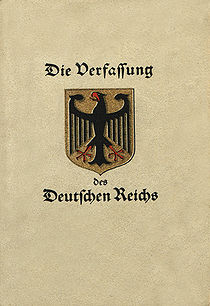
Constitution
A constitution is a set of fundamental principles or established precedents according to which a state or other organization is governed. These rules together make up, i.e. constitute, what the entity is...
that governed Germany
Germany
Germany , officially the Federal Republic of Germany , is a federal parliamentary republic in Europe. The country consists of 16 states while the capital and largest city is Berlin. Germany covers an area of 357,021 km2 and has a largely temperate seasonal climate...
during the Weimar Republic
Weimar Republic
The Weimar Republic is the name given by historians to the parliamentary republic established in 1919 in Germany to replace the imperial form of government...
(1919–1933). The constitution technically remained in effect throughout the existence of the Third Reich from 1933 to 1945.
Gerhard Anschütz
Gerhard Anschütz
Gerhard Anschütz was a noted German teacher of constitutional law and the leading commentator of the Weimar Constitution...
(1867–1948), a noted German teacher of constitutional law, was the leading commentator of the Weimar Constitution.
The constitution's title was the same as the Constitution of the German Empire
Constitution of the German Empire
The Constitution of the German Empire was the basic law of the German Empire of 1871-1919, enacted 16 April 1871. German historians often refer to it as Bismarck's imperial constitution....
that preceded it. The German state's official name was Deutsches Reich until the adoption of the 1949 constitution
Basic Law for the Federal Republic of Germany
The Basic Law for the Federal Republic of Germany is the constitution of Germany. It was formally approved on 8 May 1949, and, with the signature of the Allies of World War II on 12 May, came into effect on 23 May, as the constitution of those states of West Germany that were initially included...
.
Origin
Following the end of World War IWorld War I
World War I , which was predominantly called the World War or the Great War from its occurrence until 1939, and the First World War or World War I thereafter, was a major war centred in Europe that began on 28 July 1914 and lasted until 11 November 1918...
, a German National Assembly gathered in the town of Weimar
Weimar
Weimar is a city in Germany famous for its cultural heritage. It is located in the federal state of Thuringia , north of the Thüringer Wald, east of Erfurt, and southwest of Halle and Leipzig. Its current population is approximately 65,000. The oldest record of the city dates from the year 899...
, in the state of Thuringia
Thuringia
The Free State of Thuringia is a state of Germany, located in the central part of the country.It has an area of and 2.29 million inhabitants, making it the sixth smallest by area and the fifth smallest by population of Germany's sixteen states....
, in January 1919 to write a constitution for the Reich
Reich
Reich is a German word cognate with the English rich, but also used to designate an empire, realm, or nation. The qualitative connotation from the German is " sovereign state." It is the word traditionally used for a variety of sovereign entities, including Germany in many periods of its history...
. The nation was to be a democratic federal republic
Federal republic
A federal republic is a federation of states with a republican form of government. A federation is the central government. The states in a federation also maintain the federation...
, governed by a president and parliament
Reichstag
Reichstag may refer to:*Reichstag – the diets or parliaments of the Holy Roman Empire, of the Austrian-Hungarian monarchy, and of Germany from 1871 to 1945** Reichstag ** Reichstag...
.
The constitution was drafted by the lawyer and liberal politician Hugo Preuss
Hugo Preuss
Hugo Preuß was a German lawyer and liberal politician.Preuß is often regarded as the father of the German constitution of the Weimar Republic . However, his idea was more of a skeletal structure and not a word for word democratic plan...
, who was then state secretary in the Ministry of the Interior, and later became Minister of the Interior. Preuss criticized the Triple Entente
Triple Entente
The Triple Entente was the name given to the alliance among Britain, France and Russia after the signing of the Anglo-Russian Entente in 1907....
decision to prohibit the incorporation of post-Austro-Hungarian-dissolution German Austria
German Austria
Republic of German Austria was created following World War I as the initial rump state for areas with a predominantly German-speaking population within what had been the Austro-Hungarian Empire, without the Kingdom of Hungary, which in 1918 had become the Hungarian Democratic Republic.German...
into the nascent German republic, saying it was a contradiction of the Wilsonian
Wilsonian
Wilsonianism or Wilsonian are words used to describe a certain type of ideological perspectives on foreign policy. The term comes from the ideology of United States President Woodrow Wilson and his famous Fourteen Points that he believed would help create world peace if implemented.Common...
principle of self-determination
Self-determination
Self-determination is the principle in international law that nations have the right to freely choose their sovereignty and international political status with no external compulsion or external interference...
of peoples.
Disagreements arose between the delegates over issues such as the national flag, religious education for youth, and the rights of the provinces (Länder) that made up the Reich
Reich
Reich is a German word cognate with the English rich, but also used to designate an empire, realm, or nation. The qualitative connotation from the German is " sovereign state." It is the word traditionally used for a variety of sovereign entities, including Germany in many periods of its history...
. These disagreements were resolved by August 1919, though sixty-seven delegates abstained from voting to adopt the Weimar Constitution.
The Republic's first President
President of Germany
The President of the Federal Republic of Germany is the country's head of state. His official title in German is Bundespräsident . Germany has a parliamentary system of government and so the position of President is largely ceremonial...
, Friedrich Ebert
Friedrich Ebert
Friedrich Ebert was a German politician of the Social Democratic Party of Germany .When Ebert was elected as the leader of the SPD after the death of August Bebel, the party members of the SPD were deeply divided because of the party's support for World War I. Ebert supported the Burgfrieden and...
, signed the new German constitution into law on August 11, 1919. The first article of the constitution stated that "The power of the state emanates from the people."
The fundamental tenet of the Weimar Constitution was that Germany was to be a republic
Republic
A republic is a form of government in which the people, or some significant portion of them, have supreme control over the government and where offices of state are elected or chosen by elected people. In modern times, a common simplified definition of a republic is a government where the head of...
on the parliament
Parliament
A parliament is a legislature, especially in those countries whose system of government is based on the Westminster system modeled after that of the United Kingdom. The name is derived from the French , the action of parler : a parlement is a discussion. The term came to mean a meeting at which...
ary model with a parliament elected using proportional representation
Proportional representation
Proportional representation is a concept in voting systems used to elect an assembly or council. PR means that the number of seats won by a party or group of candidates is proportionate to the number of votes received. For example, under a PR voting system if 30% of voters support a particular...
.
Universal suffrage
Universal suffrage
Universal suffrage consists of the extension of the right to vote to adult citizens as a whole, though it may also mean extending said right to minors and non-citizens...
was established, with a minimum voting age of 20.
Provisions and Organization of the Weimar Constitution
The Weimar Constitution was divided into 2 main parts (Hauptteile). The two parts were divided into seven and five sections, respectively. In all, there were over 180 articles in the Constitution.Some of the more noteworthy provisions are described below, including those provisions which proved significant in the demise of the Weimar Republic
Weimar Republic
The Weimar Republic is the name given by historians to the parliamentary republic established in 1919 in Germany to replace the imperial form of government...
and the rise of the Third Reich.
The preamble
Preamble
A preamble is an introductory and expressionary statement in a document that explains the document's purpose and underlying philosophy. When applied to the opening paragraphs of a statute, it may recite historical facts pertinent to the subject of the statute...
to the Constitution reads:
- Das Deutsche Volk einig in seinen Stämmen und von dem Willen beseelt, sein Reich in Freiheit und Gerechtigkeit zu erneuen und zu festigen, dem inneren und dem äußeren Frieden zu dienen und den gesellschaftlichen Fortschritt zu fördern, hat sich diese Verfassung gegeben.
In English, this can be translated to:
- The German people united in its tribes and inspired with the will to renew and strengthen the Reich in liberty and justice, to serve internal and external tranquility, and to promote social progress, has adopted this Constitution.
Main Part I: Composition of the Reich and its Responsibility
The first part (Erster Hauptteil) of the Constitution specified the organization of the various components of the Reich government.Section 1: The Reich and its States
Section 1 consisted of Articles 1 to 19 and established the German Reich as a republic, with the power of the state being derived from the people. The Reich was defined as the region encompassed by the German provinces (Länder), and other regions could join the Reich based on popular self-determination and Reich legislation.Section 1 also established that generally-recognized principles of international law were binding on Germany and gave the Reich government exclusive jurisdiction of:
- foreign relations, colonial affairs, citizenship
- freedom of movement
- immigration, emigration, and extradition.
- defense
- currency and coinage
- customs and trade
- postal, telegraph, and telephone service
With the exceptions of the subjects for which the Reich government has exclusive jurisdiction, the provinces could govern their respective territories as they saw fit. However, Reich law superseded or nullified provincial law in the event of a conflict. Adjudication of conflicts between the Länder and the Reich government was the jurisdiction of the Supreme Court.
Provincial authorities were required to enforce Reich law and must have a constitution on free state principles. Each provincial parliament (Landtag
Landtag
A Landtag is a representative assembly or parliament in German-speaking countries with some legislative authority.- Name :...
) was to be elected by an equal and secret ballot according to representative election. Each provincial government could serve only so long as it had the confidence of the respective provincial parliament.
Section 2: The Reichstag
Articles 20 to 40 described the national parliamentParliament
A parliament is a legislature, especially in those countries whose system of government is based on the Westminster system modeled after that of the United Kingdom. The name is derived from the French , the action of parler : a parlement is a discussion. The term came to mean a meeting at which...
, the Reichstag
Reichstag (Weimar Republic)
The Reichstag was the parliament of Weimar Republic .German constitution commentators consider only the Reichstag and now the Bundestag the German parliament. Another organ deals with legislation too: in 1867-1918 the Bundesrat, in 1919–1933 the Reichsrat and from 1949 on the Bundesrat...
, which was seated in the capital, Berlin
Berlin
Berlin is the capital city of Germany and is one of the 16 states of Germany. With a population of 3.45 million people, Berlin is Germany's largest city. It is the second most populous city proper and the seventh most populous urban area in the European Union...
. The Reichstag was composed of representatives elected by the German people by an equal and secret ballot open to all Germans aged 20 or older. Proportional representation
Proportional representation
Proportional representation is a concept in voting systems used to elect an assembly or council. PR means that the number of seats won by a party or group of candidates is proportionate to the number of votes received. For example, under a PR voting system if 30% of voters support a particular...
principles governed Reichstag elections.
Members of the Reichstag represented the entire nation and were bound only to their own conscience. Members served for four years. The Reichstag could be dissolved by the Reich president and new elections held not more than 60 days after the date of dissolution.
Members of the Reichstag and provincial parliament (Landtag) were immune from arrest or investigation of a criminal offense except with the approval of the legislative body to which the person belonged. The same approval was required for any other restriction on personal freedom which might harm the member's ability to fulfil his duties. (Article 37)
Section 3: The President and the Reich Government
Section 3 consisted of Articles 41 to 59. Principal provisions were:The Reich president represented the entire German nation. Any German 35 years of age or older was eligible to serve as president, but the president could not be simultaneously a member of the Reichstag.
The President served a term of seven years and could be re-elected. He could be removed from office by plebiscite upon the vote of two-thirds of the Reichstag. Rejection of the measure by the voters would act as a re-election of the president and causes the Reichstag to be dissolved.
Reich officials and civil servants (including the chancellor and ministers) were appointed and removed by authority of the Reich president, who also had supreme command over the armed forces.
In the event a state government failed to fulfil its obligations under the constitution or Reich law, the president could use armed force to compel the state to do so. Furthermore, in the event of a serious threat to public safety or Reich security, the President could take measures — including the use of armed force — to restore law and order, and could suspend civil rights if necessary. The president was required to inform the Reichstag of these measures and the Reichstag could nullify such a presidential decree. (This provision was the infamous Article 48
Article 48 (Weimar Constitution)
Article 48 of the constitution of the Weimar Republic of Germany allowed the President, under certain circumstances, to take emergency measures without the prior consent of the Reichstag...
used by Adolf Hitler
Adolf Hitler
Adolf Hitler was an Austrian-born German politician and the leader of the National Socialist German Workers Party , commonly referred to as the Nazi Party). He was Chancellor of Germany from 1933 to 1945, and head of state from 1934 to 1945...
in 1933 to quash the civil liberty provisions of the constitution and facilitate the establishment of a dictatorship.)
The chancellor and ministers were compelled to resign in the event the Reichstag passed a vote of no confidence.
The Reich chancellor determined the political guidelines of his government and was responsible to the Reichstag. The Reich government (cabinet) formulated decisions by majority vote — in the case of a tie, the Reich president's vote was decisive. The Reichstag could accuse the Reich president, chancellor, or any minister of willful violation of the Constitution or Reich law, said case to be tried in the Supreme Court.
Section 4: The Reichsrat
Section 4 consisted of Articles 60 to 67 and established the Reichsrat (State Council). The Reichsrat was the means by which the provinces (Länder) could participate in the making of legislation at the national level. Members of the Reichsrat were members or representatives of the provincial parliaments. Government ministers were required to inform the Reichsrat of proposed legislation or administrative regulations to permit the Reichsrat to voice objections.Section 5: Reich Legislation
Articles 68 to 77 specified how legislation is to be passed into law. Laws could be proposed by a member of the Reichstag or by the Reich government and were passed on the majority vote of the Reichstag. Proposed legislation had to be presented to the Reichsrat, and the latter body's objections were required to be presented to the Reichstag.The Reich president had the power to decree that a proposed law be presented to the voters as a plebiscite before taking effect.
The Reichsrat was entitled to object to laws passed by the Reichstag. If this objection could not be resolved, the Reich president at his discretion could call for a plebiscite or let the proposed law die. If the Reichstag voted to overrule the Reichsrat's objection by a two-thirds majority, the Reich president was obligated to either proclaim the law into force or to call for a plebiscite.
Constitutional amendments were proposed as ordinary legislation, but for such an amendment to take effect, it was required that two thirds or more of the Reichstag members be present, and that at least two thirds of the members present voted in favor of the legislation.
The Reich government had the authority to establish administrative regulations unless Reich law specified otherwise.
Section 6: Reich Administration
Articles 78 to 101 described the methods by which the Reich government administered the constitution and laws, particularly in the areas where the Reich government had exclusive jurisdiction — foreign relations, colonial affairs, defence, taxation and customs, merchant shipping and waterways, railroads, and so forth.Section 7: Justice
Articles 102 to 108 established the justice system of the Weimar Republic. The principal provision established judicial independenceJudicial independence
Judicial Independence is the idea that the judiciary needs to be kept away from the other branches of government...
— judges were subject only to the law.
This section established a Supreme Court and also established administrative courts to adjudicate disputes between citizens and administrative offices of the state.
Main Part 2: Basic Rights and Obligations of Germans
The second part (Zweiter Hauptteil) of the Weimar Constitution laid out the basic rights (Grundrechte) and basic obligations (Grundpflichten) of Germans.The constitution
Constitution
A constitution is a set of fundamental principles or established precedents according to which a state or other organization is governed. These rules together make up, i.e. constitute, what the entity is...
guaranteed individual rights such as the freedom of speech and assembly to each citizen. These were based on the provisions of the earlier constitution of 1848.
Section 1: The Individual
Articles 109 to 118 set forth individual rights of Germans, the principal tenet being that every German was equal before the law. Both genders had the same rights and obligations. Privileges based on birth or social status were abolished. Titles of nobilityNobility
Nobility is a social class which possesses more acknowledged privileges or eminence than members of most other classes in a society, membership therein typically being hereditary. The privileges associated with nobility may constitute substantial advantages over or relative to non-nobles, or may be...
were abolished.
A citizen of any of the German provinces was likewise a citizen of the Reich. Germans had the right of mobility and residence, and the right to acquire property and pursue a trade. They had the right to immigrate or emigrate, and the right to Reich protection against foreign authorities.
The "national identity" of foreign language communities in Germany was protected, including the right to use their native language in education, administration, and the judicial system.
Other specific articles stated that:
Section 2: Community Life
Articles 119 to 134 guided Germans' interaction with the community and established, among other things, that:- Free and secret elections were guaranteed. (Article 125)
- All citizens were eligible for public office, without discrimination, based on their abilities. Discrimination toward female civil servants was abolished. (Article 126)
- Civil servants served the whole nation, not a specific party. They enjoyed freedom of political opinion. (Article 130)
- Citizens could be required to provide services to the state and community, including compulsory military service under regulations set by Reich law.
Section 3: Religion and Religious Communities
The religious rights of Germans were enumerated in Articles 135 to 141. Residents of the Reich were granted freedom of belief and conscience. Free practice of religion was guaranteed by the constitution and protected by the state, and no state church was established.Furthermore, the exercise of civil and civic rights and admission to state office were independent of one's religious beliefs. Public declaration of religious beliefs were not required, and no one was forced to join in a religious act or swear a religious oath.
Five articles from this section of the Constitution (Nos. 136-139 and 141) were explicitly incorporated into the Basic Law of the Federal Republic of Germany (passed in 1949), and so remain Constitutional Law in Germany today.
Section 4: Education and School
Articles 142 to 150 guided the operation of educational institutions within the Reich. Public education was provided by state institutions and regulated by the government, with cooperation between the Reich, the province, and the local community. Primary school was compulsory, with advanced schooling available to age 18 free of charge.The constitution also provided for private schooling, which was likewise regulated by the government.
In private schools operated by religious communities, religious instruction could be taught in accordance with the religious community's principles.
Section 5: The Economy
Constitutional provisions about economic affairs were given in Articles 151 to 165. One of the fundamental principles was that economic life should conform to the principles of justice, with the goal of achieving a dignified life for all and securing the economic freedomEconomic freedom
Economic freedom is a term used in economic and policy debates. As with freedom generally, there are various definitions, but no universally accepted concept of economic freedom...
of the individual.
The Reich protected labor, intellectual creation, and the rights of authors, inventors, and artists. The right to form unions and to improve working conditions was guaranteed to every individual and to all occupations, and protection of the self-employed was established.
Workers and employees were given the right to participate, on an equal footing with employers, in the regulation of wages and working conditions as well as in economic development.
Transition and Final Clauses
The final 16 articles (Articles 166 to 181) of the Weimar Constitution provided for the orderly transition to the new constitution, and stipulated in some cases when the various provisions of the new constitution take effect. In cases where legislation had yet to be passed (such as the laws governing the new Supreme Court), these articles stipulated how the constitutional authority would be exercised in the interim by existing institutions. This section also stipulated that new bodies established by the constitution took the place of obsolete bodies (such as the National Assembly) where those bodies were referred to by name in old laws or decrees.It was mandated that public servants and members of the armed forces are to take an oath on this constitution.
The previous constitution dated April 15, 1871 was suspended, but other Reich laws and decrees that didn't contradict the new constitution remained in force. Other official decrees based on hitherto-valid law remained valid until superseded by law or by decree.
The National Assembly was regarded as the Reichstag until the first Reichstag was elected and convened, and the Reich president elected by the National Assembly was to serve until June 30, 1925.
Weaknesses
In his book The Rise and Fall of the Third ReichThe Rise and Fall of the Third Reich
The Rise and Fall of the Third Reich is a 1960 non-fiction book by William L. Shirer chronicling the general history of Nazi Germany from 1933 to 1945...
, historian William Shirer described the Weimar Constitution as "on paper, the most liberal and democratic document of its kind the twentieth century had ever seen ... full of ingenious and admirable devices which seemed to guarantee the working of an almost flawless democracy." Yet, the Weimar Constitution had fundamental flaws.
Proportional representation
Proportional representation
Proportional representation is a concept in voting systems used to elect an assembly or council. PR means that the number of seats won by a party or group of candidates is proportionate to the number of votes received. For example, under a PR voting system if 30% of voters support a particular...
was one such flaw. It meant that the number of votes gained was directly proportional to the number of seats gained by a party. This system, intended to avoid the wasting of votes, caused the rise of a multitude of splinter parties, most of which represented the extreme ends of the political spectrum. This in turn made it difficult for any party to establish and maintain a workable parliamentary majority. This factionalism was one contributing factor in the frequent changes in government. Shirer cites the presence of some 28 political parties in the 1930 national elections; Otto Friedrich cites 40 different groups in the Reichstag in 1933. Proportional Representation allowed no safeguards against a quick rise of an extremist party as only a tiny minority of the votes could get Deputies into the Reichstag as shown in the 1924 elections where the Bavarian Peasants' League got just 0.7% of the vote resulting in 3 Deputies in the Reichstag.
The allocation of presidential powers was also deeply flawed. The Weimar Constitution allowed the president to dismiss the chancellor, even if the chancellor retained the confidence of the Reichstag. Similarly, the president could appoint a chancellor who didn't have the support of the Reichstag. Further, the government structure was a mix of presidential and parliamentary systems, with the president acting as a "replacement
Ersatz
Ersatz means 'substituting for, and typically inferior in quality to', e.g. 'chicory is ersatz coffee'. It is a German word literally meaning substitute or replacement...
Kaiser
Kaiser
Kaiser is the German title meaning "Emperor", with Kaiserin being the female equivalent, "Empress". Like the Russian Czar it is directly derived from the Latin Emperors' title of Caesar, which in turn is derived from the personal name of a branch of the gens Julia, to which Gaius Julius Caesar,...
" and assuming some of the powers the monarch would have wielded. Article 48
Article 48 (Weimar Constitution)
Article 48 of the constitution of the Weimar Republic of Germany allowed the President, under certain circumstances, to take emergency measures without the prior consent of the Reichstag...
, the so-called Notverordnung (emergency decree) provision, gave the president broad powers to suspend civil liberties with an insufficient system of checks and balances. This presented an opportunity that Adolf Hitler
Adolf Hitler
Adolf Hitler was an Austrian-born German politician and the leader of the National Socialist German Workers Party , commonly referred to as the Nazi Party). He was Chancellor of Germany from 1933 to 1945, and head of state from 1934 to 1945...
was quick to seize once he became chancellor. (see Reichstag Fire
Reichstag fire
The Reichstag fire was an arson attack on the Reichstag building in Berlin on 27 February 1933. The event is seen as pivotal in the establishment of Nazi Germany....
).
Even without these flaws, the Weimar Constitution was established under disadvantageous social, political, and economic conditions that have led some historians to conclude that it was doomed from birth.
Hitler's subversion of the Weimar Constitution
Less than a month after Adolf HitlerAdolf Hitler
Adolf Hitler was an Austrian-born German politician and the leader of the National Socialist German Workers Party , commonly referred to as the Nazi Party). He was Chancellor of Germany from 1933 to 1945, and head of state from 1934 to 1945...
’s appointment as chancellor in 1933, the Reichstag Fire Decree
Reichstag Fire Decree
The Reichstag Fire Decree is the common name of the Decree of the Reich President for the Protection of People and State issued by German President Paul von Hindenburg in direct response to the Reichstag fire of 27 February 1933. The decree nullified many of the key civil liberties of German...
invoked Article 48
Article 48 (Weimar Constitution)
Article 48 of the constitution of the Weimar Republic of Germany allowed the President, under certain circumstances, to take emergency measures without the prior consent of the Reichstag...
of the Weimar Constitution, suspending several constitutional protections on civil rights
Civil rights
Civil and political rights are a class of rights that protect individuals' freedom from unwarranted infringement by governments and private organizations, and ensure one's ability to participate in the civil and political life of the state without discrimination or repression.Civil rights include...
. The articles affected were 114 (habeas corpus), 115 (inviolability of residence), 117 (correspondence privacy), 118 (freedom of expression /censorship), 123 (assembly), 124 (associations), and 153 (expropriation).
The subsequent Enabling Act, passed by the Reichstag on March 23, 1933, stated that, in addition to the traditional method of the Reichstag passing legislation, the Reich government could also pass legislation. It further stated that the powers of the Reichstag
Reichstag (Weimar Republic)
The Reichstag was the parliament of Weimar Republic .German constitution commentators consider only the Reichstag and now the Bundestag the German parliament. Another organ deals with legislation too: in 1867-1918 the Bundesrat, in 1919–1933 the Reichsrat and from 1949 on the Bundesrat...
, Reichsrat
Reichsrat (Germany)
The Reichsrat was one of the two legislative bodies in Germany under the Weimar constitution, the other one being the Reichstag. After the end of German monarchy and the founding of the Weimar Republic in 1919, the Reichsrat replaced the Bundesrat as the representation of the various German...
and Reich President were not affected. The normal legislative procedures outlined in Articles 68 to 77 of the constitution did not apply to legislation promulgated by the Reich government.
The Enabling Act was effectively a constitutional amendment because of the foregoing alterations to the normal legislative process. The act met the constitutional requirements (two thirds of the Reichstag's members were present, and two thirds of the members present voted in favor of the measure). The Act did not explicitly amend the Weimar Constitution, but there was explicit mention to the fact that the procedure sufficient for constitutional reform was followed.
The constitution of 1919 was never formally repealed, but the Enabling Act meant that all its other provisions were a dead letter. The Enabling Act itself was breached by Hitler on three occasions in 1934: Article 2 of the act stated that
'Laws enacted by the government of the Reich may deviate from the constitution as long as they do not affect the institutions of the Reichstag and the Reichsrat. The rights of the President remain undisturbed.'The powers of the Länder (states) were transferred to the Reich, rendering the Reichsrat obsolete. A month later, the Reichsrat itself was dissolved. President von Hindenburg died in August, and Hitler appropriated the president's powers for himself. The Enabling Act did not specify any recourse that could be taken if the chancellor violated Article 2, and no judicial challenge ensued.
Legacy of the Constitution
After the death of Hindenburg in 1934, the constitution was largely forgotten, with some minor exceptions. In Hitler's 1945 political testament (written shortly before his suicide) he appointed Admiral Karl Doenitz to succeed him, but he named Doenitz as President, not Fuehrer, thereby re-establishing a constitutional office which had lain dormant since Hindenburg's death ten years earlier. On the 30th of April 1945 Doenitz formed what became known as the Flensburg governmentFlensburg government
The Flensburg Government , also known as the Flensburg Cabinet and the Dönitz Government , was the short-lived administration that attempted to rule the Third Reich during most of May 1945 at the end of World War II in Europe...
, which controlled only a tiny area of Germany near the Danish border, including the town of Flensburg
Flensburg
Flensburg is an independent town in the north of the German state of Schleswig-Holstein. Flensburg is the centre of the region of Southern Schleswig...
. It was dissolved by the Allies on the 23rd of May. On the 5th of June, the Allied Berlin Declaration
Berlin Declaration (1945)
By way of the Berlin Declaration of June 5th, 1945, , the victors of World War II assumed...
abolished all the institutions of German civil government, and this established that the constitution no longer held any legal force.
The 1949 Constitution of the German Democratic Republic
Constitution of the German Democratic Republic
East Germany was founded in 1949 and was absorbed into the Federal Republic of Germany on 3 October 1990. Its original constitution was promulgated on 7 October 1949. It was heavily based on the "Weimarer Reichsverfassung", such that the GDR would be a federal and democratic republic...
contained many passages that were directly copied from the 1919 constitution. It was intended to be the constitution of a united Germany, and was thus a compromise between liberal-democratic and Leninist ideologies. It was replaced by a new, explicitly Leninist constitution in 1968. In 1990, the DDR dissolved altogether.
The Basic Law for the Federal Republic of Germany
Basic Law for the Federal Republic of Germany
The Basic Law for the Federal Republic of Germany is the constitution of Germany. It was formally approved on 8 May 1949, and, with the signature of the Allies of World War II on 12 May, came into effect on 23 May, as the constitution of those states of West Germany that were initially included...
, enacted in 1949, stated that
'The provisions of Articles 136, 137, 138, 139 and 141 of the German Constitution of 11 August 1919 shall be an integral part of this Basic Law.'These articles of the Weimar constitution (which dealt with the state's relationship to various Christian churches) remain part of the German Basic Law to this day. The Berlin Declaration
Berlin Declaration
Berlin Declaration may refer to one of the following declarations:*The Berlin Declaration on the Uniqueness of Christ and Jewish Evangelism in Europe Today is a theological declaration issued by the World Evangelical Alliance in 2008...
of 5 June 1945, establishing the Allied Control Council
Allied Control Council
The Allied Control Council or Allied Control Authority, known in the German language as the Alliierter Kontrollrat and also referred to as the Four Powers , was a military occupation governing body of the Allied Occupation Zones in Germany after the end of World War II in Europe...
formally abolished German civil government and it may be argued that this declaration also caused the original Weimar Constitution to finally go out of force.
The first official constitution of the Republic of Korea was originally based on the Weimar Constitution.
Trivia
The constitution is named after Weimar although it was signed into law by Friedrich Ebert in SchwarzburgSchwarzburg
Schwarzburg is a municipality in the valley of the Schwarza in the district Saalfeld-Rudolstadt in Thuringia, Germany.First mentioned in 1071 as Swartzinburg. The castle was from the 12th century the seat of the Counts of Schwarzburg...
. This is due to the fact that Ebert was on holiday in Schwarzburg, while the parliament working out the constitution was gathered in Weimar.
External links
- Selected Articles: http://web.jjay.cuny.edu/~jobrien/reference/ob13.html
- Entire Constitution: http://www.zum.de/psm/weimar/weimar_vve.php
- The Constitution of the German Reich (Weimar constitution) of 11 August 1919, in full text
- The portion of a series of lecture on German history pertaining to the Weimar Republic
- Additional info: http://www.johndclare.net/Weimar2.htm