

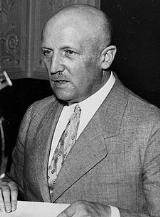
Kurt von Schleicher

Encyclopedia
Kurt von Schleicher was a German
general and the last Chancellor of Germany during the era of the Weimar Republic
. Seventeen months after his resignation, he was assassinated by order of his successor, Adolf Hitler
, in the Night of the Long Knives
.
officer and a shipowner′s daughter. He entered the German Army
in 1900 as a Leutnant
after graduating from a cadet training school. In his early years, Schleicher made two friendships which later were to play an important role in his life. As a cadet, Schleicher befriended Franz von Papen
, and later on as an officer in the Third Guards Regiment, he befriended Oskar von Hindenburg
. During World War I
, he served on the staff of Wilhelm Groener
, who became Schleicher′s patron. In December 1918, Schleicher delivered an ultimatum to Friedrich Ebert
on behalf of Paul von Hindenburg
demanding that the German provisional government either allow the Army to crush the Spartacus League or the Army would do that task themselves. During the ensuing talks with the German cabinet, Schleicher was able to get permission to allow the Army to return to Berlin. On December 23, 1918, a group of Red sailors seemed set to storm and take over the Provisional government when the sailors cut all telephone lines from the Chancellor′s office to the War Ministry except for a secret one. When Ebert used the secret line to call the War Ministry, it was Schleicher who took the call. In exchange for agreeing to send help to the government, Schleicher was able to secure Ebert′s assent to the Army being allowed to maintain its political autonomy. When Gustav Noske
was appointed Defence Minister on December 27, 1918, both Groener and his protégé Schleicher established excellent working relations with the new minister. To deal with the problem of the lack of loyal troops, Schleicher helped to found the Freikorps
in early January 1919.
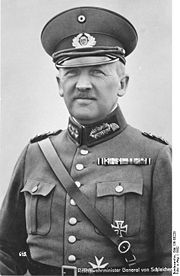 In the early 1920s, Schleicher had emerged as a leading protégé of General
Hans von Seeckt
, who often gave Schleicher sensitive assignments. In the spring of 1921, Seeckt created a secret group within the Reichswehr known as Sondergruppe R whose task was to work with the Red Army in their common struggle against the international system established by the Treaty of Versailles
. Schleicher was a leading member of Sondergruppe R, and it was he who worked out the arrangements with Leonid Krasin
for German aid to the Soviet arms industry. In September 1921, at a secret meeting in Schleicher′s appartment, the details of an arrangement were reached in which German financial and technological aid for building the Soviet arms industry were exchanged for Soviet support in helping Germany circumvent the disarmament clauses of the Treaty of Versailles. Schleicher created several dummy corporations, most notably the GEFU (Gesellschaft zur Förderung gewerblicher Unternehmungen-Company for the promotion of industrial enterprise) that funnelled 75 million Reichmarks into the Soviet arms industry. The GEFU founded factories in the Soviet Union for the production of aircraft, tanks, artillery shells and poison gas. The arms contracts of GEFU in the Soviet Union
ensured that Germany did not fall behind in military technology in the 1920s despite being disarmed by Versailles, and laid the covert foundations in the 1920s for the overt rearmament of the 1930s. At the same time, a team from Sondergruppe R comprising Schleicher, Eugen Ott, Fedor von Bock
and Kurt von Hammerstein-Equord
formed the liaison with Major
Bruno Ernst Buchrucker, who led the so-called Arbeits-Kommandos (Work Commandos), which officially was a labor group intended to assist with civilian projects, but in reality were thinly disguised soldiers that allowed Germany to exceed the limits on troop strength set by Versailles. Buchrucker′s so-called "Black Reichswehr"
became infamous for its practice of murdering all those Germans whom it was suspected were working as informers for the Allied Control Commission, which was responsible for ensuring that Germany was in compliance with Part V of the Treaty of Versailles. The killings perpetrated by the "Black Reichswehr were justifed under the so-called Femegerichte (secret court) system in which alleged traitors were killed after being "convicted" in secret "trials" that the victim was unaware of. These killings were ordered by officers from Sondergruppe R as the best way to neutralize the efforts of the Allied Control Commission. Regarding the Femegerichte murders, Carl von Ossietzky
wrote:
Despite Seeckt′s patronage, it was Schleicher who brought about his downfall in 1926 by leaking that Seeckt had invited the former Crown Prince to attend military manoeuvres. After Seeckt′s fall, Schleicher became, in the words of Andreas Hillgruber
"in fact, if not in name", the "military-political head of the Reichswehr". Schleicher′s triumph was also the triumph of the "modern" faction within the Reichswehr who favored a total war ideology and wanted Germany to become a dicatorship that would wage total war upon the other nations of Europe.
During the 1920s, he moved up steadily in the Reichswehr, the German army, becoming the primary liaison between the Army and civilian government officials. He generally preferred to operate behind the scenes, planting stories in friendly newspapers and relying on a casual network of informers to find out what other government departments were planning. The appointment of Groener as Defence Minister in January 1928 did much to advance Schleicher′s career. Groener, who regarded Schleicher as his "adopted son", openly favored Schleicher and created the Ministeramt (Office of the Ministerial Affairs) in 1928 just for him. The new office concerned all matters relating to joint concerns of the Army and Navy, and was tasked with the liaison between the military and other departments and between the military and politicians. Groener called Schleicher "my cardinal in politics" and came to depend more and more on Schleicher to get favorable military budgets passed. Schleicher justified Groener′s confidence by getting the naval budget for 1929 passed despite the opposition of the anti-militarist Social Democrats, who formed the largest party in the Reichstag at the time. Schleicher prepared Groener′s statements to the Cabinet and attended Cabinet meetings on a regular basis. Above all, Schleicher won the right to brief President Hindenburg on both political and military matters. In late 1926-early 1927, Schleicher told Hindenburg that if it was impossible to form a government headed by the German National People’s Party alone, then Hindenburg should "appoint a government in which he had confidence, without consulting the parties or paying attention to their wishes" and with "the order for dissolution ready to hand, give the government every constitutional opportunity to a majority in Parliament". This was the origin of the "Presidential Governments". Together with Major Oskar von Hindenburg
, Otto Meißner
, and General Wilhelm Groener
, Schleicher was a leading member of the Kamarilla
that surrounded President von Hindenburg. It was Schleicher who came up with the idea of a "Presidential Government" based on the so-called "25/48/53 formula". Under a "Presidential Government" the head of government
(in this case, the chancellor
), is responsible to the head of state
, and not to a legislative body. The "25/48/53 formula" referred to the three articles of the Constitution that could make a "Presidential government" possible:
Schleicher′s idea was to have Hindenburg use his powers under Article 53 to appoint a man of Schleicher′s choosing as chancellor, who would rule under the provisions of Article 48. Should the Reichstag
threaten to annul any laws so passed, Hindenburg could counter with the threat of dissolution
. Hindenburg was unenthusiastic about these plans, but was pressured into going along with them by his son along with Meißner, Groener and Schleicher. During the course of the winter of 1929-30, Schleicher, through various intrigues, undermined the "Grand Coalition" government of Hermann Müller
with the support of Groener and Hindenburg. In March 1930, Müller′s government fell and the first "Presidential Government" headed by Heinrich Brüning
came into office.
Although essentially a Prussian authoritarian in his views on order, discipline and the so-called decadence of the Weimar era, Schleicher also believed that the Army had a social function; that of an institution unifying the diverse elements in society. Interestingly, he was also opposed to policies such as Eastern Aid (Osthilfe)
for the bankrupt East Elbian estates of his fellow Junker
s. In economic policy, therefore, he was a relative moderate. By 1931, Germany′s restrictions of experienced military reserves were coming to an end owing to Part V of the Treaty of Versailles
, which had forbade conscription Schleicher was worried that unless Germany brought back conscription soon, then the military basis of German power would be destroyed forever. For this reason, Schleicher and the rest of the Reichswehr leadership were determined that Germany must put an end to Versailles in the near-future and in the meantime saw the SA and other right-wing paramilitary groups as the best substitute for conscription. With that goal in mind, Schleicher opened secret talks with the SA in 1931. Like the rest of the Reichswehr leadership, Schleicher saw democracy as an impediment to military power, and was convinced that only a dictatorship could make Germany a great military power again. Through Schleicher sometimes claimed to be a monarchist, in reality he cared nothing for the House of Hohenzollern
, and often stated: "Republic or monarchy is not the question now, but rather what should the republic look like". Through Schleicher was willing to accept a republic, he was deeply hostile toward the democratic Weimar republic, and much preferred a regime dominated by the military. The German historian Eberhard Kolb
wrote that:
Schleicher became a major figure behind the scenes in the presidential cabinet government of Heinrich Brüning
between 1930 and 1932, serving as an aide to General Groener, the Minister of Defence. Eventually, Schleicher, who established a close relationship with Reichspräsident
(Reich President) Paul von Hindenburg
, came into conflict with Brüning and Groener and his intrigues were largely responsible for their fall in May 1932. By coincidence, his name translated from German is "Sneaker" or "Creeper".
During the presidential election of 1932, Schleicher grew annoyed when the SPD started to proclaim themselves as allies of the government against the Nazis. On March 15, 1932 in a memo to Groener, Schleicher wrote in reference to the date of the presidential election:
joked in 1932:
, who knew Schleicher well, remembered hearing Schleicher proclaim during a dinner in a posh restaurant in Berlin in the spring of 1932 that "What Germany needs today is a strong man" while tapping himself on the chest.
Schleicher told Hindenburg that his gruelling re-election campaign was the fault of Brüning who could had Hindenburg′s term extended by the Reichstag, and not done so in order to "humilate" Hindenburg by making him appear on the same stage as Social Demorcatic leaders. When in early April 1932, Brüning and Groner decided to have the SA banned following complaints from Prussia and other Lander governments, Schleicher was at first supportive, but soon changed his mind and argued against a ban. Both Schleicher and his close friend, General Kurt von Hammerstein repeatedly contended to Groener that the Reichswehr leadership did not see the banning of the SA in the best interests of the Reich
In April 1932, when Brüning banned the SA
and the SS
, Groener received an angry letter from Hindenburg on April 16, 1932 demanding to know why the Reichsbanner
, the para-military wing of the Social Democrats had not also been banned. This was especially the case as Hindenburg said he had solid evidence that the Reichsbanner was planning a coup. The same letter from the President was leaked and also appeared at the same day in all of the right-wing German newspapers. Groener discovered the source of these allegations of a Social Democratic putsch and the leak was Eugen Ott a close protégé's of Schleicher. The British historian John Wheeler-Bennett
wrote that the evidence for a SPD putsch was "flimsy" at best, and this was just Schleicher′s way of discrediting Groener in Hidndenburg′s eyes. Groener′s friends told him that there it was impossible that Ott would fabricate allegations of that sort or leak the President′s letter on his own, and that he should sack Schleicher at once. Groener, however, refused to believe that his old friend had turned on him, and refused to fire Schleicher.
At the same time, Schleicher started rumors that Groener was a secret Social Democrat and made much of the fact that his daughter was born not nine months after Groener′s marriage. On April 22, 1932, during a secret meeting, Schleicher told the SA leader—Count von Helldorf
—that he together with the rest of the Reichswehr were opposed to the ban on the SA, and he would do his best to have it lifted as soon as possible. On May 8, 1932, Schleicher had a secret meeting with Hitler, during which he told him that a new "presidential government" would soon be appointed, and in exchange for promising to dissolve the Reichstag and lift the ban on the SA and the SS, received a promise from Hitler to support the new government. After Groener had been salvaged in a Reichstag debate with the Nazis over the alleged Social Democratic putsch and Groener′s lack of belief in it, Schleicher told his mentor that "he no longer enjoyed the confidence of the Army" and must resign at once. With that, Groener resigned as Defence and Interior Ministers. On May 30, 1932, Schleicher′s intrigues borne fruit when Hindenburg sacked Brüning as Chancellor and appointed as his successor Franz von Papen
. Schleicher had chosen von Papen, who was unknown to the German public as a new Chancellor as he believed he could control Papen from behind the scenes. Schleicher′s first choice for his "Government of the President′s Friends" had been Count Kuno von Westarp
, by which means he hoped to retain Brüning—who was a close friend of Westarp—in the Cabinet. When Brüning — who was deeply hurt and angry about Schleicher′s treatment of him — made it clear that he would not serve in the new government at all, Schleicher dropped Westarp. Other possible names mentioned to head the new government were Alfred Hugenberg
and Carl Friedrich Goerdeler
, both of whom were vetoed by Hindenburg. Schleicher finally chose Papen because he was an old friend of Schleicher′s and because of his reputation for being superficial and his obscurity. At the time of Papen′s appointment, Schleicher boasted that "I′m not the soul of the cabinet, but I am perhaps its will" The German historian Eberhard Kolb
wrote of Schleicher′s "key role" in the downfall of not only Brüning, but also the Weimar republic, for by bringing down Brüning Schleicher unintentionally and quite unnecessarily set off a series of events that would to led directly to the Third Reich.
Schleicher′s example in bringing down the Brüning government led to a much overt politicization of the Reichswehr. Starting the spring of 1932, a number of officers whom the British historian John Wheeler-Bennett described as "crypto-Nazis" such as Werner von Blomberg
, Wilhelm Keitel
and Walther von Reichenau
all started talks on their own with the NSDAP. Without realizing it, Schleicher′s example served to undermine his own power since in part his power had always rested on the fact that he was the only general who was allowed to talk to the politicians.
The new Chancellor, Franz von Papen
, in return hand-picked Schleicher as Minister of Defence. The first act of the new government was to dissolve the Reichstag in accodance with Schleicher′s "gentlemen′s aggreement" with Hitler on June 4, 1932. On June 15, 1932, the new government lifted the ban on the SA and the SS, who were secretly encouraged to indulge in as much violence as possible. Schleicher wanted as much mayhem on the streets as possible both to discredit democracy and to provide a pretext for the new authoritarian regime he was working to create Besides for ordering new elections, Schleicher and Papen worked together to undermine the Social Democratic government of Prussia headed by Otto Braun
. To this end, Schleicher fabricated evidence that the Prussian police under Braun's orders were favoring the Communist Rotfrontkämpferbund
in street clashes with the SA, which he used to get an emergency degree from Hindenburg imposing Reich control on Prussia. To facilitate his plans for a coup against the Prussian government and to avert the danger of a general strike which had defeated the Kapp Putsch
of 1920, Schleicher had a series of secret meetings with trade union leaders, during which he promised them a leading role in the new authoritarian
political system he was building, in return for which he received a promise that there would be no general strike in support of Braun. In the Rape of Prussia
on July 20, 1932, Schleicher had martial law proclaimed and called out the Reichswehr under Gerd von Rundstedt
to oust the elected Prussian government, which was accomplished without a shot being fired. Using Article 48
, Hindenburg named Papen the Reich Commissioner of Prussia. The SPD called for a general strike, but the union leaders—believing in Schleicher′s—promises ordered their members to stay at their jobs. In the Reichstag election of July 31, 1932, the NSDAP became the largest party.
In August 1932, Hitler renaged on the "gentlemen′s aggreement" he made with Schleicher that May, and instead of supporting the Papen government demanded the Chancellorship for himself. On August 5, 1932, Hitler and Schleicher held a secret meeting, in which Hitler demanded that he become Chancellor and the Ministries of the Interior and Justice go to Nazis; Schleicher could remain as Defence Minister. Schleicher was willing to accept Hitler′s arrangement, and only the opposition of Hindenburg stopped Hitler from receiving the Chancellorship in August 1932. It was at this moment that Schleicher′s influence with Hindenburg started to go into decline. Due to Hindenburg′s opposition, Schleicher was forced to tell Hitler that at most he could give was the Vice-Chancellorship, an offer that Hitler refused. In September 1932, Papen′s government was defeated on a no-confidence motion in the Reichstag, at which point the Reichstag was again dissolved. In the election of November 6, 1932
, the NSDAP lost seats, but still remained the largest party. By the beginning of November, Papen who showed himself more asserative than what Schleicher had expected, which led to a growing rift between the two. Eventually, Papen and Schleicher came into conflict, and when, following the government could not maintain a working parliamentary majority, Papen was forced to resign, and Schleicher succeeded him as Chancellor of Germany. Schleicher brought down Papen′s government on December 3, 1932 when Papen told the Cabinet that he wished to declare martial law. Schleicher then released the results of a war game which showed that if martial law was declared then the Reichswehr would not be able to defeat the various para-military groups.
 Schleicher hoped to attain a majority in the Reichstag
by gaining the support of the Nazis for his government. To gain Nazi support while keeping himself Chancellor, Schleicher often talked of forming a so-called Querfront ("cross-front"), whereby he would unify Germany′s fractious special interests around a non-parliamentary, authoritarian but participatory regime as a way of forcing the Nazis to support his government. It was hoped that faced with the threat of the Querfront, Hitler would back down in his demand for the Chancellorship and support Schleicher's government instead. Schleicher was never serious about creating a querfront, which intended to be a bluff to compell the NSDAP to support the new government. As part of his attempt to blackmail Hitler into supporting his government, Schleicher went through the motions of attempting to found the Querfront by reaching out to the Social Democratic
labour unions, the Christian labor unions and the left-wing branch of the Nazi Party, led by Gregor Strasser
. On December 4, 1932, Schleicher met with Strasser, and offered to restore the Prussian government from Reich control and make Strasser the new minister-president of Prussia Schleicher′s hope was that the threat of a split within the Nazi Party with Strasser leading his faction out of the party would force Hitler to support the new government. At a secret meeting of the N.S.D.A.P. leaders on December 5, 1932, Strasser urged the N.S.D.A.P. to drop the demand for Hitler to become Chancellor and support Schleicher in exchange for which Schleicher would give the Nazis several cabinet portfolios. In a speech, Hitler won the Nazi leaders over to continuing his strategy, in which the Nazis would never support any government not headed by himself. Schleicher who was unaware of how Hitler had bested Strasser told his Cabinet on December 7, 1932 that he would soon have the support the Nazis deputies in the Reichstag, which together with the Zentrum and some of the smaller parties would give his "presidential government" a majority in the Reichstag. On December 8, 1932, Strasser resigned as head of the N.S.D.A.P.′s organizational department in protest against Hitler′s strategy of opposing every government not headed by himself. At the same time, Schleicher let it be known to Hitler that he offered Strasser the Vice-Chancellorship. At another meeting of Nazi Party leaders, Hitler denounced Strasser and threatened suicide if more Nazi leaders followed Strasser. Hitler′s speech had the desired effect and Strasser was left alone in the party.
One of the main initiatives of the Schleicher government was a public works program intended to counter the effects of the Great Depression, which was sheparded by Günther Gereke whom Schleicher had appointed special commissioner for employment. The various public works projects—which were to give 2,000,000 unemployed Germans jobs by July 1933 and are often wrongly attributed to Hitler—were the work of the Schleicher government, which had passed the necessary legislation in January. The American historian Henry Ashby Turner
wrote that if Schleicher had been able to stay in office for a few more months, then the economic benefits of the public works projects would had left Schleicher in a much stronger political position.
Schleicher′s relations with his Cabinet were poor. With two exceptions, Schleicher retained all of Papen′s cabinet, which meant that much of the unpopularity of the Papen government was inherited by Schleicher′s government. When one of Schleicher′s aides pointed this out, Schleicher stated: "Yes, sonny boy [Kerlchen], you're completely right; but I can't do without these people at the moment, because I have no one else". Schleicher′s secretive ways, and open contempt for his ministers made for poor relations between the Chancellor and his Cabinet. Regarding tariffs, Schleicher refused to make a firm stand. The Minister of Agriculture Magnus von Braun
wanted high tariffs as a way of supporting German farmers while the Economics Minister Hermann Warmbold was opposed to further protectionism lest it damage even more the export of German industrial goods. Schleicher refused to make a decision about where he stood about tariffs, and instead told the two ministers to resolve their dispute without involving him. Braun later was to call his time in Schleicher′s government "pure torture".
Schleicher′s non-policy on tariffs hurt his government very badly when on 11 January 1933 the leaders of the Agrarian League launched a blistering attack on Schleicher in front of Hindenburg. The Agrarian League leaders attacked Schleicher for his failure to keep his promise to raise tariffs on imports of food from abroad, and his allowing to lapse a law from the Papen government that gave farmers a grace period from foreclosure if they defaulted on their debts. On the same day, the Agrarian League released a statement to the press that attacked Schleicher as "the tool of the almighty money-bag interests of internationally oriented export industry and its satellites" and accused Schleicher of "an indifference to the impoverishment of agriculture beyond the capacity of even a purely Marxist regime". Hindenburg—who always saw himself as the patron of German farmers—was most upset about what the Agrarian League leaders had told him, and summoned Schleicher at once to meet with him and the Agrarian League leaders later on the afternoon of January 11, 1933 to explain to him why Schleicher was allowing German agriculture to die. During the ensuring meeting, Hindenburg took the side of the Agrarian League and forced Schleicher to give in to the all demands of the League about bringing higher tariffs on foreign agriculture and bringing back the law extending the grace period of farmers faced with foreclosure. Despite Schleicher giving in to Hindenburg′s blowbeating, on January 12, 1933 the League released a public letter to Hindenburg asking that Schleicher be sacked at once. At the same time, Hindenburg received hundreds of letters and telegrams from Junkers who were active in the League asking for Schleicher to be dimissed as Chancellor.
Faced with intracable problems at home, Schleicher focused on foreign policy. His major interests was in winning gleichberechtigung ("equality of armaments"), that is doing away with Part V of the Treaty of Versailles
, which had disarmed Germany. In a speech before a group of German journalists on January 13, 1933, Schleicher boasted about how based how the acceptance "in principle" of gleichberechtigung by the other powers at the World Disarmament Conference
in December 1932 that he planned to have by no later than the spring of 1934 a return to conscription and of Germany having all the weapons forbidden by Versailles. On January 15, 1933, in a speech Schleicher announced that his main foreign policy goals were gleichberechtigung and conscription.
On January 20, 1933, Schleicher missed one of his best chances to save his government. Wilhelm Frick
—who was in charge of the Nazi Reichstag delegration when Hermann Göring
was not present—suggested to the Reichstag′s agenda committee that the Reichstag go into recess until the next budget could be presented, which had had been some time in the spring. Had this happened, by the recess ended, Schleicher would had been reaping the benefits of the public works projects that his government had began in January, and in-fighting within the N.S.D.A.P. would had worsed. Instead, Schleicher had his Chief of Staff, Erwin Planck
tell the Reichstag that the government wanted the recess to be short as possible, which led to the recess be extended only to January 31.
The ousted Papen now had Hindenburg's ear, because the latter was beginning to have misgivings about Schleicher′s "cryptoparliamentarianism" and willingness to work with the SPD
, which the old President despised. Papen was urging the aged President to appoint Hitler as Chancellor in a coalition with the Nationalist Deutschenationale Volkspartei (German National People′s Party; DNVP) who, together with Papen, would supposedly be in a position to moderate Nazi excesses. Unbeknownst to Schleicher, Papen was holding secret meetings with both Hitler and Hindenburg, who then refused Schleicher′s request for emergency powers and another dissolution of the Reichstag
. On January 28, 1933, Schleicher told his Cabinet that he needed a degree from the President to dissolve the Reichstag, or otherwise his government was likely to be defeated on a no-confidence vote when the Reichstag reconvened on January 31. Schleicher then went to see Hindenburg to ask for the dissolution degree, and was refused. Upon his return to meet with the Cabinet, Schleicher announced his intention resign, and signed the degree allowing for 500,000,000 marks to be spent on public works projects. It should be noted when Schleicher learned that his government was doomed when Hindenburg refused the dissolution degree that Schleicher thought his successor was going to be Papen, and as such it was towards blocking that event that Schleicher devoted his energy.
On January 29, Werner von Blomberg
—who was part of the German delegration at the World Disarmament Conference
—in Geneva was orderd to return to Berlin at once by President Hindenburg, who did so without informing Schleicher or the Army Commander, General Kurt von Hammerstein. Upon learning of this, Schleicher guessed correctly that the order to recall Blomberg to Berlin meant his government was doomed. When Blomberg arrived at the railroad station in Berlin, he was met at by Major von Kuntzen ordering him to report at once to the Defence Ministry on behalf of General von Hammerstein, and by Major Oskar von Hindenburg
ordering him to report at once to the Presidential palace. Over Kuntzen's protests, Blomberg chose to go with Hindenburg to meet his father, who swore him in as Defence Minister.
That same day, Schleicher learning that his government was about to fall, and fearing that his rival Papen would get the Chancellorship, led Schleicher to favor a Hitler Chancellorship. Knowing of Papen′s by now boundless hatred for him, Schleicher knew he had no chance of becoming Defense Minister in a new Papen government, but he felt his chances of becoming the Defense Minister in a Hitler government were very good. At this time, Schleicher told Meissner "If Hitler wants to establish a dictatorship, the Army will be a dictatorship within the dictatorship" headed by himself. Schleicher sent his close associate General Kurt von Hammerstein-Equord
to meet with Hitler on January 29, during which Hammerstein warned Hitler not to trust Papen, and promised that the Reichswehr stood behind Hitler being appointed Chancellor. Through Papen had made it clear that he would never serve in a government with Schleicher, when Hamerstein asked if Schleicher could become Defense Minister in a Hitler government, Hitler gave a positive answer. When Hammmerstein and Schleicher met later on the evening of January 29 to discuss what Hitler had said, they dispatched Werner von Alvensleben
to meet Hitler who was having dinner at the apartment of Joseph Goebbels
to seek further assurances that Schleicher could serve in a Hitler government. During his visit, Alvensleben had proclaimed very loudly that the Reichswehr would use force if any government emerged that was not to the Army′s liking. When after Alvensleben′s return without a clear answer as to where Hitler stood about having Schleicher as Defense Minister, Hammerstein phoned Hitler to warn him that he was faced with a fait accompli, by which Hammerstein meant a Papen government without the Nazis. Hitler however misunderstood Hammerstein′s remark as implying that Schleicher was about to launch a putsch to keep him out of power. In a climate of crisis with wild rumours running rampant that Schleicher was moving troops into Berlin to depose Hindenburg, Papen convinced the President that there was not a moment to lose, and to appoint Hitler chancellor the next day. The President dismissed Schleicher, calling Hitler into power on 30 January 1933 In the following months, the Nazis issued the Reichstag Fire Decree and the Enabling Act, transforming Germany into a totalitarian dictatorship.
and Hitler over the role of the SA in the Nazi state led Schleicher to start playing politics again. Schleicher criticized the current Hitler cabinet, while some of Schleicher′s followers—such as General Ferdinand von Bredow
and Werner von Alvensleben
—started passing along lists of a new Hitler Cabinet in which Schleicher would become Vice-Chancellor, Röhm Minister of Defence, Brüning Foreign Minister and Strasser Minister of National Economy. The British historian Sir John Wheeler-Bennett
—who knew Schleicher and his circle well—wrote that the "lack of discretion" that Bredow displayed as he went about showing anyone who was interested the list of the proposed cabinet was "terrifying". Fearing this would lead to his overthrow and the collapse of his regime, Hitler had considered Schleicher a target for assassination for some time. When, on 30 June 1934, the Night of the Long Knives
occurred, Schleicher was one of the chief victims. While in his house, he was gunned down; hearing the shots, his wife came into the room, whereupon she was also shot.
At his funeral, Schleicher′s good friend General Kurt von Hammerstein-Equord
was much offended when the SS refused to allow him to attend the service and confiscated the wreaths that the mourners had brought. Hammerstein—together with Generalfeldmarshall August von Mackensen
—launched a campaign to have Schleicher rehabilitated. In his speech to the Reichstag on July 13 justifying his actions, Hitler denounced Schleicher for conspiring with Röhm to overthrow the government, whom Hitler alleged were both traitors working in the pay of France. Since Schleicher was a good friend of André François-Poncet
, and because of his reputation for intrigue, the claim that Schleicher was working for France had enough certain surface plausibility for most Germans to accept it, though it was not in fact true. The falsity of Hitler′s claims could be seen in that François-Poncet was not declared persona non grata as normally would happen if an Ambassador were caught being involved in a coup plot against his host government. In late 1934-early 1935, Werner von Fritsch
and Werner von Blomberg
, whom Hammerstein had shamed into joining his campaign, successfully pressured Hitler into rehabilitating General von Schleicher, claiming that as officers they could not stand the press attacks on Schleicher, which portrayed him as a traitor working for France. In a speech given on January 3, 1935 at the Berlin State Opera, Hitler stated that Schleicher had been shot "in error", that his murder had been ordered on the basis of false information, and that Schleicher′s name was to be restored to the honor roll of his regiment. The remarks rehabiliting Schleicher were not published in the German press, through Generalfeldmarshall von Mackensen announced Schleicher′s rehabilition at a public gathering of General Staff officers on February 28, 1935. As far as the Army was concerned, the matter of Schleicher′s murder was settled. However, the Nazis continued in private to accuse Schleicher of high treason. Hermann Göring
told Jan Szembek
during a visit to Warsaw in January 1935 that Schleicher had urged Hitler in January 1933 to reach an understanding with France and the Soviet Union, and partition Poland with the latter, and that was why Hitler had Schleicher killed. Hitler told the Polish Ambassador Józef Lipski
on May 22, 1935 that Schleicher was "rightfully murdered, if only because he had sought to maintain the Rapallo Treaty".
Germany
Germany , officially the Federal Republic of Germany , is a federal parliamentary republic in Europe. The country consists of 16 states while the capital and largest city is Berlin. Germany covers an area of 357,021 km2 and has a largely temperate seasonal climate...
general and the last Chancellor of Germany during the era of the Weimar Republic
Weimar Republic
The Weimar Republic is the name given by historians to the parliamentary republic established in 1919 in Germany to replace the imperial form of government...
. Seventeen months after his resignation, he was assassinated by order of his successor, Adolf Hitler
Adolf Hitler
Adolf Hitler was an Austrian-born German politician and the leader of the National Socialist German Workers Party , commonly referred to as the Nazi Party). He was Chancellor of Germany from 1933 to 1945, and head of state from 1934 to 1945...
, in the Night of the Long Knives
Night of the Long Knives
The Night of the Long Knives , sometimes called "Operation Hummingbird " or in Germany the "Röhm-Putsch," was a purge that took place in Nazi Germany between June 30 and July 2, 1934, when the Nazi regime carried out a series of political murders...
.
Early life
Schleicher was born in Brandenburg an der Havel, the son of a PrussianKingdom of Prussia
The Kingdom of Prussia was a German kingdom from 1701 to 1918. Until the defeat of Germany in World War I, it comprised almost two-thirds of the area of the German Empire...
officer and a shipowner′s daughter. He entered the German Army
German Army
The German Army is the land component of the armed forces of the Federal Republic of Germany. Following the disbanding of the Wehrmacht after World War II, it was re-established in 1955 as the Bundesheer, part of the newly formed West German Bundeswehr along with the Navy and the Air Force...
in 1900 as a Leutnant
Second Lieutenant
Second lieutenant is a junior commissioned officer military rank in many armed forces.- United Kingdom and Commonwealth :The rank second lieutenant was introduced throughout the British Army in 1871 to replace the rank of ensign , although it had long been used in the Royal Artillery, Royal...
after graduating from a cadet training school. In his early years, Schleicher made two friendships which later were to play an important role in his life. As a cadet, Schleicher befriended Franz von Papen
Franz von Papen
Lieutenant-Colonel Franz Joseph Hermann Michael Maria von Papen zu Köningen was a German nobleman, Roman Catholic monarchist politician, General Staff officer, and diplomat, who served as Chancellor of Germany in 1932 and as Vice-Chancellor under Adolf Hitler in 1933–1934...
, and later on as an officer in the Third Guards Regiment, he befriended Oskar von Hindenburg
Oskar von Hindenburg
Generalleutnant Oskar von Beneckendorff und von Hindenburg was the politically powerful son and aide-de-camp to Field Marshal and President of Germany Paul von Hindenburg....
. During World War I
World War I
World War I , which was predominantly called the World War or the Great War from its occurrence until 1939, and the First World War or World War I thereafter, was a major war centred in Europe that began on 28 July 1914 and lasted until 11 November 1918...
, he served on the staff of Wilhelm Groener
Wilhelm Groener
Karl Eduard Wilhelm Groener was a German soldier and politician.-Biography:He was born in Ludwigsburg in the Kingdom of Württemberg, the son of a regimental paymaster. He entered the Württemberg Army in 1884, and attended the War Academy from 1893 to 1897, whereupon he was appointed to the General...
, who became Schleicher′s patron. In December 1918, Schleicher delivered an ultimatum to Friedrich Ebert
Friedrich Ebert
Friedrich Ebert was a German politician of the Social Democratic Party of Germany .When Ebert was elected as the leader of the SPD after the death of August Bebel, the party members of the SPD were deeply divided because of the party's support for World War I. Ebert supported the Burgfrieden and...
on behalf of Paul von Hindenburg
Paul von Hindenburg
Paul Ludwig Hans Anton von Beneckendorff und von Hindenburg , known universally as Paul von Hindenburg was a Prussian-German field marshal, statesman, and politician, and served as the second President of Germany from 1925 to 1934....
demanding that the German provisional government either allow the Army to crush the Spartacus League or the Army would do that task themselves. During the ensuing talks with the German cabinet, Schleicher was able to get permission to allow the Army to return to Berlin. On December 23, 1918, a group of Red sailors seemed set to storm and take over the Provisional government when the sailors cut all telephone lines from the Chancellor′s office to the War Ministry except for a secret one. When Ebert used the secret line to call the War Ministry, it was Schleicher who took the call. In exchange for agreeing to send help to the government, Schleicher was able to secure Ebert′s assent to the Army being allowed to maintain its political autonomy. When Gustav Noske
Gustav Noske
Gustav Noske was a German politician of the Social Democratic Party of Germany . He served as the first Minister of Defence of Germany between 1919 and 1920.-Biography:...
was appointed Defence Minister on December 27, 1918, both Groener and his protégé Schleicher established excellent working relations with the new minister. To deal with the problem of the lack of loyal troops, Schleicher helped to found the Freikorps
Freikorps
Freikorps are German volunteer military or paramilitary units. The term was originally applied to voluntary armies formed in German lands from the middle of the 18th century onwards. Between World War I and World War II the term was also used for the paramilitary organizations that arose during...
in early January 1919.
Army service after World War I
General (Germany)
General is presently the highest rank of the German Army and Luftwaffe . It is the equivalent to the rank of Admiral in the German Navy .-Early history:...
Hans von Seeckt
Hans von Seeckt
Johannes Friedrich "Hans" von Seeckt was a German military officer noted for his organization of the German Army during the Weimar Republic.-Early life:...
, who often gave Schleicher sensitive assignments. In the spring of 1921, Seeckt created a secret group within the Reichswehr known as Sondergruppe R whose task was to work with the Red Army in their common struggle against the international system established by the Treaty of Versailles
Treaty of Versailles
The Treaty of Versailles was one of the peace treaties at the end of World War I. It ended the state of war between Germany and the Allied Powers. It was signed on 28 June 1919, exactly five years after the assassination of Archduke Franz Ferdinand. The other Central Powers on the German side of...
. Schleicher was a leading member of Sondergruppe R, and it was he who worked out the arrangements with Leonid Krasin
Leonid Krasin
Leonid Borisovich Krasin July 1870, Kurgan – November 24, 1926) was a Russian and Soviet Bolshevik politician and diplomat.-Early years:Krasin was born in Kurgan, near Tobol'sk in Siberia. His father, Boris Ivanovich Krasin was the local chief of police...
for German aid to the Soviet arms industry. In September 1921, at a secret meeting in Schleicher′s appartment, the details of an arrangement were reached in which German financial and technological aid for building the Soviet arms industry were exchanged for Soviet support in helping Germany circumvent the disarmament clauses of the Treaty of Versailles. Schleicher created several dummy corporations, most notably the GEFU (Gesellschaft zur Förderung gewerblicher Unternehmungen-Company for the promotion of industrial enterprise) that funnelled 75 million Reichmarks into the Soviet arms industry. The GEFU founded factories in the Soviet Union for the production of aircraft, tanks, artillery shells and poison gas. The arms contracts of GEFU in the Soviet Union
Soviet Union
The Soviet Union , officially the Union of Soviet Socialist Republics , was a constitutionally socialist state that existed in Eurasia between 1922 and 1991....
ensured that Germany did not fall behind in military technology in the 1920s despite being disarmed by Versailles, and laid the covert foundations in the 1920s for the overt rearmament of the 1930s. At the same time, a team from Sondergruppe R comprising Schleicher, Eugen Ott, Fedor von Bock
Fedor von Bock
Fedor von Bock was a German Generalfeldmarshall who served in the Wehrmacht during the Second World War. As a leader who lectured his soldiers about the honor of dying for the German Fatherland, he was nicknamed "Der Sterber"...
and Kurt von Hammerstein-Equord
Kurt von Hammerstein-Equord
Kurt Gebhard Adolf Philipp Freiherr von Hammerstein-Equord was a German general who served for a period as Commander-in-Chief of the Reichswehr...
formed the liaison with Major
Major
Major is a rank of commissioned officer, with corresponding ranks existing in almost every military in the world.When used unhyphenated, in conjunction with no other indicator of rank, the term refers to the rank just senior to that of an Army captain and just below the rank of lieutenant colonel. ...
Bruno Ernst Buchrucker, who led the so-called Arbeits-Kommandos (Work Commandos), which officially was a labor group intended to assist with civilian projects, but in reality were thinly disguised soldiers that allowed Germany to exceed the limits on troop strength set by Versailles. Buchrucker′s so-called "Black Reichswehr"
Black Reichswehr
Black Reichswehr was the name for the illegal paramilitary formations created by the Germans during the Weimar Republic, raised despite restrictions imposed by the Versailles Treaty.-Restrictions on German Military Forces after World War I:...
became infamous for its practice of murdering all those Germans whom it was suspected were working as informers for the Allied Control Commission, which was responsible for ensuring that Germany was in compliance with Part V of the Treaty of Versailles. The killings perpetrated by the "Black Reichswehr were justifed under the so-called Femegerichte (secret court) system in which alleged traitors were killed after being "convicted" in secret "trials" that the victim was unaware of. These killings were ordered by officers from Sondergruppe R as the best way to neutralize the efforts of the Allied Control Commission. Regarding the Femegerichte murders, Carl von Ossietzky
Carl von Ossietzky
Carl von Ossietzky was a German pacifist and the recipient of the 1935 Nobel Peace Prize. He was convicted of high treason and espionage in 1931 after publishing details of Germany's alleged violation of the Treaty of Versailles by rebuilding an air force, the predecessor of the Luftwaffe, and...
wrote:
"Lieutenant Schulz (charged with the murder of informers against the "Black Reichswehr") did nothing but carry out the orders given him, and that certainly Colonel von Bock, and probably Colonel von Schleicher and General Seeckt, should be sitting in the dock beside him".Several times Schleicher perjured himself in court when he denied that the Reichswehr had anything to do with the "Black Reichswehr" or the murders they had committed. In a secret letter sent to the President of the German Supreme Court, which was trying a member of the Black Reichswehr for murder, Seeckt admitted that the Black Reichswehr was controlled by the Reichswehr, and claimed that the murders were justified by the struggle against Versailles, so the court should acquit the defendant. Following the hyper-inflation that destroyed the German economy in 1923, between September 1923-February 1924 the Reichswehr took over much of the administration of the country, a task that Schleicher played a prominent role in, and which left him with a taste for power. Though Seeckt disliked Schleicher, he appreciated his political finesse and came to increasingly assign Schleicher tasks dealing with politicians
Despite Seeckt′s patronage, it was Schleicher who brought about his downfall in 1926 by leaking that Seeckt had invited the former Crown Prince to attend military manoeuvres. After Seeckt′s fall, Schleicher became, in the words of Andreas Hillgruber
Andreas Hillgruber
Andreas Fritz Hillgruber was a conservative German historian. Hillgruber was influential as a military and diplomatic historian.At his death in 1989, the American historian Francis L...
"in fact, if not in name", the "military-political head of the Reichswehr". Schleicher′s triumph was also the triumph of the "modern" faction within the Reichswehr who favored a total war ideology and wanted Germany to become a dicatorship that would wage total war upon the other nations of Europe.
During the 1920s, he moved up steadily in the Reichswehr, the German army, becoming the primary liaison between the Army and civilian government officials. He generally preferred to operate behind the scenes, planting stories in friendly newspapers and relying on a casual network of informers to find out what other government departments were planning. The appointment of Groener as Defence Minister in January 1928 did much to advance Schleicher′s career. Groener, who regarded Schleicher as his "adopted son", openly favored Schleicher and created the Ministeramt (Office of the Ministerial Affairs) in 1928 just for him. The new office concerned all matters relating to joint concerns of the Army and Navy, and was tasked with the liaison between the military and other departments and between the military and politicians. Groener called Schleicher "my cardinal in politics" and came to depend more and more on Schleicher to get favorable military budgets passed. Schleicher justified Groener′s confidence by getting the naval budget for 1929 passed despite the opposition of the anti-militarist Social Democrats, who formed the largest party in the Reichstag at the time. Schleicher prepared Groener′s statements to the Cabinet and attended Cabinet meetings on a regular basis. Above all, Schleicher won the right to brief President Hindenburg on both political and military matters. In late 1926-early 1927, Schleicher told Hindenburg that if it was impossible to form a government headed by the German National People’s Party alone, then Hindenburg should "appoint a government in which he had confidence, without consulting the parties or paying attention to their wishes" and with "the order for dissolution ready to hand, give the government every constitutional opportunity to a majority in Parliament". This was the origin of the "Presidential Governments". Together with Major Oskar von Hindenburg
Oskar von Hindenburg
Generalleutnant Oskar von Beneckendorff und von Hindenburg was the politically powerful son and aide-de-camp to Field Marshal and President of Germany Paul von Hindenburg....
, Otto Meißner
Otto Meißner
Otto Meißner was head of the Office of the President of Germany during the entire period of the Weimar Republic under Friedrich Ebert and Paul von Hindenburg and, finally, at the beginning of the Nazi era under Adolf Hitler.-Life:The son of a postal official, Meißner studied law in Strasbourg from...
, and General Wilhelm Groener
Wilhelm Groener
Karl Eduard Wilhelm Groener was a German soldier and politician.-Biography:He was born in Ludwigsburg in the Kingdom of Württemberg, the son of a regimental paymaster. He entered the Württemberg Army in 1884, and attended the War Academy from 1893 to 1897, whereupon he was appointed to the General...
, Schleicher was a leading member of the Kamarilla
Camarilla
Camarilla may refer to:*Camarilla, an unofficial group of courtiers or favorites surrounding and influencing a king or ruler, specifically the two such groups prominent in German history....
that surrounded President von Hindenburg. It was Schleicher who came up with the idea of a "Presidential Government" based on the so-called "25/48/53 formula". Under a "Presidential Government" the head of government
Head of government
Head of government is the chief officer of the executive branch of a government, often presiding over a cabinet. In a parliamentary system, the head of government is often styled prime minister, chief minister, premier, etc...
(in this case, the chancellor
Chancellor
Chancellor is the title of various official positions in the governments of many nations. The original chancellors were the Cancellarii of Roman courts of justice—ushers who sat at the cancelli or lattice work screens of a basilica or law court, which separated the judge and counsel from the...
), is responsible to the head of state
Head of State
A head of state is the individual that serves as the chief public representative of a monarchy, republic, federation, commonwealth or other kind of state. His or her role generally includes legitimizing the state and exercising the political powers, functions, and duties granted to the head of...
, and not to a legislative body. The "25/48/53 formula" referred to the three articles of the Constitution that could make a "Presidential government" possible:
- Article 25 allowed the President to dissolve the Reichstag.
- Article 48 allowed the President to sign into law emergency bills without the consent of the Reichstag. However, the Reichstag could cancel any law passed by Article 48 by a simple majority within 60 days of its passage.
- Article 53 allowed the President to appoint the Chancellor.
Schleicher′s idea was to have Hindenburg use his powers under Article 53 to appoint a man of Schleicher′s choosing as chancellor, who would rule under the provisions of Article 48. Should the Reichstag
Reichstag (Weimar Republic)
The Reichstag was the parliament of Weimar Republic .German constitution commentators consider only the Reichstag and now the Bundestag the German parliament. Another organ deals with legislation too: in 1867-1918 the Bundesrat, in 1919–1933 the Reichsrat and from 1949 on the Bundesrat...
threaten to annul any laws so passed, Hindenburg could counter with the threat of dissolution
Dissolution of parliament
In parliamentary systems, a dissolution of parliament is the dispersal of a legislature at the call of an election.Usually there is a maximum length of a legislature, and a dissolution must happen before the maximum time...
. Hindenburg was unenthusiastic about these plans, but was pressured into going along with them by his son along with Meißner, Groener and Schleicher. During the course of the winter of 1929-30, Schleicher, through various intrigues, undermined the "Grand Coalition" government of Hermann Müller
Hermann Müller (politician)
' , born in Mannheim, was a German Social Democratic politician who served as Foreign Minister , and twice as Chancellor of Germany under the Weimar Republic...
with the support of Groener and Hindenburg. In March 1930, Müller′s government fell and the first "Presidential Government" headed by Heinrich Brüning
Heinrich Brüning
Heinrich Brüning was Chancellor of Germany from 1930 to 1932, during the Weimar Republic. He was the longest serving Chancellor of the Weimar Republic, and remains a controversial figure in German politics....
came into office.
Although essentially a Prussian authoritarian in his views on order, discipline and the so-called decadence of the Weimar era, Schleicher also believed that the Army had a social function; that of an institution unifying the diverse elements in society. Interestingly, he was also opposed to policies such as Eastern Aid (Osthilfe)
Eastern Aid (Osthilfe)
Osthilfe was a policy of the German Government of the Weimar Republic to give financial support from Government funds to bankrupt estates in East Prussia....
for the bankrupt East Elbian estates of his fellow Junker
Junker
A Junker was a member of the landed nobility of Prussia and eastern Germany. These families were mostly part of the German Uradel and carried on the colonization and Christianization of the northeastern European territories during the medieval Ostsiedlung. The abbreviation of Junker is Jkr...
s. In economic policy, therefore, he was a relative moderate. By 1931, Germany′s restrictions of experienced military reserves were coming to an end owing to Part V of the Treaty of Versailles
Treaty of Versailles
The Treaty of Versailles was one of the peace treaties at the end of World War I. It ended the state of war between Germany and the Allied Powers. It was signed on 28 June 1919, exactly five years after the assassination of Archduke Franz Ferdinand. The other Central Powers on the German side of...
, which had forbade conscription Schleicher was worried that unless Germany brought back conscription soon, then the military basis of German power would be destroyed forever. For this reason, Schleicher and the rest of the Reichswehr leadership were determined that Germany must put an end to Versailles in the near-future and in the meantime saw the SA and other right-wing paramilitary groups as the best substitute for conscription. With that goal in mind, Schleicher opened secret talks with the SA in 1931. Like the rest of the Reichswehr leadership, Schleicher saw democracy as an impediment to military power, and was convinced that only a dictatorship could make Germany a great military power again. Through Schleicher sometimes claimed to be a monarchist, in reality he cared nothing for the House of Hohenzollern
House of Hohenzollern
The House of Hohenzollern is a noble family and royal dynasty of electors, kings and emperors of Prussia, Germany and Romania. It originated in the area around the town of Hechingen in Swabia during the 11th century. They took their name from their ancestral home, the Burg Hohenzollern castle near...
, and often stated: "Republic or monarchy is not the question now, but rather what should the republic look like". Through Schleicher was willing to accept a republic, he was deeply hostile toward the democratic Weimar republic, and much preferred a regime dominated by the military. The German historian Eberhard Kolb
Eberhard Kolb
Professor Eberhard Kolb is one of Germany's foremost authorities on German history of the nineteenth and twentieth centuries.- Biography :...
wrote that:
“...from the mid-1920s onwards the Army leaders had developed and propagated new social conceptions of a militarist kind, tending towards a fusion of the military and civilian sectors and ultimately a totalitarian military state (Wehrstaat)”.It was Schleicher′s dream to create that Wehrstaat (Military State) in which the military would reorganzie German society as part of the preparations for the total war that the Reichswehr wished to wage.
Schleicher became a major figure behind the scenes in the presidential cabinet government of Heinrich Brüning
Heinrich Brüning
Heinrich Brüning was Chancellor of Germany from 1930 to 1932, during the Weimar Republic. He was the longest serving Chancellor of the Weimar Republic, and remains a controversial figure in German politics....
between 1930 and 1932, serving as an aide to General Groener, the Minister of Defence. Eventually, Schleicher, who established a close relationship with Reichspräsident
Reichspräsident
The Reichspräsident was the German head of state under the Weimar constitution, which was officially in force from 1919 to 1945. In English he was usually simply referred to as the President of Germany...
(Reich President) Paul von Hindenburg
Paul von Hindenburg
Paul Ludwig Hans Anton von Beneckendorff und von Hindenburg , known universally as Paul von Hindenburg was a Prussian-German field marshal, statesman, and politician, and served as the second President of Germany from 1925 to 1934....
, came into conflict with Brüning and Groener and his intrigues were largely responsible for their fall in May 1932. By coincidence, his name translated from German is "Sneaker" or "Creeper".
During the presidential election of 1932, Schleicher grew annoyed when the SPD started to proclaim themselves as allies of the government against the Nazis. On March 15, 1932 in a memo to Groener, Schleicher wrote in reference to the date of the presidential election:
"I am really looking forward to 11 April-then it will be possible to talk to this lying brood with no holds barred...After the events of the last few days, I am really glad that there is a counterweight [to the Social Democrats] in the form of the Nazis, who are not very decent chaps either and must be stomached with the greatest caution. If they did not exist, we should virtually have to invent them".Through his secret contacts with various Nazi leaders, Schleicher planned to secure Nazi support for a new right-wing "presidential government" of his creation, thereby destroying German democracy. Schleicher believed that once democracy was abolished, he could in turn destroy the Nazis by exploiting feuds between various Nazi leaders and by incorporating the SA into the Reichswehr. Reflecting Schleicher′s reputation for deviousness and being untrustworthy, Hermann Göring
Hermann Göring
Hermann Wilhelm Göring, was a German politician, military leader, and a leading member of the Nazi Party. He was a veteran of World War I as an ace fighter pilot, and a recipient of the coveted Pour le Mérite, also known as "The Blue Max"...
joked in 1932:
"Any Chancellor who has Herr von Schleicher on his side must expect sooner or later to be sunk by the Schleicher torpedo, there was a joke current in political circles-"General von Schleicher ought really to have been an Admiral for his military genius lies in shooting under water at his political friends"".During this period, Schleicher became increasingly convinced that the solution to all of Germany′s problems was a "strong man" and that he was that "strong man". The British historian Sir John Wheeler-Bennett
John Wheeler-Bennett
Sir John Wheeler Wheeler-Bennett , GCVO, CMG, OBE, FBA, FRSL was a conservative English historian of German and diplomatic history, and the official biographer of King George VI.-Early career:...
, who knew Schleicher well, remembered hearing Schleicher proclaim during a dinner in a posh restaurant in Berlin in the spring of 1932 that "What Germany needs today is a strong man" while tapping himself on the chest.
Schleicher told Hindenburg that his gruelling re-election campaign was the fault of Brüning who could had Hindenburg′s term extended by the Reichstag, and not done so in order to "humilate" Hindenburg by making him appear on the same stage as Social Demorcatic leaders. When in early April 1932, Brüning and Groner decided to have the SA banned following complaints from Prussia and other Lander governments, Schleicher was at first supportive, but soon changed his mind and argued against a ban. Both Schleicher and his close friend, General Kurt von Hammerstein repeatedly contended to Groener that the Reichswehr leadership did not see the banning of the SA in the best interests of the Reich
In April 1932, when Brüning banned the SA
Sturmabteilung
The Sturmabteilung functioned as a paramilitary organization of the National Socialist German Workers' Party . It played a key role in Adolf Hitler's rise to power in the 1920s and 1930s...
and the SS
Schutzstaffel
The Schutzstaffel |Sig runes]]) was a major paramilitary organization under Adolf Hitler and the Nazi Party. Built upon the Nazi ideology, the SS under Heinrich Himmler's command was responsible for many of the crimes against humanity during World War II...
, Groener received an angry letter from Hindenburg on April 16, 1932 demanding to know why the Reichsbanner
Reichsbanner Schwarz-Rot-Gold
The Reichsbanner Schwarz-Rot-Gold was a Social Democratic paramilitary force formed during the Weimar Republic in 1924....
, the para-military wing of the Social Democrats had not also been banned. This was especially the case as Hindenburg said he had solid evidence that the Reichsbanner was planning a coup. The same letter from the President was leaked and also appeared at the same day in all of the right-wing German newspapers. Groener discovered the source of these allegations of a Social Democratic putsch and the leak was Eugen Ott a close protégé's of Schleicher. The British historian John Wheeler-Bennett
John Wheeler-Bennett
Sir John Wheeler Wheeler-Bennett , GCVO, CMG, OBE, FBA, FRSL was a conservative English historian of German and diplomatic history, and the official biographer of King George VI.-Early career:...
wrote that the evidence for a SPD putsch was "flimsy" at best, and this was just Schleicher′s way of discrediting Groener in Hidndenburg′s eyes. Groener′s friends told him that there it was impossible that Ott would fabricate allegations of that sort or leak the President′s letter on his own, and that he should sack Schleicher at once. Groener, however, refused to believe that his old friend had turned on him, and refused to fire Schleicher.
At the same time, Schleicher started rumors that Groener was a secret Social Democrat and made much of the fact that his daughter was born not nine months after Groener′s marriage. On April 22, 1932, during a secret meeting, Schleicher told the SA leader—Count von Helldorf
Wolf-Heinrich Graf von Helldorf
Wolf-Heinrich Graf von Helldorf was a leading figure in the Nazi regime.-Early life:Helldorf was born in Merseburg, a landowner's son, Helldorf served as a lieutenant from 1915 in the First World War, and from 1918 was a member of the Prussian state assembly.-Berlin chief of police:Already by...
—that he together with the rest of the Reichswehr were opposed to the ban on the SA, and he would do his best to have it lifted as soon as possible. On May 8, 1932, Schleicher had a secret meeting with Hitler, during which he told him that a new "presidential government" would soon be appointed, and in exchange for promising to dissolve the Reichstag and lift the ban on the SA and the SS, received a promise from Hitler to support the new government. After Groener had been salvaged in a Reichstag debate with the Nazis over the alleged Social Democratic putsch and Groener′s lack of belief in it, Schleicher told his mentor that "he no longer enjoyed the confidence of the Army" and must resign at once. With that, Groener resigned as Defence and Interior Ministers. On May 30, 1932, Schleicher′s intrigues borne fruit when Hindenburg sacked Brüning as Chancellor and appointed as his successor Franz von Papen
Franz von Papen
Lieutenant-Colonel Franz Joseph Hermann Michael Maria von Papen zu Köningen was a German nobleman, Roman Catholic monarchist politician, General Staff officer, and diplomat, who served as Chancellor of Germany in 1932 and as Vice-Chancellor under Adolf Hitler in 1933–1934...
. Schleicher had chosen von Papen, who was unknown to the German public as a new Chancellor as he believed he could control Papen from behind the scenes. Schleicher′s first choice for his "Government of the President′s Friends" had been Count Kuno von Westarp
Kuno von Westarp
Count Kuno von Westarp was a German Conservative politician.From 1913 to 1918 Westarp was the head of the Conservative Party in the Reichstag. In 1918, he joined the Deutschnationale Volkspartei...
, by which means he hoped to retain Brüning—who was a close friend of Westarp—in the Cabinet. When Brüning — who was deeply hurt and angry about Schleicher′s treatment of him — made it clear that he would not serve in the new government at all, Schleicher dropped Westarp. Other possible names mentioned to head the new government were Alfred Hugenberg
Alfred Hugenberg
Alfred Ernst Christian Alexander Hugenberg was an influential German businessman and politician. Hugenberg, a leading figure within nationalist politics in Germany for the first few decades of the twentieth century, became the country's leading media proprietor within the inter-war period...
and Carl Friedrich Goerdeler
Carl Friedrich Goerdeler
Carl Friedrich Goerdeler was a monarchist conservative German politician, executive, economist, civil servant and opponent of the Nazi regime...
, both of whom were vetoed by Hindenburg. Schleicher finally chose Papen because he was an old friend of Schleicher′s and because of his reputation for being superficial and his obscurity. At the time of Papen′s appointment, Schleicher boasted that "I′m not the soul of the cabinet, but I am perhaps its will" The German historian Eberhard Kolb
Eberhard Kolb
Professor Eberhard Kolb is one of Germany's foremost authorities on German history of the nineteenth and twentieth centuries.- Biography :...
wrote of Schleicher′s "key role" in the downfall of not only Brüning, but also the Weimar republic, for by bringing down Brüning Schleicher unintentionally and quite unnecessarily set off a series of events that would to led directly to the Third Reich.
Schleicher′s example in bringing down the Brüning government led to a much overt politicization of the Reichswehr. Starting the spring of 1932, a number of officers whom the British historian John Wheeler-Bennett described as "crypto-Nazis" such as Werner von Blomberg
Werner von Blomberg
Werner Eduard Fritz von Blomberg was a German Generalfeldmarschall, Minister of War and Commander-in-Chief of the Armed Forces until January 1938.-Early life:...
, Wilhelm Keitel
Wilhelm Keitel
Wilhelm Bodewin Gustav Keitel was a German field marshal . As head of the Oberkommando der Wehrmacht and de facto war minister, he was one of Germany's most senior military leaders during World War II...
and Walther von Reichenau
Walther von Reichenau
Walter von Reichenau was a German Generalfeldmarschall during World War II.-History:Reichenau was born in Karlsruhe to a Prussian general and joined the German Army in 1903. During World War I he served on the Western Front...
all started talks on their own with the NSDAP. Without realizing it, Schleicher′s example served to undermine his own power since in part his power had always rested on the fact that he was the only general who was allowed to talk to the politicians.
The new Chancellor, Franz von Papen
Franz von Papen
Lieutenant-Colonel Franz Joseph Hermann Michael Maria von Papen zu Köningen was a German nobleman, Roman Catholic monarchist politician, General Staff officer, and diplomat, who served as Chancellor of Germany in 1932 and as Vice-Chancellor under Adolf Hitler in 1933–1934...
, in return hand-picked Schleicher as Minister of Defence. The first act of the new government was to dissolve the Reichstag in accodance with Schleicher′s "gentlemen′s aggreement" with Hitler on June 4, 1932. On June 15, 1932, the new government lifted the ban on the SA and the SS, who were secretly encouraged to indulge in as much violence as possible. Schleicher wanted as much mayhem on the streets as possible both to discredit democracy and to provide a pretext for the new authoritarian regime he was working to create Besides for ordering new elections, Schleicher and Papen worked together to undermine the Social Democratic government of Prussia headed by Otto Braun
Otto Braun
This article is about the Prime Minister of Prussia. For the German Communist and once the Comintern military adviser to the Chinese Communist revolution see Otto Braun ....
. To this end, Schleicher fabricated evidence that the Prussian police under Braun's orders were favoring the Communist Rotfrontkämpferbund
Rotfrontkämpferbund
Rotfrontkämpferbund was a paramilitary organization of the Communist Party of Germany created on 18 July 1924 during the Weimar Republic. Its first leader was Ernst Thälmann...
in street clashes with the SA, which he used to get an emergency degree from Hindenburg imposing Reich control on Prussia. To facilitate his plans for a coup against the Prussian government and to avert the danger of a general strike which had defeated the Kapp Putsch
Kapp Putsch
The Kapp Putsch — or more accurately the Kapp-Lüttwitz Putsch — was a 1920 coup attempt during the German Revolution of 1918–1919 aimed at overthrowing the Weimar Republic...
of 1920, Schleicher had a series of secret meetings with trade union leaders, during which he promised them a leading role in the new authoritarian
Authoritarianism
Authoritarianism is a form of social organization characterized by submission to authority. It is usually opposed to individualism and democracy...
political system he was building, in return for which he received a promise that there would be no general strike in support of Braun. In the Rape of Prussia
Preußenschlag
In 1932, the Preußenschlag, or "Prussian coup", was one of the major steps towards the end of the German inter-war democracy, which would later greatly facilitate the "Gleichschaltung" of Germany after Adolf Hitler's rise to power...
on July 20, 1932, Schleicher had martial law proclaimed and called out the Reichswehr under Gerd von Rundstedt
Gerd von Rundstedt
Karl Rudolf Gerd von Rundstedt was a Generalfeldmarschall of the German Army during World War II. He held some of the highest field commands in all phases of the war....
to oust the elected Prussian government, which was accomplished without a shot being fired. Using Article 48
Article 48 (Weimar Constitution)
Article 48 of the constitution of the Weimar Republic of Germany allowed the President, under certain circumstances, to take emergency measures without the prior consent of the Reichstag...
, Hindenburg named Papen the Reich Commissioner of Prussia. The SPD called for a general strike, but the union leaders—believing in Schleicher′s—promises ordered their members to stay at their jobs. In the Reichstag election of July 31, 1932, the NSDAP became the largest party.
In August 1932, Hitler renaged on the "gentlemen′s aggreement" he made with Schleicher that May, and instead of supporting the Papen government demanded the Chancellorship for himself. On August 5, 1932, Hitler and Schleicher held a secret meeting, in which Hitler demanded that he become Chancellor and the Ministries of the Interior and Justice go to Nazis; Schleicher could remain as Defence Minister. Schleicher was willing to accept Hitler′s arrangement, and only the opposition of Hindenburg stopped Hitler from receiving the Chancellorship in August 1932. It was at this moment that Schleicher′s influence with Hindenburg started to go into decline. Due to Hindenburg′s opposition, Schleicher was forced to tell Hitler that at most he could give was the Vice-Chancellorship, an offer that Hitler refused. In September 1932, Papen′s government was defeated on a no-confidence motion in the Reichstag, at which point the Reichstag was again dissolved. In the election of November 6, 1932
German election, November 1932
The German parliamentary election of 6 November 1932 saw a significant drop for the Nazi Party and increases for the Communists and the national conservative DNVP...
, the NSDAP lost seats, but still remained the largest party. By the beginning of November, Papen who showed himself more asserative than what Schleicher had expected, which led to a growing rift between the two. Eventually, Papen and Schleicher came into conflict, and when, following the government could not maintain a working parliamentary majority, Papen was forced to resign, and Schleicher succeeded him as Chancellor of Germany. Schleicher brought down Papen′s government on December 3, 1932 when Papen told the Cabinet that he wished to declare martial law. Schleicher then released the results of a war game which showed that if martial law was declared then the Reichswehr would not be able to defeat the various para-military groups.
Chancellorship
Reichstag (Weimar Republic)
The Reichstag was the parliament of Weimar Republic .German constitution commentators consider only the Reichstag and now the Bundestag the German parliament. Another organ deals with legislation too: in 1867-1918 the Bundesrat, in 1919–1933 the Reichsrat and from 1949 on the Bundesrat...
by gaining the support of the Nazis for his government. To gain Nazi support while keeping himself Chancellor, Schleicher often talked of forming a so-called Querfront ("cross-front"), whereby he would unify Germany′s fractious special interests around a non-parliamentary, authoritarian but participatory regime as a way of forcing the Nazis to support his government. It was hoped that faced with the threat of the Querfront, Hitler would back down in his demand for the Chancellorship and support Schleicher's government instead. Schleicher was never serious about creating a querfront, which intended to be a bluff to compell the NSDAP to support the new government. As part of his attempt to blackmail Hitler into supporting his government, Schleicher went through the motions of attempting to found the Querfront by reaching out to the Social Democratic
Social Democratic Party of Germany
The Social Democratic Party of Germany is a social-democratic political party in Germany...
labour unions, the Christian labor unions and the left-wing branch of the Nazi Party, led by Gregor Strasser
Gregor Strasser
Gregor Strasser was a politician of the National Socialist German Workers Party...
. On December 4, 1932, Schleicher met with Strasser, and offered to restore the Prussian government from Reich control and make Strasser the new minister-president of Prussia Schleicher′s hope was that the threat of a split within the Nazi Party with Strasser leading his faction out of the party would force Hitler to support the new government. At a secret meeting of the N.S.D.A.P. leaders on December 5, 1932, Strasser urged the N.S.D.A.P. to drop the demand for Hitler to become Chancellor and support Schleicher in exchange for which Schleicher would give the Nazis several cabinet portfolios. In a speech, Hitler won the Nazi leaders over to continuing his strategy, in which the Nazis would never support any government not headed by himself. Schleicher who was unaware of how Hitler had bested Strasser told his Cabinet on December 7, 1932 that he would soon have the support the Nazis deputies in the Reichstag, which together with the Zentrum and some of the smaller parties would give his "presidential government" a majority in the Reichstag. On December 8, 1932, Strasser resigned as head of the N.S.D.A.P.′s organizational department in protest against Hitler′s strategy of opposing every government not headed by himself. At the same time, Schleicher let it be known to Hitler that he offered Strasser the Vice-Chancellorship. At another meeting of Nazi Party leaders, Hitler denounced Strasser and threatened suicide if more Nazi leaders followed Strasser. Hitler′s speech had the desired effect and Strasser was left alone in the party.
One of the main initiatives of the Schleicher government was a public works program intended to counter the effects of the Great Depression, which was sheparded by Günther Gereke whom Schleicher had appointed special commissioner for employment. The various public works projects—which were to give 2,000,000 unemployed Germans jobs by July 1933 and are often wrongly attributed to Hitler—were the work of the Schleicher government, which had passed the necessary legislation in January. The American historian Henry Ashby Turner
Henry Ashby Turner
Henry Ashby Turner, Jr. was an American historian of Germany who was a professor at Yale University for over forty years...
wrote that if Schleicher had been able to stay in office for a few more months, then the economic benefits of the public works projects would had left Schleicher in a much stronger political position.
Schleicher′s relations with his Cabinet were poor. With two exceptions, Schleicher retained all of Papen′s cabinet, which meant that much of the unpopularity of the Papen government was inherited by Schleicher′s government. When one of Schleicher′s aides pointed this out, Schleicher stated: "Yes, sonny boy [Kerlchen], you're completely right; but I can't do without these people at the moment, because I have no one else". Schleicher′s secretive ways, and open contempt for his ministers made for poor relations between the Chancellor and his Cabinet. Regarding tariffs, Schleicher refused to make a firm stand. The Minister of Agriculture Magnus von Braun
Magnus von Braun (senior)
Magnus Alexander Maximilian Freiherr von Braun was a German jurist and politician.-Biography:Braun was born at his family's manor of Neucken, an estate the von Brauns had owned since 1803, near Pr...
wanted high tariffs as a way of supporting German farmers while the Economics Minister Hermann Warmbold was opposed to further protectionism lest it damage even more the export of German industrial goods. Schleicher refused to make a decision about where he stood about tariffs, and instead told the two ministers to resolve their dispute without involving him. Braun later was to call his time in Schleicher′s government "pure torture".
Schleicher′s non-policy on tariffs hurt his government very badly when on 11 January 1933 the leaders of the Agrarian League launched a blistering attack on Schleicher in front of Hindenburg. The Agrarian League leaders attacked Schleicher for his failure to keep his promise to raise tariffs on imports of food from abroad, and his allowing to lapse a law from the Papen government that gave farmers a grace period from foreclosure if they defaulted on their debts. On the same day, the Agrarian League released a statement to the press that attacked Schleicher as "the tool of the almighty money-bag interests of internationally oriented export industry and its satellites" and accused Schleicher of "an indifference to the impoverishment of agriculture beyond the capacity of even a purely Marxist regime". Hindenburg—who always saw himself as the patron of German farmers—was most upset about what the Agrarian League leaders had told him, and summoned Schleicher at once to meet with him and the Agrarian League leaders later on the afternoon of January 11, 1933 to explain to him why Schleicher was allowing German agriculture to die. During the ensuring meeting, Hindenburg took the side of the Agrarian League and forced Schleicher to give in to the all demands of the League about bringing higher tariffs on foreign agriculture and bringing back the law extending the grace period of farmers faced with foreclosure. Despite Schleicher giving in to Hindenburg′s blowbeating, on January 12, 1933 the League released a public letter to Hindenburg asking that Schleicher be sacked at once. At the same time, Hindenburg received hundreds of letters and telegrams from Junkers who were active in the League asking for Schleicher to be dimissed as Chancellor.
Faced with intracable problems at home, Schleicher focused on foreign policy. His major interests was in winning gleichberechtigung ("equality of armaments"), that is doing away with Part V of the Treaty of Versailles
Treaty of Versailles
The Treaty of Versailles was one of the peace treaties at the end of World War I. It ended the state of war between Germany and the Allied Powers. It was signed on 28 June 1919, exactly five years after the assassination of Archduke Franz Ferdinand. The other Central Powers on the German side of...
, which had disarmed Germany. In a speech before a group of German journalists on January 13, 1933, Schleicher boasted about how based how the acceptance "in principle" of gleichberechtigung by the other powers at the World Disarmament Conference
World Disarmament Conference
The Conference for the Reduction and Limitation of Armaments of 1932-34 was an effort by member states of the League of Nations, together with the U.S. and the Soviet Union, to actualize the ideology of disarmament...
in December 1932 that he planned to have by no later than the spring of 1934 a return to conscription and of Germany having all the weapons forbidden by Versailles. On January 15, 1933, in a speech Schleicher announced that his main foreign policy goals were gleichberechtigung and conscription.
On January 20, 1933, Schleicher missed one of his best chances to save his government. Wilhelm Frick
Wilhelm Frick
Wilhelm Frick was a prominent German Nazi official serving as Minister of the Interior of the Third Reich. After the end of World War II, he was tried for war crimes at the Nuremberg Trials and executed...
—who was in charge of the Nazi Reichstag delegration when Hermann Göring
Hermann Göring
Hermann Wilhelm Göring, was a German politician, military leader, and a leading member of the Nazi Party. He was a veteran of World War I as an ace fighter pilot, and a recipient of the coveted Pour le Mérite, also known as "The Blue Max"...
was not present—suggested to the Reichstag′s agenda committee that the Reichstag go into recess until the next budget could be presented, which had had been some time in the spring. Had this happened, by the recess ended, Schleicher would had been reaping the benefits of the public works projects that his government had began in January, and in-fighting within the N.S.D.A.P. would had worsed. Instead, Schleicher had his Chief of Staff, Erwin Planck
Erwin Planck
Erwin Planck was a German politician, and a resistance fighter in the Third Reich.Born in Berlin, Erwin Planck was theoretical physicist Max Planck's and his first wife's fourth child. After his Abitur in 1911, Planck went into the military and pursued a career as an officer...
tell the Reichstag that the government wanted the recess to be short as possible, which led to the recess be extended only to January 31.
The ousted Papen now had Hindenburg's ear, because the latter was beginning to have misgivings about Schleicher′s "cryptoparliamentarianism" and willingness to work with the SPD
Social Democratic Party of Germany
The Social Democratic Party of Germany is a social-democratic political party in Germany...
, which the old President despised. Papen was urging the aged President to appoint Hitler as Chancellor in a coalition with the Nationalist Deutschenationale Volkspartei (German National People′s Party; DNVP) who, together with Papen, would supposedly be in a position to moderate Nazi excesses. Unbeknownst to Schleicher, Papen was holding secret meetings with both Hitler and Hindenburg, who then refused Schleicher′s request for emergency powers and another dissolution of the Reichstag
Reichstag (Weimar Republic)
The Reichstag was the parliament of Weimar Republic .German constitution commentators consider only the Reichstag and now the Bundestag the German parliament. Another organ deals with legislation too: in 1867-1918 the Bundesrat, in 1919–1933 the Reichsrat and from 1949 on the Bundesrat...
. On January 28, 1933, Schleicher told his Cabinet that he needed a degree from the President to dissolve the Reichstag, or otherwise his government was likely to be defeated on a no-confidence vote when the Reichstag reconvened on January 31. Schleicher then went to see Hindenburg to ask for the dissolution degree, and was refused. Upon his return to meet with the Cabinet, Schleicher announced his intention resign, and signed the degree allowing for 500,000,000 marks to be spent on public works projects. It should be noted when Schleicher learned that his government was doomed when Hindenburg refused the dissolution degree that Schleicher thought his successor was going to be Papen, and as such it was towards blocking that event that Schleicher devoted his energy.
On January 29, Werner von Blomberg
Werner von Blomberg
Werner Eduard Fritz von Blomberg was a German Generalfeldmarschall, Minister of War and Commander-in-Chief of the Armed Forces until January 1938.-Early life:...
—who was part of the German delegration at the World Disarmament Conference
World Disarmament Conference
The Conference for the Reduction and Limitation of Armaments of 1932-34 was an effort by member states of the League of Nations, together with the U.S. and the Soviet Union, to actualize the ideology of disarmament...
—in Geneva was orderd to return to Berlin at once by President Hindenburg, who did so without informing Schleicher or the Army Commander, General Kurt von Hammerstein. Upon learning of this, Schleicher guessed correctly that the order to recall Blomberg to Berlin meant his government was doomed. When Blomberg arrived at the railroad station in Berlin, he was met at by Major von Kuntzen ordering him to report at once to the Defence Ministry on behalf of General von Hammerstein, and by Major Oskar von Hindenburg
Oskar von Hindenburg
Generalleutnant Oskar von Beneckendorff und von Hindenburg was the politically powerful son and aide-de-camp to Field Marshal and President of Germany Paul von Hindenburg....
ordering him to report at once to the Presidential palace. Over Kuntzen's protests, Blomberg chose to go with Hindenburg to meet his father, who swore him in as Defence Minister.
That same day, Schleicher learning that his government was about to fall, and fearing that his rival Papen would get the Chancellorship, led Schleicher to favor a Hitler Chancellorship. Knowing of Papen′s by now boundless hatred for him, Schleicher knew he had no chance of becoming Defense Minister in a new Papen government, but he felt his chances of becoming the Defense Minister in a Hitler government were very good. At this time, Schleicher told Meissner "If Hitler wants to establish a dictatorship, the Army will be a dictatorship within the dictatorship" headed by himself. Schleicher sent his close associate General Kurt von Hammerstein-Equord
Kurt von Hammerstein-Equord
Kurt Gebhard Adolf Philipp Freiherr von Hammerstein-Equord was a German general who served for a period as Commander-in-Chief of the Reichswehr...
to meet with Hitler on January 29, during which Hammerstein warned Hitler not to trust Papen, and promised that the Reichswehr stood behind Hitler being appointed Chancellor. Through Papen had made it clear that he would never serve in a government with Schleicher, when Hamerstein asked if Schleicher could become Defense Minister in a Hitler government, Hitler gave a positive answer. When Hammmerstein and Schleicher met later on the evening of January 29 to discuss what Hitler had said, they dispatched Werner von Alvensleben
Werner von Alvensleben
Werner von Alvensleben was a German businessman and politician.He was the second son of Werner Graf von Alvensleben-Neugattersleben and Anna von Veltheim...
to meet Hitler who was having dinner at the apartment of Joseph Goebbels
Joseph Goebbels
Paul Joseph Goebbels was a German politician and Reich Minister of Propaganda in Nazi Germany from 1933 to 1945. As one of Adolf Hitler's closest associates and most devout followers, he was known for his zealous oratory and anti-Semitism...
to seek further assurances that Schleicher could serve in a Hitler government. During his visit, Alvensleben had proclaimed very loudly that the Reichswehr would use force if any government emerged that was not to the Army′s liking. When after Alvensleben′s return without a clear answer as to where Hitler stood about having Schleicher as Defense Minister, Hammerstein phoned Hitler to warn him that he was faced with a fait accompli, by which Hammerstein meant a Papen government without the Nazis. Hitler however misunderstood Hammerstein′s remark as implying that Schleicher was about to launch a putsch to keep him out of power. In a climate of crisis with wild rumours running rampant that Schleicher was moving troops into Berlin to depose Hindenburg, Papen convinced the President that there was not a moment to lose, and to appoint Hitler chancellor the next day. The President dismissed Schleicher, calling Hitler into power on 30 January 1933 In the following months, the Nazis issued the Reichstag Fire Decree and the Enabling Act, transforming Germany into a totalitarian dictatorship.
Assassination
In the spring of 1934, hearing of the growing rift between Ernst RöhmErnst Röhm
Ernst Julius Röhm, was a German officer in the Bavarian Army and later an early Nazi leader. He was a co-founder of the Sturmabteilung , the Nazi Party militia, and later was its commander...
and Hitler over the role of the SA in the Nazi state led Schleicher to start playing politics again. Schleicher criticized the current Hitler cabinet, while some of Schleicher′s followers—such as General Ferdinand von Bredow
Ferdinand von Bredow
Ferdinand von Bredow was a German Generalmajor and former head of the Abwehr in the Reich Defence Ministry and deputy defence minister in Kurt von Schleicher's cabinet .Bredow was, along with Schleicher, among Adolf Hitler's bitterest...
and Werner von Alvensleben
Werner von Alvensleben
Werner von Alvensleben was a German businessman and politician.He was the second son of Werner Graf von Alvensleben-Neugattersleben and Anna von Veltheim...
—started passing along lists of a new Hitler Cabinet in which Schleicher would become Vice-Chancellor, Röhm Minister of Defence, Brüning Foreign Minister and Strasser Minister of National Economy. The British historian Sir John Wheeler-Bennett
John Wheeler-Bennett
Sir John Wheeler Wheeler-Bennett , GCVO, CMG, OBE, FBA, FRSL was a conservative English historian of German and diplomatic history, and the official biographer of King George VI.-Early career:...
—who knew Schleicher and his circle well—wrote that the "lack of discretion" that Bredow displayed as he went about showing anyone who was interested the list of the proposed cabinet was "terrifying". Fearing this would lead to his overthrow and the collapse of his regime, Hitler had considered Schleicher a target for assassination for some time. When, on 30 June 1934, the Night of the Long Knives
Night of the Long Knives
The Night of the Long Knives , sometimes called "Operation Hummingbird " or in Germany the "Röhm-Putsch," was a purge that took place in Nazi Germany between June 30 and July 2, 1934, when the Nazi regime carried out a series of political murders...
occurred, Schleicher was one of the chief victims. While in his house, he was gunned down; hearing the shots, his wife came into the room, whereupon she was also shot.
At his funeral, Schleicher′s good friend General Kurt von Hammerstein-Equord
Kurt von Hammerstein-Equord
Kurt Gebhard Adolf Philipp Freiherr von Hammerstein-Equord was a German general who served for a period as Commander-in-Chief of the Reichswehr...
was much offended when the SS refused to allow him to attend the service and confiscated the wreaths that the mourners had brought. Hammerstein—together with Generalfeldmarshall August von Mackensen
August von Mackensen
Anton Ludwig August von Mackensen , born August Mackensen, was a German soldier and field marshal. He commanded with success during the First World War and became one of the German Empire's most prominent military leaders. After the Armistice, Mackensen was interned for a year...
—launched a campaign to have Schleicher rehabilitated. In his speech to the Reichstag on July 13 justifying his actions, Hitler denounced Schleicher for conspiring with Röhm to overthrow the government, whom Hitler alleged were both traitors working in the pay of France. Since Schleicher was a good friend of André François-Poncet
André François-Poncet
André François-Poncet was a French politician and diplomat whose post as ambassador to Germany allowed him to witness first-hand the rise to power of Adolf Hitler and the Nazi Party, and the Nazi regime's preparations for war.François-Poncet was the son of a counselor of the Court of Appeals in...
, and because of his reputation for intrigue, the claim that Schleicher was working for France had enough certain surface plausibility for most Germans to accept it, though it was not in fact true. The falsity of Hitler′s claims could be seen in that François-Poncet was not declared persona non grata as normally would happen if an Ambassador were caught being involved in a coup plot against his host government. In late 1934-early 1935, Werner von Fritsch
Werner von Fritsch
Werner Thomas Ludwig Freiherr von Fritsch was a prominent Wehrmacht officer, member of the German High Command, and the second German general to be killed during World War II.-Early life:...
and Werner von Blomberg
Werner von Blomberg
Werner Eduard Fritz von Blomberg was a German Generalfeldmarschall, Minister of War and Commander-in-Chief of the Armed Forces until January 1938.-Early life:...
, whom Hammerstein had shamed into joining his campaign, successfully pressured Hitler into rehabilitating General von Schleicher, claiming that as officers they could not stand the press attacks on Schleicher, which portrayed him as a traitor working for France. In a speech given on January 3, 1935 at the Berlin State Opera, Hitler stated that Schleicher had been shot "in error", that his murder had been ordered on the basis of false information, and that Schleicher′s name was to be restored to the honor roll of his regiment. The remarks rehabiliting Schleicher were not published in the German press, through Generalfeldmarshall von Mackensen announced Schleicher′s rehabilition at a public gathering of General Staff officers on February 28, 1935. As far as the Army was concerned, the matter of Schleicher′s murder was settled. However, the Nazis continued in private to accuse Schleicher of high treason. Hermann Göring
Hermann Göring
Hermann Wilhelm Göring, was a German politician, military leader, and a leading member of the Nazi Party. He was a veteran of World War I as an ace fighter pilot, and a recipient of the coveted Pour le Mérite, also known as "The Blue Max"...
told Jan Szembek
Jan Szembek (diplomat)
Count Jan Szembek was a Polish diplomat, one of the most influential in late years of the Second Polish Republic, close associate of Józef Beck. Szembek was born in a szlachta family on July 11, 1881 in the village of Poręba near Alwernia. He graduated from the Vienna University, then took up the...
during a visit to Warsaw in January 1935 that Schleicher had urged Hitler in January 1933 to reach an understanding with France and the Soviet Union, and partition Poland with the latter, and that was why Hitler had Schleicher killed. Hitler told the Polish Ambassador Józef Lipski
Józef Lipski
Józef Lipski . Polish diplomat and Ambassador to Nazi Germany, 1934 to 1939. Lipski played a key role in foreign policy of Second Polish Republic.-Life:Lipski trained as a lawyer, and joined the Polish Ministry of Foreign Affairs in 1925....
on May 22, 1935 that Schleicher was "rightfully murdered, if only because he had sought to maintain the Rapallo Treaty".
Schleicher's Cabinet, December 1932 - January 1933
- Kurt von Schleicher — Chancellor and Minister of Defense
- Konstantin Freeherr von NeurathKonstantin von NeurathKonstantin Freiherr von Neurath was a German diplomat remembered mostly for having served as Foreign minister of Germany between 1932 and 1938...
- Minister of Foreign AffairsForeign Minister of GermanyThe Federal Minister for Foreign Affairs is the head of the Federal Foreign Office and a member of the Cabinet of Germany. The current office holder is Guido Westerwelle... - Franz BrachtFranz BrachtClemens Emil Franz Bracht was a German jurist and politician.Born in Berlin, he studied law at the University of Würzburg and the University of Berlin. He joined the Centre Party and on 18 December 1924 became Supreme Burgomaster of Essen...
- Minister of the Interior - Lutz Graf Schwerin von Krosigk - Minister of Finance
- Hermann Warmbold - Minister of Economics
- Friedrich SyrupFriedrich SyrupFriedrich Heinrich Karl Syrup was a German jurist and politician.- Life :Syrup was born in Lüchow in Lüchow-Dannenberg district, Province of Hanover. The postal official's son studied engineering science as well as law and political science...
- Minister of Labor - Franz GürtnerFranz GürtnerFranz Gürtner was a German Minister of Justice in Adolf Hitler's cabinet, responsible for coordinating jurisprudence in the Third Reich. Detesting the cruel ways of the Gestapo and SA in dealing with prisoners of war, he protested unsuccessfully to Hitler, nevertheless staying on in the cabinet,...
(DNVP) - Minister of Justice - Paul Freiherr Eltz von Rübenach - Minister of Posts and Transport
- Magnus Freiherr von BraunMagnus von Braun (senior)Magnus Alexander Maximilian Freiherr von Braun was a German jurist and politician.-Biography:Braun was born at his family's manor of Neucken, an estate the von Brauns had owned since 1803, near Pr...
(DNVP) - Minister of Food - Günther Gereke - Reichskomissar for Employment
- Johannes PopitzJohannes PopitzJohannes Popitz was a Prussian finance minister and a member of the German Resistance against Nazi Germany.- Life :...
- Minister without Portfolio