


Hans von Luck

Encyclopedia
Hans-Ulrich von Luck und Witten (15 July 1911–15 January 1997), usually shortened to Hans von Luck, was a Colonel
in the German
Armored Forces
(Oberst
der Panzerwaffe
) during World War II
. He served with the 7th Panzer Division
and 21st Panzer Division
, seeing action in Poland, France, North Africa, Italy and Russia. He was a close associate of Generalfeldmarschall
Erwin Rommel
. He is author of the book Panzer Commander.
, Province of Schleswig-Holstein
, into a Prussia
n family with old military roots, going back to the 13th century. Members of his family had fought with, among others, Frederick the Great
during the Seven Years' War
. Luck's father, Otto von Luck, broke tradition by serving as a Naval
officer during World War I
and taking part in the Battle of Jutland
. Following his father's death from the Spanish flu
in 1918, Luck's adoptive father brought him up in the "Prussian" manner. On 1 April 1917 Luck enrolled in the Monastery School in Flensburg, studying the classic languages such as Latin
and Greek
. This gave him a remarkable comprehension of foreign languages, having gained a strong command of English, French, and Russian before the war. During the war, he was able to communicate with French and British soldiers. Later, during his imprisonment, he was able to use his knowledge of Russian to negotiate his release.
In 1929, after taking his Abitur
, Luck started his career as an Army
officer, serving as a cadet in a Silesian
cavalry regiment. He was unexpectedly transferred to the 1st Motorized Battalion in East Prussia
after a short while, something Luck regretted, perceiving the cavalry as the elite force. He soon found the future Panzerwaffe to be to his liking, however. In 1931/32 Luck attended a nine month course, led by Erwin Rommel
, at the infantry school in Dresden
, to complete his commission as a junior officer. In the autumn of 1932 Luck was promoted to Leutnant, and in 1933 his unit were equipped with their first scout cars
, marking the first step towards becoming an armoured reconnaissance battalion. On 30 June 1934 Luck's unit took part in the Night of the Long Knives
, arresting several Sturmabteilung
members in Stettin.
In 1936 Luck assumed command over the third company in the 8th Armoured Reconnaissance Battalion, stationed in Potsdam
. Here he spent much time working under the personal supervision of General Heinz Guderian
, who was responsible for forming the doctrines for the new German armoured force. Luck spent the next years serving in various armoured units, and traveled extensively around Europe when on leave. In 1939 he was posted to the 2nd Light Division
, serving with the 7th Armoured Reconnaissance Battalion.
, attacked Poland
. Luck led the reconnaissance force in the vanguard of the Division. Over the next days, the Division advanced through Kielce
, Radom
and Łódź, but it was not until 6 September that serious resistance was encountered. The Division continued on towards Warsaw
, and on 9 September it reached the outskirts. The city did not fall until 27 September, marking the unit's end of fighting in Poland, after suffering only light casualties.
After Poland, the unit returned to Germany, where the 2nd Light Division was reorganised and reequipped to form the 7th Panzer Division
. On 6 February 1940 General Rommel assumed command of the unit. Receiving new Panzer III
and Panzer IV
tanks, as well as new six-wheel scout cars
armed with a 2.0 cm gun for Luck's unit, 37th Armoured Reconnaissance Battalion commanded by Major Erdmann. At the beginning of May 1940 the unit moved to the Eifel mountains
area, in preparation for the invasion of France.
, advanced into Belgium
to proceed to the Meuse river
near Dinant
as part of the invasion of France
. At the Meuse 7th Panzer was held up, due to the bridge having been destroyed and determined sniper and artillery fire from the French defenders. The Germans lacked smoke grenades, so Rommel, having assumed personal command of the crossing, ordered a few nearby houses to be torched to conceal the attack, and summoned Ju87 Stukas to dive-bomb the French defences. The German Panzer Grenadiers crossed the rivers in rubber boats, with Rommel leading the second wave across the river. The aerial bombardment, while not seeming to do much damage, psychologically battered the French defenders so much that most of them abandoned their posts and ran. The Division, still spearheaded by Luck's recce force, dashed further inland, always spurred on by Rommel, and far in front of any friendly forces.
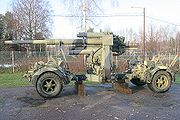 By 18 May the Division had captured Cambrai
, and on 20 May it reached Arras. Here Rommel wanted to cut off the British Expeditionary Force
's path to the coast, and Luck was tasked with forcing a crossing over the La Bassée canal near the city. During this action Luck was wounded in the hand, but after a night's rest he was back with the unit. Supported by Stuka
dive bombers, the unit managed to force a crossing. The British and French launched a counterattack (Battle of Arras
) with Matilda tank
s and Char B1
s, and the Germans found their 3.7 cm antitank guns and their 75mm tank guns useless against its heavy armor. Several batteries of 88 mm gun
s and 105mm guns had to be brought up to deal with the threat. The British and French Counterattack was so effective that the German gunners found themselves firing over open sights in order to knock out the Matilda tank
s and the Char B1
s The crossing was secured after several days of fierce fighting.
The 7th Panzer continued its advance, and on 27 May it reached Lille
. The following day the Division came under heavy fire from German artillery due to the rapidity of the advance. During this barrage the commander of the 37th Armoured Reconnaissance Battalion was killed, and Rommel assigned Luck to this command, despite Luck being the second youngest company commander in the unit. While the British evacuated the troops at Dunkirk
, the 7th Panzer Division was given a few days of rest. During this period Luck received the Iron Cross
I class.
On 5 June the Division resumed its advance, in a drive for the Seine river to secure the bridges near Rouen
. Advancing 100 km in two days, the Division reached Rouen, only to find the bridges destroyed. On 8 June Luck led his recce battalion towards the coast, with the tanks of the Division some distance behind. On 9 June Luck reached the coast, where Rommel ordered him to proceed southwards with only his recce battalion and a battery of 88mm guns in support to capture the port of Fecamp
. Upon reaching the port, Luck demanded the port's surrender, but due to the presence of two British destroyers evacuating troops, this was denied. On 10 June Luck ordered all his troops to open fire on the destroyers, the port facilities and the radio station in the town, in the hope of forcing the town into surrendering. Apart from the few 88 mm guns he had only the light 3.7 and 2 cm guns of the scout cars to help with the barrage. Nevertheless the barrage quickly persuaded the French garrison to surrender, while the two British destroyers steamed away.
On 15 June 7th Panzer started advancing on Cherbourg. On 17 June the division advanced 350 km, and on 18 June the town was captured. The Division then proceeded towards Bordeaux
, but stopped when the armistice was signed on 21 June. In July the Division was sent to the Paris
area to start preparations for Operation Seelöwe. The preparations were half-hearted however, as it became clearer and clearer that the Luftwaffe would not be able to secure air superiority over the British coast. In February 1941 Rommel was replaced by General Freiherr von Funk. In June the Division was sent to East Prussia.
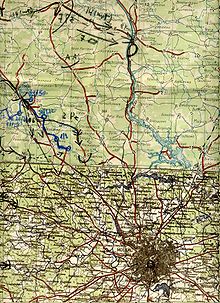 On 22 June 1941 the invasion of the Soviet Union
began. Luck, now a Hauptmann
, was attached to the Division HQ, and the division was attached to 3rd Panzer group under Army Group Center. 3rd Panzer Group captured Vilnius
, Lithuania
before advancing on Minsk
. During this advance Luck had a narrow escape, when he and his adjutant in a Mercedes cabriolet stumbled into a large group of Russian infantry along a narrow wooded track. The adjutant firing wildly, they managed to escape. After the capture of Minsk the armored spearhead continued east towards Vitebsk
. After Vitebsk, Luck was again assigned as commander of the Armoured Reconnaissance Battalion, after the previous commander was killed in action.
On 26 July the pocket around Smolensk
was closed, with Luck's Battalion closing the Smolensk-Moscow road. Continuing on towards Moscow
Luck encountered increasingly stiff resistance, and more and more T-34 and T-50
tanks, which were impervious to the 3.7 cm guns the recce battalion had, and could only be destroyed with 88 mm guns. This, and the lengthening supply distances, forced the advance to a crawl.
By the end of October massive snowfalls and plummeting temperatures forced the advance to halt. During November only very few advances were made, although the 7th Panzer Division managed to secure a bridgehead south of Kalinin
and not far from the outskirts of Moscow, with a detachment of Luck's command penetrating into the city itself. On 3 December Luck had to cover the retreat of the division from a bridgehead to an area east of Klin
. The withdrawal could only be conducted on two roads, with very high piles of snow alongside them, meaning that no maneuvering could take place. The Soviet air force put the retreating columns under constant attack, and it suffered heavy losses. There was little antiaircraft artillery available, and the Luftwaffe had already retreated to air bases further west. Luck's rearguard, however, had a substantial number of light antiaircraft guns, and managed to extract itself without heavy losses. The withdrawal did not end until the German units were forced to a position 100 km from Moscow. On 2 January 1942 Luck was awarded the German Cross
in Gold, and received orders he was to report in Africa after a request by Rommel.
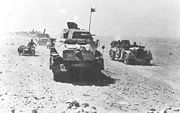 After spending February and March 1942 on leave, Luck reported back for duty on 1 April 1942 and transferred to the Afrikakorps, reaching Africa on 8 April, where he was reunited with Rommel. Luck, now a major
, assumed command over the 3rd Panzer Reconnaissance Battalion of the 21st Panzer Division
. Over the next two months Luck familiarised himself with the African theatre, during a lull in the fighting. On 24 May an offensive was launched towards Tobruk
.
On 27 May Luck's recce battalion, in support of the attack on the Gazala
positions, encountered a group of American built Grant tanks
. The Grants opened fire from such a range that the 5 cm antitank guns Luck commanded were ineffective. Luck ordered his men to set up defensive positions, but while he was directing the deployment and fire of the antitank guns, he was wounded in the right leg by shrapnel, and the doctor treating him wanted him evacuated to a field hospital. By this time the battalion, and indeed the whole Afrikakorps, was encircled by the British, however, and Luck had to conduct defensive operations. Rommel decided to withdraw through the partially defended Gazala positions, and Luck was tasked with protecting the south flank of the withdrawal. For five days Luck, with a steady dosage of morphine to ease the pain in his leg, conducted a fighting retreat with his battalion. On 1 June the Afrikakorps had managed to disengage, and Luck could finally be evacuated to a field hospital, while Rommel resumed the attack on the British positions south of Gazala.
on the edge of the Qattara Depression
, guarding the south flank of the Afrikakorps. Here, the battalion lived a mostly carefree existence, the only threat being the occasional raid by the British Long Range Desert Group
.
On 23 October 1942 the lull was broken, as the British launched the attack of the Second Battle of El Alamein
, and on 2 November General Montgomery broke through the German lines. On 4 November the XX Italian Corps had been surrounded, and a 20 km gap had appeared in the German lines. Rommel, despite Hitler's
orders to the contrary, ordered a general retreat, and Luck's recce battalion withdrew, protecting the south flank, and scouting for any mounting threats to the retreat. On 7 November Luck linked up with General Hermann-Bernhard Ramcke
who led the Ramcke Parachute Brigade
. The remaining 700 paratroopers had left all their heavy equipment behind, and had walked a long way, but still remained in good fighting order.
On 8 November Luck received two additional recce battalions in support, and continued operations to ensure the safety of the Afrikakorps southern flank. During the next days there were frequent encounters with British patrols seeking alternative paths to outflank the Germans. On one occasion Luck, facing the Royal Dragoons
regiment, received a radio transmission from the British asking about the well being of a British patrol gone missing. Luck confirmed that the men had been captured, and were in fine form. After this a regular 5 pm cease fire was established, and the two sides swapped information about men captured and their conditions.
On 20 November Luck returned to Rommel's HQ, where a depressed Rommel told him the battle of Africa was lost, and that all that was left to do was to evacuate as many officers, specialist and veterans as possible. Rommel also told Luck that the war was lost, and all that was left was to make a peace treaty with the allies, which would entail the removal of Hitler. Rommel claimed that only an alliance between the Western countries against Russia could save Western Civilization, and Winston Churchill
was the man to lead it. On 6 December the Germans retreated to Tunisia
. The severe fuel shortage curtailed operations, but on 17 December Luck and his reinforced detachment managed to flank an advancing British Armor Division, and destroy 20 tanks using the 88mm guns. On 31 December Luck was ordered further west, to secure the area south of Tripoli
.
of the Special Air Service
.
On 1 February 1943 Rommel attacked the Americans in Morocco
who had landed there during Operation Torch
. Luck was again tasked with protecting the flanks of the assault, and then to go on the offensive to harass the retreating Americans. On 19 February Luck was tasked with capturing the Kasserine pass
in a surprise coup. The Americans were alert, however, and the heavy defensive fire spoiled Luck's advance. Rommel, however, led a decisive attack on the following day with the 21st and 10th
Panzer Divisions, breaking through the Pass within minutes. The Americans fought stubbornly, but their tanks were no match for the Panzer IV F2 (called 'MkIV Special' by the British)
and Tiger
tanks of the Germans. Over the next days, Luck supported the advance, but his unit lost most of its armored cars and ammunition, and in the beginning of March the battalion was pulled back and kept as reserve.
By the end of March the German positions in Africa became more and more desperate. Rommel flew to Germany to argue that the forces would have to withdrawn. He was rejected, and denied permission to return to Africa. Luck received orders from the new commander of Army Group Africa, General Hans-Jürgen von Arnim
, to fly back to Germany to try to persuade Hitler of the necessity to withdraw experienced troops from Africa. It was hoped a battle-hardened major would perhaps have a better chance. Luck travelled to the Führer's HQ, but the plan was flatly rejected by Hitler's chief of staff, Alfred Jodl
. Luck wanted to travel back to Africa, but all travel to the beleaguered forces was forbidden. By the end of April, as the situation had grown very desperate, Hitler backed down and ordered the evacuation. This was, however, too late, and on 6 May the forces in Africa surrendered, with more than 130,000 Germans taken prisoner.
. Upon reaching the Panzer Lehr HQ Luck was informed that he had been reassigned to the 21st Panzer Division, that was stationed near Rennes
, in Normandy. In early May Luck took up his duties there.
The 21st Panzer Division had been reconstituted in late 1943, after it had lost all its men in Africa during the surrender there. It had been put together with a cadre of experienced men from Russia, along with new recruits from Germany, and was commanded by General der Artillerie Edgar Feuchtinger
, who had no combat and no Panzer forces experience. Luck was put in command of the 125th Panzer Grenadier Regiment. Much of the materiel of the Division was captured French armaments, and many of the tanks and assault guns consisted of captured French vehicles retrofitted with German armor and guns. Luck's regiment was stationed at Vimont, northeast of Caen
, with two companies of assault guns in support.
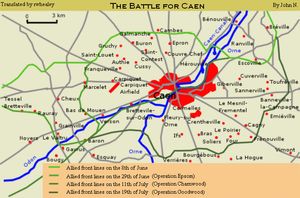 On 6 June 1944 the invasion of Normandy started. During the night Luck was startled by the reports of paratroopers landing in his area, and establishing a bridgehead on the east side of the Orne River
. A quick attack was launched by the II Battalion, and it succeeded in disturbing the paratrooper operations, and capturing some prisoners. Luck was, however, hampered by the strict orders not to engage in major operations unless cleared to do so by high command. As the day wore on, the defenders on the coast were smashed, while 21 Panzer Division remained mostly motionless, apart from an order at 4:30 a.m. directing other elements of the unit to move against the paratroopers of the British 6th Airborne Division
and thus farther away from the coast.
Around 10:30 a.m. General Erich Marcks
, commander of the 84th Corps (to which 21st Panzer Division was attached), ordered the entire 21st to attack east of the Orne River. This was later countermanded from 7th Army high command, ordering only Luck's detachment to attack east of Orne, while the rest of the division should attack on the west side of the river. This naturally caused much confusion and further delayed the German response. Nevertheless, at 1700 p.m. Luck attempted to break through to the Orne river bridges at Bénouville
with his Schützenpanzerwagen (armoured personnel carriers), but heavy fire from the warships supporting the British paratroopers, under Major John Howard
, holding the bridges drove his forces back. Added to this, more British paratroopers landed in the rear area of the Regiment, forcing Luck's II Battalion to fall back to avoid getting surrounded. This battalion lost its commander on the morning of 7 June.
On the morning of the 9 June Luck's command was designated Kampfgruppe von Luck, and in addition to the elements of 125th Panzer Grenadier Regiment already under Luck's command it consisted of Panzer Reconnaissance Battalion 21, 4th Company, Panzer Regiment 22, three batteries from Major Alfred Becker's Assault-Gun Battalion 200 and one company from Antitank Battalion 220 (88mm guns). With this force Luck was again tasked with assaulting the Orne bridges, and recapturing them from the British paratroopers. Starting one hour before dawn to avoid the worst of the British naval and aerial support, the Kampfgruppe advanced on the village of Ranville, dislodging the enemy there, but it could not penetrate the British lines to reach the bridges. The British paratroopers had been reinforced by the British 51st (Highland) Division
on the evening of 8 June.
On 12 June Kampfgruppe von Luck, now further enlarged with an addition of a brigade of Nebelwerfer
s, successfully reclaimed the village of Sainte-Honorine
, lying on an important hill overlooking the invasion beaches. A furious counterattack by a Canadian Division resulted in the Germans having to withdraw again, after fierce hand to hand fighting. After this final attack had been repulsed, Luck determined that the British bridgehead could not be eliminated, but due to the counterattacks launched by Kampfgruppe von Luck, the British/Canadian forces stopped any further advance in the sector, preferring to lay mines and dig themselves in. Apart from a failed German attack on 15 June, the sector was relatively quiet for the next two weeks.
taking place further south, Luck, holding the right flank of the German lines around Caen, did not see any major action until Operation Epsom
was launched and the British 11th Armoured Division
attacked the positions of 192nd Regiment on 27 June. The British armour advanced without infantry support, and was easily destroyed in the hedgerows of the area. However, some elements of the British forces managed to penetrate the western outskirts of Caen.
In the beginning of July Luck's Kampfgruppe were further augmented with the arrival of Heavy Tank Battalion 503
equipped with Tiger I tanks. Further assault gun elements were also brought in. Luck was now attached to I SS Panzer Corps
, commanded by Sepp Dietrich
. On the morning of 18 July Luck, returning from a three-day leave in Paris, was faced with the opening of Operation Goodwood
. A heavy bombardment, followed by a creeping artillery barrage, had hit the Kampfgruppe's positions, but no action had been taken by the commander put in place in Luck's absence.
Luck set out for the front, and to his dismay saw a large contingent of British tanks rolling over what had been the dug in positions of I Battalion/125th Panzer Grenadier Regiment, in the direction of Cagny
. Spotting a Luftwaffe
Flak battery of 88mm guns, Luck ordered the commander to open fire on the flank of the British tanks. The battery commander, a young captain, refused to do so, as he was under orders to engage enemy aircraft. At this refusal Luck drew his service pistol, leveled it at the man and said "Either you're a dead man or you can earn yourself a medal." The battery thus engaging the enemy, Luck spent the remainder of the day furiously trying to plug the gaps in his line. Most of the Kampfgruppes armour had been destroyed in the heavy barrages earlier in the day, so it was left to a few scattered antitank and assault gun batteries to take on the advancing British tanks. In recent years the truth of this portrayal of Luck's guns has been questioned by academics such as Ian Daglish
who have studied the aerial photographs of Cagny taken hours after the battle; these show no sign of an 88mm battery or even that one had been positioned in the village. However, no suitable alternative seems to explain the heavy destruction wrought on 11th Armoured.
Assuming the story is fact, the 88mm guns at Cagny had indeed stopped the British advance, inflicting heavy casualties on the 11th Armoured Division. The following division, the Guards Armoured Division did not heed the fate of the 11th, and it too took massive losses in the area, effectively halting the British armoured advance. Advancing without infantry support, the armour units were unable to overcome the entrenched antitank guns. The Luftwaffe 88mm battery Luck commandeered earlier in the day accounted for about 40 British tanks alone. In the afternoon the first elements of the 1st SS Division Leibstandarte SS Adolf Hitler
had moved up in support and the situation was somewhat stabilized.
During 19 July Luck's Kampfgruppe, still supported by the SS armour, held the British at bay, counterattacking on the flanks and causing them heavy losses. The British advance ground to a halt after having covered only 9 km, and suffering the loss of some 450 tanks. In the evening the 12th SS Panzer Division Hitlerjugend
relieved Luck's men. For his important role in defeating the British in Operation Goodwood
Luck earned the Knight's Cross of the Iron Cross
on 8 August 1944 as Major
and leader of the Panzergreandier-Regiment 125 and was promoted to Oberstleutnant
.
area south of Bayeux
to prevent a breakthrough in that area. This was the same area where Michael Wittmann
and his Tiger crew almost single handedly had defeated a British thrust on 13 June during the Battle of Villers-Bocage
. On 26 July Panzer Lehr's lines were broken, and 21st Panzer Division reoriented themselves on this new threat. On 31 July General Patton broke through at Avranches
. With this all the German divisions in Normandy were in danger of being encircled, and a rapid retreat was ordered.
Luck reached Falaise
after two weeks of delaying action. On 17 August a British attack split the 21st Panzer Division, leaving half inside the now emerging Falaise Pocket
, while Luck's command found itself on the outside. Kampfgruppe von Luck was now tasked with holding the Western end of the gap open, and succeeded in holding it open until 21 August, allowing about half of the 100,000 trapped troops to escape, though most of the heavy materiel and vehicles were destroyed in the pocket. A new threat was already emerging, with Patton threatening to create yet another pocket, south of the Seine River. Luck was put in command of the remains of 21st Panzer Division and conducted a rearguard action, only barely able to keep the front intact until the last German forces could be withdrawn over the Seine on 26 August.
Now began an eleven day march across the axis of advance of the American forces. On 9 September Luck's command reached its assigned area near Strasbourg
. Here Luck established himself under General Hasso von Manteuffel
's Fifth Panzer Army
operating in the Lorraine
area and eventually defending the Siegfried Line
. During Operation Nordwind
, Luck was ordered to participate in the recapture of Hatten, Bas-Rhin
. In January 1945, when the division was moved to the Oder
front, Luck played a major role in the division's operations along the Reitwein
Spur. He surrendered to the Soviets while attempting a breakout from the Battle of Halbe
encirclement in April 1945.
in Georgia
, Luck was repatriated. He became heavily involved in veterans' associations, and also lecturing military students. He also became good friends with several of his former opponents, most notably British
Airborne
Major John Howard
. He also formed a friendship with popular U.S.
historian
Stephen Ambrose
, at whose instigation he wrote his memoirs, titled Panzer Commander.
After the war, Luck and Howard would have coffee together in Bénouville
at probably the first building in France to be liberated from German occupation, café Gondrée. Because the owners were severely anti-German, Howard convinced them that Luck was a Swede.
Colonel
Colonel , abbreviated Col or COL, is a military rank of a senior commissioned officer. It or a corresponding rank exists in most armies and in many air forces; the naval equivalent rank is generally "Captain". It is also used in some police forces and other paramilitary rank structures...
in the German
Nazi Germany
Nazi Germany , also known as the Third Reich , but officially called German Reich from 1933 to 1943 and Greater German Reich from 26 June 1943 onward, is the name commonly used to refer to the state of Germany from 1933 to 1945, when it was a totalitarian dictatorship ruled by...
Armored Forces
Wehrmacht
The Wehrmacht – from , to defend and , the might/power) were the unified armed forces of Nazi Germany from 1935 to 1945. It consisted of the Heer , the Kriegsmarine and the Luftwaffe .-Origin and use of the term:...
(Oberst
Oberst
Oberst is a military rank in several German-speaking and Scandinavian countries, equivalent to Colonel. It is currently used by both the ground and air forces of Austria, Germany, Switzerland, Denmark and Norway. The Swedish rank överste is a direct translation, as are the Finnish rank eversti...
der Panzerwaffe
Panzerwaffe
Panzerwaffe refers to a command within the Heer of the German Wehrmacht, responsible for the affairs of panzer and motorized forces shortly before and during the Second World War...
) during World War II
World War II
World War II, or the Second World War , was a global conflict lasting from 1939 to 1945, involving most of the world's nations—including all of the great powers—eventually forming two opposing military alliances: the Allies and the Axis...
. He served with the 7th Panzer Division
German 7th Panzer Division
The 7th Panzer Division was a German elite armored formation which participated in the Battle of France. General Erwin Rommel commanded the division, which was nicknamed the "Ghost Division" because of its speed and independent movement, which even the German High Command had difficulty following...
and 21st Panzer Division
German 21st Panzer Division
The 21st Panzer Division was a German armoured division best known for its role in the battles of the North African Campaign from 1941–1943 during World War II when it was one of the two armoured divisions making up the Afrika Korps.-Origins:...
, seeing action in Poland, France, North Africa, Italy and Russia. He was a close associate of Generalfeldmarschall
Generalfeldmarschall
Field Marshal or Generalfeldmarschall in German, was a rank in the armies of several German states and the Holy Roman Empire; in the Austrian Empire, the rank Feldmarschall was used...
Erwin Rommel
Erwin Rommel
Erwin Johannes Eugen Rommel , popularly known as the Desert Fox , was a German Field Marshal of World War II. He won the respect of both his own troops and the enemies he fought....
. He is author of the book Panzer Commander.
Early life
Luck was born in FlensburgFlensburg
Flensburg is an independent town in the north of the German state of Schleswig-Holstein. Flensburg is the centre of the region of Southern Schleswig...
, Province of Schleswig-Holstein
Province of Schleswig-Holstein
The Province of Schleswig-Holstein was a province of the Kingdom of Prussia and the Free State of Prussia from 1868 to 1946. It was created from the Duchies of Schleswig and Holstein, which had been conquered by Prussia and the Austrian Empire from Denmark in the Second War of Schleswig in 1864...
, into a Prussia
Prussia
Prussia was a German kingdom and historic state originating out of the Duchy of Prussia and the Margraviate of Brandenburg. For centuries, the House of Hohenzollern ruled Prussia, successfully expanding its size by way of an unusually well-organized and effective army. Prussia shaped the history...
n family with old military roots, going back to the 13th century. Members of his family had fought with, among others, Frederick the Great
Frederick II of Prussia
Frederick II was a King in Prussia and a King of Prussia from the Hohenzollern dynasty. In his role as a prince-elector of the Holy Roman Empire, he was also Elector of Brandenburg. He was in personal union the sovereign prince of the Principality of Neuchâtel...
during the Seven Years' War
Seven Years' War
The Seven Years' War was a global military war between 1756 and 1763, involving most of the great powers of the time and affecting Europe, North America, Central America, the West African coast, India, and the Philippines...
. Luck's father, Otto von Luck, broke tradition by serving as a Naval
Kaiserliche Marine
The Imperial German Navy was the German Navy created at the time of the formation of the German Empire. It existed between 1871 and 1919, growing out of the small Prussian Navy and Norddeutsche Bundesmarine, which primarily had the mission of coastal defense. Kaiser Wilhelm II greatly expanded...
officer during World War I
World War I
World War I , which was predominantly called the World War or the Great War from its occurrence until 1939, and the First World War or World War I thereafter, was a major war centred in Europe that began on 28 July 1914 and lasted until 11 November 1918...
and taking part in the Battle of Jutland
Battle of Jutland
The Battle of Jutland was a naval battle between the British Royal Navy's Grand Fleet and the Imperial German Navy's High Seas Fleet during the First World War. The battle was fought on 31 May and 1 June 1916 in the North Sea near Jutland, Denmark. It was the largest naval battle and the only...
. Following his father's death from the Spanish flu
Spanish flu
The 1918 flu pandemic was an influenza pandemic, and the first of the two pandemics involving H1N1 influenza virus . It was an unusually severe and deadly pandemic that spread across the world. Historical and epidemiological data are inadequate to identify the geographic origin...
in 1918, Luck's adoptive father brought him up in the "Prussian" manner. On 1 April 1917 Luck enrolled in the Monastery School in Flensburg, studying the classic languages such as Latin
Latin
Latin is an Italic language originally spoken in Latium and Ancient Rome. It, along with most European languages, is a descendant of the ancient Proto-Indo-European language. Although it is considered a dead language, a number of scholars and members of the Christian clergy speak it fluently, and...
and Greek
Ancient Greek
Ancient Greek is the stage of the Greek language in the periods spanning the times c. 9th–6th centuries BC, , c. 5th–4th centuries BC , and the c. 3rd century BC – 6th century AD of ancient Greece and the ancient world; being predated in the 2nd millennium BC by Mycenaean Greek...
. This gave him a remarkable comprehension of foreign languages, having gained a strong command of English, French, and Russian before the war. During the war, he was able to communicate with French and British soldiers. Later, during his imprisonment, he was able to use his knowledge of Russian to negotiate his release.
In 1929, after taking his Abitur
Abitur
Abitur is a designation used in Germany, Finland and Estonia for final exams that pupils take at the end of their secondary education, usually after 12 or 13 years of schooling, see also for Germany Abitur after twelve years.The Zeugnis der Allgemeinen Hochschulreife, often referred to as...
, Luck started his career as an Army
German Army
The German Army is the land component of the armed forces of the Federal Republic of Germany. Following the disbanding of the Wehrmacht after World War II, it was re-established in 1955 as the Bundesheer, part of the newly formed West German Bundeswehr along with the Navy and the Air Force...
officer, serving as a cadet in a Silesian
Province of Silesia
The Province of Silesia was a province of the Kingdom of Prussia from 1815 to 1919.-Geography:The territory comprised the bulk of the former Bohemian crown land of Silesia and the County of Kladsko, which King Frederick the Great had conquered from the Austrian Habsburg Monarchy in the 18th...
cavalry regiment. He was unexpectedly transferred to the 1st Motorized Battalion in East Prussia
East Prussia
East Prussia is the main part of the region of Prussia along the southeastern Baltic Coast from the 13th century to the end of World War II in May 1945. From 1772–1829 and 1878–1945, the Province of East Prussia was part of the German state of Prussia. The capital city was Königsberg.East Prussia...
after a short while, something Luck regretted, perceiving the cavalry as the elite force. He soon found the future Panzerwaffe to be to his liking, however. In 1931/32 Luck attended a nine month course, led by Erwin Rommel
Erwin Rommel
Erwin Johannes Eugen Rommel , popularly known as the Desert Fox , was a German Field Marshal of World War II. He won the respect of both his own troops and the enemies he fought....
, at the infantry school in Dresden
Dresden
Dresden is the capital city of the Free State of Saxony in Germany. It is situated in a valley on the River Elbe, near the Czech border. The Dresden conurbation is part of the Saxon Triangle metropolitan area....
, to complete his commission as a junior officer. In the autumn of 1932 Luck was promoted to Leutnant, and in 1933 his unit were equipped with their first scout cars
Leichter Panzerspähwagen
The Leichter Panzerspähwagen were a series of light four-wheel drive armoured cars produced by Nazi Germany from 1935 to 1944....
, marking the first step towards becoming an armoured reconnaissance battalion. On 30 June 1934 Luck's unit took part in the Night of the Long Knives
Night of the Long Knives
The Night of the Long Knives , sometimes called "Operation Hummingbird " or in Germany the "Röhm-Putsch," was a purge that took place in Nazi Germany between June 30 and July 2, 1934, when the Nazi regime carried out a series of political murders...
, arresting several Sturmabteilung
Sturmabteilung
The Sturmabteilung functioned as a paramilitary organization of the National Socialist German Workers' Party . It played a key role in Adolf Hitler's rise to power in the 1920s and 1930s...
members in Stettin.
In 1936 Luck assumed command over the third company in the 8th Armoured Reconnaissance Battalion, stationed in Potsdam
Potsdam
Potsdam is the capital city of the German federal state of Brandenburg and part of the Berlin/Brandenburg Metropolitan Region. It is situated on the River Havel, southwest of Berlin city centre....
. Here he spent much time working under the personal supervision of General Heinz Guderian
Heinz Guderian
Heinz Wilhelm Guderian was a German general during World War II. He was a pioneer in the development of armored warfare, and was the leading proponent of tanks and mechanization in the Wehrmacht . Germany's panzer forces were raised and organized under his direction as Chief of Mobile Forces...
, who was responsible for forming the doctrines for the new German armoured force. Luck spent the next years serving in various armoured units, and traveled extensively around Europe when on leave. In 1939 he was posted to the 2nd Light Division
German 2nd Light Division
The 2nd Light Division was created in November 1938. In 1939 it fought in the Invasion of Poland...
, serving with the 7th Armoured Reconnaissance Battalion.
Invasion of Poland
On 1 September 1939 the 2nd Light Division, under General Georg StummeGeorg Stumme
Georg Stumme was a World War II German general most notable for his brief command of the Axis forces at the beginning of the Second Battle of El Alamein.-Biography:...
, attacked Poland
Invasion of Poland (1939)
The Invasion of Poland, also known as the September Campaign or 1939 Defensive War in Poland and the Poland Campaign in Germany, was an invasion of Poland by Germany, the Soviet Union, and a small Slovak contingent that marked the start of World War II in Europe...
. Luck led the reconnaissance force in the vanguard of the Division. Over the next days, the Division advanced through Kielce
Kielce
Kielce ) is a city in central Poland with 204,891 inhabitants . It is also the capital city of the Świętokrzyskie Voivodeship since 1999, previously in Kielce Voivodeship...
, Radom
Radom
Radom is a city in central Poland with 223,397 inhabitants . It is located on the Mleczna River in the Masovian Voivodeship , having previously been the capital of Radom Voivodeship ; 100 km south of Poland's capital, Warsaw.It is home to the biennial Radom Air Show, the largest and...
and Łódź, but it was not until 6 September that serious resistance was encountered. The Division continued on towards Warsaw
Warsaw
Warsaw is the capital and largest city of Poland. It is located on the Vistula River, roughly from the Baltic Sea and from the Carpathian Mountains. Its population in 2010 was estimated at 1,716,855 residents with a greater metropolitan area of 2,631,902 residents, making Warsaw the 10th most...
, and on 9 September it reached the outskirts. The city did not fall until 27 September, marking the unit's end of fighting in Poland, after suffering only light casualties.
After Poland, the unit returned to Germany, where the 2nd Light Division was reorganised and reequipped to form the 7th Panzer Division
German 7th Panzer Division
The 7th Panzer Division was a German elite armored formation which participated in the Battle of France. General Erwin Rommel commanded the division, which was nicknamed the "Ghost Division" because of its speed and independent movement, which even the German High Command had difficulty following...
. On 6 February 1940 General Rommel assumed command of the unit. Receiving new Panzer III
Panzer III
Panzer III was the common name of a medium tank that was developed in the 1930s by Germany and was used extensively in World War II. The official German designation was Panzerkampfwagen III translating as "armoured battle vehicle". It was intended to fight other armoured fighting vehicles and...
and Panzer IV
Panzer IV
The Panzerkampfwagen IV , commonly known as the Panzer IV, was a medium tank developed in Nazi Germany in the late 1930s and used extensively during the Second World War. Its ordnance inventory designation was Sd.Kfz...
tanks, as well as new six-wheel scout cars
Schwerer Panzerspähwagen
The term Schwerer Panzerspähwagen , covers the 6 and 8 wheeled armoured cars Germany used during the Second World War....
armed with a 2.0 cm gun for Luck's unit, 37th Armoured Reconnaissance Battalion commanded by Major Erdmann. At the beginning of May 1940 the unit moved to the Eifel mountains
Eifel
The Eifel is a low mountain range in western Germany and eastern Belgium. It occupies parts of southwestern North Rhine-Westphalia, northwestern Rhineland-Palatinate and the south of the German-speaking Community of Belgium....
area, in preparation for the invasion of France.
Invasion of France
On 10 May 1940 the 7th Panzer Division, a part of 15th Panzer Corps under General Hermann HothHermann Hoth
Hermann "Papa" Hoth was an officer in the German military from 1903 to 1945. He attained the rank of Generaloberst during World War II. He fought in France, but is most noted for his later exploits as a panzer commander on the Eastern Front...
, advanced into Belgium
Belgium
Belgium , officially the Kingdom of Belgium, is a federal state in Western Europe. It is a founding member of the European Union and hosts the EU's headquarters, and those of several other major international organisations such as NATO.Belgium is also a member of, or affiliated to, many...
to proceed to the Meuse river
Meuse River
The Maas or Meuse is a major European river, rising in France and flowing through Belgium and the Netherlands before draining into the North Sea...
near Dinant
Dinant
Dinant is a Walloon city and municipality located on the River Meuse in the Belgian province of Namur, Belgium. The Dinant municipality includes the old communes of Anseremme, Bouvignes-sur-Meuse, Dréhance, Falmagne, Falmignoul, Foy-Notre-Dame, Furfooz, Lisogne, Sorinnes, and Thynes.-Origins to...
as part of the invasion of France
Battle of France
In the Second World War, the Battle of France was the German invasion of France and the Low Countries, beginning on 10 May 1940, which ended the Phoney War. The battle consisted of two main operations. In the first, Fall Gelb , German armoured units pushed through the Ardennes, to cut off and...
. At the Meuse 7th Panzer was held up, due to the bridge having been destroyed and determined sniper and artillery fire from the French defenders. The Germans lacked smoke grenades, so Rommel, having assumed personal command of the crossing, ordered a few nearby houses to be torched to conceal the attack, and summoned Ju87 Stukas to dive-bomb the French defences. The German Panzer Grenadiers crossed the rivers in rubber boats, with Rommel leading the second wave across the river. The aerial bombardment, while not seeming to do much damage, psychologically battered the French defenders so much that most of them abandoned their posts and ran. The Division, still spearheaded by Luck's recce force, dashed further inland, always spurred on by Rommel, and far in front of any friendly forces.
Cambrai
Cambrai is a commune in the Nord department in northern France. It is a sub-prefecture of the department.Cambrai is the seat of an archdiocese whose jurisdiction was immense during the Middle Ages. The territory of the Bishopric of Cambrai, roughly coinciding with the shire of Brabant, included...
, and on 20 May it reached Arras. Here Rommel wanted to cut off the British Expeditionary Force
British Expeditionary Force (World War II)
The British Expeditionary Force was the British force in Europe from 1939–1940 during the Second World War. Commanded by General Lord Gort, the BEF constituted one-tenth of the defending Allied force....
's path to the coast, and Luck was tasked with forcing a crossing over the La Bassée canal near the city. During this action Luck was wounded in the hand, but after a night's rest he was back with the unit. Supported by Stuka
Junkers Ju 87
The Junkers Ju 87 or Stuka was a two-man German ground-attack aircraft...
dive bombers, the unit managed to force a crossing. The British and French launched a counterattack (Battle of Arras
Battle of Arras (1940)
The Battle of Arras took place during the Battle of France, in the early stages of World War II. It was an Allied counterattack against the flank of the German army, that took place near the town of Arras, in north-eastern France. The German forces were pushing north toward the channel coast, in...
) with Matilda tank
Matilda Mk I
The Tank, Infantry, Mk I, Matilda I was a British infantry tank of the Second World War. It is not to be confused with the later model Tank, Infantry Mk II , also known as the "Matilda II" which took over the "Matilda" name after the early part of the war when the first Matilda was withdrawn from...
s and Char B1
Char B1
The Char B1 was a French heavy tank manufactured before World War II.The Char B1 was a specialised heavy break-through vehicle, originally conceived as a self-propelled gun with a 75 mm howitzer in the hull; later a 47 mm gun in a turret was added, to allow it to function also as a Char...
s, and the Germans found their 3.7 cm antitank guns and their 75mm tank guns useless against its heavy armor. Several batteries of 88 mm gun
88 mm gun
The 88 mm gun was a German anti-aircraft and anti-tank artillery gun from World War II. It was widely used by Germany throughout the war, and was one of the most recognizable German weapons of the war...
s and 105mm guns had to be brought up to deal with the threat. The British and French Counterattack was so effective that the German gunners found themselves firing over open sights in order to knock out the Matilda tank
Matilda Mk I
The Tank, Infantry, Mk I, Matilda I was a British infantry tank of the Second World War. It is not to be confused with the later model Tank, Infantry Mk II , also known as the "Matilda II" which took over the "Matilda" name after the early part of the war when the first Matilda was withdrawn from...
s and the Char B1
Char B1
The Char B1 was a French heavy tank manufactured before World War II.The Char B1 was a specialised heavy break-through vehicle, originally conceived as a self-propelled gun with a 75 mm howitzer in the hull; later a 47 mm gun in a turret was added, to allow it to function also as a Char...
s The crossing was secured after several days of fierce fighting.
The 7th Panzer continued its advance, and on 27 May it reached Lille
Lille
Lille is a city in northern France . It is the principal city of the Lille Métropole, the fourth-largest metropolitan area in the country behind those of Paris, Lyon and Marseille. Lille is situated on the Deûle River, near France's border with Belgium...
. The following day the Division came under heavy fire from German artillery due to the rapidity of the advance. During this barrage the commander of the 37th Armoured Reconnaissance Battalion was killed, and Rommel assigned Luck to this command, despite Luck being the second youngest company commander in the unit. While the British evacuated the troops at Dunkirk
Operation Dynamo
The Dunkirk evacuation, commonly known as the Miracle of Dunkirk, code-named Operation Dynamo by the British, was the evacuation of Allied soldiers from the beaches and harbour of Dunkirk, France, between 26 May and the early hours of 3 June 1940, because the British, French and Belgian troops were...
, the 7th Panzer Division was given a few days of rest. During this period Luck received the Iron Cross
Iron Cross
The Iron Cross is a cross symbol typically in black with a white or silver outline that originated after 1219 when the Kingdom of Jerusalem granted the Teutonic Order the right to combine the Teutonic Black Cross placed above a silver Cross of Jerusalem....
I class.
On 5 June the Division resumed its advance, in a drive for the Seine river to secure the bridges near Rouen
Rouen
Rouen , in northern France on the River Seine, is the capital of the Haute-Normandie region and the historic capital city of Normandy. Once one of the largest and most prosperous cities of medieval Europe , it was the seat of the Exchequer of Normandy in the Middle Ages...
. Advancing 100 km in two days, the Division reached Rouen, only to find the bridges destroyed. On 8 June Luck led his recce battalion towards the coast, with the tanks of the Division some distance behind. On 9 June Luck reached the coast, where Rommel ordered him to proceed southwards with only his recce battalion and a battery of 88mm guns in support to capture the port of Fecamp
Fécamp
Fécamp is a commune in the Seine-Maritime department in the Haute-Normandie region in northern France.-Geography:Fécamp is situated in the valley of the river Valmont, at the heart of the Pays de Caux, on the Albaster Coast...
. Upon reaching the port, Luck demanded the port's surrender, but due to the presence of two British destroyers evacuating troops, this was denied. On 10 June Luck ordered all his troops to open fire on the destroyers, the port facilities and the radio station in the town, in the hope of forcing the town into surrendering. Apart from the few 88 mm guns he had only the light 3.7 and 2 cm guns of the scout cars to help with the barrage. Nevertheless the barrage quickly persuaded the French garrison to surrender, while the two British destroyers steamed away.
On 15 June 7th Panzer started advancing on Cherbourg. On 17 June the division advanced 350 km, and on 18 June the town was captured. The Division then proceeded towards Bordeaux
Bordeaux
Bordeaux is a port city on the Garonne River in the Gironde department in southwestern France.The Bordeaux-Arcachon-Libourne metropolitan area, has a population of 1,010,000 and constitutes the sixth-largest urban area in France. It is the capital of the Aquitaine region, as well as the prefecture...
, but stopped when the armistice was signed on 21 June. In July the Division was sent to the Paris
Paris
Paris is the capital and largest city in France, situated on the river Seine, in northern France, at the heart of the Île-de-France region...
area to start preparations for Operation Seelöwe. The preparations were half-hearted however, as it became clearer and clearer that the Luftwaffe would not be able to secure air superiority over the British coast. In February 1941 Rommel was replaced by General Freiherr von Funk. In June the Division was sent to East Prussia.
Invasion of the Soviet Union
Operation Barbarossa
Operation Barbarossa was the code name for Germany's invasion of the Soviet Union during World War II that began on 22 June 1941. Over 4.5 million troops of the Axis powers invaded the USSR along a front., the largest invasion in the history of warfare...
began. Luck, now a Hauptmann
Hauptmann
Hauptmann is a German word usually translated as captain when it is used as an officer's rank in the German, Austrian and Swiss armies. While "haupt" in contemporary German means "main", it also has the dated meaning of "head", i.e...
, was attached to the Division HQ, and the division was attached to 3rd Panzer group under Army Group Center. 3rd Panzer Group captured Vilnius
Vilnius
Vilnius is the capital of Lithuania, and its largest city, with a population of 560,190 as of 2010. It is the seat of the Vilnius city municipality and of the Vilnius district municipality. It is also the capital of Vilnius County...
, Lithuania
Lithuania
Lithuania , officially the Republic of Lithuania is a country in Northern Europe, the biggest of the three Baltic states. It is situated along the southeastern shore of the Baltic Sea, whereby to the west lie Sweden and Denmark...
before advancing on Minsk
Minsk
- Ecological situation :The ecological situation is monitored by Republican Center of Radioactive and Environmental Control .During 2003–2008 the overall weight of contaminants increased from 186,000 to 247,400 tons. The change of gas as industrial fuel to mazut for financial reasons has worsened...
. During this advance Luck had a narrow escape, when he and his adjutant in a Mercedes cabriolet stumbled into a large group of Russian infantry along a narrow wooded track. The adjutant firing wildly, they managed to escape. After the capture of Minsk the armored spearhead continued east towards Vitebsk
Vitebsk
Vitebsk, also known as Viciebsk or Vitsyebsk , is a city in Belarus, near the border with Russia. The capital of the Vitebsk Oblast, in 2004 it had 342,381 inhabitants, making it the country's fourth largest city...
. After Vitebsk, Luck was again assigned as commander of the Armoured Reconnaissance Battalion, after the previous commander was killed in action.
On 26 July the pocket around Smolensk
Smolensk
Smolensk is a city and the administrative center of Smolensk Oblast, Russia, located on the Dnieper River. Situated west-southwest of Moscow, this walled city was destroyed several times throughout its long history since it was on the invasion routes of both Napoleon and Hitler. Today, Smolensk...
was closed, with Luck's Battalion closing the Smolensk-Moscow road. Continuing on towards Moscow
Moscow
Moscow is the capital, the most populous city, and the most populous federal subject of Russia. The city is a major political, economic, cultural, scientific, religious, financial, educational, and transportation centre of Russia and the continent...
Luck encountered increasingly stiff resistance, and more and more T-34 and T-50
T-50 tank
The T-50 light infantry tank was built by the Soviet Union at the beginning of World War II. The design for this vehicle had some advanced features, but was complicated and expensive, and only a short production run of 69 tanks was completed...
tanks, which were impervious to the 3.7 cm guns the recce battalion had, and could only be destroyed with 88 mm guns. This, and the lengthening supply distances, forced the advance to a crawl.
By the end of October massive snowfalls and plummeting temperatures forced the advance to halt. During November only very few advances were made, although the 7th Panzer Division managed to secure a bridgehead south of Kalinin
Kalinin, Russia
Kalinin is the name of several inhabited localities in Russia:Rural localities*Kalinin, Republic of Adygea, a khutor in Maykopsky District of the Republic of Adygea*Kalinin, Ryazan Oblast, a settlement in Ukholovsky District of Ryazan Oblast...
and not far from the outskirts of Moscow, with a detachment of Luck's command penetrating into the city itself. On 3 December Luck had to cover the retreat of the division from a bridgehead to an area east of Klin
Klin
Klin is a town and the administrative center of Klinsky District of Moscow Oblast, Russia, located northwest of Moscow. The M10 highway connecting Moscow to St. Petersburg and the Moscow-Saint Petersburg Railway run through the town. It was home to Klin air base during the Cold War. ...
. The withdrawal could only be conducted on two roads, with very high piles of snow alongside them, meaning that no maneuvering could take place. The Soviet air force put the retreating columns under constant attack, and it suffered heavy losses. There was little antiaircraft artillery available, and the Luftwaffe had already retreated to air bases further west. Luck's rearguard, however, had a substantial number of light antiaircraft guns, and managed to extract itself without heavy losses. The withdrawal did not end until the German units were forced to a position 100 km from Moscow. On 2 January 1942 Luck was awarded the German Cross
German Cross
The German Cross was instituted by Adolf Hitler on 17 November 1941 as an award ranking higher than the Iron Cross First Class but below the Knight's Cross of the Iron Cross respectively ranking higher than the War Merit Cross First Class with Swords but below the Knight's Cross of the War Merit...
in Gold, and received orders he was to report in Africa after a request by Rommel.
North Africa
Major
Major is a rank of commissioned officer, with corresponding ranks existing in almost every military in the world.When used unhyphenated, in conjunction with no other indicator of rank, the term refers to the rank just senior to that of an Army captain and just below the rank of lieutenant colonel. ...
, assumed command over the 3rd Panzer Reconnaissance Battalion of the 21st Panzer Division
German 21st Panzer Division
The 21st Panzer Division was a German armoured division best known for its role in the battles of the North African Campaign from 1941–1943 during World War II when it was one of the two armoured divisions making up the Afrika Korps.-Origins:...
. Over the next two months Luck familiarised himself with the African theatre, during a lull in the fighting. On 24 May an offensive was launched towards Tobruk
Tobruk
Tobruk or Tubruq is a city, seaport, and peninsula on Libya's eastern Mediterranean coast, near the border with Egypt. It is the capital of the Butnan District and has a population of 120,000 ....
.
On 27 May Luck's recce battalion, in support of the attack on the Gazala
Battle of Gazala
The Battle of Gazala was an important battle of the Second World War Western Desert Campaign, fought around the port of Tobruk in Libya from 26 May-21 June 1942...
positions, encountered a group of American built Grant tanks
M3 Lee
The Medium Tank M3 was an American tank used during World War II. In Britain the tank was called "General Lee", named after Confederate General Robert E. Lee, and the modified version built with a new turret was called the "General Grant", named after U.S. General Ulysses S. Grant.Design commenced...
. The Grants opened fire from such a range that the 5 cm antitank guns Luck commanded were ineffective. Luck ordered his men to set up defensive positions, but while he was directing the deployment and fire of the antitank guns, he was wounded in the right leg by shrapnel, and the doctor treating him wanted him evacuated to a field hospital. By this time the battalion, and indeed the whole Afrikakorps, was encircled by the British, however, and Luck had to conduct defensive operations. Rommel decided to withdraw through the partially defended Gazala positions, and Luck was tasked with protecting the south flank of the withdrawal. For five days Luck, with a steady dosage of morphine to ease the pain in his leg, conducted a fighting retreat with his battalion. On 1 June the Afrikakorps had managed to disengage, and Luck could finally be evacuated to a field hospital, while Rommel resumed the attack on the British positions south of Gazala.
Reversal of fortunes
The wound in Luck's leg had become infected, and he was sent to Germany to recuperate. In mid September Luck was declared fit for duty and returned to Africa. There he resumed his command of the 3rd recce battalion, garrisoned at a pleasant oasis near SiwaSiwa Oasis
The Siwa Oasis is an oasis in Egypt, located between the Qattara Depression and the Egyptian Sand Sea in the Libyan Desert, nearly 50 km east of the Libyan border, and 560 km from Cairo....
on the edge of the Qattara Depression
Qattara Depression
The Qattara Depression is a depression in the north west of Egypt in the Matruh Governorate and is part of the Libyan Desert. It lies below sea level and is covered with salt pans, sand dunes and salt marshes. The region extends between latitudes of 28°35' and 30°25' North and longitudes of 26°20'...
, guarding the south flank of the Afrikakorps. Here, the battalion lived a mostly carefree existence, the only threat being the occasional raid by the British Long Range Desert Group
Long Range Desert Group
The Long Range Desert Group was a reconnaissance and raiding unit of the British Army during the Second World War. The commander of the German Afrika Corps, Field Marshal Erwin Rommel, admitted that the LRDG "caused us more damage than any other British unit of equal strength".Originally called...
.
On 23 October 1942 the lull was broken, as the British launched the attack of the Second Battle of El Alamein
Second Battle of El Alamein
The Second Battle of El Alamein marked a major turning point in the Western Desert Campaign of the Second World War. The battle took place over 20 days from 23 October – 11 November 1942. The First Battle of El Alamein had stalled the Axis advance. Thereafter, Lieutenant-General Bernard Montgomery...
, and on 2 November General Montgomery broke through the German lines. On 4 November the XX Italian Corps had been surrounded, and a 20 km gap had appeared in the German lines. Rommel, despite Hitler's
Adolf Hitler
Adolf Hitler was an Austrian-born German politician and the leader of the National Socialist German Workers Party , commonly referred to as the Nazi Party). He was Chancellor of Germany from 1933 to 1945, and head of state from 1934 to 1945...
orders to the contrary, ordered a general retreat, and Luck's recce battalion withdrew, protecting the south flank, and scouting for any mounting threats to the retreat. On 7 November Luck linked up with General Hermann-Bernhard Ramcke
Hermann-Bernhard Ramcke
Hermann-Bernhard "Gerhard" Ramcke was a German general. He was a recipient of the Knights Cross of the Iron Cross with Swords, Oak Leaves, and Diamonds, one of only 27 people in the German military so decorated...
who led the Ramcke Parachute Brigade
Ramcke Parachute Brigade
Fallschirmjäger-Brigade AfrikaFallschirmjäger-Brigade RamckeLuftwaffen-Jäger-Brigade 1The Fallschirmjäger-Brigade Ramcke was an elite German Luftwaffe Fallschirmjäger Brigade which saw action in the Mediterranean Theatre during World War II.-History:Following the costly success of Operation...
. The remaining 700 paratroopers had left all their heavy equipment behind, and had walked a long way, but still remained in good fighting order.
On 8 November Luck received two additional recce battalions in support, and continued operations to ensure the safety of the Afrikakorps southern flank. During the next days there were frequent encounters with British patrols seeking alternative paths to outflank the Germans. On one occasion Luck, facing the Royal Dragoons
Royal Dragoons
The Royal Dragoons was a cavalry regiment of the British Army. The regiment was formed in 1661, and served until 1969, when it was amalgamated with the Royal Horse Guards to form The Blues and Royals....
regiment, received a radio transmission from the British asking about the well being of a British patrol gone missing. Luck confirmed that the men had been captured, and were in fine form. After this a regular 5 pm cease fire was established, and the two sides swapped information about men captured and their conditions.
On 20 November Luck returned to Rommel's HQ, where a depressed Rommel told him the battle of Africa was lost, and that all that was left to do was to evacuate as many officers, specialist and veterans as possible. Rommel also told Luck that the war was lost, and all that was left was to make a peace treaty with the allies, which would entail the removal of Hitler. Rommel claimed that only an alliance between the Western countries against Russia could save Western Civilization, and Winston Churchill
Winston Churchill
Sir Winston Leonard Spencer-Churchill, was a predominantly Conservative British politician and statesman known for his leadership of the United Kingdom during the Second World War. He is widely regarded as one of the greatest wartime leaders of the century and served as Prime Minister twice...
was the man to lead it. On 6 December the Germans retreated to Tunisia
Tunisia
Tunisia , officially the Tunisian RepublicThe long name of Tunisia in other languages used in the country is: , is the northernmost country in Africa. It is a Maghreb country and is bordered by Algeria to the west, Libya to the southeast, and the Mediterranean Sea to the north and east. Its area...
. The severe fuel shortage curtailed operations, but on 17 December Luck and his reinforced detachment managed to flank an advancing British Armor Division, and destroy 20 tanks using the 88mm guns. On 31 December Luck was ordered further west, to secure the area south of Tripoli
Tripoli
Tripoli is the capital and largest city in Libya. It is also known as Western Tripoli , to distinguish it from Tripoli, Lebanon. It is affectionately called The Mermaid of the Mediterranean , describing its turquoise waters and its whitewashed buildings. Tripoli is a Greek name that means "Three...
.
The end of the campaign in Africa
On 23 January Tripoli fell to the British. A few days later Luck, leading a patrol following a report of high ranking officers in the area, observed through his binoculars a meeting between Montgomery and what he believed to be Churchill, wearing a safari helmet. The range was considered too far for engagement, but Luck claims in his memoirs that "Actually, I thought about what Rommel said about Churchill and held my fire." Later that month, Luck captured David StirlingDavid Stirling
Colonel Sir Archibald David Stirling, DSO, DFC, OBE was a Scottish laird, mountaineer, World War II British Army officer, and the founder of the Special Air Service.-Life before the war:...
of the Special Air Service
Special Air Service
Special Air Service or SAS is a corps of the British Army constituted on 31 May 1950. They are part of the United Kingdom Special Forces and have served as a model for the special forces of many other countries all over the world...
.
On 1 February 1943 Rommel attacked the Americans in Morocco
Morocco
Morocco , officially the Kingdom of Morocco , is a country located in North Africa. It has a population of more than 32 million and an area of 710,850 km², and also primarily administers the disputed region of the Western Sahara...
who had landed there during Operation Torch
Operation Torch
Operation Torch was the British-American invasion of French North Africa in World War II during the North African Campaign, started on 8 November 1942....
. Luck was again tasked with protecting the flanks of the assault, and then to go on the offensive to harass the retreating Americans. On 19 February Luck was tasked with capturing the Kasserine pass
Battle of the Kasserine Pass
The Battle of the Kasserine Pass was a battle that took place during the Tunisia Campaign of World War II in February 1943. It was a series of battles fought around Kasserine Pass, a wide gap in the Grand Dorsal chain of the Atlas Mountains in west central Tunisia...
in a surprise coup. The Americans were alert, however, and the heavy defensive fire spoiled Luck's advance. Rommel, however, led a decisive attack on the following day with the 21st and 10th
German 10th Panzer Division
The 10th Panzer Division was a formation of the German Wehrmacht during World War II.It was formed in Prague in March 1939, and served in the Army Group North reserve during the invasion of Poland of the same year. The division participated in the Battle of France in 1940, where it captured Calais,...
Panzer Divisions, breaking through the Pass within minutes. The Americans fought stubbornly, but their tanks were no match for the Panzer IV F2 (called 'MkIV Special' by the British)
Panzer IV
The Panzerkampfwagen IV , commonly known as the Panzer IV, was a medium tank developed in Nazi Germany in the late 1930s and used extensively during the Second World War. Its ordnance inventory designation was Sd.Kfz...
and Tiger
Tiger I
Tiger I is the common name of a German heavy tank developed in 1942 and used in World War II. The final official German designation was Panzerkampfwagen Tiger Ausf. E, often shortened to Tiger. It was an answer to the unexpectedly formidable Soviet armour encountered in the initial months of...
tanks of the Germans. Over the next days, Luck supported the advance, but his unit lost most of its armored cars and ammunition, and in the beginning of March the battalion was pulled back and kept as reserve.
By the end of March the German positions in Africa became more and more desperate. Rommel flew to Germany to argue that the forces would have to withdrawn. He was rejected, and denied permission to return to Africa. Luck received orders from the new commander of Army Group Africa, General Hans-Jürgen von Arnim
Hans-Jürgen von Arnim
Hans-Jürgen Bernhard Theodor von Arnim was a German Generaloberst who served during World War II. He was also a recipient of the Knight's Cross of the Iron Cross...
, to fly back to Germany to try to persuade Hitler of the necessity to withdraw experienced troops from Africa. It was hoped a battle-hardened major would perhaps have a better chance. Luck travelled to the Führer's HQ, but the plan was flatly rejected by Hitler's chief of staff, Alfred Jodl
Alfred Jodl
Alfred Josef Ferdinand Jodl was a German military commander, attaining the position of Chief of the Operations Staff of the Armed Forces High Command during World War II, acting as deputy to Wilhelm Keitel...
. Luck wanted to travel back to Africa, but all travel to the beleaguered forces was forbidden. By the end of April, as the situation had grown very desperate, Hitler backed down and ordered the evacuation. This was, however, too late, and on 6 May the forces in Africa surrendered, with more than 130,000 Germans taken prisoner.
In the reserves
The next couple of months Luck spent on leave (He was informed that he was to take 12 months leave after the meeting with Jodl, he suggested that it should be six months and he could be assigned to the Panzer Reconnaissance School in Paris. So in August he was assigned to the Panzer Reconnaissance School in Paris, were he taught new officers the tricks of the trade. In March 1944 he was sent on a short course for regimental commanders in Berlin, and in the beginning of April Luck assumed command over one of the regiments in the elite Panzer-Lehr-Division, led by General BayerleinFritz Bayerlein
Fritz Bayerlein was a German panzer general during the Second World War.Fritz Bayerlein was born in Würzburg, Franconia, Germany. During the First World War, Bayerlein was drafted into the 9th Bavarian Infantry in 1917 and fought on the Western front. He was wounded and received an Iron Cross when...
. Upon reaching the Panzer Lehr HQ Luck was informed that he had been reassigned to the 21st Panzer Division, that was stationed near Rennes
Rennes
Rennes is a city in the east of Brittany in northwestern France. Rennes is the capital of the region of Brittany, as well as the Ille-et-Vilaine department.-History:...
, in Normandy. In early May Luck took up his duties there.
The 21st Panzer Division had been reconstituted in late 1943, after it had lost all its men in Africa during the surrender there. It had been put together with a cadre of experienced men from Russia, along with new recruits from Germany, and was commanded by General der Artillerie Edgar Feuchtinger
Edgar Feuchtinger
Edgar Feuchtinger was a German General during the Second World War.-Biography:Born in Metz , Feuchtinger joined a cadet school in Karlsruhe in 1907. During the First World War, he fought as lieutenant in Russia and France...
, who had no combat and no Panzer forces experience. Luck was put in command of the 125th Panzer Grenadier Regiment. Much of the materiel of the Division was captured French armaments, and many of the tanks and assault guns consisted of captured French vehicles retrofitted with German armor and guns. Luck's regiment was stationed at Vimont, northeast of Caen
Caen
Caen is a commune in northwestern France. It is the prefecture of the Calvados department and the capital of the Basse-Normandie region. It is located inland from the English Channel....
, with two companies of assault guns in support.
The Normandy invasion
Orne River
The Orne is a river in Normandy, within northwestern France. It discharges into the English Channel at the port of Ouistreham. Its source is in Aunou-sur-Orne, east of Sées...
. A quick attack was launched by the II Battalion, and it succeeded in disturbing the paratrooper operations, and capturing some prisoners. Luck was, however, hampered by the strict orders not to engage in major operations unless cleared to do so by high command. As the day wore on, the defenders on the coast were smashed, while 21 Panzer Division remained mostly motionless, apart from an order at 4:30 a.m. directing other elements of the unit to move against the paratroopers of the British 6th Airborne Division
British 6th Airborne Division
The 6th Airborne Division was an airborne division in the British Army during the Second World War. It took part in Operation Tonga, the airborne landings on the left flank of the invasion beaches in the Normandy Landings. It played a small part in the Battle of the Bulge and was involved in...
and thus farther away from the coast.
Around 10:30 a.m. General Erich Marcks
Erich Marcks
Erich Marcks was a German general of artillery in World War II.-Biography:Born in Schöneberg, Marcks was the son of the German historian Erich Marcks. He began advanced studies in philosophy in Freiburg in 1909. He broke off his studies after only three semesters and became a career officer of...
, commander of the 84th Corps (to which 21st Panzer Division was attached), ordered the entire 21st to attack east of the Orne River. This was later countermanded from 7th Army high command, ordering only Luck's detachment to attack east of Orne, while the rest of the division should attack on the west side of the river. This naturally caused much confusion and further delayed the German response. Nevertheless, at 1700 p.m. Luck attempted to break through to the Orne river bridges at Bénouville
Bénouville
Bénouville is the name of several communes in France:*Bénouville, in the Calvados département*Bénouville, in the Seine-Maritime département...
with his Schützenpanzerwagen (armoured personnel carriers), but heavy fire from the warships supporting the British paratroopers, under Major John Howard
John Howard (soldier)
Major John Howard DSO was a British Army officer who led a glider-borne assault on two bridges between Bénouville and Ranville in Normandy, France on 6 June 1944 as part of the D-Day landings during the Second World War...
, holding the bridges drove his forces back. Added to this, more British paratroopers landed in the rear area of the Regiment, forcing Luck's II Battalion to fall back to avoid getting surrounded. This battalion lost its commander on the morning of 7 June.
On the morning of the 9 June Luck's command was designated Kampfgruppe von Luck, and in addition to the elements of 125th Panzer Grenadier Regiment already under Luck's command it consisted of Panzer Reconnaissance Battalion 21, 4th Company, Panzer Regiment 22, three batteries from Major Alfred Becker's Assault-Gun Battalion 200 and one company from Antitank Battalion 220 (88mm guns). With this force Luck was again tasked with assaulting the Orne bridges, and recapturing them from the British paratroopers. Starting one hour before dawn to avoid the worst of the British naval and aerial support, the Kampfgruppe advanced on the village of Ranville, dislodging the enemy there, but it could not penetrate the British lines to reach the bridges. The British paratroopers had been reinforced by the British 51st (Highland) Division
British 51st (Highland) Infantry Division (World War II)
For the First World War unit, see 51st Division .The 51st Infantry Division was a British Territorial Army division that fought during the Second World War...
on the evening of 8 June.
On 12 June Kampfgruppe von Luck, now further enlarged with an addition of a brigade of Nebelwerfer
Nebelwerfer
The Nebelwerfer was a World War II German series of weapons originally designed to deliver chemical weapons. They were initially developed by and assigned to the Wehrmacht's so-called Chemical Troops ...
s, successfully reclaimed the village of Sainte-Honorine
Sainte-Honorine
Sainte-Honorine is part of the name of several communes in France:* Conflans-Sainte-Honorine, in the Yvelines département* Sainte-Honorine-de-Ducy, in the Calvados département...
, lying on an important hill overlooking the invasion beaches. A furious counterattack by a Canadian Division resulted in the Germans having to withdraw again, after fierce hand to hand fighting. After this final attack had been repulsed, Luck determined that the British bridgehead could not be eliminated, but due to the counterattacks launched by Kampfgruppe von Luck, the British/Canadian forces stopped any further advance in the sector, preferring to lay mines and dig themselves in. Apart from a failed German attack on 15 June, the sector was relatively quiet for the next two weeks.
Operation Goodwood
With British attempts at breaking out around CaenCaen
Caen is a commune in northwestern France. It is the prefecture of the Calvados department and the capital of the Basse-Normandie region. It is located inland from the English Channel....
taking place further south, Luck, holding the right flank of the German lines around Caen, did not see any major action until Operation Epsom
Operation Epsom
Operation Epsom, also known as the First Battle of the Odon, was a Second World War British offensive that took place between 26 and 30 June 1944, during the Battle of Normandy...
was launched and the British 11th Armoured Division
British 11th Armoured Division
The 11th Armoured Division, known as The Black Bull, was a British Army division formed in 1941 during the Second World War. The Division was formed in response to the unanticipated success of German panzer divisions...
attacked the positions of 192nd Regiment on 27 June. The British armour advanced without infantry support, and was easily destroyed in the hedgerows of the area. However, some elements of the British forces managed to penetrate the western outskirts of Caen.
In the beginning of July Luck's Kampfgruppe were further augmented with the arrival of Heavy Tank Battalion 503
German 503rd Heavy Panzer Detachment
The 503rd Heavy Tank Battalion was a German heavy Panzer Abteilung equipped with Tiger I tanks and Panzer IIIs. In 1944, it was re-equipped with the new Tiger II. The 503rd saw action on the Eastern and Western Fronts during the Second World War...
equipped with Tiger I tanks. Further assault gun elements were also brought in. Luck was now attached to I SS Panzer Corps
I SS Panzer Corps
The I SS Panzer Corps Leibstandarte SS Adolf Hitler or I SS Panzer Corps was a German Waffen-SS panzer corps which saw action on both the Western and Eastern Fronts during World War II.-Formation and training:...
, commanded by Sepp Dietrich
Sepp Dietrich
Josef "Sepp" Dietrich was a German SS General. He was one of Nazi Germany's most decorated soldiers and commanded formations up to Army level during World War II. Prior to 1929 he was Adolf Hitler's chauffeur and bodyguard but received rapid promotion after his participation in the murder of...
. On the morning of 18 July Luck, returning from a three-day leave in Paris, was faced with the opening of Operation Goodwood
Operation Goodwood
Operation Goodwood was an attack launched on 18 July 1944, during the Second World War, by the British army to the east of the city of Caen...
. A heavy bombardment, followed by a creeping artillery barrage, had hit the Kampfgruppe's positions, but no action had been taken by the commander put in place in Luck's absence.
Luck set out for the front, and to his dismay saw a large contingent of British tanks rolling over what had been the dug in positions of I Battalion/125th Panzer Grenadier Regiment, in the direction of Cagny
Cagny, Calvados
Cagny is a commune in the Calvados department in the Basse-Normandie region in northwestern France.-Population:...
. Spotting a Luftwaffe
Luftwaffe
Luftwaffe is a generic German term for an air force. It is also the official name for two of the four historic German air forces, the Wehrmacht air arm founded in 1935 and disbanded in 1946; and the current Bundeswehr air arm founded in 1956....
Flak battery of 88mm guns, Luck ordered the commander to open fire on the flank of the British tanks. The battery commander, a young captain, refused to do so, as he was under orders to engage enemy aircraft. At this refusal Luck drew his service pistol, leveled it at the man and said "Either you're a dead man or you can earn yourself a medal." The battery thus engaging the enemy, Luck spent the remainder of the day furiously trying to plug the gaps in his line. Most of the Kampfgruppes armour had been destroyed in the heavy barrages earlier in the day, so it was left to a few scattered antitank and assault gun batteries to take on the advancing British tanks. In recent years the truth of this portrayal of Luck's guns has been questioned by academics such as Ian Daglish
Ian Daglish
Ian Daglish was a British military historian who specialised in writing on the British Army in the Battle of Normandy.-Personal life:...
who have studied the aerial photographs of Cagny taken hours after the battle; these show no sign of an 88mm battery or even that one had been positioned in the village. However, no suitable alternative seems to explain the heavy destruction wrought on 11th Armoured.
Assuming the story is fact, the 88mm guns at Cagny had indeed stopped the British advance, inflicting heavy casualties on the 11th Armoured Division. The following division, the Guards Armoured Division did not heed the fate of the 11th, and it too took massive losses in the area, effectively halting the British armoured advance. Advancing without infantry support, the armour units were unable to overcome the entrenched antitank guns. The Luftwaffe 88mm battery Luck commandeered earlier in the day accounted for about 40 British tanks alone. In the afternoon the first elements of the 1st SS Division Leibstandarte SS Adolf Hitler
1st SS Division Leibstandarte SS Adolf Hitler
The Leibstandarte SS Adolf Hitler was Adolf Hitler's personal bodyguard. Initially the size of a regiment, the LSSAH eventually grew into a divisional-sized unit...
had moved up in support and the situation was somewhat stabilized.
During 19 July Luck's Kampfgruppe, still supported by the SS armour, held the British at bay, counterattacking on the flanks and causing them heavy losses. The British advance ground to a halt after having covered only 9 km, and suffering the loss of some 450 tanks. In the evening the 12th SS Panzer Division Hitlerjugend
12th SS Panzer Division Hitlerjugend
The 12th SS Panzer Division Hitlerjugend was a German Waffen SS armoured division during World War II. The Hitlerjugend was unique because the majority of its junior enlisted men were drawn from members of the Hitler Youth, while the senior NCOs and officers were generally veterans of the Eastern...
relieved Luck's men. For his important role in defeating the British in Operation Goodwood
Operation Goodwood
Operation Goodwood was an attack launched on 18 July 1944, during the Second World War, by the British army to the east of the city of Caen...
Luck earned the Knight's Cross of the Iron Cross
Knight's Cross of the Iron Cross
The Knight's Cross of the Iron Cross was a grade of the 1939 version of the 1813 created Iron Cross . The Knight's Cross of the Iron Cross was the highest award of Germany to recognize extreme battlefield bravery or successful military leadership during World War II...
on 8 August 1944 as Major
Major
Major is a rank of commissioned officer, with corresponding ranks existing in almost every military in the world.When used unhyphenated, in conjunction with no other indicator of rank, the term refers to the rank just senior to that of an Army captain and just below the rank of lieutenant colonel. ...
and leader of the Panzergreandier-Regiment 125 and was promoted to Oberstleutnant
Oberstleutnant
Oberstleutnant is a German Army and Air Force rank equal to Lieutenant Colonel, above Major, and below Oberst.There are two paygrade associated to the rank of Oberstleutnant...
.
The Falaise Pocket
A week later, after some time to rest and reinforce, the 21st Panzer Division was sent to the Villers BocageVillers-Bocage, Calvados
-External links:* *...
area south of Bayeux
Bayeux
Bayeux is a commune in the Calvados department in Normandy in northwestern France.Bayeux is the home of the Bayeux Tapestry, which depicts the events leading up to the Norman conquest of England.-Administration:Bayeux is a sub-prefecture of Calvados...
to prevent a breakthrough in that area. This was the same area where Michael Wittmann
Michael Wittmann
Michael Wittmann was a German Waffen-SS tank commander during the Second World War. Wittmann would rise to the rank of SS-Hauptsturmführer and was a Knight's Cross of the Iron Cross holder....
and his Tiger crew almost single handedly had defeated a British thrust on 13 June during the Battle of Villers-Bocage
Battle of Villers-Bocage
The Battle of Villers-Bocage took place during the Second World War on 13 June 1944, one week after the Allies landed in Normandy to begin the liberation of German-occupied France. The battle was the result of a British attempt to improve their position by exploiting a temporary vulnerability in...
. On 26 July Panzer Lehr's lines were broken, and 21st Panzer Division reoriented themselves on this new threat. On 31 July General Patton broke through at Avranches
Avranches
Avranches is a commune in the Manche department in the Basse-Normandie region in north-western France. It is a sub-prefecture of the department. The inhabitants are called Avranchinais.-History:...
. With this all the German divisions in Normandy were in danger of being encircled, and a rapid retreat was ordered.
Luck reached Falaise
Falaise, Calvados
Falaise is a commune in the Calvados department in the Basse-Normandie region in northwestern France.-History:The town was the birthplace of William I the Conqueror, first of the Norman Kings of England. The Château de Falaise , which overlooks the town from a high crag, was formerly the seat of...
after two weeks of delaying action. On 17 August a British attack split the 21st Panzer Division, leaving half inside the now emerging Falaise Pocket
Falaise pocket
The battle of the Falaise Pocket, fought during the Second World War from 12 to 21 August 1944, was the decisive engagement of the Battle of Normandy...
, while Luck's command found itself on the outside. Kampfgruppe von Luck was now tasked with holding the Western end of the gap open, and succeeded in holding it open until 21 August, allowing about half of the 100,000 trapped troops to escape, though most of the heavy materiel and vehicles were destroyed in the pocket. A new threat was already emerging, with Patton threatening to create yet another pocket, south of the Seine River. Luck was put in command of the remains of 21st Panzer Division and conducted a rearguard action, only barely able to keep the front intact until the last German forces could be withdrawn over the Seine on 26 August.
Now began an eleven day march across the axis of advance of the American forces. On 9 September Luck's command reached its assigned area near Strasbourg
Strasbourg
Strasbourg is the capital and principal city of the Alsace region in eastern France and is the official seat of the European Parliament. Located close to the border with Germany, it is the capital of the Bas-Rhin département. The city and the region of Alsace are historically German-speaking,...
. Here Luck established himself under General Hasso von Manteuffel
Hasso von Manteuffel
Hasso-Eccard Freiherr von Manteuffel was a German soldier and liberal politician of the 20th century.He served in both world wars, and during World War II was a distinguished general...
's Fifth Panzer Army
German Fifth Panzer Army
The 5th Panzer Army, also known as Panzer Group West and Panzer Group Eberbach was a panzer army which saw action in the Western front and North Africa...
operating in the Lorraine
Lorraine (province)
The Duchy of Upper Lorraine was an historical duchy roughly corresponding with the present-day northeastern Lorraine region of France, including parts of modern Luxembourg and Germany. The main cities were Metz, Verdun, and the historic capital Nancy....
area and eventually defending the Siegfried Line
Siegfried Line
The original Siegfried line was a line of defensive forts and tank defences built by Germany as a section of the Hindenburg Line 1916–1917 in northern France during World War I...
. During Operation Nordwind
Operation Nordwind
Operation North Wind was the last major German offensive of World War II on the Western Front. It began on 1 January 1945 in Alsace and Lorraine in northeastern France, and it ended on 25 January.-Objectives:...
, Luck was ordered to participate in the recapture of Hatten, Bas-Rhin
Hatten, Bas-Rhin
Hatten is a commune in the Bas-Rhin department in Alsace in north-eastern France, some fifteen kilometres to the south of Wissembourg.-Geography:...
. In January 1945, when the division was moved to the Oder
Oder
The Oder is a river in Central Europe. It rises in the Czech Republic and flows through western Poland, later forming of the border between Poland and Germany, part of the Oder-Neisse line...
front, Luck played a major role in the division's operations along the Reitwein
Reitwein
Reitwein is a municipality in the district Märkisch-Oderland, in Brandenburg, Germany. It is located near the border with Poland....
Spur. He surrendered to the Soviets while attempting a breakout from the Battle of Halbe
Battle of Halbe
The Battle of Halbe lasted from April 24 - May 1, 1945 was a battle in which the German Ninth Army, under the command of Colonel General Theodor Busse was destroyed as a fighting force by the Red Army during the Battle for Berlin....
encirclement in April 1945.
After the war
After several years' internment at a GulagGulag
The Gulag was the government agency that administered the main Soviet forced labor camp systems. While the camps housed a wide range of convicts, from petty criminals to political prisoners, large numbers were convicted by simplified procedures, such as NKVD troikas and other instruments of...
in Georgia
Georgia (country)
Georgia is a sovereign state in the Caucasus region of Eurasia. Located at the crossroads of Western Asia and Eastern Europe, it is bounded to the west by the Black Sea, to the north by Russia, to the southwest by Turkey, to the south by Armenia, and to the southeast by Azerbaijan. The capital of...
, Luck was repatriated. He became heavily involved in veterans' associations, and also lecturing military students. He also became good friends with several of his former opponents, most notably British
United Kingdom
The United Kingdom of Great Britain and Northern IrelandIn the United Kingdom and Dependencies, other languages have been officially recognised as legitimate autochthonous languages under the European Charter for Regional or Minority Languages...
Airborne
British 6th Airborne Division
The 6th Airborne Division was an airborne division in the British Army during the Second World War. It took part in Operation Tonga, the airborne landings on the left flank of the invasion beaches in the Normandy Landings. It played a small part in the Battle of the Bulge and was involved in...
Major John Howard
John Howard (soldier)
Major John Howard DSO was a British Army officer who led a glider-borne assault on two bridges between Bénouville and Ranville in Normandy, France on 6 June 1944 as part of the D-Day landings during the Second World War...
. He also formed a friendship with popular U.S.
United States
The United States of America is a federal constitutional republic comprising fifty states and a federal district...
historian
Historian
A historian is a person who studies and writes about the past and is regarded as an authority on it. Historians are concerned with the continuous, methodical narrative and research of past events as relating to the human race; as well as the study of all history in time. If the individual is...
Stephen Ambrose
Stephen Ambrose
Stephen Edward Ambrose was an American historian and biographer of U.S. Presidents Dwight D. Eisenhower and Richard Nixon. He was a long time professor of history at the University of New Orleans and the author of many best selling volumes of American popular history...
, at whose instigation he wrote his memoirs, titled Panzer Commander.
After the war, Luck and Howard would have coffee together in Bénouville
Bénouville, Calvados
Bénouville is a commune in the Calvados department in the Basse-Normandie region in northwestern France.It is located on the Canal de Caen à la Mer close to Caen and Ouistreham.-Sights:* Château de Bénouville completed in 1777 by Claude Nicolas Ledoux...
at probably the first building in France to be liberated from German occupation, café Gondrée. Because the owners were severely anti-German, Howard convinced them that Luck was a Swede.