

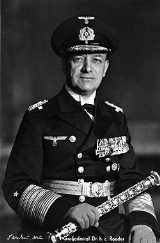
Erich Raeder

Encyclopedia
Erich Johann Albert Raeder (24 April 1876 – 6 November 1960) was a naval
leader in Germany before and during World War II
. Raeder attained the highest possible naval rank—that of Großadmiral
(Grand Admiral) — in 1939, becoming the first person to hold that rank since Alfred von Tirpitz
. Raeder led the Kriegsmarine
(German Navy) for the first half of the war, but resigned in 1943 and was replaced by Karl Dönitz
. He was sentenced to life in prison at the Nuremberg Trials
, but was later released.
province of Schleswig-Holstein
in the German Empire
. His father was a headmaster. He was the captain of Kaiser Wilhem II's private yacht in the years leading up to World War I. He joined the Kaiserliche Marine
(Imperial Navy) in 1894 and rapidly rose in rank, becoming Chief of Staff for Franz von Hipper
in 1912. He served in this position during World War I
as well as in combat posts, taking part in the Battle of Dogger Bank
in 1915 and the Battle of Jutland
in 1916. After the war, in 1920, Raeder was involved in the failed Kapp Putsch
, and after its suppresion he was marginalized in the Navy, being transferred to the Naval Archives, where for two years he studied naval history. Raeder also was the author of a number of studies about naval warfare, something that resulted in his being awarded a Doctor of Philosophy
decree honoris causa by the University of Kiel
.
After this, Raeder continued to rise steadily in the navy hierarchy
, becoming a Konteradmiral
(Rear Admiral) in 1922 and a Vizeadmiral
(Vice Admiral) in 1925. In October 1928, Raeder was promoted to Admiral
and made Commander-in-Chief of the Reichsmarine
, the Weimar Republic
Navy (Oberbefehlshaber der Reichsmarine).
′s attempt to rebuild the Kriegsmarine
, while apparently disagreeing strongly on most other matters. On 20 April 1936, just a few days before Raeder's 60th birthday, Hitler promoted him to Generaladmiral
(General Admiral). In his quest to rebuild the German Navy, Raeder faced constant challenges from Hermann Göring
′s ongoing quest to build up the Luftwaffe
.
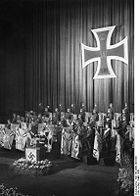 He was promoted to Großadmiral (Grand Admiral) in 1939, becoming the first to hold that rank since Alfred von Tirpitz
. Later that year, he suggested invading Norway in order to secure sheltered docks out of reach of the Royal Air Force
, as well as provide direct exits into the North Sea
, but was strongly opposed by the German Naval Staff and "[A]t the end, Raeder agreed that the 'best' solution was preservation of the status quo."
Norway was vital to Germany as a transport route for iron ore from Sweden, a supply that Britain was determined to stop. One adopted British plan was to go through Norway and occupy cities in Sweden. An Allied invasion was ordered on 12 March, and the Germans intercepted radio traffic setting March 14 as deadline for the preparation. Peace in Finland interrupted the Allied plans, but Hitler became, rightly, convinced that the Allies would try again, and ordered operation Weseruebung. The new Allied plans were Wilfred
and Plan R 4
. The plan was to provoke a German reaction by laying mines in Norwegian waters, and once Germany showed signs of taking action UK troops would occupy Narvik
, Trondheim
and Bergen
and launch a raid on Stavanger
to destroy Sola airfield
. However "the mines were not laid until the morning of 8 April, by which time the German ships were advancing up the Norwegian coast."
Raeder argued strongly against Operation Sea Lion, the planned German invasion of Great Britain. He felt that the war at sea could be conducted far more successfully via an indirect strategic approach, by increasing the numbers of U-boats and small surface vessels in service. He also had doubts about Germany's ability to gain air superiority over the English Channel
and the lack of regional German naval superiority. Air supremacy was a prerequisite to successfully preventing destruction of the German invasion fleet by the Royal Navy
. Instead, Raeder favored a strategic focus on the Mediterranean theater including a strong German presence in North Africa
, plus an invasion of Malta
and the Middle East. He believed that capturing Gibraltar
, the Canary Islands
and the Suez Canal
would knock the United Kingdom out of the war. For instance, Raeder once told Hitler that a major offensive against Egypt
and the Suez gave Germany a chance to strike a blow that "would be more deadly to the British Empire than the capture of London!" On several occasions, he suggested that Hitler send the vaunted tank commander Erwin Rommel
to Egypt. Hitler finally relented in 1941, and then only to relieve the Italians.
The invasion was postponed indefinitely due to the Luftwaffe′s failure to obtain air superiority during the Battle of Britain
, and the significantly greater power of the Royal Navy over the German Naval forces. Instead, the German war machine was diverted to Operation Barbarossa
, the German invasion of the Soviet Union
, which he vigorously opposed. Raeder thought Hitler was so fixated on wiping out the Soviet regime that he didn't realize that a larger, global strategy could have easily tipped the balance in Germany's favor.
—combined with the outstanding success of the U-boat
fleet under the command of Karl Dönitz
—led to his eventual demotion to the rank of Admiral Inspector of the Kriegsmarine in January 1943. Raeder offered his resignation as an apology and formally resigned from Kriegsmarine in May 1943. Dönitz succeeded him in the post of Commander-in-Chief of the Navy on 30 January 1943.
Raeder was suspected of involvement in the 20 July plot, but immediately cleared himself by going to Rastenburg to personally assure Hitler of his loyalty.
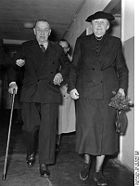 After the war, Raeder was sentenced to life imprisonment at the Nuremberg Trials
, for waging a war of aggression
, a charge arising from his planning of the German invasion of Norway.
The German defense in the Nuremberg trials in 1946 argued that Germany was "compelled to attack Norway by the need to forestall an Allied invasion and that her action was therefore preemptive
", e.g. such as argued for the Anglo-Soviet invasion of Iran
. The German defense was referring to Plan R 4
and its predecessors. However the International Military Tribunal at Nuremberg determined that no Allied invasion was imminent, and therefore rejected the German argument that Germany was entitled to attack Norway.
The sentence was later reduced and, due to ill health, he was released at 11:35 on 26 September 1955. After his release he settled down at the Uhlandstrasse in Lippstadt
, Westphalia
. He later wrote an autobiography, Mein Leben, in 1957.
Erich Raeder died in Kiel
on 6 November 1960. He is buried in the Nordfriedhof (North Cemetery), Kiel.
Navy
A navy is the branch of a nation's armed forces principally designated for naval and amphibious warfare; namely, lake- or ocean-borne combat operations and related functions...
leader in Germany before and during World War II
World War II
World War II, or the Second World War , was a global conflict lasting from 1939 to 1945, involving most of the world's nations—including all of the great powers—eventually forming two opposing military alliances: the Allies and the Axis...
. Raeder attained the highest possible naval rank—that of Großadmiral
Grand Admiral
Grand admiral is a historic naval rank, generally being the highest such rank present in any particular country. Its most notable use was in Germany — the German word is Großadmiral.-France:...
(Grand Admiral) — in 1939, becoming the first person to hold that rank since Alfred von Tirpitz
Alfred von Tirpitz
Alfred von Tirpitz was a German Admiral, Secretary of State of the German Imperial Naval Office, the powerful administrative branch of the German Imperial Navy from 1897 until 1916. Prussia never had a major navy, nor did the other German states before the German Empire was formed in 1871...
. Raeder led the Kriegsmarine
Kriegsmarine
The Kriegsmarine was the name of the German Navy during the Nazi regime . It superseded the Kaiserliche Marine of World War I and the post-war Reichsmarine. The Kriegsmarine was one of three official branches of the Wehrmacht, the unified armed forces of Nazi Germany.The Kriegsmarine grew rapidly...
(German Navy) for the first half of the war, but resigned in 1943 and was replaced by Karl Dönitz
Karl Dönitz
Karl Dönitz was a German naval commander during World War II. He started his career in the German Navy during World War I. In 1918, while he was in command of , the submarine was sunk by British forces and Dönitz was taken prisoner...
. He was sentenced to life in prison at the Nuremberg Trials
Nuremberg Trials
The Nuremberg Trials were a series of military tribunals, held by the victorious Allied forces of World War II, most notable for the prosecution of prominent members of the political, military, and economic leadership of the defeated Nazi Germany....
, but was later released.
Early years
Raeder was born into a middle-class family in Wandsbek in the PrussianKingdom of Prussia
The Kingdom of Prussia was a German kingdom from 1701 to 1918. Until the defeat of Germany in World War I, it comprised almost two-thirds of the area of the German Empire...
province of Schleswig-Holstein
Province of Schleswig-Holstein
The Province of Schleswig-Holstein was a province of the Kingdom of Prussia and the Free State of Prussia from 1868 to 1946. It was created from the Duchies of Schleswig and Holstein, which had been conquered by Prussia and the Austrian Empire from Denmark in the Second War of Schleswig in 1864...
in the German Empire
German Empire
The German Empire refers to Germany during the "Second Reich" period from the unification of Germany and proclamation of Wilhelm I as German Emperor on 18 January 1871, to 1918, when it became a federal republic after defeat in World War I and the abdication of the Emperor, Wilhelm II.The German...
. His father was a headmaster. He was the captain of Kaiser Wilhem II's private yacht in the years leading up to World War I. He joined the Kaiserliche Marine
Kaiserliche Marine
The Imperial German Navy was the German Navy created at the time of the formation of the German Empire. It existed between 1871 and 1919, growing out of the small Prussian Navy and Norddeutsche Bundesmarine, which primarily had the mission of coastal defense. Kaiser Wilhelm II greatly expanded...
(Imperial Navy) in 1894 and rapidly rose in rank, becoming Chief of Staff for Franz von Hipper
Franz von Hipper
Franz Ritter von Hipper was an admiral in the German Imperial Navy . Franz von Hipper joined the German Navy in 1881 as an officer cadet. He commanded several torpedo boat units and served as watch officer aboard several warships, as well as Kaiser Wilhelm II's yacht Hohenzollern...
in 1912. He served in this position during World War I
World War I
World War I , which was predominantly called the World War or the Great War from its occurrence until 1939, and the First World War or World War I thereafter, was a major war centred in Europe that began on 28 July 1914 and lasted until 11 November 1918...
as well as in combat posts, taking part in the Battle of Dogger Bank
Battle of Dogger Bank (1915)
The Battle of Dogger Bank was a naval battle fought near the Dogger Bank in the North Sea on 24 January 1915, during the First World War, between squadrons of the British Grand Fleet and the German High Seas Fleet....
in 1915 and the Battle of Jutland
Battle of Jutland
The Battle of Jutland was a naval battle between the British Royal Navy's Grand Fleet and the Imperial German Navy's High Seas Fleet during the First World War. The battle was fought on 31 May and 1 June 1916 in the North Sea near Jutland, Denmark. It was the largest naval battle and the only...
in 1916. After the war, in 1920, Raeder was involved in the failed Kapp Putsch
Kapp Putsch
The Kapp Putsch — or more accurately the Kapp-Lüttwitz Putsch — was a 1920 coup attempt during the German Revolution of 1918–1919 aimed at overthrowing the Weimar Republic...
, and after its suppresion he was marginalized in the Navy, being transferred to the Naval Archives, where for two years he studied naval history. Raeder also was the author of a number of studies about naval warfare, something that resulted in his being awarded a Doctor of Philosophy
Doctor of Philosophy
Doctor of Philosophy, abbreviated as Ph.D., PhD, D.Phil., or DPhil , in English-speaking countries, is a postgraduate academic degree awarded by universities...
decree honoris causa by the University of Kiel
University of Kiel
The University of Kiel is a university in the city of Kiel, Germany. It was founded in 1665 as the Academia Holsatorum Chiloniensis by Christian Albert, Duke of Holstein-Gottorp and has approximately 23,000 students today...
.
After this, Raeder continued to rise steadily in the navy hierarchy
Hierarchy
A hierarchy is an arrangement of items in which the items are represented as being "above," "below," or "at the same level as" one another...
, becoming a Konteradmiral
Rear Admiral
Rear admiral is a naval commissioned officer rank above that of a commodore and captain, and below that of a vice admiral. It is generally regarded as the lowest of the "admiral" ranks, which are also sometimes referred to as "flag officers" or "flag ranks"...
(Rear Admiral) in 1922 and a Vizeadmiral
Vice Admiral
Vice admiral is a senior naval rank of a three-star flag officer, which is equivalent to lieutenant general in the other uniformed services. A vice admiral is typically senior to a rear admiral and junior to an admiral...
(Vice Admiral) in 1925. In October 1928, Raeder was promoted to Admiral
Admiral
Admiral is the rank, or part of the name of the ranks, of the highest naval officers. It is usually considered a full admiral and above vice admiral and below admiral of the fleet . It is usually abbreviated to "Adm" or "ADM"...
and made Commander-in-Chief of the Reichsmarine
Reichsmarine
The Reichsmarine was the name of the German Navy during the Weimar Republic and first two years of Nazi Germany. It was the naval branch of the Reichswehr, existing from 1918 to 1935...
, the Weimar Republic
Weimar Republic
The Weimar Republic is the name given by historians to the parliamentary republic established in 1919 in Germany to replace the imperial form of government...
Navy (Oberbefehlshaber der Reichsmarine).
Rebuilding the German Navy
Although he generally disliked the Nazi Party, he strongly supported Adolf HitlerAdolf Hitler
Adolf Hitler was an Austrian-born German politician and the leader of the National Socialist German Workers Party , commonly referred to as the Nazi Party). He was Chancellor of Germany from 1933 to 1945, and head of state from 1934 to 1945...
′s attempt to rebuild the Kriegsmarine
Kriegsmarine
The Kriegsmarine was the name of the German Navy during the Nazi regime . It superseded the Kaiserliche Marine of World War I and the post-war Reichsmarine. The Kriegsmarine was one of three official branches of the Wehrmacht, the unified armed forces of Nazi Germany.The Kriegsmarine grew rapidly...
, while apparently disagreeing strongly on most other matters. On 20 April 1936, just a few days before Raeder's 60th birthday, Hitler promoted him to Generaladmiral
General Admiral
General admiral was a Danish, Dutch, German, Russian, Portuguese, Spanish and Swedish naval rank. Its historic origin is a title high military or naval dignitaries of early modern Europe sometimes held, for example the commander-in-chief of the Dutch Republic's navy .-Third Reich:In the German...
(General Admiral). In his quest to rebuild the German Navy, Raeder faced constant challenges from Hermann Göring
Hermann Göring
Hermann Wilhelm Göring, was a German politician, military leader, and a leading member of the Nazi Party. He was a veteran of World War I as an ace fighter pilot, and a recipient of the coveted Pour le Mérite, also known as "The Blue Max"...
′s ongoing quest to build up the Luftwaffe
Luftwaffe
Luftwaffe is a generic German term for an air force. It is also the official name for two of the four historic German air forces, the Wehrmacht air arm founded in 1935 and disbanded in 1946; and the current Bundeswehr air arm founded in 1956....
.
World War II
Alfred von Tirpitz
Alfred von Tirpitz was a German Admiral, Secretary of State of the German Imperial Naval Office, the powerful administrative branch of the German Imperial Navy from 1897 until 1916. Prussia never had a major navy, nor did the other German states before the German Empire was formed in 1871...
. Later that year, he suggested invading Norway in order to secure sheltered docks out of reach of the Royal Air Force
Royal Air Force
The Royal Air Force is the aerial warfare service branch of the British Armed Forces. Formed on 1 April 1918, it is the oldest independent air force in the world...
, as well as provide direct exits into the North Sea
North Sea
In the southwest, beyond the Straits of Dover, the North Sea becomes the English Channel connecting to the Atlantic Ocean. In the east, it connects to the Baltic Sea via the Skagerrak and Kattegat, narrow straits that separate Denmark from Norway and Sweden respectively...
, but was strongly opposed by the German Naval Staff and "[A]t the end, Raeder agreed that the 'best' solution was preservation of the status quo."
Norway was vital to Germany as a transport route for iron ore from Sweden, a supply that Britain was determined to stop. One adopted British plan was to go through Norway and occupy cities in Sweden. An Allied invasion was ordered on 12 March, and the Germans intercepted radio traffic setting March 14 as deadline for the preparation. Peace in Finland interrupted the Allied plans, but Hitler became, rightly, convinced that the Allies would try again, and ordered operation Weseruebung. The new Allied plans were Wilfred
Wilfred
Wilfred or Wilfrid may refer to:* Wilfred , which lists persons named Wilfred, Wilfrid or Wilfrith* Thomas Wilfred , musician and inventor* Operation Wilfred, a British Second World War naval operation...
and Plan R 4
Plan R 4
Plan R 4 was the World War II British plan for an invasion of the neutral state of Norway in April 1940. Earlier the British had planned a similar intervention with France during the Winter War.-Background:...
. The plan was to provoke a German reaction by laying mines in Norwegian waters, and once Germany showed signs of taking action UK troops would occupy Narvik
Narvik
is the third largest city and municipality in Nordland county, Norway by population. Narvik is located on the shores of the Narvik Fjord . The municipality is part of the Ofoten traditional region of North Norway, inside the arctic circle...
, Trondheim
Trondheim
Trondheim , historically, Nidaros and Trondhjem, is a city and municipality in Sør-Trøndelag county, Norway. With a population of 173,486, it is the third most populous municipality and city in the country, although the fourth largest metropolitan area. It is the administrative centre of...
and Bergen
Bergen
Bergen is the second largest city in Norway with a population of as of , . Bergen is the administrative centre of Hordaland county. Greater Bergen or Bergen Metropolitan Area as defined by Statistics Norway, has a population of as of , ....
and launch a raid on Stavanger
Stavanger
Stavanger is a city and municipality in the county of Rogaland, Norway.Stavanger municipality has a population of 126,469. There are 197,852 people living in the Stavanger conurbation, making Stavanger the fourth largest city, but the third largest urban area, in Norway...
to destroy Sola airfield
Stavanger Airport, Sola
Stavanger Airport, Sola is an international airport located in Sola, Norway, southwest of Stavanger. It is Norway's third-busiest airport, with both fixed-wing aircraft and helicopter traffic for the offshore North Sea oil installations...
. However "the mines were not laid until the morning of 8 April, by which time the German ships were advancing up the Norwegian coast."
Raeder argued strongly against Operation Sea Lion, the planned German invasion of Great Britain. He felt that the war at sea could be conducted far more successfully via an indirect strategic approach, by increasing the numbers of U-boats and small surface vessels in service. He also had doubts about Germany's ability to gain air superiority over the English Channel
English Channel
The English Channel , often referred to simply as the Channel, is an arm of the Atlantic Ocean that separates southern England from northern France, and joins the North Sea to the Atlantic. It is about long and varies in width from at its widest to in the Strait of Dover...
and the lack of regional German naval superiority. Air supremacy was a prerequisite to successfully preventing destruction of the German invasion fleet by the Royal Navy
Royal Navy
The Royal Navy is the naval warfare service branch of the British Armed Forces. Founded in the 16th century, it is the oldest service branch and is known as the Senior Service...
. Instead, Raeder favored a strategic focus on the Mediterranean theater including a strong German presence in North Africa
North Africa
North Africa or Northern Africa is the northernmost region of the African continent, linked by the Sahara to Sub-Saharan Africa. Geopolitically, the United Nations definition of Northern Africa includes eight countries or territories; Algeria, Egypt, Libya, Morocco, South Sudan, Sudan, Tunisia, and...
, plus an invasion of Malta
Malta
Malta , officially known as the Republic of Malta , is a Southern European country consisting of an archipelago situated in the centre of the Mediterranean, south of Sicily, east of Tunisia and north of Libya, with Gibraltar to the west and Alexandria to the east.Malta covers just over in...
and the Middle East. He believed that capturing Gibraltar
Gibraltar
Gibraltar is a British overseas territory located on the southern end of the Iberian Peninsula at the entrance of the Mediterranean. A peninsula with an area of , it has a northern border with Andalusia, Spain. The Rock of Gibraltar is the major landmark of the region...
, the Canary Islands
Canary Islands
The Canary Islands , also known as the Canaries , is a Spanish archipelago located just off the northwest coast of mainland Africa, 100 km west of the border between Morocco and the Western Sahara. The Canaries are a Spanish autonomous community and an outermost region of the European Union...
and the Suez Canal
Suez Canal
The Suez Canal , also known by the nickname "The Highway to India", is an artificial sea-level waterway in Egypt, connecting the Mediterranean Sea and the Red Sea. Opened in November 1869 after 10 years of construction work, it allows water transportation between Europe and Asia without navigation...
would knock the United Kingdom out of the war. For instance, Raeder once told Hitler that a major offensive against Egypt
Egypt
Egypt , officially the Arab Republic of Egypt, Arabic: , is a country mainly in North Africa, with the Sinai Peninsula forming a land bridge in Southwest Asia. Egypt is thus a transcontinental country, and a major power in Africa, the Mediterranean Basin, the Middle East and the Muslim world...
and the Suez gave Germany a chance to strike a blow that "would be more deadly to the British Empire than the capture of London!" On several occasions, he suggested that Hitler send the vaunted tank commander Erwin Rommel
Erwin Rommel
Erwin Johannes Eugen Rommel , popularly known as the Desert Fox , was a German Field Marshal of World War II. He won the respect of both his own troops and the enemies he fought....
to Egypt. Hitler finally relented in 1941, and then only to relieve the Italians.
The invasion was postponed indefinitely due to the Luftwaffe′s failure to obtain air superiority during the Battle of Britain
Battle of Britain
The Battle of Britain is the name given to the World War II air campaign waged by the German Air Force against the United Kingdom during the summer and autumn of 1940...
, and the significantly greater power of the Royal Navy over the German Naval forces. Instead, the German war machine was diverted to Operation Barbarossa
Operation Barbarossa
Operation Barbarossa was the code name for Germany's invasion of the Soviet Union during World War II that began on 22 June 1941. Over 4.5 million troops of the Axis powers invaded the USSR along a front., the largest invasion in the history of warfare...
, the German invasion of the Soviet Union
Soviet Union
The Soviet Union , officially the Union of Soviet Socialist Republics , was a constitutionally socialist state that existed in Eurasia between 1922 and 1991....
, which he vigorously opposed. Raeder thought Hitler was so fixated on wiping out the Soviet regime that he didn't realize that a larger, global strategy could have easily tipped the balance in Germany's favor.
Resignation and retirement
A series of failed operations after that point, particularly the Battle of the Barents SeaBattle of the Barents Sea
The Battle of the Barents Sea took place on 31 December 1942 between German surface raiders and British ships escorting convoy JW 51B to Kola Inlet in the USSR. The action took place in the Barents Sea north of North Cape, Norway...
—combined with the outstanding success of the U-boat
U-boat
U-boat is the anglicized version of the German word U-Boot , itself an abbreviation of Unterseeboot , and refers to military submarines operated by Germany, particularly in World War I and World War II...
fleet under the command of Karl Dönitz
Karl Dönitz
Karl Dönitz was a German naval commander during World War II. He started his career in the German Navy during World War I. In 1918, while he was in command of , the submarine was sunk by British forces and Dönitz was taken prisoner...
—led to his eventual demotion to the rank of Admiral Inspector of the Kriegsmarine in January 1943. Raeder offered his resignation as an apology and formally resigned from Kriegsmarine in May 1943. Dönitz succeeded him in the post of Commander-in-Chief of the Navy on 30 January 1943.
Raeder was suspected of involvement in the 20 July plot, but immediately cleared himself by going to Rastenburg to personally assure Hitler of his loyalty.
After the war
Nuremberg Trials
The Nuremberg Trials were a series of military tribunals, held by the victorious Allied forces of World War II, most notable for the prosecution of prominent members of the political, military, and economic leadership of the defeated Nazi Germany....
, for waging a war of aggression
War of aggression
A war of aggression, sometimes also war of conquest, is a military conflict waged without the justification of self-defense usually for territorial gain and subjugation. The phrase is distinctly modern and diametrically opposed to the prior legal international standard of "might makes right", under...
, a charge arising from his planning of the German invasion of Norway.
The German defense in the Nuremberg trials in 1946 argued that Germany was "compelled to attack Norway by the need to forestall an Allied invasion and that her action was therefore preemptive
Preemptive war
A preemptive war is a war that is commenced in an attempt to repel or defeat a perceived inevitable offensive or invasion, or to gain a strategic advantage in an impending war before that threat materializes. It is a war which preemptively 'breaks the peace'. The term: 'preemptive war' is...
", e.g. such as argued for the Anglo-Soviet invasion of Iran
Anglo-Soviet invasion of Iran
The Anglo-Soviet invasion of Iran was the Allied invasion of the Imperial State of Iran during World War II, by British, Commonwealth, and Soviet armed forces. The invasion from August 25 to September 17, 1941, was codenamed Operation Countenance...
. The German defense was referring to Plan R 4
Plan R 4
Plan R 4 was the World War II British plan for an invasion of the neutral state of Norway in April 1940. Earlier the British had planned a similar intervention with France during the Winter War.-Background:...
and its predecessors. However the International Military Tribunal at Nuremberg determined that no Allied invasion was imminent, and therefore rejected the German argument that Germany was entitled to attack Norway.
The sentence was later reduced and, due to ill health, he was released at 11:35 on 26 September 1955. After his release he settled down at the Uhlandstrasse in Lippstadt
Lippstadt
Lippstadt is a town in North Rhine-Westphalia, Germany. It is the largest town within the district of Soest.-Geography:Lippstadt is situated in the Lippe valley, roughly 70 kilometres east of Dortmund and roughly 30 kilometres west of Paderborn...
, Westphalia
Westphalia
Westphalia is a region in Germany, centred on the cities of Arnsberg, Bielefeld, Dortmund, Minden and Münster.Westphalia is roughly the region between the rivers Rhine and Weser, located north and south of the Ruhr River. No exact definition of borders can be given, because the name "Westphalia"...
. He later wrote an autobiography, Mein Leben, in 1957.
Erich Raeder died in Kiel
Kiel
Kiel is the capital and most populous city in the northern German state of Schleswig-Holstein, with a population of 238,049 .Kiel is approximately north of Hamburg. Due to its geographic location in the north of Germany, the southeast of the Jutland peninsula, and the southwestern shore of the...
on 6 November 1960. He is buried in the Nordfriedhof (North Cemetery), Kiel.
Dates of Rank
- Seekadett - 13 May 1895
- Fähnrich zur See - 25 October 1897
- Leutnant zur See - 1 January 1899
- Oberleutnant zur See - 9 April 1900
- Kapitänleutnant - 21 March 1905
- Korvettenkapitän - 15 April 1911
- Fregattenkapitän - 26 April 1917
- Kapitän zur See - 29 November 1919
- Konteradmiral - 1 August 1922
- Vizeadmiral - 10 September 1925
- AdmiralAdmiralAdmiral is the rank, or part of the name of the ranks, of the highest naval officers. It is usually considered a full admiral and above vice admiral and below admiral of the fleet . It is usually abbreviated to "Adm" or "ADM"...
- 1 October 1928 - Generaladmiral - 20 April 1936
- Großadmiral - 1 April 1939
Awards and decorations
- Iron CrossIron CrossThe Iron Cross is a cross symbol typically in black with a white or silver outline that originated after 1219 when the Kingdom of Jerusalem granted the Teutonic Order the right to combine the Teutonic Black Cross placed above a silver Cross of Jerusalem....
(1914)- 1st Class (19 November 1914)
- 2nd Class (18 February 1915)
- Order of the Red EagleOrder of the Red EagleThe Order of the Red Eagle was an order of chivalry of the Kingdom of Prussia. It was awarded to both military personnel and civilians, to recognize valor in combat, excellence in military leadership, long and faithful service to the kingdom, or other achievements...
4th Class (22 June 1907) - Honor Knight's Cross 2nd Class with silver Crown of the House and Merit Order of Peter Frederick LouisHouse and Merit Order of Peter Frederick LouisThe House and Merit Order of Duke Peter Frederick Louis was a civil and military order of the Grand Duchy of Oldenburg, a member state of the German Empire. The order was founded by Grand Duke Friedrich August of Oldenburg on November 27, 1838...
(17 September 1907) - Kings Crown to the Order of the Red Eagle 4th Class (5 September 1911)
- Commander's Cross of the Order of Franz JosephOrder of Franz JosephThe Imperial Austrian Franz Joseph Order was founded by the Emperor Franz Joseph I of Austria on December 2, 1849 on the first anniversary of his assumption of the Imperial Crown...
(16 September 1911) - Greek Commander's Cross of the Order of the RedeemerOrder of the RedeemerThe Order of the Redeemer , also known as the Order of the Savior, is an order of Greece. The Order of the Redeemer is the oldest and highest decoration awarded by the modern Greek state.- History :...
(14 May 1912) - Cross of HonorCross of HonorThe Cross of Honor, also known as the Honor Cross or, popularly, the Hindenburg Cross, was a commemorative medal inaugurated on July 13, 1934 by Reichspräsident Paul von Hindenburg for those soldiers of Imperial Germany who fought in World War I...
(9 October 1934) - Golden Party BadgeGolden Party BadgeThe Golden Party Badge was a special badge of the Nazi Party. The first 100,000 members who had joined and had uninterrupted service in the Party were given the right to wear it...
(30 January 1937) - Order of St. Maurice and St. Lazarus Grand Cross (20 September 1937)
- Order of the Rising SunOrder of the Rising SunThe is a Japanese order, established in 1875 by Emperor Meiji of Japan. The Order was the first national decoration awarded by the Japanese Government, created on April 10, 1875 by decree of the Council of State. The badge features rays of sunlight from the rising sun...
(9 November 1937) - Clasp to the Iron CrossClasp to the Iron CrossThe Clasp to the Iron Cross was a metal medal clasp displayed on the uniforms of German Wehrmacht personnel who had been awarded the Iron Cross in World War I. It was displayed on the uniforms of many high ranking officers during World War II as most had also served in World War I...
(1939)- 2nd Class
- 1st Class
- Knight's Cross of the Iron CrossKnight's Cross of the Iron CrossThe Knight's Cross of the Iron Cross was a grade of the 1939 version of the 1813 created Iron Cross . The Knight's Cross of the Iron Cross was the highest award of Germany to recognize extreme battlefield bravery or successful military leadership during World War II...
on 30 September 1939 as Großadmiral and Oberbefehlshaber der Kriegsmarine - Romanian Order of Michael the BraveOrder of Michael the BraveThe Order of Michael the Brave is Romania's highest military decoration, instituted by King Ferdinand I during the early stages of the Romanian Campaign of World War I, and was again awarded in World War II...
- 1st, 2nd and 3rd Class (14 October 1941)
- Finnish Grand Cross of the Order of the Cross of LibertyOrder of the Cross of LibertyThere are three official orders in Finland: the Order of the Cross of Liberty , the Order of the White Rose of Finland and the Order of the Lion of Finland. The President of Finland is the Grand Master of the two orders, and usually of the Order of the Cross of Liberty as well, Grand Mastership of...
(25 March 1942)