


Louis XI of France

Encyclopedia
Louis XI called the Prudent , was the King of France from 1461 to 1483. He was the son of Charles VII of France
and Mary of Anjou, a member of the House of Valois.
During his 22-year reign, Louis successfully expanded royal power at the expense of that of the dukes. Shrewd and often vicious, he spun webs of plot and conspiracy which earned him the nicknames the Cunning (Middle French
: le rusé) and the Universal Spider (Middle French
: l'universelle aragne ). His love for scheming and intrigue made him many enemies, including his father, his brother Charles de Valois, Duc de Berry
, as well as Charles the Bold, Duke of Burgundy and Edward IV of England
.
, Cher
in 1423, when the English held northern France and his father Charles VII was restricted to the centre and south. Louis was the grandson of the strong-willed Yolande of Aragon
, the princess who was the driving force in driving the English out of France. Louis despised his father, regarding him as a weakling.
On 24 June 1436 he met Margaret of Scotland, daughter of James I of Scotland
, the bride his father had chosen for diplomatic reasons. There are no direct accounts from Louis or his young bride of their first impressions of each other, and it is mere speculation to say whether or not they actually had negative feelings for each other. Several historians think that Louis had a predetermined attitude to hate his wife. But it is universally agreed upon that Louis entered the ceremony and the marriage itself dutifully, as evidenced by his formal embrace of Margaret upon their first meeting.
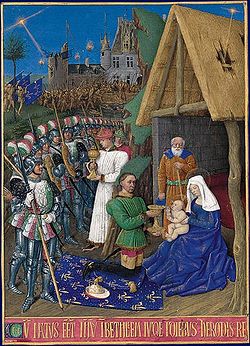 Louis' marriage shows both the nature of medieval royal diplomacy and the precarious position of the French monarchy at the time. The wedding — by the standards of the time, it was a very plain ceremony — took place 25 June 1436 in the afternoon in the chapel of the castle of Tours
and was presided over by the Archbishop of Reims
. The 13-year-old Louis looked clearly more mature than his eleven-year old bride, who looked like a beautiful “doll”, and was treated as such by her in-laws. Charles wore “grey riding pants” and “did not even bother to remove his spurs.” The Scottish guests were quickly hustled out after the wedding reception, as the Valois court was quite impoverished at this time. They simply could not afford an extravagant ceremony or to host their Scottish guests for any longer than they did. The Scots however saw this behaviour as an insult to their small but proud country.
Following the ceremony, “doctors advised against consummation” because of the relative immaturity of the bride and bridegroom. Margaret continued her studies and Louis went on tour with Charles to loyal areas of the kingdom. Even at this time, Charles was taken aback by the intelligence and temper of his son. During this tour, Louis was named Dauphin by Charles, as is traditional for the eldest son of the king.
In 1440, Louis, aged 17, was part of the uprising known as the Praguerie
, which sought to control Charles and install Louis as Regent
. The uprising failed and Louis was forced to submit to the King, who however forgave him. In this revolt, Louis was greatly influenced by Charles de Bourbon, whose troops were “badly out of condition” with “poor logistics.” Louis was forced to retreat to Paris but was “by no means trounced.” In fact, before his final defeat, “[Louis's]...military strength, combined with antipathy of the masses for great lords, won him the support of the citizens of Paris.” This was a great learning experience for Louis. James Cleugh notes:
Louis continued soldiering. In 1444 he led an army of "écorcheurs
" against the Swiss at the Battle of St. Jakob an der Birs
and was impressed by the latter's military might. He still loathed his father, however, and on 27 September 1446 he was ordered out of court and sent to his own province of Dauphiné
, where he was to establish order. Despite frequent summons by the King, the two would never meet again. In Dauphiné, Louis ruled as King in all but name, continuing his intrigues against his father. On 14 February 1451, Louis, 27, who had been widowed for six years, made a strategic marriage to the eight-year-old Charlotte of Savoy
, without Charles' consent.
Finally, in August 1456, Charles sent an army to Dauphiné. Louis fled to Burgundy
where he was granted refuge by Duke Philip the Good and his son Charles the Bold and settled in the castle of Genappe
. King Charles was furious when Philip refused to hand over Louis and warned the Duke that he was "giving shelter to a fox who will eat his chickens".
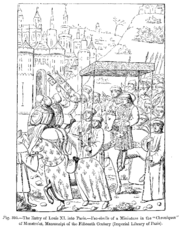
to be crowned in case his brother, Charles, Duke of Berry
, beat him to it.
Louis pursued many of the same interests as his father had pursued less successfully, such as limiting the powers of the Dukes and Barons of France. He suppressed many of his former co-conspirators, who had thought him their friend. He became extremely fiscally prudent, whereas he had previously been lavish and extravagant. He wore rough and simple clothes and mixed with ordinary people and merchants. A candid account of some of Louis's activities is given by the courtier, Philippe de Commynes, in his memoir
s of the period.
and Amiens
. But Philip's son, Charles, was angry, feeling that he was being deprived of his inheritance. He joined a rebellion called the League of the Public Weal
, led by Louis's brother Charles. Although the rebels were largely unsuccessful in battle, Louis was forced to grant an unfavourable peace as a matter of political expediency.
Upon becoming Duke in 1467, Charles seriously considered having an independent Kingdom of his own, but he had many problems with his territories, especially with the people of Liège who were constantly rising against him. Louis was their ally.
In 1468 Louis and Charles met in Peronne
but in the course of the negotiations they learned that the Liegois had again risen up and killed the Burgundian governor. Charles was furious. Philippe de Commynes and the Duke's other advisors had to calm him down for fear that he might hit the King. Louis was forced into a humiliating treaty, giving up many of the lands he had acquired and witnessing the siege of Liege in which hundreds were massacred.
But once out of Charles's reach, Louis declared the treaty invalid and set about building up his forces. His aim was to destroy Burgundy once and for all and end a feud which had lasted over three generations since the murder of Louis, Duke of Orléans in 1407. War broke out in 1472, but Charles's siege of Beauvais
and other towns were unsuccessful and he finally sued for peace. Commines rallied to the King's side and was made welcome.
In 1469 Louis founded the Order of St. Michael, probably in imitation of and as a French rival to the prestigious Burgundian Order of the Golden Fleece
, founded by Charles' father, Philip the Good, just as previously John II has founded the now defunct Order of the Star
in imitation of and as a French rival to Edward III's Order of the Garter
. In both cases, a French king appears to have been motivated to found an order of chivalry to increase the prestige of the French royal court by the example of his chief political adversary.
. Louis had an interest in this war since Charles the Bold was allied with the Yorkists who opposed King Henry VI
. When the Earl of Warwick
fell out with Edward IV
, whom he had helped to the throne, Louis granted him refuge in France. Through Louis' diplomacy, Warwick then formed an alliance with his bitter enemy, Margaret of Anjou
, in order to restore her husband Henry VI to the throne. The plan worked and Edward was forced into exile, but he later returned and Warwick the Kingmaker was killed at the Battle of Barnet
in 1471. King Henry was murdered soon afterwards.
Now the undisputed master of England, Edward invaded France in 1475, but Louis was able to negotiate the Treaty of Picquigny
by which the English army left France in return for a large sum of money. The English renounced their claim to French lands such as Normandy
and the Hundred Years War could be said to be finally over. Louis bragged that although his father had driven the English out by force of arms, he'd driven them out by force of pâté
, venison
and good wine.
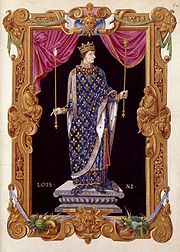 Louis still had to take care of the Duke of Burgundy and for this he employed the Swiss, whose military might was renowned and which he had admired at Birs
.
War broke out between Charles and the Swiss, but it was a disastrous campaign for the Duke and he was finally killed at the Battle of Nancy
on 5 January 1477, ending the Burgundian Wars
.
Louis had destroyed his sworn enemy. Other lords who still favoured the feudal system gave in to his authority. Others like Jacques d'Armagnac, Duke of Nemours
were executed.
.
Louis XI was very superstitious. He surrounded himself with astrologers
. Interested in science, he once pardoned a man sentenced to death on condition that he serve as a guinea pig in a gallstone operation.
By war, by cunning and with sheer guile, Louis XI overcame France's feudal lords, and at the time of his death in the Château de Plessis-lez-Tours
, he had united France and laid the foundations of a strong monarchy. He was however a secretive, isolated and reclusive man and few mourned his passing.
Despite his cunning and overall policy of Realpolitik, Niccolò Machiavelli
actually criticized Louis harshly in The Prince
, calling him shortsighted for degrading France's ability and prestige by abolishing his own infantry in favor of Swiss mercenaries
.
Louis XI died in August of 1483 and was interred in the Notre-Dame de Cléry Basilica http://www.clery-saint-andre.com/basilique.html in Cléry-Saint-André
in the Arrondissement of Orléans
. His wife Charlotte died a few months later and is interred with him. Louis XI was succeeded by his son, Charles VIII
, who was thirteen, and his eldest daughter Anne of France
became Regent.
. Balzac gives a plausible and somewhat favourable picture of the king in his story "Master Cornelius". Louis XI appears as a character in several film versions of the stage melodrama If I Were King
, a fictitious play about real-life poet François Villon
. He is also an important character in Victor Hugo
's classic novel The Hunchback of Notre Dame
as well as its film adaptations. He also appears in the operetta The Vagabond King
, which is based on If I Were King. Among the actors who have played him onscreen are Robert Morley
, Basil Rathbone
, Conrad Veidt
, Harry Davenport, Walter Hampden
, and O. P. Heggie. In addition, Louis XI is also a minor character in Henry VI, Part III by William Shakespeare
, where he is stylised as Lewis; he is depicted as, after choosing to support the Yorkist faction, switching allegiance to the Lancastrians, led by Margaret, following Edward IV's refusal to marry a French noblewoman.
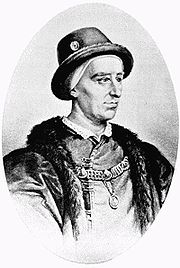
Charles VII of France
Charles VII , called the Victorious or the Well-Served , was King of France from 1422 to his death, though he was initially opposed by Henry VI of England, whose Regent, the Duke of Bedford, ruled much of France including the capital, Paris...
and Mary of Anjou, a member of the House of Valois.
During his 22-year reign, Louis successfully expanded royal power at the expense of that of the dukes. Shrewd and often vicious, he spun webs of plot and conspiracy which earned him the nicknames the Cunning (Middle French
Middle French
Middle French is a historical division of the French language that covers the period from 1340 to 1611. It is a period of transition during which:...
: le rusé) and the Universal Spider (Middle French
Middle French
Middle French is a historical division of the French language that covers the period from 1340 to 1611. It is a period of transition during which:...
: l'universelle aragne ). His love for scheming and intrigue made him many enemies, including his father, his brother Charles de Valois, Duc de Berry
Charles de Valois, Duc de Berry
Charles de Valois, Duke of Berry was a son of Charles VII, King of France. He spent most of his life in conflict with his elder brother, King Louis XI of France.-Life:...
, as well as Charles the Bold, Duke of Burgundy and Edward IV of England
Edward IV of England
Edward IV was King of England from 4 March 1461 until 3 October 1470, and again from 11 April 1471 until his death. He was the first Yorkist King of England...
.
Early life
Louis was born at BourgesBourges
Bourges is a city in central France on the Yèvre river. It is the capital of the department of Cher and also was the capital of the former province of Berry.-History:...
, Cher
Cher (département)
Cher is an administrative department located in the centre of France. It is named after the Cher River.-History:Cher is one of the original 83 departments created during the French Revolution on 4 March 1790. Most of it was created, along with the adjacent department of Indre from the former...
in 1423, when the English held northern France and his father Charles VII was restricted to the centre and south. Louis was the grandson of the strong-willed Yolande of Aragon
Yolande of Aragon
Yolande of Aragon, , was a throne claimant and titular queen regnant of Aragon, titular queen consort of Naples, Duchess of Anjou, Countess of Provence, and regent of Provence during the minority of her son...
, the princess who was the driving force in driving the English out of France. Louis despised his father, regarding him as a weakling.
On 24 June 1436 he met Margaret of Scotland, daughter of James I of Scotland
James I of Scotland
James I, King of Scots , was the son of Robert III and Annabella Drummond. He was probably born in late July 1394 in Dunfermline as youngest of three sons...
, the bride his father had chosen for diplomatic reasons. There are no direct accounts from Louis or his young bride of their first impressions of each other, and it is mere speculation to say whether or not they actually had negative feelings for each other. Several historians think that Louis had a predetermined attitude to hate his wife. But it is universally agreed upon that Louis entered the ceremony and the marriage itself dutifully, as evidenced by his formal embrace of Margaret upon their first meeting.
Tours
Tours is a city in central France, the capital of the Indre-et-Loire department.It is located on the lower reaches of the river Loire, between Orléans and the Atlantic coast. Touraine, the region around Tours, is known for its wines, the alleged perfection of its local spoken French, and for the...
and was presided over by the Archbishop of Reims
Reims
Reims , a city in the Champagne-Ardenne region of France, lies east-northeast of Paris. Founded by the Gauls, it became a major city during the period of the Roman Empire....
. The 13-year-old Louis looked clearly more mature than his eleven-year old bride, who looked like a beautiful “doll”, and was treated as such by her in-laws. Charles wore “grey riding pants” and “did not even bother to remove his spurs.” The Scottish guests were quickly hustled out after the wedding reception, as the Valois court was quite impoverished at this time. They simply could not afford an extravagant ceremony or to host their Scottish guests for any longer than they did. The Scots however saw this behaviour as an insult to their small but proud country.
Following the ceremony, “doctors advised against consummation” because of the relative immaturity of the bride and bridegroom. Margaret continued her studies and Louis went on tour with Charles to loyal areas of the kingdom. Even at this time, Charles was taken aback by the intelligence and temper of his son. During this tour, Louis was named Dauphin by Charles, as is traditional for the eldest son of the king.
In 1440, Louis, aged 17, was part of the uprising known as the Praguerie
The Praguerie
The Praguerie was a revolt of the French nobility against King Charles VII in 1440.It was so named because a similar rising had recently taken place in Prague, Bohemia, at that time closely associated with France through the House of Luxembourg, kings of Bohemia, and it was caused by the reforms of...
, which sought to control Charles and install Louis as Regent
Regent
A regent, from the Latin regens "one who reigns", is a person selected to act as head of state because the ruler is a minor, not present, or debilitated. Currently there are only two ruling Regencies in the world, sovereign Liechtenstein and the Malaysian constitutive state of Terengganu...
. The uprising failed and Louis was forced to submit to the King, who however forgave him. In this revolt, Louis was greatly influenced by Charles de Bourbon, whose troops were “badly out of condition” with “poor logistics.” Louis was forced to retreat to Paris but was “by no means trounced.” In fact, before his final defeat, “[Louis's]...military strength, combined with antipathy of the masses for great lords, won him the support of the citizens of Paris.” This was a great learning experience for Louis. James Cleugh notes:
“Like other strong minded boys, he had found at last he could not carry all before him by mere bluster. Neither as prince nor as king did he ever forget his lesson. He never acted on pure impulse, without reflection, though to his life’s end he was constantly tempted to take such a risk.”
Louis continued soldiering. In 1444 he led an army of "écorcheurs
Ecorcheurs
The écorcheurs were armed bands who desolated France in the reign of Charles VII, stripping their victims of everything, often to their very clothes....
" against the Swiss at the Battle of St. Jakob an der Birs
Battle of St. Jakob an der Birs
The Battle of St. Jakob an der Birs was fought between the Old Swiss Confederacy and French mercenaries , on the banks of the river Birs...
and was impressed by the latter's military might. He still loathed his father, however, and on 27 September 1446 he was ordered out of court and sent to his own province of Dauphiné
Dauphiné
The Dauphiné or Dauphiné Viennois is a former province in southeastern France, whose area roughly corresponded to that of the present departments of :Isère, :Drôme, and :Hautes-Alpes....
, where he was to establish order. Despite frequent summons by the King, the two would never meet again. In Dauphiné, Louis ruled as King in all but name, continuing his intrigues against his father. On 14 February 1451, Louis, 27, who had been widowed for six years, made a strategic marriage to the eight-year-old Charlotte of Savoy
Charlotte of Savoy
Charlotte of Savoy was the second wife and only Queen consort of Louis XI of France. She had three surviving children, one of whom succeeded Louis as King Charles VIII of France, with her eldest daughter, Anne of France, acting as his regent.- Family :She was a daughter of Louis, Duke of Savoy,...
, without Charles' consent.
Finally, in August 1456, Charles sent an army to Dauphiné. Louis fled to Burgundy
Duchy of Burgundy
The Duchy of Burgundy , was heir to an ancient and prestigious reputation and a large division of the lands of the Second Kingdom of Burgundy and in its own right was one of the geographically larger ducal territories in the emergence of Early Modern Europe from Medieval Europe.Even in that...
where he was granted refuge by Duke Philip the Good and his son Charles the Bold and settled in the castle of Genappe
Genappe
Genappe is a Walloon municipality located in the Belgian province of Walloon Brabant. On 1 January 2006 Genappe had a total population of 14,136...
. King Charles was furious when Philip refused to hand over Louis and warned the Duke that he was "giving shelter to a fox who will eat his chickens".
Succession as King
In 1461 Louis learned that his father was dying. He thus hurried to ReimsReims
Reims , a city in the Champagne-Ardenne region of France, lies east-northeast of Paris. Founded by the Gauls, it became a major city during the period of the Roman Empire....
to be crowned in case his brother, Charles, Duke of Berry
Charles de Valois, Duc de Berry
Charles de Valois, Duke of Berry was a son of Charles VII, King of France. He spent most of his life in conflict with his elder brother, King Louis XI of France.-Life:...
, beat him to it.
Louis pursued many of the same interests as his father had pursued less successfully, such as limiting the powers of the Dukes and Barons of France. He suppressed many of his former co-conspirators, who had thought him their friend. He became extremely fiscally prudent, whereas he had previously been lavish and extravagant. He wore rough and simple clothes and mixed with ordinary people and merchants. A candid account of some of Louis's activities is given by the courtier, Philippe de Commynes, in his memoir
Memoir
A memoir , is a literary genre, forming a subclass of autobiography – although the terms 'memoir' and 'autobiography' are almost interchangeable. Memoir is autobiographical writing, but not all autobiographical writing follows the criteria for memoir set out below...
s of the period.
Feud with Charles the Bold
Philip the Good was keen to start a Crusade and Louis gave him money in exchange for a number of territories including PicardyPicardy
This article is about the historical French province. For other uses, see Picardy .Picardy is a historical province of France, in the north of France...
and Amiens
Amiens
Amiens is a city and commune in northern France, north of Paris and south-west of Lille. It is the capital of the Somme department in Picardy...
. But Philip's son, Charles, was angry, feeling that he was being deprived of his inheritance. He joined a rebellion called the League of the Public Weal
League of the Public Weal
The League of the Public Weal was an alliance of feudal nobles organized in 1465 in defiance of the centralized authority of King Louis XI of France...
, led by Louis's brother Charles. Although the rebels were largely unsuccessful in battle, Louis was forced to grant an unfavourable peace as a matter of political expediency.
Upon becoming Duke in 1467, Charles seriously considered having an independent Kingdom of his own, but he had many problems with his territories, especially with the people of Liège who were constantly rising against him. Louis was their ally.
In 1468 Louis and Charles met in Peronne
Péronne, Somme
Péronne is a commune of the Somme department in Picardie in northern France.It is close to where the Battles of the Somme took place during World War I...
but in the course of the negotiations they learned that the Liegois had again risen up and killed the Burgundian governor. Charles was furious. Philippe de Commynes and the Duke's other advisors had to calm him down for fear that he might hit the King. Louis was forced into a humiliating treaty, giving up many of the lands he had acquired and witnessing the siege of Liege in which hundreds were massacred.
But once out of Charles's reach, Louis declared the treaty invalid and set about building up his forces. His aim was to destroy Burgundy once and for all and end a feud which had lasted over three generations since the murder of Louis, Duke of Orléans in 1407. War broke out in 1472, but Charles's siege of Beauvais
Beauvais
Beauvais is a city approximately by highway north of central Paris, in the northern French region of Picardie. It currently has a population of over 60,000 inhabitants.- History :...
and other towns were unsuccessful and he finally sued for peace. Commines rallied to the King's side and was made welcome.
In 1469 Louis founded the Order of St. Michael, probably in imitation of and as a French rival to the prestigious Burgundian Order of the Golden Fleece
Order of the Golden Fleece
The Order of the Golden Fleece is an order of chivalry founded in Bruges by Philip III, Duke of Burgundy in 1430, to celebrate his marriage to the Portuguese princess Infanta Isabella of Portugal, daughter of King John I of Portugal. It evolved as one of the most prestigious orders in Europe...
, founded by Charles' father, Philip the Good, just as previously John II has founded the now defunct Order of the Star
Order of the Star (France)
The Order of the Star was an order of chivalry founded on 6 November 1351 by John II of France in imitation of the Order of the Garter recently founded by Edward III of England...
in imitation of and as a French rival to Edward III's Order of the Garter
Order of the Garter
The Most Noble Order of the Garter, founded in 1348, is the highest order of chivalry, or knighthood, existing in England. The order is dedicated to the image and arms of St...
. In both cases, a French king appears to have been motivated to found an order of chivalry to increase the prestige of the French royal court by the example of his chief political adversary.
Dealings with England
Meanwhile England was going through its own civil conflict known as the Wars of the RosesWars of the Roses
The Wars of the Roses were a series of dynastic civil wars for the throne of England fought between supporters of two rival branches of the royal House of Plantagenet: the houses of Lancaster and York...
. Louis had an interest in this war since Charles the Bold was allied with the Yorkists who opposed King Henry VI
Henry VI of England
Henry VI was King of England from 1422 to 1461 and again from 1470 to 1471, and disputed King of France from 1422 to 1453. Until 1437, his realm was governed by regents. Contemporaneous accounts described him as peaceful and pious, not suited for the violent dynastic civil wars, known as the Wars...
. When the Earl of Warwick
Richard Neville, 16th Earl of Warwick
Richard Neville KG, jure uxoris 16th Earl of Warwick and suo jure 6th Earl of Salisbury and 8th and 5th Baron Montacute , known as Warwick the Kingmaker, was an English nobleman, administrator, and military commander...
fell out with Edward IV
Edward IV of England
Edward IV was King of England from 4 March 1461 until 3 October 1470, and again from 11 April 1471 until his death. He was the first Yorkist King of England...
, whom he had helped to the throne, Louis granted him refuge in France. Through Louis' diplomacy, Warwick then formed an alliance with his bitter enemy, Margaret of Anjou
Margaret of Anjou
Margaret of Anjou was the wife of King Henry VI of England. As such, she was Queen consort of England from 1445 to 1461 and again from 1470 to 1471; and Queen consort of France from 1445 to 1453...
, in order to restore her husband Henry VI to the throne. The plan worked and Edward was forced into exile, but he later returned and Warwick the Kingmaker was killed at the Battle of Barnet
Battle of Barnet
The Battle of Barnet was a decisive engagement in the Wars of the Roses, a dynastic conflict of 15th-century England. The military action, along with the subsequent Battle of Tewkesbury, secured the throne for Edward IV...
in 1471. King Henry was murdered soon afterwards.
Now the undisputed master of England, Edward invaded France in 1475, but Louis was able to negotiate the Treaty of Picquigny
Treaty of Picquigny
The Treaty of Picquigny was a peace treaty negotiated on 29 August 1475 between the Kingdom of England and the Kingdom of France. Louis XI of France paid Edward IV of England to return to England and not take up arms to pursue his claim to the French throne. Edward was provided with an immediate...
by which the English army left France in return for a large sum of money. The English renounced their claim to French lands such as Normandy
Normandy
Normandy is a geographical region corresponding to the former Duchy of Normandy. It is in France.The continental territory covers 30,627 km² and forms the preponderant part of Normandy and roughly 5% of the territory of France. It is divided for administrative purposes into two régions:...
and the Hundred Years War could be said to be finally over. Louis bragged that although his father had driven the English out by force of arms, he'd driven them out by force of pâté
Pâté
Pâté is a mixture of ground meat and fat minced into a spreadable paste. Common additions include vegetables, herbs, spices, and either wine or cognac, armagnac or brandy...
, venison
Venison
Venison is the meat of a game animal, especially a deer but also other animals such as antelope, wild boar, etc.-Etymology:The word derives from the Latin vēnor...
and good wine.
Settling with Charles the Bold
Battle of St. Jakob an der Birs
The Battle of St. Jakob an der Birs was fought between the Old Swiss Confederacy and French mercenaries , on the banks of the river Birs...
.
War broke out between Charles and the Swiss, but it was a disastrous campaign for the Duke and he was finally killed at the Battle of Nancy
Battle of Nancy
The Battle of Nancy was the final and decisive battle of the Burgundian Wars, fought outside the walls of Nancy on 5 January 1477 between Charles the Bold, Duke of Burgundy, and René II, Duke of Lorraine...
on 5 January 1477, ending the Burgundian Wars
Burgundian Wars
The Burgundian Wars were a conflict between the Dukes of Burgundy and the Kings of France, later involving the Old Swiss Confederacy, which would play a decisive role. Open war broke out in 1474, and in the following years the Duke of Burgundy, Charles the Bold, was defeated three times on the...
.
Louis had destroyed his sworn enemy. Other lords who still favoured the feudal system gave in to his authority. Others like Jacques d'Armagnac, Duke of Nemours
Jacques d'Armagnac, Duke of Nemours
Jacques d'Armagnac, duke of Nemours was the son of Bernard d'Armagnac, count of Pardiac, and Eleanor of Bourbon-La Marche....
were executed.
Legacy
Louis then started developing the Kingdom. He encouraged trade fairs and the building and maintenance of roads. He is seen as one of the first modern Kings of France, taking it out of the Middle AgesMiddle Ages
The Middle Ages is a periodization of European history from the 5th century to the 15th century. The Middle Ages follows the fall of the Western Roman Empire in 476 and precedes the Early Modern Era. It is the middle period of a three-period division of Western history: Classic, Medieval and Modern...
.
Louis XI was very superstitious. He surrounded himself with astrologers
Astrology
Astrology consists of a number of belief systems which hold that there is a relationship between astronomical phenomena and events in the human world...
. Interested in science, he once pardoned a man sentenced to death on condition that he serve as a guinea pig in a gallstone operation.
By war, by cunning and with sheer guile, Louis XI overcame France's feudal lords, and at the time of his death in the Château de Plessis-lez-Tours
Château de Plessis-lez-Tours
The Château de Plessis-lez-Tours is a Renaissance château located in the town of La Riche in the Indre-et-Loire department, in the Loire Valley of France.It was the favorite residence of King Louis XI of France, who died there on 30 August 1483...
, he had united France and laid the foundations of a strong monarchy. He was however a secretive, isolated and reclusive man and few mourned his passing.
Despite his cunning and overall policy of Realpolitik, Niccolò Machiavelli
Niccolò Machiavelli
Niccolò di Bernardo dei Machiavelli was an Italian historian, philosopher, humanist, and writer based in Florence during the Renaissance. He is one of the main founders of modern political science. He was a diplomat, political philosopher, playwright, and a civil servant of the Florentine Republic...
actually criticized Louis harshly in The Prince
The Prince
The Prince is a political treatise by the Italian diplomat, historian and political theorist Niccolò Machiavelli. From correspondence a version appears to have been distributed in 1513, using a Latin title, De Principatibus . But the printed version was not published until 1532, five years after...
, calling him shortsighted for degrading France's ability and prestige by abolishing his own infantry in favor of Swiss mercenaries
Swiss mercenaries
Swiss mercenaries were notable for their service in foreign armies, especially the armies of the Kings of France, throughout the Early Modern period of European history, from the Later Middle Ages into the Age of the European Enlightenment...
.
Louis XI died in August of 1483 and was interred in the Notre-Dame de Cléry Basilica http://www.clery-saint-andre.com/basilique.html in Cléry-Saint-André
Cléry-Saint-André
Cléry-Saint-André is a commune in the Loiret department in north-central France.-See also:*Communes of the Loiret department...
in the Arrondissement of Orléans
Arrondissement of Orléans
The arrondissement of Orléans is an arrondissement of France, located in the Loiret département, in the Centre région. It has 24 cantons and 122 communes.-Cantons:The cantons of the arrondissement of Orléans are:# Artenay# Beaugency...
. His wife Charlotte died a few months later and is interred with him. Louis XI was succeeded by his son, Charles VIII
Charles VIII of France
Charles VIII, called the Affable, , was King of France from 1483 to his death in 1498. Charles was a member of the House of Valois...
, who was thirteen, and his eldest daughter Anne of France
Anne of France
Anne of France was the eldest daughter of Louis XI of France and his second wife, Charlotte of Savoy. Anne was the sister of King Charles VIII of France, for whom she acted as regent during his minority; and of Joan of France, who was briefly queen consort to Louis XII...
became Regent.
In popular culture
Louis XI is a central character in Sir Walter Scott's 1823 novel Quentin DurwardQuentin Durward
Quentin Durward is a historical novel by Walter Scott, first published in 1823. The story concerns a Scottish archer in the service of the French King Louis XI ....
. Balzac gives a plausible and somewhat favourable picture of the king in his story "Master Cornelius". Louis XI appears as a character in several film versions of the stage melodrama If I Were King
If I Were King
If I Were King is a 1938 American biographical historical drama film starring Ronald Colman as medieval poet François Villon, and featuring Basil Rathbone and Frances Dee...
, a fictitious play about real-life poet François Villon
François Villon
François Villon was a French poet, thief, and vagabond. He is perhaps best known for his Testaments and his Ballade des Pendus, written while in prison...
. He is also an important character in Victor Hugo
Victor Hugo
Victor-Marie Hugo was a Frenchpoet, playwright, novelist, essayist, visual artist, statesman, human rights activist and exponent of the Romantic movement in France....
's classic novel The Hunchback of Notre Dame
The Hunchback of Notre Dame
The Hunchback of Notre-Dame is a novel by Victor Hugo published in 1831. The French title refers to the Notre Dame Cathedral in Paris, on which the story is centered.-Background:...
as well as its film adaptations. He also appears in the operetta The Vagabond King
The Vagabond King
The Vagabond King is a 1925 operetta by Rudolf Friml in four acts, with a book and lyrics by Brian Hooker and William H. Post, based upon Justin Huntly McCarthy's 1901 romantic play If I Were King...
, which is based on If I Were King. Among the actors who have played him onscreen are Robert Morley
Robert Morley
Robert Adolph Wilton Morley, CBE was an English actor who, often in supporting roles, was usually cast as a pompous English gentleman representing the Establishment...
, Basil Rathbone
Basil Rathbone
Sir Basil Rathbone, KBE, MC, Kt was an English actor. He rose to prominence in England as a Shakespearean stage actor and went on to appear in over 70 films, primarily costume dramas, swashbucklers, and, occasionally, horror films...
, Conrad Veidt
Conrad Veidt
Conrad Veidt was a German actor best remembered for his roles in films such as The Cabinet of Dr. Caligari , The Man Who Laughs , The Thief of Bagdad and Casablanca...
, Harry Davenport, Walter Hampden
Walter Hampden
Walter Hampden is the artist name of Walter Hampden Dougherty was a U.S. actor and theatre manager. He was the younger brother of the American painter Paul Dougherty ....
, and O. P. Heggie. In addition, Louis XI is also a minor character in Henry VI, Part III by William Shakespeare
William Shakespeare
William Shakespeare was an English poet and playwright, widely regarded as the greatest writer in the English language and the world's pre-eminent dramatist. He is often called England's national poet and the "Bard of Avon"...
, where he is stylised as Lewis; he is depicted as, after choosing to support the Yorkist faction, switching allegiance to the Lancastrians, led by Margaret, following Edward IV's refusal to marry a French noblewoman.
Children with Charlotte of Savoy
Louis's marriage with Charlotte of Savoy would not be consummated until she was fourteen. Their children included:- Louis (1458–60)
- Joachim (born and died 1459)
- Louise (born and died 1460)
- Anne of FranceAnne of FranceAnne of France was the eldest daughter of Louis XI of France and his second wife, Charlotte of Savoy. Anne was the sister of King Charles VIII of France, for whom she acted as regent during his minority; and of Joan of France, who was briefly queen consort to Louis XII...
, (3 April 1461 − 14 November 1522), who became Duchess of Bourbon, - JoanJoan of France, Duchess of BerryJoan of France was briefly Queen consort of France as wife of King Louis XII of France, in between the death of her brother, Charles VIII, and the annulment of her marriage....
(23 April 1464 – 4 February 1505), who became Queen of France - Francis (born and died 1466)
- Charles VIII of FranceCharles VIII of FranceCharles VIII, called the Affable, , was King of France from 1483 to his death in 1498. Charles was a member of the House of Valois...
(30 June 1470 – 8 April 1498) - Francis (1472–73)