
All Topics  
Glenn Curtiss

 
Glenn Curtiss

   Email Print
   Bookmark   Link


Glenn Curtiss


Glenn Hammond Curtiss (21 May 1878 – 23 July 1930) was an American aviation
Aviation

File:Norwegian military Bell 412SP helicopters.jpgAviation refers to activities involving man-made flying devices , including the people, organizations, and regulatory bodies involved with them....
 pioneer and founder of the Curtiss Aeroplane and Motor Company
Curtiss Aeroplane and Motor Company

Curtiss Aeroplane and Motor Company was an American aircraft manufacturer that went public in 1916 with Glenn Curtiss as president.Glenn Curtiss had helped found the Aerial Experimental Association in 1907 and he created the Herring-Curtiss Company with Augustus Moore Herring in 1909; this was renamed the Curtiss Aeroplane Company in...
, now part of Curtiss-Wright Corporation.

iss was born in 1878 in Hammondsport, New York
Hammondsport, New York

Hammondsport is a village in Steuben County, New York, New York, United States. The population was 731 at the 2000 census. The village is named after its founding father....
 to Frank Richmond Curtiss and Lua Andrews. Although he only received a formal education up to Grade 8, his early interest in mechanics and inventions was evident at his first job at the Eastman Dry Plate and Film Company (later Eastman Kodak Company) in Rochester, New York
Rochester, New York

Rochester is a city in Monroe County, New York, New York State, south of Lake Ontario in the United States. The Rochester metropolitan area is the second largest economy in New York State, behind the New York City metropolitan area....
.


Discussion
Ask a question about 'Glenn Curtiss'
Start a new discussion about 'Glenn Curtiss'
Answer questions from other users
Full Discussion Forum


Encyclopedia


Glenn Hammond Curtiss (21 May 1878 – 23 July 1930) was an American aviation
Aviation

File:Norwegian military Bell 412SP helicopters.jpgAviation refers to activities involving man-made flying devices , including the people, organizations, and regulatory bodies involved with them....
 pioneer and founder of the Curtiss Aeroplane and Motor Company
Curtiss Aeroplane and Motor Company

Curtiss Aeroplane and Motor Company was an American aircraft manufacturer that went public in 1916 with Glenn Curtiss as president.Glenn Curtiss had helped found the Aerial Experimental Association in 1907 and he created the Herring-Curtiss Company with Augustus Moore Herring in 1909; this was renamed the Curtiss Aeroplane Company in...
, now part of Curtiss-Wright Corporation.

Birth and early career

Curtiss was born in 1878 in Hammondsport, New York
Hammondsport, New York

Hammondsport is a village in Steuben County, New York, New York, United States. The population was 731 at the 2000 census. The village is named after its founding father....
 to Frank Richmond Curtiss and Lua Andrews. Although he only received a formal education up to Grade 8, his early interest in mechanics and inventions was evident at his first job at the Eastman Dry Plate and Film Company (later Eastman Kodak Company) in Rochester, New York
Rochester, New York

Rochester is a city in Monroe County, New York, New York State, south of Lake Ontario in the United States. The Rochester metropolitan area is the second largest economy in New York State, behind the New York City metropolitan area....
. He invented a stencil machine adopted at the plant and later built a rudimentary camera to study photography.

On 7 March 1898, Curtiss married Lena Pearl Neff, daughter of Guy L. Neff, in Hammondsport, NY. Curtiss began his career as a bicycle
Bicycle

The bicycle, bike, or cycle is a pedal-driven, human-powered transport with two bicycle wheel attached to a bicycle frame, one behind the other....
 racer, Western Union
Western Union

The Western Union Company is a financial services and communications company based in the United States. Its North American headquarters is at Englewood, Colorado, and its international marketing and commercial services headquarters are in Montvale, New Jersey....
 bicycle messenger, and bicycle shop owner. He developed an interest in motorcycle
Motorcycle

A motorcycle is a Single track, two-wheeled motor vehicle powered by an Motorcycle engine. Motorcycles vary considerably depending on the task for which they are designed, such as Touring motorcycle travel, navigating Naked bike, Cruiser , Motorcycle sport and Motorbike racing, or off-road conditions....
s when internal combustion engines became more available. In 1902 he began manufacturing motorcycles with his own single cylinder internal combustion engine
Internal combustion engine

The internal combustion engine is an engine in which the combustion of a fuel occurs in a combustion chamber inside and integral to the engine. In an internal combustion engine it is always the expansion of the high temperature and pressure gases that are produced by the combustion which apply force to the movable component of the engine, such as...
s. His first motorcycle actually had a tomato can for a carburetor. In 1903 he set a motorcycle land speed record
Motorcycle land speed record

The motorcycle land speed record is the fastest speed achieved by a motorcycle on land. It is standardized as the speed over a course of fixed length, averaged over two runs in opposite directions....
 at 64 mph
Miles per hour

The mile per hour is a physical unit of speed, expressing the number of Mile covered per hour.It is currently the Unit of measurement used for speed limits, and speeds, on roads in the United Kingdom and United States....
 (103 km/h) for one mile (1.6 km). In 1907 he set a world record of 136.36 mph (219.31 km/h), on a 40-hp V8 powered motorcycle of his own design and construction. For four years, until 1911, he was literally "The Fastest Man on Earth". At this time he was considered by many to be America's No. 1 maker of high-performance motorcycles.

Curtiss, The Engine Man

Curtis Glenn 021
In 1904, Curtiss became a supplier of engines for California "aeronaut", Tom Baldwin. In that same year, Baldwin's California Arrow, powered by a Curtiss 9 HP V-twin motorcycle engine, became the first successful dirigible in America. In 1907, Curtiss was approached by Alexander Graham Bell to provide a suitable engine for heavier-than-air flight experimentation. Bell was impressed by Curtiss and his engine, the result being an invitation to join Bell's Aerial Experiment Association (AEA). Through the course of the next two years, the AEA produced four aircraft, each one an improvement over the last. Curtiss flew their third aircraft, the famous June Bug 5,080 ft. on 4 July 1908 to win the Scientific American Trophy. This was considered to be the first pre-announced public flight of a heavier-than-air flying machine in America. For this flight and for other achievements that were to follow, Curtiss received U.S. Pilot's license #1 from the Aero Club of America. The flight of the June Bug propelled Glenn Curtiss and aviation firmly into public awareness.

Competition

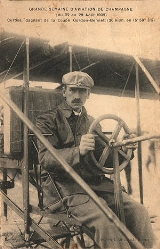
In August 1909, Curtiss competed in the world's first air meet, the Grande Semaine d'Aviation flying contest at Rheims, France
France

France , officially the French Republic , is a country whose Metropolitan France is located in Western Europe and that also comprises various Overseas departments and territories of France....
, organized by the Aero-Club de France. The Wrights, who were selling their machines to customers in Germany at the time, elected to not personally compete. There were two Wright aircraft at the meet but they did not win any events. Curtiss went on to win the overall speed event, flying a 10 km course at 46.5 mph
Miles per hour

The mile per hour is a physical unit of speed, expressing the number of Mile covered per hour.It is currently the Unit of measurement used for speed limits, and speeds, on roads in the United Kingdom and United States....
 (75 km/h) in just under 16 minutes, six seconds faster than runner-up Louis Bleriot
Louis Blériot

Louis Bl?riot was a French inventor and engineer. In 1909 he completed the first flight across a large body of water in a heavier-than-air craft when he crossed the English Channel, receiving a prize of 1000 pound sterlings for doing so....
 and winning the Gordon Bennett Cup
Gordon Bennett Cup

There are three Gordon Bennett Cups:*Gordon Bennett Cup in auto racing*Gordon Bennett Cup in ballooning — for a time, a separate cup was also awarded for powered air racing...
. For this he was awarded French pilot's license No. 2 (Bleriot, who flew the English Channel in 1909, had been awarded license No.1). It is notable that two years earlier, Curtiss went 90 mph faster on a motorcycle.

The pre-war years

During the 1909-1910 period, Curtiss employed a number of demonstration pilots including Eugene Ely
Eugene Burton Ely

Eugene Burton Ely was an aviator, credited with the first shipboard aircraft take off and landing....
 and Lincoln Beachey. Aerial competitions and demonstration flights across North America helped to introduce aviation to a curious public; Curtiss took full advantage of these occasions to promote his products.

This was a busy period for Glenn Curtiss. In May 1910, he flew from Albany to New York City to make the first long-distance flight between two major cities in the U.S. For this 137-mile flight, he won a $10,000 prize offered by publisher Joseph Pulitzer
Joseph Pulitzer

Joseph Pulitzer was a Hungarian-American publisher best known for posthumously establishing the Pulitzer Prizes and for originating yellow journalism....
 and was awarded permanent possession of the Scientific America Trophy. A month later he provided a simulated bombing demonstration to Naval officers at Hammondsport. Two months later, Lt. Jacob E. Fickel demonstrated the feasibility of shooting at targets on the ground from an aircraft with Curtiss serving as pilot. One month later, in September, he trained the first woman pilot, Blanche Stuart Scott
Blanche Stuart Scott

Blanche Stuart Scott , also known as Betty Scott, was the first United States woman aviator....
.

On 18 January 1911, Eugene Ely took off from a temporary fly-off platform mounted on the forward deck of the cruiser USS Birmingham. His successful take-off and ensuing flight to shore marked the beginning of a relationship between Curtiss and the Navy that remained significant for decades. At the end of 1910, Curtiss established a winter encampment at San Diego to teach flying to Army and Naval personnel. It was here that he trained Lt. Theodore Ellyson, who was to become U.S.Naval Aviator #1. The original site of this winter encampment is now part of Naval Air Station North Island and is referred to by the Navy as "The Birthplace of Naval Aviation". Through the course of that winter, Curtiss was able to develop a float (pontoon) design that would enable him to take off and land on water. Demonstrations of this advancement were of great interest to the Navy, but more significant as far as the Navy was concerned, was Eugene Ely successfully landing his Curtiss pusher (the same plane used to take off from the Birmingham)on a makeshift platform mounted on the rear deck of the battleship USS Pennsylvania. This was the first arrester-cable landing on a ship and the precurser of modern day carrier operations.

Back in Hammondsport six months later, in July 1911, Curtiss sold to the U.S. Navy their first aircraft, the A-1 Triad. The A-1, which was primarily a seaplane, was also equipped with retractable wheels, making it the first amphibian. Curtiss trained the Navy's first pilots and built their first aircraft. For this he is considered to be "The Father of Naval Aviation".

World War I and after

As 1916 approached, it was feared that the United States would be drawn into the conflict. The U.S. Army Air Corps ordered the development of a simple, easy to fly and maintain two-seat trainer. Curtiss created the JN-4 "Jenny" for the Army, and the N-9 seaplane version for the Navy. It is one of the most famous products of the Curtiss company, and thousands were sold to the military of the United States, Canada and Britain. Civilian and military aircraft demand was booming and this year saw their operations grow to employ 18,000 workers in Buffalo and 3,000 workers in Hammondsport.

In 1917 the U.S. Navy commissioned Curtiss to design a long-range, four-engined flying boat large enough to hold a crew of five, which became known as the NC-4
NC-4

The NC-4 was a Curtiss NC flying boat, designed by Glenn Curtiss and manufactured by Curtiss Aeroplane and Motor Company. In May 1919 the NC-4 became the first aircraft to fly across the Atlantic Ocean, making the crossing as far as Lisbon in 19 days, with multiple stops along the way....
. The post-World War I downturn of military contracts saw the Curtiss company shrink significantly, and Glenn Curtiss returned to his love of racing to improve product development, only this time with racing aircraft instead of motorcycles. Worldwide demand for increasingly larger seaplanes continued to be a mainstay in the Curtiss company's survival during the pre-World War II era.

Curtiss seaplanes won the Schneider Cup two consecutive races, 1923 and 1925. The 1925 race was won by U.S. Navy Lieutenant David Rittenhouse flying a Curtiss C.R.3 to 177.266 mph (285.457 km/h).

Piloted by US Army Lt. Cyrus Bettis, a Curtiss R3C won the Pulitzer Trophy Race on 12 October 1925, at a speed of 248.9 mph (400.6 km/h). Thirteen days later, Jimmy Doolittle
Jimmy Doolittle

General James Harold "Jimmy" Doolittle, United States Air Force was an American aviation pioneer. Doolittle served as a brigadier general, major general and lieutenant general in the United States Army Air Forces during the World War II....
 won the Schnieder in the same aircraft fitted with floats. Doolittle finished first with a top speed of 232.573 mph (374.247 km/h).

Patent dispute

The patent dispute with the Wright brothers continued for several years until it was resolved during World War I
World War I

World War I, or the First World War , was a global military conflict which involved the Great powers, organized into two opposing military alliances: the Allies of World War I and the Central Powers....
. Since the last Wright aircraft, the Wright Model L was a single prototype of a "scouting" aircraft, made in 1916, the U.S. government, desperately short of combat aircraft, pressured both firms to resolve the patent dispute. In 1917, the U.S. government subsequently proferred a large and profitable contract to Curtiss to build aircraft for the U.S. Army. The Wright Aeronautical
Wright Aeronautical

Wright Aeronautical was an aircraft and aircraft engine manufacturer located in ....
 Corporation, a successor to the original Wright Company, ultimately merged with the Curtiss Aeroplane and Motor Company
Curtiss Aeroplane and Motor Company

Curtiss Aeroplane and Motor Company was an American aircraft manufacturer that went public in 1916 with Glenn Curtiss as president.Glenn Curtiss had helped found the Aerial Experimental Association in 1907 and he created the Herring-Curtiss Company with Augustus Moore Herring in 1909; this was renamed the Curtiss Aeroplane Company in...
 on 5 July 1929, forming the Curtiss-Wright
Curtiss-Wright

The Curtiss-Wright Corporation was once a leading aircraft manufacturer of the United States, but has since become a component manufacturer, specializing in actuators, controls , valves, and metal treatment....
 company, just before Glenn Curtiss' death.

Death

Curtiss died in 1930 in Buffalo, New York
Buffalo, New York

Buffalo , is the second largest city in the state of New York. Located in Western New York on the eastern shores of Lake Erie and at the head of the Niagara River, Buffalo is the principal city of the Buffalo-Niagara Falls metropolitan area and the county seat of Erie County, New York....
, from complications after appendix
Vermiform appendix

In human anatomy, the appendix is a blind ended tube connected to the cecum , from which it develops embryologically. The cecum is a pouch-like structure of the Colon ....
 surgery, and was buried in Pleasant Valley Cemetery in Hammondsport, New York. He was inducted into the National Aviation Hall of Fame
National Aviation Hall of Fame

The United States of America National Aviation Hall of Fame is located at the National Museum of the United States Air Force at Wright-Patterson Air Force Base, east Dayton, Ohio....
 in 1964, the Motorsports Hall of Fame of America
Motorsports Hall of Fame of America

The Motorsports Hall of Fame of America is a Hall of Fame and museum in Novi, Michigan for United States motorsports legends....
 in 1990, and the Motorcycle Hall of Fame
Motorcycle Hall of Fame

The Motorcycle Hall of Fame Museum is located near Columbus, Ohio, United States suburb of Pickerington, Ohio. The Motorcycle Hall of Fame recognizes individuals who have contributed to motorcycle sport, motorcycle construction and motorcycling in general....
 in 1998.

Timeline


See also

  • Opa-locka Airport
    Opa-locka Airport

    Opa-locka Airport , also known as Opa-locka Executive Airport, is a general aviation airport and joint civil-military airfield located in Opa-locka, Florida and 10 miles north of the central business district of Miami, Florida, in Miami-Dade County, Florida, Florida, United States....
  • Curtiss mansion
  • R. J. Mitchell
    R. J. Mitchell

    Reginald Joseph Mitchell Commander of the Order of the British Empire, Fellow of the Royal Aeronautical Society, was an aeronautical engineering, best known for his design of the Supermarine Spitfire....
     - British designer of various Supermarine airplanes
  • Mario Castoldi
    Mario Castoldi

    Mario Castoldi was an Italy aircraft engineer and designer....
     - Italian seaplane designer


Bibliography

  • "At Dayton". Time (magazine)
    Time (magazine)

    Time is a weekly United States newsmagazine, similar to Newsweek and U.S. News & World Report. A European edition is published from London....
    , 13 October 1924.
  • Casey,Louis S. Curtiss: The Hammondsport Era, 1907-1915. New York: Crown Publishers, 1981. ISBN 978-0517545652.
  • Roseberry, C.R. Glenn Curtiss: Pioneer of Flight. Garden City, NY: Doubleday & Company, 1972. ISBN 0-81560-264-2.
  • Shulman, Seth. Unlocking the Sky: Glenn Hammond Curtiss and the Race to Invent the Airplane. New York: Harper Collins, 2002. ISBN 0-06-019633-5.
  • "Speed Limit". Time (magazine)
    Time (magazine)

    Time is a weekly United States newsmagazine, similar to Newsweek and U.S. News & World Report. A European edition is published from London....
    , 29 October 1923.


External links