

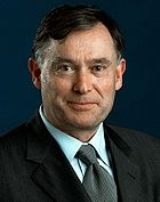
President of Germany

Encyclopedia
The President of the Federal Republic of Germany is the country's head of state
. His official title in German is Bundespräsident (“Federal President”). Germany
has a parliamentary system
of government and so the position of President is largely ceremonial. Nevertheless the President has some important "reserve powers" in case of political instability (such as those provided for by Article 81 of the Basic Law
).
The President is elected by the Federal Convention, a body established solely for that purpose. Christian Wulff
was elected Federal President in the 2010 presidential election
. The first official residence of the President is the Bellevue Palace
in Berlin
. The President's second official residence is the Hammerschmidt Villa
in Bonn
.
members as well as an equal number of delegates chosen by the legislatures of the Länder
(states). The delegates of each Land to the Federal Convention are elected by the members of the state legislature
under a form of proportional representation
. However it is not required that Land delegates themselves be members of a legislature; often prominent citizens are chosen.
In total, the Federal Convention numbers more than one thousand members. The German constitution, the Basic Law, requires that it be convened no later than thirty days before the expiration of the term of office of the President (which is five years). The body is convened and chaired by the President of the Bundestag
. Since 1979, all these conventions have been held on 23 May, the date of the foundation of the Federal Republic in 1949. An exception to this was the 2010 election, since Horst Köhler
stepped down from his office before his term was over.
The Federal Convention attempts to elect a president by an absolute majority of votes cast. If, after two votes, no single candidate has received this level of support, in the third and final vote the candidate endorsed by a plurality of votes cast is deemed elected. The process of electing the President is usually determined by party politics, the office being in the gift of whichever party, or group of allied parties, can muster a majority in the convention. The authors of the Basic Law chose an indirect form of presidential election because they believed it would produce a head of state who was widely acceptable and yet at the same time insulated from public pressure and lacking in sufficient popular legitimacy to undermine other institutions of government.
The President may not be a member of the government or of a legislature at either the federal or state level. On taking office the president must take the following oath, stipulated by Article 56 of the Basic Law, before the assembled members of the Bundestag and Bundesrat (however he or she is permitted to omit the religious references if so desired):
"upon the proposal of the Chancellor." The President can dismiss the Chancellor but only in the event that the Bundestag passes a Constructive Vote of No Confidence
. If this occurs the President must dismiss the chancellor and appoint the successor requested by the Bundestag.
asked for a vote of confidence, which was defeated.
, but no President since World War II has ever used this theoretically given veto power. In any case, the Presidents have only refused to sign laws that they believed to violate the constitution.
The role of President is partly similar in some ways to that of a constitutional monarch found in other European states, with the important difference being that the President is elected, and selected based on his or her distinguished reputation. Therefore, the power of daily politics in Germany is concentrated in the position of the Chancellor of Germany with the president acting more as the guardian of the political system, moral authority and identification figure.
Other comparisons might be to a court philosopher, or a 'national conscience'. The President is called on to develop, interpret and communicate a long-term view of trends affecting Germany and its role in the world. Formulating such vision calls for reflection about Germany's past. Recent Presidents have been instrumental in getting Germans to constructively confront their history during the Nazi period, for instance.
In the few cases in which a bill was not signed, all presidents have claimed that the bill in question was manifestly unconstitutional. In the autumn of 2006, President Köhler
did so twice within three months. Also, in some cases, a president has signed a law while asking that the political parties refer the case to the Federal Constitutional Court
in order to test the law's constitutionality. The most recent case of such an occurrence was the controversial passing of an immigration law
in the Bundesrat in 2002, when the delegates of Brandenburg
failed to come up with the unanimous vote that the Basic Law requires of each Land's delegation in the Bundesrat. This law was ultimately declared invalid by the court for reasons of procedure.
. If the President is outside of the country, or the position is vacant, the President of the Bundesrat
(a position that is rotated among the state premiers on an annual basis) temporarily assumes the powers of the president until a successor is elected without assuming the office of president as such. While doing so, he or she does not continue to exercise the role of chair of the Bundesrat. If the President dies, resigns or is otherwise removed from office, a successor is to be elected within thirty days. This process was triggered for the first time on May 31, 2010, when Horst Köhler resigned the office, as all his predecessors (with the exception of Heinrich Lübke, who announced in 1968 that he would resign the following year, his resignation taking effect after the regular election of his successor and just three months before the scheduled end of his term of office) had served their terms in full. Jens Böhrnsen
, Mayor of Bremen
and current President of the Bundesrat, assumed the powers and duties of head of state.
While the President is abroad on a state visit the President of the Bundesrat does not assume all of his responsibilities but may deputise for the President, performing on the President's behalf merely those tasks that require his or her physical presence, such as the signing of documents.
for willfully violating German law. Once the Bundestag impeaches the President, the Federal Constitutional Court is charged with determining if he or she is guilty of the offence. If the charge is sustained the court has authority to remove the President from office. To date no President has ever been impeached.
 The standard of the President of Germany was adopted on 11 April 1921, and used in this design until 1933. A slightly modified version also existed from 1926, that was used in addition to the 1921 version. In 1933, these versions were both replaced by another modified version, that was used until 1935.
The Weimar-era presidential standard from 1921 was adopted again as presidential standard by a decision by President Theodor Heuss
on 20 January 1950, when he also formally adopted other Weimar-era state symbols including the coat of arms. The eagle in the design that was used in the coat of arms and presidential standard in the Weimar Republic and today was originally introduced by a decision by President Friedrich Ebert
on 11 November 1919.
, which was drafted in the aftermath of World War I
and the abdication of Emperor Wilhelm II in 1918. In Germany the new head of state was called the Reichspräsident
.
Friedrich Ebert
(SPD
) served as Germany's first President, followed by Paul von Hindenburg
. The office effectively came to an end upon Hindenburg's death in 1934 and its powers merged with those of Chancellor
. Adolf Hitler
now ruled Germany as "Führer und Reichskanzler", combing his previous positions in party and government. The office however was not abolished and briefly revived at the end of the Second World War when Hitler appointed Grand Admiral Karl Dönitz
as his successor as President of Germany. Dönitz signed the surrender to the Allies and was arrested a few days later.
The Weimar Constitution
created a semi-presidential system
in which power was divided between the President, a cabinet and a parliament. The President enjoyed far greater power than the current president and had an active political role, rather than a largely ceremonial one. The influence of the President also increased greatly as a result of the instability of the Weimar period. The President had authority to appoint the Chancellor and could dismiss the entire cabinet at any time. However it was also necessary for the cabinet to enjoy the confidence of the Reichstag
(parliament) because it could be removed by a vote of no confidence. All bills had to receive the signature of the president to become law and, although he did not have an absolute veto on legislation, he could insist that a law be submitted for the approval of voters in a referendum
. The president also had authority to dissolve the Reichstag, conduct foreign affairs, and command the armed forces. Article 48 of the constitution also provided the president sweeping powers in the event of a crisis. If there was a threat to "public order and security" he could legislate by decree and suspend civil rights.
Unlike the current President of Germany, the Weimar constitution provided that the president be directly elected and serve a seven-year term. The election involved a form of the two-round system
. However the first President was elected by the National Assembly and subsequently only two direct presidential elections actually occurred. These were the election of Paul von Hindenburg
in 1925 and his re-election in 1932.
The system created by the Weimar constitution led to a number of problems. In particular, the fact that the President could appoint the cabinet, while the Reichstag had only a power of dismissal, created a high cabinet turn-over as ministers were appointed by the President only to be dismissed by the Reichstag shortly afterwards. Eventually Hindenburg stopped trying to appoint cabinets that enjoyed the confidence of the Reichstag and ruled by means of three "presidential cabinets" (Präsidialkabinette). Hindenburg was also able to use his power of dissolution to by-pass the Reichstag. If the Reichstag threatened to censure his ministers or revoke one of his decrees he could simply dissolve the body and be able to govern without its interference until elections had been held. This led to eight Reichstag elections taking place in the 14 years of the Republic's existence; only one parliamentary term, that of 1920-1924, was completed without elections being held early.
) in the former U.S., and British zones of occupation, the Saar
in French zone, until 1957, when it joined the FRG, and the German Democratic Republic (East Germany) in the former Soviet Zone. There continued to be two states on German soil until reunification in 1990.
, in 1960 in favour of a collective head of state. All government positions of the GDR, including the Presidency, were appointed by the ruling Socialist Unity Party of Germany
. De facto the Soviet
authorities in Moscow determined who would get the highest offices.
. Since the reunification of Germany in 1990 this head of state has presided over the whole of Germany.
Under the Basic Law the President was to be elected by a specially convened body called the Federal Assembly
(Bundesversammlung) to serve a five-year term. In accordance with Germany's parliamentary system
of government, the presidency has been limited by a mixture of law and convention
to being a ceremonial position. This is in part due to concerns about the misuse of presidential power in Weimar.
Head of State
A head of state is the individual that serves as the chief public representative of a monarchy, republic, federation, commonwealth or other kind of state. His or her role generally includes legitimizing the state and exercising the political powers, functions, and duties granted to the head of...
. His official title in German is Bundespräsident (“Federal President”). Germany
Germany
Germany , officially the Federal Republic of Germany , is a federal parliamentary republic in Europe. The country consists of 16 states while the capital and largest city is Berlin. Germany covers an area of 357,021 km2 and has a largely temperate seasonal climate...
has a parliamentary system
Parliamentary system
A parliamentary system is a system of government in which the ministers of the executive branch get their democratic legitimacy from the legislature and are accountable to that body, such that the executive and legislative branches are intertwined....
of government and so the position of President is largely ceremonial. Nevertheless the President has some important "reserve powers" in case of political instability (such as those provided for by Article 81 of the Basic Law
Basic Law for the Federal Republic of Germany
The Basic Law for the Federal Republic of Germany is the constitution of Germany. It was formally approved on 8 May 1949, and, with the signature of the Allies of World War II on 12 May, came into effect on 23 May, as the constitution of those states of West Germany that were initially included...
).
The President is elected by the Federal Convention, a body established solely for that purpose. Christian Wulff
Christian Wulff
Christian Wilhelm Walter Wulff is the President of Germany and a politician of the Christian Democratic Union. He was elected President on 2010 and publicly swore the oath of office on . A lawyer by profession, he served as Premier of the state of Lower Saxony from 2003 to 2010.-Early life and...
was elected Federal President in the 2010 presidential election
German presidential election, 2010
An indirect presidential election was held in Germany on 30 June 2010 following the resignation of Horst Köhler as President of Germany on 31 May 2010. Christian Wulff, the candidate nominated by the three governing parties, the Christian Democratic Union, the Christian Social Union of Bavaria and...
. The first official residence of the President is the Bellevue Palace
Schloss Bellevue
Schloss Bellevue is the official residence of the President of Germany since 1994. The palace in the central Tiergarten district of Berlin is situated on the northern edge of the Großer Tiergarten park, on the banks of the Spree river, near the Berlin Victory Column...
in Berlin
Berlin
Berlin is the capital city of Germany and is one of the 16 states of Germany. With a population of 3.45 million people, Berlin is Germany's largest city. It is the second most populous city proper and the seventh most populous urban area in the European Union...
. The President's second official residence is the Hammerschmidt Villa
Hammerschmidt Villa
Villa Hammerschmidt was designated the official residence of the President of Germany in 1951. Located in the former West German capital of Bonn, it remained the official residence of the President until the government offices were returned to the recently-reunified Berlin in 1994...
in Bonn
Bonn
Bonn is the 19th largest city in Germany. Located in the Cologne/Bonn Region, about 25 kilometres south of Cologne on the river Rhine in the State of North Rhine-Westphalia, it was the capital of West Germany from 1949 to 1990 and the official seat of government of united Germany from 1990 to 1999....
.
Selection
The Federal President is elected by secret ballot, without debate, by the Federal Convention, a body established solely for that purpose. The convention consists of all BundestagBundestag
The Bundestag is a federal legislative body in Germany. In practice Germany is governed by a bicameral legislature, of which the Bundestag serves as the lower house and the Bundesrat the upper house. The Bundestag is established by the German Basic Law of 1949, as the successor to the earlier...
members as well as an equal number of delegates chosen by the legislatures of the Länder
States of Germany
Germany is made up of sixteen which are partly sovereign constituent states of the Federal Republic of Germany. Land literally translates as "country", and constitutionally speaking, they are constituent countries...
(states). The delegates of each Land to the Federal Convention are elected by the members of the state legislature
Legislature
A legislature is a kind of deliberative assembly with the power to pass, amend, and repeal laws. The law created by a legislature is called legislation or statutory law. In addition to enacting laws, legislatures usually have exclusive authority to raise or lower taxes and adopt the budget and...
under a form of proportional representation
Proportional representation
Proportional representation is a concept in voting systems used to elect an assembly or council. PR means that the number of seats won by a party or group of candidates is proportionate to the number of votes received. For example, under a PR voting system if 30% of voters support a particular...
. However it is not required that Land delegates themselves be members of a legislature; often prominent citizens are chosen.
In total, the Federal Convention numbers more than one thousand members. The German constitution, the Basic Law, requires that it be convened no later than thirty days before the expiration of the term of office of the President (which is five years). The body is convened and chaired by the President of the Bundestag
President of the German Bundesrat
In Germany, the President of the Bundesrat or President of the Federal Council is the chairperson or speaker of the Bundesrat . The presidency of the Bundesrat rotates among the heads of government of each of the states on an annual basis...
. Since 1979, all these conventions have been held on 23 May, the date of the foundation of the Federal Republic in 1949. An exception to this was the 2010 election, since Horst Köhler
Horst Köhler
Horst Köhler is a German politician of the Christian Democratic Union. He was President of Germany from 2004 to 2010. As the candidate of the two Christian Democratic sister parties, the CDU and the CSU, and the liberal FDP, Köhler was elected to his first five-year term by the Federal Assembly on...
stepped down from his office before his term was over.
The Federal Convention attempts to elect a president by an absolute majority of votes cast. If, after two votes, no single candidate has received this level of support, in the third and final vote the candidate endorsed by a plurality of votes cast is deemed elected. The process of electing the President is usually determined by party politics, the office being in the gift of whichever party, or group of allied parties, can muster a majority in the convention. The authors of the Basic Law chose an indirect form of presidential election because they believed it would produce a head of state who was widely acceptable and yet at the same time insulated from public pressure and lacking in sufficient popular legitimacy to undermine other institutions of government.
Qualifications
The office of President is open to all Germans who are entitled to vote in Bundestag elections and have reached the age of 40, but no one may serve more than two consecutive five-year terms. The president receives an annual payment of approximately €213,000 that continues when he or she leaves office.The President may not be a member of the government or of a legislature at either the federal or state level. On taking office the president must take the following oath, stipulated by Article 56 of the Basic Law, before the assembled members of the Bundestag and Bundesrat (however he or she is permitted to omit the religious references if so desired):
I swear that I will dedicate my efforts to the well-being of the German people, enhance their benefits, avert harm from them, uphold and defend the Constitution and the statutes of the Federation, fulfil my duties conscientiously, and do justice to all. (So help me God.)
Duties and functions
The degree of power actually conferred upon the President by the Basic Law is ambiguous. However, in practice, holders of the office treat it as a largely ceremonial one and act with the advice of the Federal Government. Unlike many constitutions the Basic Law does not designate the head of state as the commander-in-chief of the military (ceremonially or otherwise). This role is vested in times of peace in the Minister of Defense, going to the Chancellor rather than the President in times of war, by Article 65a. Nevertheless Germany cannot declare a state of war without the approval of the President. The President carries out the following duties:Appointment of the Federal Government
The President proposes an individual as Chancellor and then, provided they are subsequently elected by the Bundestag, appoints him or her to the office. However the Bundestag is free to disregard the President's proposal and elect another individual to the post, whom the President is then obliged to appoint. The President appoints and dismisses the remaining members of the Federal GovernmentCabinet of Germany
The Cabinet of Germany is the chief executive body of the Federal Republic of Germany. It consists of the Chancellor and the cabinet ministers. The fundamentals of the cabinet's organization are set down in articles 62 to 69 of the Basic Law.-Nomination:...
"upon the proposal of the Chancellor." The President can dismiss the Chancellor but only in the event that the Bundestag passes a Constructive Vote of No Confidence
Constructive vote of no confidence
The constructive vote of no confidence is a variation on the motion of no confidence which allows a parliament to withdraw confidence from a head of government only if there is a positive majority for a prospective successor...
. If this occurs the President must dismiss the chancellor and appoint the successor requested by the Bundestag.
Other appointments
The President appoints federal judges, federal civil servants and military officers. All such appointments require the counter-signature of either the chancellor or the relevant cabinet minister.Dissolution of the Bundestag
In the event that the Bundestag elects an individual for the office of chancellor by a plurality of votes, rather than a majority, the President can, at his or her discretion, either appoint that individual as chancellor or dissolve the Bundestag, triggering a new election. In the event that a vote of confidence is defeated in the Bundestag, and the incumbent chancellor proposes a dissolution, the President may, at his discretion, dissolve the body within 21 days. As of 2010, this power has only been applied three times in the history of the Federal Republic. In all three occurrences it is doubtful whether the motives for that dissolution were in accordance with the constitution's intentions. Each time the incumbent chancellor called for the vote of confidence with the stated intention of being defeated, in order to be able to call for new elections before the end of their regular term, as the Basic Law does not give the Bundestag a right to dissolve itself. The most recent occurrence was on 1 July 2005, when Chancellor Gerhard SchröderGerhard Schröder
Gerhard Fritz Kurt Schröder is a German politician, and was Chancellor of Germany from 1998 to 2005. A member of the Social Democratic Party of Germany , he led a coalition government of the SPD and the Greens. Before becoming a full-time politician, he was a lawyer, and before becoming Chancellor...
asked for a vote of confidence, which was defeated.
Promulgation of the law
All federal laws must, after counter-signature, be signed by the president before they can come into effect. Upon signing, the President has to check if the law was passed according to the order mandated by the constitution and/or if the content of the law is constitutional. If not, he or she has the right (and, some argue, the duty) to refuse to sign the law. This has happened rather rarely. In Art. 82 the constitution does not explicitly rule out that the President can even refuse to sign a law merely because he disagrees with its content, i.e. that he has a power of vetoVeto
A veto, Latin for "I forbid", is the power of an officer of the state to unilaterally stop an official action, especially enactment of a piece of legislation...
, but no President since World War II has ever used this theoretically given veto power. In any case, the Presidents have only refused to sign laws that they believed to violate the constitution.
Foreign relations
The President represents Germany in the World (Art. 59 Basic Law), holds foreign visits and receives foreign dignitaries. He or she also concludes treaties with foreign nations (which do not come into effect until affirmed by the Bundestag), accredits German diplomats and receives the letters of accreditation of foreign diplomats.Pardons and honours
The President may grant pardons if the person concerned had been convicted under federal jurisdiction and also confers decorations and honours.State of legislational emergency
In the event of a national crisis, the emergency law reforms of 1968 designate the President as a mediator. If the Bundestag rejects a motion of confidence, but neither a new chancellor is elected nor the Bundestag is dissolved, the President may, by request of the cabinet, declare a "legislative state of emergency", which is quite different from a conventional state of emergency: If it is declared, during a limited period of time, bills proposed by the cabinet and designated as "urgent", but rejected by the Bundestag, become law nonetheless, if the Bundesrat does pass them. But the legislative state of emergency does not suspend basic human rights nor does it grant the executive branch any exceptional power. Such an emergency has never been declared.Impartiality and influence
Though usually chosen as the candidate of a political party or parties, the president nonetheless is expected to be non-partisan after assuming office. Every President to date has let his or her party membership rest dormant during his term of office. Although the formal powers of the President are limited, the President's role can be quite significant depending on his or her own activities. The very fact that the President usually doesn't interfere with day-to-day politics means that if he or she does choose to speak out on an issue, the event is perceived as one to take note of. There have been a number of occasions when certain presidential speeches have dominated German political debate for a year or more.The role of President is partly similar in some ways to that of a constitutional monarch found in other European states, with the important difference being that the President is elected, and selected based on his or her distinguished reputation. Therefore, the power of daily politics in Germany is concentrated in the position of the Chancellor of Germany with the president acting more as the guardian of the political system, moral authority and identification figure.
Other comparisons might be to a court philosopher, or a 'national conscience'. The President is called on to develop, interpret and communicate a long-term view of trends affecting Germany and its role in the world. Formulating such vision calls for reflection about Germany's past. Recent Presidents have been instrumental in getting Germans to constructively confront their history during the Nazi period, for instance.
Reserve powers
Some argue that the Basic Law does not require that the President follow government directives in all circumstances. It is suggested, for instance, that the President could refuse to sign legislation merely because he disagrees with its content, thus vetoing it, or refuse to approve a cabinet appointment. Because no President has ever attempted to take either of these actions the constitutionality of these points has never been tested.In the few cases in which a bill was not signed, all presidents have claimed that the bill in question was manifestly unconstitutional. In the autumn of 2006, President Köhler
Horst Köhler
Horst Köhler is a German politician of the Christian Democratic Union. He was President of Germany from 2004 to 2010. As the candidate of the two Christian Democratic sister parties, the CDU and the CSU, and the liberal FDP, Köhler was elected to his first five-year term by the Federal Assembly on...
did so twice within three months. Also, in some cases, a president has signed a law while asking that the political parties refer the case to the Federal Constitutional Court
Federal Constitutional Court of Germany
The Federal Constitutional Court is a special court established by the Grundgesetz, the German basic law...
in order to test the law's constitutionality. The most recent case of such an occurrence was the controversial passing of an immigration law
Immigration law
Immigration law refers to national government policies which control the phenomenon of immigration to their country.Immigraton law, regarding foreign citizens, is related to nationality law, which governs the legal status of people, in matters such as citizenship...
in the Bundesrat in 2002, when the delegates of Brandenburg
Brandenburg
Brandenburg is one of the sixteen federal-states of Germany. It lies in the east of the country and is one of the new federal states that were re-created in 1990 upon the reunification of the former West Germany and East Germany. The capital is Potsdam...
failed to come up with the unanimous vote that the Basic Law requires of each Land's delegation in the Bundesrat. This law was ultimately declared invalid by the court for reasons of procedure.
Succession
The Basic Law did not create an office of vice presidentVice president
A vice president is an officer in government or business who is below a president in rank. The name comes from the Latin vice meaning 'in place of'. In some countries, the vice president is called the deputy president...
. If the President is outside of the country, or the position is vacant, the President of the Bundesrat
President of the German Bundesrat
In Germany, the President of the Bundesrat or President of the Federal Council is the chairperson or speaker of the Bundesrat . The presidency of the Bundesrat rotates among the heads of government of each of the states on an annual basis...
(a position that is rotated among the state premiers on an annual basis) temporarily assumes the powers of the president until a successor is elected without assuming the office of president as such. While doing so, he or she does not continue to exercise the role of chair of the Bundesrat. If the President dies, resigns or is otherwise removed from office, a successor is to be elected within thirty days. This process was triggered for the first time on May 31, 2010, when Horst Köhler resigned the office, as all his predecessors (with the exception of Heinrich Lübke, who announced in 1968 that he would resign the following year, his resignation taking effect after the regular election of his successor and just three months before the scheduled end of his term of office) had served their terms in full. Jens Böhrnsen
Jens Böhrnsen
Jens Böhrnsen is a German politician of the SPD. Since 2005, he has served as the President of the Senate and Mayor of the Free Hanseatic City of Bremen, that is, the head of government of the city-state of Bremen...
, Mayor of Bremen
Bremen
The City Municipality of Bremen is a Hanseatic city in northwestern Germany. A commercial and industrial city with a major port on the river Weser, Bremen is part of the Bremen-Oldenburg metropolitan area . Bremen is the second most populous city in North Germany and tenth in Germany.Bremen is...
and current President of the Bundesrat, assumed the powers and duties of head of state.
While the President is abroad on a state visit the President of the Bundesrat does not assume all of his responsibilities but may deputise for the President, performing on the President's behalf merely those tasks that require his or her physical presence, such as the signing of documents.
Impeachment and removal
While in office the President enjoys immunity from prosecution and cannot be voted out of office or recalled. The only mechanism for removing the President is impeachment by the Bundestag or BundesratBundesrat of Germany
The German Bundesrat is a legislative body that represents the sixteen Länder of Germany at the federal level...
for willfully violating German law. Once the Bundestag impeaches the President, the Federal Constitutional Court is charged with determining if he or she is guilty of the offence. If the charge is sustained the court has authority to remove the President from office. To date no President has ever been impeached.
Presidential standard
The Weimar-era presidential standard from 1921 was adopted again as presidential standard by a decision by President Theodor Heuss
Theodor Heuss
Theodor Heuss was a liberal German politician who served as the first President of the Federal Republic of Germany after World War II from 1949 to 1959...
on 20 January 1950, when he also formally adopted other Weimar-era state symbols including the coat of arms. The eagle in the design that was used in the coat of arms and presidential standard in the Weimar Republic and today was originally introduced by a decision by President Friedrich Ebert
Friedrich Ebert
Friedrich Ebert was a German politician of the Social Democratic Party of Germany .When Ebert was elected as the leader of the SPD after the death of August Bebel, the party members of the SPD were deeply divided because of the party's support for World War I. Ebert supported the Burgfrieden and...
on 11 November 1919.
Weimar Republic
The position of President of Germany was first established by the Weimar ConstitutionWeimar constitution
The Constitution of the German Reich , usually known as the Weimar Constitution was the constitution that governed Germany during the Weimar Republic...
, which was drafted in the aftermath of World War I
World War I
World War I , which was predominantly called the World War or the Great War from its occurrence until 1939, and the First World War or World War I thereafter, was a major war centred in Europe that began on 28 July 1914 and lasted until 11 November 1918...
and the abdication of Emperor Wilhelm II in 1918. In Germany the new head of state was called the Reichspräsident
Reichspräsident
The Reichspräsident was the German head of state under the Weimar constitution, which was officially in force from 1919 to 1945. In English he was usually simply referred to as the President of Germany...
.
Friedrich Ebert
Friedrich Ebert
Friedrich Ebert was a German politician of the Social Democratic Party of Germany .When Ebert was elected as the leader of the SPD after the death of August Bebel, the party members of the SPD were deeply divided because of the party's support for World War I. Ebert supported the Burgfrieden and...
(SPD
Social Democratic Party of Germany
The Social Democratic Party of Germany is a social-democratic political party in Germany...
) served as Germany's first President, followed by Paul von Hindenburg
Paul von Hindenburg
Paul Ludwig Hans Anton von Beneckendorff und von Hindenburg , known universally as Paul von Hindenburg was a Prussian-German field marshal, statesman, and politician, and served as the second President of Germany from 1925 to 1934....
. The office effectively came to an end upon Hindenburg's death in 1934 and its powers merged with those of Chancellor
Chancellor of Germany
The Chancellor of Germany is, under the German 1949 constitution, the head of government of Germany...
. Adolf Hitler
Adolf Hitler
Adolf Hitler was an Austrian-born German politician and the leader of the National Socialist German Workers Party , commonly referred to as the Nazi Party). He was Chancellor of Germany from 1933 to 1945, and head of state from 1934 to 1945...
now ruled Germany as "Führer und Reichskanzler", combing his previous positions in party and government. The office however was not abolished and briefly revived at the end of the Second World War when Hitler appointed Grand Admiral Karl Dönitz
Karl Dönitz
Karl Dönitz was a German naval commander during World War II. He started his career in the German Navy during World War I. In 1918, while he was in command of , the submarine was sunk by British forces and Dönitz was taken prisoner...
as his successor as President of Germany. Dönitz signed the surrender to the Allies and was arrested a few days later.
The Weimar Constitution
Weimar constitution
The Constitution of the German Reich , usually known as the Weimar Constitution was the constitution that governed Germany during the Weimar Republic...
created a semi-presidential system
Semi-presidential system
The semi-presidential system is a system of government in which a president and a prime minister are both active participants in the day-to-day administration of the state...
in which power was divided between the President, a cabinet and a parliament. The President enjoyed far greater power than the current president and had an active political role, rather than a largely ceremonial one. The influence of the President also increased greatly as a result of the instability of the Weimar period. The President had authority to appoint the Chancellor and could dismiss the entire cabinet at any time. However it was also necessary for the cabinet to enjoy the confidence of the Reichstag
Reichstag (Weimar Republic)
The Reichstag was the parliament of Weimar Republic .German constitution commentators consider only the Reichstag and now the Bundestag the German parliament. Another organ deals with legislation too: in 1867-1918 the Bundesrat, in 1919–1933 the Reichsrat and from 1949 on the Bundesrat...
(parliament) because it could be removed by a vote of no confidence. All bills had to receive the signature of the president to become law and, although he did not have an absolute veto on legislation, he could insist that a law be submitted for the approval of voters in a referendum
Referendum
A referendum is a direct vote in which an entire electorate is asked to either accept or reject a particular proposal. This may result in the adoption of a new constitution, a constitutional amendment, a law, the recall of an elected official or simply a specific government policy. It is a form of...
. The president also had authority to dissolve the Reichstag, conduct foreign affairs, and command the armed forces. Article 48 of the constitution also provided the president sweeping powers in the event of a crisis. If there was a threat to "public order and security" he could legislate by decree and suspend civil rights.
Unlike the current President of Germany, the Weimar constitution provided that the president be directly elected and serve a seven-year term. The election involved a form of the two-round system
Two-round system
The two-round system is a voting system used to elect a single winner where the voter casts a single vote for their chosen candidate...
. However the first President was elected by the National Assembly and subsequently only two direct presidential elections actually occurred. These were the election of Paul von Hindenburg
Paul von Hindenburg
Paul Ludwig Hans Anton von Beneckendorff und von Hindenburg , known universally as Paul von Hindenburg was a Prussian-German field marshal, statesman, and politician, and served as the second President of Germany from 1925 to 1934....
in 1925 and his re-election in 1932.
The system created by the Weimar constitution led to a number of problems. In particular, the fact that the President could appoint the cabinet, while the Reichstag had only a power of dismissal, created a high cabinet turn-over as ministers were appointed by the President only to be dismissed by the Reichstag shortly afterwards. Eventually Hindenburg stopped trying to appoint cabinets that enjoyed the confidence of the Reichstag and ruled by means of three "presidential cabinets" (Präsidialkabinette). Hindenburg was also able to use his power of dissolution to by-pass the Reichstag. If the Reichstag threatened to censure his ministers or revoke one of his decrees he could simply dissolve the body and be able to govern without its interference until elections had been held. This led to eight Reichstag elections taking place in the 14 years of the Republic's existence; only one parliamentary term, that of 1920-1924, was completed without elections being held early.
Partition
De jure, the German Reich did not cease to exist in 1945, but after four years of Allied occupation, three German states were formed inside of Germany as a whole in 1949: the Federal Republic of Germany (then commonly known as West GermanyWest Germany
West Germany is the common English, but not official, name for the Federal Republic of Germany or FRG in the period between its creation in May 1949 to German reunification on 3 October 1990....
) in the former U.S., and British zones of occupation, the Saar
Saar (protectorate)
The Saar Protectorate was a German borderland territory twice temporarily made a protectorate state. Since rejoining Germany the second time in 1957, it is the smallest Federal German Area State , the Saarland, not counting the city-states Berlin, Hamburg and Bremen...
in French zone, until 1957, when it joined the FRG, and the German Democratic Republic (East Germany) in the former Soviet Zone. There continued to be two states on German soil until reunification in 1990.
East Germany
East Germany established the office of a head of state with the title of President of the Republic (German: Präsident der Republik) in 1949, but abandoned the office with the death of the first president, Wilhelm PieckWilhelm Pieck
Friedrich Wilhelm Reinhold Pieck was a German politician and a Communist. In 1949, he became the first President of the German Democratic Republic, an office abolished upon his death. He was succeeded by Walter Ulbricht, who served as Chairman of the Council of States.-Biography:Pieck was born to...
, in 1960 in favour of a collective head of state. All government positions of the GDR, including the Presidency, were appointed by the ruling Socialist Unity Party of Germany
Socialist Unity Party of Germany
The Socialist Unity Party of Germany was the governing party of the German Democratic Republic from its formation on 7 October 1949 until the elections of March 1990. The SED was a communist political party with a Marxist-Leninist ideology...
. De facto the Soviet
Soviet Union
The Soviet Union , officially the Union of Soviet Socialist Republics , was a constitutionally socialist state that existed in Eurasia between 1922 and 1991....
authorities in Moscow determined who would get the highest offices.
Federal Republic of Germany
With the promulgation of the Basic Law (a new German constitution) in 1949, the office of Federal President (in German: Bundespräsident) was created in West GermanyWest Germany
West Germany is the common English, but not official, name for the Federal Republic of Germany or FRG in the period between its creation in May 1949 to German reunification on 3 October 1990....
. Since the reunification of Germany in 1990 this head of state has presided over the whole of Germany.
Under the Basic Law the President was to be elected by a specially convened body called the Federal Assembly
Bundesversammlung (Germany)
The Federal Convention is a special body in the institutional system of Germany, convened solely for the purpose of electing the German Federal President , either every five years or within 30 days of a president's resignation, death or removal from office.The Bundesversammlung includes the entire...
(Bundesversammlung) to serve a five-year term. In accordance with Germany's parliamentary system
Parliamentary system
A parliamentary system is a system of government in which the ministers of the executive branch get their democratic legitimacy from the legislature and are accountable to that body, such that the executive and legislative branches are intertwined....
of government, the presidency has been limited by a mixture of law and convention
Constitutional convention (political custom)
A constitutional convention is an informal and uncodified procedural agreement that is followed by the institutions of a state. In some states, notably those Commonwealth of Nations states that follow the Westminster system and whose political systems derive from British constitutional law, most...
to being a ceremonial position. This is in part due to concerns about the misuse of presidential power in Weimar.